Executive Summary
This guide outlines actionable recommendations and reusable tools for any team, inside or outside of government, seeking to get accurate COVID-19 vaccine information to immigrant communities at scale. Just as there is a “last mile” challenge getting shots in arms, there is a last-mile communication challenge: getting existing public health messages about the vaccine seen and heard by immigrant communities most impacted by COVID-19. Despite unprecedented funding efforts, access to information that is trustworthy and digestible remains very limited for non-English speaking communities.
As of the publication of this brief, the United States is far from vaccinating 75 percent of its population, the level American science officials estimate is needed to end the pandemic. The longer the pandemic rages, the greater the toll on immigrant communities disproportionately devastated by COVID-19. Our tools and methods are designed for our present, crucial window of opportunity. Especially now that the vaccine has become widely available to the general public, we must address key vaccine information gaps prevalent in immigrant communities.
Over eight weeks in December through early February 2021, our team of human-centered design, content, and communications experts partnered with Colorado’s Department of Public Health (CDHPE) and the Governor’s Office to test tools and methods aimed at improving COVID-19 vaccine information flows to immigrant communities, particularly those with language barriers. Our eight weeks of research and testing led to:
- Research vaccine concerns and questions from English and Spanish-speaking immigrant Coloradans in December 2020, based on 140 survey responses and 26 interviews.
- A pool of 98 immigrant Coloradans interested in participating in future interviews and usability testing.
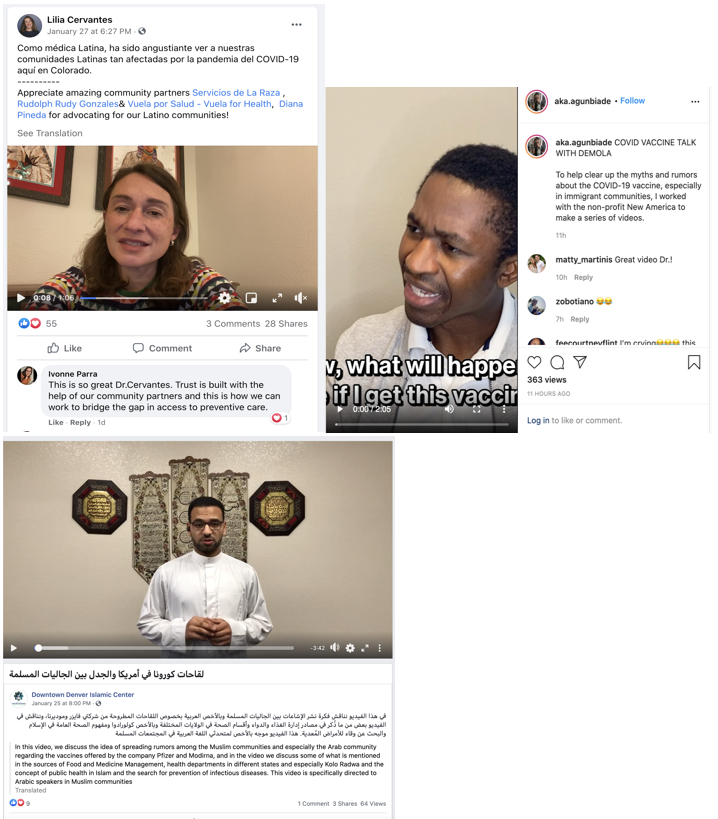
- A pilot of 5 short videos in 4 languages about key vaccine concerns, made and shared on social media in under 2 weeks by immigrant healthcare workers and faith leaders.
- A directory of 50+ multilingual, immigrant influencers and 100+ immigrant community based organizations for future vaccine and public health communication efforts, representing 21 different languages.
- Short and long-term recommendations for making state COVID-19 content more accessible and useful, based on feedback from immigrant Coloradans
Based on what we learned, our top recommendations for teams facing similar communications challenges are:
- Cast a wide net of inquiry to find and collaborate with trusted community messengers (healthcare workers, faith leaders, and community organizers and outreach workers) who are experts at transcreating, not just translating public health communications. Giving them funds and concise instructions is the most effective way to reach hard-to-reach communities at scale.
- Add feedback loops to the content creation process to avoid future communications gaps. Test state vaccine content and websites with immigrant community members on a regular basis. Enable communications staffers to work alongside community organizations and trusted messengers—respect their expertise in crafting and amplifying culturally relevant content.
- Use persuasive message framing and accessible formats. In our testing, the most effective message framing emphasized that getting vaccinated protects loved ones and the larger community. For messages to be heard, acknowledging how viewers are feeling during this stressful time enables them to listen. Prioritize non-written formats, like call centers, videos, and visuals. If content needs to be written, keep it concise, direct, and easily shareable by text message.
The rest of this brief contains detailed insights and links to reusable methods and templates for each of these recommendations. Even though the landscape has changed since these recommendations were formed and vaccines have become much more widely available, we think that the recommendations, tailored as applicable to current communication needs, can still apply.
We operated in a quick-changing environment at a time when the first vaccine was first approved, and much of what we learned from Colorado’s approach has changed or the recommendations we suggested have since been incorporated. For instance, many of the trusted messengers are incorporated into the media campaign and Colorado’s COVID-19 website has been translated into Spanish. The tools used by partners in Colorado continue to evolve. This brief does not reflect the full scope or current approach of Colorado to ensure immigrants and refugees receive the vaccine.
Table of Contents: