
Ranked-Choice Voting Delivers Representation and Consensus in Presidential Primaries
This brief is part of a series by the Electoral Reform Research Group, a collaboration between New America, Stanford University’s Center on Democracy, Development, and the Rule of Law, the American Enterprise Institute, and the Unite America Institute. To find the full report of the study summarized below, click here.
Overview
This project examined the results of the 2020 Democratic presidential nomination contests in the five states that adopted ranked-choice voting (RCV) rules. Our findings indicate that voters used their rankings not only to nominate the strongest candidate to represent the party in the general election but also to ensure representation of the party's diverse electorate at the national convention.
Research Questions
- How is RCV in a presidential primary election different from standard instant runoff RCV?
- What patterns emerged from the states that used RCV for party presidential nominations? How were these patterns similar to or different from non-RCV election results? And which candidates benefited from RCV rules?
- Based on our analysis, what can we expect in the future if RCV is used in more (if not all) presidential nomination contests? Should there be rule changes with respect to how RCV is applied in these contests?
Key Findings
- RCV used in presidential primary elections differs from instant runoff RCV in two important ways: 1) There is an unknown number of winners, unlike standard RCV in which the number of winners is predetermined; and 2) the purpose of these elections is both to decide the nominee and to ensure that more—and more diverse—candidates have representation at the convention to reflect the party's broad electorate.
- Current President Joe Biden was the clear first-preference majority winner in all RCV elections and Sen. Bernie Sanders (I-Vt.) was the second most popular candidate. RCV did not distort the ultimate purpose of forming a consensus on the nominee. Additionally, our analysis demonstrated that Sen. Elizabeth Warren (D-Mass.) would have earned more delegates if more states had used RCV, and thus she would have had more representation at the convention.
- RCV shows great potential to produce results more representative of the diverse Democratic electorate and to engage more voters to participate in presidential primary elections. Reducing the 15 percent threshold might produce even stronger diversity and turnout.
Background and Research Design
The Democratic Party has long realized that mobilizing its base and enlarging its electorate in nomination contests can be just as important as finding the strongest candidate. Indeed, since 1972, the Democratic Party “has enforced a total ban on statewide winner-take-all primaries,” and the party has “usually encouraged their state parties to adopt proportional representation formulas.”1 The system is meant to encourage more voices and greater diversity, in contrast to the winner-take-all rule adopted by the Republican Party.
In 2020, the Democratic Party attempted to make the process even more representative with the use of ranked-choice ballots for its presidential primaries in five states: Alaska, Hawaii, Kansas, Nevada, and Wyoming. This real-world experiment was an opportunity to study how RCV operates and how voters express themselves under conditions and goals that differ from standard single-winner instant runoff.
In standard instant runoff RCV, as in first-past-the-post (FPTP) election rules, there is always one winner, either the majority winner using instant runoff or the plurality winner used under FPTP. By contrast, in the 2020 Democratic primary elections, because the goal was not just to elect the party's presidential nominee but also to allocate delegates for the national convention, the RCV process continued until all candidates in the final round reached 15 percent or more of the votes.
This method of awarding delegates differs from instant runoff rules in two important ways. First, it adds a layer of uncertainty. The form of RCV used in the 2020 nomination contests distributed delegates in proportion to the vote shares of all candidates who reached the 15 percent threshold—the final number of qualifying candidates being unknown until the votes are tabulated. In other words, when voters cast their primary ballots, they did not know how many candidates could win delegates. Empirical studies in the last decade have shown conflicting results regarding whether voters are sophisticated enough to use ranking systems to express their preferences, or whether RCV fulfills its promise to produce more consensus winners. Moreover, up to now most research on the use of RCV has been based on ballots designed to elect a predetermined number of winners. In these cases, the election produces either one majority winner tabulated in the final round of vote transfers in instant runoff voting, or a known number of winners in single transferable vote (STV) for representative legislatures. Therefore, little is known about RCV when there is not a predetermined number of winners.
Second, this method has a dual purpose: Democratic presidential primary elections must determine the nominee as well as ensure that candidates—particularly those representing racial, gender, religious, ideological, and other minority groups traditionally left out of the party elite—are represented at the convention to reflect the party’s diverse electorate.
To improve our understanding of this method, we first looked at how RCV was applied across the five states in 2020. We then compared it to the standard instant runoff method being adopted in a growing number of U.S. cities and states. Detailed election returns were examined, and where available the vote-transfers in each round of vote tabulations were investigated to see whether or not the system worked as intended. That is, did RCV rules support (or distort) the goal of nominating the strongest candidate among a large pool of candidates? Did RCV play a role in enhancing proportional representation in the 2020 Democratic presidential nomination contests? If so, how?
Findings and Implications
We observed how ranked-choice was applied in the five states. While there were slight variations between the states, the basic rules were the same. Democratic primary voters were allowed to rank a maximum of five candidates. If any candidate out of the total pool of candidates did not reach the 15 percent threshold in the first round, then the candidate with the fewest first-preference votes was eliminated and the second-preference votes from those ballots were redistributed to the first-place votes of the remaining candidates in the next round. This process continued until every remaining candidate had at least 15 percent of the vote, and thus gained at least a single delegate.
Among the five states studied, the outlier was Nevada, which used RCV only to tabulate the early voting results, which were then added to the caucus votes. Nevada thus did not publish the detailed breakdown of each round of RCV tabulation nor the share of RCV votes in the final vote shares of all candidates. The RCV results from Kansas were more accessible, however we do not have detailed breakdowns for Sen. Warren and Rep. Tulsi Gabbard (D-Hawaii) for the second through fourth rounds of vote tabulations. Alaska, Hawaii, and Wyoming provided complete breakdowns for each round, allowing for more in-depth analysis.
Figure 1 displays the multiple-round vote transfer process for all candidates in Alaska's RCV primary, which occurred before those in Wyoming, Kansas, and Hawaii. Note that Biden and Sen. Sanders were both in the vote transfer process until the last round of vote tabulation (round eight), and Sen. Warren was competitive enough to stay in the vote transfer process until round seven, though she was already the third-place winner in the very first round, based on the first-preference choices of all voters.
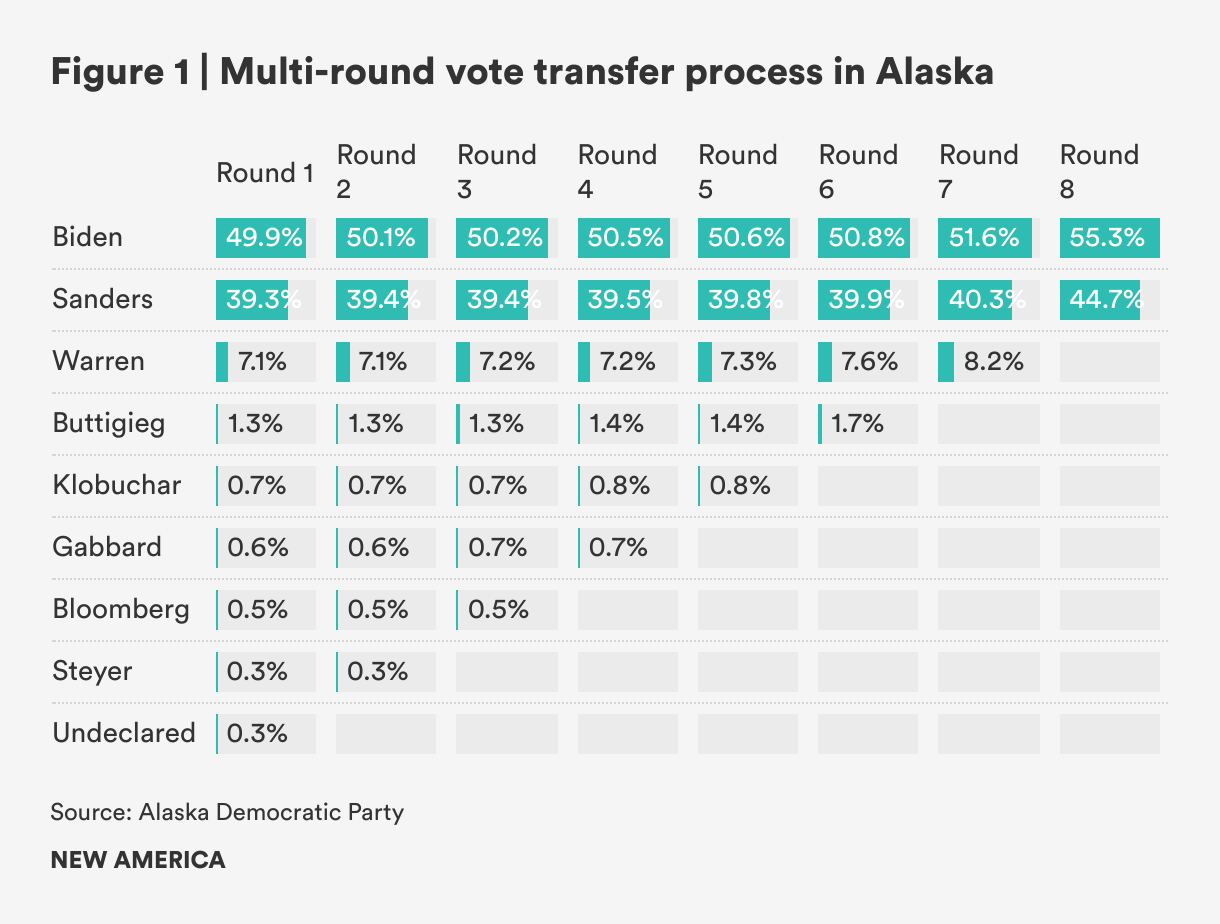
The 2020 Alaska presidential primary had two “winners,” in that both Sanders and Biden earned delegates. Had instant runoff been used instead, when Biden accumulated more than 50 percent of the votes by the second round of vote tabulation, the RCV process would have ended because there was already a simple majority winner and Biden would have been awarded all of Alaska’s pledged delegates.
We also examined the RCV results for each round in Wyoming and Hawaii’s two congressional districts. As detailed in the full paper, Biden was the first-preference majority winner in both contests, with Sanders coming in second. In these states, RCV both helped consolidate the nomination of Biden as the official candidate for the Democratic Party in the general election, and documented Sanders’ popularity.
In addition, the results shed light on RCV’s role in enhancing the representativeness of the Democrats’ delegate selection process—an especially important feature for the party in 2020, as they needed a broad electoral coalition to defeat President Trump in the general election. Our empirical analysis of all RCV states showed that RCV not only allowed a sufficiently large number of voters to send a strong message of choosing Biden to compete against Trump in the general election, but also let the progressive wing of the party select Sanders as the alternative to Biden.
RCV furthermore allowed the clear third-favorite candidate, Warren, to display her unique strength among a powerful segment of the electorate. Indeed, by combining the vote transfer data with the exhausted ballots in each round (i.e., ballots without any further ranking of candidates beyond those that have already been eliminated), we can observe that Warren received the greatest representational boost from the RCV rules.
As shown in the full report, Warren was the third-place winner in all RCV states except Nevada, which held the earliest RCV election on the 2020 Democratic nomination election calendar, and which used RCV only for the early-voting portion of the final votes cast. Among the four states that used RCV for all votes cast, in the first four or five rounds, Warren’s votes were fairly “flat,” indicating she earned minimal vote transfers in these early rounds. In other words, as the weakest candidates such as Tom Steyer and Michael Bloomberg were eliminated in early rounds of tabulation, Warren was not the second choice for voters whose first-preference candidates were already eliminated. As the rounds went beyond the fourth or fifth round, however, Warren received greater shares of vote transfers. Especially in Alaska and Wyoming, there was a steep upward trend in the late rounds of RCV vote tabulations for Warren. More concretely, more voters who voted for either Sen. Amy Klobuchar or Pete Buttigieg as their first choice preferred Warren over Biden and Sanders.
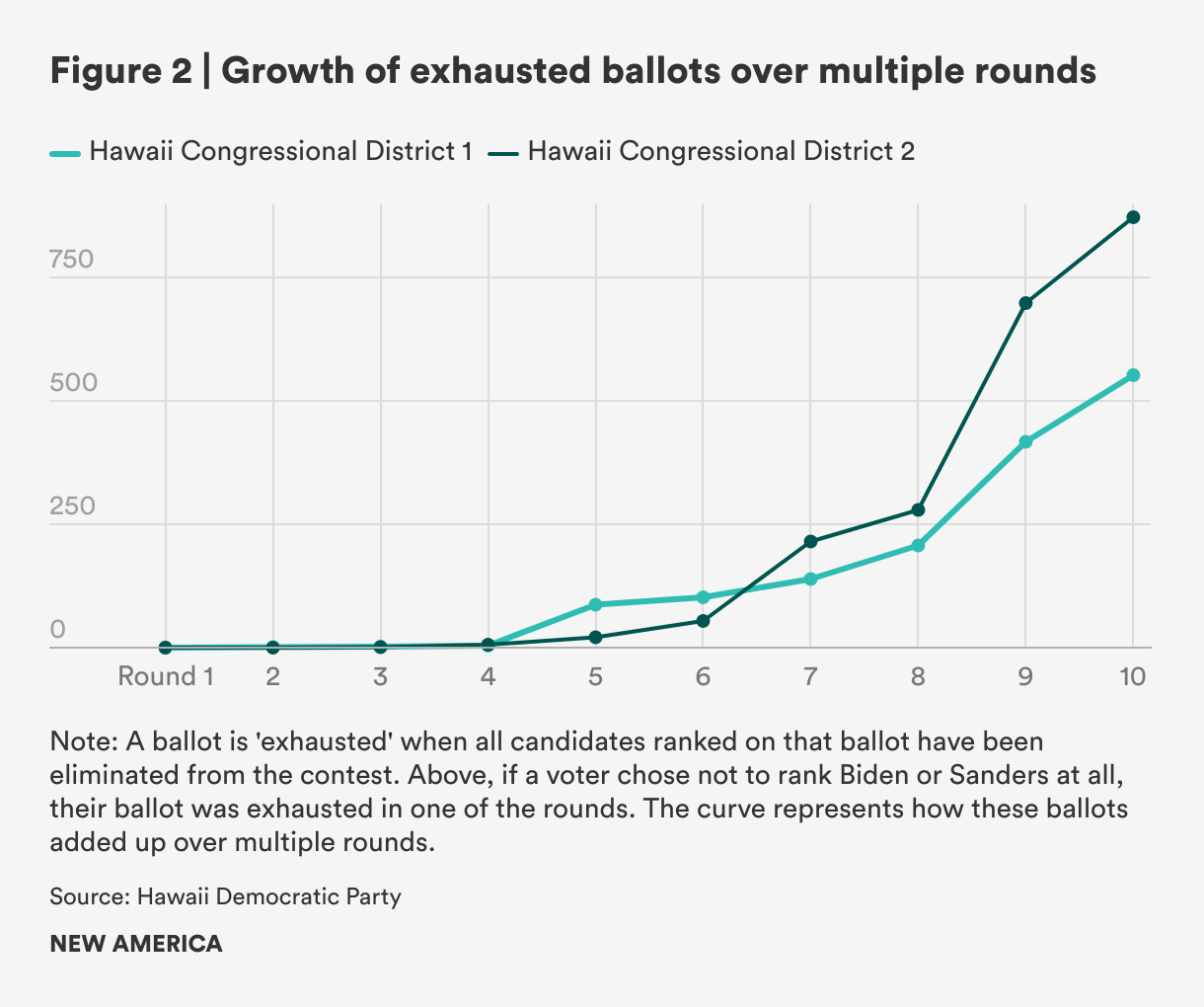
Notably, many Warren voters did not vote for Biden or Sanders at all on their ballots. This is shown in Figure 2 based on the analysis of the exhausted ballots in Hawaii, which reported vote tabulations disaggregated by their two congressional districts.
The J-shaped curves in Figure 2 demonstrate that a significant number of voters used their rankings to show preference for Warren, instead of Biden or Sanders. Note that the first four rounds did not generate any exhausted ballots; they involved the elimination of only the weakest candidates (such as Steyer), and all of the voters who voted these weakest candidates as their first choice ranked other candidates as well, ensuring that their ballots continued to be countable in the tally until at least the fifth round.
Between the fifth and the eighth rounds, however, the exhausted votes started to pick up, suggesting some voters indeed stopped ranking altogether after ranking their preferred second-tier candidates. But it was the last two rounds where the curves were extended almost straight up, indicating that the number of exhausted ballots increased exponentially as Gabbard and Warren dropped from the vote tabulations. The last round in particular shows the ballots that became exhausted because voters did not rank Biden or Sanders at all.
This preference for Warren (but not Biden or Sanders), clearly visible here, would not have been revealed with a traditional single-mark ballot.
RCV not only allowed a sufficiently large number of voters to send a strong message of choosing Biden to represent the party to compete against President Trump in the general election, but also let the progressive wing of the party select Sanders as the alternative to Biden. More importantly, it illuminated a clear third-favorite candidate, Warren. RCV amplified Warren’s candidacy, a woman and progressive, as well as the voices of her supporters through additional representation at the national convention, including when voting for the party platform.
Conclusion
This study first examined the key differences between standard instant runoff RCV and the proportional form of RCV implemented in five states' 2020 Democratic presidential nomination contests. Beginning with Alaska, had the state's Democratic Party followed the standard instant runoff model, Biden would have won in the second round when the votes from the first-place undeclared ballots were redistributed, increasing Biden’s vote share from 49.9 percent to 50.1 percent, or a simple majority. In turn, had they followed that model, Biden would have received all 15 pledged delegates when passing the majority threshold in the second round.
Our second empirical finding brings promising news to the Democratic Party and potential future growth of RCV applications in party presidential nomination contests. RCV results from Alaska, Kansas, Wyoming, and Hawaii's two congressional districts demonstrate that voters understood how to use ranked ballots. The results also indicate that voters understood the necessity of using their preferences, first and foremost, to nominate the strongest candidate to enter in the general election. Biden drew the most first-preference votes in all RCV elections for which we have detailed data. Voters also made it clear that Sanders was the second most popular candidate. Therefore, RCV did not distort the ultimate purpose of the 2020 Democratic primaries to form a consensus on their nominee.
Unlike in the traditional FPTP system, RCV provided voters with the opportunity to express their preferences beyond picking the candidate they thought would perform best in the general election. Voters used this opportunity to send a strong message of support for Warren, elevating her vote shares much closer to the 15 percent threshold. Though she ultimately did not reach that threshold in the RCV states, our analysis demonstrated that using RCV would have raised her share above 15 percent in the delegate-rich Super Tuesday state of California, in addition to Oklahoma, the District of Columbia, and Democrats Abroad. In short, Warren would have earned more delegates if more states had used RCV in their 2020 Democratic nomination contests, and thus she would have had more representation at convention.
Overall, our findings strongly suggest that RCV indeed can be used effectively in presidential nomination contests, and voters are capable of effectively ranking their preferences. Finally, RCV shows potential to make presidential nomination contests more representative of the electorate and stimulate more participation in traditionally low Democratic turnout states, such as Wyoming and Alaska.
View and download the full report here.
Acknowledgments
We would like to thank Lee Drutman and Maresa Strano for providing guidance on the grant application and execution, and for organizing the February 2020 meeting of the Electoral Reform Research Group (ERRG) in Washington D.C. The data collection and analysis for this paper was funded by New America, through their ERRG initiative with support from Arnold Ventures. We are also grateful to Richard Engstrom for advice on this research, and to the Political Science Department and the College of Social and Behavioral Science at the University of Utah for their support for the grant application.
Downloads
More About the Authors

Baodong Liu
Nadia Mahallati
Charles M. Turner
Issues
Programs/Projects/Initiatives


Citations
- William G. Mayer, The Divided Democrats: Ideological Unity, Party Reform, and Presidential Elections (Boulder, Colorado: West View Press), 15.