Electoral Systems Affect Legitimacy Gaps and Affective Polarization
This brief is part of a series by the Electoral Reform Research Group, a collaboration between New America, Stanford University’s Center on Democracy, Development, and the Rule of Law, the American Enterprise Institute, and the Unite America Institute. To find the full report of the study summarized below, click here.
Overview
This brief reports results from a large-scale behavioral game designed to investigate the effects of different electoral systems on attitudes generally believed to underpin democratic stability. Participants were randomly matched with up to 22 different players in real time and asked to vote for parties under plurality voting, proportional representation, or ranked-choice voting rules. The number of parties in each system also varied randomly. Based on the votes cast by all players, the election result determined a participant’s payout based on the distance between their vote choice and the winning party. Afterward, participants played a modified dictator game, which provided behavioral measures of interparty animosity. We also measured their satisfaction with the election outcomes and examined gaps between those who won and lost the elections.
Research Questions
- How do election type and the number of parties in the system affect perceptions of system legitimacy?
- How do election type and the number of parties in the system affect the “winner-loser gap” in perceived system legitimacy?
- How do election type and the number of parties in the system affect interparty animosity?
Key Findings
- System characteristics had no main effects on perceptions of system legitimacy.
- The winner-loser gap in perceived system legitimacy was smallest in ranked-choice systems and proportional systems and largest in plurality systems.
- The winner-loser gap in perceived system legitimacy was larger in the three-party than the four-party system.
- Interparty animosity was, on average, lower in plurality systems than the other systems.
- Having fewer parties yielded more interparty animosity than having many parties.
Background and Research Design
A stable democracy depends on two things above all else. First, citizens must believe that elections are fair, as expressed by election losers’ willingness to accept the outcomes even if they may be unhappy about them on a personal level. Second, there can be only a minimal amount of interparty animosity, also known as affective polarization. Both criteria are shaped by a democracy’s choice of electoral systems and voting rules. For instance, proportional representation—where legislative seats are allocated to political parties in proportion to the votes cast for each party—is generally considered a fairer system than disproportional systems, such as majoritarian and plurality systems. In proportional systems, minority voices are relatively well represented in government, and losers still have a say in the decision-making process. As a result, losing hurts less. Conversely, winning means more to those in plurality systems due to their winner-take-all, zero-sum nature.
In assessing the effects of different electoral systems, the proportionality or disproportionality of the system has been the main focus since it is most directly related to how votes translate into power. However, ballot structure is another critical dimension of electoral systems worthy of attention. More specifically, how much freedom is allowed in vote choice.
For instance, preferential voting systems such as ranked-choice voting (RCV) allow voters to rank multiple preferences instead of selecting just one. In the United States, some states and cities have adopted RCV to replace single vote plurality systems. Because preferential voting systems allow voters more choices, one can expect this freedom might encourage more public confidence in the system. Nevertheless, there is relatively little empirical work on the relationship between preferential systems and attitudes toward the democratic process.
Besides overall evaluations of the political system, we hypothesized that the electoral system and outcomes could influence another set of “mass attitudes,” or attitudes toward other members of society. Specifically, we explore the possibility that different electoral systems produce different levels of interparty animosity or affective polarization, which refers to the tendency to dislike and disparage those who support the opposing party. Given the winner-take-all nature of plurality systems, where a party’s status (winner or loser) is more clearly determined by an election, party supporters may be more motivated to see those of the opposing party as a threat to their party’s power, which could enhance animus toward them.
We employed a large-scale behavioral game to study the effects of electoral system features and election outcomes on voters' perceptions of the electoral system and behavior towards others. We modeled the experiment after a standard experimental design used to test the impact of institutional design on decisions to vote or not.
Our experiment built on the standard design in a few ways: (1) it involved far more people than the typical game, which allowed us sufficient power to test for the hypothesized interaction effects without needing players to play dozens of rounds of games; (2) we randomized the number of teams, as well as system characteristics; and (3) we included various survey and behavioral measures after the experiment, including an additional pairwise donation game, a modified dictator game, to test whether these features have downstream consequences. In this part of the experiment, respondents were randomly paired with another player and given a pot of money to distribute. The respondents could choose to keep all, some, or none of the money. The players were told about each other’s decisions in the election, and we operationalized interparty animosity as the difference in money allocated to out-party versus in-party players.
Findings and Implications
Our results in some ways experimentally validate past observational studies, although they identify important nuances and significantly extend the literature. We examined whether the system and number of parties, respectively, were related to the difference in satisfaction and perceived fairness between those who won versus those who lost in the election (winner-loser gap). For each condition, we estimate the winner-loser gap by calculating the difference in perceived legitimacy between someone whose payout was one standard deviation below the mean (electoral losers) versus someone whose payout was one standard deviation above the mean.
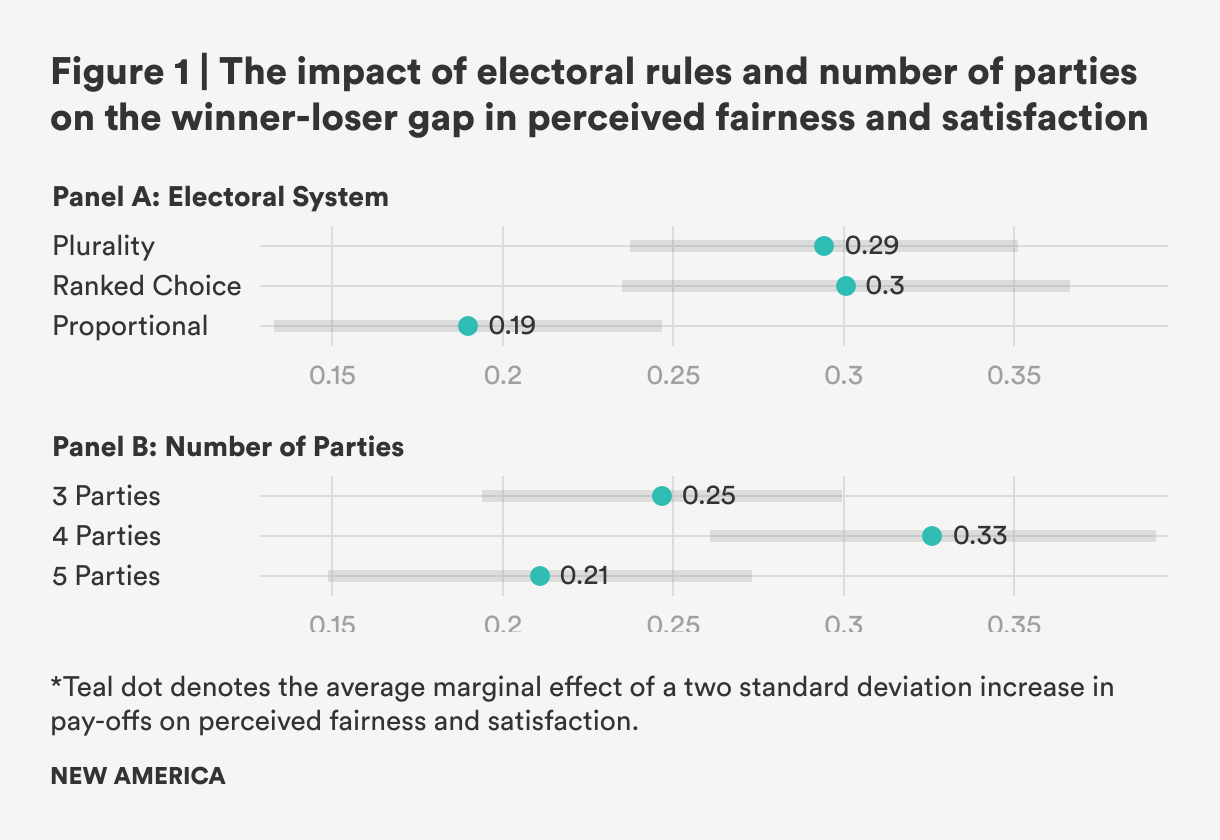
We found that proportional systems yielded a significantly smaller winner-loser gap in satisfaction with the outcomes than single-winner ranked-choice and plurality systems (Figure 1, Panel A). Plurality and ranked choice systems led to similarly sized gaps. Contrary to expectations, the winner-loser gap in satisfaction was significantly larger in three versus four parties but, in line with expectations, significantly smaller in four versus five parties (Figure 1, Panel B). In other words, the proportional systems and systems with five parties yielded the smallest winner-loser gap in satisfaction.
Next we examined the results of the modified dictator game, which was designed to measure the level of interparty animosity. In this game we defined an in-group as a match between the actions of two randomly assigned players. For instance, if both players voted for party A, they were considered in-group members, out-group members, otherwise. (Recall that players were told their partner's behavior in the election game prior to the modified dictator game.) Consistent with our expectations, we found significant in-group bias—when people were matched with a player who engaged in the same action as they did in the election round, they gave them significantly more tokens on average.
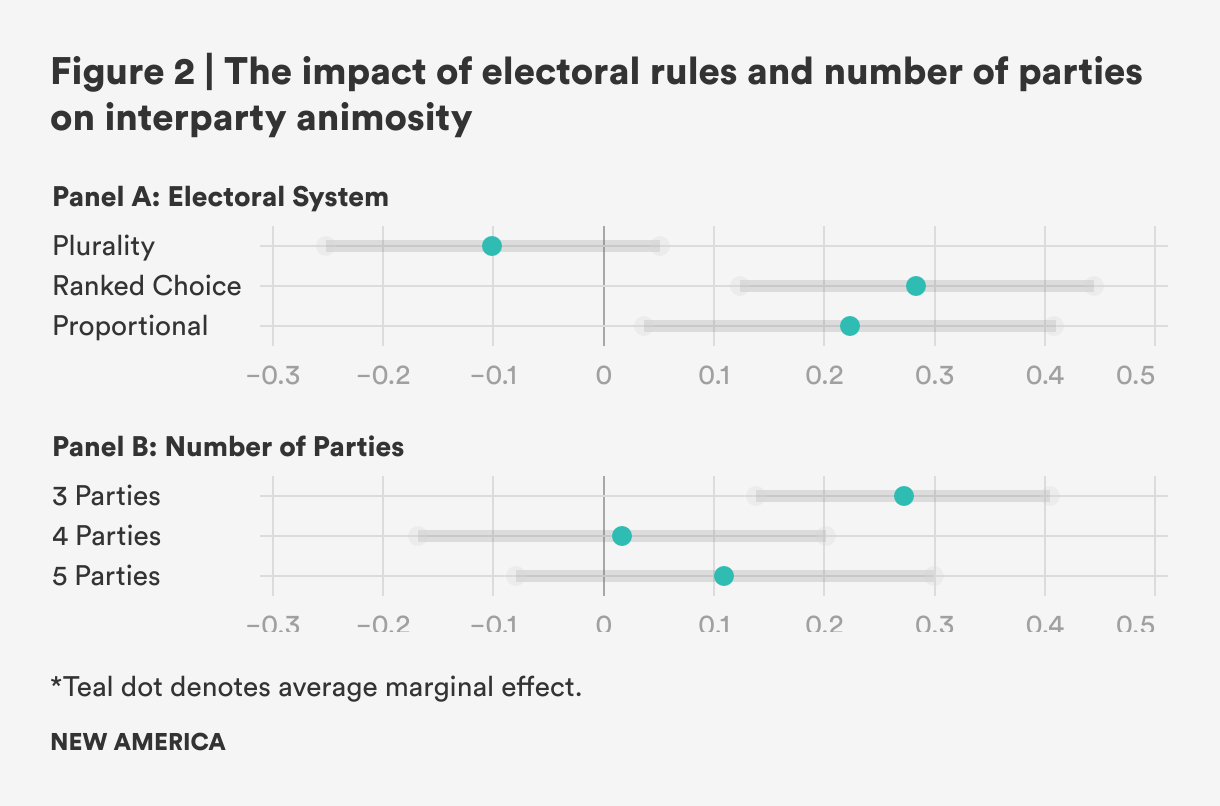
As shown in Figure 2, Panel A, there was more in-group bias in proportional systems and ranked-choice than plurality systems. The two-way interactions testing the difference between playing an in-group versus out-group member in a proportional versus plurality system was significant, as was the two-way interaction in a ranked-choice versus plurality system. Hence, counter to our expectations, plurality systems yielded the lowest level of interparty animosity.
In line with our expectations, increasing the number of teams in a system decreased in-group bias (Figure 2, Panel B). In-group bias was largest in three-party systems, smallest in four-party systems, and middling in five-party systems. The two-way interactions indicated that playing an in-group versus out-group member in a three- versus four-party system was significant, and playing an in-group versus out-group member in a three- versus five-party party system was marginally significant.
In sum, our results suggest that electoral reforms that replace plurality systems with proportional and preferential systems and encourage multipartyism can ameliorate the winner-loser gap in perceived system legitimacy. By shrinking that gap we can reduce the likelihood that electoral losers will turn away from democratic processes and towards alternative and sometimes violent methods to make their voices heard. At the same time, reformers should be wary of how moving away from plurality might impact interparty animosity. Our findings suggest that electoral reform that does not lead to a change in the number of parties in a system may make interparty animosity worse.
Conclusion
Throughout the Western world, increased affective polarization and decreased trust in institutions has raised fears about the future of democracy. The present work indicates that certain institutions, namely those based on proportional representation and RCV, as well as multiparty arrangements, decrease the winner-loser gap in perceived system legitimacy. When electoral losers feel that the democratic process is fair, they are more likely to continue participating. Recent events in the United States, wherein electoral losers refused to accept the election results and engaged in a violent insurrection, underscore the importance of these results.
However, our results indicate that plurality systems led to less interparty animosity than proportional and ranked-choice systems. While concerning, when proportional and ranked-choice systems had more parties, interparty animosity was as low as in plurality systems. Together, these results indicate multiparty proportional or ranked-choice systems can offer the benefits of a small winner-loser gap and an absence of interparty animosity.
While institutional changes at the national level are rare, subnational governments frequently experiment with reform. The present work reinforces the significant role these institutions play in shaping our attitudes toward democracy and serves as a note of encouragement to reformers who seek to decrease the prevalence of electoral systems based on plurality voting.
View and download the full report here.
Acknowledgments
We are grateful for the funding and organization of research efforts from New America, the Electoral Reform Research Group, and Arnold Ventures. We are also grateful for the comments and feedback from Lee Drutman, Noam Gidron, Will Horne, and participants of the Electoral Reform Research Group.
Downloads
More About the Authors

Sean Fischer
Amber Hye-Yon Lee
Yphtach Lelkes
Issues
Programs/Projects/Initiatives
Related

From Polarization to Pluralism: Harnessing Parties and Fusion Voting for a Healthier Democracy