A Chapter of: Learning at Home While Under-connected
Educational Assets and Priorities for School Next Year
Parental Gains from Remote Learning
The negative impacts of remote learning on children and families have rightfully been where educators and policymakers have focused their attention. We wanted to balance that focus by investigating what parents may also have learned during this extraordinary year, when they became their children’s in-house learning guides overnight. This in no way diminishes the stresses and strains online learning generated for both parents and children. But even the most challenging circumstances can develop new skills and confidence, and schools may be able to support and build on these new strengths and assets in the future.
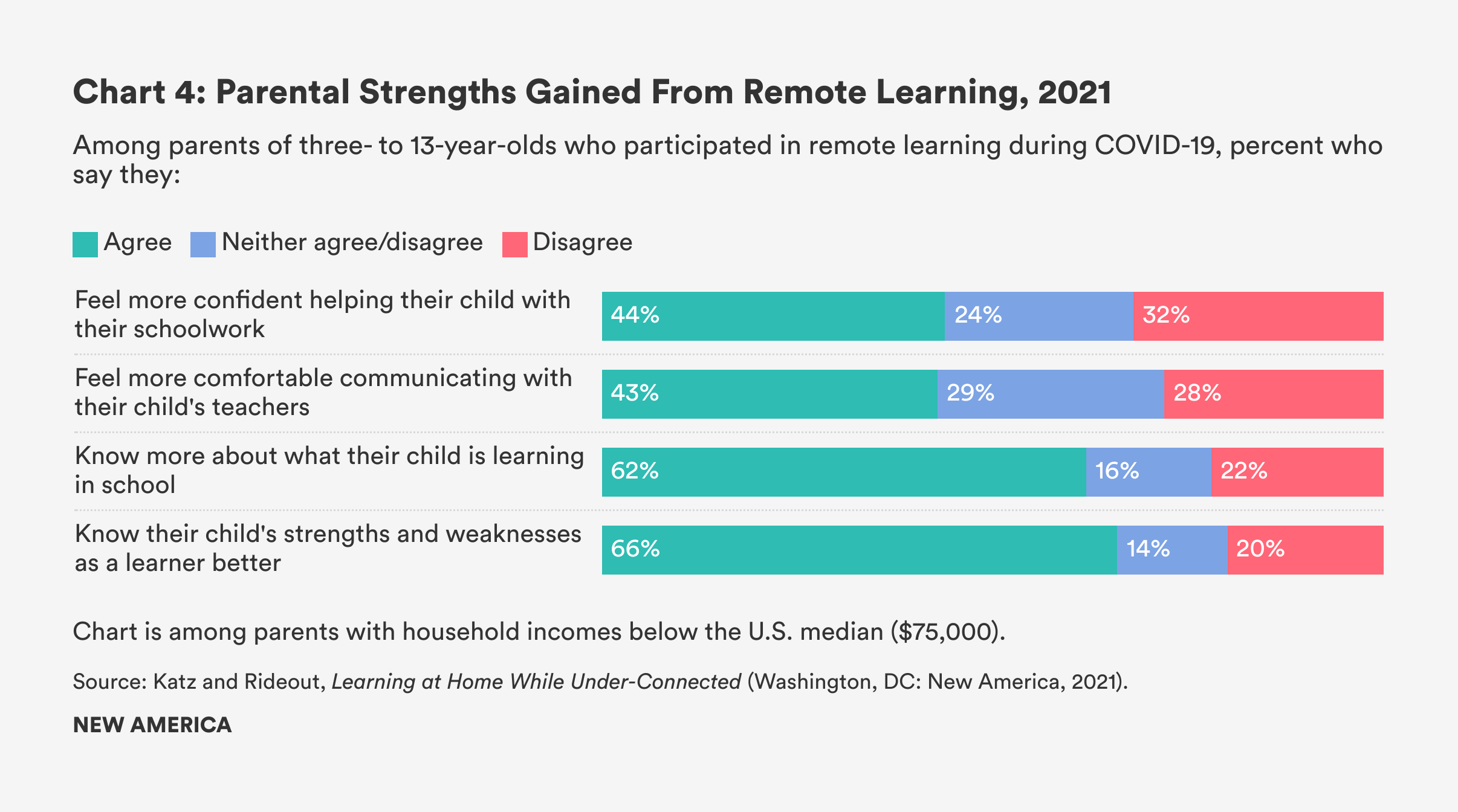
Two-thirds of parents (66 percent) agree that they know more about their child’s strengths and weaknesses as a learner now than they did before the pandemic, including 42 percent who “strongly” agree with that statement (see Chart 4). This deeper knowledge could benefit children going forward, as parents help to guide their children’s homework, or seek assistance or enrichment for their children’s learning. A majority (62 percent) of parents also agree that they know more about what their child is learning in school now than they did prior to the pandemic, including 36 percent who strongly agree.
About four in ten parents report being more comfortable communicating with their children’s teachers now than they were before the pandemic or feeling more confident helping their child with their schoolwork (43 percent and 44 percent, respectively). More than one in four (29 percent) parents disagreed with the notion of feeling more comfortable communicating with their children’s teachers than a year ago, and 32 percent disagreed that they feel more confident helping their child with their schoolwork (the rest neither agreed nor disagreed). Educators should prioritize improving parent-teacher communication and building parents’ comfort in seeking teachers’ guidance to ensure smooth transitions into or back to in-person schooling after the summer break.
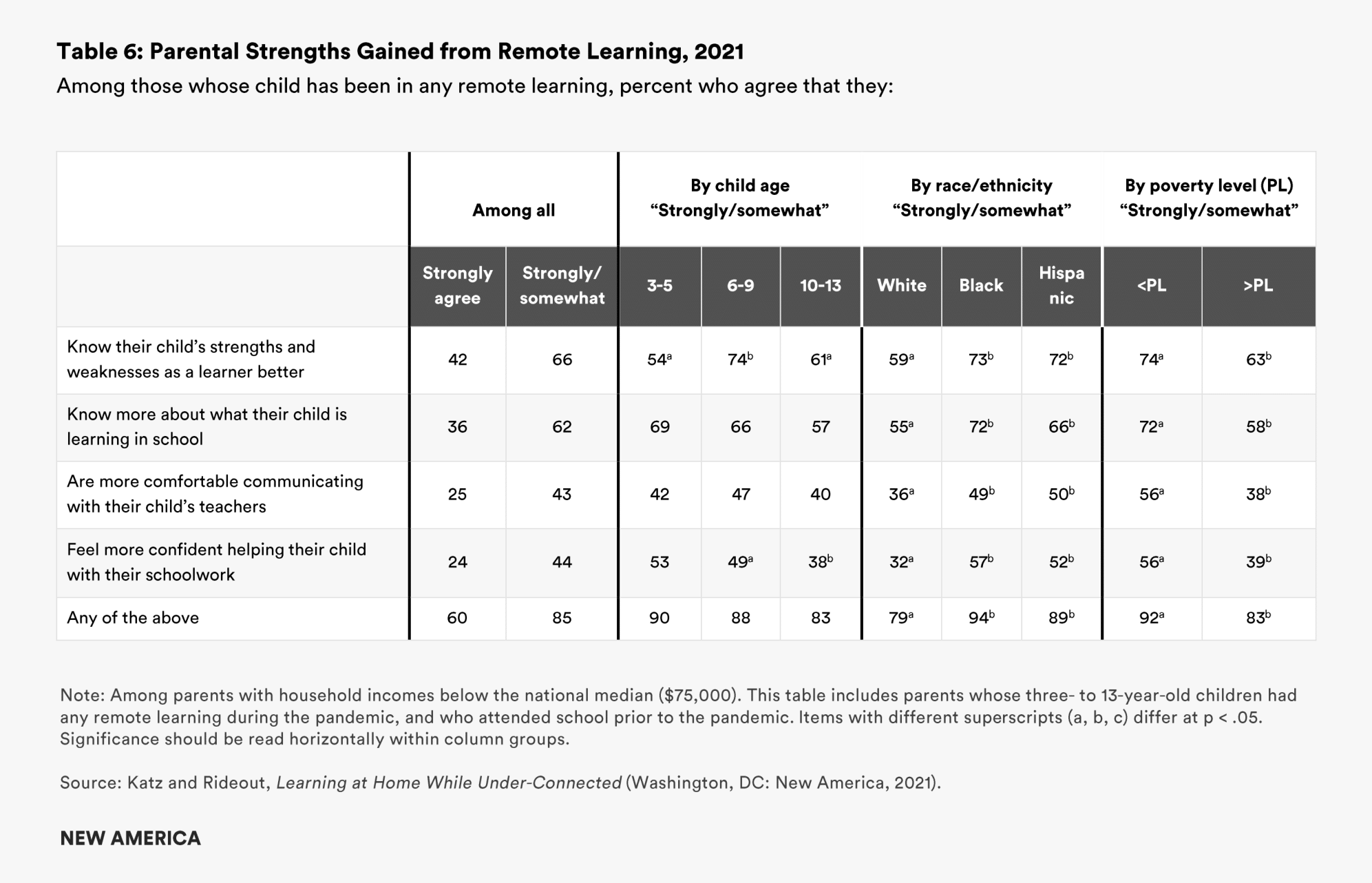
One of the more positive outcomes of pandemic remote learning may be that Black and Hispanic parents, as well as those living on incomes below the federal poverty line, reported the greatest gains in terms of understanding their child’s strengths and weaknesses as a learner, knowing more about what they are learning in school, feeling comfortable communicating with their teachers, and being confident in their ability to help their children with their schoolwork (see Table 6). Given that parents of color and parents living on incomes below the federal poverty level are among those who have historically faced disproportionate challenges building strong relationships with educators, these findings are a bright spot worth building on.
Priorities for the Next School Year
Since our survey coincided with the rapid deployment of vaccines against COVID-19, a full return to in-person school for the fall 2021 term finally felt probable. Educators and policymakers at federal, state, and local levels have been prioritizing ‘high-dose tutoring’10 and other initiatives to try to accelerate academic progress when they return to classrooms. When we asked parents their priorities for the return to school in the fall, academic concerns were less pressing than their children’s social and emotional well-being. To ensure a smooth transition from learning at home to learning at school, it will be critical for educators to establish clear priorities for the new school year that align with what parents consider the most pressing developmental concerns for their children.
In this survey, we elicited parents’ opinions on their top priority for their child’s school in the fall of 2021. We listed five possible priorities and asked parents to choose the most important one (“After all the educational disruptions the pandemic has caused this past year, what do you think will be most important for your child” at school next year?). And then we asked parents an open-ended question about any other issues that they consider a “very important educational priority” for their child next fall.
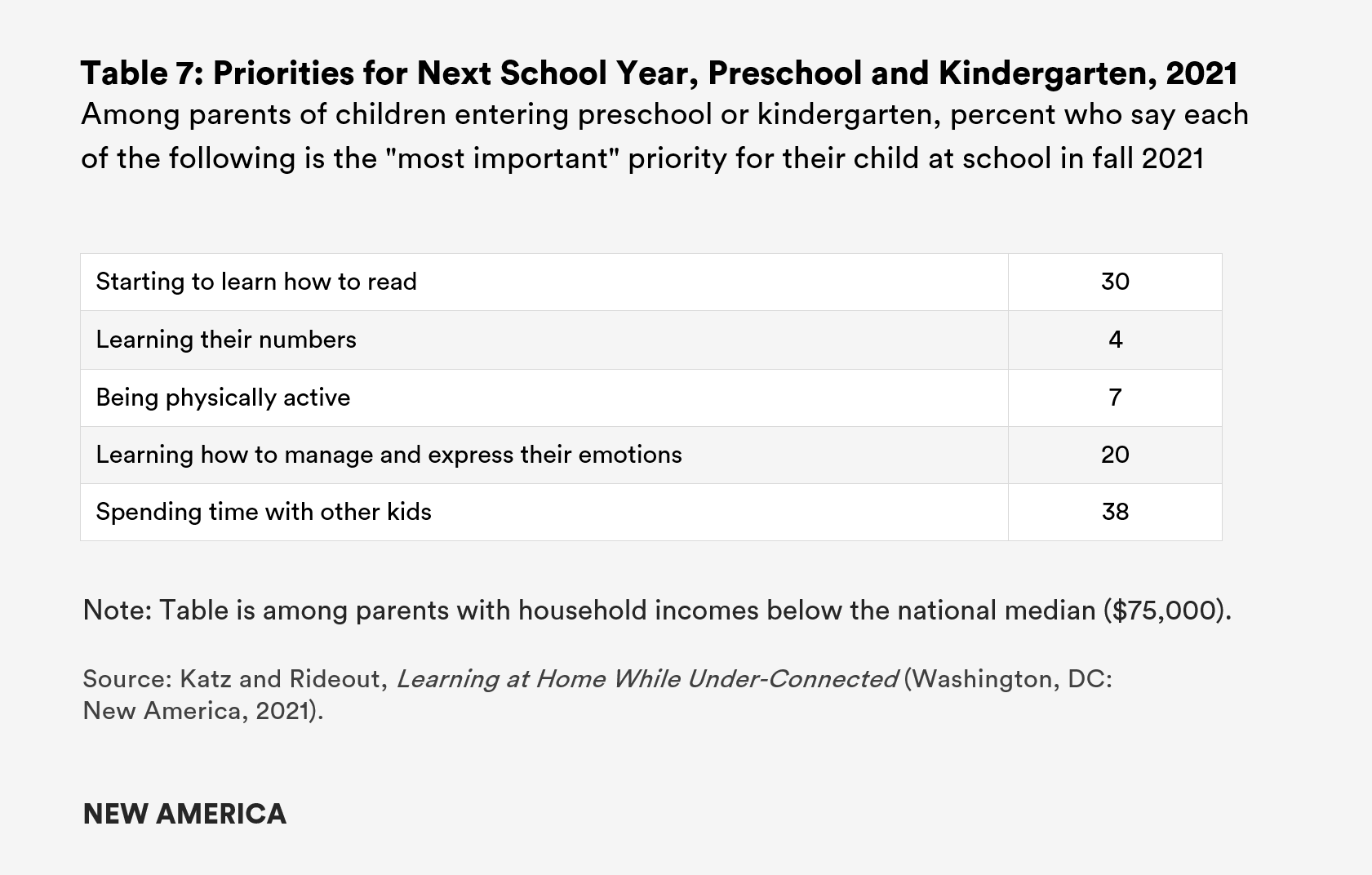
Of the five priorities listed in the closed-end question, two were academic, one was physical, and two were social/emotional. Despite all the public attention paid to “learning loss” during the pandemic, the majority of parents selected socialization or socio-emotional development as their top priority for their child. Among those whose child will be entering preschool or kindergarten, 58 percent selected either “spending time with other kids” (38 percent) or “learning how to manage and express their emotions” (20 percent) as the most important priority for the coming school year, compared to the 34 percent who selected either “starting to learn how to read” (30 percent) or “learning their numbers” (4 percent; see Table 7).
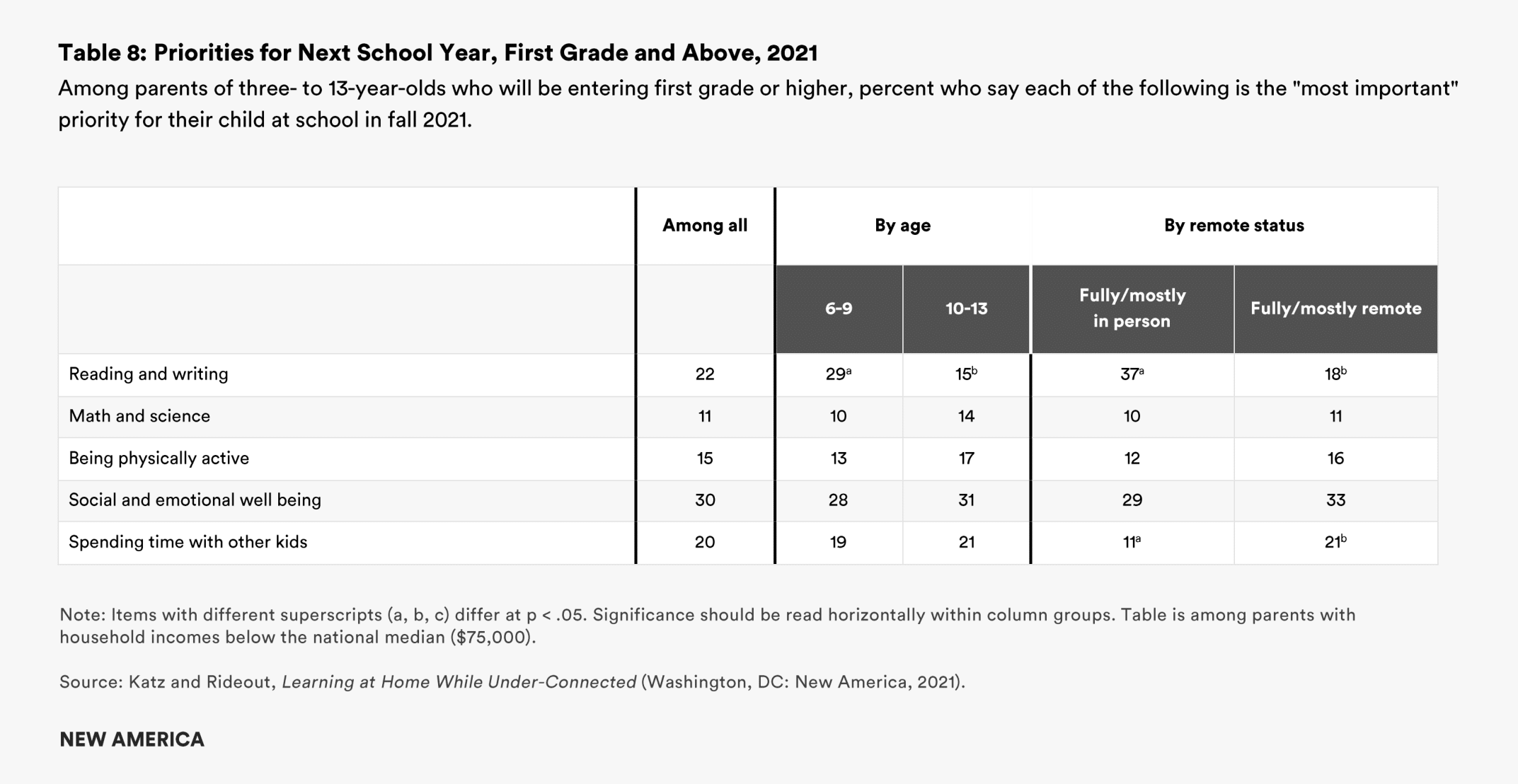
Among parents with children in first grade or higher, a total of 50 percent chose either “social and emotional well-being” (30 percent) or “spending time with other kids” (20 percent), compared with 33 percent who chose an academic priority (22 percent for reading and writing, and 11 percent for math and science). This does not imply that academics are not important to parents—reading was the number two priority among parents in both groups—but the findings clearly show that parents are deeply concerned about their children’s socialization and social-emotional well-being after more than a year of remote learning and social distancing (see Table 8).
In Parents’ Own Words: Priorities for the Next School Year
A total of 383 parents (38 percent of those surveyed) opted to provide additional perspectives in their own words on “very important” priorities for their child when school starts in fall of 2021. Consistent with the findings reported above, responses reflect socio-emotional priorities; 59 percent of open-ended responses focused on issues such as smoothing children’s transitions to in-person school five days per week, spending time with same-age peers, building strong relationships with teachers, or their child’s general well-being and mental health. By comparison, 24 percent of parents who provided responses used the opportunity to emphasize academic concerns (see Table 9).

Thematic analysis revealed an overwhelming sentiment among parents that cut across categories: that their children need to return to full-time, in-person learning in the fall. Many framed this as “going back to school and back to normal.” For others, it was the urgency of children learning in a developmentally appropriate environment.
For others, the return to in-person schooling will be a welcome return to parenting without also having to guide remote learning. As one parent summarized, her priority for the fall is “having someone who is qualified to teach my child. That's not me.”
Twenty-eight percent of parents who offered who offered priorities in their own words mentioned ensuring their child’s smooth adjustment to in-person learning. In-person learning will re-instill “a solid schedule and structure,” that will require their child to maintain better focus, follow directions, and manage their time, parents said. These skills have been hard to build or maintain at home. As one parent said, “it's like pulling teeth to get him to stay focused and on task [remotely].” Others tied their priorities for their child’s adjustment to resuming a more rigorous course load.
Another parent provided perhaps the most elegant summation of what children will need as they adjust to being back in school full time: “time and grace.”
One in five parents offering an open-ended response highlighted relationship development as a top priority, whether with peers (12%) or with teachers (8%). One parent said, “she needs to be around people her own age,” and another cited the need “to see friends’ faces, just being with other kids.” Other parents felt that building relationships with teachers would be crucial; the kinds of “hands-on learning with the teacher that he can't get through a computer.”
An additional 11 percent of parents shared that their children’s overall well-being and mental health was a very important priority; for example, that children “have fun at school, feel comfortable at school.” Others discussed how anxious their children have been this year and their hopes that the fall term, and a semblance of normalcy, would help provide their children a greater sense of security.
Nine percent of parents referenced COVID-related concerns as their main priority for the fall. About two-thirds of these parents specified a desire to maintain masking and social distancing to ensure their child’s health and safety. The remainder emphasized the need to end in-school masking, either because doing so symbolizes a return to a recognizable normal, or because they consider masking an impediment to children’s language learning and relationship development.
One in four parents (24 percent) named an academic issue as a top priority, whether they conveyed a general sense of urgency around ensuring their child could “rebound” or “recover” from this year or specified that their child will need remedial support in a specific subject, the most common being reading or writing Others wanted schools to prioritize the sorts of experiential learning that children missed this year, be that science labs, art, music, or hands-on learning experiences in general.
Closely tied to desires to resume experiential learning were parents’ hopes that their child would recover a sense of joy in learning by returning to school, “having him learn more of the things he likes,” as one parent put it. Another parent clearly reflects this desire to see more of the magic of learning return to their children’s lives: “To keep on wanting to learn what interests them and just learning new things…you know, having fun in learning what you like to do. Having fun is so important too.”
For some parents, a renewed sense of joy in being physically present in school was tied to resuming physical education (2 percent), school sports, and other extracurricular activities (1 percent). Another 2 percent of parents were anxious for their children to resume their therapeutic services or special education programs provided by their schools.