A Chapter of: Learning at Home While Under-connected
Devices and Internet Access in the Home
Six years ago, in a report titled Opportunity for All? Technology and Learning in Lower-Income Families, we documented how digital inequality was affecting access to learning opportunities in lower-income families with school-aged children.8 We warned that these obstacles would have “considerable consequences” for children and families in the years to come, as technology use became increasingly integral to learning in and out of school. Once the COVID-19 pandemic arrived on U.S. shores and closed school buildings across the country, the reality of those consequences hit hard and fast.
Many schools, internet service providers, nonprofits, and families themselves tried to patch gaps in access to both digital devices and the internet. In this report, we document the state of families’ digital access one year into the pandemic (in March and April of 2021), when online schooling remained the norm in most places. Our data include the types of digital devices that families have in their homes (and especially, whether or not there is a computer available), and the types of internet connections they have (i.e., whether families have some type of broadband home access, dial-up service, mobile-only access, or no personal internet access). We then explore the extent to which families are “under-connected”—that is, whether the devices and internet service they have are sufficient and reliable enough to meet their needs. And finally, we compare where families were six years ago in relation to these issues with where they are today.
Internet Access in 2021
The type of internet access that children have at home has always mattered, but it has never mattered more than it did this past year. Remote learning required being able to livestream classes on Zoom, watch videos to complete assignments, and submit work online. Anything less than a strong broadband connection simply could not enable children’s full participation.
Among all families with three- to 13-year-old children whose household incomes are below the national median:
- 82 percent have some kind of broadband internet access (e.g., cable, satellite, fiber optic, or a hot spot)
- 11 percent have mobile-only access (i.e., internet access via a data plan on a smartphone or tablet)
- 3 percent have dial-up access
- 2 percent have home access, but are not sure what kind
- 1 percent have no internet access at all
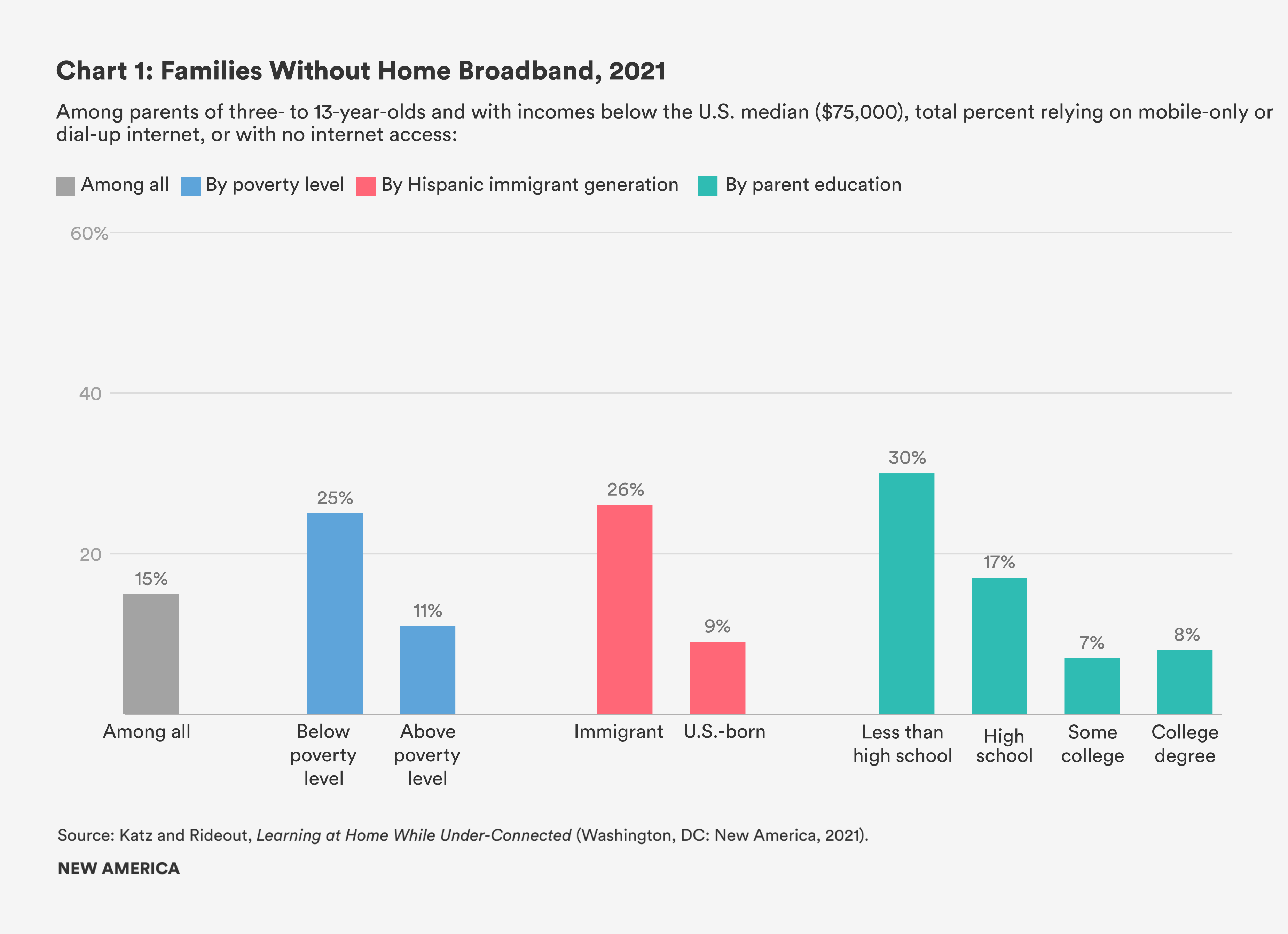
These rates of home broadband access are a vast improvement from what we found in our 2015 survey (see discussion below). However, they still leave 15 percent of children—roughly one in seven—with mobile-only, dial-up, or no internet access. The discrepancies for families living below the federal poverty line are starker still: a total of one in four have mobile-only (17 percent), dial-up (7 percent), or no internet service at all (1 percent; see Chart 1 and Table 1).
We also find differences by race/ethnicity and immigrant generation. Black families are more likely than White and Hispanic families to have broadband home internet service (92 percent of Black families, vs. 80 percent of White and 79 percent of Hispanic families). Families headed by U.S.-born Hispanics are much more likely to have home broadband access than families headed by immigrant Hispanics (91 percent vs. 72 percent).
Rates of home internet access vary substantially by parents’ levels of education as well: 30 percent of children whose parents did not have a high school diploma rely on mobile-only (21 percent) or dial-up (6 percent) internet access, or have no internet access at all (3 percent). By contrast, 8 percent of children of college graduates have mobile-only (4 percent) or dial-up (4 percent). Our survey found that no children of college graduates lacks internet access.
There were no statistically significant differences in type of home internet access based on whether the respondent lived in an urban, rural, or suburban area, indicating that the differences in broadband access identified in this survey are not based on geographic factors. Indeed, among those without home internet access, 35 percent cite cost as the major factor, compared to 12 percent who say their community does not have good service available (see Chart 2).
FAMILIES WITHOUT HOME BROADBAND, 2021
Among parents of three- to 13-year-olds with incomes below the U.S. median, total percent relying on mobile-only or dial-up, or with no internet access:

Device Access in 2021
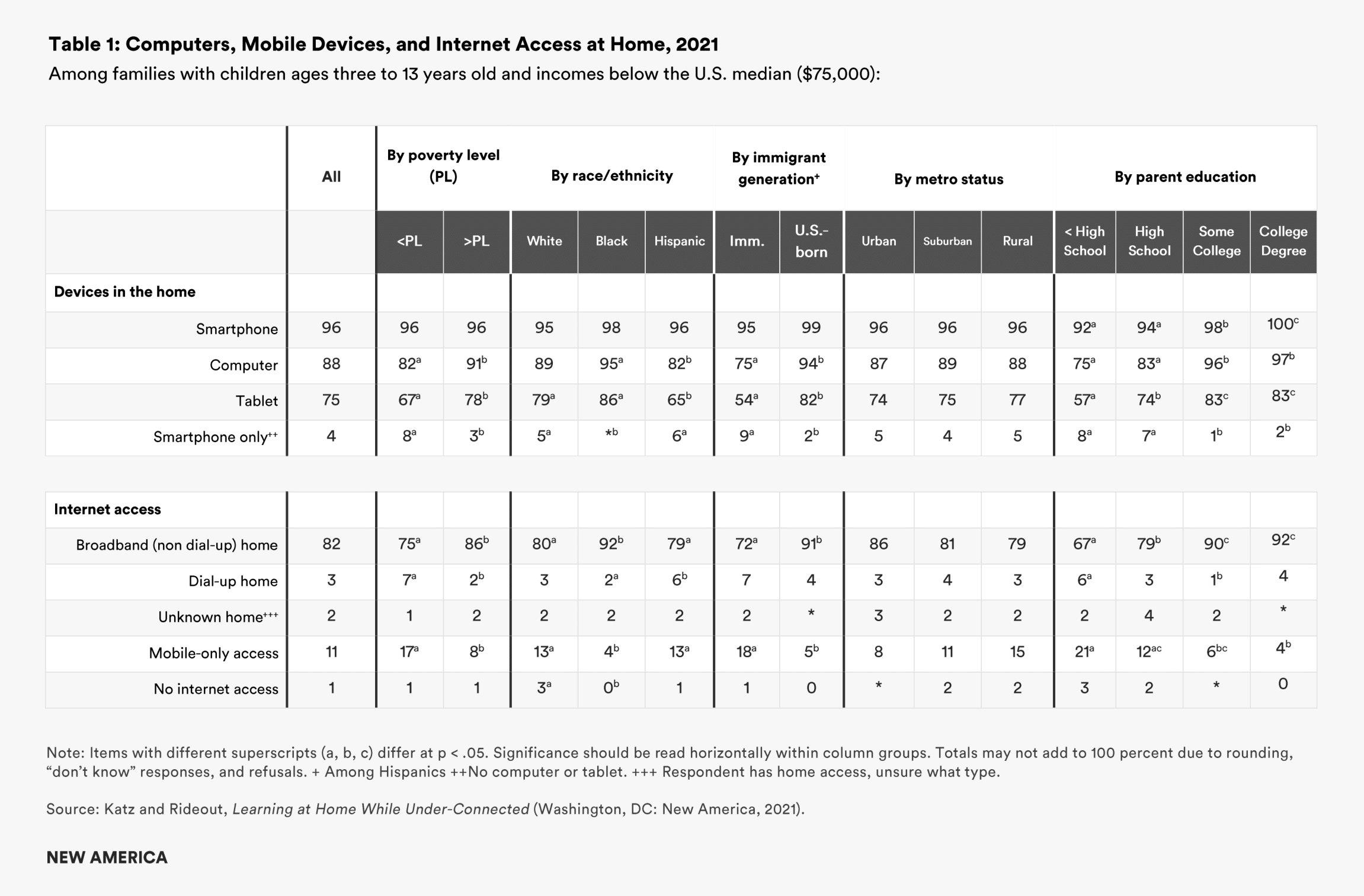
Nearly nine in 10 (88 percent) lower-income families have a computer in the home, and 75 percent have a tablet device. Since younger children could fully participate in remote learning on a tablet more readily than elementary school-aged children, we also examined rates of device ownership by child age. Rates of home computer access indeed vary by age, from 80 percent of families with three- to five-year-olds, to 93 percent of those with 10- to 13-year-olds. Parents with six- to nine-year-olds fall in-between these two groups, suggesting that computer ownership increases gradually as children progress through elementary school (89 percent have a computer at home, not statistically different from either of the other age groups).
Computer access is lowest among families headed by Hispanic immigrants (75 percent), who did not graduate from high school (75 percent), and households with incomes below the poverty level (82 percent). Only a small number of families have to rely exclusively on a smartphone: overall, 4 percent of families had a smartphone but no tablet or computer, ranging up to 8 percent of those living below the poverty line and 9 percent in families headed by immigrant Hispanics (see Table 1).
The “Under-connected” in 2021
While it is important to identify which families do or do not have broadband internet access and a computer, yes/no questions about access cannot provide the full story. Informed by our interviews with hundreds of lower-income families with elementary school-aged children since 2013, we developed a more nuanced set of questions to identify which families have insufficient and inconsistent access to digital devices, internet service, or both.9 For many families, paying for the internet competes with other, more pressing bills some months. Their devices break or work slowly but are too expensive to replace. Families make do by sharing fewer devices than they need for everyone to have as much time online as they would like. These families are “under-connected” by virtue of indicating that their connectivity is more limited than they need it to be.
To fully diagnose who is under-connected, questions must also be asked in a way that captures fluctuations in connectivity over time. This is because parents might report that their internet connection and devices are working well on the day they answer the question, but that may not have been the case last week, or last month.
Our findings clearly demonstrate why addressing digital inequality will require addressing the challenges of being under-connected. Even among lower-income families who report having computers, tablets, and home broadband internet access, a majority are nonetheless still under-connected.
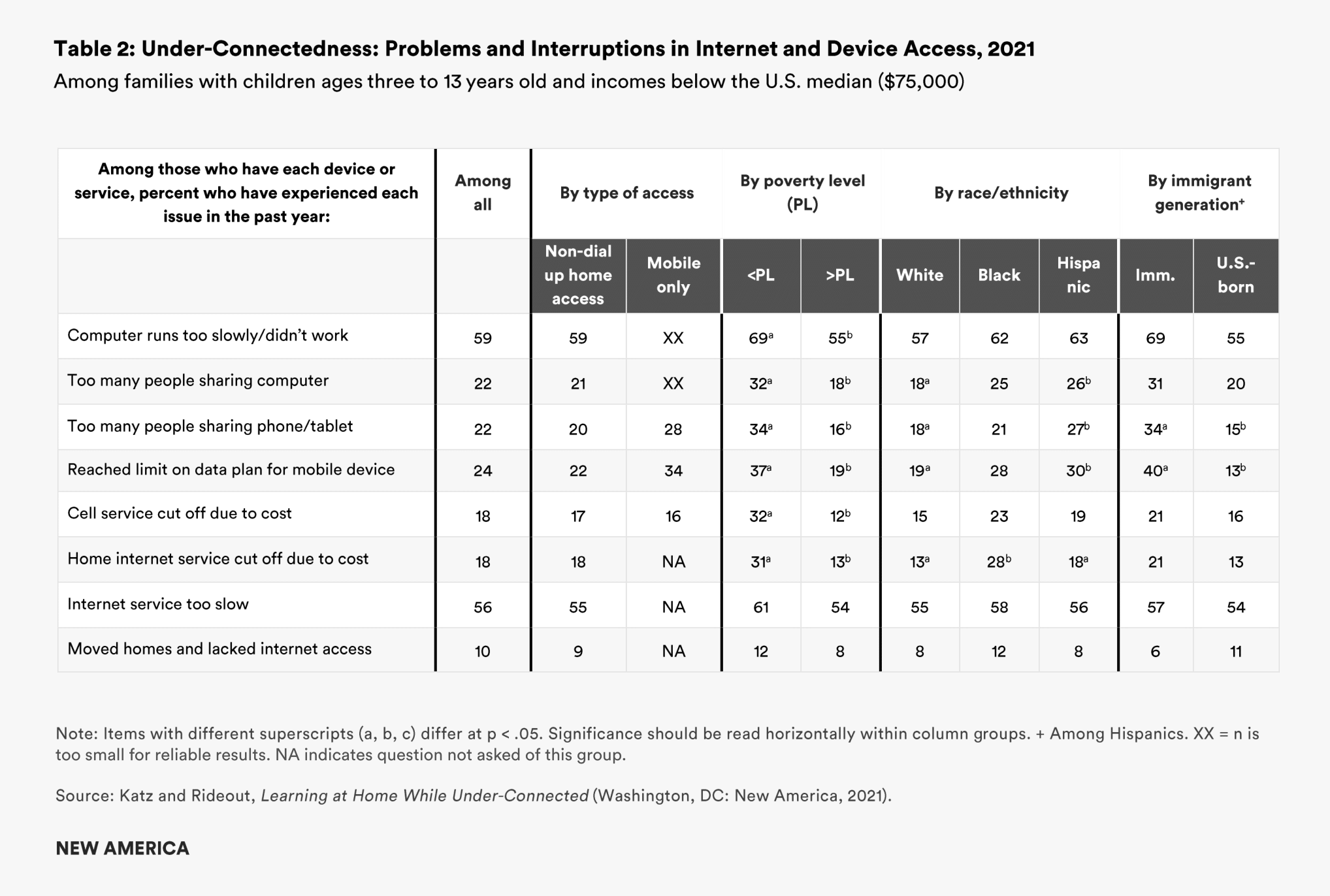
For example, among the 82 percent of families who report having broadband internet service, more than half (55 percent) said their internet service had been too slow in the past 12 months, and almost one-fifth (18 percent) reported interruptions in their internet service at least once in the past year due to unpaid bills (see Table 2).
Roughly one in ten (11 percent) families has mobile-only internet access, meaning that they report only having internet access at home via a data plan on their smartphone or tablet. Mobile-only access is a form of under-connectedness in its own right, given how challenging it is to do complex tasks like a homework assignment on a smartphone, as compared to doing so on a computer.
Similar patterns emerge regarding devices. More than half (59 percent) of parents reported that their computers did not work properly or ran too slowly. These challenges were more common among families headed by immigrant Hispanics and among those living below the federal poverty line (69 percent in both cases).
And about one in five (22 percent) of all families with a computer said there were too many people who needed to use it for them to have as much time on it as they needed. The same proportion (22 percent) of families with a mobile device reported the same problems, with too many people needing to use the smartphone or tablet. The challenges families faced in having to share devices were almost certainly more acute than in other years, with both school and work being remote for so many families during the pandemic.
Families headed by immigrant Hispanics were more likely to report being under-connected than other lower-income families. Forty percent of immigrant Hispanic respondents with a mobile device said they had reached the data limits on their mobile plans and could not go online at least once in the past year, compared with 13 percent of families headed by U.S.-born Hispanics. Additionally, 34 percent of Hispanic families with immigrant parentage said there were too many people trying to share a single device, compared with 15 percent of families with U.S.-born Hispanic parents.
Not surprisingly, families living below the poverty level had a particularly hard time keeping up with the costs of internet service and mobile data plans. They were also more likely to report that they did not have enough devices to meet their families’ needs, or that their devices ran too slowly.
- Seventy-five percent of families with incomes below the federal poverty line reported having home broadband service, but one-third (31 percent) of them have had their service cut off at least once during the past year, due to cost.
- Nearly all families living below the federal poverty level have a smartphone or a tablet, but 37 percent reported hitting the data limits on their mobile plans at least once during the past year. Roughly one-third said too many family members needed to share mobile devices (34 percent) or reported having their cell service cut off entirely at least once in the past year, due to an inability to pay the bill (32 percent).
- Eighty-two percent of families in poverty have a computer at home, but one-third of them (32 percent) said there were too many people competing for time on the device, and nearly seven in 10 (69 percent) said their computer was too old or ran too slowly.
Changes in Internet and Device Access 2015–2021
Internet Access over Time
In 2015, we conducted a nationally representative, probability-based telephone survey of lower-income parents. Since we used the same population parameters and sampling methods this year, we can systematically compare how these families were faring digitally before and during the pandemic. Our 2015 survey focused on families with children ages six to 13 years old; therefore, our comparisons are limited to the subset of the 2021 sample with children in the same age range (n=799).
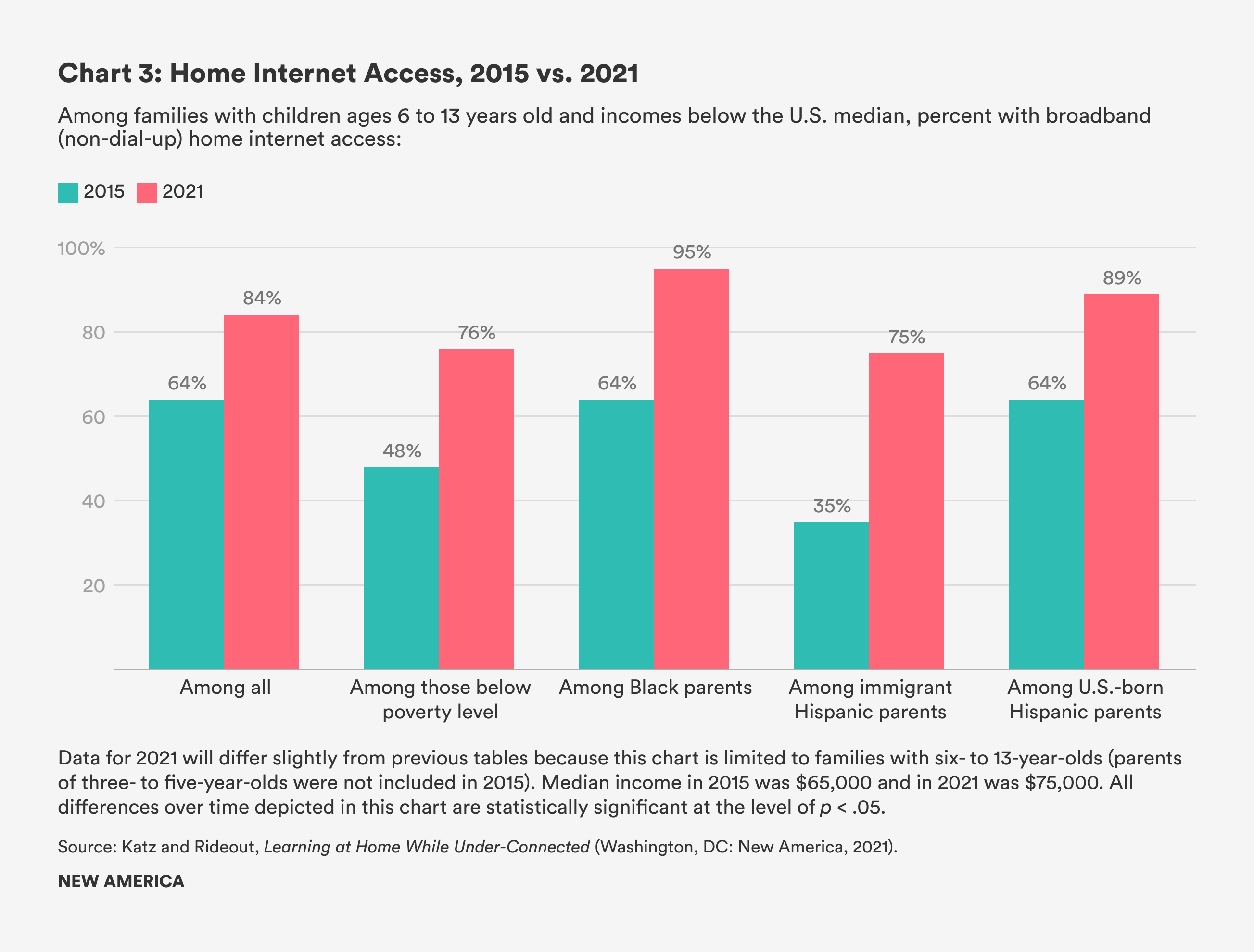
We find dramatic gains in internet access between 2015 and 2021 among this subset of families (see Chart 3). Those gains have been particularly substantial for the families who were most likely to be under-connected in 2015, including families headed by immigrant Hispanic parents.
- Home broadband access increased from 64 percent to 84 percent among lower-income families with children ages six to 13. The proportion of these families relying on mobile-only access also dropped significantly, from 23 percent to 10 percent. And the proportion with no internet access at all declined from 5 percent in 2015, to 1 percent in 2021.
- Among families reporting household incomes below the federal poverty line, broadband access increased from 48 percent in 2015 to 76 percent in 2021. The proportion of families relying on mobile-only access dropped by more than half, from 33 percent to 15 percent, and families reporting no internet access at all declined from 9 percent to 2 percent over the same time period.
- Among lower-income Black families in our samples, home broadband access increased from 64 percent in 2015 to 95 percent in 2021. Mobile-only access among Black families dropped from 25 percent to 5 percent during the same time period.
- Among lower-income families headed by U.S.-born Hispanics, home broadband access increased from 64 percent in 2015 to 89 percent in 2021. Mobile-only access decreased, from 17 percent in 2015 to 5 percent in 2021.
- Among families headed by immigrant Hispanics, home broadband access more than doubled, from 35 percent in 2015 to 75 percent in 2021. The proportion of these families relying on mobile-only access dropped from 41 percent to 17 percent, and those reporting no internet access at all had dropped from 10 percent to 1 percent. In 2015, 63 percent of families headed by immigrant Hispanics had either mobile-only (41 percent), dial-up (12 percent), or no internet access (10 percent); in 2021, 23 percent of these families experienced those same circumstances.
Device Access over Time
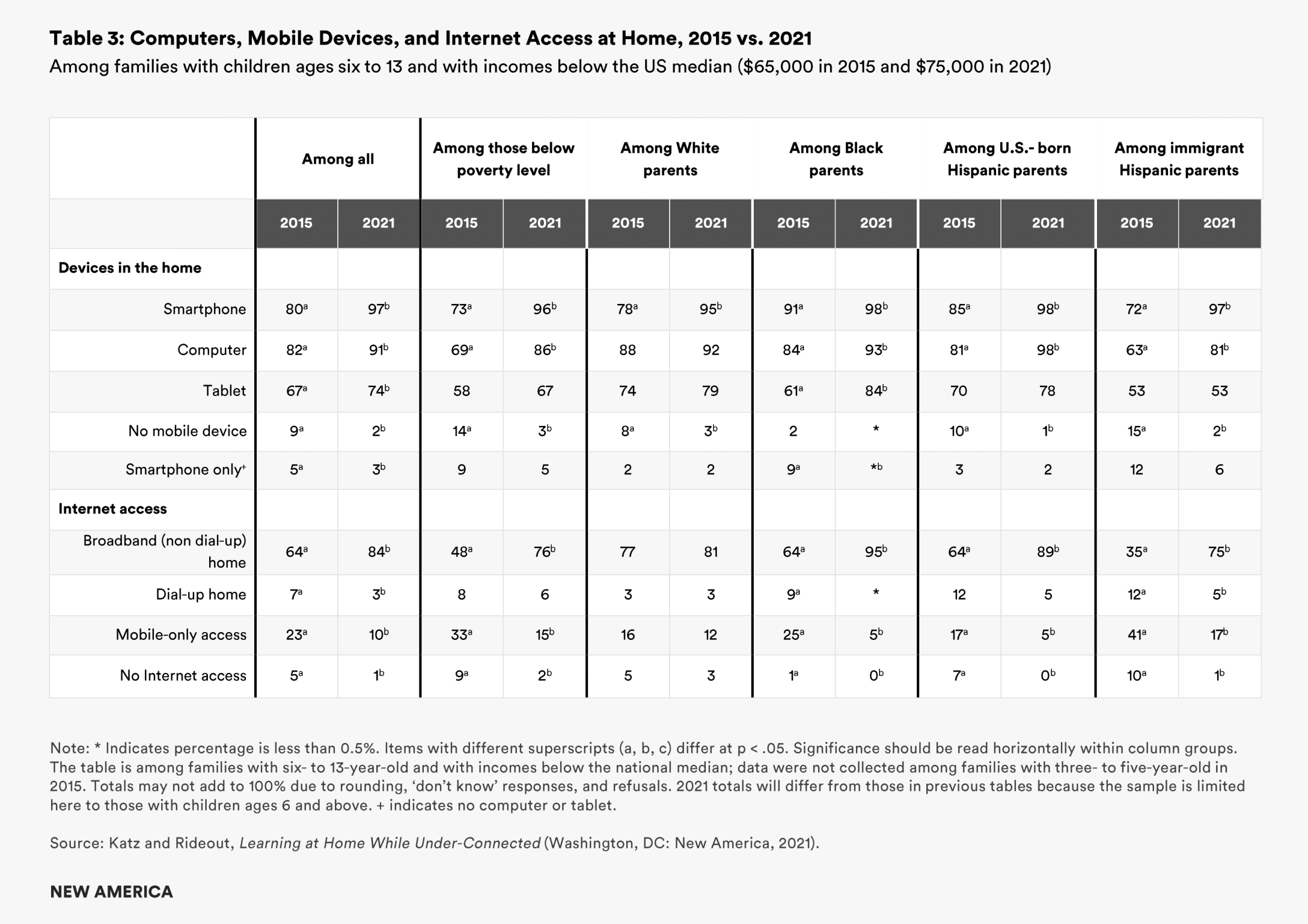
Just as rates of home internet access have increased dramatically between 2015 and 2021, so too has home computer access among lower-income families with six- to 13-year-olds (see Table 3). It is not possible to tell from this particular survey whether this is a result of schools delivering “emergency” laptops due to the pandemic that families will need to return or due to increased rates of families owning these devices.
Overall, home computer access has increased from 82 percent in 2015 to 91 percent in 2021 among families with six- to 13-year-olds. The increase has been especially pronounced among families living below the federal poverty level (an increase from 69 percent in 2015 to 86 percent in 2021), and among families headed by immigrant Hispanic parents (from 63 percent to 81 percent).
Families are also much more likely to report having other digital devices in the home in 2021 compared with 2015, including smartphones and tablets. The proportion of families with a smartphone increased from 80 percent to 97 percent among all families with six- to 13-year-olds, with especially notable increases among those whose incomes are below the poverty level (from 73 percent to 96 percent), among White families (from 78 percent to 95 percent), and among families headed by immigrant Hispanic parents (from 72 percent to 97 percent).

Citations
- The Joan Ganz Cooney Center at Sesame Workshop published the 2016 report. For the survey, accompanying case studies, and policy brief, see http://digitalequityforlearning.org
- Vikki S. Katz, “What It Means to Be ‘Under-Connected’ in Lower-Income Families,” Journal of Children and Media, 11, no. 2 (2017): 241–244.