A Chapter of: Learning at Home While Under-connected
Key Findings
Unless otherwise specified, all findings are among families with children ages three to 13 years old, and with incomes below the national median of $75,000 a year.
1. Rates of home internet access and computer ownership are up substantially from 2015, but many children from families with incomes below the national median still lack the essentials.
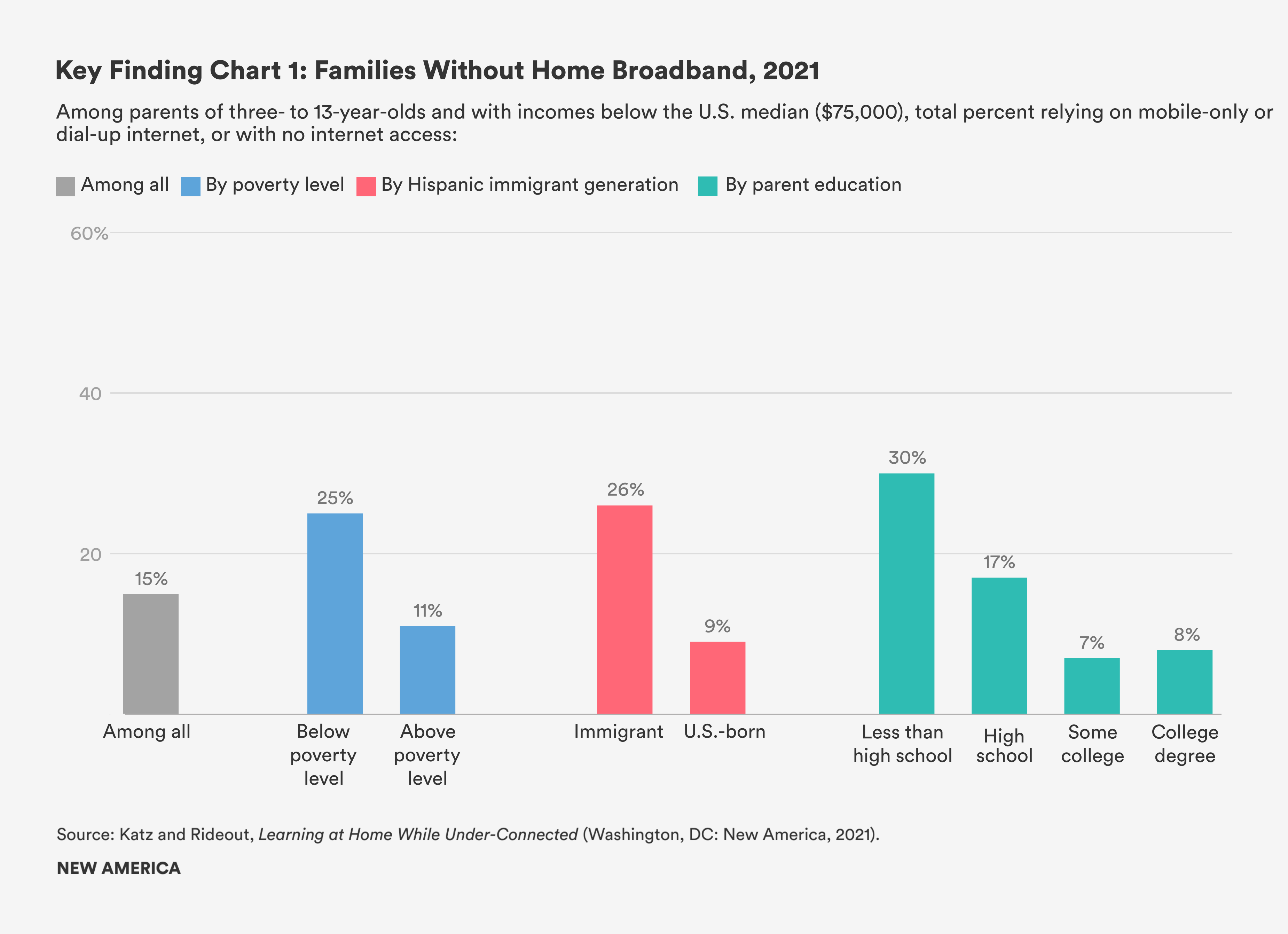
- One in seven children still does not have broadband internet access at home.
- Among all families in the survey, 11 percent still have mobile-only, 3 percent have dial-up, and 1 percent have no internet access at home.
- In families with incomes below the federal poverty level: one in four (25 percent) still have mobile-only (17 percent), dial-up (7 percent), or no internet service at all (1 percent).
- In families headed by immigrant Hispanic parents: just 72 percent have broadband service, compared with 80 percent of White families, 91 percent of families with U.S.-born Hispanic parents, and 92 percent of Black families.
- Cost remains the primary reason many families lack internet access.
- A plurality (35 percent) cite expense as the major factor, while 19 percent say they do not really need the internet, and 12 percent say there is no good service available in their community.
- There were no statistically significant differences in the type of home internet access based on whether the respondent lived in an urban, rural, or suburban area.
- Most children now have a computer at home, but one in eight still does not.
- Eighty-eight percent of three- to 13-year-olds now have a computer at home, but 12% still do not.
- Among families with six- to 13-year-olds, 91 percent now have a computer at home—up from 82 percent in 2015, when we first surveyed families with children in this age group.
- The increase has been especially pronounced among families living below the poverty level (from 69 percent in 2015 to 86 percent in 2021) and among families headed by immigrant Hispanic parents (from 63 percent to 81 percent).
- Access to home internet service is up substantially from 2015.7
- Among families with children ages 6 to 13, access to non-dial-up home internet service has increased from 64 percent in 2015 to 84 percent in 2021.
- Especially notable increases have occurred among families with incomes below the poverty level (from 48 percent in 2015 to 76 percent in 2021), among Black households (64 percent to 95 percent), and among families headed by immigrant Hispanic parents (from 35 percent to 75 percent).
2. Even among families with computers and broadband internet access at home, a majority are “under-connected,” meaning that they report insufficient and unreliable access to the internet and internet-connecting devices.
- Among families who have broadband home internet service:
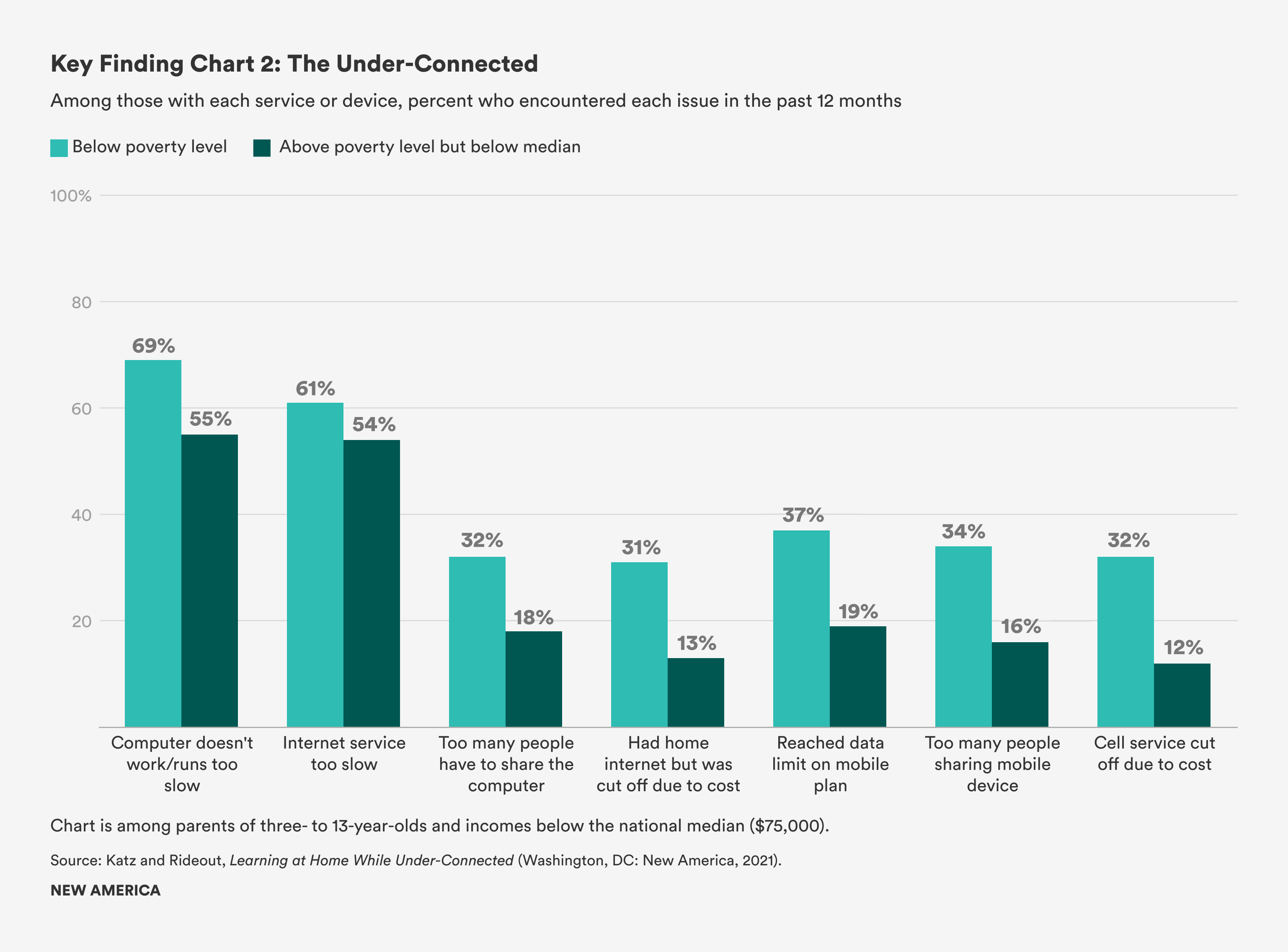
- 56 percent say their service is too slow.
- 18 percent say their service has been cut off at least once in the past 12 months due to trouble paying for it.
- Among those who only have internet access via a smartphone or tablet (mobile-only access):
- 34 percent say they hit the data limits in their plan at least once in the past year, preventing them from being consistently connected to the internet.
- 28 percent say they have a hard time getting as much time on devices as they need, because too many people are sharing them.
- 16 percent say their mobile phone service has been cut off at least once during the past year because they could not pay for it.
- Among those with a computer at home:
- 59 percent say it does not work properly or runs too slowly.
- 22 percent say it is hard to get time on it because there are too many people sharing it.
- The proportion of lower-income families who are under-connected hardly changed at all between 2015 and 2021—despite large increases in rates of home broadband and computer access.
3. The majority of students learning remotely this year experienced disruptions in their education due to being under-connected.
- More than half (53 percent) of remote students experienced one of the following disruptions at some point during the past year:
- 34 percent were unable to participate in class or complete their schoolwork due to a lack of internet access.
- 32 percent had to attend school or do their schoolwork on a smartphone for some period of time.
- 21 percent were unable to participate in school or finish their schoolwork because they could not access a computer.
- The type and quality of a family’s internet access has a direct impact on students’ school participation.
- Among parents with mobile-only or dial-up internet, half (52 percent) said their lack of internet access prevented their children from participating or completing their schoolwork at some point over the past year, compared with 32 percent of those with non-dial-up home access.
4. The digital challenges of remote learning hit families in the lowest income bracket and those headed by Black or Hispanic parents hardest.
- Among those with incomes below the federal poverty level:
- 65 percent reported that lacking access to a computer or the internet had prevented their children from participating in class, completing their schoolwork, or had necessitated participating in class via a smartphone. 48 percent of students in families living above the poverty line (but still below the median annual household income of $75,000) reported these same challenges.
- Among Hispanic and Black families:
- Majorities of Hispanic (66 percent) and Black (56 percent) parents report that their children experienced these obstacles to school participation, compared with 42 percent of White parents.
- Among families headed by immigrant Hispanics:
- 75 percent have experienced some of these disruptions in learning, with lack of internet access (52 percent) being the most likely cause for students being unable to attend school or do their schoolwork.

5. While remote learning was a tremendous stressor for parents, many also reported gaining new insights into their children’s schoolwork and learning habits, assets that can benefit families and schools moving forward.
- The majority of parents deepened their understanding of their children as learners.
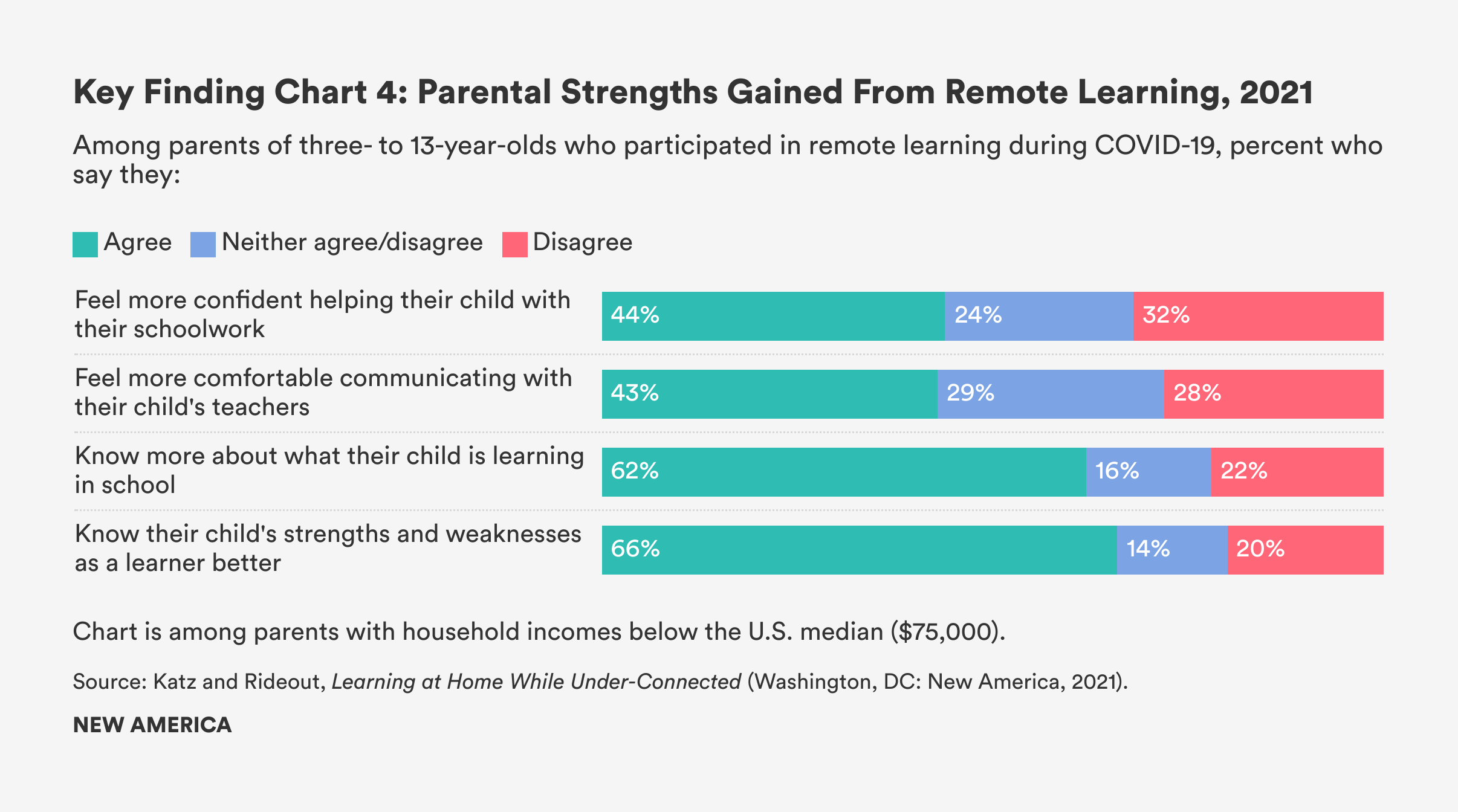
- Two-thirds of parents (66 percent) say they know more about their child’s strengths and weaknesses as a learner now than they did before the pandemic.
- 62 percent say they know more about what their child is learning in school now, as compared with prior to the pandemic.
- Many parents are more confident and comfortable being involved in their child’s education.
- 43 percent say they are more comfortable communicating with their children’s teachers now than they were before the pandemic.
- 44 percent say they are more confident helping their child with their schoolwork than they were before remote learning.
- Black and Hispanic parents, as well as families with household incomes below the poverty line, report the largest gains across all these measures. For example, 57 percent of Black parents, 56 percent of parents with incomes below the federal poverty level, and 52 percent of Hispanic parents say they now feel more confident helping their child with their schoolwork than prior to the pandemic, compared to 32 percent of White parents and 39 percent of those with incomes above the poverty level (but still below $75,000).
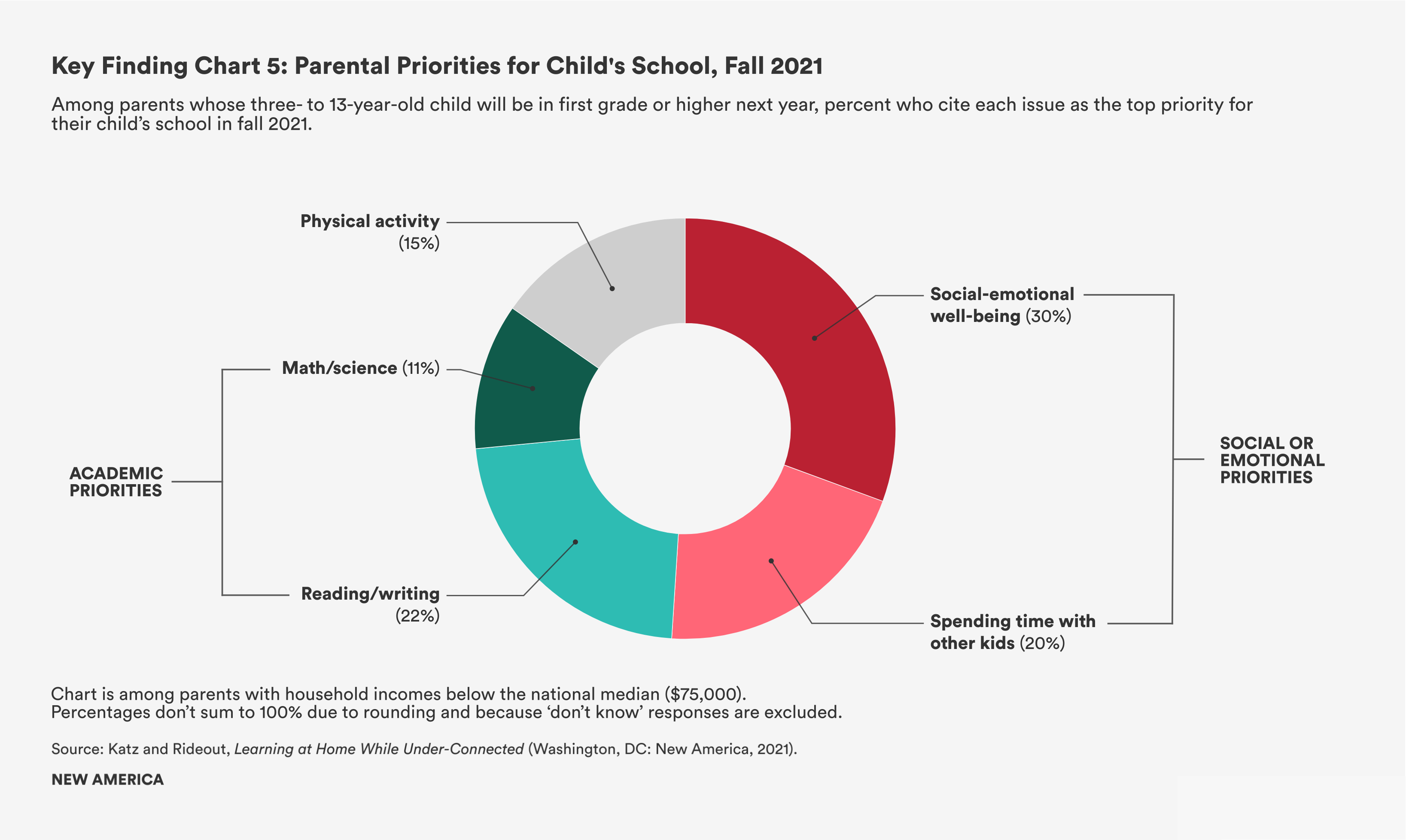
6. Parents prioritize social and emotional development ahead of academics for the upcoming school year.
- Social and emotional well-being: Half of parents whose children will be entering first grade or higher say the most important priority for school next year is either their child’s social and emotional well-being (30 percent), or simply getting to spend time with other kids (20 percent).
- Academics: One-third of parents say academic issues are most important for their child, including reading and writing (22 percent) or math and science (11 percent).
- Physical activity: The rest (15 percent) say their top priority is their child being physically active.
7. Many families have relied on informal educational media to help keep kids growing and learning during the COVID-19 pandemic.
- Frequency of educational media use: One-third of parents say their children “often” watch educational TV shows (33 percent) and online videos (32 percent), play educational games (33 percent), or use digital devices to make art or music or engage in other creative activities (36 percent).
- Helpfulness of educational media: About half of parents whose children “often” use educational TV shows, videos, or games say they have been “very” helpful in keeping children learning and growing during the pandemic (57 percent for educational videos, 51 percent for TV shows and digital games).
- The lowest-income families rely most on educational media. Children whose household incomes are below the federal poverty level—who are also disproportionately affected by disruptions to remote schooling—are making the most use of informal educational TV shows and videos. 40 percent of children in these households “often” watch educational TV and 41 percent watch educational online videos (compared to 30 percent and 29 percent of those with household incomes above the poverty level).
8. Family reading patterns shifted during the pandemic.
- Frequency of reading: 23 percent of parents with three- to nine-year-olds say they have spent more time reading with their children during the pandemic than they did previously, while 10 percent said they were reading less frequently than before.
- Access to print books: 30 percent of parents say it has been harder to get print books for their children during the pandemic; this was especially true among Hispanic parents (39 percent) and those whose incomes are below the poverty level (42 percent).
- Use of e-books: 41 percent of parents say their children read e-books more now than they did before the pandemic.
9. Parents and children help each other learn with technology, even more than they did in 2015.
- Parents and children are equally likely to help each other with technology. More than half of parents (55 percent) say they often or sometimes help their 10- to 13-year-olds with computers or the internet. A nearly identical proportion (56 percent) say their 10- to 13-year-olds often or sometimes help them with technology.
- Less-educated parents and those with the lowest incomes rely on their children for technology help more than other parents do. For example, 65 percent of parents without a high school diploma say their children often or sometimes help them, compared with 33 percent of parents with a college degree. Similarly, parents with incomes below the federal poverty level are more likely to say their 10- to 13-year-olds help them with specific tech-related tasks than parents with incomes above the poverty level, such as learning how digital devices work (51 percent vs. 38 percent), finding information online (49 percent vs. 34 percent), and downloading content (50 percent vs. 34 percent).
- Mutual tech support has increased since 2015. Parents are more likely to say they ever help their six- to 13-year-olds with computers or the internet today (90 percent) than they were in 2015 (77 percent). They are also more likely to say their children ever help them with technology (81 percent of parents of 10- to 13-year-olds, vs. 62 percent in 2015).

Citations
- In 2015, we surveyed 1,191 lower-income parents with children ages six to 13, using many of the same questions regarding access to the internet and digital devices, enabling us to compare families’ experiences over time. Victoria J. Rideout and Vikki S. Katz, Opportunity for All?: Technology and Learning in Lower-Income Families, Joan Ganz Cooney Center at Sesame Workshop (New York, 2016), https://joanganzcooneycenter.org/publication/opportunity-for-all-technology-and-learning-in-lower-income-families/