A Chapter of: Bringing Americans Home 2021
3. Methods, Limitations, and Definitions
This report is based on a series of 42 interviews with individuals personally connected to a case in which an American was held hostage or unlawfully or wrongfully detained, hereinafter referred to as participants. In every hostage or unlawful or wrongful detainee case, each participant was a U.S. national.66
Interviews with hostages, unlawful or wrongful detainees, and their families consisted of a series of questions focused on thematic areas drawn directly from PPD-30 to provide a qualitative understanding of the experiences of hostages, wrongful detainees, and their families. Each interview also included a quantitative assessment of the effectiveness of PPD-30 by assigning a numerical value indicating the degree to which each participant agreed or disagreed with a variety of statements asked during the interview process.67 JWFLF sought to ensure confidentiality throughout the interview process. In an attempt to prevent bias and protect the identity of the hostages, wrongful detainees, and their families, JWFLF assigned a random six-digit serial number to each case and permanently discarded each participant’s name. Analysis of each case was then carried out using the six-digit serial number.
Definitions
To more closely align with the U.S. government’s hostage recovery enterprise classification and terminology, this report distinguishes within its analysis the difference between hostage cases and cases of unlawful or wrongful detention.
JWFLF uses the conventional definition of a hostage as a person detained and under the threat of death, injury, or continued detention by an individual or group (but not a state) in order to compel a third party to do (or abstain from doing) any act as an explicit or implicit condition of the person’s release.68 For this report, a hostage-taking event includes U.S. nationals held by non-state actors, specifically by terrorist organizations, militants, criminal groups, pirates, or unknown captors.
JWFLF does not include individuals who were involved in (1) kidnapping attempts resulting in the immediate death of the victim, or the victim was killed before being taken to a secondary location; or (2) if a person has been reported missing and there is no evidence, open-source reporting, or indication from family members that the individual was taken hostage by a terrorist organization, militants, criminal groups, pirates, or unknown captors.
Where the actor holding a U.S. national is a state, JWFLF includes the case where the detention is wrongful or unlawful. JWFLF considers the detention of a U.S. national to be unlawful or wrongful based on criteria found in the Robert Levinson Hostage-Recovery and Hostage-Taking Accountability Act adopted into law on December 27, 2020.69 Cases in which a foreign government acknowledges that it has detained a U.S. national may be considered unlawful or wrongful if:
- U.S. officials receive or possess credible information indicating innocence of the detained individual;
- The individual is being detained solely or substantially because he or she is a U.S. national;
- The individual is being detained solely or substantially to influence U.S. government policy or to secure economic or political concessions from the U.S. government;
- The detention appears to be because the individual sought to obtain, exercise, defend, or promote freedom of the press, freedom of religion, or the right to peacefully assemble;
- The individual is being detained in violation of the laws of the detaining country;
- Independent nongovernmental organizations (NGOs) or journalists have raised legitimate questions about the innocence of the detained individual;
- The U.S. mission in the country where the individual is being detained has received credible reports that the detention is a pretext for an illegitimate purpose;
- The individual is detained in a country where the Department of State has determined in its annual human rights reports that the judicial system is not independent or impartial, is susceptible to corruption, or is incapable of rendering just verdicts;
- The individual is being detained in inhumane conditions;
- Due process of law has been sufficiently impaired so as to render the detention arbitrary; or
- U.S. diplomatic engagement is likely necessary to secure the release of the detained individual.70
Limitations
One of the challenges in this study was obtaining a consistent number of responses for every question asked during the interview process. In some cases, not all questions were applicable to each participant’s experiences. In other cases, it was difficult to obtain a response to all questions because of the emotional impact of the interview question. JWFLF put the safety and emotional needs of the participants above its ability to glean information from the participant’s difficult experiences. For example, participants were given the opportunity and were encouraged to refrain from answering questions that made them feel uncomfortable. In some instances, interviews were shortened, or questions were omitted at the interviewer’s discretion if the participant showed signs of increased anger, stress, and/or anxiety. It was not the intent of the interviewer for the participant to relive traumatic events, but to allow each of its participants the opportunity to be heard. Many families who have experienced a hostage-taking or a wrongful detention find it extremely difficult to recount and are understandably unwilling to examine their trauma any further.
Another limitation of this report derives from the provision of anonymity to interviewees. All sources agreed to be interviewed on the condition that they remain confidential. Specific dates and locations of interviews were omitted. In addition, countries, regions, terrorist organizations, prisons, specifics on dates, and timeframes of captivity were also omitted in order to protect the participant’s and/or their respective loved one’s identities.
This effort to keep interviewees confidential has its drawbacks. It can leave the reader without a clear understanding of the full context of the issues discussed in the report. In addition, only providing feedback from anonymous sources may leave the reader questioning the author’s ability to access the most credible sources and their ability to provide the most accurate and timely information on the intended subject. This places an added responsibility on the author to select sources with utmost care, all while seeking additional sources from similar high-level positions, to gain well-rounded perspectives on issues discussed in the report. Information from interviews was verified with other sources, further corroborating an accurate representation of the information gathered during each interview.
On the other hand, protecting a source’s identity has many benefits. It encourages candor and allows the participant to speak more freely, it protects the participant’s loved ones who are currently held in captivity, and it allows participants to advocate for hostages or unlawful or wrongful detainees without repercussions from the hostage recovery enterprise.
Another limitation derives from the complexity of the issues involved and the speed with which conditions can change. About half of the participants were interviewed more than once as hostage or unlawful or wrongful detainee issues continue to evolve at a rapid pace. While this can introduce a level of variability into their answers, it allowed participants and their concerns to be more fully heard as hostage and unlawful or wrongful detainee issues continue to evolve.
Interviewed Participants
Of the 42 participants interviewed for this report, 28 were associated with a specific hostage or unlawful or wrongful detention case. The remaining 14 interviews were conducted with current or former U.S. officials and former senior military officials. These 14 interviews were not included in the quantitative numerical rankings portion of the report (Section 4 and Appendices B and C). Instead, their responses helped inform discussions and provide more context to the issues discussed in Section 4 and Section 5.
Of them, 28 participants interviewed for the report who were associated with either a hostage or unlawful or wrongful detention case, three were advocates (who dealt with both hostage and detainee cases), three were family representatives, and 22 were former hostages, unlawful or wrongful detainees, or family members of current or former hostage and unlawful or wrongful detainees.
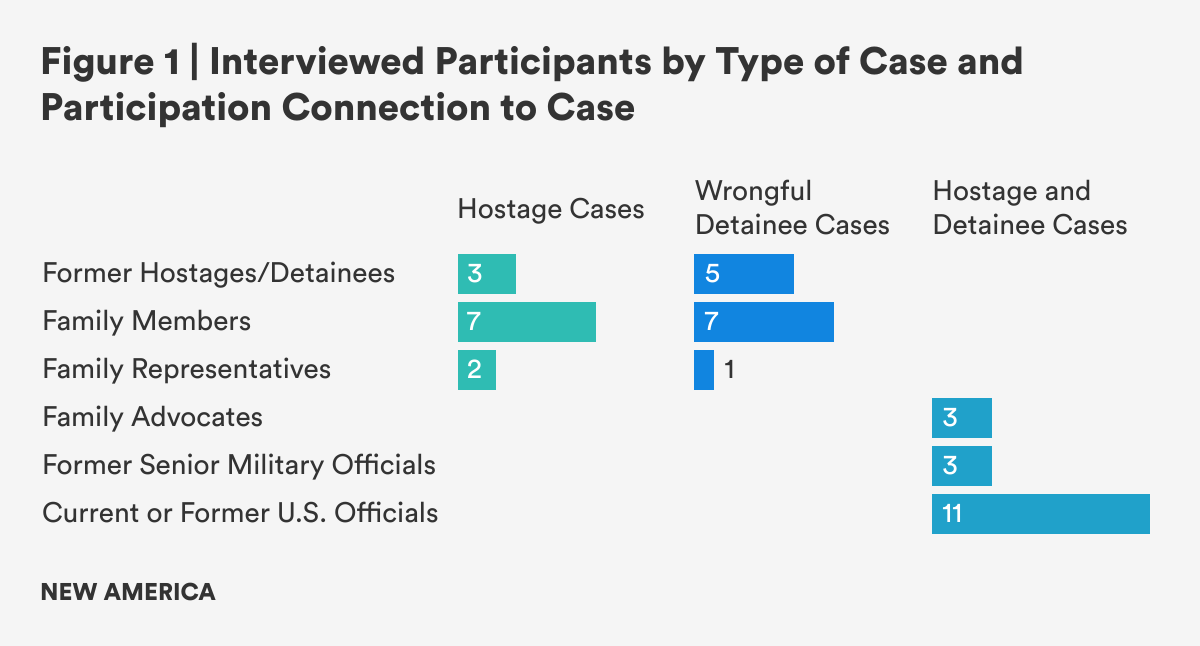
In total, this study represents 18 individual hostage and unlawful or wrongful detention cases. It includes eight hostage cases (including unacknowledged detainee cases), and 10 unlawful or wrongful detainee cases. Participants involved in hostage cases included three former hostages, seven family members, and two family representatives, in addition to the three family advocates involved in both hostage and unlawful or wrongful detention cases. Participants involved in unlawful or wrongful detention cases included five former detainees, seven family members, and one family representative as well as the three advocates. Figure 1 provides the breakdown of participants.
The cases represented in this study took place from the 2010s through the present. However, including more specific dates would have a negative impact on the participants’ confidentiality. Ten of the 18 cases represented in this study are currently active. In the remaining eight cases, the hostages or detainees in question have either returned home or are no longer in captivity. These cases are still being pursued by the U.S. government, and all but one participant is currently working with the U.S. hostage recovery enterprise.71

Bringing Americans Home 2021
- Foreword
- Executive Summary
- 1. Introduction
- 2. A Brief Examination of U.S. Hostage Policy: 1960’s–Today
- 3. Methods, Limitations, and Definitions
- 4. Perceptions of the U.S. Government’s Hostage Recovery Enterprise
- 5. Key Concerns Among Hostage and Unlawful or Wrongful Detainee Families
- 6. Conclusion
- Appendix A: Requests Regarding Mental Health, Physical, and Financial Support for Returning Hostages and Unlawful or Wrongful Detainees
- Appendix B: Hostage Interview Responses
- Appendix C: Unlawful or Wrongful Detainee Interview Responses
Citations
- While U.S. lawful permanent residents (LPRs) were not represented in this study, they are considered U.S. persons and are covered under current U.S. hostage and detainee policy. Both U.S. Nationals and LPRs are included in the James W. Foley Legacy Foundation’s advocacy work with families, and in its research on the total number of publicly known cases of U.S. persons held hostage and wrongfully detained abroad.
- Participants were provided with five options to respond: Strongly agree, agree, neutral, disagree, and strongly disagree.
- Language from Article 1 of the International Convention Against the Taking of Hostages (United Nations, 1979). https://treaties.un.org/doc/db/terrorism/english-18-5.pdf
- Juan Pachon, “Senators Menendez, Rubio, Leahy, Coons, Shaheen Celebrate Expected Passage of Robert Levinson Hostage Recovery and Hostage-Taking Accountability Act.”
- “Robert Levinson Hostage Recovery and Hostage-Taking Accountability Act,” pp. 2-3. https://www.congress.gov/116/bills/s5074/BILLS-116s5074is.pdf
- In the one case that is not ongoing, the participant was notified by the U.S. government that the case had been closed, even without receiving any resolution.