Grow Your Own Educators in Minnesota
Abstract
Sometimes aided by state grants and guidance, Minnesota community partnerships are implementing Grow Your Own educator (GYO) programs to diversify the teacher workforce. The following is an examination of the growth and development of Minnesota GYO. While statewide grants fund some programs for either paraprofessionals or secondary students, the bulk of Minnesota GYO is local in nature, with partners crafting programs contextualized to the communities where they are found. Three such programs–two in the Twin Cities region and one in the rural southwest–are further highlighted. We can learn from the progress grassroots activists, policymakers, and educators have achieved advancing Minnesota GYO, with an eye toward facing the challenges that still prevent far too many children from getting the educators they deserve.
Acknowledgments
This work is better because of the contributions of a team of reviewers and thought partners. I am thankful to Amaya Garcia, Elena Silva, and Raven DeRamus-Byers for reviewing drafts of this report. I appreciate Sabrina Detlef for her editorial support, and Riker Pasterkiewicz, Julie Brosnan, Fabio Murgia, and Joe Wilkes for their assistance with communication, data visualization, and layout. I am grateful to Rhonda Bonnstetter, Rebekah Doyle Bute, Jennifer Clifden, Danaya Lamker-Franke, Tyler Livingston, Laura Mogelson, Kandy Noles-Stevens, Christine Quisley, and Paul Spies for sharing their experiences and knowledge with me. This work would not have been possible without the generous support of the McKnight Foundation. The views expressed in this report are those of the author and do not necessarily reflect the views of the individuals and foundations who supported this work.
Downloads
Introduction
Across the nation, states and school districts are increasingly recognizing the need to diversify the teacher workforce and to provide students with access to teachers who share their race, ethnicity, and home languages. A racially and ethnically diverse teacher workforce has numerous benefits for students of color, including better test scores,1 higher rates of high school graduation, and more college aspiration.2 Racially diverse students with teachers who reflect student demographics experience lower rates of suspension and absenteeism,3 and they are more likely to be recommended for advanced courses.4
State and local education agencies (LEAs) have increasingly turned to Grow Your Own (GYO) teacher programs as one way to increase the racial and linguistic diversity of the teacher workforce. GYO programs are partnerships between educator preparation programs, school districts, and local organizations that recruit and prepare community members (e.g., parents, paraprofessionals, uncertified school staff, high school students) to teach where they live. At its best, GYO presents opportunities for schools to recruit teachers from their community for their community, letting them focus on who is recruited and how barriers are removed to promote success and persistence in teacher preparation programs.
This paper highlights GYO efforts across the state of Minnesota, examining GYO growth in the last decade, the role that the state and LEAs play in its development, and its impact on educators and students alike. A key takeaway is that while GYO is a catch-all phrase describing approaches to recruiting and developing educators locally, how that is done depends on the context of the community where the program is located. The steps that grassroots activists, state and local officials, and dedicated educators and professionals have taken to make GYO work in Minnesota can be instructive for other policymakers and school leaders looking to follow suit.
Background: Minnesota
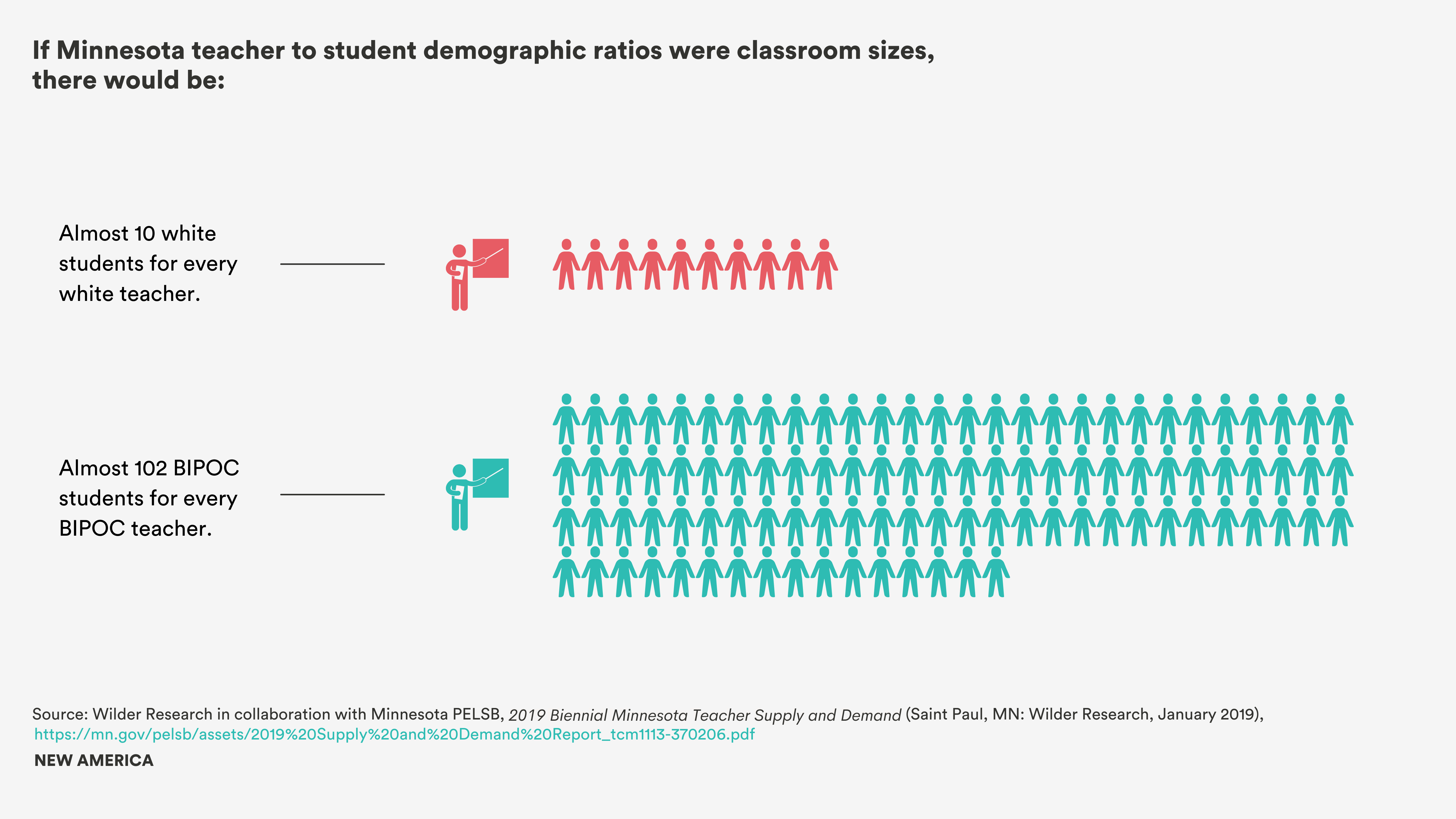
According to the 2019 Biennial Minnesota Teacher Supply and Demand report,5 only 4.3 percent of licensed teachers in the state are teachers of color.6 This is far lower than the share of students of color statewide, which is 32.4 percent.7 For every teacher of color in the state, there are nearly 102 students of color. For every white teacher, there are nearly 10 white students. Not one of the state’s 13 economic development regions has a teaching workforce that even approaches the diversity of its students.8 This is true not only in the areas traditionally viewed as more diverse, like the Twin Cities region (Minneapolis and Saint Paul), but also in the northern headwaters region and increasingly diverse rural schools and districts. As the state has diversified, its teaching population has not. Given the benefits of a diverse teacher workforce, it stands to reason that if Minnesota diversifies its teaching workforce, its BIPOC students will benefit in turn.
Citations
- Thomas S. Dee, “Teachers, Race, and Student Achievement in a Randomized Experiment,” The Review of Economics and Statistics 86 (2004): 195–210, https://doi.org/10.1162/003465304323023750
- Seth Gershenson, Cassandra M. D. Hart, Constance A. Lindsay, and Nicholas W. Papageorge, “The Long-Run Impacts of Same-Race Teachers,” IZA Institute of Labor Economics 10630 (2017): 1–70, http://ftp.iza.org/dp10630.pdf
- Stephen B. Holt and Seth Gershenson, “The Impact of Demographic Representation on Absences and Suspensions,” Policy Studies Journal 47 (November 2019): 1069–1099, https://onlinelibrary.wiley.com/doi/abs/10.1111/psj.12229
- Jason A. Grissom and Christopher Redding, “Discretion and Disproportionality: Explaining the Underrepresentation of High-Achieving Students of Color in Gifted Programs,” AERA Open 2 (January–March 2016): 1–25, https://eric.ed.gov/?id=EJ1194583
- Wilder Research in collaboration with Minnesota PELSB, 2019 Biennial Minnesota Teacher Supply and Demand (Saint Paul, MN: Wilder Research, January 2019), https://mn.gov/pelsb/assets/2019%20Supply%20and%20Demand%20Report_tcm1113-370206.pdf. The 2021 report contained numerous errors in the race and ethnicity data, making an accurate analysis of the numbers all but impossible. For more information, see 2021 Biennial Report: Supply and Demand of Teachers in Minnesota (Saint Paul: Minnesota PELSB, 2021), 18–19, https://mn.gov/pelsb/assets/Supply%20and%20Demand%202021_Final_tcm1113-463801.pdf
- Wilder Research with PELSB, 2019 Biennial.
- Minnesota Department of Education (MDE), “Minnesota Education Statistics Summary,” September 5, 2019, https://education.mn.gov/mdeprod/groups/educ/documents/basic/bwrl/mdg3/~edisp/mde087765.pdf
- Wilder Research with PELSB, 2019 Biennial, 5.
GYO in Minnesota
Minnesota is one of nine states in the nation that offers a statewide competitive grant for GYO program development and implementation (see Appendix).9 Since the 2016–17 school year, it has allocated $1.5 million annually for the GYO grant program to fund two pathways aimed at boosting the state’s supply of teachers: “Pathway 1” for paraprofessional programs, and “Pathway 2” for secondary student programs.10 While the state has a set of requirements for grant eligibility, it does not have explicit criteria for how individual GYO programs should be designed.11 According to Tyler Livingston, supervisor of educator effectiveness programs at the Minnesota Department of Education (MDE), this reflects a Minnesotan approach to local control governance, in which LEAs have wide latitude in the manner by which they operate.12
Paraprofessional Pathways to Teacher Licensure:Pathway 1
There is clear appeal for a pathway for paraprofessionals to earn their teaching license. Paraprofessionals more closely match student race, ethnicity, and language demographics than the teacher workforce, nearly mirroring the national population.13 In Saint Paul Public Schools (SPPS), for example, 53 percent of paraprofessionals are Black, Indigenous, and people of color (BIPOC), compared to just 20 percent of SPPS licensed teachers.14 In addition, many paraprofessionals have a demonstrated interest in education, and their experience in schools makes them better prepared for the teaching profession than nontraditional candidates without similar experience.
School districts that enroll 30 percent or more students of color and that have partnered with an nonconventional teacher residency program approved by the state’s Professional Educator Licensing and Standards Board (PELSB) are eligible to apply for the GYO Pathway 1 grant. “Nonconventional teacher residency programs” are those established outside of traditional teacher certification routes which provide a year-long clinical training under the mentorship of a licensed teacher. This requirement significantly narrows the potential applicant pool; only two universities, the University of St. Thomas and University of Minnesota, Twin Cities, are currently PELSB certified as nonconventional residency programs. An additional nine universities have PELSB-approved nonconventional programs (not residency), and these programs may also qualify for GYO funding if they offer a residency program that meets PELSB’s definition of “residency.”15 The grant funding must go toward scholarships and stipends for program candidates, and programs are “strongly encouraged,” although not required, to recruit BIPOC candidates. In both 2020 and 2021, all Pathway 1 grants were awarded to districts partnered with either the University of Minnesota, Twin Cities (UMTC) or the University of St. Thomas, and all but one district awarded a grant in 2020 got the grant again in 2021.16
GYO for Secondary Students: Pathway 2 and Other Grants
GYO programs for secondary students have historically emphasized building student interest in the profession through coursework, internships at local schools, and even clubs. Despite their popularity—47 states and the District of Columbia have at least one GYO program for secondary students—little is known about the programs’ impact on eventual teacher recruitment and retention.17 The need for these programs is clear, considering that few American high school students aspire to be educators. In a 2015 ACT survey of 1.9 million students, only 4 percent of respondents wanted to become teachers, and of those, 70 percent were white.18 If we are to increase the percentage of BIPOC educators, any strategy must include the recruitment and retention of BIPOC students.
To be sure, state policies and funding are integral to increasing opportunities for high school students to gain exposure to teaching as a career, but they are only part of the strategy. Any successful program for high school students ultimately operates at the local level. Southwest Teacher Preparatory Program staff were effusive in their praise for the local high school teacher responsible for identifying and recruiting students for his introduction to education course in Worthington, Minnesota.19 Teachers can play a critical role by simply telling students that teaching could be in their future. As Kleber Ortiz, a faculty member at Minneapolis Community & Technical College, noted during a public New America event on GYO, “we’re trying to get students to think about teaching, when we haven’t planted in their hearts that they can be teachers. It’s very hard for students to see themselves as teachers when we haven’t said ‘you can be a teacher’ from day one.”20
Minnesota began to address this challenge using several grant programs: the GYO Pathway 2 Grant, Introduction to Teaching Concurrent Enrollment Grant, and Concurrent Enrollment Aid. School districts and charters may pursue a grant specifically focused on expanding GYO for secondary students. So-called Pathway 2 grants appear to be far less restrictive; they can be used for a host of different programs. The only requirement is that they “encourage secondary school students to pursue teaching.”21 This reflects the nature of secondary programs, which vary greatly in scope and design but usually exist to generate interest in teaching.22 The MDE awarded Pathway 2 funds to four districts partnered with four different universities in fiscal year 2020, and one district partnered with one university in fiscal year 2021.23
Pathway 2 funds are not the only state funding source for secondary GYO programs. Minnesota allocated $375,000 annually in 2020 and 2021 for its “Introduction to Teaching Concurrent Enrollment Grant,” for institutions offering “Introduction to Teaching” or “Introduction to Education,” concurrent enrollment courses that allow students to earn college credits while still in high school.24 This is in addition to the $150 per pupil a district receives for each student in a concurrent enrollment course,25 additional funding that postsecondary institutions receive per credit hour rewarded,26 and another $4 million annual grant in 2020 and 2021 set aside for Concurrent Enrollment Aid.27 Schools may offer a concurrent enrollment course, where students may receive both secondary and postsecondary credit upon successful completion, if they are partnered with an accredited postsecondary institution that has adopted and implemented the National Alliance of Concurrent Enrollment Partnerships’ program standards.28
However, while there is ample funding for concurrent enrollment, students may face barriers in accessing these courses. First, students must be in 10th grade or higher. Students who apply must have received a passing score on the eighth grade Minnesota Comprehensive Assessment in reading. Program admission can be limited based on past academic performance and left up to the discretion of the postsecondary institution. Finally, access to these programs may be limited by geographic proximity to an eligible postsecondary institution, lack of licensed teachers to teach the course, or lack of student interest that limits enrollment. There is not, however, a significant financial barrier; the MDE pays for any concurrent enrollment fees and necessary materials.29
The role of advocacy in promoting a diverse teacher workforce and GYO programs
While efforts to diversify the teacher workforce have been ongoing for more than a decade, statewide momentum accelerated with the formation of the Coalition to Increase Teachers of Color and American Indian Teachers (TOCAIT) in Minnesota in December 2015. Recognizing the need to diversify the teaching workforce, and spurred by local policy briefs highlighting the issue, seven teacher educators and two district administrators began organizing Minnesota education interests around a shared goal: doubling the number of TOCAIT in the state and ensuring that at least 20 percent of people in teacher preparation pathways are BIPOC.30
In 2016, the Coalition developed and adopted a five-point legislative platform to meet its goals.31 Relationships built through this process, and most importantly with Minnesota’s state ethnic councils (led by the Minnesota Council on Latino Affairs (MCLA), and including the Council on Asian Pacific Minnesotans, the Council for Minnesotans of African Heritage and the Minnesota Indian Affairs Council) helped the Coalition work with state policymakers and legislators.32
The Coalition has affected real legislative change. In 2016, it successfully lobbied for language in the omnibus HF 2749 that, for the first time, established that students shall have “equitable access to effective and diverse teachers who reflect the racial/ethnic diversity of enrolled students in the district.”33 Codifying a statewide commitment to teacher diversity formalized an obligation to give students access to educators that reflect their own diversity, building leverage for successive legislation. The Coalition introduced, and found bipartisan sponsors for, the first iteration of the Increase Teachers of Color Act (ITCA) in the 2017 legislative session, a bill that has been introduced annually since, with significant changes year to year depending on current need and past success. That year the Coalition helped secure a $500,000 increase in GYO grant funding, an expanded definition of who could receive GYO grants, expansion of other funding streams to include GYO programs, and the establishment of (and funding for) an “Introduction to Teaching” concurrent enrollment course.
Between 2018 and 2020, the Coalition had mixed success with its legislative proposals.34 In the 2021 legislative session, it is focused on expanding GYO grants for three types of programs (rather than the current two) and increasing biennial GYO funding from $3 million to $17 million in FY 2022–23.
A central challenge to its work is navigating the state’s divided legislature—Democrats control the House and Republicans control the Senate. However, the Coalition’s approach of developing relationships with relevant entities and individuals, collaborating with others to develop goals, having a feedback cycle to make necessary corrections, and using advocacy to push legislation and lift up the experiences of teachers and students has helped it be successful. It does not hang its laurels on a single victory, but evaluates the results of its work, determines the next round of changes that it would like to see, and repeats the cycle. Paul Spies, Coalition co-founder, notes that it only focuses on issues with membership consensus, presenting a unified front.35 Core to this is building and maintaining relationships with Minnesota’s TOCAIT, hosting conferences, affinity group dinners, dialogues, and other events.36 The Coalition also attributed its success to placing GYO programs in a broader ecosystem of needed changes; developing clear, easy to communicate short- and long-term goals; leveraging available resources rather than starting from scratch; centering BIPOC voices; and developing resilience.37
Last, it is important to note that the Coalition’s work has not been on GYO alone, but on a holistic approach to increasing teachers of color and American Indian teachers. While GYO is an important tool for building teacher diversity, and one of the Coalition’s five priorities, the strategy will not be successful in increasing teacher diversity if climates on school and university campuses are not more diverse, or if they do not receive induction and retention support once they successfully complete a GYO program. As Spies observed: “tearing down systemic racism in every aspect is important too. If teachers of color are introduced into a system still rife with systemic inequity, the program simply isn’t going to be effective.”38
Citations
- Thomas S. Dee, “Teachers, Race, and Student Achievement in a Randomized Experiment,” The Review of Economics and Statistics 86 (2004): 195–210, https://doi.org/10.1162/003465304323023750
- Seth Gershenson, Cassandra M. D. Hart, Constance A. Lindsay, and Nicholas W. Papageorge, “The Long-Run Impacts of Same-Race Teachers,” IZA Institute of Labor Economics 10630 (2017): 1–70, http://ftp.iza.org/dp10630.pdf
- Stephen B. Holt and Seth Gershenson, “The Impact of Demographic Representation on Absences and Suspensions,” Policy Studies Journal 47 (November 2019): 1069–1099, https://onlinelibrary.wiley.com/doi/abs/10.1111/psj.12229
- Jason A. Grissom and Christopher Redding, “Discretion and Disproportionality: Explaining the Underrepresentation of High-Achieving Students of Color in Gifted Programs,” AERA Open 2 (January–March 2016): 1–25, https://eric.ed.gov/?id=EJ1194583
- Wilder Research in collaboration with Minnesota PELSB, 2019 Biennial Minnesota Teacher Supply and Demand (Saint Paul, MN: Wilder Research, January 2019), https://mn.gov/pelsb/assets/2019%20Supply%20and%20Demand%20Report_tcm1113-370206.pdf. The 2021 report contained numerous errors in the race and ethnicity data, making an accurate analysis of the numbers all but impossible. For more information, see 2021 Biennial Report: Supply and Demand of Teachers in Minnesota (Saint Paul: Minnesota PELSB, 2021), 18–19, https://mn.gov/pelsb/assets/Supply%20and%20Demand%202021_Final_tcm1113-463801.pdf
- Wilder Research with PELSB, 2019 Biennial.
- Minnesota Department of Education (MDE), “Minnesota Education Statistics Summary,” September 5, 2019, https://education.mn.gov/mdeprod/groups/educ/documents/basic/bwrl/mdg3/~edisp/mde087765.pdf
- Wilder Research with PELSB, 2019 Biennial, 5.
- Amaya Garcia, A 50-State Scan of Grow Your Own Teacher Policies and Programs (Washington, DC: New America, 2020), https://www.newamerica.org/education-policy/reports/grow-your-own-teachers/
- House File 1, 91st Legislature and 1st Special Session, §3-23-6 (MN 2019), https://www.revisor.mn.gov/laws/2019/1/Session+Law/Chapter/11/. For full authorizing language, see this report’s appendix.
- The MDE does not solely focus on GYO as a strategy to diversify the teaching workforce statewide. It has an inventory of funded programs for diversifying the teacher workforce, officially listing 11 different sources that districts may be eligible. For a full list, see the department’s “Inventory of Funded Programs” at https://education.mn.gov/mdeprod/idcplg?IdcService=GET_FILE&dDocName=MDE089146&RevisionSelectionMethod=latestReleased&Rendition=primary. In an interview with the supervisor of educator effectiveness programs at MDE, it was noted that in addition to administering, distributing, and monitoring diversity-related grant funds, the state leverages convening power to spread good ideas and practices statewide, provides technical assistance upon request, and is actively looking into building state communities of practice. See note #12, below.
- Tyler Livingston (supervisor of educator effectiveness programs in the MDE), in conversation with author, March 24, 2021.
- Kaylan Connally, Amaya Garcia, Shayna Cook, and Conor P. Williams, Teacher Talent Untapped: Multilingual Paraprofessionals Speak About the Barriers to Entering the Profession (Washington, DC: New America, 2017), 7, https://www.newamerica.org/education-policy/policy-papers/teacher-talent-untapped/
- Saint Paul Public Schools (SPPS), Teacher Quality Partnership Grant Application (Washington, DC: U.S. Department of Education, 2019), 4, https://oese.ed.gov/files/2019/12/stpaulPN.pdf
- From PELSB’s “List of Approved Nonconventional Teacher Residency Programs: “PELSB has defined ‘residency’ to include: • District and preparation provider partnership. • Financial support provided to the candidate may be offered in exchange for a teaching commitment. • Instruction and assessment of teacher candidates is tightly integrated with clinical practice. • Full academic year (4–5 days per week) of clinical practice; teacher candidate and trained mentor teacher follow co-teaching model; National Center for Teacher Residencies advocates for 1200 total clinical hours for full academic year placements. • Mentor teachers trained in mentoring, co-teaching, and collaborative feedback practices.• Cohort-based.” For more information, see Minnesota Department of Education (MDE), “List of Approved Nonconventional Teacher Residency Programs,” 2019, https://education.mn.gov/mdeprod/groups/educ/documents/grant/bwrl/mdg3/~edisp/mde087100.pdf
- FY 2020 GYO Pathway 1 funds were awarded to Anoka-Hennepin School District, Intermediate School District 917, Minneapolis Public Schools, Northeast Metro 916 Intermediate School District, and Saint Paul Public Schools. FY 2021 GYO Pathway 1 funds were awarded to Anoka-Hennepin School District, Intermediate School District 917, Minneapolis Public Schools, rth St. Paul-Maplewood-Oakdale ISD 622, and Saint Paul Public Schools. Tyler Livingston, in email to author, May 21, 2021.
- Amaya Garcia, A 50-State Scan; and Conra D. Gist, Margarita Bianco, and Marvin Lynn, “Examining Grow Your Own Programs Across the Teacher Development Continuum: Mining Research on Teachers of Color and Nontraditional Educator Pipelines,” Journal of Teacher Education 70 (2019).
- The Condition of Future Educators 2015 (Iowa City, IA: ACT 2015), https://www.act.org/content/dam/act/unsecured/documents/Future-Educators-2015.pdf
- Rhonda Bonnstetter (coordinator, Southwest Teacher Preparation Partnership) and Christine Quisley, (SWTPP director of clinical experiences), in conversation with author, April 28, 2021.
- Kleber Ortiz, “Growing Our Own Educators in Minnesota: Programs for High School Students,” online video of webcast, February 18, 2021, https://www.newamerica.org/education-policy/events/growing-our-own-educators-minnesota-high-school-programs/
- House File 1, 91st Legislature and 1st Special Session, §3-23-6c (MN 2019), https://www.revisor.mn.gov/laws/2019/1/Session+Law/Chapter/11/
- Gist, Bianco, and Lynn.
- FY 2020 GYO Pathway 2 funds were awarded to Bloomington Public Schools in partnership with Normandale Community College, Roseville Area Schools in partnership with Minneapolis Community and Technical College, St. Cloud Area School District in partnership with St. Cloud State University, and Saint Paul Public Schools in partnership with University of Minnesota, Twin Cities. FY 2021 GYO Pathway 2 funds were awarded to the Faribault School System in partnership with Minnesota State University Mankato. Tyler Livingston, in email to author, May 21, 2021.
- House File 1, 91st Legislature and 1st Special Session, §3-23-2 (MN 2019), https://www.revisor.mn.gov/laws/2019/1/Session+Law/Chapter/11/
- House File 1, 91st Legislature and 1st Special Session, §2-10-3 (MN 2019), https://www.revisor.mn.gov/laws/2019/1/Session+Law/Chapter/11/
- 2020 Minnesota Statutes, §124D.09 (MN 2020), https://www.revisor.mn.gov/statutes/cite/124D.09#stat.124D.09.10
- House File 1, 91st Legislature and 1st Special Session, §2-33-23 (MN 2019), https://www.revisor.mn.gov/laws/2019/1/Session+Law/Chapter/11/
- 2020 Minnesota Statutes, Education Code: Prekindergarten–Grade 12, §124D.091 (MN 2020), https://www.revisor.mn.gov/statutes/cite/124D.091
- 2020 Minnesota Statutes, Education Code: Prekindergarten–Grade 12, §124D.09.13 (MN 2020), https://www.revisor.mn.gov/statutes/cite/124D.09.13
- Robbie Burnett, Violeta Hernandez Espinosa, and Paul Spies, “Minnesota Grow your Own Policy Spotlight,” Teacher Education Quarterly (Winter 2019): 87–96.
- The Coalition’s five key approaches center on transforming climate and curriculum, incentives for teaching service for BIPOC individuals, ending teacher testing requirements, induction and retention support, and pathways for BIPOC individuals into the classroom. For more information, see https://www.tocaimn.com/about
- Burnett, Hernandez Espinosa, and Spies.
- House File 2749, 89th Legislature, §122A.41.5 (MN 2016), http://wdoc.house.leg.state.mn.us/leg/LS89/HF2749.3.pdf
- Coalition to Increase Teachers of Color and American Indian Teachers in Minnesota (website), “A Brief History of the Coalition,” https://www.tocaimn.com/history
- Paul Spies (Coalition to Increase Teachers of Color and American Indian Teachers in Minnesota Co-founder), in conversation with author, March 24, 2021.
- Coalition to Increase Teachers of Color and American Indian Teachers in Minnesota.
- Burnett, Hernandez Espinosa, and Spies, 93–94.
- Spies.
A Closer Look at Minnesota GYO Programs: Local Work
The following three programs, two in the Twin Cities region and one in the southwest corner of the state, demonstrate how drastically different GYO approaches can be. Program organization and structure depends on available resources, the challenges faced by teaching residents, and the strength of the partnerships between district(s) and postsecondary institution(s). But all three are driven by a common goal: diversifying the teacher workforce.
The Saint Paul Urban Teacher Residency Program
The Saint Paul Public Schools Urban Teacher Residency Program (SUTR) is a partnership between the University of St. Thomas and Saint Paul Public Schools (SPPS). While the program is not exclusively for SPPS paraprofessionals, the program gives heavy admission preference to SPPS employees. To be eligible, an individual must have a bachelor's degree from an accredited institution and must commit to teach for a minimum of three years in SPPS after successful completion of the program.39 At 15 months long, the program is a full teacher residency, with coursework over two summers, as well as on Mondays during the fall semester and Fridays during the spring. The other four days, residents work under the guidance of a trained mentor teacher. Once candidates complete the program, they earn a master’s in education and, upon successful passing the Minnesota Teaching Licensure Examinations (MTLEs), a Tier 3 teaching license.40 Graduates have earned licenses in elementary education and special education. Between 25 and 30 residents are in each cohort, with the program currently finalizing its sixth cohort.
SUTR traces its roots to the Twin Cities Teaching Collaborative (TC2) in 2010, a collective of six Twin Cities colleges and universities working together to improve teacher preparation.41 While the partnership did not formalize a region-wide GYO program, it did help SPPS build relationships with universities in the region. When SPPS won a $150,000 teacher residency planning grant from the Bush Foundation in 2014, it chose to partner with St. Thomas.42 Guided by the National Center for Teacher Residencies (NCTR), SPPS and St. Thomas developed a program model and received a three-year, $3 million grant43 in December 2015. SUTR established additional funding streams from federal and local sources and continued support from NCTR to help sustain the program, including significant matching funds from SPPS.44
In the most recent fiscal year, SUTR had a combined $1.5 million in funding from multiple sources, including a federal Teacher Quality Partnership (TQP) grant, NCTR grant, and school district partnerships.45 The money allows SUTR to provide substantial supports for its residents: each resident receives a $26,000 stipend, health and dental insurance, and $1,000 in books for their courses. The TQP grant funds a full-time recruiter, a data analyst, and one elementary and one special education specialist. Navigating pairs, affinity groups, and mentor stipends are also funded by NCTR’s Black Educators Initiative. St. Thomas also provides in-kind contributions, reducing tuition for students (residents pay $21,000, less than traditional tuition), giving students merit-based scholarships, and supporting a .5 full-time equivalent SUTR coordinator, as well as other faculty and staff that work with SUTR students.46 Residents are required to pay back a portion of their stipend if they do not complete their three-year teaching obligation.47
SUTR developed its approach as a response to the challenges faced by paraprofessionals and other non-traditional candidates in three core areas: recruitment, training, and retention. Housed within SPPS’s human resources department, the full-time recruiter is tasked with finding a representative cohort of educators annually to reflect SPPS’s student diversity. She does not just “sell” the SUTR package, but also builds relationships with potential candidates and helps make the program manageable. For example, she looks for additional scholarships. The stipend and benefits are essential for recruitment (and persistence through training), as it is very difficult for candidates to work an additional job while enrolled in the program. During training, technical assistance from the NCTR assists SUTR in assessing and improving its program. Significant investment in staff, and support days in the program calendar, are direct responses to struggles balancing challenging coursework with other responsibilities. As one example, residents pursuing special education licensure get one day a month with their mentor teacher to focus on completing state-required paperwork.
Most recently, SUTR built retention supports for graduates after program completion, providing newly licensed teachers with induction resources and a mentor. It found that while candidates may be equipped to teach after graduation, significant learning curves still exist. The special education license, for example, is generalized to grades K–12, so new educators may need more grade-specific guidance. SUTR’s BIPOC educators often benefit from support navigating their new environments as they enter schools where the majority of educators and staff are white.48
Relationships with SPPS officials and schools lead to high rates of graduate placement in schools, where the starting salary hovers around $52,000 for new teachers with a master’s degree. And SUTR residents persist at higher rates. Eighty-six residents from cohorts one through four were hired by SPPS through the 2020 school year. Ninety-three percent of SUTR’s graduates in cohorts one through four were retained after one year, 83 percent in cohorts one through three were retained after two years, and 64 percent in cohorts one and two were still teaching in SPPS after three years.49
While SUTR has yet to reach its goal of 80 percent candidates of color (to reflect SPPS’s similar 79 percent BIPOC students), SUTR’s first five cohorts were between 54 and 64 percent BIPOC,50 compared to the 20 percent of licensed teachers of color at SPPS. Available data indicate that 100 percent of graduates in cohort one were hired, as were 86 percent of graduates in cohort two.51 These numbers are a marked improvement over SPPS norms, and SUTR hopes that they can be a model for broader SPPS approaches to recruit, train, and retain a teacher workforce that is more reflective of its student demographics.
University of Minnesota, Twin Cities Grow Your Own Teachers Program
The University of Minnesota, Twin Cities’ (UMTC) Grow Your Own Teachers (MNGOT) program traces its roots to the Minneapolis Residency Program (MRP). Formed in 2015, the MRP was a partnership between the UMTC and Minneapolis Public Schools (MPS), focusing on recruiting non-licensed MPS employees to increase the diversity of the district’s educators.52 Available to any staff member with a bachelor's degree, three cohorts of residents from MPS have completed their 15-month residency and a 30-credit, three-semester pathway to a full license and master's degree.53 The program started strong (the first cohort was 75 percent BIPOC), and was well supported by district, state, and philanthropic funding. The MRP was funded by a commitment from MPS, a seed investment from Minnesota Comeback (a Minnesota organization investing in programs improving the state’s K–12 education system), and, as one of the two original programs eligible for state grant funds, $750,000 from the Minnesota Grow Your Own Grant.54 Of the 47 MRP graduates whose employment records were found, 43 are still at MPS (37 in teaching roles), with four more graduates in teaching roles in other districts.55
The program transitioned from the Minneapolis Residency Program in 2017 to MNGOT in 2018 due to a lack of available funding from MPS and limited teaching placements for program graduates.56 State funding was also reduced, due to increased demand for grant funding from other school districts.
MNGOT launched using the existing MRP framework and curriculum with some modifications. Now the program is two years in duration, rather than three semesters, and is for non-licensed district employees with bachelor’s degrees. Successful completion leads to a license in secondary sciences, K–6 elementary, and, as of the fall 2022 cohort, K–12 ESL.57 Any school district with at least 30 percent BIPOC students is eligible to participate.
Limited grant and district funding means that the program operates at cost. MNGOT does not receive federal funding. Its state funding is limited to money granted to districts that include MNGOT as a partner and, most recently, a $56,000 Collaborative Urban and Greater Minnesota Educators of Color (CUGMEC) Grant for FY 2021.58 In lieu of tuition, candidates pay a fee of $10,800 a year, or $21,600 in total. Like other programs, stress, time, and money are significant barriers for residents.
MNGOT’s program leadership and staff are proactive about helping reduce these obstacles. First, MNGOT is relentless in gaining additional funds for its residents, working with each one to help them find private donations and grants to cover their fees. It relies in part on individual private donations from individuals and family foundations to the university for specific candidates. For example, Laura Mogelson, director of the Multiple Pathways to Teaching Office at UMTC, described how MNGOT staff cobbled together seven different sources of aid for one resident. The program is designed to be job-embedded so that candidates continue to be employed full time by their districts as paraprofessionals. Coursework is Tuesday evenings and every other Saturday, rather than during the school day, and over two years rather than three semesters.59 Residents hail from nine districts in the area.
The district with by far the largest cohort is Anoka-Hennepin Schools (AHS), north of the Twin Cities. The partnership between Anoka and MNGOT is fruitful, and instructive, for several reasons. First, Anoka has a designated recruitment and retention specialist—Julie Phillips—who serves as the primary recruiter for Anoka MNGOT candidates, visiting schools, promoting the program, and leveraging relationships with district principals to identify paraprofessionals that could be a good fit.60 Anoka is alone among the partner districts in helping fund its candidates, with the help of grants from state and local sources.61 Starting with four candidates in the first cohort, AHS staff now account for 18 of the 30 teacher candidates in the 2020-2022 MNGOT cohort.62 Most significantly, the Anoka and MNGOT teams work together. As Phillips observed, “communication is probably the biggest part of that partnership.” The team at UMTC have been “instrumental in helping us write our grant proposal to solidify our program,” she said, adding, “at the end of the year as we write our summary…and our report on how the year went, we do that together. It’s a conversation and it's a collaboration.”63
By contrast, MNGOT Program Administrator Jennifer Clifden noted that maintaining communication and consistency among the program contacts can be a challenge due to staff turnover in some of their partner school districts. 64 These partnerships are all the more important because MNGOT educators keep their full-time roles as paraprofessionals. Districts and principals must be willing and able to coordinate with MNGOT to ensure that participants are meeting the expectations for their full-time positions and their teacher residency.
For the first cohort (2018–20), 17 of the 18 candidates (23.5 percent BIPOC) from 10 districts completed the program, 13 of whom are now employed as fully licensed teachers. In the 2019–21 cohort, 21 of the 23 candidates (56.5 percent BIPOC) from nine districts are on track for completion. All 30 residents from the 2020–2022 cohort (36.6 percent BIPOC) are currently on track, half of whom are preparing for K–12 ESL.65 Including MRP from 2015–17, UMTC GYO programs have averaged more than 50 percent BIPOC.66
The Southwest Teacher Preparation Program
The Southwest Teacher Preparation Program (SWTPP) is a partnership between Minnesota West Community and Technical College (MNWest), Southwest Minnesota State University (SMSU), and Worthington Public Schools. Worthington is a rural school district in southern Minnesota that also happens to be one of the most diverse in the state, with 78.7 percent of its students being students of color and 36.8 percent being classified as English learners.67 The district’s licensed educators are far less diverse (by one count, 97 percent white68) than the student body, and Worthington faces the already-difficult challenge of recruiting and retaining educators in a predominantly rural community.
Rather than take a deficit-minded approach, the SWTPP looked at its diverse paraprofessional staff as a candidate pool with experiences in the schools that reflected the experiences of its students. Recognizing the opportunity, it worked backwards, identifying the obstacles that hindered paraprofessionals from gaining full-time teaching licenses. Many of their paraprofessionals only have their associate degrees, so SWTPP built a program where that was the baseline credential necessary to begin. SWTPP cohort residents start their coursework at MNWest in Worthington to complete any prerequisites, before transferring to SMSU. But Worthington educators do not have to drive the more than 60 miles to SMSU. Instead, the SWTPP partnership arranged a SMSU satellite campus at MNWest. Candidates can also remotely attend SMSU.69
Because paraprofessionals cannot afford to stop working to be full-time students or student teachers, the SWTPP applied for a waiver from the state that let its residents teach half-time, year-long (rather than the state-required full-time over at least 12 weeks), and over two years. Worthington Public Schools also committed resources to the program, allowing paraprofessionals to retain their paid positions with the necessary flexibility to complete their residency hours. Upon program completion, residents receive their elementary education license (with the option to also pursue licensure in ESL and/or K–12 reading), and are guaranteed a job interview at a Worthington school. The partnership leans heavily on Worthington principals, through the region’s principals’ association, to identify and recruit paraprofessionals that they believe would be a good fit for the program.70
SWTPP has four other non-traditional pathways to teaching, illustrating the many situations that individuals may approach pursuing the profession: for current MNWest students, for candidates with a prior bachelor’s degree/Tier 1 teaching license, for community members interested in becoming teachers, and for high school students.71 The program will have its first cohort this coming fall.72 Currently, the SWTPP does not access state or federal money, instead using grants from the McKnight Foundation and Southwest Initiative Foundation (SWIF) to help pay scholarships and grants for candidates. SWTPP and Worthington also fund stipends for mentor teachers who work with educators their first three years in the classroom to promote retention of BIPOC educators.
Similarly funded by SWIF and the McKnight Foundation, high school students in the secondary pathway take an introduction to education course at MNWest. Taught by a local high school teacher, students get exposure to the teaching profession and a 15-hour teaching lab where they student-teach in a Worthington school.73 Concurrent enrollment agreements with MNWest give students three college credits that can apply to an associate degree at MNWest, which easily rolls into credit toward a teaching degree at SMSU. Students may also take a concurrent enrollment “Technology in Education” course, receiving two MNWest credits upon successful completion.74 Students are recruited locally, with the course’s high school teacher leading recruitment efforts.
More broadly, SMSU has offered concurrent enrollment courses in Introduction to Education and Introduction to Child Growth and Development since 2018. Focusing on GYO in Minnesota rural schools, SMSU awarded 1506 credits to 502 students across 26 public schools through fall 2020.75 High school educators teach the course, while a SMSU professor supports the program and serves as the faculty of record. Thirteen former concurrent enrollment students are now enrolled in education programs at SMSU, and while SMSU does not track students at other universities, it is estimated that the large majority of students who have enrolled in college since are pursuing careers in education.76
In addition to SWTPP, which primarily focuses on elementary education licenses, SMSU has two other programs for paraprofessionals pursuing teaching licensure, one for special education and another for ESL. The special education program was SMSU’s first foray into paraprofessional pathways, initially funded by a $385,000 state grant eight years ago, which paid faculty until program tuition could cover costs approximately two years later. Every candidate in the special education program has passed the requisite MTLEs, and all but three have met state edTPA77 requirements, a success rate that SMSU attributes to the quality and experience of its paraprofessionals. Starting in fall 2021, paraprofessionals may also pursue an ESL license (for which SWTPP got a similar state waiver).
Citations
- Thomas S. Dee, “Teachers, Race, and Student Achievement in a Randomized Experiment,” The Review of Economics and Statistics 86 (2004): 195–210, https://doi.org/10.1162/003465304323023750
- Seth Gershenson, Cassandra M. D. Hart, Constance A. Lindsay, and Nicholas W. Papageorge, “The Long-Run Impacts of Same-Race Teachers,” IZA Institute of Labor Economics 10630 (2017): 1–70, http://ftp.iza.org/dp10630.pdf
- Stephen B. Holt and Seth Gershenson, “The Impact of Demographic Representation on Absences and Suspensions,” Policy Studies Journal 47 (November 2019): 1069–1099, https://onlinelibrary.wiley.com/doi/abs/10.1111/psj.12229
- Jason A. Grissom and Christopher Redding, “Discretion and Disproportionality: Explaining the Underrepresentation of High-Achieving Students of Color in Gifted Programs,” AERA Open 2 (January–March 2016): 1–25, https://eric.ed.gov/?id=EJ1194583
- Wilder Research in collaboration with Minnesota PELSB, 2019 Biennial Minnesota Teacher Supply and Demand (Saint Paul, MN: Wilder Research, January 2019), https://mn.gov/pelsb/assets/2019%20Supply%20and%20Demand%20Report_tcm1113-370206.pdf. The 2021 report contained numerous errors in the race and ethnicity data, making an accurate analysis of the numbers all but impossible. For more information, see 2021 Biennial Report: Supply and Demand of Teachers in Minnesota (Saint Paul: Minnesota PELSB, 2021), 18–19, https://mn.gov/pelsb/assets/Supply%20and%20Demand%202021_Final_tcm1113-463801.pdf
- Wilder Research with PELSB, 2019 Biennial.
- Minnesota Department of Education (MDE), “Minnesota Education Statistics Summary,” September 5, 2019, https://education.mn.gov/mdeprod/groups/educ/documents/basic/bwrl/mdg3/~edisp/mde087765.pdf
- Wilder Research with PELSB, 2019 Biennial, 5.
- Amaya Garcia, A 50-State Scan of Grow Your Own Teacher Policies and Programs (Washington, DC: New America, 2020), https://www.newamerica.org/education-policy/reports/grow-your-own-teachers/
- House File 1, 91st Legislature and 1st Special Session, §3-23-6 (MN 2019), https://www.revisor.mn.gov/laws/2019/1/Session+Law/Chapter/11/. For full authorizing language, see this report’s appendix.
- The MDE does not solely focus on GYO as a strategy to diversify the teaching workforce statewide. It has an inventory of funded programs for diversifying the teacher workforce, officially listing 11 different sources that districts may be eligible. For a full list, see the department’s “Inventory of Funded Programs” at https://education.mn.gov/mdeprod/idcplg?IdcService=GET_FILE&dDocName=MDE089146&RevisionSelectionMethod=latestReleased&Rendition=primary. In an interview with the supervisor of educator effectiveness programs at MDE, it was noted that in addition to administering, distributing, and monitoring diversity-related grant funds, the state leverages convening power to spread good ideas and practices statewide, provides technical assistance upon request, and is actively looking into building state communities of practice. See note #12, below.
- Tyler Livingston (supervisor of educator effectiveness programs in the MDE), in conversation with author, March 24, 2021.
- Kaylan Connally, Amaya Garcia, Shayna Cook, and Conor P. Williams, Teacher Talent Untapped: Multilingual Paraprofessionals Speak About the Barriers to Entering the Profession (Washington, DC: New America, 2017), 7, https://www.newamerica.org/education-policy/policy-papers/teacher-talent-untapped/
- Saint Paul Public Schools (SPPS), Teacher Quality Partnership Grant Application (Washington, DC: U.S. Department of Education, 2019), 4, https://oese.ed.gov/files/2019/12/stpaulPN.pdf
- From PELSB’s “List of Approved Nonconventional Teacher Residency Programs: “PELSB has defined ‘residency’ to include: • District and preparation provider partnership. • Financial support provided to the candidate may be offered in exchange for a teaching commitment. • Instruction and assessment of teacher candidates is tightly integrated with clinical practice. • Full academic year (4–5 days per week) of clinical practice; teacher candidate and trained mentor teacher follow co-teaching model; National Center for Teacher Residencies advocates for 1200 total clinical hours for full academic year placements. • Mentor teachers trained in mentoring, co-teaching, and collaborative feedback practices.• Cohort-based.” For more information, see Minnesota Department of Education (MDE), “List of Approved Nonconventional Teacher Residency Programs,” 2019, https://education.mn.gov/mdeprod/groups/educ/documents/grant/bwrl/mdg3/~edisp/mde087100.pdf
- FY 2020 GYO Pathway 1 funds were awarded to Anoka-Hennepin School District, Intermediate School District 917, Minneapolis Public Schools, Northeast Metro 916 Intermediate School District, and Saint Paul Public Schools. FY 2021 GYO Pathway 1 funds were awarded to Anoka-Hennepin School District, Intermediate School District 917, Minneapolis Public Schools, rth St. Paul-Maplewood-Oakdale ISD 622, and Saint Paul Public Schools. Tyler Livingston, in email to author, May 21, 2021.
- Amaya Garcia, A 50-State Scan; and Conra D. Gist, Margarita Bianco, and Marvin Lynn, “Examining Grow Your Own Programs Across the Teacher Development Continuum: Mining Research on Teachers of Color and Nontraditional Educator Pipelines,” Journal of Teacher Education 70 (2019).
- The Condition of Future Educators 2015 (Iowa City, IA: ACT 2015), https://www.act.org/content/dam/act/unsecured/documents/Future-Educators-2015.pdf
- Rhonda Bonnstetter (coordinator, Southwest Teacher Preparation Partnership) and Christine Quisley, (SWTPP director of clinical experiences), in conversation with author, April 28, 2021.
- Kleber Ortiz, “Growing Our Own Educators in Minnesota: Programs for High School Students,” online video of webcast, February 18, 2021, https://www.newamerica.org/education-policy/events/growing-our-own-educators-minnesota-high-school-programs/
- House File 1, 91st Legislature and 1st Special Session, §3-23-6c (MN 2019), https://www.revisor.mn.gov/laws/2019/1/Session+Law/Chapter/11/
- Gist, Bianco, and Lynn.
- FY 2020 GYO Pathway 2 funds were awarded to Bloomington Public Schools in partnership with Normandale Community College, Roseville Area Schools in partnership with Minneapolis Community and Technical College, St. Cloud Area School District in partnership with St. Cloud State University, and Saint Paul Public Schools in partnership with University of Minnesota, Twin Cities. FY 2021 GYO Pathway 2 funds were awarded to the Faribault School System in partnership with Minnesota State University Mankato. Tyler Livingston, in email to author, May 21, 2021.
- House File 1, 91st Legislature and 1st Special Session, §3-23-2 (MN 2019), https://www.revisor.mn.gov/laws/2019/1/Session+Law/Chapter/11/
- House File 1, 91st Legislature and 1st Special Session, §2-10-3 (MN 2019), https://www.revisor.mn.gov/laws/2019/1/Session+Law/Chapter/11/
- 2020 Minnesota Statutes, §124D.09 (MN 2020), https://www.revisor.mn.gov/statutes/cite/124D.09#stat.124D.09.10
- House File 1, 91st Legislature and 1st Special Session, §2-33-23 (MN 2019), https://www.revisor.mn.gov/laws/2019/1/Session+Law/Chapter/11/
- 2020 Minnesota Statutes, Education Code: Prekindergarten–Grade 12, §124D.091 (MN 2020), https://www.revisor.mn.gov/statutes/cite/124D.091
- 2020 Minnesota Statutes, Education Code: Prekindergarten–Grade 12, §124D.09.13 (MN 2020), https://www.revisor.mn.gov/statutes/cite/124D.09.13
- Robbie Burnett, Violeta Hernandez Espinosa, and Paul Spies, “Minnesota Grow your Own Policy Spotlight,” Teacher Education Quarterly (Winter 2019): 87–96.
- The Coalition’s five key approaches center on transforming climate and curriculum, incentives for teaching service for BIPOC individuals, ending teacher testing requirements, induction and retention support, and pathways for BIPOC individuals into the classroom. For more information, see https://www.tocaimn.com/about
- Burnett, Hernandez Espinosa, and Spies.
- House File 2749, 89th Legislature, §122A.41.5 (MN 2016), http://wdoc.house.leg.state.mn.us/leg/LS89/HF2749.3.pdf
- Coalition to Increase Teachers of Color and American Indian Teachers in Minnesota (website), “A Brief History of the Coalition,” https://www.tocaimn.com/history
- Paul Spies (Coalition to Increase Teachers of Color and American Indian Teachers in Minnesota Co-founder), in conversation with author, March 24, 2021.
- Coalition to Increase Teachers of Color and American Indian Teachers in Minnesota.
- Burnett, Hernandez Espinosa, and Spies, 93–94.
- Spies.
- Saint Paul Public Schools (website), “FAQs: What is SUTR? Who can apply? How much does it cost?” https://www.spps.org/Page/24504
- Minnesota teachers can earn one of four teaching licenses (tiers), with Tier 1 licenses being easiest to earn and Tier 4 the hardest. Different tiers have different requirements for earning and different renewal frequencies. For more information, see Education Minnesota, “Tiered Licensure in Minnesota,” July 18, 2018, https://www.educationminnesota.org/EDMN/media/edmn-files/resources/TieredLicensure_Infographic_WCAG_Compliant.pdf
- TC2 no longer exists as its own entity; it has been rolled into the Network for Excellence in Teaching, or NExT, as six of the 14 member institutions looking to improve teacher preparation in North Dakota, South Dakota, and Minnesota. For more information, visit Network for Excellence in Teaching (NexT) (website), https://www.nexteachers.org/
- SPPS, Teacher Quality Partnership Grant Application, 7.
- A sub-award from the U.S. Department of Education’s Supporting Effective Educators Development (SEED) grant program.
- Saint Paul Public Schools (website), “SPPS Seeking to Recruit Future Teachers from Diverse Backgrounds,” https://www.spps.org/site/default.aspx?PageType=3&ModuleInstanceID=95993&ViewID=7b97f7ed-8e5e-4120-848f-a8b4987d588f&RenderLoc=0&FlexDataID=77593&PageID=30358; and Danaya Lamker-Franke (SUTR supervisor), in conversation with author, April 28, 2021.
- Lamker-Franke, in email to author, May 12, 2021.
- SPPS, Teacher Quality Partnership Grant Application, 50.
- SPPS, Teacher Quality Partnership Grant Application, 23.
- Danaya Lamker-Franke, in conversation with author.
- Danaya Lamker-Franke, in email to author, May 25, 2021.
- SPPS Urban Teacher Residency by the Numbers (Saint Paul, MN: SPPS Department of Research, Evaluation, and Assessment, December 2020), emailed to author April 23, 2021.
- SPPS, Teacher Quality Partnership Grant Application, 20.
- Laura Mogelson (director, Multiple Pathways to Teaching Office University of Minnesota Twin Cities) and Jennifer Clifden (MNGOT program administrator), in conversation with author, April 29, 2021.
- Mogelson, in conversation with author.
- Mogelson, in conversation with author.
- Supplemental MNGOT Placement and Employment (April 2021) (Minneapolis: University of Minnesota Twin Cities, 2021), emailed to the author on May 6, 2021.
- Mogelson, in email to author, May 6, 2021.
- University of Minnesota (website), “MNGOT: MEd and Initial Teaching License,” https://www.cehd.umn.edu/teaching/grow/teacher/
- Office of the Legislative Auditor, Collaborative Urban and Greater Minnesota Educators of Color (CUGMEC) Grant Program (Saint Paul: State of Minnesota, 2021), 8, https://www.auditor.leg.state.mn.us/ped/pedrep/cugmec.pdf
- Jennifer Clifden, “Approaches to Grow Your Own Educator Programs in Minnesota: Pathways for Adults,” online video of webcast, February 10, 2021, https://www.newamerica.org/education-policy/events/approaches-grow-your-own-educator-programs-minnesota/
- Mogelson and Clifden, in conversation with author.
- Mogelson, in conversation with author.
- Mogelson.
- Julie Phillips, “Approaches to Grow Your Own Educator Programs in Minnesota: Pathways for Adults,” online video of webcast, February 10, 2021, https://www.newamerica.org/education-policy/events/approaches-grow-your-own-educator-programs-minnesota/. AHS also has residency partnerships with the University of St. Thomas and the University of Minnesota, outside of MNGOT.
- Clifden, “Approaches to Grow Your Own.”
- Supplemental MNGOT Placement and Employment (April 2021). BIPOC candidate numbers are from: Multiple Pathways to Teaching (Minneapolis, MN: University of Minnesota Twin Cities College of Education and Human Development, 2021), emailed to author May 6, 2021.
- Multiple Pathways to Teaching.
- Minnesota Department of Education, Minnesota Report Card, “Worthington School District,” https://rc.education.mn.gov/#demographics/orgId--10518000000__groupType--district__p--f
- Alyssa Sobotka, “Data Provides Insight into District 518 Schools,” The Globe, September 21, 2019, https://www.dglobe.com/news/education/4671502-Data-provides-insight-into-District-518-schools
- Bonnstetter and Quisley.
- Bonnstetter and Quisley.
- Christine Quisley, Southwest Teacher Preparation Program Pathways to Teaching (Worthington, MN: 2021), flyer emailed to author.
- Rhonda Bonnstetter, in email to author, May 20, 2021.
- Independent School District 518, Worthington, MN (website), “MN West Intro to Education,” https://www.isd518.net/schools/whs/concurrent-enrollment/intro-to-education/
- Independent School District 518, Worthington, MN (website), “MN West Technology in Education,” https://www.isd518.net/schools/whs/concurrent-enrollment/tech-in-education/
- Kandy Noles-Stevens (SMSU assistant professor of education), in email to author, May 27, 2021.
- Kandy Noles-Stevens.
- According to edTPA, Minnesota requires that all state-approved teacher preparation programs administer the edTPA teacher assessment to all candidates. The edTPA assessment requires candidates to demonstrate subject-specific proficiency through a submitted portfolio of work. For more information about edTPA, see its website, https://www.edtpa.com/PageView.aspx?f=GEN_AboutEdTPA.html
Challenges and Recommendations for Improving the Structure of GYO Grants in Minnesota
In interviews with various individuals across the three programs and the state more broadly, several challenges with the current GYO grant structure have emerged. First, the funding level for the grant program has not increased since its conception in 2016, when program eligibility was restricted to just two universities. The demand for these grants currently far outpaces the supply: there were 18 applicants requesting over $3 million in funding in fiscal year 2020 and 17 applicants requesting nearly $3 million in FY 2021. The state awarded funds to nine programs in FY 2020 and six programs in FY 2021.78 Only $1.455 million is available annually, for both pathways, and some have questioned whether these funds are necessary for secondary pathways, given the other sources of funding available for concurrent enrollment programs.
In addition, the grant competition cycle is contingent on the Minnesota legislative calendar, which ends in the middle of May (barring the need for a special session), meaning that the grant process cannot even start until early June. Currently, the MDE estimates that awardees may not be able to access funds until up to six months after the close of the legislative session, or well into a traditional fall semester where a cohort of paraprofessionals would find themselves needing scholarships or stipends.79 This timeline makes the grant an unreliable source of funding for long-term planning and program sustainability.
Finally, the grant requirements are narrow, limiting the number of eligible districts and educators. The paraprofessional pathway, for example, is only for those who have a bachelor's degree. Requiring state testing passage for secondary students could limit student access, too. The greater flexibility from the state in its requirements to enter the profession, without compromising on requirements for full licensure, the more teachers that may be able to join.
With these challenges in mind, 2021 proposals for reforming Minnesota GYO Grants include: preventing GYO-specific Pathway 2 grants from funding concurrent enrollment, which is already covered in other grants; increasing GYO grant funding; establishing a third pathway that is not a residency program which will include adults who do not have a bachelor’s degree; and requiring, rather than strongly encouraging, that funds go to BIPOC candidates. For more information on how the 2021 ICTA and Governor Tim Walz’s 2021 budget proposal would reform GYO grants, see: “2021 GYO Reform Proposals.”
2021 GYO Reform Proposals
House File 227, the 2021 iteration of the ICTA, would:
- Better define what Pathway 2 grants could and could not be used for, including future teaching clubs, wrap-around services for BIPOC students, and scholarships for BIPOC students enrolling in Minnesota undergraduate teacher preparation programs.80
- Increase GYO grant funding to $17 million over two years for the GYO grants program, or $8.5 million annually and $10 million annually for fiscal year 2024 and later.81 The proposal also seeks to increase the Concurrent Enrollment “Introduction to Teaching” grants from $350,000 to $500,000 annually,82 and mark $3 million annually for mentoring, induction, and retention incentive grants for teachers of color.83
- Establish a third pathway that is not a residency program which will include adults who do not have a bachelor’s degree.84
- Change the GYO legislation to require, rather than strongly encourage, that funds go to BIPOC candidates.
- For a district or charter to be eligible for GYO grants for secondary students it “must ensure that the aggregate percentage of secondary school students of color and American Indian students participating in the program is equal to or greater than the aggregate percentage of students of color and American Indian students in the school district or charter school.”85
- At least 80 percent of residency grants would go to scholarships or stipends for BIPOC residents.86
- Adult pathway grants would go toward scholarships or stipends for BIPOC candidates, and to programs with more than half of their candidates identifying as BIPOC.87
Governor Tim Walz’s 2021 budget proposal includes $4.5 million in competitive grants to implement the state’s induction model, an additional $2 million annually to expand the Grow Your Own Grant (while also expanding the eligibility length and creating a third pathway), and a $4 million annual grant for a new program for educator career pathways for middle and secondary school students.88
Citations
- Thomas S. Dee, “Teachers, Race, and Student Achievement in a Randomized Experiment,” The Review of Economics and Statistics 86 (2004): 195–210, https://doi.org/10.1162/003465304323023750
- Seth Gershenson, Cassandra M. D. Hart, Constance A. Lindsay, and Nicholas W. Papageorge, “The Long-Run Impacts of Same-Race Teachers,” IZA Institute of Labor Economics 10630 (2017): 1–70, http://ftp.iza.org/dp10630.pdf
- Stephen B. Holt and Seth Gershenson, “The Impact of Demographic Representation on Absences and Suspensions,” Policy Studies Journal 47 (November 2019): 1069–1099, https://onlinelibrary.wiley.com/doi/abs/10.1111/psj.12229
- Jason A. Grissom and Christopher Redding, “Discretion and Disproportionality: Explaining the Underrepresentation of High-Achieving Students of Color in Gifted Programs,” AERA Open 2 (January–March 2016): 1–25, https://eric.ed.gov/?id=EJ1194583
- Wilder Research in collaboration with Minnesota PELSB, 2019 Biennial Minnesota Teacher Supply and Demand (Saint Paul, MN: Wilder Research, January 2019), https://mn.gov/pelsb/assets/2019%20Supply%20and%20Demand%20Report_tcm1113-370206.pdf. The 2021 report contained numerous errors in the race and ethnicity data, making an accurate analysis of the numbers all but impossible. For more information, see 2021 Biennial Report: Supply and Demand of Teachers in Minnesota (Saint Paul: Minnesota PELSB, 2021), 18–19, https://mn.gov/pelsb/assets/Supply%20and%20Demand%202021_Final_tcm1113-463801.pdf
- Wilder Research with PELSB, 2019 Biennial.
- Minnesota Department of Education (MDE), “Minnesota Education Statistics Summary,” September 5, 2019, https://education.mn.gov/mdeprod/groups/educ/documents/basic/bwrl/mdg3/~edisp/mde087765.pdf
- Wilder Research with PELSB, 2019 Biennial, 5.
- Amaya Garcia, A 50-State Scan of Grow Your Own Teacher Policies and Programs (Washington, DC: New America, 2020), https://www.newamerica.org/education-policy/reports/grow-your-own-teachers/
- House File 1, 91st Legislature and 1st Special Session, §3-23-6 (MN 2019), https://www.revisor.mn.gov/laws/2019/1/Session+Law/Chapter/11/. For full authorizing language, see this report’s appendix.
- The MDE does not solely focus on GYO as a strategy to diversify the teaching workforce statewide. It has an inventory of funded programs for diversifying the teacher workforce, officially listing 11 different sources that districts may be eligible. For a full list, see the department’s “Inventory of Funded Programs” at https://education.mn.gov/mdeprod/idcplg?IdcService=GET_FILE&dDocName=MDE089146&RevisionSelectionMethod=latestReleased&Rendition=primary. In an interview with the supervisor of educator effectiveness programs at MDE, it was noted that in addition to administering, distributing, and monitoring diversity-related grant funds, the state leverages convening power to spread good ideas and practices statewide, provides technical assistance upon request, and is actively looking into building state communities of practice. See note #12, below.
- Tyler Livingston (supervisor of educator effectiveness programs in the MDE), in conversation with author, March 24, 2021.
- Kaylan Connally, Amaya Garcia, Shayna Cook, and Conor P. Williams, Teacher Talent Untapped: Multilingual Paraprofessionals Speak About the Barriers to Entering the Profession (Washington, DC: New America, 2017), 7, https://www.newamerica.org/education-policy/policy-papers/teacher-talent-untapped/
- Saint Paul Public Schools (SPPS), Teacher Quality Partnership Grant Application (Washington, DC: U.S. Department of Education, 2019), 4, https://oese.ed.gov/files/2019/12/stpaulPN.pdf
- From PELSB’s “List of Approved Nonconventional Teacher Residency Programs: “PELSB has defined ‘residency’ to include: • District and preparation provider partnership. • Financial support provided to the candidate may be offered in exchange for a teaching commitment. • Instruction and assessment of teacher candidates is tightly integrated with clinical practice. • Full academic year (4–5 days per week) of clinical practice; teacher candidate and trained mentor teacher follow co-teaching model; National Center for Teacher Residencies advocates for 1200 total clinical hours for full academic year placements. • Mentor teachers trained in mentoring, co-teaching, and collaborative feedback practices.• Cohort-based.” For more information, see Minnesota Department of Education (MDE), “List of Approved Nonconventional Teacher Residency Programs,” 2019, https://education.mn.gov/mdeprod/groups/educ/documents/grant/bwrl/mdg3/~edisp/mde087100.pdf
- FY 2020 GYO Pathway 1 funds were awarded to Anoka-Hennepin School District, Intermediate School District 917, Minneapolis Public Schools, Northeast Metro 916 Intermediate School District, and Saint Paul Public Schools. FY 2021 GYO Pathway 1 funds were awarded to Anoka-Hennepin School District, Intermediate School District 917, Minneapolis Public Schools, rth St. Paul-Maplewood-Oakdale ISD 622, and Saint Paul Public Schools. Tyler Livingston, in email to author, May 21, 2021.
- Amaya Garcia, A 50-State Scan; and Conra D. Gist, Margarita Bianco, and Marvin Lynn, “Examining Grow Your Own Programs Across the Teacher Development Continuum: Mining Research on Teachers of Color and Nontraditional Educator Pipelines,” Journal of Teacher Education 70 (2019).
- The Condition of Future Educators 2015 (Iowa City, IA: ACT 2015), https://www.act.org/content/dam/act/unsecured/documents/Future-Educators-2015.pdf
- Rhonda Bonnstetter (coordinator, Southwest Teacher Preparation Partnership) and Christine Quisley, (SWTPP director of clinical experiences), in conversation with author, April 28, 2021.
- Kleber Ortiz, “Growing Our Own Educators in Minnesota: Programs for High School Students,” online video of webcast, February 18, 2021, https://www.newamerica.org/education-policy/events/growing-our-own-educators-minnesota-high-school-programs/
- House File 1, 91st Legislature and 1st Special Session, §3-23-6c (MN 2019), https://www.revisor.mn.gov/laws/2019/1/Session+Law/Chapter/11/
- Gist, Bianco, and Lynn.
- FY 2020 GYO Pathway 2 funds were awarded to Bloomington Public Schools in partnership with Normandale Community College, Roseville Area Schools in partnership with Minneapolis Community and Technical College, St. Cloud Area School District in partnership with St. Cloud State University, and Saint Paul Public Schools in partnership with University of Minnesota, Twin Cities. FY 2021 GYO Pathway 2 funds were awarded to the Faribault School System in partnership with Minnesota State University Mankato. Tyler Livingston, in email to author, May 21, 2021.
- House File 1, 91st Legislature and 1st Special Session, §3-23-2 (MN 2019), https://www.revisor.mn.gov/laws/2019/1/Session+Law/Chapter/11/
- House File 1, 91st Legislature and 1st Special Session, §2-10-3 (MN 2019), https://www.revisor.mn.gov/laws/2019/1/Session+Law/Chapter/11/
- 2020 Minnesota Statutes, §124D.09 (MN 2020), https://www.revisor.mn.gov/statutes/cite/124D.09#stat.124D.09.10
- House File 1, 91st Legislature and 1st Special Session, §2-33-23 (MN 2019), https://www.revisor.mn.gov/laws/2019/1/Session+Law/Chapter/11/
- 2020 Minnesota Statutes, Education Code: Prekindergarten–Grade 12, §124D.091 (MN 2020), https://www.revisor.mn.gov/statutes/cite/124D.091
- 2020 Minnesota Statutes, Education Code: Prekindergarten–Grade 12, §124D.09.13 (MN 2020), https://www.revisor.mn.gov/statutes/cite/124D.09.13
- Robbie Burnett, Violeta Hernandez Espinosa, and Paul Spies, “Minnesota Grow your Own Policy Spotlight,” Teacher Education Quarterly (Winter 2019): 87–96.
- The Coalition’s five key approaches center on transforming climate and curriculum, incentives for teaching service for BIPOC individuals, ending teacher testing requirements, induction and retention support, and pathways for BIPOC individuals into the classroom. For more information, see https://www.tocaimn.com/about
- Burnett, Hernandez Espinosa, and Spies.
- House File 2749, 89th Legislature, §122A.41.5 (MN 2016), http://wdoc.house.leg.state.mn.us/leg/LS89/HF2749.3.pdf
- Coalition to Increase Teachers of Color and American Indian Teachers in Minnesota (website), “A Brief History of the Coalition,” https://www.tocaimn.com/history
- Paul Spies (Coalition to Increase Teachers of Color and American Indian Teachers in Minnesota Co-founder), in conversation with author, March 24, 2021.
- Coalition to Increase Teachers of Color and American Indian Teachers in Minnesota.
- Burnett, Hernandez Espinosa, and Spies, 93–94.
- Spies.
- Saint Paul Public Schools (website), “FAQs: What is SUTR? Who can apply? How much does it cost?” https://www.spps.org/Page/24504
- Minnesota teachers can earn one of four teaching licenses (tiers), with Tier 1 licenses being easiest to earn and Tier 4 the hardest. Different tiers have different requirements for earning and different renewal frequencies. For more information, see Education Minnesota, “Tiered Licensure in Minnesota,” July 18, 2018, https://www.educationminnesota.org/EDMN/media/edmn-files/resources/TieredLicensure_Infographic_WCAG_Compliant.pdf
- TC2 no longer exists as its own entity; it has been rolled into the Network for Excellence in Teaching, or NExT, as six of the 14 member institutions looking to improve teacher preparation in North Dakota, South Dakota, and Minnesota. For more information, visit Network for Excellence in Teaching (NexT) (website), https://www.nexteachers.org/
- SPPS, Teacher Quality Partnership Grant Application, 7.
- A sub-award from the U.S. Department of Education’s Supporting Effective Educators Development (SEED) grant program.
- Saint Paul Public Schools (website), “SPPS Seeking to Recruit Future Teachers from Diverse Backgrounds,” https://www.spps.org/site/default.aspx?PageType=3&ModuleInstanceID=95993&ViewID=7b97f7ed-8e5e-4120-848f-a8b4987d588f&RenderLoc=0&FlexDataID=77593&PageID=30358; and Danaya Lamker-Franke (SUTR supervisor), in conversation with author, April 28, 2021.
- Lamker-Franke, in email to author, May 12, 2021.
- SPPS, Teacher Quality Partnership Grant Application, 50.
- SPPS, Teacher Quality Partnership Grant Application, 23.
- Danaya Lamker-Franke, in conversation with author.
- Danaya Lamker-Franke, in email to author, May 25, 2021.
- SPPS Urban Teacher Residency by the Numbers (Saint Paul, MN: SPPS Department of Research, Evaluation, and Assessment, December 2020), emailed to author April 23, 2021.
- SPPS, Teacher Quality Partnership Grant Application, 20.
- Laura Mogelson (director, Multiple Pathways to Teaching Office University of Minnesota Twin Cities) and Jennifer Clifden (MNGOT program administrator), in conversation with author, April 29, 2021.
- Mogelson, in conversation with author.
- Mogelson, in conversation with author.
- Supplemental MNGOT Placement and Employment (April 2021) (Minneapolis: University of Minnesota Twin Cities, 2021), emailed to the author on May 6, 2021.
- Mogelson, in email to author, May 6, 2021.
- University of Minnesota (website), “MNGOT: MEd and Initial Teaching License,” https://www.cehd.umn.edu/teaching/grow/teacher/
- Office of the Legislative Auditor, Collaborative Urban and Greater Minnesota Educators of Color (CUGMEC) Grant Program (Saint Paul: State of Minnesota, 2021), 8, https://www.auditor.leg.state.mn.us/ped/pedrep/cugmec.pdf
- Jennifer Clifden, “Approaches to Grow Your Own Educator Programs in Minnesota: Pathways for Adults,” online video of webcast, February 10, 2021, https://www.newamerica.org/education-policy/events/approaches-grow-your-own-educator-programs-minnesota/
- Mogelson and Clifden, in conversation with author.
- Mogelson, in conversation with author.
- Mogelson.
- Julie Phillips, “Approaches to Grow Your Own Educator Programs in Minnesota: Pathways for Adults,” online video of webcast, February 10, 2021, https://www.newamerica.org/education-policy/events/approaches-grow-your-own-educator-programs-minnesota/. AHS also has residency partnerships with the University of St. Thomas and the University of Minnesota, outside of MNGOT.
- Clifden, “Approaches to Grow Your Own.”
- Supplemental MNGOT Placement and Employment (April 2021). BIPOC candidate numbers are from: Multiple Pathways to Teaching (Minneapolis, MN: University of Minnesota Twin Cities College of Education and Human Development, 2021), emailed to author May 6, 2021.
- Multiple Pathways to Teaching.
- Minnesota Department of Education, Minnesota Report Card, “Worthington School District,” https://rc.education.mn.gov/#demographics/orgId--10518000000__groupType--district__p--f
- Alyssa Sobotka, “Data Provides Insight into District 518 Schools,” The Globe, September 21, 2019, https://www.dglobe.com/news/education/4671502-Data-provides-insight-into-District-518-schools
- Bonnstetter and Quisley.
- Bonnstetter and Quisley.
- Christine Quisley, Southwest Teacher Preparation Program Pathways to Teaching (Worthington, MN: 2021), flyer emailed to author.
- Rhonda Bonnstetter, in email to author, May 20, 2021.
- Independent School District 518, Worthington, MN (website), “MN West Intro to Education,” https://www.isd518.net/schools/whs/concurrent-enrollment/intro-to-education/
- Independent School District 518, Worthington, MN (website), “MN West Technology in Education,” https://www.isd518.net/schools/whs/concurrent-enrollment/tech-in-education/
- Kandy Noles-Stevens (SMSU assistant professor of education), in email to author, May 27, 2021.
- Kandy Noles-Stevens.
- According to edTPA, Minnesota requires that all state-approved teacher preparation programs administer the edTPA teacher assessment to all candidates. The edTPA assessment requires candidates to demonstrate subject-specific proficiency through a submitted portfolio of work. For more information about edTPA, see its website, https://www.edtpa.com/PageView.aspx?f=GEN_AboutEdTPA.html
- Paul Spies, “Approaches to Grow Your Own Educator Programs in Minnesota: Pathways for Adults,” online video of webcast, February 10, 2021, https://www.newamerica.org/education-policy/events/approaches-grow-your-own-educator-programs-minnesota/
- Minnesota Department of Education (website), “Grow Your Own,” https://education.mn.gov/MDE/dse/equitdiv/grow/
- House File 217, 92nd Legislature, §16.5 (MN 2021) https://www.revisor.mn.gov/bills/text.php?number=HF0217&version=latest&session=92&session_number=0&session_year=2021
- House File 217, 92nd Legislature, §21.3(a) (MN 2021) https://www.revisor.mn.gov/bills/text.php?number=HF0217&version=latest&session=92&session_number=0&session_year=2021
- House File 217, 92nd Legislature, §21.9(a) (MN 2021) https://www.revisor.mn.gov/bills/text.php?number=HF0217&version=latest&session=92&session_number=0&session_year=2021
- House File 217, 92nd Legislature, §21.4(a) (MN 2021) https://www.revisor.mn.gov/bills/text.php?number=HF0217&version=latest&session=92&session_number=0&session_year=2021
- House File 217, 92nd Legislature, §16.4 (MN 2021) https://www.revisor.mn.gov/bills/text.php?number=HF0217&version=latest&session=92&session_number=0&session_year=2021
- House File 217, 92nd Legislature, §16.5(a) (MN 2021) https://www.revisor.mn.gov/bills/text.php?number=HF0217&version=latest&session=92&session_number=0&session_year=2021
- House File 217, 92nd Legislature, §16.3 (MN 2021) https://www.revisor.mn.gov/bills/text.php?number=HF0217&version=latest&session=92&session_number=0&session_year=2021
- House File 217, 92nd Legislature, §16.4 (MN 2021) https://www.revisor.mn.gov/bills/text.php?number=HF0217&version=latest&session=92&session_number=0&session_year=2021
- Adosh Unni (MDE Director of Government Relations), Approaches to Grow Your Own Educator Programs in Minnesota: Pathways for Adults,” online video of webcast, February 10, 2021, https://www.newamerica.org/education-policy/events/approaches-grow-your-own-educator-programs-minnesota/
Conclusion
To the state government’s credit, institutional resources, both financial and less tangible ones, have been leveraged for the benefit of GYO programs, oftentimes driven by the tireless efforts of organized advocates like the Coalition to Increase Teachers of Color and American Indian Teachers (TOCAIT) in Minnesota. Minnesota has established a statewide dedication to diversifying the teaching workforce, establishing a common language in the 2016 ITCA that is the foundation for this work. This dedication transcends political party lines; all but one of the ITCA bills has been bipartisan. And the Minnesota Council on Latino Affairs, the Council on Asian Pacific Minnesotans, the Council for Minnesotans of African Heritage, and the Minnesota Indian Affairs Council are institutionalized entities in the state government that amplify the voices of BIPOC Minnesotans inside the halls of power.
Seed money was necessary to develop curriculum, recruit candidates, and hire staff. Over time, upfront costs can be offset by program tuition and other funds. All three programs need substantial financial support. For successful partnerships, relationships between LEAs and teacher preparation programs are important. Having point people in districts responsible for program administration, and school leaders invested in the program and willing to help recruit and work around residents, are assets. Communication between partners is essential. As Clifden observed, “one of the challenges that I’ve just discovered in this role is that when you’re establishing partnerships, you need to have a strong leader in the district, somebody…who’s all on board who gets it who wants to sustain the work in the district.”89
For paraprofessional residents, the greatest barriers are finding the time and the money to complete the program. All three programs in Minnesota were designed around responding to these challenges. This includes financial support personalized for each candidate, set schedules and class sign-ups that remove candidate burden around planning classes, and ways to either compress or expand the program timeline to limit its effect on candidates’ full-time positions and income.
Diversifying the teacher workforce is a core motivation for all three highlighted GYO programs, stated explicitly in their goals and other program literature. But diversification is not solely dependent on recruiting and training BIPOC candidates, a reality that programs have responded to as they grow and learn. BIPOC educators meet significant cultural barriers in what is still a predominantly white profession, regardless of the demographics of the students that they teach. In interviews, staff in all three highlighted programs discussed how program curriculum explored residents’ racial and ethnic identities, as well as various culturally responsive practices. SUTR has invested significant dollars to support program graduates through the induction process, Anoka Hennepin has started a new mentorship program for new teachers of color in the district, and all three programs have pursued funding for, implemented, or considered developing more robust teacher mentoring programs.
Statewide, policymakers and advocates are hoping to reform the GYO grant program to better reflect the needs of districts, their partner teacher preparation programs and BIPOC educator candidates, as well as increasing program funding. Seeing the success of programs like the those in the Twin Cities and Worthington communities, there is clear momentum to continue to promote GYO in the state. Building a more representative teaching workforce does not happen overnight, but investing in community-developed teachers is a good place to start.
Citations
- Thomas S. Dee, “Teachers, Race, and Student Achievement in a Randomized Experiment,” The Review of Economics and Statistics 86 (2004): 195–210, https://doi.org/10.1162/003465304323023750
- Seth Gershenson, Cassandra M. D. Hart, Constance A. Lindsay, and Nicholas W. Papageorge, “The Long-Run Impacts of Same-Race Teachers,” IZA Institute of Labor Economics 10630 (2017): 1–70, http://ftp.iza.org/dp10630.pdf
- Stephen B. Holt and Seth Gershenson, “The Impact of Demographic Representation on Absences and Suspensions,” Policy Studies Journal 47 (November 2019): 1069–1099, https://onlinelibrary.wiley.com/doi/abs/10.1111/psj.12229
- Jason A. Grissom and Christopher Redding, “Discretion and Disproportionality: Explaining the Underrepresentation of High-Achieving Students of Color in Gifted Programs,” AERA Open 2 (January–March 2016): 1–25, https://eric.ed.gov/?id=EJ1194583
- Wilder Research in collaboration with Minnesota PELSB, 2019 Biennial Minnesota Teacher Supply and Demand (Saint Paul, MN: Wilder Research, January 2019), https://mn.gov/pelsb/assets/2019%20Supply%20and%20Demand%20Report_tcm1113-370206.pdf. The 2021 report contained numerous errors in the race and ethnicity data, making an accurate analysis of the numbers all but impossible. For more information, see 2021 Biennial Report: Supply and Demand of Teachers in Minnesota (Saint Paul: Minnesota PELSB, 2021), 18–19, https://mn.gov/pelsb/assets/Supply%20and%20Demand%202021_Final_tcm1113-463801.pdf
- Wilder Research with PELSB, 2019 Biennial.
- Minnesota Department of Education (MDE), “Minnesota Education Statistics Summary,” September 5, 2019, https://education.mn.gov/mdeprod/groups/educ/documents/basic/bwrl/mdg3/~edisp/mde087765.pdf
- Wilder Research with PELSB, 2019 Biennial, 5.
- Amaya Garcia, A 50-State Scan of Grow Your Own Teacher Policies and Programs (Washington, DC: New America, 2020), https://www.newamerica.org/education-policy/reports/grow-your-own-teachers/
- House File 1, 91st Legislature and 1st Special Session, §3-23-6 (MN 2019), https://www.revisor.mn.gov/laws/2019/1/Session+Law/Chapter/11/. For full authorizing language, see this report’s appendix.
- The MDE does not solely focus on GYO as a strategy to diversify the teaching workforce statewide. It has an inventory of funded programs for diversifying the teacher workforce, officially listing 11 different sources that districts may be eligible. For a full list, see the department’s “Inventory of Funded Programs” at https://education.mn.gov/mdeprod/idcplg?IdcService=GET_FILE&dDocName=MDE089146&RevisionSelectionMethod=latestReleased&Rendition=primary. In an interview with the supervisor of educator effectiveness programs at MDE, it was noted that in addition to administering, distributing, and monitoring diversity-related grant funds, the state leverages convening power to spread good ideas and practices statewide, provides technical assistance upon request, and is actively looking into building state communities of practice. See note #12, below.
- Tyler Livingston (supervisor of educator effectiveness programs in the MDE), in conversation with author, March 24, 2021.
- Kaylan Connally, Amaya Garcia, Shayna Cook, and Conor P. Williams, Teacher Talent Untapped: Multilingual Paraprofessionals Speak About the Barriers to Entering the Profession (Washington, DC: New America, 2017), 7, https://www.newamerica.org/education-policy/policy-papers/teacher-talent-untapped/
- Saint Paul Public Schools (SPPS), Teacher Quality Partnership Grant Application (Washington, DC: U.S. Department of Education, 2019), 4, https://oese.ed.gov/files/2019/12/stpaulPN.pdf
- From PELSB’s “List of Approved Nonconventional Teacher Residency Programs: “PELSB has defined ‘residency’ to include: • District and preparation provider partnership. • Financial support provided to the candidate may be offered in exchange for a teaching commitment. • Instruction and assessment of teacher candidates is tightly integrated with clinical practice. • Full academic year (4–5 days per week) of clinical practice; teacher candidate and trained mentor teacher follow co-teaching model; National Center for Teacher Residencies advocates for 1200 total clinical hours for full academic year placements. • Mentor teachers trained in mentoring, co-teaching, and collaborative feedback practices.• Cohort-based.” For more information, see Minnesota Department of Education (MDE), “List of Approved Nonconventional Teacher Residency Programs,” 2019, https://education.mn.gov/mdeprod/groups/educ/documents/grant/bwrl/mdg3/~edisp/mde087100.pdf
- FY 2020 GYO Pathway 1 funds were awarded to Anoka-Hennepin School District, Intermediate School District 917, Minneapolis Public Schools, Northeast Metro 916 Intermediate School District, and Saint Paul Public Schools. FY 2021 GYO Pathway 1 funds were awarded to Anoka-Hennepin School District, Intermediate School District 917, Minneapolis Public Schools, rth St. Paul-Maplewood-Oakdale ISD 622, and Saint Paul Public Schools. Tyler Livingston, in email to author, May 21, 2021.
- Amaya Garcia, A 50-State Scan; and Conra D. Gist, Margarita Bianco, and Marvin Lynn, “Examining Grow Your Own Programs Across the Teacher Development Continuum: Mining Research on Teachers of Color and Nontraditional Educator Pipelines,” Journal of Teacher Education 70 (2019).
- The Condition of Future Educators 2015 (Iowa City, IA: ACT 2015), https://www.act.org/content/dam/act/unsecured/documents/Future-Educators-2015.pdf
- Rhonda Bonnstetter (coordinator, Southwest Teacher Preparation Partnership) and Christine Quisley, (SWTPP director of clinical experiences), in conversation with author, April 28, 2021.
- Kleber Ortiz, “Growing Our Own Educators in Minnesota: Programs for High School Students,” online video of webcast, February 18, 2021, https://www.newamerica.org/education-policy/events/growing-our-own-educators-minnesota-high-school-programs/
- House File 1, 91st Legislature and 1st Special Session, §3-23-6c (MN 2019), https://www.revisor.mn.gov/laws/2019/1/Session+Law/Chapter/11/
- Gist, Bianco, and Lynn.
- FY 2020 GYO Pathway 2 funds were awarded to Bloomington Public Schools in partnership with Normandale Community College, Roseville Area Schools in partnership with Minneapolis Community and Technical College, St. Cloud Area School District in partnership with St. Cloud State University, and Saint Paul Public Schools in partnership with University of Minnesota, Twin Cities. FY 2021 GYO Pathway 2 funds were awarded to the Faribault School System in partnership with Minnesota State University Mankato. Tyler Livingston, in email to author, May 21, 2021.
- House File 1, 91st Legislature and 1st Special Session, §3-23-2 (MN 2019), https://www.revisor.mn.gov/laws/2019/1/Session+Law/Chapter/11/
- House File 1, 91st Legislature and 1st Special Session, §2-10-3 (MN 2019), https://www.revisor.mn.gov/laws/2019/1/Session+Law/Chapter/11/
- 2020 Minnesota Statutes, §124D.09 (MN 2020), https://www.revisor.mn.gov/statutes/cite/124D.09#stat.124D.09.10
- House File 1, 91st Legislature and 1st Special Session, §2-33-23 (MN 2019), https://www.revisor.mn.gov/laws/2019/1/Session+Law/Chapter/11/
- 2020 Minnesota Statutes, Education Code: Prekindergarten–Grade 12, §124D.091 (MN 2020), https://www.revisor.mn.gov/statutes/cite/124D.091
- 2020 Minnesota Statutes, Education Code: Prekindergarten–Grade 12, §124D.09.13 (MN 2020), https://www.revisor.mn.gov/statutes/cite/124D.09.13
- Robbie Burnett, Violeta Hernandez Espinosa, and Paul Spies, “Minnesota Grow your Own Policy Spotlight,” Teacher Education Quarterly (Winter 2019): 87–96.
- The Coalition’s five key approaches center on transforming climate and curriculum, incentives for teaching service for BIPOC individuals, ending teacher testing requirements, induction and retention support, and pathways for BIPOC individuals into the classroom. For more information, see https://www.tocaimn.com/about
- Burnett, Hernandez Espinosa, and Spies.
- House File 2749, 89th Legislature, §122A.41.5 (MN 2016), http://wdoc.house.leg.state.mn.us/leg/LS89/HF2749.3.pdf
- Coalition to Increase Teachers of Color and American Indian Teachers in Minnesota (website), “A Brief History of the Coalition,” https://www.tocaimn.com/history
- Paul Spies (Coalition to Increase Teachers of Color and American Indian Teachers in Minnesota Co-founder), in conversation with author, March 24, 2021.
- Coalition to Increase Teachers of Color and American Indian Teachers in Minnesota.
- Burnett, Hernandez Espinosa, and Spies, 93–94.
- Spies.
- Saint Paul Public Schools (website), “FAQs: What is SUTR? Who can apply? How much does it cost?” https://www.spps.org/Page/24504
- Minnesota teachers can earn one of four teaching licenses (tiers), with Tier 1 licenses being easiest to earn and Tier 4 the hardest. Different tiers have different requirements for earning and different renewal frequencies. For more information, see Education Minnesota, “Tiered Licensure in Minnesota,” July 18, 2018, https://www.educationminnesota.org/EDMN/media/edmn-files/resources/TieredLicensure_Infographic_WCAG_Compliant.pdf
- TC2 no longer exists as its own entity; it has been rolled into the Network for Excellence in Teaching, or NExT, as six of the 14 member institutions looking to improve teacher preparation in North Dakota, South Dakota, and Minnesota. For more information, visit Network for Excellence in Teaching (NexT) (website), https://www.nexteachers.org/
- SPPS, Teacher Quality Partnership Grant Application, 7.
- A sub-award from the U.S. Department of Education’s Supporting Effective Educators Development (SEED) grant program.
- Saint Paul Public Schools (website), “SPPS Seeking to Recruit Future Teachers from Diverse Backgrounds,” https://www.spps.org/site/default.aspx?PageType=3&ModuleInstanceID=95993&ViewID=7b97f7ed-8e5e-4120-848f-a8b4987d588f&RenderLoc=0&FlexDataID=77593&PageID=30358; and Danaya Lamker-Franke (SUTR supervisor), in conversation with author, April 28, 2021.
- Lamker-Franke, in email to author, May 12, 2021.
- SPPS, Teacher Quality Partnership Grant Application, 50.
- SPPS, Teacher Quality Partnership Grant Application, 23.
- Danaya Lamker-Franke, in conversation with author.
- Danaya Lamker-Franke, in email to author, May 25, 2021.
- SPPS Urban Teacher Residency by the Numbers (Saint Paul, MN: SPPS Department of Research, Evaluation, and Assessment, December 2020), emailed to author April 23, 2021.
- SPPS, Teacher Quality Partnership Grant Application, 20.
- Laura Mogelson (director, Multiple Pathways to Teaching Office University of Minnesota Twin Cities) and Jennifer Clifden (MNGOT program administrator), in conversation with author, April 29, 2021.
- Mogelson, in conversation with author.
- Mogelson, in conversation with author.
- Supplemental MNGOT Placement and Employment (April 2021) (Minneapolis: University of Minnesota Twin Cities, 2021), emailed to the author on May 6, 2021.
- Mogelson, in email to author, May 6, 2021.
- University of Minnesota (website), “MNGOT: MEd and Initial Teaching License,” https://www.cehd.umn.edu/teaching/grow/teacher/
- Office of the Legislative Auditor, Collaborative Urban and Greater Minnesota Educators of Color (CUGMEC) Grant Program (Saint Paul: State of Minnesota, 2021), 8, https://www.auditor.leg.state.mn.us/ped/pedrep/cugmec.pdf
- Jennifer Clifden, “Approaches to Grow Your Own Educator Programs in Minnesota: Pathways for Adults,” online video of webcast, February 10, 2021, https://www.newamerica.org/education-policy/events/approaches-grow-your-own-educator-programs-minnesota/
- Mogelson and Clifden, in conversation with author.
- Mogelson, in conversation with author.
- Mogelson.
- Julie Phillips, “Approaches to Grow Your Own Educator Programs in Minnesota: Pathways for Adults,” online video of webcast, February 10, 2021, https://www.newamerica.org/education-policy/events/approaches-grow-your-own-educator-programs-minnesota/. AHS also has residency partnerships with the University of St. Thomas and the University of Minnesota, outside of MNGOT.
- Clifden, “Approaches to Grow Your Own.”
- Supplemental MNGOT Placement and Employment (April 2021). BIPOC candidate numbers are from: Multiple Pathways to Teaching (Minneapolis, MN: University of Minnesota Twin Cities College of Education and Human Development, 2021), emailed to author May 6, 2021.
- Multiple Pathways to Teaching.
- Minnesota Department of Education, Minnesota Report Card, “Worthington School District,” https://rc.education.mn.gov/#demographics/orgId--10518000000__groupType--district__p--f
- Alyssa Sobotka, “Data Provides Insight into District 518 Schools,” The Globe, September 21, 2019, https://www.dglobe.com/news/education/4671502-Data-provides-insight-into-District-518-schools
- Bonnstetter and Quisley.
- Bonnstetter and Quisley.
- Christine Quisley, Southwest Teacher Preparation Program Pathways to Teaching (Worthington, MN: 2021), flyer emailed to author.
- Rhonda Bonnstetter, in email to author, May 20, 2021.
- Independent School District 518, Worthington, MN (website), “MN West Intro to Education,” https://www.isd518.net/schools/whs/concurrent-enrollment/intro-to-education/
- Independent School District 518, Worthington, MN (website), “MN West Technology in Education,” https://www.isd518.net/schools/whs/concurrent-enrollment/tech-in-education/
- Kandy Noles-Stevens (SMSU assistant professor of education), in email to author, May 27, 2021.
- Kandy Noles-Stevens.
- According to edTPA, Minnesota requires that all state-approved teacher preparation programs administer the edTPA teacher assessment to all candidates. The edTPA assessment requires candidates to demonstrate subject-specific proficiency through a submitted portfolio of work. For more information about edTPA, see its website, https://www.edtpa.com/PageView.aspx?f=GEN_AboutEdTPA.html
- Paul Spies, “Approaches to Grow Your Own Educator Programs in Minnesota: Pathways for Adults,” online video of webcast, February 10, 2021, https://www.newamerica.org/education-policy/events/approaches-grow-your-own-educator-programs-minnesota/
- Minnesota Department of Education (website), “Grow Your Own,” https://education.mn.gov/MDE/dse/equitdiv/grow/
- House File 217, 92nd Legislature, §16.5 (MN 2021) https://www.revisor.mn.gov/bills/text.php?number=HF0217&version=latest&session=92&session_number=0&session_year=2021
- House File 217, 92nd Legislature, §21.3(a) (MN 2021) https://www.revisor.mn.gov/bills/text.php?number=HF0217&version=latest&session=92&session_number=0&session_year=2021
- House File 217, 92nd Legislature, §21.9(a) (MN 2021) https://www.revisor.mn.gov/bills/text.php?number=HF0217&version=latest&session=92&session_number=0&session_year=2021
- House File 217, 92nd Legislature, §21.4(a) (MN 2021) https://www.revisor.mn.gov/bills/text.php?number=HF0217&version=latest&session=92&session_number=0&session_year=2021
- House File 217, 92nd Legislature, §16.4 (MN 2021) https://www.revisor.mn.gov/bills/text.php?number=HF0217&version=latest&session=92&session_number=0&session_year=2021
- House File 217, 92nd Legislature, §16.5(a) (MN 2021) https://www.revisor.mn.gov/bills/text.php?number=HF0217&version=latest&session=92&session_number=0&session_year=2021
- House File 217, 92nd Legislature, §16.3 (MN 2021) https://www.revisor.mn.gov/bills/text.php?number=HF0217&version=latest&session=92&session_number=0&session_year=2021
- House File 217, 92nd Legislature, §16.4 (MN 2021) https://www.revisor.mn.gov/bills/text.php?number=HF0217&version=latest&session=92&session_number=0&session_year=2021
- Adosh Unni (MDE Director of Government Relations), Approaches to Grow Your Own Educator Programs in Minnesota: Pathways for Adults,” online video of webcast, February 10, 2021, https://www.newamerica.org/education-policy/events/approaches-grow-your-own-educator-programs-minnesota/
- Clifden, “Approaches to Grow Your Own.”
Appendix
Minnesota Authorizing Language:
Passed in 2019, the following is House File 1, the current law authorizing Minnesota’s GYO grant program, outlining its eligibility requirements:90
Subd. 6. Paraprofessional pathway to teacher licensure.
(a) For grants to school districts for Grow Your Own new teacher programs:
$1,500,000 ….. 2018
$1,500,000 ….. 2019
(b) The grants are for school districts with more than 30 percent minority students for a Board of Teaching-approved nonconventional teacher residency pilot program. The program must provide tuition scholarships or stipends to enable school district employees or community members affiliated with a school district who seek an education license to participate in a nonconventional teacher preparation program. School districts that receive funds under this subdivision are strongly encouraged to recruit candidates of color and American Indian candidates to participate in the Grow Your Own new teacher programs. Districts or schools providing financial support may require a commitment as determined by the district to teach in the district or school for a reasonable amount of time that does not exceed five years.
(c) School districts and charter schools may also apply for grants to develop innovative expanded Grow Your Own programs that encourage secondary school students to pursue teaching, including developing and offering dual-credit postsecondary course options in schools for "Introduction to Teaching" or "Introduction to Education" courses consistent with Minnesota Statutes, section 124D.09, subdivision 10.
(d) Programs must annually report to the commissioner by the date determined by the commissioner on their activities under this section, including the number of participants, the percentage of participants who are of color or who are American Indian, and an assessment of program effectiveness, including participant feedback, areas for improvement, the percentage of participants continuing to pursue teacher licensure, and the number of participants hired in the school or district as teachers after completing preparation programs.
(e) The department may retain up to three percent of the appropriation amount to monitor and administer the grant program.
(f) Any balance in the first year does not cancel but is available in the second year.
Citations
- Thomas S. Dee, “Teachers, Race, and Student Achievement in a Randomized Experiment,” The Review of Economics and Statistics 86 (2004): 195–210, https://doi.org/10.1162/003465304323023750
- Seth Gershenson, Cassandra M. D. Hart, Constance A. Lindsay, and Nicholas W. Papageorge, “The Long-Run Impacts of Same-Race Teachers,” IZA Institute of Labor Economics 10630 (2017): 1–70, http://ftp.iza.org/dp10630.pdf
- Stephen B. Holt and Seth Gershenson, “The Impact of Demographic Representation on Absences and Suspensions,” Policy Studies Journal 47 (November 2019): 1069–1099, https://onlinelibrary.wiley.com/doi/abs/10.1111/psj.12229
- Jason A. Grissom and Christopher Redding, “Discretion and Disproportionality: Explaining the Underrepresentation of High-Achieving Students of Color in Gifted Programs,” AERA Open 2 (January–March 2016): 1–25, https://eric.ed.gov/?id=EJ1194583
- Wilder Research in collaboration with Minnesota PELSB, 2019 Biennial Minnesota Teacher Supply and Demand (Saint Paul, MN: Wilder Research, January 2019), https://mn.gov/pelsb/assets/2019%20Supply%20and%20Demand%20Report_tcm1113-370206.pdf. The 2021 report contained numerous errors in the race and ethnicity data, making an accurate analysis of the numbers all but impossible. For more information, see 2021 Biennial Report: Supply and Demand of Teachers in Minnesota (Saint Paul: Minnesota PELSB, 2021), 18–19, https://mn.gov/pelsb/assets/Supply%20and%20Demand%202021_Final_tcm1113-463801.pdf
- Wilder Research with PELSB, 2019 Biennial.
- Minnesota Department of Education (MDE), “Minnesota Education Statistics Summary,” September 5, 2019, https://education.mn.gov/mdeprod/groups/educ/documents/basic/bwrl/mdg3/~edisp/mde087765.pdf
- Wilder Research with PELSB, 2019 Biennial, 5.
- Amaya Garcia, A 50-State Scan of Grow Your Own Teacher Policies and Programs (Washington, DC: New America, 2020), https://www.newamerica.org/education-policy/reports/grow-your-own-teachers/
- House File 1, 91st Legislature and 1st Special Session, §3-23-6 (MN 2019), https://www.revisor.mn.gov/laws/2019/1/Session+Law/Chapter/11/. For full authorizing language, see this report’s appendix.
- The MDE does not solely focus on GYO as a strategy to diversify the teaching workforce statewide. It has an inventory of funded programs for diversifying the teacher workforce, officially listing 11 different sources that districts may be eligible. For a full list, see the department’s “Inventory of Funded Programs” at https://education.mn.gov/mdeprod/idcplg?IdcService=GET_FILE&dDocName=MDE089146&RevisionSelectionMethod=latestReleased&Rendition=primary. In an interview with the supervisor of educator effectiveness programs at MDE, it was noted that in addition to administering, distributing, and monitoring diversity-related grant funds, the state leverages convening power to spread good ideas and practices statewide, provides technical assistance upon request, and is actively looking into building state communities of practice. See note #12, below.
- Tyler Livingston (supervisor of educator effectiveness programs in the MDE), in conversation with author, March 24, 2021.
- Kaylan Connally, Amaya Garcia, Shayna Cook, and Conor P. Williams, Teacher Talent Untapped: Multilingual Paraprofessionals Speak About the Barriers to Entering the Profession (Washington, DC: New America, 2017), 7, https://www.newamerica.org/education-policy/policy-papers/teacher-talent-untapped/
- Saint Paul Public Schools (SPPS), Teacher Quality Partnership Grant Application (Washington, DC: U.S. Department of Education, 2019), 4, https://oese.ed.gov/files/2019/12/stpaulPN.pdf
- From PELSB’s “List of Approved Nonconventional Teacher Residency Programs: “PELSB has defined ‘residency’ to include: • District and preparation provider partnership. • Financial support provided to the candidate may be offered in exchange for a teaching commitment. • Instruction and assessment of teacher candidates is tightly integrated with clinical practice. • Full academic year (4–5 days per week) of clinical practice; teacher candidate and trained mentor teacher follow co-teaching model; National Center for Teacher Residencies advocates for 1200 total clinical hours for full academic year placements. • Mentor teachers trained in mentoring, co-teaching, and collaborative feedback practices.• Cohort-based.” For more information, see Minnesota Department of Education (MDE), “List of Approved Nonconventional Teacher Residency Programs,” 2019, https://education.mn.gov/mdeprod/groups/educ/documents/grant/bwrl/mdg3/~edisp/mde087100.pdf
- FY 2020 GYO Pathway 1 funds were awarded to Anoka-Hennepin School District, Intermediate School District 917, Minneapolis Public Schools, Northeast Metro 916 Intermediate School District, and Saint Paul Public Schools. FY 2021 GYO Pathway 1 funds were awarded to Anoka-Hennepin School District, Intermediate School District 917, Minneapolis Public Schools, rth St. Paul-Maplewood-Oakdale ISD 622, and Saint Paul Public Schools. Tyler Livingston, in email to author, May 21, 2021.
- Amaya Garcia, A 50-State Scan; and Conra D. Gist, Margarita Bianco, and Marvin Lynn, “Examining Grow Your Own Programs Across the Teacher Development Continuum: Mining Research on Teachers of Color and Nontraditional Educator Pipelines,” Journal of Teacher Education 70 (2019).
- The Condition of Future Educators 2015 (Iowa City, IA: ACT 2015), https://www.act.org/content/dam/act/unsecured/documents/Future-Educators-2015.pdf
- Rhonda Bonnstetter (coordinator, Southwest Teacher Preparation Partnership) and Christine Quisley, (SWTPP director of clinical experiences), in conversation with author, April 28, 2021.
- Kleber Ortiz, “Growing Our Own Educators in Minnesota: Programs for High School Students,” online video of webcast, February 18, 2021, https://www.newamerica.org/education-policy/events/growing-our-own-educators-minnesota-high-school-programs/
- House File 1, 91st Legislature and 1st Special Session, §3-23-6c (MN 2019), https://www.revisor.mn.gov/laws/2019/1/Session+Law/Chapter/11/
- Gist, Bianco, and Lynn.
- FY 2020 GYO Pathway 2 funds were awarded to Bloomington Public Schools in partnership with Normandale Community College, Roseville Area Schools in partnership with Minneapolis Community and Technical College, St. Cloud Area School District in partnership with St. Cloud State University, and Saint Paul Public Schools in partnership with University of Minnesota, Twin Cities. FY 2021 GYO Pathway 2 funds were awarded to the Faribault School System in partnership with Minnesota State University Mankato. Tyler Livingston, in email to author, May 21, 2021.
- House File 1, 91st Legislature and 1st Special Session, §3-23-2 (MN 2019), https://www.revisor.mn.gov/laws/2019/1/Session+Law/Chapter/11/
- House File 1, 91st Legislature and 1st Special Session, §2-10-3 (MN 2019), https://www.revisor.mn.gov/laws/2019/1/Session+Law/Chapter/11/
- 2020 Minnesota Statutes, §124D.09 (MN 2020), https://www.revisor.mn.gov/statutes/cite/124D.09#stat.124D.09.10
- House File 1, 91st Legislature and 1st Special Session, §2-33-23 (MN 2019), https://www.revisor.mn.gov/laws/2019/1/Session+Law/Chapter/11/
- 2020 Minnesota Statutes, Education Code: Prekindergarten–Grade 12, §124D.091 (MN 2020), https://www.revisor.mn.gov/statutes/cite/124D.091
- 2020 Minnesota Statutes, Education Code: Prekindergarten–Grade 12, §124D.09.13 (MN 2020), https://www.revisor.mn.gov/statutes/cite/124D.09.13
- Robbie Burnett, Violeta Hernandez Espinosa, and Paul Spies, “Minnesota Grow your Own Policy Spotlight,” Teacher Education Quarterly (Winter 2019): 87–96.
- The Coalition’s five key approaches center on transforming climate and curriculum, incentives for teaching service for BIPOC individuals, ending teacher testing requirements, induction and retention support, and pathways for BIPOC individuals into the classroom. For more information, see https://www.tocaimn.com/about
- Burnett, Hernandez Espinosa, and Spies.
- House File 2749, 89th Legislature, §122A.41.5 (MN 2016), http://wdoc.house.leg.state.mn.us/leg/LS89/HF2749.3.pdf
- Coalition to Increase Teachers of Color and American Indian Teachers in Minnesota (website), “A Brief History of the Coalition,” https://www.tocaimn.com/history
- Paul Spies (Coalition to Increase Teachers of Color and American Indian Teachers in Minnesota Co-founder), in conversation with author, March 24, 2021.
- Coalition to Increase Teachers of Color and American Indian Teachers in Minnesota.
- Burnett, Hernandez Espinosa, and Spies, 93–94.
- Spies.
- Saint Paul Public Schools (website), “FAQs: What is SUTR? Who can apply? How much does it cost?” https://www.spps.org/Page/24504
- Minnesota teachers can earn one of four teaching licenses (tiers), with Tier 1 licenses being easiest to earn and Tier 4 the hardest. Different tiers have different requirements for earning and different renewal frequencies. For more information, see Education Minnesota, “Tiered Licensure in Minnesota,” July 18, 2018, https://www.educationminnesota.org/EDMN/media/edmn-files/resources/TieredLicensure_Infographic_WCAG_Compliant.pdf
- TC2 no longer exists as its own entity; it has been rolled into the Network for Excellence in Teaching, or NExT, as six of the 14 member institutions looking to improve teacher preparation in North Dakota, South Dakota, and Minnesota. For more information, visit Network for Excellence in Teaching (NexT) (website), https://www.nexteachers.org/
- SPPS, Teacher Quality Partnership Grant Application, 7.
- A sub-award from the U.S. Department of Education’s Supporting Effective Educators Development (SEED) grant program.
- Saint Paul Public Schools (website), “SPPS Seeking to Recruit Future Teachers from Diverse Backgrounds,” https://www.spps.org/site/default.aspx?PageType=3&ModuleInstanceID=95993&ViewID=7b97f7ed-8e5e-4120-848f-a8b4987d588f&RenderLoc=0&FlexDataID=77593&PageID=30358; and Danaya Lamker-Franke (SUTR supervisor), in conversation with author, April 28, 2021.
- Lamker-Franke, in email to author, May 12, 2021.
- SPPS, Teacher Quality Partnership Grant Application, 50.
- SPPS, Teacher Quality Partnership Grant Application, 23.
- Danaya Lamker-Franke, in conversation with author.
- Danaya Lamker-Franke, in email to author, May 25, 2021.
- SPPS Urban Teacher Residency by the Numbers (Saint Paul, MN: SPPS Department of Research, Evaluation, and Assessment, December 2020), emailed to author April 23, 2021.
- SPPS, Teacher Quality Partnership Grant Application, 20.
- Laura Mogelson (director, Multiple Pathways to Teaching Office University of Minnesota Twin Cities) and Jennifer Clifden (MNGOT program administrator), in conversation with author, April 29, 2021.
- Mogelson, in conversation with author.
- Mogelson, in conversation with author.
- Supplemental MNGOT Placement and Employment (April 2021) (Minneapolis: University of Minnesota Twin Cities, 2021), emailed to the author on May 6, 2021.
- Mogelson, in email to author, May 6, 2021.
- University of Minnesota (website), “MNGOT: MEd and Initial Teaching License,” https://www.cehd.umn.edu/teaching/grow/teacher/
- Office of the Legislative Auditor, Collaborative Urban and Greater Minnesota Educators of Color (CUGMEC) Grant Program (Saint Paul: State of Minnesota, 2021), 8, https://www.auditor.leg.state.mn.us/ped/pedrep/cugmec.pdf
- Jennifer Clifden, “Approaches to Grow Your Own Educator Programs in Minnesota: Pathways for Adults,” online video of webcast, February 10, 2021, https://www.newamerica.org/education-policy/events/approaches-grow-your-own-educator-programs-minnesota/
- Mogelson and Clifden, in conversation with author.
- Mogelson, in conversation with author.
- Mogelson.
- Julie Phillips, “Approaches to Grow Your Own Educator Programs in Minnesota: Pathways for Adults,” online video of webcast, February 10, 2021, https://www.newamerica.org/education-policy/events/approaches-grow-your-own-educator-programs-minnesota/. AHS also has residency partnerships with the University of St. Thomas and the University of Minnesota, outside of MNGOT.
- Clifden, “Approaches to Grow Your Own.”
- Supplemental MNGOT Placement and Employment (April 2021). BIPOC candidate numbers are from: Multiple Pathways to Teaching (Minneapolis, MN: University of Minnesota Twin Cities College of Education and Human Development, 2021), emailed to author May 6, 2021.
- Multiple Pathways to Teaching.
- Minnesota Department of Education, Minnesota Report Card, “Worthington School District,” https://rc.education.mn.gov/#demographics/orgId--10518000000__groupType--district__p--f
- Alyssa Sobotka, “Data Provides Insight into District 518 Schools,” The Globe, September 21, 2019, https://www.dglobe.com/news/education/4671502-Data-provides-insight-into-District-518-schools
- Bonnstetter and Quisley.
- Bonnstetter and Quisley.
- Christine Quisley, Southwest Teacher Preparation Program Pathways to Teaching (Worthington, MN: 2021), flyer emailed to author.
- Rhonda Bonnstetter, in email to author, May 20, 2021.
- Independent School District 518, Worthington, MN (website), “MN West Intro to Education,” https://www.isd518.net/schools/whs/concurrent-enrollment/intro-to-education/
- Independent School District 518, Worthington, MN (website), “MN West Technology in Education,” https://www.isd518.net/schools/whs/concurrent-enrollment/tech-in-education/
- Kandy Noles-Stevens (SMSU assistant professor of education), in email to author, May 27, 2021.
- Kandy Noles-Stevens.
- According to edTPA, Minnesota requires that all state-approved teacher preparation programs administer the edTPA teacher assessment to all candidates. The edTPA assessment requires candidates to demonstrate subject-specific proficiency through a submitted portfolio of work. For more information about edTPA, see its website, https://www.edtpa.com/PageView.aspx?f=GEN_AboutEdTPA.html
- Paul Spies, “Approaches to Grow Your Own Educator Programs in Minnesota: Pathways for Adults,” online video of webcast, February 10, 2021, https://www.newamerica.org/education-policy/events/approaches-grow-your-own-educator-programs-minnesota/
- Minnesota Department of Education (website), “Grow Your Own,” https://education.mn.gov/MDE/dse/equitdiv/grow/
- House File 217, 92nd Legislature, §16.5 (MN 2021) https://www.revisor.mn.gov/bills/text.php?number=HF0217&version=latest&session=92&session_number=0&session_year=2021
- House File 217, 92nd Legislature, §21.3(a) (MN 2021) https://www.revisor.mn.gov/bills/text.php?number=HF0217&version=latest&session=92&session_number=0&session_year=2021
- House File 217, 92nd Legislature, §21.9(a) (MN 2021) https://www.revisor.mn.gov/bills/text.php?number=HF0217&version=latest&session=92&session_number=0&session_year=2021
- House File 217, 92nd Legislature, §21.4(a) (MN 2021) https://www.revisor.mn.gov/bills/text.php?number=HF0217&version=latest&session=92&session_number=0&session_year=2021
- House File 217, 92nd Legislature, §16.4 (MN 2021) https://www.revisor.mn.gov/bills/text.php?number=HF0217&version=latest&session=92&session_number=0&session_year=2021
- House File 217, 92nd Legislature, §16.5(a) (MN 2021) https://www.revisor.mn.gov/bills/text.php?number=HF0217&version=latest&session=92&session_number=0&session_year=2021
- House File 217, 92nd Legislature, §16.3 (MN 2021) https://www.revisor.mn.gov/bills/text.php?number=HF0217&version=latest&session=92&session_number=0&session_year=2021
- House File 217, 92nd Legislature, §16.4 (MN 2021) https://www.revisor.mn.gov/bills/text.php?number=HF0217&version=latest&session=92&session_number=0&session_year=2021
- Adosh Unni (MDE Director of Government Relations), Approaches to Grow Your Own Educator Programs in Minnesota: Pathways for Adults,” online video of webcast, February 10, 2021, https://www.newamerica.org/education-policy/events/approaches-grow-your-own-educator-programs-minnesota/
- Clifden, “Approaches to Grow Your Own.”
- House File 1, 91st Legislature and 1st Special Session, §3-23-6 (MN 2019), https://www.revisor.mn.gov/laws/2019/1/Session+Law/Chapter/11/
More About the Author