A Chapter of: Negotiated Rulemaking 2021
The Negotiators
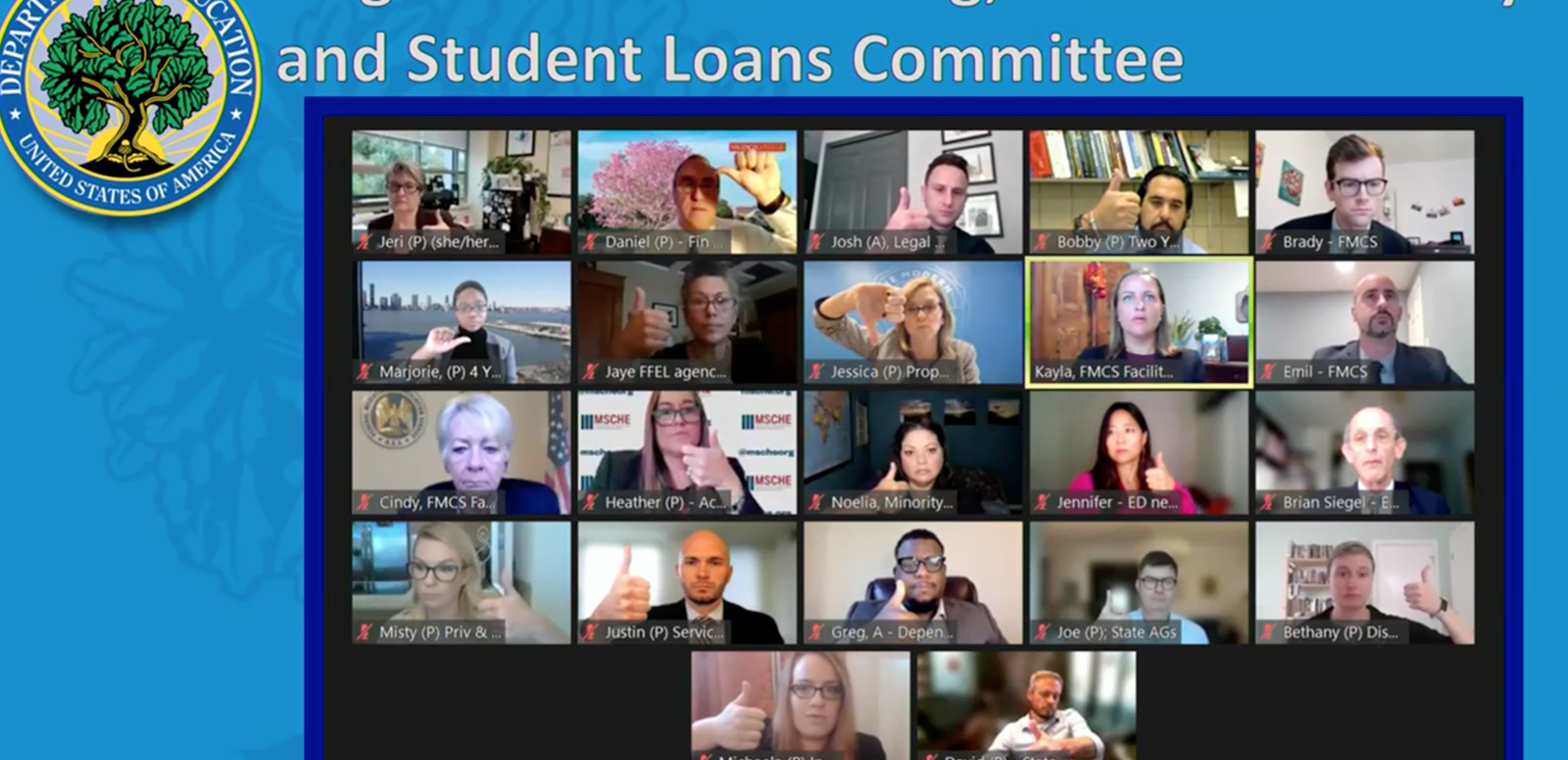
The Department has selected negotiators for rulemaking by reviewing public nominations for negotiators. These negotiators usually are knowledgeable about the topic, represent the interests of those significantly affected by the topics proposed for rulemaking, and reflect the diversity of program participants. The Department generally selects one negotiator and one alternate negotiator. The primary negotiator participates in the negreg discussion and votes to reach consensus. The alternate negotiator does so only if the primary negotiator is absent. The subcommittee will only have primary negotiators but is nonvoting and will only present recommendations to the main committee.
The Department identified several constituencies that they would like to see represented at the negotiation table, and the full list of negotiators can be downloaded here (revised list here) and will be available on the Department's negotiated rulemaking website. The Prison Education Program subcommittee original members are here with a revised list here. The constituencies represented include:
- (1) Dependent students – these are undergraduate students who are typically traditionally-aged college students. A student is a dependent student if they were required to enter both their and their parents’ information on their most recent FAFSA submission.
- (2) Independent students – these are often older or nontraditional students, such as students over the age of 24. Students who are married, have children or other dependents, or who were unaccompanied and homeless or at risk of being homeless are independent students. Independent students can be pursuing undergraduate or graduate studies. A student is an independent student if they were not required to enter their parents' information on their most recent FAFSA submission.
- Note: Students who were formerly incarcerated and participated in postsecondary education while in prison are included in the independent and dependent student categories regardless of whether they received Federal student aid, and we encourage nominations for individuals with those experiences. For both student spots, we also encourage individuals or organizations representing low-income students to apply.
- (3) Student loan borrowers. This includes but is not limited to: student loan borrowers who are currently repaying their student loans, student loan borrowers who defaulted or are currently in default, student loan borrowers who were in forbearance or are currently in the administrative (automatic) forbearance due to COVID-19, and student loan borrowers who prior to the administrative forbearance were delinquent (late) on their student loans payments.
- (4) Legal assistance organizations that represent students and/or borrowers.
- (5) U.S. military service members, veterans, or groups representing them.
- (6) State attorneys general.
- (7) State higher education executive officers, State authorizing agencies, and/or State regulators of institutions of higher education and/or loan servicers.
- (8) Individuals with disabilities or groups representing them.
- (9) Financial aid administrators at postsecondary institutions.
- (10) Two-year public institutions of higher education.
- (11) Four-year public institutions of higher education.
- (12) Private nonprofit institutions of higher education.
- (13) Proprietary institutions.
- (14) Minority-serving institutions – institutions of higher education eligible to receive Federal assistance under title III, parts A, B, and F, and title V of the HEA, which include Historically Black Colleges and Universities, Hispanic-Serving Institutions, American Indian Tribally Controlled Colleges and Universities, Alaska Native and Native Hawaiian-Serving Institutions, Predominantly Black Institutions, Native American-Serving Nontribal Institutions, and Asian American and Native American Pacific Islander-Serving Institutions.
- (15) Federal Family Education Loan (FFEL) lenders and/or guaranty agencies.
- (16) Accrediting agencies.
The Department also asked for nominations for advisors. Advisors are not be members of committees nor do they participate in reaching consensus. Instead, they serve as a resource to committee members. The list of these non-voting advisors is in the downloadable link above of the full list of negotiators. In addition, that document contains information on the Prison Education Programs Subcommittee which will be held October 18-20, 2021 and November 8-10, 2021.