Recommendations for Future Research
Move Away from Measuring “Ideology” and Toward Specific Issues and Principles of Governance
As with all research and analysis, much depends on the measures that we use. Most of the studies discussed are based on one-dimensional measures of “ideology” among voters and elected officials. I put ideology in quotes because it is not clear what these measures are actually capturing anymore.
Partisanship and ideology are different things. Ideology is a principles-based worldview that gives an individual a sense of what goes with what based on certain unifying principles. Partisanship is a form of teamsmanship. Parties can have unifying ideologies, and often do. But an extreme partisan and an ideologue are not the same thing. Politicians are flexible, but political elites tend to have clearer ideologies. A consistent finding is that among mass publics, maybe a quarter (at most) of voters have something resembling an ideology. Most voters are partisans first, and far more willing to change their ideology to fit with their partisanship than to change their partisanship. Voters simply have less consistent ideologies, so measuring extreme versus moderate voters makes less and less sense.108
For elected officials, the problem of measuring ideology is that the typical measure, DW-NOMINATE scores, is derived from roll-call voting. In a highly partisan era in which party leaders exert strong control over the issues that come up for a vote, the voting scores collapse into a one-dimensional measure that is based on partisanship. Partisanship may correlate with ideology, but it is partisanship that is driving the scores. Though DW-NOMINATE scores have become the standard measure for ideology among many political scientists and data-literate journalists, a growing number of scholars have criticized these measures as both limited and misleading, and have offered other measures, though many of them are also based on votes.109
Moving beyond votes, one way forward is to turn to network analysis, to better assess which legislators work productively with other legislators in less formal ways that do not show up in highly-censored roll call votes. For example, Jennifer Victor and colleagues have done some excellent work already showing the role of legislative caucuses as potential sources of cross-partisan compromise. Measuring participation in cross-partisan networks and caucuses might prove a better outcome to measure than voting scores.110
The Lugar Center has developed a bipartisanship score for all members of Congress, based on bill sponsorship and co-sponsorship patterns.111 GovTrack has developed an ideology score also based on bill and resolution sponsorship and co-sponsorship.112 Again, given the censored nature of roll-call voting, either (or both) of these might be better measures for studying the effects of primary reform than Nominate scores.
Another way to advance work in this area is to look more closely at more specific issues, both among politicians but especially among voters. For example, it may be the case that while primary voters are not significantly more extreme overall, they may be more extreme on particularly polarizing issues, like racial justice or immigration. Separating out these kinds of zero-sum cultural and identity issues may yield insights that a one-dimensional measure of ideology cannot.
Similarly, given that growing research indicates that “negative” partisanship (dislike of the out-party) is more significant than ideological polarization, we should be looking more closely at differences in affective polarization between primary and general election voters. Rather than focus on ideology, perhaps we should be focused on the extent to which primary voters have stronger levels of negative partisanship as compared to general election voters.
In short, it is quite possible that we are measuring the wrong things, and as a result, generating misleading findings.
Looking More at Politician Rhetoric and Messaging
Another way to advance this work might be to look more clearly at rhetoric and sentiment, and the extent to which representatives operating under different primary systems focus their time on attacking political opponents as opposed to promoting policy solutions. Similarly, we might investigate the extent to which members focus their energies on polarizing cultural and identity issues as opposed to touting less polarizing and local issues.113
Growing research shows that what drives members to more extreme positions is the threat of a challenge. We can measure some of this through surveys of elected officials, as Anderson and colleagues do in Rejecting Compromise. But we can also measure this by looking at campaign messaging and statements. One piece of low-hanging fruit is to examine more closely how candidates campaign in different types of primaries, and the type of rhetoric they use depending on the level and character of the opposition. This builds on Steven Sparks’s 2019 work in Polarization and the Top-Two Primary. If primary type makes a difference, we might able to measure it here by observing how candidates campaign in the face of a threat, and how and when they adjust their rhetoric toward compromise and the opposing party. If affective polarization is especially pronounced in primaries, do incumbents facing a challenge talk more about the threat of the opposing party in certain types of primaries compared to others? Or, following on the possibility that certain issues might be most salient for primary voters, do candidates talk more about these issues leading up to primary elections?
Here, one could leverage the fact that senators are up for election every six years to see whether senators engage in more extreme rhetoric and confrontational position-taking and voting in the year leading up to their primaries, and how this varies by primary type. Political scientists have shied away from this because the House offers many more cases, but a more qualitative case study here might yield important insights.
Exploring Party, Interest Group, and Donor Coalitions in Primaries
One of the other aspects of the threat is that it often comes from advocacy groups or donor communities. Are certain groups and donor communities common across primary challenges? Are there clear networks of both that tend to support more moderate versus extremist challengers? What role do party committees play?
A few strains of literature might be relevant here. First, the work of Hans Hassell has looked at the ways in which party networks coordinate in making nominations in congressional elections. Though his work has not examined the distinctions between primary types, his qualitative approach to how parties organize and strategically elevate certain candidates over others could yield useful insights into how primary rules affect party strategies.114 Similarly, qualitative surveys of party chairs could also be illuminating. In a survey of party chairs at the county-level (or equivalent) branch of government in 2013 local party leaders said they preferred more extreme candidates to more centrist candidates. This finding was true especially among Republicans, who preferred extreme candidates by a 10-to-1 margin. (Democrats preferred more extreme candidates just 2-to-1.)115 As with Hassell’s analysis, this study did not examine the effects of primary type on preferences of party chairs.
Second, Adam Bonica’s work using campaign finance data to measure ideology through his “CF Score” approach offers another way to think about the types of candidates and donor networks that compete under different types of primary rules. Given the important role of donor networks, paying closer attention to donor patterns may give us more insight into potential factions and splits in the major parties than voting records can, especially moving forward.116 This can help us to better evaluate candidate entry, an approach that Bonica’s Stanford colleague Andrew Hall used to track the decline of moderate candidate entry in his 2019 book, Who Wants to Run?: How the Devaluing of Political Office Drives Polarization.117
Third, since political parties are at their core coalitions of interest groups, we ought to look more closely at the factions of interest group coalitions within the parties and how they line up with endorsements and fundraising support under different types of primaries. Here, we can utilize IGScores (or Interest Group Scores), a measure already developed by Jesse Crosson, Alexander Furnas, and Geoffrey Lorenz. IGScores measure the ideology of interest groups based on the statements that the groups make in support or opposition to bills.118
Since both the CF and IG scores are latent factors extracted from a large number of data points, they also offer the opportunity to consider multidimensional measures of ideology that may be more useful than the single dimension into which NOMINATE has collapsed in an era of hyper-partisan voting. These scores could also be used to estimate the types of political parties that could emerge under different voting rules, since all political parties need networks of donors and interest groups in order to become viable.
Treating Asymmetry Seriously
Many studies find important asymmetries between Democrats and Republicans, with Republicans generally preferring more very conservative candidates and favoring more opposition to compromise. It would be helpful to have a more qualitative study of Republican versus Democratic primary challenges that explores how successful challengers behave once elected and how Republicans and Democrats attempt to fend off primary challenges, particularly across different types of primary systems.
More Focus on Geography
Is the primary problem the same everywhere? Are certain types of lopsided districts more prone to extreme primary challenges? How does the safeness of the district relate to the threat of a primary and to the behavior of incumbents? One finding from the literature on redistricting and competition is that closely competitive districts do not elect representatives with more moderate voting records. Could primaries have something to do with this?
Some districts are just very conservative, and some districts are just very liberal. For example, Rep. Marjorie Taylor Greene (R-Ga.) represents one of the most conservative districts in the country. She may well be a good fit for her district. A persistent debate in the literature on polarization is over how much polarization is simply a function of partisan sorting. But this raises an important question: if constituents elected members who were more in line with their districts, would we still have high levels of partisan polarization simply based on the underlying geographical splits between the parties and the competing coalitions? I have not seen any analysis that tries to tease out these two explanations.
Alternatively, it might be valuable to look more closely at the role of competitive districts. Given that parties put more resources into electing moderates in competitive districts, we might expect them to help elevate more moderate candidates who are more likely to win, and we might see partisan voters also looking to choose the most electable candidate.
Looking Beyond our Borders
Parties in other democracies use different institutional arrangements for nominating candidates. Comparing the United States to other comparable democracies could give us some insights into the extent to which its unique bottom-up approach to selecting party nominations is a contributor to intense hyper-partisanship.
What about the Senate?
One obvious limitation of all the work described above is that it overwhelmingly focuses on the House. Because there are relatively few U.S. senators it is difficult to obtain enough statistical power to make clear inferences about the effects of primaries. Thus, it is possible that even if primary reforms do not appear to have much impact on the House elections, they could have more impact on the Senate. There are two reasons to think this might be the case.
First, being a senator is more prestigious and powerful than being a House member, therefore it is possible that running for Senate has broader appeal for more moderate politicians who might be less inclined to run for the House.
Second, because Senate elections are statewide elections, they are higher profile contests, and attract more media attention, which means that a broader group of voters may be informed and interested in Senate primaries than in House primary elections, which tend to get less coverage. Indeed, there is some very solid evidence that voters do learn much more about candidates in statewide primary elections (for senator and governor) than they do about House elections or other down-ballot elections, and as a result. As a result, voters are better informed about Senate and gubernatorial primary candidates, and more likely to choose the candidate whose ideology aligns closer to theirs.119 Of course, this only helps more moderate candidates if primary voters want a more moderate candidate.
However, since the effect of Senate primary type on candidate ideology has not been systematically studied, we do not know its impact. Below, I report the NOMINATE averages by primary type for senators.
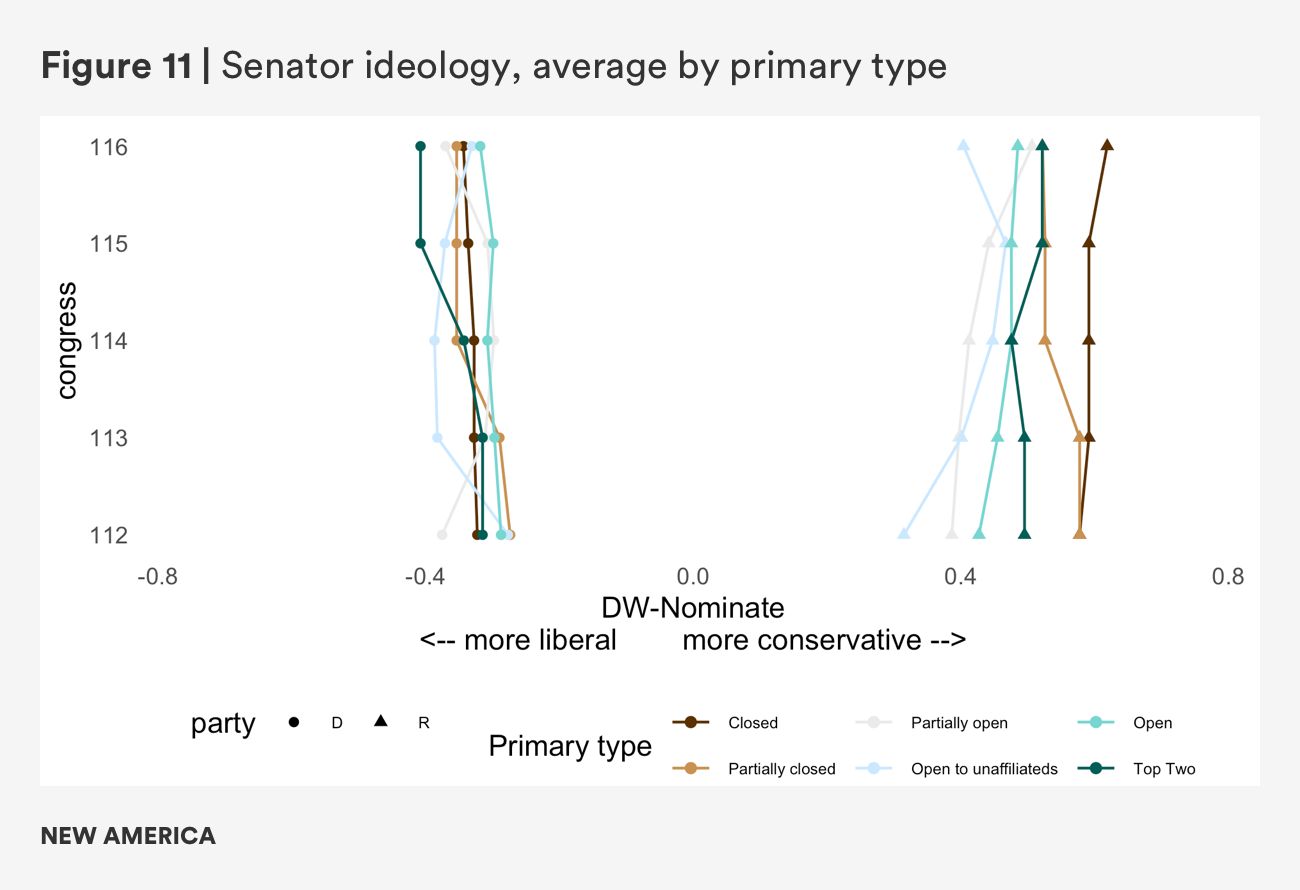
Given the small sample size, we should interpret these results with a degree of caution (also, the fact that NOMINATE may not be the right metric). With that said, two things jump out. The first is that while closed primaries elected more moderate Republicans to the House, closed primaries elected more extreme Republicans to the Senate. Second, the most liberal Democratic senators were elected under the top-two primary. This is likely because California and Washington are very liberal states. So further analysis will need to account for state-level factors in more detail. This is purely preliminary and suggestive.
More importantly, future potential work on Senate primary elections will need to have a qualitative element too, relying more on details and narratives to understand the dynamics of Senate primaries, and how they might in fact (not just in speculation) be different from House primaries.
The Need for More Research
Changing political institutions is high-stakes work. It requires a tremendous investment of resources, both time and money, and there will always be some unanticipated consequences. This is why it is so crucial to work from a realistic understanding of the interactions between voters, candidates, parties, and institutions. None of the debates discussed in this report are settled. And the environment is constantly changing. The more we know, the more precise and well-grounded our interventions can be.

What We Know about Congressional Primaries and Congressional Primary Reform
- Executive Summary
- Introduction
- Why Do We Have Primaries?
- How Should We Think about Primary Reform?
- Are Primaries a Problem?
- Can Primary Reform Change Who Votes, Runs, and Wins?
- Why Hasn't the Top-Two Primary Been More Transformative?
- Additional Original Analysis
- Implications for Top-Four/Five Voting
- Recommendations for Future Research
- Conclusions
Citations
- For useful discussions of the differences between ideology and partisanship see: Kinder and Kalmoe, Neither Liberal nor Conservative. Hans Noel, “Ideology and Its Discombobulations,” The Journal of Politics, June 7, 2019, 000–000, https://doi.org/10.1086/703491. Hans Noel, Political Ideologies and Political Parties in America (New York: Cambridge University Press, 2014).
- For useful discussion of the limits of DW-Nominate, see Frances E. Lee, Beyond Ideology: Politics, Principles, and Partisanship in the U. S. Senate, 1 edition (Chicago ; London: University Of Chicago Press, 2009); Frances E. Lee, “Patronage, Logrolls, and ‘Polarization’: Congressional Parties of the Gilded Age, 1876–1896,” Studies in American Political Development 30, no. 2 (October 2016): 116–27. John H. Aldrich, Jacob M. Montgomery, and David B. Sparks, “Polarization and Ideology: Partisan Sources of Low Dimensionality in Scaled Roll Call Analyses,” Political Analysis 22, no. 4 (2014): 435–56. Michael H. Crespin and David W. Rohde, “Dimensions, Issues, and Bills: Appropriations Voting on the House Floor,” The Journal of Politics 72, no. 4 (October 2010): 976–89, https://doi.org/10.1017/S0022381610000472; Jason M. Roberts, Steven S. Smith, and Stephen R. Haptonstahl, “The Dimensionality of Congressional Voting Reconsidered,” American Politics Research 44, no. 5 (September 1, 2016): 794–815, https://doi.org/10.1177/1532673X15608940. Verlan Lewis, “The Problem of Donald Trump and the Static Spectrum Fallacy,” Party Politics, September 16, 2019, 1354068819871673, https://doi.org/10.1177/1354068819871673;Arthur Spirling and Iain McLean, “UK OC OK? Interpreting Optimal Classification Scores for the U.K. House of Commons,” Political Analysis 15, no. 1 (ed 2007): 85–96, https://doi.org/10.1093/pan/mpl009. Hans Noel, “Separating Ideology from Party in Roll Call Data” (Unpublished manuscript, Georgetown University, 2014). Hopkins, Noel, and Noel, “Trump and the Shifting Meaning of ‘Conservative’: Using Activists’ Pairwise Comparisons to Measure Senators’ Perceived Ideologies.” Devin Caughey and Eric Schickler, “Substance and Change in Congressional Ideology: NOMINATE and Its Alternatives,” Studies in American Political Development 30, no. 2 (October 2016): 128–46, https://doi.org/10.1017/S0898588X16000092; David A. Bateman and John Lapinski, “Ideal Points and American Political Development: Beyond DW-NOMINATE,” Studies in American Political Development 30, no. 2 (October 2016): 147–71, https://doi.org/10.1017/S0898588X16000080; Nicole Asmussen and Jinhee Jo, “Anchors Away: A New Approach for Estimating Ideal Points Comparable across Time and Chambers,” Political Analysis 24, no. 2 (ed 2016): 172–88, https://doi.org/10.1093/pan/mpw003. Jeffrey B. Lewis, “Estimating Voter Preference Distributions from Individual-Level Voting Data,” Political Analysis 9, no. 3 (January 2001): 275–97, https://doi.org/10.1093/polana/9.3.275; Joshua Clinton, Simon Jackman, and Douglas Rivers, “The Statistical Analysis of Roll Call Data,” American Political Science Review 98, no. 2 (May 2004): 355–70, https://doi.org/10.1017/S0003055404001194. For a defense of NOMINATE, see Nolan McCarty, “In Defense of DW-NOMINATE,” Studies in American Political Development 30, no. 2 (October 2016): 172–84, https://doi.org/10.1017/S0898588X16000110.
- See, e.g. Jennifer Nicoll Victor and Nils Ringe, “The Social Utility of Informal Institutions: Caucuses as Networks in the 110th US House of Representatives,” American Politics Research 37, no. 5 (2009): 742–66; Jennifer Nicoll Victor, Alexander H. Montgomery, and Mark Lubell, The Oxford Handbook of Political Networks (Oxford University Press, 2017); Nils Ringe, Jennifer Nicoll Victor, and Justin H. Gross, “Keeping Your Friends Close and Your Enemies Closer? Information Networks in Legislative Politics,” British Journal of Political Science, 2013, 601–28; Jennifer N Victor, “Legislative Networks and Partisan Entrenchment” (Working paper, 2018). Victor is currently working on a book on the topic of networks.
- The Lugar Center, “Bipartisan Index,” https://www.thelugarcenter.org/ourwork-Bipartisan-Index.html, accessed June 4, 2021.
- GovTrack, “Ideology Score,” https://www.govtrack.us/congress/members/report-cards/2019/senate/ideology, accessed June 4, 2021.
- For one possible approach to this, consider the work of Justin Grimmer, who has found that lawmakers in safe seats take on more polarizing national issues, while lawmakers in competitive seats focus more on uncontroversial local issues. Justin Grimmer, “Appropriators Not Position Takers: The Distorting Effects of Electoral Incentives on Congressional Representation,” American Journal of Political Science 57, no. 3 (July 1, 2013): 624–42, https://doi.org/10.1111/ajps.12000; Justin Grimmer, Representational Style in Congress: What Legislators Say and Why It Matters (New York: Cambridge University Press, 2013).
- Hassell, “Party Control of Party Primaries”; Hans J. G. Hassell, The Party’s Primary: Control of Congressional Nominations (Cambridge, United Kingdom ; New York: Cambridge University Press, 2017); Hans J. G. Hassell, “Principled Moderation: Understanding Parties’ Support of Moderate Candidates,” Legislative Studies Quarterly 43, no. 2 (May 1, 2018): 343–69.
- David E. Broockman et al., “Why Local Party Leaders Don’t Support Nominating Centrists,” British Journal of Political Science, 2020, 1–26, https://doi.org/10.1017/S0007123419000309.
- See Adam Bonica, “Mapping the Ideological Marketplace,” American Journal of Political Science 58, no. 2 (2014): 367–86, https://doi.org/10.1111/ajps.12062. Data is here: https://data.stanford.edu/dime For a relevant analysis, see Adam Bonica et al., “Ideological Sorting of Physicians in Both Geography and the Workplace,” Journal of Health Politics, Policy and Law, May 28, 2020, 8641555, https://doi.org/10.1215/03616878-8641555.
- Hall, Who Wants to Run?
- Jesse M. Crosson, Alexander C. Furnas, and Geoffrey M. Lorenz, “Polarized Pluralism: Organizational Preferences and Biases in the American Pressure System,” American Political Science Review, 2020, 1–21, https://doi.org/10.1017/S0003055420000350.
- Shigeo Hirano et al., “Voter Learning in State Primary Elections,” American Journal of Political Science 59, no. 1 (2015): 91–108, https://doi.org/10.1111/ajps.12093.