What We Know about Congressional Primaries and Congressional Primary Reform
Table of Contents
- Executive Summary
- Introduction
- Why Do We Have Primaries?
- How Should We Think about Primary Reform?
- Are Primaries a Problem?
- Can Primary Reform Change Who Votes, Runs, and Wins?
- Why Hasn't the Top-Two Primary Been More Transformative?
- Additional Original Analysis
- Implications for Top-Four/Five Voting
- Recommendations for Future Research
- Conclusions
Abstract
This report offers an analytical overview of recent scholarship on the effects of the primary election on politics and the effects of different primary rules on voters, candidates, and policy moderation. Though many studies have been conducted in recent years, this is the first time that they have been systematically brought together with the express purpose of drawing comprehensive lessons.
Acknowledgments
Thanks Nick Troiano, Tyler Fisher, and Jack Santucci for very helpful comments. Thanks especially to Maresa Strano for her detailed editing, background research, and extremely helpful comments. Funding for this work was provided by the Unite America Institute.
Downloads
Executive Summary
The congressional primary is often portrayed as a central agent in the story of hyper-partisan polarization in the United States and congressional politics in particular. This has led reformers to explore the possibility that primary reform, particularly open and nonpartisan primaries, could be a promising mechanism to elevate more moderate and compromise-oriented candidates and representatives.
This report offers an analytical overview of recent scholarship on the effects of the primary election on politics and the effects of different primary rules on voters, candidates, and policy moderation. Though many studies have been conducted in recent years, this is the first time that they have been systematically brought together with the express purpose of drawing comprehensive lessons.
The broad takeaway is that while primary elections are likely contributors to hyper-partisanship, their impact is more marginal than many popular accounts suggest. Similarly, primary reform thus far has had very limited impact. At best, existing studies have found only marginal effects on voters, candidates, and electoral winners across different types of primaries—including the much-discussed California top-two primary.
Yet research does show that primaries incentivize more polarizing behavior among candidates and legislators. There is ample evidence that fear of a primary challenge leads candidates to reject compromise; to cultivate and stay close to their primary constituencies and the interests groups and donors who actively fund candidates in primaries; and to engage in partisan conflict to prove their bona fides to their primary constituencies. Driving this fear, in large part, is the assumption that primary electorates are more ideologically extreme than general election electorates. However, findings in support of this assumption are somewhat mixed, and may be distracting us from the deeper, more troubling divide that exists between Democratic and Republican electorates.
Indeed, primary electorates are probably a little more extreme than general election electorates, but whatever difference exists between them is dwarfed by the difference between Democratic and Republican electorates. There is not some latent fifth column of sensible moderate voters reluctantly waiting in the wings. The vast majority of voters have sorted into the two teams on offer.
The forces driving hyper-partisan polarization appear to be deeper than primary reform can reach. With the two parties already so far apart, and a winner-take-all electoral system that increasingly rewards extremity, there are simply very few opportunities for would-be moderates to gain traction. And few would-be moderate politicians have the desire to fight a losing battle.
Certainly, existing studies have their limits. This report concludes with a series of recommendations for new research approaches and new types of data that could help answer some of our unresolved questions. It also looks forward to the innovation and potential spread of the top-four open primary in Alaska. Though we need to assess its impact in the real world, there are at least theoretical reasons why this model might incentivize compromise-oriented politicians seeking to build more inclusive electoral coalitions.
Those seeking greater insight into the potential for primary reform will find there is much to learn from a comprehensive analysis of recent scholarship on primary elections. But beyond that scope, the extensive research on this topic provides a unique window into the structure of partisan competition in America, and the challenges of countering hyper-partisan polarization at this critical moment for our democracy.
Introduction
The congressional primary is often portrayed as a central agent in the story of hyper-partisan polarization in the United States, and congressional politics in particular. The story goes something like this: In primary elections, especially “closed” primaries (in which only registered partisans can vote), only the most extreme partisan voters participate. To win over these ideological partisans, candidates adopt combative rhetoric and extreme policy positions, while moderates are shut out.
Within this framing, the straightforward solution appears to be primary reform. Different primary rules, in theory, could create different pathways for would-be moderates and compromisers to attain elected office. In particular, the idea of “open” and “nonpartisan” primaries (in which all voters can participate, regardless of party affiliation) has captured the imagination of many reformers and good government politicians.1
There are good reasons why primary elections have become an increasingly attractive target for reform in recent years. Chief among them is that districts are more politically lopsided than ever, to the extent that roughly five out of every six congressional districts voters are so solidly Democratic or Republican that the only election that matters is the primary election.2 This trend toward “safe districts” is largely a product of geographic sorting of the parties, and an important driver of partisan polarization. When districts are highly partisan, their representatives will likely be highly partisan too.
Any theory of representation would expect this degree of district lopsidedness to lead to greater polarization among elected representatives, with or without primary elections. But primaries are seen as an accelerant to polarization because the Democrat or Republican who seeks to represent a district must also survive a primary election. Especially in lopsided districts, winning the primary is tantamount to winning the general election, no matter how extreme the candidate.3 In this environment, many have turned to primary reform for hope, seeing primary rules as relatively open to change.
But is primary reform as promising as its advocates argue? Is the congressional primary election as responsible for hyper-partisan polarization as its critics claim? Are there feasible and productive paths forward for primary reform? Or is primary reform a dead end and a waste of energy? In other words, is the congressional primary the polarizing force it has been made out to be, and if so, can it be redeemed?
This report attempts to tackle these questions by providing an analytical overview of recent scholarship on the effects of the primary election on U.S. politics, and the effects of different primary rules on voters, candidates, and policy moderation. In doing so, this report offers a more complicated take on the conventional wisdom that primaries are to blame for polarization and that reforming them is a powerful lever for political change. Broadly, the research shows that primary elections are likely contributors to hyper-partisanship, but their impact is more marginal than many popular accounts suggest. Similarly, primary reform may not be as promising as its advocates propose. At best, existing studies have found only marginal effects of primary reform—especially the much-discussed California top-two primary—in promoting more moderation in politics.
Most studies and analyses discussed in this report have appeared in peer-reviewed academic journals over the last decade (approximately); all of them come from respected political scientists. Admittedly, this report does not encompass the totality of studies on primaries and primary reform. However, primaries and primary reform are topics that have been well-studied by political scientists in recent history, and they have generated relatively consistent conclusions.
Citations
- A typical formulation of this thesis comes from Chuck Schumer in a 2014 New York Times Op-ed entitled “End Partisan Primaries, Save America.” Schumer writes: “The partisan primary system, which favors more ideologically pure candidates, has contributed to the election of more extreme officeholders and increased political polarization. It has become a menace to governing.” Schumer goes on to urge adoption of the top-two open primary: “We need a national movement to adopt the “top-two” primary (also known as an open primary), in which all voters, regardless of party registration, can vote and the top two vote-getters, regardless of party, then enter a runoff. This would prevent a hard-right or hard-left candidate from gaining office with the support of just a sliver of the voters of the vastly diminished primary electorate; to finish in the top two, candidates from either party would have to reach out to the broad middle. “
- See, for example, FairVote’s 2020 Monopoly Politics Report, which lists only 67 out of 435 districts (15.4 percent) as competitive enough to indicate uncertainty over the general election outcome. source
- Extreme candidates may pay a small general election penalty, but in most elections, it is not big enough to matter. Andrew B. Hall and Daniel M. Thompson, “Who Punishes Extremist Nominees? Candidate Ideology and Turning Out the Base in US Elections,” American Political Science Review 112, no. 3 (August 2018): 509–24, source is also evidence that the penalty has declined or disappeared in more recent elections, largely because partisanship has become even more important than ideology to voters (that is, even more moderate partisans care more about partisanship than moderation). See Stephen M. Utych, “Man Bites Blue Dog: Are Moderates Really More Electable than Ideologues?,” The Journal of Politics 82, no. 1 (August 27, 2019): 392–96, source.
Why Do We Have Primaries?
To understand why we have primary elections, we need to start with the basic premise that modern democracy involves elections between at least two political parties. Political parties are the preeminent institutions of modern democracy because they make political competition coherent and accessible to the masses. They limit the potential choices (i.e. candidates and policy priorities) to a manageable amount and shape the kinds of coalitions necessary to govern a diverse society.4
However, political parties, especially American political parties, are abstract and frustratingly diffuse. They are everywhere and nowhere at once, and famously difficult for political scientists to define.5 Elections are fought between actual people—candidates—even if they are affiliated with political parties. And it is individual representatives who ultimately draw up and vote on our laws, even if those representatives are affiliated with parties. This creates endless confusion among political analysts, who tend to castigate representatives who are too partisan, and praise individuals who are more independent of political parties. Yet without political parties to limit the number of candidates, elections would be confusing and chaotic, with too many competitors and no gatekeepers. At the same time, political parties are ultimately defined by their elected representatives, who together form a coalition. If the coalition were too loose and incoherent it would become meaningless, throwing elections and governing into disarray. Parties always form in modern mass democracy because something needs to structure politics, to make it possible to conduct elections and pass legislation. That something is the political party.6
If a political party is ultimately defined by the coalition of individual representatives who get elected and come to represent that party in the public mind, then the process by which those representatives are nominated to compete is “one of the central defining functions of a political party in a democracy.”7 But how should nominations work? One can imagine any number of processes, from giving the power to a singular party leader, to holding a public election open to all. Most political parties around the world are closer to the first than the second, with a small group of core leaders who control nominations. In many political systems, parties assemble candidate lists and voters can only select among the candidates on the list, or simply select the party. The United States is at the extreme end of leaving nominations to the public. Compared to those of every other democracy, modern American political parties are uniquely porous and non-hierarchical in their selection of candidates.8
Despite how they operate today, American political parties historically worked more along the lines of the first model. Prior to the introduction of the direct primary in the early twentieth century, parties were more clearly private clubs, which nominated their own candidates through various gatherings or conventions, and, for the most part, their members took turns in office. But around 1900, this chaotic approach to nominating candidates had become increasingly fraught.9
In attempting to fix or change any institution, it is crucial to understand why it exists in the first place. After all, existing institutions are not random piles of sand. Rather, institutions are edifices constructed by a previous generation, and they reflect the compromises, intentions, and assumptions of previous leaders. These previous leaders were attempting to solve a particular problem at a particular time. As with many political institutional changes, attempts to fix one problem create different problems down the road because politics is always changing and all institutional changes have unanticipated consequences.
So what problems did the direct primary solve—and what new problems did it create? First, we need to consider the problems parties were facing at the time the reform was introduced. As America grew and became more diverse both culturally and economically in the late nineteenth century, parties were struggling to manage a rapidly growing number of competing interests and factions. It was becoming harder to agree on candidates, which meant (even) more chaotic nominating conventions. Resolving these unruly conventions required more bargaining among party elites and the factions they represented, and that bargaining required many dubious deals, prompting frequent and often justified cries of corruption. Meanwhile, ambitious politicians grew increasingly frustrated with the power that the convention system gave political bosses and wire pullers. Tired of having to suck up to some political machine, and confident that a direct connection with the voters would afford them the autonomy and power that they deserved, many candidates decided to run on their own.
In short, the old convention system had fewer and fewer defenders, as its problems became harder and harder to manage. The only consistent proponents of the existing primary system were rural delegates and representatives who feared that a more popular-vote driven system would undermine their power relative to urban voters, who were underrepresented generally.
In the 1890s, political parties in some places had already turned over their role in administering candidate selection to the states when internal divides prevented them from doing so, marking the first versions of the direct primary. The same decade also saw the introduction of the “Australian” ballot, in which states printed universal ballots that listed all candidates, rather than parties and candidates handing out individual ballots or “tickets.” This put pressure on parties to establish consistent procedures for selecting official nominees in order to control their spot on the ballot. Additionally, as the realignment of 1896 created more solid single-party states and districts, the nominating convention effectively became the election. For reformers, the only way to ensure electoral competition that gave voters a meaningful choice was to move to a direct primary. And for party leaders, particularly in the solidly one-party South, a primary election was a tool to keep all the dissenting factions within the party ranks, rather than leave open the opportunity for a dissenter to mount a general election challenge.
Wisconsin, then a hotbed of progressive reform, enacted the first official direct primary statute in 1903. Within a decade, most states followed Wisconsin’s lead. Corruption had grown rampant under the previous system, and many reformers at the time saw a purifying effect in the new approach. As one chronicler of this history explained, the reforms “might be described as democratic in their approach only to the extent to which they wished to see more respectable, middle- and upper-class citizens participating in the process. Immigrant and working-class voters dominated the caucuses and primaries, so it was claimed, because so few of the ‘better element’ turned out for these events. Corrupt political machines employed fair means and foul through their control of the nomination process to fend off challengers. Civic-minded citizens knew that the system was rigged, reformers averred, hence their decision not to participate was entirely understandable. The same citizens would flock to the polls if they knew their votes would be honestly counted by election officials who were not beholden to a corrupt political boss.”10
Nebraska Sen. George Norris (R), a leading progressive, explained his high hopes for the direct primary in a 1923 essay entitled “Why I Believe in the Direct Primary.” The direct primary, Norris noted, places “a great deal of responsibility… upon the individual voter. The intelligent American citizen assumes this responsibility with a firm determination of performing his full duty by informing himself upon all the questions pertaining to government. It therefore results in a more intelligent electorate, and as this intelligence increases, it results in better government.” Norris predicted that, with this added citizen responsibility would come “the enlightened judgment of reason that will pervade the firesides and homes of a thinking patriotic people.”11 As was typical of mugwump progressive reformers, Norris shared an abiding faith in the wisdom of ordinary citizens to exercise reasoned and independent judgment, as well as a deep-seated conviction that partisan bosses and organized interests were corrupting forces.
The direct primary, of course, did not bring the desired transformation in the intelligence and reasoned engagement of the electorate. In this respect, it followed the path of other Progressive Era reforms that envisioned a more enlightened and engaged electorate if only special interests and partisan machines were sidelined. Instead, citizens proved mostly uninterested, and happy to turn power back over to the parties and the interests.12
Despite primary reform, party bosses largely maintained their grip on power, though their power involved more indirect means of marshaling endorsements and money. These factors became more important when candidates had to compete against one other more publicly, which made name recognition more valuable and more costly. Though direct primary elections did bring competition more into the open, thus giving voters more direct say, the consensus among historians of primary elections is that primaries mostly enabled the major parties to continue to operate successfully. Party leaders could maintain their big tents by keeping primary elections open to all factions, who could then fight it out amongst themselves without forcing leaders to pick sides and potentially offend anybody.
The most consequential effect of the direct primary was that it increased the importance of candidates in American elections, and contributed to the unique candidate-centeredness of American political parties.13 Arguably, this trend was already underway, but the direct primary codified the new arrangement. In the wake of the direct primary, parties found it difficult to forge meaningful national identities (at least, until the rise of national campaign financing networks in the 1980s), and party leaders struggled to exercise the kinds of gatekeeping responsibilities that are so common across other advanced democracies. To be sure, parties in all other democracies also struggle with the right balance between top-down and bottom-up power in nominating candidates, and candidate selection remains a live debate. But no other democracy has gone as far in the direction of bottom-up candidate selection as the United States.
The history of the direct primary has two important lessons for us. First, it tells us that reform is possible when political actors widely acknowledge that the current system is failing and unsustainable. When reformers present an alternative that solves a pressing problem for both party leaders and elected representatives, that alternative has a very good chance of passing, even if it creates some uncertainty.
Second, this history tells us that there is no one perfect approach to the process of candidate nomination. If parties are in charge of nominations, party leaders may have a hard time overcoming their own biases to navigate competing factions in a way that everyone agrees is fair and neutral. If voters choose party nominees, politics becomes more centered on candidates, which raises the importance of name recognition and individual fundraising. Under these circumstances, party leaders cannot exert as much direct gatekeeping control, and must instead rely on more informal, behind-the-scenes approaches, such as endorsements and campaign contributions.
Again, there is no perfect system. All rules elevate certain types of candidates and certain factions above others. Parties in every advanced democracy around the world struggle with intra-party politics. Different approaches select for different qualities. But visible or invisible, candidate selection is an essential, defining feature of political parties. And as a general rule, the more bottom-up the process, the more candidate-centric it is.
One of the paradoxes of American politics is the extent to which partisanship has become such a dominating force even as the parties remain weak and porous institutions.14 This paradox has led reformers in two different directions by focusing on two competing aspects of the problem: Is the problem that partisanship is too strong? Or is the problem that parties are too weak?
Both questions lead back to primaries. Those with more affinity for political parties, largely political scientists, have called for turning party nominations back to the party leaders, hoping for more candidate quality control as a way to weaken destructive partisan polarization.15 Others, particularly supporters of open primaries and independent movements, think that less party control is the solution to polarization. What both groups have in common is that they see candidate selection as crucial. But both camps make very different assumptions about the behaviors and incentives of voters, candidates, and parties, and how these behaviors and incentives might change under different rules. Existing studies of primary elections and electorates have a lot to say about these assumptions. By focusing more closely on what we know (and still need to know) we can get closer to an understanding both of the nature of the problem of hyper-partisan polarization and how we might mitigate it.
Citations
- A typical formulation of this thesis comes from Chuck Schumer in a 2014 New York Times Op-ed entitled “End Partisan Primaries, Save America.” Schumer writes: “The partisan primary system, which favors more ideologically pure candidates, has contributed to the election of more extreme officeholders and increased political polarization. It has become a menace to governing.” Schumer goes on to urge adoption of the top-two open primary: “We need a national movement to adopt the “top-two” primary (also known as an open primary), in which all voters, regardless of party registration, can vote and the top two vote-getters, regardless of party, then enter a runoff. This would prevent a hard-right or hard-left candidate from gaining office with the support of just a sliver of the voters of the vastly diminished primary electorate; to finish in the top two, candidates from either party would have to reach out to the broad middle. “
- See, for example, FairVote’s 2020 Monopoly Politics Report, which lists only 67 out of 435 districts (15.4 percent) as competitive enough to indicate uncertainty over the general election outcome. source">source
- Extreme candidates may pay a small general election penalty, but in most elections, it is not big enough to matter. Andrew B. Hall and Daniel M. Thompson, “Who Punishes Extremist Nominees? Candidate Ideology and Turning Out the Base in US Elections,” American Political Science Review 112, no. 3 (August 2018): 509–24, source">source is also evidence that the penalty has declined or disappeared in more recent elections, largely because partisanship has become even more important than ideology to voters (that is, even more moderate partisans care more about partisanship than moderation). See Stephen M. Utych, “Man Bites Blue Dog: Are Moderates Really More Electable than Ideologues?,” The Journal of Politics 82, no. 1 (August 27, 2019): 392–96, source">source.
- See, e.g. G. Bingham Powell, Elections as Instruments of Democracy: Majoritarian and Proportional Visions (New Haven: Yale University Press, 2000). E. E. Schattschneider, Party Government (New York, N.Y.: Farrar & Rinehart, Inc., 1942). Robert Alan Dahl, Political Oppositions in Western Democracies (Yale University Press, 1966). Nancy L. Rosenblum, On the Side of the Angels: An Appreciation of Parties and Partisanship (Princeton: Princeton University Press, 2008).
- For a discussion of the challenges in defining political parties, see Lee Drutman, Breaking the Two-Party Doom Loop: The Case for Multiparty Democracy in America (New York: Oxford University Press, 2020).
- John H. Aldrich, Why Parties?: The Origin and Transformation of Political Parties in America (Chicago: University of Chicago Press, 1995).
- Richard Katz argues: “This is true not only in the sense that selection of candidates to contest elections is one of the functions that separates parties from other organizations that may try to influence electoral outcomes and governmental decisions, but also in the sense that the candidates it nominates play an important role in defining what the party is. More particularly, candidates as persons, and candidacies as roles or positions, serve at least four interrelated functions within contemporary political parties as organizations and contemporary democracies as systems of governance.” Richard S. Katz, “The Problem of Candidate Selection and Models of Party Democracy,” Party Politics 7, no. 3 (May 1, 2001): 277–96.
- Reuven Y. Hazan, Reuven Y. Hazan, and Gideon Rahat, Democracy within Parties: Candidate Selection Methods and Their Political Consequences (Oxford University Press, 2010); William Paul Cross and Jean-Benoît Pilet, The Politics of Party Leadership: A Cross-National Perspective (Oxford University Press, 2015).
- The history in this section is drawn from John F. Reynolds, The Demise of the American Convention System, 1880-1911 (Cambridge ; New York: Cambridge University Press, 2006); John F. Reynolds, “The Origins of the Direct Primary,” in Routledge Handbook of Primary Elections, ed. Robert G. Boatright, 1st ed. (New York: Routledge, 2018), 39–56, source; and Alan Ware, The American Direct Primary: Party Institutionalization and Transformation in the North (Cambridge University Press, 2002). Shigeo Hirano, Primary Elections in the United States (Cambridge University Press, 2019).
- Reynolds, John F. “The Origins of the Direct Primary.” In Routledge Handbook of Primary Elections, edited by Robert G. Boatright, 1st ed., 39–56. New York : Routledge, [2018]: Routledge, 2018. source.
- George W. Norris, “Why I Believe in the Direct Primary,” The ANNALS of the American Academy of Political and Social Science 106, no. 1 (March 1923): 22–30, 30.
- Grant McConnell, Private Power & American Democracy (New York: Knopf, 1966).
- Leon D. Epstein, Political Parties in the American Mold (Madison: University of Wisconsin Press, 1986).
- See Julia Azari, source
- For a strong version of this argument, see: Rosenbluth, Frances, and Ian Shapiro. Responsible Parties: Saving Democracy from Itself. New Haven: Yale University Press, 2018.
How Should We Think about Primary Reform?
This section provides an overview of congressional primary types and primary reform theory. It also establishes a framework for thinking about and evaluating primary elections and primary reform based on two core questions and six testable premises.
To begin, broadly, the existing scholarship on primaries tries to answer two questions:
- Are primary elections important contributors to hyper-partisan polarization?
- Can changing the rules of the primary incentivize more compromise-oriented and moderate lawmaking, and if so, which rule changes?
The answer to the first question appears to be that, yes, primary elections probably do make hyper-partisan polarization more intractable.
The answer to the second question, however, seems to be that no, primary reform is unlikely to do much to reduce polarization.
Many scholars have looked at the effect of open primaries and top-two primaries. Most have concluded that they have no effect on the types of representatives who are elected. A few scholars have found some marginal effects, but nothing on the order that would suggest primary reforms are anything close to transformative.
However, a few caveats: First, in evaluating whether primaries worsen polarization, we need to keep in mind the alternatives to primaries as mechanisms for nominating general election candidates. That is, we need to ask: “primaries compared to what?” One alternative is a return to the caucus or convention system that preceded the introduction of the direct primary, or, more likely, a modern equivalent of internal party nominating procedures, such as those found in most advanced democracies. Another alternative would be to allow all candidates who wish to win a seat to compete in a single election, without having to pass through a lower-turnout primary first.
Both of these alternatives have obvious problems. The first solution (letting parties decide internally) makes nominating too exclusive and potentially susceptible to corruption, given that most nominees will face no other general election challenge in a two-party system that is highly sorted by geography. The second solution (let anybody compete in a general election) creates a problem of cognitive overload, in which voters will be asked to consider way too many candidates, without clear party endorsements. Under such nonpartisan conditions, voters are more likely to choose based on name recognition (benefiting well-financed candidates and/or celebrities), or more discouragingly, ethnic in-group favoritism.16 That is, we need to recognize that even in a world without primary elections, parties still need to have some mechanism by which to elevate certain candidates over others. And there are no neutral decision rules. All decision rules privilege some actors over others. But some do it more clearly, while other decision rules do more to structure choices behind the scenes.17 For example, primary rules that ostensibly leave power to the voters by removing parties may actually wind up further empowering private donors, whose financing becomes more important in the absence of party labels. In this case, we are simply trading one set of gatekeepers for another. This is largely the story of primary reform in the early twentieth century.
In response to the question, “primaries compared to what?,” we must also consider that every American election makes use of some type of primary. So whatever conjectures we make about the problems of primary elections generally, we have nothing else to compare them to in contemporary U.S. politics. Of course, we can compare our nomination processes to how other parties in other democracies select candidates. But other countries have different political systems. The closest comparison might be to the United Kingdom, which uses a similar first-past-the-post system and also has many lopsided districts, but where parties choose their candidates instead of voters. However, the United Kingdom is suffering from similar polarization and dysfunction, and a growing number of scholars attribute these problems to its similar first-past-the-post elections system.18
It is not the primary itself, then, but the variation in types of primaries that has given scholars the most leverage on the question of primary reform. With considerable variation in primary type across states and some changes over time, scholars have gained better insights into how primary elections operate; the extent to which changing the rules of primaries can change the types of candidates who get elected; and how candidates behave once elected.
The Types of Congressional Primaries
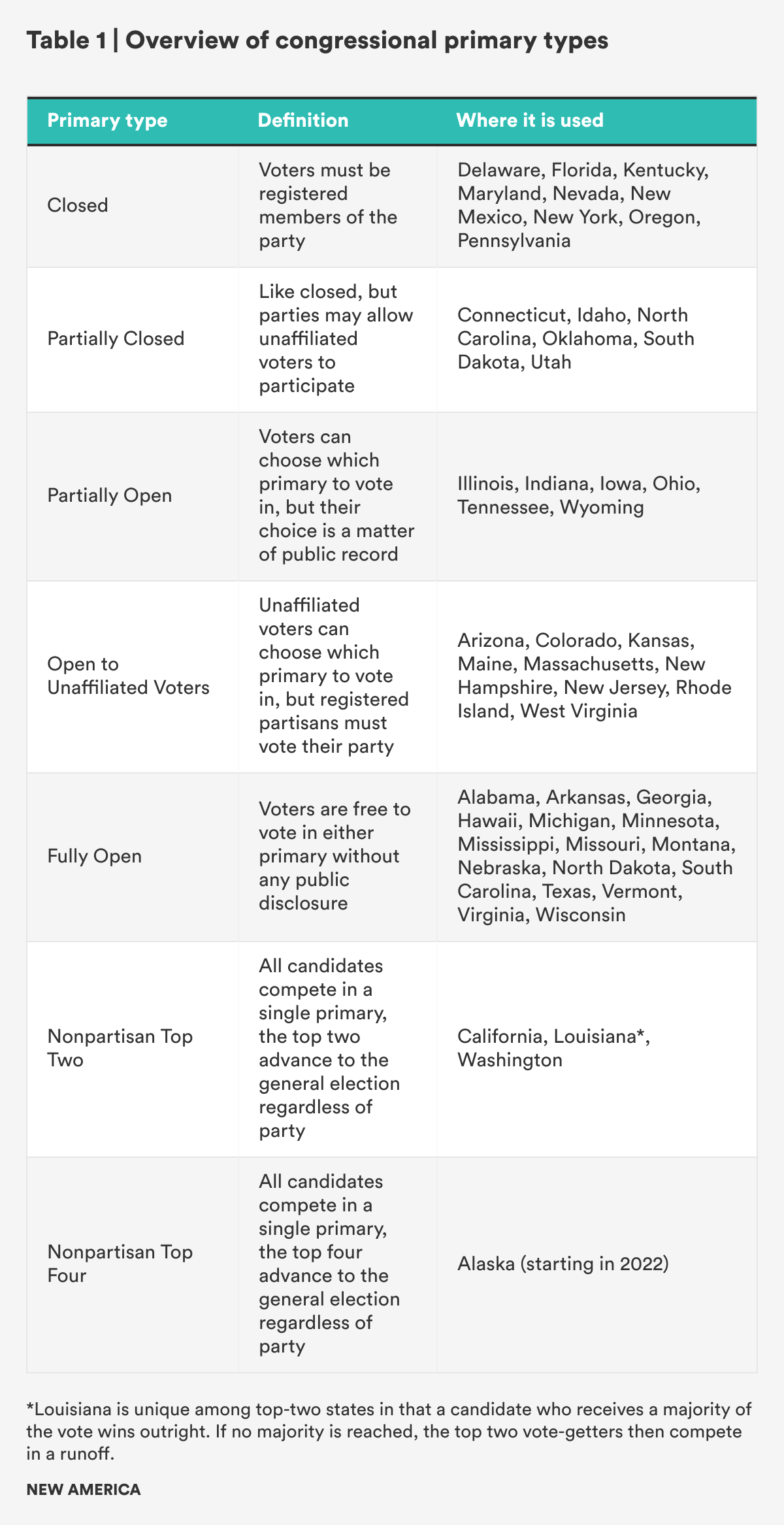
Across the 50 states there are now seven types of congressional primary:19
- Closed: voters must be registered members of the party;
- Partially Closed: like closed, but parties may allow unaffiliated voters (those who have not registered with a party) to participate;
- Partially Open: voters can choose which primary to vote in, but their choice is a matter of public record;
- Open to Unaffiliated Voters: unaffiliated voters can choose which primary to vote in, but registered partisans must vote their party;
- Fully Open: voters are free to vote in either primary without any public disclosure;
- Nonpartisan Top Two: all candidates compete in a single primary, the top two advance to the general election regardless of party;
- Nonpartisan Top Four: all candidates compete in a single primary, the top four advance to the general election regardless of party.
Generally, the primary reform conversation takes off from the baseline that closed primaries are the problem. That is because in closed primaries, only partisans get to participate. The argument against closed primaries, as the advocacy group Open Primaries models on their website, is that “Closed primaries are a fetter. They produce elected officials more accountable to their party than to their constituents. They restrict participation and reinforce division. They exclude independent voters, the largest and fastest growing sector of the electorate. And closed primaries make it more difficult for the American people—voters and elected officials alike—to come together across ideological lines.”20
Currently, only nine states have fully closed primaries, and in an additional five states, one of the two major parties uses closed primaries.21 The vast majority of state primary elections are held under a partially or fully open system, in which independent voters are allowed to participate. At first glance, then, the claim that closed primaries are responsible for the division and the divisiveness in our democracy seems unlikely. After all, this is a nationwide problem, and fewer than one in five states use fully closed primaries.
But if the closed primary system is not the main culprit, what is? Increasingly, reformers believe it could be the partisan nature of many primary elections. As such, the primary reforms generating the most interest today are two variations on the open primary: the top-two nonpartisan open primary and the top-four nonpartisan open primary.
The top-two open primary is effectively a two-round system, in which the top two finishers in the primary election advance to the general election, regardless of party. The intuition is that in districts that are lopsided in favor of one party or the other, more moderate candidates can run and win under the top-two primary by attracting support from the minority party’s voters who would settle for a moderate if they cannot have a candidate of their own party. For example, in a district that is 75 percent Democratic, two Democrats would be likely to emerge from the primary and then face off in the general election. Presumably the more moderate Democrat would win the general election, since the more moderate Democrat could win some Republican support. By contrast, under the closed primary system, there is no potential check on a Democratic primary selecting a more extreme candidate, who will win the general election no matter what. As such, the theory is that the top-two primary can encourage intra-partisan contests that encourage moderation.
Finally, there is the top-four open primary with ranked-choice voting (RCV) in the general election. In some ways, the top-four open primary works similarly to top-two, but it allows the top four finishers in the primary to move onto the general election. Then, so theory goes, by using RCV in the general election, the more moderate of the four candidates can win by being the second or third choice of opposing partisans. In theory, this system should encourage more moderate candidates to run for office and win. Because the top-four primary is still untested as of this writing we do not know whether it will work as advertised.22 But there is good reason to think that it should.
Also worth noting is the two-round primary system used in 10 states, eight of which are located in the South. Under this system, if no candidate wins a majority of the vote, the top two vote-getters advance to a primary runoff election. This system was created and widely adopted in the Jim Crow South, where the most significant and cohesive minority bloc was Black voters.23 A majority vote requirement can effectively marginalize any political minority, but the requirement's impact and intent was in most cases to marginalize the Black political minority.24 The Democratic Party’s dominance in the South under Jim Crow meant that most elections were decided in the primary, and the runoff served as a means to encourage intra-party competition (which in turn deterred defections); to unify the party around a candidate after a fractious primary campaign; and even to marginalize fringe or extreme (white) factions. In many ways, the original purpose of the primary runoff was to perpetuate the Democratic Party’s rule of the South.
The Theory of Reform
Let us now turn to the theory motivating primary reform. Above I described the two basic questions of the research: 1) Are primary elections important contributors to hyper-partisan polarization, and 2) Can changing the rules of the primary incentivize more compromise-oriented and moderate lawmaking—if so, which rule changes? There are two basic principles that correspond to these questions. The first is that primaries make hyper-partisan polarization worse. The second is that we can do something about that problem through primary reform. Both have testable sub-premises, listed below.
I. Primaries are a Problem
Premise 1: In most districts, the primary is the only election that matters. Most districts are solidly Democratic or solidly Republican, making the general election a foregone conclusion: only the primary matters. Thus, the primary should be open to everyone. For example, Republicans and Independents in a heavily Democratic district should be able to vote in the Democratic primary, since that is the election that matters. Not to allow everyone to participate in the same primary is disenfranchising to supporters of the district’s clear minority party.
Premise 2: Partisan primary electorates are disproportionately more extreme and more hyper-partisan than the electorate as a whole. If this is the case, expanding the primary to all voters would create a more moderate electorate that would elect more compromise-oriented candidates
Premise 3: Incumbent members of Congress fear a primary challenge, and adjust to avoid one. Because the threat of a primary challenge looms large, members tack to the extremes.
II. Changing the Primary Would Fix the Primary Problem
Premise 4: Changing the primary process would change who votes in the primaries. Specifically, allowing all voters (not just partisan) to participate would expand participation, especially to more moderate and compromise-oriented voters.
Premise 5: Changing the primary process would change the strategic entry and positioning of candidates, generating more moderate candidates. Specifically, moderate candidates are deterred from running in primaries because of the rules of primary elections, and more moderate candidates would run if rules were changed. Candidates may also change how they campaign, relying less on extreme partisan rhetoric and out-party demonization in order to appeal to a broader electorate.
Premise 6: Changing the primary process would change the types of candidates who get elected, generating more moderate winners and less polarization. Finally, altering the primary rules should create winners who may be incentivized to work more productively across party lines and, perhaps, ultimately less legislative polarization.
Premise 6 presumably rests on Premises 2-5, since it seems unlikely that primary reform would change outcomes if Premises 2-5 did not hold, but it is possible that there is another mechanism at work. Likewise, it is possible for some or all of the other premises to be true without Premise 6 (primary reforms actually generate moderation) also being true. If so, we would also need to think about whether there is some other mechanism.
Let us preview the main findings here before moving onto them in more detail.
Premise 1: In most districts, the primary is the only election that matters. This is absolutely the case. In roughly five out of six districts, the general election is a foregone conclusion. It is solidly safe for one of the two parties.
Premise 2: Partisan primary electorates are disproportionately more extreme and partisan than the electorate as a whole. There is mixed evidence for this premise. Primary voters are more politically engaged and stronger partisans, but not significantly more ideologically extreme. Whatever difference exists between general and primary election voters within each party is very small compared to the differences in ideology between voters of the two major parties.
Premise 3: Incumbent members of Congress fear a primary challenge, and adjust to avoid one. This is absolutely the case. Many incumbent members are very worried about a primary challenge and strategically ward off such challengers by making sure they are hardcore partisan fighters, closely connected with active primary constituencies who might otherwise promote a challenger.
Premise 4: Changing the primary process would change who votes in the primaries. There is little evidence to support this premise. Regardless of the rules (open, closed, top two), primary electorates look similar along key characteristics, and primary turnout is consistently very low.
Premise 5: Changing the primary process would change the strategic entry and positioning of candidates, generating more moderate candidates. There is also little evidence to support this claim. None of the existing primary regimes has induced more moderate candidate entry than any other. Rather, broader factors, such as the overall extremism of both parties and the high cost of running, are doing far more to discourage would-be moderate candidates from running. And of course, more moderate candidates running is a prerequisite for more moderate candidates winning.
Premise 6: Changing the primary process would lead to more moderate winners and reduce polarization. Thus far, primary reform has had little impact on mitigating polarization.
In short, there is plenty of evidence to suggest that members of Congress fear primary challenges and this threat tugs them to more confrontational extremes. It is demonstrably true that in the vast majority of House seats, the primary is the most important election. There is much less support for the other premises commonly believed among primary reformers.
Citations
- A typical formulation of this thesis comes from Chuck Schumer in a 2014 New York Times Op-ed entitled “End Partisan Primaries, Save America.” Schumer writes: “The partisan primary system, which favors more ideologically pure candidates, has contributed to the election of more extreme officeholders and increased political polarization. It has become a menace to governing.” Schumer goes on to urge adoption of the top-two open primary: “We need a national movement to adopt the “top-two” primary (also known as an open primary), in which all voters, regardless of party registration, can vote and the top two vote-getters, regardless of party, then enter a runoff. This would prevent a hard-right or hard-left candidate from gaining office with the support of just a sliver of the voters of the vastly diminished primary electorate; to finish in the top two, candidates from either party would have to reach out to the broad middle. “
- See, for example, FairVote’s 2020 Monopoly Politics Report, which lists only 67 out of 435 districts (15.4 percent) as competitive enough to indicate uncertainty over the general election outcome. <a href="source">source">source
- Extreme candidates may pay a small general election penalty, but in most elections, it is not big enough to matter. Andrew B. Hall and Daniel M. Thompson, “Who Punishes Extremist Nominees? Candidate Ideology and Turning Out the Base in US Elections,” American Political Science Review 112, no. 3 (August 2018): 509–24, <a href="source">source">source is also evidence that the penalty has declined or disappeared in more recent elections, largely because partisanship has become even more important than ideology to voters (that is, even more moderate partisans care more about partisanship than moderation). See Stephen M. Utych, “Man Bites Blue Dog: Are Moderates Really More Electable than Ideologues?,” The Journal of Politics 82, no. 1 (August 27, 2019): 392–96, <a href="source">source">source.
- See, e.g. G. Bingham Powell, Elections as Instruments of Democracy: Majoritarian and Proportional Visions (New Haven: Yale University Press, 2000). E. E. Schattschneider, Party Government (New York, N.Y.: Farrar & Rinehart, Inc., 1942). Robert Alan Dahl, Political Oppositions in Western Democracies (Yale University Press, 1966). Nancy L. Rosenblum, On the Side of the Angels: An Appreciation of Parties and Partisanship (Princeton: Princeton University Press, 2008).
- For a discussion of the challenges in defining political parties, see Lee Drutman, Breaking the Two-Party Doom Loop: The Case for Multiparty Democracy in America (New York: Oxford University Press, 2020).
- John H. Aldrich, Why Parties?: The Origin and Transformation of Political Parties in America (Chicago: University of Chicago Press, 1995).
- Richard Katz argues: “This is true not only in the sense that selection of candidates to contest elections is one of the functions that separates parties from other organizations that may try to influence electoral outcomes and governmental decisions, but also in the sense that the candidates it nominates play an important role in defining what the party is. More particularly, candidates as persons, and candidacies as roles or positions, serve at least four interrelated functions within contemporary political parties as organizations and contemporary democracies as systems of governance.” Richard S. Katz, “The Problem of Candidate Selection and Models of Party Democracy,” Party Politics 7, no. 3 (May 1, 2001): 277–96.
- Reuven Y. Hazan, Reuven Y. Hazan, and Gideon Rahat, Democracy within Parties: Candidate Selection Methods and Their Political Consequences (Oxford University Press, 2010); William Paul Cross and Jean-Benoît Pilet, The Politics of Party Leadership: A Cross-National Perspective (Oxford University Press, 2015).
- The history in this section is drawn from John F. Reynolds, The Demise of the American Convention System, 1880-1911 (Cambridge ; New York: Cambridge University Press, 2006); John F. Reynolds, “The Origins of the Direct Primary,” in Routledge Handbook of Primary Elections, ed. Robert G. Boatright, 1st ed. (New York: Routledge, 2018), 39–56, source">source; and Alan Ware, The American Direct Primary: Party Institutionalization and Transformation in the North (Cambridge University Press, 2002). Shigeo Hirano, Primary Elections in the United States (Cambridge University Press, 2019).
- Reynolds, John F. “The Origins of the Direct Primary.” In Routledge Handbook of Primary Elections, edited by Robert G. Boatright, 1st ed., 39–56. New York : Routledge, [2018]: Routledge, 2018. source">source.
- George W. Norris, “Why I Believe in the Direct Primary,” The ANNALS of the American Academy of Political and Social Science 106, no. 1 (March 1923): 22–30, 30.
- Grant McConnell, Private Power & American Democracy (New York: Knopf, 1966).
- Leon D. Epstein, Political Parties in the American Mold (Madison: University of Wisconsin Press, 1986).
- See Julia Azari, source">source
- For a strong version of this argument, see: Rosenbluth, Frances, and Ian Shapiro. Responsible Parties: Saving Democracy from Itself. New Haven: Yale University Press, 2018.
- Melody Crowder-Meyer et al., “A Different Kind of Disadvantage: Candidate Race, Cognitive Complexity, and Voter Choice,” Political Behavior, October 9, 2018, source.
- On the power to structure decision rules as the supreme power, see, e.g. E. E. Schattschneider, The Semi-Sovereign People: A Realist’s View of Democracy in America (Holt, Rinehart and Winston, 1960). William H Riker, The Art of Political Manipulation (New Haven: Yale University Press, 1986). Peter Bachrach and Morton S. Baratz, “Two Faces of Power,” The American Political Science Review 56, no. 4 (December 1, 1962): 947–52.
- See, e.g. Jason S Spicer, “Electoral Systems, Regional Resentment and the Surprising Success of Anglo-American Populism,” Cambridge Journal of Regions, Economy and Society 11, no. 1 (March 10, 2018): 115–41, source. Jonathan A. Rodden, Why Cities Lose: The Deep Roots of the Urban-Rural Political Divide (Basic Books, 2019). Noam Gidron, James Adams, and Will Horne, American Affective Polarization in Comparative Perspective (Cambridge University Press, 2020), source.
- Some states use different rules for presidential primaries. Since this report is oriented around congressional primaries, I ignore presidential primary rules.
- Open Primaries website, “Our Mission,” source, accessed March 22, 2021). For more discussion of the rise of independent voters and the case for primary reform, see John Opdycke and Jeremy Gruber, The Next Great Migration: The Rise of Independent Voters (Open Primaries, 2020).
- Ballotpedia, “Closed Primary,” source.
- Alaska will run its first top-four primary in 2022. Fair Vote has simulated top-four outcomes in WA and CA source and source ; The simulations projected broad intra- and inter-party general election competition, with more minor party presence. However, simulations are based on candidate entry patterns under Top Two rules. Different rules may encourage different candidates and different types of candidates to run.
- National Conference of State Legislatures, “Primary Runoffs,” source, accessed May 17, 2021. The exception to the majority-requirement is North Carolina, where a candidate who secures 30 percent in the primary can advance straight to the general election. North Carolina also allows the second-highest finisher to waive the runoff. The two non-Southern states that use some form of primary runoff are South Dakota and Vermont.
- A 2007 report from the Department of the Interior showed how Georgia’s statewide mandatory primary runoff law, enacted in 1963, was conceived and sold explicitly as a means to undercut Black candidates. see: U.S. Department of the Interior National Historic Landmarks Program, Civil Rights in America:Racial Voting Rights, 2007, revised 2009, source
Are Primaries a Problem?
The first premise of primary reform is that primaries are indeed a problem. This section evaluates reasons why that might be the case.
Premise 1: In most districts, the primary is the only election that matters.
Conclusion: Supported
This is such a basic premise that it is perhaps obvious to anyone who follows U.S. politics. Over the past several decades, the share of both congressional districts and states that are two-party competitive has declined steadily. The below chart comes from my book, Breaking the Two-Party Doom Loop.25
Though this decline in competitiveness is often erroneously attributed to gerrymandering, it is largely a function of the broader geographic sorting of the two parties. As Democrats have become much more a party of big cities (while Republicans have stopped competing for the votes of urban, cosmopolitan America), Democrats have wound up concentrated in a large number of safe seats in and around major cities. Likewise, as Republicans have increasingly become the party of exurban America (while Democrats have ceased competing in small-town and rural areas), Republicans now occupy a large number of safe seats in the less populated parts of the country. The remaining swing districts tend to be in the suburbs, straddling more densely populated Democratic precincts, and more sparsely populated Republican precincts. Importantly, this means that just because a district is a swing district, it does not necessarily contain a large number of moderate swing voters. In fact, most swing districts are only swing because they are split between an equal number of partisans on both sides.26
With most general elections essentially uncontested (with only nominal challengers, and sometimes none at all), primary elections have become more focal,27 and the number of challengers has risen, though not as much as many popular accounts would have us believe.28
Premise 2: Partisan primary electorates are disproportionately more extreme and more hyper-partisan than the electorate as a whole.
Conclusion: Mixed Evidence, Not Well Supported
Conventional wisdom is that primary elections are polarizing, and that the primary “base”—the voters who turn out in primary elections—represents the more extreme wing of both parties. Over the years, many scholars have attempted to evaluate this premise, but the results have been more mixed than the conventional wisdom would suggest.
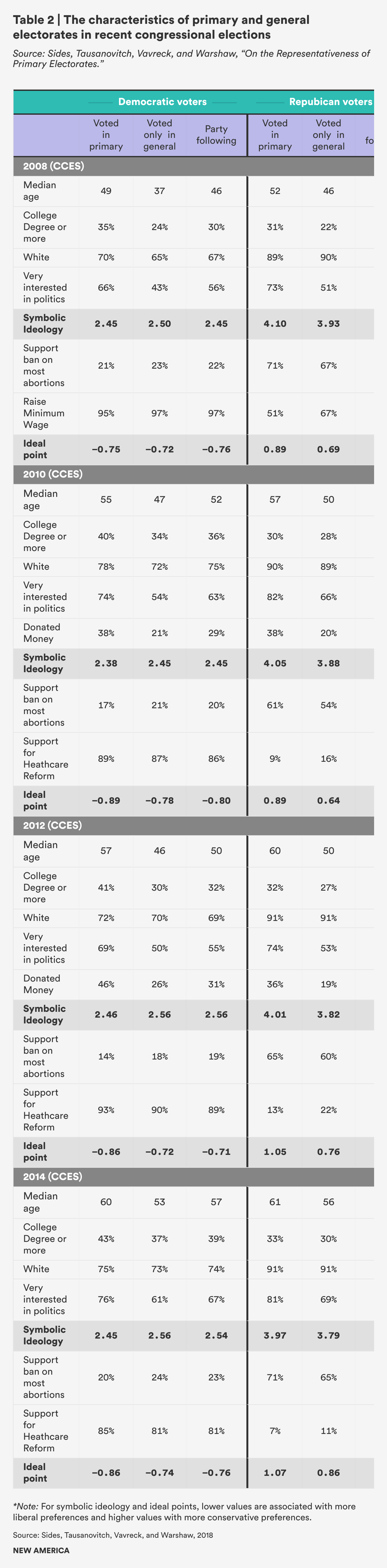
The most comprehensive and methodologically rigorous recent study is the 2018 article “On the Representativeness of Primary Electorates,”29 which combines data from five large surveys covering four election cycles (2008, 2010, 2012, and 2014).30 As authors John Sides, Chris Tausanovitch, Lynn Vavreck, and Christopher Warshaw conclude, “Primary voters are not demographically distinct or ideologically extreme compared to those who identify with the party or who voted for its presidential candidate in the general election, or than those who identify with the party and voted in the general election but not in the primary. The only substantial difference is that primary voters report more interest in politics.”
Certainly, there are some small differences between primary and general election voters. Republican primary voters score slightly higher/more conservative (~0.2 points) on the “symbolic ideology” score, a scale that goes from -2 (most liberal) to 2 (most conservative). Democratic voters score slightly lower/more liberal (~0.1) points. But the important point is that these differences are tiny compared to the large differences between Democratic and Republican voters. Below, Table 2 is reproduced from the article.
Sides and colleagues also distinguish between primary voters and what they call the “party following.” This distinction allows them to include voters who supported a party’s candidate in the general election, thus covering independent voters. Using these distinctions, they compare differences in symbolic ideology across three types of primaries: closed, semi-closed, and open. The results are reproduced below (Table 3).
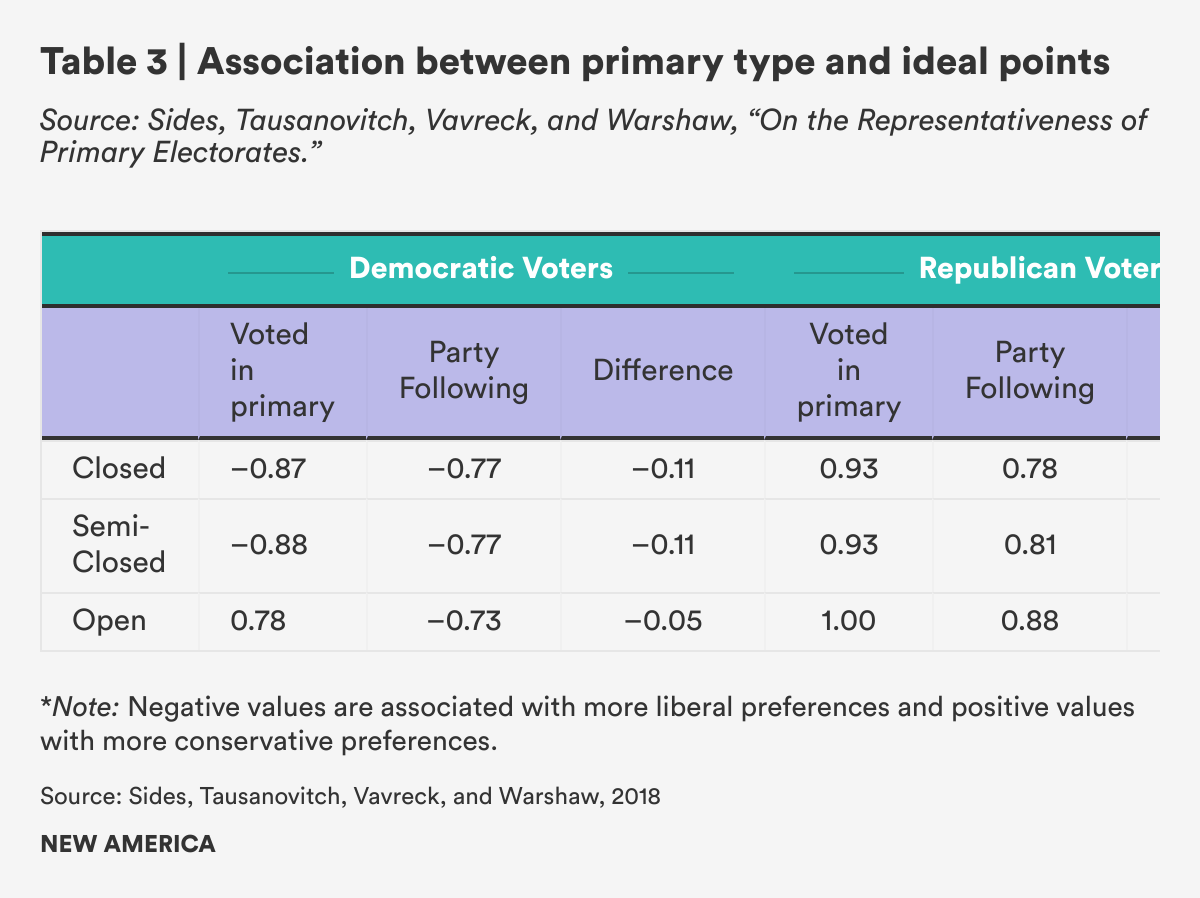
Again, the overwhelming distinction is between Democratic and Republican “party following” voters—a difference of between 1.55 and 1.61 units on the scale (depending on primary type). That is more than 10 times the difference between primary and general election supporters of both parties! Likewise, the difference in voters by primary type is tiny. Similarly, the 2008 article “Don’t Blame Primary Voters for Polarization” by Alan Abramowitz finds “very little difference between the ideologies of each party’s primary voters and the ideologies of its general election voters.”31 Intriguingly, the most ideologically extreme sub-group in the Sides et al. analysis (Table 3) is Republican candidate supporters who voted in open primaries.
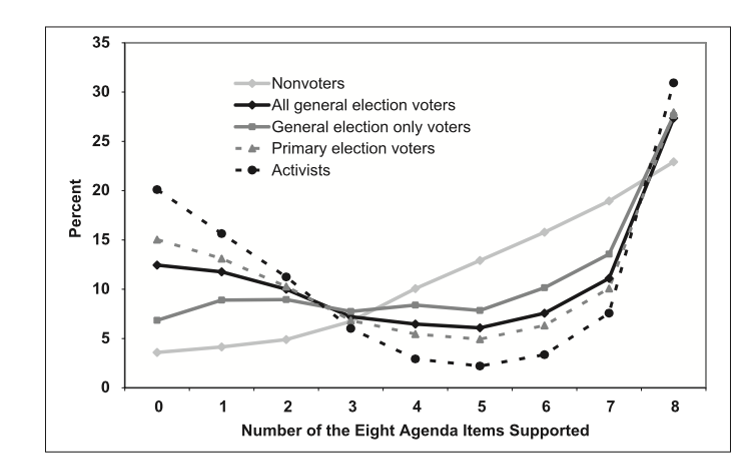
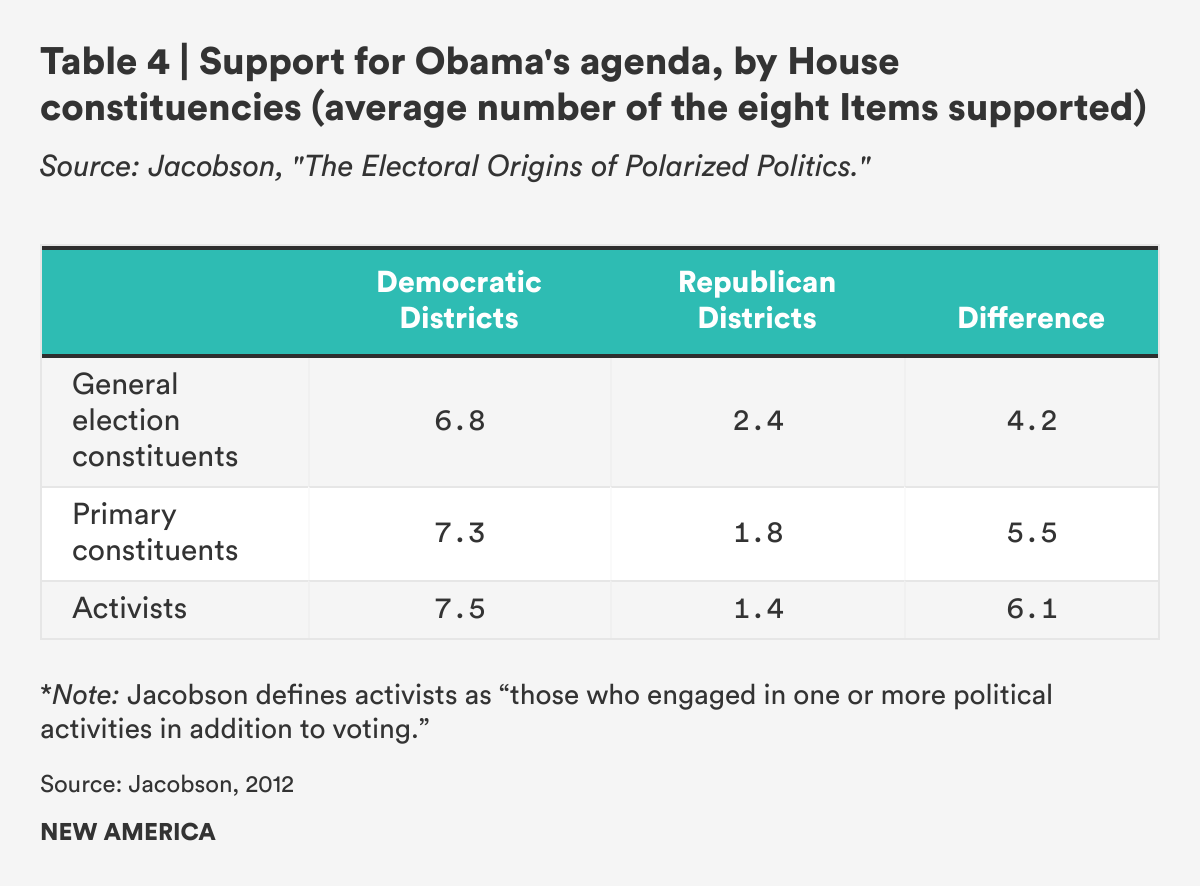
Other studies, however, find the primary voters are more ideologically extreme. Gary Jacobson’s 2012 article, “The Electoral Origins of Polarized Politics: Evidence From the 2010 Cooperative Congressional Election Study,” argues: “Primary electoral constituencies tend to be even more extreme, particularly on the Republican side, deterring departures from party orthodoxy and thus movement toward the median voter.”32 Jacobson’s approach is to look at nine key questions on salient issues with clear partisan-ideological differences and look for consistency across those questions. Jacobson finds that primary voters are more consistently Democratic-liberal or Republican-conservative. Below are Jacobson’s charts. Note that Jacobson defines activists as “those who engaged in one or more political activities in addition to voting.”33
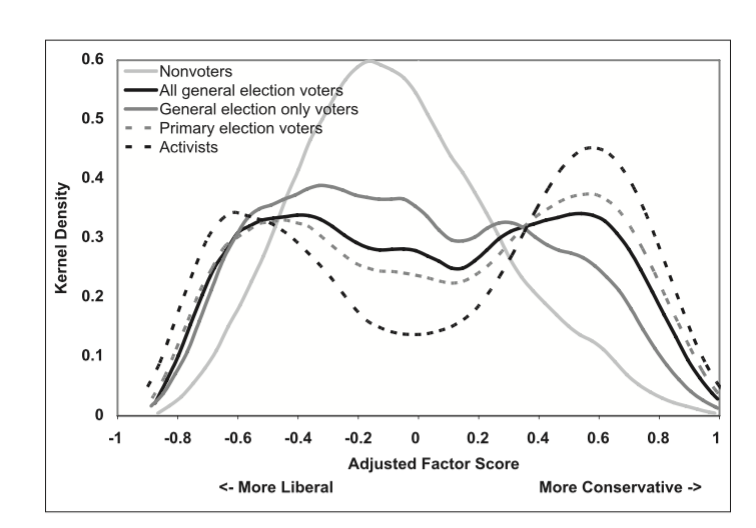
Jacobson finds support/opposition to Obama’s agenda is more consistent for primary voters than among general election voters, who are more mixed. However, the difference between Democrats and Republicans (4.2 points) is much greater than the difference between general election and primary constituents (0.5 points for Democrats, and 0.6 points for Republicans). By contrast, the difference between partisan primary and partisan general elections is about half a point.
The other recent article to look systematically at the differences in electorates is Seth J. Hill’s 2015, “Institution of Nomination and the Policy Ideology of Primary Electorates.” Though the article is primarily focused on measuring the differences of primary ideology by type of election (he finds no relationship), the article concludes that, “Primary voters are more divergent from even the party’s supporters at the general election” than other recent studies have found.34
Certainly, one reason for conflicting conclusions is that methodologies differ.35 Until recently, it has been difficult to verify who actually voted in primary elections, and relying on surveys alone can be misleading as voters tend to over-represent the extent to which they vote in primaries. Also, ideological extremism and hyper-partisanship are not easily defined; results vary depending on measures used to capture key concepts and what survey questions researchers draw upon.
A quick detour into ideology and extremism, then: When many analysts think about ideology, they assume a one-dimensional spectrum from very liberal to very conservative. But this is not really how ideology works for most people. Most people do not have so much of a clear ideology, and certainly not a one-dimensional ideology. More people have partisan attachments than clear ideologies. It is only among the roughly 25 percent of voters (typically the most highly engaged) that survey researchers typically find something resembling a consistent ideology. But even this can be flexible. To the extent ideology exists, it is mostly just consistent support for a list of party positions.36
Consider support for former President Donald Trump. Trump, a Republican, is not classically conservative, and it would be hard to describe him as an ideologue. Accordingly, it is hard to describe the current fight within the Republican Party as one between ideologically pure Republican base voters and moderates. Instead, the hard-core Republican partisans are probably better characterized by a particular set of beliefs around national identity and race and culture, and an opposition to compromise with Democrats. This is different from the typical one-dimensional view of ideology that frequently holds. It is more a matter of identity than ideology, which makes it trickier to measure. To the extent Trump’s strongest supporters are the most conservative Republicans, they are not conservative in a conventional ideological sense, but rather in a confrontational identity sense.37 So, is ideological extremism the same thing as hyper-partisanship? And if not, which do we care more about?
This indicates that the most consequential difference between primary and general election voters might be partisan affect, or out-party hatred—something that none of the existing studies have measured, and an opportunity for future research. Given that the most consistent and persistent differences between primary and general election voters involve their level of political engagement, and political engagement tends to correspond to strength of partisanship, as well as exposure to confrontational media, the most significant difference between primary and general electorates will probably be along this dimension.
However, given the depth to which out-party hatred has soaked into the mindset of partisans of all levels of engagement, the deeper problem with polarization almost certainly comes down to the differences between voters of the two parties. This is consistent throughout the studies. Primary electorates may be a little more polarized than general election electorates. But general election electorates are also extremely polarized. As Abramowitz argued in his 2008 paper, “The polarized state of American politics today reflects the polarized state of the overall American electorate rather than any peculiar characteristics of primary voters.” He went on to note that, “Even after they secure their party’s nomination, it may be risky for candidates to adopt more moderate policy positions in order to appeal to swing voters, because any such move toward the center would risk alienating a large proportion of their party’s electoral base.”38 This is certainly even truer today, 13 years later, after the polarizing politics of the Obama and Trump presidencies. There just are not very many voters today in an idealized moderate middle.39
In an earlier era, of course, in which there were both liberal and conservative Republican voters, there were both liberal and conservative Republican primary voters, which tended to elect more moderate Republicans. Similarly, there were liberal and conservative Democratic primary voters. But as the parties sorted on a national level, the voters selecting Republicans became more conservative, and the voters selecting Democrats became more liberal. This created a reinforcing cycle. In a study of changing primary electorates, Seth Hill and Chris Tausanovitch conclude that: “More extreme primary electorates encourage the election of more extreme legislators, and that more extreme legislators in turn cause primary sorting, which narrows the primary electorate and makes it even more extreme. This is a continuing cycle that was initiated by the fall of the Solid South.”40
One implication of this partisan sorting, as Hill and Tausanovitch note, is that if sorting is driving the polarization of primary electorates, then it is not the rules of primaries that matter, but the shape of the primary electorate that matters. Thus, they write, “Our evidence suggests that more open participation rules are not very important to the composition of primary electorates relative to the effect of the sorting of party identification."
The bottom line, then, seems to be that primary voters are more politically engaged, and probably more politically extreme than general election voters, though it is not entirely clear what extreme actually means; and whatever differences exist between primary and general election voters are tiny compared to the differences between Democratic and Republican voters. There is not some latent hidden force of moderate, compromise-oriented voters who would move politics to the middle if only primary election rules were changed, or primary elections were even eliminated. The root problem is the sorting of the parties and the polarization that has followed.
There is not some latent hidden force of moderate, compromise-oriented voters who would move politics to the middle if only primary election rules were changed, or primary elections were even eliminated.
Certainly, none of these studies are the final word, especially given the data analyzed in these studies only goes up through 2014, and there is no agreement on measurement. Polarization and partisan resentment have, of course, continued to evolve and we should continue to investigate possible changes in the electorate, and perhaps explore other measurement strategies, too. And yet we can see that even as politics has polarized in recent decades, the finding that the primary electorate and the general election electorate are not critically distinct (and certainly not as distinct as incumbents fear, as discussed below) has remained remarkably robust.41 This creates a strong expectation that the last six years will not demonstrate a major change in these trends, and different metrics will not yield notably different results.
Premise 3: Incumbent members of Congress fear a primary challenge, and adjust to avoid one.
Conclusion: Supported
Assuming that the primary is the most important election in the vast majority of congressional districts (and many solidly one-party states), most incumbent members of Congress can safely win re-election as long as they hold off a primary challenger. As a result, fear of “being primaried” is always looming in the minds of members of Congress, and is frequently volunteered as an explanation for why particular lawmakers engage in more confrontational and extreme position-taking: they are afraid of losing.
One obvious rejoinder is that very few incumbents actually lose their primaries, as shown in Table 5, which was reproduced from the 2018 Brookings Primary Project.42
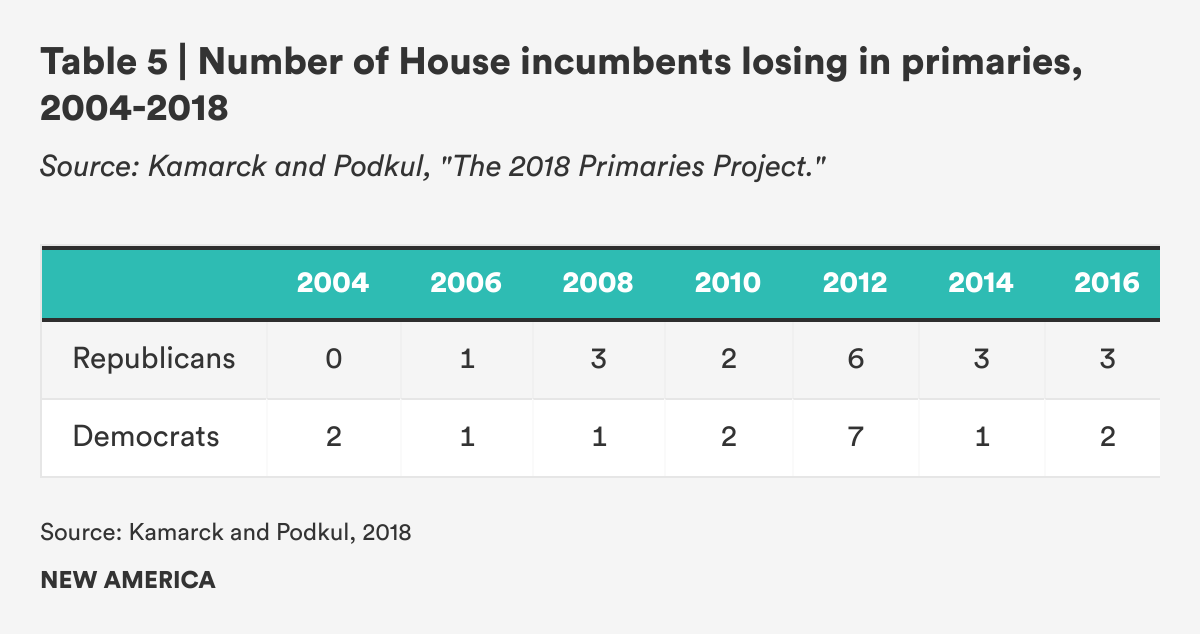
Nonetheless, the few examples take on outsized importance in the minds of many incumbents. In many respects, it is the threat, rather than the reality, that looms largest. The lack of successful primary challenges may only be evidence of the ability of incumbents to deter such challenges by keeping close to their primary voters, the same ones who previously elected them. Additionally, if primary electorates are more extreme than general electorates, more would-be moderate challengers may be deterred from running, believing that they could not possibly win a primary.
Now let us go into more detail into the nature of the primary threat and how incumbents adjust their behavior in response to it.
Extreme Challengers are More Likely than Moderate Challengers
One reason why extreme challengers are more feared is because incumbents are far more likely to face extreme challengers than moderate challengers. The first explanation for this is that would-be moderate challengers have less desire to run in the current political environment. Fundraising and campaigning are hard and time consuming. Challenging an incumbent is difficult. In our current political environment, those willing to bear the high personal costs of campaigning are those with the most passionate beliefs about politics, and passion and extremism go together.43 Would-be moderate challengers tend to lack the commitment of the true partisan believer that drives so many into office these days. And often, these potential challengers have more established careers they would rather not give up.
Additionally, as the parties have polarized, would-be moderate candidates simply do not see themselves as "fitting" with either of the two major parties, but especially the Republican Party.44 Consider this: If you are a moderate, where would you fit in either of the two parties? Do you want to be a lone voice with few friends in the legislature? For most, the answer is no, not really.
Fundraising also shapes types of challengers who emerge. Since it is very difficult for candidates to gain traction without the ability to raise large sums of money, candidates who are good at fundraising have an advantage. Donors who fund moderate incumbents tend to be access-oriented donors—that is, donors who contribute in order to build relationships with legislators, which in turn makes it easier for them to ask for favors. Access-oriented donors tend to be business interests and other perennial political players. Donors who fund challengers tend to be less interested in access since challengers often lose, and individual donors, both small and large, tend to be on the extremes.45 Extreme challengers will therefore tend to have access to a greater number of fundraising networks than moderate challengers, who have nothing to offer more moderate access-oriented donors other than a long-shot. In their 2017 book Crisis Point, for example, former U.S. Sens. Tom Daschle (D-S.D.) and Trent Lott (R-Miss.) write, “There are lots of responsible, conservative senators looking over their shoulders, worried about getting attacked from the Club for Growth or the Senate Conservatives Fund and their deep war chests.”46
Finally, because primary electorates are so small in number, a challenger candidate with dedicated support can defeat an incumbent by turning out a different constituency than voted in prior elections. This means that a challenger could always be lurking, with plenty of so far un-mobilized constituencies waiting in the shadows.
Note that all of these reasons have very little to do with the attitudes of actual primary voters. Instead, they stem from: 1) the fact that extreme challengers are more motivated to bear the high personal and fundraising costs of campaigning; and 2) generally, more resources are available for more extreme primary challengers than for more moderate primary challengers.
Incumbents Manage Primary Threats by Staying Close to their Primary Constituencies and Avoiding Compromises
In a comprehensive Brookings study published in 2018, Elaine Kamarck and James Wallner concluded that, “The fear of being primaried prompts members of Congress to change their behavior in ways that reduce the likelihood of it occurring and that increase the likelihood of prevailing in a contested primary, if a challenger actually emerges."47(emphasis mine) Even if successful primary challenges are rare, the threat of them looms large.
Kamarck and Wallner identify four primary ways in which members ward off primary threats. First, they “stay close to their primary constituency to help identify potential threats early.” Second, because “they believe that outside advocacy groups are important especially in primary races,” incumbents stay close to the outside advocacy groups that might otherwise mount a primary challenge. So, the first two ways incumbents avoid primary challengers is to give disproportionate say to the voters and groups most active in their primaries—and most likely to mount and support a challenge.
The third and fourth ways to avoid challengers involve party leadership. They observe that, “Leaders structure the legislative agenda to avoid issues that will upset their primary constituencies. When that is not possible, members try to consider must-pass issues in the least damaging way possible.” And because, “members believe that party unity—both back home and in D.C.—is an important element to prevail in a contested primary,” they work to avoid cracks in their party, which typically involves acts that strengthen partisanship and elevate partisan divides.
In short, both incumbent members and partisan leaders avoid primary challenges by becoming more confrontationally partisan.
Avoiding compromise is another strategically adaptive behavior. In a comprehensive survey of state legislators and city officials, Sarah Anderson, Daniel Butler, and Laurel Harbridge-Young found that elected lawmakers refused to compromise because they were afraid of primary voters. Their 2020 book is informatively titled Rejecting Compromise: Legislators’ Fear of Primary Voters.
Among some of the book’s key findings:
- “Seventy-two percent of state legislators and 68 percent of elected city officials thought they would receive some or a lot of retribution if they compromised.” (The compromise described was a meeting-in-the-middle, “half-loaf” compromise.)
- Among state legislators, “43 percent of respondents said that they could name a time when a legislator had lost their seat because they voted for a compromise.”
- “Increased Tea Party attachment among constituents is associated with a reduced likelihood of legislators voting for the compromise.”48
Surprisingly, a majority of primary voters do support compromise. By the authors’ estimates, only a third of primary voters are opposed to compromise.
Unsurprisingly, opposition to compromise correlates with extreme ideology. Anti-compromise attitudes are especially strong among those who call themselves extremely conservative or extremely liberal. Those who identified as Tea Party members are also more likely to oppose compromise.49 But not only do they oppose compromise, they also actively punish incumbents for compromise.50 In short, it is not primary voters writ large that incumbent members worry about, but rather a specific subset of the primary electorate that opposes specific compromises.
But even so, losses always loom larger than gains. The specific threat of even a subset of primary voters supporting a challenger, and of a challenger emerging in response to a particular vote, is easy to visualize, and could cost a lawmaker their seat. The political upside of a compromise is harder to visualize, especially in an era in which cross-partisan voting is low among the public and no amount of compromising may be able to sway supporters of the opposing party.
According to Anderson, Butler, and Harbridge-Yong, “The difficulty is that legislators do not always know ex-ante which compromise votes will mobilize primary voters or even challengers against them. As a result, cautious legislators have incentives to reject many compromises, even if these proposals have the support of the majority of their voters.”
They go on: “Even if the voters who are willing to punish for a given compromise are small in number, they may be consequential for electoral prospects if there are several groups who all care about their own, different issue… If a legislator alienates enough primary voters by supporting compromise proposals it could lead to electoral defeat.”
Powering this dynamic is primary voters’ tendency to track representatives' voting records. This makes sense, as those voting records are more likely to be important in primary elections given the absence of party cues. However, it also increases the salience of compromise votes in a way that undermines opportunities for compromise. As Anderson, Butler, and Harbridge-Young explain, “Primary voters are more likely to pay attention to their legislator’s voting record, especially on issues about which they care deeply, giving them the knowledge necessary to punish the legislator for compromising. This can make votes for compromise more consequential in contested primaries.”51
Moreover, since lawmakers are most likely to hear from dissatisfied constituents when they do compromise (as opposed to not hearing complaints when they do not compromise), the volume of constituent opposition may mislead lawmakers as to the extent of the threat they potentially face in a primary. Numerous studies have shown that incumbent lawmakers tend to have inaccurate perceptions of district opinion. They do not have access to high-quality district polling, and have very limited information from commercial voter files. Absent accurate information, especially about that small subset of active primary voters, it can be very difficult to tell the noise from the signal.52
The following table from Rejecting Compromise emphasizes the key point: Lawmakers fear that primary voters and donors will punish them for compromise, far more than general election voters. Being risk averse, most incumbents will avoid compromises that could provoke a serious primary challenge.
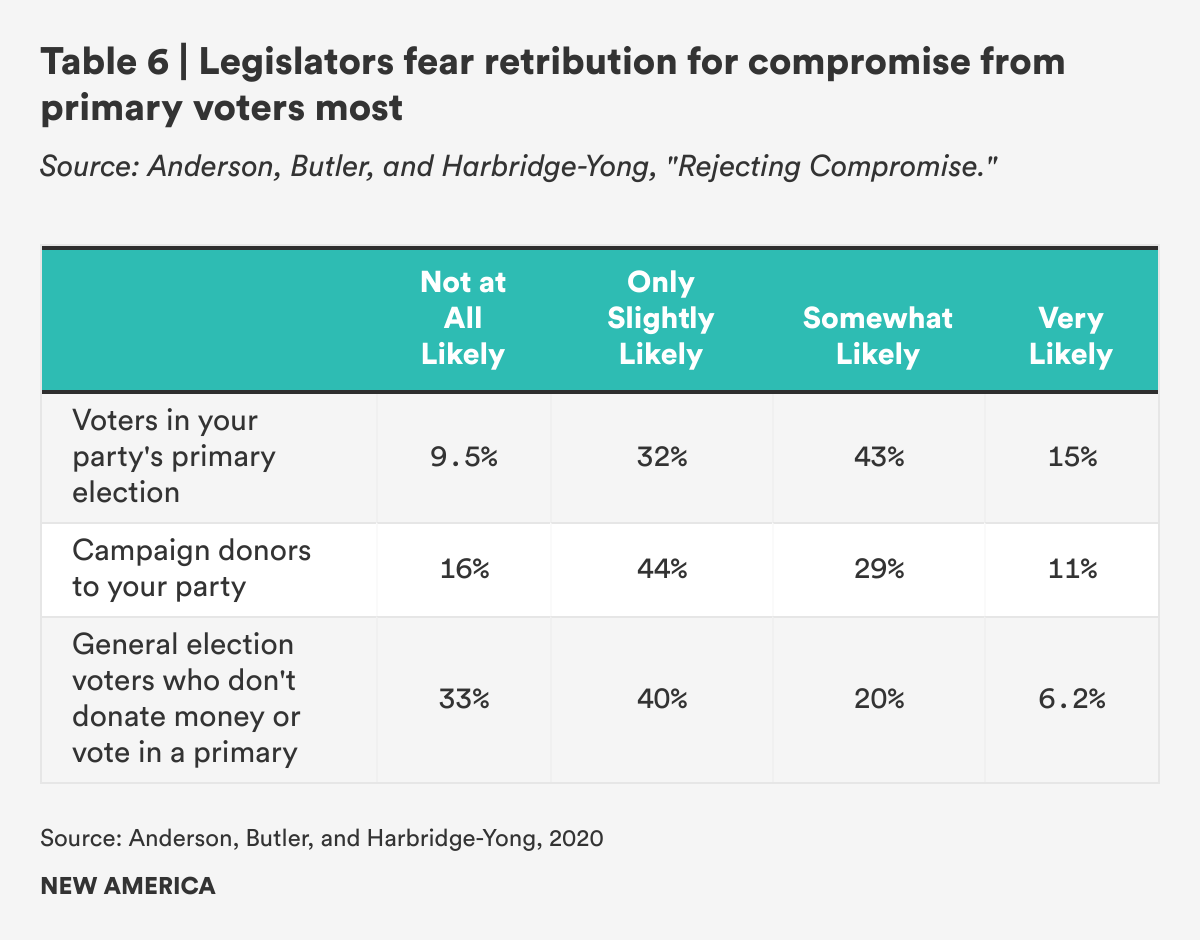
As with most aspects of contemporary American politics, there is some asymmetry to the phenomenon of incumbents fearing punishment by extreme primary voters. In a survey of state legislators who faced primary challenges, 45 percent of Republicans thought that their primary challenger was “more conservative than me” whereas 33 percent of Democrats believed that their 2016 challenger was “more liberal than me.” Based on that, similar percentages of Republicans and Democrats anticipated the same challenger in the future. Perhaps even more significantly, when asked which they feared losing more, a general election or a primary, almost half of Democrats (49 percent) anticipated losing in the general election, while just 12 percent anticipated losing the primary. Among Republicans, meanwhile, less than a quarter (24 percent) anticipated losing in a general election, while 15 percent feared losing in a primary.53
Finally, even those who defeat extreme primary challenges are not secure. If they drew an extreme primary challenge once, chances are they will draw another one again. Thus, members who face extreme challengers vote in such a way that they believe will ward off such challengers. In short, they adapt by becoming more extreme.54 This steady shift has been taking place for decades.55
Going further back, however, the polarizing threat of primary challenges does not seem to be as significant, likely because the parties were not so clearly sorted. Taking a more historical approach that focuses on the Senate and goes all the way back to 1948, Shigeo Hirano, James Snyder, and John Mark Hanson report “little evidence that the introduction of primary elections, the level of primary election turnout, or the threat of primary competition are associated with partisan polarization in congressional roll call voting.” Their paper, “Primary Elections and Partisan Polarization of the U.S. Congress,” shows that whether or not senators face primary challengers has historically had little to do with the extremism of their voting records, and likewise, whether incumbents survive challenges also has very little to do with the extremism of their voting methods.56 That said, their study only goes through 2006. Recent years have made primary elections more polarizing, as both the threat of extreme primary challengers has become more salient and the parties have become much better sorted into clearly distinct ideological coalitions.57 It would thus be worthwhile to update this analysis to see whether the past 15 years have altered the pattern.
To summarize, incumbent members of Congress most certainly fear primary challenges to their extremes, and they actively work to avoid these challenges by heading them off in ways that exacerbate partisan conflict.
Note again that this fear is entirely based around the threat, and that the threat does not depend on primary voters being more extreme than general election voters. It depends instead on primary challengers being able to activate a set of donors, groups, and voters who might not otherwise participate. Note also that this does not have much to do with the type of primary institution; challenges are possible under any set of primary rules. For example, when Rep. Dave Brat (R-Va.) famously primaried Rep. Eric Cantor (R-Va.), he did so in a state that uses open primary rules, Virginia. Losing a primary is a possibility under any system. However, in a nonpartisan primary in which multiple candidates advance to a general election, the likelihood of an incumbent advancing increases with the number of candidates who advance. In a top-five election, it would be extremely unlikely for an incumbent not to advance. Thus, a top-five system would have one clear benefit: effectively removing the threat of primary challenge, and all that such a threat entails.
Summary: Are Primaries a Problem?
To summarize, the question of whether primaries are the problem had three premises.
Premise 1: In most districts, the primary is the only election that matters.
Premise 2: Partisan primary electorates are disproportionately more extreme and more hyper-partisan than the electorate as a whole.
Premise 3: Incumbent members of Congress fear a primary challenge, and adjust to avoid one.
Premise 1 is undisputed. Clearly, most districts are solidly Democrat or Republican, and have become more so in recent years. Premise 3 finds strong support as well. Incumbent members fear a primary challenge, and act to avoid one by moving to their extremes and trying to make peace with groups and donors who might support such a challenger.
However, the evidence for Premise 2 is limited and mixed. Primary voters may be a little more extreme than general election voters. But whatever differences exist between the primary and general election voters of each party (including independent leaners), it is tiny compared to the differences between supporters (including leaners) of both parties. The two parties are very far apart. Primaries probably make compromise harder, and exert a more extreme pull, but it is a small additional tug on the deeper pulls that come from two parties representing two very different geographical and cultural coalitions.
Citations
- A typical formulation of this thesis comes from Chuck Schumer in a 2014 New York Times Op-ed entitled “End Partisan Primaries, Save America.” Schumer writes: “The partisan primary system, which favors more ideologically pure candidates, has contributed to the election of more extreme officeholders and increased political polarization. It has become a menace to governing.” Schumer goes on to urge adoption of the top-two open primary: “We need a national movement to adopt the “top-two” primary (also known as an open primary), in which all voters, regardless of party registration, can vote and the top two vote-getters, regardless of party, then enter a runoff. This would prevent a hard-right or hard-left candidate from gaining office with the support of just a sliver of the voters of the vastly diminished primary electorate; to finish in the top two, candidates from either party would have to reach out to the broad middle. “
- See, for example, FairVote’s 2020 Monopoly Politics Report, which lists only 67 out of 435 districts (15.4 percent) as competitive enough to indicate uncertainty over the general election outcome. <a href="<a href="source">source">source">source
- Extreme candidates may pay a small general election penalty, but in most elections, it is not big enough to matter. Andrew B. Hall and Daniel M. Thompson, “Who Punishes Extremist Nominees? Candidate Ideology and Turning Out the Base in US Elections,” American Political Science Review 112, no. 3 (August 2018): 509–24, <a href="<a href="source">source">source">source is also evidence that the penalty has declined or disappeared in more recent elections, largely because partisanship has become even more important than ideology to voters (that is, even more moderate partisans care more about partisanship than moderation). See Stephen M. Utych, “Man Bites Blue Dog: Are Moderates Really More Electable than Ideologues?,” The Journal of Politics 82, no. 1 (August 27, 2019): 392–96, <a href="<a href="source">source">source">source.
- See, e.g. G. Bingham Powell, Elections as Instruments of Democracy: Majoritarian and Proportional Visions (New Haven: Yale University Press, 2000). E. E. Schattschneider, Party Government (New York, N.Y.: Farrar & Rinehart, Inc., 1942). Robert Alan Dahl, Political Oppositions in Western Democracies (Yale University Press, 1966). Nancy L. Rosenblum, On the Side of the Angels: An Appreciation of Parties and Partisanship (Princeton: Princeton University Press, 2008).
- For a discussion of the challenges in defining political parties, see Lee Drutman, Breaking the Two-Party Doom Loop: The Case for Multiparty Democracy in America (New York: Oxford University Press, 2020).
- John H. Aldrich, Why Parties?: The Origin and Transformation of Political Parties in America (Chicago: University of Chicago Press, 1995).
- Richard Katz argues: “This is true not only in the sense that selection of candidates to contest elections is one of the functions that separates parties from other organizations that may try to influence electoral outcomes and governmental decisions, but also in the sense that the candidates it nominates play an important role in defining what the party is. More particularly, candidates as persons, and candidacies as roles or positions, serve at least four interrelated functions within contemporary political parties as organizations and contemporary democracies as systems of governance.” Richard S. Katz, “The Problem of Candidate Selection and Models of Party Democracy,” Party Politics 7, no. 3 (May 1, 2001): 277–96.
- Reuven Y. Hazan, Reuven Y. Hazan, and Gideon Rahat, Democracy within Parties: Candidate Selection Methods and Their Political Consequences (Oxford University Press, 2010); William Paul Cross and Jean-Benoît Pilet, The Politics of Party Leadership: A Cross-National Perspective (Oxford University Press, 2015).
- The history in this section is drawn from John F. Reynolds, The Demise of the American Convention System, 1880-1911 (Cambridge ; New York: Cambridge University Press, 2006); John F. Reynolds, “The Origins of the Direct Primary,” in Routledge Handbook of Primary Elections, ed. Robert G. Boatright, 1st ed. (New York: Routledge, 2018), 39–56, <a href="source">source">source; and Alan Ware, The American Direct Primary: Party Institutionalization and Transformation in the North (Cambridge University Press, 2002). Shigeo Hirano, Primary Elections in the United States (Cambridge University Press, 2019).
- Reynolds, John F. “The Origins of the Direct Primary.” In Routledge Handbook of Primary Elections, edited by Robert G. Boatright, 1st ed., 39–56. New York : Routledge, [2018]: Routledge, 2018. <a href="source">source">source.
- George W. Norris, “Why I Believe in the Direct Primary,” The ANNALS of the American Academy of Political and Social Science 106, no. 1 (March 1923): 22–30, 30.
- Grant McConnell, Private Power & American Democracy (New York: Knopf, 1966).
- Leon D. Epstein, Political Parties in the American Mold (Madison: University of Wisconsin Press, 1986).
- See Julia Azari, <a href="source">source">source
- For a strong version of this argument, see: Rosenbluth, Frances, and Ian Shapiro. Responsible Parties: Saving Democracy from Itself. New Haven: Yale University Press, 2018.
- Melody Crowder-Meyer et al., “A Different Kind of Disadvantage: Candidate Race, Cognitive Complexity, and Voter Choice,” Political Behavior, October 9, 2018, source">source.
- On the power to structure decision rules as the supreme power, see, e.g. E. E. Schattschneider, The Semi-Sovereign People: A Realist’s View of Democracy in America (Holt, Rinehart and Winston, 1960). William H Riker, The Art of Political Manipulation (New Haven: Yale University Press, 1986). Peter Bachrach and Morton S. Baratz, “Two Faces of Power,” The American Political Science Review 56, no. 4 (December 1, 1962): 947–52.
- See, e.g. Jason S Spicer, “Electoral Systems, Regional Resentment and the Surprising Success of Anglo-American Populism,” Cambridge Journal of Regions, Economy and Society 11, no. 1 (March 10, 2018): 115–41, source">source. Jonathan A. Rodden, Why Cities Lose: The Deep Roots of the Urban-Rural Political Divide (Basic Books, 2019). Noam Gidron, James Adams, and Will Horne, American Affective Polarization in Comparative Perspective (Cambridge University Press, 2020), source">source.
- Some states use different rules for presidential primaries. Since this report is oriented around congressional primaries, I ignore presidential primary rules.
- Open Primaries website, “Our Mission,” source">source, accessed March 22, 2021). For more discussion of the rise of independent voters and the case for primary reform, see John Opdycke and Jeremy Gruber, The Next Great Migration: The Rise of Independent Voters (Open Primaries, 2020).
- Ballotpedia, “Closed Primary,” source">source.
- Alaska will run its first top-four primary in 2022. Fair Vote has simulated top-four outcomes in WA and CA source">source and source">source ; The simulations projected broad intra- and inter-party general election competition, with more minor party presence. However, simulations are based on candidate entry patterns under Top Two rules. Different rules may encourage different candidates and different types of candidates to run.
- National Conference of State Legislatures, “Primary Runoffs,” source">source, accessed May 17, 2021. The exception to the majority-requirement is North Carolina, where a candidate who secures 30 percent in the primary can advance straight to the general election. North Carolina also allows the second-highest finisher to waive the runoff. The two non-Southern states that use some form of primary runoff are South Dakota and Vermont.
- A 2007 report from the Department of the Interior showed how Georgia’s statewide mandatory primary runoff law, enacted in 1963, was conceived and sold explicitly as a means to undercut Black candidates. see: U.S. Department of the Interior National Historic Landmarks Program, Civil Rights in America:Racial Voting Rights, 2007, revised 2009, source">source
- Drutman, 100.
- Nolan McCarty et al., “Geography, Uncertainty, and Polarization,” Political Science Research and Methods 7, no. 4 (October 2019): 775–94, source.
- Jamie L. Carson et al., “Constituency Congruency and Candidate Competition in U.S. House Elections,” Legislative Studies Quarterly 36, no. 3 (2011): 461–82, source.
- For detailed analysis of changes over time, see Robert G. Boatright, Getting Primaried: The Changing Politics of Congressional Primary Challenges (Ann Arbor, MI: University of Michigan Press, 2013).
- John Sides, Chris Tausanovitch, Lynn Vavreck, and Christopher Warshaw, “On the Representativeness of Primary Electorates,” British Journal of Political Science, March 2018, 1–9.
- As the authors note: “These data offer four main advantages. First, they encompass two presidential and two midterm elections and allow us to separate presidential and congressional primary voters in states that hold presidential and congressional primaries on different dates in presidential election years. Secondly, they contain large enough samples to estimate the impact of primary rules, which vary across states. Thirdly, they feature many measures of political attitudes. Finally, these data allow us to rely on validated turnout rather than potentially biased self- reports. The validated turnout data reveal substantial overlap in the primary and general electorates. In the 2008 CCAP, 68 percent of validated general election voters also voted in their state’s primary. The overlap between the two electorates means that roughly a third of 2008 general election voters voted ‘only’ in the general election and not in the primary. Any differences between the primary and general electorates must therefore manifest themselves in this relatively small group of voters.”
- Alan Abramowitz, “Don’t Blame Primary Voters for Polarization,” The Forum 5, no. 4 (2008): 1–11.
- Gary C. Jacobson, “The Electoral Origins of Polarized Politics: Evidence From the 2010 Cooperative Congressional Election Study,” American Behavioral Scientist 56, no. 12 (December 1, 2012): 1612–30, source.
- Jacobson, 1620-1621.
- Seth J. Hill, “Institution of Nomination and the Policy Ideology of Primary Electorates,” Quarterly Journal of Political Science 10, no. 4 (December 17, 2015): 461–87, source.
- Hill 2015 explains: “ Three features of my analysis are distinct from most previous comparisons. First, I examine congressional primary voters in each district, rather than presidential or congressional voters nationwide. Second, I use validated as opposed to self-reported primary turnout. And third, I use a scaled measure of ideology across multiple items, which may be a more accurate measure of preferences subject to less measurement error than individual survey responses. Future work could more carefully consider the most accurate way to measure the distinctiveness of primary voters.”In “On the Representativeness of Primary Electorates,” Sides, Tausanovitch, Vavreck, and Warshaw explain why their results differ from those of Jacobson and Hill despite their drawing from the same surveys: “In contrast to Jacobson, we use validated turnout data. As we describe in the online appendix, self-reported turnout produces larger differences between primary voters and the party following. And unlike Hill, we rely on simple disaggregated means and very large sample sizes, rather than a hierarchical model.”25
- Donald R. Kinder and Nathan P. Kalmoe, Neither Liberal nor Conservative: Ideological Innocence in the American Public (Chicago ; London: University Of Chicago Press, 2017). Lilliana Mason, “Ideologues without Issues: The Polarizing Consequences of Ideological Identities,” Public Opinion Quarterly 82, no. S1 (April 11, 2018): 280–301, source.
- See, e.g. Daniel J Hopkins, Hans Noel, and Hans Noel, “Trump and the Shifting Meaning of ‘Conservative’: Using Activists’ Pairwise Comparisons to Measure Senators’ Perceived Ideologies” (Working paper, 2021).
- Abramowitz, “Don’t Blame Primary Voters for Polarization.”
- Lee Drutman, “Myth of the Moderate Middle,” FiveThirtyEight, Sep. 24, 2019, source.
- Seth J. Hill and Chris Tausanovitch, “Southern Realignment, Party Sorting, and the Polarization of American Primary Electorates, 1958–2012,” Public Choice 176, no. 1 (July 1, 2018): 107–32, source.
- For older studies, see, e.g. Barbara Norrander, “Ideological Representativeness of Presidential Primary Voters,” American Journal of Political Science 33, no. 3 (1989): 570–87, source; John G. Geer, “Assessing the Representativeness of Electorates in Presidential Primaries,” American Journal of Political Science 32, no. 4 (1988): 929–45, source.
- Elaine Kamarck and Alexander R. Podkul, The 2018 Primaries Project: Introduction to the candidates (Washington, DC: Brookings Institution, 2018), source.
- Andrew B. Hall, Who Wants to Run?: How the Devaluing of Political Office Drives Polarization, First edition (Chicago ; London: University of Chicago Press, 2019).
- Danielle M. Thomsen, “Ideological Moderates Won’t Run: How Party Fit Matters for Partisan Polarization in Congress,” Journal of Politics 76, no. 3 (July 2014): 786–97, source; Danielle M. Thomsen, Opting Out of Congress: Partisan Polarization and the Decline of Moderate Candidates (Cambridge, United Kingdom: Cambridge University Press, 2017); John H. Aldrich and Danielle M. Thomsen, “Party, Policy, and the Ambition to Run for Higher Office,” Legislative Studies Quarterly 42, no. 2 (2017): 321–43, source writes: "The more liberal the Republican state legislator, the less likely she is to run for Congress; the more conservative the Democratic state legislator, the less likely she is to do so."
- Michael J. Barber, “Ideological Donors, Contribution Limits, and the Polarization of American Legislatures,” The Journal of Politics 78, no. 1 (2016): 296–310. Raymond J. LaRaja and Brian F. Schaffner, Campaign Finance and Political Polarization: When Purists Prevail (Ann Arbor: University of Michigan Press, 2015).
- Trent Lott, Tom Daschle, and Jon Sternfeld, Crisis Point: Why We Must – and How We Can – Overcome Our Broken Politics in Washington and Across America (New York: Bloomsbury Press, 2016) p.42.
- James Wallner and Elaine C Kamarck, Primaries and Incumbent Behavior (Brookings Institution: October 2018), source.
- Sarah E. Anderson, Daniel M. Butler, and Laurel Harbridge-Young, Rejecting Compromise: Legislators' Fear of Primary Voters, (Cambridge, MA: Cambridge University Press, 2020), 80 .“Substantively, a one standard deviation increase in Tea Party attachment (a 6.4% increase in people who say they have a very strong attachment to the Tea Party) is associated with a 4.6–5.3 percentage point decrease in the likelihood that a legislator will vote in favor of the compromise legislation (p = 0.005, two-sided). The more Tea Party voters there were in the district, the more likely the member of Congress was to vote against compromise legislation.” (79)
- Anderson, Butler, and Harbridge-Young, 87-88: “Among all respondents, just over half (52%) said that the two sides should meet in the middle at 50. As with compromise in the generic form, support for this more concrete partisan compromise is lower among subgroups of the electorate. Among ideologues, only a third (32%) favor an even compromise. Majorities of strong partisans, campaign donors, and Tea Party supporters also oppose compromise with the other party, suggesting that legislators may be right that these electorally important subgroups of primary voters oppose compromises made with the opposing party.” Drawing on a Pew study, they write: “the data from Pew (column 1) show that generic support for legislators who compromise drops from 61% overall to less than a majority for the very liberal or very conservative (46%) and Tea Party supporters (37%). Majorities of strong partisans and donors continue to express support for legislators who compromise.3”
- Anderson, Butler, and Harbridge-Young, Figure 5.5 shows that these co-partisan primary voters who oppose the specific compromise punish legislators for compromising.
- Anderson, Butler, and Harbridge-Yong, 60. The authors also note: “Media coverage that paints compromise in a negative light may magnify the perceived risks of compromising and the likelihood of facing a primary challenger from the far left or far right. In the 2017 survey at the NCSL Summit, we asked the legislators how various media outlets covered compromise. The majority of legislators (60%) thought that cable news outlets like MSNBC and Fox News portrayed legislative compromises in a negative light, while only 12% of legislators thought that these outlets portrayed it in a positive light. While legislators thought that national net- work news, major newspapers, and the local media were more neutral in their presentation, enough likely primary voters watch news like MSNBC and Fox to give legislators pause when considering compromise.” (81)
- Christopher Skovron, “What Politicians Believe About Electoral Accountability,” SSRN Electronic Journal, 2018, source. “At the state level, they especially have limited access to district-level polling, leading to inaccurate perceptions of public opinion among their constituents (Broockman and Skovron 2018). Congressional staffers have similarly inaccurate perceptions of public opinion (Hertel-Fernandez, Mildenberger and Stokes 2018). Although campaigns now have access to more data on voters than ever before, many of the records in commercial voter files remain imprecise (Hersh 2015; Fraga, Holbein and Skovron 2018) and often provide only limited information about constituents.”
- Skovron.
- Caitlin E. Jewitt and Sarah A. Treul, “Ideological Primaries and Their Influence in Congress,” in Routledge Handbook of Primary Elections, ed. Robert G. Boatright, 1st ed. (New York: Routledge, 2018), 213–25, source; Caitlin E. Jewitt and Sarah A. Treul, “Ideological Primary Competition and Congressional Behavior,” Congress & the Presidency 46, no. 3 (September 2, 2019): 471–94, source. Jewitt and Treul report: “ The results of our analysis, examining the 2000–2012 elections in which incumbent members of the House faced primary challenges, support our the- ory. We show that among incumbents who return to the House as members of the minority party, no significant relationship exists between experiencing an ideological primary and a non-ideological primary challenge on the per-cent of the time that they vote with their party leader on all roll calls. We do, however, find that on key votes, members of the minority party significantly increase the percent of the time they vote with their party leader. Although we did not necessarily expect this finding for key votes, we believe that it makes sense for two reasons. First, given the nature of key votes, these are the votes most likely to generate attention back home in the district and give a potential primary challenger ammunition for another run at the incumbent. Second, the party leadership is the most likely to whip members on key votes. Taken together, we believe these two reasons explain the sig-nificant increase in the partisan behavior of minority members on key votes following an ideological primary challenge.For majority party members, however, we show that an ideological primary challenge results in a 3.4% increase in voting against their own party on all roll calls, on average, when compared to majority party members who face a non-ideological primary challenge.2 Similarly, majority party members who faced an ideological primary challenge are 5.4% more likely to vote against their own party on key votes than are members of the majority party who faced a non-ideological primary challenge. Upon returning to Washington, majority party members who faced an ideological primary are voting against their party—both on all roll calls and on key votes—to a greater extent than their majority party colleagues who defeated a primary challenge that was not ideological in nature. Members of the majority party need a way to demon-strate their extremism and their best way to do this via votes is to vote against the party, proclaiming the party is simply not extreme enough.”
- David W. Brady, Hahrie Han, and Jeremy C. Pope, “Primary Elections and Candidate Ideology: Out of Step with the Primary Electorate?,” Legislative Studies Quarterly 32, no. 1 (February 2007): 79–105.
- Shigeo Hirano et al., “Primary Elections and Partisan Polarization in the U.S. Congress,” Quarterly Journal of Political Science, 2010, source.
- Hill and Tausanovitch, “Southern Realignment, Party Sorting, and the Polarization of American Primary Electorates, 1958–2012.”
Can Primary Reform Change Who Votes, Runs, and Wins?
Now we turn to the possibility that changing the primary would have a positive effect on the primary problem. Here, the most promising avenue for reform is in the top-two/four/five approach to primaries, because it simply makes the primary less important, particularly the top-four/five approach.
The theory of primary reform suggests that changing primary rules could produce more moderate winners. The expected intermediary effects involve who votes in primaries, which types of candidates enter primaries, and the extent to which incumbents fear “being primaried.” That is, under more open and nonpartisan primary rules, the expectation is that a more diverse and less extreme group of voters would participate, thus giving more moderate candidates a path forward. It would be unlikely for primary reform to yield more moderate winners without more moderate challengers. And it would be unlikely for more moderate candidates to enter if they did not see a path to victory.
More simply, the questions about the effect of primary reform can be broken down into three related questions: who votes (premise 4), who runs (premise 5), and who wins (premise 6).
Premise 4: Changing the primary process would change who votes in the primaries.
Conclusion: Not Supported for Open and Top-Two Primaries
Do different types of primary systems attract different mixes of voters? Do more open primaries bring in more moderate voters? The answer to these questions appears to be simple: No.
The most comprehensive study is Seth Hill’s “Institution of Nomination and the Policy Ideology of Primary Electorates.” Hill found that changing the nominating process had no effect on the ideological composition of primary election voters. “I find no evidence that … closed and semi-closed primary states had more ideological primary voters than states with more open primary systems…To the extent that there is a relationship between primary ideology and closed primary institution, it is in the direction opposite that hypothesized.”58
In Hill’s analysis, primary voters are more extreme than general election voters. But that is true, he found, regardless of the rules. Or put another way, going from closed to open or top two does not make the primary electorate more moderate. If anything, it seems to make the primary electorate a little more extreme. Hill speculates: “This result is very interesting. It either means that the citizens who want to participate in primary elections do so regardless of institutions in place, that institution of nomination is seriously confounded with ideological features of the states, or that different regulations on the franchise influence the composition of voters who participate but not their preferences.”59
Though Hill found primary voters to be more extreme compared to Sides and colleague’s analysis (discussed above), their analysis also found that the institution of primary election had no effect on the ideological composition of voters. A third recent study, looking only at presidential primary electorates, reached the same conclusion: "The overall ideological composition of primary electorates does not vary much by participation rules.”60
Briefly, the ideological profile of partisan voters is the same, regardless of the rules. One potential reason why electorates in open and closed primaries may look similar is that in states where primaries are more open, more voters decline to state their party. Therefore, the effect of primary rules may have more to do with the choices of engaged citizens whether or not to register as partisans than it does with the choice of citizens to get engaged enough in politics to pay attention to primaries.61
However, there may be a very modest effect of primary institutions on turnout, and as expected, the easier it is to vote in a primary, the higher the share of voters who participate. However, the effect is minimal. At best, open primaries increase participation by only 2 or 3 percentage points at best, and top-two primaries by about 6 percentage points.62 Given already abysmally low turnout in primaries, and thus plenty of room to expand, these are hardly transformative numbers—especially since they do not appear to change the ideological content of the voters who participate.
Premise 5: Changing the primary process would change the strategic entry and positioning of candidates, generating more moderate candidates.
Conclusion: Not Supported for Open and Top-Two Primaries
The second question is whether or not different primary systems encourage more moderate candidates to run for office. After all, it is hard for more moderate candidates to win if they do not even run.
And here, again, the evidence is largely on the side of primary type does not really matter. More open primary rules do not attract more moderate candidates to run.
In a 2015 study, “Primary Systems and Candidate Ideology: Evidence From Federal and State Legislative Elections,” Jon C. Rogowski and Stephanie Langella find no evidence that primary reforms have induced moderate candidates to enter politics: “The inconsistent results across parties, subsets of candidates, and legislative institutions do not allow us to reject the null hypothesis that nonpartisan primaries have no effect on candidate ideological extremity.”63
Rather, their findings suggest that the more open and nonpartisan primaries generate fewer moderate winners, “insofar as candidates in nonpartisan primaries are more extreme than candidates in closed primary systems. This leads us to conclude that, to amend a common aphorism, while you may be able to take the primaries away from the party, you can’t take the party out of the primaries.”64
In a 2018 study, Thad Kousser, Justin Phillips, and Boris Shor looked specifically at the effect of California’s top-two primary reform, comparing the ideological distribution of candidates pre-reform (2010) to post-reform (2012).65 They found that “lawmakers shifted marginally to the extremes, particularly in the Republican Party (where many of the party’s remaining moderates lost in 2012). At least judged by candidate positions in campaigns, the new rules did not bring the return to moderation that many of their backers had expected."66
The reforms, in other words, had no impact: “What we observe, then, is maintenance of the status quo. The lawmakers whom Californians send to Congress are nearly always located away from their district’s average voter and toward their party’s side of the ideological divide, a trend that the reforms of 2012 did nothing to halt.”67
Another 2018 study, by Kristin Kanthak and Eric Loep, took a more targeted look at strategic candidate entry. Kanthak and Loepp found no effect. “Primary types do not appear to singularly affect the likelihood that different types of candidates choose to run for office,” they write. “Nor do ideological disparities between general election candidates appear to result from the primary system a state chooses for its nomination contests. While many popular accounts of legislative polarization blame primaries for encouraging the emergence of extreme candidates, the evidence does not bear this out.”68
Despite the prevailing conventional wisdom, moderates actually do better than expected when they run in primaries,69 particularly when they have the backing of the party leadership, as they often do in swing districts.70 So the fact that few moderates run reflects a deeper problem: Most would-be moderates, particularly on the right, do not see running for office as an attractive career path. And because moderates do not see their parties as good fits for them71—either because they are discouraged from running by local party leaders72 or because they simply are not motivated enough by the partisan fights to bear the tremendous personal and financial costs of running for office73—the candidate field tends to be increasingly dominated by more extreme individuals, regardless, again, of the primary system.
Thus, as Danielle Thomsen concludes in “When Might Moderates Win the Primary?” (a chapter in a 2018 edited volume on primaries), “Primary voters may be more likely to select moderates or ideologues depending on the choices that are presented to them. Perhaps instead of focusing on changing primary laws, the first step for reformers who wish to diminish the ideological gulf between the two parties should be to encourage more moderates to run for office. Regardless of the configuration of choices on the ballot, in order for a moderate candidate to get elected, there must be a moderate for voters to choose.”74
But even if different primary rules do not change who runs, they may change how candidates campaign. One study finds at least rhetorical moderation in one-party contests under the California top-two primary system. The 2019 article, “Polarization and the Top-Two Primary: Moderating Candidate Rhetoric in One-Party Contests,” by Steven Sparks, finds that in same-party contests, candidates make more bipartisan statements, and fewer ideological statements. Though not a direct test of moderation, Sparks does show that the same party contests that the top-two primary sometimes generate do at least result in more moderate rhetoric. As Sparks notes, “If the top-two primary invokes moderation and bipartisanship into candidate rhetoric, it may likewise ease symptoms of affective polarization among the citizenry, at least at the margins."75
Premise 6: Changing the primary process would change the types of candidates who get elected, generating more moderate winners and less polarization.
Conclusion: Not Supported for Open and Top-Two Primaries
Finally, we come to the big question: Do different primary systems affect the types of candidates who win? The answer appears to be: No, not really.
The first major comprehensive study to look at this came out in 2014, following the first election cycle of California using the top-two primary. In “A Primary Cause of Partisanship? Nomination Systems and Legislator Ideology,” a team of five political scientists (Eric McGhee, Seth Masket, Boris Shor, Steven Rogers, and Nolan McCarty) looked at the effects of different primary systems on candidate selection. They found no effect: “These systems have little consistent effect on legislator ideology. In fact, most of the effects we have found tend to be the opposite of those that are typically expected: the more open the primary system, the more liberal the Democrat and the more conservative the Republican.”76
The data in this paper cover 1992-2010, so they come before the introduction of the top-two primary in California. Below I reproduce two key graphics from the paper. The first, Table 7 below,77 shows the regression results, producing different effects by party, and using “fixed effects” (controls) for state and year. (The larger the coefficient, the more the type of primary is associated with extreme winners; negative coefficients reflect that the primary type is associated with less extreme winners. All of these are compared to pure closed, so that operates as the baseline for comparisons.)
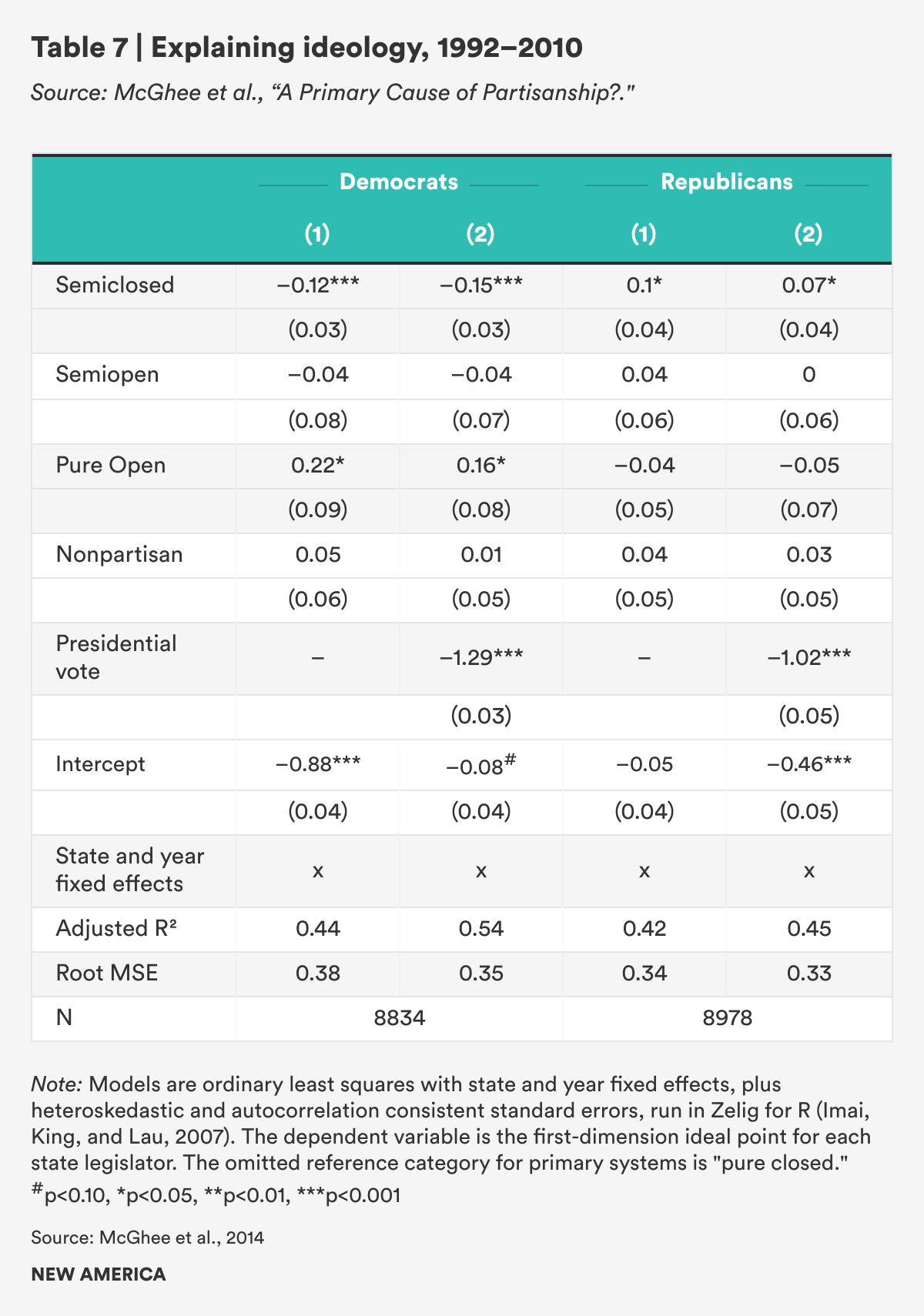
The second graph from their articles shows the time trends in state legislator partisan polarization by primary type based on the regression results, charting mean ideal points of Democrats and Republicans by their state-level ideology scores. If you are having a hard time telling the difference between the five types, that is because the differences are not that significant. State legislative polarization has increased about the same in all the states that use this type of primary.
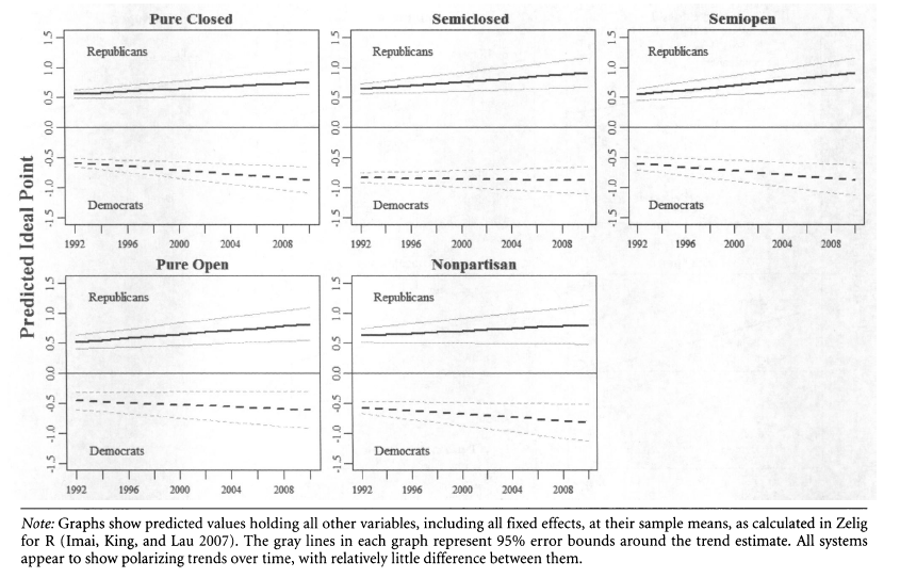
McGhee and colleagues argue: “Regardless of the mechanism, our analysis suggests we should expect little from open primary reform in the modern political age. The effect is inconsistent and weak, and where it is stronger and more robust, it is the opposite of the one that is generally intended."78
In 2017, with a few election cycles on the books following Washington’s and California’s implementation of top-two in 2008 and 2011, respectively, scholars began looking specifically at the effects of the top-two primary. The first study “Has the Top Two Primary Elected More Moderates?” by Eric McGhee and Boris Shor, found that Democrats in the California State Legislature had on the whole become slightly more moderate. However, they found no effect for California Republicans, and no effect for either Washington State Democrats or Republicans.79 Below I reproduce their key figure, which shows the state legislator ideology over time.
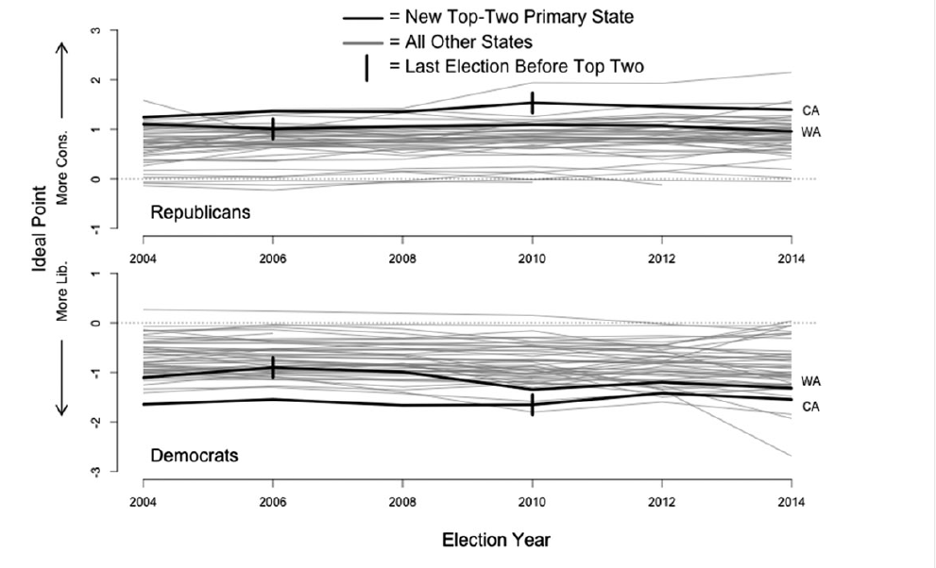
The changes here are certainly not dramatic. The authors also caution that whatever effect they are picking up in California may be because of the redistricting reform that also passed in 2010 (more on redistricting in a separate section).80 Notably, prior to their adoption of top-two primaries, California Democrats were the most consistently liberal in the country, so from a basic reversion-to-the-mean perspective, it might not be surprising to see some shifts. Yet, as with almost every study in this literature review, whatever differences exist between primary types are one order of magnitude smaller than the differences that exist between the two parties.
A more recent analysis by Jack Santucci extended this pattern forward. Again, the conclusion remained the same: “Nonpartisan elections don’t reduce polarization.”81 Santucci’s graphics show polarization trends in the upper chambers and lower chambers. In short, California and Washington, the two states that adopted top-two nonpartisan primaries (denoted as NPTRS for “nonpartisan two-round electoral system” in the graphics below) were very polarized both before and after primary reform.
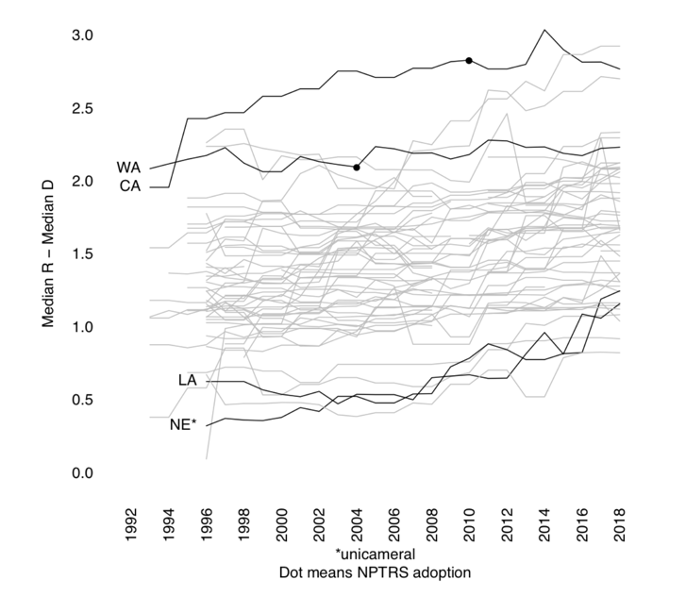
In a more modest 2015 study, Eric McGhee focused more narrowly on economic policy, and found that though Democrats had moderated somewhat on economic issues, “signs that electoral pressures produced this moderation are difficult to find.”82 Rather, it appeared that Democrats were becoming more business friendly prior to 2010.
In 2020, a decade into the reform, two studies came out that looked at the effect of the top-two primaries on congressional delegations.
In one, Christian Grose discovered some modest effects. In “Reducing Legislative Polarization: Top-Two and Open Primaries Are Associated with More Moderate Legislators,” he found that holding the partisanship and ideology of the district constant, the top-two primary is associated with between 0.07 and .10 points more moderate ideology scores for representatives. The effect of open primaries is about half that. These are orders of magnitude smaller than the difference between the two parties, but still potentially important.83 I reproduce his regression results below.
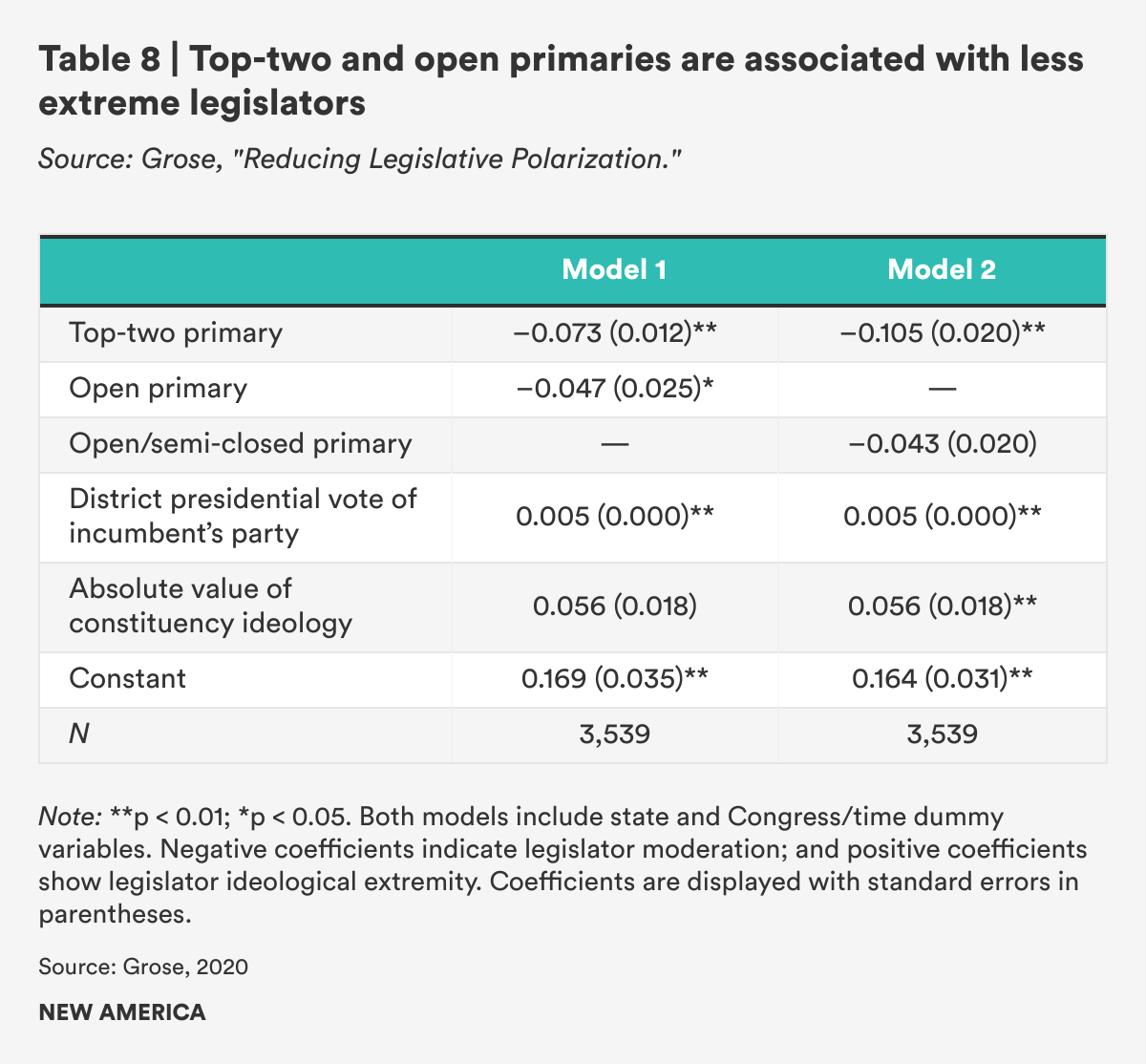
Since Grose’s study is the outlier in the bunch, it raises the obvious question: What is he doing differently? Grose’s study has the advantage of covering a large period of time, 2003-2018, which gives him over 3,500 observations, including 564 under top-two systems. However, it is important to compare his regression analysis to the one that McGhee, Masket, Shor, Rogers, and McCarty use in their 2014 paper. McGhee et al. include fixed effects (controls) for year and state, and they run separate regressions for Democrats and Republicans.
My personal analysis is that McGhee et al.’s methodological choices are all more sound. First, in conducting this kind of analysis over many years, controlling for the year is a good way to account for any secular time trends. In this case, it controls for the fact that polarization has been increasing throughout this period, so you want the estimate to account for that fact. Second, controlling for the state takes into account that different states and different state parties have different political cultures. This seems less important given the nationalization of politics, but still a good check. Running separate analyses for Democrats and Republicans, however, does seem very important, given that much of the literature has found that different primary types seem to have different impacts on Democrats and Republicans, though even these results are inconsistent across analyses, an inconsistency that suggests that these results are not entirely solid.
However, one intriguing data point from Grose’s study is that “among new members of Congress, those elected in top-two primaries are more than 18 percentage points less extreme than closed primary legislators.” (my italics) It is possible that reforms will produce more of a moderating effect through member replacement, in which case they will take time. As always, reform is part of a dynamic process.
The other 2020 study looks more closely at the same-party general contests and also finds that the top-two primary has not delivered on its promise. The paper, “Extreme districts, moderate winners: Same-party challenges, and deterrence in top-two primaries,” by Jesse Crosson concludes that, “Post-reform winners on the whole are not more moderate than similar races pre-reform.”84 In other words, the top-two system has not really worked as intended.
But it is a little more complicated and interesting than the top line finding. When Crosson digs deeper he does find that the same-party challenges are more likely to produce moderate winners, as the reform intended. However, the ability of the reform to have a large-scale impact is muted by the incumbents' ability to avoid same-party challenges. To the extent moderation emerges under the top-two system, then, it emerges in open seats that are solid enough for one party to induce same-party general election challenges. This is a relatively small share of seats. As Crosson notes, “When incumbent legislators are not running, same-party general elections are more likely to occur… This may indicate that incumbents are better able to insulate themselves from co-partisan challenges than are candidates in open seats.” Crosson suggests that party leaders also may be influencing candidate entry in order to avoid same-party competition.”85
Citations
- A typical formulation of this thesis comes from Chuck Schumer in a 2014 New York Times Op-ed entitled “End Partisan Primaries, Save America.” Schumer writes: “The partisan primary system, which favors more ideologically pure candidates, has contributed to the election of more extreme officeholders and increased political polarization. It has become a menace to governing.” Schumer goes on to urge adoption of the top-two open primary: “We need a national movement to adopt the “top-two” primary (also known as an open primary), in which all voters, regardless of party registration, can vote and the top two vote-getters, regardless of party, then enter a runoff. This would prevent a hard-right or hard-left candidate from gaining office with the support of just a sliver of the voters of the vastly diminished primary electorate; to finish in the top two, candidates from either party would have to reach out to the broad middle. “
- See, for example, FairVote’s 2020 Monopoly Politics Report, which lists only 67 out of 435 districts (15.4 percent) as competitive enough to indicate uncertainty over the general election outcome. <a href="<a href="<a href="source">source">source">source">source
- Extreme candidates may pay a small general election penalty, but in most elections, it is not big enough to matter. Andrew B. Hall and Daniel M. Thompson, “Who Punishes Extremist Nominees? Candidate Ideology and Turning Out the Base in US Elections,” American Political Science Review 112, no. 3 (August 2018): 509–24, <a href="<a href="<a href="source">source">source">source">source is also evidence that the penalty has declined or disappeared in more recent elections, largely because partisanship has become even more important than ideology to voters (that is, even more moderate partisans care more about partisanship than moderation). See Stephen M. Utych, “Man Bites Blue Dog: Are Moderates Really More Electable than Ideologues?,” The Journal of Politics 82, no. 1 (August 27, 2019): 392–96, <a href="<a href="<a href="source">source">source">source">source.
- See, e.g. G. Bingham Powell, Elections as Instruments of Democracy: Majoritarian and Proportional Visions (New Haven: Yale University Press, 2000). E. E. Schattschneider, Party Government (New York, N.Y.: Farrar & Rinehart, Inc., 1942). Robert Alan Dahl, Political Oppositions in Western Democracies (Yale University Press, 1966). Nancy L. Rosenblum, On the Side of the Angels: An Appreciation of Parties and Partisanship (Princeton: Princeton University Press, 2008).
- For a discussion of the challenges in defining political parties, see Lee Drutman, Breaking the Two-Party Doom Loop: The Case for Multiparty Democracy in America (New York: Oxford University Press, 2020).
- John H. Aldrich, Why Parties?: The Origin and Transformation of Political Parties in America (Chicago: University of Chicago Press, 1995).
- Richard Katz argues: “This is true not only in the sense that selection of candidates to contest elections is one of the functions that separates parties from other organizations that may try to influence electoral outcomes and governmental decisions, but also in the sense that the candidates it nominates play an important role in defining what the party is. More particularly, candidates as persons, and candidacies as roles or positions, serve at least four interrelated functions within contemporary political parties as organizations and contemporary democracies as systems of governance.” Richard S. Katz, “The Problem of Candidate Selection and Models of Party Democracy,” Party Politics 7, no. 3 (May 1, 2001): 277–96.
- Reuven Y. Hazan, Reuven Y. Hazan, and Gideon Rahat, Democracy within Parties: Candidate Selection Methods and Their Political Consequences (Oxford University Press, 2010); William Paul Cross and Jean-Benoît Pilet, The Politics of Party Leadership: A Cross-National Perspective (Oxford University Press, 2015).
- The history in this section is drawn from John F. Reynolds, The Demise of the American Convention System, 1880-1911 (Cambridge ; New York: Cambridge University Press, 2006); John F. Reynolds, “The Origins of the Direct Primary,” in Routledge Handbook of Primary Elections, ed. Robert G. Boatright, 1st ed. (New York: Routledge, 2018), 39–56, <a href="<a href="source">source">source">source; and Alan Ware, The American Direct Primary: Party Institutionalization and Transformation in the North (Cambridge University Press, 2002). Shigeo Hirano, Primary Elections in the United States (Cambridge University Press, 2019).
- Reynolds, John F. “The Origins of the Direct Primary.” In Routledge Handbook of Primary Elections, edited by Robert G. Boatright, 1st ed., 39–56. New York : Routledge, [2018]: Routledge, 2018. <a href="<a href="source">source">source">source.
- George W. Norris, “Why I Believe in the Direct Primary,” The ANNALS of the American Academy of Political and Social Science 106, no. 1 (March 1923): 22–30, 30.
- Grant McConnell, Private Power & American Democracy (New York: Knopf, 1966).
- Leon D. Epstein, Political Parties in the American Mold (Madison: University of Wisconsin Press, 1986).
- See Julia Azari, <a href="<a href="source">source">source">source
- For a strong version of this argument, see: Rosenbluth, Frances, and Ian Shapiro. Responsible Parties: Saving Democracy from Itself. New Haven: Yale University Press, 2018.
- Melody Crowder-Meyer et al., “A Different Kind of Disadvantage: Candidate Race, Cognitive Complexity, and Voter Choice,” Political Behavior, October 9, 2018, <a href="source">source">source.
- On the power to structure decision rules as the supreme power, see, e.g. E. E. Schattschneider, The Semi-Sovereign People: A Realist’s View of Democracy in America (Holt, Rinehart and Winston, 1960). William H Riker, The Art of Political Manipulation (New Haven: Yale University Press, 1986). Peter Bachrach and Morton S. Baratz, “Two Faces of Power,” The American Political Science Review 56, no. 4 (December 1, 1962): 947–52.
- See, e.g. Jason S Spicer, “Electoral Systems, Regional Resentment and the Surprising Success of Anglo-American Populism,” Cambridge Journal of Regions, Economy and Society 11, no. 1 (March 10, 2018): 115–41, <a href="source">source">source. Jonathan A. Rodden, Why Cities Lose: The Deep Roots of the Urban-Rural Political Divide (Basic Books, 2019). Noam Gidron, James Adams, and Will Horne, American Affective Polarization in Comparative Perspective (Cambridge University Press, 2020), <a href="source">source">source.
- Some states use different rules for presidential primaries. Since this report is oriented around congressional primaries, I ignore presidential primary rules.
- Open Primaries website, “Our Mission,” <a href="source">source">source, accessed March 22, 2021). For more discussion of the rise of independent voters and the case for primary reform, see John Opdycke and Jeremy Gruber, The Next Great Migration: The Rise of Independent Voters (Open Primaries, 2020).
- Ballotpedia, “Closed Primary,” <a href="source">source">source.
- Alaska will run its first top-four primary in 2022. Fair Vote has simulated top-four outcomes in WA and CA <a href="source">source">source and <a href="source">source">source ; The simulations projected broad intra- and inter-party general election competition, with more minor party presence. However, simulations are based on candidate entry patterns under Top Two rules. Different rules may encourage different candidates and different types of candidates to run.
- National Conference of State Legislatures, “Primary Runoffs,” <a href="source">source">source, accessed May 17, 2021. The exception to the majority-requirement is North Carolina, where a candidate who secures 30 percent in the primary can advance straight to the general election. North Carolina also allows the second-highest finisher to waive the runoff. The two non-Southern states that use some form of primary runoff are South Dakota and Vermont.
- A 2007 report from the Department of the Interior showed how Georgia’s statewide mandatory primary runoff law, enacted in 1963, was conceived and sold explicitly as a means to undercut Black candidates. see: U.S. Department of the Interior National Historic Landmarks Program, Civil Rights in America:Racial Voting Rights, 2007, revised 2009, <a href="source">source">source
- Drutman, 100.
- Nolan McCarty et al., “Geography, Uncertainty, and Polarization,” Political Science Research and Methods 7, no. 4 (October 2019): 775–94, source">source.
- Jamie L. Carson et al., “Constituency Congruency and Candidate Competition in U.S. House Elections,” Legislative Studies Quarterly 36, no. 3 (2011): 461–82, source">source.
- For detailed analysis of changes over time, see Robert G. Boatright, Getting Primaried: The Changing Politics of Congressional Primary Challenges (Ann Arbor, MI: University of Michigan Press, 2013).
- John Sides, Chris Tausanovitch, Lynn Vavreck, and Christopher Warshaw, “On the Representativeness of Primary Electorates,” British Journal of Political Science, March 2018, 1–9.
- As the authors note: “These data offer four main advantages. First, they encompass two presidential and two midterm elections and allow us to separate presidential and congressional primary voters in states that hold presidential and congressional primaries on different dates in presidential election years. Secondly, they contain large enough samples to estimate the impact of primary rules, which vary across states. Thirdly, they feature many measures of political attitudes. Finally, these data allow us to rely on validated turnout rather than potentially biased self- reports. The validated turnout data reveal substantial overlap in the primary and general electorates. In the 2008 CCAP, 68 percent of validated general election voters also voted in their state’s primary. The overlap between the two electorates means that roughly a third of 2008 general election voters voted ‘only’ in the general election and not in the primary. Any differences between the primary and general electorates must therefore manifest themselves in this relatively small group of voters.”
- Alan Abramowitz, “Don’t Blame Primary Voters for Polarization,” The Forum 5, no. 4 (2008): 1–11.
- Gary C. Jacobson, “The Electoral Origins of Polarized Politics: Evidence From the 2010 Cooperative Congressional Election Study,” American Behavioral Scientist 56, no. 12 (December 1, 2012): 1612–30, source">source.
- Jacobson, 1620-1621.
- Seth J. Hill, “Institution of Nomination and the Policy Ideology of Primary Electorates,” Quarterly Journal of Political Science 10, no. 4 (December 17, 2015): 461–87, source">source.
- Hill 2015 explains: “ Three features of my analysis are distinct from most previous comparisons. First, I examine congressional primary voters in each district, rather than presidential or congressional voters nationwide. Second, I use validated as opposed to self-reported primary turnout. And third, I use a scaled measure of ideology across multiple items, which may be a more accurate measure of preferences subject to less measurement error than individual survey responses. Future work could more carefully consider the most accurate way to measure the distinctiveness of primary voters.”In “On the Representativeness of Primary Electorates,” Sides, Tausanovitch, Vavreck, and Warshaw explain why their results differ from those of Jacobson and Hill despite their drawing from the same surveys: “In contrast to Jacobson, we use validated turnout data. As we describe in the online appendix, self-reported turnout produces larger differences between primary voters and the party following. And unlike Hill, we rely on simple disaggregated means and very large sample sizes, rather than a hierarchical model.”25
- Donald R. Kinder and Nathan P. Kalmoe, Neither Liberal nor Conservative: Ideological Innocence in the American Public (Chicago ; London: University Of Chicago Press, 2017). Lilliana Mason, “Ideologues without Issues: The Polarizing Consequences of Ideological Identities,” Public Opinion Quarterly 82, no. S1 (April 11, 2018): 280–301, source">source.
- See, e.g. Daniel J Hopkins, Hans Noel, and Hans Noel, “Trump and the Shifting Meaning of ‘Conservative’: Using Activists’ Pairwise Comparisons to Measure Senators’ Perceived Ideologies” (Working paper, 2021).
- Abramowitz, “Don’t Blame Primary Voters for Polarization.”
- Lee Drutman, “Myth of the Moderate Middle,” FiveThirtyEight, Sep. 24, 2019, source">source.
- Seth J. Hill and Chris Tausanovitch, “Southern Realignment, Party Sorting, and the Polarization of American Primary Electorates, 1958–2012,” Public Choice 176, no. 1 (July 1, 2018): 107–32, source">source.
- For older studies, see, e.g. Barbara Norrander, “Ideological Representativeness of Presidential Primary Voters,” American Journal of Political Science 33, no. 3 (1989): 570–87, source">source; John G. Geer, “Assessing the Representativeness of Electorates in Presidential Primaries,” American Journal of Political Science 32, no. 4 (1988): 929–45, source">source.
- Elaine Kamarck and Alexander R. Podkul, The 2018 Primaries Project: Introduction to the candidates (Washington, DC: Brookings Institution, 2018), source">source.
- Andrew B. Hall, Who Wants to Run?: How the Devaluing of Political Office Drives Polarization, First edition (Chicago ; London: University of Chicago Press, 2019).
- Danielle M. Thomsen, “Ideological Moderates Won’t Run: How Party Fit Matters for Partisan Polarization in Congress,” Journal of Politics 76, no. 3 (July 2014): 786–97, source">source; Danielle M. Thomsen, Opting Out of Congress: Partisan Polarization and the Decline of Moderate Candidates (Cambridge, United Kingdom: Cambridge University Press, 2017); John H. Aldrich and Danielle M. Thomsen, “Party, Policy, and the Ambition to Run for Higher Office,” Legislative Studies Quarterly 42, no. 2 (2017): 321–43, source">source writes: "The more liberal the Republican state legislator, the less likely she is to run for Congress; the more conservative the Democratic state legislator, the less likely she is to do so."
- Michael J. Barber, “Ideological Donors, Contribution Limits, and the Polarization of American Legislatures,” The Journal of Politics 78, no. 1 (2016): 296–310. Raymond J. LaRaja and Brian F. Schaffner, Campaign Finance and Political Polarization: When Purists Prevail (Ann Arbor: University of Michigan Press, 2015).
- Trent Lott, Tom Daschle, and Jon Sternfeld, Crisis Point: Why We Must – and How We Can – Overcome Our Broken Politics in Washington and Across America (New York: Bloomsbury Press, 2016) p.42.
- James Wallner and Elaine C Kamarck, Primaries and Incumbent Behavior (Brookings Institution: October 2018), source">source.
- Sarah E. Anderson, Daniel M. Butler, and Laurel Harbridge-Young, Rejecting Compromise: Legislators' Fear of Primary Voters, (Cambridge, MA: Cambridge University Press, 2020), 80 .“Substantively, a one standard deviation increase in Tea Party attachment (a 6.4% increase in people who say they have a very strong attachment to the Tea Party) is associated with a 4.6–5.3 percentage point decrease in the likelihood that a legislator will vote in favor of the compromise legislation (p = 0.005, two-sided). The more Tea Party voters there were in the district, the more likely the member of Congress was to vote against compromise legislation.” (79)
- Anderson, Butler, and Harbridge-Young, 87-88: “Among all respondents, just over half (52%) said that the two sides should meet in the middle at 50. As with compromise in the generic form, support for this more concrete partisan compromise is lower among subgroups of the electorate. Among ideologues, only a third (32%) favor an even compromise. Majorities of strong partisans, campaign donors, and Tea Party supporters also oppose compromise with the other party, suggesting that legislators may be right that these electorally important subgroups of primary voters oppose compromises made with the opposing party.” Drawing on a Pew study, they write: “the data from Pew (column 1) show that generic support for legislators who compromise drops from 61% overall to less than a majority for the very liberal or very conservative (46%) and Tea Party supporters (37%). Majorities of strong partisans and donors continue to express support for legislators who compromise.3”
- Anderson, Butler, and Harbridge-Young, Figure 5.5 shows that these co-partisan primary voters who oppose the specific compromise punish legislators for compromising.
- Anderson, Butler, and Harbridge-Yong, 60. The authors also note: “Media coverage that paints compromise in a negative light may magnify the perceived risks of compromising and the likelihood of facing a primary challenger from the far left or far right. In the 2017 survey at the NCSL Summit, we asked the legislators how various media outlets covered compromise. The majority of legislators (60%) thought that cable news outlets like MSNBC and Fox News portrayed legislative compromises in a negative light, while only 12% of legislators thought that these outlets portrayed it in a positive light. While legislators thought that national net- work news, major newspapers, and the local media were more neutral in their presentation, enough likely primary voters watch news like MSNBC and Fox to give legislators pause when considering compromise.” (81)
- Christopher Skovron, “What Politicians Believe About Electoral Accountability,” SSRN Electronic Journal, 2018, source">source. “At the state level, they especially have limited access to district-level polling, leading to inaccurate perceptions of public opinion among their constituents (Broockman and Skovron 2018). Congressional staffers have similarly inaccurate perceptions of public opinion (Hertel-Fernandez, Mildenberger and Stokes 2018). Although campaigns now have access to more data on voters than ever before, many of the records in commercial voter files remain imprecise (Hersh 2015; Fraga, Holbein and Skovron 2018) and often provide only limited information about constituents.”
- Skovron.
- Caitlin E. Jewitt and Sarah A. Treul, “Ideological Primaries and Their Influence in Congress,” in Routledge Handbook of Primary Elections, ed. Robert G. Boatright, 1st ed. (New York: Routledge, 2018), 213–25, source">source; Caitlin E. Jewitt and Sarah A. Treul, “Ideological Primary Competition and Congressional Behavior,” Congress & the Presidency 46, no. 3 (September 2, 2019): 471–94, source">source. Jewitt and Treul report: “ The results of our analysis, examining the 2000–2012 elections in which incumbent members of the House faced primary challenges, support our the- ory. We show that among incumbents who return to the House as members of the minority party, no significant relationship exists between experiencing an ideological primary and a non-ideological primary challenge on the per-cent of the time that they vote with their party leader on all roll calls. We do, however, find that on key votes, members of the minority party significantly increase the percent of the time they vote with their party leader. Although we did not necessarily expect this finding for key votes, we believe that it makes sense for two reasons. First, given the nature of key votes, these are the votes most likely to generate attention back home in the district and give a potential primary challenger ammunition for another run at the incumbent. Second, the party leadership is the most likely to whip members on key votes. Taken together, we believe these two reasons explain the sig-nificant increase in the partisan behavior of minority members on key votes following an ideological primary challenge.For majority party members, however, we show that an ideological primary challenge results in a 3.4% increase in voting against their own party on all roll calls, on average, when compared to majority party members who face a non-ideological primary challenge.2 Similarly, majority party members who faced an ideological primary challenge are 5.4% more likely to vote against their own party on key votes than are members of the majority party who faced a non-ideological primary challenge. Upon returning to Washington, majority party members who faced an ideological primary are voting against their party—both on all roll calls and on key votes—to a greater extent than their majority party colleagues who defeated a primary challenge that was not ideological in nature. Members of the majority party need a way to demon-strate their extremism and their best way to do this via votes is to vote against the party, proclaiming the party is simply not extreme enough.”
- David W. Brady, Hahrie Han, and Jeremy C. Pope, “Primary Elections and Candidate Ideology: Out of Step with the Primary Electorate?,” Legislative Studies Quarterly 32, no. 1 (February 2007): 79–105.
- Shigeo Hirano et al., “Primary Elections and Partisan Polarization in the U.S. Congress,” Quarterly Journal of Political Science, 2010, source">source.
- Hill and Tausanovitch, “Southern Realignment, Party Sorting, and the Polarization of American Primary Electorates, 1958–2012.”
- Hill, “Institution of Nomination and the Policy Ideology of Primary Electorates,” Quarterly Journal of Political Science, 10, no. 4 (2015): 461-487. source.
- Hill.
- Barbara Norrander and Jay Wendland, “Open versus Closed Primaries and the Ideological Composition of Presidential Primary Electorates,” Electoral Studies 42 (June 1, 2016): 229–36, source.
- Norrander and Wendland.
- “Point estimates suggest an increase in turnout of 1.5 percentage points in open primaries and 6.1 percentage points in nonpartisan primaries.” Seth J. Hill, “Sidestepping Primary Reform: Political Action in Response to Institutional Change,” Political Science Research and Methods, 2020, 1–17, source. See also Matthew J. Geras and Michael H. Crespin’s “The Effect of Open and Closed Primaries on Voter Turnout:” “For both the Republicans and the Democrats, voter turnout was highest during open primaries and lowest during hybrid primaries. The predicted difference in turnout between these two types of primaries appears to amount to about 2 to 3 percent.” Matthew J. Geras and Michael H. Crespin, “The Effect of Open and Closed Primaries on Voter Turnout,” in Routledge Handbook of Primary Elections, ed. Robert G. Boatright, 1st ed. (New York: Routledge, 2018), 133–46, source.
- Jon C. Rogowski and Stephanie Langella, “Primary Systems and Candidate Ideology: Evidence From Federal and State Legislative Elections,” American Politics Research 43, no. 5 (September 1, 2015): 865, source.
- Rogowski and Langella, 865
- Thad Kousser, Justin Phillips, and Boris Shor, “Reform and Representation: A New Method Applied to Recent Electoral Changes,” Political Science Research and Methods 6, no. 4 (October 2018): 809–27, source.
- Kousser, Phillips, and Shor, 820.
- Kousser, Phillips, and Shor, 22.
- Kristin Kanthak and Eric Loepp, “Strategic Candidate Entry,” in Routledge Handbook of Primary Elections, ed. Robert G. Boatright, 1st ed. (New York: Routledge, 2018), 147–57, source.
- Danielle M. Thomsen, “When Might Moderates Win the Primary?,” in Routledge Handbook of Primary Elections, ed. Robert G. Boatright, 1st ed. (New York: Routledge, 2018), 226–35, source.
- Hans J. G. Hassell, “Party Control of Party Primaries: Party Influence in Nominations for the US Senate,” The Journal of Politics 78, no. 1 (2016): 75–87.
- Thomsen, Opting Out of Congress.
- David E Broockman et al., “Having Their Cake and Eating It, Too: (Why) Local Party Leaders Prefer Nominating Extreme Candidates,” Working Paper, Stanford University, 2017, 53.
- Hall, Who Wants to Run?
- Thomsen, “When Might Moderates Win the Primary?”.
- Steven Sparks, “Polarization and the Top-Two Primary: Moderating Candidate Rhetoric in One-Party Contests,” Political Communication 36, no. 4 (October 2, 2019): 565–85, source.
- Eric McGhee, Seth Masket, Boris Shor, Steven Rogers, and Nolan McCarty, “A Primary Cause of Partisanship? Nomination Systems and Legislator Ideology,” American Journal of Political Science 58, no. 2 (2014): 337–51, source.
- McGhee et al., Table 2.
- McGhee, Masket, Shor, Rogers, and McCarty.
- Eric McGhee and Boris Shor, “Has the Top Two Primary Elected More Moderates?,” Perspectives on Politics, September 2017, 1–14, source.
- McGhee and Shor. As they note: “a portion of this effect appears to stem from the redistricting that occurred coincident with the Top Two. Our analysis also considers possible effects from other sources. Relaxed term limits went into effect at the same time as both the Top Two and the redistricting, but this change does not appear to account for all of the change in Democrats. That said, the residual pre/post change after accounting for the other potential causes leaves only a small shift to explain. Any effects we do find are limited to Democrats in California alone.” They also add a second caveat: “It is worth noting the limits of our analysis. We feel relatively more confident about the role of redistricting, since we have measured the source of those effects more directly. We can also be reasonably confident about the role of term limits, since we have comparison groups for whom the term limits change did not apply: continuing legislators and members of Congress. These groups show far smaller pre/post effects, suggesting that term limits may explain still more of the difference.”
- Jack Santucci, “Nonpartisan elections don’t reduce polarization,” Medium, February 11, 2021, source.
- “Moderation on Chamber issues came in advance of the first election under the reforms, and those who were termed out or decided not to run for reelection were just as likely to moderate as legislators who were continuing in the same body. Moreover, there is no evidence that greater moderation in the Democratic caucus has led to greater success for the Chamber’s policy agenda. Thus, there is a real possibility that this moderation is simply position-taking by elected officials who know that no concrete change in policy will come from it.” Eric McGhee, “California’s Top Two Primary and the Business Agenda,” California Journal of Politics and Policy 7, no. 1 (February 5, 2015), source.
- Christian R. Grose, “Reducing Legislative Polarization: Top-Two and Open Primaries Are Associated with More Moderate Legislators,” Journal of Political Institutions and Political Economy 1, no. 2 (June 30, 2020), source.
- Jesse Crosson, “Extreme Districts, Moderate Winners: Same-Party Challenges, and Deterrence in Top-Two Primaries,” Political Science Research and Methods, March 17, 2020, 1–17, source.
- Crosson.
Why Hasn't the Top-Two Primary Been More Transformative?
Taken together, the studies described above suggest that primary reform is not a particularly promising leverage point. Primary type seems to make little difference on who votes, who runs, and who gets elected. And to the extent there is a moderating effect of primary type, the most consistent results suggest that more Republicans should be elected by closed primary.
Since most of the studies focus on the top-two primary, and the top-two primary is of the greatest current interest to reformers, let us focus here. Below are five possibilities that emerge from the studies.
Not Enough Same-Party General Elections
Mechanically, the top-two primary’s greatest effect is going to come from districts that are so lopsided that they generate same-party general elections, thus electing candidates more moderate than would otherwise have been elected under the old system in which winning the Democratic or Republican primary was enough.
But, as Crosson’s analysis noted, “While reformers appear to have hoped same-party competition would occur at high rates in partisan-homogenous districts, the sorting analysis presented here suggests that political elites are able to avoid such competition.” Still, this is not fatal. It just suggests that more work needs to be done to induce more same-party competition: “Taken together, these findings suggest that political scientists’ claims that the top-two primary has had ‘no effect’ are premature and that the key to the system’s effectiveness lies in reformers’ ability to find ways to encourage more same-party competition.”
Still, same-party general elections do occur about one-sixth of the time, and such elections do tend to be less ideologically polarized.86 Perhaps, however, this is not enough to generate enough of an effect, or at least not without greater incumbent turnover.
No Decision Rule is Neutral, and Either Parties or Interest Groups will find a Way to Structure Choices No Matter What
Another possibility is that parties, interest groups, donors, and even candidates coordinate behind the scenes to mitigate some of the potentially moderating effects because they do not like moderation. All of these groups have ways to shape candidate entry by steering resources (money and endorsements) toward favored candidates, deterring unwelcome challengers, and generally shaping voter perceptions through their networks.
In addition, even if more moderate challengers can win in an open election, things change when they are incumbents facing demands from donors and interest groups.87 If the vast majorities of Democrats (or Republicans) in a legislature are more extreme, incumbents are going to face pressure from their colleagues to join the fight. In a polarized legislature, the middle is a lonely place to be. Most politicians are social animals, after all. This may explain particularly the continued polarization of the California State Legislature.
With multiple candidates running under the same partisan label, voters can no longer rely on partisan affiliation alone to choose their preferred candidate. In an idealized theory, this arrangement should force voters to evaluate candidates more independently. This has long been the theory of nonpartisan primaries—that absent partisan shortcuts, voters would look more closely at individual candidates and choose better candidates as a result. But in practice, most voters are too busy with the rest of their lives to evaluate individual candidates on the issues. They instead default to other shortcuts, such as endorsements, in-group affiliation, or most commonly, simply name recognition. And voters who do pay close attention often have strong and disparate preferences.
Name recognition is especially helpful for incumbents and for very well-funded candidates who can spend lots of money on advertising. Again, all decision rules empower some groups over others. If your theory of politics is that, all else equal, parties are more problematic than well-funded interest groups and private donors, and incumbents are preferable to challengers, then the top-two primary, or any nonpartisan primary, ought to increase the power of those two groups.
Also notable here is that California’s shift to nonpartisan top-two primaries generated an increase in about $18 million in contributions (compared to states that did not reform).88 And, to reiterate, when voters have to choose between multiple candidates running under the same party banner, money is that much more influential in helping them decide. A 2018 study by Steven Sparks underscores this point: "In the absence of differentiating party cues to guide vote choice, the information provided by campaign expenditures has a much larger effect for increasing challenger vote share and overcoming the advantages inherent to incumbency. Put simply, challengers in one-party contests are able to get a bigger bang for their buck, which better equips them to overcome the inherent advantage.”89 This is both because incumbents have a much bigger built-in advantage in same-party contests due to their name recognition, and because voters are much more likely to consider a challenger when they do not have to change their party.
Not Enough Crossover Voting in Same-Party General Elections
Another possibility is that, even within the top-two contests, levels of cross-over voting are lower than expected. Remember, a key expectation of the top-two open primary is that Republican voters will vote for the more moderate Democrat if two Democrats compete in the general election, and vice versa. But this depends on orphaned Republicans bothering to vote in a general election in which the choice is between two Democrats. For many orphaned Republicans, a choice between two Democrats is a choice between two equally bad options; hence, better to abstain. It is the same for Democrats choosing between two Republicans. One study found that almost half of the orphaned voters abstained in a general election.90 Another found more than 40 percent abstention among orphaned voters, and concluded that voters of the opposing party had a hard time telling the difference between the ideology of opposite party candidates. (That is, Democrats had a hard time telling the difference between moderate and extreme Republicans, and vice versa; to most Democrats, a Republican is just a Republican, and vice versa.)91
These findings were again confirmed in a 2021 study, showing once again that orphaned voters abstain at high rates, leading the study’s authors to warn, “minority party voters and candidates may be disproportionately harmed by” the top-two primary system.92 A similar critique was leveled against the runoff elections in the South.
Voters Cannot Tell the Difference between Moderate and Extreme Candidates without Distinguishing Party Labels
Another possibility is that voters have a hard time distinguishing moderate and more extreme candidates of the same party. One study conducted just before California’s 2012 primaries found that, “voters failed to distinguish moderate and extreme candidates. As a consequence, voters actually chose more ideologically distant candidates on the new ballot.” This led the authors to suggest that "lack of voter knowledge about candidate ideology and the problem of more than two candidates may be formidable obstacles” to electing more moderate candidates.93
Additionally, many so-called moderates in the voting population simply do not have strong preferences in either direction, not because they are inherently moderate, but because they do not pay enough attention to politics to have strong ideological views.94 Rather than selecting on policy, they pay attention to other factors, such as name recognition, looks, or other idiosyncratic character traits. Studies show that such voters actually de-emphasize policy and ideology. As a result, “moderate voters are less responsive to candidate positioning than non-moderate voters.”95
There Aren't that Many Moderate Voters; Independents are Not Necessarily Moderates
More broadly, there is considerable evidence that self-identified moderate voters do not necessarily hold moderate views on policy. Many moderates hold a mix of extreme views that do not neatly fit into either liberal or conservative camps, leaving them with moderate as the only reasonable label. Or, extreme liberal and conservative views on different issues average out to make a voter look moderate in a one-dimensional measure of ideology.96 Similarly, though there may be many registered independents, those independents are not necessarily moderate either.97 As Samara Klar and Yanna Krupnikov write in their book Independent Politics, most political independents vote like partisans.98
Many self-identified independents and moderates are more politically extreme than partisans.99 They are also less likely to reward compromise than registered partisans, contrary to conventional wisdom.100
In short, if the problem is the voters demanding extreme positions and rejecting compromises, the problem is not limited to registered partisans who vote in a partisan primary. Many independents and moderates are even worse. Notably, Republican primary voters who registered as independents were significantly more likely to support Trump than registered Republican voters in the 2016 primary, and Democratic voters who registered as independents were significantly more likely to support Sen. Bernie Sanders (I-Vt.) than registered Democrats. And according to regression models from an article by Joshua J. Dyck, Shanna Pearson-Merkowitz, and Michael Coates, the effect of registering as an independent was three times greater than a voter’s ideology in predicting support for Trump or Sanders.101
No matter what the primary rules, the deeper problem in our era of highly polarized conflictual politics is that a limited number of highly engaged partisans are driving political conflict. Many Americans are largely turned off from politics. It is not the opportunity to participate in primary elections that is keeping them from voting but the broader tenor of political conflict and media coverage of that conflict that keeps many voters largely on the sidelines. Independents are often more extreme and less compromise oriented than registered partisans, and largely distinguished by their frustration with and anger toward the political system. They are also often the least likely to support compromise, making them most receptive to the most anti-system populist candidates.102
Citations
- A typical formulation of this thesis comes from Chuck Schumer in a 2014 New York Times Op-ed entitled “End Partisan Primaries, Save America.” Schumer writes: “The partisan primary system, which favors more ideologically pure candidates, has contributed to the election of more extreme officeholders and increased political polarization. It has become a menace to governing.” Schumer goes on to urge adoption of the top-two open primary: “We need a national movement to adopt the “top-two” primary (also known as an open primary), in which all voters, regardless of party registration, can vote and the top two vote-getters, regardless of party, then enter a runoff. This would prevent a hard-right or hard-left candidate from gaining office with the support of just a sliver of the voters of the vastly diminished primary electorate; to finish in the top two, candidates from either party would have to reach out to the broad middle. “
- See, for example, FairVote’s 2020 Monopoly Politics Report, which lists only 67 out of 435 districts (15.4 percent) as competitive enough to indicate uncertainty over the general election outcome. <a href="<a href="<a href="<a href="source">source">source">source">source">source
- Extreme candidates may pay a small general election penalty, but in most elections, it is not big enough to matter. Andrew B. Hall and Daniel M. Thompson, “Who Punishes Extremist Nominees? Candidate Ideology and Turning Out the Base in US Elections,” American Political Science Review 112, no. 3 (August 2018): 509–24, <a href="<a href="<a href="<a href="source">source">source">source">source">source is also evidence that the penalty has declined or disappeared in more recent elections, largely because partisanship has become even more important than ideology to voters (that is, even more moderate partisans care more about partisanship than moderation). See Stephen M. Utych, “Man Bites Blue Dog: Are Moderates Really More Electable than Ideologues?,” The Journal of Politics 82, no. 1 (August 27, 2019): 392–96, <a href="<a href="<a href="<a href="source">source">source">source">source">source.
- See, e.g. G. Bingham Powell, Elections as Instruments of Democracy: Majoritarian and Proportional Visions (New Haven: Yale University Press, 2000). E. E. Schattschneider, Party Government (New York, N.Y.: Farrar & Rinehart, Inc., 1942). Robert Alan Dahl, Political Oppositions in Western Democracies (Yale University Press, 1966). Nancy L. Rosenblum, On the Side of the Angels: An Appreciation of Parties and Partisanship (Princeton: Princeton University Press, 2008).
- For a discussion of the challenges in defining political parties, see Lee Drutman, Breaking the Two-Party Doom Loop: The Case for Multiparty Democracy in America (New York: Oxford University Press, 2020).
- John H. Aldrich, Why Parties?: The Origin and Transformation of Political Parties in America (Chicago: University of Chicago Press, 1995).
- Richard Katz argues: “This is true not only in the sense that selection of candidates to contest elections is one of the functions that separates parties from other organizations that may try to influence electoral outcomes and governmental decisions, but also in the sense that the candidates it nominates play an important role in defining what the party is. More particularly, candidates as persons, and candidacies as roles or positions, serve at least four interrelated functions within contemporary political parties as organizations and contemporary democracies as systems of governance.” Richard S. Katz, “The Problem of Candidate Selection and Models of Party Democracy,” Party Politics 7, no. 3 (May 1, 2001): 277–96.
- Reuven Y. Hazan, Reuven Y. Hazan, and Gideon Rahat, Democracy within Parties: Candidate Selection Methods and Their Political Consequences (Oxford University Press, 2010); William Paul Cross and Jean-Benoît Pilet, The Politics of Party Leadership: A Cross-National Perspective (Oxford University Press, 2015).
- The history in this section is drawn from John F. Reynolds, The Demise of the American Convention System, 1880-1911 (Cambridge ; New York: Cambridge University Press, 2006); John F. Reynolds, “The Origins of the Direct Primary,” in Routledge Handbook of Primary Elections, ed. Robert G. Boatright, 1st ed. (New York: Routledge, 2018), 39–56, <a href="<a href="<a href="source">source">source">source">source; and Alan Ware, The American Direct Primary: Party Institutionalization and Transformation in the North (Cambridge University Press, 2002). Shigeo Hirano, Primary Elections in the United States (Cambridge University Press, 2019).
- Reynolds, John F. “The Origins of the Direct Primary.” In Routledge Handbook of Primary Elections, edited by Robert G. Boatright, 1st ed., 39–56. New York : Routledge, [2018]: Routledge, 2018. <a href="<a href="<a href="source">source">source">source">source.
- George W. Norris, “Why I Believe in the Direct Primary,” The ANNALS of the American Academy of Political and Social Science 106, no. 1 (March 1923): 22–30, 30.
- Grant McConnell, Private Power & American Democracy (New York: Knopf, 1966).
- Leon D. Epstein, Political Parties in the American Mold (Madison: University of Wisconsin Press, 1986).
- See Julia Azari, <a href="<a href="<a href="source">source">source">source">source
- For a strong version of this argument, see: Rosenbluth, Frances, and Ian Shapiro. Responsible Parties: Saving Democracy from Itself. New Haven: Yale University Press, 2018.
- Melody Crowder-Meyer et al., “A Different Kind of Disadvantage: Candidate Race, Cognitive Complexity, and Voter Choice,” Political Behavior, October 9, 2018, <a href="<a href="source">source">source">source.
- On the power to structure decision rules as the supreme power, see, e.g. E. E. Schattschneider, The Semi-Sovereign People: A Realist’s View of Democracy in America (Holt, Rinehart and Winston, 1960). William H Riker, The Art of Political Manipulation (New Haven: Yale University Press, 1986). Peter Bachrach and Morton S. Baratz, “Two Faces of Power,” The American Political Science Review 56, no. 4 (December 1, 1962): 947–52.
- See, e.g. Jason S Spicer, “Electoral Systems, Regional Resentment and the Surprising Success of Anglo-American Populism,” Cambridge Journal of Regions, Economy and Society 11, no. 1 (March 10, 2018): 115–41, <a href="<a href="source">source">source">source. Jonathan A. Rodden, Why Cities Lose: The Deep Roots of the Urban-Rural Political Divide (Basic Books, 2019). Noam Gidron, James Adams, and Will Horne, American Affective Polarization in Comparative Perspective (Cambridge University Press, 2020), <a href="<a href="source">source">source">source.
- Some states use different rules for presidential primaries. Since this report is oriented around congressional primaries, I ignore presidential primary rules.
- Open Primaries website, “Our Mission,” <a href="<a href="source">source">source">source, accessed March 22, 2021). For more discussion of the rise of independent voters and the case for primary reform, see John Opdycke and Jeremy Gruber, The Next Great Migration: The Rise of Independent Voters (Open Primaries, 2020).
- Ballotpedia, “Closed Primary,” <a href="<a href="source">source">source">source.
- Alaska will run its first top-four primary in 2022. Fair Vote has simulated top-four outcomes in WA and CA <a href="<a href="source">source">source">source and <a href="<a href="source">source">source">source ; The simulations projected broad intra- and inter-party general election competition, with more minor party presence. However, simulations are based on candidate entry patterns under Top Two rules. Different rules may encourage different candidates and different types of candidates to run.
- National Conference of State Legislatures, “Primary Runoffs,” <a href="<a href="source">source">source">source, accessed May 17, 2021. The exception to the majority-requirement is North Carolina, where a candidate who secures 30 percent in the primary can advance straight to the general election. North Carolina also allows the second-highest finisher to waive the runoff. The two non-Southern states that use some form of primary runoff are South Dakota and Vermont.
- A 2007 report from the Department of the Interior showed how Georgia’s statewide mandatory primary runoff law, enacted in 1963, was conceived and sold explicitly as a means to undercut Black candidates. see: U.S. Department of the Interior National Historic Landmarks Program, Civil Rights in America:Racial Voting Rights, 2007, revised 2009, <a href="<a href="source">source">source">source
- Drutman, 100.
- Nolan McCarty et al., “Geography, Uncertainty, and Polarization,” Political Science Research and Methods 7, no. 4 (October 2019): 775–94, <a href="source">source">source.
- Jamie L. Carson et al., “Constituency Congruency and Candidate Competition in U.S. House Elections,” Legislative Studies Quarterly 36, no. 3 (2011): 461–82, <a href="source">source">source.
- For detailed analysis of changes over time, see Robert G. Boatright, Getting Primaried: The Changing Politics of Congressional Primary Challenges (Ann Arbor, MI: University of Michigan Press, 2013).
- John Sides, Chris Tausanovitch, Lynn Vavreck, and Christopher Warshaw, “On the Representativeness of Primary Electorates,” British Journal of Political Science, March 2018, 1–9.
- As the authors note: “These data offer four main advantages. First, they encompass two presidential and two midterm elections and allow us to separate presidential and congressional primary voters in states that hold presidential and congressional primaries on different dates in presidential election years. Secondly, they contain large enough samples to estimate the impact of primary rules, which vary across states. Thirdly, they feature many measures of political attitudes. Finally, these data allow us to rely on validated turnout rather than potentially biased self- reports. The validated turnout data reveal substantial overlap in the primary and general electorates. In the 2008 CCAP, 68 percent of validated general election voters also voted in their state’s primary. The overlap between the two electorates means that roughly a third of 2008 general election voters voted ‘only’ in the general election and not in the primary. Any differences between the primary and general electorates must therefore manifest themselves in this relatively small group of voters.”
- Alan Abramowitz, “Don’t Blame Primary Voters for Polarization,” The Forum 5, no. 4 (2008): 1–11.
- Gary C. Jacobson, “The Electoral Origins of Polarized Politics: Evidence From the 2010 Cooperative Congressional Election Study,” American Behavioral Scientist 56, no. 12 (December 1, 2012): 1612–30, <a href="source">source">source.
- Jacobson, 1620-1621.
- Seth J. Hill, “Institution of Nomination and the Policy Ideology of Primary Electorates,” Quarterly Journal of Political Science 10, no. 4 (December 17, 2015): 461–87, <a href="source">source">source.
- Hill 2015 explains: “ Three features of my analysis are distinct from most previous comparisons. First, I examine congressional primary voters in each district, rather than presidential or congressional voters nationwide. Second, I use validated as opposed to self-reported primary turnout. And third, I use a scaled measure of ideology across multiple items, which may be a more accurate measure of preferences subject to less measurement error than individual survey responses. Future work could more carefully consider the most accurate way to measure the distinctiveness of primary voters.”In “On the Representativeness of Primary Electorates,” Sides, Tausanovitch, Vavreck, and Warshaw explain why their results differ from those of Jacobson and Hill despite their drawing from the same surveys: “In contrast to Jacobson, we use validated turnout data. As we describe in the online appendix, self-reported turnout produces larger differences between primary voters and the party following. And unlike Hill, we rely on simple disaggregated means and very large sample sizes, rather than a hierarchical model.”25
- Donald R. Kinder and Nathan P. Kalmoe, Neither Liberal nor Conservative: Ideological Innocence in the American Public (Chicago ; London: University Of Chicago Press, 2017). Lilliana Mason, “Ideologues without Issues: The Polarizing Consequences of Ideological Identities,” Public Opinion Quarterly 82, no. S1 (April 11, 2018): 280–301, <a href="source">source">source.
- See, e.g. Daniel J Hopkins, Hans Noel, and Hans Noel, “Trump and the Shifting Meaning of ‘Conservative’: Using Activists’ Pairwise Comparisons to Measure Senators’ Perceived Ideologies” (Working paper, 2021).
- Abramowitz, “Don’t Blame Primary Voters for Polarization.”
- Lee Drutman, “Myth of the Moderate Middle,” FiveThirtyEight, Sep. 24, 2019, <a href="source">source">source.
- Seth J. Hill and Chris Tausanovitch, “Southern Realignment, Party Sorting, and the Polarization of American Primary Electorates, 1958–2012,” Public Choice 176, no. 1 (July 1, 2018): 107–32, <a href="source">source">source.
- For older studies, see, e.g. Barbara Norrander, “Ideological Representativeness of Presidential Primary Voters,” American Journal of Political Science 33, no. 3 (1989): 570–87, <a href="source">source">source; John G. Geer, “Assessing the Representativeness of Electorates in Presidential Primaries,” American Journal of Political Science 32, no. 4 (1988): 929–45, <a href="source">source">source.
- Elaine Kamarck and Alexander R. Podkul, The 2018 Primaries Project: Introduction to the candidates (Washington, DC: Brookings Institution, 2018), <a href="source">source">source.
- Andrew B. Hall, Who Wants to Run?: How the Devaluing of Political Office Drives Polarization, First edition (Chicago ; London: University of Chicago Press, 2019).
- Danielle M. Thomsen, “Ideological Moderates Won’t Run: How Party Fit Matters for Partisan Polarization in Congress,” Journal of Politics 76, no. 3 (July 2014): 786–97, <a href="source">source">source; Danielle M. Thomsen, Opting Out of Congress: Partisan Polarization and the Decline of Moderate Candidates (Cambridge, United Kingdom: Cambridge University Press, 2017); John H. Aldrich and Danielle M. Thomsen, “Party, Policy, and the Ambition to Run for Higher Office,” Legislative Studies Quarterly 42, no. 2 (2017): 321–43, <a href="source">source">source writes: "The more liberal the Republican state legislator, the less likely she is to run for Congress; the more conservative the Democratic state legislator, the less likely she is to do so."
- Michael J. Barber, “Ideological Donors, Contribution Limits, and the Polarization of American Legislatures,” The Journal of Politics 78, no. 1 (2016): 296–310. Raymond J. LaRaja and Brian F. Schaffner, Campaign Finance and Political Polarization: When Purists Prevail (Ann Arbor: University of Michigan Press, 2015).
- Trent Lott, Tom Daschle, and Jon Sternfeld, Crisis Point: Why We Must – and How We Can – Overcome Our Broken Politics in Washington and Across America (New York: Bloomsbury Press, 2016) p.42.
- James Wallner and Elaine C Kamarck, Primaries and Incumbent Behavior (Brookings Institution: October 2018), <a href="source">source">source.
- Sarah E. Anderson, Daniel M. Butler, and Laurel Harbridge-Young, Rejecting Compromise: Legislators' Fear of Primary Voters, (Cambridge, MA: Cambridge University Press, 2020), 80 .“Substantively, a one standard deviation increase in Tea Party attachment (a 6.4% increase in people who say they have a very strong attachment to the Tea Party) is associated with a 4.6–5.3 percentage point decrease in the likelihood that a legislator will vote in favor of the compromise legislation (p = 0.005, two-sided). The more Tea Party voters there were in the district, the more likely the member of Congress was to vote against compromise legislation.” (79)
- Anderson, Butler, and Harbridge-Young, 87-88: “Among all respondents, just over half (52%) said that the two sides should meet in the middle at 50. As with compromise in the generic form, support for this more concrete partisan compromise is lower among subgroups of the electorate. Among ideologues, only a third (32%) favor an even compromise. Majorities of strong partisans, campaign donors, and Tea Party supporters also oppose compromise with the other party, suggesting that legislators may be right that these electorally important subgroups of primary voters oppose compromises made with the opposing party.” Drawing on a Pew study, they write: “the data from Pew (column 1) show that generic support for legislators who compromise drops from 61% overall to less than a majority for the very liberal or very conservative (46%) and Tea Party supporters (37%). Majorities of strong partisans and donors continue to express support for legislators who compromise.3”
- Anderson, Butler, and Harbridge-Young, Figure 5.5 shows that these co-partisan primary voters who oppose the specific compromise punish legislators for compromising.
- Anderson, Butler, and Harbridge-Yong, 60. The authors also note: “Media coverage that paints compromise in a negative light may magnify the perceived risks of compromising and the likelihood of facing a primary challenger from the far left or far right. In the 2017 survey at the NCSL Summit, we asked the legislators how various media outlets covered compromise. The majority of legislators (60%) thought that cable news outlets like MSNBC and Fox News portrayed legislative compromises in a negative light, while only 12% of legislators thought that these outlets portrayed it in a positive light. While legislators thought that national net- work news, major newspapers, and the local media were more neutral in their presentation, enough likely primary voters watch news like MSNBC and Fox to give legislators pause when considering compromise.” (81)
- Christopher Skovron, “What Politicians Believe About Electoral Accountability,” SSRN Electronic Journal, 2018, <a href="source">source">source. “At the state level, they especially have limited access to district-level polling, leading to inaccurate perceptions of public opinion among their constituents (Broockman and Skovron 2018). Congressional staffers have similarly inaccurate perceptions of public opinion (Hertel-Fernandez, Mildenberger and Stokes 2018). Although campaigns now have access to more data on voters than ever before, many of the records in commercial voter files remain imprecise (Hersh 2015; Fraga, Holbein and Skovron 2018) and often provide only limited information about constituents.”
- Skovron.
- Caitlin E. Jewitt and Sarah A. Treul, “Ideological Primaries and Their Influence in Congress,” in Routledge Handbook of Primary Elections, ed. Robert G. Boatright, 1st ed. (New York: Routledge, 2018), 213–25, <a href="source">source">source; Caitlin E. Jewitt and Sarah A. Treul, “Ideological Primary Competition and Congressional Behavior,” Congress & the Presidency 46, no. 3 (September 2, 2019): 471–94, <a href="source">source">source. Jewitt and Treul report: “ The results of our analysis, examining the 2000–2012 elections in which incumbent members of the House faced primary challenges, support our the- ory. We show that among incumbents who return to the House as members of the minority party, no significant relationship exists between experiencing an ideological primary and a non-ideological primary challenge on the per-cent of the time that they vote with their party leader on all roll calls. We do, however, find that on key votes, members of the minority party significantly increase the percent of the time they vote with their party leader. Although we did not necessarily expect this finding for key votes, we believe that it makes sense for two reasons. First, given the nature of key votes, these are the votes most likely to generate attention back home in the district and give a potential primary challenger ammunition for another run at the incumbent. Second, the party leadership is the most likely to whip members on key votes. Taken together, we believe these two reasons explain the sig-nificant increase in the partisan behavior of minority members on key votes following an ideological primary challenge.For majority party members, however, we show that an ideological primary challenge results in a 3.4% increase in voting against their own party on all roll calls, on average, when compared to majority party members who face a non-ideological primary challenge.2 Similarly, majority party members who faced an ideological primary challenge are 5.4% more likely to vote against their own party on key votes than are members of the majority party who faced a non-ideological primary challenge. Upon returning to Washington, majority party members who faced an ideological primary are voting against their party—both on all roll calls and on key votes—to a greater extent than their majority party colleagues who defeated a primary challenge that was not ideological in nature. Members of the majority party need a way to demon-strate their extremism and their best way to do this via votes is to vote against the party, proclaiming the party is simply not extreme enough.”
- David W. Brady, Hahrie Han, and Jeremy C. Pope, “Primary Elections and Candidate Ideology: Out of Step with the Primary Electorate?,” Legislative Studies Quarterly 32, no. 1 (February 2007): 79–105.
- Shigeo Hirano et al., “Primary Elections and Partisan Polarization in the U.S. Congress,” Quarterly Journal of Political Science, 2010, <a href="source">source">source.
- Hill and Tausanovitch, “Southern Realignment, Party Sorting, and the Polarization of American Primary Electorates, 1958–2012.”
- Hill, “Institution of Nomination and the Policy Ideology of Primary Electorates,” Quarterly Journal of Political Science, 10, no. 4 (2015): 461-487. source">source.
- Hill.
- Barbara Norrander and Jay Wendland, “Open versus Closed Primaries and the Ideological Composition of Presidential Primary Electorates,” Electoral Studies 42 (June 1, 2016): 229–36, source">source.
- Norrander and Wendland.
- “Point estimates suggest an increase in turnout of 1.5 percentage points in open primaries and 6.1 percentage points in nonpartisan primaries.” Seth J. Hill, “Sidestepping Primary Reform: Political Action in Response to Institutional Change,” Political Science Research and Methods, 2020, 1–17, source">source. See also Matthew J. Geras and Michael H. Crespin’s “The Effect of Open and Closed Primaries on Voter Turnout:” “For both the Republicans and the Democrats, voter turnout was highest during open primaries and lowest during hybrid primaries. The predicted difference in turnout between these two types of primaries appears to amount to about 2 to 3 percent.” Matthew J. Geras and Michael H. Crespin, “The Effect of Open and Closed Primaries on Voter Turnout,” in Routledge Handbook of Primary Elections, ed. Robert G. Boatright, 1st ed. (New York: Routledge, 2018), 133–46, source">source.
- Jon C. Rogowski and Stephanie Langella, “Primary Systems and Candidate Ideology: Evidence From Federal and State Legislative Elections,” American Politics Research 43, no. 5 (September 1, 2015): 865, source">source.
- Rogowski and Langella, 865
- Thad Kousser, Justin Phillips, and Boris Shor, “Reform and Representation: A New Method Applied to Recent Electoral Changes,” Political Science Research and Methods 6, no. 4 (October 2018): 809–27, source">source.
- Kousser, Phillips, and Shor, 820.
- Kousser, Phillips, and Shor, 22.
- Kristin Kanthak and Eric Loepp, “Strategic Candidate Entry,” in Routledge Handbook of Primary Elections, ed. Robert G. Boatright, 1st ed. (New York: Routledge, 2018), 147–57, source">source.
- Danielle M. Thomsen, “When Might Moderates Win the Primary?,” in Routledge Handbook of Primary Elections, ed. Robert G. Boatright, 1st ed. (New York: Routledge, 2018), 226–35, source">source.
- Hans J. G. Hassell, “Party Control of Party Primaries: Party Influence in Nominations for the US Senate,” The Journal of Politics 78, no. 1 (2016): 75–87.
- Thomsen, Opting Out of Congress.
- David E Broockman et al., “Having Their Cake and Eating It, Too: (Why) Local Party Leaders Prefer Nominating Extreme Candidates,” Working Paper, Stanford University, 2017, 53.
- Hall, Who Wants to Run?
- Thomsen, “When Might Moderates Win the Primary?”.
- Steven Sparks, “Polarization and the Top-Two Primary: Moderating Candidate Rhetoric in One-Party Contests,” Political Communication 36, no. 4 (October 2, 2019): 565–85, source">source.
- Eric McGhee, Seth Masket, Boris Shor, Steven Rogers, and Nolan McCarty, “A Primary Cause of Partisanship? Nomination Systems and Legislator Ideology,” American Journal of Political Science 58, no. 2 (2014): 337–51, source">source.
- McGhee et al., Table 2.
- McGhee, Masket, Shor, Rogers, and McCarty.
- Eric McGhee and Boris Shor, “Has the Top Two Primary Elected More Moderates?,” Perspectives on Politics, September 2017, 1–14, source">source.
- McGhee and Shor. As they note: “a portion of this effect appears to stem from the redistricting that occurred coincident with the Top Two. Our analysis also considers possible effects from other sources. Relaxed term limits went into effect at the same time as both the Top Two and the redistricting, but this change does not appear to account for all of the change in Democrats. That said, the residual pre/post change after accounting for the other potential causes leaves only a small shift to explain. Any effects we do find are limited to Democrats in California alone.” They also add a second caveat: “It is worth noting the limits of our analysis. We feel relatively more confident about the role of redistricting, since we have measured the source of those effects more directly. We can also be reasonably confident about the role of term limits, since we have comparison groups for whom the term limits change did not apply: continuing legislators and members of Congress. These groups show far smaller pre/post effects, suggesting that term limits may explain still more of the difference.”
- Jack Santucci, “Nonpartisan elections don’t reduce polarization,” Medium, February 11, 2021, source">source.
- “Moderation on Chamber issues came in advance of the first election under the reforms, and those who were termed out or decided not to run for reelection were just as likely to moderate as legislators who were continuing in the same body. Moreover, there is no evidence that greater moderation in the Democratic caucus has led to greater success for the Chamber’s policy agenda. Thus, there is a real possibility that this moderation is simply position-taking by elected officials who know that no concrete change in policy will come from it.” Eric McGhee, “California’s Top Two Primary and the Business Agenda,” California Journal of Politics and Policy 7, no. 1 (February 5, 2015), source">source.
- Christian R. Grose, “Reducing Legislative Polarization: Top-Two and Open Primaries Are Associated with More Moderate Legislators,” Journal of Political Institutions and Political Economy 1, no. 2 (June 30, 2020), source">source.
- Jesse Crosson, “Extreme Districts, Moderate Winners: Same-Party Challenges, and Deterrence in Top-Two Primaries,” Political Science Research and Methods, March 17, 2020, 1–17, source">source.
- Crosson.
- Benjamin Highton, Robert Huckfeldt, and Isaac Hale, “Some General Consequences of California’s Top-Two Primary System,” California Journal of Politics and Policy 8, no. 2 (2016), source.
- “Perhaps, because candidates running in California’s few competitive districts face pressures to conform to party and interest group discipline in order to raise the money necessary for close campaigns, they are not able to converge on the district median.” Thad Kousser, Justin Phillips, and Boris Shor, “Reform and Representation: A New Method Applied to Recent Electoral Changes,” Political Science Research and Methods 6, no. 4 (October 2018): 809–27, source.
- Hill, “Sidestepping Primary Reform.”
- Steven Sparks, “Campaign Spending and the Top-Two Primary: How Challengers Earn More Votes per Dollar in One-Party Contests,” Electoral Studies 54 (August 2018): p. 61, source.
- “47.9% of orphaned voters chose to abstain in the State Assembly race in the general Election. Of those voters who had a co-partisan choice available, only 3.9% chose to abstain." Jonathan Nagler, “Voter Behavior in California’s Top Two Primary,” California Journal of Politics and Policy 7, no. 1 (2015), source.
- Colin A. Fisk, “No Republican, No Vote: Undervoting and Consequences of the Top-Two Primary System,” State Politics & Policy Quarterly, December 23, 2019, 1532440019893688, source. for a similar finding see also: Highton, Huckfeldt, and Hale, “Some General Consequences of California’s Top-Two Primary System.”
- Daniel D. Bonneau and John Zaleski, “The Effect of California’s Top-Two Primary System on Voter Turnout in US House Elections,” Economics of Governance 22, no. 1 (March 1, 2021): 1–21, source.
- Douglas J. Ahler, Jack Citrin, and Gabriel S. Lenz, “Do Open Primaries Improve Representation? An Experimental Test of California’s 2012 Top-Two Primary,” Legislative Studies Quarterly 41, no. 2 (2016): 237–68, source.
- Kinder and Kalmoe, Neither Liberal nor Conservative.
- James Adams et al., “Do Moderate Voters Weigh Candidates’ Ideologies? Voters’ Decision Rules in the 2010 Congressional Elections,” Political Behavior 39, no. 1 (March 2017): 205–27.
- Douglas J. Ahler and David E. Broockman, “The Delegate Paradox: Why Polarized Politicians Can Represent Citizens Best,” The Journal of Politics 80, no. 4 (August 7, 2018): 1117–33, source.
- source">The Moderate Middle Is A Myth
- Samara Klar and Yanna Krupnikov, Independent Politics: How American Disdain for Parties Leads to Political Inaction (New York: Cambridge University Press, 2016).
- Ahler and Broockman, “The Delegate Paradox.” source
- As Klar and Krupnikov note in their excellent book Independent Politics, "The very people who dislike parties want their own party to fight harder. When the debate is contentious , when sacrifices need to be made, the people who avoid parties actually punish their own party for compromising…These people, be they independents or undercover partisans, are full of contradictions. On the one hand, they refuse to identify with partisan label or do anything to support a party they may secretly endorse. On the other hand, they are frustrated when their favored party compromises, wishing instead for a stronger fight. In some ways, these people lack the normatively positive aspects of partisans (for example, being politically participatory) while embracing the negative aspects of partisans (a stubborn dislike of compromise)…The people who avoid partisanship are a political candidate's worst nightmare. They do little to offer support, they refuse to admit their support publicly, and they are unlikely to convince their social networks to support a particular party position or policy. Meanwhile, they make grand overtures about partisan compromise yet grow increasingly frustrated when their party — the very same party they are ashamed to admit they prefer — bends in any way to the will of the opposition, even when this is the only way the political process can move forward. These voters want their party to engage in the very same behavior that (they claim) drove them away from partisanship in the first place."
- Joshua J. Dyck, Shanna Pearson-Merkowitz, and Michael Coates, “Primary Distrust: Political Distrust and Support for the Insurgent Candidacies of Donald Trump and Bernie Sanders in the 2016 Primary,” PS: Political Science & Politics 51, no. 2 (April 2018): 351–57, source.
- Dyck, Pearson-Merkowitz, and Coates. Klar and Krupnikov, Independent Politics.
Additional Original Analysis
Since some of the studies are incomplete or in need of updating, I add my own original analysis of the effects of primary type on delegation. Like the vast majority of other studies, I find that primary type has minimal effects.
If primary type matters, we should expect to see differences in the voting scores of members across primary type. And if closed primaries are the problem, we should expect to see the most extreme members emerging out of closed primaries.
Instead, we see the opposite in Figure 7, which shows the ideology of members in the 116th Congress by the primary type under which they were elected.
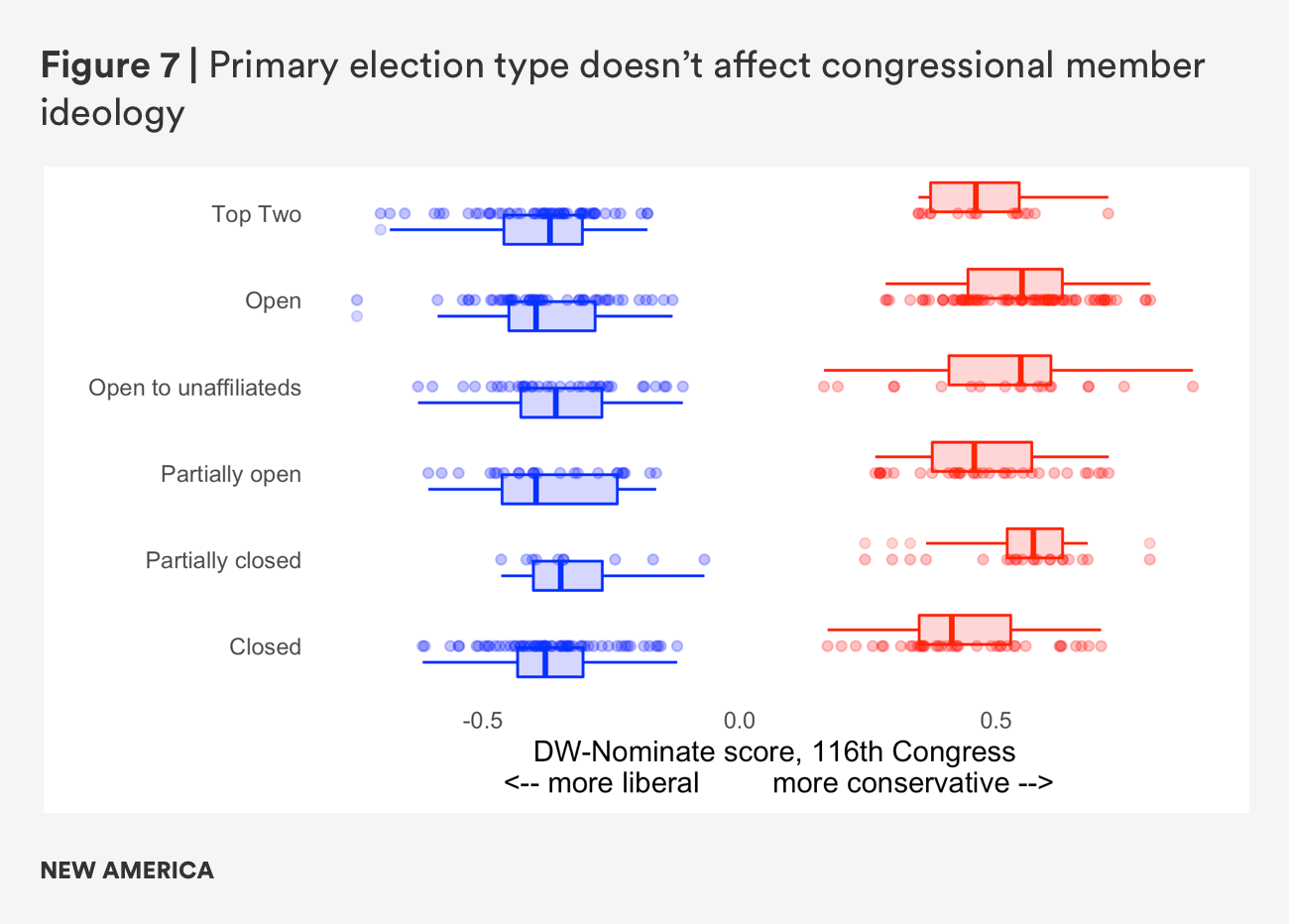
Figure 7 is a box-and-whiskers plot. The shaded box covers half of the observations, and the line in the middle of the box shows the median of the distribution. Among Democrats, the primary type seems to have absolutely no effect on the underlying voting ideology of the members elected under that type of primary.
Among Republicans, a slightly more interesting pattern emerges. Closed primaries tend to elect more moderate members; open primaries elect more extreme members. This is the opposite of what the entire open primaries movement argues.
However, one might be skeptical of these results, because they do not take into account the partisanship of the underlying district. Figure 8 takes this into account by plotting the member’s DW-NOMINATE (dynamic, weighted NOMINATE) score on the Y-axis and Trump’s 2020 vote share in the district on the X-axis.
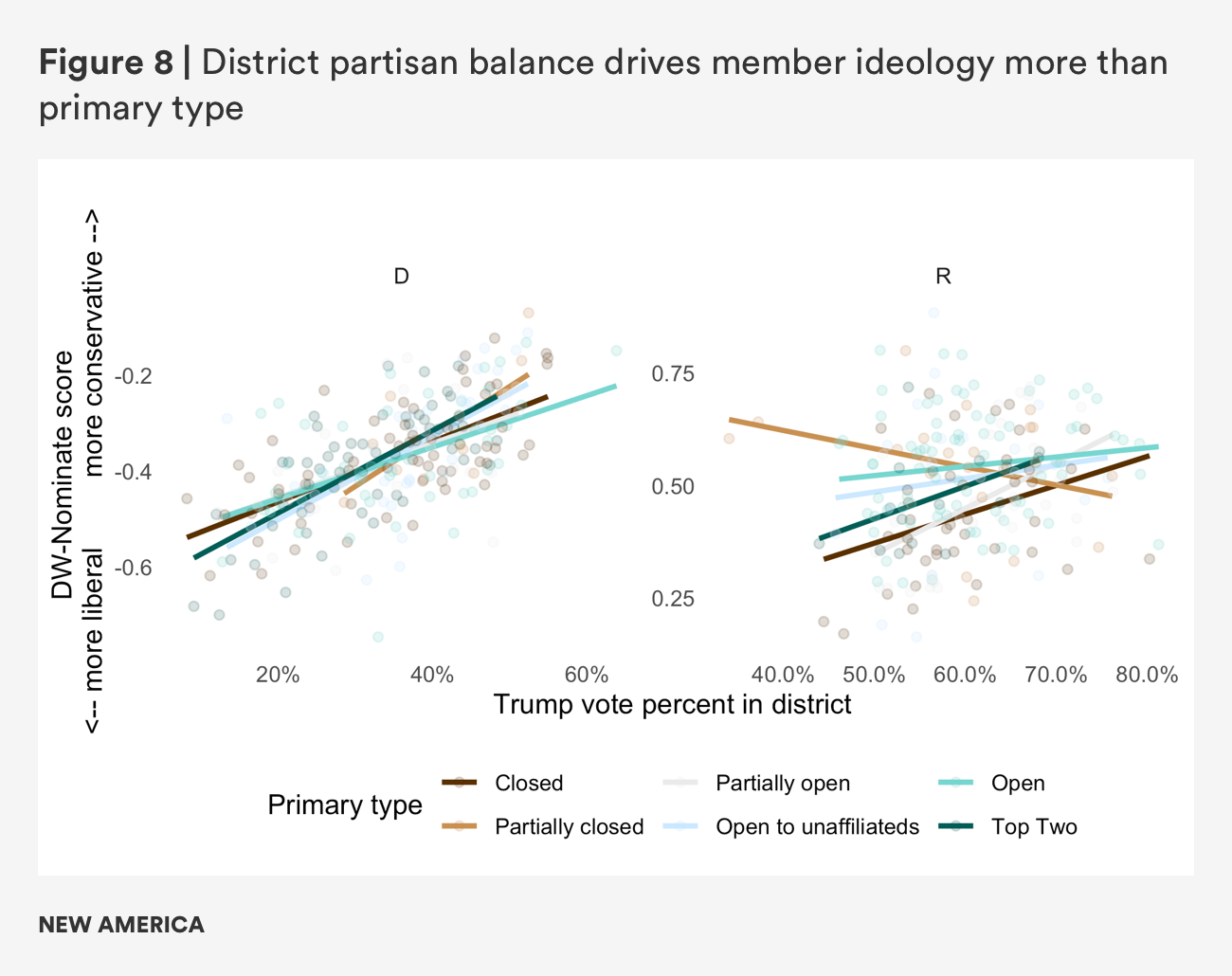
Here we see that Trump’s vote share in the district correlates with member ideology, especially among Democrats. Put another way, the safest Democratic districts elect the most liberal members of Congress. This is hardly surprising as many of those districts are in large urban areas. The relationship is less clear among Republicans, though still in the same direction. There is a little more variation by primary type. Here it is notable that the sharpest slope (strongest correlation) exists among closed primaries.
Why is this so? Perhaps in more competitive districts, closed primaries may be a way for party leaders to use their influence to steer voters toward more moderate candidates, who would be more likely to win, whereas in open primaries, there are fewer voters who care what party leaders think. It is also possible that many independent Republicans register as independents because they think the Republican Party is not conservative enough—more so than Democrats register as independents on the belief Democrats are insufficiently liberal. This could explain the pronounced gap between open and closed primaries in closer districts, but the shrinking gap as districts become safer. Both of these hypotheses are worth further investigation.
Finally, I estimate the effects of different primary rules, controlling for district partisanship. Figure 9 reports the coefficients from two regressions, one explaining ideological extremism scores among Democrats, the other explaining extremism scores among Republicans. (Extremism is the absolute value of DW-NOMINATE scores.) The omitted category for primary type is “closed” so every other category should be compared to that baseline.
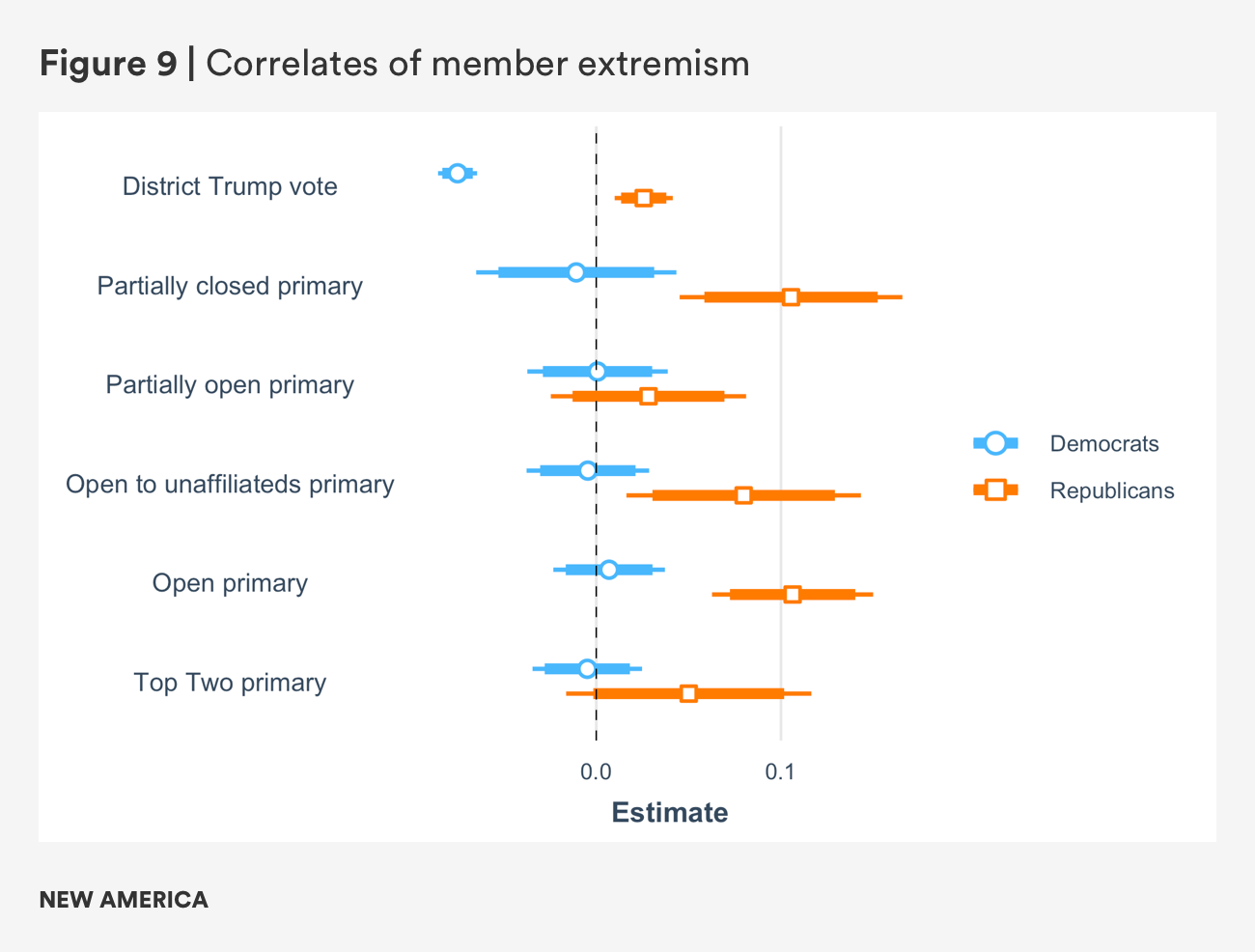
A few significant points emerge from this presentation of the relationships. First, as has been consistent throughout this analysis, among Democrats, primary type makes no difference in member ideology. Regardless of primary type, the only factor that explains member liberalism in this model is district partisanship, with safer districts sending more liberal members to Congress on average.
Among Republicans, more Trump-like districts send more conservative members to Congress, as expected, though the effect is not as large. Intriguingly, the effect of open primaries is to elect significantly more conservative members to Congress as compared to closed primaries. This is consistent with the Sides et al. finding that the most ideologically extreme subgroup across the 2008-2014 cycles was Republican candidate supporters who voted in open primaries. More broadly, compared to closed primaries, every other primary type is associated with more conservative members of Congress. Again, this runs contrary to the expectations.
But this looks at a single Congress. How much of this is consistent across multiple Congresses? To assess this, I grouped Democrats and Republicans separately by primary type, and took the average NOMINATE score across each delegation for the past five Congresses (to keep districting boundaries mostly consistent). The results suggest that there was nothing unique about the 116th Congress. The differences in primary type are consistent across multiple Congresses.
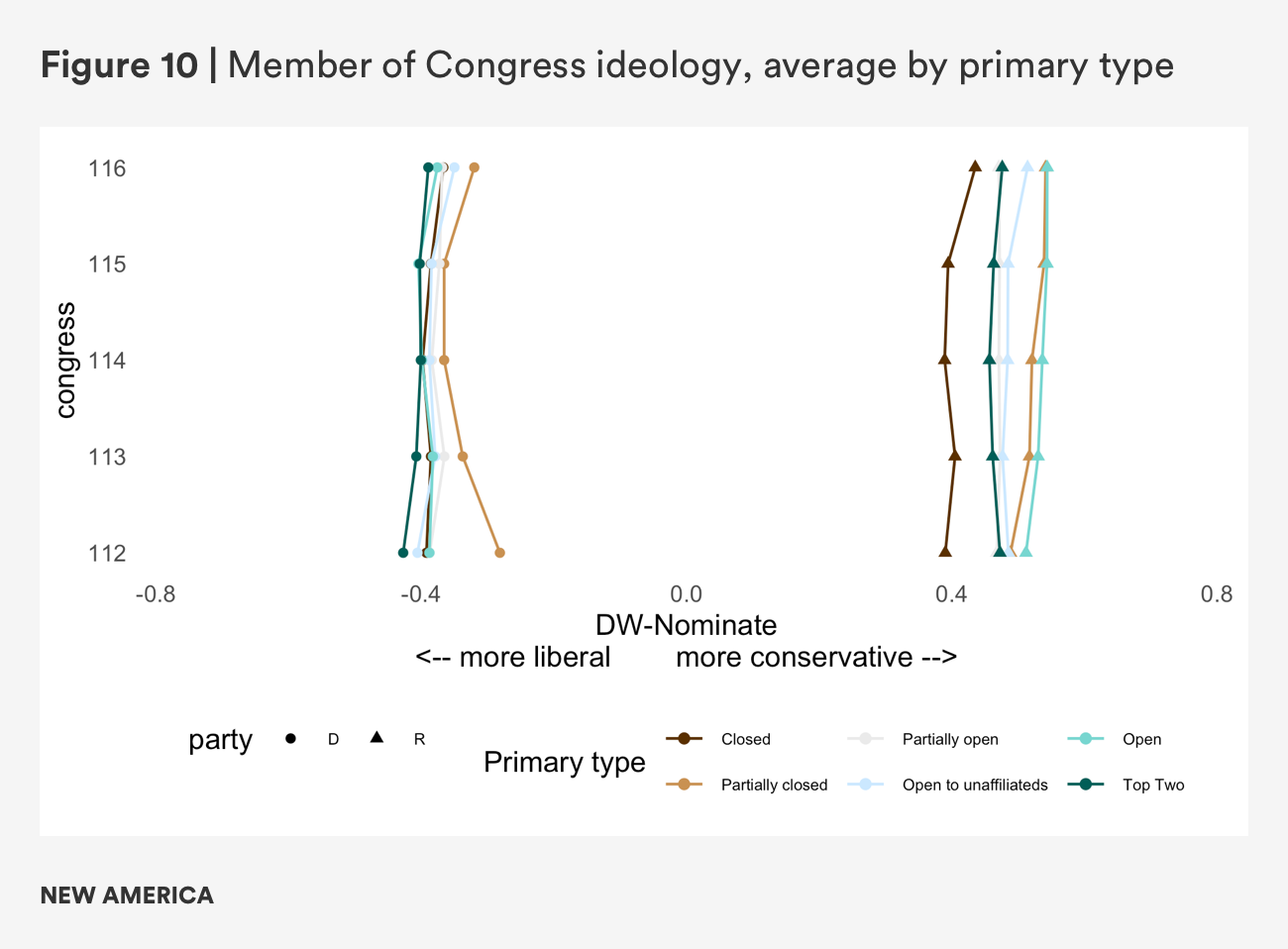
The takeaway from this analysis is simple: nothing in the data for the last Congress or the last decade suggests that primary type matters when it comes to member ideology. Contrary to expectations, open primaries consistently elect, on average, more extreme Republicans than closed primaries do. In fact, closed primaries consistently elect more moderate Republicans than open primaries. Meanwhile, the top-two primary has not moved the needle very much at all.
The other key takeaway from Figure 10 is that the difference between the parties is orders of magnitude larger than the differences among partisans by primary type. In other words, even if one took away from the above graphic that the key to making Republicans more moderate was to enact closed primaries everywhere, Republicans and Democrats in Congress would remain extremely far apart.
Citations
- A typical formulation of this thesis comes from Chuck Schumer in a 2014 New York Times Op-ed entitled “End Partisan Primaries, Save America.” Schumer writes: “The partisan primary system, which favors more ideologically pure candidates, has contributed to the election of more extreme officeholders and increased political polarization. It has become a menace to governing.” Schumer goes on to urge adoption of the top-two open primary: “We need a national movement to adopt the “top-two” primary (also known as an open primary), in which all voters, regardless of party registration, can vote and the top two vote-getters, regardless of party, then enter a runoff. This would prevent a hard-right or hard-left candidate from gaining office with the support of just a sliver of the voters of the vastly diminished primary electorate; to finish in the top two, candidates from either party would have to reach out to the broad middle. “
- See, for example, FairVote’s 2020 Monopoly Politics Report, which lists only 67 out of 435 districts (15.4 percent) as competitive enough to indicate uncertainty over the general election outcome. <a href="<a href="<a href="<a href="<a href="source">source">source">source">source">source">source
- Extreme candidates may pay a small general election penalty, but in most elections, it is not big enough to matter. Andrew B. Hall and Daniel M. Thompson, “Who Punishes Extremist Nominees? Candidate Ideology and Turning Out the Base in US Elections,” American Political Science Review 112, no. 3 (August 2018): 509–24, <a href="<a href="<a href="<a href="<a href="source">source">source">source">source">source">source is also evidence that the penalty has declined or disappeared in more recent elections, largely because partisanship has become even more important than ideology to voters (that is, even more moderate partisans care more about partisanship than moderation). See Stephen M. Utych, “Man Bites Blue Dog: Are Moderates Really More Electable than Ideologues?,” The Journal of Politics 82, no. 1 (August 27, 2019): 392–96, <a href="<a href="<a href="<a href="<a href="source">source">source">source">source">source">source.
- See, e.g. G. Bingham Powell, Elections as Instruments of Democracy: Majoritarian and Proportional Visions (New Haven: Yale University Press, 2000). E. E. Schattschneider, Party Government (New York, N.Y.: Farrar & Rinehart, Inc., 1942). Robert Alan Dahl, Political Oppositions in Western Democracies (Yale University Press, 1966). Nancy L. Rosenblum, On the Side of the Angels: An Appreciation of Parties and Partisanship (Princeton: Princeton University Press, 2008).
- For a discussion of the challenges in defining political parties, see Lee Drutman, Breaking the Two-Party Doom Loop: The Case for Multiparty Democracy in America (New York: Oxford University Press, 2020).
- John H. Aldrich, Why Parties?: The Origin and Transformation of Political Parties in America (Chicago: University of Chicago Press, 1995).
- Richard Katz argues: “This is true not only in the sense that selection of candidates to contest elections is one of the functions that separates parties from other organizations that may try to influence electoral outcomes and governmental decisions, but also in the sense that the candidates it nominates play an important role in defining what the party is. More particularly, candidates as persons, and candidacies as roles or positions, serve at least four interrelated functions within contemporary political parties as organizations and contemporary democracies as systems of governance.” Richard S. Katz, “The Problem of Candidate Selection and Models of Party Democracy,” Party Politics 7, no. 3 (May 1, 2001): 277–96.
- Reuven Y. Hazan, Reuven Y. Hazan, and Gideon Rahat, Democracy within Parties: Candidate Selection Methods and Their Political Consequences (Oxford University Press, 2010); William Paul Cross and Jean-Benoît Pilet, The Politics of Party Leadership: A Cross-National Perspective (Oxford University Press, 2015).
- The history in this section is drawn from John F. Reynolds, The Demise of the American Convention System, 1880-1911 (Cambridge ; New York: Cambridge University Press, 2006); John F. Reynolds, “The Origins of the Direct Primary,” in Routledge Handbook of Primary Elections, ed. Robert G. Boatright, 1st ed. (New York: Routledge, 2018), 39–56, <a href="<a href="<a href="<a href="source">source">source">source">source">source; and Alan Ware, The American Direct Primary: Party Institutionalization and Transformation in the North (Cambridge University Press, 2002). Shigeo Hirano, Primary Elections in the United States (Cambridge University Press, 2019).
- Reynolds, John F. “The Origins of the Direct Primary.” In Routledge Handbook of Primary Elections, edited by Robert G. Boatright, 1st ed., 39–56. New York : Routledge, [2018]: Routledge, 2018. <a href="<a href="<a href="<a href="source">source">source">source">source">source.
- George W. Norris, “Why I Believe in the Direct Primary,” The ANNALS of the American Academy of Political and Social Science 106, no. 1 (March 1923): 22–30, 30.
- Grant McConnell, Private Power & American Democracy (New York: Knopf, 1966).
- Leon D. Epstein, Political Parties in the American Mold (Madison: University of Wisconsin Press, 1986).
- See Julia Azari, <a href="<a href="<a href="<a href="source">source">source">source">source">source
- For a strong version of this argument, see: Rosenbluth, Frances, and Ian Shapiro. Responsible Parties: Saving Democracy from Itself. New Haven: Yale University Press, 2018.
- Melody Crowder-Meyer et al., “A Different Kind of Disadvantage: Candidate Race, Cognitive Complexity, and Voter Choice,” Political Behavior, October 9, 2018, <a href="<a href="<a href="source">source">source">source">source.
- On the power to structure decision rules as the supreme power, see, e.g. E. E. Schattschneider, The Semi-Sovereign People: A Realist’s View of Democracy in America (Holt, Rinehart and Winston, 1960). William H Riker, The Art of Political Manipulation (New Haven: Yale University Press, 1986). Peter Bachrach and Morton S. Baratz, “Two Faces of Power,” The American Political Science Review 56, no. 4 (December 1, 1962): 947–52.
- See, e.g. Jason S Spicer, “Electoral Systems, Regional Resentment and the Surprising Success of Anglo-American Populism,” Cambridge Journal of Regions, Economy and Society 11, no. 1 (March 10, 2018): 115–41, <a href="<a href="<a href="source">source">source">source">source. Jonathan A. Rodden, Why Cities Lose: The Deep Roots of the Urban-Rural Political Divide (Basic Books, 2019). Noam Gidron, James Adams, and Will Horne, American Affective Polarization in Comparative Perspective (Cambridge University Press, 2020), <a href="<a href="<a href="source">source">source">source">source.
- Some states use different rules for presidential primaries. Since this report is oriented around congressional primaries, I ignore presidential primary rules.
- Open Primaries website, “Our Mission,” <a href="<a href="<a href="source">source">source">source">source, accessed March 22, 2021). For more discussion of the rise of independent voters and the case for primary reform, see John Opdycke and Jeremy Gruber, The Next Great Migration: The Rise of Independent Voters (Open Primaries, 2020).
- Ballotpedia, “Closed Primary,” <a href="<a href="<a href="source">source">source">source">source.
- Alaska will run its first top-four primary in 2022. Fair Vote has simulated top-four outcomes in WA and CA <a href="<a href="<a href="source">source">source">source">source and <a href="<a href="<a href="source">source">source">source">source ; The simulations projected broad intra- and inter-party general election competition, with more minor party presence. However, simulations are based on candidate entry patterns under Top Two rules. Different rules may encourage different candidates and different types of candidates to run.
- National Conference of State Legislatures, “Primary Runoffs,” <a href="<a href="<a href="source">source">source">source">source, accessed May 17, 2021. The exception to the majority-requirement is North Carolina, where a candidate who secures 30 percent in the primary can advance straight to the general election. North Carolina also allows the second-highest finisher to waive the runoff. The two non-Southern states that use some form of primary runoff are South Dakota and Vermont.
- A 2007 report from the Department of the Interior showed how Georgia’s statewide mandatory primary runoff law, enacted in 1963, was conceived and sold explicitly as a means to undercut Black candidates. see: U.S. Department of the Interior National Historic Landmarks Program, Civil Rights in America:Racial Voting Rights, 2007, revised 2009, <a href="<a href="<a href="source">source">source">source">source
- Drutman, 100.
- Nolan McCarty et al., “Geography, Uncertainty, and Polarization,” Political Science Research and Methods 7, no. 4 (October 2019): 775–94, <a href="<a href="source">source">source">source.
- Jamie L. Carson et al., “Constituency Congruency and Candidate Competition in U.S. House Elections,” Legislative Studies Quarterly 36, no. 3 (2011): 461–82, <a href="<a href="source">source">source">source.
- For detailed analysis of changes over time, see Robert G. Boatright, Getting Primaried: The Changing Politics of Congressional Primary Challenges (Ann Arbor, MI: University of Michigan Press, 2013).
- John Sides, Chris Tausanovitch, Lynn Vavreck, and Christopher Warshaw, “On the Representativeness of Primary Electorates,” British Journal of Political Science, March 2018, 1–9.
- As the authors note: “These data offer four main advantages. First, they encompass two presidential and two midterm elections and allow us to separate presidential and congressional primary voters in states that hold presidential and congressional primaries on different dates in presidential election years. Secondly, they contain large enough samples to estimate the impact of primary rules, which vary across states. Thirdly, they feature many measures of political attitudes. Finally, these data allow us to rely on validated turnout rather than potentially biased self- reports. The validated turnout data reveal substantial overlap in the primary and general electorates. In the 2008 CCAP, 68 percent of validated general election voters also voted in their state’s primary. The overlap between the two electorates means that roughly a third of 2008 general election voters voted ‘only’ in the general election and not in the primary. Any differences between the primary and general electorates must therefore manifest themselves in this relatively small group of voters.”
- Alan Abramowitz, “Don’t Blame Primary Voters for Polarization,” The Forum 5, no. 4 (2008): 1–11.
- Gary C. Jacobson, “The Electoral Origins of Polarized Politics: Evidence From the 2010 Cooperative Congressional Election Study,” American Behavioral Scientist 56, no. 12 (December 1, 2012): 1612–30, <a href="<a href="source">source">source">source.
- Jacobson, 1620-1621.
- Seth J. Hill, “Institution of Nomination and the Policy Ideology of Primary Electorates,” Quarterly Journal of Political Science 10, no. 4 (December 17, 2015): 461–87, <a href="<a href="source">source">source">source.
- Hill 2015 explains: “ Three features of my analysis are distinct from most previous comparisons. First, I examine congressional primary voters in each district, rather than presidential or congressional voters nationwide. Second, I use validated as opposed to self-reported primary turnout. And third, I use a scaled measure of ideology across multiple items, which may be a more accurate measure of preferences subject to less measurement error than individual survey responses. Future work could more carefully consider the most accurate way to measure the distinctiveness of primary voters.”In “On the Representativeness of Primary Electorates,” Sides, Tausanovitch, Vavreck, and Warshaw explain why their results differ from those of Jacobson and Hill despite their drawing from the same surveys: “In contrast to Jacobson, we use validated turnout data. As we describe in the online appendix, self-reported turnout produces larger differences between primary voters and the party following. And unlike Hill, we rely on simple disaggregated means and very large sample sizes, rather than a hierarchical model.”25
- Donald R. Kinder and Nathan P. Kalmoe, Neither Liberal nor Conservative: Ideological Innocence in the American Public (Chicago ; London: University Of Chicago Press, 2017). Lilliana Mason, “Ideologues without Issues: The Polarizing Consequences of Ideological Identities,” Public Opinion Quarterly 82, no. S1 (April 11, 2018): 280–301, <a href="<a href="source">source">source">source.
- See, e.g. Daniel J Hopkins, Hans Noel, and Hans Noel, “Trump and the Shifting Meaning of ‘Conservative’: Using Activists’ Pairwise Comparisons to Measure Senators’ Perceived Ideologies” (Working paper, 2021).
- Abramowitz, “Don’t Blame Primary Voters for Polarization.”
- Lee Drutman, “Myth of the Moderate Middle,” FiveThirtyEight, Sep. 24, 2019, <a href="<a href="source">source">source">source.
- Seth J. Hill and Chris Tausanovitch, “Southern Realignment, Party Sorting, and the Polarization of American Primary Electorates, 1958–2012,” Public Choice 176, no. 1 (July 1, 2018): 107–32, <a href="<a href="source">source">source">source.
- For older studies, see, e.g. Barbara Norrander, “Ideological Representativeness of Presidential Primary Voters,” American Journal of Political Science 33, no. 3 (1989): 570–87, <a href="<a href="source">source">source">source; John G. Geer, “Assessing the Representativeness of Electorates in Presidential Primaries,” American Journal of Political Science 32, no. 4 (1988): 929–45, <a href="<a href="source">source">source">source.
- Elaine Kamarck and Alexander R. Podkul, The 2018 Primaries Project: Introduction to the candidates (Washington, DC: Brookings Institution, 2018), <a href="<a href="source">source">source">source.
- Andrew B. Hall, Who Wants to Run?: How the Devaluing of Political Office Drives Polarization, First edition (Chicago ; London: University of Chicago Press, 2019).
- Danielle M. Thomsen, “Ideological Moderates Won’t Run: How Party Fit Matters for Partisan Polarization in Congress,” Journal of Politics 76, no. 3 (July 2014): 786–97, <a href="<a href="source">source">source">source; Danielle M. Thomsen, Opting Out of Congress: Partisan Polarization and the Decline of Moderate Candidates (Cambridge, United Kingdom: Cambridge University Press, 2017); John H. Aldrich and Danielle M. Thomsen, “Party, Policy, and the Ambition to Run for Higher Office,” Legislative Studies Quarterly 42, no. 2 (2017): 321–43, <a href="<a href="source">source">source">source writes: "The more liberal the Republican state legislator, the less likely she is to run for Congress; the more conservative the Democratic state legislator, the less likely she is to do so."
- Michael J. Barber, “Ideological Donors, Contribution Limits, and the Polarization of American Legislatures,” The Journal of Politics 78, no. 1 (2016): 296–310. Raymond J. LaRaja and Brian F. Schaffner, Campaign Finance and Political Polarization: When Purists Prevail (Ann Arbor: University of Michigan Press, 2015).
- Trent Lott, Tom Daschle, and Jon Sternfeld, Crisis Point: Why We Must – and How We Can – Overcome Our Broken Politics in Washington and Across America (New York: Bloomsbury Press, 2016) p.42.
- James Wallner and Elaine C Kamarck, Primaries and Incumbent Behavior (Brookings Institution: October 2018), <a href="<a href="source">source">source">source.
- Sarah E. Anderson, Daniel M. Butler, and Laurel Harbridge-Young, Rejecting Compromise: Legislators' Fear of Primary Voters, (Cambridge, MA: Cambridge University Press, 2020), 80 .“Substantively, a one standard deviation increase in Tea Party attachment (a 6.4% increase in people who say they have a very strong attachment to the Tea Party) is associated with a 4.6–5.3 percentage point decrease in the likelihood that a legislator will vote in favor of the compromise legislation (p = 0.005, two-sided). The more Tea Party voters there were in the district, the more likely the member of Congress was to vote against compromise legislation.” (79)
- Anderson, Butler, and Harbridge-Young, 87-88: “Among all respondents, just over half (52%) said that the two sides should meet in the middle at 50. As with compromise in the generic form, support for this more concrete partisan compromise is lower among subgroups of the electorate. Among ideologues, only a third (32%) favor an even compromise. Majorities of strong partisans, campaign donors, and Tea Party supporters also oppose compromise with the other party, suggesting that legislators may be right that these electorally important subgroups of primary voters oppose compromises made with the opposing party.” Drawing on a Pew study, they write: “the data from Pew (column 1) show that generic support for legislators who compromise drops from 61% overall to less than a majority for the very liberal or very conservative (46%) and Tea Party supporters (37%). Majorities of strong partisans and donors continue to express support for legislators who compromise.3”
- Anderson, Butler, and Harbridge-Young, Figure 5.5 shows that these co-partisan primary voters who oppose the specific compromise punish legislators for compromising.
- Anderson, Butler, and Harbridge-Yong, 60. The authors also note: “Media coverage that paints compromise in a negative light may magnify the perceived risks of compromising and the likelihood of facing a primary challenger from the far left or far right. In the 2017 survey at the NCSL Summit, we asked the legislators how various media outlets covered compromise. The majority of legislators (60%) thought that cable news outlets like MSNBC and Fox News portrayed legislative compromises in a negative light, while only 12% of legislators thought that these outlets portrayed it in a positive light. While legislators thought that national net- work news, major newspapers, and the local media were more neutral in their presentation, enough likely primary voters watch news like MSNBC and Fox to give legislators pause when considering compromise.” (81)
- Christopher Skovron, “What Politicians Believe About Electoral Accountability,” SSRN Electronic Journal, 2018, <a href="<a href="source">source">source">source. “At the state level, they especially have limited access to district-level polling, leading to inaccurate perceptions of public opinion among their constituents (Broockman and Skovron 2018). Congressional staffers have similarly inaccurate perceptions of public opinion (Hertel-Fernandez, Mildenberger and Stokes 2018). Although campaigns now have access to more data on voters than ever before, many of the records in commercial voter files remain imprecise (Hersh 2015; Fraga, Holbein and Skovron 2018) and often provide only limited information about constituents.”
- Skovron.
- Caitlin E. Jewitt and Sarah A. Treul, “Ideological Primaries and Their Influence in Congress,” in Routledge Handbook of Primary Elections, ed. Robert G. Boatright, 1st ed. (New York: Routledge, 2018), 213–25, <a href="<a href="source">source">source">source; Caitlin E. Jewitt and Sarah A. Treul, “Ideological Primary Competition and Congressional Behavior,” Congress & the Presidency 46, no. 3 (September 2, 2019): 471–94, <a href="<a href="source">source">source">source. Jewitt and Treul report: “ The results of our analysis, examining the 2000–2012 elections in which incumbent members of the House faced primary challenges, support our the- ory. We show that among incumbents who return to the House as members of the minority party, no significant relationship exists between experiencing an ideological primary and a non-ideological primary challenge on the per-cent of the time that they vote with their party leader on all roll calls. We do, however, find that on key votes, members of the minority party significantly increase the percent of the time they vote with their party leader. Although we did not necessarily expect this finding for key votes, we believe that it makes sense for two reasons. First, given the nature of key votes, these are the votes most likely to generate attention back home in the district and give a potential primary challenger ammunition for another run at the incumbent. Second, the party leadership is the most likely to whip members on key votes. Taken together, we believe these two reasons explain the sig-nificant increase in the partisan behavior of minority members on key votes following an ideological primary challenge.For majority party members, however, we show that an ideological primary challenge results in a 3.4% increase in voting against their own party on all roll calls, on average, when compared to majority party members who face a non-ideological primary challenge.2 Similarly, majority party members who faced an ideological primary challenge are 5.4% more likely to vote against their own party on key votes than are members of the majority party who faced a non-ideological primary challenge. Upon returning to Washington, majority party members who faced an ideological primary are voting against their party—both on all roll calls and on key votes—to a greater extent than their majority party colleagues who defeated a primary challenge that was not ideological in nature. Members of the majority party need a way to demon-strate their extremism and their best way to do this via votes is to vote against the party, proclaiming the party is simply not extreme enough.”
- David W. Brady, Hahrie Han, and Jeremy C. Pope, “Primary Elections and Candidate Ideology: Out of Step with the Primary Electorate?,” Legislative Studies Quarterly 32, no. 1 (February 2007): 79–105.
- Shigeo Hirano et al., “Primary Elections and Partisan Polarization in the U.S. Congress,” Quarterly Journal of Political Science, 2010, <a href="<a href="source">source">source">source.
- Hill and Tausanovitch, “Southern Realignment, Party Sorting, and the Polarization of American Primary Electorates, 1958–2012.”
- Hill, “Institution of Nomination and the Policy Ideology of Primary Electorates,” Quarterly Journal of Political Science, 10, no. 4 (2015): 461-487. <a href="source">source">source.
- Hill.
- Barbara Norrander and Jay Wendland, “Open versus Closed Primaries and the Ideological Composition of Presidential Primary Electorates,” Electoral Studies 42 (June 1, 2016): 229–36, <a href="source">source">source.
- Norrander and Wendland.
- “Point estimates suggest an increase in turnout of 1.5 percentage points in open primaries and 6.1 percentage points in nonpartisan primaries.” Seth J. Hill, “Sidestepping Primary Reform: Political Action in Response to Institutional Change,” Political Science Research and Methods, 2020, 1–17, <a href="source">source">source. See also Matthew J. Geras and Michael H. Crespin’s “The Effect of Open and Closed Primaries on Voter Turnout:” “For both the Republicans and the Democrats, voter turnout was highest during open primaries and lowest during hybrid primaries. The predicted difference in turnout between these two types of primaries appears to amount to about 2 to 3 percent.” Matthew J. Geras and Michael H. Crespin, “The Effect of Open and Closed Primaries on Voter Turnout,” in Routledge Handbook of Primary Elections, ed. Robert G. Boatright, 1st ed. (New York: Routledge, 2018), 133–46, <a href="source">source">source.
- Jon C. Rogowski and Stephanie Langella, “Primary Systems and Candidate Ideology: Evidence From Federal and State Legislative Elections,” American Politics Research 43, no. 5 (September 1, 2015): 865, <a href="source">source">source.
- Rogowski and Langella, 865
- Thad Kousser, Justin Phillips, and Boris Shor, “Reform and Representation: A New Method Applied to Recent Electoral Changes,” Political Science Research and Methods 6, no. 4 (October 2018): 809–27, <a href="source">source">source.
- Kousser, Phillips, and Shor, 820.
- Kousser, Phillips, and Shor, 22.
- Kristin Kanthak and Eric Loepp, “Strategic Candidate Entry,” in Routledge Handbook of Primary Elections, ed. Robert G. Boatright, 1st ed. (New York: Routledge, 2018), 147–57, <a href="source">source">source.
- Danielle M. Thomsen, “When Might Moderates Win the Primary?,” in Routledge Handbook of Primary Elections, ed. Robert G. Boatright, 1st ed. (New York: Routledge, 2018), 226–35, <a href="source">source">source.
- Hans J. G. Hassell, “Party Control of Party Primaries: Party Influence in Nominations for the US Senate,” The Journal of Politics 78, no. 1 (2016): 75–87.
- Thomsen, Opting Out of Congress.
- David E Broockman et al., “Having Their Cake and Eating It, Too: (Why) Local Party Leaders Prefer Nominating Extreme Candidates,” Working Paper, Stanford University, 2017, 53.
- Hall, Who Wants to Run?
- Thomsen, “When Might Moderates Win the Primary?”.
- Steven Sparks, “Polarization and the Top-Two Primary: Moderating Candidate Rhetoric in One-Party Contests,” Political Communication 36, no. 4 (October 2, 2019): 565–85, <a href="source">source">source.
- Eric McGhee, Seth Masket, Boris Shor, Steven Rogers, and Nolan McCarty, “A Primary Cause of Partisanship? Nomination Systems and Legislator Ideology,” American Journal of Political Science 58, no. 2 (2014): 337–51, <a href="source">source">source.
- McGhee et al., Table 2.
- McGhee, Masket, Shor, Rogers, and McCarty.
- Eric McGhee and Boris Shor, “Has the Top Two Primary Elected More Moderates?,” Perspectives on Politics, September 2017, 1–14, <a href="source">source">source.
- McGhee and Shor. As they note: “a portion of this effect appears to stem from the redistricting that occurred coincident with the Top Two. Our analysis also considers possible effects from other sources. Relaxed term limits went into effect at the same time as both the Top Two and the redistricting, but this change does not appear to account for all of the change in Democrats. That said, the residual pre/post change after accounting for the other potential causes leaves only a small shift to explain. Any effects we do find are limited to Democrats in California alone.” They also add a second caveat: “It is worth noting the limits of our analysis. We feel relatively more confident about the role of redistricting, since we have measured the source of those effects more directly. We can also be reasonably confident about the role of term limits, since we have comparison groups for whom the term limits change did not apply: continuing legislators and members of Congress. These groups show far smaller pre/post effects, suggesting that term limits may explain still more of the difference.”
- Jack Santucci, “Nonpartisan elections don’t reduce polarization,” Medium, February 11, 2021, <a href="source">source">source.
- “Moderation on Chamber issues came in advance of the first election under the reforms, and those who were termed out or decided not to run for reelection were just as likely to moderate as legislators who were continuing in the same body. Moreover, there is no evidence that greater moderation in the Democratic caucus has led to greater success for the Chamber’s policy agenda. Thus, there is a real possibility that this moderation is simply position-taking by elected officials who know that no concrete change in policy will come from it.” Eric McGhee, “California’s Top Two Primary and the Business Agenda,” California Journal of Politics and Policy 7, no. 1 (February 5, 2015), <a href="source">source">source.
- Christian R. Grose, “Reducing Legislative Polarization: Top-Two and Open Primaries Are Associated with More Moderate Legislators,” Journal of Political Institutions and Political Economy 1, no. 2 (June 30, 2020), <a href="source">source">source.
- Jesse Crosson, “Extreme Districts, Moderate Winners: Same-Party Challenges, and Deterrence in Top-Two Primaries,” Political Science Research and Methods, March 17, 2020, 1–17, <a href="source">source">source.
- Crosson.
- Benjamin Highton, Robert Huckfeldt, and Isaac Hale, “Some General Consequences of California’s Top-Two Primary System,” California Journal of Politics and Policy 8, no. 2 (2016), source">source.
- “Perhaps, because candidates running in California’s few competitive districts face pressures to conform to party and interest group discipline in order to raise the money necessary for close campaigns, they are not able to converge on the district median.” Thad Kousser, Justin Phillips, and Boris Shor, “Reform and Representation: A New Method Applied to Recent Electoral Changes,” Political Science Research and Methods 6, no. 4 (October 2018): 809–27, source">source.
- Hill, “Sidestepping Primary Reform.”
- Steven Sparks, “Campaign Spending and the Top-Two Primary: How Challengers Earn More Votes per Dollar in One-Party Contests,” Electoral Studies 54 (August 2018): p. 61, source">source.
- “47.9% of orphaned voters chose to abstain in the State Assembly race in the general Election. Of those voters who had a co-partisan choice available, only 3.9% chose to abstain." Jonathan Nagler, “Voter Behavior in California’s Top Two Primary,” California Journal of Politics and Policy 7, no. 1 (2015), source">source.
- Colin A. Fisk, “No Republican, No Vote: Undervoting and Consequences of the Top-Two Primary System,” State Politics & Policy Quarterly, December 23, 2019, 1532440019893688, source">source. for a similar finding see also: Highton, Huckfeldt, and Hale, “Some General Consequences of California’s Top-Two Primary System.”
- Daniel D. Bonneau and John Zaleski, “The Effect of California’s Top-Two Primary System on Voter Turnout in US House Elections,” Economics of Governance 22, no. 1 (March 1, 2021): 1–21, source">source.
- Douglas J. Ahler, Jack Citrin, and Gabriel S. Lenz, “Do Open Primaries Improve Representation? An Experimental Test of California’s 2012 Top-Two Primary,” Legislative Studies Quarterly 41, no. 2 (2016): 237–68, source">source.
- Kinder and Kalmoe, Neither Liberal nor Conservative.
- James Adams et al., “Do Moderate Voters Weigh Candidates’ Ideologies? Voters’ Decision Rules in the 2010 Congressional Elections,” Political Behavior 39, no. 1 (March 2017): 205–27.
- Douglas J. Ahler and David E. Broockman, “The Delegate Paradox: Why Polarized Politicians Can Represent Citizens Best,” The Journal of Politics 80, no. 4 (August 7, 2018): 1117–33, source">source.
- <a href="source">source">The Moderate Middle Is A Myth
- Samara Klar and Yanna Krupnikov, Independent Politics: How American Disdain for Parties Leads to Political Inaction (New York: Cambridge University Press, 2016).
- Ahler and Broockman, “The Delegate Paradox.” source">source
- As Klar and Krupnikov note in their excellent book Independent Politics, "The very people who dislike parties want their own party to fight harder. When the debate is contentious , when sacrifices need to be made, the people who avoid parties actually punish their own party for compromising…These people, be they independents or undercover partisans, are full of contradictions. On the one hand, they refuse to identify with partisan label or do anything to support a party they may secretly endorse. On the other hand, they are frustrated when their favored party compromises, wishing instead for a stronger fight. In some ways, these people lack the normatively positive aspects of partisans (for example, being politically participatory) while embracing the negative aspects of partisans (a stubborn dislike of compromise)…The people who avoid partisanship are a political candidate's worst nightmare. They do little to offer support, they refuse to admit their support publicly, and they are unlikely to convince their social networks to support a particular party position or policy. Meanwhile, they make grand overtures about partisan compromise yet grow increasingly frustrated when their party — the very same party they are ashamed to admit they prefer — bends in any way to the will of the opposition, even when this is the only way the political process can move forward. These voters want their party to engage in the very same behavior that (they claim) drove them away from partisanship in the first place."
- Joshua J. Dyck, Shanna Pearson-Merkowitz, and Michael Coates, “Primary Distrust: Political Distrust and Support for the Insurgent Candidacies of Donald Trump and Bernie Sanders in the 2016 Primary,” PS: Political Science & Politics 51, no. 2 (April 2018): 351–57, source">source.
- Dyck, Pearson-Merkowitz, and Coates. Klar and Krupnikov, Independent Politics.
Implications for Top-Four/Five Voting
Over the last year, the idea of “Final Five Voting” has drawn increasing attention from reformers. Developed by Katherine Gehl and the Institute for Political Innovation, Final Five Voting combines an open top-five nonpartisan primary with a ranked-choice voting general election. Alaska has adopted a top-four version of this model, but since advocates are primarily interested in a top-five model, I will sometimes refer to this model as “top five.” Top five works better than top four because a slate of five candidates creates a more obvious place for one candidate to locate in the middle, or to raise a new issue entirely outside the left-right liberal-conservative spectrum.
Top five, and even top four, is certainly a worthwhile experiment. Though we do not yet know what the Alaska experiment will yield, the existing body of research leads us to a few conclusions about what problems it solves over the existing models, and where it might fall short.
The biggest benefit is that it makes the primary election much less important. In a top-five system, it really no longer even makes sense to think of the first election as a “primary,” since primaries were designed to select party nominees. If multiple candidates are competing on the same party label, it might make sense to think of it more as a preliminary or first-round election. Rather than narrowing the election to just two candidates, allowing four or five candidates to make it to the general election means that more moderate or heterodox candidates who might not advance in a primary election can still compete in the general election; voters will have more choices at the time in which more voters are paying attention; and more candidates will have an incentive to distinguish themselves by the quality of their ideas, rather than simply by being the lesser of two evils.
A top-five primary also reduces the threat of a primary challenge. In a top-five primary, most likely two Democrats and two Republicans could advance to the general election. Instead of losing to a single challenger, now an incumbent would most likely have to lose to two challengers—an even more unlikely outcome. Of course, the threat will still exist, but now there will be multiple pathways to a general election, as opposed to just one path for partisans of both sides.
Whether or not it leads to more moderate candidates actually winning is less certain. Under a top-five system, most general elections will result in both major parties advancing at least two candidates to the ranked-choice general election. Here, the Republicans more palatable to Democrats will have a greater chance of winning on second or third preferences as Democrats are eliminated, and vice versa. However, the outcomes will likely depend on the distribution of underlying preferences. Given this uncertainty, it would be very helpful to generate simulations under a top-three, top-four, and top-five primary with ranked-choice voting, varying candidate positioning, and entry to test the robustness of the assumptions. Experimental surveys in hypothetical elections could generate realistic expectations as to how voters might rank candidates in actual elections.
But before diving in, existing research offers some important points of caution.
First, because voters use party labels as shortcuts, many voters will likely have a hard time distinguishing between more moderate and more extreme candidates running under the same party labels. The research discussed above suggests that this is especially true when voters are evaluating candidates of the opposing party. To most Democrats, all Republicans are the same. To most Republicans, all Democrats are the same. Thus, in a ranked-choice general election, it is not clear how many voters will be able to identify the more moderate opposing party candidate for purposes of ranking. The experience of the California top-two Primary suggests that many partisans will simply not vote for an opposing partisan candidate, regardless of how moderate that candidate actually is.
This, however, is not necessarily a fatal flaw. In a general election, more moderate candidates can make more targeted outreach attempts to crossover voters (and for the first time, they will have an incentive to do so). To help, rules could encourage party factions to more clearly identify and brand themselves in the general election, to signal more clearly to voters. One way to accelerate this would be through fusion balloting. Fusion balloting, used most prominently in New York, gives third parties ballot lines that allow them to endorse major party candidates. Such official ballot endorsements could help voters distinguish better among different types of Democrats and Republicans, and also serve as a stepping stone to build new party organizations.103
Second, and relatedly, when multiple candidates compete under the same party label, voters typically substitute other shortcuts to help them evaluate candidates. The most common shortcut is name recognition. This benefits incumbents and very well-funded challengers. Another common shortcut is ascriptive identity, such as race, ethnicity, or gender.104 In idealized theory, voters look to the qualifications and policies of candidates to decide whom to support. In practice, this complexity overwhelms most voters, who typically lack clear policy preferences, and prefer mental shortcuts such as party brands to guide them. Again, additional parties and endorsements could help voters distinguish between candidates more easily by signaling to voters which candidates more closely share their values in a more crowded field.
Third, turnout in primary elections is consistently very low. This is true regardless of primary type (as discussed above), and regardless of primary calendar timing.105 It is also true whether or not states offer voting by mail or not, though voting by mail may boost primary turnout very slightly.106 Again, this is not a fatal flaw for the top-five primary. Indeed, the top-five primary is probably the formulation that best overcomes this problem by making it easier for candidates who do not fit the hyper-partisan mold to emerge. But again, there are ways to encourage more of such candidates to run by creating opportunities for new party labels and organizations that can mobilize voters independently of the two major parties. Fusion balloting, discussed in the previous paragraph, is one such option. Loosening ballot access laws is another option. By making it easier for additional parties to have ballot lines on a general election ballot, and to enjoy the benefits of being a recognized political party, more non-traditional parties can organize to mobilize voters to participate in the primary elections.107
Fourth, it is important to recognize that many would-be candidates who do not fit the mold of strong partisan Democrat or strong partisan Republican have been discouraged from seeking office after considering the large personal cost of seeking office and the reality that they will not fit well with either party. Most people who seek public office are social creatures. Adrift from both major parties is lonely place to be. Again, this is an important reason to encourage the formation of new party organizations which can give candidates a campaign support network and a sense of belonging that they would not get from either of the two major parties. Ballot access and fusion balloting would help facilitate this development.
Fifth, the top-five primary is likely to have the greatest impact on statewide elections, such as for senators. These elections attract more media attention and voters learn more about candidates as a result, encouraging voters to learn more about the candidates. The top-five primary may have some effect on House races, but such effect is likely to be marginal.
Overall, the top-five primary is a reform worth pursuing. Its clearest benefit is that it minimizes the importance of the primary election as a winnowing mechanism, and it minimizes the threat of a primary challenge costing an incumbent their seat. These alone are reasons to pursue it. However, in order for the top-five primary to have a maximal impact in breaking apart the hyper-partisan binary, other supporting reforms, such as loosened ballot access laws and fusion balloting should be pursued alongside the top-five primary. For voters, this combination is an easy sell: it will give voters more choices, which voters repeatedly say they want. For elected officials, these reforms will give them more freedom to solve public problems and legislate, and perhaps even establish new factions or parties that would more equally distribute power.
Ultimately, all changes to existing rules are experiments, which have both anticipated and unanticipated consequences. We must approach any reform grounded in realism, drawing on the best available research to anticipate how parties, candidates, and especially voters will behave under new rules. An overly optimistic view divorced from realism will inevitably disappoint. But an overly pessimistic view that suggests nothing can change puts us in a disabling posture of learned helplessness. As always, we must follow the narrow path between the two, and the more we learn about the terrain, the more we can avoid the pitfalls of either side.
Updated on 7/27/21: This report has been updated to reflect that Final Five Voting was developed by Katherine Gehl and the Institute for Political Innovation.
Citations
- A typical formulation of this thesis comes from Chuck Schumer in a 2014 New York Times Op-ed entitled “End Partisan Primaries, Save America.” Schumer writes: “The partisan primary system, which favors more ideologically pure candidates, has contributed to the election of more extreme officeholders and increased political polarization. It has become a menace to governing.” Schumer goes on to urge adoption of the top-two open primary: “We need a national movement to adopt the “top-two” primary (also known as an open primary), in which all voters, regardless of party registration, can vote and the top two vote-getters, regardless of party, then enter a runoff. This would prevent a hard-right or hard-left candidate from gaining office with the support of just a sliver of the voters of the vastly diminished primary electorate; to finish in the top two, candidates from either party would have to reach out to the broad middle. “
- See, for example, FairVote’s 2020 Monopoly Politics Report, which lists only 67 out of 435 districts (15.4 percent) as competitive enough to indicate uncertainty over the general election outcome. <a href="<a href="<a href="<a href="<a href="<a href="source">source">source">source">source">source">source">source
- Extreme candidates may pay a small general election penalty, but in most elections, it is not big enough to matter. Andrew B. Hall and Daniel M. Thompson, “Who Punishes Extremist Nominees? Candidate Ideology and Turning Out the Base in US Elections,” American Political Science Review 112, no. 3 (August 2018): 509–24, <a href="<a href="<a href="<a href="<a href="<a href="source">source">source">source">source">source">source">source is also evidence that the penalty has declined or disappeared in more recent elections, largely because partisanship has become even more important than ideology to voters (that is, even more moderate partisans care more about partisanship than moderation). See Stephen M. Utych, “Man Bites Blue Dog: Are Moderates Really More Electable than Ideologues?,” The Journal of Politics 82, no. 1 (August 27, 2019): 392–96, <a href="<a href="<a href="<a href="<a href="<a href="source">source">source">source">source">source">source">source.
- See, e.g. G. Bingham Powell, Elections as Instruments of Democracy: Majoritarian and Proportional Visions (New Haven: Yale University Press, 2000). E. E. Schattschneider, Party Government (New York, N.Y.: Farrar & Rinehart, Inc., 1942). Robert Alan Dahl, Political Oppositions in Western Democracies (Yale University Press, 1966). Nancy L. Rosenblum, On the Side of the Angels: An Appreciation of Parties and Partisanship (Princeton: Princeton University Press, 2008).
- For a discussion of the challenges in defining political parties, see Lee Drutman, Breaking the Two-Party Doom Loop: The Case for Multiparty Democracy in America (New York: Oxford University Press, 2020).
- John H. Aldrich, Why Parties?: The Origin and Transformation of Political Parties in America (Chicago: University of Chicago Press, 1995).
- Richard Katz argues: “This is true not only in the sense that selection of candidates to contest elections is one of the functions that separates parties from other organizations that may try to influence electoral outcomes and governmental decisions, but also in the sense that the candidates it nominates play an important role in defining what the party is. More particularly, candidates as persons, and candidacies as roles or positions, serve at least four interrelated functions within contemporary political parties as organizations and contemporary democracies as systems of governance.” Richard S. Katz, “The Problem of Candidate Selection and Models of Party Democracy,” Party Politics 7, no. 3 (May 1, 2001): 277–96.
- Reuven Y. Hazan, Reuven Y. Hazan, and Gideon Rahat, Democracy within Parties: Candidate Selection Methods and Their Political Consequences (Oxford University Press, 2010); William Paul Cross and Jean-Benoît Pilet, The Politics of Party Leadership: A Cross-National Perspective (Oxford University Press, 2015).
- The history in this section is drawn from John F. Reynolds, The Demise of the American Convention System, 1880-1911 (Cambridge ; New York: Cambridge University Press, 2006); John F. Reynolds, “The Origins of the Direct Primary,” in Routledge Handbook of Primary Elections, ed. Robert G. Boatright, 1st ed. (New York: Routledge, 2018), 39–56, <a href="<a href="<a href="<a href="<a href="source">source">source">source">source">source">source; and Alan Ware, The American Direct Primary: Party Institutionalization and Transformation in the North (Cambridge University Press, 2002). Shigeo Hirano, Primary Elections in the United States (Cambridge University Press, 2019).
- Reynolds, John F. “The Origins of the Direct Primary.” In Routledge Handbook of Primary Elections, edited by Robert G. Boatright, 1st ed., 39–56. New York : Routledge, [2018]: Routledge, 2018. <a href="<a href="<a href="<a href="<a href="source">source">source">source">source">source">source.
- George W. Norris, “Why I Believe in the Direct Primary,” The ANNALS of the American Academy of Political and Social Science 106, no. 1 (March 1923): 22–30, 30.
- Grant McConnell, Private Power & American Democracy (New York: Knopf, 1966).
- Leon D. Epstein, Political Parties in the American Mold (Madison: University of Wisconsin Press, 1986).
- See Julia Azari, <a href="<a href="<a href="<a href="<a href="source">source">source">source">source">source">source
- For a strong version of this argument, see: Rosenbluth, Frances, and Ian Shapiro. Responsible Parties: Saving Democracy from Itself. New Haven: Yale University Press, 2018.
- Melody Crowder-Meyer et al., “A Different Kind of Disadvantage: Candidate Race, Cognitive Complexity, and Voter Choice,” Political Behavior, October 9, 2018, <a href="<a href="<a href="<a href="source">source">source">source">source">source.
- On the power to structure decision rules as the supreme power, see, e.g. E. E. Schattschneider, The Semi-Sovereign People: A Realist’s View of Democracy in America (Holt, Rinehart and Winston, 1960). William H Riker, The Art of Political Manipulation (New Haven: Yale University Press, 1986). Peter Bachrach and Morton S. Baratz, “Two Faces of Power,” The American Political Science Review 56, no. 4 (December 1, 1962): 947–52.
- See, e.g. Jason S Spicer, “Electoral Systems, Regional Resentment and the Surprising Success of Anglo-American Populism,” Cambridge Journal of Regions, Economy and Society 11, no. 1 (March 10, 2018): 115–41, <a href="<a href="<a href="<a href="source">source">source">source">source">source. Jonathan A. Rodden, Why Cities Lose: The Deep Roots of the Urban-Rural Political Divide (Basic Books, 2019). Noam Gidron, James Adams, and Will Horne, American Affective Polarization in Comparative Perspective (Cambridge University Press, 2020), <a href="<a href="<a href="<a href="source">source">source">source">source">source.
- Some states use different rules for presidential primaries. Since this report is oriented around congressional primaries, I ignore presidential primary rules.
- Open Primaries website, “Our Mission,” <a href="<a href="<a href="<a href="source">source">source">source">source">source, accessed March 22, 2021). For more discussion of the rise of independent voters and the case for primary reform, see John Opdycke and Jeremy Gruber, The Next Great Migration: The Rise of Independent Voters (Open Primaries, 2020).
- Ballotpedia, “Closed Primary,” <a href="<a href="<a href="<a href="source">source">source">source">source">source.
- Alaska will run its first top-four primary in 2022. Fair Vote has simulated top-four outcomes in WA and CA <a href="<a href="<a href="<a href="source">source">source">source">source">source and <a href="<a href="<a href="<a href="source">source">source">source">source">source ; The simulations projected broad intra- and inter-party general election competition, with more minor party presence. However, simulations are based on candidate entry patterns under Top Two rules. Different rules may encourage different candidates and different types of candidates to run.
- National Conference of State Legislatures, “Primary Runoffs,” <a href="<a href="<a href="<a href="source">source">source">source">source">source, accessed May 17, 2021. The exception to the majority-requirement is North Carolina, where a candidate who secures 30 percent in the primary can advance straight to the general election. North Carolina also allows the second-highest finisher to waive the runoff. The two non-Southern states that use some form of primary runoff are South Dakota and Vermont.
- A 2007 report from the Department of the Interior showed how Georgia’s statewide mandatory primary runoff law, enacted in 1963, was conceived and sold explicitly as a means to undercut Black candidates. see: U.S. Department of the Interior National Historic Landmarks Program, Civil Rights in America:Racial Voting Rights, 2007, revised 2009, <a href="<a href="<a href="<a href="source">source">source">source">source">source
- Drutman, 100.
- Nolan McCarty et al., “Geography, Uncertainty, and Polarization,” Political Science Research and Methods 7, no. 4 (October 2019): 775–94, <a href="<a href="<a href="source">source">source">source">source.
- Jamie L. Carson et al., “Constituency Congruency and Candidate Competition in U.S. House Elections,” Legislative Studies Quarterly 36, no. 3 (2011): 461–82, <a href="<a href="<a href="source">source">source">source">source.
- For detailed analysis of changes over time, see Robert G. Boatright, Getting Primaried: The Changing Politics of Congressional Primary Challenges (Ann Arbor, MI: University of Michigan Press, 2013).
- John Sides, Chris Tausanovitch, Lynn Vavreck, and Christopher Warshaw, “On the Representativeness of Primary Electorates,” British Journal of Political Science, March 2018, 1–9.
- As the authors note: “These data offer four main advantages. First, they encompass two presidential and two midterm elections and allow us to separate presidential and congressional primary voters in states that hold presidential and congressional primaries on different dates in presidential election years. Secondly, they contain large enough samples to estimate the impact of primary rules, which vary across states. Thirdly, they feature many measures of political attitudes. Finally, these data allow us to rely on validated turnout rather than potentially biased self- reports. The validated turnout data reveal substantial overlap in the primary and general electorates. In the 2008 CCAP, 68 percent of validated general election voters also voted in their state’s primary. The overlap between the two electorates means that roughly a third of 2008 general election voters voted ‘only’ in the general election and not in the primary. Any differences between the primary and general electorates must therefore manifest themselves in this relatively small group of voters.”
- Alan Abramowitz, “Don’t Blame Primary Voters for Polarization,” The Forum 5, no. 4 (2008): 1–11.
- Gary C. Jacobson, “The Electoral Origins of Polarized Politics: Evidence From the 2010 Cooperative Congressional Election Study,” American Behavioral Scientist 56, no. 12 (December 1, 2012): 1612–30, <a href="<a href="<a href="source">source">source">source">source.
- Jacobson, 1620-1621.
- Seth J. Hill, “Institution of Nomination and the Policy Ideology of Primary Electorates,” Quarterly Journal of Political Science 10, no. 4 (December 17, 2015): 461–87, <a href="<a href="<a href="source">source">source">source">source.
- Hill 2015 explains: “ Three features of my analysis are distinct from most previous comparisons. First, I examine congressional primary voters in each district, rather than presidential or congressional voters nationwide. Second, I use validated as opposed to self-reported primary turnout. And third, I use a scaled measure of ideology across multiple items, which may be a more accurate measure of preferences subject to less measurement error than individual survey responses. Future work could more carefully consider the most accurate way to measure the distinctiveness of primary voters.”In “On the Representativeness of Primary Electorates,” Sides, Tausanovitch, Vavreck, and Warshaw explain why their results differ from those of Jacobson and Hill despite their drawing from the same surveys: “In contrast to Jacobson, we use validated turnout data. As we describe in the online appendix, self-reported turnout produces larger differences between primary voters and the party following. And unlike Hill, we rely on simple disaggregated means and very large sample sizes, rather than a hierarchical model.”25
- Donald R. Kinder and Nathan P. Kalmoe, Neither Liberal nor Conservative: Ideological Innocence in the American Public (Chicago ; London: University Of Chicago Press, 2017). Lilliana Mason, “Ideologues without Issues: The Polarizing Consequences of Ideological Identities,” Public Opinion Quarterly 82, no. S1 (April 11, 2018): 280–301, <a href="<a href="<a href="source">source">source">source">source.
- See, e.g. Daniel J Hopkins, Hans Noel, and Hans Noel, “Trump and the Shifting Meaning of ‘Conservative’: Using Activists’ Pairwise Comparisons to Measure Senators’ Perceived Ideologies” (Working paper, 2021).
- Abramowitz, “Don’t Blame Primary Voters for Polarization.”
- Lee Drutman, “Myth of the Moderate Middle,” FiveThirtyEight, Sep. 24, 2019, <a href="<a href="<a href="source">source">source">source">source.
- Seth J. Hill and Chris Tausanovitch, “Southern Realignment, Party Sorting, and the Polarization of American Primary Electorates, 1958–2012,” Public Choice 176, no. 1 (July 1, 2018): 107–32, <a href="<a href="<a href="source">source">source">source">source.
- For older studies, see, e.g. Barbara Norrander, “Ideological Representativeness of Presidential Primary Voters,” American Journal of Political Science 33, no. 3 (1989): 570–87, <a href="<a href="<a href="source">source">source">source">source; John G. Geer, “Assessing the Representativeness of Electorates in Presidential Primaries,” American Journal of Political Science 32, no. 4 (1988): 929–45, <a href="<a href="<a href="source">source">source">source">source.
- Elaine Kamarck and Alexander R. Podkul, The 2018 Primaries Project: Introduction to the candidates (Washington, DC: Brookings Institution, 2018), <a href="<a href="<a href="source">source">source">source">source.
- Andrew B. Hall, Who Wants to Run?: How the Devaluing of Political Office Drives Polarization, First edition (Chicago ; London: University of Chicago Press, 2019).
- Danielle M. Thomsen, “Ideological Moderates Won’t Run: How Party Fit Matters for Partisan Polarization in Congress,” Journal of Politics 76, no. 3 (July 2014): 786–97, <a href="<a href="<a href="source">source">source">source">source; Danielle M. Thomsen, Opting Out of Congress: Partisan Polarization and the Decline of Moderate Candidates (Cambridge, United Kingdom: Cambridge University Press, 2017); John H. Aldrich and Danielle M. Thomsen, “Party, Policy, and the Ambition to Run for Higher Office,” Legislative Studies Quarterly 42, no. 2 (2017): 321–43, <a href="<a href="<a href="source">source">source">source">source writes: "The more liberal the Republican state legislator, the less likely she is to run for Congress; the more conservative the Democratic state legislator, the less likely she is to do so."
- Michael J. Barber, “Ideological Donors, Contribution Limits, and the Polarization of American Legislatures,” The Journal of Politics 78, no. 1 (2016): 296–310. Raymond J. LaRaja and Brian F. Schaffner, Campaign Finance and Political Polarization: When Purists Prevail (Ann Arbor: University of Michigan Press, 2015).
- Trent Lott, Tom Daschle, and Jon Sternfeld, Crisis Point: Why We Must – and How We Can – Overcome Our Broken Politics in Washington and Across America (New York: Bloomsbury Press, 2016) p.42.
- James Wallner and Elaine C Kamarck, Primaries and Incumbent Behavior (Brookings Institution: October 2018), <a href="<a href="<a href="source">source">source">source">source.
- Sarah E. Anderson, Daniel M. Butler, and Laurel Harbridge-Young, Rejecting Compromise: Legislators' Fear of Primary Voters, (Cambridge, MA: Cambridge University Press, 2020), 80 .“Substantively, a one standard deviation increase in Tea Party attachment (a 6.4% increase in people who say they have a very strong attachment to the Tea Party) is associated with a 4.6–5.3 percentage point decrease in the likelihood that a legislator will vote in favor of the compromise legislation (p = 0.005, two-sided). The more Tea Party voters there were in the district, the more likely the member of Congress was to vote against compromise legislation.” (79)
- Anderson, Butler, and Harbridge-Young, 87-88: “Among all respondents, just over half (52%) said that the two sides should meet in the middle at 50. As with compromise in the generic form, support for this more concrete partisan compromise is lower among subgroups of the electorate. Among ideologues, only a third (32%) favor an even compromise. Majorities of strong partisans, campaign donors, and Tea Party supporters also oppose compromise with the other party, suggesting that legislators may be right that these electorally important subgroups of primary voters oppose compromises made with the opposing party.” Drawing on a Pew study, they write: “the data from Pew (column 1) show that generic support for legislators who compromise drops from 61% overall to less than a majority for the very liberal or very conservative (46%) and Tea Party supporters (37%). Majorities of strong partisans and donors continue to express support for legislators who compromise.3”
- Anderson, Butler, and Harbridge-Young, Figure 5.5 shows that these co-partisan primary voters who oppose the specific compromise punish legislators for compromising.
- Anderson, Butler, and Harbridge-Yong, 60. The authors also note: “Media coverage that paints compromise in a negative light may magnify the perceived risks of compromising and the likelihood of facing a primary challenger from the far left or far right. In the 2017 survey at the NCSL Summit, we asked the legislators how various media outlets covered compromise. The majority of legislators (60%) thought that cable news outlets like MSNBC and Fox News portrayed legislative compromises in a negative light, while only 12% of legislators thought that these outlets portrayed it in a positive light. While legislators thought that national net- work news, major newspapers, and the local media were more neutral in their presentation, enough likely primary voters watch news like MSNBC and Fox to give legislators pause when considering compromise.” (81)
- Christopher Skovron, “What Politicians Believe About Electoral Accountability,” SSRN Electronic Journal, 2018, <a href="<a href="<a href="source">source">source">source">source. “At the state level, they especially have limited access to district-level polling, leading to inaccurate perceptions of public opinion among their constituents (Broockman and Skovron 2018). Congressional staffers have similarly inaccurate perceptions of public opinion (Hertel-Fernandez, Mildenberger and Stokes 2018). Although campaigns now have access to more data on voters than ever before, many of the records in commercial voter files remain imprecise (Hersh 2015; Fraga, Holbein and Skovron 2018) and often provide only limited information about constituents.”
- Skovron.
- Caitlin E. Jewitt and Sarah A. Treul, “Ideological Primaries and Their Influence in Congress,” in Routledge Handbook of Primary Elections, ed. Robert G. Boatright, 1st ed. (New York: Routledge, 2018), 213–25, <a href="<a href="<a href="source">source">source">source">source; Caitlin E. Jewitt and Sarah A. Treul, “Ideological Primary Competition and Congressional Behavior,” Congress & the Presidency 46, no. 3 (September 2, 2019): 471–94, <a href="<a href="<a href="source">source">source">source">source. Jewitt and Treul report: “ The results of our analysis, examining the 2000–2012 elections in which incumbent members of the House faced primary challenges, support our the- ory. We show that among incumbents who return to the House as members of the minority party, no significant relationship exists between experiencing an ideological primary and a non-ideological primary challenge on the per-cent of the time that they vote with their party leader on all roll calls. We do, however, find that on key votes, members of the minority party significantly increase the percent of the time they vote with their party leader. Although we did not necessarily expect this finding for key votes, we believe that it makes sense for two reasons. First, given the nature of key votes, these are the votes most likely to generate attention back home in the district and give a potential primary challenger ammunition for another run at the incumbent. Second, the party leadership is the most likely to whip members on key votes. Taken together, we believe these two reasons explain the sig-nificant increase in the partisan behavior of minority members on key votes following an ideological primary challenge.For majority party members, however, we show that an ideological primary challenge results in a 3.4% increase in voting against their own party on all roll calls, on average, when compared to majority party members who face a non-ideological primary challenge.2 Similarly, majority party members who faced an ideological primary challenge are 5.4% more likely to vote against their own party on key votes than are members of the majority party who faced a non-ideological primary challenge. Upon returning to Washington, majority party members who faced an ideological primary are voting against their party—both on all roll calls and on key votes—to a greater extent than their majority party colleagues who defeated a primary challenge that was not ideological in nature. Members of the majority party need a way to demon-strate their extremism and their best way to do this via votes is to vote against the party, proclaiming the party is simply not extreme enough.”
- David W. Brady, Hahrie Han, and Jeremy C. Pope, “Primary Elections and Candidate Ideology: Out of Step with the Primary Electorate?,” Legislative Studies Quarterly 32, no. 1 (February 2007): 79–105.
- Shigeo Hirano et al., “Primary Elections and Partisan Polarization in the U.S. Congress,” Quarterly Journal of Political Science, 2010, <a href="<a href="<a href="source">source">source">source">source.
- Hill and Tausanovitch, “Southern Realignment, Party Sorting, and the Polarization of American Primary Electorates, 1958–2012.”
- Hill, “Institution of Nomination and the Policy Ideology of Primary Electorates,” Quarterly Journal of Political Science, 10, no. 4 (2015): 461-487. <a href="<a href="source">source">source">source.
- Hill.
- Barbara Norrander and Jay Wendland, “Open versus Closed Primaries and the Ideological Composition of Presidential Primary Electorates,” Electoral Studies 42 (June 1, 2016): 229–36, <a href="<a href="source">source">source">source.
- Norrander and Wendland.
- “Point estimates suggest an increase in turnout of 1.5 percentage points in open primaries and 6.1 percentage points in nonpartisan primaries.” Seth J. Hill, “Sidestepping Primary Reform: Political Action in Response to Institutional Change,” Political Science Research and Methods, 2020, 1–17, <a href="<a href="source">source">source">source. See also Matthew J. Geras and Michael H. Crespin’s “The Effect of Open and Closed Primaries on Voter Turnout:” “For both the Republicans and the Democrats, voter turnout was highest during open primaries and lowest during hybrid primaries. The predicted difference in turnout between these two types of primaries appears to amount to about 2 to 3 percent.” Matthew J. Geras and Michael H. Crespin, “The Effect of Open and Closed Primaries on Voter Turnout,” in Routledge Handbook of Primary Elections, ed. Robert G. Boatright, 1st ed. (New York: Routledge, 2018), 133–46, <a href="<a href="source">source">source">source.
- Jon C. Rogowski and Stephanie Langella, “Primary Systems and Candidate Ideology: Evidence From Federal and State Legislative Elections,” American Politics Research 43, no. 5 (September 1, 2015): 865, <a href="<a href="source">source">source">source.
- Rogowski and Langella, 865
- Thad Kousser, Justin Phillips, and Boris Shor, “Reform and Representation: A New Method Applied to Recent Electoral Changes,” Political Science Research and Methods 6, no. 4 (October 2018): 809–27, <a href="<a href="source">source">source">source.
- Kousser, Phillips, and Shor, 820.
- Kousser, Phillips, and Shor, 22.
- Kristin Kanthak and Eric Loepp, “Strategic Candidate Entry,” in Routledge Handbook of Primary Elections, ed. Robert G. Boatright, 1st ed. (New York: Routledge, 2018), 147–57, <a href="<a href="source">source">source">source.
- Danielle M. Thomsen, “When Might Moderates Win the Primary?,” in Routledge Handbook of Primary Elections, ed. Robert G. Boatright, 1st ed. (New York: Routledge, 2018), 226–35, <a href="<a href="source">source">source">source.
- Hans J. G. Hassell, “Party Control of Party Primaries: Party Influence in Nominations for the US Senate,” The Journal of Politics 78, no. 1 (2016): 75–87.
- Thomsen, Opting Out of Congress.
- David E Broockman et al., “Having Their Cake and Eating It, Too: (Why) Local Party Leaders Prefer Nominating Extreme Candidates,” Working Paper, Stanford University, 2017, 53.
- Hall, Who Wants to Run?
- Thomsen, “When Might Moderates Win the Primary?”.
- Steven Sparks, “Polarization and the Top-Two Primary: Moderating Candidate Rhetoric in One-Party Contests,” Political Communication 36, no. 4 (October 2, 2019): 565–85, <a href="<a href="source">source">source">source.
- Eric McGhee, Seth Masket, Boris Shor, Steven Rogers, and Nolan McCarty, “A Primary Cause of Partisanship? Nomination Systems and Legislator Ideology,” American Journal of Political Science 58, no. 2 (2014): 337–51, <a href="<a href="source">source">source">source.
- McGhee et al., Table 2.
- McGhee, Masket, Shor, Rogers, and McCarty.
- Eric McGhee and Boris Shor, “Has the Top Two Primary Elected More Moderates?,” Perspectives on Politics, September 2017, 1–14, <a href="<a href="source">source">source">source.
- McGhee and Shor. As they note: “a portion of this effect appears to stem from the redistricting that occurred coincident with the Top Two. Our analysis also considers possible effects from other sources. Relaxed term limits went into effect at the same time as both the Top Two and the redistricting, but this change does not appear to account for all of the change in Democrats. That said, the residual pre/post change after accounting for the other potential causes leaves only a small shift to explain. Any effects we do find are limited to Democrats in California alone.” They also add a second caveat: “It is worth noting the limits of our analysis. We feel relatively more confident about the role of redistricting, since we have measured the source of those effects more directly. We can also be reasonably confident about the role of term limits, since we have comparison groups for whom the term limits change did not apply: continuing legislators and members of Congress. These groups show far smaller pre/post effects, suggesting that term limits may explain still more of the difference.”
- Jack Santucci, “Nonpartisan elections don’t reduce polarization,” Medium, February 11, 2021, <a href="<a href="source">source">source">source.
- “Moderation on Chamber issues came in advance of the first election under the reforms, and those who were termed out or decided not to run for reelection were just as likely to moderate as legislators who were continuing in the same body. Moreover, there is no evidence that greater moderation in the Democratic caucus has led to greater success for the Chamber’s policy agenda. Thus, there is a real possibility that this moderation is simply position-taking by elected officials who know that no concrete change in policy will come from it.” Eric McGhee, “California’s Top Two Primary and the Business Agenda,” California Journal of Politics and Policy 7, no. 1 (February 5, 2015), <a href="<a href="source">source">source">source.
- Christian R. Grose, “Reducing Legislative Polarization: Top-Two and Open Primaries Are Associated with More Moderate Legislators,” Journal of Political Institutions and Political Economy 1, no. 2 (June 30, 2020), <a href="<a href="source">source">source">source.
- Jesse Crosson, “Extreme Districts, Moderate Winners: Same-Party Challenges, and Deterrence in Top-Two Primaries,” Political Science Research and Methods, March 17, 2020, 1–17, <a href="<a href="source">source">source">source.
- Crosson.
- Benjamin Highton, Robert Huckfeldt, and Isaac Hale, “Some General Consequences of California’s Top-Two Primary System,” California Journal of Politics and Policy 8, no. 2 (2016), <a href="source">source">source.
- “Perhaps, because candidates running in California’s few competitive districts face pressures to conform to party and interest group discipline in order to raise the money necessary for close campaigns, they are not able to converge on the district median.” Thad Kousser, Justin Phillips, and Boris Shor, “Reform and Representation: A New Method Applied to Recent Electoral Changes,” Political Science Research and Methods 6, no. 4 (October 2018): 809–27, <a href="source">source">source.
- Hill, “Sidestepping Primary Reform.”
- Steven Sparks, “Campaign Spending and the Top-Two Primary: How Challengers Earn More Votes per Dollar in One-Party Contests,” Electoral Studies 54 (August 2018): p. 61, <a href="source">source">source.
- “47.9% of orphaned voters chose to abstain in the State Assembly race in the general Election. Of those voters who had a co-partisan choice available, only 3.9% chose to abstain." Jonathan Nagler, “Voter Behavior in California’s Top Two Primary,” California Journal of Politics and Policy 7, no. 1 (2015), <a href="source">source">source.
- Colin A. Fisk, “No Republican, No Vote: Undervoting and Consequences of the Top-Two Primary System,” State Politics & Policy Quarterly, December 23, 2019, 1532440019893688, <a href="source">source">source. for a similar finding see also: Highton, Huckfeldt, and Hale, “Some General Consequences of California’s Top-Two Primary System.”
- Daniel D. Bonneau and John Zaleski, “The Effect of California’s Top-Two Primary System on Voter Turnout in US House Elections,” Economics of Governance 22, no. 1 (March 1, 2021): 1–21, <a href="source">source">source.
- Douglas J. Ahler, Jack Citrin, and Gabriel S. Lenz, “Do Open Primaries Improve Representation? An Experimental Test of California’s 2012 Top-Two Primary,” Legislative Studies Quarterly 41, no. 2 (2016): 237–68, <a href="source">source">source.
- Kinder and Kalmoe, Neither Liberal nor Conservative.
- James Adams et al., “Do Moderate Voters Weigh Candidates’ Ideologies? Voters’ Decision Rules in the 2010 Congressional Elections,” Political Behavior 39, no. 1 (March 2017): 205–27.
- Douglas J. Ahler and David E. Broockman, “The Delegate Paradox: Why Polarized Politicians Can Represent Citizens Best,” The Journal of Politics 80, no. 4 (August 7, 2018): 1117–33, <a href="source">source">source.
- <a href="<a href="source">source">source">The Moderate Middle Is A Myth
- Samara Klar and Yanna Krupnikov, Independent Politics: How American Disdain for Parties Leads to Political Inaction (New York: Cambridge University Press, 2016).
- Ahler and Broockman, “The Delegate Paradox.” <a href="source">source">source
- As Klar and Krupnikov note in their excellent book Independent Politics, "The very people who dislike parties want their own party to fight harder. When the debate is contentious , when sacrifices need to be made, the people who avoid parties actually punish their own party for compromising…These people, be they independents or undercover partisans, are full of contradictions. On the one hand, they refuse to identify with partisan label or do anything to support a party they may secretly endorse. On the other hand, they are frustrated when their favored party compromises, wishing instead for a stronger fight. In some ways, these people lack the normatively positive aspects of partisans (for example, being politically participatory) while embracing the negative aspects of partisans (a stubborn dislike of compromise)…The people who avoid partisanship are a political candidate's worst nightmare. They do little to offer support, they refuse to admit their support publicly, and they are unlikely to convince their social networks to support a particular party position or policy. Meanwhile, they make grand overtures about partisan compromise yet grow increasingly frustrated when their party — the very same party they are ashamed to admit they prefer — bends in any way to the will of the opposition, even when this is the only way the political process can move forward. These voters want their party to engage in the very same behavior that (they claim) drove them away from partisanship in the first place."
- Joshua J. Dyck, Shanna Pearson-Merkowitz, and Michael Coates, “Primary Distrust: Political Distrust and Support for the Insurgent Candidacies of Donald Trump and Bernie Sanders in the 2016 Primary,” PS: Political Science & Politics 51, no. 2 (April 2018): 351–57, <a href="source">source">source.
- Dyck, Pearson-Merkowitz, and Coates. Klar and Krupnikov, Independent Politics.
- For more on the possible effects of fusion balloting, see Adam Chamberlain, “Fusion Ballots and the Question of Organisational Type,” Representation 49, no. 1 (April 1, 2013): 45–54, source; Adam Chamberlain, “Fusion Ballots as a Candidate-Centered Reform: Evidence from Oregon,” The Social Science Journal 49, no. 4 (December 1, 2012): 458–64, source; Howard A. Scarrow, “Duverger’s Law, Fusion, and the Decline of American" Third" Parties,” Western Political Quarterly 39, no. 4 (1986): 634–47. Lisa Disch, The Tyranny of the Two-Party System (New York: Columbia University Press, 2002).
- Crowder-Meyer, Melody, Shana Kushner Gadarian, Jessica Trounstine, and Kau Vue. “A Different Kind of Disadvantage: Candidate Race, Cognitive Complexity, and Voter Choice.” Political Behavior, October 9, 2018. source.
- Robert G. Boatright, Vincent G. Moscardelli, and Clifford D. Vickrey, “Primary Election Timing and Voter Turnout,” Election Law Journal: Rules, Politics, and Policy 19, no. 4 (July 28, 2020): 472–85, source.
- Priscilla L. Southwell, “Analysis of the Turnout Effects of Vote by Mail Elections, 1980–2007,” The Social Science Journal 46, no. 1 (March 1, 2009): 211–17, source.
- For a discussion of the effect of ballot access laws, see Barry C. Burden, “Ballot Regulations and Multiparty Politics in the States,” PS: Political Science and Politics 40, no. 4 (2007): 669–73.
Recommendations for Future Research
Move Away from Measuring “Ideology” and Toward Specific Issues and Principles of Governance
As with all research and analysis, much depends on the measures that we use. Most of the studies discussed are based on one-dimensional measures of “ideology” among voters and elected officials. I put ideology in quotes because it is not clear what these measures are actually capturing anymore.
Partisanship and ideology are different things. Ideology is a principles-based worldview that gives an individual a sense of what goes with what based on certain unifying principles. Partisanship is a form of teamsmanship. Parties can have unifying ideologies, and often do. But an extreme partisan and an ideologue are not the same thing. Politicians are flexible, but political elites tend to have clearer ideologies. A consistent finding is that among mass publics, maybe a quarter (at most) of voters have something resembling an ideology. Most voters are partisans first, and far more willing to change their ideology to fit with their partisanship than to change their partisanship. Voters simply have less consistent ideologies, so measuring extreme versus moderate voters makes less and less sense.108
For elected officials, the problem of measuring ideology is that the typical measure, DW-NOMINATE scores, is derived from roll-call voting. In a highly partisan era in which party leaders exert strong control over the issues that come up for a vote, the voting scores collapse into a one-dimensional measure that is based on partisanship. Partisanship may correlate with ideology, but it is partisanship that is driving the scores. Though DW-NOMINATE scores have become the standard measure for ideology among many political scientists and data-literate journalists, a growing number of scholars have criticized these measures as both limited and misleading, and have offered other measures, though many of them are also based on votes.109
Moving beyond votes, one way forward is to turn to network analysis, to better assess which legislators work productively with other legislators in less formal ways that do not show up in highly-censored roll call votes. For example, Jennifer Victor and colleagues have done some excellent work already showing the role of legislative caucuses as potential sources of cross-partisan compromise. Measuring participation in cross-partisan networks and caucuses might prove a better outcome to measure than voting scores.110
The Lugar Center has developed a bipartisanship score for all members of Congress, based on bill sponsorship and co-sponsorship patterns.111 GovTrack has developed an ideology score also based on bill and resolution sponsorship and co-sponsorship.112 Again, given the censored nature of roll-call voting, either (or both) of these might be better measures for studying the effects of primary reform than Nominate scores.
Another way to advance work in this area is to look more closely at more specific issues, both among politicians but especially among voters. For example, it may be the case that while primary voters are not significantly more extreme overall, they may be more extreme on particularly polarizing issues, like racial justice or immigration. Separating out these kinds of zero-sum cultural and identity issues may yield insights that a one-dimensional measure of ideology cannot.
Similarly, given that growing research indicates that “negative” partisanship (dislike of the out-party) is more significant than ideological polarization, we should be looking more closely at differences in affective polarization between primary and general election voters. Rather than focus on ideology, perhaps we should be focused on the extent to which primary voters have stronger levels of negative partisanship as compared to general election voters.
In short, it is quite possible that we are measuring the wrong things, and as a result, generating misleading findings.
Looking More at Politician Rhetoric and Messaging
Another way to advance this work might be to look more clearly at rhetoric and sentiment, and the extent to which representatives operating under different primary systems focus their time on attacking political opponents as opposed to promoting policy solutions. Similarly, we might investigate the extent to which members focus their energies on polarizing cultural and identity issues as opposed to touting less polarizing and local issues.113
Growing research shows that what drives members to more extreme positions is the threat of a challenge. We can measure some of this through surveys of elected officials, as Anderson and colleagues do in Rejecting Compromise. But we can also measure this by looking at campaign messaging and statements. One piece of low-hanging fruit is to examine more closely how candidates campaign in different types of primaries, and the type of rhetoric they use depending on the level and character of the opposition. This builds on Steven Sparks’s 2019 work in Polarization and the Top-Two Primary. If primary type makes a difference, we might able to measure it here by observing how candidates campaign in the face of a threat, and how and when they adjust their rhetoric toward compromise and the opposing party. If affective polarization is especially pronounced in primaries, do incumbents facing a challenge talk more about the threat of the opposing party in certain types of primaries compared to others? Or, following on the possibility that certain issues might be most salient for primary voters, do candidates talk more about these issues leading up to primary elections?
Here, one could leverage the fact that senators are up for election every six years to see whether senators engage in more extreme rhetoric and confrontational position-taking and voting in the year leading up to their primaries, and how this varies by primary type. Political scientists have shied away from this because the House offers many more cases, but a more qualitative case study here might yield important insights.
Exploring Party, Interest Group, and Donor Coalitions in Primaries
One of the other aspects of the threat is that it often comes from advocacy groups or donor communities. Are certain groups and donor communities common across primary challenges? Are there clear networks of both that tend to support more moderate versus extremist challengers? What role do party committees play?
A few strains of literature might be relevant here. First, the work of Hans Hassell has looked at the ways in which party networks coordinate in making nominations in congressional elections. Though his work has not examined the distinctions between primary types, his qualitative approach to how parties organize and strategically elevate certain candidates over others could yield useful insights into how primary rules affect party strategies.114 Similarly, qualitative surveys of party chairs could also be illuminating. In a survey of party chairs at the county-level (or equivalent) branch of government in 2013 local party leaders said they preferred more extreme candidates to more centrist candidates. This finding was true especially among Republicans, who preferred extreme candidates by a 10-to-1 margin. (Democrats preferred more extreme candidates just 2-to-1.)115 As with Hassell’s analysis, this study did not examine the effects of primary type on preferences of party chairs.
Second, Adam Bonica’s work using campaign finance data to measure ideology through his “CF Score” approach offers another way to think about the types of candidates and donor networks that compete under different types of primary rules. Given the important role of donor networks, paying closer attention to donor patterns may give us more insight into potential factions and splits in the major parties than voting records can, especially moving forward.116 This can help us to better evaluate candidate entry, an approach that Bonica’s Stanford colleague Andrew Hall used to track the decline of moderate candidate entry in his 2019 book, Who Wants to Run?: How the Devaluing of Political Office Drives Polarization.117
Third, since political parties are at their core coalitions of interest groups, we ought to look more closely at the factions of interest group coalitions within the parties and how they line up with endorsements and fundraising support under different types of primaries. Here, we can utilize IGScores (or Interest Group Scores), a measure already developed by Jesse Crosson, Alexander Furnas, and Geoffrey Lorenz. IGScores measure the ideology of interest groups based on the statements that the groups make in support or opposition to bills.118
Since both the CF and IG scores are latent factors extracted from a large number of data points, they also offer the opportunity to consider multidimensional measures of ideology that may be more useful than the single dimension into which NOMINATE has collapsed in an era of hyper-partisan voting. These scores could also be used to estimate the types of political parties that could emerge under different voting rules, since all political parties need networks of donors and interest groups in order to become viable.
Treating Asymmetry Seriously
Many studies find important asymmetries between Democrats and Republicans, with Republicans generally preferring more very conservative candidates and favoring more opposition to compromise. It would be helpful to have a more qualitative study of Republican versus Democratic primary challenges that explores how successful challengers behave once elected and how Republicans and Democrats attempt to fend off primary challenges, particularly across different types of primary systems.
More Focus on Geography
Is the primary problem the same everywhere? Are certain types of lopsided districts more prone to extreme primary challenges? How does the safeness of the district relate to the threat of a primary and to the behavior of incumbents? One finding from the literature on redistricting and competition is that closely competitive districts do not elect representatives with more moderate voting records. Could primaries have something to do with this?
Some districts are just very conservative, and some districts are just very liberal. For example, Rep. Marjorie Taylor Greene (R-Ga.) represents one of the most conservative districts in the country. She may well be a good fit for her district. A persistent debate in the literature on polarization is over how much polarization is simply a function of partisan sorting. But this raises an important question: if constituents elected members who were more in line with their districts, would we still have high levels of partisan polarization simply based on the underlying geographical splits between the parties and the competing coalitions? I have not seen any analysis that tries to tease out these two explanations.
Alternatively, it might be valuable to look more closely at the role of competitive districts. Given that parties put more resources into electing moderates in competitive districts, we might expect them to help elevate more moderate candidates who are more likely to win, and we might see partisan voters also looking to choose the most electable candidate.
Looking Beyond our Borders
Parties in other democracies use different institutional arrangements for nominating candidates. Comparing the United States to other comparable democracies could give us some insights into the extent to which its unique bottom-up approach to selecting party nominations is a contributor to intense hyper-partisanship.
What about the Senate?
One obvious limitation of all the work described above is that it overwhelmingly focuses on the House. Because there are relatively few U.S. senators it is difficult to obtain enough statistical power to make clear inferences about the effects of primaries. Thus, it is possible that even if primary reforms do not appear to have much impact on the House elections, they could have more impact on the Senate. There are two reasons to think this might be the case.
First, being a senator is more prestigious and powerful than being a House member, therefore it is possible that running for Senate has broader appeal for more moderate politicians who might be less inclined to run for the House.
Second, because Senate elections are statewide elections, they are higher profile contests, and attract more media attention, which means that a broader group of voters may be informed and interested in Senate primaries than in House primary elections, which tend to get less coverage. Indeed, there is some very solid evidence that voters do learn much more about candidates in statewide primary elections (for senator and governor) than they do about House elections or other down-ballot elections, and as a result. As a result, voters are better informed about Senate and gubernatorial primary candidates, and more likely to choose the candidate whose ideology aligns closer to theirs.119 Of course, this only helps more moderate candidates if primary voters want a more moderate candidate.
However, since the effect of Senate primary type on candidate ideology has not been systematically studied, we do not know its impact. Below, I report the NOMINATE averages by primary type for senators.
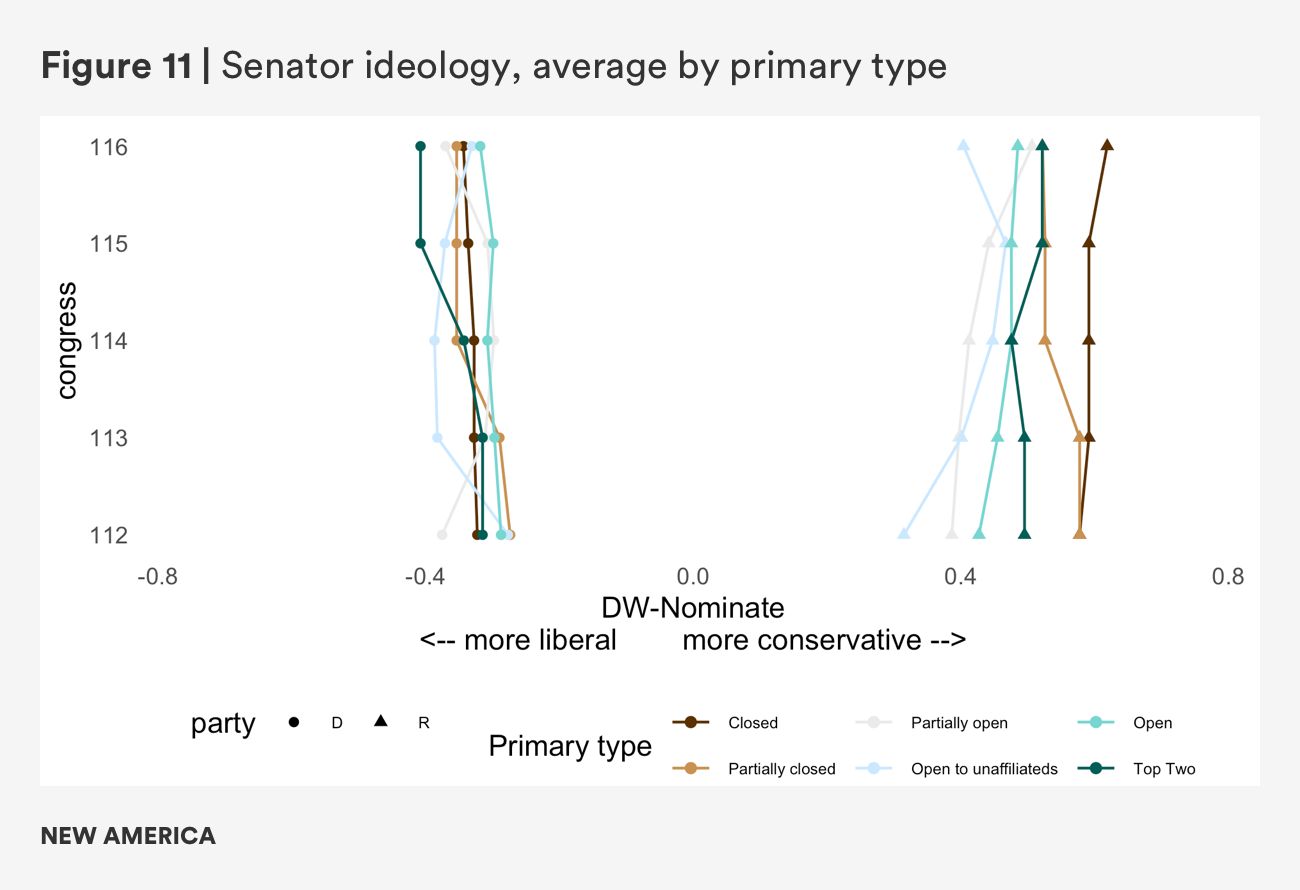
Given the small sample size, we should interpret these results with a degree of caution (also, the fact that NOMINATE may not be the right metric). With that said, two things jump out. The first is that while closed primaries elected more moderate Republicans to the House, closed primaries elected more extreme Republicans to the Senate. Second, the most liberal Democratic senators were elected under the top-two primary. This is likely because California and Washington are very liberal states. So further analysis will need to account for state-level factors in more detail. This is purely preliminary and suggestive.
More importantly, future potential work on Senate primary elections will need to have a qualitative element too, relying more on details and narratives to understand the dynamics of Senate primaries, and how they might in fact (not just in speculation) be different from House primaries.
The Need for More Research
Changing political institutions is high-stakes work. It requires a tremendous investment of resources, both time and money, and there will always be some unanticipated consequences. This is why it is so crucial to work from a realistic understanding of the interactions between voters, candidates, parties, and institutions. None of the debates discussed in this report are settled. And the environment is constantly changing. The more we know, the more precise and well-grounded our interventions can be.
Citations
- A typical formulation of this thesis comes from Chuck Schumer in a 2014 New York Times Op-ed entitled “End Partisan Primaries, Save America.” Schumer writes: “The partisan primary system, which favors more ideologically pure candidates, has contributed to the election of more extreme officeholders and increased political polarization. It has become a menace to governing.” Schumer goes on to urge adoption of the top-two open primary: “We need a national movement to adopt the “top-two” primary (also known as an open primary), in which all voters, regardless of party registration, can vote and the top two vote-getters, regardless of party, then enter a runoff. This would prevent a hard-right or hard-left candidate from gaining office with the support of just a sliver of the voters of the vastly diminished primary electorate; to finish in the top two, candidates from either party would have to reach out to the broad middle. “
- See, for example, FairVote’s 2020 Monopoly Politics Report, which lists only 67 out of 435 districts (15.4 percent) as competitive enough to indicate uncertainty over the general election outcome. <a href="<a href="<a href="<a href="<a href="<a href="<a href="source">source">source">source">source">source">source">source">source
- Extreme candidates may pay a small general election penalty, but in most elections, it is not big enough to matter. Andrew B. Hall and Daniel M. Thompson, “Who Punishes Extremist Nominees? Candidate Ideology and Turning Out the Base in US Elections,” American Political Science Review 112, no. 3 (August 2018): 509–24, <a href="<a href="<a href="<a href="<a href="<a href="<a href="source">source">source">source">source">source">source">source">source is also evidence that the penalty has declined or disappeared in more recent elections, largely because partisanship has become even more important than ideology to voters (that is, even more moderate partisans care more about partisanship than moderation). See Stephen M. Utych, “Man Bites Blue Dog: Are Moderates Really More Electable than Ideologues?,” The Journal of Politics 82, no. 1 (August 27, 2019): 392–96, <a href="<a href="<a href="<a href="<a href="<a href="<a href="source">source">source">source">source">source">source">source">source.
- See, e.g. G. Bingham Powell, Elections as Instruments of Democracy: Majoritarian and Proportional Visions (New Haven: Yale University Press, 2000). E. E. Schattschneider, Party Government (New York, N.Y.: Farrar & Rinehart, Inc., 1942). Robert Alan Dahl, Political Oppositions in Western Democracies (Yale University Press, 1966). Nancy L. Rosenblum, On the Side of the Angels: An Appreciation of Parties and Partisanship (Princeton: Princeton University Press, 2008).
- For a discussion of the challenges in defining political parties, see Lee Drutman, Breaking the Two-Party Doom Loop: The Case for Multiparty Democracy in America (New York: Oxford University Press, 2020).
- John H. Aldrich, Why Parties?: The Origin and Transformation of Political Parties in America (Chicago: University of Chicago Press, 1995).
- Richard Katz argues: “This is true not only in the sense that selection of candidates to contest elections is one of the functions that separates parties from other organizations that may try to influence electoral outcomes and governmental decisions, but also in the sense that the candidates it nominates play an important role in defining what the party is. More particularly, candidates as persons, and candidacies as roles or positions, serve at least four interrelated functions within contemporary political parties as organizations and contemporary democracies as systems of governance.” Richard S. Katz, “The Problem of Candidate Selection and Models of Party Democracy,” Party Politics 7, no. 3 (May 1, 2001): 277–96.
- Reuven Y. Hazan, Reuven Y. Hazan, and Gideon Rahat, Democracy within Parties: Candidate Selection Methods and Their Political Consequences (Oxford University Press, 2010); William Paul Cross and Jean-Benoît Pilet, The Politics of Party Leadership: A Cross-National Perspective (Oxford University Press, 2015).
- The history in this section is drawn from John F. Reynolds, The Demise of the American Convention System, 1880-1911 (Cambridge ; New York: Cambridge University Press, 2006); John F. Reynolds, “The Origins of the Direct Primary,” in Routledge Handbook of Primary Elections, ed. Robert G. Boatright, 1st ed. (New York: Routledge, 2018), 39–56, <a href="<a href="<a href="<a href="<a href="<a href="source">source">source">source">source">source">source">source; and Alan Ware, The American Direct Primary: Party Institutionalization and Transformation in the North (Cambridge University Press, 2002). Shigeo Hirano, Primary Elections in the United States (Cambridge University Press, 2019).
- Reynolds, John F. “The Origins of the Direct Primary.” In Routledge Handbook of Primary Elections, edited by Robert G. Boatright, 1st ed., 39–56. New York : Routledge, [2018]: Routledge, 2018. <a href="<a href="<a href="<a href="<a href="<a href="source">source">source">source">source">source">source">source.
- George W. Norris, “Why I Believe in the Direct Primary,” The ANNALS of the American Academy of Political and Social Science 106, no. 1 (March 1923): 22–30, 30.
- Grant McConnell, Private Power & American Democracy (New York: Knopf, 1966).
- Leon D. Epstein, Political Parties in the American Mold (Madison: University of Wisconsin Press, 1986).
- See Julia Azari, <a href="<a href="<a href="<a href="<a href="<a href="source">source">source">source">source">source">source">source
- For a strong version of this argument, see: Rosenbluth, Frances, and Ian Shapiro. Responsible Parties: Saving Democracy from Itself. New Haven: Yale University Press, 2018.
- Melody Crowder-Meyer et al., “A Different Kind of Disadvantage: Candidate Race, Cognitive Complexity, and Voter Choice,” Political Behavior, October 9, 2018, <a href="<a href="<a href="<a href="<a href="source">source">source">source">source">source">source.
- On the power to structure decision rules as the supreme power, see, e.g. E. E. Schattschneider, The Semi-Sovereign People: A Realist’s View of Democracy in America (Holt, Rinehart and Winston, 1960). William H Riker, The Art of Political Manipulation (New Haven: Yale University Press, 1986). Peter Bachrach and Morton S. Baratz, “Two Faces of Power,” The American Political Science Review 56, no. 4 (December 1, 1962): 947–52.
- See, e.g. Jason S Spicer, “Electoral Systems, Regional Resentment and the Surprising Success of Anglo-American Populism,” Cambridge Journal of Regions, Economy and Society 11, no. 1 (March 10, 2018): 115–41, <a href="<a href="<a href="<a href="<a href="source">source">source">source">source">source">source. Jonathan A. Rodden, Why Cities Lose: The Deep Roots of the Urban-Rural Political Divide (Basic Books, 2019). Noam Gidron, James Adams, and Will Horne, American Affective Polarization in Comparative Perspective (Cambridge University Press, 2020), <a href="<a href="<a href="<a href="<a href="source">source">source">source">source">source">source.
- Some states use different rules for presidential primaries. Since this report is oriented around congressional primaries, I ignore presidential primary rules.
- Open Primaries website, “Our Mission,” <a href="<a href="<a href="<a href="<a href="source">source">source">source">source">source">source, accessed March 22, 2021). For more discussion of the rise of independent voters and the case for primary reform, see John Opdycke and Jeremy Gruber, The Next Great Migration: The Rise of Independent Voters (Open Primaries, 2020).
- Ballotpedia, “Closed Primary,” <a href="<a href="<a href="<a href="<a href="source">source">source">source">source">source">source.
- Alaska will run its first top-four primary in 2022. Fair Vote has simulated top-four outcomes in WA and CA <a href="<a href="<a href="<a href="<a href="source">source">source">source">source">source">source and <a href="<a href="<a href="<a href="<a href="source">source">source">source">source">source">source ; The simulations projected broad intra- and inter-party general election competition, with more minor party presence. However, simulations are based on candidate entry patterns under Top Two rules. Different rules may encourage different candidates and different types of candidates to run.
- National Conference of State Legislatures, “Primary Runoffs,” <a href="<a href="<a href="<a href="<a href="source">source">source">source">source">source">source, accessed May 17, 2021. The exception to the majority-requirement is North Carolina, where a candidate who secures 30 percent in the primary can advance straight to the general election. North Carolina also allows the second-highest finisher to waive the runoff. The two non-Southern states that use some form of primary runoff are South Dakota and Vermont.
- A 2007 report from the Department of the Interior showed how Georgia’s statewide mandatory primary runoff law, enacted in 1963, was conceived and sold explicitly as a means to undercut Black candidates. see: U.S. Department of the Interior National Historic Landmarks Program, Civil Rights in America:Racial Voting Rights, 2007, revised 2009, <a href="<a href="<a href="<a href="<a href="source">source">source">source">source">source">source
- Drutman, 100.
- Nolan McCarty et al., “Geography, Uncertainty, and Polarization,” Political Science Research and Methods 7, no. 4 (October 2019): 775–94, <a href="<a href="<a href="<a href="source">source">source">source">source">source.
- Jamie L. Carson et al., “Constituency Congruency and Candidate Competition in U.S. House Elections,” Legislative Studies Quarterly 36, no. 3 (2011): 461–82, <a href="<a href="<a href="<a href="source">source">source">source">source">source.
- For detailed analysis of changes over time, see Robert G. Boatright, Getting Primaried: The Changing Politics of Congressional Primary Challenges (Ann Arbor, MI: University of Michigan Press, 2013).
- John Sides, Chris Tausanovitch, Lynn Vavreck, and Christopher Warshaw, “On the Representativeness of Primary Electorates,” British Journal of Political Science, March 2018, 1–9.
- As the authors note: “These data offer four main advantages. First, they encompass two presidential and two midterm elections and allow us to separate presidential and congressional primary voters in states that hold presidential and congressional primaries on different dates in presidential election years. Secondly, they contain large enough samples to estimate the impact of primary rules, which vary across states. Thirdly, they feature many measures of political attitudes. Finally, these data allow us to rely on validated turnout rather than potentially biased self- reports. The validated turnout data reveal substantial overlap in the primary and general electorates. In the 2008 CCAP, 68 percent of validated general election voters also voted in their state’s primary. The overlap between the two electorates means that roughly a third of 2008 general election voters voted ‘only’ in the general election and not in the primary. Any differences between the primary and general electorates must therefore manifest themselves in this relatively small group of voters.”
- Alan Abramowitz, “Don’t Blame Primary Voters for Polarization,” The Forum 5, no. 4 (2008): 1–11.
- Gary C. Jacobson, “The Electoral Origins of Polarized Politics: Evidence From the 2010 Cooperative Congressional Election Study,” American Behavioral Scientist 56, no. 12 (December 1, 2012): 1612–30, <a href="<a href="<a href="<a href="source">source">source">source">source">source.
- Jacobson, 1620-1621.
- Seth J. Hill, “Institution of Nomination and the Policy Ideology of Primary Electorates,” Quarterly Journal of Political Science 10, no. 4 (December 17, 2015): 461–87, <a href="<a href="<a href="<a href="source">source">source">source">source">source.
- Hill 2015 explains: “ Three features of my analysis are distinct from most previous comparisons. First, I examine congressional primary voters in each district, rather than presidential or congressional voters nationwide. Second, I use validated as opposed to self-reported primary turnout. And third, I use a scaled measure of ideology across multiple items, which may be a more accurate measure of preferences subject to less measurement error than individual survey responses. Future work could more carefully consider the most accurate way to measure the distinctiveness of primary voters.”In “On the Representativeness of Primary Electorates,” Sides, Tausanovitch, Vavreck, and Warshaw explain why their results differ from those of Jacobson and Hill despite their drawing from the same surveys: “In contrast to Jacobson, we use validated turnout data. As we describe in the online appendix, self-reported turnout produces larger differences between primary voters and the party following. And unlike Hill, we rely on simple disaggregated means and very large sample sizes, rather than a hierarchical model.”25
- Donald R. Kinder and Nathan P. Kalmoe, Neither Liberal nor Conservative: Ideological Innocence in the American Public (Chicago ; London: University Of Chicago Press, 2017). Lilliana Mason, “Ideologues without Issues: The Polarizing Consequences of Ideological Identities,” Public Opinion Quarterly 82, no. S1 (April 11, 2018): 280–301, <a href="<a href="<a href="<a href="source">source">source">source">source">source.
- See, e.g. Daniel J Hopkins, Hans Noel, and Hans Noel, “Trump and the Shifting Meaning of ‘Conservative’: Using Activists’ Pairwise Comparisons to Measure Senators’ Perceived Ideologies” (Working paper, 2021).
- Abramowitz, “Don’t Blame Primary Voters for Polarization.”
- Lee Drutman, “Myth of the Moderate Middle,” FiveThirtyEight, Sep. 24, 2019, <a href="<a href="<a href="<a href="source">source">source">source">source">source.
- Seth J. Hill and Chris Tausanovitch, “Southern Realignment, Party Sorting, and the Polarization of American Primary Electorates, 1958–2012,” Public Choice 176, no. 1 (July 1, 2018): 107–32, <a href="<a href="<a href="<a href="source">source">source">source">source">source.
- For older studies, see, e.g. Barbara Norrander, “Ideological Representativeness of Presidential Primary Voters,” American Journal of Political Science 33, no. 3 (1989): 570–87, <a href="<a href="<a href="<a href="source">source">source">source">source">source; John G. Geer, “Assessing the Representativeness of Electorates in Presidential Primaries,” American Journal of Political Science 32, no. 4 (1988): 929–45, <a href="<a href="<a href="<a href="source">source">source">source">source">source.
- Elaine Kamarck and Alexander R. Podkul, The 2018 Primaries Project: Introduction to the candidates (Washington, DC: Brookings Institution, 2018), <a href="<a href="<a href="<a href="source">source">source">source">source">source.
- Andrew B. Hall, Who Wants to Run?: How the Devaluing of Political Office Drives Polarization, First edition (Chicago ; London: University of Chicago Press, 2019).
- Danielle M. Thomsen, “Ideological Moderates Won’t Run: How Party Fit Matters for Partisan Polarization in Congress,” Journal of Politics 76, no. 3 (July 2014): 786–97, <a href="<a href="<a href="<a href="source">source">source">source">source">source; Danielle M. Thomsen, Opting Out of Congress: Partisan Polarization and the Decline of Moderate Candidates (Cambridge, United Kingdom: Cambridge University Press, 2017); John H. Aldrich and Danielle M. Thomsen, “Party, Policy, and the Ambition to Run for Higher Office,” Legislative Studies Quarterly 42, no. 2 (2017): 321–43, <a href="<a href="<a href="<a href="source">source">source">source">source">source writes: "The more liberal the Republican state legislator, the less likely she is to run for Congress; the more conservative the Democratic state legislator, the less likely she is to do so."
- Michael J. Barber, “Ideological Donors, Contribution Limits, and the Polarization of American Legislatures,” The Journal of Politics 78, no. 1 (2016): 296–310. Raymond J. LaRaja and Brian F. Schaffner, Campaign Finance and Political Polarization: When Purists Prevail (Ann Arbor: University of Michigan Press, 2015).
- Trent Lott, Tom Daschle, and Jon Sternfeld, Crisis Point: Why We Must – and How We Can – Overcome Our Broken Politics in Washington and Across America (New York: Bloomsbury Press, 2016) p.42.
- James Wallner and Elaine C Kamarck, Primaries and Incumbent Behavior (Brookings Institution: October 2018), <a href="<a href="<a href="<a href="source">source">source">source">source">source.
- Sarah E. Anderson, Daniel M. Butler, and Laurel Harbridge-Young, Rejecting Compromise: Legislators' Fear of Primary Voters, (Cambridge, MA: Cambridge University Press, 2020), 80 .“Substantively, a one standard deviation increase in Tea Party attachment (a 6.4% increase in people who say they have a very strong attachment to the Tea Party) is associated with a 4.6–5.3 percentage point decrease in the likelihood that a legislator will vote in favor of the compromise legislation (p = 0.005, two-sided). The more Tea Party voters there were in the district, the more likely the member of Congress was to vote against compromise legislation.” (79)
- Anderson, Butler, and Harbridge-Young, 87-88: “Among all respondents, just over half (52%) said that the two sides should meet in the middle at 50. As with compromise in the generic form, support for this more concrete partisan compromise is lower among subgroups of the electorate. Among ideologues, only a third (32%) favor an even compromise. Majorities of strong partisans, campaign donors, and Tea Party supporters also oppose compromise with the other party, suggesting that legislators may be right that these electorally important subgroups of primary voters oppose compromises made with the opposing party.” Drawing on a Pew study, they write: “the data from Pew (column 1) show that generic support for legislators who compromise drops from 61% overall to less than a majority for the very liberal or very conservative (46%) and Tea Party supporters (37%). Majorities of strong partisans and donors continue to express support for legislators who compromise.3”
- Anderson, Butler, and Harbridge-Young, Figure 5.5 shows that these co-partisan primary voters who oppose the specific compromise punish legislators for compromising.
- Anderson, Butler, and Harbridge-Yong, 60. The authors also note: “Media coverage that paints compromise in a negative light may magnify the perceived risks of compromising and the likelihood of facing a primary challenger from the far left or far right. In the 2017 survey at the NCSL Summit, we asked the legislators how various media outlets covered compromise. The majority of legislators (60%) thought that cable news outlets like MSNBC and Fox News portrayed legislative compromises in a negative light, while only 12% of legislators thought that these outlets portrayed it in a positive light. While legislators thought that national net- work news, major newspapers, and the local media were more neutral in their presentation, enough likely primary voters watch news like MSNBC and Fox to give legislators pause when considering compromise.” (81)
- Christopher Skovron, “What Politicians Believe About Electoral Accountability,” SSRN Electronic Journal, 2018, <a href="<a href="<a href="<a href="source">source">source">source">source">source. “At the state level, they especially have limited access to district-level polling, leading to inaccurate perceptions of public opinion among their constituents (Broockman and Skovron 2018). Congressional staffers have similarly inaccurate perceptions of public opinion (Hertel-Fernandez, Mildenberger and Stokes 2018). Although campaigns now have access to more data on voters than ever before, many of the records in commercial voter files remain imprecise (Hersh 2015; Fraga, Holbein and Skovron 2018) and often provide only limited information about constituents.”
- Skovron.
- Caitlin E. Jewitt and Sarah A. Treul, “Ideological Primaries and Their Influence in Congress,” in Routledge Handbook of Primary Elections, ed. Robert G. Boatright, 1st ed. (New York: Routledge, 2018), 213–25, <a href="<a href="<a href="<a href="source">source">source">source">source">source; Caitlin E. Jewitt and Sarah A. Treul, “Ideological Primary Competition and Congressional Behavior,” Congress & the Presidency 46, no. 3 (September 2, 2019): 471–94, <a href="<a href="<a href="<a href="source">source">source">source">source">source. Jewitt and Treul report: “ The results of our analysis, examining the 2000–2012 elections in which incumbent members of the House faced primary challenges, support our the- ory. We show that among incumbents who return to the House as members of the minority party, no significant relationship exists between experiencing an ideological primary and a non-ideological primary challenge on the per-cent of the time that they vote with their party leader on all roll calls. We do, however, find that on key votes, members of the minority party significantly increase the percent of the time they vote with their party leader. Although we did not necessarily expect this finding for key votes, we believe that it makes sense for two reasons. First, given the nature of key votes, these are the votes most likely to generate attention back home in the district and give a potential primary challenger ammunition for another run at the incumbent. Second, the party leadership is the most likely to whip members on key votes. Taken together, we believe these two reasons explain the sig-nificant increase in the partisan behavior of minority members on key votes following an ideological primary challenge.For majority party members, however, we show that an ideological primary challenge results in a 3.4% increase in voting against their own party on all roll calls, on average, when compared to majority party members who face a non-ideological primary challenge.2 Similarly, majority party members who faced an ideological primary challenge are 5.4% more likely to vote against their own party on key votes than are members of the majority party who faced a non-ideological primary challenge. Upon returning to Washington, majority party members who faced an ideological primary are voting against their party—both on all roll calls and on key votes—to a greater extent than their majority party colleagues who defeated a primary challenge that was not ideological in nature. Members of the majority party need a way to demon-strate their extremism and their best way to do this via votes is to vote against the party, proclaiming the party is simply not extreme enough.”
- David W. Brady, Hahrie Han, and Jeremy C. Pope, “Primary Elections and Candidate Ideology: Out of Step with the Primary Electorate?,” Legislative Studies Quarterly 32, no. 1 (February 2007): 79–105.
- Shigeo Hirano et al., “Primary Elections and Partisan Polarization in the U.S. Congress,” Quarterly Journal of Political Science, 2010, <a href="<a href="<a href="<a href="source">source">source">source">source">source.
- Hill and Tausanovitch, “Southern Realignment, Party Sorting, and the Polarization of American Primary Electorates, 1958–2012.”
- Hill, “Institution of Nomination and the Policy Ideology of Primary Electorates,” Quarterly Journal of Political Science, 10, no. 4 (2015): 461-487. <a href="<a href="<a href="source">source">source">source">source.
- Hill.
- Barbara Norrander and Jay Wendland, “Open versus Closed Primaries and the Ideological Composition of Presidential Primary Electorates,” Electoral Studies 42 (June 1, 2016): 229–36, <a href="<a href="<a href="source">source">source">source">source.
- Norrander and Wendland.
- “Point estimates suggest an increase in turnout of 1.5 percentage points in open primaries and 6.1 percentage points in nonpartisan primaries.” Seth J. Hill, “Sidestepping Primary Reform: Political Action in Response to Institutional Change,” Political Science Research and Methods, 2020, 1–17, <a href="<a href="<a href="source">source">source">source">source. See also Matthew J. Geras and Michael H. Crespin’s “The Effect of Open and Closed Primaries on Voter Turnout:” “For both the Republicans and the Democrats, voter turnout was highest during open primaries and lowest during hybrid primaries. The predicted difference in turnout between these two types of primaries appears to amount to about 2 to 3 percent.” Matthew J. Geras and Michael H. Crespin, “The Effect of Open and Closed Primaries on Voter Turnout,” in Routledge Handbook of Primary Elections, ed. Robert G. Boatright, 1st ed. (New York: Routledge, 2018), 133–46, <a href="<a href="<a href="source">source">source">source">source.
- Jon C. Rogowski and Stephanie Langella, “Primary Systems and Candidate Ideology: Evidence From Federal and State Legislative Elections,” American Politics Research 43, no. 5 (September 1, 2015): 865, <a href="<a href="<a href="source">source">source">source">source.
- Rogowski and Langella, 865
- Thad Kousser, Justin Phillips, and Boris Shor, “Reform and Representation: A New Method Applied to Recent Electoral Changes,” Political Science Research and Methods 6, no. 4 (October 2018): 809–27, <a href="<a href="<a href="source">source">source">source">source.
- Kousser, Phillips, and Shor, 820.
- Kousser, Phillips, and Shor, 22.
- Kristin Kanthak and Eric Loepp, “Strategic Candidate Entry,” in Routledge Handbook of Primary Elections, ed. Robert G. Boatright, 1st ed. (New York: Routledge, 2018), 147–57, <a href="<a href="<a href="source">source">source">source">source.
- Danielle M. Thomsen, “When Might Moderates Win the Primary?,” in Routledge Handbook of Primary Elections, ed. Robert G. Boatright, 1st ed. (New York: Routledge, 2018), 226–35, <a href="<a href="<a href="source">source">source">source">source.
- Hans J. G. Hassell, “Party Control of Party Primaries: Party Influence in Nominations for the US Senate,” The Journal of Politics 78, no. 1 (2016): 75–87.
- Thomsen, Opting Out of Congress.
- David E Broockman et al., “Having Their Cake and Eating It, Too: (Why) Local Party Leaders Prefer Nominating Extreme Candidates,” Working Paper, Stanford University, 2017, 53.
- Hall, Who Wants to Run?
- Thomsen, “When Might Moderates Win the Primary?”.
- Steven Sparks, “Polarization and the Top-Two Primary: Moderating Candidate Rhetoric in One-Party Contests,” Political Communication 36, no. 4 (October 2, 2019): 565–85, <a href="<a href="<a href="source">source">source">source">source.
- Eric McGhee, Seth Masket, Boris Shor, Steven Rogers, and Nolan McCarty, “A Primary Cause of Partisanship? Nomination Systems and Legislator Ideology,” American Journal of Political Science 58, no. 2 (2014): 337–51, <a href="<a href="<a href="source">source">source">source">source.
- McGhee et al., Table 2.
- McGhee, Masket, Shor, Rogers, and McCarty.
- Eric McGhee and Boris Shor, “Has the Top Two Primary Elected More Moderates?,” Perspectives on Politics, September 2017, 1–14, <a href="<a href="<a href="source">source">source">source">source.
- McGhee and Shor. As they note: “a portion of this effect appears to stem from the redistricting that occurred coincident with the Top Two. Our analysis also considers possible effects from other sources. Relaxed term limits went into effect at the same time as both the Top Two and the redistricting, but this change does not appear to account for all of the change in Democrats. That said, the residual pre/post change after accounting for the other potential causes leaves only a small shift to explain. Any effects we do find are limited to Democrats in California alone.” They also add a second caveat: “It is worth noting the limits of our analysis. We feel relatively more confident about the role of redistricting, since we have measured the source of those effects more directly. We can also be reasonably confident about the role of term limits, since we have comparison groups for whom the term limits change did not apply: continuing legislators and members of Congress. These groups show far smaller pre/post effects, suggesting that term limits may explain still more of the difference.”
- Jack Santucci, “Nonpartisan elections don’t reduce polarization,” Medium, February 11, 2021, <a href="<a href="<a href="source">source">source">source">source.
- “Moderation on Chamber issues came in advance of the first election under the reforms, and those who were termed out or decided not to run for reelection were just as likely to moderate as legislators who were continuing in the same body. Moreover, there is no evidence that greater moderation in the Democratic caucus has led to greater success for the Chamber’s policy agenda. Thus, there is a real possibility that this moderation is simply position-taking by elected officials who know that no concrete change in policy will come from it.” Eric McGhee, “California’s Top Two Primary and the Business Agenda,” California Journal of Politics and Policy 7, no. 1 (February 5, 2015), <a href="<a href="<a href="source">source">source">source">source.
- Christian R. Grose, “Reducing Legislative Polarization: Top-Two and Open Primaries Are Associated with More Moderate Legislators,” Journal of Political Institutions and Political Economy 1, no. 2 (June 30, 2020), <a href="<a href="<a href="source">source">source">source">source.
- Jesse Crosson, “Extreme Districts, Moderate Winners: Same-Party Challenges, and Deterrence in Top-Two Primaries,” Political Science Research and Methods, March 17, 2020, 1–17, <a href="<a href="<a href="source">source">source">source">source.
- Crosson.
- Benjamin Highton, Robert Huckfeldt, and Isaac Hale, “Some General Consequences of California’s Top-Two Primary System,” California Journal of Politics and Policy 8, no. 2 (2016), <a href="<a href="source">source">source">source.
- “Perhaps, because candidates running in California’s few competitive districts face pressures to conform to party and interest group discipline in order to raise the money necessary for close campaigns, they are not able to converge on the district median.” Thad Kousser, Justin Phillips, and Boris Shor, “Reform and Representation: A New Method Applied to Recent Electoral Changes,” Political Science Research and Methods 6, no. 4 (October 2018): 809–27, <a href="<a href="source">source">source">source.
- Hill, “Sidestepping Primary Reform.”
- Steven Sparks, “Campaign Spending and the Top-Two Primary: How Challengers Earn More Votes per Dollar in One-Party Contests,” Electoral Studies 54 (August 2018): p. 61, <a href="<a href="source">source">source">source.
- “47.9% of orphaned voters chose to abstain in the State Assembly race in the general Election. Of those voters who had a co-partisan choice available, only 3.9% chose to abstain." Jonathan Nagler, “Voter Behavior in California’s Top Two Primary,” California Journal of Politics and Policy 7, no. 1 (2015), <a href="<a href="source">source">source">source.
- Colin A. Fisk, “No Republican, No Vote: Undervoting and Consequences of the Top-Two Primary System,” State Politics & Policy Quarterly, December 23, 2019, 1532440019893688, <a href="<a href="source">source">source">source. for a similar finding see also: Highton, Huckfeldt, and Hale, “Some General Consequences of California’s Top-Two Primary System.”
- Daniel D. Bonneau and John Zaleski, “The Effect of California’s Top-Two Primary System on Voter Turnout in US House Elections,” Economics of Governance 22, no. 1 (March 1, 2021): 1–21, <a href="<a href="source">source">source">source.
- Douglas J. Ahler, Jack Citrin, and Gabriel S. Lenz, “Do Open Primaries Improve Representation? An Experimental Test of California’s 2012 Top-Two Primary,” Legislative Studies Quarterly 41, no. 2 (2016): 237–68, <a href="<a href="source">source">source">source.
- Kinder and Kalmoe, Neither Liberal nor Conservative.
- James Adams et al., “Do Moderate Voters Weigh Candidates’ Ideologies? Voters’ Decision Rules in the 2010 Congressional Elections,” Political Behavior 39, no. 1 (March 2017): 205–27.
- Douglas J. Ahler and David E. Broockman, “The Delegate Paradox: Why Polarized Politicians Can Represent Citizens Best,” The Journal of Politics 80, no. 4 (August 7, 2018): 1117–33, <a href="<a href="source">source">source">source.
- <a href="<a href="<a href="source">source">source">source">The Moderate Middle Is A Myth
- Samara Klar and Yanna Krupnikov, Independent Politics: How American Disdain for Parties Leads to Political Inaction (New York: Cambridge University Press, 2016).
- Ahler and Broockman, “The Delegate Paradox.” <a href="<a href="source">source">source">source
- As Klar and Krupnikov note in their excellent book Independent Politics, "The very people who dislike parties want their own party to fight harder. When the debate is contentious , when sacrifices need to be made, the people who avoid parties actually punish their own party for compromising…These people, be they independents or undercover partisans, are full of contradictions. On the one hand, they refuse to identify with partisan label or do anything to support a party they may secretly endorse. On the other hand, they are frustrated when their favored party compromises, wishing instead for a stronger fight. In some ways, these people lack the normatively positive aspects of partisans (for example, being politically participatory) while embracing the negative aspects of partisans (a stubborn dislike of compromise)…The people who avoid partisanship are a political candidate's worst nightmare. They do little to offer support, they refuse to admit their support publicly, and they are unlikely to convince their social networks to support a particular party position or policy. Meanwhile, they make grand overtures about partisan compromise yet grow increasingly frustrated when their party — the very same party they are ashamed to admit they prefer — bends in any way to the will of the opposition, even when this is the only way the political process can move forward. These voters want their party to engage in the very same behavior that (they claim) drove them away from partisanship in the first place."
- Joshua J. Dyck, Shanna Pearson-Merkowitz, and Michael Coates, “Primary Distrust: Political Distrust and Support for the Insurgent Candidacies of Donald Trump and Bernie Sanders in the 2016 Primary,” PS: Political Science & Politics 51, no. 2 (April 2018): 351–57, <a href="<a href="source">source">source">source.
- Dyck, Pearson-Merkowitz, and Coates. Klar and Krupnikov, Independent Politics.
- For more on the possible effects of fusion balloting, see Adam Chamberlain, “Fusion Ballots and the Question of Organisational Type,” Representation 49, no. 1 (April 1, 2013): 45–54, source">source; Adam Chamberlain, “Fusion Ballots as a Candidate-Centered Reform: Evidence from Oregon,” The Social Science Journal 49, no. 4 (December 1, 2012): 458–64, source">source; Howard A. Scarrow, “Duverger’s Law, Fusion, and the Decline of American" Third" Parties,” Western Political Quarterly 39, no. 4 (1986): 634–47. Lisa Disch, The Tyranny of the Two-Party System (New York: Columbia University Press, 2002).
- Crowder-Meyer, Melody, Shana Kushner Gadarian, Jessica Trounstine, and Kau Vue. “A Different Kind of Disadvantage: Candidate Race, Cognitive Complexity, and Voter Choice.” Political Behavior, October 9, 2018. source">source.
- Robert G. Boatright, Vincent G. Moscardelli, and Clifford D. Vickrey, “Primary Election Timing and Voter Turnout,” Election Law Journal: Rules, Politics, and Policy 19, no. 4 (July 28, 2020): 472–85, source">source.
- Priscilla L. Southwell, “Analysis of the Turnout Effects of Vote by Mail Elections, 1980–2007,” The Social Science Journal 46, no. 1 (March 1, 2009): 211–17, source">source.
- For a discussion of the effect of ballot access laws, see Barry C. Burden, “Ballot Regulations and Multiparty Politics in the States,” PS: Political Science and Politics 40, no. 4 (2007): 669–73.
- For useful discussions of the differences between ideology and partisanship see: Kinder and Kalmoe, Neither Liberal nor Conservative. Hans Noel, “Ideology and Its Discombobulations,” The Journal of Politics, June 7, 2019, 000–000, source. Hans Noel, Political Ideologies and Political Parties in America (New York: Cambridge University Press, 2014).
- For useful discussion of the limits of DW-Nominate, see Frances E. Lee, Beyond Ideology: Politics, Principles, and Partisanship in the U. S. Senate, 1 edition (Chicago ; London: University Of Chicago Press, 2009); Frances E. Lee, “Patronage, Logrolls, and ‘Polarization’: Congressional Parties of the Gilded Age, 1876–1896,” Studies in American Political Development 30, no. 2 (October 2016): 116–27. John H. Aldrich, Jacob M. Montgomery, and David B. Sparks, “Polarization and Ideology: Partisan Sources of Low Dimensionality in Scaled Roll Call Analyses,” Political Analysis 22, no. 4 (2014): 435–56. Michael H. Crespin and David W. Rohde, “Dimensions, Issues, and Bills: Appropriations Voting on the House Floor,” The Journal of Politics 72, no. 4 (October 2010): 976–89, source; Jason M. Roberts, Steven S. Smith, and Stephen R. Haptonstahl, “The Dimensionality of Congressional Voting Reconsidered,” American Politics Research 44, no. 5 (September 1, 2016): 794–815, source. Verlan Lewis, “The Problem of Donald Trump and the Static Spectrum Fallacy,” Party Politics, September 16, 2019, 1354068819871673, source Spirling and Iain McLean, “UK OC OK? Interpreting Optimal Classification Scores for the U.K. House of Commons,” Political Analysis 15, no. 1 (ed 2007): 85–96, source. Hans Noel, “Separating Ideology from Party in Roll Call Data” (Unpublished manuscript, Georgetown University, 2014). Hopkins, Noel, and Noel, “Trump and the Shifting Meaning of ‘Conservative’: Using Activists’ Pairwise Comparisons to Measure Senators’ Perceived Ideologies.” Devin Caughey and Eric Schickler, “Substance and Change in Congressional Ideology: NOMINATE and Its Alternatives,” Studies in American Political Development 30, no. 2 (October 2016): 128–46, source; David A. Bateman and John Lapinski, “Ideal Points and American Political Development: Beyond DW-NOMINATE,” Studies in American Political Development 30, no. 2 (October 2016): 147–71, source; Nicole Asmussen and Jinhee Jo, “Anchors Away: A New Approach for Estimating Ideal Points Comparable across Time and Chambers,” Political Analysis 24, no. 2 (ed 2016): 172–88, source. Jeffrey B. Lewis, “Estimating Voter Preference Distributions from Individual-Level Voting Data,” Political Analysis 9, no. 3 (January 2001): 275–97, source; Joshua Clinton, Simon Jackman, and Douglas Rivers, “The Statistical Analysis of Roll Call Data,” American Political Science Review 98, no. 2 (May 2004): 355–70, source. For a defense of NOMINATE, see Nolan McCarty, “In Defense of DW-NOMINATE,” Studies in American Political Development 30, no. 2 (October 2016): 172–84, source.
- See, e.g. Jennifer Nicoll Victor and Nils Ringe, “The Social Utility of Informal Institutions: Caucuses as Networks in the 110th US House of Representatives,” American Politics Research 37, no. 5 (2009): 742–66; Jennifer Nicoll Victor, Alexander H. Montgomery, and Mark Lubell, The Oxford Handbook of Political Networks (Oxford University Press, 2017); Nils Ringe, Jennifer Nicoll Victor, and Justin H. Gross, “Keeping Your Friends Close and Your Enemies Closer? Information Networks in Legislative Politics,” British Journal of Political Science, 2013, 601–28; Jennifer N Victor, “Legislative Networks and Partisan Entrenchment” (Working paper, 2018). Victor is currently working on a book on the topic of networks.
- The Lugar Center, “Bipartisan Index,” source, accessed June 4, 2021.
- GovTrack, “Ideology Score,” source, accessed June 4, 2021.
- For one possible approach to this, consider the work of Justin Grimmer, who has found that lawmakers in safe seats take on more polarizing national issues, while lawmakers in competitive seats focus more on uncontroversial local issues. Justin Grimmer, “Appropriators Not Position Takers: The Distorting Effects of Electoral Incentives on Congressional Representation,” American Journal of Political Science 57, no. 3 (July 1, 2013): 624–42, source; Justin Grimmer, Representational Style in Congress: What Legislators Say and Why It Matters (New York: Cambridge University Press, 2013).
- Hassell, “Party Control of Party Primaries”; Hans J. G. Hassell, The Party’s Primary: Control of Congressional Nominations (Cambridge, United Kingdom ; New York: Cambridge University Press, 2017); Hans J. G. Hassell, “Principled Moderation: Understanding Parties’ Support of Moderate Candidates,” Legislative Studies Quarterly 43, no. 2 (May 1, 2018): 343–69.
- David E. Broockman et al., “Why Local Party Leaders Don’t Support Nominating Centrists,” British Journal of Political Science, 2020, 1–26, source.
- See Adam Bonica, “Mapping the Ideological Marketplace,” American Journal of Political Science 58, no. 2 (2014): 367–86, source. Data is here: source For a relevant analysis, see Adam Bonica et al., “Ideological Sorting of Physicians in Both Geography and the Workplace,” Journal of Health Politics, Policy and Law, May 28, 2020, 8641555, source.
- Hall, Who Wants to Run?
- Jesse M. Crosson, Alexander C. Furnas, and Geoffrey M. Lorenz, “Polarized Pluralism: Organizational Preferences and Biases in the American Pressure System,” American Political Science Review, 2020, 1–21, source.
- Shigeo Hirano et al., “Voter Learning in State Primary Elections,” American Journal of Political Science 59, no. 1 (2015): 91–108, source.
Conclusions
This report set out to answer two main questions:
- Are primary elections important contributors to hyper-partisan polarization?
- Can changing the rules of the primary incentivize more compromise-oriented and moderate lawmaking, and if so, which rule changes?
Are primary elections important contributors to hyper-partisan polarization? The main conclusion here is that primary elections do appear to exert a polarizing tug on our politics. This tug is difficult to quantify because we cannot run the experiment in which American politics did not adopt primary elections in the early twentieth century, thus setting our electoral system along a different path entirely. However, the counterfactual does invite useful speculation. Given all the other forces that have driven polarization (the sorting of the parties, the consistently close national elections, the nationalization of politics), it seems unlikely on its face that a different path for nominating procedures would have pushed American political development down a different course.
There is ample evidence that fear of a primary challenge pulls candidates to reject compromise; to cultivate and stay close to their primary constituencies and the interests groups and donors who actively fund candidates in primaries; and to engage in partisan conflict to prove their bona fides with their primary constituencies. But findings on whether primary electorates are more ideologically extreme than general election electorates are somewhat mixed. The best answer is probably that primary electorates are a little more ideologically extreme than general election electorates, but whatever difference exists between primary and general election electorates is dwarfed by the difference between Democratic and Republican electorates. Indeed, the biggest divide, by far, is between the parties themselves. Contrary to popular theory, there is not some latent fifth column of sensible moderate voters, reluctantly waiting in the wings. The vast majority of voters have sorted into the two teams on offer.
Still, primary electorates are consistently distinguished by their high levels of political engagement. Regardless of ideology, they are stronger partisans.
Finally, partisanship and ideology are related but distinct concepts, and should be treated as such. We may need to revise our concerns about extremism to focus more on partisan conflict and compromise and less on policy preferences if we want to understand the dynamics of primary elections—and more broadly, the conflict consuming American politics right now.
Can changing the rules of the primary incentivize more compromise-oriented and moderate lawmaking, and if so, which rule changes? With this question, we are on firmer empirical ground in drawing conclusions, as primary type varies considerably across states, and several states have changed their primary type over the last few decades. The overwhelming conclusion across multiple studies is that the differences across primary types do not have much of an impact on who votes, who runs, or who wins. The most studied reform is the California top-two primary. Reformers had high hopes this reform would lead to more moderate politics, however its effect has been extremely muted. Of course, as with all reforms, it is quite possible that it could become more effective over time. But the record thus far is not encouraging.
The overwhelming conclusion across multiple studies is that the differences across primary types do not have much of an impact on who votes, who runs, or who wins.
The forces driving hyper-partisan polarization appear to be deeper than primary reform can reach. There are simply very few opportunities for would-be moderates to gain traction in this polarized climate, and few would-be moderate politicians have the desire to fight a losing battle within either of the two major parties. There is even less incentive to go it alone or form a third party, thanks to our single-winner plurality electoral system that channels all political opportunity to the two major parties. Thus far, the broader structural and national forces driving hyper-partisan polarization have proved much more important than variations in primary rules.
Of course, the studies discussed in this report have their limits. It is possible that scholars are using the wrong measures or measuring the wrong outcomes. It is also possible that the effects have been difficult to detect and take time to show up because political actors need to adapt. Above, I suggested some alternative ways we might study the effects of primary and primary reform. However, the more likely conclusion is that these studies are correct in their general assessment, and that broader structural forces driving hyper-partisanship are much more important than primary type or even existence.
There is still much to learn from the wide scholarship on primaries and primary reform. If you accept the conclusion that primary reform has a marginal impact, it is important to understand why, so that other reforms can benefit from the insights that studying primaries yields for how voters, candidates, and parties might behave under different sets of rules. Alternatively, if you accept the conclusion that primary reform has so far had a marginal impact, but could be an important lever of change going forward (especially since it appears to be relatively amenable to reform), it is equally important to understand why previous reform efforts have not succeeded in bending the river, so that future reformers can either avoid faulty assumptions that previous reforms made, or evaluate whether other baseline conditions that limited previous reform efforts may have changed such that future reform efforts are more likely to succeed. After all, our political system is in constant flux, and reforms that may have been irrelevant or unsuccessful under previous conditions may yet prove relevant and successful under different circumstances, as in a scientist who repeats an experiment under altered conditions. At the same time, we must heed Einstein’s advice that attempting the same thing over and over (under the same conditions) and expecting a different result is pure insanity.
Citations
- A typical formulation of this thesis comes from Chuck Schumer in a 2014 New York Times Op-ed entitled “End Partisan Primaries, Save America.” Schumer writes: “The partisan primary system, which favors more ideologically pure candidates, has contributed to the election of more extreme officeholders and increased political polarization. It has become a menace to governing.” Schumer goes on to urge adoption of the top-two open primary: “We need a national movement to adopt the “top-two” primary (also known as an open primary), in which all voters, regardless of party registration, can vote and the top two vote-getters, regardless of party, then enter a runoff. This would prevent a hard-right or hard-left candidate from gaining office with the support of just a sliver of the voters of the vastly diminished primary electorate; to finish in the top two, candidates from either party would have to reach out to the broad middle. “
- See, for example, FairVote’s 2020 Monopoly Politics Report, which lists only 67 out of 435 districts (15.4 percent) as competitive enough to indicate uncertainty over the general election outcome. <a href="<a href="<a href="<a href="<a href="<a href="<a href="<a href="source">source">source">source">source">source">source">source">source">source
- Extreme candidates may pay a small general election penalty, but in most elections, it is not big enough to matter. Andrew B. Hall and Daniel M. Thompson, “Who Punishes Extremist Nominees? Candidate Ideology and Turning Out the Base in US Elections,” American Political Science Review 112, no. 3 (August 2018): 509–24, <a href="<a href="<a href="<a href="<a href="<a href="<a href="<a href="source">source">source">source">source">source">source">source">source">source is also evidence that the penalty has declined or disappeared in more recent elections, largely because partisanship has become even more important than ideology to voters (that is, even more moderate partisans care more about partisanship than moderation). See Stephen M. Utych, “Man Bites Blue Dog: Are Moderates Really More Electable than Ideologues?,” The Journal of Politics 82, no. 1 (August 27, 2019): 392–96, <a href="<a href="<a href="<a href="<a href="<a href="<a href="<a href="source">source">source">source">source">source">source">source">source">source.
- See, e.g. G. Bingham Powell, Elections as Instruments of Democracy: Majoritarian and Proportional Visions (New Haven: Yale University Press, 2000). E. E. Schattschneider, Party Government (New York, N.Y.: Farrar & Rinehart, Inc., 1942). Robert Alan Dahl, Political Oppositions in Western Democracies (Yale University Press, 1966). Nancy L. Rosenblum, On the Side of the Angels: An Appreciation of Parties and Partisanship (Princeton: Princeton University Press, 2008).
- For a discussion of the challenges in defining political parties, see Lee Drutman, Breaking the Two-Party Doom Loop: The Case for Multiparty Democracy in America (New York: Oxford University Press, 2020).
- John H. Aldrich, Why Parties?: The Origin and Transformation of Political Parties in America (Chicago: University of Chicago Press, 1995).
- Richard Katz argues: “This is true not only in the sense that selection of candidates to contest elections is one of the functions that separates parties from other organizations that may try to influence electoral outcomes and governmental decisions, but also in the sense that the candidates it nominates play an important role in defining what the party is. More particularly, candidates as persons, and candidacies as roles or positions, serve at least four interrelated functions within contemporary political parties as organizations and contemporary democracies as systems of governance.” Richard S. Katz, “The Problem of Candidate Selection and Models of Party Democracy,” Party Politics 7, no. 3 (May 1, 2001): 277–96.
- Reuven Y. Hazan, Reuven Y. Hazan, and Gideon Rahat, Democracy within Parties: Candidate Selection Methods and Their Political Consequences (Oxford University Press, 2010); William Paul Cross and Jean-Benoît Pilet, The Politics of Party Leadership: A Cross-National Perspective (Oxford University Press, 2015).
- The history in this section is drawn from John F. Reynolds, The Demise of the American Convention System, 1880-1911 (Cambridge ; New York: Cambridge University Press, 2006); John F. Reynolds, “The Origins of the Direct Primary,” in Routledge Handbook of Primary Elections, ed. Robert G. Boatright, 1st ed. (New York: Routledge, 2018), 39–56, <a href="<a href="<a href="<a href="<a href="<a href="<a href="source">source">source">source">source">source">source">source">source; and Alan Ware, The American Direct Primary: Party Institutionalization and Transformation in the North (Cambridge University Press, 2002). Shigeo Hirano, Primary Elections in the United States (Cambridge University Press, 2019).
- Reynolds, John F. “The Origins of the Direct Primary.” In Routledge Handbook of Primary Elections, edited by Robert G. Boatright, 1st ed., 39–56. New York : Routledge, [2018]: Routledge, 2018. <a href="<a href="<a href="<a href="<a href="<a href="<a href="source">source">source">source">source">source">source">source">source.
- George W. Norris, “Why I Believe in the Direct Primary,” The ANNALS of the American Academy of Political and Social Science 106, no. 1 (March 1923): 22–30, 30.
- Grant McConnell, Private Power & American Democracy (New York: Knopf, 1966).
- Leon D. Epstein, Political Parties in the American Mold (Madison: University of Wisconsin Press, 1986).
- See Julia Azari, <a href="<a href="<a href="<a href="<a href="<a href="<a href="source">source">source">source">source">source">source">source">source
- For a strong version of this argument, see: Rosenbluth, Frances, and Ian Shapiro. Responsible Parties: Saving Democracy from Itself. New Haven: Yale University Press, 2018.
- Melody Crowder-Meyer et al., “A Different Kind of Disadvantage: Candidate Race, Cognitive Complexity, and Voter Choice,” Political Behavior, October 9, 2018, <a href="<a href="<a href="<a href="<a href="<a href="source">source">source">source">source">source">source">source.
- On the power to structure decision rules as the supreme power, see, e.g. E. E. Schattschneider, The Semi-Sovereign People: A Realist’s View of Democracy in America (Holt, Rinehart and Winston, 1960). William H Riker, The Art of Political Manipulation (New Haven: Yale University Press, 1986). Peter Bachrach and Morton S. Baratz, “Two Faces of Power,” The American Political Science Review 56, no. 4 (December 1, 1962): 947–52.
- See, e.g. Jason S Spicer, “Electoral Systems, Regional Resentment and the Surprising Success of Anglo-American Populism,” Cambridge Journal of Regions, Economy and Society 11, no. 1 (March 10, 2018): 115–41, <a href="<a href="<a href="<a href="<a href="<a href="source">source">source">source">source">source">source">source. Jonathan A. Rodden, Why Cities Lose: The Deep Roots of the Urban-Rural Political Divide (Basic Books, 2019). Noam Gidron, James Adams, and Will Horne, American Affective Polarization in Comparative Perspective (Cambridge University Press, 2020), <a href="<a href="<a href="<a href="<a href="<a href="source">source">source">source">source">source">source">source.
- Some states use different rules for presidential primaries. Since this report is oriented around congressional primaries, I ignore presidential primary rules.
- Open Primaries website, “Our Mission,” <a href="<a href="<a href="<a href="<a href="<a href="source">source">source">source">source">source">source">source, accessed March 22, 2021). For more discussion of the rise of independent voters and the case for primary reform, see John Opdycke and Jeremy Gruber, The Next Great Migration: The Rise of Independent Voters (Open Primaries, 2020).
- Ballotpedia, “Closed Primary,” <a href="<a href="<a href="<a href="<a href="<a href="source">source">source">source">source">source">source">source.
- Alaska will run its first top-four primary in 2022. Fair Vote has simulated top-four outcomes in WA and CA <a href="<a href="<a href="<a href="<a href="<a href="source">source">source">source">source">source">source">source and <a href="<a href="<a href="<a href="<a href="<a href="source">source">source">source">source">source">source">source ; The simulations projected broad intra- and inter-party general election competition, with more minor party presence. However, simulations are based on candidate entry patterns under Top Two rules. Different rules may encourage different candidates and different types of candidates to run.
- National Conference of State Legislatures, “Primary Runoffs,” <a href="<a href="<a href="<a href="<a href="<a href="source">source">source">source">source">source">source">source, accessed May 17, 2021. The exception to the majority-requirement is North Carolina, where a candidate who secures 30 percent in the primary can advance straight to the general election. North Carolina also allows the second-highest finisher to waive the runoff. The two non-Southern states that use some form of primary runoff are South Dakota and Vermont.
- A 2007 report from the Department of the Interior showed how Georgia’s statewide mandatory primary runoff law, enacted in 1963, was conceived and sold explicitly as a means to undercut Black candidates. see: U.S. Department of the Interior National Historic Landmarks Program, Civil Rights in America:Racial Voting Rights, 2007, revised 2009, <a href="<a href="<a href="<a href="<a href="<a href="source">source">source">source">source">source">source">source
- Drutman, 100.
- Nolan McCarty et al., “Geography, Uncertainty, and Polarization,” Political Science Research and Methods 7, no. 4 (October 2019): 775–94, <a href="<a href="<a href="<a href="<a href="source">source">source">source">source">source">source.
- Jamie L. Carson et al., “Constituency Congruency and Candidate Competition in U.S. House Elections,” Legislative Studies Quarterly 36, no. 3 (2011): 461–82, <a href="<a href="<a href="<a href="<a href="source">source">source">source">source">source">source.
- For detailed analysis of changes over time, see Robert G. Boatright, Getting Primaried: The Changing Politics of Congressional Primary Challenges (Ann Arbor, MI: University of Michigan Press, 2013).
- John Sides, Chris Tausanovitch, Lynn Vavreck, and Christopher Warshaw, “On the Representativeness of Primary Electorates,” British Journal of Political Science, March 2018, 1–9.
- As the authors note: “These data offer four main advantages. First, they encompass two presidential and two midterm elections and allow us to separate presidential and congressional primary voters in states that hold presidential and congressional primaries on different dates in presidential election years. Secondly, they contain large enough samples to estimate the impact of primary rules, which vary across states. Thirdly, they feature many measures of political attitudes. Finally, these data allow us to rely on validated turnout rather than potentially biased self- reports. The validated turnout data reveal substantial overlap in the primary and general electorates. In the 2008 CCAP, 68 percent of validated general election voters also voted in their state’s primary. The overlap between the two electorates means that roughly a third of 2008 general election voters voted ‘only’ in the general election and not in the primary. Any differences between the primary and general electorates must therefore manifest themselves in this relatively small group of voters.”
- Alan Abramowitz, “Don’t Blame Primary Voters for Polarization,” The Forum 5, no. 4 (2008): 1–11.
- Gary C. Jacobson, “The Electoral Origins of Polarized Politics: Evidence From the 2010 Cooperative Congressional Election Study,” American Behavioral Scientist 56, no. 12 (December 1, 2012): 1612–30, <a href="<a href="<a href="<a href="<a href="source">source">source">source">source">source">source.
- Jacobson, 1620-1621.
- Seth J. Hill, “Institution of Nomination and the Policy Ideology of Primary Electorates,” Quarterly Journal of Political Science 10, no. 4 (December 17, 2015): 461–87, <a href="<a href="<a href="<a href="<a href="source">source">source">source">source">source">source.
- Hill 2015 explains: “ Three features of my analysis are distinct from most previous comparisons. First, I examine congressional primary voters in each district, rather than presidential or congressional voters nationwide. Second, I use validated as opposed to self-reported primary turnout. And third, I use a scaled measure of ideology across multiple items, which may be a more accurate measure of preferences subject to less measurement error than individual survey responses. Future work could more carefully consider the most accurate way to measure the distinctiveness of primary voters.”In “On the Representativeness of Primary Electorates,” Sides, Tausanovitch, Vavreck, and Warshaw explain why their results differ from those of Jacobson and Hill despite their drawing from the same surveys: “In contrast to Jacobson, we use validated turnout data. As we describe in the online appendix, self-reported turnout produces larger differences between primary voters and the party following. And unlike Hill, we rely on simple disaggregated means and very large sample sizes, rather than a hierarchical model.”25
- Donald R. Kinder and Nathan P. Kalmoe, Neither Liberal nor Conservative: Ideological Innocence in the American Public (Chicago ; London: University Of Chicago Press, 2017). Lilliana Mason, “Ideologues without Issues: The Polarizing Consequences of Ideological Identities,” Public Opinion Quarterly 82, no. S1 (April 11, 2018): 280–301, <a href="<a href="<a href="<a href="<a href="source">source">source">source">source">source">source.
- See, e.g. Daniel J Hopkins, Hans Noel, and Hans Noel, “Trump and the Shifting Meaning of ‘Conservative’: Using Activists’ Pairwise Comparisons to Measure Senators’ Perceived Ideologies” (Working paper, 2021).
- Abramowitz, “Don’t Blame Primary Voters for Polarization.”
- Lee Drutman, “Myth of the Moderate Middle,” FiveThirtyEight, Sep. 24, 2019, <a href="<a href="<a href="<a href="<a href="source">source">source">source">source">source">source.
- Seth J. Hill and Chris Tausanovitch, “Southern Realignment, Party Sorting, and the Polarization of American Primary Electorates, 1958–2012,” Public Choice 176, no. 1 (July 1, 2018): 107–32, <a href="<a href="<a href="<a href="<a href="source">source">source">source">source">source">source.
- For older studies, see, e.g. Barbara Norrander, “Ideological Representativeness of Presidential Primary Voters,” American Journal of Political Science 33, no. 3 (1989): 570–87, <a href="<a href="<a href="<a href="<a href="source">source">source">source">source">source">source; John G. Geer, “Assessing the Representativeness of Electorates in Presidential Primaries,” American Journal of Political Science 32, no. 4 (1988): 929–45, <a href="<a href="<a href="<a href="<a href="source">source">source">source">source">source">source.
- Elaine Kamarck and Alexander R. Podkul, The 2018 Primaries Project: Introduction to the candidates (Washington, DC: Brookings Institution, 2018), <a href="<a href="<a href="<a href="<a href="source">source">source">source">source">source">source.
- Andrew B. Hall, Who Wants to Run?: How the Devaluing of Political Office Drives Polarization, First edition (Chicago ; London: University of Chicago Press, 2019).
- Danielle M. Thomsen, “Ideological Moderates Won’t Run: How Party Fit Matters for Partisan Polarization in Congress,” Journal of Politics 76, no. 3 (July 2014): 786–97, <a href="<a href="<a href="<a href="<a href="source">source">source">source">source">source">source; Danielle M. Thomsen, Opting Out of Congress: Partisan Polarization and the Decline of Moderate Candidates (Cambridge, United Kingdom: Cambridge University Press, 2017); John H. Aldrich and Danielle M. Thomsen, “Party, Policy, and the Ambition to Run for Higher Office,” Legislative Studies Quarterly 42, no. 2 (2017): 321–43, <a href="<a href="<a href="<a href="<a href="source">source">source">source">source">source">source writes: "The more liberal the Republican state legislator, the less likely she is to run for Congress; the more conservative the Democratic state legislator, the less likely she is to do so."
- Michael J. Barber, “Ideological Donors, Contribution Limits, and the Polarization of American Legislatures,” The Journal of Politics 78, no. 1 (2016): 296–310. Raymond J. LaRaja and Brian F. Schaffner, Campaign Finance and Political Polarization: When Purists Prevail (Ann Arbor: University of Michigan Press, 2015).
- Trent Lott, Tom Daschle, and Jon Sternfeld, Crisis Point: Why We Must – and How We Can – Overcome Our Broken Politics in Washington and Across America (New York: Bloomsbury Press, 2016) p.42.
- James Wallner and Elaine C Kamarck, Primaries and Incumbent Behavior (Brookings Institution: October 2018), <a href="<a href="<a href="<a href="<a href="source">source">source">source">source">source">source.
- Sarah E. Anderson, Daniel M. Butler, and Laurel Harbridge-Young, Rejecting Compromise: Legislators' Fear of Primary Voters, (Cambridge, MA: Cambridge University Press, 2020), 80 .“Substantively, a one standard deviation increase in Tea Party attachment (a 6.4% increase in people who say they have a very strong attachment to the Tea Party) is associated with a 4.6–5.3 percentage point decrease in the likelihood that a legislator will vote in favor of the compromise legislation (p = 0.005, two-sided). The more Tea Party voters there were in the district, the more likely the member of Congress was to vote against compromise legislation.” (79)
- Anderson, Butler, and Harbridge-Young, 87-88: “Among all respondents, just over half (52%) said that the two sides should meet in the middle at 50. As with compromise in the generic form, support for this more concrete partisan compromise is lower among subgroups of the electorate. Among ideologues, only a third (32%) favor an even compromise. Majorities of strong partisans, campaign donors, and Tea Party supporters also oppose compromise with the other party, suggesting that legislators may be right that these electorally important subgroups of primary voters oppose compromises made with the opposing party.” Drawing on a Pew study, they write: “the data from Pew (column 1) show that generic support for legislators who compromise drops from 61% overall to less than a majority for the very liberal or very conservative (46%) and Tea Party supporters (37%). Majorities of strong partisans and donors continue to express support for legislators who compromise.3”
- Anderson, Butler, and Harbridge-Young, Figure 5.5 shows that these co-partisan primary voters who oppose the specific compromise punish legislators for compromising.
- Anderson, Butler, and Harbridge-Yong, 60. The authors also note: “Media coverage that paints compromise in a negative light may magnify the perceived risks of compromising and the likelihood of facing a primary challenger from the far left or far right. In the 2017 survey at the NCSL Summit, we asked the legislators how various media outlets covered compromise. The majority of legislators (60%) thought that cable news outlets like MSNBC and Fox News portrayed legislative compromises in a negative light, while only 12% of legislators thought that these outlets portrayed it in a positive light. While legislators thought that national net- work news, major newspapers, and the local media were more neutral in their presentation, enough likely primary voters watch news like MSNBC and Fox to give legislators pause when considering compromise.” (81)
- Christopher Skovron, “What Politicians Believe About Electoral Accountability,” SSRN Electronic Journal, 2018, <a href="<a href="<a href="<a href="<a href="source">source">source">source">source">source">source. “At the state level, they especially have limited access to district-level polling, leading to inaccurate perceptions of public opinion among their constituents (Broockman and Skovron 2018). Congressional staffers have similarly inaccurate perceptions of public opinion (Hertel-Fernandez, Mildenberger and Stokes 2018). Although campaigns now have access to more data on voters than ever before, many of the records in commercial voter files remain imprecise (Hersh 2015; Fraga, Holbein and Skovron 2018) and often provide only limited information about constituents.”
- Skovron.
- Caitlin E. Jewitt and Sarah A. Treul, “Ideological Primaries and Their Influence in Congress,” in Routledge Handbook of Primary Elections, ed. Robert G. Boatright, 1st ed. (New York: Routledge, 2018), 213–25, <a href="<a href="<a href="<a href="<a href="source">source">source">source">source">source">source; Caitlin E. Jewitt and Sarah A. Treul, “Ideological Primary Competition and Congressional Behavior,” Congress & the Presidency 46, no. 3 (September 2, 2019): 471–94, <a href="<a href="<a href="<a href="<a href="source">source">source">source">source">source">source. Jewitt and Treul report: “ The results of our analysis, examining the 2000–2012 elections in which incumbent members of the House faced primary challenges, support our the- ory. We show that among incumbents who return to the House as members of the minority party, no significant relationship exists between experiencing an ideological primary and a non-ideological primary challenge on the per-cent of the time that they vote with their party leader on all roll calls. We do, however, find that on key votes, members of the minority party significantly increase the percent of the time they vote with their party leader. Although we did not necessarily expect this finding for key votes, we believe that it makes sense for two reasons. First, given the nature of key votes, these are the votes most likely to generate attention back home in the district and give a potential primary challenger ammunition for another run at the incumbent. Second, the party leadership is the most likely to whip members on key votes. Taken together, we believe these two reasons explain the sig-nificant increase in the partisan behavior of minority members on key votes following an ideological primary challenge.For majority party members, however, we show that an ideological primary challenge results in a 3.4% increase in voting against their own party on all roll calls, on average, when compared to majority party members who face a non-ideological primary challenge.2 Similarly, majority party members who faced an ideological primary challenge are 5.4% more likely to vote against their own party on key votes than are members of the majority party who faced a non-ideological primary challenge. Upon returning to Washington, majority party members who faced an ideological primary are voting against their party—both on all roll calls and on key votes—to a greater extent than their majority party colleagues who defeated a primary challenge that was not ideological in nature. Members of the majority party need a way to demon-strate their extremism and their best way to do this via votes is to vote against the party, proclaiming the party is simply not extreme enough.”
- David W. Brady, Hahrie Han, and Jeremy C. Pope, “Primary Elections and Candidate Ideology: Out of Step with the Primary Electorate?,” Legislative Studies Quarterly 32, no. 1 (February 2007): 79–105.
- Shigeo Hirano et al., “Primary Elections and Partisan Polarization in the U.S. Congress,” Quarterly Journal of Political Science, 2010, <a href="<a href="<a href="<a href="<a href="source">source">source">source">source">source">source.
- Hill and Tausanovitch, “Southern Realignment, Party Sorting, and the Polarization of American Primary Electorates, 1958–2012.”
- Hill, “Institution of Nomination and the Policy Ideology of Primary Electorates,” Quarterly Journal of Political Science, 10, no. 4 (2015): 461-487. <a href="<a href="<a href="<a href="source">source">source">source">source">source.
- Hill.
- Barbara Norrander and Jay Wendland, “Open versus Closed Primaries and the Ideological Composition of Presidential Primary Electorates,” Electoral Studies 42 (June 1, 2016): 229–36, <a href="<a href="<a href="<a href="source">source">source">source">source">source.
- Norrander and Wendland.
- “Point estimates suggest an increase in turnout of 1.5 percentage points in open primaries and 6.1 percentage points in nonpartisan primaries.” Seth J. Hill, “Sidestepping Primary Reform: Political Action in Response to Institutional Change,” Political Science Research and Methods, 2020, 1–17, <a href="<a href="<a href="<a href="source">source">source">source">source">source. See also Matthew J. Geras and Michael H. Crespin’s “The Effect of Open and Closed Primaries on Voter Turnout:” “For both the Republicans and the Democrats, voter turnout was highest during open primaries and lowest during hybrid primaries. The predicted difference in turnout between these two types of primaries appears to amount to about 2 to 3 percent.” Matthew J. Geras and Michael H. Crespin, “The Effect of Open and Closed Primaries on Voter Turnout,” in Routledge Handbook of Primary Elections, ed. Robert G. Boatright, 1st ed. (New York: Routledge, 2018), 133–46, <a href="<a href="<a href="<a href="source">source">source">source">source">source.
- Jon C. Rogowski and Stephanie Langella, “Primary Systems and Candidate Ideology: Evidence From Federal and State Legislative Elections,” American Politics Research 43, no. 5 (September 1, 2015): 865, <a href="<a href="<a href="<a href="source">source">source">source">source">source.
- Rogowski and Langella, 865
- Thad Kousser, Justin Phillips, and Boris Shor, “Reform and Representation: A New Method Applied to Recent Electoral Changes,” Political Science Research and Methods 6, no. 4 (October 2018): 809–27, <a href="<a href="<a href="<a href="source">source">source">source">source">source.
- Kousser, Phillips, and Shor, 820.
- Kousser, Phillips, and Shor, 22.
- Kristin Kanthak and Eric Loepp, “Strategic Candidate Entry,” in Routledge Handbook of Primary Elections, ed. Robert G. Boatright, 1st ed. (New York: Routledge, 2018), 147–57, <a href="<a href="<a href="<a href="source">source">source">source">source">source.
- Danielle M. Thomsen, “When Might Moderates Win the Primary?,” in Routledge Handbook of Primary Elections, ed. Robert G. Boatright, 1st ed. (New York: Routledge, 2018), 226–35, <a href="<a href="<a href="<a href="source">source">source">source">source">source.
- Hans J. G. Hassell, “Party Control of Party Primaries: Party Influence in Nominations for the US Senate,” The Journal of Politics 78, no. 1 (2016): 75–87.
- Thomsen, Opting Out of Congress.
- David E Broockman et al., “Having Their Cake and Eating It, Too: (Why) Local Party Leaders Prefer Nominating Extreme Candidates,” Working Paper, Stanford University, 2017, 53.
- Hall, Who Wants to Run?
- Thomsen, “When Might Moderates Win the Primary?”.
- Steven Sparks, “Polarization and the Top-Two Primary: Moderating Candidate Rhetoric in One-Party Contests,” Political Communication 36, no. 4 (October 2, 2019): 565–85, <a href="<a href="<a href="<a href="source">source">source">source">source">source.
- Eric McGhee, Seth Masket, Boris Shor, Steven Rogers, and Nolan McCarty, “A Primary Cause of Partisanship? Nomination Systems and Legislator Ideology,” American Journal of Political Science 58, no. 2 (2014): 337–51, <a href="<a href="<a href="<a href="source">source">source">source">source">source.
- McGhee et al., Table 2.
- McGhee, Masket, Shor, Rogers, and McCarty.
- Eric McGhee and Boris Shor, “Has the Top Two Primary Elected More Moderates?,” Perspectives on Politics, September 2017, 1–14, <a href="<a href="<a href="<a href="source">source">source">source">source">source.
- McGhee and Shor. As they note: “a portion of this effect appears to stem from the redistricting that occurred coincident with the Top Two. Our analysis also considers possible effects from other sources. Relaxed term limits went into effect at the same time as both the Top Two and the redistricting, but this change does not appear to account for all of the change in Democrats. That said, the residual pre/post change after accounting for the other potential causes leaves only a small shift to explain. Any effects we do find are limited to Democrats in California alone.” They also add a second caveat: “It is worth noting the limits of our analysis. We feel relatively more confident about the role of redistricting, since we have measured the source of those effects more directly. We can also be reasonably confident about the role of term limits, since we have comparison groups for whom the term limits change did not apply: continuing legislators and members of Congress. These groups show far smaller pre/post effects, suggesting that term limits may explain still more of the difference.”
- Jack Santucci, “Nonpartisan elections don’t reduce polarization,” Medium, February 11, 2021, <a href="<a href="<a href="<a href="source">source">source">source">source">source.
- “Moderation on Chamber issues came in advance of the first election under the reforms, and those who were termed out or decided not to run for reelection were just as likely to moderate as legislators who were continuing in the same body. Moreover, there is no evidence that greater moderation in the Democratic caucus has led to greater success for the Chamber’s policy agenda. Thus, there is a real possibility that this moderation is simply position-taking by elected officials who know that no concrete change in policy will come from it.” Eric McGhee, “California’s Top Two Primary and the Business Agenda,” California Journal of Politics and Policy 7, no. 1 (February 5, 2015), <a href="<a href="<a href="<a href="source">source">source">source">source">source.
- Christian R. Grose, “Reducing Legislative Polarization: Top-Two and Open Primaries Are Associated with More Moderate Legislators,” Journal of Political Institutions and Political Economy 1, no. 2 (June 30, 2020), <a href="<a href="<a href="<a href="source">source">source">source">source">source.
- Jesse Crosson, “Extreme Districts, Moderate Winners: Same-Party Challenges, and Deterrence in Top-Two Primaries,” Political Science Research and Methods, March 17, 2020, 1–17, <a href="<a href="<a href="<a href="source">source">source">source">source">source.
- Crosson.
- Benjamin Highton, Robert Huckfeldt, and Isaac Hale, “Some General Consequences of California’s Top-Two Primary System,” California Journal of Politics and Policy 8, no. 2 (2016), <a href="<a href="<a href="source">source">source">source">source.
- “Perhaps, because candidates running in California’s few competitive districts face pressures to conform to party and interest group discipline in order to raise the money necessary for close campaigns, they are not able to converge on the district median.” Thad Kousser, Justin Phillips, and Boris Shor, “Reform and Representation: A New Method Applied to Recent Electoral Changes,” Political Science Research and Methods 6, no. 4 (October 2018): 809–27, <a href="<a href="<a href="source">source">source">source">source.
- Hill, “Sidestepping Primary Reform.”
- Steven Sparks, “Campaign Spending and the Top-Two Primary: How Challengers Earn More Votes per Dollar in One-Party Contests,” Electoral Studies 54 (August 2018): p. 61, <a href="<a href="<a href="source">source">source">source">source.
- “47.9% of orphaned voters chose to abstain in the State Assembly race in the general Election. Of those voters who had a co-partisan choice available, only 3.9% chose to abstain." Jonathan Nagler, “Voter Behavior in California’s Top Two Primary,” California Journal of Politics and Policy 7, no. 1 (2015), <a href="<a href="<a href="source">source">source">source">source.
- Colin A. Fisk, “No Republican, No Vote: Undervoting and Consequences of the Top-Two Primary System,” State Politics & Policy Quarterly, December 23, 2019, 1532440019893688, <a href="<a href="<a href="source">source">source">source">source. for a similar finding see also: Highton, Huckfeldt, and Hale, “Some General Consequences of California’s Top-Two Primary System.”
- Daniel D. Bonneau and John Zaleski, “The Effect of California’s Top-Two Primary System on Voter Turnout in US House Elections,” Economics of Governance 22, no. 1 (March 1, 2021): 1–21, <a href="<a href="<a href="source">source">source">source">source.
- Douglas J. Ahler, Jack Citrin, and Gabriel S. Lenz, “Do Open Primaries Improve Representation? An Experimental Test of California’s 2012 Top-Two Primary,” Legislative Studies Quarterly 41, no. 2 (2016): 237–68, <a href="<a href="<a href="source">source">source">source">source.
- Kinder and Kalmoe, Neither Liberal nor Conservative.
- James Adams et al., “Do Moderate Voters Weigh Candidates’ Ideologies? Voters’ Decision Rules in the 2010 Congressional Elections,” Political Behavior 39, no. 1 (March 2017): 205–27.
- Douglas J. Ahler and David E. Broockman, “The Delegate Paradox: Why Polarized Politicians Can Represent Citizens Best,” The Journal of Politics 80, no. 4 (August 7, 2018): 1117–33, <a href="<a href="<a href="source">source">source">source">source.
- <a href="<a href="<a href="<a href="source">source">source">source">source">The Moderate Middle Is A Myth
- Samara Klar and Yanna Krupnikov, Independent Politics: How American Disdain for Parties Leads to Political Inaction (New York: Cambridge University Press, 2016).
- Ahler and Broockman, “The Delegate Paradox.” <a href="<a href="<a href="source">source">source">source">source
- As Klar and Krupnikov note in their excellent book Independent Politics, "The very people who dislike parties want their own party to fight harder. When the debate is contentious , when sacrifices need to be made, the people who avoid parties actually punish their own party for compromising…These people, be they independents or undercover partisans, are full of contradictions. On the one hand, they refuse to identify with partisan label or do anything to support a party they may secretly endorse. On the other hand, they are frustrated when their favored party compromises, wishing instead for a stronger fight. In some ways, these people lack the normatively positive aspects of partisans (for example, being politically participatory) while embracing the negative aspects of partisans (a stubborn dislike of compromise)…The people who avoid partisanship are a political candidate's worst nightmare. They do little to offer support, they refuse to admit their support publicly, and they are unlikely to convince their social networks to support a particular party position or policy. Meanwhile, they make grand overtures about partisan compromise yet grow increasingly frustrated when their party — the very same party they are ashamed to admit they prefer — bends in any way to the will of the opposition, even when this is the only way the political process can move forward. These voters want their party to engage in the very same behavior that (they claim) drove them away from partisanship in the first place."
- Joshua J. Dyck, Shanna Pearson-Merkowitz, and Michael Coates, “Primary Distrust: Political Distrust and Support for the Insurgent Candidacies of Donald Trump and Bernie Sanders in the 2016 Primary,” PS: Political Science & Politics 51, no. 2 (April 2018): 351–57, <a href="<a href="<a href="source">source">source">source">source.
- Dyck, Pearson-Merkowitz, and Coates. Klar and Krupnikov, Independent Politics.
- For more on the possible effects of fusion balloting, see Adam Chamberlain, “Fusion Ballots and the Question of Organisational Type,” Representation 49, no. 1 (April 1, 2013): 45–54, <a href="source">source">source; Adam Chamberlain, “Fusion Ballots as a Candidate-Centered Reform: Evidence from Oregon,” The Social Science Journal 49, no. 4 (December 1, 2012): 458–64, <a href="source">source">source; Howard A. Scarrow, “Duverger’s Law, Fusion, and the Decline of American" Third" Parties,” Western Political Quarterly 39, no. 4 (1986): 634–47. Lisa Disch, The Tyranny of the Two-Party System (New York: Columbia University Press, 2002).
- Crowder-Meyer, Melody, Shana Kushner Gadarian, Jessica Trounstine, and Kau Vue. “A Different Kind of Disadvantage: Candidate Race, Cognitive Complexity, and Voter Choice.” Political Behavior, October 9, 2018. <a href="source">source">source.
- Robert G. Boatright, Vincent G. Moscardelli, and Clifford D. Vickrey, “Primary Election Timing and Voter Turnout,” Election Law Journal: Rules, Politics, and Policy 19, no. 4 (July 28, 2020): 472–85, <a href="source">source">source.
- Priscilla L. Southwell, “Analysis of the Turnout Effects of Vote by Mail Elections, 1980–2007,” The Social Science Journal 46, no. 1 (March 1, 2009): 211–17, <a href="source">source">source.
- For a discussion of the effect of ballot access laws, see Barry C. Burden, “Ballot Regulations and Multiparty Politics in the States,” PS: Political Science and Politics 40, no. 4 (2007): 669–73.
- For useful discussions of the differences between ideology and partisanship see: Kinder and Kalmoe, Neither Liberal nor Conservative. Hans Noel, “Ideology and Its Discombobulations,” The Journal of Politics, June 7, 2019, 000–000, source">source. Hans Noel, Political Ideologies and Political Parties in America (New York: Cambridge University Press, 2014).
- For useful discussion of the limits of DW-Nominate, see Frances E. Lee, Beyond Ideology: Politics, Principles, and Partisanship in the U. S. Senate, 1 edition (Chicago ; London: University Of Chicago Press, 2009); Frances E. Lee, “Patronage, Logrolls, and ‘Polarization’: Congressional Parties of the Gilded Age, 1876–1896,” Studies in American Political Development 30, no. 2 (October 2016): 116–27. John H. Aldrich, Jacob M. Montgomery, and David B. Sparks, “Polarization and Ideology: Partisan Sources of Low Dimensionality in Scaled Roll Call Analyses,” Political Analysis 22, no. 4 (2014): 435–56. Michael H. Crespin and David W. Rohde, “Dimensions, Issues, and Bills: Appropriations Voting on the House Floor,” The Journal of Politics 72, no. 4 (October 2010): 976–89, source">source; Jason M. Roberts, Steven S. Smith, and Stephen R. Haptonstahl, “The Dimensionality of Congressional Voting Reconsidered,” American Politics Research 44, no. 5 (September 1, 2016): 794–815, source">source. Verlan Lewis, “The Problem of Donald Trump and the Static Spectrum Fallacy,” Party Politics, September 16, 2019, 1354068819871673, source">source Spirling and Iain McLean, “UK OC OK? Interpreting Optimal Classification Scores for the U.K. House of Commons,” Political Analysis 15, no. 1 (ed 2007): 85–96, source">source. Hans Noel, “Separating Ideology from Party in Roll Call Data” (Unpublished manuscript, Georgetown University, 2014). Hopkins, Noel, and Noel, “Trump and the Shifting Meaning of ‘Conservative’: Using Activists’ Pairwise Comparisons to Measure Senators’ Perceived Ideologies.” Devin Caughey and Eric Schickler, “Substance and Change in Congressional Ideology: NOMINATE and Its Alternatives,” Studies in American Political Development 30, no. 2 (October 2016): 128–46, source">source; David A. Bateman and John Lapinski, “Ideal Points and American Political Development: Beyond DW-NOMINATE,” Studies in American Political Development 30, no. 2 (October 2016): 147–71, source">source; Nicole Asmussen and Jinhee Jo, “Anchors Away: A New Approach for Estimating Ideal Points Comparable across Time and Chambers,” Political Analysis 24, no. 2 (ed 2016): 172–88, source">source. Jeffrey B. Lewis, “Estimating Voter Preference Distributions from Individual-Level Voting Data,” Political Analysis 9, no. 3 (January 2001): 275–97, source">source; Joshua Clinton, Simon Jackman, and Douglas Rivers, “The Statistical Analysis of Roll Call Data,” American Political Science Review 98, no. 2 (May 2004): 355–70, source">source. For a defense of NOMINATE, see Nolan McCarty, “In Defense of DW-NOMINATE,” Studies in American Political Development 30, no. 2 (October 2016): 172–84, source">source.
- See, e.g. Jennifer Nicoll Victor and Nils Ringe, “The Social Utility of Informal Institutions: Caucuses as Networks in the 110th US House of Representatives,” American Politics Research 37, no. 5 (2009): 742–66; Jennifer Nicoll Victor, Alexander H. Montgomery, and Mark Lubell, The Oxford Handbook of Political Networks (Oxford University Press, 2017); Nils Ringe, Jennifer Nicoll Victor, and Justin H. Gross, “Keeping Your Friends Close and Your Enemies Closer? Information Networks in Legislative Politics,” British Journal of Political Science, 2013, 601–28; Jennifer N Victor, “Legislative Networks and Partisan Entrenchment” (Working paper, 2018). Victor is currently working on a book on the topic of networks.
- The Lugar Center, “Bipartisan Index,” source">source, accessed June 4, 2021.
- GovTrack, “Ideology Score,” source">source, accessed June 4, 2021.
- For one possible approach to this, consider the work of Justin Grimmer, who has found that lawmakers in safe seats take on more polarizing national issues, while lawmakers in competitive seats focus more on uncontroversial local issues. Justin Grimmer, “Appropriators Not Position Takers: The Distorting Effects of Electoral Incentives on Congressional Representation,” American Journal of Political Science 57, no. 3 (July 1, 2013): 624–42, source">source; Justin Grimmer, Representational Style in Congress: What Legislators Say and Why It Matters (New York: Cambridge University Press, 2013).
- Hassell, “Party Control of Party Primaries”; Hans J. G. Hassell, The Party’s Primary: Control of Congressional Nominations (Cambridge, United Kingdom ; New York: Cambridge University Press, 2017); Hans J. G. Hassell, “Principled Moderation: Understanding Parties’ Support of Moderate Candidates,” Legislative Studies Quarterly 43, no. 2 (May 1, 2018): 343–69.
- David E. Broockman et al., “Why Local Party Leaders Don’t Support Nominating Centrists,” British Journal of Political Science, 2020, 1–26, source">source.
- See Adam Bonica, “Mapping the Ideological Marketplace,” American Journal of Political Science 58, no. 2 (2014): 367–86, source">source. Data is here: source">source For a relevant analysis, see Adam Bonica et al., “Ideological Sorting of Physicians in Both Geography and the Workplace,” Journal of Health Politics, Policy and Law, May 28, 2020, 8641555, source">source.
- Hall, Who Wants to Run?
- Jesse M. Crosson, Alexander C. Furnas, and Geoffrey M. Lorenz, “Polarized Pluralism: Organizational Preferences and Biases in the American Pressure System,” American Political Science Review, 2020, 1–21, source">source.
- Shigeo Hirano et al., “Voter Learning in State Primary Elections,” American Journal of Political Science 59, no. 1 (2015): 91–108, source">source.