Teaching Cyber Citizenship
Table of Contents
- Executive Summary
- Introduction: What Drives the Need for New Skills?
- What Do We Mean By Cyber Citizenship And What Skills Contribute To It?
- What Does Research Say About Building These Skills?
- What are the Challenges to Implementation in the U.S. Education System?
- New Instructional Materials Developed for Educators, But Also A New Problem
- A First Step: The Cyber Citizenship Portal
- Recommendations
- Conclusion: What Would Success Look Like?
- Appendix: Diagram of Emerging Network
Abstract
Our children, and our nation, face new challenges in our increasingly digital world. The following report makes the case for building greater resilience against the growing problems of misinformation and disinformation by equipping our teachers and students with the tools and skills they need to face and understand those problems. It begins with an exploration of the history of various terms and concepts, from media and digital literacy to digital citizenship and civics to cybersecurity awareness. The report finds that their respective treatments of skills, ethics, and threats is crucially needed—and that they now cross at what might be conceived of as “cyber citizenship.” This conceptual intersection allows a new kind of coalition-building, drawing together groups in fields that range from education to public interest technology to national security, who all now share an interest in tackling these challenges.
The report explores nascent research on the efficacy of such programming and the challenges of implementing them in schools in the United States. It describes the recent growth in new tools and sites for educators to teach such skills—but also highlights the problem of finding and comparing these resources. To tackle this problem, the report describes a forthcoming cyber citizenship portal for educators and offers a series of recommendations for policymakers and philanthropies alike. It concludes with a vision of what success might look like: a world in which our children and society are equipped to succeed in 21st century life, with resilience against the information threats that so challenge us now. And we conclude with a diagram of an emerging network of organizations as well as a vision for building skills and mindsets for cyber citizenship.
Acknowledgments
This report is part of the Cyber Citizenship Initiative and is the result of teamwork across several institutions and initiatives striving to model the collaboration recommended in its pages. We are grateful to Anne Collier, Michelle Ciulla Lipkin, and Sabia Prescott for their clarifying questions and insights and to Richard Culatta for his gracious review during a very busy time. We would also like to thank Sabrina Detlef, Dearra Hart, Riker Pasterkiewicz, Fabio Murgia, and Joe Wilkes for their editorial skills and production and graphics work. This report was funded by Cyber Florida, as part of its important mission to support cybersecurity education, academic and practical research, and community outreach and engagement. Without its support, this paper and forthcoming Cyber Citizenship Initiative portal would not be possible.
This project is a collaboration between New America and Cyber Florida.
Downloads
Executive Summary
The online world provides information and connection in every realm of our society, from our business and politics to the education of our children and the ways that they communicate and share with each other. Yet it is also a realm of manipulation and threat that has exponentially grown in recent years. False and misleading claims and conspiracy theories have gone viral, threatening not just our democracy, but even public health. At the same time, the very ways that the online world works can present new challenges for a student just trying to find reliable information for school research or make plans for the weekend.
In facing this new world, new skills are needed. We call them cyber citizenship skills. They grow from the intersection of critical thinking that comes from media literacy, the positive sense of ethics and responsibility in digital citizenship and civics, and the cybersecurity field’s awareness of deliberate online threats and tactics that are used to target us all. They are skills to navigate an increasingly online world safely and effectively, including against the potential for manipulation at the individual and social level.
The following paper lays out the key concepts and case for building greater resilience to online threats by equipping our teachers and students with the tools and skills they desperately need. We begin with an exploration of the history of various terms and explains the cross of key concepts that cyber citizenship encompasses. By providing a framework for the intersecting components of cyber citizenship, we operationalize the term to align with the important role of coalition-building. We then focus on the state of the field and the efficacy of such programming. Descriptive synopses of several programs are provided along with measurable outcomes and findings from impact studies. We examine the challenges of implementing such programs in schools in the United States, which is not just a matter of resources, but also structure and approach. We also examine of the state of the field in terms of the new tools and sites developed for educators. We delve into the ways in which educators are also using new forms of technology for instruction and highlights the challenges with locating reliable tools. A solution for these challenges is presented next, via an online resource that will build a community for educators to gather, easily access, and rate instructional materials for their effectiveness in their classroom contexts. We then offer a series of recommendations for policymakers and philanthropies alike. And we conclude with a vision of what success might look like, a world in which our children and society are equipped to succeed in 21st century life and defeat the challenges of online threats.
Introduction: What Drives the Need for New Skills?
Over the last half century, our world has increasingly become digital. The original ARPANET “network of networks” first created by the U.S. military for linking university scientists’ research now makes up a diverse global internet of websites, connected devices, and social media platforms that is almost endless in its scale. It is also essential to the functioning of not just our economy, but our systems of education, public health, national security, and even our democracy itself.
And yet, that very same space has become a new kind of conflict space. It is not just that the networks can be hacked, but that the people on them can fall prey to false and toxic information. Hate and conspiracy theories have proliferated, spreading on a scale like never before in history. In a world of “alternative facts,” where even the phrase “fake news” has become twisted and weaponized, it is useful to define the very terms of this problem.1
A simple breakdown is offered by the United Nations Educational, Scientific, and Cultural Organization (UNESCO) as a resource for those who teach journalism:2
- Misinformation: Information that is false but not created with the intention of causing harm.
- Disinformation: Information that is false and deliberately created to harm a person, social group, organization or country.
- Mal-information: Information that is based on reality, but elevated or pushed in order to inflict harm on a person, social group, organization, or country.
Each term is agnostic about the topic of information, the party behind it, or the target of the harm. Yet across each type and on every topic of importance, this “weaponization of social media” has shaped not just what people see and believe online, but also how they act.3 Indeed, the last year saw a surge in foreign and domestic campaigns that sought to spread falsehood, foment distrust, and destabilize the U.S. during an election, while enabling and elevating the forces of extremism and conspiracy theory. What public health professionals call the “infodemic” of false information about COVID-19 has been one of the reasons that the pandemic has been so devastating and long-running.4 As the chairs of the bipartisan U.S. Cyberspace Solarium Commission stated, facing this challenge is now of "truly life or death importance."5
It is also arguably key to America’s standing in the world. As U.S. Army strategist Ryan W. Kort writes, how we handle information threats is "just as vital to success as shrewd diplomacy, a favorable correlation of military forces, and economic metrics such as gross domestic product or industrial capacity…If the United States is serious about competition in a global, informationalized arena against other aspiring great powers, a better-informed and engaged populace capable of thinking critically about the veracity of information it encounters daily should strengthen America’s intrinsic informational and economic strengths. A better-educated and informed public is a cognitively armed population, better able to participate in the processes of government, drive civic outcomes, and thwart disinformation while also producing innovative products and solutions."6
Yet, the issue is not just the safety and security of our society writ large, but also for the individual. In an increasingly digital world, new skills are needed to thrive as a student, consumer, and citizen. They are key to our health, as people use the internet to search for everything from information on vaccines to mental health support. And they are a critical matter for our education system. Every day, teachers and parents deal with how our youth can safely and effectively navigate and participate in the increasingly online world they depend on for everything from classroom research to extracurricular activities, job-searching, entertainment, and socializing.
As this challenge has become increasingly recognized, a wide range of organizations have begun to wrestle with its ramifications. New business and government initiatives and more than 460 civil society, university, and think tank projects, task forces, and other programs are focused on various facets of this problem of information disorder.7
This work has generally broken down along two lines, focused either on software or legal code change. That is, one track of work seeks to resolve the problem through the platform companies that host and run the information networks. These are initiatives that focus on getting companies to alter their policies, with, for example, calls for different approaches to content moderation or the network-shaping algorithms. The other track seeks a resolution through government regulation. Its focus is on measures that range from changing the relatively limited corporate liability for what is on their networks to potentially breaking up the firms themselves.
These proposed fixes via technology and government regulation bring in highly contentious questions of both government and corporate power, as well as foundational debates over freedom of speech. The outcome is a hard truth. The various desired (and often contradictory) changes to company practice or government policy are unlikely to be implemented to the full extent of their advocates’ wishes in the near term. This is a simple fact of the nature of both a free market and a democracy, especially one as deeply divided as ours.
Yet, even if these proposed fixes were somehow achieved, the challenges would remain. Again and again, the groups behind such disinformation campaigns—be they foreign governments, domestic conspiracy theorists, or just “click-bait” marketers—alter their strategies and tactics to work around technical or policy changes.8 This combined market and battle space will always feature the interactive back-and-forth of adaptation.9
Nor would these changes, which tend to be focused on the most pernicious issues of national security, prove useful to the needs of either today’s young people or future generations at the personal level.
While we obviously must better defend young people against cyber threats, they also simply need to learn to navigate the challenges of using the internet to take care of their health and improve their social and educational lives—not to mention build their own spaces for dialogue and community involvement. Whether students are connecting with friends or researching the pyramids for a school paper, they have to weave through commercial marketing and one-sided histories, and risk even being sent down an algorithmic rabbit hole to extremist content.10 For many students—particularly those in marginalized groups and those who are subject to hateful speech and threats in their own communities—the stakes are high. The next generation needs to be able to feel safe in online spaces. They also need to use digital tools to learn about the world, inquire about it, and learn about themselves and their communities without being co-opted by hidden forces trying to divide them.11 A report to the Washington State legislature sums it up: “Helping our students navigate the deep waters of technology and become responsible, ethical digital citizens is crucial to their development and to our future.”12
This points to the importance of a third approach, in addition to legal or software change. And despite attracting far less attention in political debate, media discussion, and civil society projects and task forces, it is the one that is most recommended by experts.
When the Carnegie Endowment for International Peace gathered 84 proposals from 51 different organizations exploring what needed to be done to counter online forces of toxicity that contaminate and poison truth, one of the most frequently recommended policy actions was to raise the skills of those who consume and share that information.13 Unlike the above software or legal code approaches, it focuses not just on the attacker or the location of attack. It seeks to aid the target of the attack. Building up the resilience of the individual, and the society as a whole, enables the attack to be shrugged off.
This is not to say that these other approaches are not needed nor valuable. A repeated finding in these proposals is that there is no silver bullet for the challenges of digital life. What is optimal instead is a sustained effort analogous to the layered social prevention strategies, inoculation measures, and personal approaches to healthy living and hygiene that are used in public health. Here too, efforts at raising digital skills can and should be nested within wider work to improve the policies of both companies and government.
Focusing on aiding the human target of mis and disinformation also has a valuable effect beyond that individual. In strategic terms, the value of such resilience building can be conceptualized as “deterrence by denial.” In this, attackers are dissuaded not out of fear of retaliation, but because the intended attack is less likely to succeed.
Yet, these skills are not just about defense against a foreign government or domestic conspiracy theorist. They are as much about what is needed to operate effectively in an increasingly digital world. Whether it is searching for information on voter registries, concert tickets, or vaccines, the primary issue we face is no longer how to find information (which is all too easy), but understanding the environment from which that information comes.
Five Reasons to Invest in Cyber Citizenship Education
This approach is:
- Human-Centered: Investing in cyber citizenship skills recognizes the inherently human nature of this challenge. The attacker who is spreading disinformation has human agency and will alter tactics and approaches around corporate and legal policy changes. But so too does the target have human agency over what they grant attention to, what they click on, and what they share across their networks. The would-be victim ultimately decides the success or failure of such attempts to target them.
- Long Term and Sustainable: Attackers in the future will alter not just tactics, but also the technologies themselves. This is not just about ever-changing platforms of popularity (such skills are valuable whether you are still on MySpace or TikTok), but also the pending social media weaponization of AI in the form of hyper-realistic “chatbot” accounts and video “deep fakes.” This means corporate action or government regulation can be rapidly outdated, whereas target skills are enduring.
- Topic-Agnostic: These skills build resilience whether the theme is politics, economics, health, or just teenage social life.
- Based on Lessons Learned: This approach realizes the lessons of other nations that have built up far more resilience against the most pernicious of these threats, in large part because they have longer experience with them. Nations like Estonia, Sweden and Finland certainly do not have the same political or economic power as the US nor do the platform companies operate differently there.14 But they are widely acknowledged to have done a far better job at both building resilience in their democracies against such threats and preparing their students for digital futures.15
- Non-Partisan: These approaches sidestep both the censorship debate and the deep challenges in the U.S. of partisanship in our politics. They respect individuals’ 1st Amendment rights of expression, across any topic or party. Instead of “dictating what to think” or say, as noted by the authors of a recent RAND report, they instead provide youth with the skills they need to thrive in a digital world.16
Yet, despite the essential value of such skills across so many different areas, the U.S. has fallen behind its peers in this aspect of education. For a space that is all about networks, there are a series of connection points missing in our response to it.
First is a disconnection between the research and policy communities. This problem area brings in issues of education, technology, cybersecurity, national security, information warfare, and counter-extremism. Yet, experts and policymakers in these varied fields are often not only not working together, but completely unfamiliar with each other’s work and organizational approaches. Second is a disconnect between those research and policy communities and the practitioners, who are the ones who must implement such policy in school systems, classrooms, and extracurricular programs. Finally, the insights and experiences of these educators and the teaching tools they must use are not gathered for easy and ready use, limiting both the scale and effectiveness of the limited curricula and educational programs now available.
What About Adults?
While the focus of this paper is youth and education, people of all ages are at risk of being manipulated online, whether through misleading emails or disinformation campaigns on social media. In this paper we discuss how the systems of education that support learning in school classrooms (online and in-person) and in semi-structured extracurricular programs like afterschool media clubs and podcast studio programs at public libraries can better provide these skills. But we recognize that research and development of tools and interventions to support skill-building in adults are also needed.
This paper proposes a path forward. The first section will explore the history and definitions of the key concepts behind such skills-building. In the next section we examine the question of whether such programs work and under what conditions. Then we explore the current status and challenges of implementing these programs within the U.S. education system, moving to a section providing examples of some new tools and instructional materials being developed for educators. We then propose how to fill a key missing piece in the implementation and success of these programs in the U.S. and beyond: a resource where educators can easily search for and compare instructional materials and share best practices. We close by offering a series of policy recommendations that can better equip our teachers, our kids, and our nation for an even more digital future.
Citations
- For more information, see Marilyn Wedge, “The Historical Origin of ‘Alternative Facts,’” Psychology Today, January 23, 2017 at source; and Chau Tong, Hyungjin Gill, Jianing Li, Sebastián Valenzuela, and Hernando Rojas, “‘Fake News Is Anything They Say!’—Conceptualization and Weaponization of Fake News among the American Public,” Mass Communication and Society 5, no. 23 (2020), source;
- Journalism, “Fake News” and Disinformation: A Handbook for Journalism Education and Training (UNESCO 2021), source
- The concept of “weaponization of social media” is treated at length in the book by P. W. Singer and Emerson T. Brooking, LikeWar: The Weaponization of Social Media (New York: Houghton Harcourt, 2018), www.likewarbook.com
- See the lead editorial, “The COVID-19 infodemic,” in Lancet Infectious Disease, no. 20 (2020): 8, source
- Maggie Miller, “Russia Using Coronavirus Fears to Spread Misinformation in Western Countries,” The Hill, March 18, 2020, source
- For further reading, see Ryan Kort, “The Next National Security Strategy and National Resilience Throughout Education,” The Bridge, April 15, 2021, source
- For more information, see Victoria Smith, Mapping Worldwide Initiatives to Counter Influence Operations (Washington, DC: Carnegie Endowment for International Peace, 2020), source
- Cat Zarzewski and Aaron Schaffer, “Technology 202: Domestic Extremists Are Changing Their Playbook as Social Media Cracks Down,” Washington Post, April 19, 2021, source
- For more on this back-and-forth adaptation, see P. W. Singer and Emerson T. Brooking, “What Clausewitz Can Teach Us About War on Social Media: Military Tactics in the Age of Facebook,” Foreign Affairs, October 4, 2018, source
- For a compelling investigation of how young people find themselves going down these “rabbit holes,” see the eight-part audio series Rabbit Hole led by Kevin Roose, technology reporter for the New York Times: source.
- For more on the importance of giving youth these opportunities for learning, see the suite of principles and research studies related to what is called “connected learning,” supported by the MacArthur Foundation, the Heinz Endowments, and other philanthropic partners over the last decade. Reports are accessible through the University of California at Irvine’s Connected Learning Lab at source. Among the scholars involved in this work is Nicole Mirra of Rutgers University, whose Educating for Empathy (Teachers College Press, 2018), examines connections between digital media, critical literacy, and civics education to foster critical thinking and empathetic perspectives. See more at source
- Peter D. Tamayo, Digital Citizenship Recommendations: Report to the Legislature (Olympia, WA: Office of the Superintendent of Public Instruction, 2016),source
- Kamaya Yadaf, “Countering Influence Operations: A Review of Policies Since 2016,” Partnership for Countering Influence Operations, Carnegie Endowment for International Peace, November 30, 2020, source
- For more on the rankings of nations in their resilience to disinformation, see Marin Lessenski, “Just Think about It. Findings of the Media Literacy Index 2019,” published on website for Open Society Institute Sofia, November 2019, source
- For more information on Finland’s initiative to increase media literacy to citizens, politicians and journalists, see Eliza Mackintosh and Edward Kiernan, “Finland Is Winning the War on Fake News. What It's Learned May Be Crucial to Western Democracy,” CNN.com Special Report, May 2019, source. For further reading on Estonia’s initiative to increase fake news detection, see “Exclusive: How Estonia Is Training Young People to Spot Fake News” published by GovInsider, July 2019,source. For more on Estonia’s on cybersecurity education and digital services expansion, see Estonia: “The First Digitally Literate Country” published by Start it up, July 2020, source
- Alice Huget, et al. Exploring Media Literacy Education as a Tool for Mitigating Truth Decay (Santa Monica, CA: RAND Corporation, 2019),source
What Do We Mean By Cyber Citizenship And What Skills Contribute To It?
The concept of Cyber Citizenship brings together the various components of what is needed to thrive in an increasingly online world and defend against the new threats within it. As such, it brings together facets of literacy, civic engagement and citizenship, and threat awareness.
Our definitions and concepts of “literacy” have always evolved to match the technology and politics of the time. Initially literacy was viewed as the ability to read and write, but also meant the ability to do so at the level required to engage in the key power dynamics of the era. In the ancient Roman Republic, for example, there was no governmental requirement for education, but it was expected that the paterfamilias (head of family) of wealthy and landed families would provide this skill to sons and even daughters via tutors. By the Middle Ages, however, these skills were primarily the domain for court scribes and monks.
The rise of the printing press and then the modern democratic state changed this expectation. Soon, greater and greater portions of society were expected to be literate. Soon after the Massachusetts Bay Colony was established in early 17th century America, for instance, its governing General Court created a series of schools “to teach children Puritan values and how to read the Bible.”17 As these colonies became the United States of America, Thomas Jefferson argued that the new nation required a new system of education to maintain and guard it from tyranny. In his 1779 "A Bill for the More General Diffusion of Knowledge,"18 Jefferson called for public education for "all the free children, male and female."
There was a catch, which goes back to the connection of literacy with power and politics. By definition, these skills of literacy were to be withheld from those who were not free and not considered citizens—enslaved and indigenous peoples. Indeed, after Nat Turner’s rebellion in 1831, Southern states declared illegal any meetings to teach enslaved people to read and write, showing both the power and instrumentality of literacy.19 This dynamic between power, concepts of citizenship, and literacy continued throughout our history, from the very first provision of public education in the U.S., starting in 1830s Massachusetts, to the way that poll taxes and literacy tests were used to exclude African American voters from voting in the Jim Crow South.
Thus, new configurations of technology, social and political activity, and information have always brought with them new forms for inclusion and exclusion. They can also open opportunities for attack and abuse, threatening long-standing institutions and individuals alike. That is, each and every new form of communications technology has created not just new powers, but new vehicles for stories to be told—including ones that are not truthful. For example, only a few years after the printing press was invented, it was used to push conspiracy theories and anti-Semitic “blood libel” stories that led to the bishop-prince of one Italian city to order its entire Jewish community arrested and tortured.20
Even our most vaunted historic figures engaged in media manipulation. Consider the case of The New England Courant, one of the first newspapers published in America. In 1722, it featured a series of witty letters by a “Mrs. Silence Dogood.” They were actually false accounts written by a 16-year-old apprentice at the newspaper named Benjamin Franklin (making him, among other things, the founding father of “fake news” in America).21 Franklin would later deploy this same technique to concoct and distribute fake letters as news “supplements” to gin up support for America declaring independence from Britain.22
The 20th century’s invention of new communications beyond the printed form created new tools for information sharing, but also power and influence, sometimes in the most pernicious ways possible. For example, “it would not have been possible,” said Nazi Minister of Propaganda Joseph Goebbels, “for us to take power or to use it in the ways that we have without the radio.”23 The subsequent rise of television then drove a new conversation around the power of mass media and how audiences could be steered into what seemed like any fad or belief.
In the wake of World War II and the competition of ideas in the Cold War, as well as the explosion of new communications technologies, concepts of literacy and education needs broadened. Educators began to recognize that helping students become “literate" required more than simply teaching them to read and write. To produce not just good students, but good citizens, students also needed ways to critically inquire about the texts they read, the images they see, and the messages they hear. Asking who is behind these stories (“Who wrote this and why?”) has become a key part of what is termed “media literacy,” a concept that originated in part as an approach for helping students deconstruct commercial advertising.
In the 1990s, the arrival of the World Wide Web and personal computing spawned yet more forms of communication technologies and powers, as well as new types of literacies to be taught. These are often grouped now under the heading of “digital literacy,” “digital media literacy,” or “digital and media literacy.” Underneath this “digital” moniker fell the ability to operate a computer. But it was more than that. Individuals could now participate in the world of publishing, producing and sharing their own ideas, images, and text online.24 They thus needed to learn how media was made and what tools enabled message-making. And they needed to grasp concepts such as news literacy, data literacy, and information literacy. Donald J. Leu, a literacy and technology professor at the University of Connecticut, has called these “new literacies.”25 They may also increasingly include “social literacy,” the ability to tap social-emotional skills while navigating through social media and other communications platforms.26 The National Association for Media Literacy Education (NAMLE), an organization of more than 6,500 educators and researchers, is aiming to make space for these many literacies. It defines being media literate as the ability to access, analyze, evaluate, create, and act using all forms of communication.27
As notions of literacy have been expanding, so have notions of a second type of skills, those required to be a responsible citizen, or what is often called “digital citizenship.”
At first, schools focused less on the political aspects of citizenship, and more on the new modes of good behavior on the internet itself, such as “netiquette.” That is, the concept of “digital citizenship” emerged largely as a normative framework in the late 2000s, emphasizing the responsibility of youth to adhere to digital copyright regulations and to accurately assess the credibility of online information.28 As one of the co-authors Nate Fisk noted in a report for the International Society for Technology in Education, these original concepts of digital citizenship emerged “as the norms of behavior with regard to technology use”29 and largely responded to concerns over student “abuse” of classroom technologies. Concerns over cyberbullying and online incivility would drive further development of the concept into the 2010s—emphasizing the personal responsibility and accountability of students as itself a form of “citizenship.”30
To be sure, the term has been used to include broader ideas of citizenship, civic engagement, media literacy, and participatory practice in academic literature. However, in classroom practice, “digital citizenship” for many educators remains centered on this older, normative framework, emphasizing personal accountability and protecting oneself from harm as opposed to social action and civic responsibility. For example, in a survey of U.S. K–12 teachers by Common Sense Media, participants reported that the most commonly taught elements of digital citizenship were “digital drama, cyberbullying, and hate-speech” (46 percent) and “privacy and safety” (43 percent).31 These are important elements, but they do not focus on the full challenges of social media weaponization.
It is for this reason that many leaders in the field, like the Youth and Media team at the Berkman Klein Center for Internet & Society and the 15-organization coalition known as DigCit Commit led by the International Society for Technology in Education (ISTE), have begun to mobilize around the concept of what is called “Digital Citizenship+” by offering up a wealth of new curricula and resources developed for educators. As ISTE puts it, “digital citizenship goes beyond conversations about personal responsibility. It’s about being active citizens who see possibilities instead of problems, and opportunities instead of risks as they curate a positive and effective digital footprint.”32
The third area of education’s intersection with online power and skill-building emerged over the past two decades in the field of cybersecurity. While the internet started as a means to connect researchers at various educational institutions, it soon became a space in which individuals worked to “hack” the emergent computer networks. The first known example was in 1967, by a group of young people. Students at Evanston Township High School were given access to IBM's nascent APL network and, upon learning the code, began to “bomb the system" by penetrating different parts of the network.33 These early forays led to the realization that networks needed to be secured from more malicious hackers, which, in turn, led to a new field of education designed to train up dedicated specialists in cybersecurity.
By the 2000s, cybersecurity was being taught both in the military and in certain universities, typically in computer science and engineering schools. These programs became more formally supported through efforts like the 2009 Comprehensive National Cybersecurity Initiative (CNCI), which laid out goals across the U.S. government workforce, as well as the creation across Fortune 500 companies of business units dedicated to network defense, often led by a new executive known as a chief information security officer (CISO).34
But the realization quickly came that this was insufficient. Not everyone could or should be a cybersecurity specialist, but there was a wider need for cybersecurity awareness. There was a need to prepare for threats of a different sort than the cyberbullying that captivated attention a decade ago. Instead this was about threats to democracy in the form of malign use of information. This led to short education primers and training programs being woven into both adult workforce programs and even K–12 schools.
These range from textual papers and books to camps and immersive games. One example is Teaching Digital Natives, a Florida-based nonprofit founded in 2017 that provides coding camps and training to teachers and kids in the Miami area. (See screen shot below.) 35
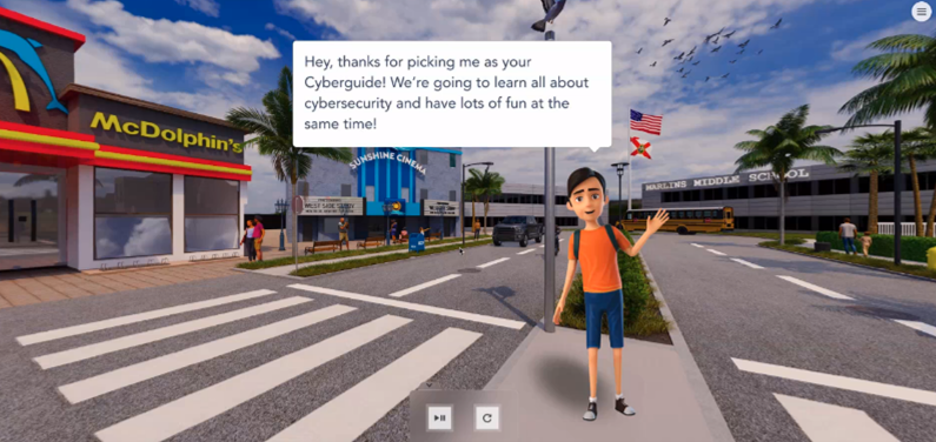
This track emphasizes the importance of understanding the environment of online threats. It typically presents the forms of computer network attack and scenarios for how a computer user might unwittingly download malware or allow a threat actor into a network. In recent years, it has begun to add in awareness raising of broader information threats, along the lines of deliberate disinformation and manipulation campaigns. This has mirrored both the broadening threats discussed earlier and the broadening responsibilities of network defender organizations in both government and the private sector.
What is evident is that each of these valuable approaches have evolved over the last decades in each of their realms. But they also increasingly connect and cross in what they care about and teach towards. We have chosen the term “cyber citizenship” to capture this concept.36 It marks the intersection of the critical thinking within media literacy, the positive sense of ethics and responsibility in digital citizenship and civics, and the cybersecurity field’s awareness of deliberate online threats and tactics that are used to target us all.
This concept thus focuses on what is needed to allow people to responsibly and effectively use these new technologies, while also defending against societal challenges that arise from the combination of the viral spread of (mis-/dis-/mal-) information, everyday reliance on algorithmically supported social media platforms, and organized (and frequently well-resourced) attackers working to destabilize political institutions.
While the concept appears new, it actually builds on some of the earliest thinking on the challenges of our online world and online threats. In its 2010 report to Congress, the Online Safety & Technology Working Group (formed by the Protecting Children in the 21st Century Act) called for universal instruction in media literacy, digital citizenship, and “computer security” in K–12 schools.37 However, we recognize that the concept will likely continue to develop—ideally as a more inclusive community of practice forms to address the challenges described above.
Cyber Citizenship
Cyber Citizenship is at the intersection of media literacy, digital citizenship and civics, and cybersecurity awareness. It entails the knowledge, skills, and responsibility to participate meaningfully and safely in civil society in the 21st century, as well as to build resilience against online manipulation and threats.
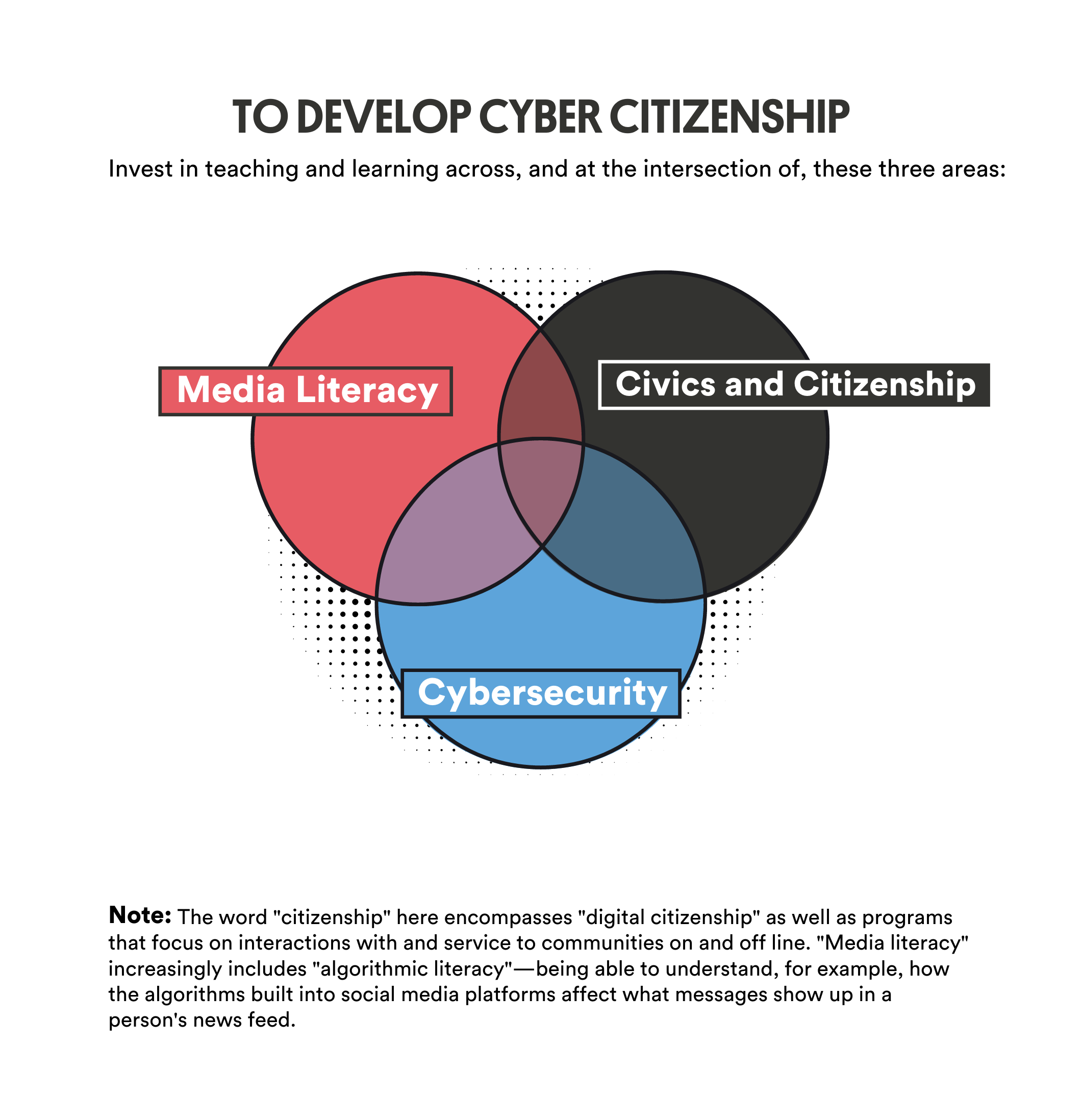
To provide an example of how these areas cross, take the issue of algorithms. Understanding how social media platforms use algorithms is a requirement of digital media literacy, but also connects to the problem of information threats because algorithms drive misinformation virally across networks. And the power of algorithms will only grow as technology advances. In realms that range from business and entertainment to politics and information warfare, the use of algorithms, artificial intelligence, and machine learning will increasingly predict and shape human interaction.38 These (often deliberately hidden) tools are a built-in feature of the digital platforms’ very design, used to collect and leverage data to guide attention and encourage behaviors as part of their profit model.
And yet, too few of those targeted by algorithms are even aware of how they work, while algorithms and algorithm bias shape everything from buying habits to criminal justice. This issue becomes significantly more complex as the developers of such algorithms themselves frequently do not fully understand how they operate—invisibly “moving fast and breaking things,” to borrow from the historical parlance of Silicon Valley.
Cyber citizenship also involves facing the cross-cutting challenge of epistemological imagination, or how people know what they know. It involves recognizing that people come at facts from different perspectives, not to mention working to understand who is behind a message, what their motivations are for writing that message, and what emotions may be stirred up by that message. For example, a 2019 Common Sense study asked K-12 teachers about their concerns related to these issues. The most common was that “students lack skills to critically evaluate online information.”39
This has become not just a bug, but a feature of our world, as it becomes increasingly shaped by online networks. And it is connected to many of the most pernicious trends in our society. As aptly described by the technology and social media researcher danah boyd, “the idea that there could be multiple histories, multiple truths blew my mind….But the hole that opens up, that invites people to look for new explanations….That hole can be filled in deeply problematic ways. When we ask students to challenge their sacred cows but don’t give them a new framework through which to make sense of the world, others are often there to do it for us.”40
Today’s initiatives must seek to provide students with the capacity to understand these new dynamics as well. Students have to be able to comprehend not only the many new ways in which information might be produced and distributed, but also the many new ways in which various groups might be led to believe it to be legitimate or not.
Citations
- For more information, see Marilyn Wedge, “The Historical Origin of ‘Alternative Facts,’” Psychology Today, January 23, 2017 at source">source; and Chau Tong, Hyungjin Gill, Jianing Li, Sebastián Valenzuela, and Hernando Rojas, “‘Fake News Is Anything They Say!’—Conceptualization and Weaponization of Fake News among the American Public,” Mass Communication and Society 5, no. 23 (2020), source">source;
- Journalism, “Fake News” and Disinformation: A Handbook for Journalism Education and Training (UNESCO 2021), source">source
- The concept of “weaponization of social media” is treated at length in the book by P. W. Singer and Emerson T. Brooking, LikeWar: The Weaponization of Social Media (New York: Houghton Harcourt, 2018), www.likewarbook.com
- See the lead editorial, “The COVID-19 infodemic,” in Lancet Infectious Disease, no. 20 (2020): 8, source">source
- Maggie Miller, “Russia Using Coronavirus Fears to Spread Misinformation in Western Countries,” The Hill, March 18, 2020, source">source
- For further reading, see Ryan Kort, “The Next National Security Strategy and National Resilience Throughout Education,” The Bridge, April 15, 2021, source">source
- For more information, see Victoria Smith, Mapping Worldwide Initiatives to Counter Influence Operations (Washington, DC: Carnegie Endowment for International Peace, 2020), source">source
- Cat Zarzewski and Aaron Schaffer, “Technology 202: Domestic Extremists Are Changing Their Playbook as Social Media Cracks Down,” Washington Post, April 19, 2021, source">source
- For more on this back-and-forth adaptation, see P. W. Singer and Emerson T. Brooking, “What Clausewitz Can Teach Us About War on Social Media: Military Tactics in the Age of Facebook,” Foreign Affairs, October 4, 2018, source">source
- For a compelling investigation of how young people find themselves going down these “rabbit holes,” see the eight-part audio series Rabbit Hole led by Kevin Roose, technology reporter for the New York Times: source">source.
- For more on the importance of giving youth these opportunities for learning, see the suite of principles and research studies related to what is called “connected learning,” supported by the MacArthur Foundation, the Heinz Endowments, and other philanthropic partners over the last decade. Reports are accessible through the University of California at Irvine’s Connected Learning Lab at source">source. Among the scholars involved in this work is Nicole Mirra of Rutgers University, whose Educating for Empathy (Teachers College Press, 2018), examines connections between digital media, critical literacy, and civics education to foster critical thinking and empathetic perspectives. See more at source">source
- Peter D. Tamayo, Digital Citizenship Recommendations: Report to the Legislature (Olympia, WA: Office of the Superintendent of Public Instruction, 2016),source">source
- Kamaya Yadaf, “Countering Influence Operations: A Review of Policies Since 2016,” Partnership for Countering Influence Operations, Carnegie Endowment for International Peace, November 30, 2020, source">source
- For more on the rankings of nations in their resilience to disinformation, see Marin Lessenski, “Just Think about It. Findings of the Media Literacy Index 2019,” published on website for Open Society Institute Sofia, November 2019, source">source
- For more information on Finland’s initiative to increase media literacy to citizens, politicians and journalists, see Eliza Mackintosh and Edward Kiernan, “Finland Is Winning the War on Fake News. What It's Learned May Be Crucial to Western Democracy,” CNN.com Special Report, May 2019, source">source. For further reading on Estonia’s initiative to increase fake news detection, see “Exclusive: How Estonia Is Training Young People to Spot Fake News” published by GovInsider, July 2019,source">source. For more on Estonia’s on cybersecurity education and digital services expansion, see Estonia: “The First Digitally Literate Country” published by Start it up, July 2020, source">source
- Alice Huget, et al. Exploring Media Literacy Education as a Tool for Mitigating Truth Decay (Santa Monica, CA: RAND Corporation, 2019),source">source
- For further reading on the history of the public education system of the U.S., see A Relevant History of Public Education in the United States by Grace Chen, education researcher for Public School Review, February 2021,source
- For further reading on Thomas Jefferson’s bill on education, see A Bill for the More General Diffusion of Knowledge by Thomas Jefferson Encyclopedia, source
- To read the full primary document, see An Act to Amend the Act Concerning Slaves, Free Negroes and Mulattoes passed by the General Assembly on April 7, 1831, source
- Jacob Soll, “The Long and Brutal History of Fake News,” Politico Magazine, December 18, 2016,source
- Singer and Brooking, LikeWar, 29.
- As described by Jennifer LaGarde and Darren Hudgins in Fact vs. Fiction: Teaching Critical Thinking Skills in the Age of Fake News (ISTE, 2018), 1–160.
- As quoted in LikeWar, 32.
- See Henry Jenkins, et al., in “Confronting the Challenges of Participatory Culture: Media Education for the 21st Century,” (MacArthur Foundation, 2006), source
- Donald J. Leu, Lisa Zawilinski, Elena Forzani, and Nicole Timbrell, “Best Practices in Teaching the New Literacies of Online Research and Comprehension,” in Best practices in literacy instruction, ed. Lesly Mandel Morrow and Linda B. Gambrell (New York, NY: Guilford Press, 2015), 343-364.source
- See, for example, the social and emotional learning skills outlined by the Collaborative for Academic, Social, and Emotional Learning at source; For more on this concept, also see Anne Collier, “So where are we with digital citizenship now?” Net Family News, November 2, 2018, source
- For more about NAMLE and its definition of media literacy and media literacy education, see source
- Sandra C. Cortesi, Andres Lombana, Alex Hasse and Sonia Kim, “Youth and Digital Citizenship+ (Plus): Understanding Skills for a Digital World,” ResearchGate (January 2020),source
- Mike E. Ribble, et al., “Digital Citizenship: Addressing Appropriate Technology Behavior,” International Society for Technology in Education (September 2004): 7.
- For further reading, see “Citizenship Digital and Otherwise: The Responsibility Lies with Our Students and Ourselves” written by Thomas Douglas of International Society for Technology in Education, December 28, 2018.
- Vanessa Vega and Michael B. Robb, The Common Sense Census: Inside the 21st-Century Classroom (San Francisco, CA: Common Sense Media, 2019), source
- As quoted by ISTE in Digital Citizenship in Education: Bring Digital Citizenship to the Classroom in Meaningful Ways (ISTE, 2021), source
- A. D. Falkoff, "The IBM Family of APL Systems," in IBM Systems Journal 30, no. 4, 416–432,source
- For further reading on the proclaimed “historical material,” see The Comprehensive National Cybersecurity Initiative published by The White House under former president Barack Obama, source
- More on Teaching Digital Natives is available at source
- The Merriam-Webster Dictionary places the origin of the word cybercitizenship (there written as one word, not two) in 1994. See source; Some of early uses of the term appear in the late ‘90s and early 2000s. See for example: Michael J. Berson and Ilene R. Berson, “Developing Thoughtful ‘Cybercitizens,’” Social Studies and the Young Learner 16, no. 4 (March–April 2004): 5–8, source
- Hemanshu Nigam and Anne Collier, “Youth Safety on a Living Internet,” Report of the Online Safety and Technology Working Group, June 4, 2010, pages 31 and 32, source
- See Shoshana Zuboff, The Age of Surveillance Capitalism: The Fight for a Human Future at the New Frontier of Power (New York: PublicAffairs, 2019).
- Vega and Robb, The Common Sense Census, 2, source
- danah boyd, “You Think You Want Media Literacy… Do You?,” Data & Society: Points, March 9th, 2018.
What Does Research Say About Building These Skills?
Policy leaders, educators, and parents have all voiced a sense of urgency about the problems of an increasingly polluted information environment and the need to figure out what teaching methods or materials will build the critical thinking skills that students need. Yet helping students to become aware of manipulation by social media algorithms, to avoid being misled by false claims (spread by automated bots or otherwise), and to learn to check sources before getting carried away by emotions—these are skills neither easily gained nor easy to assess. Indicators of success are not going to come from one-and-done modules or multiple-choice tests.
Fortunately, there are some foundations to build upon in studying what works. As discussed earlier, the field of media literacy education is not new. Indeed, the National Association for Media Literacy Education (NAMLE) emerged before the dawn of either Facebook or YouTube. Efforts to infuse classroom lessons with new communications tools and help build students’ skills in choosing and using media and technology for civic dialogue have been underway for decades. Leading organizations that support educators, like the National Council of Teachers of English, the National Council of Social Studies, and ISTE, have been grappling with and developing new frameworks for teaching that recognize the power of communications and network tools that enable anyone to publish anything at any time. Educators have also benefited over the past decade from research on the benefits of harnessing digital media for connected learning. The Connected Learning Alliance has found that students learn most when their personal interests are connected to “meaningful relationships and real-world opportunity.”41 And in cybersecurity, researchers can now collect data on the reduction of risky behavior, such as click rates on phishing tests, after students are taught how to avoid scams online.
However, in the areas that make up the intersection of cyber citizenship, a robust base of replicated studies on how to build skills and an awareness specific to fighting disinformation, misinformation, and mal-information does not yet exist. This is a result of both the relative newness of the problem and the fact that the focus until now has been on remedies such as technological fixes or regulation. It also points to a policy need, support for more research into which skill-building approaches work best, for which types of students, in which contexts—and for which desired outcomes. Each element is a critical part of strengthening the education system, including informal learning settings, such as extracurricular programs for children, teens, or adults.
Fortunately, research initiatives are taking shape. One is Mapping Impactful Media Literacy Practices, a two-year, U.S.-based research project started in 2020, that begins with a comprehensive review of current studies and includes international perspectives.42 It aims to identify what the research counts as an impactful media literacy practice, map that practice in different educational settings, and create a tool for educators to determine the impact of their own efforts.
As that work unfolds, there are some key lessons from new studies that have emerged in the past few years to examine how to help build resilience to dis- and misinformation. For example, a 2020 study of Learn to Discern, a program designed and run by the international education and research firm IREX, showed that targeted skill-building messages were effective in reducing engagement with misinformation, by helping people to recognize how various sources and authors were triggering their emotions. The program is designed to help people become more aware of their whole information environment, including a recognition of how some texts or videos are designed to generate strong emotional responses that could lead to the sharing and spreading of misinformation.
Notably, this “emphasis on emotional awareness and thought-driven decision-making,” as IREX describes it,43 is different from approaches that rely on a deep reading of just one text—an approach criticized of late.44 Asking students to think critically only about the words inside a text misses the mark, especially when so many texts are little more than memes with photos and a few words. A key part of media literacy education today involves helping students to do “lateral reading,” in which they shift horizontally in their web browser, opening a new tab to search for evidence that a source is considered credible by others.45 Students also benefit from seeing the way an issue is framed. This can happen when teachers help them see the larger environment of information at their fingertips, including various authors and motivations, and how their own information environment is shaping their understanding of the world.
In the study using Learn to Discern materials, Facebook users were shown a short video about media literacy that informed them of Russian sources of news messages. Then they were asked about whether they would “like” various pieces of politically right-leaning Russian content on social media. The study, led by RAND as part of its research on Russian propaganda, showed that materials such as “the video on media literacy…appeared to reduce the number of self-reported ‘likes’ for politically right-leaning Russian content.”46 This was just one study and many more are needed. Yet the results point to early evidence that interventions can be helpful.
Another research-validated approach is designed to build resilient mindsets by putting people into synthetic environments in which they can “experience” and learn, without the associated risks of the real world.47 One example of this is making students into antagonists (or “chief disinformation officers”) in simulation games that show how chaos ensues when bad information spreads. Researchers at the University of Cambridge have developed two such games—Bad News and Harmony Square—to study their impact. Harmony Square is a free, 10-minute game available on the internet that, as the researchers explain, “incorporates active experiential learning through a perspective-taking exercise: players are tasked with spreading misinformation and fomenting internal divisions in the quiet, peaceful neighborhood of Harmony Square.”48 Their study examined whether players perform better on tests of their ability to spot trolls and identify emotionally exploitative, conspiratorial, or polarizing content than people who did not play the game. In a randomized, controlled trial involving 681 people (half from the U.S. and half from other parts of the world), they found that those who played Harmony Square were more likely to consider manipulative social media as unreliable, had more confidence in spotting that content, and were less likely to share it.49
And more research is emerging from programs such as KQED Learn, an educational site associated with the public radio station in California’s Bay Area. in 2020, it conducted pre- and post-tests with nearly 200 students whose teachers participated in KQED’s media literacy and civic engagement programs. The students showed significant growth in their ability to distinguish between legitimate and dubious photographs and to compare articles for reliability. They also improved on their ability to check the reliability of sources by using lateral reading techniques instead of relying on searches inside the text.50
These three examples show how education and learning strategies are evolving to incorporate new findings in the science of human behavior and cognition. And more studies continue to emerge, from scholars at research centers such as the newly formed Center for an Informed Public and in publications such as the Journal of Media Literacy Education. Gathering robust evidence on how educators should go about building these skills and developing these mindsets is important. As the KQED study showed, this is about more than teaching students to look for a “.edu” or “.org” on a website, since this is now understood as nowhere near enough, as bad actors can easily stand up fake “.org” websites. Nor is it telling them to avoid Wikipedia. (We find that many teachers are not aware that Wikipedia’s commitment to transparency, and its self-policing corps of human editors, now makes it one of the most reliable sources for checking contested information.) This kind of teaching also goes beyond traditional news literacy education, which provides a good foundation but may not go far enough in helping people spot trolls and content generated by bots, intentionally designed to sow division. And it recognizes that online threats are about more than clicking the wrong link and downloading malware.
Interdisciplinary efforts are thus key. As part of these, drawing in new fields will be even more valuable to future research on effectiveness. For example, cognitive science is bringing new insights into how people learn and are shaped by information they ingest and information environments they participate in. This includes the impact of psychological phenomena such as the illusory truth effect (the impact of seeing false information repeated so much it seems true) and first-impression bias (in which the information people read first has lasting effects on behavior). Public interest technologists and those who study polarization on the internet are paying attention to the impact of algorithms on what information people see. One example is the way that YouTube serves up videos that lead people down rabbit holes of extremism. And national security experts are constantly identifying what military analysts call TTPs (Tactics, Techniques, and Procedures) of social media warfare by foreign groups and governments that are intent on disrupting democracies.
Here again we see the value of building bridges between different fields and approaches. Educators are not often privy to these new developments and the instructional materials they use can quickly become out of date. For example, Russian actors targeted the 2016 US presidential election by utilizing thousands of false front accounts (“sock-puppets”) and tens of thousands of algorithmic bots that injected disinformation themes into the U.S. political ecosystem. In the 2020 election, they pivoted to elevating domestic sources of disinformation and conspiracy theories.
Educational materials thus will need to incorporate more recognition of changing TTPs threat actors, to ensure that teachers do not become unwitting conduits for more polarization. This may be especially important if they are designing lessons that, say, ask students to argue two sides of an issue that might actually be part of a disinformation campaign.
Citations
- For more information, see Marilyn Wedge, “The Historical Origin of ‘Alternative Facts,’” Psychology Today, January 23, 2017 at <a href="source">source">source; and Chau Tong, Hyungjin Gill, Jianing Li, Sebastián Valenzuela, and Hernando Rojas, “‘Fake News Is Anything They Say!’—Conceptualization and Weaponization of Fake News among the American Public,” Mass Communication and Society 5, no. 23 (2020), <a href="source">source">source;
- Journalism, “Fake News” and Disinformation: A Handbook for Journalism Education and Training (UNESCO 2021), <a href="source">source">source
- The concept of “weaponization of social media” is treated at length in the book by P. W. Singer and Emerson T. Brooking, LikeWar: The Weaponization of Social Media (New York: Houghton Harcourt, 2018), www.likewarbook.com
- See the lead editorial, “The COVID-19 infodemic,” in Lancet Infectious Disease, no. 20 (2020): 8, <a href="source">source">source
- Maggie Miller, “Russia Using Coronavirus Fears to Spread Misinformation in Western Countries,” The Hill, March 18, 2020, <a href="source">source">source
- For further reading, see Ryan Kort, “The Next National Security Strategy and National Resilience Throughout Education,” The Bridge, April 15, 2021, <a href="source">source">source
- For more information, see Victoria Smith, Mapping Worldwide Initiatives to Counter Influence Operations (Washington, DC: Carnegie Endowment for International Peace, 2020), <a href="source">source">source
- Cat Zarzewski and Aaron Schaffer, “Technology 202: Domestic Extremists Are Changing Their Playbook as Social Media Cracks Down,” Washington Post, April 19, 2021, <a href="source">source">source
- For more on this back-and-forth adaptation, see P. W. Singer and Emerson T. Brooking, “What Clausewitz Can Teach Us About War on Social Media: Military Tactics in the Age of Facebook,” Foreign Affairs, October 4, 2018, <a href="source">source">source
- For a compelling investigation of how young people find themselves going down these “rabbit holes,” see the eight-part audio series Rabbit Hole led by Kevin Roose, technology reporter for the New York Times: <a href="source">source">source.
- For more on the importance of giving youth these opportunities for learning, see the suite of principles and research studies related to what is called “connected learning,” supported by the MacArthur Foundation, the Heinz Endowments, and other philanthropic partners over the last decade. Reports are accessible through the University of California at Irvine’s Connected Learning Lab at <a href="source">source">source. Among the scholars involved in this work is Nicole Mirra of Rutgers University, whose Educating for Empathy (Teachers College Press, 2018), examines connections between digital media, critical literacy, and civics education to foster critical thinking and empathetic perspectives. See more at <a href="source">source">source
- Peter D. Tamayo, Digital Citizenship Recommendations: Report to the Legislature (Olympia, WA: Office of the Superintendent of Public Instruction, 2016),<a href="source">source">source
- Kamaya Yadaf, “Countering Influence Operations: A Review of Policies Since 2016,” Partnership for Countering Influence Operations, Carnegie Endowment for International Peace, November 30, 2020, <a href="source">source">source
- For more on the rankings of nations in their resilience to disinformation, see Marin Lessenski, “Just Think about It. Findings of the Media Literacy Index 2019,” published on website for Open Society Institute Sofia, November 2019, <a href="source">source">source
- For more information on Finland’s initiative to increase media literacy to citizens, politicians and journalists, see Eliza Mackintosh and Edward Kiernan, “Finland Is Winning the War on Fake News. What It's Learned May Be Crucial to Western Democracy,” CNN.com Special Report, May 2019, <a href="source">source">source. For further reading on Estonia’s initiative to increase fake news detection, see “Exclusive: How Estonia Is Training Young People to Spot Fake News” published by GovInsider, July 2019,<a href="source">source">source. For more on Estonia’s on cybersecurity education and digital services expansion, see Estonia: “The First Digitally Literate Country” published by Start it up, July 2020, <a href="source">source">source
- Alice Huget, et al. Exploring Media Literacy Education as a Tool for Mitigating Truth Decay (Santa Monica, CA: RAND Corporation, 2019),<a href="source">source">source
- For further reading on the history of the public education system of the U.S., see A Relevant History of Public Education in the United States by Grace Chen, education researcher for Public School Review, February 2021,source">source
- For further reading on Thomas Jefferson’s bill on education, see A Bill for the More General Diffusion of Knowledge by Thomas Jefferson Encyclopedia, source">source
- To read the full primary document, see An Act to Amend the Act Concerning Slaves, Free Negroes and Mulattoes passed by the General Assembly on April 7, 1831, source">source
- Jacob Soll, “The Long and Brutal History of Fake News,” Politico Magazine, December 18, 2016,source">source
- Singer and Brooking, LikeWar, 29.
- As described by Jennifer LaGarde and Darren Hudgins in Fact vs. Fiction: Teaching Critical Thinking Skills in the Age of Fake News (ISTE, 2018), 1–160.
- As quoted in LikeWar, 32.
- See Henry Jenkins, et al., in “Confronting the Challenges of Participatory Culture: Media Education for the 21st Century,” (MacArthur Foundation, 2006), source">source
- Donald J. Leu, Lisa Zawilinski, Elena Forzani, and Nicole Timbrell, “Best Practices in Teaching the New Literacies of Online Research and Comprehension,” in Best practices in literacy instruction, ed. Lesly Mandel Morrow and Linda B. Gambrell (New York, NY: Guilford Press, 2015), 343-364.source">source
- See, for example, the social and emotional learning skills outlined by the Collaborative for Academic, Social, and Emotional Learning at source">source; For more on this concept, also see Anne Collier, “So where are we with digital citizenship now?” Net Family News, November 2, 2018, source">source
- For more about NAMLE and its definition of media literacy and media literacy education, see source">source
- Sandra C. Cortesi, Andres Lombana, Alex Hasse and Sonia Kim, “Youth and Digital Citizenship+ (Plus): Understanding Skills for a Digital World,” ResearchGate (January 2020),source">source
- Mike E. Ribble, et al., “Digital Citizenship: Addressing Appropriate Technology Behavior,” International Society for Technology in Education (September 2004): 7.
- For further reading, see “Citizenship Digital and Otherwise: The Responsibility Lies with Our Students and Ourselves” written by Thomas Douglas of International Society for Technology in Education, December 28, 2018.
- Vanessa Vega and Michael B. Robb, The Common Sense Census: Inside the 21st-Century Classroom (San Francisco, CA: Common Sense Media, 2019), source">source
- As quoted by ISTE in Digital Citizenship in Education: Bring Digital Citizenship to the Classroom in Meaningful Ways (ISTE, 2021), source">source
- A. D. Falkoff, "The IBM Family of APL Systems," in IBM Systems Journal 30, no. 4, 416–432,source">source
- For further reading on the proclaimed “historical material,” see The Comprehensive National Cybersecurity Initiative published by The White House under former president Barack Obama, source">source
- More on Teaching Digital Natives is available at source">source
- The Merriam-Webster Dictionary places the origin of the word cybercitizenship (there written as one word, not two) in 1994. See source">source; Some of early uses of the term appear in the late ‘90s and early 2000s. See for example: Michael J. Berson and Ilene R. Berson, “Developing Thoughtful ‘Cybercitizens,’” Social Studies and the Young Learner 16, no. 4 (March–April 2004): 5–8, source">source
- Hemanshu Nigam and Anne Collier, “Youth Safety on a Living Internet,” Report of the Online Safety and Technology Working Group, June 4, 2010, pages 31 and 32, source">source
- See Shoshana Zuboff, The Age of Surveillance Capitalism: The Fight for a Human Future at the New Frontier of Power (New York: PublicAffairs, 2019).
- Vega and Robb, The Common Sense Census, 2, source">source
- danah boyd, “You Think You Want Media Literacy… Do You?,” Data & Society: Points, March 9th, 2018.
- See the Connected Learning Alliance for more about the elements of and principles behind “connected learning,” at source
- Paul Mihaldis, associate professor and graduate program director for the Media Design program at Emerson College, is the principal investigator, and NAMLE is the lead partner. See source
- For further reading, see Randomized Control Trial Finds IREX’s Media Literacy Messages to Be Effective in Reducing Engagement with Disinformation published by IREX,source
- Charlie Warzel, “Don’t Go Down the Rabbit Hole: Critical Thinking, as We’re Taught to Do It, Isn’t Helping in the Fight Against Misinformation,” New York Times, February 18, 2021, source
- The concept of lateral reading is described in several media literacy resources and emerged from the research of the Stanford History Education Group, led by Sam Wineburg. For a useful overview, see “Expand Your View with Lateral Reading,” an article published by the News Literacy Project at source
- Todd C. Helmus, et al., Russian Propaganda Hits Its Mark (Santa Monica, CA: RAND Corporation, 2020), source
- Harmony Square is the example noted here because of the Cambridge research study, but educators may also be interested in another game, which may be appropriate for slightly younger students, called Interland, designed as part of Google’s Be Internet Awesome initiative. As Google describes it, “Interland is a free, web-based game designed to help kids learn five foundational lessons across four different mini-games, or ‘lands.’ Kids are invited to play their way to Internet Awesome in a quest to deny hackers, sink phishers, one-up cyberbullies, outsmart oversharers and become safe, confident explorers of the online world.” For more, see source
- Jon Roozenbeek and Sander Van Der Linden, “Breaking Harmony Square: A Game that “Inoculates” against Political Information,” Misinformation Review, November 6, 2020, 1,source
- Roozenbeek and Van Der Linden, 5–7,source
- Institute for the Study of Knowledge Management in Education, Equity and Access, Civic Engagement and Media Literacy- Final Report: KQED Learn Impact Study (Half Moon Bay, CA: Institute for the Study of Knowledge Management in Education, 2020),source
What are the Challenges to Implementation in the U.S. Education System?
The challenge of building up resilience in the U.S. system through greater cyber citizenship skills, however, is not just about building better tools and research. It also comes from the very makeup of our education system.
As opposed to the nations that have tried to equip their students for digital skills and threats, such as Estonia and Finland, the U.S. does not have a single school system in which the national government has a central budget and authority over what is taught or how. Instead, it has a federal Department of Education that supports and steers, but the leaders of more than 18,000 school districts at the community level make most of the decisions.51 The education agencies for each of the 50 states have considerable power too—they hold the purse strings for the majority of the funding, set standards for what students should learn and teachers should know, authorize assessments, and approve textbooks.
This uniquely American system is critical to keep in mind in any discussion of how to improve education at a large scale in the U.S. By definition, it does not just involve trying to train teachers on new methods, introduce new curricula, and so forth. It also means moving budgets and priorities across a labyrinth of bureaucracies and constituencies. One cautionary tale is what happened during the movement a decade ago to develop common academic standards for mathematics and English language arts, known as the Common Core.52 Although the movement ultimately led to stronger standards adopted by 45 states, the District of Columbia, and several territories,53 it also sparked years of controversy. The debate ranged from political concerns over what was perceived as national leaders meddling in local affairs to consternation over new tests and often haphazard implementation and training at the school level. The backlash reverberates today.
Given the difficulties in promoting common standards for the seemingly uncontroversial subjects of math and reading, widespread adoption of standards for building resilience to information threats will be a challenge, to say nothing of how high the hurdles will be in trying to adapt curricula and teaching strategies to match those standards.
Yet that difficulty does not mean effort is not merited. Indeed, many efforts are already underway to develop standards in the three areas discussed above. More recently, the RAND Corporation’s Truth Decay Initiative has developed strong standards for the subset of media literacy skills needed to combat disinformation and misinformation.54 ISTE has integrated digital citizenship standards into the comprehensive technology standards that it encourages states and districts to adopt.
A growing number of states (14 as of June 2021) have passed legislation to promote media literacy education and digital citizenship, several of which start with adopting standards.55 In Florida, for example, the 2020 “Next Generation Sunshine State Standards” establish curricular core content. Among those listed in Florida standards documents are “technology-literacy skills; information and media-literacy skills; and civic-engagement skills.”56
Standards are crucial in setting expectations, and often the funding and training that goes to implementing them. They also matter immensely to teachers, who, for better or worse, have to teach towards them and thus shape their lesson plans and use of classroom time.
However, standards are not enough. Instead, as Media Literacy Now explains, “implementation is key.”57 Implementation brings together several key elements: effective, independently evaluated, research-backed tools and curricula; standards that guide and help expand use; and, most importantly, funding. Educators do not just need instructional materials that help them teach to those standards. They also require time to evaluate those materials, the ability to exchange information about what works, and training on how to integrate those materials into existing lessons.
These training needs are significant and are a particular challenge in our system. While there are many effective programs in the U.S., our country’s overall teacher preparation system is anemic. Education schools often get low marks for not delivering the knowledge and skills that future teachers need.58 Once teachers are hired, they rarely get robust professional development.59 And coursework for prospective or current teachers is often not designed to stay current on topic, most especially the issues we’ve seen in the crossing areas of cyber citizenship, like filter bubbles,60 how algorithms and recommendation engines deliver increasingly extreme news and videos, or the prevalence and tactics of disinformation.
There are important exceptions to this, which show that progress can be made with proper problem recognition and effort. The states of New Mexico and Washington, for example, have recently invested in teacher training on media literacy.61
Yet overall, teacher training cannot keep up. Take the area of civics and citizenship skills. Data from RAND about American teachers’ capacity to help students develop a strong understanding of civics—a subject area that, like social studies, has been part of public schooling for decades—shows big gaps. As the RAND Corporation’s Julia H. Kaufman puts it, the data paints “a concerning picture about K–12 teachers' capacity to address civic education.”62 A similar RAND report focused on social studies teachers also finds worrisome deficits, "especially," as the report's authors note, "in light of the fractured media landscape and the growing prevalence of disinformation.”63
Yet many of today’s teachers do see the urgency of providing more instruction on media literacy and digital citizenship. In answering that RAND survey question about the importance of students learning to “critically evaluate information for credibility and bias,” 82 percent of elementary school teachers and 92 percent of secondary school teachers said that this came somewhat or very close to their own views.64 And among social studies teachers, at least, there are signs of some teaching of these skills. In that same RAND study, for example, more than 80 percent of high school social studies teachers said they sought to teach students how to distinguish between fact and opinion. That same report, however, showed that a sizable percentage of social studies teachers—38 percent of those at the high school level—gave only slight emphasis or no emphasis to issues of “responsible internet use,” which in the survey included ensuring the reliability of sources and interacting responsibly on social media.65 These illustrate the continued disconnect between the issues and the classroom.
Fortunately, new instructional materials—from interactive games to multi-week lesson plans—have emerged to support teachers who strive to teach these skills. In addition, new initiatives, some based at universities and others within community educational organizations, are emerging to socialize the need for such programs and provide training to educators on how to incorporate these new tools.
Citations
- For more information, see Marilyn Wedge, “The Historical Origin of ‘Alternative Facts,’” Psychology Today, January 23, 2017 at <a href="<a href="source">source">source">source; and Chau Tong, Hyungjin Gill, Jianing Li, Sebastián Valenzuela, and Hernando Rojas, “‘Fake News Is Anything They Say!’—Conceptualization and Weaponization of Fake News among the American Public,” Mass Communication and Society 5, no. 23 (2020), <a href="<a href="source">source">source">source;
- Journalism, “Fake News” and Disinformation: A Handbook for Journalism Education and Training (UNESCO 2021), <a href="<a href="source">source">source">source
- The concept of “weaponization of social media” is treated at length in the book by P. W. Singer and Emerson T. Brooking, LikeWar: The Weaponization of Social Media (New York: Houghton Harcourt, 2018), www.likewarbook.com
- See the lead editorial, “The COVID-19 infodemic,” in Lancet Infectious Disease, no. 20 (2020): 8, <a href="<a href="source">source">source">source
- Maggie Miller, “Russia Using Coronavirus Fears to Spread Misinformation in Western Countries,” The Hill, March 18, 2020, <a href="<a href="source">source">source">source
- For further reading, see Ryan Kort, “The Next National Security Strategy and National Resilience Throughout Education,” The Bridge, April 15, 2021, <a href="<a href="source">source">source">source
- For more information, see Victoria Smith, Mapping Worldwide Initiatives to Counter Influence Operations (Washington, DC: Carnegie Endowment for International Peace, 2020), <a href="<a href="source">source">source">source
- Cat Zarzewski and Aaron Schaffer, “Technology 202: Domestic Extremists Are Changing Their Playbook as Social Media Cracks Down,” Washington Post, April 19, 2021, <a href="<a href="source">source">source">source
- For more on this back-and-forth adaptation, see P. W. Singer and Emerson T. Brooking, “What Clausewitz Can Teach Us About War on Social Media: Military Tactics in the Age of Facebook,” Foreign Affairs, October 4, 2018, <a href="<a href="source">source">source">source
- For a compelling investigation of how young people find themselves going down these “rabbit holes,” see the eight-part audio series Rabbit Hole led by Kevin Roose, technology reporter for the New York Times: <a href="<a href="source">source">source">source.
- For more on the importance of giving youth these opportunities for learning, see the suite of principles and research studies related to what is called “connected learning,” supported by the MacArthur Foundation, the Heinz Endowments, and other philanthropic partners over the last decade. Reports are accessible through the University of California at Irvine’s Connected Learning Lab at <a href="<a href="source">source">source">source. Among the scholars involved in this work is Nicole Mirra of Rutgers University, whose Educating for Empathy (Teachers College Press, 2018), examines connections between digital media, critical literacy, and civics education to foster critical thinking and empathetic perspectives. See more at <a href="<a href="source">source">source">source
- Peter D. Tamayo, Digital Citizenship Recommendations: Report to the Legislature (Olympia, WA: Office of the Superintendent of Public Instruction, 2016),<a href="<a href="source">source">source">source
- Kamaya Yadaf, “Countering Influence Operations: A Review of Policies Since 2016,” Partnership for Countering Influence Operations, Carnegie Endowment for International Peace, November 30, 2020, <a href="<a href="source">source">source">source
- For more on the rankings of nations in their resilience to disinformation, see Marin Lessenski, “Just Think about It. Findings of the Media Literacy Index 2019,” published on website for Open Society Institute Sofia, November 2019, <a href="<a href="source">source">source">source
- For more information on Finland’s initiative to increase media literacy to citizens, politicians and journalists, see Eliza Mackintosh and Edward Kiernan, “Finland Is Winning the War on Fake News. What It's Learned May Be Crucial to Western Democracy,” CNN.com Special Report, May 2019, <a href="<a href="source">source">source">source. For further reading on Estonia’s initiative to increase fake news detection, see “Exclusive: How Estonia Is Training Young People to Spot Fake News” published by GovInsider, July 2019,<a href="<a href="source">source">source">source. For more on Estonia’s on cybersecurity education and digital services expansion, see Estonia: “The First Digitally Literate Country” published by Start it up, July 2020, <a href="<a href="source">source">source">source
- Alice Huget, et al. Exploring Media Literacy Education as a Tool for Mitigating Truth Decay (Santa Monica, CA: RAND Corporation, 2019),<a href="<a href="source">source">source">source
- For further reading on the history of the public education system of the U.S., see A Relevant History of Public Education in the United States by Grace Chen, education researcher for Public School Review, February 2021,<a href="source">source">source
- For further reading on Thomas Jefferson’s bill on education, see A Bill for the More General Diffusion of Knowledge by Thomas Jefferson Encyclopedia, <a href="source">source">source
- To read the full primary document, see An Act to Amend the Act Concerning Slaves, Free Negroes and Mulattoes passed by the General Assembly on April 7, 1831, <a href="source">source">source
- Jacob Soll, “The Long and Brutal History of Fake News,” Politico Magazine, December 18, 2016,<a href="source">source">source
- Singer and Brooking, LikeWar, 29.
- As described by Jennifer LaGarde and Darren Hudgins in Fact vs. Fiction: Teaching Critical Thinking Skills in the Age of Fake News (ISTE, 2018), 1–160.
- As quoted in LikeWar, 32.
- See Henry Jenkins, et al., in “Confronting the Challenges of Participatory Culture: Media Education for the 21st Century,” (MacArthur Foundation, 2006), <a href="source">source">source
- Donald J. Leu, Lisa Zawilinski, Elena Forzani, and Nicole Timbrell, “Best Practices in Teaching the New Literacies of Online Research and Comprehension,” in Best practices in literacy instruction, ed. Lesly Mandel Morrow and Linda B. Gambrell (New York, NY: Guilford Press, 2015), 343-364.<a href="source">source">source
- See, for example, the social and emotional learning skills outlined by the Collaborative for Academic, Social, and Emotional Learning at <a href="source">source">source; For more on this concept, also see Anne Collier, “So where are we with digital citizenship now?” Net Family News, November 2, 2018, <a href="source">source">source
- For more about NAMLE and its definition of media literacy and media literacy education, see <a href="source">source">source
- Sandra C. Cortesi, Andres Lombana, Alex Hasse and Sonia Kim, “Youth and Digital Citizenship+ (Plus): Understanding Skills for a Digital World,” ResearchGate (January 2020),<a href="source">source">source
- Mike E. Ribble, et al., “Digital Citizenship: Addressing Appropriate Technology Behavior,” International Society for Technology in Education (September 2004): 7.
- For further reading, see “Citizenship Digital and Otherwise: The Responsibility Lies with Our Students and Ourselves” written by Thomas Douglas of International Society for Technology in Education, December 28, 2018.
- Vanessa Vega and Michael B. Robb, The Common Sense Census: Inside the 21st-Century Classroom (San Francisco, CA: Common Sense Media, 2019), <a href="source">source">source
- As quoted by ISTE in Digital Citizenship in Education: Bring Digital Citizenship to the Classroom in Meaningful Ways (ISTE, 2021), <a href="source">source">source
- A. D. Falkoff, "The IBM Family of APL Systems," in IBM Systems Journal 30, no. 4, 416–432,<a href="source">source">source
- For further reading on the proclaimed “historical material,” see The Comprehensive National Cybersecurity Initiative published by The White House under former president Barack Obama, <a href="source">source">source
- More on Teaching Digital Natives is available at <a href="source">source">source
- The Merriam-Webster Dictionary places the origin of the word cybercitizenship (there written as one word, not two) in 1994. See <a href="source">source">source; Some of early uses of the term appear in the late ‘90s and early 2000s. See for example: Michael J. Berson and Ilene R. Berson, “Developing Thoughtful ‘Cybercitizens,’” Social Studies and the Young Learner 16, no. 4 (March–April 2004): 5–8, <a href="source">source">source
- Hemanshu Nigam and Anne Collier, “Youth Safety on a Living Internet,” Report of the Online Safety and Technology Working Group, June 4, 2010, pages 31 and 32, <a href="source">source">source
- See Shoshana Zuboff, The Age of Surveillance Capitalism: The Fight for a Human Future at the New Frontier of Power (New York: PublicAffairs, 2019).
- Vega and Robb, The Common Sense Census, 2, <a href="source">source">source
- danah boyd, “You Think You Want Media Literacy… Do You?,” Data & Society: Points, March 9th, 2018.
- See the Connected Learning Alliance for more about the elements of and principles behind “connected learning,” at source">source
- Paul Mihaldis, associate professor and graduate program director for the Media Design program at Emerson College, is the principal investigator, and NAMLE is the lead partner. See source">source
- For further reading, see Randomized Control Trial Finds IREX’s Media Literacy Messages to Be Effective in Reducing Engagement with Disinformation published by IREX,source">source
- Charlie Warzel, “Don’t Go Down the Rabbit Hole: Critical Thinking, as We’re Taught to Do It, Isn’t Helping in the Fight Against Misinformation,” New York Times, February 18, 2021, source">source
- The concept of lateral reading is described in several media literacy resources and emerged from the research of the Stanford History Education Group, led by Sam Wineburg. For a useful overview, see “Expand Your View with Lateral Reading,” an article published by the News Literacy Project at source">source
- Todd C. Helmus, et al., Russian Propaganda Hits Its Mark (Santa Monica, CA: RAND Corporation, 2020), source">source
- Harmony Square is the example noted here because of the Cambridge research study, but educators may also be interested in another game, which may be appropriate for slightly younger students, called Interland, designed as part of Google’s Be Internet Awesome initiative. As Google describes it, “Interland is a free, web-based game designed to help kids learn five foundational lessons across four different mini-games, or ‘lands.’ Kids are invited to play their way to Internet Awesome in a quest to deny hackers, sink phishers, one-up cyberbullies, outsmart oversharers and become safe, confident explorers of the online world.” For more, see source">source
- Jon Roozenbeek and Sander Van Der Linden, “Breaking Harmony Square: A Game that “Inoculates” against Political Information,” Misinformation Review, November 6, 2020, 1,source">source
- Roozenbeek and Van Der Linden, 5–7,source">source
- Institute for the Study of Knowledge Management in Education, Equity and Access, Civic Engagement and Media Literacy- Final Report: KQED Learn Impact Study (Half Moon Bay, CA: Institute for the Study of Knowledge Management in Education, 2020),source">source
- To view the complete table, see Selected Statistics from the Public Elementary and Secondary Education Universe: School Year 2015–2016 published by the National Center for Education Statistics.source
- Strong Standards: A Review of Changes to State Standards Since the Common Core (Washington, DC: Achieve, November 13, 2017), source
- To view a U.S. map on adopted Core Standards, see Standards in Your State published by the Common Core: State Standards Initiative, source
- Alice Huguet, Garrett Baker, Laura S. Hamilton, and John F. Payne, Media Literacy Standards to Counter Truth Decay (Santa Monica, CA: RAND Corporation, 2021), source
- Note that the tracking of legislation related to the skills described in this paper can get complicated because of unsettled terminology and definitions across different sectors. For example, Media Literacy Now tracks legislation that includes the terms “media literacy” or “digital citizenship,” but does not include “digital literacy” in its tracking and analysis of state legislation. As the organization describes it, “We have specifically not included “digital literacy,” as this term refers primarily to knowing how to use the devices that deliver information as opposed to developing critical thinking skills around the information accessed.”
- For further reading on Florida’s stature, see The 2020 Florida Statutes: The Next Generation Sunshine State Standards, documented by the Florida Legislature, source
- U.S. Media Literacy Policy Report 2020, Media Literacy Now, 4, source
- Melissa Tooley and Laura Bornfreund, Time to Improve: How Federal Policy Can Promote Better Prepared Teachers and School Leaders, (Washington, DC: New America, 2014), 4, source
- As described in New America’s report, No Panacea: Diagnosing What Ails Teacher Professional Development Before Reaching for Remedies, teachers need—but typically lack—professional development experiences that are “sustained, relevant to teachers’ daily work and content areas, and involve active learning and collaboration among colleagues.” See pages 2–3 of source
- For more on filter bubbles, see the May 4, 2011 TED Talk by Eli Pariser, who described them as “your own personal, unique universe of information that you live in online.” source
- Legislatures in both Washington and New Mexico passed funding bills recently that increased funding for teacher training programs in media literacy. For more, see pages 12–13 of the U.S. Media Literacy Report from Media Literacy Now, source
- Julia H. Kaufman, “Giving Teachers the Tools They Need to Provide 21st-Century Civics Education,” The RAND Blog, February 23, 2021, source
- Laura S. Hamilton, Julia H. Kaufman, and Lynn Hu, Social Studies Teachers' Perspectives on Key Civic Outcomes in 2010 and 2019: Civic Development in the Era of Truth Decay (Santa Monica, CA: RAND Corporation, 2020), 3, source.
- Laura S. Hamilton, Julia H. Kaufman, and Lynn Hu, Media Use and Literacy in Schools: Civic Development in the Era of Truth Decay (Santa Monica, CA: RAND Corporation, 2020), 4, source.
- Hamilton, Kaufman, and Hu, Media Use and Literacy in Schools, 2–3.
New Instructional Materials Developed for Educators, But Also A New Problem
Digital tools have increasingly become a requirement for engaging students in classroom instruction as well as the expectation for teachers to embed them in curricula. A range of new cyber citizenship tools of all kinds are cropping up—either whole curricula or smaller units—as well as games and videos to embed in classroom lessons.
According to a New America analysis of survey data from RAND, the shift toward digital tools for instruction began even before the pandemic. YouTube, Kahoot!, BrainPOP, Quizlet and other platforms had gained popularity with teachers before the shift to online learning.66 For instance, when English language arts teachers were asked to select from a Likert scale how frequently they used YouTube and BrainPop for instruction, there was an increase by 20 percent of teachers reporting regular usage in 2019 compared to the prior year.
The data are not yet available, but digital educational tool use can be assumed to have drastically surged during the pandemic and the massive shift to remote schooling.67 And, like so much else, the long-term effect of greater use and comfort with digital teaching tools will be felt after full return to the physical classroom. It is likely, for example, that teachers will increasingly reach for digital instructional materials and use them to supplement and enhance their lessons, no longer relying solely on textbooks or workbooks mandated by districts. A 2020 RAND survey found that most teachers used digital materials as supplemental resources, adopting resources like YouTube, Khan Academy, and ReadWorks that provided specific content.68
This shift to digital materials is another reason why new and timely digital tools that are specific to particular content areas tend to hold much stake—especially those instructional materials and training that focus on these combined need areas of cyber citizenship.
A quick tour of content-specific materials that have emerged in the past few years is impressive, especially given how new the field is. Earlier, we mentioned Harmony Square, a new game that puts students in the role of disinformation spreaders. Another entrant is Escape Fake, a free app-based game for teens and developed in Austria; it puts players in an augmented reality escape room where they have to collect evidence to show what is real and what has been fabricated (see screen shot below).69
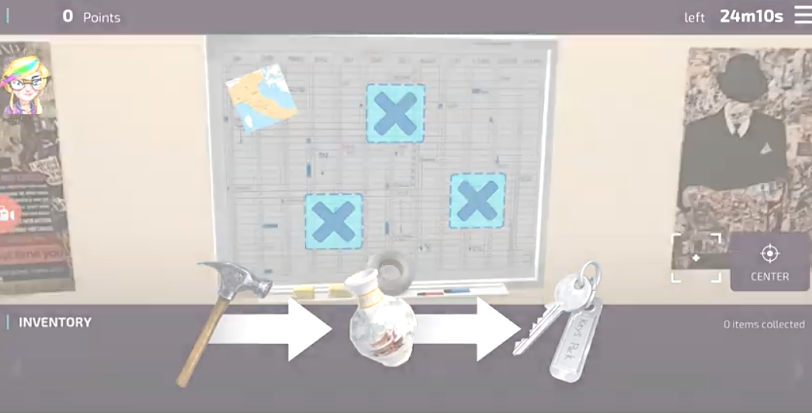
More extensive curricular materials and information exchanges are emerging too. For example, as of mid-2021, Common Sense Education’s curriculum on digital citizenship has been implemented in 2,561 schools and 72 school districts.70 The DigCit Commit coalition, organized by ISTE, has similarly engaged 15 national organizations with connections to educators, to host summits, workshops, develop social media campaigns, and provide updated lists of resources.71 In turn, the National Media Literacy Alliance formed by NAMLE is working to bring together organizations such as the National Council on Social Studies and the American Association of School Librarians to share resources across disciplines.72 And the Media Education Lab, founded by Renee Hobbs at the University of Rhode Island, provides an annual summer institute for K–12 teachers around the country to build and share their own tools and strategies in digital literacy.73 These various examples show the emerging network, and demonstrate the exciting possibilities that come from bringing groups together into a larger community of practice around such programs.
Other organizations such as Civic Online Reasoning (COR) and the News Literacy Project have become go-to platforms for educators to access resources that teach the skills needed to combat misinformation and disinformation. In fact, examining these two platforms shows the growth in tools and resources becoming available in this space.
Founded in 2015 by the Stanford History Education Group, COR is an initiative and free online resource that allows educators to access lesson plans and assessments. The focus of COR is to teach students how to analyze online content through skills such as lateral reading. There are over 16 videos focused on skill development and multiple crash courses. Additionally, over 25 lessons and 22 assessments, on topics ranging from evaluating sponsored content to verifying claims on social media, are provided in its curriculum index. The materials are based on research conducted by Stanford scholars and educators can view numerous articles on the COR website to connect research with practice on every lesson they teach.
The News Literacy Project, a nonpartisan national nonprofit, is another place for educators seeking to teach students how to evaluate online information. Initiatives such as News Lit Nation are focused on building community among educators. The organization offers its online Checkology curriculum platform that teaches news literacy skills to students. Accessibility to the Checkology platform is similar to COR, with videos available to freely view and use. Resources available through the site explore a gamut of topics, from understanding algorithms, global press freedoms, and conspiratorial thinking. Teachers can see standards alignment across states and search by difficulty level. Recently, the News Literacy Project has partnered with the creators of the Trust Me documentary, to provide a curriculum that accompanies the film for use in schools and community spaces.
However, while there are a growing number of content-specific resources and platforms available digitally, there is variance in the field. Some are free and some require payment. This, of course, shapes which tools that school systems and individual teachers can access and use, as there are varied budgets. Even more, not all of the tools are vetted by scholars or field experts. And of those that are evaluated, many are evaluated through less than rigorous research means, with a particular issue being internal versus external evaluation.74 This means that the quality and effectiveness of tools can vary. It is thus challenging even for experts to tell which tools are effective for student learning, and which are just well packaged.
This relates to a second problem. Rather than being gathered in one place, these resources are spread out across the growing universe of nonprofit and for-profit organizations that either make or seek to deliver them to educators. This creates an irony: for a space that is all about networks and virality, online materials to teach about it are not easy to find and compare.
This has been found in both quantitative and qualitative research. A 2019 NAMLE survey of more than 300 media literacy educators uncovered that they were using more than 500 different educational resources. “There is a lack,” the report states, “of a central, online repository of comprehensive, quality curriculum materials and lesson plans available for free to teachers and other professional educators.”75
Similarly, when our research team gathered a series of educator focus groups in 2020-21, a topic of discussion was the challenges of locating quality online resources. When asked how they tried to locate effective resources for classroom instruction, one teacher responded, “I do a lot of Googling.”
Educators need a place where they can easily search, filter, sort, and find vetted quality materials that match the needs of their classrooms. They need a place to search for supplementary materials, such as videos or games, to be embedded in a short lesson, and for comprehensive curricular materials designed to be taught over a month, semester, or a year. They also need a place to learn from each other’s experiences and insights and hear from researchers.
A recent study of educators in Washington State reinforces this need and points to one key answer. It pulled insights from teacher-librarians, principals, and technology directors at 1,111 Washington state schools, “to understand how they are currently integrating digital citizenship and media literacy education in their curriculum.”76 The responses showed that educators would benefit from something like a portal—“a web-based location to recommend successful practices and resources and work with the K–12 community and other stakeholders to identify and develop additional Open Educational Resources to support digital citizenship, media literacy and Internet safety in schools.”
Citations
- For more information, see Marilyn Wedge, “The Historical Origin of ‘Alternative Facts,’” Psychology Today, January 23, 2017 at <a href="<a href="<a href="source">source">source">source">source; and Chau Tong, Hyungjin Gill, Jianing Li, Sebastián Valenzuela, and Hernando Rojas, “‘Fake News Is Anything They Say!’—Conceptualization and Weaponization of Fake News among the American Public,” Mass Communication and Society 5, no. 23 (2020), <a href="<a href="<a href="source">source">source">source">source;
- Journalism, “Fake News” and Disinformation: A Handbook for Journalism Education and Training (UNESCO 2021), <a href="<a href="<a href="source">source">source">source">source
- The concept of “weaponization of social media” is treated at length in the book by P. W. Singer and Emerson T. Brooking, LikeWar: The Weaponization of Social Media (New York: Houghton Harcourt, 2018), www.likewarbook.com
- See the lead editorial, “The COVID-19 infodemic,” in Lancet Infectious Disease, no. 20 (2020): 8, <a href="<a href="<a href="source">source">source">source">source
- Maggie Miller, “Russia Using Coronavirus Fears to Spread Misinformation in Western Countries,” The Hill, March 18, 2020, <a href="<a href="<a href="source">source">source">source">source
- For further reading, see Ryan Kort, “The Next National Security Strategy and National Resilience Throughout Education,” The Bridge, April 15, 2021, <a href="<a href="<a href="source">source">source">source">source
- For more information, see Victoria Smith, Mapping Worldwide Initiatives to Counter Influence Operations (Washington, DC: Carnegie Endowment for International Peace, 2020), <a href="<a href="<a href="source">source">source">source">source
- Cat Zarzewski and Aaron Schaffer, “Technology 202: Domestic Extremists Are Changing Their Playbook as Social Media Cracks Down,” Washington Post, April 19, 2021, <a href="<a href="<a href="source">source">source">source">source
- For more on this back-and-forth adaptation, see P. W. Singer and Emerson T. Brooking, “What Clausewitz Can Teach Us About War on Social Media: Military Tactics in the Age of Facebook,” Foreign Affairs, October 4, 2018, <a href="<a href="<a href="source">source">source">source">source
- For a compelling investigation of how young people find themselves going down these “rabbit holes,” see the eight-part audio series Rabbit Hole led by Kevin Roose, technology reporter for the New York Times: <a href="<a href="<a href="source">source">source">source">source.
- For more on the importance of giving youth these opportunities for learning, see the suite of principles and research studies related to what is called “connected learning,” supported by the MacArthur Foundation, the Heinz Endowments, and other philanthropic partners over the last decade. Reports are accessible through the University of California at Irvine’s Connected Learning Lab at <a href="<a href="<a href="source">source">source">source">source. Among the scholars involved in this work is Nicole Mirra of Rutgers University, whose Educating for Empathy (Teachers College Press, 2018), examines connections between digital media, critical literacy, and civics education to foster critical thinking and empathetic perspectives. See more at <a href="<a href="<a href="source">source">source">source">source
- Peter D. Tamayo, Digital Citizenship Recommendations: Report to the Legislature (Olympia, WA: Office of the Superintendent of Public Instruction, 2016),<a href="<a href="<a href="source">source">source">source">source
- Kamaya Yadaf, “Countering Influence Operations: A Review of Policies Since 2016,” Partnership for Countering Influence Operations, Carnegie Endowment for International Peace, November 30, 2020, <a href="<a href="<a href="source">source">source">source">source
- For more on the rankings of nations in their resilience to disinformation, see Marin Lessenski, “Just Think about It. Findings of the Media Literacy Index 2019,” published on website for Open Society Institute Sofia, November 2019, <a href="<a href="<a href="source">source">source">source">source
- For more information on Finland’s initiative to increase media literacy to citizens, politicians and journalists, see Eliza Mackintosh and Edward Kiernan, “Finland Is Winning the War on Fake News. What It's Learned May Be Crucial to Western Democracy,” CNN.com Special Report, May 2019, <a href="<a href="<a href="source">source">source">source">source. For further reading on Estonia’s initiative to increase fake news detection, see “Exclusive: How Estonia Is Training Young People to Spot Fake News” published by GovInsider, July 2019,<a href="<a href="<a href="source">source">source">source">source. For more on Estonia’s on cybersecurity education and digital services expansion, see Estonia: “The First Digitally Literate Country” published by Start it up, July 2020, <a href="<a href="<a href="source">source">source">source">source
- Alice Huget, et al. Exploring Media Literacy Education as a Tool for Mitigating Truth Decay (Santa Monica, CA: RAND Corporation, 2019),<a href="<a href="<a href="source">source">source">source">source
- For further reading on the history of the public education system of the U.S., see A Relevant History of Public Education in the United States by Grace Chen, education researcher for Public School Review, February 2021,<a href="<a href="source">source">source">source
- For further reading on Thomas Jefferson’s bill on education, see A Bill for the More General Diffusion of Knowledge by Thomas Jefferson Encyclopedia, <a href="<a href="source">source">source">source
- To read the full primary document, see An Act to Amend the Act Concerning Slaves, Free Negroes and Mulattoes passed by the General Assembly on April 7, 1831, <a href="<a href="source">source">source">source
- Jacob Soll, “The Long and Brutal History of Fake News,” Politico Magazine, December 18, 2016,<a href="<a href="source">source">source">source
- Singer and Brooking, LikeWar, 29.
- As described by Jennifer LaGarde and Darren Hudgins in Fact vs. Fiction: Teaching Critical Thinking Skills in the Age of Fake News (ISTE, 2018), 1–160.
- As quoted in LikeWar, 32.
- See Henry Jenkins, et al., in “Confronting the Challenges of Participatory Culture: Media Education for the 21st Century,” (MacArthur Foundation, 2006), <a href="<a href="source">source">source">source
- Donald J. Leu, Lisa Zawilinski, Elena Forzani, and Nicole Timbrell, “Best Practices in Teaching the New Literacies of Online Research and Comprehension,” in Best practices in literacy instruction, ed. Lesly Mandel Morrow and Linda B. Gambrell (New York, NY: Guilford Press, 2015), 343-364.<a href="<a href="source">source">source">source
- See, for example, the social and emotional learning skills outlined by the Collaborative for Academic, Social, and Emotional Learning at <a href="<a href="source">source">source">source; For more on this concept, also see Anne Collier, “So where are we with digital citizenship now?” Net Family News, November 2, 2018, <a href="<a href="source">source">source">source
- For more about NAMLE and its definition of media literacy and media literacy education, see <a href="<a href="source">source">source">source
- Sandra C. Cortesi, Andres Lombana, Alex Hasse and Sonia Kim, “Youth and Digital Citizenship+ (Plus): Understanding Skills for a Digital World,” ResearchGate (January 2020),<a href="<a href="source">source">source">source
- Mike E. Ribble, et al., “Digital Citizenship: Addressing Appropriate Technology Behavior,” International Society for Technology in Education (September 2004): 7.
- For further reading, see “Citizenship Digital and Otherwise: The Responsibility Lies with Our Students and Ourselves” written by Thomas Douglas of International Society for Technology in Education, December 28, 2018.
- Vanessa Vega and Michael B. Robb, The Common Sense Census: Inside the 21st-Century Classroom (San Francisco, CA: Common Sense Media, 2019), <a href="<a href="source">source">source">source
- As quoted by ISTE in Digital Citizenship in Education: Bring Digital Citizenship to the Classroom in Meaningful Ways (ISTE, 2021), <a href="<a href="source">source">source">source
- A. D. Falkoff, "The IBM Family of APL Systems," in IBM Systems Journal 30, no. 4, 416–432,<a href="<a href="source">source">source">source
- For further reading on the proclaimed “historical material,” see The Comprehensive National Cybersecurity Initiative published by The White House under former president Barack Obama, <a href="<a href="source">source">source">source
- More on Teaching Digital Natives is available at <a href="<a href="source">source">source">source
- The Merriam-Webster Dictionary places the origin of the word cybercitizenship (there written as one word, not two) in 1994. See <a href="<a href="source">source">source">source; Some of early uses of the term appear in the late ‘90s and early 2000s. See for example: Michael J. Berson and Ilene R. Berson, “Developing Thoughtful ‘Cybercitizens,’” Social Studies and the Young Learner 16, no. 4 (March–April 2004): 5–8, <a href="<a href="source">source">source">source
- Hemanshu Nigam and Anne Collier, “Youth Safety on a Living Internet,” Report of the Online Safety and Technology Working Group, June 4, 2010, pages 31 and 32, <a href="<a href="source">source">source">source
- See Shoshana Zuboff, The Age of Surveillance Capitalism: The Fight for a Human Future at the New Frontier of Power (New York: PublicAffairs, 2019).
- Vega and Robb, The Common Sense Census, 2, <a href="<a href="source">source">source">source
- danah boyd, “You Think You Want Media Literacy… Do You?,” Data & Society: Points, March 9th, 2018.
- See the Connected Learning Alliance for more about the elements of and principles behind “connected learning,” at <a href="source">source">source
- Paul Mihaldis, associate professor and graduate program director for the Media Design program at Emerson College, is the principal investigator, and NAMLE is the lead partner. See <a href="source">source">source
- For further reading, see Randomized Control Trial Finds IREX’s Media Literacy Messages to Be Effective in Reducing Engagement with Disinformation published by IREX,<a href="source">source">source
- Charlie Warzel, “Don’t Go Down the Rabbit Hole: Critical Thinking, as We’re Taught to Do It, Isn’t Helping in the Fight Against Misinformation,” New York Times, February 18, 2021, <a href="source">source">source
- The concept of lateral reading is described in several media literacy resources and emerged from the research of the Stanford History Education Group, led by Sam Wineburg. For a useful overview, see “Expand Your View with Lateral Reading,” an article published by the News Literacy Project at <a href="source">source">source
- Todd C. Helmus, et al., Russian Propaganda Hits Its Mark (Santa Monica, CA: RAND Corporation, 2020), <a href="source">source">source
- Harmony Square is the example noted here because of the Cambridge research study, but educators may also be interested in another game, which may be appropriate for slightly younger students, called Interland, designed as part of Google’s Be Internet Awesome initiative. As Google describes it, “Interland is a free, web-based game designed to help kids learn five foundational lessons across four different mini-games, or ‘lands.’ Kids are invited to play their way to Internet Awesome in a quest to deny hackers, sink phishers, one-up cyberbullies, outsmart oversharers and become safe, confident explorers of the online world.” For more, see <a href="source">source">source
- Jon Roozenbeek and Sander Van Der Linden, “Breaking Harmony Square: A Game that “Inoculates” against Political Information,” Misinformation Review, November 6, 2020, 1,<a href="source">source">source
- Roozenbeek and Van Der Linden, 5–7,<a href="source">source">source
- Institute for the Study of Knowledge Management in Education, Equity and Access, Civic Engagement and Media Literacy- Final Report: KQED Learn Impact Study (Half Moon Bay, CA: Institute for the Study of Knowledge Management in Education, 2020),<a href="source">source">source
- To view the complete table, see Selected Statistics from the Public Elementary and Secondary Education Universe: School Year 2015–2016 published by the National Center for Education Statistics.source">source
- Strong Standards: A Review of Changes to State Standards Since the Common Core (Washington, DC: Achieve, November 13, 2017), source">source
- To view a U.S. map on adopted Core Standards, see Standards in Your State published by the Common Core: State Standards Initiative, source">source
- Alice Huguet, Garrett Baker, Laura S. Hamilton, and John F. Payne, Media Literacy Standards to Counter Truth Decay (Santa Monica, CA: RAND Corporation, 2021), source">source
- Note that the tracking of legislation related to the skills described in this paper can get complicated because of unsettled terminology and definitions across different sectors. For example, Media Literacy Now tracks legislation that includes the terms “media literacy” or “digital citizenship,” but does not include “digital literacy” in its tracking and analysis of state legislation. As the organization describes it, “We have specifically not included “digital literacy,” as this term refers primarily to knowing how to use the devices that deliver information as opposed to developing critical thinking skills around the information accessed.”
- For further reading on Florida’s stature, see The 2020 Florida Statutes: The Next Generation Sunshine State Standards, documented by the Florida Legislature, source">source
- U.S. Media Literacy Policy Report 2020, Media Literacy Now, 4, source">source
- Melissa Tooley and Laura Bornfreund, Time to Improve: How Federal Policy Can Promote Better Prepared Teachers and School Leaders, (Washington, DC: New America, 2014), 4, source">source
- As described in New America’s report, No Panacea: Diagnosing What Ails Teacher Professional Development Before Reaching for Remedies, teachers need—but typically lack—professional development experiences that are “sustained, relevant to teachers’ daily work and content areas, and involve active learning and collaboration among colleagues.” See pages 2–3 of source">source
- For more on filter bubbles, see the May 4, 2011 TED Talk by Eli Pariser, who described them as “your own personal, unique universe of information that you live in online.” source">source
- Legislatures in both Washington and New Mexico passed funding bills recently that increased funding for teacher training programs in media literacy. For more, see pages 12–13 of the U.S. Media Literacy Report from Media Literacy Now, source">source
- Julia H. Kaufman, “Giving Teachers the Tools They Need to Provide 21st-Century Civics Education,” The RAND Blog, February 23, 2021, source">source
- Laura S. Hamilton, Julia H. Kaufman, and Lynn Hu, Social Studies Teachers' Perspectives on Key Civic Outcomes in 2010 and 2019: Civic Development in the Era of Truth Decay (Santa Monica, CA: RAND Corporation, 2020), 3, source">source.
- Laura S. Hamilton, Julia H. Kaufman, and Lynn Hu, Media Use and Literacy in Schools: Civic Development in the Era of Truth Decay (Santa Monica, CA: RAND Corporation, 2020), 4, source">source.
- Hamilton, Kaufman, and Hu, Media Use and Literacy in Schools, 2–3.
- Sabia Prescott and Jasmyn Gilmore, “Digital Resources and Pandemic Pedagogy: Part 1,” a blog post published on New America’s EdCentral blog on March 10, 2021 as part of a series unpacking the RAND data. source
- As noted in Prescott and Gilmore’s analysis in their March 10, 2021 blog post, “while the spring 2020 data [from RAND] was collected based upon material use before the pandemic, these persistent challenges expressed in the fall 2020 COVID-19 data may suggest an even greater reliance on digital materials and resources over the course of the 2020–2021 school year.”
- For all the reports emerging from RAND’s American Instructional Resources Survey (AIRS) project, see source
- See source
- These are schools and districts that have pledged deep implementation of the curriculum as part of becoming Common Sense Schools and Common Sense Districts. Other schools and districts may be also using the curriculum in a comprehensive way, but are not officially part of the Common Sense program. This information comes from email correspondence with Kelly Mendoza, senior director of education programs at Common Sense Media, in May 2021.
- To further explore DigCitCommit, visit source
- For more on the National Media Literacy Alliance, see source
- To further explore Media Education Lab, visit source
- One exception may be the Be Internet Awesome materials developed and disseminated by Google, which were under review by an independent evaluator at the time of this report’s printing and not yet published in a peer-reviewed journal.
- Snapshot 2019: The State of Media Literacy Education in the U.S. (New York: National Association for Media Literacy Education, 2019) 9, source
- For more information, visit the Digital Citizenship and Media Literacy pages of the Office of the Superintendent of Public Instruction for the state of Washington, at source
A First Step: The Cyber Citizenship Portal
The Cyber Citizenship project began in order to help resolve some of the challenges at this intersection of digital and media literacy, digital civics and citizenship, and cybersecurity and information threat awareness, with a special focus on aiding teachers. Launched in December 2020 as a partnership between Cyber Florida, the Florida state education system’s cybersecurity program, and New America’s education and national security policy teams, our goal is to support educators seeking to build students' resilience against the new challenges and threats of the digital world.
The project’s initial activities included two key lines of effort. The first was to seek to bring together and aid the varied groups wrestling with the above issues from all the different perspectives. They ranged from education policymakers at the federal and state level to teams working on topics of disinformation and extremism at organizations like the White House and Department of Defense. This included building a network of partnerships with groups that ranged from Florida universities to NAMLE and ISTE. It also convened a working group of educators, policymakers, and practitioners who share a common interest in improving the cyber citizenship skills of our nation’s K–12 students. The diversity shows the importance of crossing field boundaries, as they ranged from high school teachers to tech policy experts to even National Security Agency officials. The goal is to break down field barriers and form a community of practice.
The project’s second line of effort explored how to provide educators with more ready access to needed resources. As discussed earlier, parallel to the need to convene people is the need to convene and organize the ever-growing set of tools and technologies designed to help teachers and students learn skills of resilience.
This led to a new project to build a free, easily accessible, searchable database to answer this call, the Cyber Citizenship Portal, set to launch later in 2021. Links to digital resources will be made available in one searchable location, with filters to help find tools and instructional resources matched for specific age groups and subject areas. Important to educator needs, it will be aligned with the academic standards that shape so many teaching choices.
In its first years, the portal will focus on supporting educators in K–12 schools, including teachers, librarians, curriculum advisors, and leaders of extracurricular programs across various grade levels. A secondary audience includes educators in higher education institutions and those who are working with adult learners.
In designing the portal, we have been guided by the model of the Open Educational Resources (OER) Commons site, which, in addition to building community hubs around topics, also enables educators to enter key words in a simple search bar or use an advanced searching page to filter for grade-level, type of tool, and more.77 Based on interviews with educators about their needs, our portal will adopt a similar organizing framework, to enable them to find resources that are not only OER (which are not only free but also reusable and adaptable) but also those that are free yet copyrighted or restricted in some way and resources that require payment.
As we are a Florida state government supported initiative, the first stage of our portal development will concentrate on search functionality to help educators seeking materials that match Florida’s academic standards. However, the entire database will be open and relevant to educators outside of Florida too.
This experimental project points to new areas for expansion. What is needed is a one-stop shop for tools and information, providing a connection point for the many organizations getting involved in this space, not to mention a sustained community for researchers and practitioners across different district and state borders. However, each state has different standards. While state education policymakers can try to align with each other on the emerging and overlapping areas of cyber citizenship skills, the hard reality is that this is not going to be achieved in the near future. Instead, we hope future iterations of the portal under development can be extended, copied, or adapted for different audiences of users in different states or countries (such as tagging tools by not just grade level, but also by language). One concept is to use web-based location in the same way that an e-commerce site does, to provide entry to centralized space, but allowing educators to search by filters related to their own education system. Thus, they can meet their particular needs, while still being part of a larger community for sharing curricula and best practices across borders.
Citations
- For more information, see Marilyn Wedge, “The Historical Origin of ‘Alternative Facts,’” Psychology Today, January 23, 2017 at <a href="<a href="<a href="<a href="source">source">source">source">source">source; and Chau Tong, Hyungjin Gill, Jianing Li, Sebastián Valenzuela, and Hernando Rojas, “‘Fake News Is Anything They Say!’—Conceptualization and Weaponization of Fake News among the American Public,” Mass Communication and Society 5, no. 23 (2020), <a href="<a href="<a href="<a href="source">source">source">source">source">source;
- Journalism, “Fake News” and Disinformation: A Handbook for Journalism Education and Training (UNESCO 2021), <a href="<a href="<a href="<a href="source">source">source">source">source">source
- The concept of “weaponization of social media” is treated at length in the book by P. W. Singer and Emerson T. Brooking, LikeWar: The Weaponization of Social Media (New York: Houghton Harcourt, 2018), www.likewarbook.com
- See the lead editorial, “The COVID-19 infodemic,” in Lancet Infectious Disease, no. 20 (2020): 8, <a href="<a href="<a href="<a href="source">source">source">source">source">source
- Maggie Miller, “Russia Using Coronavirus Fears to Spread Misinformation in Western Countries,” The Hill, March 18, 2020, <a href="<a href="<a href="<a href="source">source">source">source">source">source
- For further reading, see Ryan Kort, “The Next National Security Strategy and National Resilience Throughout Education,” The Bridge, April 15, 2021, <a href="<a href="<a href="<a href="source">source">source">source">source">source
- For more information, see Victoria Smith, Mapping Worldwide Initiatives to Counter Influence Operations (Washington, DC: Carnegie Endowment for International Peace, 2020), <a href="<a href="<a href="<a href="source">source">source">source">source">source
- Cat Zarzewski and Aaron Schaffer, “Technology 202: Domestic Extremists Are Changing Their Playbook as Social Media Cracks Down,” Washington Post, April 19, 2021, <a href="<a href="<a href="<a href="source">source">source">source">source">source
- For more on this back-and-forth adaptation, see P. W. Singer and Emerson T. Brooking, “What Clausewitz Can Teach Us About War on Social Media: Military Tactics in the Age of Facebook,” Foreign Affairs, October 4, 2018, <a href="<a href="<a href="<a href="source">source">source">source">source">source
- For a compelling investigation of how young people find themselves going down these “rabbit holes,” see the eight-part audio series Rabbit Hole led by Kevin Roose, technology reporter for the New York Times: <a href="<a href="<a href="<a href="source">source">source">source">source">source.
- For more on the importance of giving youth these opportunities for learning, see the suite of principles and research studies related to what is called “connected learning,” supported by the MacArthur Foundation, the Heinz Endowments, and other philanthropic partners over the last decade. Reports are accessible through the University of California at Irvine’s Connected Learning Lab at <a href="<a href="<a href="<a href="source">source">source">source">source">source. Among the scholars involved in this work is Nicole Mirra of Rutgers University, whose Educating for Empathy (Teachers College Press, 2018), examines connections between digital media, critical literacy, and civics education to foster critical thinking and empathetic perspectives. See more at <a href="<a href="<a href="<a href="source">source">source">source">source">source
- Peter D. Tamayo, Digital Citizenship Recommendations: Report to the Legislature (Olympia, WA: Office of the Superintendent of Public Instruction, 2016),<a href="<a href="<a href="<a href="source">source">source">source">source">source
- Kamaya Yadaf, “Countering Influence Operations: A Review of Policies Since 2016,” Partnership for Countering Influence Operations, Carnegie Endowment for International Peace, November 30, 2020, <a href="<a href="<a href="<a href="source">source">source">source">source">source
- For more on the rankings of nations in their resilience to disinformation, see Marin Lessenski, “Just Think about It. Findings of the Media Literacy Index 2019,” published on website for Open Society Institute Sofia, November 2019, <a href="<a href="<a href="<a href="source">source">source">source">source">source
- For more information on Finland’s initiative to increase media literacy to citizens, politicians and journalists, see Eliza Mackintosh and Edward Kiernan, “Finland Is Winning the War on Fake News. What It's Learned May Be Crucial to Western Democracy,” CNN.com Special Report, May 2019, <a href="<a href="<a href="<a href="source">source">source">source">source">source. For further reading on Estonia’s initiative to increase fake news detection, see “Exclusive: How Estonia Is Training Young People to Spot Fake News” published by GovInsider, July 2019,<a href="<a href="<a href="<a href="source">source">source">source">source">source. For more on Estonia’s on cybersecurity education and digital services expansion, see Estonia: “The First Digitally Literate Country” published by Start it up, July 2020, <a href="<a href="<a href="<a href="source">source">source">source">source">source
- Alice Huget, et al. Exploring Media Literacy Education as a Tool for Mitigating Truth Decay (Santa Monica, CA: RAND Corporation, 2019),<a href="<a href="<a href="<a href="source">source">source">source">source">source
- For further reading on the history of the public education system of the U.S., see A Relevant History of Public Education in the United States by Grace Chen, education researcher for Public School Review, February 2021,<a href="<a href="<a href="source">source">source">source">source
- For further reading on Thomas Jefferson’s bill on education, see A Bill for the More General Diffusion of Knowledge by Thomas Jefferson Encyclopedia, <a href="<a href="<a href="source">source">source">source">source
- To read the full primary document, see An Act to Amend the Act Concerning Slaves, Free Negroes and Mulattoes passed by the General Assembly on April 7, 1831, <a href="<a href="<a href="source">source">source">source">source
- Jacob Soll, “The Long and Brutal History of Fake News,” Politico Magazine, December 18, 2016,<a href="<a href="<a href="source">source">source">source">source
- Singer and Brooking, LikeWar, 29.
- As described by Jennifer LaGarde and Darren Hudgins in Fact vs. Fiction: Teaching Critical Thinking Skills in the Age of Fake News (ISTE, 2018), 1–160.
- As quoted in LikeWar, 32.
- See Henry Jenkins, et al., in “Confronting the Challenges of Participatory Culture: Media Education for the 21st Century,” (MacArthur Foundation, 2006), <a href="<a href="<a href="source">source">source">source">source
- Donald J. Leu, Lisa Zawilinski, Elena Forzani, and Nicole Timbrell, “Best Practices in Teaching the New Literacies of Online Research and Comprehension,” in Best practices in literacy instruction, ed. Lesly Mandel Morrow and Linda B. Gambrell (New York, NY: Guilford Press, 2015), 343-364.<a href="<a href="<a href="source">source">source">source">source
- See, for example, the social and emotional learning skills outlined by the Collaborative for Academic, Social, and Emotional Learning at <a href="<a href="<a href="source">source">source">source">source; For more on this concept, also see Anne Collier, “So where are we with digital citizenship now?” Net Family News, November 2, 2018, <a href="<a href="<a href="source">source">source">source">source
- For more about NAMLE and its definition of media literacy and media literacy education, see <a href="<a href="<a href="source">source">source">source">source
- Sandra C. Cortesi, Andres Lombana, Alex Hasse and Sonia Kim, “Youth and Digital Citizenship+ (Plus): Understanding Skills for a Digital World,” ResearchGate (January 2020),<a href="<a href="<a href="source">source">source">source">source
- Mike E. Ribble, et al., “Digital Citizenship: Addressing Appropriate Technology Behavior,” International Society for Technology in Education (September 2004): 7.
- For further reading, see “Citizenship Digital and Otherwise: The Responsibility Lies with Our Students and Ourselves” written by Thomas Douglas of International Society for Technology in Education, December 28, 2018.
- Vanessa Vega and Michael B. Robb, The Common Sense Census: Inside the 21st-Century Classroom (San Francisco, CA: Common Sense Media, 2019), <a href="<a href="<a href="source">source">source">source">source
- As quoted by ISTE in Digital Citizenship in Education: Bring Digital Citizenship to the Classroom in Meaningful Ways (ISTE, 2021), <a href="<a href="<a href="source">source">source">source">source
- A. D. Falkoff, "The IBM Family of APL Systems," in IBM Systems Journal 30, no. 4, 416–432,<a href="<a href="<a href="source">source">source">source">source
- For further reading on the proclaimed “historical material,” see The Comprehensive National Cybersecurity Initiative published by The White House under former president Barack Obama, <a href="<a href="<a href="source">source">source">source">source
- More on Teaching Digital Natives is available at <a href="<a href="<a href="source">source">source">source">source
- The Merriam-Webster Dictionary places the origin of the word cybercitizenship (there written as one word, not two) in 1994. See <a href="<a href="<a href="source">source">source">source">source; Some of early uses of the term appear in the late ‘90s and early 2000s. See for example: Michael J. Berson and Ilene R. Berson, “Developing Thoughtful ‘Cybercitizens,’” Social Studies and the Young Learner 16, no. 4 (March–April 2004): 5–8, <a href="<a href="<a href="source">source">source">source">source
- Hemanshu Nigam and Anne Collier, “Youth Safety on a Living Internet,” Report of the Online Safety and Technology Working Group, June 4, 2010, pages 31 and 32, <a href="<a href="<a href="source">source">source">source">source
- See Shoshana Zuboff, The Age of Surveillance Capitalism: The Fight for a Human Future at the New Frontier of Power (New York: PublicAffairs, 2019).
- Vega and Robb, The Common Sense Census, 2, <a href="<a href="<a href="source">source">source">source">source
- danah boyd, “You Think You Want Media Literacy… Do You?,” Data & Society: Points, March 9th, 2018.
- See the Connected Learning Alliance for more about the elements of and principles behind “connected learning,” at <a href="<a href="source">source">source">source
- Paul Mihaldis, associate professor and graduate program director for the Media Design program at Emerson College, is the principal investigator, and NAMLE is the lead partner. See <a href="<a href="source">source">source">source
- For further reading, see Randomized Control Trial Finds IREX’s Media Literacy Messages to Be Effective in Reducing Engagement with Disinformation published by IREX,<a href="<a href="source">source">source">source
- Charlie Warzel, “Don’t Go Down the Rabbit Hole: Critical Thinking, as We’re Taught to Do It, Isn’t Helping in the Fight Against Misinformation,” New York Times, February 18, 2021, <a href="<a href="source">source">source">source
- The concept of lateral reading is described in several media literacy resources and emerged from the research of the Stanford History Education Group, led by Sam Wineburg. For a useful overview, see “Expand Your View with Lateral Reading,” an article published by the News Literacy Project at <a href="<a href="source">source">source">source
- Todd C. Helmus, et al., Russian Propaganda Hits Its Mark (Santa Monica, CA: RAND Corporation, 2020), <a href="<a href="source">source">source">source
- Harmony Square is the example noted here because of the Cambridge research study, but educators may also be interested in another game, which may be appropriate for slightly younger students, called Interland, designed as part of Google’s Be Internet Awesome initiative. As Google describes it, “Interland is a free, web-based game designed to help kids learn five foundational lessons across four different mini-games, or ‘lands.’ Kids are invited to play their way to Internet Awesome in a quest to deny hackers, sink phishers, one-up cyberbullies, outsmart oversharers and become safe, confident explorers of the online world.” For more, see <a href="<a href="source">source">source">source
- Jon Roozenbeek and Sander Van Der Linden, “Breaking Harmony Square: A Game that “Inoculates” against Political Information,” Misinformation Review, November 6, 2020, 1,<a href="<a href="source">source">source">source
- Roozenbeek and Van Der Linden, 5–7,<a href="<a href="source">source">source">source
- Institute for the Study of Knowledge Management in Education, Equity and Access, Civic Engagement and Media Literacy- Final Report: KQED Learn Impact Study (Half Moon Bay, CA: Institute for the Study of Knowledge Management in Education, 2020),<a href="<a href="source">source">source">source
- To view the complete table, see Selected Statistics from the Public Elementary and Secondary Education Universe: School Year 2015–2016 published by the National Center for Education Statistics.<a href="source">source">source
- Strong Standards: A Review of Changes to State Standards Since the Common Core (Washington, DC: Achieve, November 13, 2017), <a href="source">source">source
- To view a U.S. map on adopted Core Standards, see Standards in Your State published by the Common Core: State Standards Initiative, <a href="source">source">source
- Alice Huguet, Garrett Baker, Laura S. Hamilton, and John F. Payne, Media Literacy Standards to Counter Truth Decay (Santa Monica, CA: RAND Corporation, 2021), <a href="source">source">source
- Note that the tracking of legislation related to the skills described in this paper can get complicated because of unsettled terminology and definitions across different sectors. For example, Media Literacy Now tracks legislation that includes the terms “media literacy” or “digital citizenship,” but does not include “digital literacy” in its tracking and analysis of state legislation. As the organization describes it, “We have specifically not included “digital literacy,” as this term refers primarily to knowing how to use the devices that deliver information as opposed to developing critical thinking skills around the information accessed.”
- For further reading on Florida’s stature, see The 2020 Florida Statutes: The Next Generation Sunshine State Standards, documented by the Florida Legislature, <a href="source">source">source
- U.S. Media Literacy Policy Report 2020, Media Literacy Now, 4, <a href="source">source">source
- Melissa Tooley and Laura Bornfreund, Time to Improve: How Federal Policy Can Promote Better Prepared Teachers and School Leaders, (Washington, DC: New America, 2014), 4, <a href="source">source">source
- As described in New America’s report, No Panacea: Diagnosing What Ails Teacher Professional Development Before Reaching for Remedies, teachers need—but typically lack—professional development experiences that are “sustained, relevant to teachers’ daily work and content areas, and involve active learning and collaboration among colleagues.” See pages 2–3 of <a href="source">source">source
- For more on filter bubbles, see the May 4, 2011 TED Talk by Eli Pariser, who described them as “your own personal, unique universe of information that you live in online.” <a href="source">source">source
- Legislatures in both Washington and New Mexico passed funding bills recently that increased funding for teacher training programs in media literacy. For more, see pages 12–13 of the U.S. Media Literacy Report from Media Literacy Now, <a href="source">source">source
- Julia H. Kaufman, “Giving Teachers the Tools They Need to Provide 21st-Century Civics Education,” The RAND Blog, February 23, 2021, <a href="source">source">source
- Laura S. Hamilton, Julia H. Kaufman, and Lynn Hu, Social Studies Teachers' Perspectives on Key Civic Outcomes in 2010 and 2019: Civic Development in the Era of Truth Decay (Santa Monica, CA: RAND Corporation, 2020), 3, <a href="source">source">source.
- Laura S. Hamilton, Julia H. Kaufman, and Lynn Hu, Media Use and Literacy in Schools: Civic Development in the Era of Truth Decay (Santa Monica, CA: RAND Corporation, 2020), 4, <a href="source">source">source.
- Hamilton, Kaufman, and Hu, Media Use and Literacy in Schools, 2–3.
- Sabia Prescott and Jasmyn Gilmore, “Digital Resources and Pandemic Pedagogy: Part 1,” a blog post published on New America’s EdCentral blog on March 10, 2021 as part of a series unpacking the RAND data. source">source
- As noted in Prescott and Gilmore’s analysis in their March 10, 2021 blog post, “while the spring 2020 data [from RAND] was collected based upon material use before the pandemic, these persistent challenges expressed in the fall 2020 COVID-19 data may suggest an even greater reliance on digital materials and resources over the course of the 2020–2021 school year.”
- For all the reports emerging from RAND’s American Instructional Resources Survey (AIRS) project, see source">source
- See source">source
- These are schools and districts that have pledged deep implementation of the curriculum as part of becoming Common Sense Schools and Common Sense Districts. Other schools and districts may be also using the curriculum in a comprehensive way, but are not officially part of the Common Sense program. This information comes from email correspondence with Kelly Mendoza, senior director of education programs at Common Sense Media, in May 2021.
- To further explore DigCitCommit, visit source">source
- For more on the National Media Literacy Alliance, see source">source
- To further explore Media Education Lab, visit source">source
- One exception may be the Be Internet Awesome materials developed and disseminated by Google, which were under review by an independent evaluator at the time of this report’s printing and not yet published in a peer-reviewed journal.
- Snapshot 2019: The State of Media Literacy Education in the U.S. (New York: National Association for Media Literacy Education, 2019) 9, source">source
- For more information, visit the Digital Citizenship and Media Literacy pages of the Office of the Superintendent of Public Instruction for the state of Washington, at source">source
- See OER Commons at source
Recommendations
We hope that our portal will help educators as they help their students develop these urgently needed skills. Yet changes in education policy (federal, state, and local) are also required to prompt educators to take advantage of resources like this, to ensure they receive the tools and training they need, and to align incentives so that they are rewarded for incorporating these new strategies in the classroom. Investments are also needed at the national and federal level to spur research and development, assess progress using newly created metrics and benchmarks, and build coalitions and networks across literacy, citizenship, and cybersecurity initiatives. (See Appendix for a diagram of emerging networks in this space.)
A networked array of actions, which must extend from research needs to professional development, should help to drive positive change by empowering the educator, and, in turn, the students, so that they can learn to participate meaningfully in 21st century civil society and resist the growing forces of online manipulation in all their forms.
At the highest level, three key elements of education strategy around these issues should include:
- Agenda-setting statements: We need attention and leadership at the most senior levels of government to stress how a healthy democracy and literally healthy population require us to face our information disorder with positive actions to build cyber citizenship skills. It is requisite for national leaders to communicate how domestic education and national security policy are now wrapped together in new ways. Such statements are essential to create support and validation for such programs.
- Coalition building: We should build on efforts to create a collaborative community of experts, practitioners, and organizations in fields ranging from national and cybersecurity to pedagogy and education policy, along with frontline educators. This coalition-building effort needs people and institutions who are responsible for coordinating multiple lines of activity and creating future fora for collaboration. In the civics arena, the Educating for American Democracy effort, which has brought together dozens of champion organizations across education and research initiatives, is a model.78
- Catalyzing investment: We need investments in cyber citizenship skills from philanthropy and government that starts to come close to even a fraction of what is already spent on debating and researching platform company legal regulation and software changes. Catalyzing support is required for (a) research for what works best and how to deploy those ideas, (b) information and tool sharing across sectors, and (c) expanding the deployment of such programs that could have a magnified effect. This is also a space for incentivizing matching funds.
We offer these specific recommendations for those in federal, state, or philanthropic roles:
Federal Agencies
- The White House National Security and Domestic Policy Councils should serve as a dual convening body for expanding efforts in support of digital literacy, digital citizenship, and cybersecurity awareness and their intersection point in cyber citizenship. Designate a lead official in each entity to ensure follow-up. This effort can also be tied into the president’s stated priority of action items for the upcoming Summit of Democracies as a key deliverable that would both protect democracy at home and aid our allies and their youth wrestling with similar threats.
- Related federal agencies—from the Department of Homeland Security to the Department of Education—should establish and coordinate multi-year research and development programs to develop, support, and test the efficacy of teaching strategies and instructional tools.
- Studies should be designed with diversity, equity, and inclusion at the forefront so that students in lower-income communities (rural, urban, suburban) and communities of color gain access to educational materials and trained professionals and so that research studies reflect the needs and attributes of the many varied student populations in the U.S.
- The Department of Education should provide catalyzing funds in support of teacher preparation programs and collaborative programming at the state level, much in the way it has supported and motivated prior education reforms on everything from STEM to physical fitness.
- The Department of State should explore how it might support similar efforts in democracies facing similar challenges, as well as aid in drawing in lessons from allied states.
- The Department of Defense should designate a lead official in the Office of the Secretary (OSD) for monitoring and coordinating with the effort, as part of (a) its own nascent efforts at providing digital literacy training to its adult service members, and (b) the related needs within the Department of Defense Dependents Schools (the 10th largest school system in the U.S.).
State and Local Government
- Support the development and coordination of resources to ensure that instructional materials related to cyber citizenship are discoverable, accessible, aligned to standards, and up to date. Develop connections and alignment between the emerging cyber citizenship portal and other hubs that are dedicated to civics, literacy, and cybersecurity.
- Develop systems of compensation and credit for the educators getting involved in building and sustaining these portals.
- Spur education schools and teacher preparation programs to offer courses on the teaching of these concepts (digital+media literacy, digital civics, and cybersecurity, and the intersection point of cyber citizenship) as a way to build resiliency to mis-, dis- and mal-information. Encourage coordination between education schools and professional development to help faculty stay abreast of new developments.
- Scale up sustainable in-service professional development initiatives for educators by creating exchanges for them to share stories of what works; share each other’s lesson plans, instructional materials, and teaching strategies; and work with researchers and developers in creating better tools and strategies for engaging students.
- Support the development of communities of practice that support the four action steps above. This can be done by:
- Establishing state-to-local grant programs that bring educators and researchers together to build pilot programs and benchmark success.
- Investing in librarians (public librarians and teacher librarians in schools) to help curate resources in partnership with other educators and to stay informed by taking on leadership positions in coalitions across literacy, civics, and cybersecurity sectors.
Philanthropic Organizations
- Assess support towards this issue space, exploring where catalyzing investment might be most effective and where efforts can be expanded.
- Encourage the development of coalitions across civics, literacy, and cybersecurity sectors to share research findings and develop materials to support educators. Invest in hubs to increase the capacity for education and research institutions to learn from each other and build sustainable pathways for exchanging information on what works.
- Make use of past investment in related initiatives. For example, millions of dollars have been spent on journalism initiatives and think tank research to explore the impact of social media companies and other platforms on information environments. Bringing lessons from those efforts to the education community—and by extension to students who will make up the next generation—is one way to leverage this investment.
Citations
- For more information, see Marilyn Wedge, “The Historical Origin of ‘Alternative Facts,’” Psychology Today, January 23, 2017 at <a href="<a href="<a href="<a href="<a href="source">source">source">source">source">source">source; and Chau Tong, Hyungjin Gill, Jianing Li, Sebastián Valenzuela, and Hernando Rojas, “‘Fake News Is Anything They Say!’—Conceptualization and Weaponization of Fake News among the American Public,” Mass Communication and Society 5, no. 23 (2020), <a href="<a href="<a href="<a href="<a href="source">source">source">source">source">source">source;
- Journalism, “Fake News” and Disinformation: A Handbook for Journalism Education and Training (UNESCO 2021), <a href="<a href="<a href="<a href="<a href="source">source">source">source">source">source">source
- The concept of “weaponization of social media” is treated at length in the book by P. W. Singer and Emerson T. Brooking, LikeWar: The Weaponization of Social Media (New York: Houghton Harcourt, 2018), www.likewarbook.com
- See the lead editorial, “The COVID-19 infodemic,” in Lancet Infectious Disease, no. 20 (2020): 8, <a href="<a href="<a href="<a href="<a href="source">source">source">source">source">source">source
- Maggie Miller, “Russia Using Coronavirus Fears to Spread Misinformation in Western Countries,” The Hill, March 18, 2020, <a href="<a href="<a href="<a href="<a href="source">source">source">source">source">source">source
- For further reading, see Ryan Kort, “The Next National Security Strategy and National Resilience Throughout Education,” The Bridge, April 15, 2021, <a href="<a href="<a href="<a href="<a href="source">source">source">source">source">source">source
- For more information, see Victoria Smith, Mapping Worldwide Initiatives to Counter Influence Operations (Washington, DC: Carnegie Endowment for International Peace, 2020), <a href="<a href="<a href="<a href="<a href="source">source">source">source">source">source">source
- Cat Zarzewski and Aaron Schaffer, “Technology 202: Domestic Extremists Are Changing Their Playbook as Social Media Cracks Down,” Washington Post, April 19, 2021, <a href="<a href="<a href="<a href="<a href="source">source">source">source">source">source">source
- For more on this back-and-forth adaptation, see P. W. Singer and Emerson T. Brooking, “What Clausewitz Can Teach Us About War on Social Media: Military Tactics in the Age of Facebook,” Foreign Affairs, October 4, 2018, <a href="<a href="<a href="<a href="<a href="source">source">source">source">source">source">source
- For a compelling investigation of how young people find themselves going down these “rabbit holes,” see the eight-part audio series Rabbit Hole led by Kevin Roose, technology reporter for the New York Times: <a href="<a href="<a href="<a href="<a href="source">source">source">source">source">source">source.
- For more on the importance of giving youth these opportunities for learning, see the suite of principles and research studies related to what is called “connected learning,” supported by the MacArthur Foundation, the Heinz Endowments, and other philanthropic partners over the last decade. Reports are accessible through the University of California at Irvine’s Connected Learning Lab at <a href="<a href="<a href="<a href="<a href="source">source">source">source">source">source">source. Among the scholars involved in this work is Nicole Mirra of Rutgers University, whose Educating for Empathy (Teachers College Press, 2018), examines connections between digital media, critical literacy, and civics education to foster critical thinking and empathetic perspectives. See more at <a href="<a href="<a href="<a href="<a href="source">source">source">source">source">source">source
- Peter D. Tamayo, Digital Citizenship Recommendations: Report to the Legislature (Olympia, WA: Office of the Superintendent of Public Instruction, 2016),<a href="<a href="<a href="<a href="<a href="source">source">source">source">source">source">source
- Kamaya Yadaf, “Countering Influence Operations: A Review of Policies Since 2016,” Partnership for Countering Influence Operations, Carnegie Endowment for International Peace, November 30, 2020, <a href="<a href="<a href="<a href="<a href="source">source">source">source">source">source">source
- For more on the rankings of nations in their resilience to disinformation, see Marin Lessenski, “Just Think about It. Findings of the Media Literacy Index 2019,” published on website for Open Society Institute Sofia, November 2019, <a href="<a href="<a href="<a href="<a href="source">source">source">source">source">source">source
- For more information on Finland’s initiative to increase media literacy to citizens, politicians and journalists, see Eliza Mackintosh and Edward Kiernan, “Finland Is Winning the War on Fake News. What It's Learned May Be Crucial to Western Democracy,” CNN.com Special Report, May 2019, <a href="<a href="<a href="<a href="<a href="source">source">source">source">source">source">source. For further reading on Estonia’s initiative to increase fake news detection, see “Exclusive: How Estonia Is Training Young People to Spot Fake News” published by GovInsider, July 2019,<a href="<a href="<a href="<a href="<a href="source">source">source">source">source">source">source. For more on Estonia’s on cybersecurity education and digital services expansion, see Estonia: “The First Digitally Literate Country” published by Start it up, July 2020, <a href="<a href="<a href="<a href="<a href="source">source">source">source">source">source">source
- Alice Huget, et al. Exploring Media Literacy Education as a Tool for Mitigating Truth Decay (Santa Monica, CA: RAND Corporation, 2019),<a href="<a href="<a href="<a href="<a href="source">source">source">source">source">source">source
- For further reading on the history of the public education system of the U.S., see A Relevant History of Public Education in the United States by Grace Chen, education researcher for Public School Review, February 2021,<a href="<a href="<a href="<a href="source">source">source">source">source">source
- For further reading on Thomas Jefferson’s bill on education, see A Bill for the More General Diffusion of Knowledge by Thomas Jefferson Encyclopedia, <a href="<a href="<a href="<a href="source">source">source">source">source">source
- To read the full primary document, see An Act to Amend the Act Concerning Slaves, Free Negroes and Mulattoes passed by the General Assembly on April 7, 1831, <a href="<a href="<a href="<a href="source">source">source">source">source">source
- Jacob Soll, “The Long and Brutal History of Fake News,” Politico Magazine, December 18, 2016,<a href="<a href="<a href="<a href="source">source">source">source">source">source
- Singer and Brooking, LikeWar, 29.
- As described by Jennifer LaGarde and Darren Hudgins in Fact vs. Fiction: Teaching Critical Thinking Skills in the Age of Fake News (ISTE, 2018), 1–160.
- As quoted in LikeWar, 32.
- See Henry Jenkins, et al., in “Confronting the Challenges of Participatory Culture: Media Education for the 21st Century,” (MacArthur Foundation, 2006), <a href="<a href="<a href="<a href="source">source">source">source">source">source
- Donald J. Leu, Lisa Zawilinski, Elena Forzani, and Nicole Timbrell, “Best Practices in Teaching the New Literacies of Online Research and Comprehension,” in Best practices in literacy instruction, ed. Lesly Mandel Morrow and Linda B. Gambrell (New York, NY: Guilford Press, 2015), 343-364.<a href="<a href="<a href="<a href="source">source">source">source">source">source
- See, for example, the social and emotional learning skills outlined by the Collaborative for Academic, Social, and Emotional Learning at <a href="<a href="<a href="<a href="source">source">source">source">source">source; For more on this concept, also see Anne Collier, “So where are we with digital citizenship now?” Net Family News, November 2, 2018, <a href="<a href="<a href="<a href="source">source">source">source">source">source
- For more about NAMLE and its definition of media literacy and media literacy education, see <a href="<a href="<a href="<a href="source">source">source">source">source">source
- Sandra C. Cortesi, Andres Lombana, Alex Hasse and Sonia Kim, “Youth and Digital Citizenship+ (Plus): Understanding Skills for a Digital World,” ResearchGate (January 2020),<a href="<a href="<a href="<a href="source">source">source">source">source">source
- Mike E. Ribble, et al., “Digital Citizenship: Addressing Appropriate Technology Behavior,” International Society for Technology in Education (September 2004): 7.
- For further reading, see “Citizenship Digital and Otherwise: The Responsibility Lies with Our Students and Ourselves” written by Thomas Douglas of International Society for Technology in Education, December 28, 2018.
- Vanessa Vega and Michael B. Robb, The Common Sense Census: Inside the 21st-Century Classroom (San Francisco, CA: Common Sense Media, 2019), <a href="<a href="<a href="<a href="source">source">source">source">source">source
- As quoted by ISTE in Digital Citizenship in Education: Bring Digital Citizenship to the Classroom in Meaningful Ways (ISTE, 2021), <a href="<a href="<a href="<a href="source">source">source">source">source">source
- A. D. Falkoff, "The IBM Family of APL Systems," in IBM Systems Journal 30, no. 4, 416–432,<a href="<a href="<a href="<a href="source">source">source">source">source">source
- For further reading on the proclaimed “historical material,” see The Comprehensive National Cybersecurity Initiative published by The White House under former president Barack Obama, <a href="<a href="<a href="<a href="source">source">source">source">source">source
- More on Teaching Digital Natives is available at <a href="<a href="<a href="<a href="source">source">source">source">source">source
- The Merriam-Webster Dictionary places the origin of the word cybercitizenship (there written as one word, not two) in 1994. See <a href="<a href="<a href="<a href="source">source">source">source">source">source; Some of early uses of the term appear in the late ‘90s and early 2000s. See for example: Michael J. Berson and Ilene R. Berson, “Developing Thoughtful ‘Cybercitizens,’” Social Studies and the Young Learner 16, no. 4 (March–April 2004): 5–8, <a href="<a href="<a href="<a href="source">source">source">source">source">source
- Hemanshu Nigam and Anne Collier, “Youth Safety on a Living Internet,” Report of the Online Safety and Technology Working Group, June 4, 2010, pages 31 and 32, <a href="<a href="<a href="<a href="source">source">source">source">source">source
- See Shoshana Zuboff, The Age of Surveillance Capitalism: The Fight for a Human Future at the New Frontier of Power (New York: PublicAffairs, 2019).
- Vega and Robb, The Common Sense Census, 2, <a href="<a href="<a href="<a href="source">source">source">source">source">source
- danah boyd, “You Think You Want Media Literacy… Do You?,” Data & Society: Points, March 9th, 2018.
- See the Connected Learning Alliance for more about the elements of and principles behind “connected learning,” at <a href="<a href="<a href="source">source">source">source">source
- Paul Mihaldis, associate professor and graduate program director for the Media Design program at Emerson College, is the principal investigator, and NAMLE is the lead partner. See <a href="<a href="<a href="source">source">source">source">source
- For further reading, see Randomized Control Trial Finds IREX’s Media Literacy Messages to Be Effective in Reducing Engagement with Disinformation published by IREX,<a href="<a href="<a href="source">source">source">source">source
- Charlie Warzel, “Don’t Go Down the Rabbit Hole: Critical Thinking, as We’re Taught to Do It, Isn’t Helping in the Fight Against Misinformation,” New York Times, February 18, 2021, <a href="<a href="<a href="source">source">source">source">source
- The concept of lateral reading is described in several media literacy resources and emerged from the research of the Stanford History Education Group, led by Sam Wineburg. For a useful overview, see “Expand Your View with Lateral Reading,” an article published by the News Literacy Project at <a href="<a href="<a href="source">source">source">source">source
- Todd C. Helmus, et al., Russian Propaganda Hits Its Mark (Santa Monica, CA: RAND Corporation, 2020), <a href="<a href="<a href="source">source">source">source">source
- Harmony Square is the example noted here because of the Cambridge research study, but educators may also be interested in another game, which may be appropriate for slightly younger students, called Interland, designed as part of Google’s Be Internet Awesome initiative. As Google describes it, “Interland is a free, web-based game designed to help kids learn five foundational lessons across four different mini-games, or ‘lands.’ Kids are invited to play their way to Internet Awesome in a quest to deny hackers, sink phishers, one-up cyberbullies, outsmart oversharers and become safe, confident explorers of the online world.” For more, see <a href="<a href="<a href="source">source">source">source">source
- Jon Roozenbeek and Sander Van Der Linden, “Breaking Harmony Square: A Game that “Inoculates” against Political Information,” Misinformation Review, November 6, 2020, 1,<a href="<a href="<a href="source">source">source">source">source
- Roozenbeek and Van Der Linden, 5–7,<a href="<a href="<a href="source">source">source">source">source
- Institute for the Study of Knowledge Management in Education, Equity and Access, Civic Engagement and Media Literacy- Final Report: KQED Learn Impact Study (Half Moon Bay, CA: Institute for the Study of Knowledge Management in Education, 2020),<a href="<a href="<a href="source">source">source">source">source
- To view the complete table, see Selected Statistics from the Public Elementary and Secondary Education Universe: School Year 2015–2016 published by the National Center for Education Statistics.<a href="<a href="source">source">source">source
- Strong Standards: A Review of Changes to State Standards Since the Common Core (Washington, DC: Achieve, November 13, 2017), <a href="<a href="source">source">source">source
- To view a U.S. map on adopted Core Standards, see Standards in Your State published by the Common Core: State Standards Initiative, <a href="<a href="source">source">source">source
- Alice Huguet, Garrett Baker, Laura S. Hamilton, and John F. Payne, Media Literacy Standards to Counter Truth Decay (Santa Monica, CA: RAND Corporation, 2021), <a href="<a href="source">source">source">source
- Note that the tracking of legislation related to the skills described in this paper can get complicated because of unsettled terminology and definitions across different sectors. For example, Media Literacy Now tracks legislation that includes the terms “media literacy” or “digital citizenship,” but does not include “digital literacy” in its tracking and analysis of state legislation. As the organization describes it, “We have specifically not included “digital literacy,” as this term refers primarily to knowing how to use the devices that deliver information as opposed to developing critical thinking skills around the information accessed.”
- For further reading on Florida’s stature, see The 2020 Florida Statutes: The Next Generation Sunshine State Standards, documented by the Florida Legislature, <a href="<a href="source">source">source">source
- U.S. Media Literacy Policy Report 2020, Media Literacy Now, 4, <a href="<a href="source">source">source">source
- Melissa Tooley and Laura Bornfreund, Time to Improve: How Federal Policy Can Promote Better Prepared Teachers and School Leaders, (Washington, DC: New America, 2014), 4, <a href="<a href="source">source">source">source
- As described in New America’s report, No Panacea: Diagnosing What Ails Teacher Professional Development Before Reaching for Remedies, teachers need—but typically lack—professional development experiences that are “sustained, relevant to teachers’ daily work and content areas, and involve active learning and collaboration among colleagues.” See pages 2–3 of <a href="<a href="source">source">source">source
- For more on filter bubbles, see the May 4, 2011 TED Talk by Eli Pariser, who described them as “your own personal, unique universe of information that you live in online.” <a href="<a href="source">source">source">source
- Legislatures in both Washington and New Mexico passed funding bills recently that increased funding for teacher training programs in media literacy. For more, see pages 12–13 of the U.S. Media Literacy Report from Media Literacy Now, <a href="<a href="source">source">source">source
- Julia H. Kaufman, “Giving Teachers the Tools They Need to Provide 21st-Century Civics Education,” The RAND Blog, February 23, 2021, <a href="<a href="source">source">source">source
- Laura S. Hamilton, Julia H. Kaufman, and Lynn Hu, Social Studies Teachers' Perspectives on Key Civic Outcomes in 2010 and 2019: Civic Development in the Era of Truth Decay (Santa Monica, CA: RAND Corporation, 2020), 3, <a href="<a href="source">source">source">source.
- Laura S. Hamilton, Julia H. Kaufman, and Lynn Hu, Media Use and Literacy in Schools: Civic Development in the Era of Truth Decay (Santa Monica, CA: RAND Corporation, 2020), 4, <a href="<a href="source">source">source">source.
- Hamilton, Kaufman, and Hu, Media Use and Literacy in Schools, 2–3.
- Sabia Prescott and Jasmyn Gilmore, “Digital Resources and Pandemic Pedagogy: Part 1,” a blog post published on New America’s EdCentral blog on March 10, 2021 as part of a series unpacking the RAND data. <a href="source">source">source
- As noted in Prescott and Gilmore’s analysis in their March 10, 2021 blog post, “while the spring 2020 data [from RAND] was collected based upon material use before the pandemic, these persistent challenges expressed in the fall 2020 COVID-19 data may suggest an even greater reliance on digital materials and resources over the course of the 2020–2021 school year.”
- For all the reports emerging from RAND’s American Instructional Resources Survey (AIRS) project, see <a href="source">source">source
- See <a href="source">source">source
- These are schools and districts that have pledged deep implementation of the curriculum as part of becoming Common Sense Schools and Common Sense Districts. Other schools and districts may be also using the curriculum in a comprehensive way, but are not officially part of the Common Sense program. This information comes from email correspondence with Kelly Mendoza, senior director of education programs at Common Sense Media, in May 2021.
- To further explore DigCitCommit, visit <a href="source">source">source
- For more on the National Media Literacy Alliance, see <a href="source">source">source
- To further explore Media Education Lab, visit <a href="source">source">source
- One exception may be the Be Internet Awesome materials developed and disseminated by Google, which were under review by an independent evaluator at the time of this report’s printing and not yet published in a peer-reviewed journal.
- Snapshot 2019: The State of Media Literacy Education in the U.S. (New York: National Association for Media Literacy Education, 2019) 9, <a href="source">source">source
- For more information, visit the Digital Citizenship and Media Literacy pages of the Office of the Superintendent of Public Instruction for the state of Washington, at <a href="source">source">source
- See OER Commons at source">source
- See Educating for American Democracy at source
Conclusion: What Would Success Look Like?
Imagine a world in which a young student is looking at a computer screen and sees false information on YouTube, Facebook, Instagram, TikTok, or some not yet invented social media platform. Perhaps it is a conspiracy theory pushed by a foreign government or an extremist group, seeking to recruit her or cause harm to our democracy. Or it might be a veiled advertisement, seeking to induce her to buy some shoddy product or steal her personal information. Or maybe it is just a rumor among school peers that has run wild. Whatever it is, that information was designed to trigger emotions and lead to sharing, as well as real-world action to her detriment.
But, that student does not click and share. She has learned that information can be created to mislead. She has learned how the online world works, including how algorithms shape content and target us. She has learned how media is created and how to verify sources.
She has resisted taking the electronic bait because she has had access to tools that teach this in fun and engaging, and research validated manners. Her teachers and the leaders of her school, library, and extracurricular programs have been given the training and time to effectively teach these with these tools. And they are constantly refreshing their own methods based on local needs and the latest in both research and lessons shared by their colleagues.
We can turn this scenario into reality through a multidisciplinary approach that creates a community of educators, researchers, game and tech developers, educational publishers, and policymakers all working together. They can learn each other’s terminology and gain shared vocabulary, develop vehicles for exchanging ideas about what works in different settings with different types of students from different backgrounds, create metrics for measuring efficacy, develop new research agendas and scope out new lines of research and development. They can both support each other and be supported by an effective infrastructure of everything from easy-to-use databases available in each state to enabling budgets and training programs. We can grow and strengthen each of these to the point at which skills of resilience are common across school districts, libraries, and learning communities in the U.S. and democracies around the world.
We can achieve this goal if we remember who it is all about enabling, preparing and protecting: that student and our democracy.
Citations
- For more information, see Marilyn Wedge, “The Historical Origin of ‘Alternative Facts,’” Psychology Today, January 23, 2017 at <a href="<a href="<a href="<a href="<a href="<a href="source">source">source">source">source">source">source">source; and Chau Tong, Hyungjin Gill, Jianing Li, Sebastián Valenzuela, and Hernando Rojas, “‘Fake News Is Anything They Say!’—Conceptualization and Weaponization of Fake News among the American Public,” Mass Communication and Society 5, no. 23 (2020), <a href="<a href="<a href="<a href="<a href="<a href="source">source">source">source">source">source">source">source;
- Journalism, “Fake News” and Disinformation: A Handbook for Journalism Education and Training (UNESCO 2021), <a href="<a href="<a href="<a href="<a href="<a href="source">source">source">source">source">source">source">source
- The concept of “weaponization of social media” is treated at length in the book by P. W. Singer and Emerson T. Brooking, LikeWar: The Weaponization of Social Media (New York: Houghton Harcourt, 2018), www.likewarbook.com
- See the lead editorial, “The COVID-19 infodemic,” in Lancet Infectious Disease, no. 20 (2020): 8, <a href="<a href="<a href="<a href="<a href="<a href="source">source">source">source">source">source">source">source
- Maggie Miller, “Russia Using Coronavirus Fears to Spread Misinformation in Western Countries,” The Hill, March 18, 2020, <a href="<a href="<a href="<a href="<a href="<a href="source">source">source">source">source">source">source">source
- For further reading, see Ryan Kort, “The Next National Security Strategy and National Resilience Throughout Education,” The Bridge, April 15, 2021, <a href="<a href="<a href="<a href="<a href="<a href="source">source">source">source">source">source">source">source
- For more information, see Victoria Smith, Mapping Worldwide Initiatives to Counter Influence Operations (Washington, DC: Carnegie Endowment for International Peace, 2020), <a href="<a href="<a href="<a href="<a href="<a href="source">source">source">source">source">source">source">source
- Cat Zarzewski and Aaron Schaffer, “Technology 202: Domestic Extremists Are Changing Their Playbook as Social Media Cracks Down,” Washington Post, April 19, 2021, <a href="<a href="<a href="<a href="<a href="<a href="source">source">source">source">source">source">source">source
- For more on this back-and-forth adaptation, see P. W. Singer and Emerson T. Brooking, “What Clausewitz Can Teach Us About War on Social Media: Military Tactics in the Age of Facebook,” Foreign Affairs, October 4, 2018, <a href="<a href="<a href="<a href="<a href="<a href="source">source">source">source">source">source">source">source
- For a compelling investigation of how young people find themselves going down these “rabbit holes,” see the eight-part audio series Rabbit Hole led by Kevin Roose, technology reporter for the New York Times: <a href="<a href="<a href="<a href="<a href="<a href="source">source">source">source">source">source">source">source.
- For more on the importance of giving youth these opportunities for learning, see the suite of principles and research studies related to what is called “connected learning,” supported by the MacArthur Foundation, the Heinz Endowments, and other philanthropic partners over the last decade. Reports are accessible through the University of California at Irvine’s Connected Learning Lab at <a href="<a href="<a href="<a href="<a href="<a href="source">source">source">source">source">source">source">source. Among the scholars involved in this work is Nicole Mirra of Rutgers University, whose Educating for Empathy (Teachers College Press, 2018), examines connections between digital media, critical literacy, and civics education to foster critical thinking and empathetic perspectives. See more at <a href="<a href="<a href="<a href="<a href="<a href="source">source">source">source">source">source">source">source
- Peter D. Tamayo, Digital Citizenship Recommendations: Report to the Legislature (Olympia, WA: Office of the Superintendent of Public Instruction, 2016),<a href="<a href="<a href="<a href="<a href="<a href="source">source">source">source">source">source">source">source
- Kamaya Yadaf, “Countering Influence Operations: A Review of Policies Since 2016,” Partnership for Countering Influence Operations, Carnegie Endowment for International Peace, November 30, 2020, <a href="<a href="<a href="<a href="<a href="<a href="source">source">source">source">source">source">source">source
- For more on the rankings of nations in their resilience to disinformation, see Marin Lessenski, “Just Think about It. Findings of the Media Literacy Index 2019,” published on website for Open Society Institute Sofia, November 2019, <a href="<a href="<a href="<a href="<a href="<a href="source">source">source">source">source">source">source">source
- For more information on Finland’s initiative to increase media literacy to citizens, politicians and journalists, see Eliza Mackintosh and Edward Kiernan, “Finland Is Winning the War on Fake News. What It's Learned May Be Crucial to Western Democracy,” CNN.com Special Report, May 2019, <a href="<a href="<a href="<a href="<a href="<a href="source">source">source">source">source">source">source">source. For further reading on Estonia’s initiative to increase fake news detection, see “Exclusive: How Estonia Is Training Young People to Spot Fake News” published by GovInsider, July 2019,<a href="<a href="<a href="<a href="<a href="<a href="source">source">source">source">source">source">source">source. For more on Estonia’s on cybersecurity education and digital services expansion, see Estonia: “The First Digitally Literate Country” published by Start it up, July 2020, <a href="<a href="<a href="<a href="<a href="<a href="source">source">source">source">source">source">source">source
- Alice Huget, et al. Exploring Media Literacy Education as a Tool for Mitigating Truth Decay (Santa Monica, CA: RAND Corporation, 2019),<a href="<a href="<a href="<a href="<a href="<a href="source">source">source">source">source">source">source">source
- For further reading on the history of the public education system of the U.S., see A Relevant History of Public Education in the United States by Grace Chen, education researcher for Public School Review, February 2021,<a href="<a href="<a href="<a href="<a href="source">source">source">source">source">source">source
- For further reading on Thomas Jefferson’s bill on education, see A Bill for the More General Diffusion of Knowledge by Thomas Jefferson Encyclopedia, <a href="<a href="<a href="<a href="<a href="source">source">source">source">source">source">source
- To read the full primary document, see An Act to Amend the Act Concerning Slaves, Free Negroes and Mulattoes passed by the General Assembly on April 7, 1831, <a href="<a href="<a href="<a href="<a href="source">source">source">source">source">source">source
- Jacob Soll, “The Long and Brutal History of Fake News,” Politico Magazine, December 18, 2016,<a href="<a href="<a href="<a href="<a href="source">source">source">source">source">source">source
- Singer and Brooking, LikeWar, 29.
- As described by Jennifer LaGarde and Darren Hudgins in Fact vs. Fiction: Teaching Critical Thinking Skills in the Age of Fake News (ISTE, 2018), 1–160.
- As quoted in LikeWar, 32.
- See Henry Jenkins, et al., in “Confronting the Challenges of Participatory Culture: Media Education for the 21st Century,” (MacArthur Foundation, 2006), <a href="<a href="<a href="<a href="<a href="source">source">source">source">source">source">source
- Donald J. Leu, Lisa Zawilinski, Elena Forzani, and Nicole Timbrell, “Best Practices in Teaching the New Literacies of Online Research and Comprehension,” in Best practices in literacy instruction, ed. Lesly Mandel Morrow and Linda B. Gambrell (New York, NY: Guilford Press, 2015), 343-364.<a href="<a href="<a href="<a href="<a href="source">source">source">source">source">source">source
- See, for example, the social and emotional learning skills outlined by the Collaborative for Academic, Social, and Emotional Learning at <a href="<a href="<a href="<a href="<a href="source">source">source">source">source">source">source; For more on this concept, also see Anne Collier, “So where are we with digital citizenship now?” Net Family News, November 2, 2018, <a href="<a href="<a href="<a href="<a href="source">source">source">source">source">source">source
- For more about NAMLE and its definition of media literacy and media literacy education, see <a href="<a href="<a href="<a href="<a href="source">source">source">source">source">source">source
- Sandra C. Cortesi, Andres Lombana, Alex Hasse and Sonia Kim, “Youth and Digital Citizenship+ (Plus): Understanding Skills for a Digital World,” ResearchGate (January 2020),<a href="<a href="<a href="<a href="<a href="source">source">source">source">source">source">source
- Mike E. Ribble, et al., “Digital Citizenship: Addressing Appropriate Technology Behavior,” International Society for Technology in Education (September 2004): 7.
- For further reading, see “Citizenship Digital and Otherwise: The Responsibility Lies with Our Students and Ourselves” written by Thomas Douglas of International Society for Technology in Education, December 28, 2018.
- Vanessa Vega and Michael B. Robb, The Common Sense Census: Inside the 21st-Century Classroom (San Francisco, CA: Common Sense Media, 2019), <a href="<a href="<a href="<a href="<a href="source">source">source">source">source">source">source
- As quoted by ISTE in Digital Citizenship in Education: Bring Digital Citizenship to the Classroom in Meaningful Ways (ISTE, 2021), <a href="<a href="<a href="<a href="<a href="source">source">source">source">source">source">source
- A. D. Falkoff, "The IBM Family of APL Systems," in IBM Systems Journal 30, no. 4, 416–432,<a href="<a href="<a href="<a href="<a href="source">source">source">source">source">source">source
- For further reading on the proclaimed “historical material,” see The Comprehensive National Cybersecurity Initiative published by The White House under former president Barack Obama, <a href="<a href="<a href="<a href="<a href="source">source">source">source">source">source">source
- More on Teaching Digital Natives is available at <a href="<a href="<a href="<a href="<a href="source">source">source">source">source">source">source
- The Merriam-Webster Dictionary places the origin of the word cybercitizenship (there written as one word, not two) in 1994. See <a href="<a href="<a href="<a href="<a href="source">source">source">source">source">source">source; Some of early uses of the term appear in the late ‘90s and early 2000s. See for example: Michael J. Berson and Ilene R. Berson, “Developing Thoughtful ‘Cybercitizens,’” Social Studies and the Young Learner 16, no. 4 (March–April 2004): 5–8, <a href="<a href="<a href="<a href="<a href="source">source">source">source">source">source">source
- Hemanshu Nigam and Anne Collier, “Youth Safety on a Living Internet,” Report of the Online Safety and Technology Working Group, June 4, 2010, pages 31 and 32, <a href="<a href="<a href="<a href="<a href="source">source">source">source">source">source">source
- See Shoshana Zuboff, The Age of Surveillance Capitalism: The Fight for a Human Future at the New Frontier of Power (New York: PublicAffairs, 2019).
- Vega and Robb, The Common Sense Census, 2, <a href="<a href="<a href="<a href="<a href="source">source">source">source">source">source">source
- danah boyd, “You Think You Want Media Literacy… Do You?,” Data & Society: Points, March 9th, 2018.
- See the Connected Learning Alliance for more about the elements of and principles behind “connected learning,” at <a href="<a href="<a href="<a href="source">source">source">source">source">source
- Paul Mihaldis, associate professor and graduate program director for the Media Design program at Emerson College, is the principal investigator, and NAMLE is the lead partner. See <a href="<a href="<a href="<a href="source">source">source">source">source">source
- For further reading, see Randomized Control Trial Finds IREX’s Media Literacy Messages to Be Effective in Reducing Engagement with Disinformation published by IREX,<a href="<a href="<a href="<a href="source">source">source">source">source">source
- Charlie Warzel, “Don’t Go Down the Rabbit Hole: Critical Thinking, as We’re Taught to Do It, Isn’t Helping in the Fight Against Misinformation,” New York Times, February 18, 2021, <a href="<a href="<a href="<a href="source">source">source">source">source">source
- The concept of lateral reading is described in several media literacy resources and emerged from the research of the Stanford History Education Group, led by Sam Wineburg. For a useful overview, see “Expand Your View with Lateral Reading,” an article published by the News Literacy Project at <a href="<a href="<a href="<a href="source">source">source">source">source">source
- Todd C. Helmus, et al., Russian Propaganda Hits Its Mark (Santa Monica, CA: RAND Corporation, 2020), <a href="<a href="<a href="<a href="source">source">source">source">source">source
- Harmony Square is the example noted here because of the Cambridge research study, but educators may also be interested in another game, which may be appropriate for slightly younger students, called Interland, designed as part of Google’s Be Internet Awesome initiative. As Google describes it, “Interland is a free, web-based game designed to help kids learn five foundational lessons across four different mini-games, or ‘lands.’ Kids are invited to play their way to Internet Awesome in a quest to deny hackers, sink phishers, one-up cyberbullies, outsmart oversharers and become safe, confident explorers of the online world.” For more, see <a href="<a href="<a href="<a href="source">source">source">source">source">source
- Jon Roozenbeek and Sander Van Der Linden, “Breaking Harmony Square: A Game that “Inoculates” against Political Information,” Misinformation Review, November 6, 2020, 1,<a href="<a href="<a href="<a href="source">source">source">source">source">source
- Roozenbeek and Van Der Linden, 5–7,<a href="<a href="<a href="<a href="source">source">source">source">source">source
- Institute for the Study of Knowledge Management in Education, Equity and Access, Civic Engagement and Media Literacy- Final Report: KQED Learn Impact Study (Half Moon Bay, CA: Institute for the Study of Knowledge Management in Education, 2020),<a href="<a href="<a href="<a href="source">source">source">source">source">source
- To view the complete table, see Selected Statistics from the Public Elementary and Secondary Education Universe: School Year 2015–2016 published by the National Center for Education Statistics.<a href="<a href="<a href="source">source">source">source">source
- Strong Standards: A Review of Changes to State Standards Since the Common Core (Washington, DC: Achieve, November 13, 2017), <a href="<a href="<a href="source">source">source">source">source
- To view a U.S. map on adopted Core Standards, see Standards in Your State published by the Common Core: State Standards Initiative, <a href="<a href="<a href="source">source">source">source">source
- Alice Huguet, Garrett Baker, Laura S. Hamilton, and John F. Payne, Media Literacy Standards to Counter Truth Decay (Santa Monica, CA: RAND Corporation, 2021), <a href="<a href="<a href="source">source">source">source">source
- Note that the tracking of legislation related to the skills described in this paper can get complicated because of unsettled terminology and definitions across different sectors. For example, Media Literacy Now tracks legislation that includes the terms “media literacy” or “digital citizenship,” but does not include “digital literacy” in its tracking and analysis of state legislation. As the organization describes it, “We have specifically not included “digital literacy,” as this term refers primarily to knowing how to use the devices that deliver information as opposed to developing critical thinking skills around the information accessed.”
- For further reading on Florida’s stature, see The 2020 Florida Statutes: The Next Generation Sunshine State Standards, documented by the Florida Legislature, <a href="<a href="<a href="source">source">source">source">source
- U.S. Media Literacy Policy Report 2020, Media Literacy Now, 4, <a href="<a href="<a href="source">source">source">source">source
- Melissa Tooley and Laura Bornfreund, Time to Improve: How Federal Policy Can Promote Better Prepared Teachers and School Leaders, (Washington, DC: New America, 2014), 4, <a href="<a href="<a href="source">source">source">source">source
- As described in New America’s report, No Panacea: Diagnosing What Ails Teacher Professional Development Before Reaching for Remedies, teachers need—but typically lack—professional development experiences that are “sustained, relevant to teachers’ daily work and content areas, and involve active learning and collaboration among colleagues.” See pages 2–3 of <a href="<a href="<a href="source">source">source">source">source
- For more on filter bubbles, see the May 4, 2011 TED Talk by Eli Pariser, who described them as “your own personal, unique universe of information that you live in online.” <a href="<a href="<a href="source">source">source">source">source
- Legislatures in both Washington and New Mexico passed funding bills recently that increased funding for teacher training programs in media literacy. For more, see pages 12–13 of the U.S. Media Literacy Report from Media Literacy Now, <a href="<a href="<a href="source">source">source">source">source
- Julia H. Kaufman, “Giving Teachers the Tools They Need to Provide 21st-Century Civics Education,” The RAND Blog, February 23, 2021, <a href="<a href="<a href="source">source">source">source">source
- Laura S. Hamilton, Julia H. Kaufman, and Lynn Hu, Social Studies Teachers' Perspectives on Key Civic Outcomes in 2010 and 2019: Civic Development in the Era of Truth Decay (Santa Monica, CA: RAND Corporation, 2020), 3, <a href="<a href="<a href="source">source">source">source">source.
- Laura S. Hamilton, Julia H. Kaufman, and Lynn Hu, Media Use and Literacy in Schools: Civic Development in the Era of Truth Decay (Santa Monica, CA: RAND Corporation, 2020), 4, <a href="<a href="<a href="source">source">source">source">source.
- Hamilton, Kaufman, and Hu, Media Use and Literacy in Schools, 2–3.
- Sabia Prescott and Jasmyn Gilmore, “Digital Resources and Pandemic Pedagogy: Part 1,” a blog post published on New America’s EdCentral blog on March 10, 2021 as part of a series unpacking the RAND data. <a href="<a href="source">source">source">source
- As noted in Prescott and Gilmore’s analysis in their March 10, 2021 blog post, “while the spring 2020 data [from RAND] was collected based upon material use before the pandemic, these persistent challenges expressed in the fall 2020 COVID-19 data may suggest an even greater reliance on digital materials and resources over the course of the 2020–2021 school year.”
- For all the reports emerging from RAND’s American Instructional Resources Survey (AIRS) project, see <a href="<a href="source">source">source">source
- See <a href="<a href="source">source">source">source
- These are schools and districts that have pledged deep implementation of the curriculum as part of becoming Common Sense Schools and Common Sense Districts. Other schools and districts may be also using the curriculum in a comprehensive way, but are not officially part of the Common Sense program. This information comes from email correspondence with Kelly Mendoza, senior director of education programs at Common Sense Media, in May 2021.
- To further explore DigCitCommit, visit <a href="<a href="source">source">source">source
- For more on the National Media Literacy Alliance, see <a href="<a href="source">source">source">source
- To further explore Media Education Lab, visit <a href="<a href="source">source">source">source
- One exception may be the Be Internet Awesome materials developed and disseminated by Google, which were under review by an independent evaluator at the time of this report’s printing and not yet published in a peer-reviewed journal.
- Snapshot 2019: The State of Media Literacy Education in the U.S. (New York: National Association for Media Literacy Education, 2019) 9, <a href="<a href="source">source">source">source
- For more information, visit the Digital Citizenship and Media Literacy pages of the Office of the Superintendent of Public Instruction for the state of Washington, at <a href="<a href="source">source">source">source
- See OER Commons at <a href="source">source">source
- See Educating for American Democracy at source">source
Appendix: Diagram of Emerging Network
Citations
- For more information, see Marilyn Wedge, “The Historical Origin of ‘Alternative Facts,’” Psychology Today, January 23, 2017 at <a href="<a href="<a href="<a href="<a href="<a href="<a href="source">source">source">source">source">source">source">source">source; and Chau Tong, Hyungjin Gill, Jianing Li, Sebastián Valenzuela, and Hernando Rojas, “‘Fake News Is Anything They Say!’—Conceptualization and Weaponization of Fake News among the American Public,” Mass Communication and Society 5, no. 23 (2020), <a href="<a href="<a href="<a href="<a href="<a href="<a href="source">source">source">source">source">source">source">source">source;
- Journalism, “Fake News” and Disinformation: A Handbook for Journalism Education and Training (UNESCO 2021), <a href="<a href="<a href="<a href="<a href="<a href="<a href="source">source">source">source">source">source">source">source">source
- The concept of “weaponization of social media” is treated at length in the book by P. W. Singer and Emerson T. Brooking, LikeWar: The Weaponization of Social Media (New York: Houghton Harcourt, 2018), www.likewarbook.com
- See the lead editorial, “The COVID-19 infodemic,” in Lancet Infectious Disease, no. 20 (2020): 8, <a href="<a href="<a href="<a href="<a href="<a href="<a href="source">source">source">source">source">source">source">source">source
- Maggie Miller, “Russia Using Coronavirus Fears to Spread Misinformation in Western Countries,” The Hill, March 18, 2020, <a href="<a href="<a href="<a href="<a href="<a href="<a href="source">source">source">source">source">source">source">source">source
- For further reading, see Ryan Kort, “The Next National Security Strategy and National Resilience Throughout Education,” The Bridge, April 15, 2021, <a href="<a href="<a href="<a href="<a href="<a href="<a href="source">source">source">source">source">source">source">source">source
- For more information, see Victoria Smith, Mapping Worldwide Initiatives to Counter Influence Operations (Washington, DC: Carnegie Endowment for International Peace, 2020), <a href="<a href="<a href="<a href="<a href="<a href="<a href="source">source">source">source">source">source">source">source">source
- Cat Zarzewski and Aaron Schaffer, “Technology 202: Domestic Extremists Are Changing Their Playbook as Social Media Cracks Down,” Washington Post, April 19, 2021, <a href="<a href="<a href="<a href="<a href="<a href="<a href="source">source">source">source">source">source">source">source">source
- For more on this back-and-forth adaptation, see P. W. Singer and Emerson T. Brooking, “What Clausewitz Can Teach Us About War on Social Media: Military Tactics in the Age of Facebook,” Foreign Affairs, October 4, 2018, <a href="<a href="<a href="<a href="<a href="<a href="<a href="source">source">source">source">source">source">source">source">source
- For a compelling investigation of how young people find themselves going down these “rabbit holes,” see the eight-part audio series Rabbit Hole led by Kevin Roose, technology reporter for the New York Times: <a href="<a href="<a href="<a href="<a href="<a href="<a href="source">source">source">source">source">source">source">source">source.
- For more on the importance of giving youth these opportunities for learning, see the suite of principles and research studies related to what is called “connected learning,” supported by the MacArthur Foundation, the Heinz Endowments, and other philanthropic partners over the last decade. Reports are accessible through the University of California at Irvine’s Connected Learning Lab at <a href="<a href="<a href="<a href="<a href="<a href="<a href="source">source">source">source">source">source">source">source">source. Among the scholars involved in this work is Nicole Mirra of Rutgers University, whose Educating for Empathy (Teachers College Press, 2018), examines connections between digital media, critical literacy, and civics education to foster critical thinking and empathetic perspectives. See more at <a href="<a href="<a href="<a href="<a href="<a href="<a href="source">source">source">source">source">source">source">source">source
- Peter D. Tamayo, Digital Citizenship Recommendations: Report to the Legislature (Olympia, WA: Office of the Superintendent of Public Instruction, 2016),<a href="<a href="<a href="<a href="<a href="<a href="<a href="source">source">source">source">source">source">source">source">source
- Kamaya Yadaf, “Countering Influence Operations: A Review of Policies Since 2016,” Partnership for Countering Influence Operations, Carnegie Endowment for International Peace, November 30, 2020, <a href="<a href="<a href="<a href="<a href="<a href="<a href="source">source">source">source">source">source">source">source">source
- For more on the rankings of nations in their resilience to disinformation, see Marin Lessenski, “Just Think about It. Findings of the Media Literacy Index 2019,” published on website for Open Society Institute Sofia, November 2019, <a href="<a href="<a href="<a href="<a href="<a href="<a href="source">source">source">source">source">source">source">source">source
- For more information on Finland’s initiative to increase media literacy to citizens, politicians and journalists, see Eliza Mackintosh and Edward Kiernan, “Finland Is Winning the War on Fake News. What It's Learned May Be Crucial to Western Democracy,” CNN.com Special Report, May 2019, <a href="<a href="<a href="<a href="<a href="<a href="<a href="source">source">source">source">source">source">source">source">source. For further reading on Estonia’s initiative to increase fake news detection, see “Exclusive: How Estonia Is Training Young People to Spot Fake News” published by GovInsider, July 2019,<a href="<a href="<a href="<a href="<a href="<a href="<a href="source">source">source">source">source">source">source">source">source. For more on Estonia’s on cybersecurity education and digital services expansion, see Estonia: “The First Digitally Literate Country” published by Start it up, July 2020, <a href="<a href="<a href="<a href="<a href="<a href="<a href="source">source">source">source">source">source">source">source">source
- Alice Huget, et al. Exploring Media Literacy Education as a Tool for Mitigating Truth Decay (Santa Monica, CA: RAND Corporation, 2019),<a href="<a href="<a href="<a href="<a href="<a href="<a href="source">source">source">source">source">source">source">source">source
- For further reading on the history of the public education system of the U.S., see A Relevant History of Public Education in the United States by Grace Chen, education researcher for Public School Review, February 2021,<a href="<a href="<a href="<a href="<a href="<a href="source">source">source">source">source">source">source">source
- For further reading on Thomas Jefferson’s bill on education, see A Bill for the More General Diffusion of Knowledge by Thomas Jefferson Encyclopedia, <a href="<a href="<a href="<a href="<a href="<a href="source">source">source">source">source">source">source">source
- To read the full primary document, see An Act to Amend the Act Concerning Slaves, Free Negroes and Mulattoes passed by the General Assembly on April 7, 1831, <a href="<a href="<a href="<a href="<a href="<a href="source">source">source">source">source">source">source">source
- Jacob Soll, “The Long and Brutal History of Fake News,” Politico Magazine, December 18, 2016,<a href="<a href="<a href="<a href="<a href="<a href="source">source">source">source">source">source">source">source
- Singer and Brooking, LikeWar, 29.
- As described by Jennifer LaGarde and Darren Hudgins in Fact vs. Fiction: Teaching Critical Thinking Skills in the Age of Fake News (ISTE, 2018), 1–160.
- As quoted in LikeWar, 32.
- See Henry Jenkins, et al., in “Confronting the Challenges of Participatory Culture: Media Education for the 21st Century,” (MacArthur Foundation, 2006), <a href="<a href="<a href="<a href="<a href="<a href="source">source">source">source">source">source">source">source
- Donald J. Leu, Lisa Zawilinski, Elena Forzani, and Nicole Timbrell, “Best Practices in Teaching the New Literacies of Online Research and Comprehension,” in Best practices in literacy instruction, ed. Lesly Mandel Morrow and Linda B. Gambrell (New York, NY: Guilford Press, 2015), 343-364.<a href="<a href="<a href="<a href="<a href="<a href="source">source">source">source">source">source">source">source
- See, for example, the social and emotional learning skills outlined by the Collaborative for Academic, Social, and Emotional Learning at <a href="<a href="<a href="<a href="<a href="<a href="source">source">source">source">source">source">source">source; For more on this concept, also see Anne Collier, “So where are we with digital citizenship now?” Net Family News, November 2, 2018, <a href="<a href="<a href="<a href="<a href="<a href="source">source">source">source">source">source">source">source
- For more about NAMLE and its definition of media literacy and media literacy education, see <a href="<a href="<a href="<a href="<a href="<a href="source">source">source">source">source">source">source">source
- Sandra C. Cortesi, Andres Lombana, Alex Hasse and Sonia Kim, “Youth and Digital Citizenship+ (Plus): Understanding Skills for a Digital World,” ResearchGate (January 2020),<a href="<a href="<a href="<a href="<a href="<a href="source">source">source">source">source">source">source">source
- Mike E. Ribble, et al., “Digital Citizenship: Addressing Appropriate Technology Behavior,” International Society for Technology in Education (September 2004): 7.
- For further reading, see “Citizenship Digital and Otherwise: The Responsibility Lies with Our Students and Ourselves” written by Thomas Douglas of International Society for Technology in Education, December 28, 2018.
- Vanessa Vega and Michael B. Robb, The Common Sense Census: Inside the 21st-Century Classroom (San Francisco, CA: Common Sense Media, 2019), <a href="<a href="<a href="<a href="<a href="<a href="source">source">source">source">source">source">source">source
- As quoted by ISTE in Digital Citizenship in Education: Bring Digital Citizenship to the Classroom in Meaningful Ways (ISTE, 2021), <a href="<a href="<a href="<a href="<a href="<a href="source">source">source">source">source">source">source">source
- A. D. Falkoff, "The IBM Family of APL Systems," in IBM Systems Journal 30, no. 4, 416–432,<a href="<a href="<a href="<a href="<a href="<a href="source">source">source">source">source">source">source">source
- For further reading on the proclaimed “historical material,” see The Comprehensive National Cybersecurity Initiative published by The White House under former president Barack Obama, <a href="<a href="<a href="<a href="<a href="<a href="source">source">source">source">source">source">source">source
- More on Teaching Digital Natives is available at <a href="<a href="<a href="<a href="<a href="<a href="source">source">source">source">source">source">source">source
- The Merriam-Webster Dictionary places the origin of the word cybercitizenship (there written as one word, not two) in 1994. See <a href="<a href="<a href="<a href="<a href="<a href="source">source">source">source">source">source">source">source; Some of early uses of the term appear in the late ‘90s and early 2000s. See for example: Michael J. Berson and Ilene R. Berson, “Developing Thoughtful ‘Cybercitizens,’” Social Studies and the Young Learner 16, no. 4 (March–April 2004): 5–8, <a href="<a href="<a href="<a href="<a href="<a href="source">source">source">source">source">source">source">source
- Hemanshu Nigam and Anne Collier, “Youth Safety on a Living Internet,” Report of the Online Safety and Technology Working Group, June 4, 2010, pages 31 and 32, <a href="<a href="<a href="<a href="<a href="<a href="source">source">source">source">source">source">source">source
- See Shoshana Zuboff, The Age of Surveillance Capitalism: The Fight for a Human Future at the New Frontier of Power (New York: PublicAffairs, 2019).
- Vega and Robb, The Common Sense Census, 2, <a href="<a href="<a href="<a href="<a href="<a href="source">source">source">source">source">source">source">source
- danah boyd, “You Think You Want Media Literacy… Do You?,” Data & Society: Points, March 9th, 2018.
- See the Connected Learning Alliance for more about the elements of and principles behind “connected learning,” at <a href="<a href="<a href="<a href="<a href="source">source">source">source">source">source">source
- Paul Mihaldis, associate professor and graduate program director for the Media Design program at Emerson College, is the principal investigator, and NAMLE is the lead partner. See <a href="<a href="<a href="<a href="<a href="source">source">source">source">source">source">source
- For further reading, see Randomized Control Trial Finds IREX’s Media Literacy Messages to Be Effective in Reducing Engagement with Disinformation published by IREX,<a href="<a href="<a href="<a href="<a href="source">source">source">source">source">source">source
- Charlie Warzel, “Don’t Go Down the Rabbit Hole: Critical Thinking, as We’re Taught to Do It, Isn’t Helping in the Fight Against Misinformation,” New York Times, February 18, 2021, <a href="<a href="<a href="<a href="<a href="source">source">source">source">source">source">source
- The concept of lateral reading is described in several media literacy resources and emerged from the research of the Stanford History Education Group, led by Sam Wineburg. For a useful overview, see “Expand Your View with Lateral Reading,” an article published by the News Literacy Project at <a href="<a href="<a href="<a href="<a href="source">source">source">source">source">source">source
- Todd C. Helmus, et al., Russian Propaganda Hits Its Mark (Santa Monica, CA: RAND Corporation, 2020), <a href="<a href="<a href="<a href="<a href="source">source">source">source">source">source">source
- Harmony Square is the example noted here because of the Cambridge research study, but educators may also be interested in another game, which may be appropriate for slightly younger students, called Interland, designed as part of Google’s Be Internet Awesome initiative. As Google describes it, “Interland is a free, web-based game designed to help kids learn five foundational lessons across four different mini-games, or ‘lands.’ Kids are invited to play their way to Internet Awesome in a quest to deny hackers, sink phishers, one-up cyberbullies, outsmart oversharers and become safe, confident explorers of the online world.” For more, see <a href="<a href="<a href="<a href="<a href="source">source">source">source">source">source">source
- Jon Roozenbeek and Sander Van Der Linden, “Breaking Harmony Square: A Game that “Inoculates” against Political Information,” Misinformation Review, November 6, 2020, 1,<a href="<a href="<a href="<a href="<a href="source">source">source">source">source">source">source
- Roozenbeek and Van Der Linden, 5–7,<a href="<a href="<a href="<a href="<a href="source">source">source">source">source">source">source
- Institute for the Study of Knowledge Management in Education, Equity and Access, Civic Engagement and Media Literacy- Final Report: KQED Learn Impact Study (Half Moon Bay, CA: Institute for the Study of Knowledge Management in Education, 2020),<a href="<a href="<a href="<a href="<a href="source">source">source">source">source">source">source
- To view the complete table, see Selected Statistics from the Public Elementary and Secondary Education Universe: School Year 2015–2016 published by the National Center for Education Statistics.<a href="<a href="<a href="<a href="source">source">source">source">source">source
- Strong Standards: A Review of Changes to State Standards Since the Common Core (Washington, DC: Achieve, November 13, 2017), <a href="<a href="<a href="<a href="source">source">source">source">source">source
- To view a U.S. map on adopted Core Standards, see Standards in Your State published by the Common Core: State Standards Initiative, <a href="<a href="<a href="<a href="source">source">source">source">source">source
- Alice Huguet, Garrett Baker, Laura S. Hamilton, and John F. Payne, Media Literacy Standards to Counter Truth Decay (Santa Monica, CA: RAND Corporation, 2021), <a href="<a href="<a href="<a href="source">source">source">source">source">source
- Note that the tracking of legislation related to the skills described in this paper can get complicated because of unsettled terminology and definitions across different sectors. For example, Media Literacy Now tracks legislation that includes the terms “media literacy” or “digital citizenship,” but does not include “digital literacy” in its tracking and analysis of state legislation. As the organization describes it, “We have specifically not included “digital literacy,” as this term refers primarily to knowing how to use the devices that deliver information as opposed to developing critical thinking skills around the information accessed.”
- For further reading on Florida’s stature, see The 2020 Florida Statutes: The Next Generation Sunshine State Standards, documented by the Florida Legislature, <a href="<a href="<a href="<a href="source">source">source">source">source">source
- U.S. Media Literacy Policy Report 2020, Media Literacy Now, 4, <a href="<a href="<a href="<a href="source">source">source">source">source">source
- Melissa Tooley and Laura Bornfreund, Time to Improve: How Federal Policy Can Promote Better Prepared Teachers and School Leaders, (Washington, DC: New America, 2014), 4, <a href="<a href="<a href="<a href="source">source">source">source">source">source
- As described in New America’s report, No Panacea: Diagnosing What Ails Teacher Professional Development Before Reaching for Remedies, teachers need—but typically lack—professional development experiences that are “sustained, relevant to teachers’ daily work and content areas, and involve active learning and collaboration among colleagues.” See pages 2–3 of <a href="<a href="<a href="<a href="source">source">source">source">source">source
- For more on filter bubbles, see the May 4, 2011 TED Talk by Eli Pariser, who described them as “your own personal, unique universe of information that you live in online.” <a href="<a href="<a href="<a href="source">source">source">source">source">source
- Legislatures in both Washington and New Mexico passed funding bills recently that increased funding for teacher training programs in media literacy. For more, see pages 12–13 of the U.S. Media Literacy Report from Media Literacy Now, <a href="<a href="<a href="<a href="source">source">source">source">source">source
- Julia H. Kaufman, “Giving Teachers the Tools They Need to Provide 21st-Century Civics Education,” The RAND Blog, February 23, 2021, <a href="<a href="<a href="<a href="source">source">source">source">source">source
- Laura S. Hamilton, Julia H. Kaufman, and Lynn Hu, Social Studies Teachers' Perspectives on Key Civic Outcomes in 2010 and 2019: Civic Development in the Era of Truth Decay (Santa Monica, CA: RAND Corporation, 2020), 3, <a href="<a href="<a href="<a href="source">source">source">source">source">source.
- Laura S. Hamilton, Julia H. Kaufman, and Lynn Hu, Media Use and Literacy in Schools: Civic Development in the Era of Truth Decay (Santa Monica, CA: RAND Corporation, 2020), 4, <a href="<a href="<a href="<a href="source">source">source">source">source">source.
- Hamilton, Kaufman, and Hu, Media Use and Literacy in Schools, 2–3.
- Sabia Prescott and Jasmyn Gilmore, “Digital Resources and Pandemic Pedagogy: Part 1,” a blog post published on New America’s EdCentral blog on March 10, 2021 as part of a series unpacking the RAND data. <a href="<a href="<a href="source">source">source">source">source
- As noted in Prescott and Gilmore’s analysis in their March 10, 2021 blog post, “while the spring 2020 data [from RAND] was collected based upon material use before the pandemic, these persistent challenges expressed in the fall 2020 COVID-19 data may suggest an even greater reliance on digital materials and resources over the course of the 2020–2021 school year.”
- For all the reports emerging from RAND’s American Instructional Resources Survey (AIRS) project, see <a href="<a href="<a href="source">source">source">source">source
- See <a href="<a href="<a href="source">source">source">source">source
- These are schools and districts that have pledged deep implementation of the curriculum as part of becoming Common Sense Schools and Common Sense Districts. Other schools and districts may be also using the curriculum in a comprehensive way, but are not officially part of the Common Sense program. This information comes from email correspondence with Kelly Mendoza, senior director of education programs at Common Sense Media, in May 2021.
- To further explore DigCitCommit, visit <a href="<a href="<a href="source">source">source">source">source
- For more on the National Media Literacy Alliance, see <a href="<a href="<a href="source">source">source">source">source
- To further explore Media Education Lab, visit <a href="<a href="<a href="source">source">source">source">source
- One exception may be the Be Internet Awesome materials developed and disseminated by Google, which were under review by an independent evaluator at the time of this report’s printing and not yet published in a peer-reviewed journal.
- Snapshot 2019: The State of Media Literacy Education in the U.S. (New York: National Association for Media Literacy Education, 2019) 9, <a href="<a href="<a href="source">source">source">source">source
- For more information, visit the Digital Citizenship and Media Literacy pages of the Office of the Superintendent of Public Instruction for the state of Washington, at <a href="<a href="<a href="source">source">source">source">source
- See OER Commons at <a href="<a href="source">source">source">source
- See Educating for American Democracy at <a href="source">source">source