A Chapter of: Soleimani’s Shadow
VI. Spinning the Fatemiyoun: Raising an Army of Disposable Afghan Diaspora Online
The Guard Corps overtly stepped up its recruitment of Afghan and Pakistani militias between 2013 and 2017 as its intervention in Syria deepened. During this time, it also began to openly acknowledge the fatalities of "shrine defenders," with the media casting them as martyrs, and comparing them to Afghans and other Shia fighters killed during the Iran-Iraq War, or Sacred Defense.169 Yet, even as Iranian officials praised Afghan and Pakistani martyrs, they would not deign to drape their coffins in the Islamic Republic's flags like Iranian soldiers killed in combat, though for the most part, the fallen Afghan fighters and families were not Iranian citizens.170
Fighters shared videos of combat on phones that spread on social media platforms, which inspired some recruitment.171 Some of these same memes and viral videos even enticed a significant number of Fatemiyoun fighters who were U.S.-trained former soldiers in the Afghan National Army, and elite Afghan special forces.172 A former fighter said that many of these soldiers registered because of discrimination or the Afghan government's lack of care toward the army.173 The Guard Corps selected these individuals for command posts.174 The Guard Corps also deployed Afghan child soldiers as young as 14 who went to recruitment offices to earn more money; recruiters did not enforce the nominal rules of 18 years of age and parents' consent.175
There are few written accounts available about efforts to recruit Pakistani Shia fighters into the Zeynabiyoun Brigade. While it is likely that similar conditions drove Zeynabiyoun recruitment, it would be unwise to draw a definitive conclusion. The IRGC recruited through word of mouth in Afghan communities, for instance through work (very often construction jobs), neighborhoods, or mosques.176 An Afghan group based in Yazd, called Ansar ol-Abbas Battalion, said that the Guard al-Qadir provincial unit commander in 2011 helped form the group, stressing that the group had its own initiative.177 The group worked on cultural and social issues, according to the commander. The Battalion’s group leader said that after the Syrian war started, the battalion worked with the Guard Corps to deploy forces to Syria.178 They recruited about 100 people, five of whom died and 20 of whom were injured, a high casualty rate.
From 2014 forward, Iranian media coverage, particularly from an IRGC-linked news agency, portrayed a positive image of Afghans in Iran, and stressed that Afghans were supporters of the Islamic Republic.179 Reports centered on stories about government and social mistreatment of Afghans in Iran. One Afghan cited in a report from Tasnim News that "our problem is not with the Islamic Republic, but with the obstacles to fulfill the revolution."180 In another 2014 media take, an Iranian cleric claimed that the Supreme Leader had called for better treatment of Afghan migrants and for a committee to form in his office to help improve their conditions (there has been no indication about progress on this).181
Murals and shrines to fallen fighters began to decorate parts of the capital Tehran, and media coverage of funerals increased, as did the circulation of reports that featured heroic tales of Afghan defenders of the shrine.182 Funerals were usually held in areas that had large Afghan populations and where the fighters resided, such as Qom and Mashhad (See Figures 4 and 5).183 Funeral posters like those seen in Figure 4 below typically showed faces of fighters with their names with a background image of the shrine. Online blogs dedicated to covering news and memorials about martyrs reinforced the narratives.184
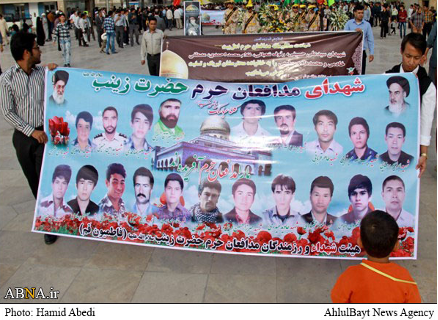
A banner carrying the faces and names of deceased Afghan fighters during a funeral ceremony for two fighters in Qom in October 2014. Along the bottom is the sponsoring committee, called the Committee of Martyrs and Warriors of Hazarat-e Zeynab Shrine Defenders.185
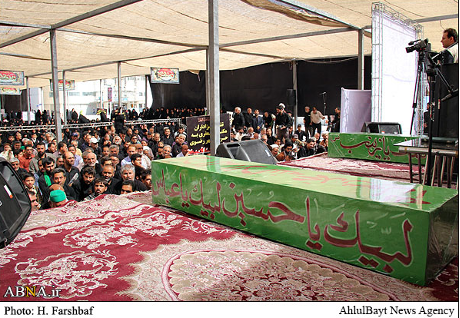
Caskets of two fighters at a funeral ceremony in Mashhad. The casket reads, "We answer your call, oh Husayn. We answer your call, oh Zeynab." A cleric is speaking before the crowd during funeral ceremonies in Mashhad.186 While the caskets are shrouded in green, representing heaven, and religious symbols Iranian fighters' caskets at the time were shrouded in the Islamic Republic's flag.
Both the Fatemiyoun and Zeynaibiyoun used social media platforms like Twitter and Facebook to raise their profile, though at first they lacked cohesive messaging. This occurred even as Iran stepped up its censorship of social media platforms like Facebook and Twitter in the wake of the 2009 post-election protests, when protesters used these platforms to coordinate protests.187 IRGC-backed groups like the Fatemiyoun and Zeynabiyoun used these platforms to advertise themselves and create an online community.188 The pages were run by affiliated accounts or individuals. They would announce fatalities that sometimes had not been covered in Iranian media.189 In 2015, Facebook took down their pages.190
When Instagram surged in popularity in early the 2010s in Iran, the Fatemiyoun’s presence on the platform quickly followed, increasing in fall 2015. Fighters would post photos from the battlefields of Syria.191 In 2018, Instagram shut down the group's page, but current and former fighters continue to use the platform and hold personal accounts, in part because Instagram is one of the rare Western social media platforms not censored by the Islamic Republic.192 Instagram accounts include those dedicated to fallen fighters.193 The Fatemiyoun's reach beyond their online community was small compared to the Islamic State, however, which had achieved the status of a global household name through its strategic use of social media.
In May 2015, the Fatemiyoun declared that their numbers had expanded. Iranian media said that they officially upgraded from a brigade to a division, which is nominally a unit of more than 10,000 fighters.194 Iranian media and officials have said that the group numbers between 10,000 and 20,000 fighters at any given time.195 A report in the Judiciary's news agency Mizan, however, said that the Fatemiyoun made the upgrade after the number of forces surpassed 3,000 fighters.196 Changing the name from brigade to division and disseminating news of the change through formal and social media helped project a stronger presence on the ground.
The actual number of Fatemiyoun fighters, however, is contested. The late Fatemiyoun commander Hosseini said that Fatemiyoun reached 14,000 fighters in Syria in 2016.197 Other analysts like Ali Alfoneh, on the other hand, have estimated that the number of fighters at any given time has been below 10,000.198 A former Fatemiyoun deputy commander told analyst Ahmad Shuja Jamal that about 50,000 Afghans deployed to Syria between 2013 and the end of 2017.199 Whatever the actual number there is little debate that Afghan fighters changed facts on the ground in Syria.
The Islamic State's declaration of the caliphate in 2014 fed into the IRGC's narrative of defending Shiism. Here was a viciously anti-Shiite group with genocidal intentions.200 Massacres of Shiites, for instance, the notorious execution of about 1,700 Shiite cadets at Camp Speicher in June, made the threat clear.201 IRGC-linked news agencies and pro-IRGC social media accounts on Telegram republished uncensored videos of Islamic State atrocities.202 The Guard Corps could not have asked for a better enemy to justify its intervention abroad. The Islamic State magnified the narrative of defending the shrine. A particularly potent narrative would be that fighters in Syria were there to prevent Zainab being "taken captive again."203 The Iranian public overwhelmingly supported the fight against the Islamic State in Iraq.204 Support for Assad, on the other hand, was contentious.205 From then on, Iran justified its presence in both Syria and Iraq as an effort to fight against the Islamic State menace, even though it was in Syria well before the group grew and became a key player on the battlefield.
A Telling Change of Emblems
An early Fatemiyoun insignia.
An early Fatemiyoun emblem.
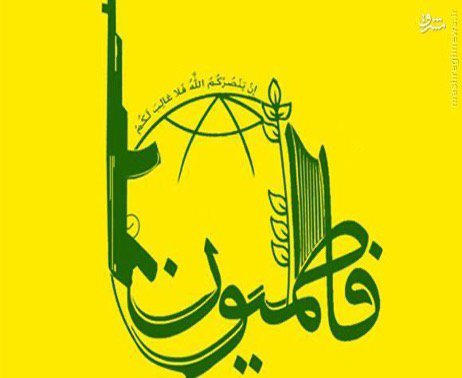
First official Fatemiyoun emblem.
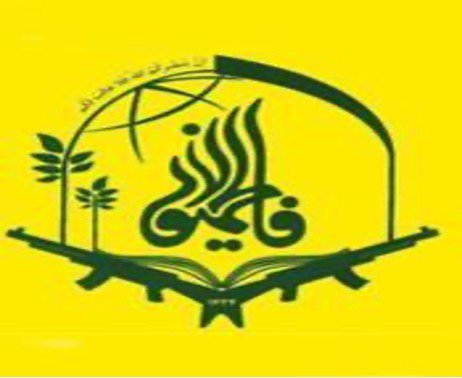
Latest official Fatemiyoun emblem.
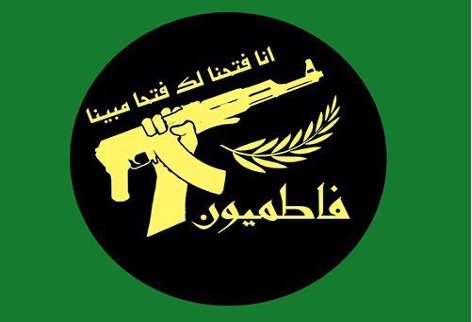
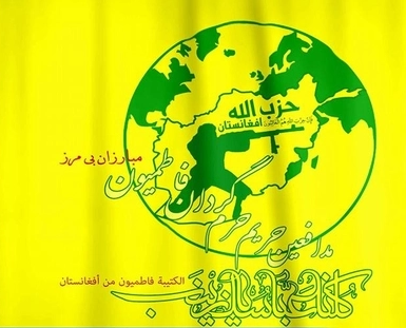
The Fatemiyoun Division has had several unofficial emblems since 2013, as can be seen from Figures 6 through 9. The changes in these emblems over time reflect the unit’s growth and the rising significance of the mission of defending the shrine for Iran’s proxy warfare strategy. More recent logos emphasize the defense of the shrine and a more global agenda with imagery that did not appear in earlier logos.
An emblem that was not widely adopted, Figure 6, shows a rising fist, symbolizing masses rising up; an AK-47, a cheap and common rifle long associated with third world struggles; and a leaf, which represents the desire for peace. The three symbols are also found in the IRGC's logo itself, drawing from the Marxist-Islamist Mujahedin-e Khalq (MKO), from which it split in the 1970s.206 "Indeed, we have given you, [O Mohammad], a clear conquest," reads the top verse that is from Quran 48:1, a revelation that marks the Prophet's conquest of Mecca. Figure 7 has appeared on social media channels. It shows an outline of the country of Afghanistan on a map of the world, with big letters that say "Afghanistan Hezbollah."207 Letters also read, "Shrine defenders of the Fatemiyoun Battalion," and "fighters without borders."
Afghan fighters adopted the image in Figure 8 on a wider scale from around the time the Fatemiyoun officially formed in late 2013 and early 2014.208 The symbol shows the globe, which reflects their growing emphasis on internationalism. In the middle reads “Fatemiyoun” written in Persian. Part of the verse from Quran 3:160 on top reads, "If God should aid you, no one can overcome you." The rest of the verse reads, "but if He should forsake you, who is there that can aid you after Him? And upon God let the believers rely." The verse prior to this recommended the faithful to have trust in the divine, and this verse explains the result of that. The various interpretations of these verses agree that only the Almighty has the power to determine victory and defeat. This full trust and realization would allow the faithful to fear no one else but God, and to ensure that they perform their religious duties. If a mujahid, or a warrior fighting for God, faces defeat, then there is wisdom in that. This theme probably applies better to the ebbs and flows of combat.
The latest logo, shown in Figure 9, was unveiled in late 2015. It is an homage to the group’s IRGC roots with an update reflecting its official raison d'etre of defending shrines in Syria.209 The book on the bottom represents the Quran, with two AK-47 assault rifles. These represent the group's religiosity and willingness to take up arms. The globe from the IRGC's logo remained in the new logo. A new feature is the shape of the dome of a shrine around the name of the Fatemiyoun in the front, which represents its declared mission to protect Shiite shrines. The number on the bottom represents the paramilitary group's founding year in the Islamic calendar, 1435, or 2013-2014.
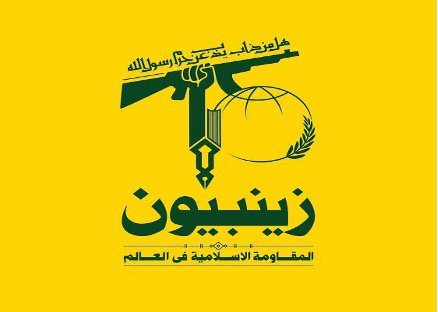
Early Zeynabiyoun insignia.
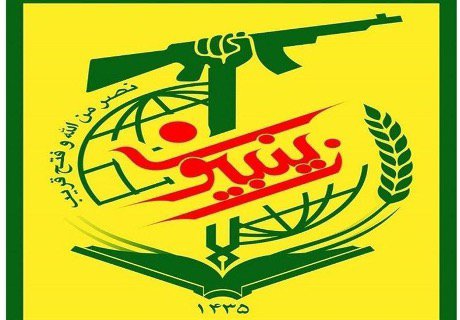
Latest Zeynbiyoun insignia.
The Zeynabiyoun Division's emblem has likewise changed. Its early symbol, seen in Figure 10, bears a striking resemblance to Lebanese Hezbollah's symbol, which was adopted from the Guard Corps. The globe, leaves, hands, and AK-47 rifles are all present. Zeynabiyoun is written in the middle. "Is there any defender to defend the household of the Prophet of God," reads the writing on top, which is attributed to Imam Hossein during the heat of the battle of Karbala when dust settled and he looked upon the remains of his dead soldiers.210 The symbol below the hand appears to a pen, which suggests knowledge, and a book, which probably suggests the Quran. On the bottom is written "Islamic Resistance in the World." Resistance refers to the alliance of state and non-state actors led by Tehran. The motto reaffirms the Zeynabiyoun's transnational Shiite identity. That is also adopted from Hezbollah, though the Lebanese organization has "Islamic Resistance in Lebanon." This Zeynabiyoun emblem was the official representation until at least 2016.211
Toward the end of 2016 and early the following year, the Zeynabiyoun adopted a new emblem, shown in Figure 11, which is remarkably similar to the previous one. The hand, AK-47, globe, pen, leaves, and name of Zeynabiyoun are present. One difference is the change in the writing, which is replaced with a verse from Quran 61:13: "victory from God and imminent conquest." The full verse is: "And [you will obtain] another [favor] you love – victory from God and imminent conquest; and give good tidings to the believers." The open book on the bottom represents the Quran. Like the Fatemiyoun, the number on the bottom is the group's founding year in the Islamic calendar, 1435, or 2013-2014.
Soleimani, the Shadow Commander, Steps Out of the Shadows
The story of the Fatemiyoun and Zeynabiyoun cannot be told without Qassem Soleimani, the famous commander of the Quds Force who met his end in the land where his legend began, Iraq. Soleimani’s own history is an example of the links between Iran’s mobilization of Afghan and Pakistani networks in the Iran-Iraq War and during the 1990s and the conflict in Syria. However, over the course of Iran’s involvement in Syria, its war against ISIS, and escalating tensions with the United States, Soleimani took on an increasingly public role. This public role would eventually connect to and help fuel the growing narrative of Iranian support for the Fatemiyoun.
Born in 1957 to a poor family in a remote village in a tribal area in Kerman Province close to the Afghan border, Soleimani left his job as a construction contractor for the Kerman Water Organization and joined the Guard Corps following its establishment in 1979.212 He rose to command a division and form close ties with commanders during the Iran-Iraq War.213 After the war, he fought smugglers in southeast Iran in the 1990s, continuing his post as commander of the Sarallah Division. He assumed command of the Quds Force in 1997 or 1998, to lead Iranian efforts against the Taliban, a top security concern at the time.214
Soleimani’s profile among the Iranian leadership rose after his direction of the Iranian war effort against American and coalition forces in Iraq following 2003.215 Khamenei bestowed a medal to Soleimani for his role during Hezbollah's war against Israel in 2006 (known in Iran as the 33-Day War), which was not publicized at the time.216 In 2011, Khamenei promoted him to Major General, making him the only general among the five branch Guard Corps commanders below the overall commander who held that rank.217 At that time, Soleimani mostly kept a low public profile, but was well known to experts on Iran and Iran's adversaries.
Western media helped cultivate the perception of Soleimani as a mastermind, even as he committed errors and failures. In 2013, a New Yorker profile cultivated—at least in the imagination of many Western—the image of the grey-bearded shadow commander who has been "reshaping the Middle East."218 Syria was the highest profile operation he was associated with at that time. In other words, Soleimani reaped the rewards of the strategy Hamedani designed. Soleimani, however, failed to predict or prevent the Islamic State's 2014 incursion into Iraq, capture of Mosul, and march to the vicinity of the Iranian border.219 While Iran prevented Assad's fall, there was no end in sight to that war. Furthermore, Iran's ties with Arab states had plummeted. Rumor and speculation spread that Soleimani might be sidelined or replaced.220 Even though the media reported that he was in Iraq to fight the Islamic State, he continued to largely keep a low profile.
That changed around September 2014, when Soleimani's use of social media propelled him to celebrity status. Photos, selfies, and videos of Soleimani at the front lines with fighters in Iraq, and meetings with commanders began to surface and be shared by users on social media platforms like Facebook, Twitter, and YouTube at a high rate (See Figures 12-14).221 Ostovar has linked Soleimani's use of social media to his desire to maintain his prime position.222 Here was the shadow commander on the front lines to combat the Islamic State, which was also using social media to inspire tens of thousands of followers. The Islamic State was the perfect enemy for Soleimani, whose presence on the front lines against this hated enemy commanded attention. He became a viral sensation. That increased his influence and power on the ground, as well. Footage at recently conquered areas fed his public perception as a mastermind. That in turn fed into even more attention, creating a momentum that grew his legendary persona. His presence became a morale booster for allies, and a menace for his adversaries. The social media revolution allowed Soleimani and the Islamic State to not only spread their messages but change geopolitics.
Soleimani transformed the face of Iran’s influence in southwest Asia. He became the message and the medium. The IRGC and the Islamic Republic enthusiastically started to promote a cult of personality around him. His public persona is that of a charismatic, humble, and pious general committed to the Islamic Revolution, loyal to Supreme Leader Ali Khamenei, and to Iran’s revolutionary cause of challenging American hegemony and power projection in the Middle East.223 While the anti-Islamic State coalition pushed back the Salafist jihadist group in Iraq, the Syrian war was becoming more desperate for Iran.
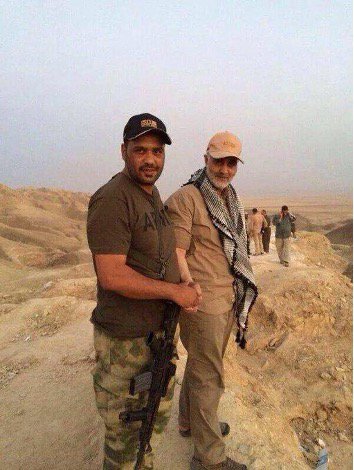
Qassem Soleimani near Amerli, September 2014.224
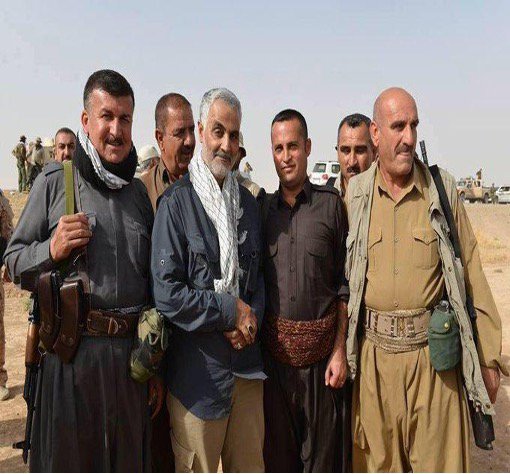
Soleimani with Iran-linked Patriotic Union of Kurdistan (PUK) fighters near Tuz Khurmatu, October 2014.225
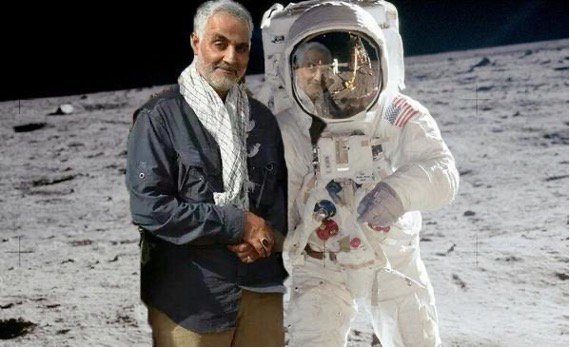
A viral meme of Soleimani with astronaut Neil Armstrong on the moon parodying the photos Soleimani was releasing in public in a number of areas, which through social media became an internet sensation.226
Putin Steps In: 2015 as Watershed Moment for Iran’s Proxy War Strategy and Narrative
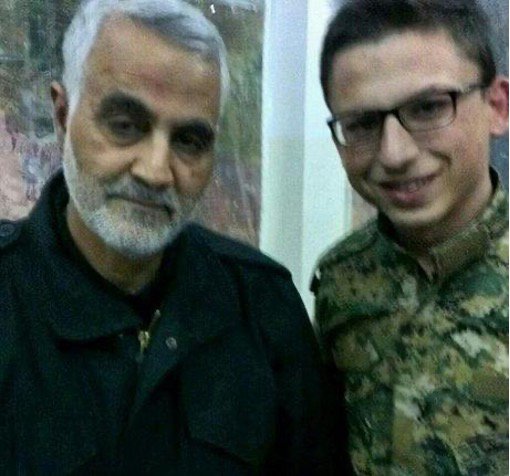
Selfie of Soleimani with a Russian soldier that circulated widely on social media in February 2016.227
Early 2015 was grim for Damascus and Tehran. A jihadist-led coalition conquered Idlib Governorate, which could act as a launching pad for further territorial gains including in the Alawite heartland in the west.228 Damascus controlled small patches of Syrian territory. Iran had already deployed thousands of its foreign legion. Tehran had two options: cut its losses and concentrate on securing the territory stretching from Latakia in the west and down the Lebanese border to Damascus, or escalate to turn the tide of war.229 The latter would mean the deployment of tens of thousands more Iranian and Shiite paramilitary boots. That carried high costs and the risk of war with outside powers that, at that time, would have found a full-scale Iranian invasion of the Levant intolerable. Iran was already facing the threat of attacks against its nuclear facilities and was under crushing sanctions over its weapons program.230 Tehran's adversaries had the leverage of destroying Iran's air bridge to Syria, its primary supply route, to cripple Iranian operations. The Guard Corps had no answer for their superior air power and air defense systems.
Iran needed the intervention of another power on its side: Russia. In 2015, Soleimani personally traveled to Moscow with a proposition for President Vladimir Putin: Russia and Iran could save Assad, the Kremlin's long-time ally, and turn the tide of the war.231 In a meeting that is said to have lasted over two hours, Soleimani told Putin that "the last trench of the eastern bloc is Syria, and if you lose this, Westerners would no longer value you."232 In this deal, Iran would provide the bulk of ground forces, and Russia would provide its airpower, as well as some Russian ground troops.233 Iran could inject Iranian boots into its Shiite expeditionary forces and escalate without the high risk and cost of a solo Iranian intervention. Putin also saw an opportunity to flex the Kremlin's muscles abroad and escalate militarily without the burden of significant Russian casualties.234
Coordination between Russia and Iran has endured despite mutual mistrust.235 Tehran and the Kremlin mobilized following the signing of the Joint Comprehensive Plan of Action in July 2015, which removed international sanctions in exchange for a temporary freeze on the nuclear program.236 That deal allowed Iran to de-escalate tensions with the West. In September, Putin announced in a press conference that Russia would escalate its involvement in Syria.
After the Russian announcement, Iran stepped up its military presence, but continued to obfuscate the level of its involvement. Commanders acknowledged they were coordinating with Russia in Syria.237 Iran, however, continued arguing that its military personnel were advisers, the narrative it has used since 2012.238 The facts on the ground, however, proved otherwise. The most senior commander killed during this period was Hamedani, an event that grabbed headlines across the world, and the Guard Corps held a massive funeral for him.239 The Islamic Republic deployed thousands of Guard Corps personnel drawn from the Ground Forces, an unprecedented scale in its proxy warfare history, though the quality of Iranian soldiers atrophied compared to the early phases of the war due to casualties.240 Many Iranian fighters and Basij paramilitary members who died during this time were not professional soldiers, and received three months of basic training before deploying to Syria.241 Many were members of Basij who were deeply influenced by ideological programs and training courses that instilled a desire for martyrdom.242
Across Syria, the Fatemiyoun and Zeynabiyoun participated in virtually every major battle. The Fatemiyoun had pronounced roles in the battles for Palmyra in 2016 and the next year for a second time after the Islamic State wrestled control of the area again. Both battles became the subject of documentaries, like the “Battle for Palmyra,” and “On the Line of Fire,” which was about the second battle.243 These paramilitary groups have been instrumental for Tehran's gains in Syria and shape regional geopolitics without these paramilitary groups.
Iran’s Proxy War Narrative Goes Viral
While the IRGC maintained that it was in an advisory role, it capitalized on the increased presence of Afghan and Pakistani fighters in Syria to augment its cultural production activities. Stories about Fatemiyoun and Zeynabiyoun fighters began appearing more frequently in Iranian state-backed media along with more and more online and offline memorials. In time, he combined the impact of Russia’s entry into the war, and Soleimani’s efforts to build up his own mythic status made Iran’s sectarian narrative go viral. The IRGC further exploited the moment by cranking up its production of documentaries and viral videos.
The October 2015 coordinated assault on rebel positions across Syria by Russia and Iran coincided with Muharram, the mourning of the Master of Martyrs, Imam Hoseyn. The Guard Corps capitalized on that, calling the assault Operation Muharram.244 The Syrian battlefield was thus the latest reenactment of and the continuation of Karbala. In this act, the new Yazid were foreign powers like the United States, Saudi Arabia, and Israel that Tehran said wanted to overthrow Assad as well as all Syrian opposition to Assad, who were called ISIS, Saudi mercenaries, or followers of "American Islam,” a derisive term used to describe a depoliticized version of the true faith.245 State-linked news agencies typically served as a primary pipeline, running videos, photos, and interviews that appealed to religious and nationalist emotions to justify the presence in Syria.246
Those productions spread on social media and received many reactions, particularly among pro-IRGC groups.247 On social media, such as Instagram, channels dedicated to shrine defenders, especially those that provided exclusive coverage, became popular.248 A ritual that evokes a lot of emotion is videotaping and photographing families' mourning when they receive and embrace the remains of their loved ones; the caskets remain closed if the injuries are too grievous (See Figure 16).249 These events are held at places called Ascension of Martyrs, or me'raj-e shohada, which have their own professional studios.250 The publication of memoirs of deceased fighters by IRGC-linked and pro-IRGC publication centers also increased.251
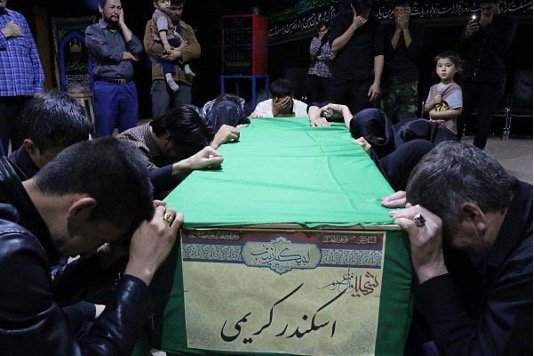
Family of Fatemiyoun fighter Eskandar Karimi mourn as they receive his casket, October 2016. The Guard Corps has flown in close family members of deceased fighters if they are in Afghanistan.252
The Islamic Republic helped drive the cultural production of the Afghan and Pakistani groups. Afghans and Pakistanis were equal to Iranian soldiers as "shrine defenders,” at least as far as narratives went.253 While the numbers of funerals increased due to the spiking fatality rate, not all the dead were announced or given funerals in order to control public perception about death rates.254 Iranian media have explicitly said that Zeynabiyoun funerals have a lower profile because of Pakistan's sensitivities and ISI's concentration on Shiites.255 That is an example of Tehran's concern about blowback in its proxy wars, as it fears Islamabad more than Kabul (the Guard Corps runs Fatemiyoun training camps in Afghanistan, according to an official who disclosed the information under Chatham House rules).
Most Afghans and Pakistanis were buried in cities home to a substantial number of migrants, such as Mashhad, Qom, and Varamin, which is outside the capital Tehran.256 The Fatemiyoun and Zeynabiyoun also became subjects of memoirs. Ebrahim Hadi Cultural Group has compiled a number of memoirs on the Fatemiyoun as well as shrine defenders in general.257 Zeynabiyoun Commander "Meysami", which is probably a nom de guerre, writes in the introduction to a memoir of slain fighter Mohammad Adil that Pakistani fighters began on their own initiative to write their memoirs in 2015 or early 2016, and that, despite challenges like the language barrier, the group eventually started the publication of series called "Children of Ruhollah [Khomeyni]."258 Meyasmi, who is probably Iranian since he referred to Iranians as compatriots with whom he shared the same language, unveiled the memoir on Adil alongside three others in a ceremony in 2019.259 Iranian media has not published a photo of Meysami.
The Guard Corps has had a high tolerance for losses in these groups. The Fatemiyoun were often used as cannon fodder.260 The Zeynabiyoun are praised as line breakers.261 Afghans fought in the most dangerous situations and battles. Entire units would sometimes be wiped out.262 A former fighter said that Iranians would shoot at Afghans trying to retreat, but that Afghans eventually earned respect.263 At least one unit refused the order of an Iranian officer to deploy to a high-risk situation and beat him up.264 At the same time, there are Afghans who are proud of their service in the Fatemiyoun on their social media accounts, and say so to expatriate news agencies.265 That means that the abuses were probably not systematic and depended on individual cases.
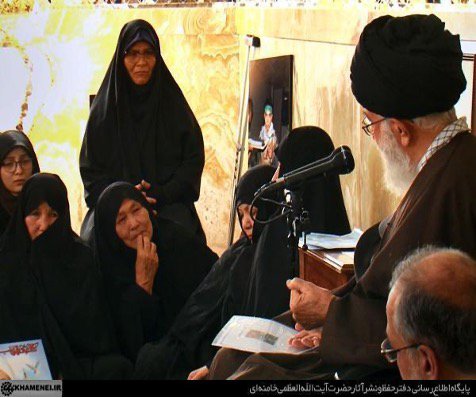
Families of deceased fighters meeting with Supreme Leader Ayatollah Ali Khamenei.266
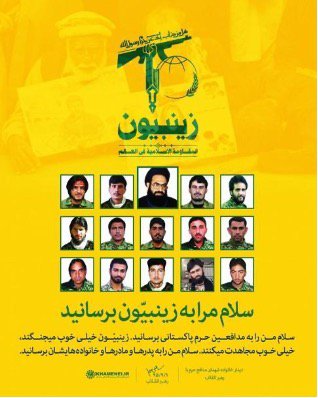
Poster with the Pakistani Zeynabiyoun logo on it, and the faces of fallen fighters as well as the group's "spiritual father" Aref al-Husayni, who was assassinated in Pakistan in 1988. The below text quotes Khamenei, who said "give my regards to Pakistani shrine defenders. The Zeynabiyoun fight very well. They engage in jihad very well. Give my regards to their fathers, mothers, and families."267
As a result of participation in combat and more transparency about the war, Khamenei recognized the fighters (See Figure 18). In what has become an annual tradition, Khamenei received the families of deceased fighters during the Iranian New Year holidays in late March 2016 at Imam Reza shrine in his hometown of Mashhad, where he spends his new year holidays every year (See Figure 17). Some families of deceased fighters had passed along a request to Khamenei's representative while opening a sports complex named after shrine defenders, according to a documentary called Father produced by the Fatemiyoun Media Center about that meeting between Khamenei and the families.268 Hailing the participation of Afghans in the 1979 revolution against the Shah and the Iran-Iraq War, Khamenei told the families that "your children put their lives as shields so that these ill-wishers and wicked do not reach the shrine of Ahl-e Bayt [Household of the Prophet]…may your dear martyrs be in the company of the martyrs of the early days of Islam, the revolution, and Karbala."
The families interviewed in the documentary Father said that the meeting was a dream come true. Line of Hezbollah, a weekly publication by the Supreme Leader's Office, wrote following the meeting that "the Afghans of Fatemiyoun have now blossomed to the flowers of the spring who continue the basiji thought of Khomeyni the great in the region and the world with their jihad and martyrdom."269 Khamenei has received poets and religious singers who have praised the Fatemiyoun and martyrs.270 "The cloudy air after you, in the silence of sunset/has mounted my shoulder of sorrow," read a line by Afghan poet Hassan Mobarez. With regards to the Pakistani fighters, Khamenei in 2016 told the family of a deceased fighter, "the Zeynabiyoun fights very well…give my regards to their fathers, mothers, and families."271
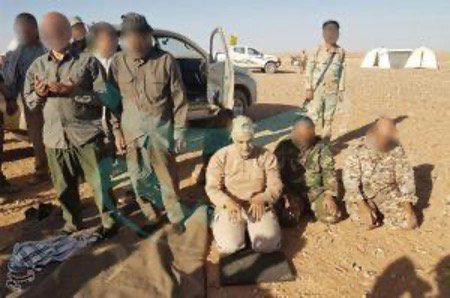
Soleimani giving a supplication prayer alongside Fatemiyoun Division fighters in Syria close to the Iraqi border. 272
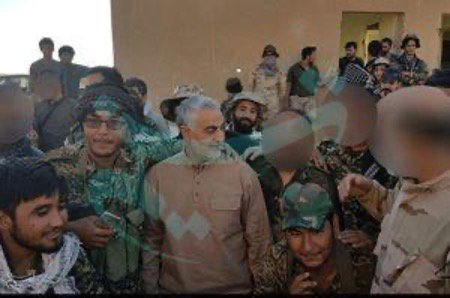
Soleimani alongside Fatemiyoun fighters. The text in the middle says "Tasnim," referring to the IRGC-linked news agency, June 2017. 273
Soleimani also tried to cultivate in public a close relationship with Fatemiyoun fighters linking his increasingly public role and the narrative of his influence and control to that of the Fatemiyoun. Fighters have posted photos and selfies with Soleimani, and Soleimani's social media accounts have also posted such photos (See for example Figures 19 and 20).274 After Tavassoli's death in 2015, Iranian media carried a photo of the deceased commander and Soleimani together, as well as Soleimani's statements that praised him.275
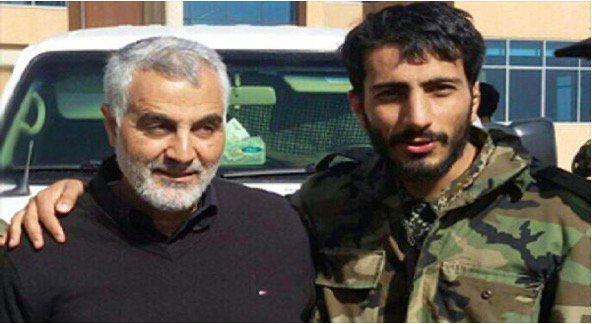
Qassem Soleimani, left, with fabled Iranian commander in the Fatemiyoun, Mostafa Sadrzadeh. 276
Later that year, Soleimani spoke at the commemoration of an Iranian commander in the Fatemiyoun, Mostafa Sadrzadeh, whose death in October 2015 coincided with Tasu'a, which marks the day before Imam Husayn's death in Karbala. Soleimani's speech, which was released in November, marked one of the instances in which Soleimani's remarks about the Fatemiyoun were made public.277 Sadrzadeh has a central role in Fatemiyoun hagiography, described as an Iranian who disguised himself as an Afghan to join (See also Figure 21).278 In a video of Soleimani among Fatemiyoun fighters, he praised Sadrzadeh for going through the trouble to disguise himself.279 He is not the only probable Quds Force member in the Fatemiyoun who was described as joining on his own but is the most famous among them.280
The death of an Iranian in Fatemiyoun ranks caught the attention of many in pro-IRGC circles, who elevated Sadrzadeh into a prominent figure in Fatemiyoun lore. "I loved him," Soleimani has said about Sadrzadeh.281 Sadrzadeh's death coincided with rising fatalities in the fall of 2015.282 In 2016, Soleimani-affiliated social media accounts released photographs with Fatemiyoun fighters at the front line.283 IRGC-linked and state media publicized Soleimani's meeting with Tavassoli's family in that summer.284 Soleimani hailed Tavassoli, saying that he "left us too soon," gifting a ring to Tavasoli's son. That is remarkable considering that at least some Fatemiyoun members believe Soleimani ordered Tavassoli's assassination. Soleimani continued that the "oppressed and humble Afghans" voluntarily went to defend "the oppressed in another part of this cruel world," adding that the Fatemiyoun had been "very effective on the battlefield." He then said that the Fatemiyoun have caused a "transformation" within Iranian society's views about Afghans, acknowledging long-standing discrimination. He noted that "graves of Afghan martyrs have become like [shrines of] Imamzadehs [offspring of Shiite Imams]," meaning that the graves were attracting visitors, and that they were becoming religious symbols.
In October 2016, Soleimani publicized a meeting with Sadrzadeh's family on the first anniversary of his death, continuing a ritual that predates the Syria war and further solidifies Sadrzadeh's position in the pantheon of holy warriors, as well as his own perception as a general who truly cares about his men.285 Soleimani continued releasing photographs with fighters, for instance in the campaign in the eastern Syrian desert in 2017.286 In contrast, Soleimani publicized fewer photos and statements with the Zeynabiyoun, probably in order to not raise Islamabad's ire. Iranian officials and commanders have also heaped praise on the Fatemiyoun and Zeynabiyoun. Guard Corps commanders and officials, such as the Supreme Leader's representatives to provinces and Friday Prayer leaders, have visited funerals of fighters, as well as families of deceased fighters.287 A retired commander who had fought in Syria said in 2016 that the Fatemiyoun would help constitute the "Shia Liberation Army."288 That was controversial, particularly in the Arab press, because it suggested the IRGC had ambitions beyond Iran's sphere of influence in the northern Middle East.289 Iranian media retracted the interview.
Speaking at a commemoration of fighters at the shrine of Imam Reza on the anniversary of Fatimah's martyrdom, then-Quds Force deputy commander and the current force chief Esma'il Gha'ani said the Fatemiyoun represents "a new culture" within the Islamic resistance culture who are fighters continuing the path of Fatima "who do not recognize borders to defend Islamic values."290 "The liberation of Aleppo was not a joking matter," he declared, adding that the Fatemiyoun "hit America in the mouth" in Syria.291
Religious singers have played crucial roles in mobilizing fighters and producing the culture. Known as Maddah, religious singers in recent years have increasingly supplanted the clergy in retelling the stories of Karbala and have grown into political and cultural icons. Mixing with elements of modern music, the singing, lyrics blend with mysticism, and the congregation's rhythmic chest beating and chorus elevate the crowd into a trance-like state.292 During the Iran-Iraq War, religious singers mobilized for combat and to raise morale at home, extolling values like martyrdom. The singers' political and cultural popularity grew in the 2000s, aided by mass media and communications.
War in Iraq and Syria provided fresh material for singers, who would publicize via their social media channels going to Syria to sing for fighters, or extol them at home, including at congregations before the Supreme Leader. Leading a congregation of Fatemiyoun fighters in Syria in 2019, prominent figure Ahmad Vaezi sings, "We are the Fatemiyoun, Allah is with us…We are the Fatemiyoun, used to love we are. It has enamored us, the excitement for martyrdom."293
Fatemiyoun also set up in-house courses to teach religious singing.294 Fighters in Syria themselves would hold sessions of singing before and after combat to raise morale. In one instance, fighter Yaser Ja'fari leads a congregation before battle while artillery is heard in the background.295 He dedicated the song to Hazrat-e Zeynab, who is often called "bibi," meaning mother, Zeynab: "oh hope of my mournful heart, I have a last will with you, oh my Zeynab, I leave the house to you."296 Later that night, Ja'fari died in action. Another religious singer in Fatemiyoun lore is Iranian Hamed Bafandeh, the subject of a 2018 Fatemiyoun Media Center documentary called The Last Chapter of Life.297 Killed a year earlier by an improvised explosive device (IED) near Hama Governorate's Halfaya, the documentary says that Bafandeh deeply impacted Afghan fighters, inspiring fighters with his eulogies and religious singings before and during battle, as well as in commemorations of deceased fighters.298
Soleimani’s Shadow
- Executive Summary
- I. Introduction
- II. The Origins of Iran’s Afghan and Pakistani Shi’a Networks
- III. Crossroads in Khuzestan: Afghan Shi’a Mobilization During the Iran-Iraq War
- IV. The Arab Spring: A New Phase of Iranian Proxy Warfare Strategy
- V. Keeping the Faith in Sacred Defense
- VI. Spinning the Fatemiyoun: Raising an Army of Disposable Afghan Diaspora Online
- VII. The Future of the Fatemiyoun Division
- Conclusion: Soleimani’s Legacy and What it Means for the Future of Proxy Warfare
- Appendix I-Timeline: The Rise of Iran’s Afghan Shia Cadres
- Appendix II-Prominent Fatemiyoun Propaganda Organizations and Groups
Citations
- Mohammadi, Syria: a Spider Hole, 138.
- Mohammadi, Syria: a Spider Hole, 138.
- Jamal, op.cit., 2018, 16.
- "از جنگ مقابل طالبان تا جنگ دربرابر داعش" ("az jang moqabel-e taleban ta jang dar barabar-e da'esh," "From War Against The Taliban to War Against The Islamic State"), IranWire, October 2, 2018. https://iranwire.com/fa/features/27876; "آموزش آمریکا در خدمت لشکر فاطمیون ایران" ("amuzesh-e amrika dar khedmat-e laskhar-e fatemiyoun-e iran," "America's training at The Service of Iran's Fatemiyoun Division"), IranWire, April 25, 2018. https://iranwire.com/fa/features/26974.
- Ibid.
- Ibid.
- "Iran: Afghan Children Recruited to Fight in Syria," Human Rights Watch, October 1, 2017, https://www.hrw.org/news/2017/10/01/iran-afghan-children-recruited-fight-syria#; "روایت کودکسربازان لشکر فاطمیون از جنگ در سوریه؛ شانس آوردیم نمردیم" ("revayat-e kudak sarbazan lashkar-e fatemiyoun az jang dar suriyeh; shans avordim namordim," "Account of Child Soldiers of The Fatemiyoun Division From War in Syria; We Were Lucky We Did Not Die"), IranWire, April 26, 2020. https://iranwire.com/fa/features/37975.
- Sune Engel Rasmussen & Zahra Nader, "Iran covertly recruits Afghan Shias to fight in Syria," The Guardian, June 30, 2016. https://www.theguardian.com/world/2016/jun/30/iran-covertly-recruits-afghan-soldiers-to-fight-in-syria.
- Fatemiyoun1434, 2019, “گزارش صدا و سیمای استان یزد از غرفه فاطمیون در نمایشگاه طریق الحسین" (Broadcasting Yazd Province Report from Fatemiyoun Kiosk in Tarigh al-Hossein Exhibition)," Telegram, https://telegram.me/s/Fatemiyoun1434?before=28950.
- The group has not had a prominent website or social media presence in order to verify these claims. The individual could be telling the truth, or may have reflected a recognition of the Guard commander that he could mobilize Afghan Shiites to fight later.
- "خیلی دور، خیلی نزدیک؛ مقدمه داستان بلند «ایرانیها» و «افغانها»" ("kheyli dur, kheyli nazdik; moqaddame-ye dastan-e boland-e 'irani-ha' va 'afghan-ha,'" "Very Far, Very Close; Introduction to The Long Story of 'Iranians' and 'Afghans'"), Tasnim News, 1 July, 2014. https://www.tasnimnews.com/fa/news/1393/04/10/337077/خیلی-دور-خیلی-نزدیک-مقدمه-داستان-بلند-ایرانی-ها-و-افغان-ها.
- "گلایههای ما مهاجرین افغانستانی، انتقاد به جمهوری اسلامی نیست؛ به موانع تحقق انقلاب است" ("gelayeha-ye ma mohajerin-e Afghanestani, enteqad be jomhouri-ye eslami nist, be mavane'-e tahaghogh-e enghelab ast," "We Afghan Migrants Have No Criticism of the Islamic Republic, it is About Obstacles to Fulfilling Revolution"), Tasnim News, July 19, 2014, https://www.tasnimnews.com/fa/news/1393/04/28/435156/گلایه-های-ما-مهاجرین-افغانستانی-انتقاد-به-جمهوری-اسلامی-نیست-به-موانع-تحقق-انقلاب-است.
- "حجتالاسلام ابراهیمی: مقام معظم رهبری دستور دادند، مهاجرین افغانستانی را «تکریم» کنید" ("hojjat ol-eslam ebrahimi: maqam-e mo'azzam-e rahbari dastur dadand, mohajerin-e afghanestani ra 'takrim' konid," "Hojjat ol-Eslam Ebrahimi: The Supreme Leader Have Ordered to 'Honor' Afghan Migrants"), Tasnim News, November 30, 2014. https://www.tasnimnews.com/fa/news/1393/09/08/572250/حجت-الاسلام-ابراهیمی-مقام-معظم-رهبری-دستور-دادند-مهاجرین-افغانستانی-را-تکریم-کنید.
- "گفتگو با مدافعان حرم حضرت زینب(س)" ("goft-o goo ma modafean-e haram-e hazrat-e Zeynab," "Interview With Defenders of the Shrine of Hazrat-e Zeynab"), Hamshahri Online, June 9, 2014. https://www.hamshahrionline.ir/news/262016/گفتگو-با-مدافعان-حرم-حضرت-زینب-س-کلیددار-حرم-از-روزهای-سخت.
- Ibid.
- "اروج لاله های سرخ زینبی در عملیات محرم" (“orouj-e laleh-ha-ye sorkh-e zeinabi dar amaliat-e moharram," "Ascendance of Red Tulips of Zeinab in the Muharram Operation"), Modafe-e Haram, October 30, 2015. http://modafeaharam.persianblog.ir/tag/مدافعان_حرم; Surging in popularity in the 2000s, blogging declined toward the mid-2010s thanks in large part to state censorship, which left pro-system blogs alone, as well as the rise of social networking sites like Facebook, Instagram, Telegram and WhatsApp. (Fred Petrossian, Arash Abadpour & Mahsa Alimardani, "The decline of Iran’s Blogestan," Washington Post, April 11, 2014. https://www.washingtonpost.com/news/monkey-cage/wp/2014/04/11/the-decline-of-irans-blogestan/.
- "تشییع پیکر دو شهید مدافع حرم حضرت زینب (س) در مشهد مقدس" (tashi-ye peykar-e do shahid-e modafe'-e haram-e hazrat-e zeynab (s) dar mashhad-e moghaddas," "Burial of Two Martyred Shrine Defenders of Hazrat-e Zeynab (pbuh) in Holy Mashhad"), Isaar, August 21, 2014. http://isaar.ir/doc/news/fa/88161/.
- Ibid.
- Mehdi Fattahi, "Iranians manage to surf the web despite tide of censorship," Associated Press, July 26, 2019. https://apnews.com/fa030c4f6ada4131a2b03147a06cc58e.
- U.S. Congress, House of Representatives, House Committee on Foreign Affairs, Iran’s Islamic Revolutionary Guard Corps: Fueling Middle East Turmoil, 114th Cong., 1st sess., 2015, 25-49.
- Ibid..
- Ibid.
- Interview with researcher, Washington, D.C., 2021.
-
The official Fatemiyoun Instagram page had more than 46,000 followers, the largest on any social media platform, before shutting down. According to IRGC-linked Mashregh News, Instagram took action after Fatemiyoun teased portions of a documentary called “Shadow of Destruction” about the paramilitary group’s campaign against ISIS in eastern Syria. Instagram shut down the official Fatemiyoun page after the group set up another page. The biggest moves against the Fatemiyoun and some popular affiliated pages or fan accounts was in March 2019; the platform continued to shut down pages after others were being set up. The platform has cited that page’s “support for a violent and/or criminal organization and group” as the reason for shutting it down. U.S. officials may have nudged the social media platform to enforce this rule.
“حذف صفحه رسمی فاطمیون از اینستاگرام”
(“hazf-e safhe-ye rasmi-ye fatemiyoun az Instagram,” “Fatemiyoun’s Official Instagram Page Took Down”), Mashregh News, May 23, 2018, https://www.mashreghnews.ir/news/858210/;
"حذف-صفحه-رسمی-فاطمیون-از-اینستاگرام; “صفحه رسمی فاطمیون مجدداً توسط اینستاگرام مسدود شد” (“safhe-ye rasmi-ye fatemiyoun mojaddadan tavassot-e Instagram masdud shod,” “The Official Instagram Page Was Blocked Against by Instgram”), Tasnim News, July 17, 2018. https://www.tasnimnews.com/fa/news/1397/04/26/1778743/; “حذف چند صد پست متعلق به شهدای مدافع حرم از اینستاگرام و فیسبوک!” (“hazf-e chand sad post motealleq be shohada-ye modafe’-e haram az Instagram va facebook,” “Several Hundred Posts Belonging To Martyred Shrine Defenders Eliminated From Instagram and Facebook!”). Ahl-ul-Bayt News Agency, March 6, 2019. https://fa.abna24.com/news/اخبار-فرا-منطقه%E2%80%8Cاي/حذف-چند-صد-پست-متعلق-به-شهدای-مدافع-حرم-از-اینستاگرام-و-فیسب_748538.html. - A series of popular or fan accounts were taken down in 2019. “حذف چند صد پست متعلق به شهدای مدافع حرم از اینستاگرام و فیسبوک!” (“hazf-e chand sad post motealleq be shohada-ye modafe’-e haram az Instagram va facebook,” “Several Hundred Posts Belonging To Martyred Shrine Defenders Eliminated From Instagram and Facebook!”). Ahl-ul-Bayt News Agency, March 6, 2019, https://fa.abna24.com/news/اخبار-فرا-منطقه%E2%80%8Cاي/حذف-چند-صد-پست-متعلق-به-شهدای-مدافع-حرم-از-اینستاگرام-و-فیسب_748538.html.
- "تیپ فاطمیون به لشکر ارتقا یافت" ("tippe fatemiyoun be lashkar erteqa yaft," "Fatemiyoun Division Upgraded to a Division"), Taghrib News Agency, May 20, 2015. http://www.taghribnews.com/fa/news/192345/تیپ-فاطمیون-لشکر-ارتقا-یافت.
- Ahmad Majidyar, "Iran Recruits and Trains Large Numbers of Afghan and Pakistani Shiites," Middle East Institute, January 18, 2017. https://www.mei.edu/publications/iran-recruits-and-trains-large-numbers-afghan-and-pakistani-shiites
- "لشکر فاطمیون؛ از آغاز تا امروز/ بازوهایی برای دفاع از حرم و خدمت به مردم" ("lashkar-e fatemiyoun; az aghaz ta emruz/ bazuhay-i baray-e defa az haram va khedmat be mardom," "Fatemiyoun Division; From Beginning to Now/ Arms To Defend the Shrine and Serve the People"), Khabar, May 12, 2019. https://khabari.org/article/1529931/لشکر-فاطمیون-از-آغاز-تا-امروز-بازوهایی-برای-دفاع-از-حرم-و-خدمت-به-مردم.
- Tobias Schneider, "The Fatemiyoun Division in the Syrian Civil War," Middle East Institute, October 2018, 5.
- Rasmussen & Nader, "Iran covertly recruits Afghan Shias to fight in Syria," The Guardian.
- Jamal, "The Fatemiyoun Army," 7.
- Ranj Alaaldin, “The Isis campaign against Iraq’s Shia Muslims is not politics. It’s genocide,” The Guardian, January 5, 2017. https://www.theguardian.com/commentisfree/2017/jan/05/isis-iraq-shia-muslims-jihadis-atrocities.
- Patrick Cockburn, "Camp Speicher massacre: Retracing the steps of Isis's worst-ever atrocity," The Independent, November 7, 2017. https://www.independent.co.uk/news/world/middle-east/camp-speicher-massacre-isis-islamic-state-tikrit-air-academy-iraq-a8040576.html.
- Mohammadi, Syria: a Spider Hole, 35-36.
- "مستند دوباره اسیر نمی شوی" ("mostanad-e dobar-e asir nemishavi," "You Will Not Be Captured Again Documentary"), Aparat, June 18, 2014. https://www.aparat.com/v/dhlRy/.
- Ali Alfoneh, "Maximal Exposure, Minimal Presence: Iran's Military Engagement in Iraq," The Washington Institute For Near East Policy, August 25, 2015. https://www.washingtoninstitute.org/policy-analysis/view/maximal-exposure-minimal-presence-irans-military-engagement-in-iraq.
- Ibid.
- Ostvoar, op.cit., "Vanguard," 2016, 52.
- “Liwa al-Fatemiyoun: Martyrdom Graphic,” Jihad Intel, accessed March 3, 2020. https://jihadintel.meforum.org/identifier/542/liwa-al-fatemiyoun-martyrdom-graphic.
- "عکس خبری/ مدافعان افغانی حرم حضرت زینب(س) و حضرت رقیه(س)" ("ax-e khabari/modafe'an-e afghani-ye haram-e hazrat-e zeynab (s) va hazrat-e roqayya," "Photo Report/Afghan Defenders of The Shrine of Hazrat-e Zeynab (pbuh) and Hazrat-e Roqayya (pbuh)"), ABNA, November 1, 2014. https://fa.abna24.com/service/pictorial/archive/2014/11/01/648368/story.html.
- "آرم رسمی «لشکر فاطمیون» رونمایی شد +عکس" ("arm-e rasmi-ye 'lashkar-e fatemiyoun' runamayi shod + aks, "The Official Logo of 'Fatemiyoun Division' Unveiled + Photo"), Jam News, November 3, 2015. https://www.jamnews.com/detail/News/593330.
- "شرح کامل واقعه عاشورا از مقتل لهوف" ("sharh-e kamel-e vaqe'ey-e Ashura az mofatel-e lahuf," "Full Description of Ashura Incident From Lohoof [Sighs of Sorrow]"), Tabnak, November 14, 2013. https://www.tabnak.ir/fa/news/357713/شرح-کامل-واقعه-عاشورا-از-مقتل-لهوف.
- "تشییع پیکر مطهر دو شهید تیپ زینبیون برگزار میشود" ("tashi-ye peykar-e motahar-e do shahid-e tipp-e zeynabiyoun bargozar mishavad, "Funeral To Be Held for Two Pure Remains of Zeynabiyoun Division Martyrs") Basij Press, January 18 2017. http://basijnews.ir/fa/news/8809714/.
- Ali Alfoneh, "Iran’s Most Dangerous General," American Enterprise Institute, July 13, 2011. https://www.aei.org/research-products/report/irans-most-dangerous-general/.
- Alfoneh concluded that Soleimani during the war gained experience to become a tactical general, but that he never managed to become a strategist: Alfoneh, "Iran’s Most Dangerous General," American Enterprise Institute; Ali Alfoneh, "Brigadier General Qassem Suleimani: A Biography," America Enterprise Institute, January 24, 2011. https://www.aei.org/research-products/report/brigadier-general-qassem-suleimani-a-biography/; Former IRGC chief commander Mohammad Ali Ja'fari, who was a senior commander in 1982, wrote in his memoirs that Soleimani during his first major command post at Operation Fat'h ol-Mobin (Manifest Victory) was unable to properly secure the flanks of two units, which bore the brunt of Iraqi pressure. Other biographies called Soleimani's first major operation a success: Gol-Ali Baba'i, "کالک های خاکی: خاطرات شفاهی سرلشکر پاسدار محمدعلی جعفری" ("kalakha-ye khaki: khaterat-e shafahi-ye sarlashkar pasdar mohammad-ali ja'fari," "Dusty Overlays: Oral Memoires of Major General Guardsman Mohammad-Ali Ja'fari"), Sureh-ye Mehr Publications, 2011, 365; Ehsan Mehrabi, "Ghasem Soleimani: The Mythical Commander," IranWire, April 11, 2019, https://iranwire.com/en/features/5966.
- Alfoneh, "Brigadier General Qassem Suleimani."
- Ostovar, "Vangard," 3.
- "مدال سردار سلیمانی پس از جنگ 33 روزه +عکس" ("medal-e sardar soleimani pas az jang-e sio-se ruz-e +asks," "Commander Soleimani's Medal After The Thirty-Three Day War + Photo"), Mashregh News, March 12, 2019. https://www.mashreghnews.ir/news/943778/; "نگاهی به فرماندهی «حاج قاسم» از زاویهای متفاوت" ("negah-i be farmandehi-ye 'haj qassem' az zaviye-i motefavet," "A Look at The Command of 'Hajj Qasem' From Another Angle"), Mashregh News, March 13, 2019. https://www.mashreghnews.ir/news/943891/.
- "۱۳ سرلشکر جمهوری اسلامی ایران" ("13 sarlashkar-e jomhuri-ye eslami-ye iran," "13 Major Generals of The Islamic Republic of Iran"), Radio Farda, January 26, 2011. https://www.radiofarda.com/a/f4_iranian_13_general_revolutionary_guards_army/2287760.html.
- Dexter Filkins, "The Shadow Commander," September 30, 2013. https://www.newyorker.com/magazine/2013/09/30/the-shadow-commander.
- Ostovar, "Vanguard," 225-226.
- Ibid.
- Ibid. 226-227
- Ibid.
- “قاسم سلیمانی؛ مردی که قدرت ایران را به رخ آمریکا کشاند” (“qasem soleimani; mardi ke qodrat-e iran ra be rokh-e amrika keshand,” “Qasem Soleimani; The Man Who Touted Iran’s Power to America”), Ahlul Bayt News Agency, November 30, 2014. https://fa.abna24.com/service/middle/archive/2014/11/30/655059/story.html; “ویژگیهای اخلاقی حاج قاسم سلیمانی به روایت همراه دیروز و امروز” (“vizhegiha-ye akhlaqi-ye haj qasem soleimani be ravayat-e hamrah-e diruz va emruz,” “Ethical Characteristics of Haj Qasem Soleimani According to the Companion of Yesterday and Today”), Ettela’at, October 16, 2016. https://www.ettelaat.com/mobile/?p=5747.
- Josh Weinberg, "Wow...#Iran IRGC Qods Force commander Qasem Soleimani on #Iraq frontlines in Amerli via @dgtlresistance," Twitter, September 3, 2014. https://twitter.com/josh_weinberg/status/507191891801423873.
- Golnaz Esfandiari, "Soleimani is everywhere RT @SumerRising: #Iraq; #Iran IRGC commander Qassim Soleimani with PUK fighters in Tuz," Twitter, October 6, 2014, https://twitter.com/GEsfandiari/status/519000407985901569.
- Nabih Bulos & Patrick J. McDonnell, “Iran’s ‘Supermani:’ fabled general, Internet sensation,” Los Angeles Times, March 4, 2015, https://www.latimes.com/world/middleeast/la-fg-iran-supermani-fabled-general-20150304-story.html; Austin Bodetti, “Even Iranian Military Generals Can Become Dank Memes in This Brave New World,” Vice, January 27, 2017. https://www.vice.com/en/article/9adwpe/even-iranian-military-generals-can-become-dank-memes-in-this-brave-new-world.
- "عکس سلفی سرباز روس با سردار سلیمانی" ("ax-e selfie-e sarbaz-e rusi ba sardar soleimani," "Russian Soldier's Selfie Photo With Commander Soleimani"), Shahid News, February 20, 2016. http://www.shahidnews.com/view/70725/عکس-سلفی-سرباز-روس-با-سردار-سلیمانی.
- Thomas Joscelyn, "The Consequences of Russia’s ‘Counterterrorism’ Campaign in Syria," Combating Terrorism Center Sentinel, Volume 9, Issue 11, December 2016. https://www.ctc.usma.edu/the-consequences-of-russias-counterterrorism-campaign-in-syria/.
- Fulton, "Iranian Strategy in Syria," 27.
- Kenneth Katzman, "Iran Sanctions," Congressional Research Service, October 15, 2012.
- "Iran Quds chief visited Russia despite U.N. travel ban: Iran official," Reuters, August 7, 2015. https://www.reuters.com/article/us-russia-iran-soleimani/iran-quds-chief-visited-russia-despite-u-n-travel-ban-iran-official-idUSKCN0QC1KM20150807.
- This statement was made by Brigadier General Mohammad-Ja'far Assadi, the former commander of Iranian advisory forces in Syria: "جزئیاتی از دیدار مهم و ۱۴۰ دقیقهای پوتین با سردار سلیمانی" ("Details From The Important and 140-minute Meeting Between Putin and Soleimani"), Parsine, July 15, 2019, https://www.parsine.com/fa/news/542888/جزئیاتی-از-دیدار-مهم-و-۱۴۰-دقیقهای-پوتین-با-سردار-سلیمانی.
- Rondeaux, op.cit., 2019.
- Ibid.
- Dmitri Trenin, "Russia and Iran: Historic Mistrust and Contemporary Partnership," Carnegie Endowment For International Peace, August 18, 2016. https://carnegie.ru/2016/08/18/russia-and-iran-historic-mistrust-and-contemporary-partnership-pub-64365.
- Paul K. Kerr & Kenneth Katzman, "Iran Nuclear Agreement and U.S. Exit," Congressional Research Service, July 20, 2018.
- Amir Toumaj, "Commander: IRGC supplies intelligence to Russia for airstrikes in Syria," FDD's Long War Journal, September 27, 2016. https://www.longwarjournal.org/archives/2016/09/commander-irgc-supplies-intelligence-to-russia-for-airstrikes-in-syria.php.
- "در صورت حمله جایی در اسراییل سالم نمیماند" ("dar surat-e hamle jay-i dar esra'il salem nemimanad," "In Case of Attack, No Where in Israel Will Be Left Unscathed"), Farda News September 16, 2012. https://www.fardanews.com/fa/news/220813/.
- Ali Arouzi, "Iranian Revolutionary Guard Commander Hussein Hamedani Killed in Syria," NBC News, October 9, 2015. https://www.nbcnews.com/news/world/iranian-revolutionary-guard-commander-hussein-hamedani-killed-syria-n441551.
- Mohammadi, Syria: A Spider Hole, 194.
- Ibid.
- Ibid.
- "مستند کامل نبرد پالمیرا" ("mostanad-e kamel-e nabard-e palmyra," "The Full Documentary of The Battle For Palmyra"), Rasekhoon, December 13, 2016, https://rasekhoon.net/media/show/1238534/مستند-نبرد-پالمیرا; "جدیدترین مستند فاطمیون تحت عنوان «روی خط آتش» رونمایی شد" ("jadidtarin mostanad-e fatemiyoun that-e onvan-e 'ruy-e khatt-e atash' runama-yi shod," "Latest Fatemiyoun Documentary Called 'On The Line of Fire' Was Unveiled"), SNN, October 8, 2017. https://snn.ir/fa/news/638471/.
- "تصاویر/ آخرین «مدافعان حرم» که در «عملیات محرم» جاودانه شدند" ("tasavir/ akharin 'modafe'an-e haram' ke dar 'amaliyat-e moharram' javdan-e shodand, "Photos / Latest 'Shrine Defenders' Who Reached Eternity in 'Operation Muharram'"), Nasim-e Sarkhs, October 27, 2015. http://nasimesarakhs.ir/اخبار-ایران-و-جهان/11729/تصاویر-آخرین-مدافعان-حرم-که-در-عملی/.
- Behnam Ben Taleblu, "Iran's Greatest Fear: 'American Islam,'" https://nationalinterest.org/feature/irans-greatest-fear-american-islam-11951.
- Mohammadi, Syria: A Spider Hole, 31, 51-52.
- Ibid, 52.
- Ibid.
- Ibid, 51-52.
- Ibid, 52.
- “100 جلد کتاب برای مدافعان حرم چاپ شده است” (“100 jeld ketab bara-ye modafe’an-e haram chap shod east,” “100 Books Have Been Published For Shrine Defenders”), Defa Press, September 20, 2017. https://defapress.ir/fa/news/258170/100-جلد-کتاب-برای-مدافعان-حرم-چاپ-شده-است-کتاب-خاطرات-قاسم-سلیمانی-منتشر-می%E2%80%8Cشود.
- "وداع با پیکر شهید مدافع حرم اسکندر کریمی" ("veda' ba peykar-e shahid-e modafe'-e haram eskandar Karimi," "Farewell With The Remains of Martyred Shrine Defender Eskandar Karimi"), Hamso, October 25, 2016. http://www.hamso.ir/news/ID/269775/وداع_با_پیکر_شهید_مدافع_حرم_اسکندر_کریمی ; “دو پسرم را در راه دفاع از حرم حضرت زینب قربانی کردم” (“do pesaram ra dar rah-e defa’ az haram-e zeynab qorbani kardam,” “I sacrificed my Two Sons In The Path of Defending The Shrine of Heer Excellency Zeynab”), IranWire, October 18, 2018. https://iranwire.com/fa/features/28009.
- “فاطمیون؛ لشکر سرداران بیادعای مدافع حرم” (“Fatemiyoun; lashkar-e sardaran-e bi edde’a-ye modafe-e haram,” “Fatemiyoun; Army of Humble Shrine Defender Commanders”), Keyhan, December 26, 2015. http://kayhan.ir/fa/news/64040//فاطمیون-لشکر-سرداران-بی%E2%80%8Cادعای-مدافع-حرم. Archived at: https://web.archive.org/web/20210224182118/http://kayhan.ir/fa/news/64040/%D9%81%D8%A7%D8%B7%D9%85%DB%8C%D9%88%D9%86-%D9%84%D8%B4%DA%A9%D8%B1-%D8%B3%D8%B1%D8%AF%D8%A7%D8%B1%D8%A7%D9%86-%D8%A8%DB%8C%E2%80%8C%D8%A7%D8%AF%D8%B9%D8%A7%DB%8C-%D9%85%D8%AF%D8%A7%D9%81%D8%B9-%D8%AD%D8%B1%D9%85.
- Ali Alfoneh, “Tehran’s Shia Foreign Legion,” Carnegie Endowment For International Peace, January 30, 2018, https://carnegieendowment.org/2018/01/30/tehran-s-shia-foreign-legions-pub-75387; Iranian commanders and media have said that Fatemiyoun deaths are higher than publicly announced, see: “شهدای فاطمیون از غریبترین شهدایی که بعد از شهادت هم نام آشنا نمیشوند” (“shohada-ye Fatemiyoun az gharibtarin shohada-yi ke ba’d az shahadat ham nam ashna nemishavand,” “Fatemiyoun Martyrs Are Most Unknown Martyrs Whose Names Not Known After Martyrdom”), Tasnim News, December 20, 2017. https://www.tasnimnews.com/fa/news/1396/09/29/1606373/شهدای-فاطمیون-از-غریب-ترین-شهدایی-که-بعد-از-شهادت-هم-نام-آشنا-نمی-شوند; “لشکر فاطمیون چگونه تأسیس شد؟” (“Lashkar-e Fatemiyoun Chegun-e Ta’sis Shod?,” “How Was The Fatemiyoun Division Formed?”), Tasnim News, May 12, 2019. https://www.tasnimnews.com/fa/news/1398/02/22/2009899/لشکر-فاطمیون-چگونه-تأسیس-شد.
- "لشکری که سختترین عملیاتها را در سوریه انجام میداد" ("lashkar-i ke sakhttarin amaliat-ha ra dar suriyeh anjam midad," "The Division That Did The Most Difficult Operations in Syria"), Islam Times, May 18, 2019. https://www.islamtimes.org/fa/article/794953/لشکری-سخت-ترین-عملیات-ها-سوریه-انجام-می-داد.
- “Visual Pilgrimage of Unknown Martyrs and Martyrs of Shrine Defenders; Behesht-e Ma’sumeh Cemetary; Qom Province Municipality,” Azm Ziarat, accessed May 8, 2020. http://azmziarat.ir/fa/pilgrimage/3/; Lars Hauch, "Understanding the Fatemiyoun Division: Life Through the Eyes of a Militia Member," Middle East Institute, May 22, 2019. https://www.mei.edu/publications/understanding-fatemiyoun-division-life-through-eyes-militia-member.
- Ebrahim Hadi Cultural Group, “Fatemiyoun Book,” accessed February 3, 2020. http://www.jhadi.ir/tag/کتاب-فاطمیون.
- Zohreh Shari'ati, "عاشقان ایستاده میمیرند" ("asheqan istadeh mimirand," "Lovers Die Standing"), Shahid Kazemi Publications: Qom, 2019, 7.
- "مجموعه کتاب های «فرزندان روح الله» رونمایی شد" ("majmu'eh ketabha-ye 'farzandan-e ruhollah' runamayi shod," "The Book Series 'Children of Ruhollah' Was Unveiled"), Iranian Students' News Agency, December 31, 2019. https://www.isna.ir/news/98101007839/مجموعه-کتاب-های-فرزندان-روح-الله-رونمایی-شد.
- Ali Alfoneh, "Four Decades in the Making: Shia Afghan Fatemiyoun Division of the Revolutionary Guards," Arab Gulf Institute, July 25, 2018. https://agsiw.org/four-decades-in-the-making-shia-afghan-fatemiyoun-division-of-the-revolutionary-guards/
- "لشکری که سختترین عملیاتها را در سوریه انجام میداد" ("lashkar-i ke sakhttarin amaliat-ha ra dar suriyeh anjam midad," "The Division That Did The Most Difficult Operations in Syria"), Islam Times, May 18, 2019. https://www.islamtimes.org/fa/article/794953/لشکری-سخت-ترین-عملیات-ها-سوریه-انجام-می-داد.
- "Iran Sent Them to Syria. Now Afghan Fighters Are a Worry at Home," New York Times, November 11, 2017. https://www.nytimes.com/2017/11/11/world/asia/afghanistan-iran-syria-revolutionary-guards.html.
- "یک عضو سابق لشکر فاطمیون: ایرانیها از پشت به ما شلیک میکردند تا فرار نکنیم" ("yek ozv-e sabeq-e lashkar-e fatemiyoun: irani-ha az posht be ma shellik mikardand ta farar nakonim," "A Former Member of Fatemiyoun Division: Iranians Would Shoot at Us From Behind So We Would Not Escape"), IranWire, December 9, 2019. https://iranwire.com/fa/blogs/227/34709.
- Ahmad Shuja Jamal, The Fatemiyoun Army: Reintegration into Afghan Society, Special Report No. 443, United States Institute of Peace, March 2019, 5.
- “نشر هادی” (“nashr-e hadi,” “Hadi Publications”), ebrahimhadi.ir, Martyr Ebrahim Hadi Cultural Group, accessed September 15, 2020. http://www.ebrahimhadi.ir/index.php/fa/2018-09-05-08-09-39/2017-10-29-08-20-40.html.
- "دیدار خانواده شهدای افغانستانی مدافع حرم لشکر فاطمیون" ("didar-e khanevadeh-ye shohada-ye afghanestani-ye modafe-e haram-e laskhar-e fatemiyoun." "Meeting of Families of Martyred Afghan Shrine Defenders"), Office for the Preservation and Publication of the Works of Grand Ayatollah Khamenei, March 27, 2016. http://farsi.khamenei.ir/video-content?id=33070.
- "سلام به زینبیون" ("salam be zeynabiyoun," "Hello to Zeynabiyoun"), Reza Holy Precinct, December 7, 2016. https://haram.razavi.ir/post/سلام-به-زینبیون.
- "مستند پدر | دیدار خانواده شهدای فاطمیون با رهبری" ("mostanad-e pedar | didar-e khanevade-ye shohada-ye fatemiyoun ba rahbari," "Father Documentary | Martyred Fatemiyoun Families Meeting With Supreme Leader"), Aparat, March 20, 2019. https://www.aparat.com/v/6LiTU.
- "فاطمیون، امتداد نسیم تفکر بسیجی" ("fatemiyoun, emtedad-e nasim-e tafakkor-e basiji, "Fatemiyoun, Continuation of the breeze of Basiji Thought"), Office for the Preservation and Publication of the Works of Grand Ayatollah Khamenei, May 23, 2016. http://farsi.khamenei.ir/others-report?id=33153.
- " دیدار شاعران ۹۶ | شعرخوانی آقای سید حسن مبارز از کشور افغانستان" (Meeting of Poets 96 | Poetry of Mr. Seyyed Hassan Mobarez From the Country of Afghanistan)," Office for the Preservation and Publication of the Works of Grand Ayatollah Khamenei (Iran), June 10, 2017. http://farsi.khamenei.ir/others-note?id=37117; "مرثیهسرایی جناب آقای میثم مطیعی" (Requiem Singing By Mr. Meysam Moti'i)," Office for the Preservation and Publication of the Works of Grand Ayatollah Khamenei (Iran), March 2, 2017. http://farsi.khamenei.ir/others-note?id=35861.
- The Division That Did The Most Difficult Operations in Syria, Mashregh News.
- Amir Toumaj, "Qassem Soleimani allegedly spotted in Syria near the Iraqi border," FDD's Long War Journal, June 14, 2017. https://www.longwarjournal.org/archives/2017/06/qassem-soleimani-spotted-in-syria-near-the-iraqi-border.php.
- Ibid.
- “سردار سلیمانی در حلقه رزمندگان فاطمیون + عکس” (“sardar soleimani dar halqe-ye razmandegan-e fatemiyoun + aks,” “Commander Soleimani in The ring of Fatemiyoun Warriors + Photo”), Iranian Labor News Agency, May 9 2016. https://www.ilna.news/بخش-سایر-رسانه-ها-10/369154-سردار-سلیمانی-در-حلقه-رزمندگان-فاطمیون-عکس.
- “صحبت های سردار سلیمانی درباره شهید صدرزاده + فیلم” (“sohbatha-ye sardar soleimani darbare-ye shahid sadrzadeh,” “Commander Soleimani’s Statements About Martyr Sardzadeh + Film”), April 2, 2016. http://www.qudsonline.ir/news/363189//صحبت-های-سردار-سلیمانی-درباره-شهید-صدرزاده-فیلم.
- “سردار سلیمانی در حلقه رزمندگان فاطمیون + عکس” (“sardar soleimani dar halqe-ye razmandegan-e fatemiyoun + aks,” “Commander Soleimani in the ring of Fatemiyoun Warriors + Photo”), Iranian Labor News Agency, May 9, 2016. https://www.ilna.news/بخش-سایر-رسانه-ها-10/369154-سردار-سلیمانی-در-حلقه-رزمندگان-فاطمیون-عکس.
- "متن سخنرانی سردار سلیمانی در جمع مدافعان حرم" ("matn-e sokhanrani-ye sardar soleimani dar jam-e modafe'an-e haram," "Transcript of Commander Soleimani's Speech Among Shrine Defenders"), Iran Diplomacy, November 2, 2015. http://irdiplomacy.ir/fa/news/1953405/متن-سخنرانی-سردار-سلیمانی-در-جمع-مدافعان-حرم-.
- Ali Alfoneh, "Shia Afghan Fighters in Syria," Atlantic Council, April 19, 2017. https://www.atlanticcouncil.org/blogs/syriasource/shia-afghan-fighters-in-syria/.
- "صدر عشق" ("sadr-e esghq," "Sadr of Love"), Sima Documentary Channel, 2015. http://www.doctv.ir/Program/150244.
- Ibid.
- Ibid.
- Ibid.
- "سردار سلیمانی در حلقه رزمندگان فاطمیون + عکس" ("sardar soleimani dar halqe-ye razmandegan-e fatemiyoun," "Commander Soleimani Among Fatemiyoun Warriors + Photo"), Iranian Labor News Agency, May 9, 2016. https://www.ilna.news/بخش-سایر-رسانه-ها-10/369154-سردار-سلیمانی-در-حلقه-رزمندگان-فاطمیون-عکس.
- "نظر حاج قاسم سلیمانی درباره فاطمیون" ("nazar-e haj ghasem soleimani darbare-ye fatemiyoun," "Hajj Qasem Soleimani's Opinion About The Fatemiyoun"), Al Waght, August 2, 2016. http://alwaght.com/fa/News/62872/دیدار-سردار-قاسم-سلیمانی-با-خانواده-فرمانده-شهید-فاطمیون--عکس. Archived at: https://web.archive.org/web/20200205174311/http://alwaght.com:80/fa/News/62872/%D8%AF%DB%8C%D8%AF%D8%A7%D8%B1-%D8%B3%D8%B1%D8%AF%D8%A7%D8%B1-%D9%82%D8%A7%D8%B3%D9%85-%D8%B3%D9%84%DB%8C%D9%85%D8%A7%D9%86%DB%8C-%D8%A8%D8%A7-%D8%AE%D8%A7%D9%86%D9%88%D8%A7%D8%AF%D9%87-%D9%81%D8%B1%D9%85%D8%A7%D9%86%D8%AF%D9%87-%D8%B4%D9%87%DB%8C%D8%AF-%D9%81%D8%A7%D8%B7%D9%85%DB%8C%D9%88%D9%86--%D8%B9%DA%A9%D8%B3.
- "دیدار سردار سلیمانی با خانوادههای شهیدان مدافع حرم صدرزاده و آژند (تصاویر)" ("didar-e sardar soleimani ba khanevadeha-ye shahidan-e modafe'-e haram sadrzadeh va azhand (tasavir)," "Commander Soleimani's Meeting With Families of Martyred Shrine Defenders Sadrzadeh and Azhand (Images)"), Harim-e Haram, October 27, 2016. https://harimeharam.ir/news/521?n=دیدار-سردار-سلیمانی-با-خانوادههای-شهیدان-مدافع-حرم-صدرزاده-و-آژند-(تصاویر.
- "لشکر فاطمیون با سردار سلیمانی به مرز عراق و سوریه رسید+عکس" ("lashkar-e fatemiyoun ba sardar soleimani be marz-e araq va suriyeh resid+ax," "Fatemiyoun Division With Commander Soleimani Reached The Iraq and Syria Border + Photo"), Jam-e Jam Online, June 12, 2017. http://jamejamonline.ir/online/2878027701443385393/لشکر-فاطمیون-با-سردار-سلیمانی-به-مرز-عراق-و-سوریه-رسید-عکس.
- Golnaz Esfandiari, “Increasing Number Of Afghans, Pakistanis Killed In Syria Buried In Iran,” Radio Free Europe, April 25, 2015. https://www.rferl.org/a/persian-letters-afghans-pakistanis-killed-fighting-in-syria-for-iran/26977907.html.
- Amir Toumaj, "IRGC commander discusses Afghan militia, ‘Shia liberation army,’ and Syria," FDD's Long War Journal, August 24, 2016. https://www.longwarjournal.org/archives/2016/08/irgc-commander-discusses-afghan-militia-shia-liberation-army-and-syria.php.
- Afshon Ostovar, "Sectarian Dilemmas in Iranian Foreign Policy," Carnegie Endowment For International Peace, 2016. https://carnegieendowment.org/2016/11/30/sectarian-dilemmas-in-iranian-foreign-policy-when-strategy-and-identity-politics-collide-pub-66288.
- "سردار قاآنی : رزمندگان 'فاطمیون' در سوریه در دهان آمریکا زدند" ("sarda qa'ani: razmandegan-e 'fatemiyoun' dar suriyeh dar dahan-e amrika zadand," "Commander Gha'ani: 'Fatemiyoun' Warriors Hit America in The Mouth in Syria") Fatemyoun.com, September 19, 2017. https://fatemyoun.com/526. Archived at: https://web.archive.org/web/20200219212720/https://fatemyoun.com/526.
- "سردار قاآنی : رزمندگان 'فاطمیون' در سوریه در دهان آمریکا زدند" ("sarda qa'ani: razmandegan-e 'fatemiyoun' dar suriyeh dar dahan-e amrika zadand," "Commander Gha'ani: 'Fatemiyoun' Warriors Hit America in The Mouth in Syria") Fatemyoun.com, September 19, 2017. https://fatemyoun.com/526. Archived at: https://web.archive.org/web/20200219212720/https://fatemyoun.com/526.
- "مستند «سربازان رهبر» فیلمی از وحید پوراستاد" ("mostanad-e 'sarbazan-e rahbar' filmi az vahid pur-ostad," "'Soldiers of The Leader' Documentary, a Film by Vahid Pur-Ostad"), Radio Farda, September 17, 2018. https://www.radiofarda.com/a/29494443.html.
- Fatemiyoun1434, 2019, "مداحی حاج احمد واعظی در جمع رزمندگان #فاطمیون" ("maddahi-ye haj ahmad-e va'ezi dar jam'-e razmandegan-e #fatemiyoun," "Religious Singing of Haj Ahmad Va'ezi Among #Fatemiyoun Warriors), Telegram, September 14, 2019. https://t.me/Fatemiyoun1434/28694.
- "کلاس مداحی رزمندگان فاطمیون در سوریه" ("kelas-e maddahi-ye razmandegan-e fatemiyoun dar suriyeh," "Religious Singing Class For Fatemiyoun Warriors in Syria"), Aparat, July 23, 2019. https://www.aparat.com/v/TCiZl.
- "نوحه افغانستانی لشکر فاطمیون در مقام بی بی حضرت زینب(ص)" ("nohe-ye afghanestani-ye lashkar-e fatemiyoun dar maqam-e bi bi Hazrat-e Zeynab," "Afghan Religious Singing For Bi Bi Her Excellency Zeynab (pbuh)"), Aparat, 2016. https://www.aparat.com/v/FN8rm.
- Ibid.
- "مستند آخرین فصل زندگی" ("mostanad-e akharin fasl-e zendegi," "Last Chapter of Life Documentary"), Aparat, April 23, 2018. https://www.aparat.com/v/P3LoK/.
- Ibid.