
Sabiha Zainulbhai
Deputy Director, Future of Land and Housing Program
Nearly one in six U.S. households are behind on rent as COVID-19 surges and the federal eviction moratorium teeters between extinction and extension.
The most recent extension of the moratorium—through October 3rd—only applies to areas where the spread of COVID-19 is substantial and high, which happens to be the vast majority of the United States.
As COVID-19 surges on and states and local governments struggle to distribute emergency rental aid, our true understanding of who is most impacted and where is stymied by a lack of local eviction data. Data on evictions is so inconsistent across the country, we may never know who lost their homes during the pandemic, where this loss is concentrated, and how the moratorium impacted communities over time.
On May 12, New America’s Future of Land and Housing program, National League of Cities, and Stanford Legal Design Lab hosted a virtual event titled, “Improving America’s Eviction Data.” As part of this event, we showcased how three different localities—Houston, Texas; Orlando, Florida; and the state of Connecticut—used eviction data and analysis to help tenants during this period of uncertainty.
These short conversations, presented as case studies below, illustrate some of the creative ways cities and states have used data to protect tenants during the pandemic. They also point to the urgent need to improve eviction data.
To that end, New America, along with several other housing organizations, co-developed 8 recommendations that present a framework for improving the local- and national-level eviction data landscape, with the goal of creating local eviction databases that feed into a national-level database.
Good eviction data allows us to understand the scale of the housing crisis we’re facing. Without a true understanding of how many tenants are being evicted each year, we cannot begin to know whether we’re looking at solutions that fit the size of the problem or whether we are just tinkering at the edges. And once we develop and implement solutions that fit the scale of the crisis, we need to continuously ensure we’re driving towards an equitable housing system that does not just perpetuate the same harms they were intended to mitigate.
This report was developed from the insights shared at an event on May 12th, 2021 hosted by New America, the National League of Cities, and Stanford Legal Design Lab. We would like to thank all the speakers of this event, who contributed their insight and expertise on the importance of a data infrastructure: Lauren Lowery, Margaret Hagan, DJ Patil, Cecilia Muñoz, Jeff Reichman, Jen Rice, Caitlin Augustin, Frank Wells, Peter Hepburn, and Salmun Kazerounian.
We would also like to thank all of our colleagues at New America who assisted with this report: Alison Yost, Maria Elkin, Joanne Zalatoris, LuLin McArthur, and Brittany VanPutten.
And finally, our work was made possible with the generous support from The Rockefeller Foundation.
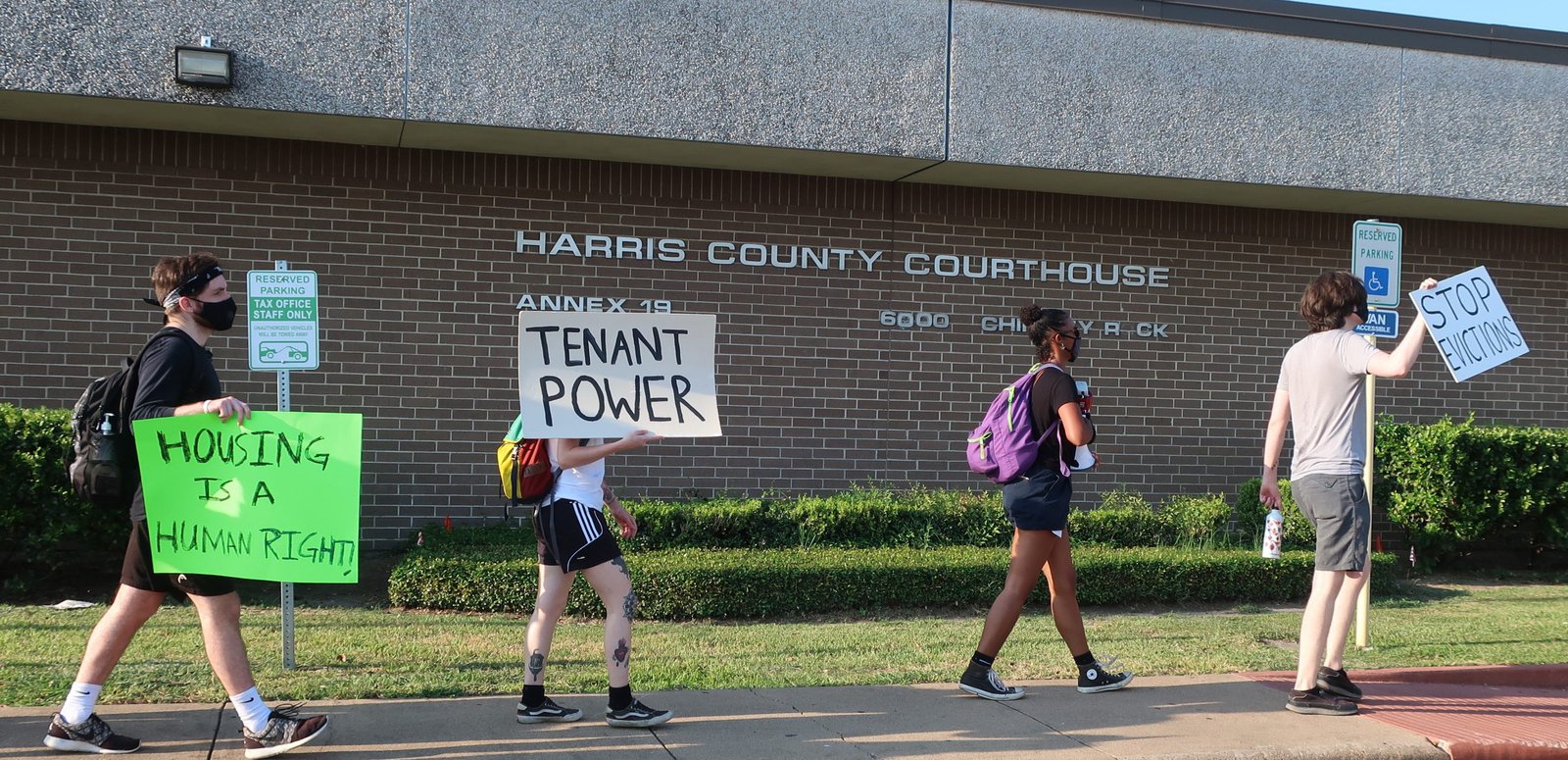
In this mini-chat, Jeff Reichman of January Advisors talks with Jen Rice, City Hall reporter at Houston Public Media, about evictions in Harris County, Texas during the COVID-19 pandemic.
Between September 2020 and April 2021, Jen attended hundreds of eviction court hearings and spoke with dozens of tenants at risk of losing their home in Houston. Despite the existence of the CDC (Centers for Disease Control and Prevention) eviction moratorium—the federal policy intended to keep tenants housed during the pandemic—Jen saw eviction filings moving forward, either because judges were not to upholding the moratorium or because tenants did not declare it in the first place.
What quickly became clear was that the narrative pushed by city officials—that the CDC moratorium was protecting tenants during this time—did not match the reality on the ground. And whether protection was extended hinged on a factor completely outside a tenant’s control: the individual judge presiding over the hearing.
Jen knew that what she was seeing play out in court houses across Houston were not one-off experiences, but a collective failure to protect vulnerable tenants. But how could she rewrite the narrative for the public without detailing each court case and each tenant's individual circumstances?
Jen found her answer through the Harris County Evictions Dashboard, which was created and maintained by January Advisors and provides daily eviction data since the beginning of 2020. This dashboard allowed Jen to see how many evictions were being filed daily, despite the moratorium. This data backed up what tenants were sharing anecdotally—that the CDC moratorium was not only failing to stop eviction filings in Harris County, but that eviction filings were actually higher during the moratorium than before it.
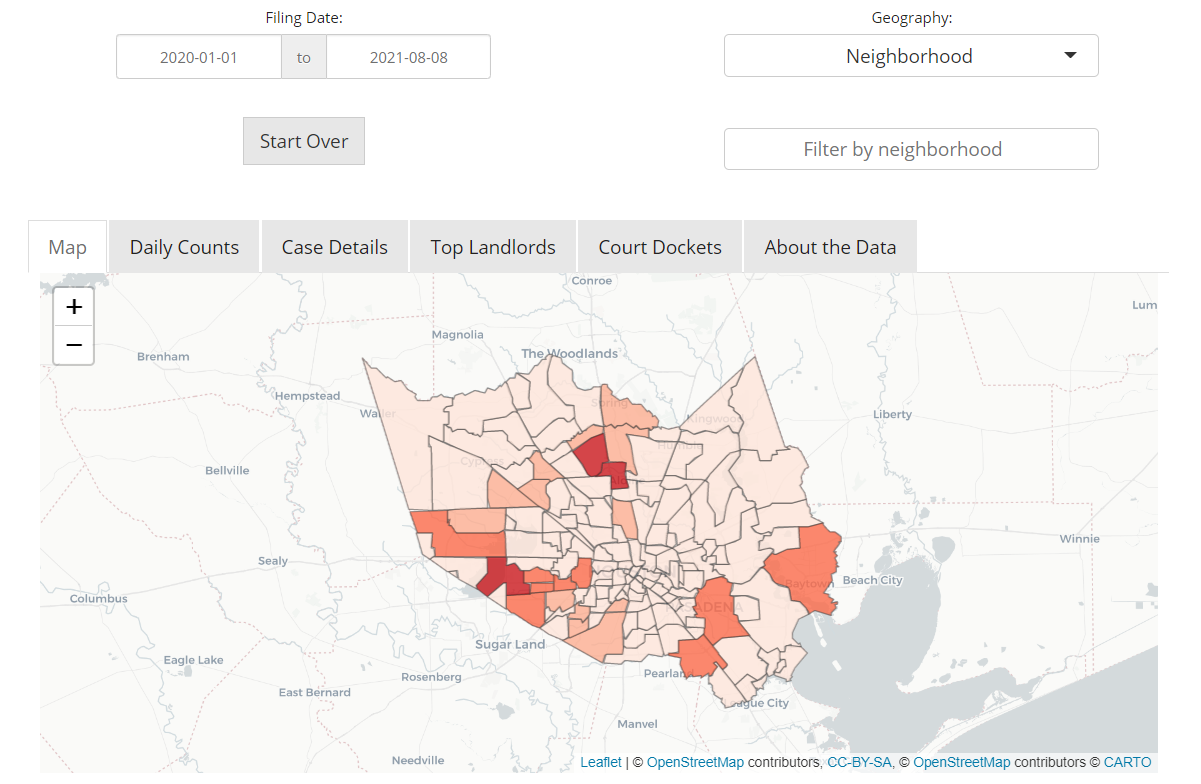
The Harris County Eviction Dashboard presents de-identified data from the Harris County Justice of the Peace Court from January 1, 2020 to present day. Members of the public can see heat maps of the number of evictions filed, as well as case level details (e.g., plaintiff, status of case, claim amount, neighborhood, court), top filers (the number of eviction cases filed by landlord), and details of upcoming cases scheduled for a hearing.
In subsequent reporting about evictions, Jen relied on this data to weave the experiences of tenants with near real-time data on eviction filings to illustrate the scale of the trauma. In particular, there were three things Jen wanted the public to understand about pandemic-era evictions:
Both Jen and Jeff describe Houston as a place with good data and weak renter protections. The ability to share the consequences of the latter is closely tied to the quality and accessibility of the former.
For more information on the Harris County Eviction Dashboard, contact Jeff Reichman at [email protected]. To contact Jen about her reporting, email [email protected].
During this mini-chat, Caitlin Augustin of DataKind speaks with Frank Wells of Bright Community Trust about building a housing response to evictions in Central Florida during the COVID-19 pandemic.
Frank and other housing stakeholders in Central Florida watched as CARES Act funding dried up by the end of July 2020. With no additional federal support in sight, no real safety net in place, and ad hoc extensions to the local eviction moratorium, Frank and colleagues knew that the tenants in Central Florida needed a plan in place—one that was responsive, comprehensive, and kept people housed.
In September 2020, Frank and colleagues convened a broad swath of housing organizations as part of an Evictions and Foreclosures Group (EFG) for an inclusive conversation around housing loss prevention. The group included city and county leaders, the court system, legal aid partners, housing nonprofits, service providers, and the regional apartment association. The contributions of this diverse group of stakeholders, though they may seem like strange bedfellows, speaks to the power of collaboration during times of crisis.
Each stakeholder in the EFG contributed data on the housing crisis facing Central Floridians. To understand the scope of the issue, a county court judge shared up-to-date information on how many eviction filings were taking place. To better understand whether existing solutions were offering sufficient protection, legal aid lawyers shared how often a CDC declaration—the signed form required for a judge to contemplate halting an eviction as part of the moratorium—was made on behalf of a tenant. The apartment association also shared information on how many tenants had payment plans with landlords.
The variation in the types of data illustrates the complexity of eviction processes, and highlights how no data source alone can provide a comprehensive understanding of its impact. By stitching together different pieces of data, the EFG knew more collectively than individually.
But still, major gaps persist. As housing and social service organizations retool to deliver emergency rental assistance as quickly as possible, there is still a disconnect between the communities most in need and the communities most able to access resources. Data that shows where evictions are filed and where rental assistance is distributed, for example, could highlight this gap, and drive us towards a more equitable housing system both during and beyond the pandemic.
For more information on the EFG, contact Frank Wells at [email protected], and for more information on DataKind, contact Caitlin Augustin at [email protected].
In this mini-chat, Peter Hepburn—an assistant professor of sociology at Rutgers University-Newark and research fellow at the Eviction Lab—spoke with Salmun Kazerounian from Connecticut Fair Housing Center about the proactive ways eviction data is being used to further tenant outreach and advocacy statewide during the pandemic.
Salmun and the CT Fair Housing Center have been collecting Connecticut eviction data since it became electronically available at the start of 2017. When the pandemic hit, they pivoted from downloading one-time snapshots of eviction data to tracking eviction trends in real time. Salmun even developed a script that updated a local, queryable eviction database on a daily basis.
It may not have been clear how this data would be deployed at the start of the pandemic, but readily-accessible data became critical when the immediate safety of tenants was threatened just a few months later.
In fall 2020, the Connecticut court system began processing eviction cases filed prior to the start of the pandemic, despite the CDC moratorium in place. With eviction case data at the ready, Salmun generated a list of eviction cases moving through the courts that resulted in a writ of execution (or court-ordered removal from one’s home). By distributing these lists to three of the state’s major housing-related legal service agencies, advocates were able to contact every tenant household at imminent risk of eviction and inform them of their rights under the CDC moratorium.
What made this outreach effort more successful than most was the ability to target resources towards the tenants most at risk. Knowing where to expend efforts on data collection, and when to leverage it to keep people housed, is critical to using housing data proactively. The good news is that with good data, and with ready access to that data, this is something that is within reach for all advocates.

The CT Fair Housing Center used data to show who has an attorney in housing court–landlords or tenants. During the first three months of 2021, 86 percent of landlords were represented by an attorney in court while only 4.7 percent tenants had legal representation. These stark differences were deployed by advocates, journalists and legal aid providers in the growing fight to extend guaranteed right to counsel for every tenant facing eviction, culminating in a Connecticut bill providing attorneys to low-income tenants. The bill passed through the Connecticut House of Representatives in early May and was signed into law in June.
Salmun and his colleagues are also building a disparate impact case to show that using a prior eviction to deny housing to tenants disproportionately harms communities of color and violates the Federal Fair Housing Act. Black and Latinx communities and women are significantly more likely to face evictions, and as a consequence, any screening policy that limits access to housing based on an eviction record perpetuates harm to these communities and bakes racial and gender inequities into the housing system.
Data is paramount to mitigating the harms caused by evictions in the short term while also building the case for reshaping the role evictions play in our housing system over the long term.
For more information on the Eviction Lab, contact Peter Hepburn at [email protected]. To contact Salmun about his work, email [email protected].
Deputy Director, Future of Land and Housing Program