A Chapter of: A Toolkit for Effective and Supportive Transitions for Children, Families, and Educators in Fall 2021 and Beyond
Six Steps to Strengthen Transitions
When early learning experiences are connected from birth through third grade (B–third), children and their families can more easily transition into pre-K, kindergarten, and the early elementary grades. Improving transitions for children and families requires careful planning, effective policies and practices, and sustainable funding. Educators can establish practices that put families more at ease, but the planning must begin well before the first day of school. On day one, teachers and schools should already have enough information to begin tailoring instruction, strategies, and environments to meet the needs of every student.
Undoubtedly, children and families need activities that engage them early and provide them with information and comfort as they begin the school year. But when enacting policy, state and local decision-makers and administrators must address the systems that support young children’s learning and development and establish conditions that ensure consistent learning environments and experiences across settings and sectors before school, in kindergarten, and beyond.
Educators across PreK–third are key to making this happen. District efforts that bring adults together to align expectations, discipline strategies, curricula, assessments, instructional strategies, family engagement approaches, and learning environments and to share data, jointly plan, and participate in PD may be less visible to children and families but no less significant. In fact, these pieces may be the most critical for creating a seamless transition into pre-K, kindergarten, and each early grade thereafter. State policymakers, from departments of education and health and human services agencies, governors’ offices and state boards of education, and more have an important role to play in setting policy goals to enable effective and supportive transitions.
There are six steps to establishing effective and supportive transition policy at the state and local level.
Step 1: Assess current transition policies and practices
Identifying a transition self-assessment tool and taking stock of current transition activities at the state and local level is the place to start. A number of self-assessment tools exist for this purpose, such as New York’s transition effectiveness assessment tool. Results of the transition self-assessment can provide an overview of current efforts as well as areas where more focused work is needed. This self-assessment should also include listening to families, prioritizing children and families who are farthest from opportunity, and tailoring investments to address their needs.
Since the transition process will be impacted by the pandemic, transition team members should also consider the possible COVID-19-related scenarios highlighted in section 4 and answer the guiding questions posed in section 5 of this toolkit.
Step 2: Determine who should help design policy
To ensure that children and families experience transitions that meet their needs, it is important for a range of stakeholders to be involved in the policy design process. While classroom teachers play a crucial role in successful transitions, the work goes far beyond them. Anyone who is a touchpoint for a child, family, and teacher during these critical years of development can play a role in ensuring that families and educators have the information they need. To this end, some states have developed resources that detail how to ensure that there is a truly representative planning team. For example,
- Wyoming's Department of Education held a Pre-K to Kindergarten Transition Summit and provided resources related to best transition practices, which are still evolving and flexible due to the re-opening of schools in the fall. In terms of transition planning, one suggestion is maintaining virtual meetings between team members to continue to foster communication, even after school re-open.
- Maine has developed online resources for early educators that detail possible transition team members, as well as ways to build and nurture relationships with families and young children, other early educators, and community organizations.
- Nevada’s Department of Education has developed a guide for supporting the transition to kindergarten that details various possible transition team members to create an inclusive group with meaningful participation.
Professionals and entities in the list below should help design policy and deliver effective and supportive transitions. This list is not exhaustive, and the appropriate participants will vary from one community to the next.
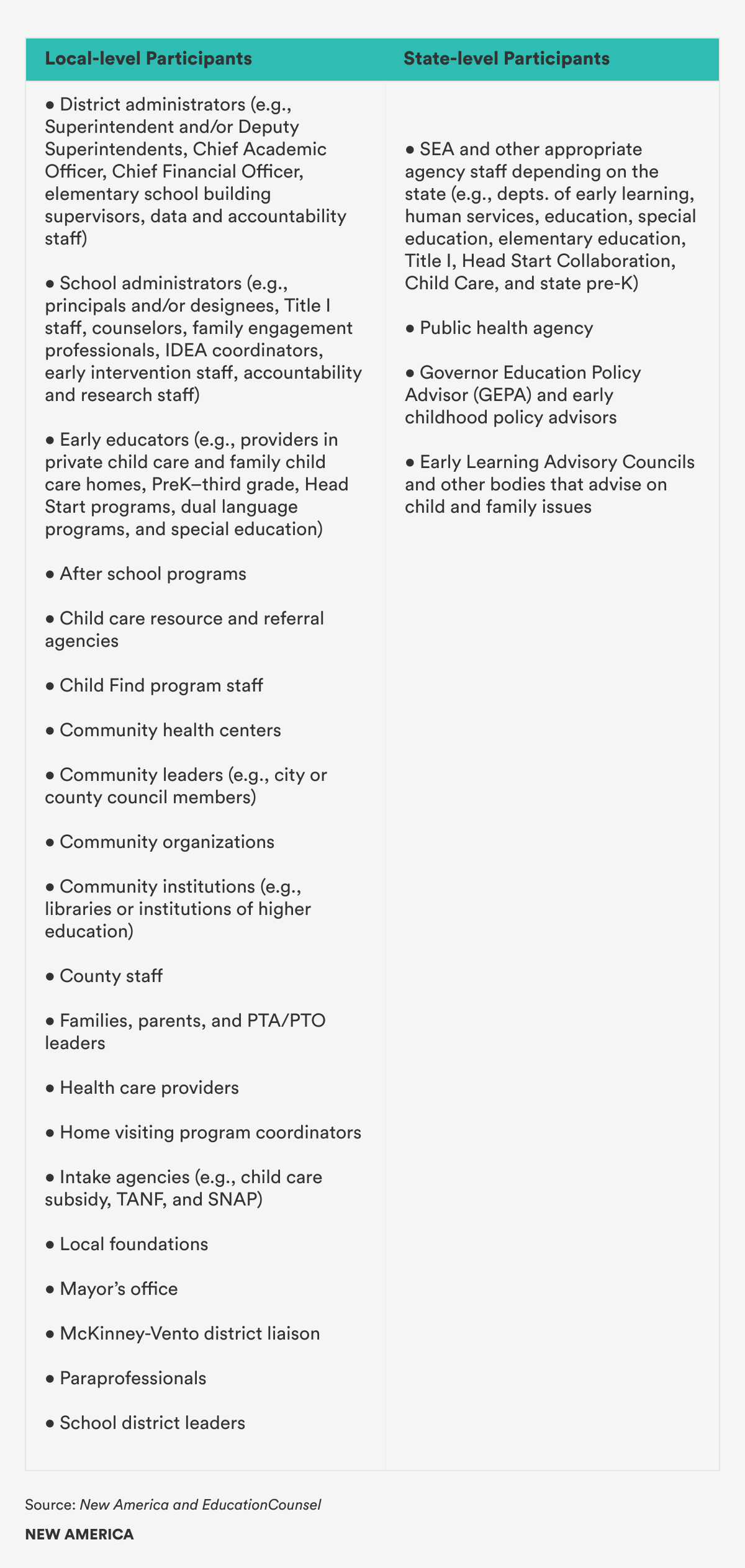
Step 3: Create a plan for improvement
The next step is creating a plan that identifies the policy changes needed to help strengthen what is happening in local communities. These policy changes may require legislative or regulatory action, but they might also be accomplished through guidance and collaboration with other state agencies or bodies. Local leaders, school districts, and other community leaders, can use what they learn from the transition policies and practices in place at the schools, community ECE programs, and other community organizations to inform the policies needed to strengthen and build upon what is already happening.
State and local improvement plans should include three buckets for policy action: (1) alignment, coordination, and collaboration; (2) transition planning and direct support; and (3) guidance, evaluation, and resources. These should plan for transition, not just as one point in time — the start of the school year — but as an ongoing process of relationship building, collaboration and coordination, and feedback loops to inform changes for future iterations.
It’s also important for transition plans to be developed by a group of diverse stakeholders representing parents, educators, and others across the early childhood and K-12 communities as well as other connected sectors such as health and family well-being.
Step 4: Decide on strategies to adopt and funding streams to support them
A core component that makes transition teams successful is establishing common, shared baselines for prioritizing ideas and initiatives generated through planning processes for implementation. In fact, an early step in kickoff meetings of state and local transition teams is creating a tool or framework for analyzing proposals for policy change. Teams should work together to select the handful of metrics or baselines for the costs and expected benefits that any policy proposal must pass to move forward. In general, this is best practice for policy analysis and implementation, but it also can be a tool for bringing diverse interest groups and stakeholders together under a shared framework and set of goals.
Implementation of individual policies should be agreed upon by relevant team members and stakeholders, but also be connected to the broader systems in place for supporting young children and their families. This requires planning that accounts for the existing capacity and responsibilities of school district and community partners, and that considers funding streams already in place that could be repurposed or expanded to support transitions. Just as transition teams develop a common framework for choosing which policies to evaluate, they should also map out how selected activities contribute to a more detailed guidebook for serving transitioning children. For example, the Louisiana Department of Education utilizes IDEA Parts C and B funding to support young children and their families throughout the various stages of early childhood transitions – with a family service coordinator serving as a liaison between families and school staff to support such transitions. Reference section 7 of this toolkit for policy recommendations with relevant funding streams and section 8 for a comprehensive list of potential funding streams.
Step 5: Develop a timeline for implementation
The timeline for implementing transition activities can and should vary depending on the needs and priorities identified at the local level. It should be nimble enough to respond quickly to new funding opportunities, information revealed from data and evaluation, and other local challenges. At the state level, timelines should be more rigid so that local transition teams are aware of consistent deadlines for reporting information to state agencies, applying for grant funds, and so on.
To ensure work plans of transition teams at all levels are clear and actionable, anticipated time frames for development, implementation, and evaluation should be embedded throughout. Timelines should also be developed with clear leaders of workstreams, ensuring that transition team members are aware of and know who is responsible for the many moving components of implementation. It is also important to approach both planning and implementation of transition activities as a consistent, ongoing, and cyclical process. During any month of the year, teams can be working to revise or update plans, publish and review data, or implement activities.
Step 6: Evaluate success and make changes as needed
Regular assessment and evaluation of state and local transition policies is a critical step for ensuring that initiatives remain timely and effective. Work plans should be developed by state and local actors with evaluation and data collection in mind. Preparing for policy to be evaluated should at least include a review of existing data reporting and collection systems as a component of the self-assessment completed in step 1, but should also consider plans for studying and updating policies based on findings.
As initiatives are implemented and policies changed, transition teams can partner with state and local accountability and research staff at early childhood and K–12 agencies for technical assistance with evaluation. Researchers can leverage data from existing systems of evaluation to understand how cohorts of children participating in transition activities performed compared to their peers. They can also administer pre- and post-surveys or other methods of evaluation to parents, children, and teachers to understand how transition planning influences family engagement, teacher satisfaction, and other goals outside the realm of traditional accountability systems. Data should be disaggregated by race, gender, primary language, and socioeconomic and disability status to ensure disparities in access or outcomes are identified.
Plans should also exist to ensure that research or trends in one community informs efforts in other communities. State education agencies play a critical role in convening school districts and localities, especially through gathering and clearly displaying data in statewide longitudinal data systems. Such evaluation and information sharing post-implementation are crucial for ensuring that the timeline for supporting child transitions is cyclical, with data and assessment informing new activities and policies adjusted for future kindergarten cohorts.
This project is a collaboration between New America and EducationCounsel.