
Leslie Villegas
Senior Policy Analyst, Education Policy
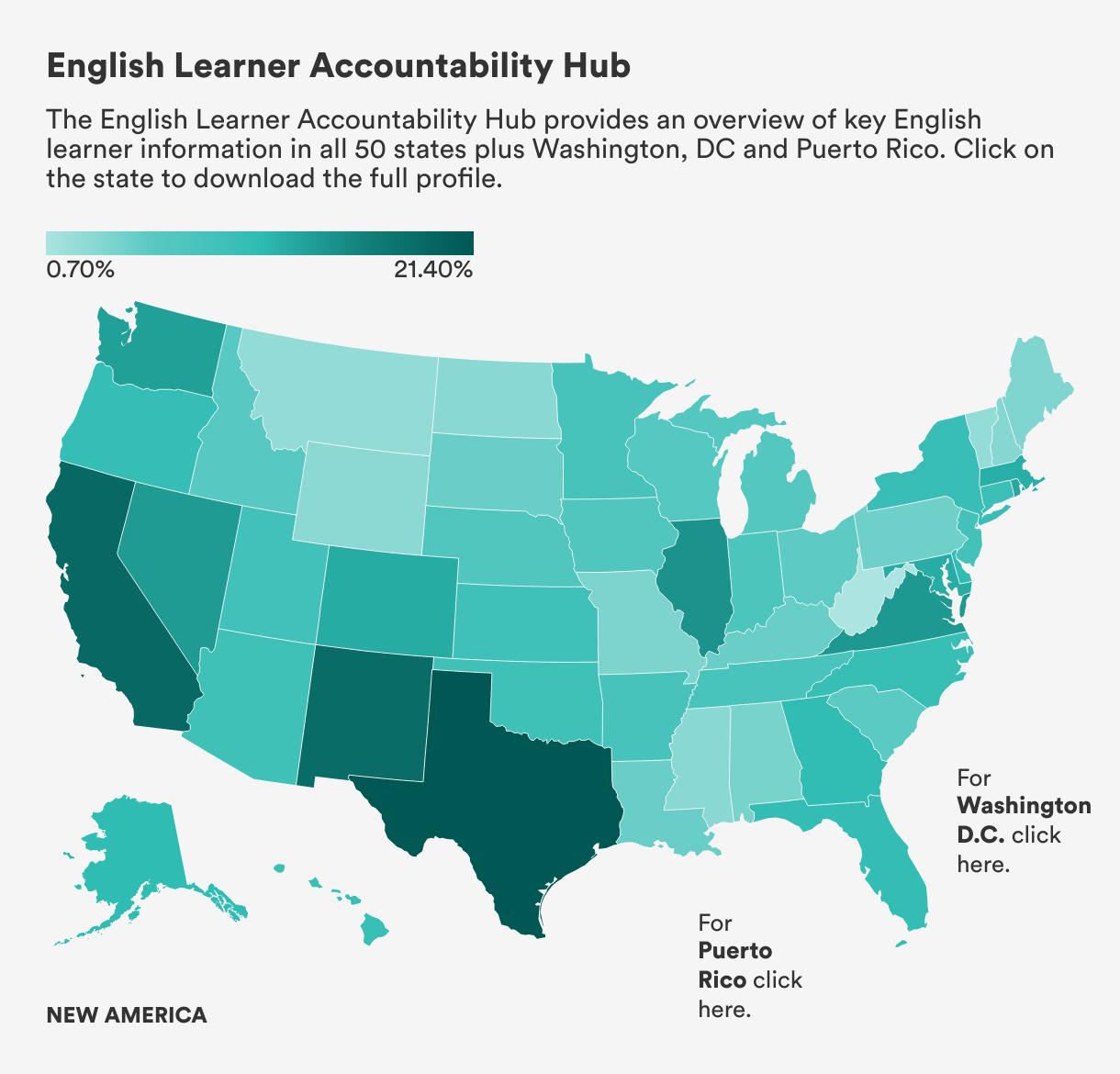
The English Learner Accountability Hub provides an overview of key English learner information in all 50 states plus Washington, DC and Puerto Rico. While the Every Student Succeeds Act (ESSA) enshrined a series of accountability measures for ELs across the country, states varied greatly in their implementation of those requirements, which means no two states are the same in their approach to providing ELs with an equitable education.
Each state profile in this hub lists key accountability policies that were adopted in accordance with federal law, including streamlined identification, assessment, and reclassification policies for ELs, maximum timelines to proficiency, and the extent to which ELs are included in school accountability systems. Each profile also contains demographic information such as states’ K–12 English learner population, most common languages spoken by ELs, and data on how many ELs are still enrolled in schools after reclassification.
The hub also includes information beyond what is required by federal law on two important EL subcategories, students with limited or interrupted formal education (SIFE/SLIFE) and long-term ELs (LTELs), when available. And each state profile is rounded out with information on instructional program models offered and the languages represented in those programs.
The English Learner Accountability Hub was created to bring information together on key policies that affect ELs' equitable access to education that is rarely found in one place. This hub is intended to be a resource for education and civil rights advocates as well as researchers interested in advancing equity for English learners and other immigrant students. As policies and demographics are ever-evolving, this hub is intended to be a living resource that will be updated periodically to reflect the current state of EL education across the United States.
How to navigate:
Please hover over each state to view a select set of data including: total EL enrollment by number and share of K-12 population and top 5 languages spoken by the EL population. To view a state's full profile, please click on the state of interest and follow the link provided. Lastly, to download a state's profile in PDF format, or get the data in Excel, please scroll to the bottom of the profile and click on links provided.
Annual meaningful differentiation (AMD): School accountability systems established by each state to identify schools for support and improvement using the academic achievement of groups of students, such as English learners, to set schools apart from each other using students’ academic performance.
Dual language learners (DLLs): children between the ages of birth to five who are in the process of simultaneously learning English and their home language(s).
Former English learners (FELs): ELs who have been reclassified and who are no longer receiving language supports. Title III of the Elementary and Secondary Education Act (ESEA) requires states to monitor FELs for two to four years and report to the federal government how these students are performing on statewide standardized assessments in ELA and math.1 States have the option to collect data on FELs beyond the maximum four years for their own data collection purposes. Please refer to the notes section in each state profile for more information about whether the number of FELs noted represents all former ELs (sometimes referred to as ever-ELs in data collection) or if the number depicts only those being monitored pursuant to Title III.
Long-term ELs (LTELs): ELs who have not reached proficiency by what is considered to be an appropriate amount of time that is supported by research. Although the federal government does not define what constitutes a LTEL, non-regulatory guidance issued by the U.S. Department of Education recommends that states consider those “who have not attained English language proficiency after five years” as LTELs.2
N size: The minimum number of students schools use to determine whether a subgroup of students, such as ELs, will be included in their school accountability system. For example, if a state adopted an accountability n size of 25, schools that enroll fewer than 25 EL are not required to include the performance of ELs in their accountability system.3
Recently arrived English learners (RAELs): English learner students who have been enrolled in U.S. schools for less than 12 months. ESSA provides states flexibility in terms of how these students are assessed academically and incorporated into the state’s accountability system. This flexibility applies to RAEL’s participation in academic assessments such as math and ELA, not the English language proficiency assessment.
Students with limited or interrupted formal education (SIFE/SLIFE): The U.S. Department of Education Newcomer Tool Kit defines SIFE as students in grades four through 12 who have experienced disruptions in their education in their native countries and/or the United States, and/or are unfamiliar with the culture of schooling.4 This definition is based on the work of Margarita Calderón, professor emerita at Johns Hopkins University, who has also attributed the following experiences to SIFE/SLIFE:5
English learner instructional program models: For detailed descriptions of the various language program models available to ELs across the country, such as dual language and transitional bilingual, please refer to New America’s glossary on the various instructional models available for ELs.
Each state profile was developed using publicly available datasets on state education agency (SEA) websites. If data were not readily available, SEA staff members were contacted and formal requests for information were submitted when necessary. The majority of the accountability policies were pulled from The Patchy Landscape of State English Learner Policies under ESSA published by the Migration Policy Institute in February 2020. Each section contains links to the sources used for further exploration and analysis. Lastly, each profile was shared with the appropriate SEA staff for each respective state prior to publishing for their review.
Please contact Leslie Villegas at [email protected] with queries regarding the information presented in this hub.
I would like to express my most sincere gratitude to Efren Velazco for his help with data collection and organization during the planning stages of this project, as well as my colleagues on the Prek-12 team for their thoughtful review and contributions. I appreciate Sabrina Detlef for her meticulous editorial support and Julie Brosnan, Fabio Murgia, Riker Pasterkiewicz, and Joe Wilkes for their assistance with communication, data visualization, and layout. This work would not have been possible without the generous support of The Heising-Simons Foundation. The views expressed in this report are those of the author and do not necessarily reflect the views of these individuals and foundations.
Senior Policy Analyst, Education Policy