The Abu Dhabi Express
Abstract
In late 2020, as the first major ceasefire in Libya’s decade-long proxy war was under negotiation, news broke of a Pentagon report suggesting that the United Arab Emirates, or UAE, co-financed the operations of the Wagner Group, a Kremlin-backed network of Russian private military security contractors. Although the Pentagon report presented no direct evidence of financial ties between the UAE and the Wagner Group, it raised questions about the UAE’s links to the Russian military outfit and its chief financier Yevgeny Prigozhin, who has been sanctioned by the United States in connection with his role in the conflicts in Ukraine and Syria, as well as interference in U.S. elections. This case study outlines how Russia leveraged its long-standing military cooperation with the UAE to piggyback the delivery of sensitive military material to forces allied with Libyan strongman, Khalifa Haftar, and Wagner Group operatives in a potential violation of a standing UN arms embargo. New America’s investigation tracked the transport of radar and electronic equipment for Russian-made Pantsir S1 anti-aircraft surface-to-air missile systems from Russia to the UAE, and tracked suspected military air transports bound for Libya from the UAE. Suspect flights from the UAE to Libya we identified included trips that used U.S.-made C17 cargo planes. Additional data provides insights into how a multi-million-dollar military-technical agreement between Russia and the UAE set the stage for Wagner Group air defense maneuvers and resulted in significant Russian and civilian casualties during a pivotal offensive on Tripoli by Haftar’s Libyan National Army. While the evidence reviewed does not provide conclusive proof of the alleged Emirati financial ties to the Wagner Group, these findings do add to the mounting evidence of UAE support for illicit mercenary activities, and, at minimum, suggest that the logistics pipeline that supports Russia’s military cooperation with the UAE in Libya is worthy of much closer scrutiny.
Acknowledgments
The authors would like to thank our partners and colleagues at New America, C4ADS, and the Center on the Future of War at Arizona State University. The unique collaboration across our organizations has afforded us unprecedented insights into the way technology and the increasingly privatized and networked nature of conflict is transforming security dynamics around the world. We are especially grateful to our partners at Airwars whose meticulous documentation of civilian casualties in Libya inspired us to launch our investigation.
Thanks also goes to New America’s talented team of editors and designers, especially to Emily Schneider for her keen editorial eye and helpful feedback as well as to Alison Yost for leading the charge on production and Joe Wilkes, Joanne Zalatoris, and Maria Elkin who laid out the paper and webpage.
Downloads
Executive Summary
In November 2020, only a month after the UN brokered a ceasefire agreement between warring parties in Libya's decade-long proxy war, the Pentagon issued a report suggesting that the United Arab Emirates, or UAE, co-financed the Libya operations of the Wagner Group, a shadowy Kremlin-backed network of Russian private military security contractors. Although the Pentagon report presented no direct evidence of financial ties between the UAE and the Wagner Group, it drew media scrutiny and raised questions about the UAE’s links to the Russian military outfit and its chief financier, Yevgeny Prigozhin.
Buried in a dense 100-page report, the Pentagon’s glancing reference to intelligence about Emirati support for Libyan strongman Khalifa Haftar, and funding for the Wagner Group’s operations in Libya, surfaced in the news just as members of Congress and human rights groups called for a halt to a pending $23 billion U.S. arms deal with the UAE. The Pentagon report also noted that U.S. Africa Command estimated that there were approximately 2,000 Russian-backed Syrian fighters in Libya. It also echoed similar reporting from a special UN body of experts that tracks mercenary activity around the world, and the UN panel of experts charged with monitoring an arms embargo against Libya that has been in place almost from the start of the civil war there in 2011.
Most importantly, the Pentagon’s findings hinted at the possibility that the UAE was not only doing business with a major rival of the U.S.- and UN-backed government of national accord in Tripoli, but with a prominent Russian oligarch who has played a leading role in a series of violations of international law by Russia that has led to deep fissures between Washington and Moscow. That key player, Yevgeny Prigozhin, is a wealthy St. Petersburg caterer turned defense logistics impresario whose close ties to Russia’s President Vladimir Putin and Moscow's security establishment have won his companies hundreds of millions of dollars worth of Russian defense ministry contracts. Prigozhin has not only figured prominently in several scandals involving the targeted killings of journalists and the intimidation of Russian dissidents, but has also been placed at the center of Russia’s aggressive influence campaigns by U.S. authorities. In early 2021, the FBI added Prigozhin to its most wanted list for his alleged role in financing the internet troll farm implicated in interfering in U.S. elections from 2016 to 2018. The U.S. Treasury Department has also sanctioned Prigozhin for his role in financing the Wagner Group’s mercenary operations in Ukraine and Syria. The European Union sanctioned Prigozhin as well for supporting the Wagner Group’s operations in Libya.
The Pentagon’s allegations of suspected UAE financing for the Wagner Group appear to corroborate widely documented evidence of Prigozhin’s involvement in Libya’s proxy war. Yet, evidence also suggests that Prigozhin’s web of enterprises is only one node in a complex network of commercial proxies that Russia and the UAE rely on to mitigate the risk that the two country’s illicit arms transfers will be interdicted by U.S. and NATO allies, and to manage associated conflict escalation risks. The unique set of arrangements between Prigozhin’s shell companies, Russian state-backed arms manufacturers, and UAE-based defense and transport firms is designed to provide maximum cover and plausible deniability for Russia’s proxies. The elaborate logistics pipeline that supported the Wagner Group in Libya at the peak of one of the most pivotal military offensives in the country’s long proxy war matters even more to the Kremlin because it provides Russia with an inexpensive, lower-risk means of testing and adapting its operational concepts in a variety of settings where it seeks to compete with NATO, the United States, and allies.
For a key U.S. ally like the UAE, doing business openly with the Wagner Group is theoretically akin to crossing an unstated but bright red line in Washington. But there is no debating that the Russian contingent provided the Emiratis significant influence over outcomes in a region long roiled by instability. The Wagner Group proved crucial in changing facts on the ground in Libya for Haftar’s Libyan National Army, or LNA, and Russian contingents operating under a complex web of shell companies were especially key to the launch of a major LNA offensive against the U.S.-backed and UN-supported Government of National Accord, or GNA, in Tripoli.
The start of the LNA assault in Tripoli in the spring of 2019 constituted a major escalation in a conflict that was already rapidly internationalizing, and triggered the insertion of thousands of Russian operatives with the Wagner Group. Analysis of publicly available data about Russian-made mobile surface-to-air missile batteries, operated by the Wagner Group during the LNA offensive on Tripoli, indicates that Russian and Emirati military cooperation was a critical enabling factor. But despite Haftar’s high hopes at the outset that the Russians would help secure victory over Tripoli, the joint LNA-Wagner Group offensive ultimately failed, in part, because of Turkish drone strikes that penetrated the air defenses of forces allied with Haftar and struck several Wagner Group-operated mobile Pantsir S1 surface-to-air missile batteries.
A review of open-source data reveals that Russian citizens and companies tied to a Wagner Group contingent that has been spotted across the Middle East, Africa, and in Ukraine appear to form the backbone of a sprawling military supply and logistics chain that spans from central Russia to the General Headquarters of the Armed Forces in Abu Dhabi in the UAE. Analysis of flight data also identified suspect flight patterns for dozens of cargo planes that departed from the UAE and then seemingly disappeared as they approached the eastern coast of Libya and the western border regions of Egypt. Dozens of flights identified by our team traveled from the Emirates using an American-made C17 military transport plane.
Although these findings do not offer conclusive proof of direct UAE financing for the Wagner Group in Libya, they are significant for three reasons. First, they come on the heels of recent UN allegations that the Wagner Group has been implicated in war crimes in Libya, and the publication of two reports separately released by the Pentagon and the UN over the last year—suggesting that the UAE co-financed Wagner Group operations in Libya. Second, recent reports that the government of Mali is negotiating a deal that would permit the Wagner Group to train and equip its military forces has set off high anxiety in France and Germany, which both have military forces deployed on counterterrorism and stabilization missions in the country. Last, but by no means least, the body of evidence we have surfaced raises questions about how—or even whether—the Biden administration has factored allegations of UAE support for the Wagner Group into its approval this spring of a controversial deal that calls for the sale of billions of dollars worth of U.S. weapons to the UAE.
The data reviewed for this study are indicative of patterns seen in other warzones where Prigozhin’s contingent contractors are active. The most notable similarity is with Ukraine, where the same Russian logistics firm that arranged Pantsir transfers to the UAE also broke with existing international embargos on pro-Russian separatist parts of the Donbas region to deliver military material to mercenary contingents. Additional data provides insights into how a multi-million-dollar military-technical agreement between Russia and the UAE set the stage for Wagner Group air defense maneuvers and resulted in significant Russian and civilian casualties during the pivotal battle for Tripoli from early 2019 to late 2020.
At minimum, these findings suggest that the logistics pipeline that supports Russia’s military cooperation with the UAE in Libya is worthy of much closer scrutiny. But what is more troubling, is that these revelations show that Russia—a permanent member of the UN Security Council with tremendous sway over the outcome of conflicts around the world—has developed a seemingly durable model for conducting a war on the cheap in contravention of international law and in breach of UN resolutions, and it has done so with the help of an ostensible American ally.
Introduction: Operation Flood of Dignity–Haftar’s Tripoli Blitzkrieg
In November 2018, Libyan strongman Gen. Khalifa Haftar flew to Moscow to meet with Russia’s minister of defense, Sergei Shoigu.1 The meeting between the two men—a one-time CIA informant turned Russian military proxy and the longtime head of Russia’s military forces—was one of several showy attempts by the Kremlin to signal its strong support for forces allied against the U.S.- and UN-backed Government of National Accord (GNA) faction in Tripoli, which was headed then by Prime Minister Fayez al Sarraj. It was also the prelude to one of the most significant chapters in Libya’s lengthy and highly internationalized civil war.
Up until that moment, Moscow’s outreach to Haftar, a one-time key adviser to Libya’s longtime dictator Muammar Qaddafi, might have been best characterized as lukewarm to middling. The civil war in Libya had by then been raging for seven years, and Russia clearly was flirting heavily with Haftar. But Haftar’s past CIA ties, muddled battlefield strategy, and Russia’s clear preference for another Libyan faction led by Qaddafi’s son, Saif al-Islam Qaddafi, meant Haftar was far from having a lock on Kremlin support.2 The Kremlin’s attitude appeared to shift, however, soon after Haftar’s late 2018 meeting with Shoigu when Haftar’s Libyan National Army forces—known as the LNA—notched a significant tactical win with the capture of the massive El Sharara oil field in southwest Libya.3
Situated just a three-hour drive west from the small town of Sabha, the El Sharara, at the time, supplied the GNA-controlled National Oil Company with an estimated 315,000 barrels of oil a day.4 The LNA’s seizure of El Sharara signaled the opening salvo of a spring offensive against the embattled GNA government, and became a critical turning point in a bloody proxy war that has drawn in as many as seven countries. If Shoigu needed proof that Haftar had the potential to become a significant asset in Russia’s years-long campaign to gain a stronger foothold in the Eastern Mediterranean, he certainly got it the day Haftar’s forces overran the perimeter of El Sharara.
Haftar’s capture of the massive El Sharara oil field in late 2018 set the stage for what was meant to be the last leg of the LNA’s arduous slog westward to take the capital of Tripoli. Dubbed “Operation Flood of Dignity,” the Blitzkrieg-style military offensive spearheaded by Haftar’s LNA forces, came on the heels of Haftar’s successful bid to seize control of major oil and gas production and transport nodes in eastern Libya.5 At the time, Russia and the UAE counted among the countries most actively engaged in providing support to proxy forces aligned against the GNA in Tripoli. Turkey, meanwhile, backed the GNA under a military cooperation agreement signed several months after the start of Haftar’s westward advance from near the LNA’s main redoubt in the eastern city of Tobruk.6
The seizure of one of Libya’s largest oil fields marked a major turning point in the war for Haftar and the LNA, but it would prove to be an equally big boon for one of Haftar’s most important Russian contacts: Yevgeny Prigozhin. Known the world over as “Putin’s Chef,” for his previous role as the Kremlin’s official caterer, Prigozhin has been the subject of U.S. scrutiny for years for his central role in a sprawling network of front companies, mercenary contingents, internet troll farms, spies, gun runners, and shady covert operatives that have figured prominently in conflicts spanning from Ukraine, to Syria, to Libya, and beyond.7
For years, American law enforcement agencies have tried and, so far, failed to bring Prigozhin to justice for his alleged role in orchestrating Russian interference in the 2016 and 2018 elections. In 2018, the Department of Justice indicted Prigozhin with conspiracy to defraud the United States, and more recently, in early 2021, the FBI placed him on its most wanted list, offering a reward of $250,000 for information leading to his arrest.8 Cast as the titular chief financier of the Wagner Group, a Kremlin-backed network of contract military contingents, Prigozhin has also been sanctioned by the U.S. Treasury department for his alleged role in financing Wagner’s network of Russian private military security contractors (PMSC) and their mercenary operations.9
The Pentagon’s Africa Command, or AFRICOM, has also linked the Wagner Group to Libya’s proxy war, and AFRICOM military leaders have repeatedly testified in Congress about the destabilizing presence of Russian mercenaries in Africa in recent years.10 The Kremlin’s backing of Wagner Group forces during the LNA offensive in 2019–2020, in fact, constituted a major escalation in a conflict that was already rapidly internationalizing, and witnessed the insertion of hundreds of Russian operatives into the Libyan fray.11
Much as Prigozhin aided Russia in pushing its proxies in Syria to prioritize military action aimed at capturing control of the country’s strategic energy reserves, it seems the Kremlin advised the same tactics for Haftar’s LNA forces in Libya.12 By early 2019, the civil war in Libya had been raging for nearly eight years, and Haftar had already met at least once with Prigozhin, Russia’s key liaison for covert military support to the LNA.
At the time, Prigozhin’s cameo appearance in a series of photographs and videos, shot during a meeting between Haftar and Russian defense officials, triggered a feeding frenzy of speculation in the international press about a potential Wagner Group intervention in Libya.13 In addition to their links to Prigozhin’s web of businesses, the Wagner Group has been accused of committing war crimes in Syria and, more recently, in the Central African Republic.14 Haftar’s meeting with Prigozhin raised concerns among branches of the UN charged with monitoring Libya’s arms embargo as well as adherence compliance with human rights protections and international humanitarian law (IHL) that more such incidents might also crop up in Libya as the Wagner Group prepared to ramp up its support to the LNA.15
Despite Haftar’s high hopes at the outset that the Russians would help secure victory over Tripoli, the joint LNA-Wagner Group offensive ultimately failed, in part because of Turkish drone strikes that penetrated the air defenses of forces allied with Haftar and struck several Wagner Group-operated mobile Pantsir S1 surface to air missile batteries. There is still an active debate among analysts about just how decisive Turkish drone strikes were in boxing in the Wagner Group’s operations in Libya.16 One analyst suggests, for instance, that Turkish propaganda around its Libya drone campaign is more reflective of spin than success, noting the high attrition rate for Turkish-made Bayraktar TB2 armed drones during the counteroffensive against Haftar’s LNA and Wagner Group forces.17
A July 2020 Drone Wars assessment also suggested that as many as 24 drones were downed in the first six months of 2020 when the offensive was likely at its most intense; 16 of those were Turkish Bayraktar TB2’s and eight were UAE supplied Chinese Wing Loongs.18 The Drone Wars study also notes that Pantsir S1’s took out many of the Turkish drones, and another report suggests that Pantsirs destroyed as many as a dozen TB2’s.19 There is little argument, therefore, about the fact that the Wagner Group’s reported use of Pantsir S1’s and Russian fighter jets, to create a defensive bubble for advancing LNA forces at the outset of Haftar’s offensive on Tripoli, initially provided an added battlefield advantage. After multiple Turkish drone strikes on Pantsir battery crews, however, the Wagner Group’s battlefield successes proved to be relatively short-lived. This raises two related questions: what happened and why?
It turns out that to answer those questions, it is important to ask and answer a few more: How did Russian made Pantsir missile batteries exported to the UAE wind up in Libya? How and why did the United Arab Emirates—a longtime key U.S. ally in the Middle East—decide to team up with Russia to help send thousands of Wagner Group operatives to fight in Libya against U.S. interests? Is there any evidence to support U.S. and UN claims about the connections between the UAE and the Russian mercenary contingent’s involvement in war crimes in Libya?
To answer these questions, New America and C4ADS analyzed open source publicly available data and found that the Wagner Group’s Pantsir ground maneuvers provide significant clues about Russian-Emirati collaboration in support of the LNA offensive on Tripoli. Our findings outline how a string of costly airstrikes on Pantsir S1’s likely manufactured by a Russian arms company for the UAE and operated by a combination of Wagner Group and Emirati operatives in cooperation with the LNA led to major battlefield reversals in Libya.
More importantly from a strategic perspective on the ongoing proxy war competition between Russia and the United States in the Middle East and Africa, the destruction of more than $100 million worth of Russians weapons platforms in Libya along with similar losses in Syria, has forced Russia to modify and upgrade the Pantsir to be more resistant to drones and to revamp its approach to air defense.
All this suggests that there is much more than meets the eye to how the Wagner Group and Prigozhin fit into Russia’s strategic maneuvers in Middle Eastern and African conflict zones. While U.S. government officials have long cast Kremlin-insider Prigozhin as the main mastermind behind the sprawling web of Russian shell companies responsible for recruiting and deploying Wagner Group contractors to global hot spots like Libya, the mechanics of the covert logistics pipeline that flows from Russia to the UAE and onto the Wagner Group is far too complex to be boiled down to the machinations of a single Russian oligarch.20 The Wagner Group and Prigozhin constitute just one node in a tangled network of nominally private firms that service Russia’s military-industrial complex and extractive industry.
The Kremlin and Prigozhin have repeatedly denied having any direct ties to Wagner Group operations in Libya, but there is sufficient evidence and analysis to indicate that Russia's plausible deniability where Prigozhin and the Wagner Group are concerned, is highly implausible.21 The U.S. AFRICOM has issued several reports and public statements about the Wagner Group’s operations in Libya, saying it believes an estimated 2,000 Russian military contractors are in the country.22 The U.S. Defense Intelligence Agency, or DIA, has said that reports about who funds the Wagner Group’s operations are “ambiguous,” but has indicated that the UAE “may provide some financing for the group’s operations.”23 Our investigation into the Wagner Group’s operations in Libya, in fact, provides fresh evidence of close cooperation on Libya between the UAE and Russia, a top rival of the United States.24
In this briefing, we describe how Turkish drone strikes on Pantsir S1 anti-aircraft missile batteries killed and wounded scores of Russian Wagner Group fighters who began pressing toward Tripoli in the summer of 2019. Our analysis also traces numerous flights between the UAE and Libya that appeared to peak during a brief ceasefire during Haftar’s push to reach the Libyan capital, which was controlled at the time by the UN- and U.S.-backed GNA. Several flights suspected of supporting the covert air bridge from the UAE to Libya were conducted by an American-made C17. Based on a meticulous analysis of social media, satellite imagery, flight data, customs, and corporate registry data, evidence uncovered during our research appears to corroborate the allegations lodged by the Pentagon and the UN, indicating that the UAE-supported and -financed Wagner Group military operations during Haftar’s bloody assault on the Libyan capital of Tripoli from April 2019 to September 2020.
The goal of our investigation was to get a clearer picture of Wagner Group operations in Libya during a pivotal turning point in the conflict and to learn how and whether Emirati support factor into Russian thrusts toward Tripoli. We set out to learn where the Wagner Group’s Pantsir S1 crews operated, who the Wagner Group fighters were, and how Pantsir S1 maneuvers under the Wagner Group’s command fit into the overall 2019–2020 offensive.
We surmised that a thorough understanding of how the Wagner Group used Pantsir surface-to-air missile batteries in the Libyan theater would also provide insights into what type of equipment was being used on the ground—as well as how that equipment was likely transported into Libya, despite the standing UN arms embargo. Another important aim was to try to develop a damage assessment that would provide insight not only into the Wagner Group’s material military losses but the number of casualties sustained by Russian mercenary contingents, as well as civilian harm caused by their operations.
It was not a simple task. Open-source research on Libya can be challenging, as local sources are often highly partisan, and freedom of speech and information is constrained. Because much of the combat in Libya takes place in remote desert locations, it can be difficult to distinguish who is doing what from a distance, and to verify information. It also needs to be stated up front that it was difficult to separate out damage and casualties stemming from Wagner Group operations versus the LNA forces’ operations. In most instances, reporting on the ground from local sources indicates that Wagner Group forces were so deeply enmeshed in LNA maneuvers, that it would be hard to give a full accounting of Wagner Group losses.
Our analysis relied, in part, on data about publicly reported field sightings and casualties resulting from airstrikes and landmines provided by our partner Airwars, a London-based research organization focused on documenting the impact of military air campaigns on civilians.25 We additionally reviewed traditional media and social media reporting about battles involving the Wagner Group and LNA during Haftar’s offensive from local Libyan news outlets and social media. These sources were also used to identify the Wagner Group’s general presence in Libya and with information culled from Vkontakte and Telegram social media accounts that track the activities of Russian PMSC fighters.26
Interviews with American and Libyan officials as well as journalists who reported on Libya’s war from the field, helped fill in gaps from media sources. Additionally, the UN panel of experts’ report on Libya issued in March 2021 was a critical resource, detailing equipment used by various combatants in the Libyan theater as well as providing documentation on airstrikes and arms shipments.27 We checked the panel’s assertions and took deliberate steps to verify the trail of evidence connecting Abu Dhabi-based defense and air transport providers to shipments of Russian-made Pantsir missile batteries. To establish the identities of Wagner operators and their connections to the Kremlin, we used a combination of strike reports and casualty information reported by Russian media outlets.
While Wagner Group casualties in Libya have been sporadically reported by the Russian press, our analysis also provides a first-of-its-kind assessment for Wagner Group forces in Libya who operated some of the very same Russian-made and UAE-financed anti-aircraft surface-to-air missile platforms, or SAMs, that were shipped via a covert pipeline. Our review of available data also finds that both Turkish strikes on Wagner Group air defense units and Wagner Group ground operations resulted in a substantial number of civilian casualties.
Analysis of publicly available data, provided in part by C4ADS and Airwars, indicates that UAE-supplied Pantsir S1’s may, in fact, have been the weakest link in the UAE and Russia’s bid to support Haftar’s LNA during the 2019-2020 offensive. In fact, research reveals that Wagner Group operatives in Libya likely sustained at least 42 fatalities during Haftar’s offensive between September 2019 and July 2020, when the LNA offensive was winding down.
This detailed assessment of Wagner Group operations comes amid recent reports that Russian mercenaries may be poised to expand their reach in Mali even as Russia and Turkey reached a tentative agreement in late June to withdraw hundreds of foreign fighters from Libya.28 Yet, while the potential Libya deal calls for Turkey and Russia to recall up to 300 Syrian mercenaries, the status of the hundreds of Russian mercenaries who oversaw several Syrian contingents and who continue to support Haftar’s LNA in the south and east of the oil and gas-rich North African country remains unclear. This is especially concerning given that a UN fact-finding mission has now reportedly determined that Wagner Group operatives have been implicated in war crimes in Libya.29
Part of ongoing research into how state-backed Russian irregular forces and the Russian business and government networks that support them are changing the character of war, our independent assessment in effect confirms a widely held consensus view that Turkish targeting of Russian-made and operated Pantsir S1 mobile air defense systems was a significant factor in Wagner Group losses and represented a key turning point in the war.30
The study’s findings suggest that if the past is in any way precedent, the Russians have learned hard-fought lessons about the challenges of running defensive anti-aircraft operations in the age of drone warfare. There is also substantial evidence to indicate that, despite heavy losses incurred by Wagner Group operatives in Libya, Russia’s political and military leaders view the payoff from conducting war by other means on the cheap and testing new approaches to integrated warfare as well worth the risk. That should be instructive for any state seeking to design strategic responses to Russia’s resurgence, especially the United States.
Citations
- Reuters, “Libya Commander Haftar Visits Russia Ahead of Conference,” Nov.7, 2018. https://www.reuters.com/article/us-russia-libya-haftar/libya-commander-haftar-visits-russia-ahead-of-conference-idUSKCN1NC2OB
- Same al-Atrash, “How a Russian Plan to Restore Qaddafi’s Regime Backfired,” Bloomberg, March 20, 2020. https://www.bloomberg.com/news/features/2020-03-20/how-a-russian-plan-to-restore-qaddafi-s-libyan-regime-backfired
- Patrick Wintour, “Conflict Erupts for Control of Libya's Largest Oil Field,” The Guardian, Feb.8, 2019. https://www.theguardian.com/world/2019/feb/08/conflict-erupts-for-control-of-libyas-largest-oil-field
- Reuters, “Libya's Sharara Oilfield Declares Force Majeure after Brief Shutdown,” June 9, 2020. https://www.reuters.com/article/us-libya-oil/libyas-sharara-oilfield-declares-force-majeure-after-brief-shutdown-idUSKBN23G0YX
- Yousuf Eltagouri, “Haftar’s Final Play: Operation Flood of Dignity and the Fight for Tripoli,” Foreign Policy Research Institute (FPRI), April 12, 2019. https://www.fpri.org/article/2019/04/haftars-final-play-operation-flood-of-dignity-and-the-fight-for-tripoli/
- Al-Jazeera, “Libya’s GNA Accepts Turkish Offer of Military Support,” December 19, 2019.https://www.aljazeera.com/news/2019/12/19/libyas-gna-accepts-turkish-offer-of-military-support
- The Moscow Times, “FBI Adds ‘Putin’s Chef’ to Wanted List, Offers $250K Reward,” February 27, 2021. https://www.themoscowtimes.com/2021/02/26/fbi-adds-putins-chef-to-wanted-list-offers-250k-reward-a73090
- See: U.S. vs. Internet Research Agency LLC, et.al., Case 1:18-cr-00032-DLF, February 16, 2018. https://www.justice.gov/file/1035477/download; FBI, “Most Wanted-Yevgeny Viktorovich Prigozhin,” https://www.fbi.gov/wanted/counterintelligence/yevgeniy-viktorovich-prigozhin
- U.S. Department of Treasury, press release, “Treasury Targets Financier’s Illicit Sanctions Evasion Activity,” July 15, 2020. https://home.treasury.gov/news/press-releases/sm1058
- Gen. Stephen J. Townsend, “A Secure and Stable Africa Is In American Interest,” Statement to the Senate Armed Services Committee, January 30, 2020. https://www.armed-services.senate.gov/imo/media/doc/Townsend_01-30-20.pdf; Candace Rondeaux, “Russia Is Getting More Than It Bargained For in Libya and Syria,” World Politics Review, May 29, 2020. https://www.worldpoliticsreview.com/articles/28798/russia-is-getting-more-than-it-bargained-for-in-libya-and-syria
- Frederic Wehery, “This War Is Out of Our Hands,” New America, Sept.14, 2020. https://www.newamerica.org/international-security/reports/this-war-is-out-of-our-hands/
- Candace Rondeaux, “Decoding the Wagner Group: Analyzing the Role of Private Military Security Contractors in Russian Proxy Warfare,” New America, Nov. 7, 2019, pp.4-5. https://www.newamerica.org/international-security/reports/decoding-wagner-group-analyzing-role-private-military-security-contractors-russian-proxy-warfare/
- Lead Command Media Bureau, Libyan Armed Forces, “Scenes from the Moment When Commander-in-Chief, Field Marshal Khalifa Haftar, Arrived at the Headquarters of the Russian Ministry of Defense,” Nov.7, 2018: https://www.youtube.com/watch?v=Vp4e8u71o20
- Candace Rondeaux, “Russian Paramilitaries Accused of Torture and Beheading in Landmark Legal Case Against Wagner Group,” The Daily Beast, March 15, 2021.https://www.thedailybeast.com/wagner-group-paramilitaries-accused-of-torture-and-beheading-in-landmark-legal-case; Declan Walsh, “Russian Mercenaries Are Driving War Crimes in Africa, UN Says,” New York Times, June 27, 2021. https://www.nytimes.com/2021/06/27/world/asia/russia-mercenaries-central-african-republic.html
- Phone interview with senior UN official, May 2020.
- Seth J. Frantzman, “How Did Turkish UAVs Outmaneuver Russia's Pantsir Air Defense in Libya: Lessons and Ramifications,” Middle East Center for Reporting and Analysis, May 28, 2020. https://www.mideastcenter.org/post/how-did-turkish-uavs-outmaneuver-russia-s-pantsir-air-defense-in-libya-lessons-and-ramifications
- Aaron Stein, “Say Hello to Turkey’s Little Friend: How Drones Help Level the Playing Field,” War on the Rocks, June 11, 2021. https://warontherocks.com/2021/06/say-hello-to-turkeys-little-friend-how-drones-help-level-the-playing-field/
- Chris Cole and Jonathan Cole, “Libyan War Sees Record Number of Drones Brought Down to Earth,” Drone Wars, July 27, 2020. https://dronewars.net/2020/07/01/libyan-war-sees-record-number-of-drones-brought-down-to-earth/
- DefenceWeb, “Libyan Pantsir-S1 air defence systems have apparently destroyed a dozen Turkish UAVs,” April 16, 2020. https://www.defenceweb.co.za/land/land-land/libyan-pantsir-s1-air-defence-systems-have-apparently-destroyed-a-dozen-turkish-uavs/
- Candace Rondeaux, “How a Man Linked to Prigozhin, ‘Putin’s Chef,’ Infiltrated the United Nations,” The Daily Beast, Nov. 27, 2020.https://www.thedailybeast.com/how-a-man-linked-to-prigozhin-putins-chef-infiltrated-the-united-ations
- Candace Rondeaux, “Decoding the Wagner Group: Analyzing the Role of Private Military Security Contractors in Russian Proxy Warfare,” New America, Nov.7, 2019. https://www.newamerica.org/international-security/reports/decoding-wagner-group-analyzing-role-private-military-security-contractors-russian-proxy-warfare/forward-operations-from-deir-ezzor-to-donbas-and-back-again; Candace Rondeaux, “Inquiry into the Murder of Hamdi Bouta and Wagner Group Operations at the Al-Shaer Gas Plant, Homs, Syria 2017,” New America, June 8, 2020. https://www.newamerica.org/international-security/reports/inquiry-murder-hamdi-bouta/
- See: U.S. Department of Defense Lead Inspector General, “East Africa Counterterrorism Operation, North and West Africa Counterterrorism Operation,” Report to the United States Congress, July 1, 2020-September 30, 2020, pp.36-37. https://media.defense.gov/2020/Nov/25/2002541626/-1/-1/1/LEAD%20IG%20EAST%20AFRICA%20AND%20NORTH%20AND%20WEST%20AFRICA%20COUNTERTERRORISM%20OPERATIONS.PDFU.S. Africa Command, Press Release, “Russia and the Wagner Group Continue to be Involved in Ground, Air Operations in Libya,” https://www.africom.mil/pressrelease/33034/russia-and-the-wagner-group-continue-to-be-in
- U.S. Department of Defense Lead Inspector General, “East Africa Counterterrorism Operation, North and West Africa Counterterrorism Operation,” Report to the United States Congress, July 1, 2020-September 30, 2020, pp.36-37. https://media.defense.gov/2020/Nov/25/2002541626/-1/-1/1/LEAD%20IG%20EAST%20AFRICA%20AND%20NORTH%20AND%20WEST%20AFRICA%20COUNTERTERRORISM%20OPERATIONS.PDF
- Alex Emmonns, Matthew Cole, “Arms Sale to UAE Goes Forward Even as U.S. Probes Tie between UAE and Russian Mercenaries,” The Intercept, December 2, 2020. https://theintercept.com/2020/12/02/uae-arms-sale-wagner-group/
- See: www.airwars.org
- Over the last several years since the Russian incursion in Crimea and the eastern Ukrainian region of Donbas, a number of Telegram channels and Vkontakte groups dedicated to cataloging the exploits of the so-called Wagner Group and the Russian military have cropped up. Two of the most well-known include the Military Informant (Voenniy Osvedomitel, Военный Осведомитель) and Reverse Side of the Medal. While both are widely considered by many disinformation researchers to be propaganda channels managed by Russian security agencies they have often proven to be useful starting points for research and further triangulation. An archived version of the Reverse Side of the Medal Vkontakte group can be found here: https://archive.is/wip/KyqTW; and an archived version of the Military Informant can be found here:https://archive.is/wip/yaYzf
- United Nations Panel of Experts on Libya report, March 8, 2021. https://undocs.org/Home/Mobile?FinalSymbol=S%2F2021%2F229&Language=E&DeviceType=Mobile
- John Irish and David Lewis, “Deal allowing Russian Mercenaries into Mali is Close,” Reuters, September 13, 2021. https://www.reuters.com/world/africa/exclusive-deal-allowing-russian-mercenaries-into-mali-is-close-sources-2021-09-13/; Angus Mcdowall and Humeyra Pamuk, “Libya's Foreign Minister Sees Progress on Removal of Foreign Mercenaries,” Reuters, June 24, 2021. https://www.reuters.com/world/africa/libya-needs-hold-election-december-ensure-lasting-peace-blinken-2021-06-23/
- Peter Beaumont, “War Crimes and Crimes Against Humanity Committed in Libya since 2016-says UN,” The Guardian, October 4, 2021. https://www.theguardian.com/world/2021/oct/04/war-crimes-and-crimes-against-humanity-committed-in-libya-since-2016-says-un
- Ben Fishman and Conor Hiney, “What Turned the Battle for Tripoli?” Washington Institute for Near East Policy, PolicyWatch 3314, May 6, 2020. https://www.washingtoninstitute.org/policy-analysis/what-turned-battle-tripoli
A Net Assessment of Wagner Group’s Networked Effects in Libya
When Russian military contractors with Wagner Group joined Haftar’s LNA forces on the frontlines of the assault on Tripoli in the spring of 2019, expectations were mixed. While Wagner contingents proved relatively successful in Ukraine and Syria, their performance in Mozambique ended in a rout.31 Still, with vast amounts of oil and gas money to be made in Libya’s embattled eastern half and the tantalizing promise of vast gold and other mineral resource stores in Libya’s Kufra Basin, the Kremlin’s hope was that Russian operatives would help turn the tide in favor of Haftar’s forces.32 Along with its bases in Syria, the Wagner Group’s presence in Libya also would gift Russia with another strategic outpost on the Mediterranean, positioning that could, in theory, give Russia an edge over NATO competitors, such as Turkey and France, and allow for deeper forays into Africa.
Indeed, the Russians quickly helped secure control of a major strategic airbase near the southeast town of al-Jufra in the early summer of 2019, and in a flash, Russian and LNA forces seemed to be at Tripoli’s doorstep.33 A key part of the Wagner Group’s early success in its supporting role to the LNA was the defensive shield provided by Russian-made Pantsir S1 anti-aircraft missile batteries.
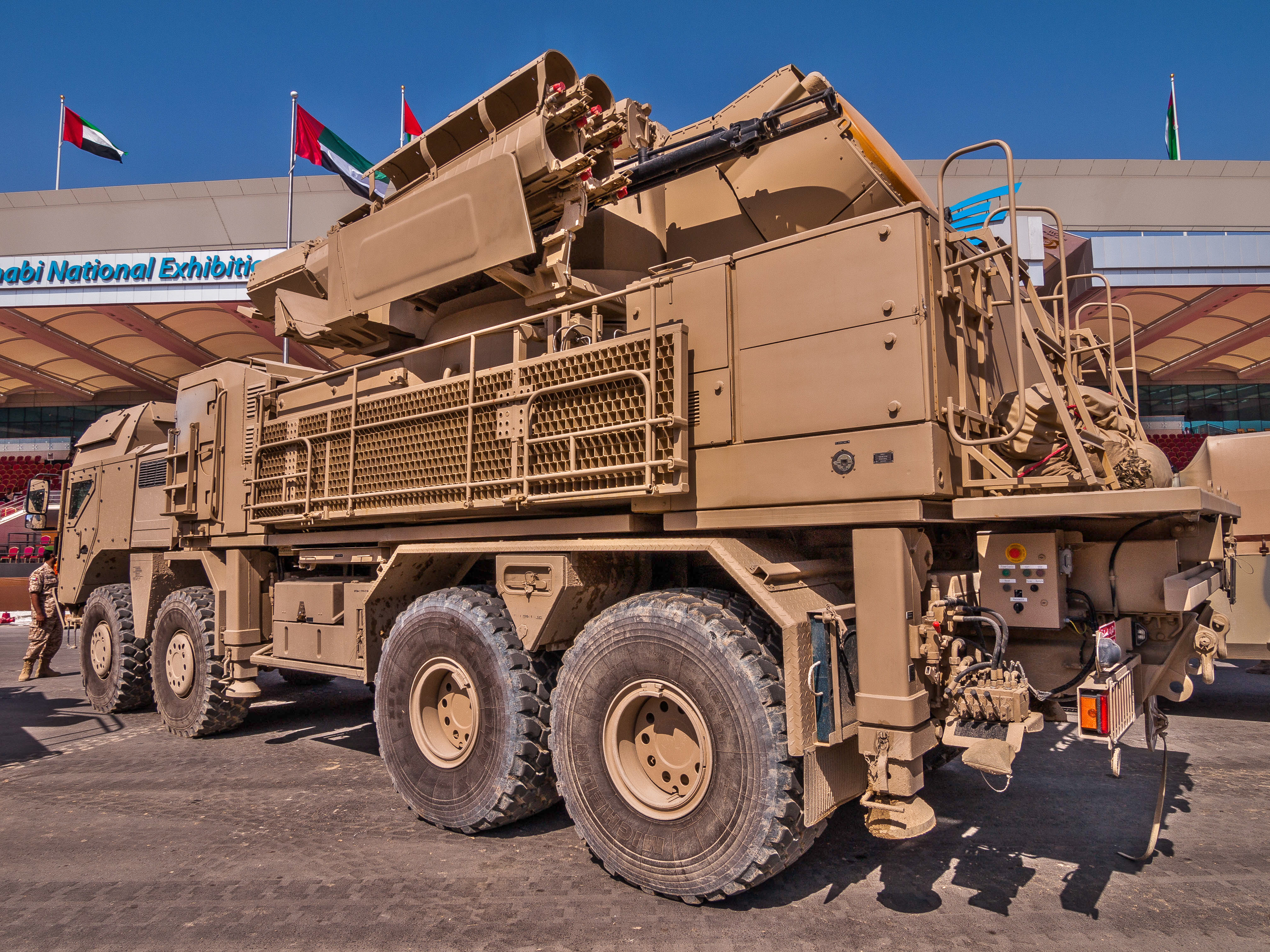
The Pantsir S1’s high degree of mobility makes it very desirable for the kind of light footprint expeditionary force maneuvers typical of Wagner Group operations, while its relatively compact size makes it easy to transport as air cargo. A large-sized armored vehicle, the Pantsir S1 carries 12 highly maneuverable missiles capable of shooting down enemy missiles at extremely low altitudes within a radius of 20 km, and it is designed to take out low flying planes, helicopters, and drones.34 It can also engage up to four targets simultaneously at any given time, making it optimal for object protection in high-tempo battles.
The Tula-based KBP Instrument Design Bureau, a Rostec subsidiary, developed the first prototype of the Pantsir S1 in the 1980s, according to Ruslan Pukhov, director of the Centre for Analysis of Strategies and Technologies (CAST), a Moscow defense think tank.35 Pantsir technology was repeatedly updated throughout the 1990s, and some consider the Pantsir S1 to be among the most advanced mobile anti-aircraft missile and cannon systems.36
The Pantsir S1 requires a three-person team for operation, and a single system is often accompanied by a separate command and control vehicle.37 Anywhere from seven to 10 crew members might typically be deployed as part of a full-package deal for Pantsir includes operation, maintenance, and repair for a single unit.38 The mobile truck-mounted system can detect and engage aircraft, missiles, and drones at a distance of 20 km, while rockets launched from the system can reach altitudes of up to 40,000 feet, according to the RAND Corporation.39 Reports of Pantsir systems damaged or seized in Libya indicate the presence of two distinct models; one kind had a made Russian Kamaz chassis, and another kind had a German-made truck chassis, the MAN SX45, which was only made for export to the UAE.40
For a brief time, Wagner Group and LNA forces looked poised to enter the Libyan capital, but their fortunes reversed after Turkey increased its military support to the GNA, which was then operating under the leadership of GNA Prime Minister Fayez al-Sarraj. Almost at the same moment that things seemed to be going Haftar’s way, Turkey began to contemplate giving more military aid to Sarraj's faltering government in Tripoli. It was then, in the summer of 2019, that the conflict in Libya became what the UN’s former special envoy to Libya, Ghassan Salame, called "possibly the largest drone war theatre now in the world.”41 Our analysis indicates that is also when the Wagner Group began to sustain its heaviest losses.
Analysis of open-source data indicates that the Wagner Group’s Pantsir S1 operations may provide clues about how the UAE and Russia collaborated during the LNA offensive on Tripoli. It also suggests that a string of costly airstrikes on Pantsir S1’s likely operated by a combination of Wagner Group and Emirati operatives in cooperation with the LNA not only led to major battlefield reversals in Libya, but along with similar losses in Syria, has since forced Russia to modify and upgrade the Pantsir to be more resistant to drones and to revamp its approach to air defense deployments.
Russia’s rapid integrated force deployment to the Middle East since the start of the conflicts in both Syria and Libya is a fairly reliable indicator of just how critical Moscow’s pre-existing historic relationships with clients of its military enterprises are to the forward operations of both official Russian military units and state-backed proxies with the Wagner Group network. Indeed, as at least one analyst has noted, in 2019, the UAE apparently supplied Wagner Group and Haftar’s LNA forces with several of its upgraded Pantsir S1M platforms.42
The findings come on the heels of two reports separately released by the Pentagon and the UN over the last year suggesting that the UAE co-financed Wagner Group operations in Libya. In March 2021, the UN issued a report implicating the UAE in backing the joint operations of Wagner Group fighters and Haftar’s LNA forces.43 If proven true, UAE support to state-backed Russian paramilitaries could represent a potential violation of existing UN arms embargoes against Libya and standing U.S. sanctions against the Wagner Group, and its chief financier, Prigozhin.
In theory, any evidence that a U.S. ally like the Emirates, or UAE, cut deals with Prigozhin, the Wagner Group, or individuals or organizations involved in supporting the Russian mercenary network could be grounds for American sanctions, or worse—the loss of a militarily powerful ally. Indeed, in late 2020, media coverage of obscure findings in a Pentagon report suggested that the UAE and Russia were co-financing joint operations between the Wagner Group operatives working for Prigozhin and Libyan strongman Gen. Khalifa Haftar almost blew up a $23 billion U.S. arms sales deal with the UAE in December 2020.44
The package includes sophisticated weaponry like F-35 aircraft and armed drones.45 The U.S. State Department, however, put a temporary hold on the deal in January after Congress raised objections over the UAE’s conduct and use of U.S.-made weapons in the conflict in Yemen. The fresh allegations about Emirati support for the LNA and the Wagner Group in Libya only inflamed the tensions between Congress and the Biden administration over the deal—not to mention the anxieties it has raised among Libyan factions once allied with the GNA in Tripoli.
The GNA’s ambassador to the UN was among the first to openly accuse the UAE of breaching the arms embargo on Libya.46 The next, more substantial, however cautious hint that the UAE could be linked to the financing of the Wagner Group surfaced in the November 2020 Pentagon report.47 In that report, the Pentagon indicated that the DIA had assessed that the UAE “may provide some financing for the group’s operations.” Emirati and Russian cooperation then became more apparent after a January 2021 story from the Times of London revealed that a Pantsir system had been purchased by the UAE from Russian and was later sent to Libya to support the LNA.48 Since then, allegations have swirled about the close collaboration between the UAE and Russia in the financing and deployment of thousands of Russian Wagner Group operatives in Libya. Emirati officials have denied having any involvement and pushed back against the notion that the UAE has a close defense partnership with Russia.49
In April, the Biden administration said, nonetheless, that it would move forward with the deal though the actual transfer would only take place in 2025, and it would be conditioned on evidence that the UAE would not use U.S.-made weapons in contravention to the law of armed conflict and international human rights law.50
Yet, the question of Emirati support for the LNA and the Wagner Group in Libya in breach of existing UN embargos remains unresolved. Moreover, recent allegations indicating that the very same support the Emriatis provided to the Wagner Group and LNA suggests at minimum inconsistency—if not outright incoherence—in the White House decision to transfer weapons to the UAE. At a minimum, the Biden administration should consider reevaluating whether the UAE is truly adhering to the conditions it has just set out for brokering the arms transfer deal.
With the U.S.-UAE arms sale now set to go forward, it will also likely provide more grist for Turkey, a NATO ally and regional rival of the UAE that has complained bitterly about uneven and unfair treatment after the U.S. imposed sanctions against Turkey in December 2020 for its purchase of Russian-made S-400 surface-to-air missile batteries.51 The United States says the S-400, a defensive weapon that has highly sophisticated signals sensing technology, is incompatible with NATO systems and poses a risk to NATO personnel. While it would be difficult to make a straight comparison between Turkey’s dealings with Russia and that of the UAE, it is worth noting that even circumstantial evidence that a key American ally like the UAE has coordinated with Russia to support off-book operations by quasi-governmental Russian paramilitaries is certainly worthy of closer scrutiny.
Our assessment of the Wagner Group’s ground operations during the Tripoli offensive, a review of flight and procurement data, and military-technical agreements between the UAE and Russia suggest there are grounds for additional inquiry into Russia’s defense logistics pipeline to the UAE, and its potential onward connections to Libya. The UAE has shelled out at least $734 million for the production, deployment, and maintenance of a fleet of Russian-made Pantsir S1 anti-aircraft batteries over the course of a series of military-technical agreements that span 30 years.52
Analysis of social media data and customs data for shipments of Pantsir-related equipment from Russia to the UAE during the 2019–2020 period brought to the surface links between Russian citizens and companies tied to a Wagner Group contingent that has been spotted across Africa and the Middle East. The network of Russian firms behind the Pantsir-related shipments appear to form the backbone of a sprawling military supply and logistics chain that spans from central Russia to the General Headquarters of the Armed Forces in Abu Dhabi in the UAE.
Although no conclusive evidence showing direct UAE financing for the Wagner Group has surfaced, our review of customs data found significant numbers of shipments of Pantsir-related equipment from Russia to the UAE during the period spanning the start of Haftar’s offensive on Tripoli in the spring of 2019 up to the signing of the ceasefire between LNA and GNA forces in the fall of 2020.
The period of increased shipments of Pantsir equipment coincided closely with heavy losses sustained by LNA forces in Libya and reports of Turkish drone strikes on several Pantsir batteries. Customs records we reviewed indicated a substantial number of shipments containing Pantsir related equipment from the central Russian city of were delivered to the UAE army headquarters in Abu Dhabi from 2019 to 2020. Analysis of flight data provided by C4ADS also identified suspect flight patterns for dozens of cargo planes that appeared to provide an illicit airbridge from the UAE into Libya during roughly the same period.
Evidence we found further revealed that the Russian logistics company that managed those shipments also is implicated in the illicit transfer of Russian military material to Russian-backed separatists in the disputed Ukrainian territory of Donbas. Publicly available records indicate that a logistics transfer station managed by a subsidiary of United Cargo Solutions, or UCS, a Moscow-based Russian shipping and logistics firm, arranged the shipment of Pantsir-related equipment via a temporary storage site in Tula.53 Reporting by Myrotvorets, a Ukrainian NGO, indicates that UCS was also allegedly involved in the transfer of material into Donbas.
An assessment of customs data for 122 shipments from Russia to the UAE during the 2019 to 2020 period shows that the Russian logistics company, which has also been linked by Ukrainian researchers to shipments of military goods to Russian-backed separatist fighters in the contested region of Donbas, was integral to the shipment of Pantsir-related materials to the UAE that were valued at an estimated $7.99 million dollars.54
Goods shipped as part of the flow of material from Russia to the UAE during the peak of Haftar’s offensive in Libya include computer components for Pantsirs; parts for a phased array antenna for Pantsirs; optical-electrical sensors for Pantsirs; hydraulic cylinders for the antennae of target detection station of Pantsirs; and a processing and control unit for Pantsir radar, according to customs data we reviewed.
Figure 1: A web page for United Cargo Solutions indicates that it provides support for shipments to and from the Donetsk People’s Republic, or DPR, in the contested eastern territory of Donbas, Ukraine.

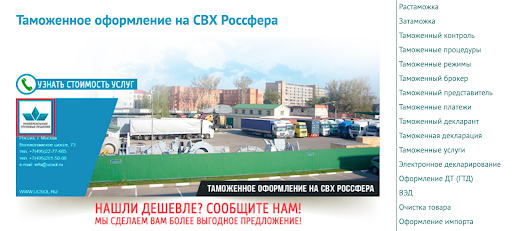
The data also indicates that the UCS subsidiary, Rossfera LLC, handled the shipments for the KBP Instrument Design Bureau, the primary manufacturer of Pantsir weapons systems. Additionally, the company website for UCS lists the KBP Instrument Design Bureau, the Russian manufacturer of Pantsir systems, as a key client and partner, and indicates that UCS handles shipments for Rossfera.55
Figure 2: Customs data for shipments of Pantsir related equipment lists the customs registry license number for Tula based Rossfera LLC as the primary point of contact for KBP Instrument Design Bureau shipments to the UAE armed forces headquarters in Abu Dhabi.
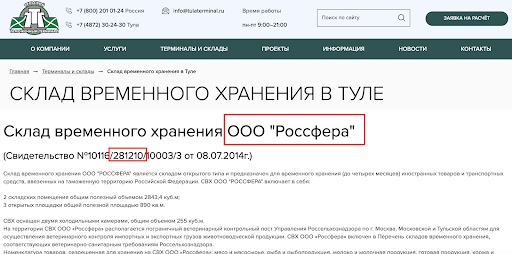
Figure 3: A web page for UCS indicates it uses the temporary storage site registered to Rossfera LLC for shipments from Tula, Russia and lists the KBP Instrument Design Bureau as a key client and partner.56
While the alleged illicit transfer of goods to eastern Ukraine via the UCS logistic pipeline reportedly sprang to life after the start of the Russian-separatist putsch in 201457 and appears to be part of a separate illicit arms pipeline, the chain of Russian logistics companies and transit stations is clearly integral to covert Russian arms transfers and PMSC operations. Although Russia has been laboring under extensive U.S. sanctions for years, and dozens of firms that have had business dealings with Russian defense firms have been sanctioned under the 2017 U.S. Countering America’s Adversaries Through Sanctions Act (CAATSA), neither United Cargo Solutions nor Rossfera shows up in the U.S. Treasury Department’s sanctions database. Better known by its acronym, CAATSA, the 2017 sanctions law aims to impose costs on organizations or individuals that conduct significant transactions with Russian defense and intelligence sector-related entities on the sanctions list.58
Whether the omissions of two key Russian logistics firms from the sanctions registers is a mere oversight or there are other reasons Treasury has not listed them, their notable absence from the sanctions registry points to serious design flaws in the legal architecture of CAATSA. As analyst Jarod Taylor points out, for mid-sized states such as the UAE with large discretionary budgets, uneven implementation of the law—and we would argue poor intelligence about Russia’s new semi-privatized defense industry model—means that U.S. allies have few incentives to cooperate in the imposition of sanctions on Russia.59
That much is clear from the large size of expenditures funneled into the transfer of Pantsir platforms to the Libyan theater. Priced at roughly $15 million each, the dozen Russian made Pantsirs transferred into Libya and ultimately destroyed in battle represented potentially more than $100 million in military equipment; and that very rough cost estimate likely does not fully account for shipping, training, maintenance, and support expenses. Nor does it necessarily account for the cost of replacement parts.
Financial costs for Pantsir-related military equipment supplied to the Wagner Group and LNA fighters, however, pales in comparison to the heavy toll taken on the lives of Libya civilians from Pantsir missile fire and the high price paid by scores of Russian contractors who spearheaded the LNA’s air defense maneuvers on the ground in Libya. There were strategic costs too. While the Wagner Group succeeded in briefly giving Haftar’s forces the upper hand in 2019, once they reached the southern suburbs of Tripoli that summer, Russian and LNA forces were unable to hold their territorial gains. After Turkey increased its military support to the embattled GNA government almost a year after the start of the LNA offensive, Haftar’s forces and Wagner operatives beat a hasty retreat eastward to the LNA’s main strongholds near Benghazi.
Citations
- Sergey Suhankin, “Russian Mercenaries Pour Into Africa and Suffer More Losses (Part One),” Jamestown Foundation, January 21, 2020. https://jamestown.org/program/russian-mercenaries-pour-into-africa-and-suffer-more-losses-part-one/
- Gus H. Goudarzi, “Geology and Mineral Resources of Libya Reconnaissance,” Geological Survey, U.S. Department of Interior, 1970 https://pubs.usgs.gov/pp/0660/report.pdf; Guido Meinhold, Daniel P. Le Heron, et.al., “The Search for “Hot Shales” in the Western Kufra Basin, Libya,” 2018. https://eprints.keele.ac.uk/4088/1/Meinhold_etal_2016_AJGS.pdf
- Giancarlo Ella Valpri, “Haftar’s Latest Declarations,” Modern Diplomacy, May 6, 2020. https://moderndiplomacy.eu/2020/05/06/khalifa-haftars-latest-declarations/
- For a detailed description of specifications for the Pantsir S1 see the manufacturer website of KBP Instrument Design Bureau: http://www.kbptula.ru/en/productions/air-defense-weapon-systems/pantsir-s1; archived version: https://archive.is/wip/Zi9dA
- DefenseWorld.net, “Russian Pantsir Air Defense System- Sitting Duck or Top Dog?” June 19, 2020. https://www.defenseworld.net/feature/42/Russian_Pantsir_Air_Defense_System__Sitting_duck_or_Top_Dog_#.YQsO8dNKifR
- Centre for Analysis of Strategies and Technologies (CAST), “Russian Arms Deliveries to the Arab Countries of the Persian Gulf Region,” Moscow Defense Brief, 4: 14, 2008. https://www.files.ethz.ch/isn/94687/2008_4.pdf
- Center for Strategic and International Studies (CSIS)t, “Pantsir S1,” Missile Defense Project, last updated July 6, 2021. https://missilethreat.csis.org/defsys/pantsir-s-1/
- Center for Strategic and International Studies (CSIS)t, “Pantsir S1,” Missile Defense Project, last updated July 6, 2021. https://missilethreat.csis.org/defsys/pantsir-s-1/
- Gordon, John IV, John Matsumura, Anthony Atler, Scott Boston, Matthew E. Boyer, Natasha Lander, and Todd Nichols, Comparing U.S. Army Systems with Foreign Counterparts: Identifying Possible Capability Gaps and Insights from Other Armies. Santa Monica, CA: RAND Corporation, 2015. https://www.rand.org/pubs/research_reports/RR716.html.
- Joseph Trevithick, “The United States Smuggled A Russian-Made Pantsir Air Defense System Out Of Libya: Report,” The Drive, January 27, 2021. https://www.thedrive.com/the-war-zone/38964/the-united-states-smuggled-a-russian-made-pantsir-air-defense-system-out-of-libya-report
- BBC, “UAE Implicated in Lethal Drone Strike in Libya,” August 28, 2021.https://www.bbc.com/news/world-africa-53917791
- Oryx, “Tracking Arms Transfers by The UAE, Russia, Jordan And Egypt To The Libyan National Army Since 2014,” March 23, 2021. https://www.oryxspioenkop.com/2020/06/types-of-arms-and-equipment-supplied-to.html
- United Nations Panel of Experts on Libya report, March 8, 2021. https://undocs.org/Home/Mobile?FinalSymbol=S%2F2021%2F229&Language=E&DeviceType=Mobile
- Amy Mackinnon, “Pentagon Says UAE Possibly Funding Russia’s Shadowy Mercenaries in Libya,” Foreign Policy, November 30, 2020. https://foreignpolicy.com/2020/11/30/pentagon-trump-russia-libya-uae/; Joe Gould, “Senate to Vote on Banning $23 billion UAE Arms Sales Next Week,” Defense News, December 3, 2020.https://www.defensenews.com/congress/2020/12/03/us-senate-to-vote-next-week-on-23b-uae-arms-sale/
- Patricia Zengerle, “Biden Administration Proceeding with $23 billion Weapon Sales to UAE,” Reuters, April 13, 2021.https://www.reuters.com/business/aerospace-defense/exclusive-biden-administration-proceeding-with-23-billion-weapon-sales-uae-2021-04-13/
- Abdulkader Assad, “Libyan Ambassador to UN at Security Council: UAE, France Breached Libya's Arms Embargo,” Libya Observer, January 30, 2020.https://www.libyaobserver.ly/news/libyan-ambassador-un-security-council-uae-france-breached-libyas-arms-embargo
- Lead Inspector General for East Africa And North And West Africa Counterterrorism Operations, Quarterly Report to the United States Congress July 1, 2020 - September 30, 2020, November 23, 2020, 37. https://media.defense.gov/2020/Dec/04/2002546287/-1/-1/1/LEAD%20IG%20EAST%20AFRICA%20AND%20NORTH%20AND%20WEST%20AFRICA%20COUNTERTERRORISM%20OPERATIONS.PDF
- Samer al-Atrush, “Russian Missile System Spirited Out of Libya by U.S.”, The Times, January 28, 2021. https://www.thetimes.co.uk/article/russian-missile-system-spirited-out-of-libya-by-us-hjjtz0kd2
- Twitter post by @UAEEmbassyUS, Dec.30, 2020: https://twitter.com/UAEEmbassyUS/status/1334548475355271168
- Michael Crowley and Edward Wong, “U.S. Is Expected to Approve Some Arms Sales to the UAE and Saudis,” New York Times, April 14, 2021. https://www.nytimes.com/2021/04/14/us/politics/arms-sales-uae-saudi-arabia.html
- BBC, “U.S. imposes Sanctions on Turkey over Russia Weapons,” December 14, 2020.https://www.bbc.com/news/world-us-canada-55311099
- Anthony H. Cordesman and Khalid R. Al-Rodhan, “Gulf Military Forces in an Era of Asymmetric Warfare,” Working Paper for Review, Center for Strategic and International Studies (CSIS), June 28, 2006, p. 10. https://csis-website-prod.s3.amazonaws.com/s3fs-public/legacy_files/files/media/csis/pubs/060728_gulf_uae.pdf
- New America reviewed customs and shipping data for KBP Instrument Design Bureau for the 2019-2020 period provided by C4ADS. Customs data for Pantsir-related equipment shipped from Tula to Abu Dhabi included the registry number for Rossfera LLC (10116/281210/10003/3), which is also listed as the operator of a temporary storage site by the Tula Customs Terminal on its webpage here: https://tulaterminal.ru/terminaly-i-sklady/sklad-vremennogo-khraneniya-v-tule/; archived version: https://archive.is/wip/mfH26 A separate website for UCS Holdings refers to Rossfera LLC as an affiliate.
- Myrotvorets expressly names the one-time director general of UCS Holdings, Sergey Alexandrovich Martyanov, as culpable in the illicit transport of goods into Donbas; the listing for Martyanov and UCS Holdings can be found here: https://myrotvorets.center/criminal/martyanov-sergej-aleksandrovich/
- United Cargo Solutions (Универсальные Грузовые Решения) homepage: https://ucsol.ru/; archived web page referencing United Cargo Solutions ties to Rossfera LLC, the primary, logistics hub manager for transfer of KBP Instrument Design Bureau export shipments can be found here: https://archive.is/vtsBv#selection-907.26-907.56
- Archived USC webpage: https://archive.is/vtsBv#selection-907.25-907.57
- Myrotvorets expressly names the one-time director general of UCS Holdings, Sergey Alexandrovich Martyanov, as culpable in the illicit transport of goods into Donbas; the listing for Martyanov and UCS Holdings can be found here: https://myrotvorets.center/criminal/martyanov-sergej-aleksandrovich/
- U.S. Federal Register, ”Notice of Department of State Sanctions Actions Pursuant To Section 231(a) of the Countering America's Adversaries Through Sanctions Act of 2017 (CAATSA) and Executive Order 13849 of September 20, 2018, and Notice of Additions To the CAATSA Section 231(d) Guidance,” October 5, 2018. https://www.federalregister.gov/documents/2018/10/05/2018-21684/notice-of-department-of-state-sanctions-actions-pursuant-to-section-231a-of-the-countering-americas
- Jarod Taylor, “An American Failure: CAATSA and Deterring Russian Arms Sales,” FPRI, November 26, 2019. https://www.fpri.org/article/2019/11/an-american-failure-caatsa-and-deterring-russian-arms-sales/
Analyzing Wagner Group Air Defense and Ground Maneuvers
Chasing Pantsirs and the Wagner Group Across the Desert
A deeper look at several of the pivotal drone strikes on Pantsir S1 crews shows that as Russian PMSC operatives maneuvered on the ground, they also left a trail of clues about who sponsored the Wagner Group’s participation in the LNA offensive. We used publicly available data, including dozens of posts on Twitter, Facebook, and Telegram, to document strikes on Pantsir units that spanned roughly from April 2019 to October 2020 when a ceasefire agreement was ultimately reached between the LNA and GNA government in Geneva. In all, we collected and analyzed more than 230 social media posts, as well as satellite images, and Arabic, Russian, and English news reports to form a highly detailed picture of the Wagner Group’s use of Pantsir S1 anti-aircraft missile batteries during the LNA’s Operation Flood of Dignity.60
It is important to acknowledge up front, however, that the data we collected from social media sources is far from comprehensive, and likely reflects a strong anti-Russia and pro-GNA bias. For example, the Pentagon’s AFRICOM has recently taken a much more aggressive approach to using Twitter to highlight Russia’s intervention in Libya, but mentions of Emirati air operations do not seem to appear often, if ever, in AFRICOM’s Twitter feed.
Likewise, video footage of Turkish drone strikes posted under the @clashreport Twitter handle typically includes Turkish language commentary and glory shots of the Turkish-made Bayraktar TB2, suggesting that the account is likely a cut out for the Turkish government. Where possible, we attempted to triangulate data on strikes collected from social media using additional sources such as media reports and accounts from eyewitnesses in Libya who also posted about incidents. The data we reviewed, nonetheless, sheds new light on how the Wagner Group lost its edge in Libya’s long-running conflict.
Before and after the beginning of the Tripoli offensive in April 2019, Emirati Wing Loong II drones appeared in satellite imagery at Al Khadim and Jufra air bases but disappeared in August 2019.61 Russian personnel reportedly seized control of both air bases by May 2020.62 The Wing Loong drone strikes initially proved quite successful in the first place as they accurately hit GNA targets and downed Turkish drones.63
For a brief time, the combined use of drones and Pantsirs operated by Russian Wagner Group air defense units created a protective bubble over western Libya where the Chinese-produced Wing Loongs operated by both the LNA and Emiratis conducted operations with impunity. But Turkey soon turned the tides with its intervention using Korkut anti-aircraft guns to shoot down hostile LNA drones. Turkey also deployed KORAL electronic warfare systems that were likely used to jam and deceive Pantsir radar equipment, leaving them vulnerable to airstrikes.64
We counted a total of 10 strikes on Pantsir S1 crews in Libya that took place from September 2019 to July 2020, and we were able to visually confirm that at least six Pantsir S1’s were destroyed during the offensive on Tripoli. Data we reviewed indicated that at least one Pantsir S1 was badly damaged during a Turkish supported GNA attack on the al-Watiya airbase on May 16, 2020.65 In some instances, the degree of damage to Pantsir mobile operating units was unclear from the social media posts that we reviewed. But we, nonetheless, found that another four Pantsirs were likely destroyed by triangulating the date and location of reported Wagner casualties with a combination of satellite imagery data and social media posts.
In all, we counted nearly 100 Wagner Group fighters who were reportedly wounded or killed during the September 2019 to July 2020 period when the Turkish air campaign was at its most intense.66 According to sources we consulted for this report, the vast majority of Wagner Group casualties were likely caused by Turkish drone strikes or shipborne surface-to-air missiles fired from Gabya destroyers that were made more effective by the use of signals-jamming equipment that made it difficult for the Pantsir radar and signals detection equipment to track incoming hostile missile fire.67
In some instances, it is unclear how Pantsirs were hit. A video compilation posted by @clashreport on Twitter on May 21, 2020, for example, shows various strikes on a number of systems.68 Three of the strikes depicted Pantsirs that were targeted with their weaponry covered over with canvas. In another one of the strikes shown, the Pantsir crew appears unable to defend itself despite the fact that it is in a defensive position and the drone is within range.
A fifth strike around July 16, 2020, shown in the compilation, shows a Pantsir that seems to be parked outside one of the aircraft shelters at Al Watiya in southern Libya. The text in the video claims GNA forces destroyed a total of 15 Pantsirs. However, @clashreport seems to generally favor GNA-ally Turkey. Its affiliation is opaque but having first access to Turkish combat footage makes links to Ankara likely.69
One possible explanation for the underwhelming performance of Pantsir units could be poor handling. Another more likely reason that Russian officials have in fact publicly, if indirectly, acknowledged,70 is that unlike those deployed to Syria, the Pantsirs deployed to Libya did not have radar systems that were optimized for intensive drone warfare.71 Turkey reportedly used KORAL jamming systems in both countries, but could have had better intelligence about the position of Pantsir units in Libya. While reports of Pantsir losses in Syria and Libya vary, those in Libya tend to be higher, with eight in Syria and, in Libya, between 10 by New America’s count or 15 as reported by Ukrainian outlet Defence Express, for example.72
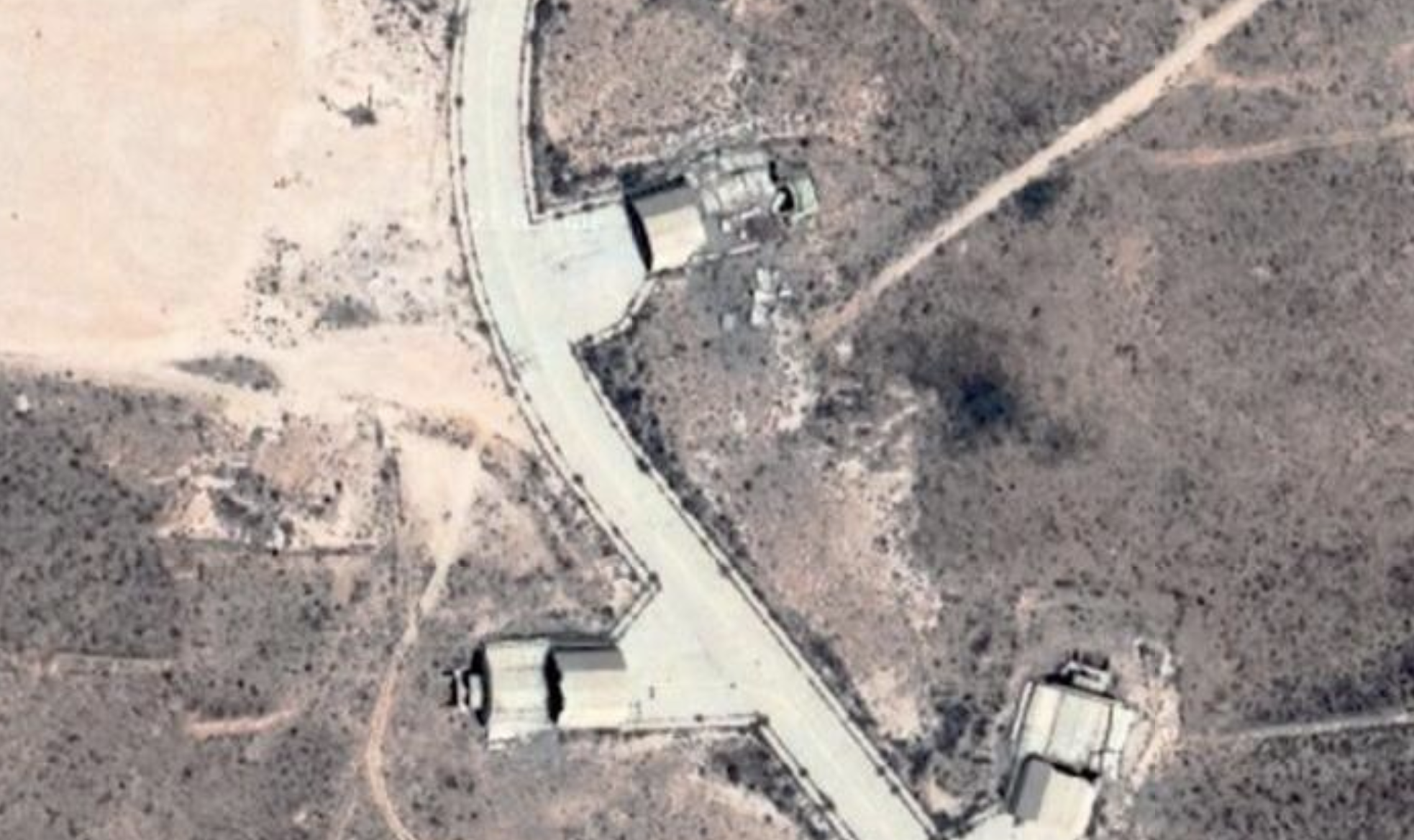
We examined satellite imagery for two successful strikes on Pantsir batteries.73 For the May 17, 2020 strike on Al Watiya airbase, a hardened aircraft shelter can be seen almost entirely destroyed. The entrance hangar had been targeted, likely by a drone, and then again hit by a larger, unknown munition74 as a Bayraktar TB2 would be incapable of causing such damage. Social media accounts extensively documented the delivery of a Pantsir75 as well as various strikes on May 1676 and 17, 2020.77
Figure 4: Destroyed hardened aircraft shelter al Al Watiya airbase (at longitude 32.478641, latitude 11.879423 via Google Maps, July 23, 2021).
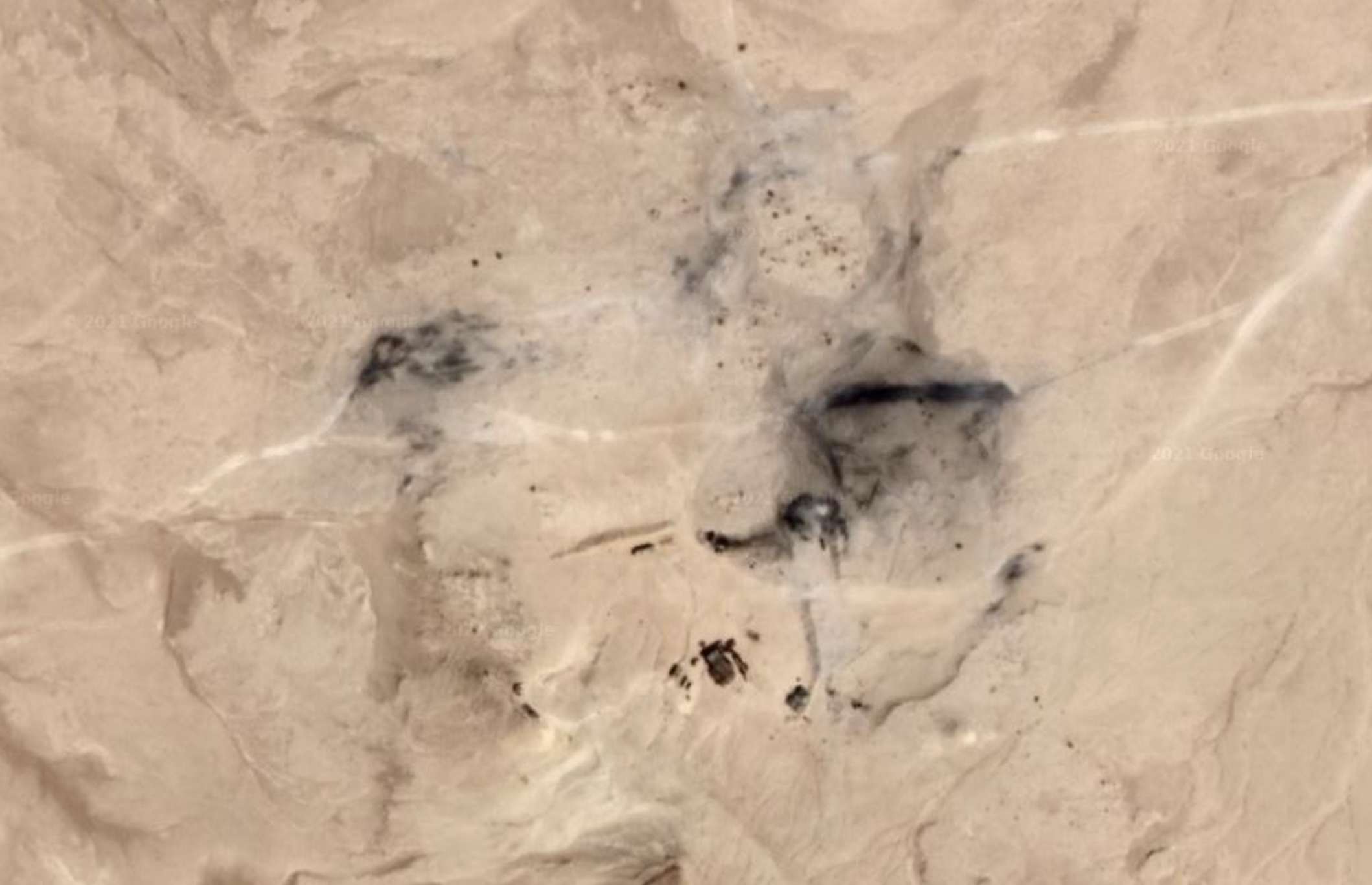
High resolution imagery of the strike near the southwest town of Sawknah on July 7, 2020 shows traces of one or several larger explosions and some sort of military structure in the desert, possibly an armored vehicle. The strike reportedly killed three Wagner operators in addition to destroying one Pantsir.78
Figure 5: Apparent traces of airstrike on a Wagner/LNA position near the town of Sawknah (longitude 29.167065, latitude 15.793217, via Google Maps, July 22, 2021).
Russian moves to improve Pantsir performance following these and other losses in the Middle East would seem to bear out the supposition that the Russian mercenary expeditionary forces serve as an important component of the Kremlin’s strategy of using proxy fighters in contested theaters to experiment with different approaches to networked warfare. In May 2019, the Russian state news outlet Tass and other sources reported that the Pantsir S1’s manufacturer, the state-run KBP Instrument Design Bureau in Tula, gave its system an overhaul with a “75-kilometer range radar and an ‘advanced’ electro-optical target tracking system” to better cope with UAVs.79
One analyst has suggested that the upgrades to the Pantsir and the rollout of the Pantsir S1M were a direct result of heavy losses incurred in Syria and Libya.80 This view also seems to be corroborated by coverage of the changes to the Pantsir by Russia’s official state press organs.81 Still, as Michael Kofman, a leading expert on Russian military affairs has suggested, there are reasons to be skeptical of claims about the performance of weapons systems that appear in the official Russian state press.82
Counting Casualties
As noted earlier, the civilian casualty count during the Tripoli offensive was exceptionally high, and combatants on all sides both caused and sustained heavy losses. The Wagner Group appeared to take the biggest hits to its forces in the fall of 2019. While it is clear from the available public data that many of the Wagner Group’s casualties likely occurred as a result of Turkish drone strikes on Russian units operating and supporting Pantsir surface-to-air missile units, the exact numbers of those killed are still unknown.
The locations where major Wagner Group casualties were reported by the UN and Russian media, nonetheless, seem to be consistent with locations also mentioned in Libyan media coverage, such as in Sawknah,83 Espiaa,84 or Qasr Bin Gashir.85 For example, the first two named Wagner operators who allegedly died in Libya alongside five or six companions were Artyom “Hulk” Nevyantsev and Ignat “Benya” Borichev on September 9, 2019, in the Saturday market area south of Tripoli.
Meduza, an online journal that covers Russian and Eurasian affairs, reported that Nevyantsev was one of the 35 Russians killed in Libya that it had identified and said Nevyantsev had previously fought in the Donbas region. A GNA or Turkish drone strike on the village of Espiaa also allegedly killed Vadim Bekshenev on September 25, 2019, and he has since been reported missing in action by his family, according to the same report.86 A video87 of Bekshenev’s phone and its contents ended up on social media, as well as other belongings, including a credit card.88 GNA forces also found more footage of Wagner operators on the phone showing them interacting with locals in Qasr Bin Gashir.89
The Conflict Intelligence team unearthed more clues about Bekshenev’s background from the video post, social media posts on Bekshenev’s Vkontakte account, and other sources.90 A decorated Russian marine, Bekshenev’s Vkontakte posts indicate he served at one point with the Paratrooper Assault Battalion of the 165th Naval Infantry Regiment of the 55th Naval Division, which was based in Vladivostok in the Russian Far East until 2009.91 A specialist in electronic warfare who served in Syria with the Wagner Group was also at one point based in Russia’s highly protected military enclave in Kaliningrad, Bekshenev also appears to have served in the 841st Independent Electronic Warfare Center of the Baltic Fleet, which is based in Russia’s Western Military District.92 While the details of Bekshenev’s military background may seem at first glance not particularly unusual for a contract soldier, they point to larger trends we have observed in the recruitment patterns among military-aged Russian men who have claimed online to have an affiliation with the Wagner Group.
In 2020, New America conducted a review of hundreds of Vkontakte postings made by 384 users who are members of a popular Vkontakte microblog that tracks Russian mercenary activities and culture and who claimed to have ties to the Wagner Group. The users in this small network identified official Russian military units they had served in both their user-profiles and in a lengthy thread about the Wagner Group. Upon close inspection, we found that the Western Military district ranked as the top location for units self-reported by “Wagnerovtsy” or “Musicians” in the group of 384 users. While the sample size is admittedly too small to draw any firm conclusions and the fidelity of claims posted online requires further verification, information about prior service provides valuable insights into the Wagner Group’s recruitment patterns. One trend we noted is that many of those in our small dataset claimed to have served in military units that had been downsized or reorganized as part of Russia’s force deployment overhaul from 2008 to 2012.93 Most in this small subset claimed affiliation with military units based in Russia, but a substantial number also claimed to come from locations outside Russia. (See tables below for a breakdown of the data).
Table A – Reported Data by Military District
| Military District | Number of Reported Affiliations |
|---|---|
| Western Military District | 92 |
| Southern Military District | 73 |
| Central Military District | 48 |
| Eastern Military District | 17 |
| Northern Fleet Military District | 3 |
| Outside Russia* | 23 |
| Total | 256 |
*Outside Russia includes units in Belarus, South Ossetia, Ukraine, DPR and LPR
Table B – Locations* of Reported Military Units
| Location | Number of Reported Affiliations |
|---|---|
| Russian Federation | 229 |
| Belarus | 8 |
| Ukraine | 5 |
| Afghanistan | 2 |
| Donetsk People’s Republic | 2 |
| South Ossetia | 2 |
| Tajikistan | 2 |
| Armenia | 1 |
| Estonia | 1 |
| Kazakhstan | 1 |
| Lithuania | 1 |
| Luhansk People’s Republic | 1 |
| Moldova | 1 |
| Total | 256 |
In line with the analysis above, it is important to note that Russian and Libyan media outlets further identified several more Wagner Group operators who were killed and injured who served in Syria and often appear to have been drawn from units that fought in Donbas. In late 2019, for instance, Evgeny Ilyubaev reportedly died in Libya.94 The 55-year-old was from Novoorsk, Orenburg, and had reportedly fought in Ukraine and Syria as well. Another fighter from the Orenburg region named Gleb Mostov died in early 2020, according to the local Russian newspaper Orengrad.95 Mostov, who reportedly fought under an assumed name, was 27 years old and operated as a sniper.96 In all, our review of publicly available accounts suggests that the Wagner Group sustained an estimated 53 to 100 casualties in Libya from September 2019 to July 2020, of which 42 to 81 were killed and 11 to 19 injured (see Figure 4 below for breakdown).
Among the most notable Wagner Group casualty reports from the Libyan front was that of Alexander Kuznetzov. Kuznetzov, who famously posed for a photo along with Putin and the Wagner Group’s titular field commander Dmitry Utkin at a state banquet in St. Petersburg, is a veteran military officer who was trained at a military college in St. Petersburg and served for a time as commander of a special operations unit in Moscow.97 A Ukrainian organization has also suggested that Kuznetsov fought in Syria before deploying to Libya.98 According to the UN panel of experts on Libya, Kuznetsov was seriously injured and transferred to St. Petersburg for medical treatment in the fall of 2019.99
Operating under the call sign “Ratibor,” Kuznetzov is reportedly one of the founding members of the Wagner Group and he fought in Donbas with Rusich, a Russian paramilitary contingent believed to be part of the Wagner Group’s core network.100
Known for its neo-fascist ideology, Rusich featured prominently in a separate investigation New America conducted into the gruesome videotaped beheading of a Syrian national in 2017.101 Kuznetzov fought as a member of Rusich, a subunit under the command of Alexander Bednov’s Batman Battalion, which has also been accused of war crimes and was a well-known vector for specialized foreign fighter units in Donbas.102
Kuznetzov’s presence and that of several other Donbas veterans with possible ties to Rusich suggest that it is perhaps not coincidental that several Russian-operated Pantsir units appear to bear the distinctive markings of ancient pagan Norse runes painted on the door of the vehicle cab.103 Commonly used by Rusich on its social media accounts, the runes for the Norse god of war Odin were deployed by the Nazis in Germany and have also been appropriated by white supremacist groups.104
In addition, a BBC investigation found evidence for ties between the Russian military and Wagner Group operatives in Libya as well as signs that at least some Wagner operatives show a deep affinity for white supremacist symbols and ideology.105 The BBC investigation unearthed a list from January 19, 2020, ordering weapons that usually only the Russian army has access to, including a T-72B tank and a Sobolyatnik compact radar system.106 The BBC also gained access to a tablet previously used by a Wagner operator that contained information on an operative named Fedor “Metla” Metelkin, who had reportedly joined the Wagner Group five or six years ago—before the Russian PMSC joined the battle in Tripoli and when they were active in eastern Ukraine. An assessment of his social media contacts once again shows links to the neo-fascist Pagan scene.107
Figure 6: Reverse Side of the Medal Twitter post from July 2021 purportedly depicting Norse runes painted on the side of a Pantsir S1 mobile surface to air missile launcher in “North Africa.”
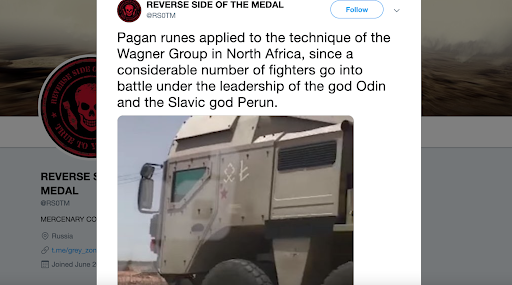
Videos and images from Libya’s frontline during and after the offensive on Tripoli show the Wagner forces scattered and scrambling into defensive positions across the Sirte-Jufra line. As the Wagner Group began pulling out of Tripoli in June 2020, they left traces such as landmines that likely came from Soviet era stashes and Russian-made booby-trapped munitions with Russian fuses. Incidents from landmines led to 30 to 40 civilian fatalities after citizens returned to their homes when the offensive ended.108 Suspected Russian-made landmines injured an estimated 78 to 110 people.109
In addition, around five civilians were reportedly killed by gunfire from Wagner operatives.110 A BBC investigation into those killings found that three of them were abducted and killed in Espiaa on September 23, 2019. Airwars identified one of the perpetrators as Vladimir Andanov, who had previously been implicated in extra-judicial killings in Ukraine.111
Toward the end of the Tripoli offensive, Wagner reportedly dug a large trench system near the frontline running from Sirte to Jufra.112 Pictures of Wagner mercenaries repeatedly showed up on social media during this period, often near bases such as Jufra, where they have been spotted in Emirati-produced armored vehicles.113 Besides their locations in Jufra,114 a review of social media posts suggests Wagner operatives have been sighted at the Al Khadim air base and possibly at smaller bases such as Brak.115
Figure 7: Wagner Group personnel and equipment losses in Libya between September 2019 and July 2020.
| Wagner Group Casualty & Damage Assessment from Suspected Strikes on Pantsir S1’s in Libya | Wagner Group Casualty & Damage Assessment from Suspected Strikes on Pantsir S1’s in Libya | Wagner Group Casualty & Damage Assessment from Suspected Strikes on Pantsir S1’s in Libya | Wagner Group Casualty & Damage Assessment from Suspected Strikes on Pantsir S1’s in Libya |
|---|---|---|---|
| Date | Location | Damage | Casualties |
| 09/09/2019 | Saturday market | Target damage unknown | 7 Wagner combatants killed or injured{{116}} |
| 09/23/2019 | Espiaa | Target damage U=unknown | 3-15 Wagner combatants killed{{117}} |
| 12/02/2019 | Qasr Bin Gashir | Target damage unknown | 9 Wagner combatants killed{{118}} |
| 04/02/2020 | Bani Walid | Target damage unknown | 1 Wagner combatant killed, 1 injured{{119}} |
| 04/03/2020 | Sirte | Target damage unknown | 20 Wagner combatant killed{{120}} |
| 04/09/2020 | Al Watiya | Target damage unknown | 4-6 Wagner combatant killed{{121}} |
| 05/16/2020 | Unknown | Target damage unknown | 15 Wagner combatant killed{{122}} |
| 05/16/2020 | Al Watiya | 1 Pantsir damaged{{123}} | 4 combatants killed, unclear whether Wagner or not{{124}} |
| 05/17/2020 | Al Watiya | 1 Pantsir destroyed{{125}} | Casualty count unknown |
| 05/20/2020 | Tarhuna | 3 Pantsirs destroyed{{126}} | Casualty count unknown |
| 05/20/2020 | Al Wushka | 2 Pantsirs destroyed{{127}} | Casualty count unknown |
| 05/20/2020 | Sirte | 1 Pantsir destroyed{{128}} | Casualty count unknown |
| 05/20/2020 | Souq Al Ahed | 1 Pantsir destroyed{{129}} | Unknown |
| 07/07/2020 | Sawknah | 1 Pantsir destroyed{{130}} | 3 Wagner combatants killed, 7 injured |
| 08/07/2021 | Jufra | None | 1 Wagner combatant killed{{131}} |
Citations
- Initial research on landmines and Turkish drone strikes by Airwars. Additional research from New America through local Libyan news media, social media, and government outlets. Telegram research on likely GRU-affiliated groups by Reverse Side of the Medal and Military Informant, two Russian social media verticals that track Russian mercenary activity,and additional investigations on Russian media outlets. For sources see: Reverse Side of the Medal’s Vkontakte page here: https://vk.com/rsotm; archived version: https://archive.is/KyqTW
- Benjamin Strick, Twitter, August 28, 2020. https://twitter.com/BenDoBrown/status/1299357673880682498
- Jalel Harchaoui, Twitter, June 8th, 2021. https://twitter.com/USAfricaCommand/status/1265630878295785477; AFRICOM, Twitter, May 27, 2020. https://twitter.com/USAfricaCommand/status/1265630878295785477; AFRICOM, Twitter, July 24, 2020. https://twitter.com/USAfricaCommand/status/1286639971642875904
- Oliver Imhof, Airwars, September 25, 2019. https://airwars.org/news-and-investigations/increasing-foreign-involvement-could-spiral-libya-conflict-out-of-control/
- United Nations Panel of Experts on Libya report, March 8, 2021, 17. https://undocs.org/Home/Mobile?FinalSymbol=S%2F2021%2F229&Language=E&DeviceType=Mobile
- Joseph Trevithick, “The United States Smuggled A Russian-Made Pantsir Air Defense System Out Of Libya: Report,” The Drive, January 27, 2021. https://www.thedrive.com/the-war-zone/38964/the-united-states-smuggled-a-russian-made-pantsir-air-defense-system-out-of-libya-report; Oryx, “Al-Watiya - From A Libyan Super Base To Turkish Air Base”, February 12, 2021. https://www.oryxspioenkop.com/2020/09/al-watiya-airbase-capture.html
- Libyan sources reporting on losses on the LNA end can often be highly partisan due to their affiliation with the GNA, Turkey, or other anti-Haftar groups. Strikes in remote desert locations can be even more challenging to verify because of the difficulty with distinguishing features when using commercially available open-source satellite map applications such as Google Earth.
- Phone interviews with former U.S. defense official and Libya Government of National Accord official, December 2020. See also: Joseph Trevithick, “Two Turkish Frigates Appear Off Libya Amid Reports Of Troops And Armor Landing Ashore,” The Drive, January 28, 2020. https://www.thedrive.com/the-war-zone/32002/two-turkish-frigates-appear-of-libya-amid-reports-of-troops-and-armor-landing-ashore
- Clash Report, Twitter, May 21st, 2020. https://twitter.com/clashreport/status/1263250605621030912
- Seth J. Frantzman, “Turkey pro-government media: ‘Jews overrepresented in Biden Cabinet,” Jerusalem Post, January 24, 2021. https://www.jpost.com/diaspora/antisemitism/turkey-pro-government-media-jews-overrepresented-in-biden-cabinet-656439
- Tulsky 1, “Deputy Defense Minister of the Russian Federation visited the Tula ‘Scheglovsky Val,’” January 1, 2019. https://1tulatv.ru/novosti/110148-zamministra-oborony-rf-posetil-tulskiy-shcheglovskiy-val.html
- Defense World, “Russian Pantsir Air Defense System- Sitting Duck or Top Dog?,” June 19, 2020. https://www.defenseworld.net/feature/42/Russian_Pantsir_Air_Defense_System__Sitting_duck_or_Top_Dog_#.YP__Ae1CTT9
- Defence Express, “An Estimate of How Many (Pantsir) S1’s Were Lost,” (“Пораховано, скільки "Панцир С1" втрачено у Сирії та Лівії,) June 5, 2020. https://defence-ua.com/news/porahovano_skilki_rosijskih_pantsir_s1_vtracheno_v_siriji_ta_liviji-915.html
- Our analysis included imagery reviewed using Google Earth satellite imagery and analysis provided by C4ADS.
- Stijn Mitzer and Joost Oliemans, “Al-Watiya - From A Libyan Super Base To Turkish Air Base”, Oryx, February 12, 2021. https://www.oryxspioenkop.com/2020/09/al-watiya-airbase-capture.html
- Unknown Soldier, Twitter, May 16, 2020. https://twitter.com/soldiername13/status/1261533857720958982
- Mahmoud Rufayda, Twitter, May 16, 2020, https://twitter.com/MahmoudErfida/status/1261762939524132864
- Oded Berkowitz, Twitter, May 16, 2020. https://twitter.com/Oded121351/status/1261726020102688769
- Jalel Harchaoui, Twitter, July 7, 2020, https://twitter.com/JMJalel_H/status/1280498442205376513
- For more detailed background about the Pantsir S1 and on the upgrades to the Pantsir S1, see: Rosboronexport, “Pantsir S1, Anti-Aircraft System-Perfect Protection of Any Object,” undated, https://roe.ru/eng/catalog/air-defence-systems/air-defense-systems-and-mounts/%22Pantsir-S1%22/Tass, “New Pantsir-S1M upgraded after Syria to be able to hit any drones — designer,” May 16, 2019, https://tass.com/defense/1058576 and Strategy Page, “Winning: Not Pantsir,” June 26, 2020. https://www.strategypage.com/htmw/htwin/articles/20200626.aspx#foo
- Strategy Page, “Winning: Not Pantsir,” June 26, 2020. https://www.strategypage.com/htmw/htwin/articles/20200626.aspx#foo
- Tass, “New Pantsir-S1M upgraded after Syria to be able to hit any drones — designer,” May 16, 2019. https://tass.com/defense/1058576
- Sebastien Roblin, “Does Russia's Anti-Drone Pantsir S1 System Even Work?” The National Interest, October 26, 2019. https://www.yahoo.com/now/does-russias-anti-drone-pantsir-010000499.html
- Il Kanguru, Twitter, April 14, 2021, https://twitter.com/il_kanguru/status/1382252287951839232
- Libya Observer, “Libya: Airstrikes by Libyan Army kill senior leaders from Haftar's forces, Russian mercenaries,” September 23, 2019, https://www.libyaobserver.ly/news/libya-airstrikes-libyan-army-kill-senior-leaders-haftars-forces-russian-mercenaries
- Aldin, Twitter, December 2019, https://twitter.com/aldin_ww/status/1210708100212240384
- Meduza, “A small price to pay for Tripoli,” October 2, 2019, https://meduza.io/en/feature/2019/10/02/a-small-price-to-pay-for-tripoli
- The Cutting Sword, Twitter, September 26, 2019, https://twitter.com/Aldamoh_201112/status/1177024122657923072
- Melad Sassi, Twitter, September 25, 2019, https://twitter.com/falconmesurata/status/1176955918401048583
- Libyan Pen, Twitter, September 26, 2019, https://twitter.com/penlibya/status/1176990594729684993
- Conflict Intelligence Team (CIT), “Russia’s ‘Africa Korps’: ‘Wagner’ mercenaries on the Frontline in Libya,” September 27, 2019. https://citeam.org/wagner-mercenaries-on-the-frontline-in-libya/?lang=en
- Conflict Intelligence Team, op.cit., 2019.
- Conflict Intelligence Team, op.cit., 2019.
- For background on Russia’s military reforms and modernization efforts undertaken under Russia’s former minister of defense Anatoly Serdyukov see: Centre for Analysis of Strategies and Technologies, “Serdyukov’s Plan for Russian Military Reform,” Moscow Defense Brief, 4;14, 2008. https://www.files.ethz.ch/isn/94687/2008_4.pdf
- Znak, “«Активная гражданская позиция, патриот»,” October 21, 2019, https://www.znak.com/2019-10-21/istochnik_v_livii_pogib_vypusknik_zhurfaka_urgu_sotrudnik_chvk_vagner
- Orengrad, “В Оренбуржье похоронят бойца, погибшего в Ливии,” February 6, 2020, https://orengrad.ru/obshhestvo/v-orenburzhe-pohoronyat-boytsa-pogibshego-v-livii/
- BBC Russia, “Обстоятельства гибели - "не наше дело". Под Оренбургом похоронили офицера, который мог погибнуть в Ливии,” February 14, 2020, https://www.bbc.com/russian/features-51501122
- Fontanka, “‘Tramp,’ “Gray,’ ‘Wagner and ‘Ratibor’ Flank the President,” (“Бродяга, Седой, Вагнер и Ратибор окружили президента”) August 17, 2017. https://www.fontanka.ru/2017/08/18/103/
- Myrotvorets, a Ukrainian non-profit organization that tracks the activities of Russian-separatist forces and their supporters in Donbas, reported that Alexander Kuznetsov was also convicted on corruption charges in 2010, but it is important to note that Myrotvorets does not make its research methods publicly available, and it is believed that former members of the Ukrainian security services run the site. For more background, see Kuznetsov summary profile information on the Myrtvorets website: https://myrotvorets.center/criminal/kuznecov-aleksandr-sergeevich-2/
- United Nations Panel of Experts on Libya report, March 8, 2021, 446, https://undocs.org/Home/Mobile?FinalSymbol=S%2F2021%2F229&Language=E&DeviceType=Mobile
- Myrotvorets, op.cit.
- Candace Rondeaux, “Inquiry into the Murder of Hamdi Bouta and Wagner Group Operations at the Al-Shaer Gas Plant, Homs, Syria 2017,” New America, June 8, 2020. https://www.newamerica.org/international-security/reports/inquiry-murder-hamdi-bouta/
- Tony Wesolowsky and Yaroslav Kreshko, “Italy Moves To Crack Down On Its Fighters In Ukraine's Donbas,” Radio Free Europe, Radio Liberty, Aug. 16, 2018. https://www.rferl.org/a/italy-moves-to-crack-down-on-its-fighters-in-ukraine-s-donbas/29437946.html
- Reverse Side of the Metal, Twitter post, July 28, 2021. Original Twitter post: https://twitter.com/RS0TM/status/1420379513712746499/photo/1; archived version: https://archive.is/FBCKb
- Anti-Defamation League, “Runic writing (racist),” undated, https://www.adl.org/education/references/hate-symbols/runic-writing-racist
- Ilya Barabanov & Nader Ibrahim, “Wagner: Scale of Russian Mercenary Operation in Libya Exposed,” BBC, August 11, 2021. https://www.bbc.com/news/world-africa-58009514
- Nader Ibrahim and Ilya Barabanov, “The Lost Tablet and the Secret Documents”, BBC, August 11, 2021, https://www.bbc.co.uk/news/extra/8iaz6xit26/the-lost-tablet-and-the-secret-documents
- BBC, “Haftar's Mercenaries: Inside the Wagner Group,” August 10, 2021, https://youtu.be/Bft8jzJHBN4
- Libya Observer, “Child killed, three injured in mine blast in south Tripoli,” March 18, 2021, https://www.libyaobserver.ly/news/child-killed-three-injured-mine-blast-south-tripoli
- Initial research by Airwars, additional open-source research by New America with focus on local medical sources
- Libya Observer, “Wagner mercenaries kill an innocent citizen and injure another,” July 21, 2020, https://www.libyaobserver.ly/inbrief/wagner-mercenaries-kill-innocent-citizen-and-injure-another; The Cutting Sword, Twitter, September 25, 2019, https://twitter.com/Aldamoh_201112/status/1176623965734920198
- Nader Ibrahim and Ilya Barabanov, “The lost tablet and the secret documents”, BBC, August 11, 2021, https://www.bbc.co.uk/news/extra/8iaz6xit26/the-lost-tablet-and-the-secret-documents
- The Libyan Observer, “Wagner Mercenaries Are Still Digging Trenches between Sirte and Jufra,” March 21, 2021. https://www.libyaobserver.ly/news/wagner-mercenaries-are-still-digging-trenches-between-sirte-and-jufra
- Sargon Courtenay, Twitter, June 6, 2021, https://twitter.com/CourtenaySargon/status/1401503780596768768
- Oded Berkowitz, Twitter, April 14, 2021, https://twitter.com/Oded121351/status/1382234963261726721
- Oded Berkowitz, Twitter, March 6, 2021, https://twitter.com/Oded121351/status/1368072402320654336
Looking at the Logistics and Following the Money
Flight Patterns
When the UN panel of experts issued its report on the status of the conflict in Libya in March 2021, it described the arms embargo as “totally ineffective.” Noting that key UN member states continue to directly support parties to the conflict, the UN panel called the embargo violations “extensive” and “blatant.” But the UN panel also subtly signaled that since several members of the UN Security Council (Russia, France, and United States) and UN member states (Qatar, Turkey, UAE, and Egypt) are arming different factions, that interdiction and sanctions enforcement appears to be impossible. “Their control of the entire supply chain complicates detection, disruption, or interdiction. These two factors make any implementation of the arms embargo more difficult,” the panel report stated.116
Of significant note is the fact that the UAE, much like Russia, relies heavily on private commercial air transport and logistics providers who have come to specialize in servicing the seamy underside of proxy wars proliferating across mineral-rich parts of the Middle East and Africa. The transatlantic policy community has generally treated Russia as unique in the world for its deployment of so-called “gray zone” strategies that combine the use of guns for hire with information operations. Yet, since the start of the disruptions of the Arab Spring, the UAE has clearly demonstrated its own strategic prowess in this regard, using its vast oil wealth to buttress its leading position in the coalition of Sunni Arab states aligned against both Iran and Qatar and perceived internal political threats from Islamist organizations like the Muslim Brotherhood. Indeed, Emirati opposition to the pro-Muslim Brotherhood factions that fall loosely under Libya’s GNA umbrella is a prime motivating factor for its alliance of convenience with Russia and the Wagner Group by association.
The UN report identified several key nodes in the supply chain network linking the UAE to Haftar’s LNA forces.117 One important node consists of the amalgam of Syrian, Sudanese, and Chadian mercenary fighters, many of whom operate alongside LNA forces and, in the case of the Syrians, are presumed to be under the Wagner Group’s control.118 Another important node in the UAE-LNA pipeline that supplies those forces is the covert air bridge that appears to span from Abu Dhabi, where Emirati armed forces are headquartered, and Russian-made Pantsirs are warehoused, to the eastern coast of Libya and bordering the western coast of Egypt, according to the UN report.119 According to media reports, the UAE air force dispatched an estimated 150 flights from January to April 2020 that UN experts believe carried ammunition and defense systems.120 Dozens of flights continued from the Emirates over the summer using an American-made C17 military transport plane.
Our review of ADS-B flight data in this area also corroborates reporting of Emirati air force flights in the vicinity of the Libyan and Egyptian coastlines and demonstrates the tempo of high-risk flights by both the UAE air force and ostensibly private operators in early 2020. A significant number of these flights overlapped with a brief temporary ceasefire in Libya, which parties to the conflict appeared to leverage for resupply. C4ADS conducted an analysis of flight data near eastern Libya and western Egypt spanning the period from January 2020 to July 2020 for airframes associated with airlines named in the March 2021 UN report as supporting the UAE-LNA air bridge.121 These included Jenis Air, Air Azee, Maximus, Zet Avia, Fly Sky, and UAE Air Force C17 military cargo planes.122
This analysis identified flights exhibiting risk of travel between the UAE and key locations in Egypt and Libya. This risk assessment was based on possible destinations as indicated by location and time, and similarity with flights identified by the UN panel of experts in routes, callsigns, and operators. In particular, we looked at UAE-origin or -destination flights that passed through a geographic bounding box derived from a UN panel of experts reporting and past C4ADS investigations. That box captures a region of Egypt that UAE-origin or -destination flights pass through while traveling to or from western Egypt bases like Sidi Barrani or Mersa Matruh.
We took a closer look at the 122 flights we initially identified as potentially suspicious to confirm that they represented a risk of flights to Libya or western Egypt air bases of interest. C4ADS found that there were approximately 52 flights of concern from the UAE to western Egypt involving ostensibly private operators identified by the UN panel of experts as supporting the LNA on behalf of the UAE, and 12 additional UAE AF C17 flights of concern from the UAE to western Egypt.123 Most of the flights took place in January and April 2020.124
We selected flights by generally looking for a pattern like that represented below, which are consistent with flights to and from air bases in eastern Libya and western Egypt. The map image in Figure 8 represents about 20 flights, which all have consistent points of convergence in western Egypt and the UAE. Flights like this represent the highest risk that flights may have traveled to or from locations of concern from an arms embargo point of view.
Figure 8: Example of high-risk flight pattern between UAE and Egypt. Source: C4ADS/Icarus Aircraft & Flight Data Analytics Platform.125
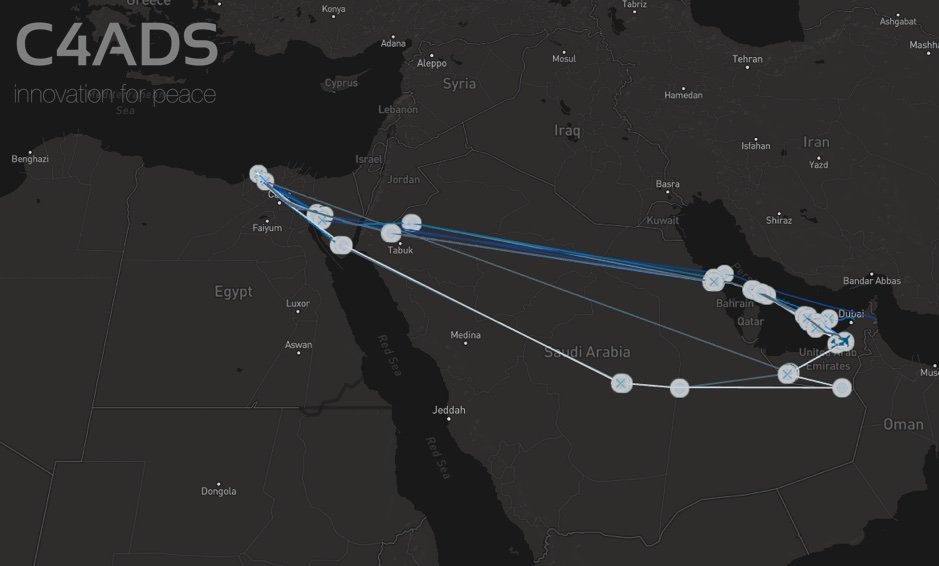
Figure 9: Flights of concern from Libya to western Egypt by month in 2020.
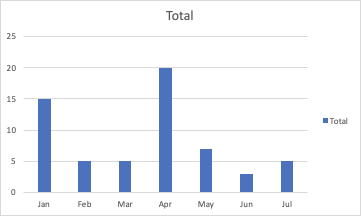
Aside from the UAE to Libya air bridge, Wagner Group operatives likely supported Russian military air operations in Libya from the Egyptian coastal towns of Marsa Matruh and Sidi Barrani, just over the Libyan border.126 Many of those flight operations likely served runs to and from the LNA/Wagner controlled al Jufra airbase. Social media and traditional news outlets reporting on successful GNA/Turkish airstrikes on Wagner positions at the al-Jufra airbase noted the destruction of a Russian-made Ilyushin 76 (IL-76) cargo plane.127
Detailed reporting by Russian and Ukrainian analysts traced the tail number of the IL-76 and its route from Fujairah Airport in the UAE and noted that the plane was registered to a British Virgin Islands company called Infinite Seal Inc.128 The plane was one of two located by the same analyst that was leased by Europe Air LLC, which operated their flights. Russia, at one point, claimed that the IL76 flights from the UAE to Libya were operated independently, but Ukrainian authorities suspended the operating certificate of Europe Air in July 2019.129
Europe Air is one of several aviation companies linked to a tangled web of covert shipping operations that Russia has tapped into in Libya, Syria, and elsewhere. Europe Air appears to be part of a cluster of aviation industry holding companies that originate in the UAE and that international authorities have scrutinized in recent years for providing chartered flights and flight crews that run shipments into warzones where sanctions are in place. One Ukrainian analyst, for instance, traced the suspicious December 2020 flight of a Russian-made IL-76 cargo plane owned by FlySky, a company that appears to be owned or controlled by beneficial stakeholders of Europe Air, from Kigali, Rwanda, to Bangui, the capital of the Central African Republic, or CAR.130
The CAR is well known as a critical node in the Wagner Group’s expanding web of influence and operations in Africa. Neighboring Rwanda is also an important hub for the Wagner Group’s covert transshipments of mercenaries and military materiel.131 Moreover, Rwanda’s government said it would begin delivering military aid to the beleaguered regime of Faustin-Archange Touadera, which Russia and the Wagner Group support, making Bangui a logical stopping point for an air bridge into CAR. However, it is important to note that there is no specific evidence that any of the companies or individuals affiliated with FlySky or Europe Air have a direct stake in Prigozhin’s activities or the Wagner Group’s operations. Nonetheless, it is an interesting coincidence that one of the key brokers of the FlySky/Europe Air air cargo pipeline is also based in the UAE.
A review of public records shows that the web of air cargo companies and fleets linked to Europe Air, FlySky, and Azee Air can be traced to Veteran Avia LLC and its chief stakeholder, Jaideep Mirchandani,132 a UAE-based aviation business magnet, who in 2014 briefly fell afoul of U.S. authorities on suspicion of facilitating air shipments of Russian-made currency to the Assad regime in Syria before sanctions were lifted against him in 2016.133 UN experts and open-source researchers have also identified flights of concern to Libya by other aviation companies in which Mirchandani reportedly has a stake.134 Soon after a well-regarded open-source researcher known as @Gerjon on Twitter traced the transfer of several planes linked to the same web of air cargo companies in July 2020, authorities in Kazakhstan suspended the operating license for Azee Air and two other aviation firms identified by the UN Security Council for violating the arms embargo to Libya.135
The Tula to Abu Dhabi Pipeline
While flight route analysis and reporting by the Pentagon, the UN, and the international press, appear to point to the existence of a UAE-based transport network and Russian-supplied pipeline for the shipment of military material to Libya, evidence of direct Emirati financing for Wagner’s logistics pipeline is not conclusive. There are, however, additional clues to be found in procurement and shipping data as well as publicly available information about the military technical agreements between the UAE and Russia for the production and deployment of Pantsir platforms and other Russian-made military material.
In the late 1990s, the KBP Instrument Design Bureau secured permission from the Russian government to begin exporting its weapons systems to foreign customers. In 1998, KBP won a tender to provide the Emirati military with a full-service anti-aircraft defense system. According to one analysis, the UAE deal called for the cancellation of $4 billion in Russian debt.136 At the time, the UAE was already looking to upgrade its military equipment and had purchased several armored personnel carriers from Russia that were also made by KBP. According to a description of the deal in “Ruskaya Sila” (“Russian Power”), a Russian-language military technical journal, the production agreement with Abu Dhabi-based Bin Jabr Enterprises, part of the multimillion-dollar Bin Jabr Group Ltd., got off to a rocky start after several issues with subcontractors.137 The contract was ultimately finalized after two years of negotiations.
Whether the terms of that deal carried over to include present-day staffing for Pantsir training and maintenance crews provided via an arrangement with Russia’s ministry of defense is not publicly known. However, it is well known that the vast majority of Russia’s defense logistics support is handled by JSC Garnizon, the successor organization of the reorganized state-run agency Oboronservis.138 On paper, reorganization merged nine subsidiary companies that specialize in aircraft and weapons maintenance, construction, trade, hotel services, agriculture, and publishing.139 In practice, it turned subsidiaries like Voentorg, the state-run logistics arm of Oboronservis, into cash cows for enterprising Kremlin insiders like Prigozhin and his associates, who have consistently won the bulk of contract bids over the last eight years since Putin fired the former minister of defense and one-time Oboronoservis head, Anatoly Serdyukov amid a corruption scandal. 140
In January 2000, Putin, who had recently been appointed acting president, signed an order that allowed for the export of Pantsirs through a deal between the KBP Instrument Bureau and the Abu Dhabi Bin Jabr Group, an Emirati defense manufacturer, for another five years.141 Founded by Saeed Bin Jabr al Suwaidi, a wealthy Emirati businessman, the Bin Jabr Group is one of the top producers of defense products in the company.142 With annual revenues estimated at $1.1 billion, the Emirati conglomerate is perhaps best known for manufacturing (with Russian technical assistance) the first Arab-made armored vehicle.143
The Bin Jabr Group’s deal with KBP represented a major expansion of the UAE’s defense ties with Russia and KBP and led to the signature of a contract valued at $734 million for the development and production of Russian-made air defense systems.144 According to Russkaya Sila, $367 million was paid by KBP, and another $367 million was offset against the repayment of Russia's state debt to the UAE. The large value of the contract suggests that the deal was likely inclusive of maintenance, repair, and training and covered related staffing costs.145
Under a wider effort by Putin and his longtime associate Sergey Chemezov of Rostec to reorganize large parts of Russia’s military-industrial complex, Pantsir development was placed under the oversight of JSC Schelglovsky Val, whose majority shareholder is KBP and whose parent company, like KBP, is linked to Rostec.146 About four years later, in 2012, KBP exhibited a prototype of the Pantsir S1 ADMSG training platform at the Indo-Pacific Arms expo in Jakarta.147 One year later, KBP announced that the Russian armed forces would formally integrate the platform and begin selling the platform to foreign customers.148 Soon after, Pantsirs were deployed to Syria despite a UN embargo imposed against the Assad regime, and in January 2014, Putin visited the plant site and was given an up-close view of the Pantsir development line.149
A press release on the KBP website memorializing Putin’s visit noted at the time that plans to beef up production of BMP-1’s and other KBP-made platforms such as the Hermes family of air, sea, and land platforms would require a substantial increase in staffing. “[T]he company will need [2,000] more young specialists. And this fact in its turn determines the necessity of solving social matters,” the press release stated. Tula’s governor at the time said plans were afoot to build housing near the KBP plant for the new team of technical specialists and their families. This might suggest one reason for the well-documented increase in recruitment of semi-private contracted technical specialists in Russia around the same time.150
At various points over the last 30 years, Libya, Syria, Egypt, Algeria, and the UAE have all been key clients of Rosoboronexport, a subsidiary of the state-run arms company Rostec, and Russia’s primary conduit for exports under its military technical agreements with foreign countries.151 The deployment of Pantsir anti-aircraft missile systems starting in 2013 in Syria, for instance, was a signature part of Russia’s approach to maintaining its influence over the regime of Syria’s president, Bashar al-Assad.152
In the case of Syria, there is sufficient evidence to suggest that Rostec, through an arms-length arrangement, would have already deployed technical teams and advisors in-country or on a field rotation deployment as part of any formal military-technical agreements executed either just before or just as the Arab Spring uprisings began in the Middle East region in 2011. From a practical point of view, this also suggests that Wagner Group operatives skilled in forward reconnaissance and anti-aircraft defense operations would likely rotate through several theaters if they signed on to deploy for more than one contract term. As noted earlier, casualty reports about Wagner Group fighters indicating prior service in Ukraine and Syria and patterns we observed in the self-reported data about prior military affiliation with special forces or Spetsnaz units seem to corroborate this theory, at least in part.
But in Libya, the Wagner Group lacked the kind of advantages it had in Syria in terms of being able to pre-position a support base for a logistics pipeline. At the outset of the Wagner Group’s entry into the fray in August 2019, Russian Pantisr maneuvers during the early part of the push toward Tripoli clearly gave an edge to Haftar’s LNA forces in terms of maintaining air superiority.153
Haftar’s offensive and the Turkish-backed counteroffensive of the GNA under the banner of its “Operation Volcano of Rage,” nonetheless, resulted in significant losses for the LNA and Wagner Group. It also marked one of the bloodiest periods in Libya’s conflict.154 But by late summer 2020, Libya’s two major warring parties—the LNA and GNA—reached a stalemate, and in October that same year, a ceasefire agreement was signed. Yet, the fresh UN allegations of the Wagner Group’s involvement in war crimes have raised anew concerns about Russian and Emirati support for their operations during the Tripoli offensive, and the diplomatic tug of war over the continued presence of Russian mercenaries is far from over.155
Citations
- UN Panel of Experts on Libya, “Letter dated 8 March 2021 from the Panel of Experts on Libya established pursuant to resolution 1973 (2011) addressed to the President of the Security Council,” March 8, 2021, p.2/548. https://digitallibrary.un.org/record/3905159?ln=en
- UN Panel of Experts on Libya, 2021, op.cit., pp.7/548-8/548
- Isabel Ivanescu and Eva Kahan, ”Syria’s Wretched Foreign Legion,” Newlines, June 1, 2021. https://newlinesmag.com/reportage/syrias-wretched-foreign-legion/
- UN Panel of Experts on Libya, 2021, op.cit., pp.28/548-30/548
- Jared Malsin, “U.A.E. Boosted Arms Transfers to Libya to Salvage Warlord’s Campaign, UN Panel Finds,” The Wall Street Journal, September 29, 2020. https://www.wsj.com/articles/u-a-e-boosted-arms-transfers-tolibyato-salvage-warlords-campaign-u-n-panel-finds-11601412059
- New America collaborated with C4ADS to conduct an analysis of publicly available flight data for the region for the period of the Tripoli offensive from April 2019 to September 2020.
- Fleets for these operators were derived from open sources, like The AeroTransport Databank, (https://atdb.aero/) a non-profit subscription-based data analysis center that provides up to date information about all worldwide transport aircraft, airlines, private and government operators - and leasing companies
- This assessment was made by identifying flights of highest risk based on operator, route, and times of travel. C4ADS initially identified approximately 122 flights of interest in the study period based on operator and routes in the study period. These flights of interest were reviewed manually to identify those that originated or terminated in UAE airspace, and either lost or regained ADS-B reception in Western Egypt, and to remove flights that appeared to have been bound for or originated from areas other than Western Egypt or Eastern Libya.
- While this data provides an indicator of risk, we cannot conclusively determine that all of these flights were bound for Libya or military bases in western Egypt, and it is not possible to verify that these aircraft carried arms and/or military materiel. This list may also be incomplete: some flights, particularly those by UAE AF, are likely to have not been broadcasted via ADS-B, or to have excluded location data from their transmissions.
- Available at https://c4ads.org/icarus.
- Owen Mathews, “Putin's Secret Armies Waged War in Syria—Where Will They Fight Next?” Newsweek, January 17, 2018. https://www.newsweek.com/2018/01/26/putin-secret-army-waged-war-syria-782762.html
- Twitter user @MoMo_elumami posted a video with satellite imagery about an attack that purportedly struck an IL76 in Libya on July 26, 2019. https://twitter.com/MoMo_elumami/status/1154722568286408704
- Dmitry Zolotukhin, “Russia Has Accused Ukraine of Supplying Weapons on Its Own,” Ukrinform, April 10, 2021. https://www.ukrinform.ua/rubric-world/3242990-rosia-zvinuvatila-ukrainu-v-postavkah-zbroi-aki-zdijsnuvala-sama.html; George Voloshin,”The Battle for Libya: How to Beat the UN Arms Embargo,” LinkedIn, May 20, 2021. https://www.linkedin.com/pulse/battle-libya-how-beat-un-arms-embargo-george-voloshin-cgss?trk=public_profile_article_view
- Dmytro Zolutukhin, “Supplies of Russian Weapons: How to “Swap In” Ukraine,” (“Поставки російської зброї: як "підставляють" Україну”) Ukrainform, February 1, 2021. https://www.ukrinform.ua/rubric-world/3182107-postavki-rosijskoi-zbroi-ak-pidstavlaut-ukrainu.html#
- Dmytro Zolutukhin, “Supplies of Russian Weapons: How to “Swap In” Ukraine,” (“Поставки російської зброї: як "підставляють" Україну”) Ukrainform, February 1, 2021. https://www.ukrinform.ua/rubric-world/3182107-postavki-rosijskoi-zbroi-ak-pidstavlaut-ukrainu.html#
- For background on the Wagner Group’s CAR and Rwanda connections see: Declan Walsh, “Russian Mercenaries Are Driving War Crimes in Africa, UN Says,” New York Times, June 27, 2021. https://www.nytimes.com/2021/06/27/world/asia/russia-mercenaries-central-african-republic.html; Zarko Perovic, ”What Laws Constrain This Russian Private Military Company?” Lawfare, Marc 23, 2021. https://www.lawfareblog.com/what-laws-constrain-russian-private-military-company; and Sergey Suhankin, ”Russia’s Growing Military Presence in the Central African Republic,” Jamestown Foundation, Eurasia Daily Monitor Volume: 18 Issue: 10, January 20,2021. https://jamestown.org/program/russias-growing-military-presence-in-the-central-african-republic/
- Dmytro Zolutukhin, “Supplies of Russian Weapons: How to “Swap In” Ukraine,” (“Поставки російської зброї: як "підставляють" Україну”) Ukrainform, February 1, 2021. https://www.ukrinform.ua/rubric-world/3182107-postavki-rosijskoi-zbroi-ak-pidstavlaut-ukrainu.html#
- On Sept.18, 2014, the United States Federal Register listed Jaideep Mirchandi and several relatives and related companies as one of several parties “acting contrary to the national security or foreign policy interests of the United States,” saying that Mirchandani and aviation companies he has ties to “involved in activities in support of the Syrian regime. In addition, Mirchandani and certain other entities were attempting to export a U.S. aircraft that would be used to further support the Syrian regime.” See the Federal Register entry for details here: https://www.federalregister.gov/documents/2014/09/18/2014-22277/addition-and-modification-of-certain-persons-on-the-entity-list-and-removal-of-certain-persons-from. About two years later, on February 23, 2016, the Federal Registry noted that Mirchandani and related aviation companies had been removed from the sanctions list; see the Federal Register entry for details here: https://www.federalregister.gov/documents/2016/02/23/2016-03745/addition-of-certain-persons-and-modification-of-certain-entries-to-the-entity-list-and-removal-of
- The UN Panel of Experts on Libya reported on violations by Deek Aviation FZE72 of the United Arab Emirates for two Ilyushin Il-76TD that Deek Aviation operated and that were destroyed by a GNA air strike against Jufrah airbase. OpewenFacto, a French-language open source investigations collective, published a case study linking Deek Aviation to a network of air cargo transporters believed to be involved in illicit arms transfers to Libya, Syria and other countries; the OpenFacto report notes that Jaideep Mirchandani at one point owned Deek Aviation. For more details see: Letter dated 29 November 2019 from the Panel of Experts on Libya established pursuant to resolution 1973 (2011) addressed to the President of the Security Council, p.323/376 https://undocs.org/S/2019/914 and OpenFacto, “Cabine or Hold: Transporting Arms by Air,” undated case study, https://openfacto.fr/cabine-or-hold-transporting-arms-by-air/
- Twitter post by @Gerjon: https://twitter.com/gerjon_/status/1284507327568252937?lang=en; Euarctiv, “Kazakhstan Suspends Three Airlines for Breaking UN Libya Embargo,” September 23, 2020. https://www.euractiv.com/section/central-asia/news/kazakhstan-suspends-three-airlines-for-breaking-un-libya-embargo/
- Shana R. Marshall, “The New Politics of Patronage: Clientelism and Patronage in the Arab World,”dissertation submitted to the Faculty of the Graduate School of the University of Maryland, College Park in partial fulfillment of the requirements for the degree of Doctorate of Philosophy2012, p.104. https://drum.lib.umd.edu/bitstream/handle/1903/12970/Marshall_umd_0117E_13169.pdf?sequence=1&isAllowed=n
- Russkaya Sila, “96K6 Pantsir-S Surface to Air Missile System,” (96К6 “Панцирь-С” ЗЕНИТНЫЙ РАКЕТНО-ПУШЕЧНЫЙ КОМПЛЕКС) undated, An archived version of the article can be found here: https://archive.is/WgSvD#selection-1655.0-1659.34
- Polina Beliakova and Sam Perlo-Freeman, “Corruption in the Russian Defense Sector,” World Peace Foundation, May 11, 2018, p.17.https://sites.tufts.edu/wpf/files/2018/05/Russian-Defense-Corruption-Report-Beliakova-Perlo-Freeman-20180502-final.pdf
- Polina Beliakova and Sam Perlo-Freeman, “Corruption in the Russian Defense Sector,” World Peace Foundation, May 11, 2018, p.17.https://sites.tufts.edu/wpf/files/2018/05/Russian-Defense-Corruption-Report-Beliakova-Perlo-Freeman-20180502-final.pdf
- Mikhail Maglov, Timur Olevsky, and Dmitry Treshchanin, “Investigation Charts Massive Haul For State Deals By Companies Linked To 'Putin's Chef',” Radio Free Europe, Radio Liberty (RFERL), February, 27, 2019. https://www.rferl.org/a/russia-prigozhin-current-time-investigation-companies-state-deals/29794524.html
- Russkaya Sila, “96K6 Pantsir-S Surface to Air Missile System,” (96К6 “Панцирь-С” ЗЕНИТНЫЙ РАКЕТНО-ПУШЕЧНЫЙ КОМПЛЕКС) undated, An archived version of the article can be found here: https://archive.is/WgSvD#selection-1655.0-1659.34;KBP Instrument Design Bureau, “Manufacturing,” undated company webpage, http://www.kbptula.ru/en/about/kbp-today/manufacturing
- For details about the Bin Jabr Group’s history and background see the company website: http://binjabr.com/
- Arabian Business, “Welcome to the life of one of the UAE's real estate moguls,” March 19, 2017. https://www.arabianbusiness.com/industries/366962-welcome-to-the-life-of-one-of-the-uaes-real-estate-moguls
- Russkaya Sila, “96K6 Pantsir-S Surface to Air Missile System,” (96К6 “Панцирь-С” ЗЕНИТНЫЙ РАКЕТНО-ПУШЕЧНЫЙ КОМПЛЕКС) undated, An archived version of the article can be found here: https://archive.is/WgSvD#selection-1655.0-1659.34
- Russkaya Sila, “96K6 Pantsir-S Surface to Air Missile System,” (96К6 “Панцирь-С” ЗЕНИТНЫЙ РАКЕТНО-ПУШЕЧНЫЙ КОМПЛЕКС) undated, An archived version of the article can be found here: https://archive.is/WgSvD#selection-1655.0-1659.34
- Open Joint Stock Company, “Schcheglovsky Val: Report on the Outcomes of Activities in 2008,” Tula, 2009. https://docplayer.com/40275600-Otkrytoe-akcionernoe-obshchestvo-shcheglovskiy-val-otchet-o-rezultatah-deyatelnosti-za-2008-g.html
- KBP Instrument Design Bureau, “Indo-Defence-2012,” undated company webpage, archived version can be found here: https://archive.is/gYYlH#selection-239.4-239.23
- KBP Instrument Design Bureau, undated news release, “The Pantsir S1 Was Adopted for Service with the Russian Army,” http://www.kbptula.ru/en/news/kbp-news/279-the-pantsir-s1-was-adopted-for-service-with-the-russian-army; archived version: https://archive.is/wip/33mSX
- KBP Instrument Design Bureau, undated press release, “Visit of the President of Russia.” http://www.kbptula.ru/en/component/content/article/141-english/en-news/en-actual/317-visit-of-president-of-russia
- Reporting on Russian mercenary activity has been voluminous in both the press and among think tanks. Nathaniel Reynolds provides one of the most salient explanations of how Prigozhin’s placement in Putin’s patronage system feeds into the make-up of the Wagner Group’s contracted units; see Nathaniel Reynolds, “Russia’s Not-So-Secret Mercenaries: Patronage, Geopolitics and the Wagner Group,” Carnegie Endowment for International Peace, 2019, pp.1-5. https://carnegieendowment.org/files/GlobalRussia_NateReynolds_Vagner.pdf
- Candace Rondeaux, “Decoding the Wagner Group: Analyzing the Role of Private Military Security Contractors in Russian Proxy Warfare,” New America, Nov.7, 2019, pp. 4-6. https://www.newamerica.org/international-security/reports/decoding-wagner-group-analyzing-role-private-military-security-contractors-russian-proxy-warfare/forward-operations-from-deir-ezzor-to-donbas-and-back-again; Alexey Khelbnikov, “Russia Looks to the Middle East to Boost Arms Exports,” Middle East Institute, April 8, 2019. https://www.mei.edu/publications/russia-looks-middle-east-boost-arms-exports
- Center for Strategic and International Studies (CSIS)t, “Pantsir S1,” Missile Defense Project, last updated July 6, 2021. https://missilethreat.csis.org/defsys/pantsir-s-1/
- Jason Pack and Wolfgang Pusztai, “Turning the Tide: How Turkey Won the War for Tripoli,” Middle East Institute, Policy Paper, November 2020, pp.11-12.
- Middle East Monitor, Libya Army Launches Operation 'Volcano of Rage' against Haftar,” April 8, 2019.https://www.middleeastmonitor.com/20190408-libya-army-launches-operation-volcano-of-rage-against-haftar/
- Stephanie Nebehay, Libya's Warring Sides, including Russian Mercenaries, May Be Guilty of Crimes – UN,” Reuters, October 4, 2021. https://www.reuters.com/world/africa/libyas-warring-sides-including-russian-mercenaries-may-be-guilty-crimes-un-2021-10-04/
Conclusion
Since the start of U.S. sanctions against Russia in the wake of Russian military interventions in Ukraine in 2014 and Syria in 2015, the Kremlin has gone to great lengths to suppress information about how it continues to supply its proxies in contravention of international arms embargoes. The Kremlin and Prigozhin have expended a considerable amount of effort to spin the narrative about Russian mercenary operations, practically inventing the Wagner Group whole cloth after several shipments of military material were interdicted in transit from Russia en route to destinations in the Middle East.156 Russia’s covert arrangements with regional partners like the UAE have been as critical to the Kremlin’s narrative building about the Wagner Group’s operations as they have been for the fortunes of companies linked to Prigozhin.
The ceasefire agreement in Libya following the 2019-2020 Tripoli offensive came as Russia and Prigozhin seemed to be consolidating hard-fought gains from the Wagner Group’s strategic seizure of major oil and gas facilities across Syria. In January 2020, the independent Russian news outlet Novaya Gazeta reported that Syria’s state oil ministry had granted production rights to two companies linked to Prigozhin’s web of enterprises.157 Several months later, another Prigozhin-linked company, Kapital LLC, sealed another deal with the Syrian government that granted Kapital leases for offshore oil and gas extraction.158 Sealed after lengthy battles to secure Syria’s oil and gas infrastructure by the Wagner Group, deals in Syria are worth millions and are representative of just how much Russia and Prigozhin likely thought they stood to gain if they could replicate the same measure of successes during the LNA offensive on Tripoli.
Yet, as the record of successful strikes on Pantsir S1’s in both Libya and Syria show, the Kremlin and Prigozhin’s adventurism has not come without significant material costs for Wagner Group operatives and the civilians they’ve encountered on the ground in both theaters.159 There are indications that nearly a dozen Pantsir systems were destroyed by Israeli jets or Turkish drone strikes in Syria and Libya from May to June 2020, according to a Russian security expert.160 In Syria, the Pantsir S1 was often deployed with an electronic warfare jamming platform, and a team meant to defeat drone swarms.161 As our analysis suggests, Pantsirs deployed in Libya during the early stages of the Tripoli offensive may not have been equipped with the same level of sensing technology, which may be one reason there were so many successful strikes on the platforms there.
Pantsir S1 losses in both theaters add up to nearly two dozen platforms destroyed. The losses have been financially and tactically costly, and triggered a new effort to upgrade what was once thought to be Russia’s premier mobile surface-to-air missile system. The latest addition to the market is the Pantsir S1M, which includes an upgraded missile detection system capable of handling incoming from drones. It may be too early to say what effect, if any, the Wagner Group’s notable Pantsir losses in Libya have had on demand for this new model.
A related key takeaway from Russia’s use of Wagner Group operatives to run its expeditionary operations with proxy forces in the Middle East—and in Libya specifically—is that perceived poor performance at the tactical level can have larger strategic costs for Russia’s military-industrial complex. On the one hand, the use of poorly paid mercenaries to operate and field test expensive military kits like the Pantsir could be considered a cheap and low-risk means of trying out concepts of operations. On the other hand, the Wagner Group’s clear failure to perform to task in Libya in particular, has resulted in reputational damage for one of Russia’s leading state-backed weapons manufacturers, denting demand for Russian arms in key markets. In the long run, that could have real material costs for Russia’s strategic positioning as the second-largest arms purveyor in the world after the United States.
Starting around 2018, in fact, several big, regular Rosoboronexport customers began to back out of weapons purchase deals for fear of the potential for sanctions risk. Indonesia, for instance, backed away from the purchase of 11 SU-35 fighter jets after encountering pressure from the United States.162 CAST cites are another example of the chilling effect of Tunisia’s February 2019 interdiction of a cargo vessel sailing under a Turkish flag that was carrying Russian-made armored Ural trucks off the coast of Tunisia.163
Yet, it is hard to fully evaluate with certainty how the Wagner Group’s mixed performance in Libya and the public relations hit from U.S. and UN reporting about breaches of the arms embargo on Libya. Though Russian analysts report that U.S. sanctions may have added up to as much as $3 billion in canceled arms contracts or lost bids, the Middle East and Africa still constituted an estimated 20 percent new arms deals for Russia; and Russia remains the world’s second largest arms purveyor. Some governments seem undeterred by the high level of scrutiny the Wagner Group’s operations in Libya have triggered. Reports that the Wagner Group is angling to seal a deal to provide weapons and training to the beleaguered government forces of Mali,164 and continued reports of its expansive operations in the Central African Republic, suggest, in fact, that Russia will continue to use Africa and the Middle East as proving grounds and showcase its military goods and services there for some time to come.
The goal of our investigation was to get a clearer picture of Wagner Group operations in Libya during a pivotal turning point in the conflict there and to learn how and whether Emirati support factor into Russian thrusts toward Tripoli. We set out to learn where the Wagner Group’s Pantsir S1 crews operated, who the Wagner Group fighters were, and how Pantsir S1 maneuvers under the Wagner Group’s command fit into the overall 2019–2020 offensive. What we learned was that the UAE—a key U.S. ally in the Middle East and the recipient of billions in American arms—served as a critical conduit for the transfer of military material that likely made the Wagner Group’s assault on Tripoli possible. We also learned that years of cooperation between Russia and the UAE in the military-industrial sphere have transformed regional dynamics in ways that may endure for some time to come.
Russia’s willingness to openly flout the arms embargo in Libya is a telling warning sign of what could be to come as it seeks to replicate its business model for deployments of Wagner Group operatives in new theaters of war. What is more troubling for the U.S. and potentially its allies in the region is that cooperation between the UAE and Russia in the Libyan theater may become a more permanent fixture of security dynamics in the region. The unique commercial interface between Russian and Emirati commercial proxies that supported the Wagner Group’s air bridge and logistics chain during Haftar’s Tripoli offensive helped the UAE and Russia maintain a patina of plausible deniability while mitigating risks of potential interdiction of military goods and further U.S. and EU sanctions.
Moreover, the Biden administration’s approval of the UAE arms deal despite substantial evidence of Emirati support for the Wagner Group and standing U.S. sanctions against the PMSC, and its primary financier Prigozhin only appears to reinforce the sense that American policy on Russia is not only inconsistent and incoherent, but also is not grounded in sound intelligence. It is too early to say how and when these deficiencies will influence future U.S. confrontations with Russia in the region and on the world stage. But we can be fairly certain it does not bode well.
Citations
- Candace Rondeaux, “Decoding the Wagner Group: Analyzing the Role of Private Military Security Contractors in Russian Proxy Warfare,” New America, Nov. 7, 2019, pp.49. https://www.newamerica.org/international-security/reports/decoding-wagner-group-analyzing-role-private-military-security-contractors-russian-proxy-warfare/
- Denis Korotkov, “For Wagner It’s Oil First,” (“Вагнер. Первая нефть”) Novaya Gazeta, January 20, 2020. http://web.archive.org/web/20200120073322/https://novayagazeta.ru/articles/2020/01/19/83514-vagner-pervaya-neft
- Amy Mackinnon, “Putin’s Shadow Warriors Stake Claim to Syria’s Oil,” Foreign Policy, May 17, 2021. https://foreignpolicy.com/2021/05/17/putin-shadow-warriors-stake-claim-syria-oil-energy-wagner-prigozhin-libya-middle-east/
- Strategy Page, “Winning: Not Pantsir,” June 26, 2020. https://www.strategypage.com/htmw/htwin/articles/20200626.aspx#foo
- DefenseWorld.net, Some “23 Russian Pantsir Air Defense Systems Destroyed in Syria, Libya: Reports,” June 9, 2020. https://www.defenseworld.net/news/27161/Some_23_Russian_Pantsir_Air_Defense_Systems_Destroyed_in_Syria__Libya__Reports#.YRVDF4hKg2w
- DefenseWorld.net, “Russian Pantsir Air Defense System- Sitting Duck or Top Dog?” June 19, 2020. https://www.defenseworld.net/feature/42/Russian_Pantsir_Air_Defense_System__Sitting_duck_or_Top_Dog_#.YQsO8dNKifR
- Donald Greenlees, “Russia Sanctions Putting Strain on U.S. Relationship with Indonesia,” The Strategist, June 27, 2019. https://www.aspistrategist.org.au/russia-sanctions-putting-strain-on-us-relationship-with-indonesia/; Centre for Analysis of Strategies and Technologies, “Russian Arms Exports in 2018,” Moscow Defense Brief, Special Issue 2019, pp.3-4.
- Centre for Analysis of Strategies and Technologies, “Russian Arms Exports in 2018,” Moscow Defense Brief, Special Issue 2019, pp.3-4. http://cast.ru/eng/books/moscow-defense-brief-special-issue-2019.html
- Deutsche Welle, “Berlin and Paris Concerned over Russian Mercenaries in Mali,” https://www.dw.com/en/berlin-and-paris-concerned-over-russian-mercenaries-in-mali/a-59201331
More About the Authors

Jack Margolin

Candace Rondeaux
Senior Fellow, Future Security