VII. Methodology
Constructing and Refining the Universe of Funds
To construct the universe of funds for the 2021 study, researchers utilized updated lists of SWFs and GPFs from the 2019 study, as compiled by the International Forum, the Organization for Economic Co-operation and Development (OECD), the Pacific Pension & Investment Institute (PPI), Professor Paul Rose at the Ohio State University Moritz College of Law, Official Monetary Financial Institutions Forum (OMFIF), Northern Trust, Willis Towers Watson, and the Sovereign Investor Institute’s Sovereign Wealth Center.
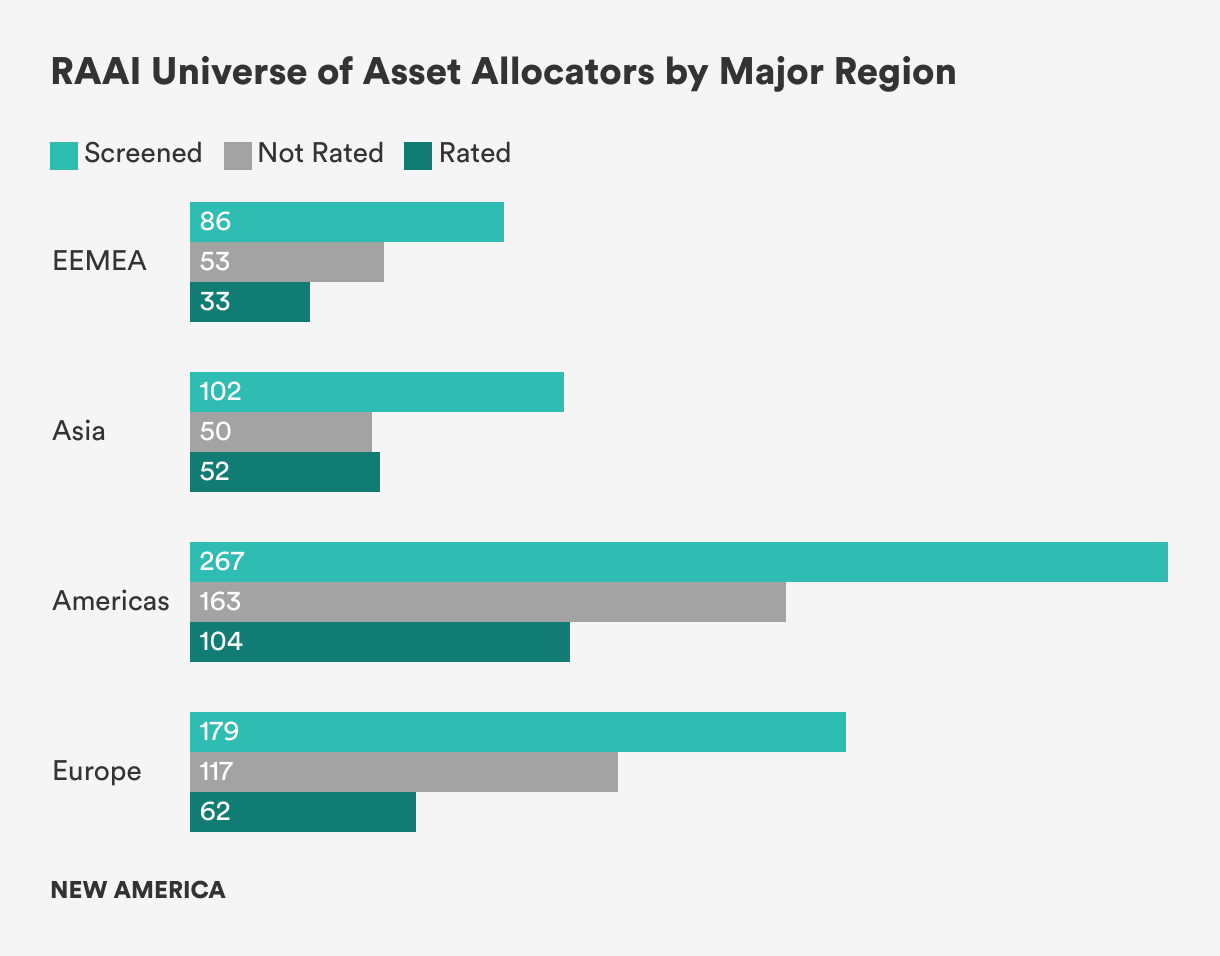
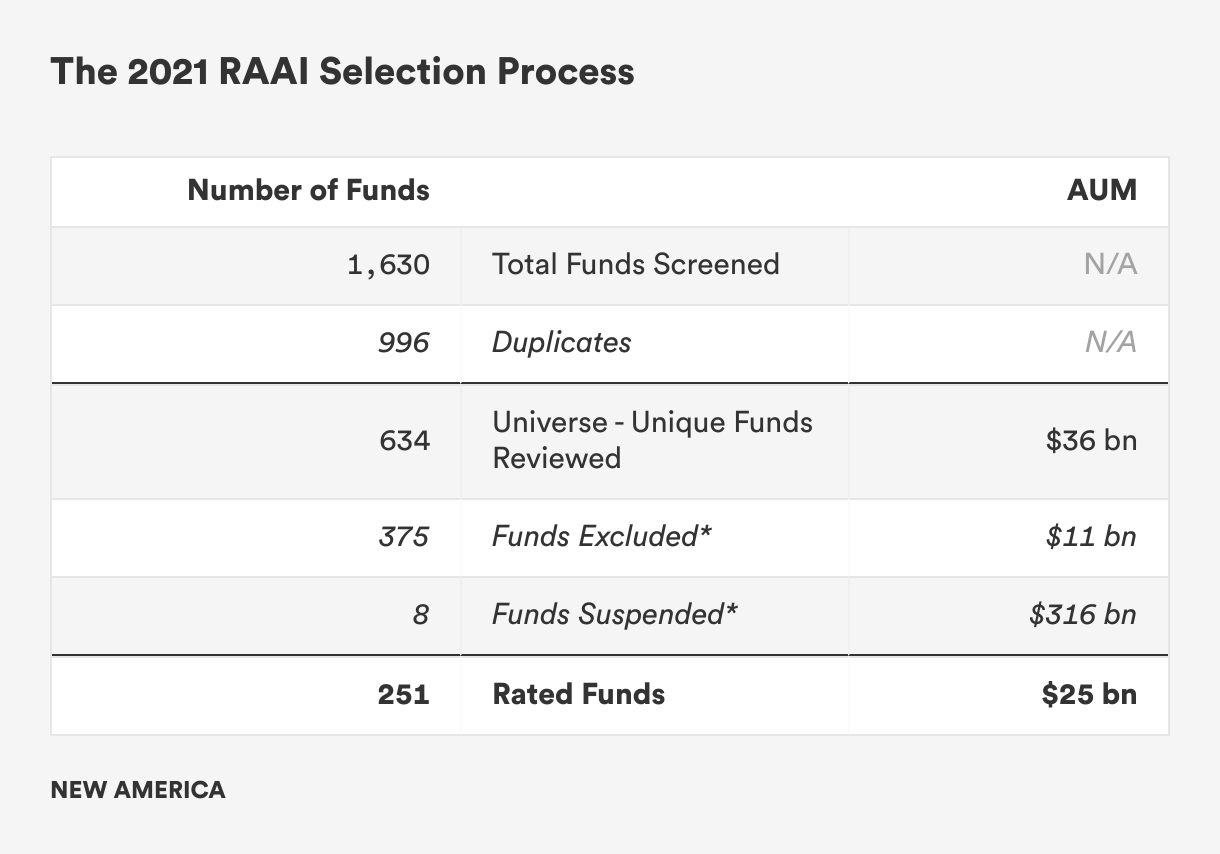
This resulted in a comprehensive list of 1630 asset allocators (compared to 624 in 2019 and 298 in 2017) to be reviewed by RAAI researchers. The comprehensive list was then cleaned of all duplicates and sub-managed accounts, eliminating 996 funds and resulting in a universe of 634 asset allocators to be analyzed, with the total AUM of $37 trillion.
Researchers then went through a series of steps to arrive at the final list of funds to be rated. First, all asset allocators other than SWFs and GPFs, the focus of the RAAI, were eliminated from the universe (including private and corporate pension funds, endowments, foundations, philanthropic organizations, family offices, insurance firms, and asset managers).
Second, to ensure the SWFs and GPFs were sufficiently large and had adequate data for rating consideration, researchers eliminated funds with less than $2 billion of AUM. In addition, asset allocators were eliminated from the ratings if they could not be evaluated due to:
- Highly constrained portfolios (for example, investing only in treasuries);
- Recent establishment leading to insufficient data;
- Lack of funding; or
- Insufficient information available in English.
This eliminated 375 funds with AUM of $11 trillion.
Finally, funds were eliminated from ratings coverage if:
- AUM had been substantially depleted or removed by stakeholders;
- The fund had been dissolved;
- The fund was embroiled in legal action due to fraud or scandal;
- AUM had been frozen; or
- The fund’s mission and/or remit had been substantially changed, leading to a reassessment of investing goals and processes.
This last step eliminated eight funds, leading to the final list of 251 asset allocators that were rated, comprising AUM of $26 trillion. The top 30 scoring asset allocators, with AUM of $7.8 trillion, were selected for The RAAI Leaders List: The 30 Most Responsible Asset Allocators in the world, with the next highest scoring 22 funds selected as finalists to complete the top quintile.
Rating Framework
Each of the 251 asset allocators in the final list were rated across 30 criteria, three for each of the 10 core principles, up from 20 criteria in 2019 (see the Principles and Criteria section for more). Reviewers analyzed information from the public domain to rate each fund, including annual reports, company websites, other published reports, articles, and additional materials available publicly. Rated funds received either full or zero points for each criteria; no partial points were assigned. Each fund was analyzed by several independent reviewers, and then ratings were double-checked by an expert.
Once scores were aggregated, asset allocators were rank-ordered and divided into quintiles such that quintile cut-off scores ensured a similar number of asset allocators in each quintile (about 50 asset allocators per quintile in 2021 compared to 40 per quintile in 2019 and 25 in 2017). Quintile 1 comprises the highest-rated asset allocators, while Quintile 5 comprises asset allocators that received the lowest ratings.
In the 2021 RAAI Index, the top 30 asset allocators in Quintile 1 made the Leaders List, and the next highest 22 in Quintile 1 were selected as finalists. In 2019, the top scoring 25 asset allocators in Quintile 1 made the Leaders List, while the next 15 from Quintile 1 and 10 from Quintile 2 were selected as finalists. In 2017, there were a total of 121 rated asset allocators, and all 25 of the top scoring funds in Quintile 1 were selected as leaders (there were no finalists).
The RAAI Index provides the first comprehensive analysis of the responsible investment practices of the world’s largest SWFs and GPFs, but there are limitations to this study. The criteria, while expanded and customized for asset allocators, are by no means an exhaustive list of responsible investing characteristics. Some important metrics may be overlooked. Second, only SWFs and GPFs that disclose information in English are rated. Thus, it is possible that a SWFs and GPFs with good, responsible investing practices, but limited English disclosures, could be overlooked by this study. In addition, awarding full or zero points for each criteria leaves little scope for nuanced analysis and ratings. Finally, since the index only covers SWFs and GPFs, there are many worthy asset allocators that are not included in the study.

The 2021 Leaders List: The 30 Most Responsible Asset Allocators
- I. Introduction
- II. Asset Allocators, Principles, and Criteria
- III. The RAAI Index and Leaders List
- IV. Why the Leaders Matter
- V. Key Findings: Are Global Asset Allocators Becoming More Responsible?
- VI. What’s New? Comparing the 2021 and 2019 RAAI Leaders List
- VII. Methodology
- VIII. Glossary of Terms
- IX. Scorecards
- X. Previous and Current Award Winners
- XI. Appendix: Ten Recommendations for Success in Responsible Investing