Building the Relationships for Collaborative Governance
Abstract
In recent years, a more collaborative form of democratic engagement has emerged, primarily at the local and state level, as well as internationally. Collaborative governance, or co-governance, refers to a broad range of models of civic engagement that allow people outside and inside government to work together in designing policy. This new form of engagement seeks to break down the boundaries between advocates and officials and is not only more democratic, but also more inclusive and open to those served by the government.
How are co-governance relationships best developed, sustained, and supported? The clearest way to answer this question is not in theory, but from the learned experiences of co-governance, at the neighborhood, city, and state level. In this report, we highlight five of these cases in communities across the country where progress has been made to improve the quality of life and strengthen the bonds of community for all through the collaborative work of democracy.
Acknowledgments
We are grateful for the collaboration and support of the Ford Foundation, Local Progress, Hester Street, Leaders Igniting Transformation, the Center for Popular Democracy, and the Realizing Democracy Initiative. We would also like to thank the following individuals for their work on these case studies and publication: Betsy MacLean, Cedi Tena, Elena Souris, Elizabeth Guernsey, Ethan Frey, Hannah Hetzer, Jason Garrett, Jessica Tang, Jessie Ulibarri, Kate Terenzi, Maresa Strano, Rebecca Rosen, Sanjiv Rao, and Tarsi Dunlop. Kevin Simowitz was particularly helpful in designing the project and identifying partners. Finally, we are thankful for the work of Alderman Carlos Ramirez-Rosa from Chicago’s 35th Ward, Colorado State Senator Faith Winter, and former Gainesville Commissioner Gail Johnson in advancing co-governance initiatives.
Downloads
Introduction
By Mark Schmitt and Hollie Russon Gilman
“Our Constitution opens with the words, ‘We the People.’ It’s time we remembered that ‘We the People’ are the government,” President Joe Biden said on March 28, 2021. This principle stands in contrast to an increasingly prevailing attitude that treats government as a separate and oppressive force, but the phrase on its own is little more than an aspiration. To realize this principle, to reconnect people and government, is the work of democracy. In this moment, there is an opportunity to build a truly multi-racial, multi-ethnic democracy, one which we have never seen before in the United States.
Elections are the primary nexus where people can exercise power over government officials and agencies. But the binary choices presented in a two-party, winner-take-all system give the public very tenuous access to or input into government decisions. Such access is also deeply unequal, as a privileged few have the time, money, education, and legal and social status to have their voice prioritized. These obstacles are structural, and are largely fundamental to the American political system and its brittle governing institutions.
A familiar form of civic engagement, then, has been adversarial: acting as individuals or organized together, citizens press and challenge government, at times by using the courts, at times by making demands at public meetings or by petition, and at times by competing in elections. In all these forms of participation, the government is seen as a target, not an ally. It’s “them,” not “us.”
In recent years, though, a more collaborative form of engagement has emerged, primarily at the local and state level, as well as internationally. This new form of engagement seeks to break down the boundaries between advocates and officials and is not only more democratic, but also more inclusive and open to those served by the government.
Collaborative governance, or co-governance, refers to a broad range of models of civic engagement that allow people outside and inside government to work together in designing policy. Beyond demands, co-governance represents a willing shift of power and trust among two typically adversarial parties. Instead of representatives and those represented on either side of a line, both see themselves as colleagues with unique and valuable capacities and perspectives that support the other’s interests and positions.
So how are such relationships best developed, sustained, and supported? The clearest way to answer this question is not in theory, but from the learned experiences of co-governance, at the neighborhood, city, and state level. Fortunately, we now have a growing resource in dozens of cases in communities across the country where progress has been made to improve the quality of life and strengthen the bonds of community for all through the collaborative work of democracy.
Some of the cases in our series highlight the use of innovative tools and processes to encourage public participation in policy decisions. One is Community-Driven Zoning and Development in Chicago, which ensured inclusive, transparent, and democratic decision-making around land use and development. Another is a proposed moratorium on development in Gainesville to protect historically Black neighborhoods and give the municipal government time to conduct a thorough community engagement process.
Other cases focus on the importance of centering impacted communities and people with lived experiences when advocating for policy change. In Milwaukee, youth organizers engaged in multi-year, multi-faceted organizing to promote an alternative vision of public school safety and demonstrated that persistence, education, and steady relationship-building are key to securing policy victories.
Finally, a number of cases demonstrate the value of building relationships across different sectors and between government officials and community members. The Bushwick Community Plan for zoning and development was unique in that the process was collaborative from the start, stemming from a partnership between city agencies, community organizations, and residents. They came up with a steering committee governing system but ensured open and inclusive participation, striking the right balance between a formalized structure and integrating community values and priorities. And in Colorado, a coalition formed around paid family and medical leave, in which advocates built mutually beneficial relationships with elected officials. The coalition employed novel methods to campaign and secure signatures during the COVID-19 pandemic. Coalition members ultimately saw success thanks to the cultivation of a broad movement comprised of a variety of expertise—including from elected officials, policy advisors, lawyers, media experts, advocates, and organizers—as well as their ability to innovate in political strategy and tactics.
Some of the cases we’ll explore have been great successes, while others have had mixed or incomplete outcomes. However, even in cases where policy wins aren’t immediate, the relationships built in collaborative governance can be impactful in the long run. The Colorado case study highlights this value of “losing forward”—that is, even though legislative efforts on paid leave repeatedly stalled, the coalition grew, garnering more media attention and further fine-tuning details of the policy for their next advocacy effort. This process resulted in a better policy overall, where setting the stage to build a movement would outlast a potential one-time policy win.
Building and sustaining the relationships of trust on which co-governance depends is challenging, in part because elected and appointed officials and community members are not used to thinking of themselves as allies and co-conspirators in building power together. This unfamiliarity is in part due to the inequities and barriers that are so fundamental to current American democracy, and in part because the trade-offs inherent to policymaking, politics, and bureaucracy create constant stress tests. Further, interpersonal trust alone cannot always transcend the boundaries that separate activists, citizens, and elected officials, who are defined by the roles of being in-power or out of power.
Stronger relationships are often built on honest communication from all participants. These relationships rest on actors’ careful understanding of the tools and strategies at their disposal, and a finely developed sense of when to deploy which strategies. Bringing a longer-term vision to relationship-building may also be helpful, including the ability to see political losses as an avenue towards advancing advocacy goals in policy. These connections are not static or built on a dichotomy, but rather ongoing relationships that exist on a continuum. Most importantly, they must clearly value and incorporate viewpoints from both the people and their government in making decisions about policy. Generating these positive feedback loops requires ongoing work and two-way relationships that are reliant on sharing power. Each of the case studies in this series—which traverse geography, approaches, and issue areas—aims to provide helpful suggestions for these elements and more. These case studies demonstrate in different ways the need for persistence and flexibility, in working through moments of disagreement and tension between actors, and celebrating the process of coming to alignment on seemingly disparate issues. Collaborative governance is a dynamic process focused on the long run, where incremental victories can be celebrated, and losses can be turned into opportunities. The examples in this publication are tailored to the unique politics of the place in which they occurred, but together, they provide suggestions for anyone looking to build stronger relationships for democratic change.
Chicago: Centering Residents in Neighborhood Development Decisions
We are grateful for the collaboration and support of Tarsi Dunlop from Local Progress and Alderman Carlos Ramirez-Rosa from Chicago's 35th Ward. The original text on which this case study is based is part of Local Progress’s Dare to Reimagine series and can be accessed here.
Introduction
In 2016, Chicago’s 35th Ward created a Community-Driven Zoning and Development (CDZD)1 process to ensure inclusive, transparent, and democratic decision-making around land use and development. Created collectively by community organizations, local residents, and experts, the CDZD goals and procedures represent over six months of research and community engagement. The process ensures that zoning decisions fully and accurately represent the interests of residents and that the community is fully informed of zoning change requests and their potential impact on the neighborhood.
Under this process, the 35th Ward has held roughly 25 public meetings on proposed zoning developments to date and has green-lighted several development projects. Most recently, the 35th Ward’s CDZD process led to the approval of a Bickerdike Redevelopment Corporation proposal to turn a city-owned parking lot on Emmett Street into a 100-unit, 100 percent affordable housing development in Logan Square,2 which will begin construction in late 2020.3
Prior to the creation of CDZD, communities in Ward 35 had continuously voiced concerns about land use and zoning, indicating that business-as-usual was driving displacement and gentrification. Since 2000, the community has witnessed the displacement of over 19,200 working class and mainly Latinx residents, pushed out by big developers and rising rents. The prevailing sentiment in the community was that developers were using their campaign contributions to influence zoning and land use regulation behind closed doors. These deals facilitated the destruction of the community’s existing affordable housing stock, and led to rampant land speculation that raised housing costs throughout the community.
Rather than having zoning decisions made without them, residents facing displacement desired an inclusive and transparent process that would put their concerns on affordability front and center. They also wanted a system that would allow them to win concessions from developers, prior to a project receiving a green light from the local alderman.
CDZD disrupts business-as-usual by ensuring residents are centered in the development decisions that impact their neighborhoods.
Collaborative Governance
The 35th Ward CDZD process was itself created through a participatory process. Shortly after taking office on a commitment to implement an inclusive, transparent, and democratic zoning review process, Alderman Carlos Ramirez-Rosa convened local community groups, including Logan Square Neighborhood Association, Logan Square Preservation, and affordable housing advocates, to discuss their ideal participatory planning process. This working group studied and discussed existing participatory planning processes throughout North America. After several months of review and discussion, the group finalized a draft process, which was then presented to the community at large for feedback and finally ratification.
The process relies heavily on existing community organizations, referred to as neighbor-led organizations (NLO). The NLOs have deep roots in their communities and decades of organizing experience. These NLOs work to gather community feedback during the earliest stages of zoning review, and the NLOs negotiate directly with zoning change applicants and developers. The NLOs are local community institutions, and help ensure that the process is a success, with consistent participation. Now in its sixth year, the process has become widely understood, standardized, and anticipated by local residents.
Thanks to a proposal from Logan Square Neighborhood Association (LSNA) youth, the 35th Ward CDZD procedures were updated in 2018 to require zoning change applicants to post a large sign detailing the zoning change request on their property. The notice is bilingual, English-Spanish, and includes a rendering of the project, an easy-to-understand description of the project, and information on the upcoming community hearing organized under the CDZD process.
The Chicago City Council, at 50 wards, is one of the largest in the country, with a range of political views represented. The council must vote on all zoning changes, but through a practice known as “aldermanic prerogative,” aldermen have historically deferred to one another on local land use and zoning decisions. This practice has given local aldermen freedom to structure their ward’s process for reviewing zoning changes. While aldermanic prerogative is unique to Chicago, the practice of deferring to local elected officials on legislation solely impacting their district is found in other legislative bodies across the country. This particular effort focused on changing zoning in one ward, a process that is relatively unique in the country.
Today, the process requires developers to provide detailed information and plans on developments (known as a zoning map amendment application). They not only must include renderings and costs, but also seek to minimize incidental costs to residents by providing information on corresponding costs, such as infrastructure stress, increased density, and demand for city services.
The CDZD process also outlines parameters for holding community meetings to accurately represent residents’ interests and engage community groups that can provide insight and local expertise. After a developer has submitted an application, neighborhood organizations review the application and meet directly with the developers to address questions and concerns. Once the community review process is done, the application then goes to review with a large neighborhood assembly that is advertised at least two weeks in advance, is held within the community, and is bilingual. Larger meetings provide child care services to make them as inclusive as possible and remove barriers for residents to attend.
Conclusion
Community-driven zoning changes that center equity and inclusivity help institutionalize important efforts on issues like increasing the supply of affordable housing. Oftentimes, ambitious commitments such as 100 percent affordability are difficult to impossible to achieve without robust community advocacy and support.
As a result of CDZD, decisions that impact the entire community were no longer made by a connected few behind closed doors. Instead, these decisions occurred in public forums where residents facing displacement and affordable housing advocates felt welcomed and encouraged to participate in the decision-making process. This has led to well-attended and robust meetings, where residents advocate for and win equitable development outcomes.
The process has made clear how important it is for residents to be empowered to make planning decisions and to be given accurate and comprehensive information. Commitment to inclusivity and equity—manifested through language and universal accessibility and other services (e.g., child care at meetings)—must be demonstrated in order to allow people to fully engage in this process. Because every zoning change has its own set of nuanced particulars that are dependent on local contexts, having a standardized process for deciding on these changes helps ensure communities are centered and have buy-in.
The process is founded on a belief that through robust community dialogue and conversation, participatory planning processes can lead to good land use and housing outcomes. While participatory planning processes are often seen as spaces where opposition to new developments and zoning changes thrives, the CDZD process works to educate community participants on good land use and zoning policy. CDZD is also a form of popular education, where residents can deepen their understanding of community development and urbanism. In this way, the community process has helped build support for dense, affordable housing developments that have faced fierce opposition in other communities.
Citations
- Carlos Rosa, 35th Ward Alderman, Community-Driven Zoning and Development, https://www.aldermancarlosrosa.org/cdzd
- "Logan Square is Home," Proposal Details, https://www.logansquareishome.org/emmett-proposal.
- Heather Cherone, “Logan Square Affordable Housing Complex One Step Away From Final Approval,” WTTW, May 18, 2020.
Gainesville: Protecting Historically Black Neighborhoods During Development
We are grateful for the collaboration and support of Tarsi Dunlop from Local Progress and former Gainesville Commissioner Gail Johnson. The original text on which this case study is based is part of Local Progress’s Dare to Reimagine series and can be accessed here.
Introduction
In October 2020, Commissioner Gail Johnson proposed that the Gainesville City Commission should enact a moratorium for 6-12 months on major development in historic and historically Black neighborhoods in Gainesville, Fla. The catalyst for the moratorium was a proposed luxury student housing development with nearly 1,000 beds for the University of Florida, which would have dramatically changed the character of the historic Black neighborhood where it was to be located. In response, a group of neighbors came together to sue the city in order to stop the development.
The growth of the University of Florida has increased pressure to build university developments in surrounding areas, many of which are in historically Black neighborhoods. As a result, these neighborhoods are experiencing a loss of affordable housing, steadily rising rents, and community displacement. The moratorium was proposed to slow the pace of gentrification and “studentification”4—the process by which specific neighborhoods become dominated by student residential occupation.
Gentrification and studentification are detrimental to communities, and especially to lower-income people of color. In addition to the increased likelihood of displacement, these communities often experience stress, depression, and downward mobility as a result of unfair housing policies.5
The goals of the moratorium were to provide the city with the opportunity to curb displacement, and to develop equitable policies, programs, and processes to guide development and growth in some of the city’s most vulnerable neighborhoods. The proposed moratorium required an intentional focus on eliminating racial inequities and barriers, and on making accountable and catalytic investments to assure that lower-income residents live in healthy, safe, and opportunity-rich neighborhoods that reflect their culture. It would also allow the city to design a thorough community engagement process to identify and incorporate the perspectives of community members into the affordable housing strategic plan and forthcoming updates to the city’s comprehensive plan.6
The Gainesville moratorium was ultimately voted down at the end of 2020, signaling an unfortunate disconnect between community engagement and the City Commission’s decision.
Collaborative Governance
The idea for a moratorium on development originated from a visit to Chapel Hill, N.C., when visitors learned about a decade-old effort enacted through the efforts of Marian Cheek Jackson Center. With the Black Lives Matter movement back in the spotlight, it was the perfect time to show in action and through policy that Black Neighborhoods Matter in Gainesville.
Resident Desmon Walker, who then became city commissioner, favored a moratorium on a luxury student development in a predominantly Black neighborhood and established the Gainesville Alliance for Equitable Development. She sponsored community events on broad intervention strategies for rising housing costs and unregulated development, supported by other groups and the City of Gainesville. Residents across the city supported the effort generally due to widespread concern around the impact of un-curtailed development in historic and historically Black neighborhoods.
Community advocacy efforts included neighborhood meetings, petitions, marches, and rallies. This energy transferred to the moratorium on major development, where it sustained city-wide support from people from all walks of life. More than 600 people signed on to a letter supporting the moratorium. However, community engagement and issue education were unexpectedly time-consuming and difficult; in hindsight, a full campaign would have been helpful. While residents understood the moratorium’s general impact, there was more uncertainty about the legalese of the term and how it would be enacted in specific neighborhoods versus citywide. On reflection, using common language, different messaging, and framing it more in everyday implications may have also been instructive.
Other policy solutions that the commission might have considered during the moratorium timeframe include a property tax circuit breaker; community education about predatory practices and speculation; legal assistance for renters at risk of displacement; zoning revisions; assistance with heirs properties; and funding for community members to buy, build, or renovate homes in the neighborhoods they grew up in. These solutions are intended to shift power by focusing on the city’s most marginalized residents.
The commission as a body is relatively moderate. Although the moratorium had broad support, the city attorney and city manager also remained risk averse. The city attorney used the state-level Bert J. Harris, Jr., Private Property Rights Protection Act of 1995 as a reason to reject the measure, arguing that the moratorium would trigger a private property rights challenge. The city manager used selective data analysis to reject the proposal, arguing that increasing density and additional units would solve housing affordability and anti-displacement issues.
Advocates hired an attorney to represent residents and challenge the city’s decision. Walker ran for commission on a platform for equitable development, and this particular fight was part of a broader conversation about how to protect similar neighborhoods in the city. As a result, her advocacy had significant political implications for her victory when she ran for council.
In early September 2021, partly as a result of the moratorium, other torpedoed initiatives, as well as ongoing challenges with the city manager, Commissioner Johnson resigned her position to focus on community organizing. Johnson’s departure was part of a spate of resignations from Gainesville city officials following the commission’s decision to retain City Manager Lee Feldman, who had been accused of gender discrimination in the workplace.7 Along with Gail Johnson, the director of the Office of Equity and Inclusion, the city clerk, and the city attorney—all of whom are women—resigned, with a number of them citing Feldman and issues of disrespect in the working environment, misuse of power, and a lack of commitment to equity as reasons for their departure.8 Though Feldman ultimately also resigned, Johnson voiced that, “power has been abused and misused. We have quickly gone from working in a low-trust environment to a no-trust environment.”9
Additionally, as part of her resignation statement, Johnson said: “The fact is that this next fiscal year of work will be predicated on the strategic plan. I fundamentally do not agree with the process of how we arrived at the priorities outlined in the strategic plan, or the execution of the priorities over the past year. The outsized focus on development is problematic…I want to work with people, and in environments where actions speak louder than words. I want to spend my valuable time working in spaces where my contributions and my perspective are valued, where my core values are in alignment with the people I work with, and where I can successfully spend my time working towards desperately needed systemic change.”
Conclusion
If this policy had passed, it would have provided a brief respite from a rapid pace of development in historically Black neighborhoods. It is not a guarantee that this would have prevented gentrification in the long term, but comprehensive municipal plans can have a significant impact on land use and zoning decisions. The city expects comprehensive plan recommendations this winter;10 inclusionary and exclusionary zoning are both topics connected with this work. The power of a moratorium is that it provides the time and space needed to implement equitable development policies and center the communities and voices most at risk of erasure. Those policies ensure that everyone participates in, and benefits from, new buildings, homes, businesses, and economic growth—especially low-income residents, communities of color, immigrants, and others most at risk of being left behind. Though the moratorium was ultimately voted down, the Gainesville process represents an informative co-governance case study on how moratoriums can be used to increase public engagement in housing policy formation.
Citations
- Nufar Avni and Nurit Alfasi, “UniverCity: The Vicious Cycle of Studentification in a Peripheral City,” City & Community 17 (December 2018): 1248-1269.
- Gail Johnson, Protecting Historically Black Neighborhoods During Development (Gainesville, FL: Local Progress, January 2021), https://www.daretoreimagine.org/case-studies/gainesville-building-moratorium?rq=gainesville.
- Conner Evans, “Gainesville is updating its comprehensive plan. Here's how to get involved in the process,” Gainesville Times, September 6, 2021.
- Katie Hyson, “Gainesville’s City Attorney And City Clerk Resigned On Wednesday,” WUFT, September 8, 2021.
- John Henderson, “Gainesville city manager submits resignation letter; fourth charter officer in four months,” Gainesville Sun, September 13, 2021.
- Aaron Adelson, “Gainesville Commissioner resigns, criticizes City Manager,” 4 News, August 23, 2021.
- Conner Evans, “Gainesville is updating its comprehensive plan. Here's how to get involved in the process,” Gainesville Times, September 6, 2021.
Milwaukee: Youth Organizers Lead the Way on Reforming Public School Safety
We are grateful for the collaboration and support of Tarsi Dunlop from Local Progress, Cendi Tena from Leaders Igniting Transformation (LIT), and Kate Terenzi from the Center for Popular Democracy. The original text on which this case study is based is part of Local Progress’s Dare to Reimagine series and can be accessed here.
Introduction
Milwaukee Public Schools (MPS) is the largest and most diverse public school district in Wisconsin. In the 2018-19 school year, MPS had 74,633 students, 89.9 percent (approximately 67,095) of whom were students of color.11
At the same time, Milwaukee is also one of the most unequal municipalities in the United States. In 2018, the U.S. Department of Education Office of Civil Rights entered into a resolution agreement with Milwaukee Public Schools after a multi-year investigation into the question of whether the district discriminated against Black students. Federal investigators found that Black students were overrepresented in the proportion of students who were referred to law enforcement (in addition to several other data points that indicated discrimination).12 The most recent local report fails to provide data on referrals to law enforcement, but federal data from the 2015–2016 school year shows another 30-point disparity between Black student enrollment and the percentage of students referred to law enforcement.13 Research shows that police interact with Black students at disproportionately high rates.
Years of increasingly harsh law enforcement and punitive school policies have resulted in growing concerns within affected communities, particularly among Black and Brown students who have been disproportionately impacted by the presence of police officers and safety assistants in and around their schools. There is no substantial evidentiary support for the proposition that suspensions or police presence in schools create safer learning environments.14 On the contrary, studies have shown that schools are no safer, even after years of punitive policing and disciplinary measures, than before such policies were implemented.15 Policing is not only ineffective, it also hurts individual students’ academic performance. One study found that experiencing an arrest for the first time in high school nearly doubles the odds of a student dropping out, and a court appearance nearly quadruples these odds.16 In addition to academic harms, recent research shows that over time, the mere presence of police may have a compounding psychological effect on students’ “nervous and immune systems that may result in anxiety, restlessness, lack of motivation, inability to focus, [and] social withdrawal.”17
These concerns have made MPS the site of powerful, multi-year community organizing, fueled by youth- and student activist-led movements. In 2016, MPS began responding to these concerns, ending the practice of permanently assigning School Resource Officers (SROs) to schools. Following the organizing and advocacy of Black and Brown young people, in 2019, the school’s board of directors reduced the number of contracts the district had established with the Milwaukee Police Department and voted down a proposed contract for upgraded X-ray metal detectors.
In 2020, following the murder of George Floyd by Minneapolis Police Department officers, youth organizers in Milwaukee built on their years of advocacy with a newfound level of community support, demanding that the school board fully end the practice of policing in schools. In 2020, the board unanimously voted to end all police contracts and limited surveillance equipment purchases to the extent permitted under state law.
The key provisions of the 2020 ordinance include:
- Immediate termination of all contracts and any further negotiations with the Milwaukee Police Department for the services of SROs and other personnel;
- Termination of any contracts to buy or maintain criminalizing equipment including metal detectors, facial recognition software, and social media monitoring software;
- A direction that the school administration creates a plan for how to use the funds previously allocated for police contracts. This plan should be done in cooperation with the advisory council established by the Black Lives Matter Resolution, the MPS Restorative Practices team, Milwaukee's Office of Violence Prevention, community partners such as the Running Rebels Violence Free Zone teams, and any other community-based organizations who may provide valuable input into the process; and
- A direction for the school board’s governmental relations services to lobby the Wisconsin legislature and the governor to repeal a law that forces Milwaukee schools to employ truancy officers, which the board strongly opposed.
Collaborative Governance
Impacted communities played the central role in fighting to defund police in schools and in shaping an alternative vision for school safety. Leaders Igniting Transformation (LIT), supported by the Black Educators Caucus and Milwaukee Inner-city Congregations Allied for Hope (MICAH), led the fight for changes in Milwaukee Public Schools (MPS) for years. LIT was founded in 2017 by young Black and Brown people directly impacted by policies that harm their communities. Through robust civic engagement and resiliency-building efforts, LIT builds homegrown leadership and empowers young Black and Brown people to drive the fight for social, racial, and economic justice.
Critically, LIT’s members are students in grades nine through twelve who have real, lived experiences. To build a strong foundation for future organizing, LIT staff helped students harness their experiences with message framing techniques and training that developed their lobbying, storytelling, and public speaking skills. They also offered education on punitive policies and detailed these policies’ impact on vulnerable student populations using specific and compelling terminology. Finally, throughout the fall of 2018, they hosted chapter and citywide meetings where LIT members engaged in power-mapping exercises, participated in political education sessions, and voted on the organization’s campaign priorities.
LIT staff and members firmly believe that success is predicated on a strong strategy first, and tactical supportive actions second. From the beginning, youth leaders at LIT took the lead as primary advocates with a clear vision for a safe and supportive learning environment as outlined in their youth agenda.18 The very first demand of this agenda, published in 2018, is the removal of police from schools. These youth leaders then took a multi-faceted approach in implementation, including broad community education and a political strategy.
In the lead-up to the 2019 school board election, LIT initiated a range of tactical supportive actions. As part of a new organization, LIT leaders knew some school board candidates, but did not have deep relationships with them. In response, LIT hosted town halls, conducted private interviews with candidates, and published questionnaire responses. Before this outreach, LIT had received support from one board member who knew some of the youth leaders but was in the minority on most policy issues. After this outreach, all of the five newly elected school board members had pledged to support LIT’s youth power agenda during their candidacy. LIT further strove to engage all of the school board members through regular meetings and consistent attendance at public meetings and forums. In doing so, they were able to help move the work forward and take a proactive but uncompromising approach towards building board relationships.
One of LIT’s primary organizing principles is to show up for those who show up for them, which later became advantageous for the 2020 campaign to defund police. LIT members showed up to support issues beyond those directly related to the youth power agenda, including a referendum effort. Individual board members, including those with significant community gravitas, in turn, started to respect LIT’s power and depend on the organization to organize other board colleagues around ideas.
Using those relationships and increased formal legitimacy as a resource, LIT was able to move more board members to align with their vision for school safety, even as board members assessed a range of funding priorities with limited resources. These school board members ultimately voted against metal detectors and to increase resources for mental health, setting the stage for further reform.
During the 2020 defund-the-police campaign, the young leaders’ vision was met with significant pushback. Some community members and parents were concerned that the proposed changes were simply a gut reaction, while some felt the alternatives for funding were not fully developed. Others expressed fear that schools would get out-of-control and the board would receive the blame.
In response, youth leaders effectively communicated their experiences and helped educate community members about the realities of how police in schools harm students, particularly youth of color. Youth leaders consistently showed up to testify at school board hearings, offering compelling stories about the learning support they needed and the vision they had for their learning community. These students—many of whom were members of LIT—experienced a discriminatory environment that felt more like a prison than a thriving learning environment. Students grounded the narrative and painted a vivid picture of day-to-day experiences, including going through metal detectors, being disrespected and looked down on by authority figures, and feeling the broad impacts of resource allocation that prioritized punitive infrastructure over supportive investments in services and counselors. Students also shared their proactive vision for thriving schools that invest in restorative practices, culturally relevant curricula, mental health resources, smaller classroom sizes, and more.
Though the school board’s direction and 2020 ordinance established a commitment to continued collaboration with community partners, some board members took longer than others to come around to alternative visions for school safety. But over time and with ongoing student advocacy and education, the school board became more responsive, taking gradual steps to reduce punitive infrastructure in the school district. In 2020, the vote to end SRO contracts was unanimous. One of LIT’s now-strongest supporters also pushed to terminate the contract for Truancy Abatement and Burglary Suppression (TABS) officers, although an added barrier has been that the state requires them in schools. In September 2020, the board voted to pass a resolution authored by another LIT champion to end suspensions in fifth grade and below.
Conclusion
The collaborative governance process in Milwaukee demonstrates the importance of showing up on a range of issues and moving forward through tension and disagreements about community-sensitive solutions given limited resources. Through persistence, education, and relationship-building, people with lived experience were at the heart of advocating for change, and were able to secure a series of significant victories and reforms to public school safety. Importantly, the process undertaken thus far in Milwaukee provides a strong framework for ongoing collaboration, power-sharing, and accountability, in which students can continue to successfully advocate for their community-informed vision of school safety.
Citations
- MPS at a Glance 2020-21 (Milwaukee, WI: Milwaukee Public Schools, April 2021), https://mps.milwaukee.k12.wi.us/MPS-Shared/Documents/MPS-District-Fact-Sheet.pdf.
- U.S. Department of Education, Office for Civil Rights, Resolution Letter for Case No. 05-14-5003, January 31, 2018, https://www2.ed.gov/about/offices/list/ocr/docs/investigations/more/05145003-a.pdf.
- U.S. Department of Education, Office for Civil Rights, Milwaukee School District: Discipline Report, 2015, https://ocrdata.ed.gov/Page?t=d&eid=29660&syk=8&pid=2539&sr=1&Report=6.
- National Association of School Psychologists, School security measures and their impact on students [Research summary], 2018, https://www.nasponline.org/Documents/Research%20and%20Policy/Research%20Center/School_Security_Measures_Impact.pdf.
- Dakota Hall and Katherine Terenzi, From Failure to Freedom: Dismantling Milwaukee’s School-to-Prison Pipeline with the Youth Power Agenda (The Center for Popular Democracy and Leaders Igniting Transformation: April, 2018), https://populardemocracy.org/sites/default/files/FailureToFreedom.pdf.
- Gary Sweeten, “Who Will Graduate? Disruption of High School Education by Arrest and Court Involvement,” Justice Quarterly 23 (December 2006): 462-480.
- Rhea W. Boyd, Angela M. Ellison and Ivor B. Horn, “Police, Equity, and Child Health,” Pediatrics 137 (March 2016), https://pediatrics.aappublications.org/content/137/3/e20152711
- Hall and Terenzi, From Failure to Freedom.
Bushwick: A Community Collaborates on a Zoning and Development Plan
We are grateful for the collaboration and support of Betsy MacLean from Hester Street. This case study draws heavily from the Bushwick Community Plan, which can be accessed here.
Introduction
In 2013, members of Brooklyn’s Community Board Four began to notice incongruous real estate development in the Bushwick neighborhood. Luxury and high-rise apartment buildings were appearing in a neighborhood of affordable two- to four-story apartments. The Community Board brought their concerns about this development trend, which threatened not only the built character of the neighborhood but also the tenure of long-time residents who could not afford rising rents, to City Council Members Antonio Reynoso and Rafael Espinal. Zoning in the neighborhood—in which Bushwick had only one designation for the entire neighborhood, commercial corridors, and residential side streets alike—created a loophole for developers to buy up adjacent low-slung buildings and build a tower on the merged lot. This led to standalone towers on residential side streets and an influx of high-income renters, fueling a broader trend of gentrification and resultant displacement in the area. In the hopes of closing the development loophole and creating the conditions for long-time residents to stay in their neighborhood, the council members initiated a community-driven process to develop a comprehensive plan for equitable neighborhood development.
The Bushwick Community Plan is the result of collaboration among local residents, community groups, elected officials, and city agencies. The process used to create this document represents a novel model in community planning. Typically, the city and community groups engage in an antagonistic process where they develop separate plans in parallel and then negotiate adversarially. In Bushwick, by contrast, local residents, community groups, city agencies, and elected officials worked side-by-side from the outset to co-develop a plan founded in the community's priorities that also took into account real-life policy and resource constraints. This plan is representative of a co-governance approach to neighborhood planning and development—one in which communities play a leadership role in identifying problems and developing solutions, grappling with tough trade-offs, and engaging with the government as collaborators.
The Bushwick Community Plan is a comprehensive vision for the neighborhood’s future, which includes strategies for protecting existing affordable housing, increasing opportunities for new, deeply affordable housing, improving infrastructure, and increasing economic opportunities. It is intended to communicate local priorities to decision-makers, while also aiding community organizations in their work and educating local residents on ways in which they can become engaged in local issues. This is a living document and is not the final word on the community’s growth and development.
Bushwick’s dynamism is what has led so many people to call it home. The neighborhood has changed over the years, but has maintained a deep commitment to its community. It is that commitment that serves as the guiding force for this plan. The strength and effectiveness of this plan will ultimately depend on local power to implement and sustain it over the long term.
Why Does Bushwick Need a Community Plan?
Bushwick’s central location, public transit infrastructure, and proximity to the increasingly gentrified neighborhood of Williamsburg have combined to make the neighborhood evermore attractive for real estate investors and an influx of a more affluent new population. By many measures, the Greenpoint-Williamsburg area has experienced the most rapid and significant transformation since the year 2000 of any neighborhood in New York City. The 2005 rezoning opened a huge swath of the historically industrial East River waterfront to high-density residential development, greatly accelerating the economic and demographic change already underway. From 2000 to 2015, the median income of Greenpoint-Williamsburg rose from $39,550 to $67,830, and the percentage of apartments renting at $2,000 a month or higher rose from less than 1 percent to 40 percent.19
Over several decades, Bushwick has become a community of predominantly Latinx immigrant families. In 2016, 84 percent of Bushwick households were renting and 51 percent were experiencing rent burden, paying over one-third of their income toward housing.20 Only 16 percent owned their homes.21
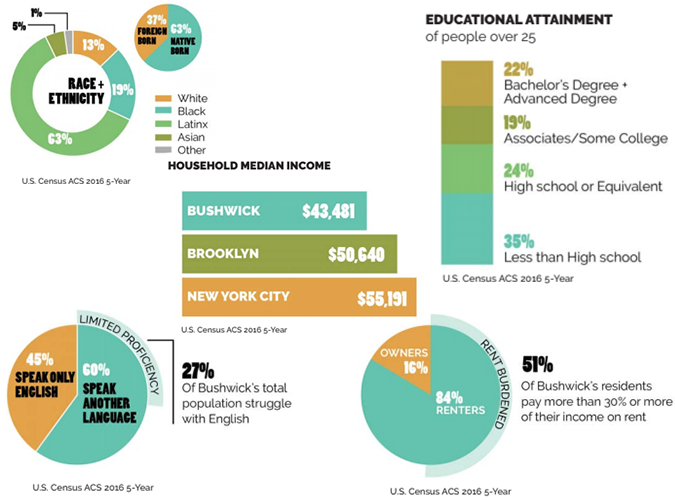
These graphics and images were sourced from the Bushwick Community Plan.22
The dramatic changes in Greenpoint-Williamsburg have had ripple effects on all surrounding neighborhoods. The area of Bushwick Community Board Four is especially poised for significant new residential development: No rezoning action is necessary to open Bushwick to an influx of market-rate residential construction. Since 2008, over 5,000 new units of housing have been built in Bushwick’s R6 zoning—a designation that allows a developer to build new housing without any height limit or requirement for affordable housing.23
A major result of this has been the creation of out-of-scale buildings, often in the middle of a block, as developers take advantage of Bushwick’s strengthening real estate market. These shifts are not only compromising the physical character of the neighborhood, previously distinguished by mostly two- to four-story buildings, but also the lived experiences of long-term residents. Landlords are pushing residents out of rent-stabilized apartments, small business owners are struggling to keep their roots in the neighborhood, and trains and buses are more crowded than ever. Rents in Bushwick are climbing at a steep rate as people with higher incomes move into the neighborhood.
According to an analysis by the Association for Neighborhood and Housing Development (ANHD), as many as 7,000 more market-rate housing units could result from Bushwick’s current zoning if no action is taken, spread throughout the neighborhood with no regard for the scale of existing buildings. Thanks to R6, a uniform zoning designation that has been left untouched since 1961, the neighborhood is moving along a clear trajectory toward gentrification, disruption, and displacement.
Community plans have the power to address these zoning-related issues, as well as other housing and real estate considerations that affect resident communities. Without community planning, those 7,000 new units in Bushwick would also lack additional open space, commercial space, industrial space, community facilities, or other forms of infrastructure and investment to help the neighborhood keep up with the growth.
There is precedent in New York City for the formation of community plans to address proposed rezoning. In 2015, East New York residents and community-based organizations created a community plan in response to the city’s rezoning plan. In 2016, groups and residents in East Harlem similarly created a community plan–this time in advance of an anticipated city rezoning.
The Bushwick Community Plan is different from many community plans because, from the beginning, it stemmed from a partnership among city agencies, organizations, and residents. Although at this point, city agencies have distanced themselves from the process, the work prior to the winter of 2018 was collaborative. Even in its current form, the Bushwick Community Plan is different in that it has included several community-based organizations, city agencies, elected officials as well as residents. Aside from the city agencies, the remaining stakeholders are continuing to work together with the hopes to re-engage city agencies once again through a rezoning process that reflects the priorities of the Bushwick community, as identified in this plan.
The outcome reflects agencies’ and residents’ combined local knowledge, priorities, analysis of trade-offs, and long-term vision. This is especially evident in some of the programs and policies that the Department of Housing Preservation and Development have amended and established since the drafting of the housing recommendations in this document.
Bushwick deserves investments from the city to preserve existing affordable housing, upgradeinfrastructure, and improve employment opportunities and neighborhood services. Rather than reacting to real estate plans and playing catch-up, a proactive plan like this one can help the community determine its own future.
The Planning Process
The community plan’s story started in 2013 when members of Community Board Four noticed out-of-context development appearing in the neighborhood and approached the two local city council offices and the Department of City Planning to request a rezoning. Community boards are local representative bodies of 50 unsalaried members appointed by the respective borough president, half of whom are nominated by city council. Soon after, Council Members Antonio Reynoso and Rafael Espinal initiated a community-based planning process, inviting residents and local organizations to create a vision for Bushwick’s future. This group met to identify top-priority neighborhood issues and develop potential solutions to meet these challenges, eventually becoming a steering committee.
The council members convened over 10 community meetings throughout 2014 and early 2015 to discuss zoning, existing conditions, goals, and community visioning on issues such as housing, open space, and economic development. These events included four visioning town hall meetings with over 200 participants, five zoning workshops, and three meetings on specific priority issues. Based on feedback from the town halls, the two council members—together with the Departments of City Planning (DCP) and Housing Preservation and Development (HPD)—launched a planning and zoning study to guide the future of Bushwick. In the summer of 2016, the council members invited Hester Street Collaborative, a community planning, design, and development nonprofit, to provide structure and facilitation to the process.
The plan’s steering committee iterated with community members on a neighborhood vision, challenges, and recommendations, with the support of six issue-specific subcommittees. Subcommittee membership was open and inclusive; each subcommittee included relevant city agencies, local advocates, and residents. The subcommittees all reviewed the priorities from the 2014–2016 town halls and worked with relevant city agencies to craft objectives and recommendations that addressed the neighborhood’s needs. Subcommittees organized large public summits in 2017, during which they informed Bushwick residents about existing and planned resources and programs and solicited input on community plan recommendations.
This process was truly a joint effort. Council members, the City Council Land Use Division, and until February 2018, representatives from DCP and HPD played important roles. An executive committee provided strategic leadership and process oversight; its members were community residents, organizational representatives (from Make the Road New York, Churches United for Fair Housing, Brooklyn Legal Services Corp. A, and RiseBoro Community Partnership), and Brooklyn Community Board Four leadership. Hester Street provided structure and facilitated the planning process. The result is a plan that is collaborative, holistic, and grounded in community vision.
Outcomes
The wide-ranging group of residents, agency staff, elected officials, and community-based organizations that developed the Bushwick Community Plan successfully ran a deeply collaborative, generative process. Though there was clear disagreement and continuous tensions along the way, the broad team of community members, local city council members, and agency officials also discovered alignment along with many steps of this journey.
The comprehensive planning process surfaced the following key community priorities that guided the process:
- Be proactive and intentional about how and where development happens;
- Create affordable housing;
- Develop new tools to preserve existing affordable housing;
- Increase opportunities for small businesses in Bushwick; and
- Work closely with city agencies to direct resources to the community for open space, infrastructure, transportation, and other neighborhood needs.
The process resulted in a series of recommendations in seven areas: housing, zoning and land use, historic preservation, economic development, open space, community health and resources, and transportation and infrastructure.
A critical leg of this collaboration came after the community plan process ended. At this point, all those who participated in creating the community plan are poised to ensure it moves to completion and implementation. If no rezoning recommendations are carried out, the current rate of development will be destructive for the community; as many as 7,000 market-rate housing units could be built without the construction of a single affordable unit. Clearly, this path will fail to meet locally-identified goals for affordability, infrastructure, and open space.
The Bushwick Community Plan is the product of deep collaboration across government and community groups that was created through an inclusive and comprehensive process. The plan includes proposals to create and preserve affordable housing, while also considering the broader needs of the neighborhood, according to the people who live and work there. The process was innovative among NYC rezoning plans in that both community and city stakeholders shaped it together from the beginning, and numerous ripple effects will emerge from this effort, including strengthened community-city relationships and long-term civic engagement among them.
Citations
- U.S. Census Bureau, American Community Survey 5-year estimates. Census data for Greenpoint-Williamsburg PUMA cited in the Bushwick Community Plan.
- U.S. Census Bureau, American Community Survey 5-year estimates, retrieved from Census Reporter Profile page for NYC-Brooklyn Community District 4--Bushwick PUMA, NY, 2019, http://censusreporter.org/profiles/79500US3604002-nyc-brooklyn-community-district-4-bushwick-puma-ny/.
- U.S. Census Bureau, American Community Survey 5-year estimates, retrieved from Census Reporter Profile page for NYC-Brooklyn Community District 4--Bushwick PUMA, NY, 2019, http://censusreporter.org/profiles/79500US3604002-nyc-brooklyn-community-district-4-bushwick-puma-ny/.
- Bushwick Community Plan, (New York, NY: Hester Street, September 2018), https://hesterstreet.org/publications/bushwick-community-plan/.
- Bushwick Community Plan
Colorado: Innovation and Persistence on Paid Leave
We are grateful for the collaboration and support of Colorado State Sen. Faith Winter (D-24) and Jessie Ulibarri from State Innovation Exchange on this case study.
Case Study
The United States remains the only developed country in the world without a national paid family and medical leave program. As federal progress on this issue stalled after 1993, family leave has become a priority for activists at the state and local levels. Nine states and the District of Columbia have enacted paid family leave programs in recent years, funded through payroll taxes. In 2020, Colorado became the first state to enact a paid family and medical leave program by ballot initiative. The story behind this achievement involves years of work and collaboration across many sectors and is a rich example of democratic co-governance.24
Every year beginning in 2014, the Colorado legislature considered, but never passed, legislation to create a statewide paid family and medical leave program.25 In 2020, the public health risks of coming to work sick were higher than ever due to the COVID-19 pandemic, yet 80 percent of Colorado workers did not have paid leave.26 As State Sen. Faith Winter, one of the bill’s original sponsors, pointed out in an op-ed, the pandemic exacerbated existing problems in a system where, even before the pandemic, 25 percent of new mothers return to work two weeks after giving birth.
But despite this context of elevated public health risks, in 2020, the bill once again failed to pass. This prompted supporters of paid family and medical leave to focus their efforts on an existing ballot measure, which would put the question directly to the citizens of Colorado. The supporters of this initiative formed a broad coalition, including elected officials, political candidates, community leaders, medical professionals, and nonprofit organizations. Much of the opposition to the plan came from large business groups, who argued that it would add an extra burden to employers and withhold money from employees for a new state program during an economic crisis.27 The logistics of organizing a ballot initiative during a pandemic created new obstacles, as traditional in-person outreach for the required 124,632 signatures28 and later voter turnout became more challenging. To adapt, supporters turned to innovative methods such as using text messages to gain signatures.29
During the November 2020 election, voters approved the initiative and passed a state paid family and medical leave program, funded by a payroll tax evenly divided between employers and employees, and set at 0.9 percent of employee wages.30 The initiative set the date for employee and business contributions to begin on January 1, 2023, and the starting date for access to the program as January 1, 2024.31 Benefits will be graduated, so that lower-income workers receive a higher percentage of their normal pay while on leave than higher earners.32
Although enacted suddenly through a ballot measure, the victory on a state paid family and medical leave program was the product of years of collaboration and relationships of trust across many different sectors of democracy: bureaucrats, citizens, advocates, and legislators across the local, state, and even federal government. Building and maintaining these relationships and partnerships over many years is a challenge that co-governance seeks to address. Frequent setbacks can undermine confidence in strategic decisions. Shifts in the political climate or changes in personnel can reset the process. But building strong partnerships, as allies inside and outside of government learn to appreciate and work across differing goals and positions, can create opportunities for residents and advocates to shape policy based on their unique experiences and perspectives, informing practitioners of decision-making and expanding the breadth of representation that politicians deliver.
Sen. Winter, who has represented Denver’s northern suburbs in the legislature since 2015, embodies the practice of co-governance, having been an organizer and activist before seeking elected office. New America Fellow Hollie Russon Gilman spoke with Sen. Winter to better understand the long path and complex relationships that led to Colorado’s breakthrough on paid leave.
Interview with Colorado State Senator Faith Winter
This interview has been condensed and lightly edited for length and clarity. To hear the full conversation, listen to this special edition of the Politics in Question podcast.
HRG: In this movement, were there strategies that you thought would work but then had to be adjusted? And how did the coalition function together?
FW: This bill was run six times before it was a successful ballot initiative. I ran it five of those six times, and many of those times I introduced the bill, we were a divided legislature when the Republicans had control. [The bill] was killed by two Democratic women first in the early years. We introduced it knowing we were going to lose, but it gave us an opportunity to “lose forward.” And what I mean by that is we were building a movement and not just trying for a one-time policy win. And so, every time we brought this legislation forward, we got more businesses involved that supported this. We built the coalition, we brought on pediatricians and NICU nurses, and we found more people to tell their stories. And every time we brought this forward, we had more media attention, a bigger coalition, and we refined the policy. When we first introduced this, we didn't have the perfect policy on how to fund it, and we eventually figured out the best way to fund it. That was very responsible, very fiscally responsible. And so every time we brought it forward, I considered it “losing forward” in a way to build a movement, include more people, and build up more leaders.
HRG: Can you say anything more about managing those political relationships from the legislative side? From the news coverage, it seemed like this was a sensitive issue. What are the lessons in terms of managing these relationships that we can extrapolate for others?
FW: One of the first decisions was actually moving forward, knowing that the Democratic House was going to kill the bill. It's not popular to divide your caucus, and we decided that this was a big enough, important enough bill to move forward and actually have accountability around a no vote. And that was a pretty bold statement that I couldn't have done without the backing of outside organizations that said, “We will have your back. We will actually do the accountability work. We will have this conversation about those Democrats [who] voted no.” And that changed the calculation.
The next year we brought it forward where we had the support of everyone in my caucus. And then we had a difficult decision in the last year when we brought this bill. It was probably the time that there was a fissure of co-governance. It was when we faced our governor and how he wanted this policy to be implemented. We'd been working on this for years, and we knew that the coalition really wanted this policy to be accessible, available, affordable, and we had worked to maintain 12 weeks of paid leave. We had worked to make sure that what was going to pass was [implemented] on a progressive basis—so that low-income folks paid less and higher-income folks paid more. And that the benefits you had were higher if you were a minimum wage worker. We worked to make sure that [the bill] provided paid family and medical leave for parents and for [their] own self-care. But the governor really wanted to do it through the private insurance market. Probably one of the hardest parts of this time was [asking], “Do we move forward with something the governor will sign and deliver something where people will have paid family leave? Or do we fight for a social insurance program, which we know is better, and get nothing?”
And ultimately, we decided at that moment to move forward, to try and provide something, but we weren't in line with the advocates. We didn't know the advocates had a bottom line that had to be social insurance. And so, there was a lack of communication at that moment. But ultimately, having a private insurance program didn't play out, and we got the better policy passed because we gave the power to the people [through a ballot measure].
HRG: We know that sometimes political relationships can feel transactional or zero-sum. Therefore, how can movements build effective relationships to share power while also being honest about the nature of political relationships?
FW: In moving from an organizer and advocate to being elected, it's a different job. When you're an advocate, you are focused on your one issue or a select number of issues. And your job is to push as far as you can to get as much as you can. And as an elected official, your job is to actually work in the reality of what is possible. There are some elected officials that will go out and, regardless of what happens, stand in their power and their truth. But they might not ever pass that bill. And part of my job of being an elected official is to work in the art of what's possible and create as much space as we can, and what remains true of co-governance is that advocates create more space for me to negotiate.
So when they tell more stories, get more media attention, have more rallies, send more postcards, and ask for more [of] what they want for paid family medical leave, they create the space for me as an elected official to negotiate on what I can pass. And you can only do that when you build trust. So I'm negotiating, and I'm not going to get everything the advocates want; I’m not going to get everything I want. I wish I could. But that's not the reality. It’s definitely not the reality of what the governor of Colorado wanted around this issue.
But having that trust to understand that the advocates are going to go to the left, they are going to be louder and I'm going to negotiate what is possible, but everything that they do creates more space for me to negotiate, and that takes trust and communication and updates to each other to actually get to the end.
HRG: You talked a little earlier about losing forward. When it works well, it can help refine a movement or a policy into something better than the original draft. But how do you keep those relationships going if the press highlights the challenges without moving beyond to the bigger picture item? How do you explain that back to constituents or advocates when there's frustration, for example?
FW: You have to celebrate every success. And the ultimate success was passing the policy and having the voters support the policy. But there are other successes along the way. Adding 10 more businesses to the coalition is a success. Getting an opinion editorial published is a success, having a Tweet storm that the governor notices is a success. And everything adds up, and it's cumulative. And [how] I view the world [is] that power is infinite, not confined. How do we actually share power and grow power? Part of the way we do that is by celebrating each step forward. It might not be the ultimate goal of passing a policy, but getting one more business signed on is a big deal. So how do we celebrate that and recognize the work and acknowledge the work and celebrate the work? Because that's what builds a movement versus building a one-time win.
HRG: When the policy actually passed, it wasn't through the legislature, but through a ballot measure. Did you pass that effort off to advocates?
FW: We had worked with advocates for a long time to actually use the ballot process as an alternative. So we had polling information that we made sure got leaked to the business lobby, for example, to show that this was really popular on the outside. And in co-governance, when it was my bill, my name was on it. But I was relying on advocates to help build the coalition and provide testimony. And when we sent it to the ballot, I was still there and doing a lot of the debates. I fundraised for the initiative, made sure that we were getting yard signs out, texted voters, talked to voters. And so it goes both ways, right? Whether my name was on it or it was a ballot initiative, it was co-governance, and we were a team. And ultimately, it was about strategy in what we could do to get this across the finish line and making sure that we were connected and making those decisions together.
HRG: I'd be curious about lessons that you've learned from doing this through a pandemic and any policy changes that you see to make our institutions more participatory and have more avenues for direct democracy—both during times of crisis and how to reform institutions in a more ongoing and sustainable way.
FW: I am just so grateful and thankful for our field team from the ballot initiative because they figured out how to collect signatures when we were basically still in stay-at-home orders, and they had single-use pens, they had masks. They doorknocked and stood six feet away. They were at grocery stores and managed to do it in a way that protected people and made sure we weren't spreading COVID-19, and also collected enough signatures and did a phenomenal job.
So the basic tenet of organizing is starting with where people are at, and we were already starting with where people were at. They cared about paid family leave. They wanted paid family leave. The pandemic showed even more how close we all were to needing paid family leave. And we were nervous about safety. And so we started with where people are at. “You can sign this, I have a mask on, here’s my single-use pen, there's sanitizer. We've got you, right?” It's the basic tenets of organizing, whether it's a pandemic or not. You start with where people are at, and you start with their concerns. You start with what they're concerned about and you go from there.
HRG: Some of your colleagues in the legislature also describe the process of creating state-paid family medical leave. For example, one early step came all the way back in 2013 when the legislature expanded the definition of family to include same-sex couples and unmarried partnerships. Adopted families is a pretty creative use of the legislative process of long-term planning when you have a goal as big as a new statewide policy. How can a collaborative movement work together to break down the steps and then plan for long-term success?
FW: The way a movement works together is by providing all the separate pieces, so you need a really good policy. There's a lawsuit right now at the state level on our policy, and we've gone to the Supreme Court before on this policy. So you need a really solid policy, which means you need good policy people. You need good lawyers. And then you need good organizers and good storytellers that could build power through people. So you have a solid foundation on policy, you have a solid foundation of law, and then you have organizers building power through people. You have legislators that are working inside the system to push the narrative. You have a really good communications plan to take that organizing work and storytelling and win over the hearts and minds of people. And that all has to work together in collaborative governance where you acknowledge, “This is my niche, this is what I'm supposed to do at this moment in order to move this forward. And I'm going to trust the lawyer over here is doing that. I want to trust that the organizers are doing that. I'm going to trust that the field team is doing that. I’m going to trust that the TV commercial that comes out is going to tell our story in the right way.” So it has to do with making sure that you have different talents on your team and that you have brought them together in a way where they trust each other and move forward together.
HRG: What happens now to these relationships? Does it move mostly to implementation? How do we keep those relationships moving on? And, of course, you mention the legal challenges that you're now working on with these policies. I would be curious about how you're managing that, including those external relationships.
FW: We're continuing to make sure that this gets implemented in the right way, because the worst thing that could happen is that this doesn't actually go well. So we're working on making sure the state government's hiring the right people to do this. We're making sure the policy is in the right place. We're making sure that we're keeping the community updated. There is going to be rulemaking, and when there's rulemaking, we have to turn people out to talk about that rulemaking.
We know that paid family and medical leave is really important and also that it is not the last policy we need to pass to make sure we're protecting workers. So, for example, I ran the Power Act this year, which we “lost forward.” That's changing the definition of sexual harassment from severe or pervasive to something that actually makes sense for the modern workplace. And many of those partners that I worked with on paid family medical leave, we are now working with on making sure we're updating our workplace harassment standards. We worked with those partners to make sure we updated our equal pay standards. We're working with our partners to make sure we're expanding access to affordable housing.
So when you build power and when you build a movement, it's not about a singular issue. It was fantastic that we won on paid family medical leave. And now we have relationships. Now we have a coalition. Now we have an ecosystem of creating change. And now we can think about: what else is next and what can we do next? And that's what we're doing.
HRG: Anything else you’d like to share?
FW: I read somewhere that politics is about relationships and not giving up. We don’t always automatically win on the first try. To get where we're going, we need to have a conversation and listen. Let's be persistent. Let's have resilient skin where we keep moving forward and together we can actually build power and build movements that change the world.
Citations
- Paid Family and Sick Leave in the U.S., (Kaiser Family Foundation, December 2020), https://www.kff.org/womens-health-policy/fact-sheet/paid-family-leave-and-sick-days-in-the-u-s/.
- Markian Hawryluk, “Paid Family Leave Bill Faces An Uphill Fight In Colorado,” NPR, March 6, 2020, https://www.npr.org/sections/health-shots/2020/03/06/810139462/paid-family-leave-bill-faces-an-uphill-fight-in-colorado.
- Ballotpedia. “Colorado Proposition 118, Paid Medical and Family Leave Initiative (2020)” https://ballotpedia.org/Colorado_Proposition_118,_Paid_Medical_and_Family_Leave_Initiative_(2020)
- Jennifer Brown, “Proposition 118 explained: Paid-leave measure would give Colorado workers time off but cost big money,” Colorado Sun, October 2, 2020, https://coloradosun.com/2020/10/02/proposition-118-paid-family-leave/.
- Marcia Martin, “Inside the Ballot Box: Prop 118 seeks to create family leave insurance program,” Logmont Leader, October 13, 2020, https://www.longmontleader.com/elections/inside-the-ballot-box-prop-118-seeks-to-create-family-leave-insurance-program-2786977.
- Conrad Swanson, “Colorado lawmakers give up on paid family leave bill, will support ballot measure,” Denver Post, May 1, 2020, https://www.denverpost.com/2020/05/01/colorado-family-leave-bill-ballot/.
- Kimberley Dempster Neilio and Harrison J Meyers, “Colorado Voters Approve Paid Family and Medical Leave Insurance Program,” The National Law Review 11 (November 2020), https://www.natlawreview.com/article/colorado-voters-approve-paid-family-and-medical-leave-insurance-program.
- Dempster Neilio and Meyers, “Colorado Voters Approve Paid Family and Medical Leave Insurance Program.”
- Joe Rubino, “Colorado Prop 118: Paid family and medical leave passes,” Denver Post, November 3, 2020, https://www.denverpost.com/2020/11/03/colorado-prop-118-results-paid-family-leave/.
- Introduction
- Chicago: Centering Residents in Neighborhood Development Decisions
- Gainesville: Protecting Historically Black Neighborhoods During Development
- Milwaukee: Youth Organizers Lead the Way on Reforming Public School Safety
- Bushwick: A Community Collaborates on a Zoning and Development Plan
- Colorado: Innovation and Persistence on Paid Leave
More About the Authors

Mark Schmitt
Senior Director, Political Reform Program

Hollie Russon Gilman
Senior Fellow, Political Reform Program