A Chapter of: What We Know About Ranked-Choice Voting
Electoral Outcomes
Claim 8: RCV Changes Who Wins
Conclusion: Evidence is limited, but mainly promising for people of color women, less so for independents and moderates; more data is needed
Above we reviewed the scholarship on RCV and candidate emergence, and concluded that more data and investigation is needed to understand whether and to what degree the introduction of RCV encourages more women, people of color, moderates, and independents to run for office.
But to the extent RCV encourages inclusivity, diversity, and moderation in politics, RCV elections must actually reward these traits with electoral victories to demonstrate their value to both winners and potential future candidates. Governing depends on the election winners. And if inclusive, diverse, and moderate candidates do not win, fewer of them will run in the future.
Women and People of Color
In theory, ranked-choice voting should expand the diversity of candidates because RCV removes the discouraging “spoiler” label lobbed at candidates who lack the overt backing of a major party. Furthermore, a more diverse set of candidates, including women and people of color who might have previously been discouraged from running for office, might be drawn to running for office.
In practice, the results are mainly promising. Some studies show a significant increase in women and people of color running under RCV; others show modest or no impact. As with many of the real-world implication questions examined here, the data is still limited and it may take time to observe meaningful impacts.
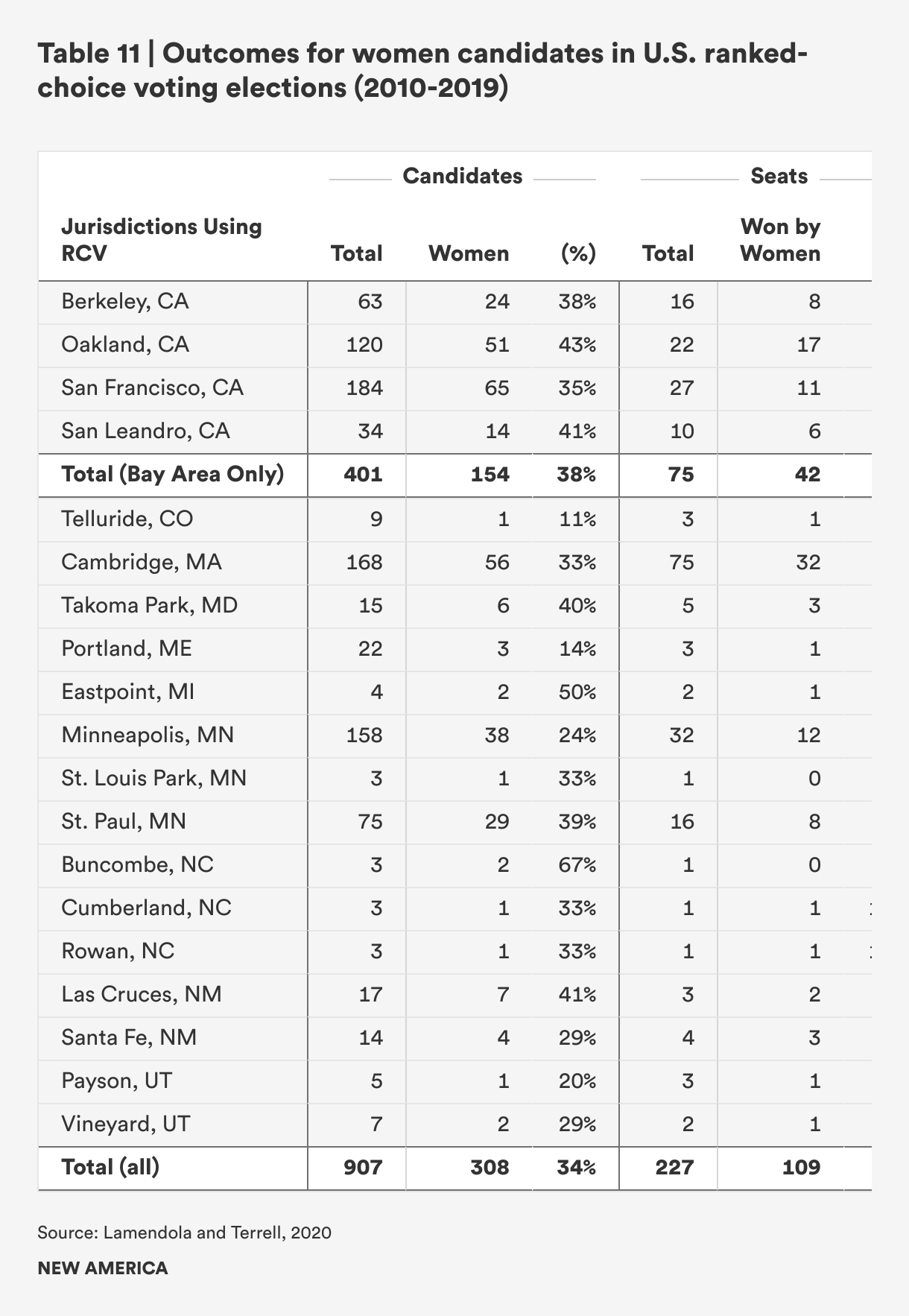
We can start with the article from John, Smith, and Zack, which we discussed above.116 They found that RCV increased the proportion of minority candidates, but not women candidates. They also found that the introduction of RCV was associated with a 0.16 increase in the predicted probability that a woman will be elected, and a 0.19 increase in the predicted odds of minority women being elected, relative to the non-RCV control cities (see Table 9 below). However, RCV did not appear to affect the probability of racial and ethnic minorities winning elections.
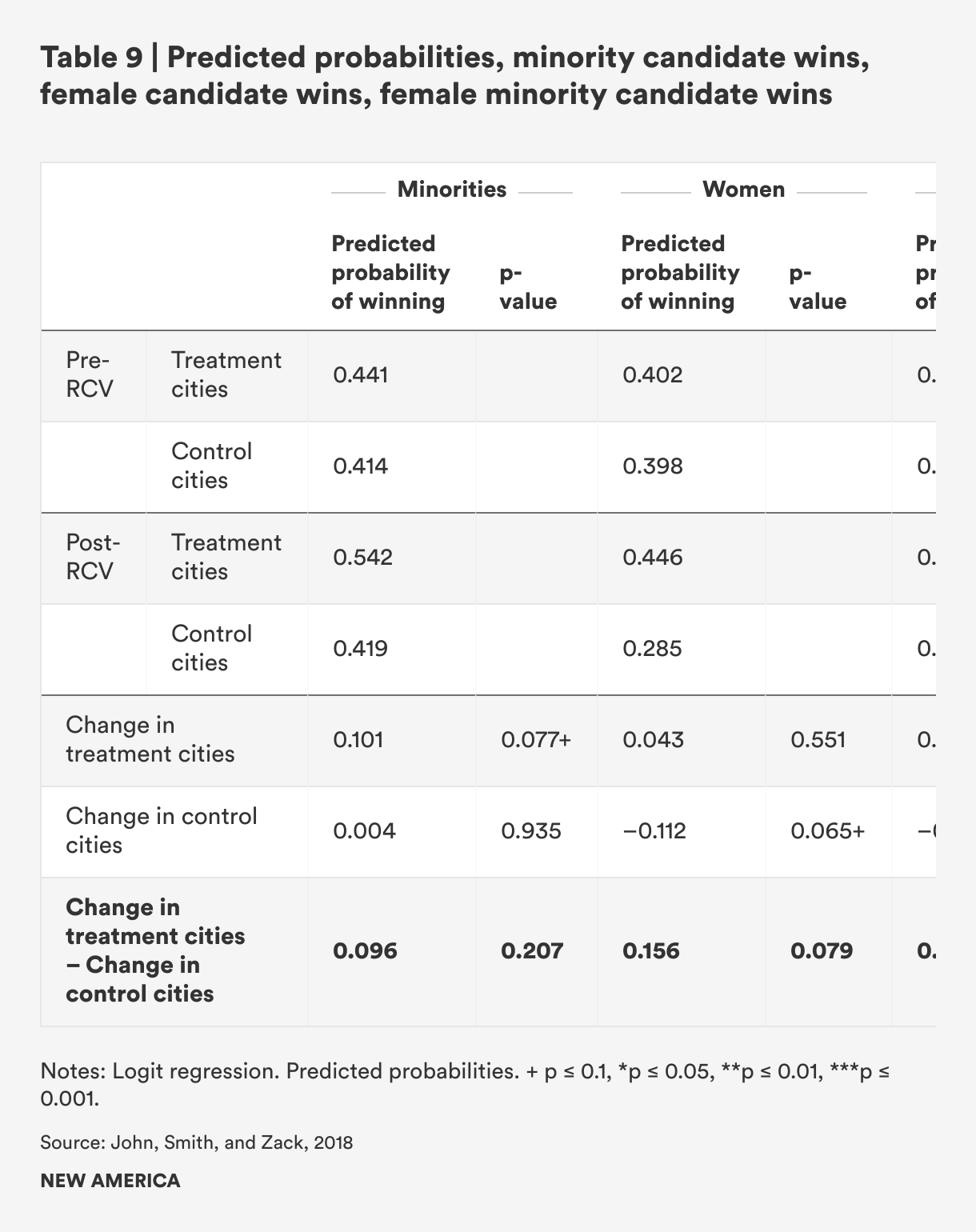
In addition, John et al. found that all three sets of variables, city characteristics, the structure of the race, and characteristics of the contest, were relevant across the three candidate groups. For minority candidates, the non-white citizen voting age population (CVAP), high incomes, a minority incumbent contesting the race, and an open seat, were associated with an increase in the odds of winning election. Critically, they estimate that term limits were associated with an 82 percent decrease in the predicted probability of a minority candidate winning election after RCV implementation (p < 0.01). While this could be a fluke (and indeed, it does not chime with past findings of a subtler, and even positive relationship between state legislative terms limits and minority representation),117 it asks us to consider how different reforms might clash in the real world, and should be investigated further. The authors suggest that the reason women of color win more under RCV might be that they go above and beyond with their outreach to their rivals’ supporters, including those from different ethnic and racial groups, seeking those vital second- and third-choice rankings.
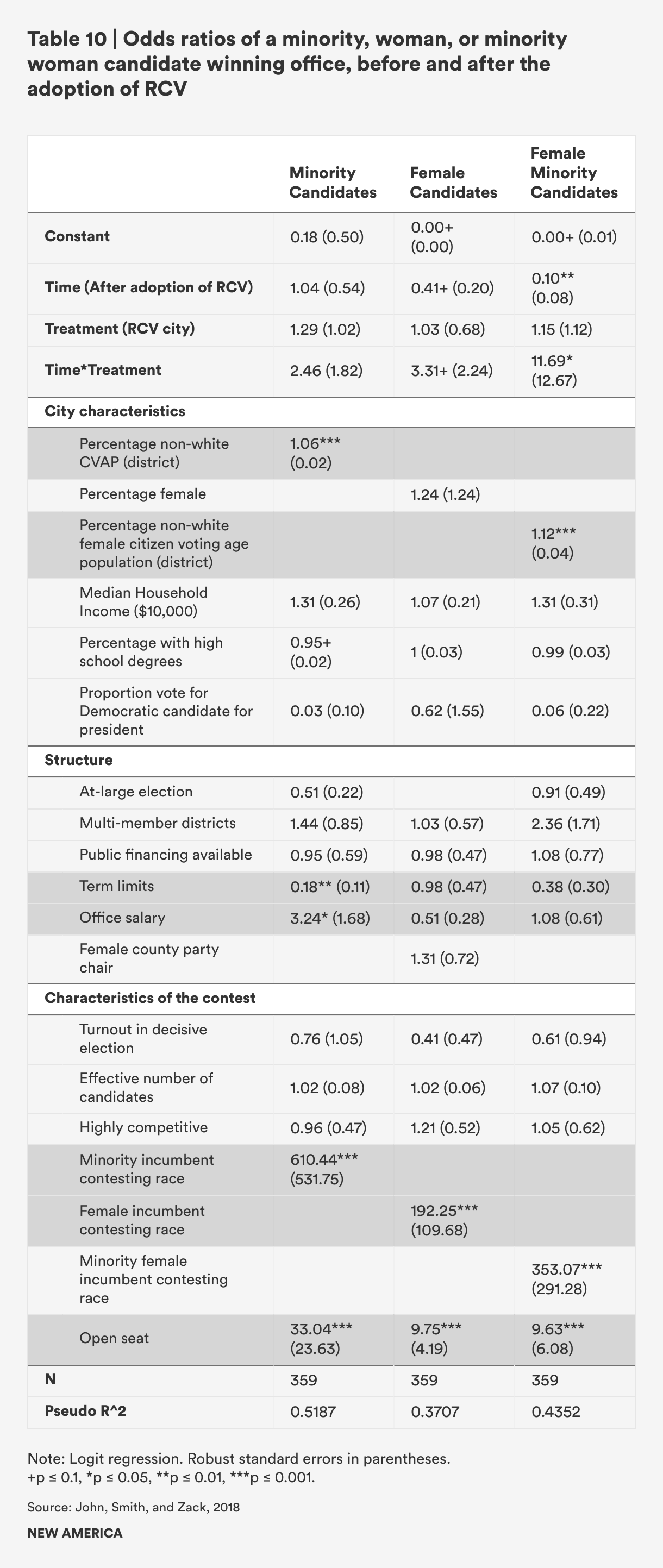
Terrell and Lamendola’s 2020 article on RCV's impacts on women's representation concluded that the number of women winning elected office is higher in cities that use RCV. Following up on the four Bay Area cities examined in John et al.,118 they report that women have won an average of 56 percent of RCV elections between 2010 and 2019, despite representing only 38 percent of candidates. Furthermore, across all 19 U.S. cities and counties using RCV in that time period, women won 48 percent of all contested seats, while making up only 34 percent of candidates (Table 11). And according to the article, as of July 2020, 47 percent of city council seats in the Bay Area cities using RCV were held by women compared to only 36 percent in control cities (California cities with at least 30,000 residents), and 37 percent in Bay Area control cities.119
Similarly, Steven Hill’s investigation of how racial minorities in San Francisco, Minneapolis, and Oakland fared under RCV concluded that around 60 percent of the 53 seats elected by preferential rules were won by ethnic minorities. Denise Munro Robb’s study of RCV’s impact on representation in San Francisco’s Board of Supervisors elections (2002, 2004, 2006, and 2008) also found greater minority representation after RCV was implemented, although there were still very few female supervisors holding office.120 Consistent with these findings, New York City’s inaugural RCV primaries in 2021 resulted not only in the city’s second Black mayor but also the most diverse and gender-balanced city council in the city’s history.121
One explanation for the increase in victors from racial and ethnic minority groups under RCV is that the system reduces the type of vote-splitting among candidates from the same background often experienced in plurality elections. FairVote’s recent analysis of RCV’s effects on communities of color found that each racial and ethnic group included in their sample “increased its win rate in elections featuring multiple members of that group; none experienced vote-splitting.” Black candidates in particular benefited. According to the report, a “Black candidate won in 67 percent of elections that featured two or more Black candidates, compared to only 32 percent of elections with only one Black candidate.”122
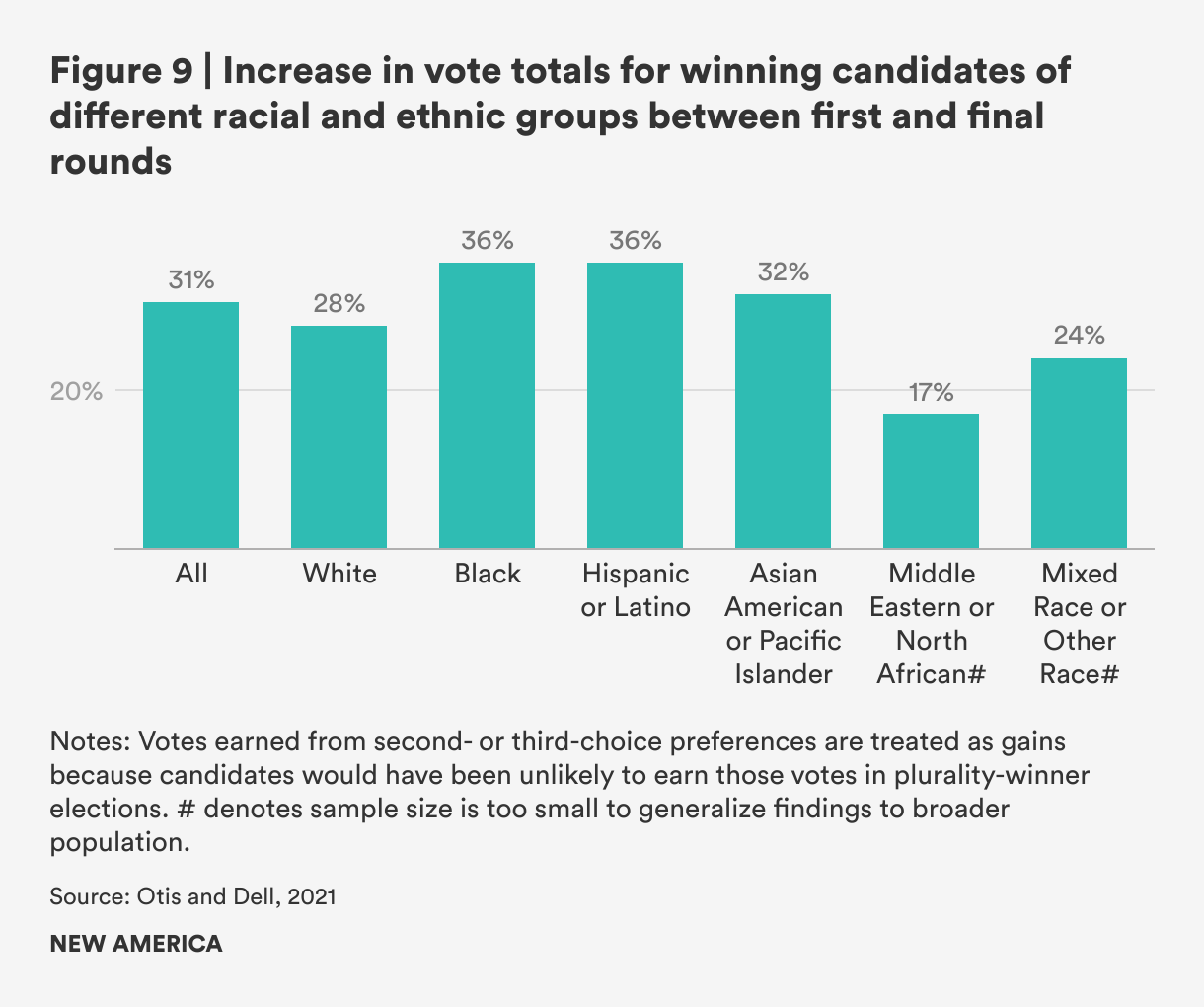
Another possible explanation for why RCV may lead to more racial and ethnic minority winners is that candidates from these groups are doing a better job of appealing to voters outside their traditional base, in order to secure those crucial back-up rankings. The same FairVote study cited above examined all single-winner RCV races in the United States that advanced past the first round of counting (that is, no candidate received a majority of first-preference votes) to ascertain which groups were more effective at accumulating support from the first to last round of counting. They found that candidates of color increased their vote totals between rounds by a greater percentage than white candidates.123
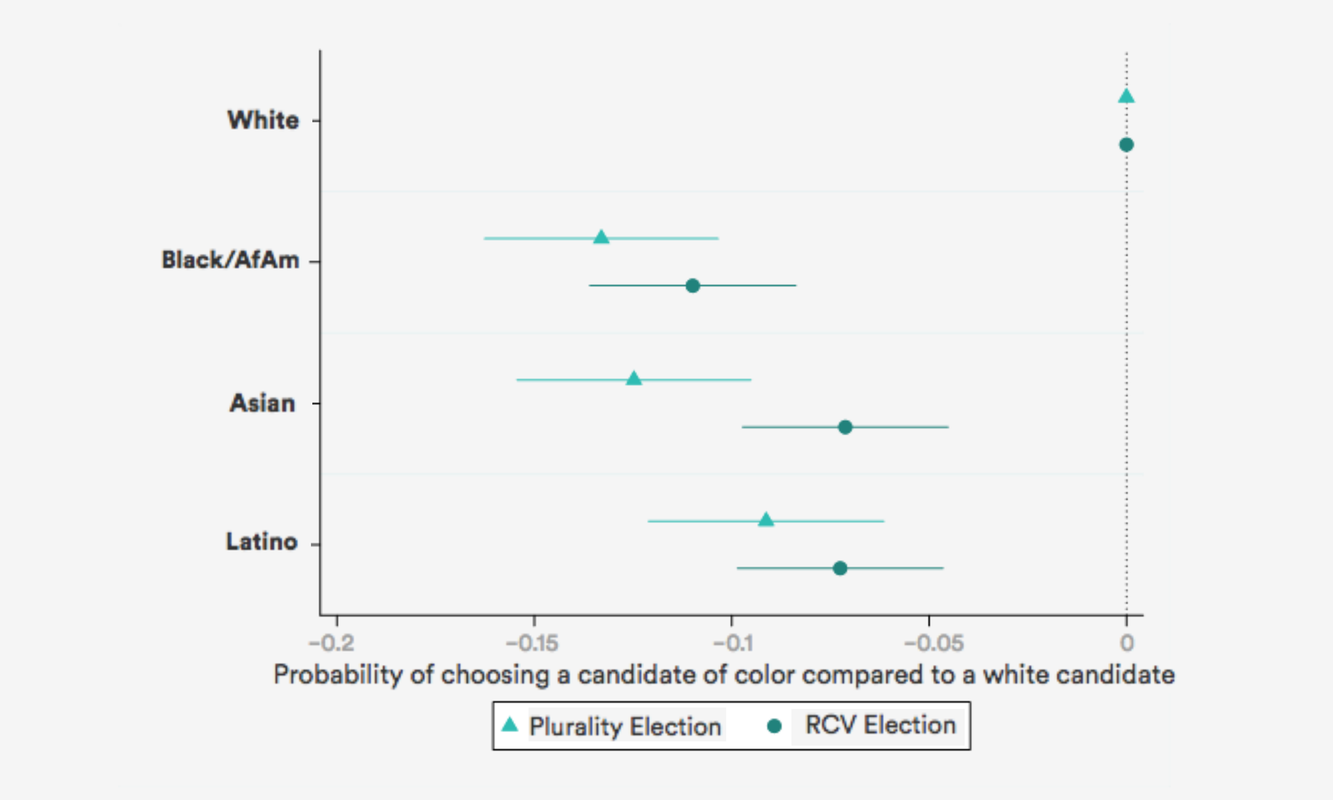
Still, one major concern related to RCV is that racial prejudices are more likely to influence vote choice when the election system is more cognitively complex.124 In "Ranking Candidates in Local Elections: Neither Panacea nor Catastrophe," Melody Crowder-Meyer, Shana Kushner Gadarian, and Jessica Trounstine found that, despite the extra effort involved in completing an RCV ballot compared to a plurality ballot, voters in an RCV election are not significantly less likely to support candidates of color relative to white candidates (see Figure 10). Importantly, adding partisan labels significantly reduced the bias against candidates of color among voters in both RCV and plurality elections. Similar to the earlier note on term limits, this finding should give proponents of nonpartisan elections some pause. Finally, their results also show that the penalties against candidates of color were "driven nearly completely by ideological moderates and conservatives as well as by white respondents." These penalties persist with experience. However, the bias toward white candidates is low among respondents with high levels of knowledge of RCV.
Figure 10 | Candidates of Color Face Similar Penalty in Nonpartisan Plurality and RCV Elections
Independents
To be sure, when non-major party candidates run, voters are more likely to support them under RCV. Jesse Clark’s 2020 study on the costs and benefits of RCV found that RCV does appear to increase the odds of a voter casting a sincere vote for a non-major party candidate. He found RCV in Maine led to a 6 percent increase in non-major party vote-share in the two 2018 congressional elections.125 Reinforcing this finding, his experimental survey (online, nationwide sample N~1500) demonstrated that RCV is associated with a 5 percent increase in the propensity to vote for (i.e., give top ranking to) a non-major party candidate.126
As discussed in the RCV Changes Who Runs section above, "Ranked-Choice Voting, Runoff, and Democracy: Insights from Maine and Other U.S. States," by Cynthia McClintock and Joseph Cerrone, assessed the openness of the electoral arena to independents and third parties and ideological moderation in the context of the 2020 federal elections, with a special focus on Maine, which implemented RCV for congressional elections in 2018. They conducted interviews with key stakeholders in Maine, including current and former political candidates (like 2020 U.S. Senate independent candidate Lisa Savage). They also identified and compared a set of 12 competitive federal election cases.127 Across those 12 elections in 2020, they found, in line with expectations, that the biggest combined vote-share for third party and independent Senate candidates (6.6 percent) was in Maine. Further, independent Lisa Savage was the only non-Democratic/non-Republican Senate candidate to achieve 5 percent in the election result.
Though not included in the McClintock Cerrone study, the substantial vote-shares earned by independents candidates Marty Grohman, Tiffany Bond and Will Hoar in Maine’s 2018 congressional elections, detailed in the “who runs” section on independents, lend further support to the claim that RCV gives a boost to independent candidates, even if that boost may not be sufficient to get them elected.
Moderates and Moderation
To assess the openness of the 2020 electoral arena to ideological moderation, McClintock and Cerrone identified and compared a set of 12 competitive federal election cases (based on Cook Political Report ratings as of summer 2020) and evaluated the 33 candidates running in those elections.128
Maine’s candidates’ scores were consistent with RCV’s promise of greater ideological moderation. Among the sample, Sen. Collins was by far the most moderate. She also won re-election; among the four Democrat and Republican candidates in Maine, only one was over .25 points more extreme than the candidate’s party’s average. However, as the authors note, based on roll call votes, Collins was rated more ideologically moderate prior to RCV’s adoption in Maine than after. In sum, they found the gains for independents and ideological moderation in Maine under RCV were modest in 2020, and the effects of both RCV and runoff were constrained by the intense political polarization in play during the study, among other factors.
Maine’s other Senator, Angus King, is also one of the more moderate Senators. However, ascribing the moderation of both King and Collins to RCV confuses correlation with causation. Both Collins and King had long careers as political moderates before RCV, and both won their RCV elections outright (without transfers). Maine is a rare closely-contested “purple” state in which moderation tends to pay. Did RCV keep them more moderate? It’s possible. Here, it might be valuable for future research to qualitatively compare Maine with New Hampshire, another purple state with a similar political culture and a similar premium on moderation in elected officials, but which didn’t enact RCV.
In general, the observed effects of RCV on candidate diversity seems to be dependent on methodology and context. Studies that find RCV elevates diverse candidates tend to be based on progressive cities. Findings based on laboratory experiments suggest RCV produces similar outcomes to plurality and runoff systems. While the difference could boil down to the fact that lab experiments don’t account for significant real-world factors that are in play in cities, the Maine example—the only real national test case we have—hints at the possibility that national political forces might be even more influential than local-level forces, but we need more data. We recommend an experiment in which the conditions of an election are manipulated to be local versus national, and participants are exposed to different kinds of messaging (i.e., some messaging that involves more attacks; other messaging that involves more willingness to compromise). Under these conditions, how do people use their rankings? This could also be used to answer some remaining questions about voter satisfaction with the ranking system.
Claim 9: RCV Leads to More Condorcet Winners
Conclusion: Mainly supported
According to FairVote, as of September 2021, there have been 289 single-winner ranked choice elections in the United States which included at least three candidates, 120 of which (or 42 percent) were decided in the first round. In the remaining 169 races, the count advanced to the instant runoff stage. Out of these, 103, or about 60 percent, resulted in winners who did not receive a majority of all votes cast because of ballot exhaustion (where voters did not rank enough candidates for their votes to ultimately count in the final round, after transfers). However, of these 103 elections, over half occurred in elections where voters were limited to only three rankings.129 When one compares non-majority RCV outcomes to a traditional top-two runoff, the turnout drop-off in second round elections is typically much higher than any ballot exhaustion.
Critics of RCV often cite the 2009 mayoral election in Burlington, Vermont as evidence that the system produces perverse outcomes. Burlington was an early adopter of RCV in 2005, but it was repealed by voters after the 2009 mayoral race, in which the winner, incumbent Bob Kiss, was neither the first-round leader nor the Condorcet winner (that is, the votes failed to show that Kiss would have won in head-to-head matchups against each of the other candidates on the ballot). Many voters who supported the subsequent repeal campaign had originally voted in favor of adopting RCV, and turned against the system because they did not like Kiss. Other voters, meanwhile, felt that they were essentially punished in the RCV election for ranking their favorite candidate first, something critics have called the “favorite betrayal criterion.”130 Still, to put Burlington in perspective, "Condorcet loser" elections are exceedingly rare under ranked-choice voting. Burlington, moreover, recently voted to bring back RCV, effective March 2022.131
Claim 10: RCV Makes Primaries Work Better in Avoiding Polarizing Candidates?
Conclusion: Early evidence is promising, more study needed
Standard RCV eliminates the need for primaries. By condensing a normally multi-stage cycle to one election held in November, RCV can significantly reduce voter dropoff and other turnout disparities between primary and general elections. In addition, as early and mail voting become more prevalent, RCV could help reduce the incidence of wasted votes cast for candidates who withdraw shortly before Election Day. In a plurality election, if your chosen candidate withdraws after you cast your vote, you’re out of luck. With RCV, if your first-choice candidate drops out, your vote will simply go to your next-ranked candidate. And though this is less studied in the United States, replacing multiple elections with a one-off RCV election should also save taxpayer money in the long term.
Despite these advantages of a one-off RCV election, recent experiments with RCV in New York City, the Virginia Republican Party, and five state Democratic parties in 2020 have opted to bring RCV to their party nomination contests while leaving the normal election calendar intact.132 The most persuasive rationale for this approach is that RCV is much more compatible with modern primaries than first-past-the-post rules, given their often large, unwieldy fields of often polarizing candidates, where candidates can often win with a small fraction of the total vote. Moreover, in many one-party jurisdictions (such as New York City) the primary election is the only election that matters. It is also easier politically to change the rules of primary elections than general elections. Regarding the introduction of RCV ballots to presidential nominating contests, FairVote’s Rob Richie and colleagues suggested that “RCV may combine the consensus‐building of pre‐1968 conventions with the modern practice of empowering voters to choose their party’s nominees.”133 It also combines well with vote-by-mail. By one estimate, almost four million ballots were “wasted” in the 2020 presidential primaries because candidates dropped out between the time a voter mailed their ballot and the day of the election. With RCV, such votes would instead transfer to voters’ back-up preference.134
Thus far, primaries that use RCV have generally produced “consensus” candidates, affirming expectations that RCV can have a moderating effect on primaries, or at least have the effect of blocking the path of more polarizing candidates who might have enough base support to win under plurality rules.
Another apparent advantage to using RCV in the primary process is that because RCV encourages sincere (as opposed to strategic) voting, ranked ballots in party primaries can more clearly demonstrate factions’ relative priorities and voting power than traditional single-mark ballots, thereby giving party leaders, who will need to unify those factions around the party nominee (and in the long term keep their big tents together and safe from a hostile takeover), a better sense of how and with whom to bargain for future cooperation.
A recent study on the 2020 Democratic presidential nomination contests in the five states that used RCV ballots concluded that voters used their rankings not only to nominate the strongest candidate to represent the party in the general election but also to ensure representation of the party's diverse electorate at the national convention.135 RCV not only allowed voters to express support for Joe Biden as the nominee but also let the progressive wing of the party select Sanders as the alternative to Biden. RCV furthermore allowed the clear third-favorite candidate, Warren, to display her unique strength among a powerful segment of the electorate. Indeed, by combining the vote transfer data with the exhausted ballots in each round one can observe that Warren received the greatest representational boost from the RCV rules. As the paper’s authors, Baodong Liu, Nadia Mahallati, Charles M. Turner note, the fact that Sen. Elizabeth Warren (D-Mass.) voters were at once numerous and unlikely to rank either Joe Biden or Sen. Bernie Sanders (I-Vt.)—a clear warning signal to party elites that accommodation is needed—would have been hidden inside the traditional balloting process.
For scholars who are interested in running more counterfactual analyses, Jason Maloy’s 2019 book Smarter Ballots: Electoral Realism and Reform includes a chapter on retrospective simulations with alternative ballot types that discusses methods, limitations, and sources of data.136
In 2021, New York City (re)introduced RCV for local primary and special elections and left the general election rules unchanged. The reform seems to have worked as intended: Besides marking the highest turnout in a New York City primary in decades, the mayoral campaign—the top contest on the ballot—elevated three candidates, two of whom are Black and two women, representing different wings of the party, and they each held on through multiple rounds of vote tabulation. Brooklyn Borough President and former police captain Eric Adams, a moderate, ultimately won the nomination thanks to the breadth, if not depth, of support for him across the five boroughs. He was the most-preferred candidate for 30 to 40 percent of voters in four boroughs; more importantly, though, more than 50 percent of city voters gave him one of their five rankings.137
Citations
- John, Smith, and Zack, “The Alternative vote.”
- See, for example, Susan J. Carroll and Krista Jenkins, “Increasing Diversity or More of the Same? Term Limits and the Representation of Women, Minorities, and Minority Women in State Legislatures,”(prepared for the annual meeting of the American Political Science Association, San Francisco, CA, August, 2001), https://citeseerx.ist.psu.edu/viewdoc/download?doi=10.1.1.507.1752&rep=rep1&type=pdf.
- John, Smith, and Zack, “The Alternative Vote”; John et al., The Impact of Ranked Choice Voting on Representation: How Ranked Choice Voting Affects Women and People of Color Candidates in California.
- Lamendola and Terrell, In Ranked Choice Elections, Women WIN. Additional data available here.
- Robb.
- Including 30 women, 86 percent of them women of color; six openly LGBTQ+ members; and at least six foreign-born members. “Major Takeaways from New York City's First Ranked Choice Election,” readMedia, July 14, 2021, http://readme.readmedia.com/Major-Takeaways-from-New-York-Citys-First-Ranked-Choice-Election/18037730.
- Deb Otis and Nora Dell, “Ranked Choice Voting Elections Benefit Candidates and Voters of Color.”
- Otis and Dell.
- Melody Crowder-Meyer, Shana Gadarian, Jessica L. Trounstine and Kau Vue, “A Different Kind of Disadvantage: Candidate Race, Cognitive Complexity, and Voter Choice,” Political Behavior 42 (2020): 509-530.
- He conducted a DID analysis of non-major party vote shares in congressional elections between 2012, 2014, 2016, and 2018.
- Clark, “Rank Deficiency.”
- The sample included two RCV elections (Maine’s Senate and 2nd Congressional District), five elections under runoff (Georgia’s regular Senate election, Georgia’s special Senate election, Georgia’s 6th Congressional District, and California’s 21st and 25th Congressional Districts), and for plurality cases they included the two competitive elections in Iowa (its Senate and 1st Congressional District) and in North Carolina (its Senate and 8th Congressional District) because Iowa and North Carolina are deemed similar to Maine and Georgia respectively by FiveThirtyEight. For an additional plurality case, they included the Senate race in Colorado on the basis of the competitiveness criterion.
- Cerrone and McClintock, “Ranked-Choice Voting, Runoff, and Democracy Insights from Maine and Other U.S. States.”
- “Data on Ranked Choice Voting,” FairVote, https://www.fairvote.org/data_on_rcv#research_rcvwinners; Craig M. Burnett, Vladimir Kogan, “Ballot (and voter) ‘exhaustion’ under Instant Runoff Voting: An examination of four ranked-choice elections,” Electoral Studies 37 (2015): 41-49, https://doi.org/10.1016/j.electstud.2014.11.006.
- How our voting system (and IRV) betrays your favourite candidate, https://www.youtube.com/watch?v=JtKAScORevQ
- Notably, RCV was repealed in Burlington by a margin of 52 to 48 percent in a low-turnout election (7,641 votes cast); it was reinstated in Burlington by a margin of 64 to 36 percent, with 13,826 votes cast.
- Alternatively, Alaska voters approved a ballot measure in 2020 to establish ranked-choice voting for general elections, including the presidential election, in which voters would rank the four candidates that advanced from a nonpartisan “top-four” primary.
- Rob Richie, Benjamin Oestericher, Deb Otis and Jeremy Seitz‐Brown, “Lessons from the Use of Ranked Choice Voting in American Presidential Primaries,” Politics and Governance 9 (June 2021): 354–364, https://www.cogitatiopress.com/politicsandgovernance/article/view/3960/3960.
- Richie et al.
- Baodong Liu, Nadia Mahallati, and Charles Turner, “Ranked-Choice Voting Delivers Representation and Consensus in Presidential Primaries,” April 9, 2021, available at SSRN: http://dx.doi.org/10.2139/ssrn.3822879
- J.S. Maloy, Smarter Ballots: Electoral Realism and Reform, (Germany: Springer International Publishing, 2019), Chapter 6.
- Wendland and Carman, Ranking Works? An Examination Of Ranked Choice Voting In New York City.