A Chapter of: Parler and the Road to the Capitol Attack
VII. Implications & Takeaways
The Value of Cross Platform Analysis with Parler as an Anchor
All the above analysis raises serious questions about the interplay between fringe platforms like Parler and mainstream social media platforms and moves by big tech companies to remove right-wing websites from their servers as a potential containment strategy for managing the spread of online hate, disinformation, and misinformation. Although more research is needed, our preliminary analysis suggests that as long as regulatory gaps for social media platforms persist, the United States faces the prospect of a months-long—or worse, years long—rolling crisis as the public backlash against far-right political violence drives extremist cadres deeper into fringe parts of the internet and farther into the dark web. Given the FBI’s warnings about the growing threat from anti-government domestic extremism, and the potential for more political violence leading up to the 2022 mid-term election cycle, there is an urgent need to learn more about how platforms on the fringes operate and the impact of interventions aimed at tamping down disinformation.
Relatedly, controversy over Parler’s role in providing a platform for the “Stop The Steal” movement continues to churn. Soon after January 10, when Amazon suspended service to Parler, a lawyer for Parler filed a request for an injunction against Amazon in federal court in Seattle asking for the suspension to be lifted.173 At the time, Amazon said that it was not confident that Parler was capable of properly policing its platform, raising questions about the conservative social media site’s overall content management and privacy protection policies, and compliance with the terms of Amazon’s service agreement.174
The case ricocheted back and forth between federal and local courts for several months. But Parler pressed forward with a lawsuit brought against Amazon in January 2021 and won a crucial judgment in federal court in September. It now appears likely that the debate over whether Amazon breached its contract with Parler will unfold in a King County, Wash. court, in Amazon’s home base of Seattle.175
In the complaint Parler filed in Seattle, Parler’s attorney accused Amazon of “anticompetitive” behavior and “bad faith conduct,” claiming that Amazon’s monopoly in cloud service gave it unfair advantage and leverage over smaller tech startups like Parler.176 “[W]hen companies are this big, it’s easy to be a bully,” Parler’s attorney said in the complaint. “Many start-up companies that have appeared to be a threat to Amazon and AWS have felt their wrath.”177 Amazon, the complaint continued, effectively sought to “kill” Parler in early 2021 just as the conservative social media startup was “poised to explode in growth.” According to the lawsuit, Amazon’s allegation that Parler was “not pursuing appropriate methods to control the content espousing violence on its platform—was untrue. Indeed, Parler stood in sharp contrast to the likes of Twitter, Facebook, and even Amazon itself, all of whom host substantial amounts of violence-inciting content.”178
The public sniping between Parler and big tech over culpability for inciting violence on January 6 is bigger than just Parler’s dispute with Amazon. Days after the January 6 attack, Facebook Chief Operating Officer Sheryl Sandberg said on a Reuters live stream, “I think these events were largely organized on platforms that don’t have our abilities to stop hate, don’t have our standards and don’t have our transparency.”179
In a March 25 letter to the House Committee on Oversight and Reform, Parler retorted that efforts to “scapegoat” and suppress the platform are due to its popularity making “the Company a competitive threat to the likes of Twitter and Facebook.”180 Although there are reasons to be skeptical of Parler’s claims about the monopolistic motivations that spurred Amazon to take Parler offline, there is a kernel of truth in the assertion that platforms with a larger user base were just as culpable in polluting the information ecosystem before the Capitol attacks.
Indeed, our preliminary assessment of publicly available Parler data as well as research by others such as the Tech Transparency Project (TTP) on more mainstream social media providers, clearly shows how instrumental mainstream platforms like Facebook and Twitter also were in popularizing “Stop the Steal” and the January 6 attack itself.181 TTP, the non-profit tech transparency watchdog, for instance, noted the proliferation of militia-related accounts on Facebook that continued even after the Silicon Valley giant announced in August 2020 that it was cracking down on militia-related content.182 As we also laid out in our analysis, Facebook and its sister platform, Instagram, were clearly also key and continue to be the locus of misinformation and disinformation promoted by “Stop the Steal” contesters, influencers, and objectors who promoted and continue to promote election-related falsehoods.
In fact, it could be persuasively argued that the intransparency of mainstream platform algorithms and rather ad hoc approach to content moderation by behemoths like Twitter, with its hundreds of millions of users, and Facebook, with its billions of users, drove the market for alt-tech platforms like Parler in the first place. That is readily apparent from our analysis of publicly available data from Parler 1.0.
As noted, Parler content containing “banned from Twitter” references rated highly among our subset of Parler influencers. We suspect a more comprehensive topic modeling analysis of all 183 million posts may further clarify the extent to which that is true for the 13 million plus users who were active on Parler 1.0. It is quite apparent from our link analysis that more data travels from Twitter and Facebook into Parler than data flowing from Parler to mainstream platforms. A more granular assessment of the actual text content of outside links would also likely deliver insights into what types of themes animated Parler 1.0 users. It is hard to argue that Facebook, Twitter, and other mainstream platforms aren’t driving demand for the type of looser content management that is typical of fringe social media sites.
Still, given the scale of platforms like Twitter, Facebook, and other big tech platforms, which clearly dwarf Parler, one might question the value of anchoring analysis of the Capitol attack in Parler and the alt-tech movement in general. One answer may be that, to an extent greater than Facebook, Twitter, or other mainstream platforms, Parler’s trajectory overlaps more squarely with that of the “Stop the Steal” movement and related counterfactual movements like QAnon. The available data makes clear that pro-Trump content and pro-Trump personalities were so outsized on Parler 1.0 relative to the overall content posted and engagement, respectively, that Parler’s influence on the events of Jan. 6 was unique in its own right.
As our analysis has shown, Parler’s growth in 2020, as well as activity on the platform, corresponded to coordinated messaging from pro-Trump influencers, who in turn reacted to real-world events. When Black Lives Matter protests highlighted instances of police violence in the late spring and summer of 2020, Parler saw an uptick in user activity and a profusion of “Back the Blue” posts. Throughout the summer and fall of 2020, high-level influencers turned Parler into a hothouse of apocalyptic messaging underscoring the corruption of big tech and government institutions, which spread elsewhere on the Internet. Meanwhile, influencers’ complaints of censorship from tech companies drove signups to Parler. Moreover, we were also able to surface evidence that there was a substantial amount of inauthentic behavior on Parler 1.0 before the January 6 attack, though to understand the subtleties of the trendlines on that score there is a need for more research.
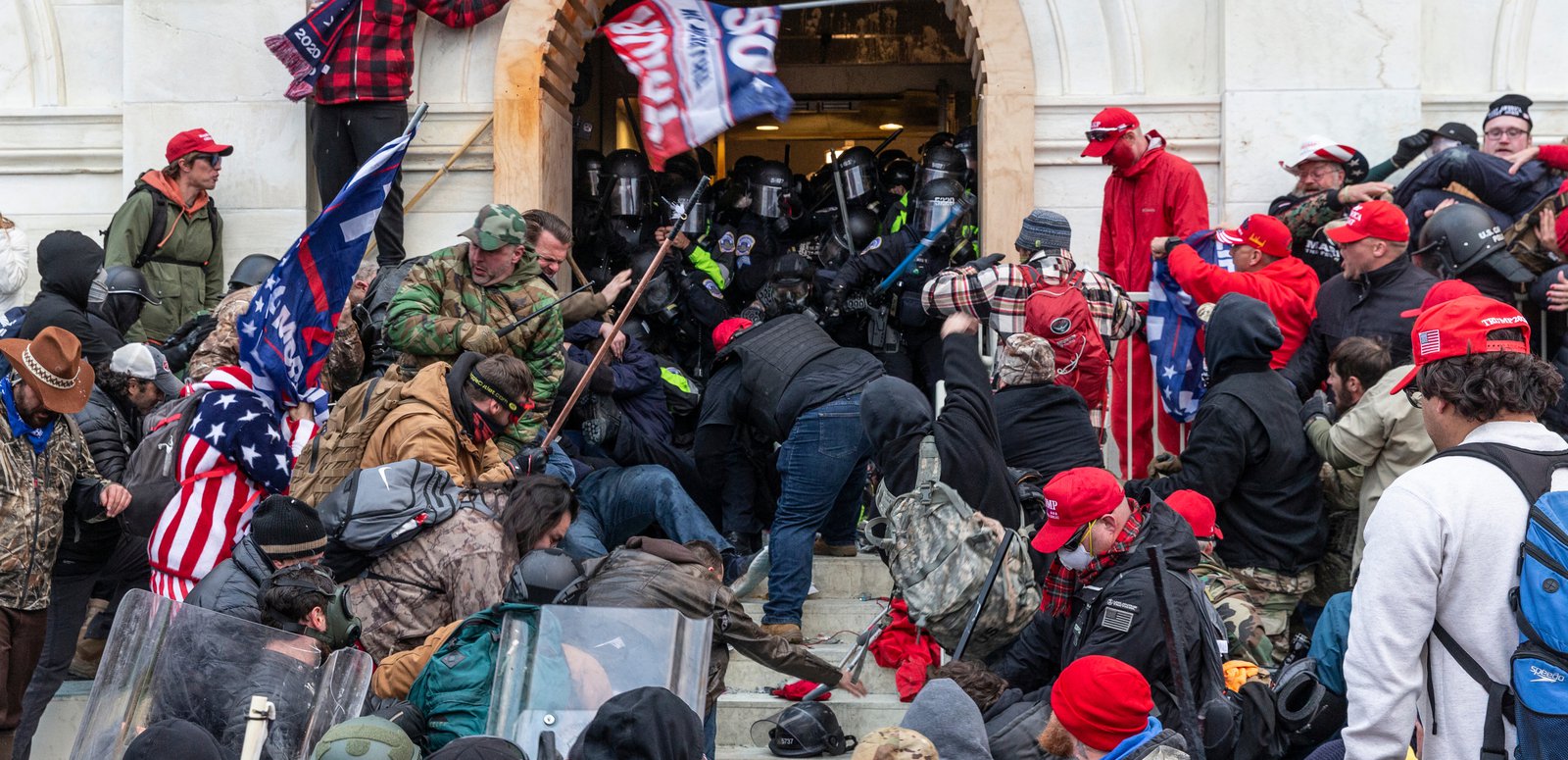
All of this suggests that Parler 1.0 primed the pump for the “Stop the Steal” movement, which exploded across the platform after the November 3 election at the same time that organizers staged nationwide protests contesting the election results. Most notably, we found that the peak of the “Stop The Steal” messaging on Parler occurred between November 11 and 15, which coincided with the first “Million MAGA March” in Washington and the highest rates of user activity on the platform as a whole. So, while there is no sure way of knowing how many people who showed up at the Capitol on January 6 were active Parler users, it seems likely that messaging developed and spread on Parler and other alt-tech platforms influenced a huge number in the crowd.
Traveling from almost every state in the country, the pro-Trump merry band of big-name influencers, citizen journalists, militia members, and other activist election contesters, were clearly spurred to action after soaking for months in targeted messaging that took critical aim at the nation’s democratic institutions as well as private and public individuals and organizations. The message was clear: all but Trump and his closest allies had failed the American public, democracy itself was at stake, and the only thing that could set the ship of state aright was direct action. What made that message so very effective in 2020 was that it landed on multiple platforms during a tumultuous year of social unrest that clearly stirred tens of thousands of Americans from across the political spectrum and the country to action for a variety of different reasons. That was made abundantly evident by the fact that those later arrested for their actions on January 6 tended to live close to clusters of protests and counter protests that occurred during 2020, as we noted above.
On the streets and online, the networked effects of poor platform governance across the Internet on the 2020 elections was notable on mainstream and fringe social media sites. But the combined impact of Parler’s loose content moderation scheme as well as data management practices and platform features that either by design or neglect or both may have made the social media startup especially vulnerable to strategic influence campaigns that relied heavily on inauthentic behavior like automated content amplification and deceptive techniques like astroturfing. Beyond the Capitol attack, it seems clear that in combination with mainstream platforms like Facebook and Twitter, Parler 1.0 had a networked effect on the information ecosystem that, left unchecked, will likely continue to reverberate far into the future of American democracy.
Parler and the Road to the Capitol Attack
- Executive Summary
- I. Introduction
- II. What We Know about Parler and Publicly Available Parler Data
- III. Contesting the Election Results: The Road to the Capitol and Indictments
- IV. Elite Signaling and Parler’s Influencers: Topic Modeling & Link Analysis
- V. Examining The Objector Parler Accounts
- VI. What the Parler Metadata Tells Us
- VII. Implications & Takeaways
Citations
- Parler LLC v. Amazon Web Services Inc., Case 2:21-cv-00031-BJR, filed in the U.S. District Court for the Western District of Washington on January 21, 2021. https://deadline.com/wp-content/uploads/2021/01/Parler-Amazon-lawsuit.pdf
- Parler LLC v. Amazon Web Services Inc., Case 2:21-cv-00031-BJR, filed in the U.S. District Court for the Western District of Washington on January 21, 2021. https://deadline.com/wp-content/uploads/2021/01/Parler-Amazon-lawsuit.pdf
- Parler initially filed a complaint against Amazon in the U.S. District Court for the Western District of Washington after a series of motions and court deliberations in the case was ultimately dropped in federal court due to procedural concerns raised by Parler. The federal judge overseeing the case remanded Parler’s complaint to the King County Superior Court in Washington in September 2021. See: Katherine Anne Long, “Parler’s Dispute with Amazon Headed Back to King County Superior Court,” Seattle Times, https://www.seattletimes.com/business/amazon/parlers-dispute-with-amazon-headed-back-to-king-county-superior-court/
- Parler LLC v. Amazon Web Services, Inc. and Amazon.com, Inc., Complaint, Case #: 21-2-02856-6 SEA, filed in the King County Superior Court on March 2,2021.https://digitalcommons.law.scu.edu/cgi/viewcontent.cgi?article=3417&context=historical
- Parler LLC v. Amazon Web Services, Inc. and Amazon.com, Inc., Complaint, Case #: 21-2-02856-6 SEA, filed in the King County Superior Court on March 2,2021, p. 2. https://digitalcommons.law.scu.edu/cgi/viewcontent.cgi?article=3417&context=historical
- Parler LLC v. Amazon Web Services, Inc. and Amazon.com, Inc., Complaint, Case #: 21-2-02856-6 SEA, filed in the King County Superior Court on March 2,2021, p. 3. https://digitalcommons.law.scu.edu/cgi/viewcontent.cgi?article=3417&context=historical
- Salvador Rodriguez, “Sandberg Says U.S. Capitol Riot was ‘Largely’ Not Organized on Facebook,” CNBC, January 11, 2021. https://www.cnbc.com/2021/01/11/sandberg-says-us-capitol-riot-was-not-organized-on-facebook.html
- “Parler Letter to Chairwoman Maloney,” March 25, 2021. https://documentcloud.adobe.com/link/review?uri=urn%3Aaaid%3Ascds%3AUS%3A18b6cc84-03e0-4d84-9536-917fd7acfa12#pageNum=1
- “Capitol Attack Was Months in the Making on Facebook,” Tech Transparency Project, January 19, 2021. https://www.techtransparencyproject.org/articles/capitol-attack-was-months-making-facebook
- “Facebook’s Militia Mess,” Tech Transparency Project, March 24, 2021. https://www.techtransparencyproject.org/articles/facebooks-militia-mess