A Chapter of: Parler and the Road to the Capitol Attack
IV. Elite Signaling and Parler’s Influencers: Topic Modeling & Link Analysis
One of the key insights from both published studies on Parler and our own examination of individuals charged with crimes related to the Capitol siege is the outsized influence prominent public figures had on shaping content engagement among Parler users with small numbers of followers. Well-known pro-Trump TV personalities like Sean Hannity and Tucker Carlson dominate on the platform alongside lesser-known but highly connected Trump campaign insiders like Lin Wood and Eric Trump.147 What is also notable is the high prevalence among influencers on Parler for linking to content from other platforms like Twitter, Facebook, and popular far-right media verticals like The Epoch Times, The Gateway Pundit, and The Western Journal.
Aliapoulios, et al. note that while the total number of Parler influencers is quite small (596) compared with the estimated 13 to 15 million platform users with accounts before Parler was taken offline, a small subset of “Gold Badge” users had more than 10,000 followers. This suggests that well-known personalities are very well positioned to shape online narratives and to do so in a coordinated manner. To test this hypothesis, we deployed a number of methods to analyze a curated dataset compiled from a little more than 100 Parler user accounts that were collected from January 6 to January 10, 2021.
Topic Modeling: Discourses of the Deplatformed and Disaffected
User accounts in our “Parler Influencers Dataset” were identified as we began to actively monitor Parler on the afternoon of January 6 as Trump rally goers converged on the Capitol.148 All totaled, our Parler Influencer Dataset contains the posts of 102 Parler users, selected for their influence on the platform as determined by either their close ties to the Trump White House, President Trump’s presidential campaign, or links to militia groups. Examples of individual influencers in the dataset include Michael Flynn, Sidney Powell, Roger Stone, and Jim Jordan. We also collected the post histories of influential groups such as the Oath Keepers, Three Percenters, and Proud Boys. Many of these groups had both national as well as local accounts (e.g. the accounts ThreePercenters and ThreePercentMichigan). All of the user accounts in this narrow dataset actively posted comments, images, videos, and links as the attack on the Capitol unfolded and for several days afterwards.
The Parler Influencer Dataset contains 46,806 posts dating from December 6, 2018 to January 10, 2021. Our team analyzed approximately 30,000 of the posts containing text data from this collection and clustered them according to topic theme.149 We also visualized the social media posts, plotting as a network any words that appeared together in any order to provide a high-level overview of the Parler conversations. This chart presents “communities” of words, each color-coded by grouping.
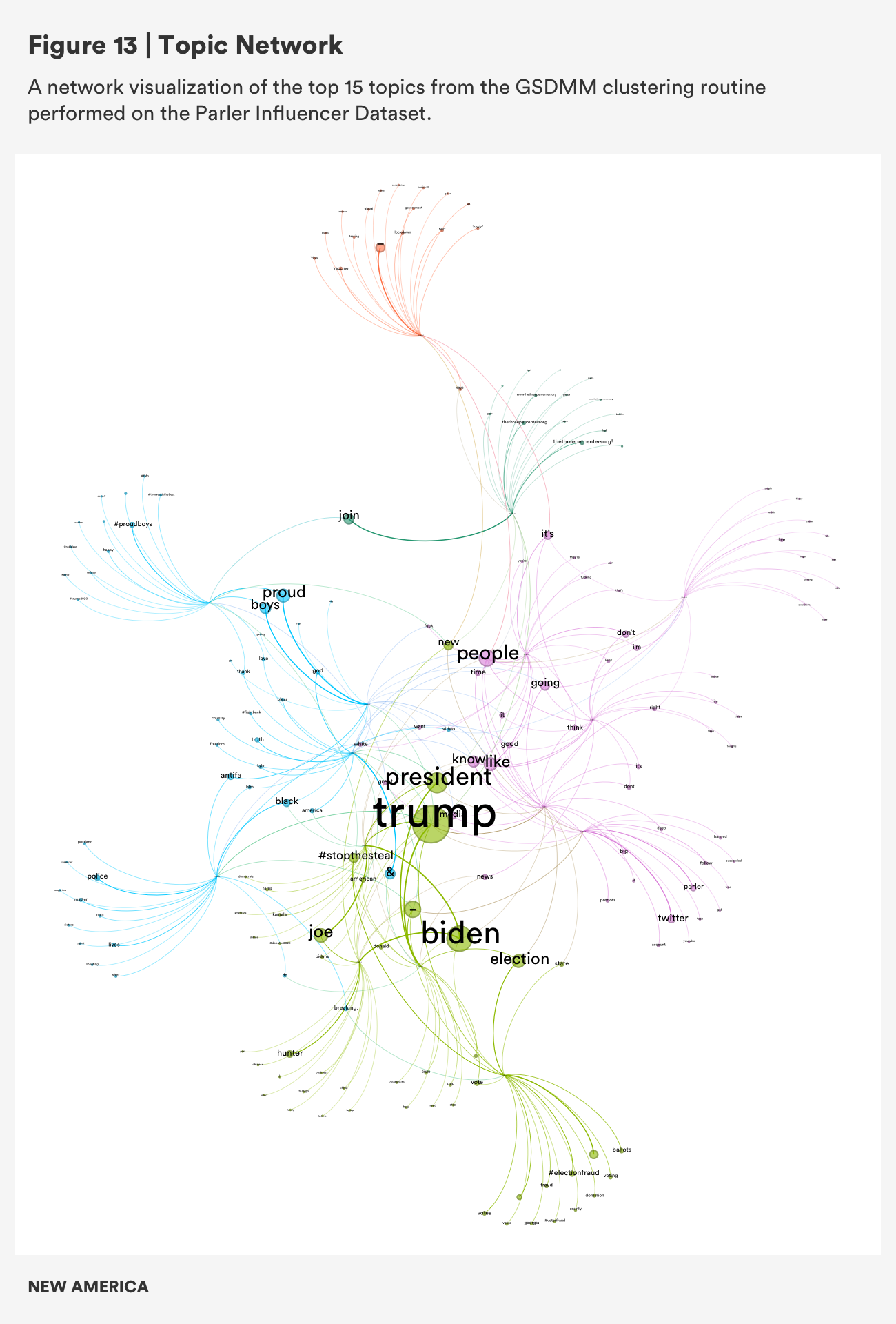
In this group of influencers, generalizations about the politics of the United States at the most macro level abound.150 More specifically, however, analysis of top themes showed that users in this group characterized the presidential election of 2020 as the centerpiece of corruption in the government. Similarly, users in this group construed politics as a struggle among Trump, Biden, and the citizens of the United States. Other thematic categories included the purported plot to steal the election, including a coverup of Hunter Biden’s alleged crimes. Being banned and/or deplatformed from mainstream social media sites like Twitter and allegations of corruption within the news media was another common theme. Along with recruiting for the Proud Boys and Three Percenters, QAnon, opposition to Antifa and Black Lives Matter figured substantially alongside COVID-19 related conspiracy theories. The cure for all these ills is for the citizens of the United States to take power from the forces that threaten the United States.
Users in this dataset characterize other platforms like Twitter as being in the pocket of partisan forces, while Parler itself acts as a kind of refuge in a world in which apocalyptic forces seem to be pervasive. According to Parler influencers in this dataset, “the people” cannot abide the pervasive rot of American society, and overall, the themes suggest that many users in this group view the United States as a country on the verge of collapse. All the major topics involve some kind of institution-ending or epoch-ending crisis, or recruitment for white supremacist organizations as a response to crisis. Taken as a whole, posts in this dataset suggest Parler nurtured a collective sense among many of its users that they were facing an existential test.
Overall, content from posts in our Influencer Dataset reads as a haven for those struggling in a world pitched against them. This is an important insight because it suggests that, among this fairly prolific set of influential conservatives and far-right groups on Parler, there was more at work than just a common tendency toward the promotion of falsehoods about the 2020 elections. Being “banned from Twitter” is such a prominent theme among users in this subset that it raises troubling questions about the unintended consequences and efficacy of content moderation schemes on mainstream platforms. In fact, further analysis of the types of data and links shared by influential users in this small group indicates that there is a good deal of collaboration between users that may have also contributed to a sense of common purpose and shared identity that acted as a mobilizing force for less well-networked users on the platform.
Influencer Link Analysis: Assessing the Hothouse Effect of Parler
After we conducted our topic modeling analysis examining themes from posts on the Parler Influencer Dataset, we decided to take a closer look at the types of content these 102 users shared. Visual media such as images and videos constituted the primary types of content embedded or linked to within influencer Parler posts. Among users in this influential subset, links to conspiracy theory websites were prominent—with a strong focus on COVID-19 via David Icke and The Gateway Pundit.
We also noted that many posts contained links to content from other platforms or media verticals from outside of Parler and that URL links within Parler posts are a method to bring content into the platform for discussion, reposting, and refinement. For instance, links to YouTube (youtube.com and youtu.be) and Twitter (twitter.com and t.co) constituted 15.91 percent of content containing URLs in the dataset.
Yet, there are few instances where Parler content is posted to mainstream social media platforms. Instead, information and links primarily flow in one direction from external social media platforms into Parler. For example, when we examined the Twitter timelines of the 147 members of Congress who formally raised objections to the certification of the vote count, only 15 tweets out of 462,458 total tweets linked to Parler. These unidirectional linking behaviors create a positive feedback loop within the platform where influencers post content curated to support extremist narratives.
This points to Parler acting as a greenhouse of misinformation, disinformation, and conspiracy theories where less extreme content was brought in from external platforms and allowed to grow and feed a disordered information ecosystem. Another way to think of this is that Parler is part of an intentional data processing workflow, one that is perhaps intentionally designed to nurture and grow extremist narratives. This is especially significant given the observations in the Stanford study on Parler that “many of the most active Parler accounts used integrations such as RSS feeds to automate content posts.”151 While some of the most prominent right-leaning media figures and outlets created accounts on the site, they largely did not cultivate their Parler audience separately from other social media audiences. Instead, they relied on integrations to automate their posts.
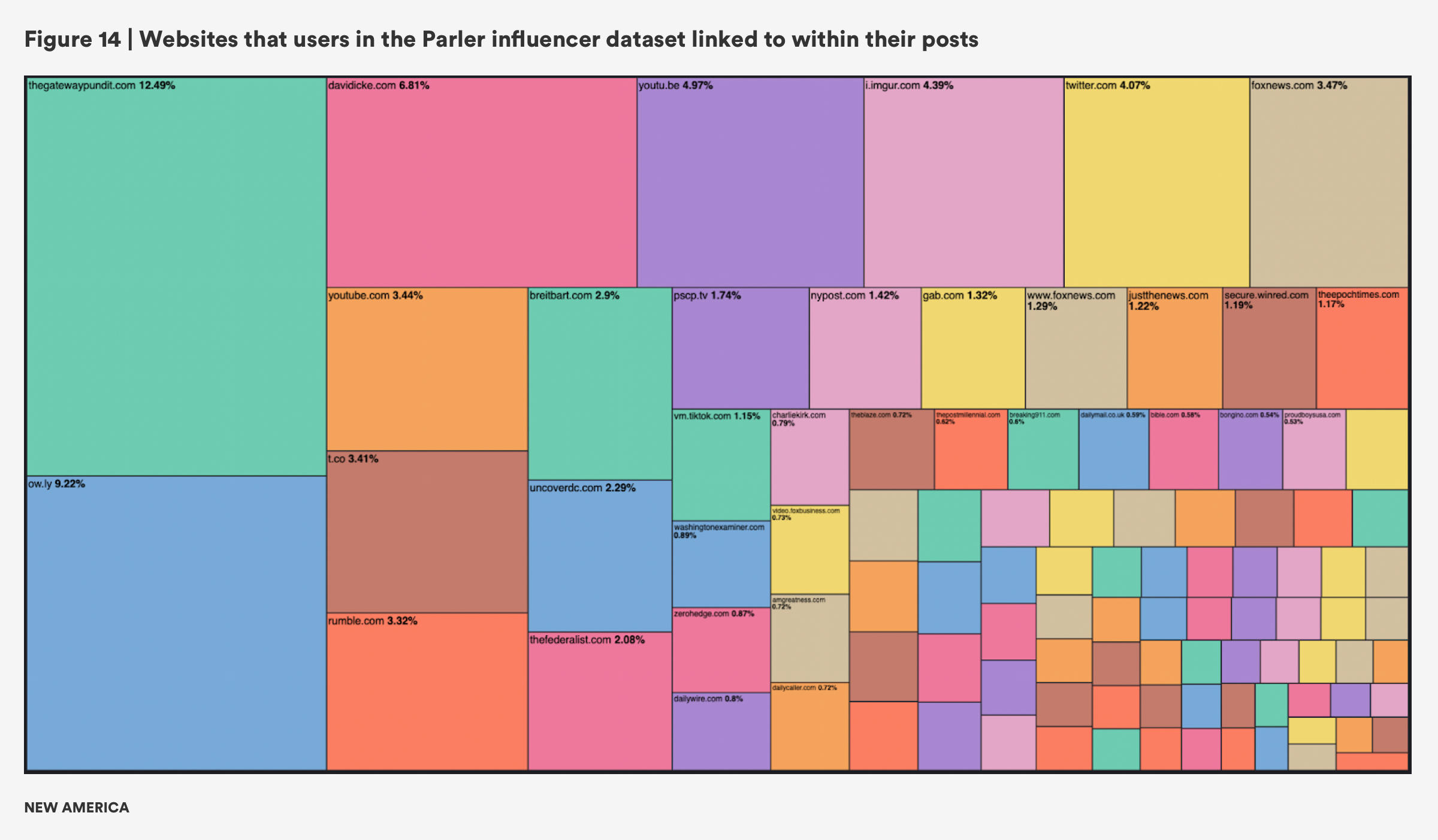
The blocks in the diagram (Figure 14) visually represent the percentage of links embedded within Parler influencers’ posts in the domain where the link originated. The links are categorized by domain, so Twitter would be represented by twitter.com and Fox News would be represented by foxnews.com.
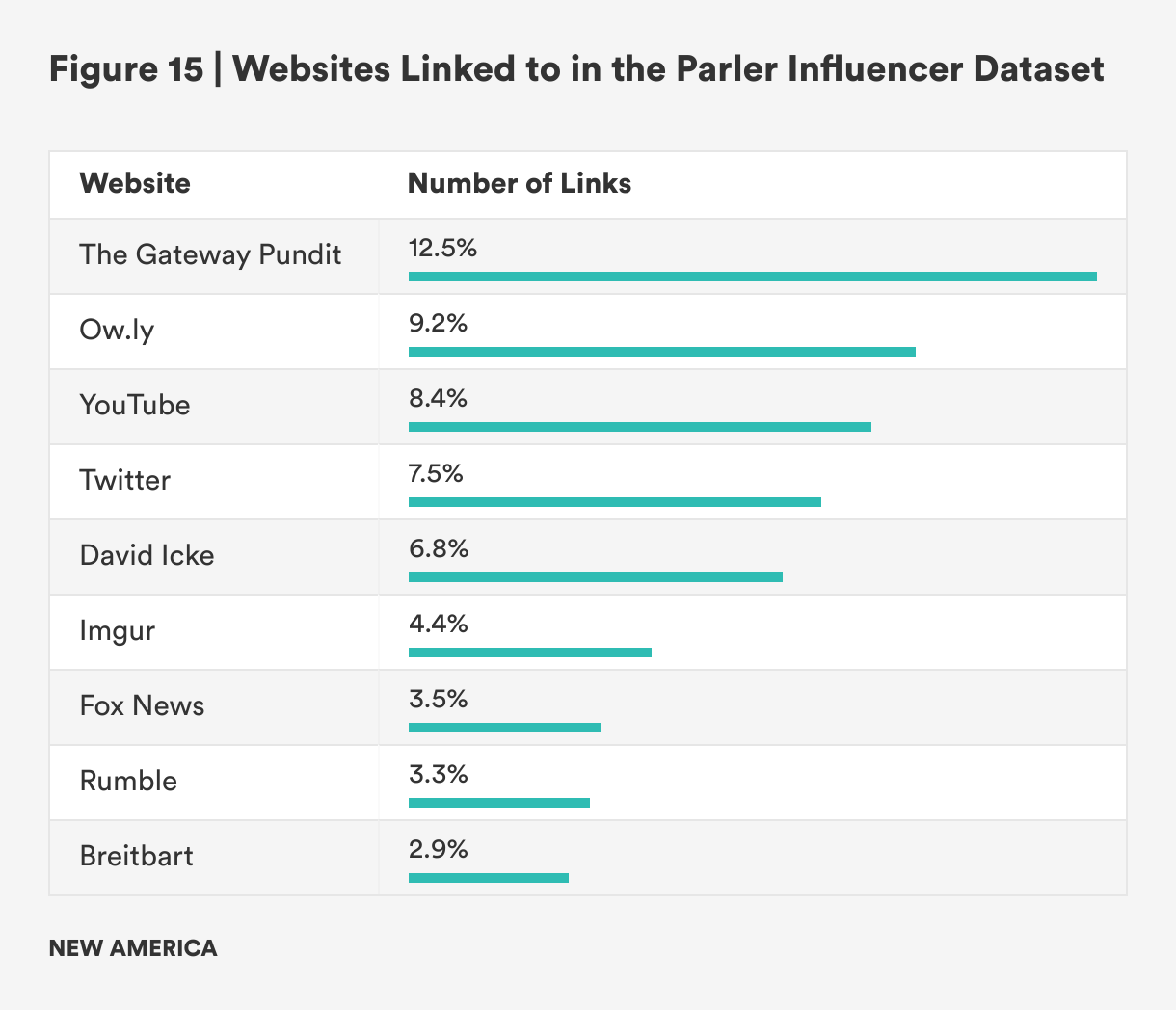
The site most linked to in the dataset is The Gateway Pundit, a far-right website known for publishing conspiracy theories.152 Second in line, is the URL shorter service Ow.ly, but since this is a link forwarding service, we cannot make any conclusions about what content the final links resolve to. Links to mainstream social media platforms YouTube, Twitter, and imaging sharing service Imgur are next in line at the top. These are bookended by links to another conspiracy theorist, David Icke, who has popularized the idea that a reptilian humanoid race rules the world. Links to Fox News, the “far-right YouTube” Rumble, and Breitbart bring up the rear.
What is also notable about the linking behavior of users in this dataset is that in mid-2020, there was a shift in linking patterns away from content drawn from mainstream social media, for example, platforms like Twitter and news sites, to conspiracy-driven content and the far-right video hosting service Rumble. This trend coincides with the shift of more conservative users from mainstream social media platforms such as Twitter to Parler due to perceived or actual banning.153 It also underscores the powerful magnetism that surfaced in our topic model analysis of the influencer Parler data where “banned from Twitter” is a prominent topic in the content of Parler posts. As we explain in the next section, the trends and patterns described above are also mirrored to some extent in the user behavior of the 147 elected politicians who formally raised objections in Congress to the certification of election results on January 6.

Parler and the Road to the Capitol Attack
- Executive Summary
- I. Introduction
- II. What We Know about Parler and Publicly Available Parler Data
- III. Contesting the Election Results: The Road to the Capitol and Indictments
- IV. Elite Signaling and Parler’s Influencers: Topic Modeling & Link Analysis
- V. Examining The Objector Parler Accounts
- VI. What the Parler Metadata Tells Us
- VII. Implications & Takeaways
Citations
- David Thiel,Renee DiResta,Shelby Grossman,Elena Cryst, “Contours and Controversies of Parler,” Stanford Internet Observatory, January 28, 2021, p.10 .https://cyber.fsi.stanford.edu/io/publication/contours-and-controversies-parler
- The Parler data was collected using an open source tool called Parlance (https://github.com/castlelemongrab/parlance) which took advantage of the lack of security and poor API design of the Parler platform to collect posts and user information.
- In our topic model, themes are understood to be salient combinations of terms that co-occur within the same social media posts. Each social media post is labeled with a single theme that is derived from observations across the entire dataset. Put another way, the model assigns a single theme to each post based on best fit. We followed up with term co-occurrence analysis, where we generated tables of words that were more likely to appear together in order to identify trends in the social media posts that could indicate the ways certain words were frequently used.
- “Trump (4346),” “Biden (2202)” and “People (1864)” are the three of the most frequently occurring nouns in this dataset.
- David Thiel, Renee DiResta, Shelby Grossman, Elena Cryst, “Contours and Controversies of Parler,” Stanford Internet Observatory, January 28, 2021, p.3 https://cyber.fsi.stanford.edu/io/publication/contours-and-controversies-parler.
- In Parler, any images attached to posts are categorized as links. To highlight links to sources not embedded within the Parler post, links to embedded Parler images (image-cdn.parler.com) have been excluded from the data used to generate this figure.
- Media coverage of the move from Twitter and Facebook to niche apps has been substantial; see, for instance: Mike Isaac and Kellen Browning, “Fact-checked on Facebook and Twitter, Conservatives Switch Their Apps,” The New York Times, November 11, 2020. https://www.nytimes.com/2020/11/11/technology/parler-rumble-newsmax.html