Parler and the Road to the Capitol Attack
Abstract
The January 6, 2021 mob assault on the U.S. Capitol exposed deep fissures between Americans and shook the very foundations of the country. The violence that day and the tech industry’s response to the tsunami of polarizing content triggered a major public debate over how social media and tech companies manage their platforms and services and the impact of content moderation policies on polarization, extremism, and political violence in the United States. That debate is also now playing out in Congress where the House Select Committee to Investigate the January 6th Attack on the United States Capitol is now underway. One big question is: How did niche social media sites geared toward far-right audiences, like Parler, contribute to polarization around the 2020 presidential election and to what extent did Parler and other platforms factor into the January 6 attack? The first in a series of investigations into the impact of the alt-tech movement on U.S. national security, this report provides an initial snapshot of observations culled from an ongoing analysis of open source data related to the Capitol attack.
Based, in part, on an early assessment of a cache of an estimated 183 million Parler posts publicly archived after Parler was temporarily deplatformed, the analysis in this report offers unique insights into online and offline early warning signs of the potential for election-related violence in the year-long run up to the Capitol attack. On the streets and online, the networked effects of poor platform governance across the internet during the 2020 presidential election were notable on mainstream and fringe social media sites. Nevertheless, the combined impact of Parler’s loose content moderation scheme as well as data-management practices and platform features—either by design or neglect, or both—may have made the social media startup especially vulnerable to strategic influence campaigns that relied heavily on inauthentic behavior like automated content amplification and deceptive techniques like astroturfing.
Acknowledgments
This report is the result of a tireless team effort by an interdisciplinary group of researchers at Arizona State University (ASU) and staff at New America. The January 6 project research team includes principal investigators Candace Rondeaux, Michael Simeone, Tom Taylor, Dave Troy, Shawn Walker, and project fellows Ben Dalton and Cuong Nguyen. New America’s Data Visualization Developer & Designer Naomi Morduch Toubman, Deputy Director of Communications for Product Design Brittany Van Putten, and Senior Editorial Content Associate Joe Wilkes made critical contributions to the research, data visualization, and production design. Emily Schneider provided invaluable support on fact-checking and copy editing.
We are grateful to our partners at the Bridging Divides Initiative at Princeton University for their advice and expert contributions, and we would like to extend our thanks to: Shannon Hiller, David Russell, Nate Rosenblatt, Autumn Lewien, and Tewonia Evans.
We’d like to also thank our partners and supporters at ASU, including the Center on the Future of War, the Data Mining and Machine Learning Lab, and the Data Science and Analytics team for ASU Libraries.
Downloads
Executive Summary
The mob assault on the U.S. Capitol on January 6, 2021, exposed deep fissures between Americans and shook the very foundations of the country. The violence that day and the tech industry’s response to it reignited public debate over how tech companies operate and the impact of social media content moderation policies on polarization, extremism, and political violence in the United States. That debate is also now playing out in Congress where the House Select Committee to Investigate the January 6th Attack on the United States Capitol.
The storming of the seat of American democracy and explosion of violent online content prompted Twitter and Facebook to ban Donald Trump from their platforms while Apple, Google, and Amazon all moved to cut off access to Parler, a social media site popular with conservatives and the far-right. As of late October 2021, when the analysis for this report was reaching an end, federal authorities had charged 632 individuals in connection with the storming of the Capitol. That number has since increased to more than 700, and, in many cases, evidence collected from social media posts was a key factor in the indictments. A comprehensive review of the indictments related to January 6 indicates, in fact, that much of that digital evidence collected to date came from Facebook, Twitter, and Parler. But one persistent question remains unanswered: How much did niche platforms like Parler and their interplay with mainstream platforms contribute to the January 6 siege and the rise of extremism in the country?
The centrality of digital data in the narrative of January 6 implicates social media and tech companies across the board. But it is not coincidental that the political unrest leading up to the assault on Congress took place against a backdrop of explosive growth in the so-called “alternative tech” or “alt-tech” movement that sprang up from the right during Trump’s presidency. Although Parler’s reach appeared to be smaller than its competitors’, Amazon's move to deplatform the social media site on January 10, four days after the Capitol attack, sent shockwaves through the tech industry. It also prompted new calls in Congress for reform of internet governance regulations. Yet nearly one year on from the Capitol attack and Parler’s shutdown, there are still many unknowns about how online content factored into the attack.
Data-driven investigations into how Parler operated before Amazon took it offline offer clues as to what happened and why on January 6. Publicly available data from the 1.0 version of Parler offers a rare opportunity to begin asking and answering questions on an empirical basis about the role of social media in undermining governance institutions and fomenting political violence in the United States and elsewhere. Data culled from across multiple platforms also provides unique insights into how the alt-tech movement that sprang up just after Trump first took office in 2017 and spawned Parler will impact future elections, and, more broadly, democratic institutions in the United States.
Working together with researchers at Arizona State University and the Bridging Divides Initiative at Princeton University, New America’s Future Frontlines team set out to learn more about the interplay between niche platforms like Parler, mainstream platforms like Twitter and Facebook, and real-world social networks. Our preliminary analysis suggests that there are grounds to be skeptical of competing claims made by all three tech companies that their platforms were no more or less culpable in spreading false, misleading, and violent content linked directly or indirectly to the #StoptheSteal movement.
Still, the focus on Parler is warranted. The initial picture that has emerged from a joint analysis conducted by researchers at New America and Arizona State University (ASU) under the auspices of the Future Frontlines program is a portrait of a social media company whose very business model appeared to be predicated on the idea that it could grow its user base by promoting the discourses of the deplatformed and the disaffected among Trump’s followers.
An examination of publicly available data from the early 1.0 version of Parler indicates that its unique business model and content moderation policies were likely a contributing factor in fomenting some of the violence that occurred in Washington, D.C. on January 6. However, as outlined in this report and in the key findings below, it is also quite clear that the platform management practices, ad hoc content moderation policies, and client services agreements adopted by big tech’s Big Five—Facebook, Twitter, Amazon, Apple, and Google—are driving the market for alt-tech social media platforms like Parler.
Key Findings:
- On the streets and online, the networked effects of poor platform governance across the internet on the 2020 elections were notable. Analysis clearly shows how instrumental mainstream platforms like Facebook and Twitter were in popularizing the “Stop the Steal” campaign and the January 6 attack itself. But the combined impact of Parler’s loose content moderation scheme as well as data management practices and platform features produced a unique hothouse effect.
- Initial analysis of links posted by a subset of influential Trump campaign insiders and militia group users found that there are few instances where Parler users posted content from the platform to other mainstream social media platforms. Instead, information and links primarily flow in one direction from external social media platforms into Parler.
- The early 1.0 version of Parler appeared to be especially vulnerable to strategic influence campaigns that relied heavily on inauthentic behavior like automated content amplification and deceptive techniques like astroturfing.
- Traveling from almost every state in the country, the pro-Trump merry band of big-name influencers, citizen journalists, militia members, and other activist election contesters who were active on Parler, were clearly spurred to action after soaking for months in targeted messaging that took critical aim at the nation’s democratic institutions as well as private and public individuals and organizations.
- During the 2020 election cycle, being banned by Twitter, Facebook, or other mainstream platforms served as both a badge of honor and call to arms for some of the more prolific influencers who were close to the Trump campaign and militia groups on the 1.0 version of Parler.
- Users in a select subset of these influential Parler users characterize other platforms like Twitter as being in the pocket of partisan forces, while Parler itself acts as a kind of refuge in a world in which apocalyptic forces are seen to be pervasive.
- All of the major topics of concern for these users involve some kind of institution-ending or epoch-ending crisis, or recruitment for white supremacist organizations as a response to crisis.
- Being “banned from Twitter” is such a prominent theme among users in this subset that it raises troubling questions about the unintended consequences and efficacy of content moderation schemes on mainstream platforms.
- In fact, further analysis of the types of data and links shared by influential users in this small group indicates that there is a good deal of collaboration between users that may have also contributed to a sense of common purpose and shared identity that acted as a mobilizing force for less well-networked users on the platform.
- At least 46 members of the 147 members of Congress who formally raised an objection to the certification of the 2020 Electoral College count joined Parler. Many Congressional objectors joined the platform in May or June of 2020. The timing is significant because this is also around the time prominent right-wing figures were leaving mainstream social media platforms for Parler due to their concerns about censorship of conservative content.
- Rep. Devin Nunes (R-Calif.) and Sen.Ted Cruz (R-Texas) had the highest number of followers. Rep. Matt Gaetz (R-Fla.), Rep. Jim Jordan (R-Ohio), Rep. Andy Biggs (R-Ariz.), Rep. Paul Gosar (R-Ariz.), and Rep. Marjorie Taylor Greene (R-Ga.) also had followers in the hundreds of thousands. The high follower counts mean that any content posted by these accounts would likely be prominently displayed when a user logged into the first version of Parler.
- Content posted on Parler 1.0 by these members of Congress received millions of impressions each day before the platform was taken offline. The objectors were large players in the Parler information ecosystem. Users paid attention to the content they posted.
- Notably, objectors posted more extreme political content on Parler than on Twitter, focusing on false claims of election fraud in the period right after Election Day 2020. They also posted content objecting to COVID-19 restrictions and mitigation measures.
- An analysis of Parler post timestamps embedded in the available metadata for over 13.25 million users and over 1 million video posts show alignment while increases in the number of posts coincide closely with significant political events and demonstrations. Some notable peak moments when there was a sharp increase include:
- The May 31, 2020 peak rises rapidly and tails off slowly, and coincides with the May 31 George Floyd protests.
- The broad July 2, 2020 peak begins its rise with the resumption of Trump campaign rallies and culminates with the Mount Rushmore campaign rally.
- The sharp July 22, 2020 peak coincided with a riot in Portland, Oregon in which protesters tried to set fire to the Portland courthouse.
- The post-election peaks on November 11-12, 2020 and on November 14-15, 2020 coincides with the competing pro-Trump rallies, March for Trump and Million MAGA March, in Washington, D.C. and nationwide, organized by Amy Kremer and Ali Alexander, respectively.
- Initial analysis suggests geotagged social media content could strengthen insight into potential warning signs of violence leading up to January 6, when combined with offline event data and ethnographic analysis, though more research is needed.
- At a variety of geographic scales, the residences of those indicted in connection with the January 6 attack tended to cluster near areas where all types of demonstrations and counter protests took place over the course of the 2020 election year, to a greater degree than anticipated.
- This points to the demonstrations in close proximity of the locality of a charged individual having greater potential predictive weight than those at the state level. Substantial hints of the relationship between demonstration activity, polarizing rhetoric of political elites and online influencers, and mobilization to violence are mirrored at the individual level among arrestees who turned up in Washington to contest the election outcomes and at scale in the Parler data.
- Statistical analysis confirmed that many of the geotagged videos cluster around the prosperous suburbs and exurbs of major metropolitan areas. Many geotagged video posts also fan out across rural areas, particularly in the more densely populated and privately owned rural areas east of the Rocky Mountains.
I. Introduction
What We Know About What Happened on Jan. 6 and Related Digital Data
There are a couple ways to think about how online content might have influenced the outbreak of violence in Washington on January 6. One is to treat the siege as a one-off event—an aberrant security breach that is unlikely to happen again. Another is to view the attack as the culmination of a years-long influence campaign involving some of Trump’s most powerful allies. Either way, the clear aim of the many thousands of Americans who stormed Congress that day was to halt the certification of the vote count in the 2020 presidential election and prevent the peaceful transfer of power to Trump’s political challenger, Joe Biden.
We know this because thousands who took part in the violence that day stated as much on platforms like Parler, Twitter, and Facebook. Much of what we know about what happened on January 6, in fact, comes from a virtual volunteer army of digital sleuths, data nerds, hackers, and investigative journalists who raced to capture as many social media posts as possible before the evidence of the violence disappeared. Indeed, FBI Director Christopher Wray estimates that the agency received upwards of 200,000 digital media tips about the events of January 6.1
On Twitter, in the immediate aftermath of the insurrection in Washington, footage of a man in a knit cap bearing the logo of the Chicago Fire Department wielding an extinguisher near the steps where Capitol Police Officer Brian Sicknick was killed went viral under the hashtag #extinguisherman.2 On Facebook, references to the #StopTheSteal campaign went viral. Parler, Twitter’s self-described conservative rival, exploded with posts thrown up by packs of Proud Boys, Oath Keepers, Three Percenters, and other white-supremacist militias who descended on Washington in the weeks leading up to January 6.3 The deaths of two pro-Trump protesters, Ashli Babbitt and Roseanne Boyland, at the scene were recorded and uploaded online on multiple platforms for all the world to witness, and have since become a cause célèbre for Trump and causus belli for far-right extremists.4
With roughly 15 million users at the time of the attack, Parler’s user base paled in comparison to the billions who use Facebook and hundreds of millions who use Twitter.5 Indeed, Parler then and now represents only a small corner in an expanding constellation of social media platforms with loose content moderation policies that have cropped up as alternatives as big tech firms have stepped up their moderation of content in recent years. These so-called “alt-tech” sites began to proliferate and take on more prominence as Trump began to prepare his re-election campaign amid a series of White House scandals. But, because so much of what the world witnessed on January 6 was culled from Parler posts and authorities have publicly linked Parler to planning of the attack, the platform has emerged as the poster child for unbridled online extremism in the United States.6
When Parler first launched a little more than three years ago, it billed itself as a free speech, censorship-free alternative to Twitter and other mainstream platforms.7 In the wake of the January 6 attack, Parler executives have, however, argued that the company is no different from mainstream platforms. In a March 2021 letter to the House Committee on Oversight and Reform, in fact, the Nevada-based social media company argued that it proactively sought to warn the FBI about concerning content posted on its platform before Trump appeared on stage at the “March to Save America” rally on the White House ellipse on January 6.8
Parler’s attorneys, in fact, asserted in the same letter that big tech companies were unfairly trying to scapegoat its platform for fomenting the violence at the Capitol, and suggested that big players like Facebook and Twitter were more culpable in allowing false and hate-filled content to circulate widely on their sites before the mob siege in Washington.9 In lawsuits and public statements, Parler’s stakeholders have continued to deflect blame for the mob assault onto other platforms, arguing that Amazon and other big tech companies singled Parler out because they wanted to crush market competition.10
Although Parler’s reach appeared to be smaller than its competitors, Amazon's move to deplatform the social media site on January 10, four days after the Capitol attack, sent enormous shockwaves through the tech industry. It also drew outsized attention from the media, advocacy groups, and Congress, prompting new calls for revisions to Section 230 of the Communications Decency Act,11 the regulation that gives Internet platforms immunity from adverse legal action related to what their users post online.12
For the above reasons and more, evidence culled from Parler and other fringe social media sites will be pivotal for the House Select Committee’s inquiry.13 As of late November 2021, the Select Committee had issued subpoenas to key organizers of the January 6 rally on the White House ellipse that lit the fuse for the violence at the Capitol.14 While some key witnesses are resisting the panel of inquiry’s requests for information and Trump himself is locked in a legal battle over potentially relevant records, it is expected that the 35 technology companies that have received requests for information to date will be relatively compliant.15
Accordingly, the Select Committee has also issued demands to Parler and other tech companies to preserve and produce records pertaining to the spread of misinformation and disinformation about the 2020 presidential elections, efforts to overturn or prevent the certification of election results, and foreign influence in the election. Of particular concern for the committee and the public are actions and policies undertaken by tech companies to manage the avalanche of false information about the elections and to manage the adverse impacts of malign influence campaigns.16
The House Select Committee has expressly said that its investigation will examine “influencing factors that contributed to the domestic terrorist attack on the Capitol and how technology, including online platforms, financing, and malign foreign influence operations and campaigns may have factored into the motivation, organization, and execution of the domestic terrorist attack on the Capitol.” This is a good start, but with dozens of social media and tech companies implicated in the January 6 attack, there is a lot of ground to cover.
What we know already is that the de-platforming of Parler and tech industry sweeps triggered and accelerated a virtual stampede to lesser-known alt-tech platforms like Gab, MeWe, and Rumble.17 That became especially evident after an anonymous hacker leaked a massive 70-terabyte cache of Parler data containing millions of digital hints about the scope of the coordinated messaging and planning that went into Trump’s online influence campaign.18 The Parler data haul has been the subject of countless media exposés, and has attracted the attention of journalists and researchers around the world.19
Yet, questions persist about how to interpret millions of posts on Parler and other platforms, what the data reveals about the events of January 6, and how social media content moderation policies might impact future elections and political violence in the United States. Here are just a few questions that we set out to answer with the launch of this project:
- Was there something unusual about the way Parler operated that made its networked effects on the information ecosystem different from those of its competitors?
- Was there evidence of any online coordination between influential Trump campaign insiders and surrogates and far-right online influencers in amplifying false content?
- How much did the rise of so-called alt-tech media, online hubs that sprang out of far-right extremist, white supremacist, and counterfactual communities, contribute to the violence on January 6?
- Is there any way to accurately assess competing claims made by big tech companies like Amazon, Facebook, and Twitter about whether fringe platforms like Parler were more culpable in fomenting online hate, mis- and disinformation about the elections, or polarizing issues like policing and COVID-19 restrictions?
- Was the riot partially a result of a coordinated strategic influence campaign where non-state actors or quasi-governmental proxies like the Internet Research Agency in Russia and state intelligence agencies like Russia’s Main Intelligence Directorate (GRU) and/or China’s People’s Liberation Army (PLA) collaborated in promoting polarizing content online?
Almost from the instant violence began to erupt at the Capitol on January 6, Parler emerged as the central focus of a loosely organized network of volunteer researchers who banded together across several time zones to monitor social media. Bellingcat, a nonprofit investigative research collective, was among one of the leading organizations who spearheaded a call to collect and archive social media data.20 Several on our team answered that call.
In the process, we collected and archived the accounts for 100-plus Parler users with close ties to the Trump campaign. That subset of accounts contains data about the online behavior of key influencers such as Sidney Powell, a one-time Trump campaign lawyer; Trump’s former national security adviser Michael Flynn; former New York City Mayor and Trump campaign lawyer Rudy Giuliani; and several dozen other lesser-known influencers and adherents of the Oath Keepers, Three-Percenters, and Proud Boys movements. We continued to collect from a variety of additional sources, including Gab, BitChute, Telegram, and Rumble, among others. But collection on Parler ended on January 10, 2021 when Amazon took Parler offline and Apple and Google stopped hosting Parler’s mobile app.21
Unbeknownst to much of the world at the time, however, a social media analyst and self-proclaimed “hacktivist” who uses the Twitter handle @donk_enby had already leapt into action well before the platform’s shutdown, archiving as much of the Parler data as possible.22 The hacktivist, who had already published the results of a study into the unofficial Parler API,23 downloaded, archived, and made publicly available a million videos from an unsecured Parler S3 bucket on Amazon’s cloud storage service.24 This data, too, became part of our collection.
In Focus: Influencers, Objectors, and Contesters on Parler and Beyond
Faced with the daunting task of trying to make sense of digital data documenting the violence and of tens of millions of social media posts and tens of terabytes of raw data, we knew we had a very hard puzzle on our hands. With more than 500 people under indictment when we started our investigation in June 2021 and only sparse information about whether and how social media data might be relevant in understanding their journey to Washington, the first challenge was to decide what exactly to focus on.
We opted, therefore, to focus first on the “StopTheSteal” movement itself and Parler as a platform second. If we approach Parler as “preparatory media,”25 that is, as media scholar Luke Munn put it, the venue that delivered the “logistical, organizational, ideological” elements to turn a mob into a cohesive force for political violence, then what did the user data look like in the events leading up to and on the day the violence unfolded in time and space? To find out, we applied a mix of methods, including open-source investigation, natural language processing, machine learning, and social network analysis to map demographic and other trends in publicly available data.
In the lead up to January 6, the beating heart of the “Stop The Steal” movement—online and offline—was the interplay between three slices of the demographic that supported Donald Trump’s false claims about election fraud. Besides Trump himself, the first among them were the influencers, high-profile insiders close to the Trump campaign and White House who publicly promoted falsehoods about voting irregularities like Powell, Giuliani, Flynn, My Pillow CEO Mike Lindell, and Trump campaign adviser Roger Stone.26 Then there were the objectors, 147 members of Congress who formally lodged objections to the certification of the elections and voted to overturn the results.27
Last, but by no means least, there were the hundreds of Americans who answered the call of political elites on Facebook, Twitter, Parler, Telegram, Gab, thedonald.win, 8kun, and other platforms. Although not all expected to join in the violent putsch aimed at contesting the election results, many did and their efforts to contest the outcome shocked the world. All three categories of social media users—influencers, objectors, and contesters—are also at the center of the inquiry behind this report.
The analysis in this report reflects our first attempt to seek answers about how Parler and other platforms factored into what happened online and what happened offline, in the real world. Based, in part, on an early assessment of a cache of an estimated 183 million Parler posts publicly archived after it was temporarily deplatformed, the analysis in this report offers unique insights into trendlines that emerged over the period spanning January 2020 to January 2021. Our analysis also relies on unique location-based event datasets, publicly available information about individuals charged in connection with the attack, and open-source data culled and curated from social media sites, public records, media accounts, and academic and think tank literature.
In all, our team has collected and begun to analyze over a million video posts, over a million image posts, over 183 million posts, and metadata from 13 million plus user accounts culled from publicly available Parler data. Additionally, we collected Twitter data from the 147 members of Congress who formally objected to the certification of the election results; and we analyzed the Parler user accounts for close to a quarter of those officials. We have also collected and curated unique data relevant to the January 6 attacks and worked with partner organizations to understand what all this data tells us about the interplay between online discourse and real-world events such as demonstrations, protests, and political violence of the kind witnessed on January 6.
The report is divided into seven sections, including this one, which provides context about the attack and a brief explanation of our research methodology:
- The second section examines the evolution of Parler’s rise from a startup social media provider with a relatively small online following to one of the topmost downloaded mobile phone apps just ahead of the 2020 election before it was taken temporarily offline in January 2021.28 The second section also outlines what is known about publicly available Parler data from the 1.0 version of the site.
- In the third section, we detail initial observations with a look at those indicted in connection with January 6 and the trajectory of specific individuals with Parler accounts who played a direct role in stoking the “Stop the Steal” movement. In this section, we also explore the connections between real world political events and demonstration activity and the scores of Americans who showed up in Washington to contest the election results.
- In the fourth section, we look at the impact of elite signaling from prominent personalities and elected officials through an assessment of the Parler accounts for a subset of influencers close to the Trump campaign and militia groups. This section includes a topic modeling and link analysis for this slice of Parler accounts that reveals the outsized impact that being banned from Twitter, Facebook, and other sites had on Parler.
- In the fifth section, we examine the social media profiles of the 147 members of Congress who formally raised objections to the certification of the Electoral College count and voted to overturn the election.
- The sixth section summarizes several observations about user behavior on Parler culled from video posts on the platform.
- The seventh and final section describes potential implications and outlines possible new lines of inquiry that may inform future research.
Methodology
In line with all the above, the Future Frontlines team and its partners set out in June 2021 to learn more about the relationship between online behavior on Parler and other social media platforms and offline behavior in the year leading up to the Capitol attack. Our research questions appeared deceptively simple: How did Parler factor into the “Stop The Steal” movement? Was there a way to tell whether and how Parler played a role in mobilizing Trump’s supporters to violence?
Relatedly, one additional question was: How could we make sense of Parler’s claims that its role in mobilizing people to violence on January 6 was no more significant than that of its rivals Twitter and Facebook? In other words, is there a way to assess the impact of fringe alt-tech social media sites that market themselves as champions of “censorship free” expression on social movements and mobilization to violence? How did interactions between Parler users and users on other platforms like Twitter come into play?
To answer those questions, we needed to know more generally about Parler’s overall operational model and how the company’s guiding philosophy mapped to the platform’s design features and operations. We also needed to understand what the publicly available data from the 1.0 version of the platform reveals about Parler’s user base and design features. We needed to know how Parler’s user base engaged on other social media platforms that were identified in federal charging documents and congressional reports and requests for information relevant to the events of January 6. We also needed to learn more about how offline events such as protests, rallies, and major news developments intersected with online activity.
Our joint team of investigators mined the data over a period of roughly six months and deployed a variety of tools to elicit a set of baseline observations, including computational analysis on metadata contained in the files, topic modeling of posts, and open-source investigation techniques. We also compiled two unique datasets.
One dataset consists of publicly available Parler posts of prominent and prolific Parler users, selected for their influence on the platform as determined by either their close ties to the Trump White House or President Trump’s presidential campaign, or links to militia groups such as the Proud Boys, Oath Keepers, and Three-Percenters. This specially curated dataset of Parler influencers contains approximately 40,000 posts, with about 30,000 containing text. While this sample cannot be categorized as representative because it is small relative to the roughly 183 million Parler posts in publicly available datasets, it does offer a window into how key Trump supporters framed their concerns about the elections and other polarizing causes that roiled the nation in the lead up to January 6.
Another dataset focused on the scores of Americans who were arrested after they answered Trump’s call to publicly contest the elections. Collected from publicly available charging documents issued by federal prosecutors, this dataset includes information about 632 people arrested in connection with the Capitol attack from early January to the end of October 2021. Unlike comparable datasets, our list of arrestees references contemporary news reports to trace individuals back to their location of residence, rather than relying on location of arrest as a surrogate for residence. This allows for more fine-grained analysis of rioters' origins, as arrests often took place some distance from arrestees’ homes.
To contextualize larger real-world trends, we also tapped into data from the U.S. Crisis Monitor supported by our partners at the Bridging Divides Initiative at Princeton University through their partnership with the Armed Conflict Location and Event Data Project (ACLED).29 The Bridging Divides Initiative (BDI) supports data-driven initiatives to build community resilience and facilitate efforts to track, prevent, and mitigate political violence in the United States. The U.S. Crisis Monitor project also provides in-depth insights into the potential risk for the escalation of political violence and identifies opportunities for de-escalation in analytical briefs. Since 2020, ACLED has systematically collected the dates, actors, locations, fatalities, and types of all political violence and demonstration events across the country.30 That data provides granularity on a number of trends mirrored in the online data we analyzed.
One U.S. Crisis Monitor analytical brief in particular, published in December 2020, stands out for its assessment of the potential for right-wing violence during the delicate period after Election Day on November 3 and leading up to the inauguration on January 20, 2021. The ACLED brief notes an uptick in right-wing events, which it defines as being motivated by “distinct” but interrelated causes, “including: pro-Trump or anti-Biden rallies,” pro-Republican Party, pro-police or “Blue Lives Matter,” anti-Black Lives Matter protests, and “demonstrations that involve QAnon conspiracy theory supporters or protesters associated with the ‘Save Our Children’ movement,” and protests involving right-wing militias or “street movements.”31
The brief noted that right-wing groups largely mobilized over the summer of 2020 in response to Black Lives Matter (BLM) demonstrations and public health related responses to COVID-19. While some militia groups like the Oath Keepers and street movements like the Proud Boys suggested poll monitoring on the day, it wasn’t until after Trump tweeted false claims about the outcome on November 4 that there was a notable increase in “Stop The Steal” demonstrations. We wanted to see if there was a similarly notable uptick of Parler posts referencing key right-wing themes like “Stop The Steal,” “Back the Blue,” and left-leaning counterprotest themes like “Count Every Vote.” We also wanted to see what, if any, spatial or temporal patterns could be discerned from the Parler data. To do this, we deployed topic modeling tools and analyzed geocoded metadata from video posts on the platform.
Our cursory assessment found Parler 1.0 seemed to gain more engagement over time as protests and demonstrations in response to public concerns about policing practices, COVID-19-related restrictions, and the 2020 election were mirrored in online discourses on mainstream platforms. User engagement on Parler, indeed, appeared to grow almost in tandem with protest events related to the election as the November 3 deadline for voting neared. However, it is worth repeating the old saw that correlation is not causation; the leaked data culled from Parler 1.0 has several significant limitations, and a lot more contextual data is needed to understand what, if any, relationship there is between online engagement on Parler and offline events.
It is important to emphasize that our observations are only preliminary and pertain only to publicly available data from Parler 1.0, the version of the platform as it existed before Amazon took it offline in January 2021.32 We lay out the weaknesses in the publicly available data from Parler 1.0 in more detail further below. But it is important to state up front one notable limitation of the data is that only so much is known about the techniques used to collect and/or curate Parler post data from the early version of the platform. Moreover, it cannot be said that the data represents the entirety of Parler’s user base pre-January 10, 2021. The picture this data delivers is at best richly pixelated and only represents a moment in time. Still, there is much that can be learned from examining the available data culled from some 4 million plus users in one set and 13 million users in another.
Citations
- Christopher Wray, Director, FBI, “Examining the January 6 Attack on the Capitol,” Statement before the House Oversight Committee, June 15, 2021. https://www.fbi.gov/news/testimony/examining-the-january-6-attack-on-the-us-capitol-wray-061521
- Countless social media users, amateur sleuths posted images posted online and in the mainstream media from the January 6 breach; one set of photos posted on Twitter on Jan.13, 2021 appeared under the hashtag #extinguisher man: https://twitter.com/search?q=%23extinguisherman.
- Devlin Barrett, Spencer S. Hsu and Aaron C. Davis, “‘Be Ready to fight’: FBI Probe of U.S. Capitol riot finds evidence detailing coordination of an assault,” The Washington Post, January 30, 2021; see also: Candace Rondeaux and Heather Hurlburt, “How Parler Reveals the Alarming Trajectory of Political Violence, The New York Times, January 25, 2021. https://www.nytimes.com/2021/01/25/opinion/parler-social-media.html; Candace Rondeaux, “Deplatforming Pro-Trump Extremists Could Drive Them Underground,” World Politics Review, January 15, 2021. https://www.worldpoliticsreview.com/articles/29354/deplatforming-pro-trump-extremists-could-drive-them-underground
- For background on Babbit and Boyland see: Vera Bergengruen, “'Our First Martyr.' How Ashli Babbitt Is Being Turned Into a Far-Right Recruiting Tool,” Time, January 10, 2021. https://time.com/5928249/ashli-babbitt-capitol-extremism/; Nicholas Bogel-Burroughs and Evan Hill, “Death of QAnon Follower at Capitol Leaves a Wake of Pain,”
- Different figures have been given for Parler’s user base. In a January 2021 interview with The New York Times, Parler CEO John Matze reportedly said he was racing to preserve the data of 15 million users before Amazon took the platform offline; See: Jack Nicas and Davey Alba, “How Parler, a Chosen App of Trump Fans, Became a Test of Free Speech,” The New York Times, February 15, 2021. https://www.nytimes.com/2021/01/10/technology/parler-app-trump-free-speech.html In a 2021 lawsuit the company filed against Amazon, lawyers for Parler suggested the company’s user base was about 15 million. See: Parler LLC v. Amazon Web Services Inc., Case 2:21-cv-00031-BJR, filed in the U.S. District Court for the Western District of Washington on January 21, 2021. https://deadline.com/wp-content/uploads/2021/01/Parler-Amazon-lawsuit.pdf
- Jason Lemon, “Parler Explains Why It Alerted FBI to Violent Posts, Users Still Mad: 'I Don't Like Snitches',” Newsweek, March 28, 2021. https://www.newsweek.com/parler-explains-why-it-alerted-fbi-violent-posts-users-still-mad-i-dont-like-snitches-1579334
- Ben Schreckinger, “Amid Censorship Fears, Trump Campaign 'checking out' Alternative Social Network Parler ,” Politico, May 28, 2019 https://www.politico.com/story/2019/05/28/trump-campaign-twitter-1345357; See also: LLC v. Amazon Web Services, Inc. and Amazon.com, Inc., Complaint, Case #: 21-2-02856-6 SEA, filed in the King County Superior Court on March 2,2021. Pp.3-5. https://digitalcommons.law.scu.edu/cgi/viewcontent.cgi?article=3417&context=historical
- Letter to Rep. Carol B. Maloney, Chairwoman, House Oversight and Reform Committee,” signed by Michael S. Dry, attorney for Parler LLC., March 25, 2021.https://www.justsecurity.org/wp-content/uploads/2021/06/Jan6-Clearinghouse-Parler-Letter-to-Chairwoman-Maloney-March-25-2021.pdf
- Letter to Rep. Carol B. Maloney, Chairwoman, House Oversight and Reform Committee,” signed by Michael S. Dry, attorney for Parler LLC., March 25, 2021.https://www.justsecurity.org/wp-content/uploads/2021/06/Jan6-Clearinghouse-Parler-Letter-to-Chairwoman-Maloney-March-25-2021.pdf
- Letter to Rep. Carol B. Maloney, Chairwoman, House Oversight and Reform Committee,” signed by Michael S. Dry, attorney for Parler LLC., March 25, 2021. https://www.justsecurity.org/wp-content/uploads/2021/06/Jan6-Clearinghouse-Parler-Letter-to-Chairwoman-Maloney-March-25-2021.pdf
- 47 U.S. Code § 230 - Protection for Private Blocking and Screening of Offensive Material, https://www.law.cornell.edu/uscode/text/47/230
- Sarah Morrison, “How the Capitol Riot Revived Calls to Reform Section 230,” Vox, January 11, 2021. https://www.vox.com/recode/22221135/capitol-riot-section-230-twitter-hawley-democrats
- Mary Clare Jalonick, “House Asks Companies to Save Jan. 6 Phone, Computer Records,” Associated Press, August 30, 2021. https://apnews.com/article/business-capitol-siege-258159f48ab54557ae780ee82a5adbec
- Luke Broadwater, “Panel Subpoenas 11 in Capitol Riot Inquiry, Eyeing Jan. 6 Rally Planners,” The New York Times, November 10, 2021.https://www.nytimes.com/2021/09/29/us/politics/capitol-riot-subpoenas.html
- Charlie Savage, “Trump Seeks Continued Block on Sending White House Files to Jan. 6 Panel,” The New York Times, November 16, 2021. https://www.nytimes.com/2021/11/16/us/politics/trump-files-jan-6-committee.html
- U.S. House Select Committee to Investigate the January 6 Attack on the United States Capitol (House Select Committee), “Select Committee Demands Records about January 6 Attack from Social Media Companies,” Press Release, August 27, 2021. https://january6th.house.gov/news/press-releases/select-committee-demands-records-related-january-6th-attack-social-media-0
- Danielle Abril, “Trump Supporters Flock to MeWe, Gab, and Rumble after Parler Goes Offline,” Fortune, January 11, 2021. https://fortune.com/2021/01/11/mewe-gab-rumble-growth-parler-trump-bans-social-media-violence/
- Cameron Dell, “Every Deleted Parler Post, Many With Users' Location Data, Has Been Archived,” Gizmodo, January 11, 2021.https://gizmodo.com/every-deleted-parler-post-many-with-users-location-dat-1846032466
- The reporting on Parler, the hack and the public archiving of the platform’s data is voluminous; one of the most seminal accounts includes a However, despite a few authoritative early takes on Parler’s design features surprisingly few academic journal articles have been published on it since the site was temporarily taken down in early January.
- Rowan Philip, “How Open Source Experts Identified the US Capitol Rioters,” Global Investigative Journalism Network, January 15, 2021. https://gijn.org/2021/01/15/how-open-source-experts-identified-the-us-capitol-rioters/
- Jose van Dijk, Tim de Winkel, and Mirko Tobias Schafer, “Deplatformization and the Governance of the Platform Ecosystem,” New Media & Society, 2021, 14614448211045662. https://journals.sagepub.com/doi/full/10.1177/14614448211045662; Brian Fung, “Parler Has Now Been Booted by Amazon, Apple and Google, CNN Business, January 11, 2021. https://www.cnn.com/2021/01/09/tech/parler-suspended-apple-app-store/index.html
- Twitter account for @donk_enby: https://twitter.com/donk_enby; archived version: https://archive.md/wip/SqBwA
- Donk_enby, “Parler Tricks: Parler's unofficial API with all endpoints present in their iOS app as of 08/12/2020,” Zenodo, December 9, 2020. https://zenodo.org/record/4426283#.YX8JcNnMLOQ
- Mary Branscombe, “Why Parler Can’t Rebuild a Scalable Cloud Service from Scratch,” The New Stack, January 19, 2021. https://thenewstack.io/why-parler-cant-rebuild-a-scalable-cloud-service-from-scratch/
- Luke Munn, “More than a Mob: Parler as Preparatory Media for the Capitol Storming,” First Monday, Vol. 26; No.3, February 2021.https://firstmonday.org/ojs/index.php/fm/article/view/11574/10077
- Candace Rondeaux, “The Digital General,” The Intercept, June 27, 2021. https://theintercept.com/2021/06/27/qanon-michael-flynn-digital-soldiers/
- Karen Yourish, Larry Buchanan and Denise Lu, “The 147 Republicans Who Voted to Overturn Election Results,” The New York Times, January 7, 2021. https://www.nytimes.com/interactive/2021/01/07/us/elections/electoral-college-biden-objectors.html
- Kate Duffy, “Conservative Social Media App Parler Has Been Downloaded Nearly 1 Million Times Since Election Day, Topping App Charts,” November 10, 2020. https://www.businessinsider.com/parler-election-conservative-social-media-app-stop-the-steal-2020-11
- A joint project of the Armed Conflict Location & Event Data Project (ACLED) and the Bridging Divides Initiative (BDI) at Princeton University, the US Crisis Monitor provides the public with real-time data and analysis on political violence and demonstrations around the country, establishing an evidence base from which to identify risks, hotspots, and available resources to empower local communities in times of crisis. See the project website for more details: https://acleddata.com/special-projects/us-crisis-monitor/
- The U.S. Crisis Monitor provided the public with real-time data and analysis on political violence and demonstrations around the country from January 2020 to March 2021, establishing an evidence base from which to identify risks, hotspots, and available resources to empower local communities in times of crisis. ACLED continues to collect event based data in the U.S. as part of it larger organizational remit. All data on political violence, demonstrations, and strategic developments in the United States are available for download here: https://acleddata.com/special-projects/us-crisis-monitor/
- ACLED, “The Future of Stop the Steal: Post-Election Trajectories for Right-Wing Mobilization in the U.S.,” U.S. Crisis Monitor, December 2020, p.8. https://acleddata.com/acleddatanew/wp-content/uploads/2020/12/ACLED_Post-Election-Right-Wing-Mobilization_Dec2020.pdf
- Note: Our analysis is ongoing; we have undertaken a full review of text based content in 183 million posts but that analysis is not yet complete and we have not yet begun analysis of specific content such as videos and image posts beyond their metadata markers.
II. What We Know about Parler and Publicly Available Parler Data
Parler: “The World’s Town Square”
Parler is part of a rising wave of so-called “alt-tech” sites targeting conservatives that sprang up after major social media companies like Facebook and Twitter began taking a more aggressive approach to content moderation in the wake of deadly clashes between protesters at the 2017 “Unite the Right” rally in Charlottesville, Va.33 Launched in the summer of 2018 with the support of financial backing from Rebekah Mercer, the wealthy daughter of hedge fund manager and Cambridge Analytica investor Robert Mercer, it immediately generated buzz for attracting pro-Trump influencers.34 Founded by University of Denver graduates John Matze and Jared Thompson, the platform billed itself as the “the world’s town square” and the “premier free-speech” alternative to Twitter where users can “speak freely” and “without fear of being deplatformed.”35
Initially, Parler’s user base showed low but steady growth at the outset with an estimated 130,000 users signing up in June 2018 in addition to the company’s 30 employees.36 The platform was unique in that it purportedly relied on big, marquee names to forge connections between its user base and advertisers. Matze told CNBC that the company would deploy a “decentralized ad model where people can advertise with influencers specifically and those influencers’ brands rather than our company as a whole.”37 “We’re a town square,” Matze said in that interview, “but we’re not a publication.”
Early on, several right-wing personalities and conservative politicians signed up, including Trump campaign insiders Sidney Powell, Lin Wood, Sen. Ted Cruz (R-Texas) of, Rep. Devin Nunes (R-Calif.), and Trump’s former national security adviser, retired Army General Michael Flynn.38 With few guidelines on what could be posted beyond a prohibition against illegal activity, low requirements for identity verification, and light content moderation, the platform appealed to social media users caught crosswise by mainstream platform governance standards.
In fact, as noted by the Stanford Internet Observatory, before Parler was deplatformed, moderation was driven by users themselves with only a little more than 800 users designated as content moderators for upwards of 13 million users in January 2021.39 Researchers have noted that the platform’s loose governance standards during the period leading up to January 2021 made it a hothouse for networks of fake accounts, parody accounts targeting Democrats and perceived leftist elites, and accounts that augmented their engagement by using integrations that would ingest news article RSS feeds from media sites known for promoting disinformation, such as the Epoch Times.40
Prior to the temporary halt of service, public profiles on Parler were largely accessible with no login to the site required. Scholar Jacqueline Otala, et al. notes that on the early version of the platform users were scored by their level of engagement that they and their content drew.41 The 1.0 version of the platform gave specific designations to users (Verified Influencers, Parler Affiliate, Verified Real Member, Parler Partner, Private Account, Early Parler-er, and Parody Account).42 A plethora of account holders also appeared to come from outside the United States, and researchers have documented evidence of Russian influence operations conducted by the Internet Research Agency that targeted far-right groups on the platform.43
Trump campaign insiders and prominent proponents of his brand of politics were among the most actively engaged on the site, which began to slowly increase its user base in mid-2019 as the 2020 election primaries grew nearer. Activity on the 1.0 version of the platform reached new peaks after the November 3, 2020 election, a wave that crested on January 6, 2021 and then was halted after major tech companies suspended or ended web hosting and mobile app services during the January 7-10 time frame.
About the Parler Data
Parler’s unique business model and user-driven content moderation drew scrutiny from the media and researchers early on. Empirically based research on the platform, however, only began to surface in academic journals after the January 6 attack. Among the most significant studies to date is one published in February 2021 by Maxwell Aliapoulios and Emmi Bevensee, et al.44 Based on data collected from a little over 4 million Parler user accounts containing a little over 183 million posts made from August 2018 to January 2021, the detailed study provides a useful snapshot of Parler’s user base during a period when it experienced high levels of growth. The Aliopoulios, et al., dataset also contains metadata about 13.25 million users and provides important insights into how the platform’s governance structure and design shaped user behavior for a substantial slice for the roughly 15 million users who were on Parler before January 10, 2021.45
Researchers on the Aliapoulios study note, for instance, that Parler experienced growth spurts that showed close proximity to real world events involving polarizing public figures like Candace Owens, or polarizing events like the police killing of George Floyd and subsequent protests, and Election Day itself. They also note that only two percent of users in their dataset opted to upload a photo of themselves and a photo identification under Parler’s opt-in verification rules at the time.46 Aliapoulios, et al., suggest that most of the content moderation on the site is done manually as opposed to by automated means.
One curious feature also noted is that the early version of Parler allowed users to monetize their online activity by permitting them to “tip” users for content creation. The tipping scheme also includes an Ad Network and Influence Network which allows for users “to pay for or earn money for hosting ad campaigns.”47 Given the number of designated influencers on the site, including those with close ties to Trump or conservative personalities like Proud Boys leader Enrique Tarrio, the monetization scheme raises interesting questions about the degree to which election disinformation on the platform contributed to profit making schemes. There were 596 prolific platform influencers with verified accounts and large followings designated as “Gold Badge,” users at the time of the study and almost 40 percent of those highly active users had a following of more than 10,000 users.48
Since so much of the platform’s activity clearly tracks with real world events related to the content moderation decisions of other mainstream platforms like Twitter and Facebook, this suggests, at minimum, that Parler’s “tipping” model and that adopted by other fringe platforms is worth greater scrutiny. This is especially true since so much of the content on Parler appears to skew in favor of Trump and far-right movements like QAnon and to pull in and push out content from Twitter and Facebook, making Parler an effective campaign vehicle for spreading false information about elections on multiple platforms.
It is perhaps because of those features that Parler also drew interest from online hacktivists concerned about the spread of hate speech and disinformation on the Internet. One such hacktivist, the Twitter user @donk_enby, in fact, made this clear in social media posts when releasing a huge cache of Parler data five days after the Capitol breach. The hacktivist scraped and archived much of the website’s content after it became clear that hundreds of Trump supporters had stormed the Capitol and simultaneously uploaded potentially incriminating photos and videos of their activities.49
When @donk_enby released publicly archived data from Parler on January 11 via Distributed Denial of Secrets (DDOSecrets), a hub for anonymously leaked data, it opened the floodgates for researchers.50 In all, the total haul consisted of 1,030,523 video posts consisting of 35 terabytes of data. In addition, the hacktivist later made available a tranche of 1,071,975 publicly available image files.51
Publicly released Parler data from the hacktivist @donk_enby also included 13,254,084 user profiles, with personally identifying information redacted. While @donk_enby reportedly archived all Parler posts, this dataset has not been made publicly available as far as we know.52 Although the tranche of data is huge, it is worth noting that, much like the large cache of data uploaded by Aliapoulious, et al. to Zenodo, it is difficult to ascertain to what extent the data archived by @donk_enby represents the entirety of the content on the website. Moreover, the dataset is really only a snapshot of the platform. It would be difficult to validate missing values.
Both publicly available Parler datasets have clear limitations that have implications for analysis. But there is sufficient evidence to show substantial overlap between both the Zenodo dataset and Parler image and video data archived by @donk_enby. Yet these datasets, which are to a certain degree independent, have relationships and these relationships can serve to evaluate inter-dataset consistency. The 183 million Parler post and comment data from Aliapoulios, et al. contain hyperlinks to embedded media; we found statistically significant overlaps with data contained in the tranche of image and video data released by the hacktivist @donk_enby.53 Since some of the attributes of both datasets also seem to align with Stanford’s assessment of the platform, it seems reasonable to conclude that what has been made publicly available to date represents a robust sampling of platform content before it was taken offline.
Much of the Parler post data uploaded to Zenodo contains links to embedded media, including 6,932,087 links to a total of 6,832,016 images with distinct URLs hosted on Parler. Of these links to Parler images in the Zenodo set, 383,115 were to images in the @donk_enby tranche of images. There were also many more links to images hosted on a variety of other services, including more than a million links to Giphy, as well as various news sources, and these are presumably publicly available subject to the terms of robots.txt. These post data also contain 270,831 links to video hosted on Parler, for a total of 261,859 distinct video URLs. Of these links, 242,617 are contained in the 1,030,523 @donk_enby videos.
The sheer volume of publicly available data from Parler is impressive but it is important to note it does have limitations. It is impossible to collect complete data from most social media platforms and the deplatforming of Parler means that the millions of posts we and other researchers have collected represent only a snapshot in time, and likely a highly pixelated one at that. As Aliapoulios and other researchers have noted, none of the publicly available Parler data was collected following the protocols of any statistically valid experimental design and none of it is demonstrably complete by us as a record of what was present or available on the Parler 1.0 platform before it shut down. Rather, these millions of Parler user posts are best categorized as “found data,” and because of that, it is difficult to ascertain whether the publicly available data has been altered in some way either by accident or design.
With the above caveats in mind, there is no question that the publicly available Parler data we collected still holds value. To examine the broad trends within Parler and other social media platforms, we combined that data with curated datasets of our own to gain insights into how and when the online activities of individuals and groups on Parler and other platforms intersected with real world events in the lead up to the attacks of January 6.
Citations
- Julia Carrie Wong, “A Year after Charlottesville, Why Can't Big Tech Delete White Supremacists?” The Guardian, July 25, 2018. https://www.theguardian.com/world/2018/jul/25/charlottesville-white-supremacists-big-tech-failure-remove
- Kim Lyons, “Social App Parler Apparently Receives Funding from the Conservative Mercer Family,” The Verge, November 14, 2020. https://www.theverge.com/2020/11/14/21565344/parler-funding-conservative-mercer-app-trump-twitter-facebook
- An archived version on Parler’s website describes the platforms original business model in detail: http://web.archive.org/web/20210103012446/https://parler.com/auth/access See also: Ivan De Luce, “Meet the People behind Right-wing Social Media Site Parler,” The Business of Business, November 11, 2021. https://www.businessofbusiness.com/articles/parler-social-media-founders-rebekah-mercer-john-matze/
- Henry Englert, “Can Ted Cruz Help Parler Beat Twitter? Probably Not.” The Business of Business, July 28, 2020. https://www.businessofbusiness.com/articles/ted-cruz-twitter-parler-right-wing-data; Ivan De Luce, “Meet the People behind Right-wing Social Media Site Parler,” The Business of Business, November 11, 2021. https://www.businessofbusiness.com/articles/parler-social-media-founders-rebekah-mercer-john-matze/
- Squawk Box, “CEO of Social Media Platform Parler on Using a ‘Decentralized’ Ad Model,” CNBC, July 2, 2020. https://www.cnbc.com/video/2020/07/02/ceo-of-social-media-platform-parler-on-using-a-decentralized-ad-model.html
- Candace Rondeaux, “The Digital General,” June 27, 2021. https://theintercept.com/2021/06/27/qanon-michael-flynn-digital-soldiers/
- David Thiel, Renee DiResta, Shelby Grossman, Elena Cryst, “Contours and Controversies of Parler,” Stanford Internet Observatory, January 28, 2021. https://cyber.fsi.stanford.edu/io/publication/contours-and-controversies-parler
- Stanford Internet Observatory, January 2021, op. cit.; Jacqueline M. Otala, Gilliam Kurtic, Isabella Grasso, Yu Liu, Jeanna Matthews, Golshan Madraki, “Political Polarization and Platform Migration: A Study of Parler and Twitter Usage by United States of America Congress Members,” April 2021, WWW '21: Companion Proceedings of the Web Conference 2021, https://dl.acm.org/doi/10.1145/3442442.3452305
- Otala, et al., op. cit., April 2021.
- Otala, et al., op. cit., April 2021.
- Graphika, “Step Into My Parler: Suspected Russian Operation Targeted Far-Right American Users on Platforms Including Gab and Parler, Resembled Recent IRA-Linked Operation that Targeted Progressives,” October 1, 2020.https://graphika.com/reports/step-into-my-parler/
- Max Aliapoulios, Emmi Bevensee, Jeremy Blackburn, Emiliano De Cristofaro, Gianluca Stringhini, Savvas Zannettou, “An Early Look at the Parler Online Social Network,” arXiv preprint arXiv:2101.03820, February 18, 2021. https://arxiv.org/pdf/2101.03820.pdf
- Aliapoulios, et al., used the tools developed by hacktivist @donk_enby to download some 183,063,187 publicly available Parler posts by 4,085,161 different usernames. The entire dataset was made publicly available on the Zenodo data repository, a platform for sharing open source data launched in 2013 by CERN and OpenAire. For more background about Zenodo see the initiative webpage here: https://zenodo.org/
- Aliapoulios, et al., op. cit., 2021, p.2.
- Aliapoulios, et al., op. cit., 2021, p. 2.
- Aliapoulios, et al., op. cit., 2021, pp. 2-5.
- Leland Nally, “The Hacker Who Archived Parler Explains How She Did It (and What Comes Next),” Vice, January 12, 2021. https://www.vice.com/en/article/n7vqew/the-hacker-who-archived-parler-explains-how-she-did-it-and-what-comes-next
- DDOSecrets posted the Parler data here: https://ddosecrets.com/wiki/Parler.
- The Future Frontlines team downloaded both the videos from DDOS and their video metadata listing, in addition all of the Parler posts and user profiles available on the Zenodo platform. The figures quoted are based on analysis and calculations performed, subsequently, by members of our team based at ASU.
- Max Aliapoulios, Emmi Bevensee, Jeremy Blackburn, Emiliano De Cristofaro, Gianluca Stringhini, Savvas Zannettou, “An Early Look at the Parler Online Social Network,” arXiv preprint arXiv:2101.03820, Jan.7, 2021. https://arxiv.org/pdf/2101.03820.pdf
- The Aliopoulios, et al., Parler dataset includes 6,932,087 hyperlinks to a total of 6,832,016 images in image-cdn.Parler.com. Of those linked images 383,115 matched images in the @donk_enby tranche. The post and comment data in the Aliopoulios dataset also contain 270,831 links to video hosted on Parler, for a total of 261,859 distinct video URLs, with 242,617 also contained in the 1,030,523 @donk_enby videos. The metadata of the @donk_enby videos contain 716,724 valid 'CreationDate' timestamps, and each post or comment contains a 'CreatedAt' time stamp, while user profiles contain a 'joined' timestamp. Comparing these offers a consistency check.
III. Contesting the Election Results: The Road to the Capitol and Indictments
The thousands of Americans who answered President Trump’s call to gather in Washington, D.C. on January 6, 2021 ranged from run-of-the-mill supporters to organized militias. They were unified in their intention to contest the certification of an election they viewed as fraudulent. Their plans for doing so, however, varied. Some who turned up at the Capitol to contest the election results, like a contingent of Oath Keepers, said they intended to conduct citizen’s arrests of uncooperative politicians.54 Others simply wanted to show support for Trump.55 Some, according to their subsequent defenses, entered the Capitol spontaneously, believing that Trump himself had invited them in.56 Others planned from the start to raid the seat of U.S. democracy and force election outcomes their way.57
As of October, federal prosecutors had charged nearly half of those indicted with misdemeanors, such as trespassing,58 and misdemeanors constitute the majority of guilty pleas to date.59 More serious felony charges include assaulting police officers, obstruction of a Congressional proceeding, and conspiracy to injure an officer or obstruct law enforcement.60 Members of organized groups present at the attack such as the Proud Boys, Oath Keepers, and Three Percenters face some of the most serious charges to date.
As of August 2021, prosecutors had charged 17 Oath Keepers with conspiracy to obstruct a Congressional proceeding, namely the certification of the Electoral College vote.61 Prosecutors have also charged members of the Proud Boys with conspiracy to obstruct Congress and conspiracy to obstruct, impede, and interfere with law enforcement officers.62 Media coverage of the attack has focused heavily on these groups, as well.6364 All three are far-right organizations with a countrywide presence that rose to prominence during the Obama and Trump administrations.
As of early October 2021, federal authorities had arrested and charged 632 individuals for their actions on January 6.65 We created a catalog of individuals charged for their participation in the January 6 attacks by extracting data from case documents released by the U.S. Attorney’s Office for the District of Columbia and related on their website.66 A majority of news sources have used the location of arrest to analyze these defendants because that data is easily accessible via the U.S. Attorney’s Office website. The charging data in our set includes a total of 632 indicted individuals as of early October 2021.67
In some instances, the location of arrest listed in the charging documents does not match the place of residence of the defendant, however. To drill down further, we analyzed the content of charging documents, as well as local news reports, to find city and state of residence68 for each defendant as well as other attributes and status information about each case. This unique dataset, when combined with location-based event data on demonstrations across the country collected by ACLED, allows us to examine the local conditions surrounding each defendant’s residence instead of where they were arrested.
We found that the residences of those arrested span 45 states and include the District of Columbia. Population-wise, the states with the highest number of arrestees were Florida (70), Texas (57), Pennsylvania (56), and New York (47). A substantial number of arrestees also came from states where Trump and lawyers representing his campaign filed lawsuits contesting the results; besides Pennsylvania, those states included Arizona, Georgia, Nevada, Michigan, Wisconsin.69 Many arrestees—some 12 percent—had military experience, including one active duty Marine major.70 Current and former police officers were also arrested for participating in the attack.71 Of all the contesters, 86 percent are male, and their average age is 39.72
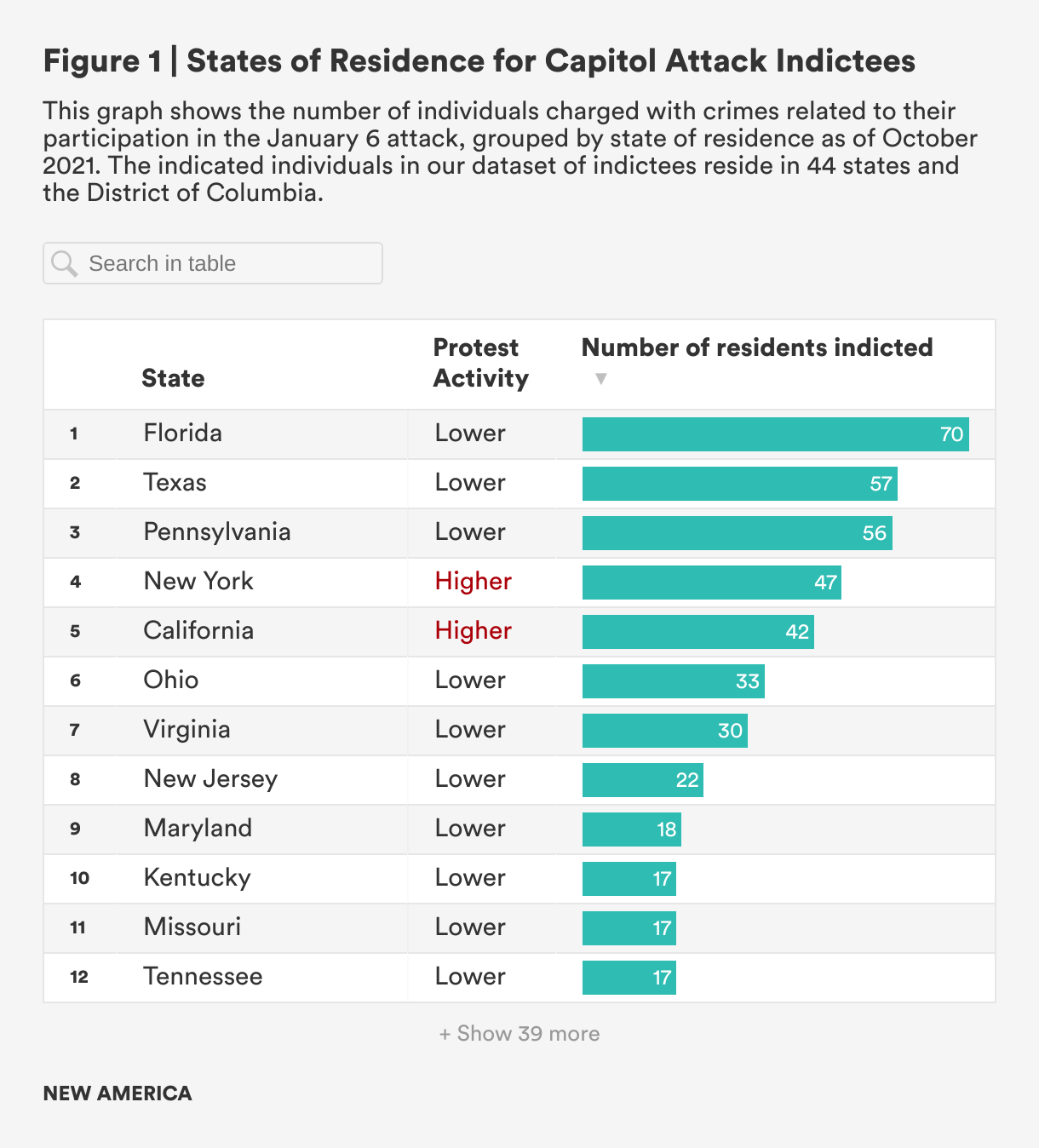
We were curious about whether there were any other discernible patterns in the arrest data that could tell us more about who showed up at the Capitol on January 6. So we examined the relationship between on-the-ground demonstrations in the lead-up to the siege and the residence of those charged with crimes related to their participation in the January 6 attack.73 Working together with the Bridging Divides Initiative (BDI) at Princeton University, we analyzed the locations of residences for 632 people charged in connection with January 6 and event location contained in the ACLED dataset with information about 24,662 demonstration events in the United States from January 1, 2020 to January 31, 2020 recorded by ACLED as part of the U.S. Crisis Monitor project.74 Together, this data captures the vast numbers of peaceful protest events and the contentious activity taking place during 2020 in the lead up to the January 6 attack, such as Black Lives Matter and “Back the Blue” counter-demonstrations, “Stop The Steal” election demonstrations, and protests related to COVID-19 restrictions.
As noted by BDI in its year-end report on the 2020 elections, there were early indications of the potential for violence in the lead up to the Capitol attack.75 While the data cited in the report shows high levels of demonstration activity during the summer months when a combination of social justice protests related to police practices and COVID-19 lockdowns spurred activity in the streets, it also notes that procedural election events that were once considered routine also triggered high levels of activity.76 In the graphs below produced by the Bridging Divides Initiative with ACLED data,77 the spike in the number of demonstrations surrounding significant events related to the BLM movement and election events is readily visible.78
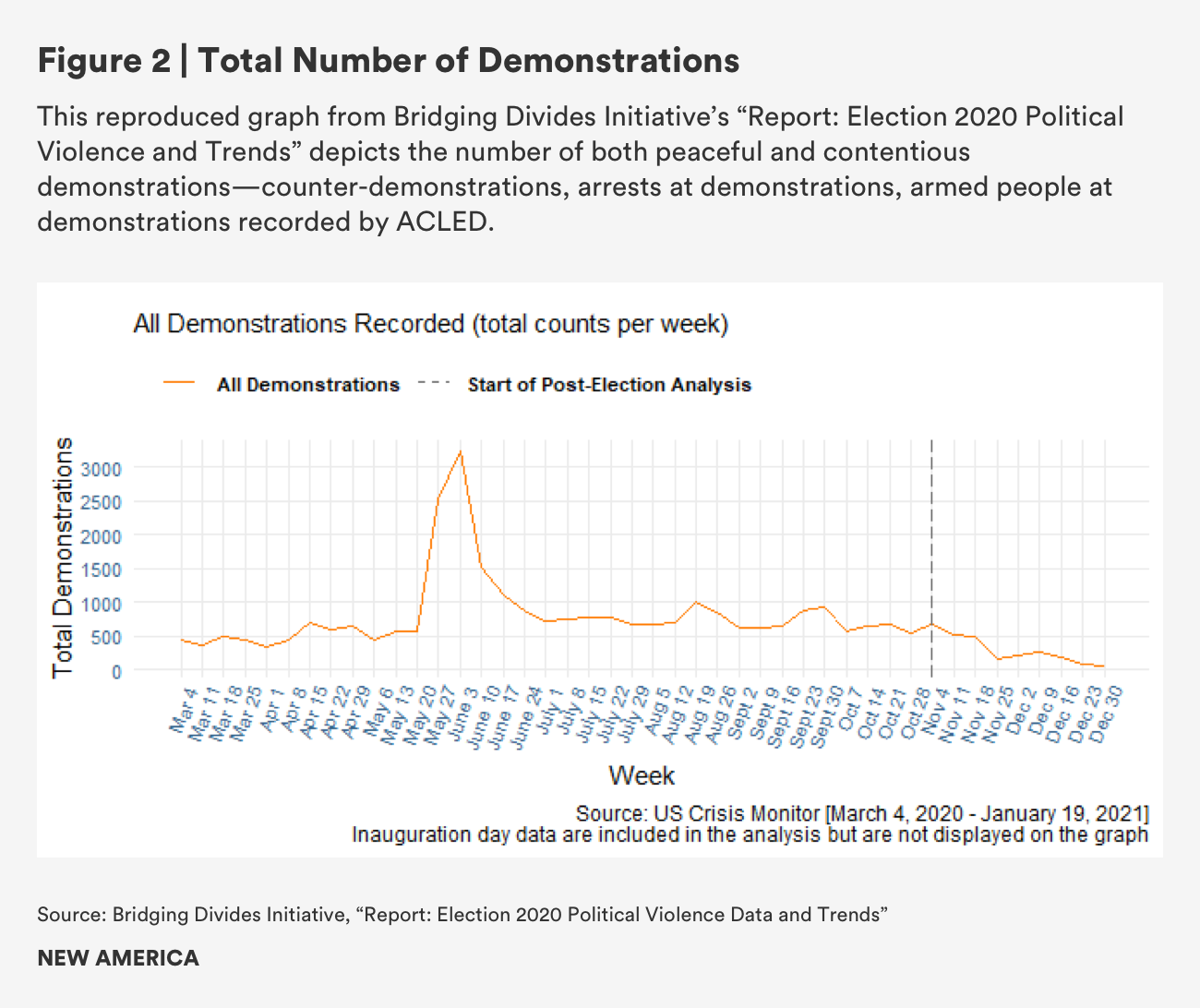
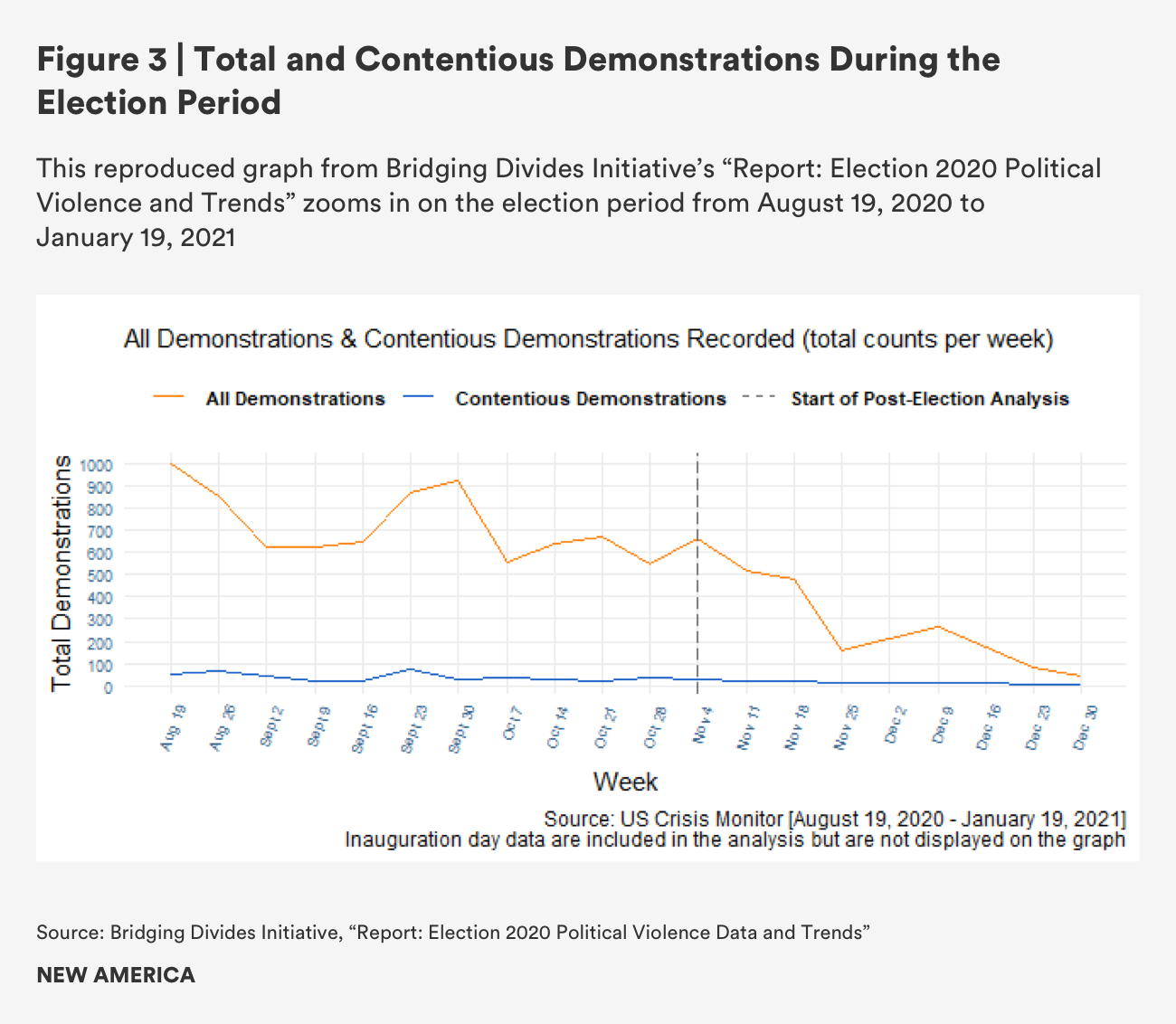
The BDI report also notes that the January 6 pro-Trump rally at the White House Ellipse marked the third “Million MAGA March” event to take place in Washington over a roughly six-week period. While, overall, the 11 week period leading up to elections showed more demonstration activity than the 11 week post-election period, there was a remarkable increase in the number of demonstrations involving unlawful militias or armed actors during the post-election period.79 Especially notable was the substantial level of counter-protest and paramilitary activity in key swing states where the Trump campaign also filed election related lawsuits, including Arizona, Georgia, Michigan, Nevada, Pennsylvania, and Wisconsin.
A statistical analysis we conducted shows that at a variety of geographic scales, the residences of those charged in the January 6 attack tended to cluster near areas where all types of demonstrations and counter protests took place, to a greater degree than anticipated under complete spatial randomness.80 That suggests that the proximity of protest activity prior to January 6 may have been an influencing factor for a substantial number of those indicted in connection with the Capitol breach.
As can be seen below, the clustering of demonstrations around an indictee’s residence is more significant—meaning looking at the local level in cities, towns and counties is more useful than generalizing to the state-level.81 That matters because a closer look at geotagged social media content from those localities like that found in videos could deliver more insights about warning signs of violence before Election Day and leading up to January 6. More research is needed, but it is possible that, combined with other types of anonymized geotagged sensing data and ethnographic analysis, the contours of early warning signs of escalating violence may be more discernible.
Figure 4
Map of locations of 24,662 demonstration events in the United States from January 1, 2020, to January 31, 2020 recorded by ACLED as part of the U.S. Crisis Monitor project and represented as orange and yellow clusters, combined with location of residences for individuals indicted from January 2021 to October 2021 for their role in the January 6th insurrection. The dataset includes 632 indicted individuals, which are represented on the map by red ringed circles.
Looking at the states with the highest number of indicted individuals related to the January 6 attack, we see that the number of demonstrations in Florida, Texas, and Ohio are less than expected given their population size. In Pennsylvania, New York, California, and Virginia, we see more demonstrations than expected. Moving our level of analysis from the state to local level, the map above combines the location of residence of individuals indicted for their role in the January 6 riot with the location of demonstrations in the United States from January 1, 2020 – January 31, 2021. The dataset includes 632 indicted individuals and 24,662 demonstration events. Zooming in on the map allows us to see the residences of indicted individuals and the protest events surrounding them.
The analysis points to a set of complex interactions between local and national demonstration events as well as external factors when looking at charging and demonstration data at the state level. The primary takeaway is that those charged with crimes related to the Capitol attack live in locations near clusters of demonstration events in both densely populated and less densely populated areas. This points to a potential relationship between local demonstrations near the residences of the 632 people charged as of October 2021 and their involvement in the Capitol attack.
It also suggests that there was likely a relationship between the galvanizing force of online mis- and dis-information about the elections and other issues that mobilized the public in the lead up to January 6. As discussed further below, hints of the relationship between demonstration activity, the polarizing rhetoric of political elites and online influencers, and mobilization to violence are mirrored at the individual level among arrestees who turned up in Washington to contest the election outcome and on a larger scale in millions of Parler posts on the early version of the site.
Data Mining Social Media for More Evidence: A Closer Look at Two Contesters
Charging documents also show the extent to which federal investigators mined social media activity in building cases against the Capitol rioters—many mention participants’ social media profiles, including those on Parler. We identified references to the social media accounts of 58 defendants in federal charging documents.82 While many usernames referenced in the documents appeared to refer to incriminating posts related to the Capitol breach on Twitter and Facebook, a substantial number also mentioned Parler handles for specific arrestees. We chose to profile two defendants from the resulting list.
What follows is a closer look at two of the contesters arrested for involvement in the January 6 attack. We chose these individuals because they illustrate many of the trendlines described elsewhere in this report. Both were active on Parler in the period leading up to and including January 6 and amplified the “StopThe Steal” messaging that dominated the platform during that time. They have ties to two of the groups central to the Justice Department’s ongoing conspiracy investigations—the Oath Keepers and Proud Boys. One resided in Ohio, home to 33 contesters, a top home state for many arrestees, while the other lived in Arizona, a pivotal target in Trump’s effort to overturn the 2020 election. Moreover, both hailed from areas with widespread demonstrations and protests throughout 2020. Finally, both contesters exemplify the complex crossover between online and offline political messaging, organizing, and networking.
An open-source investigation into these two arrestees linked to the Oath Keepers and Proud Boys reveals the extent to which online organizing, particularly on platforms like Parler, Gab, and Telegram, gave greater coherence to what might otherwise have been disparate groups. It also showed that Parler was integral to forging online and offline networks between those who showed up to the Capitol on January 6. The two cases we chose to focus on revealed substantial crossover between online instigation and offline activation. This suggests the relationship between the real and the virtual is not unidirectional, but rather a complex call-and-response dynamic in which online networks, memes, and messaging are reproduced at in-person protests, only for those in-person gatherings to generate more grist for the internet mill.
Backing the Blue, Keeping the Oath
One arrestee, Jessica Watkins, a 38-year-old small business owner from Ohio, faces several charges including conspiracy to obstruct the certification of the Electoral College vote and destruction of government property.83 The other, Micajah Jackson, 25-years old, grew up in Montana but now lives in Arizona and was charged with trespassing, as well as violent entry and disorderly conduct, on restricted Capitol grounds.84 We attempted to contact lawyers for Watkins and Jackson, but we did not receive a response before this report was scheduled to go to press.85
Watkins, the self-described commanding officer of the Ohio State Regular Militia and “a dues-paying subset of the Oath Keepers,” is one of the most visible of the 632 people that investigators have charged for the January 6 attack as of October 2021.86 This is largely thanks to the fact that Watkins, who is transgender, documented her role in the riot on her @OhioStateRegulars Parler account.87 An affidavit filed by federal prosecutors in January 2021 includes screenshots of selfies Watkins posted to the @OhioStateRegulars account.88 While she was not a particularly prolific user of the platform before January 6, she posted photos and videos of herself participating in the attack on Parler, stating “[w]e stormed the Capitol today.”89 Federal authorities claimed she was also part of a “stack” of military-clad Oath Keepers who cut through the crowd on their way inside the Capitol building.90
An Army veteran who served in Afghanistan, Watkins lived and tended to a bar in the small Ohio town of Woodstock.91 According to her one-time boyfriend and business partner, she founded her militia in 2019 to assist local first responders in weather emergencies after tornadoes tore through the region in May of that year.92 However, as Trump’s administration entered its final full year, Watkins and her militia appeared to grow more politically engaged.
In May 2020, the murder of George Floyd sparked nationwide Black Lives Matter protests, and Watkins’s Oath Keeper contingent went into action, patrolling some 12 events over the next six months.93 In response to a nationwide call from Oath Keeper leadership, Ohio State Regular Militia traveled to Louisville, Kentucky, amidst protests against the police killing of Breonna Taylor.94 Louisville was a major locus of protest events and demonstrations in 2020, with the U.S. Crisis Monitor recording 139 events in the city, compared to 72 and 109 in nearby, comparably sized Indianapolis and Nashville.95 Seven of those 139 entries either name Oath Keepers as the principal actor or mention the group. The U.S. Crisis Monitor also records 93 events in Columbus, the closest major city to Watkins’s hometown. One such protest was on November 7, 2020, at the Ohio State House where Watkins and two compatriots patrolled the area in military gear and guns after Joe Biden was projected to win the election.96
The action in Kentucky and Ohio involving BLM protests and “Back the Blue” counter protests related to the police shooting of Taylor began to pick up in early June around the time the Louisville city council passed legislation dubbed “Breonna’s Law,” which outlawed the type of no-knock warrant that triggered the police shooting that killed Taylor.97 Perhaps not surprisingly, parallel spikes in activity were visible online on Parler with posts containing the words “Back the Blue” increasing in late May and early June as Black Lives Matter protests swept across the country.
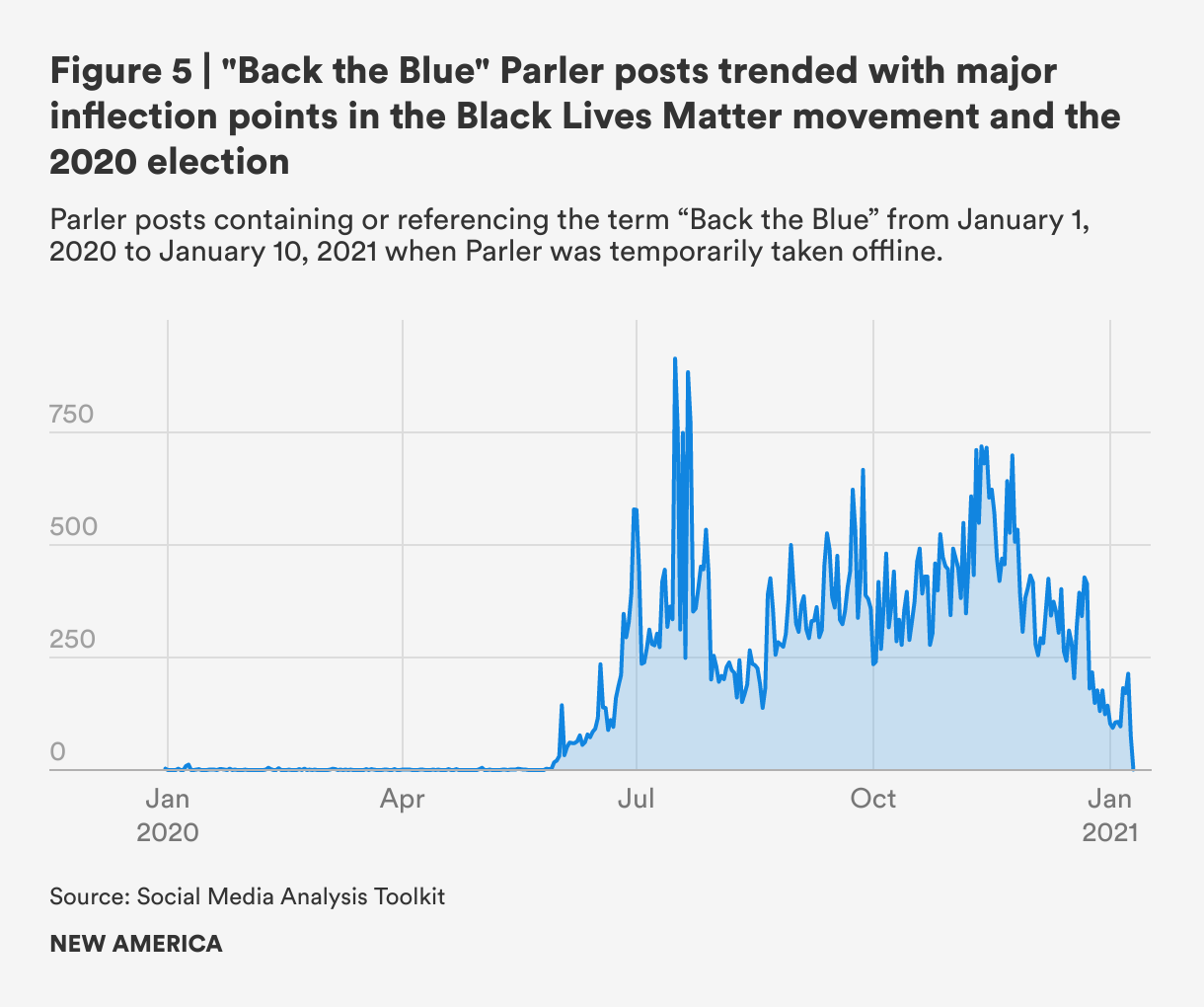
Related posts first spiked upward early in the summer of 2020 with 144 “Back the Blue''-related posts notched on June 2, a day after President Trump’s photo op in front of St. John’s Church on Lafayette Square, a move that intensified the unrest and ongoing Black Lives Matter protests in Washington that summer. The pro-police catchphrase hit its highest peak on Parler on July 16, 2020 with 914 posts that day, and then ebbed and flowed over time as protests and counter-protests swept across the country. The phrase appeared to lose salience progressively after the elections with only a handful of posts in the period from January 8-10, 2021.
The drop-off in “Back the Blue''-related posts scans with other noticeable trends visible on Parler, which progressively saw election-related slogans gain salience right after Election Day on November 3. There was a significant increase in Parler posts containing the phrase or referencing “Stop the Steal” after news outlets called the election in Biden’s favor on November 7, 2020. There was a big jump with November 13, 2020 which marked the first time Trump spoke publicly after Biden was declared the winner. On that day, 13,857 related Parler posts mentioning the “Stop the Steal” rallying cry were uploaded, according to an assessment we conducted using the Social Media Analysis Toolkit (SMAT) analysis tool, a publicly available application for tracking online trends on niche platforms.
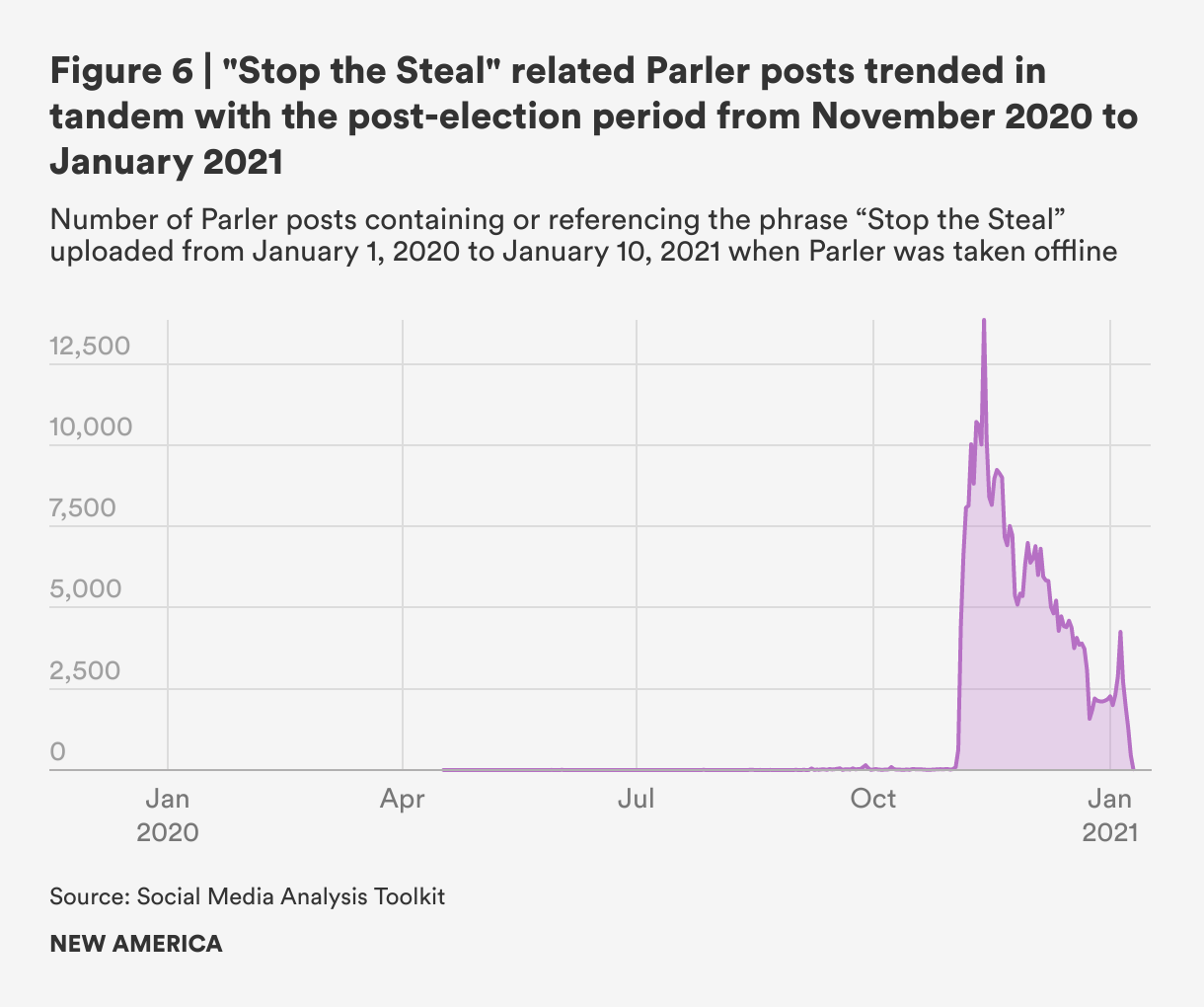
Watkins’s online activity in Parler appears to track loosely with the above trends. In early December 2020, Watkins began posting on Parler under the handle @OhioStateRegulars, which she used as a recruiting tool for her militia.98 Her first post, dated December 5, 2020, read, “Feel free to reach out. We are very active as a militia. We've been to 11 protests, and defended a MAGA truck parade. We also do training all the time.”99

Watkins also repeatedly complained about pandemic-related business restrictions,100 writing, “I own a small business, a Bar in a lockdown state. This. This is fact. We lost 60% of our revenue. If we didn't own and rent an apartment in the building, we'd have gone under already.”101 Although her post was minor in the scheme of things, it was part of a spike in activity on Parler that peaked shortly after the November 3 election but remained elevated through January 6, 2021, compared to historical rates for the platform. Analysis of post creation dates on Parler in the Aliapoulios, et al. dataset shows a substantial increase in the rate of posts on the platform after most major news media outlets declared Biden the winner of the presidential election on November 7.
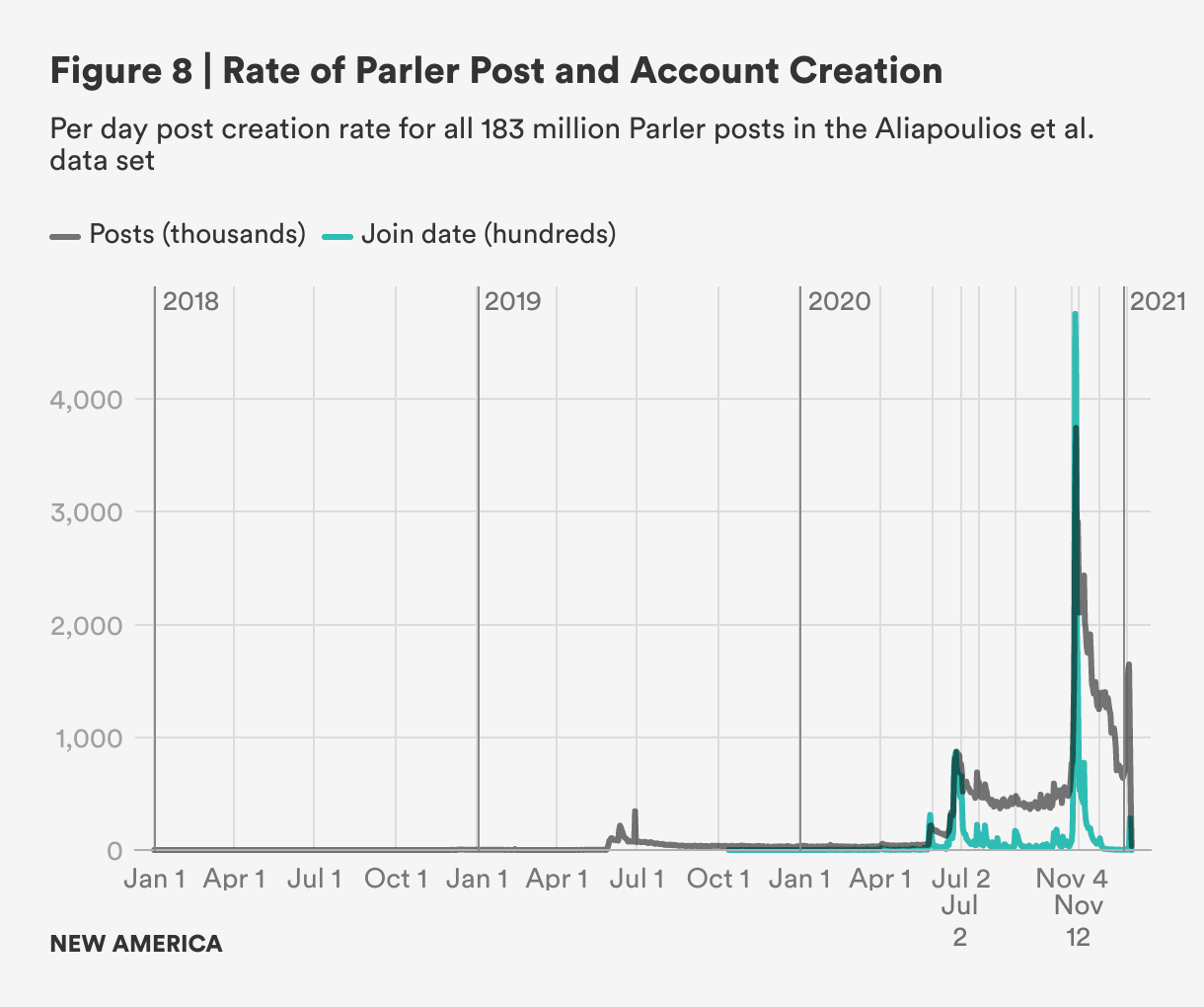
Watkins appears to be part of a wave of social media users who flocked to Parler shortly after Election Day. Publicly available posts we collected indicate she began posting to Parler beginning in December and her engagement ended when Parler was taken offline on January 10. During this brief period, she posted at least 64 times, a mix of complaints about Covid-related restrictions and Democrats, threats against Antifa, arguments with fellow Parler users over martial law, and advertisements for her militia group.102 Yet, even before Parler was deplatformed, Watkins had already made her profile private in response to growing attention from media and federal investigators.
Memes in support of law enforcement also figured prominently on Watkins’ Parler page, with her profile header featuring the popular Parler call to “Back the Blue.”103 Watkins and the network of Parler users with which she interacted boosted “Stop the Steal” messaging, as well as the hashtag itself, which Watkins appended to posts.
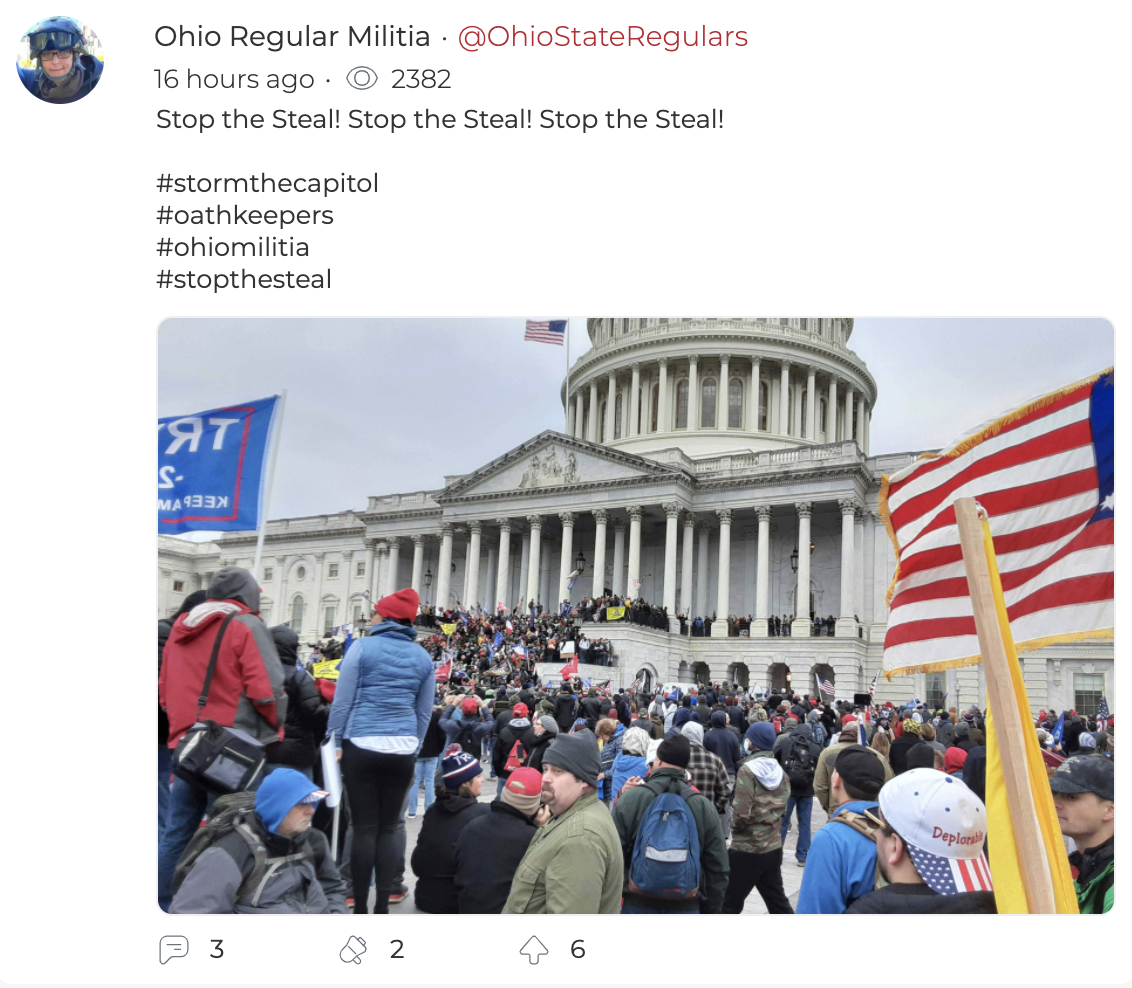
Few of Watkins’s posts, however, drew engagement from other Parler users until the day of the attack. Her most viewed post, according to Parler’s own public count of impressions, was from January 6, 2021, in which she wrote, “Yeah. We stormed the Capitol today. Teargassed, the whole, 9.”104 By January 7, the post had received 10,111 impressions. Her most commented upon post, from January 1, 2021, criticized Ohio Gov. Mike DeWine and received 184 comments.105
Watkins’s online and offline lives merged on the day of the Capitol attack. In a more than two-hour recording of the Oath Keepers’ January 6 communications on Zello, a walkie-talkie app, published by On the Media, an NPR radio show, the group can be heard planning for the “citizen’s arrest” of members of Congress.106 Watkins herself announces that she is heading toward the Capitol with “a good group” of “about 30-40 of us. We’re sticking together and sticking to the plan.”107 Then, she repeats nearly verbatim a line she had previously posted on Parler: “Trump's been trying to drain the swamp with a straw. We just brought a shop-vac.”108 As of November 2021, all of Watkins’s other known social media profiles appear to have been taken down.
Contesting the Elections from the Heart of “Stop the Steal” Country
On May 18, 2021, federal authorities arrested Micajah Jackson on charges of illegally entering Capitol grounds, and in October 2021, Jackson announced his intention to plead guilty to a single misdemeanor charge.109 Video and photos from the attack showed Jackson, a Montana native living in Arizona, marching alongside a Proud Boys contingent.110 Dressed in a plaid shirt, khaki pants, and a bright orange armband used by the Proud Boys to identify one another, Jackson was one of several in the cluster to overrun police barricades, according to federal charging documents.111 Jackson has, nonetheless, maintained in court proceedings that he had no connection to the Proud Boys prior to January 6, 2021.112
Yet, analysis of Jackson’s online activity indicates he has links to a Phoenix-based network of far-right media personalities with a strong online presence and ties to the Proud Boys and “Groyper” movements.113 Jackson’s social media accounts also feature photos of him with Rep. Paul Gosar (R-Ariz.), one of the most vocal House of Representatives members to raise a formal objection to the certification of the 2020 election results on January 6.114
Like many inspired to join the pro-Trump rally in Washington, Jackson is part of a wave of “citizen journalists,” who have sprung up all over the country in the wake of the QAnon movement. According to posts on the @conservative_embassy Instagram account, Jackson is a frequent contributor to HUB Radio Phoenix,115 an online radio program hosted via Facebook and YouTube.116 Hosted by Ron Ludders, a member-at-large of the Arizona GOP and one-time Republican party delegate, HUB Radio Phoenix bills itself on its Facebook page as a “[n]ews talk station providing truthful reporting, community events and political commentary countering false reporting presented by the main stream [sic] media.”117
An online hub for conversations with the streaming radio program hosts conversations with local Republican office holders and candidates, in particular those promoting “Stop the Steal” narratives and efforts to audit the Arizona election.118 HUB Radio Phoenix also platforms Arizona Proud Boys, as they did at a September 25, 2021 rally where Jackson was a speaker.119 While representing HUB Radio Phoenix, Jackson covers anti-vaccination120 protests and has confronted local reporters for wearing masks.121
During summer and fall 2021, Jackson regularly posted videos of himself at these events to his @conservative_embassy Instagram account. Active since March 2020, the account belonged to Arizona Stop the Steal coordinator Caden Husar until April 2021, when Husar handed it off to Jackson.122 After Instagram removed Jackson’s user account handle @thejfkreport, he began posting regularly to Instagram under @conservative_embassy, which also showed signs of occasional input from Husar. During his tenure, Husar posted QAnon-related conspiracy theories123 and “Stop the Steal” messaging.124 Since Jackson took over, he has used the account to promote the Arizona audit,125 claim that the January 6 attack was a “government psyop,”126 and spread anti-vaccination messaging.127
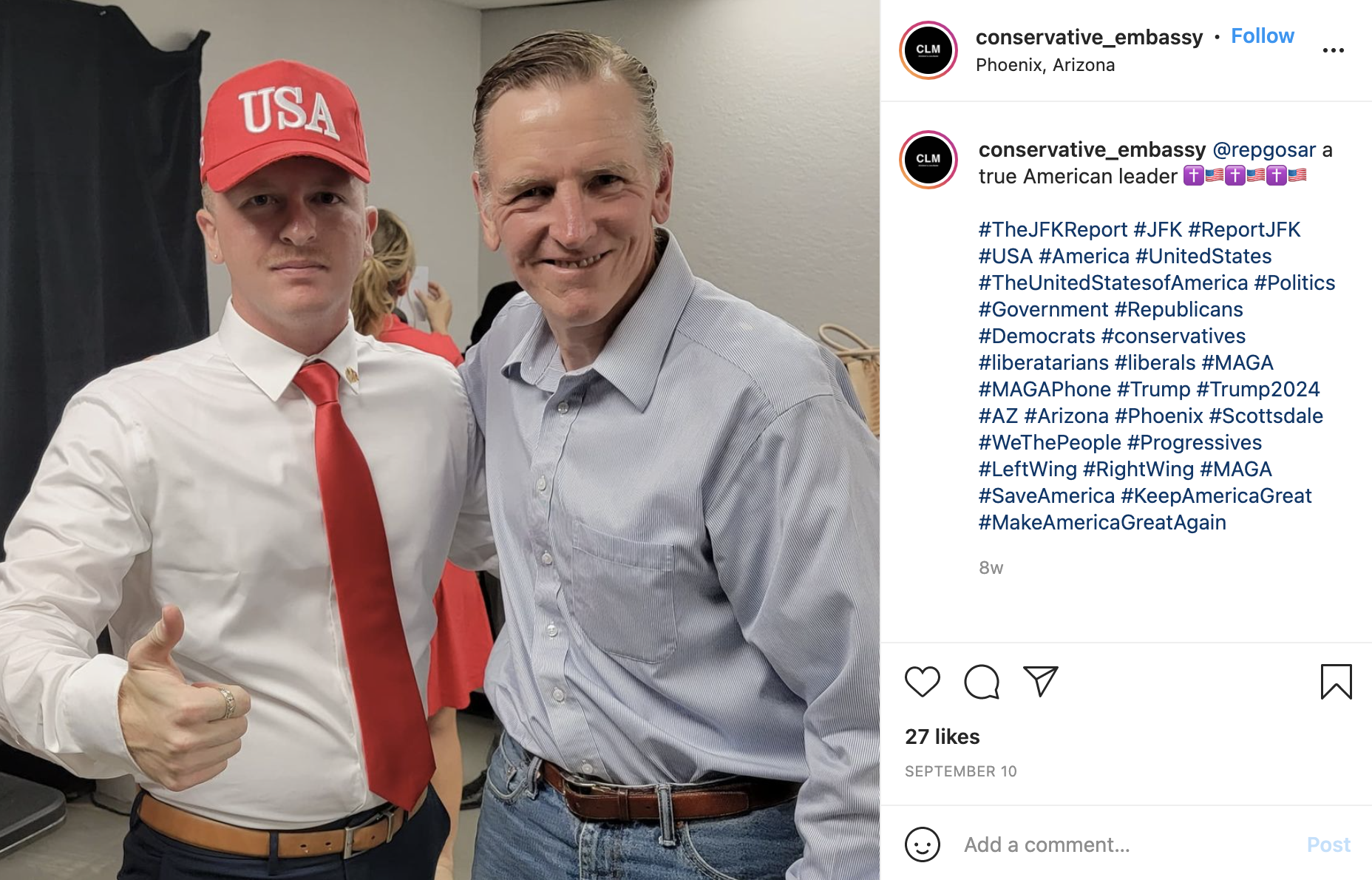
@Conservative_embassy Instagram account
Jackson’s online activity indicates he has collaborated on several occasions with a network of far-right media personalities espousing extremist views. For example, one frequent collaborator is Ethan Schmidt, creator of Phoenix's “Anti Maskers Club,” who films himself entering businesses and confronting shoppers for wearing masks.128 Jackson sometimes appears in these videos or posts them to his @conservative_embassy Instagram account.129 Schmidt maintains a variety of social media profiles, including at least two on Telegram, on which he posts videos of himself posing with Proud Boys130 and destroying what he calls “Satanic” LGBTQ+ iconography.131 One instance in this second category—Schmidt breaking a rainbow sign in an Arizona Target—earned him accolades on Alex Jones’ Infowars network.132 Schmidt also posted videos of himself forcibly removing a man’s mask133 and Arizona police seemingly arresting him for trespassing on a private business.134
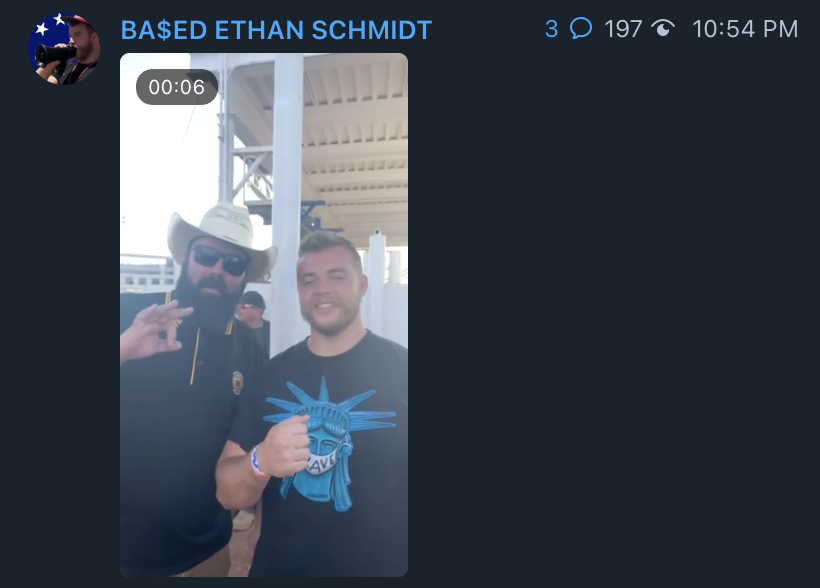
Ethan Schmidt's Telegram channel.
Jackson’s social media posts also indicate that he has collaborated at times with Greyson Arnold, a podcaster with ties to the “Groyper” movement, which the Anti-Defamation League calls “a loose network of alt right figures who are vocal supporters of white supremacist and ‘America First’ podcaster Nick Fuentes.”135 Under his aliases “Pure Politics” and “American Greyson,” Arnold runs a host of social accounts across multiple platforms, on which he cross posts and promotes content linked to Fuentes, Gosar, Schmidt, and Jackson.136 Arnold was also present at and has posted videos from a series of violent anti-transgender protests in California that included Proud Boys.137 Arnold also posted photos and videos to Telegram and YouTube of Proud Boys marching through Washington, D.C. on December 12, 2020.138 Arnold was present at the Capitol on January 6, but he has not been charged with a crime.139 On his Telegram channel, Arnold shares content from figures such as Ron Watkins,140 a key figure in the QAnon conspiracy theory network, and an anonymous account, “The Western Chauvinist,”141 that has over 53,0000 followers, appears linked to the Proud Boys, and has shared Micajah Jackson’s videos.142
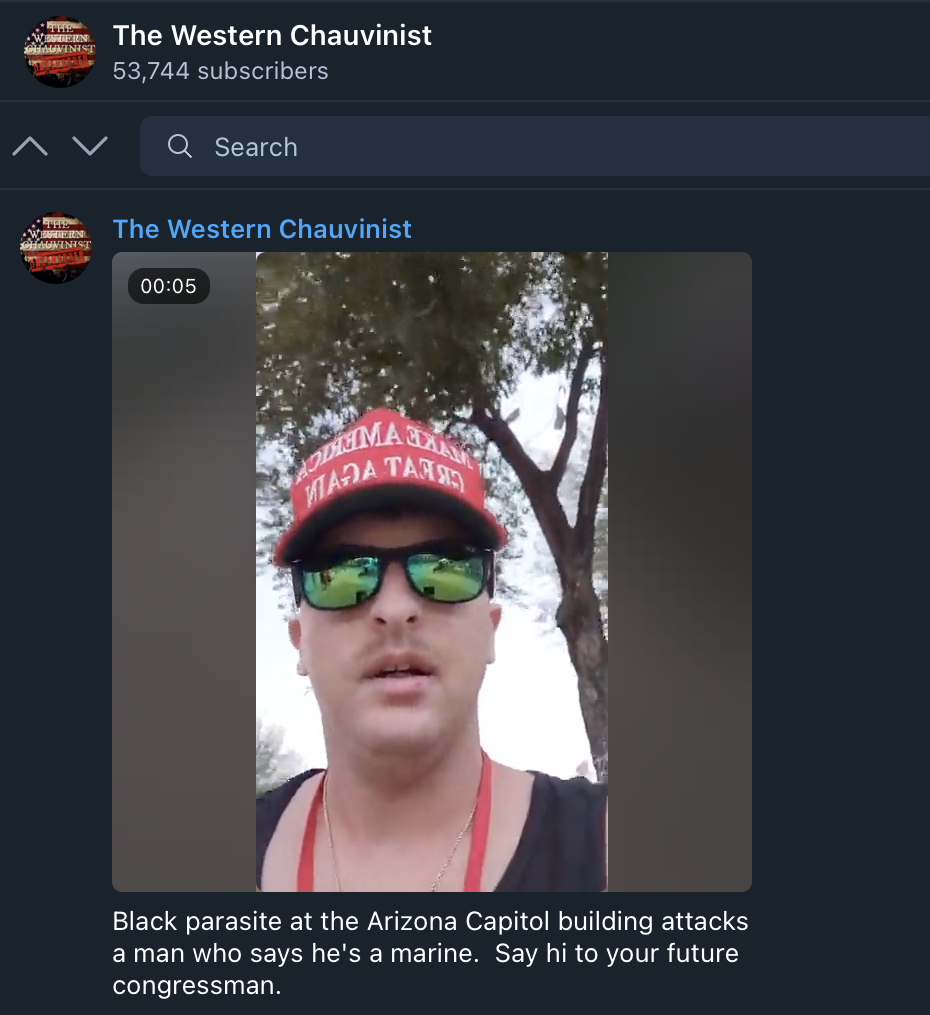
Telegram/Instagram
Mainstream platforms such as Facebook, Twitter, and Instagram have repeatedly banned Jackson and his associates, but such bans tend to be short-lived.143 Several in Jackson’s network appear to navigate around content moderation rules after they have been banned by operating under a different name or, as Jackson did, taking over an existing account.144 Repeated bans make it difficult to determine how long Jackson has collaborated with this network.
However, a review of Jackson’s deleted Parler account, which he first posted to on October 24, 2020, indicates Jackson attended several “Stop The Steal” protests. His posts also show a pattern of echoing Proud Boys content and threats of violence.145 Just days after the election, on November 16, 2020, for example, Jackson complained that an unnamed platform suspended him for 30 days “for sharing a peaceful statement from one of the Arizona Proud Boys.” On November 18, in response to a post about Maricopa County, Jackson wrote that he had been “protesting everyday there.” Several days later, Jackson wrote, “If the law will not prosecute. We the people will give justice. Death by rope,” and, in a different post, “Omar should be first,” possibly referring to Rep. Ilhan Omar (D-Minn.).
In a July 22, 2021 interview posted to HUB Radio Phoenix’s YouTube channel, Jackson characterizes his decision to attend Trump’s January 6 rally almost as a whim, something he chose to do because he was already in the area.146 “I called my mom. She stays in Ohio,” Jackson told the hosts. “And I’m like, ‘hey, can I come home for Christmas?’ ‘Yeah, that’s fine.’ I get there and talk about, ‘hey, can you watch my dog? I want to go to DC. It’s only an eight-hour drive.” Although Jackson appeared to suggest he was going to Washington on the fly, there is plenty of evidence that his journey to the Capitol that day was the culmination of a long campaign to cultivate influence online.
Far from a casual protester caught up in events, Jackson’s actions online and off show him to be a committed activist and commentator with ties to local Arizonan influencers and national figures like Rep.Gosar. As a local influencer in his own right, Jackson provides a window into the flow of false and violent content within a tightly clustered online network of media influencers, elected politicians, and high-profile members of anti-government street movements like the Proud Boys that led to the storming of the Capitol. While it is difficult to fully gauge the effects of online and offline exchanges, the posts from Parler and other platforms within Jackson’s networks make clear that elite signaling from politicians who raised objections to the certification of election results like Gosar and the desire of grassroots Trump followers to gain influence online proved potent in influencing outcomes on January 6.
Citations
- Alanna Durkin Richer, “Oath Keeper Charged in Capitol Riot Renounces Militia Group,” Associated Press, February 26, 2021. https://apnews.com/article/capitol-siege-politics-arrests-ohio-1c6efcfb1a163bcf6498dc106b222fa4
- Dan Barry, Mike McIntire and Matthew Rosenberg, “‘Our President Wants Us Here’: The Mob That Stormed the Capitol,” New York Times, January 9, 2021. https://www.nytimes.com/2021/01/09/us/capitol-rioters.html
- Jan Wolfe, “'He Invited Us': Accused Capitol Rioters Blame Trump in Novel Legal Defense,” Reuters, February 2, 2021. https://www.reuters.com/article/us-usa-trump-capitol-defense/he-invited-us-accused-capitol-rioters-blame-trump-in-novel-legal-defense-idUSKBN2A219E
- Alan Feuer, “Oath Keepers Plotting Before Capitol Riot Awaited ‘Direction’ From Trump, Prosecutors Say,” New York Times, February 11, 2021. https://www.nytimes.com/2021/02/11/us/politics/oath-keepers-trump-investigation.html
- Spencer S. Hsu, Tom Jackman, Ellie Silverman and Rachel Weiner, “Court hearings, guilty pleas belie right-wing recasting of Jan. 6 defendants as persecuted patriots,” Washington Post, September 17, 2021. https://www.washingtonpost.com/local/legal-issues/j6-rally-capitol-riot-defendants/2021/09/17/b433ecb6-1657-11ec-a5e5-ceecb895922f_story.html
- Roger Parloff, “What Do—and Will—the Criminal Prosecutions of the Jan. 6 Capitol Rioters Tell Us?” Lawfare, November 4, 2021. https://www.lawfareblog.com/what-do%E2%80%94and-will%E2%80%94-criminal-prosecutions-jan-6-capitol-rioters-tell-us
- See “Capitol Breach Cases” for a list of individuals that the Justice Department has charged following investigations into the events of January 6, 2021. The chart lists charges for each person and links to relevant charging documents. https://www.justice.gov/usao-dc/capitol-breach-cases
- “Oath Keepers Fifth Superseding Indictment,” United States Department of Justice, August 4, 2021. https://www.justice.gov/usao-dc/press-release/file/1422696/download; Southern Poverty Law Center (SPLC), “The Oath Keepers,” https://www.splcenter.org/fighting-hate/extremist-files/group/oath-keepers
- “Nordean Biggs Rehl Donohoe - Indictment,” United States Department of Justice, March 10, 2021. https://www.justice.gov/usao-dc/case-multi-defendant/file/1377586/download
- Dan Barry, Mike McIntire and Matthew Rosenberg, “‘Our President Wants Us Here’: The Mob That Stormed the Capitol,” New York Times, January 9, 2021. https://www.nytimes.com/2021/01/09/us/capitol-rioters.html
- Aaron C. Davis, “Red Flags,” Washington Post, October 31, 2021. https://www.washingtonpost.com/politics/interactive/2021/warnings-jan-6-insurrection/
- The FBI posts regular updates to information about those charged in connection with the Capitol attack on a dedicated webpage here: https://www.justice.gov/usao-dc/capitol-breach-cases. As of December 1, 2021 when this report was going to print, federal prosecutors had charged a total of 673 in connection with the siege.
- The list of defendants charged by federal authorities in connection with the Capitol attack can be found here: https://www.justice.gov/usao-dc/capitol-breach-cases
- Any indictments occurring after October 7, 2021 are not reflected in this dataset.
- Location of residence was generalized to a city/town and state pair. Exact addresses were not used in our analysis to preserve the privacy of the defendants.
- William Cummings, Joey Garrison and Jim Sergent, “By the Numbers: President Donald Trump's Failed Efforts to Overturn the Election,” USA Today, January 6, 2021. https://www.usatoday.com/in-depth/news/politics/elections/2021/01/06/trumps-failed-efforts-overturn-election-numbers/4130307001/
- Roger Parloff, “What Do—and Will—the Criminal Prosecutions of the Jan. 6 Capitol Rioters Tell Us?” Lawfare, November 4, 2021. https://www.lawfareblog.com/what-do%E2%80%94and-will%E2%80%94-criminal-prosecutions-jan-6-capitol-rioters-tell-us
- Jon Seidel, Matthew Hendrickson, and Fran Spielman, “CPD Officer Used N-word, Shared Pictures When Bragging About Role in US Capitol Riots: Feds,” Chicago Sun Times, June 11, 2021. https://chicago.suntimes.com/crime/2021/6/11/22529794/chicago-police-officer-u-s-capitol-breach-karol-chwiesiuk
- “Capitol Hill Siege,” George Washington University Program on Extremism. https://extremism.gwu.edu/Capitol-Hill-Cases
- The Bridging Divides Initiative (BDI) at Princeton University is a non-partisan research initiative that tracks and mitigates political violence in the United States. The mission of the initiative is to grow and build local community resilience throughout elections and other periods of heightened risk, laying a foundation for longer-term work to bridge the divides across communities in the United States. More information about the initiative and its collaboration with ACLED can be found on its website here: https://bridgingdivides.princeton.edu/
- The information about 24,662 demonstration events in the United States from January 1, 2020, to January 31, 2020, included only the protests and riot categories recorded by ACLED as part of the U.S. Crisis Monitor project; incidents categorized by ACLED as strategic developments were not included in our analysis.
- Bridging Divides Initiative, “Report: Election 2020 Political Violence Data and Trends,” p. 2.
- Bridging Divides Initiative, “Report: Election 2020 Political Violence Data and Trends,” pp. 2-3.
- Bridging Divides Initiative, “Report: Election 2020 Political Violence Data and Trends,” 2021, pp. 7-8. https://bridgingdivides.princeton.edu/news/2021/report-election-2020-political-violence-data-and-trends; The website for the ACLED U.S. Crisis Monitor Project can be found here: https://acleddata.com/special-projects/us-crisis-monitor/
- Bridging Divides Initiative, “Report: Election 2020 Political Violence Data and Trends,” 2021, pp. 7-8. https://bridgingdivides.princeton.edu/news/2021/report-election-2020-political-violence-data-and-trends; The website for the ACLED U.S. Crisis Monitor Project can be found here: https://acleddata.com/special-projects/us-crisis-monitor/
- Bridging Divides Initiative, “Report: Election 2020 Political Violence Data and Trends,” pp. 6-8.
- It should be noted that both point patterns (residences and demonstrations) tend to follow the spatial contours of population density in the U.S. In spite of all three patterns coinciding, it's still notable that the residences point pattern and the demonstrations point pattern do not deviate from each other. That they would follow each other isn't necessarily a given, even when they both track population density. Put another way, we could have seen arrestees only from rural areas--that's not the case.
- Using a regression analysis performed by the Bridging Divides Initiative, which takes into account that states with greater populations are more likely to see greater numbers of demonstrations, we can highlight states with deviations from the national average. Calculations are based on states’ residual values from a linear regression for total counter-protests by state population (2019 population estimates) and numbers of protests recorded in the ACLED data. See p.16 in the full Bridging Divides Initiative report for more details of this analysis at: https://bridgingdivides.princeton.edu/sites/g/files/toruqf246/files/2021-02/Report-Election2020PoliticalViolenceDataandTrends%20%281%29.pdf.
- Our team scraped and performed optical character recognition (OCR) of all charging documents available on the Justice Department website as of October 2021, then ran a Python script to identify mentions of specific social media profiles, revealing 58 defendants with named social accounts.
- Ages for Watkins and Jackson are from the time of arrest, per Department of Justice charging documents. “Oath Keepers Fifth Superseding Indictment,” United States Department of Justice, August 4, 2021. https://www.justice.gov/usao-dc/press-release/file/1422696/download
- “Jackson, Micajah Noel - Information,” United States Department of Justice, July 21, 2021.https://www.justice.gov/usao-dc/case-multi-defendant/file/1415801/download
- Emails to Shelli Peterson, Jessica Watkins’s lawyer, on November 23, 2021, and Maria Jacob, Micajah Jackson’s lawyer, on November 24, 2021 did not receive a response before this publication was set to go to press. Peterson, Watkins’s lawyer, and Jacob, Jackson’s attorney, are listed with the office of the Federal Public Defender for the District of Columbia. For background on these defendants cases, see: Jessica Garrison, Ken Bensinger, and Zoe Tillman, “Jessica Watkins, An Oath Keeper Charged In The DC Attack, Fears Harsh Treatment Because She Is Transgender, BuzzFeed News, February 21, 2021. https://www.buzzfeednews.com/article/jessicagarrison/oath-keeper-transgender-jail-jessica-watkins. Peter Wade, “Judge Ordered Jan. 6 Rioter Not to Associate with Proud Boys,” Rolling Stone, October 23, 2021. https://www.rollingstone.com/politics/politics-news/proud-boys-micajah-jackson-court-order-1246966/
- “Jessica Mare Watkins - Affidavit,” United States Department of Justice, January 16, 2021, accessed October 25, 2021, https://www.justice.gov/opa/page/file/1356116
- Jessica Garrison, Ken Bensinger, Zoe Tillman, “Jessica Watkins, An Oath Keeper Charged In The DC Attack, Fears Harsh Treatment Because She Is Transgender,” BuzzFeed News, February 21, 2021. https://www.buzzfeednews.com/article/jessicagarrison/oath-keeper-transgender-jail-jessica-watkins; “Jessica Mare Watkins - Affidavit,” United States Department of Justice, January 16, 2021, accessed October 25, 2021, https://www.justice.gov/opa/page/file/1356116
- “Jessica Mare Watkins - Affidavit,” United States Department of Justice, January 16, 2021, accessed October 25, 2021, https://www.justice.gov/opa/page/file/1356116
- “@OhioStateRegulars - Ohio Regular Militia,” The Wayback Machine, January 7, 2021. https://web.archive.org/web/20210107170810/https://parler.com/profile/OhioStateRegulars/posts
- “Caldwell, Crowl, Watkins, Parker, Parker, Young, Steele, Meggs, Meggs - Indictment,” United States Department of Justice, February 19, 2021. https://www.justice.gov/usao-dc/case-multi-defendant/file/1369071/download
- Erin Snodgrass, “'Oath Keeper' Jessica Watkins Denounced the Extremist Group But Will Stay in Jail Before Her Trial, Judge Says,” Business Insider, February 26, 2021. https://www.businessinsider.com/oath-keeper-jessica-watkins-will-stay-in-jail-before-her-trial
- Jessica Garrison and Ken Bensinger, “Meet The Woman Facing Some Of The Most Serious Capitol Riot Charges,” BuzzFeed News, January 26, 2021. https://www.buzzfeednews.com/article/jessicagarrison/conspiracy-charge-ohio-militia-capitol
- Jake Zuckerman, “Ohio Bartender and Her ‘Militia’ Drove to D.C. to Join the Capitol Breach,” Ohio Capital Journal, January 13, 2021. https://ohiocapitaljournal.com/2021/01/13/ohio-bartender-and-her-militia-drove-to-d-c-to-join-the-capitol-breach/
- Zuckerman, “Ohio Bartender and Her ‘Militia’ Drove to D.C. to Join the Capitol Breach.”
- U.S. Crisis Monitor, Armed Conflict Location & Event Data Project (ACLED). https://acleddata.com/special-projects/us-crisis-monitor
- Jake Zuckerman, “Militia Group Appears at Statehouse to ‘Protect People’ at Rallies for Trump, Biden,” Ohio Capital Journal, November 12, 2020. https://ohiocapitaljournal.com/2020/11/12/militia-group-appears-at-statehouse-to-protect-people-at-rallies-for-trump-biden/
- Christina Carrega and Sabina Ghebremedhin, “Timeline: Inside the investigation of Breonna Taylor's Killing and Its Aftermath,” ABC News, November 17, 2020. https://abcnews.go.com/US/timeline-inside-investigation-breonna-taylors-killing-aftermath/story?id=71217247
- Unless attributed to a different source, this and subsequent posts by Watkins under the @OhioStateRegulars handle are taken from the Aliapoulis, et al., dataset of Parler posts uploaded to the Zenodo data sharing platform, which our team downloaded and ported to Kibana data visualization software. The dataset does not include any posts by Watkins after December 23, 2020. Later posts she made between January 1 and January 7, 2020 are accessible on the Internet Archive’s Wayback Machine at https://web.archive.org/web/20210107170810/https://parler.com/profile/OhioStateRegulars/posts.
- Aliapoulis, et al. dataset of Parler posts.
- Watkins’s Parler posts are drawn from the Aliapoulis, et al., dataset of Parler posts uploaded to the Zenodo data sharing platform, which our team downloaded and ported to Kibana data visualization software.
- Aliapoulis, et. al. dataset of Parler posts.
- This count of total posts combines the 44 posts in the Aliapoulis, et al. dataset of Parler posts and the 20 posts archived on the Internet Archive’s Wayback Machine. Therefore, it does not include any posts Watkins’ made between December 23, 2020, her final post in the Aliapoulis, et al. dataset, and January 1, 2021, her first post in the Internet Archive.
- “@OhioStateRegulars - Ohio Regular Militia,” The Wayback Machine, January 7, 2021. https://web.archive.org/web/20210107170810/https://parler.com/profile/OhioStateRegulars/posts
- “@OhioStateRegulars - Ohio Regular Militia,” The Wayback Machine, January 7, 2021. https://web.archive.org/web/20210107170810/https://parler.com/profile/OhioStateRegulars/posts
- “@OhioStateRegulars - Ohio Regular Militia,” The Wayback Machine, January 7, 2021. https://web.archive.org/web/20210107170810/https://parler.com/profile/OhioStateRegulars/posts
- “The Zello Tapes: The Walkie-Talkie App Used During The Insurrection,” On the Media, January 15, 2021.https://www.wnycstudios.org/podcasts/otm/segments/zello-tapes-walkie-talkie-app-used-during-insurrection-on-the-media
- “The Zello Tapes: The Walkie-Talkie App Used During The Insurrection,” On the Media.
- Aliapoulis, et al. dataset of Parler posts. In a post from December 22, 2020, Watkins wrote, “The swamp is deep. Trump has been siphoning the swamp with a straw, when clearly a shop-vac is called for.”
- Marshall Cohen and Em Steck, “US Capitol Rioter with Proud Boys Ties to Plead Guilty, lawyer says,” CNN, October 27, 2021. https://www.cnn.com/2021/10/27/politics/capitol-rioter-with-proud-boys-ties-to-plead-guilty/index.html
- “Jackson, Micajah Noel - Statement of Facts,” United States Department of Justice, May 14, 2021. https://www.justice.gov/usao-dc/case-multi-defendant/file/1395291/download
- “Jackson, Micajah Noel - Statement of Facts,” United States Department of Justice.
- “Jackson, Micajah Noel - Statement of Facts,” United States Department of Justice.
- A review of Jackson’s social media accounts on Instagram (https://www.instagram.com/conservative_embassy), Twitter (https://twitter.com/thejfkreport; archived version: https://archive.md/HOUxy), Gab (https://gab.com/TheJFKReport; archived version: https://archive.md/X4hQF), and Telegram (https://t.me/TheJFKReport; archived version: https://archive.md/2eVTr) between October and November 2021 shows him to associate, cross-promote, and collaborate with Arizonan influencers like anti-mask activist Ethan Schmidt and podcaster Greyson Arnold. As detailed below in this report, Schmidt posted video of himself with a member of the Proud Boys, while Arnold posted video of Proud Boys protests and material from Nick Fuentes, founder of the Groyper movement.
- In a September 10, 2021, post on the @conservative_embassy Instagram account, Jackson appears with Gosar. The caption reads, “@repgosar a true American leader” [sic] (https://www.instagram.com/p/CTp0vfmh1ST). A similar post appears on the @TheJFKReport Gab account on July 17, 2021 (https://gab.com/TheJFKReport/posts/106598207902153147; archived version: https://archive.md/0qztj).
- Much of what is publicly known about Jackson is drawn from monitoring his @conservative_embassy Instagram account between October and November 2021. Caden Husar, an acquaintance of Jackson, began posting to the account in March 2020 and handed predominant control of it to Jackson in April 2021. An August 13, 2021, post to the account showed Jackson holding a press badge for HUB Radio Phoenix with his name and “media correspondent.” A July 29, 2021, post showed the same press badge with the caption “Hard work pays off. The JFK Report is slowly taking off.” The account can be found at https://www.instagram.com/conservative_embassy.
- HUB Radio Phoenix YouTube channel: https://www.youtube.com/channel/UCakvRRQsWVMwWlqSIECPU3A; archived version: https://archive.md/p5JNw.
- A 2019 document posted on rightlanenetwork.com listed Ludders as a member of the Arizona GOP see: https://rightlanenetwork.com/wp-content/uploads/2020/03/2019-05-31-AZ-GOP-Officers-and-Executive-Committee-members-corrected.pdf; and Jude-Joffe Block, “For Many Arizona Delegates, Trump's Speech Exceeded Expectations,” KJZZ, July 22, 2016. https://theshow.kjzz.org/content/339008/many-arizona-delegates-trumps-speech-exceeded-expectations; HUB Radio Phoenix Facebook page: https://www.facebook.com/hubradiophoenixaz; archived version: https://archive.md/wip/1zqJ1
- “Exclusive: Senator Wendy Rogers Reveals Never Before Seen Ballots That are 100% Fraud Resistant!” HUB Radio Phoenix, June 21, 2021. https://rumble.com/vitnl9-exclusive-senator-wendy-rogers-reveals-never-before-seen-ballots-that-are-1.html; archived version: https://archive.md/kl1Em#selection-39.0-39.96
- BrieAnna J. Frank and Haleigh Kochanski, “A Day After Audit Announcements, Small Group Rallies in Support of Jan. 6 Insurrection at U.S. Capitol,” AZ Central, September 25, 2021.https://www.azcentral.com/story/news/local/phoenix/2021/09/25/small-group-rallies-in-phoenix-in-support-of-jan-6-insurrection/5870343001/
- In an August 14, 2021, video posted to the @conservative_embassy Instagram account, Jackson interviews a nurse at an anti-vaccination protest. The caption reads, “Americans stood in unity against the force vaccination” [sic]. https://www.instagram.com/p/CSiom8JrEa8/
- Twitter account @az_rww, which monitors the far-right in Arizona, posted a video on September 24, 2021, in which Jackson and anti-masking activist Ethan Schmidt confront two media workers for wearing masks. Jackson appears in the video wearing his HUB Radio Phoenix press badge. https://twitter.com/az_rww/status/1441612660395503625; archived version: https://archive.md/s904C.
- Husar identifies himself as a “Stop The Steal Coordinator” on his Twitter account. https://twitter.com/HusarCaden; archived version: https://archive.md/FmSAJ.
- For example, a September 30, 2020, post showed an outline for a proposed documentary that listed “torture videos,” “missing child cases,” and “Haiti child trafficking” with reference to John Podesta and Hillary Clinton—all common tropes within the QAnon community. https://www.instagram.com/p/CFvy3Jrgciu/
- A December 3, 2020, post promoted a “Stop the Coup” protest at the Arizona State Capitol. https://www.instagram.com/p/CIUsCD2ADKp/
- A July 16, 2021, post on the @conservative_embassy Instagram account promoted a rally in support of the Arizona audit with a caption that reads, “Come on out this Sunday afternoon for another #StopTheSteal Rally hosted by @caden_husar. Caden, myself and many others will be speaking!” https://www.instagram.com/p/CRYD98DNrnl/
- In a July 24, 2021, video posted to the @conservative_embassy Instagram account, Jackson addresses a crowd with a bullhorn, saying, “The FBI set up January 6...It was a government psyop. And it's time to rise up against Antifa, BLM, and the radical federal government.” https://www.instagram.com/tv/CRt9cD6nrM6/
- An August 14, 2021, post to the @conservative_embassy Instagram account stated, “NO MANDATORY VACCINATIONS.” https://www.instagram.com/p/CSipzC8LlKl/
- Schmidt posts videos of himself entering businesses to spread anti-masking messaging to Twitter (https://twitter.com/antimaskersclub; archived version: https://archive.md/yLDNz), Telegram (https://t.me/theantimaskersclub; archived version: https://archive.md/AZBVT), Gab (https://gab.com/antimaskersclub; archived version: https://archive.md/riVLi), and Instagram (https://www.instagram.com/antimaskersclubphx). Our team monitored Schmidt’s social accounts between October and November 2021. National media have covered Schmidt’s anti-mask activities. For example, see: Em Steck and Andrew Kaczynski, “Trump-Endorsed Gubernatorial Candidate Appears with Nazi Sympathizer and QAnon-Linked Activists at Campaign Events,” CNN, November 8, 2021. https://www.cnn.com/2021/11/04/politics/kfile-kari-lake-nazi-symapthizer-qanon-figure/index.html
- In an April 11, 2021, anti-masking video posted to the @conservative_embassy Instagram account, Schmidt begins the video by saying he’s joined by “the JFK Report,” Jackson’s alias. https://www.instagram.com/p/CNiAO7mAA2b/
- An October 22, 2021, video on Schmidt’s BA$ED ETHAN SCHMIDT Telegram channel showed Schmidt posing with an Arizona Proud Boy. https://t.me/basedethanschmidt/439; archived version: https://archive.md/pWn5o.
- An October 22, 2021, video on Schmidt’s ANTIMASKERSCLUB Telegram channel is titled “Exposing Satanic Propaganda at Target” and showed Schmidt asking shoppers at a Target whether they support LGBTQ+ “Satanic propaganda.” https://t.me/theantimaskersclub/1124; archived version: https://archive.md/u6S2c.
- An October 22, 2021, video clip on Schmidt’s BA$ED ETHAN SCHMIDT Telegram channel showed Infowars host Owen Shroyer featuring Schmidt destroying a rainbow sign in a Target. https://t.me/basedethanschmidt/441; archived version: https://archive.md/U9YEt.
- An August 9, 2021, video posted to Schmidt’s BA$ED ETHAN SCHMIDT Telegram channel showed him ripping the mask off a Costco shopper. https://t.me/basedethanschmidt/105; archived version: https://archive.md/1mlCO.
- On August 5, 2021, a series of videos posted to the ANTIMASKERSCLUB Telegram channel appeared to show Scottsdale, AZ, police arresting Schmidt after warning him that he could not protest on private property. https://t.me/theantimaskersclub/471; archived version: https://archive.md/s6LwE
- Posts on the @conservative_embassy Instagram account show Jackson and Arnold spending time together (https://www.instagram.com/p/CRwZgfetqJ6/). The two men share one another’s posts (https://t.me/TheJFKReport/2005; archived version: https://archive.md/2vmr4) and have advertised themselves as appearing at the same events (https://t.me/OfficialPurePolitics/2407; archived version: https://archive.md/A5q5G). On his Telegram channel Pure Politics, Arnold shares pro-Groyper content from figures like Nick Fuentes (https://t.me/OfficialPurePolitics/671; archived version: https://archive.md/qsOeV) and Stew Peters (https://t.me/OfficialPurePolitics/2687; archived version: https://archive.md/3XsRE). In a December 3, 2020, video of a #StoptheSteal rally posted to his YouTube channel, Arnold said, “I came out here for Nick [Fuentes] as well” (https://www.youtube.com/watch?v=QMStIf79fFM; archived version: https://archive.md/1HTzx). For more on Groypers and Nick Fuentes, see “Groyper Army and ‘America First’,” Anti-Defamation League. https://www.adl.org/resources/backgrounders/groyper-army-and-america-first
- Greyson Arnold maintains accounts on Twitter (https://twitter.com/AmericanGreyson; archived version: https://archive.md/GQoxH), Telegram (https://t.me/OfficialPurePolitics; archived version: https://archive.md/QNqPa), Instagram (https://www.instagram.com/american_greyson), and YouTube (https://www.youtube.com/channel/UCRZkl8TeP7izuqDNy4OxhZg/featured; archived version: https://archive.md/MVvQK). Between October and November 2021, the period we monitored Arnold’s accounts, he crossposted or praised Fuentes (https://t.me/OfficialPurePolitics/2558; archived version: https://archive.md/AbNvv), Gosar (https://t.me/OfficialPurePolitics/2615; archived version: https://archive.md/N27IS), Schmidt (https://t.me/OfficialPurePolitics/2633; archived version: https://archive.md/9vN5s), and Jackson (https://t.me/OfficialPurePolitics/2551; archived version: https://archive.md/VEtR5).
- Multiple videos on the Pure Politics Telegram channel on July 3, 2021 and July 17, 2021, show violent clashes between pro- and anti-transgender groups outside an LA spa. https://t.me/OfficialPurePolitics/2071; archived version: https://archive.md/trBBX. For reporting on the presence of Proud Boys at the protest, see: Leila Miller, Anita Chabria, Laura J. Nelson, “How Protests over Transgender Rights at an L.A. Spa Ended in Violence,” Los Angeles Times, July 20, 2021.https://www.latimes.com/california/story/2021-07-20/how-far-right-rage-transgender-rights-la-spa-chaos-streets
- A December 12, 2020, post on Arnold’s Pure Politics Telegram channel shows a large crowd of Proud Boys with the caption, “Thousands of Proud Boys out patrolling, Antifa has already thrown explosives at Trump supporters, multiple PB patrols now happening due to the DC police being complicit in aiding local Antifa.” [sic] https://t.me/OfficialPurePolitics/345; archived version: https://archive.md/pbE9T. A longer video of the same event appeared on the Pure Politics YouTube channel on December 16, 2020. https://www.youtube.com/watch?v=Ty3Hn_TuqKI; archived version: https://archive.md/gTbWI
- A November 1, 2021, video on the Pure Politics Telegram channel showed Arnold outside the Capitol on January 6, 2021. https://t.me/OfficialPurePolitics/2613; archived version: https://archive.md/BSDx6.
- On November 6, 2021, the Pure Politics Telegram account shared a post from Ron Watkins’s Telegram channel in which Watkins endorsed Arnold’s Telegram channel. https://t.me/OfficialPurePolitics/2653; archived version: https://archive.md/EV8dT.
- Arnold’s Pure Politics Telegram channel reposts content from The Western Chauvinist Telegram channel (https://t.me/OfficialPurePolitics/2562; archived version: https://archive.md/KhU4Z). “Western Chauvinist” seems to be a reference to the Proud Boys, who refer to themselves as such. Since it was created in May 2019, the Western Chauvnist Telegam channel has featured dozens of posts in support of the Proud Boys, as well as posts containing white supremacist and anti-Semitic content (https://t.me/TheWesternChauvinist; archived version: https://archive.md/dt7uE). On September 24, 2021, the channel posted a video by Micajah Jackson in which Jackson gets into an altercation at the Arizona Capitol building (https://t.me/TheWesternChauvinist/13172; archived version: https://archive.md/fQI03). The same video appeared on the @conservative_embassy Instagram account one day later. https://www.instagram.com/p/CUQBatklPjl/
- “Western Chauvinist” seems to be a reference to the Proud Boys, who refer to themselves as such. Since it was created in May 2019, the channel has posted dozens of times in support of the Proud Boys, as well as white supremacist and anti-Semitic content (https://t.me/TheWesternChauvinist; archived version: https://archive.md/dt7uE). On September 24, 2021, the channel posted a video by Micajah Jackson in which Jackson gets into an altercation at the Arizona Capitol building (https://t.me/TheWesternChauvinist/13172; archived version: https://archive.md/fQI03). Jackson posted the same video to the @conservative_embassy Instagram account one day later. https://www.instagram.com/p/CUQBatklPjl/
- For example, Jackson’s Twitter account @TheJFKReport, created in November 2020 and which was online on January 9, 2021 (https://web.archive.org/web/20210109021129/https://twitter.com/TheJFKReport), appears to have been removed at some point between then and May 2021, when he created a new account under the same handle, according to the account’s public join date (https://twitter.com/thejfkreport; archived version: https://archive.md/Z3qSh). Instagram removed both of Jackson’s accounts @thejfkreport and @micajahjackson.
- On November 10, 2021, Ethan Schmidt posted to his personal Telegram channel a request for someone to send him an existing Instagram account that he could use. https://t.me/basedethanschmidt/577; archived version: https://archive.md/XDCjr.
- Jackson’s deleted Parler posts are drawn from the Aliapoulis, et al. dataset of Parler posts uploaded to the Zenodo data sharing platform, which our team downloaded and ported to Kibana data visualization software. Jackson first posted to the account on October 24, 2020. His final post in the Aliapoulis, et al., dataset was on December 15, 2020. Some of Jackson’s later posts are available on the Internet Archive’s Wayback Machine. https://web.archive.org/web/20200515000000*/https://parler.com/profile/TheJFKReport/posts.
- “HUB Radio Phoenix -Fighting Back Show W Josh Bernstein Guest Micajah Jackson seg 2 07 21 2021,” HUB Radio Phoenix, July 22, 2021. https://www.youtube.com/watch?v=ViP4JnVRB9E; archived version: https://archive.md/MVOYN.
IV. Elite Signaling and Parler’s Influencers: Topic Modeling & Link Analysis
One of the key insights from both published studies on Parler and our own examination of individuals charged with crimes related to the Capitol siege is the outsized influence prominent public figures had on shaping content engagement among Parler users with small numbers of followers. Well-known pro-Trump TV personalities like Sean Hannity and Tucker Carlson dominate on the platform alongside lesser-known but highly connected Trump campaign insiders like Lin Wood and Eric Trump.147 What is also notable is the high prevalence among influencers on Parler for linking to content from other platforms like Twitter, Facebook, and popular far-right media verticals like The Epoch Times, The Gateway Pundit, and The Western Journal.
Aliapoulios, et al. note that while the total number of Parler influencers is quite small (596) compared with the estimated 13 to 15 million platform users with accounts before Parler was taken offline, a small subset of “Gold Badge” users had more than 10,000 followers. This suggests that well-known personalities are very well positioned to shape online narratives and to do so in a coordinated manner. To test this hypothesis, we deployed a number of methods to analyze a curated dataset compiled from a little more than 100 Parler user accounts that were collected from January 6 to January 10, 2021.
Topic Modeling: Discourses of the Deplatformed and Disaffected
User accounts in our “Parler Influencers Dataset” were identified as we began to actively monitor Parler on the afternoon of January 6 as Trump rally goers converged on the Capitol.148 All totaled, our Parler Influencer Dataset contains the posts of 102 Parler users, selected for their influence on the platform as determined by either their close ties to the Trump White House, President Trump’s presidential campaign, or links to militia groups. Examples of individual influencers in the dataset include Michael Flynn, Sidney Powell, Roger Stone, and Jim Jordan. We also collected the post histories of influential groups such as the Oath Keepers, Three Percenters, and Proud Boys. Many of these groups had both national as well as local accounts (e.g. the accounts ThreePercenters and ThreePercentMichigan). All of the user accounts in this narrow dataset actively posted comments, images, videos, and links as the attack on the Capitol unfolded and for several days afterwards.
The Parler Influencer Dataset contains 46,806 posts dating from December 6, 2018 to January 10, 2021. Our team analyzed approximately 30,000 of the posts containing text data from this collection and clustered them according to topic theme.149 We also visualized the social media posts, plotting as a network any words that appeared together in any order to provide a high-level overview of the Parler conversations. This chart presents “communities” of words, each color-coded by grouping.
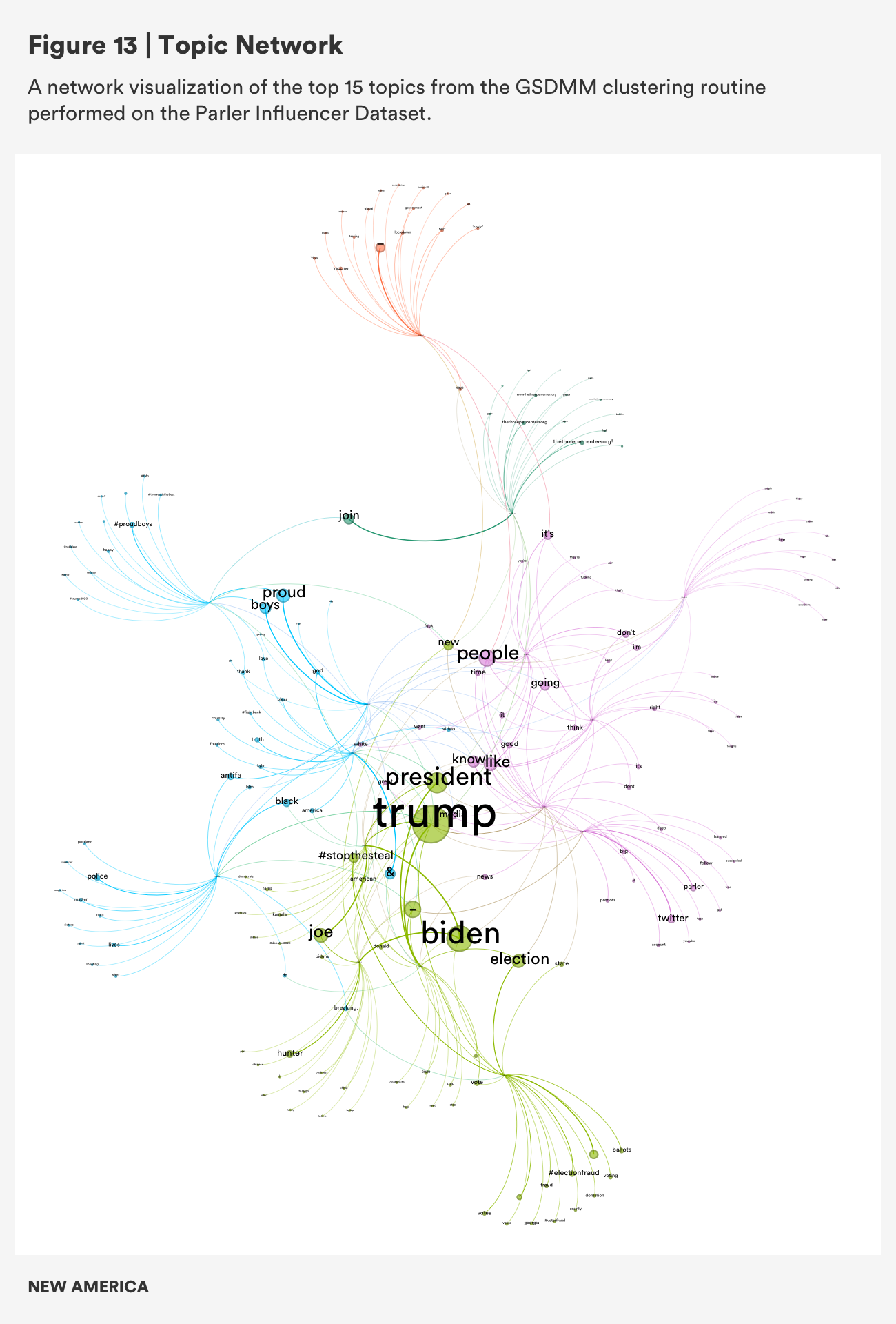
In this group of influencers, generalizations about the politics of the United States at the most macro level abound.150 More specifically, however, analysis of top themes showed that users in this group characterized the presidential election of 2020 as the centerpiece of corruption in the government. Similarly, users in this group construed politics as a struggle among Trump, Biden, and the citizens of the United States. Other thematic categories included the purported plot to steal the election, including a coverup of Hunter Biden’s alleged crimes. Being banned and/or deplatformed from mainstream social media sites like Twitter and allegations of corruption within the news media was another common theme. Along with recruiting for the Proud Boys and Three Percenters, QAnon, opposition to Antifa and Black Lives Matter figured substantially alongside COVID-19 related conspiracy theories. The cure for all these ills is for the citizens of the United States to take power from the forces that threaten the United States.
Users in this dataset characterize other platforms like Twitter as being in the pocket of partisan forces, while Parler itself acts as a kind of refuge in a world in which apocalyptic forces seem to be pervasive. According to Parler influencers in this dataset, “the people” cannot abide the pervasive rot of American society, and overall, the themes suggest that many users in this group view the United States as a country on the verge of collapse. All the major topics involve some kind of institution-ending or epoch-ending crisis, or recruitment for white supremacist organizations as a response to crisis. Taken as a whole, posts in this dataset suggest Parler nurtured a collective sense among many of its users that they were facing an existential test.
Overall, content from posts in our Influencer Dataset reads as a haven for those struggling in a world pitched against them. This is an important insight because it suggests that, among this fairly prolific set of influential conservatives and far-right groups on Parler, there was more at work than just a common tendency toward the promotion of falsehoods about the 2020 elections. Being “banned from Twitter” is such a prominent theme among users in this subset that it raises troubling questions about the unintended consequences and efficacy of content moderation schemes on mainstream platforms. In fact, further analysis of the types of data and links shared by influential users in this small group indicates that there is a good deal of collaboration between users that may have also contributed to a sense of common purpose and shared identity that acted as a mobilizing force for less well-networked users on the platform.
Influencer Link Analysis: Assessing the Hothouse Effect of Parler
After we conducted our topic modeling analysis examining themes from posts on the Parler Influencer Dataset, we decided to take a closer look at the types of content these 102 users shared. Visual media such as images and videos constituted the primary types of content embedded or linked to within influencer Parler posts. Among users in this influential subset, links to conspiracy theory websites were prominent—with a strong focus on COVID-19 via David Icke and The Gateway Pundit.
We also noted that many posts contained links to content from other platforms or media verticals from outside of Parler and that URL links within Parler posts are a method to bring content into the platform for discussion, reposting, and refinement. For instance, links to YouTube (youtube.com and youtu.be) and Twitter (twitter.com and t.co) constituted 15.91 percent of content containing URLs in the dataset.
Yet, there are few instances where Parler content is posted to mainstream social media platforms. Instead, information and links primarily flow in one direction from external social media platforms into Parler. For example, when we examined the Twitter timelines of the 147 members of Congress who formally raised objections to the certification of the vote count, only 15 tweets out of 462,458 total tweets linked to Parler. These unidirectional linking behaviors create a positive feedback loop within the platform where influencers post content curated to support extremist narratives.
This points to Parler acting as a greenhouse of misinformation, disinformation, and conspiracy theories where less extreme content was brought in from external platforms and allowed to grow and feed a disordered information ecosystem. Another way to think of this is that Parler is part of an intentional data processing workflow, one that is perhaps intentionally designed to nurture and grow extremist narratives. This is especially significant given the observations in the Stanford study on Parler that “many of the most active Parler accounts used integrations such as RSS feeds to automate content posts.”151 While some of the most prominent right-leaning media figures and outlets created accounts on the site, they largely did not cultivate their Parler audience separately from other social media audiences. Instead, they relied on integrations to automate their posts.
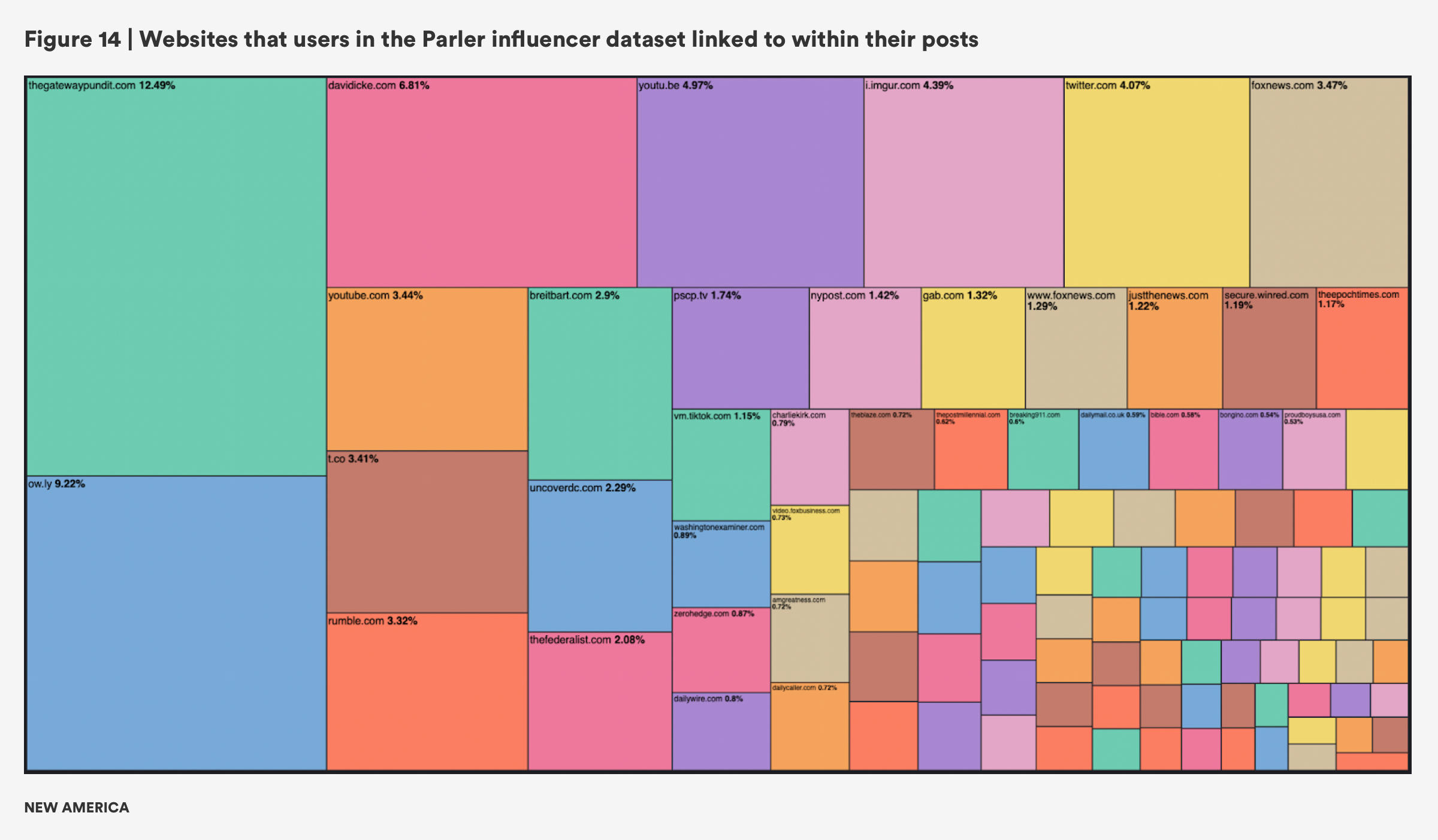
The blocks in the diagram (Figure 14) visually represent the percentage of links embedded within Parler influencers’ posts in the domain where the link originated. The links are categorized by domain, so Twitter would be represented by twitter.com and Fox News would be represented by foxnews.com.
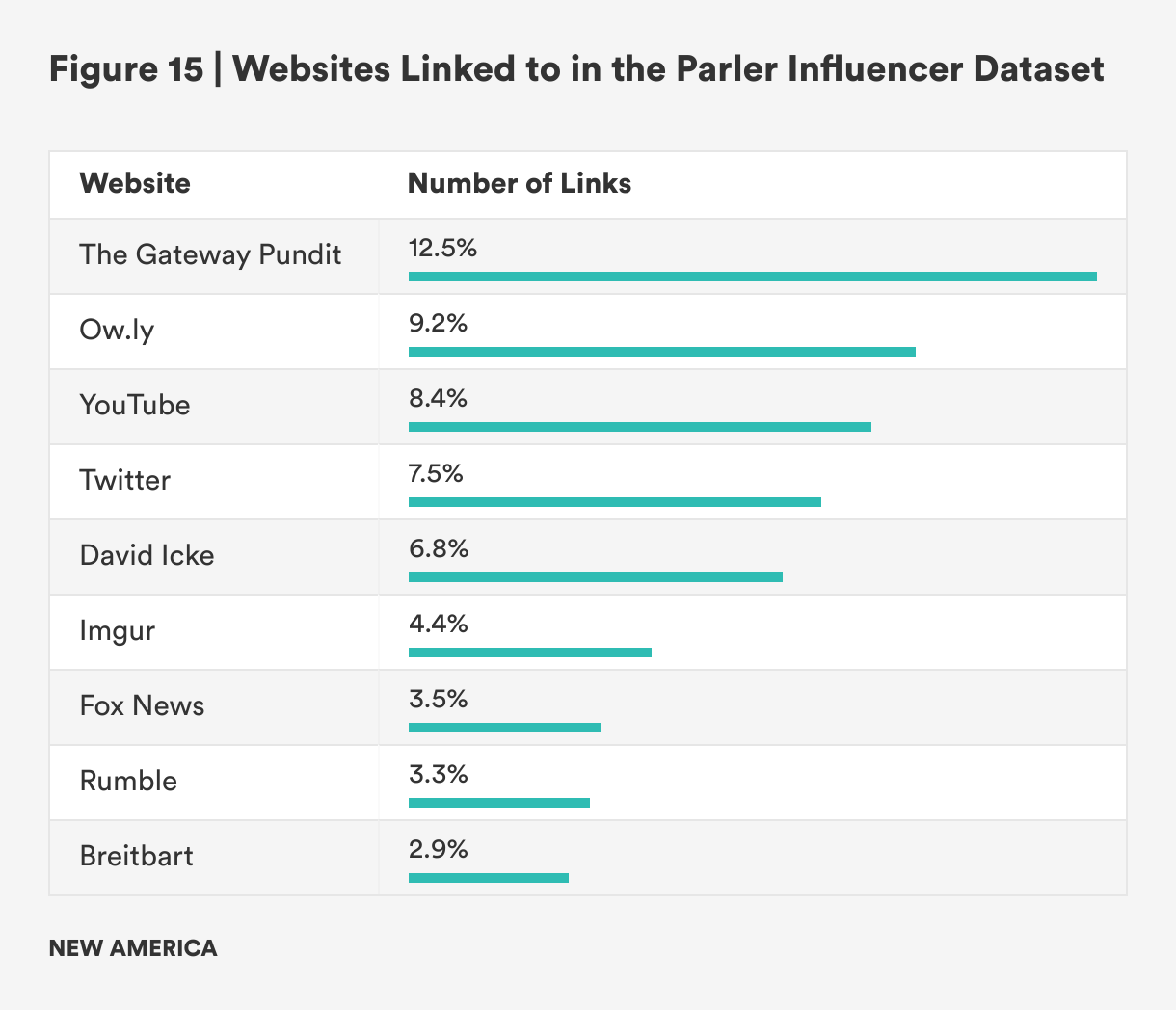
The site most linked to in the dataset is The Gateway Pundit, a far-right website known for publishing conspiracy theories.152 Second in line, is the URL shorter service Ow.ly, but since this is a link forwarding service, we cannot make any conclusions about what content the final links resolve to. Links to mainstream social media platforms YouTube, Twitter, and imaging sharing service Imgur are next in line at the top. These are bookended by links to another conspiracy theorist, David Icke, who has popularized the idea that a reptilian humanoid race rules the world. Links to Fox News, the “far-right YouTube” Rumble, and Breitbart bring up the rear.
What is also notable about the linking behavior of users in this dataset is that in mid-2020, there was a shift in linking patterns away from content drawn from mainstream social media, for example, platforms like Twitter and news sites, to conspiracy-driven content and the far-right video hosting service Rumble. This trend coincides with the shift of more conservative users from mainstream social media platforms such as Twitter to Parler due to perceived or actual banning.153 It also underscores the powerful magnetism that surfaced in our topic model analysis of the influencer Parler data where “banned from Twitter” is a prominent topic in the content of Parler posts. As we explain in the next section, the trends and patterns described above are also mirrored to some extent in the user behavior of the 147 elected politicians who formally raised objections in Congress to the certification of election results on January 6.
Citations
- David Thiel,Renee DiResta,Shelby Grossman,Elena Cryst, “Contours and Controversies of Parler,” Stanford Internet Observatory, January 28, 2021, p.10 .https://cyber.fsi.stanford.edu/io/publication/contours-and-controversies-parler
- The Parler data was collected using an open source tool called Parlance (https://github.com/castlelemongrab/parlance) which took advantage of the lack of security and poor API design of the Parler platform to collect posts and user information.
- In our topic model, themes are understood to be salient combinations of terms that co-occur within the same social media posts. Each social media post is labeled with a single theme that is derived from observations across the entire dataset. Put another way, the model assigns a single theme to each post based on best fit. We followed up with term co-occurrence analysis, where we generated tables of words that were more likely to appear together in order to identify trends in the social media posts that could indicate the ways certain words were frequently used.
- “Trump (4346),” “Biden (2202)” and “People (1864)” are the three of the most frequently occurring nouns in this dataset.
- David Thiel, Renee DiResta, Shelby Grossman, Elena Cryst, “Contours and Controversies of Parler,” Stanford Internet Observatory, January 28, 2021, p.3 https://cyber.fsi.stanford.edu/io/publication/contours-and-controversies-parler.
- In Parler, any images attached to posts are categorized as links. To highlight links to sources not embedded within the Parler post, links to embedded Parler images (image-cdn.parler.com) have been excluded from the data used to generate this figure.
- Media coverage of the move from Twitter and Facebook to niche apps has been substantial; see, for instance: Mike Isaac and Kellen Browning, “Fact-checked on Facebook and Twitter, Conservatives Switch Their Apps,” The New York Times, November 11, 2020. https://www.nytimes.com/2020/11/11/technology/parler-rumble-newsmax.html
V. Examining The Objector Parler Accounts
On January 6, 2021, after the attack on the Capitol, eight Republicans in the Senate and 139 in the House objected to Arizona’s or Pennsylvania’s 2020 election results. As reported in the news, many of Trump’s Republican allies spent months openly challenging the election results.154 While more Senate Republicans and House members had publicly stated their intention to vote in favor of objections, some lawmakers changed their votes after the attack on the Capitol. The 147 members of Congress who did not change their vote to object to the election, represent some of the loudest and most influential voices circulating misinformation about the election.
We examined the social media presence of the 147 election objectors through the lenses of their official Twitter accounts, deleted tweets from their official Twitter accounts, and compared that content with what they posted to their Parler in the lead-up to January 6. Using profile information from the Aliapoulios, et al. dataset, we were able to find Parler accounts for 46 of the 147 objectors. Of those accounts, 34 did not have a post or comment history.
The Parler account statistics for the remaining 13 objectors are displayed in the table below. The creation date of these 13 accounts is important because many objectors joined Parler in May or June of 2020. This was a period when many prominent right-wing figures were leaving mainstream social media platforms for Parler due either to a perception that mainstream platforms were prone to censoring conservative content or because they were banned after posting false content related to conspiracy themes like QAnon or inciting hatred or violence. Except for Rick Crawford, the objectors verified their accounts with Parler. Verified accounts display an official badge on the account—similar to Twitter’s verified account program. The presence of a verified badge indicates that the account is “official” and not a parody or fake account. Verification is not an automatic process; it requires the account holder to submit a photo and photo ID card.
Figure 16: Parler accounts of the 13 members of Congress who objected to the certification of the elections who we were also able to identify and that had a post or comment history.
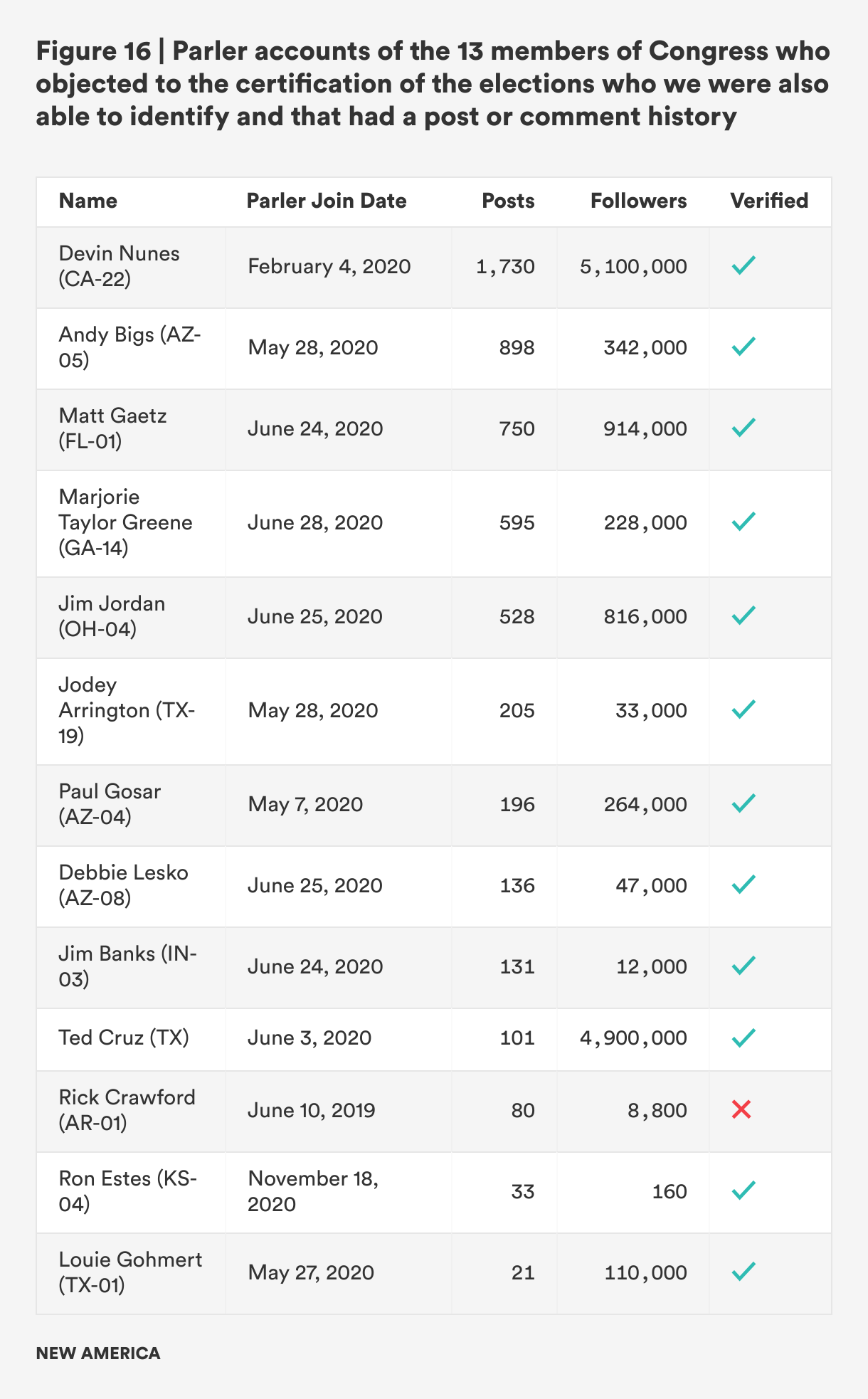
Devin Nunes and Ted Cruz had the highest number of followers. Ted Cruz, Matt Gaetz, Jim Jordan, Andy Biggs, Paul Gosar, and Majorie Taylor Greene also had followers in the hundreds of thousands before the platform was temporarily shut down. The high follower counts meant that any content posted by these accounts would have a high likelihood of being prominently displayed when a user logged into Parler. This would have been true for users who already followed those accounts as well as new users. On the one hand, high follower content was promoted to their followers. Users who followed these prolific accounts would be more likely to see the content from high-follower count users. On the other, high follower count accounts were promoted to new users and non-followers as suggested users they should follow. In other words, the objectors enjoyed outsized influence on Parler.
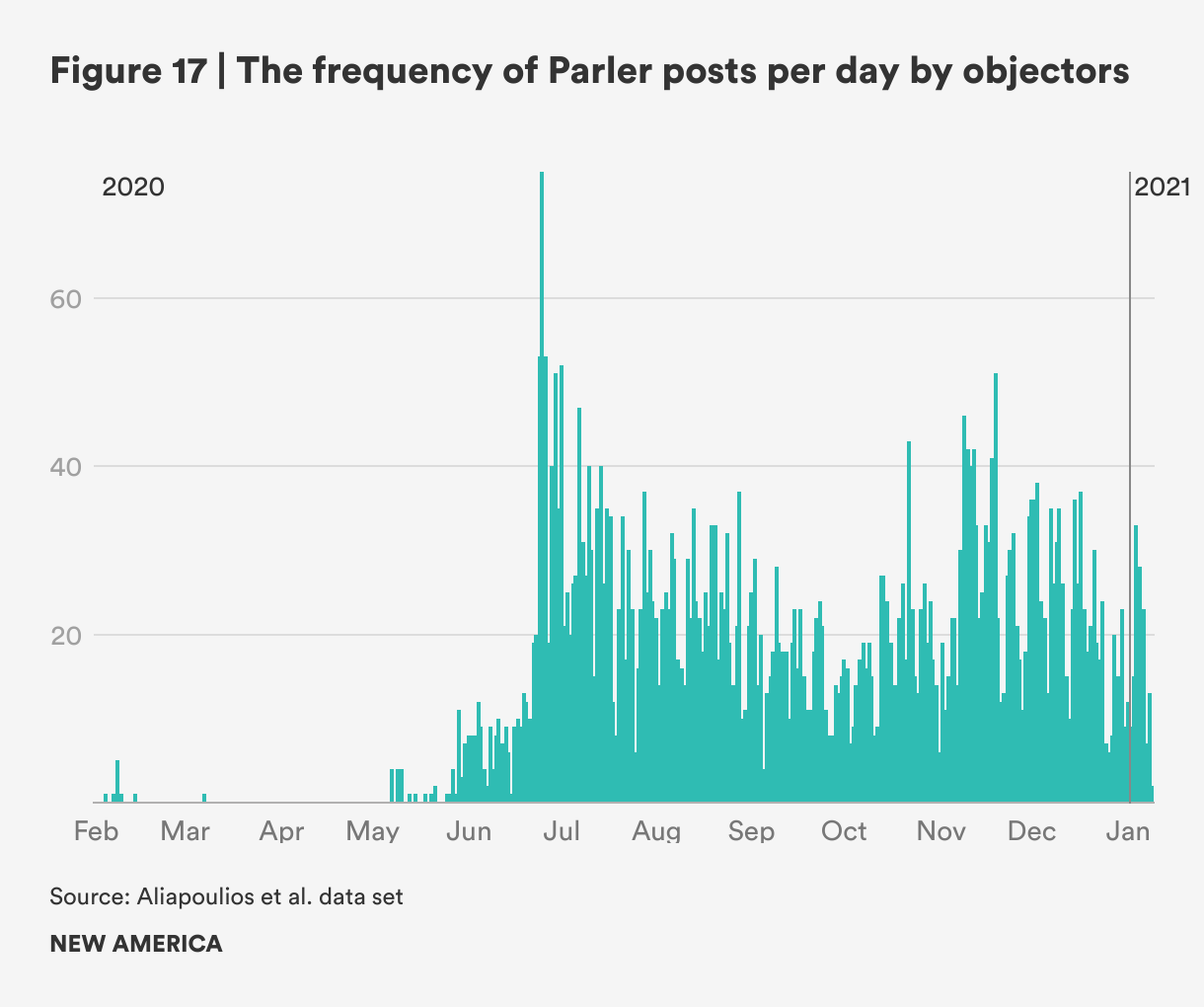
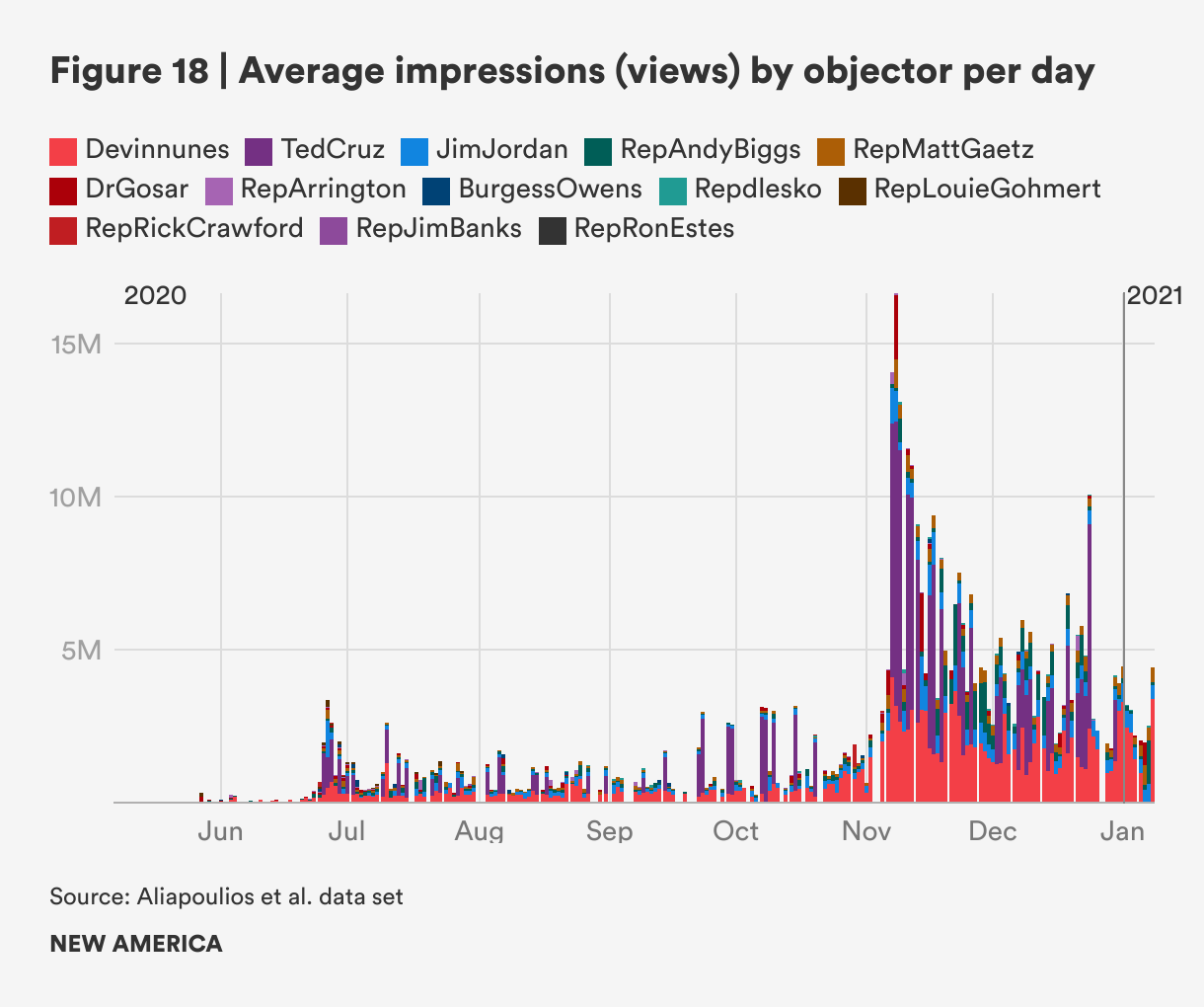
In Figure 17, we can see the posting frequency of the objectors per day. We can see that the highest posting days are clustered during the period right after many of the accounts were created. In Figure 18, we see the average number of impressions (views) by users on each day during the same period. Posts by objectors receive the most attention in the days after the election through the end of December. The peak occurred on November 7 with Devin Nunes, Ted Cruz, Paul Gosar, and Jim Jordan receiving the lion’s share of impressions. The posts associated with each of those accounts received impressions ranging from 1 million to over 8 million. The high impression numbers show just how influential the objector accounts are in the period after the election and in the build-up to January 6.
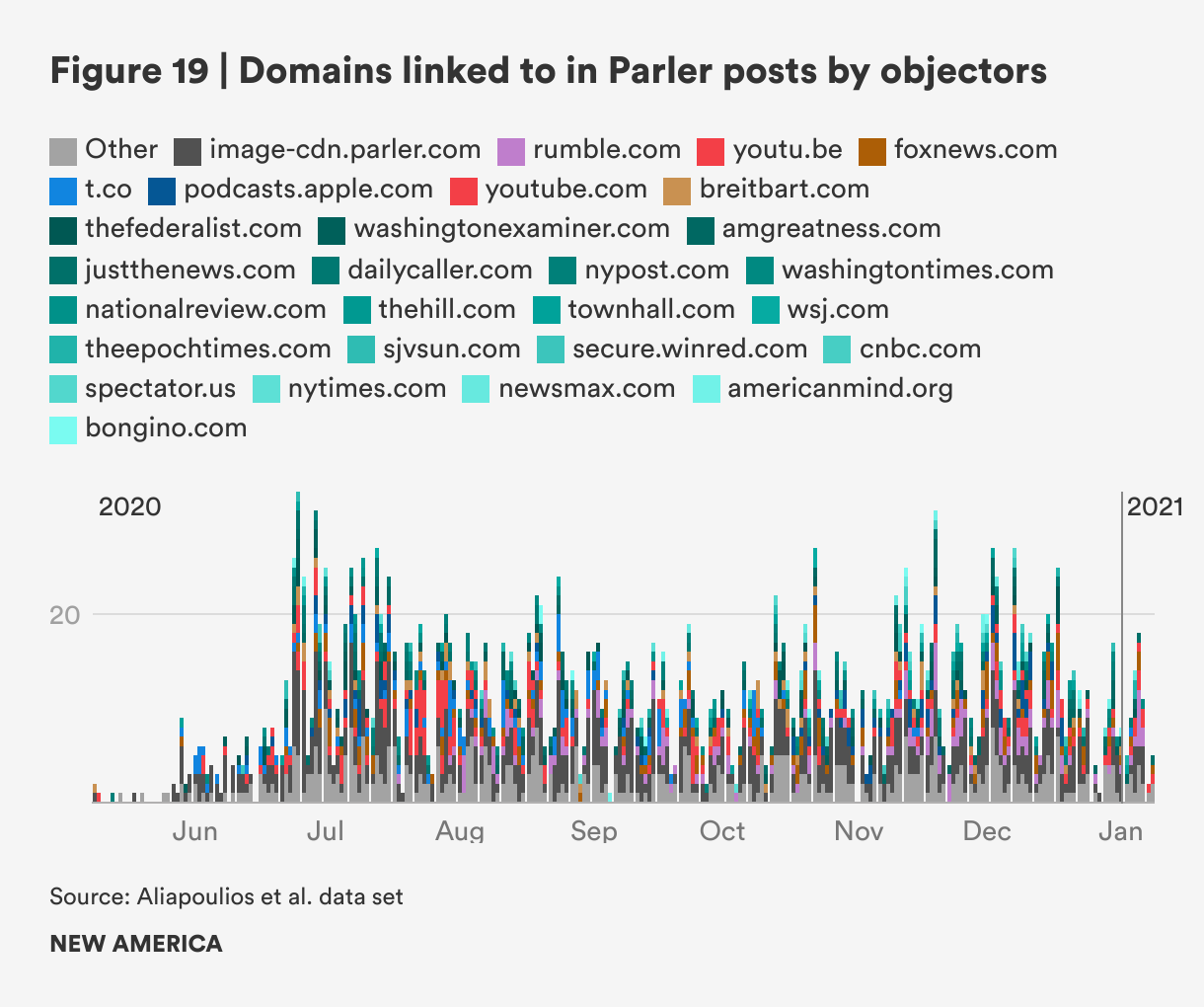
When examining the links circulated by the objectors within Parler, we see that most “news” links in these posts point readers to sites known for circulating misinformation and conspiracy theories.155,156 A little over half (52 percent) of all posts from the objectors contain links to other sites. The objectors both brought external content into Parler and provided substantial commentary without external links.
Comparing Parler and Twitter Activity
We see the Twitter accounts as a form of official, everyday communication and Parler accounts as a way to communicate more extreme political content. To compare the activities of objectors in these two spaces, we used topic modeling to understand the salient combinations of terms that co-occur within each set of social media data. The three datasets consisted of publicly available tweets from official accounts, deleted tweets collected via Politwoops,157 and Parler posts.
The topic models were very similar for the tweets that were publicly accessible on the objectors’ official Twitter accounts as well as the tweets they deleted from those accounts. Topics from the tweets were clustered around two main areas: 1) thank you notes to groups and news media who met with the objectors, and 2) policy issues related to topics like taxes, the U.S.-Mexico border, and immigration. None of the topic clusters focused on the election. This stands in contrast to the topics found in their Parler posts. The topics in the objector’s Parler posts clustered around questioning the integrity of the election, resistance to COVID-19 restrictions (i.e. in favor of reopening schools), and references to Joe Biden and Hunter Biden. Overall, these topics show that the objectors were posting different types of content to their Twitter accounts vs. Parler.
Citations
- For a full list of objectors in the U.S. Senate and House of Representatives, see Zhou, Li. “147 Republican Lawmakers Still Objected to the Election Results after the Capitol Attack.” Vox, January 6, 2021. https://www.vox.com/2021/1/6/22218058/republicans-objections-election-results.
- Sites such as the Epoch Times and Western Journal are heavy circulators of misinformation and conspiracy theories. For more information see Roose, Kevin. “How The Epoch Times Created a Giant Influence Machine.” The New York Times, October 24, 2020, sec. Technology. https://www.nytimes.com/2020/10/24/technology/epoch-times-influence-falun-gong.html
- The AllSides Media Bias Chart provides information about the political bias of media sites. See https://www.allsides.com/media-bias/media-bias-chart for the latest version of the chart.
- See: https://projects.propublica.org/politwoops/.
VI. What the Parler Metadata Tells Us
One of the most remarkable features of the Parler data that has been publicly released to date from the 1.0 version of the site is the high volume of posts that contain metadata indicating timestamps, and geo coordinates indicating where a user indicated their location. As noted earlier, the two Parler datasets released by Aliopoulos, et al. and hacktivist @donk_enby only represent snapshots of the platform before it was taken offline. However, when we performed analysis on both datasets we found a great deal of overlap between the two datasets and patterns in the data. We also performed a consistency check to identify where there might be differences in each of the two datasets, which increased our confidence that it is possible to make apples to apples comparisons between the Aliopoulios and @donk_enby data.
With metadata for more than 13.25 million individual Parler user accounts in the Aliapoulios, et al. dataset and metadata for more than 1 million video posts, there is a substantial amount of information embedded in the publicly available data. For instance, the @donk_enby dataset contained more than 1 million video posts, but of these only a small fraction contained both geo coordinates and timestamps. A total of 69,387 (6.73 percent) of video metadata contained geographic information indicating the physical location of the device that captured the video. Thousands of these geocoded metadata are manifestly fake or indicate locations far from the United States.
Despite the above stated limitations, video metadata holds valuable clues about Parler user behavior before January 6. In all, 59,791 video posts have metadata indicating geo coordinates within the United States and timestamps from the launch of the social media platform in 2018 to the day Parler was taken offline on January 10, 2021. In at least those instances, the video metadata potentially connects Parler posts to events at a particular place and time, though it is important to note that the video metadata is only that. We have not yet examined all of the video content itself and, given the huge scale of posts collected in total, the video data cannot, in any case, be construed as representative. Nor is it possible to directly extrapolate insights into the real-world behaviors of Parler’s intended demographic market from a comparison between these types of posts and, say, other types of location-based event data. Nonetheless, we were able to learn a lot about the peculiarities of the platform when we took a closer look at the timestamps and geo coordinates embedded in the publicly available metadata.
Evaluating the Timestamp Metadata
The graph shown in Figure 20 represents the number of Parler videos created per day and the number of Parler posts and comments created per day over the period from mid-November 2019 through January 10, 2021. The data in this graph represent vastly different scales: the video creations (with the black line) tops at around 12,000 videos per day, while the post and comments creation tops at over 3.5 million videos per day. However, the peaks, which are marked with green vertical lines to give a refined alignment of the two patterns seen to mirror each other, coincide closely with significant political events and demonstrations. Some notable comparisons:
- The May 31, 2020 peak rises rapidly and tails off slowly, and coincides with the May 31 George Floyd protests.158
- The broad July 2, 2020 peak begins its rise with the resumption of Trump campaign rallies159 and culminates with the Mount Rushmore campaign rally.160
- The sharp July 22, 2020 peak coincided with a riot in Portland, Ore. in which protesters tried to set fire to the Portland courthouse.161
- The post-election peaks on November 11-12, 2020 and on November 14-15, 2020 coincides with the competing pro-Trump rallies: March for Trump and Million MAGA March in Washington, D.C. and nationwide, organized by Amy Kremer and Ali Alexander, respectively.162
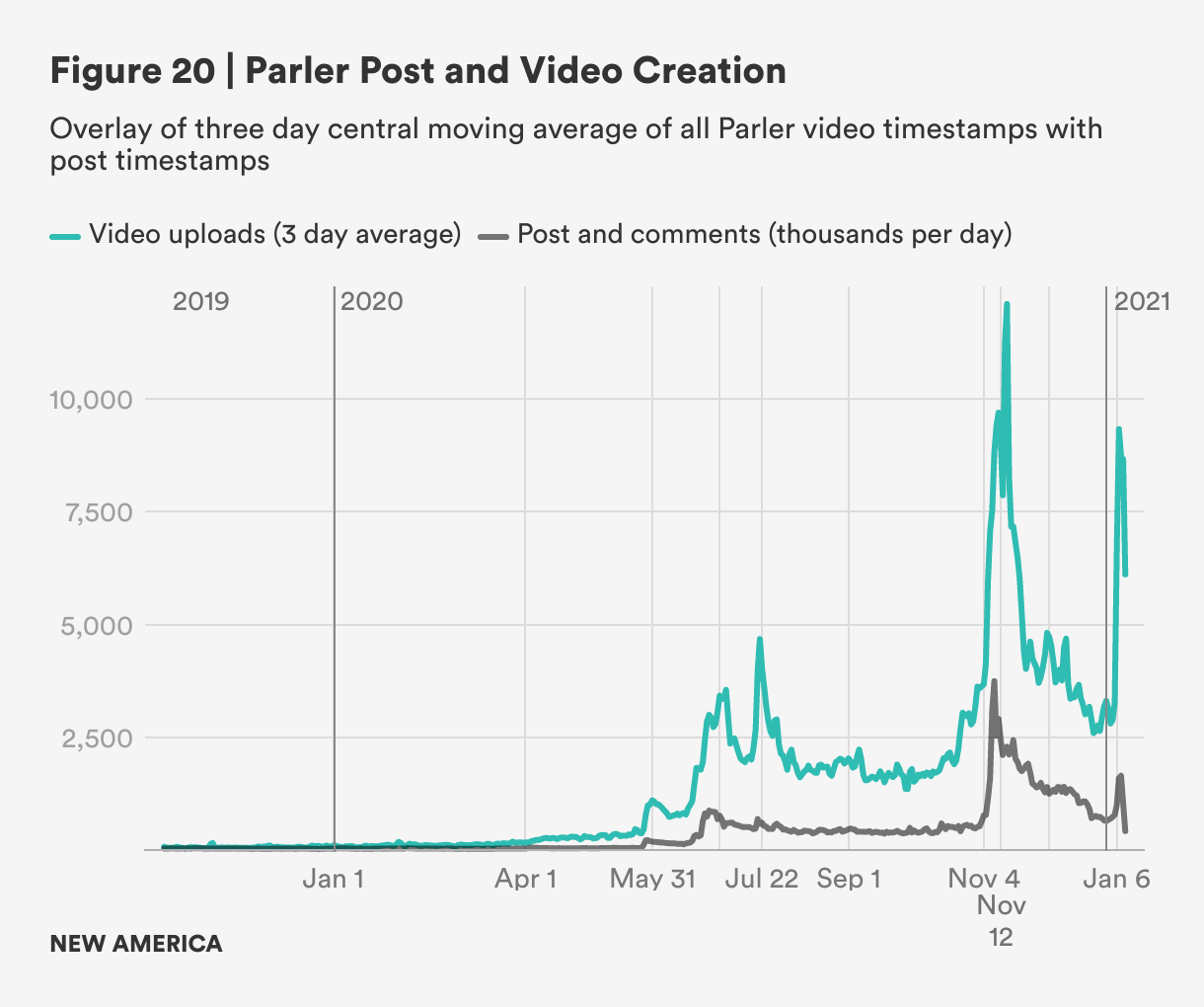
An additional useful comparison is the “joined” timestamps of Parler accounts versus the posting rate, which we overlay with the post comment dates, again with separate scales as the posts outnumber the joins by more than an order of magnitude by a factor of about 23. What is remarkable is that the rate of Parler user account creation replicates the peak structure of the posts and videos, although the account creation rate falls off much more quickly after an event than do the posts.
This suggests two competing hypotheses about the coincidence of peak patterns. One hypothesis is that the new accounts drive the increased creation of posts and videos. Another hypothesis is that the increase in user account creation and posts was the result of an orchestrated marketing campaign that combined astroturfed user engagement and was amplified by bot-like activity. This second hypothesis would indicate that there was a substantial amount of inauthentic behavior on the platform in the lead up to the elections and the post-election period before January 6. We cannot yet say conclusively whether the second hypothesis is true. But our ongoing analysis indicates that there is some evidence to suggest that it is not necessarily just the creation of new user accounts that drove the increase in activity on Parler.
For instance, one feature of Parler 1.0 is that the most prolific commenters were Parler CEO John Matze. Matze’s account showed over 1.8 million comments in which he greeted every first time post from a new user with a welcome to Parler message. Libertarian politician and former Texas lawmaker Ron Paul came in second after Matze with about 1.6 million comments. Conservative media personality Joe Pagliarulo, with almost 1.5 million comments, also welcomed every first time post from a new user with an invitation to connect by phone and by email to pro-Trump organizations.
These very high levels of activity are significant. On the one hand, for instance, millions of comments from accounts for Matze, Paul, and Pagliarulo in aggregate indicate a significant amplification of new posts. On the other hand, even so, the levels of amplification discernible in these three accounts comes nowhere close to the scale of amplification detectable on the platform as a whole.163 A closer study of the 1,394 user accounts that posted more than 10,000 times reveals that the majority of those users joined in May and June 2019 and June 2020, months that were significant for the Trump administration and the 2020 presidential campaign cycle.
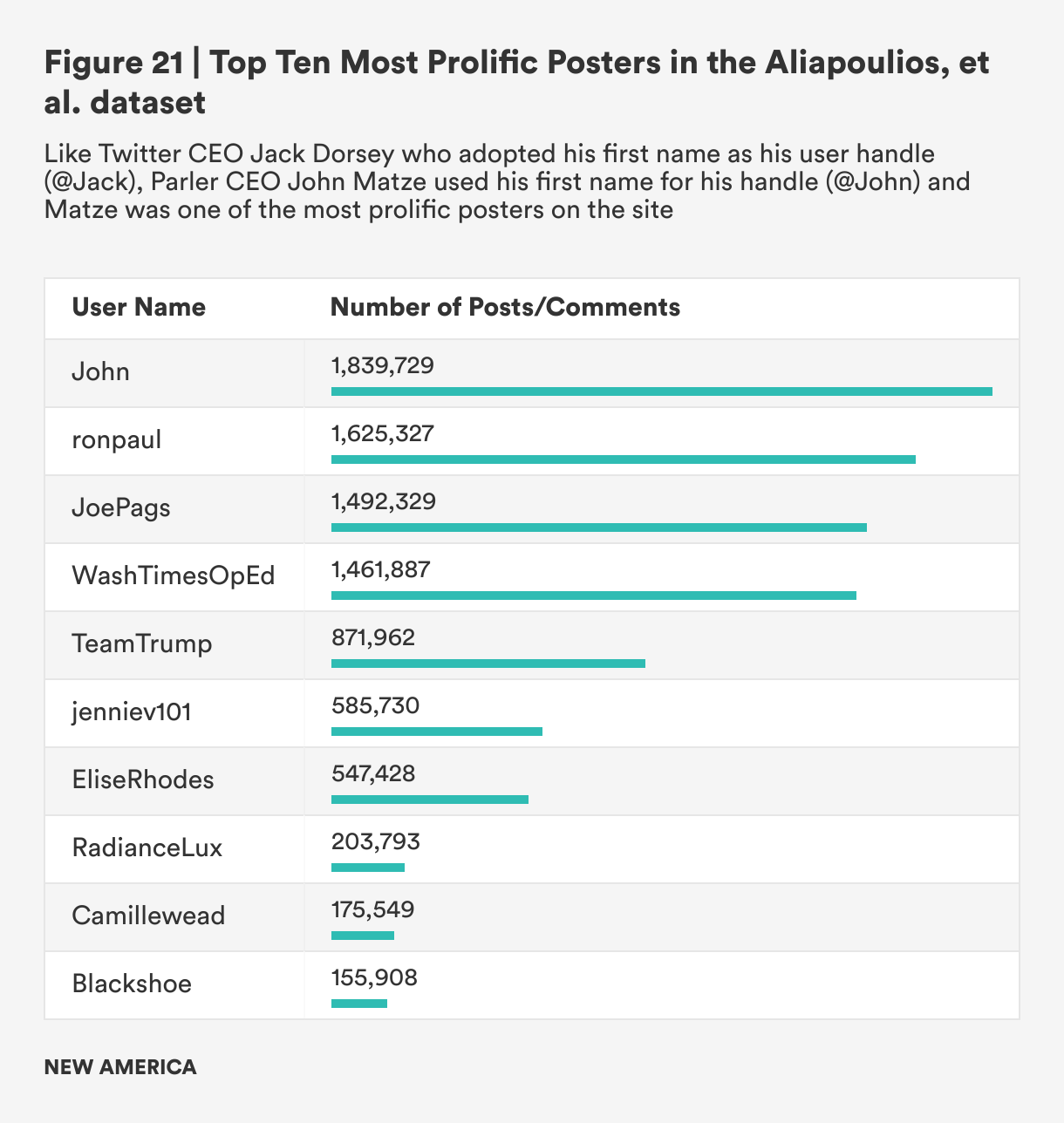
By way of context, it is important to remember that in May 2019, media outlets had already begun to report widely on the Justice Department’s appointment of a special counsel to lead a probe into the origins of the FBI investigation into Russian interference in the 2016 presidential campaign that prompted the two-year inquiry led by former FBI chief Robert Mueller.164 By June 2019, the Democratic National Committee had also already formally announced the first major candidate debate in the campaign cycle.165 The month of June 2020 also marked key moments in the presidential campaign, including Trump and Biden’s primary wins in Georgia—a toss-up state—and West Virginia, and Trump’s first major public rally in Tulsa, Okla.166
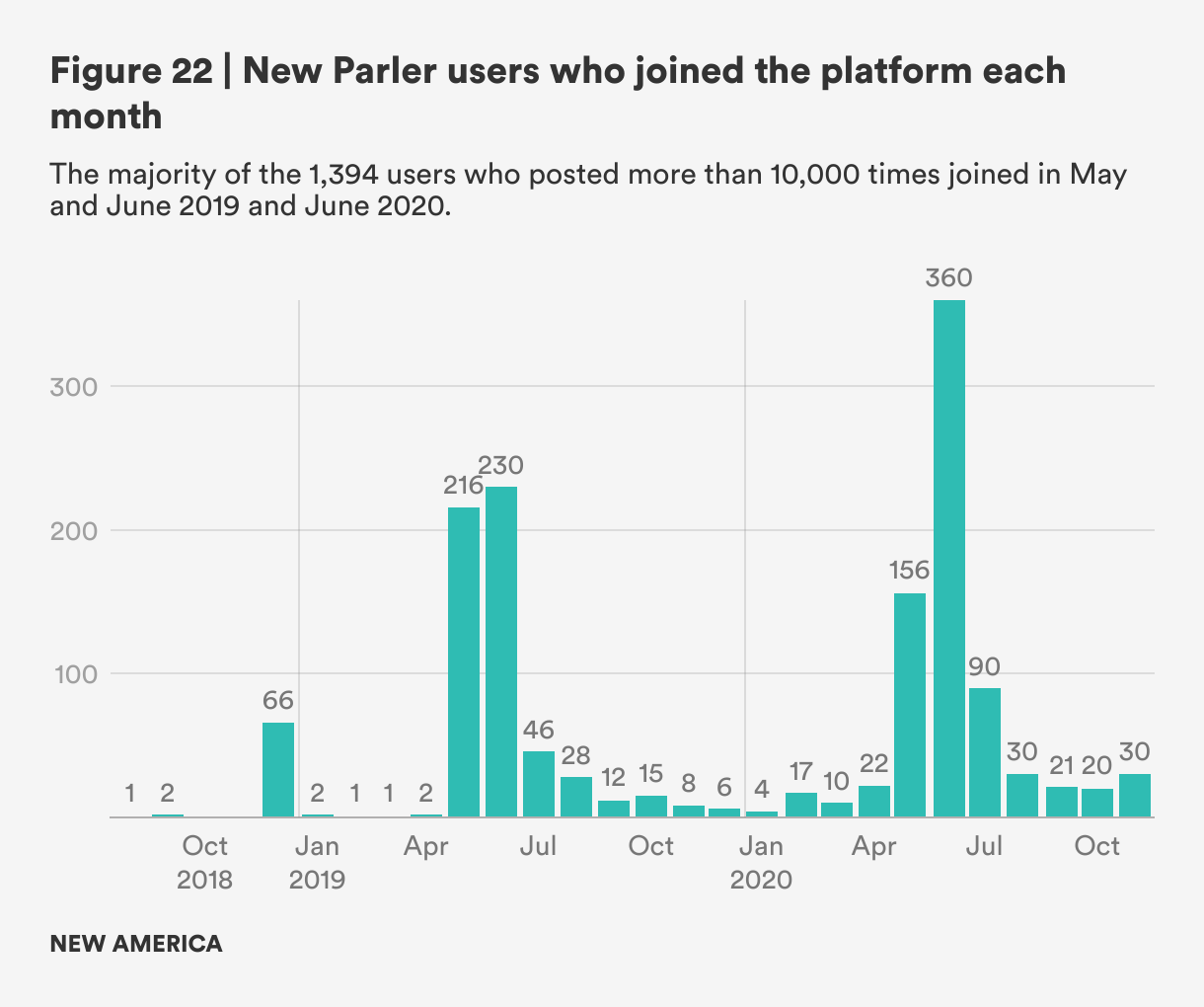
Although a more refined segmentation of the data will be required and is in process, it seems plausible that the bulk of the posting was from accounts established as the Mueller investigation was wrapping up in May 2019 and the scandal over Trump’s dealings with Ukraine was just surfacing in June 2019 and toward the presidential election at the end of the primary season in June 2020. This being the case, given the ubiquitous political outreach and given the pattern of strong posting/commenting activity highly correlated with political events, it is plausible that this cadre of frequent posters and commenters are employed in the pursuit of political influence, either by profession or passion or both. In other words, another feature that may have made Parler 1.0 so unique and distinct from other, more mainstream platforms is that it was uniquely conducive, by design or neglect, to amplify not just false or misleading content but inauthentic behavior.
Analyzing the Video Post Metadata
Much like the timestamp metadata, the Parler videos with timestamps and location specific geotag metadata present both a rich and varied geographic picture and the spatial-temporal picture enriches the purely temporal study discussed above. As has been noted by a number of researchers, platform data that contains both temporal and spatial markers, or volunteered geographic information (VGI), can be useful for crowdsourcing information about all kinds of human activity and the environments where those activities take place.167 But there are challenges with bias in this type of social media data, not the least of which is the high prevalence of use among urban dwellers in dense localities versus less populous rural areas and a lower appetite for social media use among the elderly, for example.168 There is also the problem of limited information about how certain platforms operate and how those features shape user behavior.
All the above caveats aside, the Parler video posts that contain both time and location information still hint at potentially valuable insights into the way tens of thousands of Parler users perceived and reacted to significant events that took place in the United States during the 2020 presidential election cycle. Our preliminary assessment corroborates what has already been made clear by a ProPublica investigation of the 500 videos posted to Parler on January 6 that were culled from 2,500 posted on the day of the attack alone: much of the action recorded and uploaded to Parler captured action from live protests, rallies, and marches in major cities.169
What sets our analysis apart, however, is that rather than just a curated snapshot of that single day, it provides a first-of-a-kind assessment of the nearly 60,000 video posts with real geotags that were posted on Parler from when the platform first launched in the summer of 2018 until it was temporarily taken offline in January 2021. We found that the greatest density of videos with geotags were uploaded in the Washington, D.C. area; with over 1,000 in that area alone, we can say with a high degree of confidence that more than half were likely linked to pro-Trump-related events, including the rally on January 6. Interestingly, St. Louis, Mo. ranked second only to Washington with over 500 videos containing geotags resolving to that area. However, these two large cities, Washington, D.C. and St. Louis, Mo., did not represent the majority of geotagged videos in our dataset, as can be seen from the points of upload plotted on the map of the United States in Figure 23.170
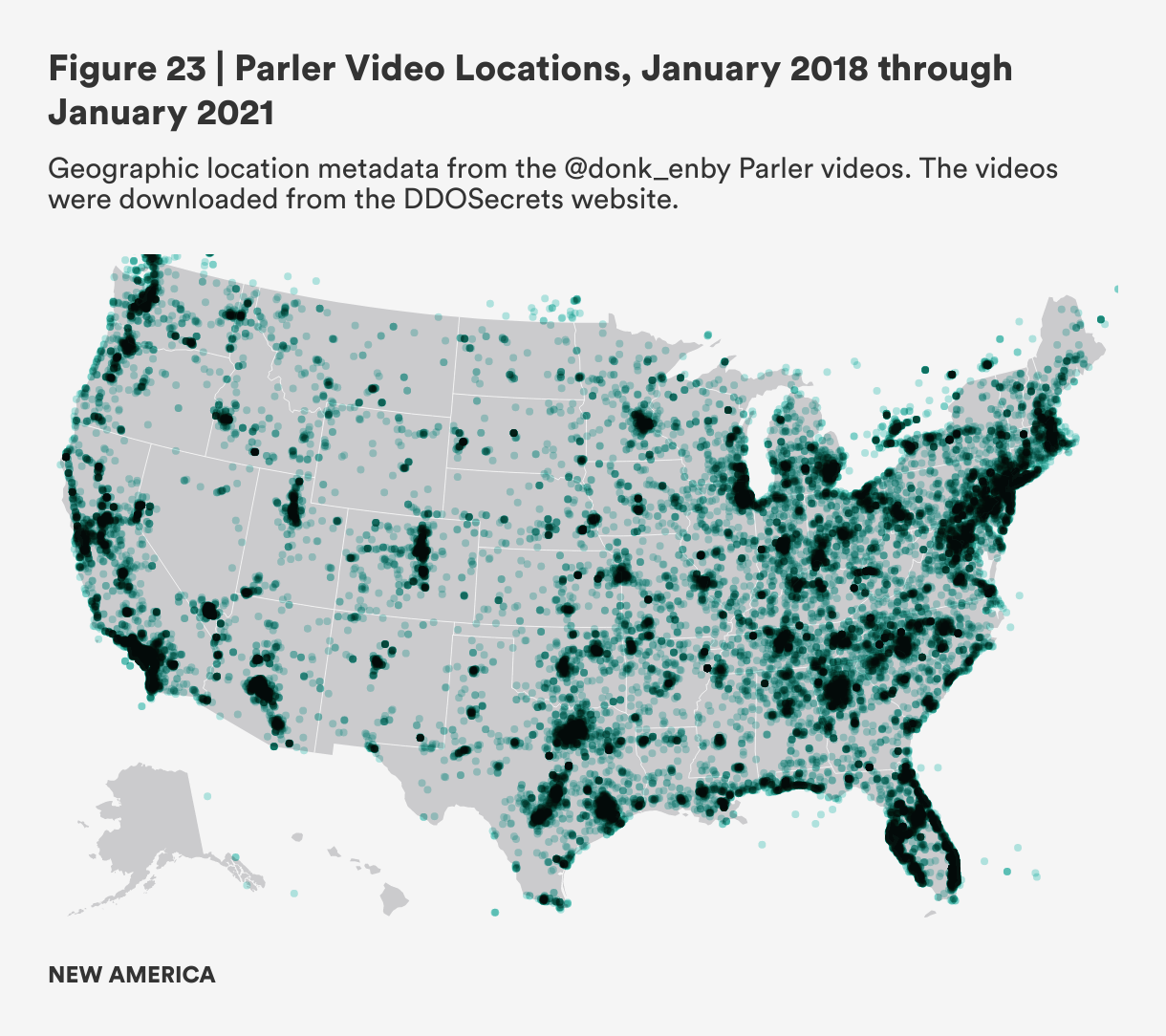
A notable finding from our analysis is that there are many, many distinct geolocations embedded in the video data. There are, in fact, too many to be located in the densely populated urban cores of the United States exclusively and too many also to have been recorded by even a medium-sized team of professional videographers. We note that many of the geotagged videos seem to be clustered around the prosperous suburbs and exurbs of major metropolitan areas. This is an intriguing finding given what we have also learned about the close and significant proximity of arrestees’ residences and areas of the country that had high levels of demonstration activity in 2020—though more research is needed to understand what these patterns and trends truly mean.
It is worth noting that many geotagged video posts are also spread out across rural areas, particularly in the more densely populated and privately owned rural areas east of the Rocky Mountains. In the West, by comparison, where rural land is almost entirely federal land populated by range cattle and farms, the proliferation of geotagged video posts outside of the city cores is visible in small towns along the major interstate highways. We see this, for example, along Highway 15 between Salt Lake City and Las Vegas or along Highways 101 and 5 in Northern California.
We confirmed these visual observations with a statistical analysis.171 The Parler videos are usually created far from a major metropolitan area and usually not in the downtown area of even a minor metropolitan area. This, too, is an interesting finding given that many social media platforms tend to attract engagement from people living close to, or in, urban areas.
Geotagged videos in the dataset we analyzed consist of 2.3 terabytes of mp4 files so forming a conclusive tally of their content is prohibitive. However, we segmented the video post files for further evaluation and identified 3,644 files in the Aliapoulios, et al. dataset where Parler users also included hashtags, which gave us more insight into the context for each video post in this subset.
A large majority are election and QAnon-related, but a significant slice consist of commercial or lifestyle-related content. To the extent that the hashtagged fraction is statistically similar to the rest, we can surmise that a majority of the video posts in this subset are likely Trump campaign or QAnon oriented.
In the context of fringe platforms like Parler, and possibly even mainstream platforms, we suspect that the online astroturfing of political grievances has become so prevalent that the distinction between what is “grassroots” authentic and inauthentic deceptive amplification of content is no longer meaningful. With these considerations in mind, a more finely honed point may be made by comparing the geolocation of Parler videos grouped by month of creation. The following set of images contains all of the same geolocations present in the above map, separated into distinct frames by the month of the video creation timestamps.
Figure 24
Few videos were posted before Spring 2020 and, until that time, they are sparsely distributed and vary in location from one month to the next. With the onset of the 2020 campaign and the creation of so many more videos, however, there are notable geographic clusters of videos that consistently appear on the map. Also notable is the explosion of geographic coverage of the created videos in November 2020.172
From the early days of Parler 1.0 beginning in August 2018, there are a sprinkling, less than one hundred per month, of geotagged videos that slowly increase in number and vary in location from month to month, until the launch of the primary campaign in May 2019. The post rate continued to trend along an upward trajectory until Trump's first major public campaign rally in Tulsa, Okla. in June 2020, which is when the number of geotagged video posts increased dramatically.
That is also when there also seemed to be a trend toward more diversity in the number of different locations where geotagged video posts were uploaded to Parler. Here, we noticed that was especially true during the post-election period from early November 2020 to early January 2021 when the number of contentious demonstrations increased, as noted in our analysis of ACLED protest event data. We conjecture that there were hundreds or thousands more that flew under the radar by virtue of being too small or too far away to be noticed. Much more research is needed, however, to better understand how and where all the puzzle pieces embedded in all the metadata fit together and it’s not a given the picture that emerges will be very clear.
Citations
- Larry Buchanan, Quoctrung Bui and Jugal K. Patel, “Black Lives Matter May Be the Largest Movement in U.S. History,” New York Times, July 3, 2020. https://www.nytimes.com/interactive/2020/07/03/us/george-floyd-protests-crowd-size.html
- Max Cohen, “Trump to Resume Campaign Rallies with June 19 Event in Tulsa,” Politico, June 10, 2020. https://www.politico.com/news/2020/06/10/trump-campaign-rally-tulsa-311516
- Annie Karni, “Trump Uses Mount Rushmore Speech to Deliver Divisive Culture War Message,” New York Times, July 3, 2020. https://www.nytimes.com/2020/07/03/us/politics/trump-coronavirus-mount-rushmore.html
- Nicholas Bogel-Burroughs, “Portland Clashes Converge on Courthouse Named for an Antiwar Republican,” New York Times, July 22, 2020. https://www.nytimes.com/2020/07/22/us/portland-protests-courthouse.html
- Jonathan Landay, “Spurred on by False Claims of Fraud, Trump Supporters Rally in Washington,” Reuters, November 14, 2020. https://www.reuters.com/article/us-usa-election/spurred-on-by-false-claims-of-fraud-trump-supporters-rally-in-washington-idUSKBN27U08C; Tina Nguyen, “MAGA Nation Tries to Rally Around Trump with MAGApalooza,” Politico, November 11, 2020. https://www.politico.com/news/2020/11/11/maga-rally-washington-dc-435958
- We found that the median number of posts/comments among accounts that post is 2, the mean is 43.5 and the standard deviation is 885: these indicate that Parler posts follow a standard social media pattern. In addition, a statistical study of the 'CreatedAt' timestamps reveals that, although the majority of accounts have very few posts, there is a long tail of a few users who have very many posts.
- Michael Balsalmo, “AP Source: Barr Launches New Look at Origins of Russia Probe,” Associated Press, May 14, 2019. https://apnews.com/article/north-america-donald-trump-ap-top-news-john-durham-politics-75e5c4efd5c74e6e9aa1ba0237a0e651
- Adam Edelman, “DNC Names 20 Candidates Who Will Appear on Stage for First Democratic Debate,” NBC News, June 13, 2019. https://www.nbcnews.com/politics/2020-election/dnc-names-20-candidates-who-will-appear-stage-first-democratic-n1017316
- Peter Baker and Maggie Haberman, “Trump Moves Tulsa Rally Date ‘Out of Respect’ for Juneteenth,” The New York Times, June 13, 2020. https://www.nytimes.com/2020/06/12/us/politics/trump-tulsa-rally-juneteenth.html
- Bianca E. Lopez, Nicholas R. Magliocca, and Andrew T. Crooks, “Challenges and Opportunities of Social Media Data for Socio-Environmental Systems Research,” Land 8, No. 7: 107, 2019, pp.1-3.https://www.mdpi.com/2073-445X/8/7/107
- Lopez, et al. op.cit., 2019.
- Lena V. Groeger, Jeff Kao, Al Shaw, Moiz Syed and Maya Eliahou, “What Parler Saw During the Attack on the Capitol,” ProPublica, January 17, 2019. https://projects.propublica.org/parler-capitol-videos/
- This figure has both the strengths and weaknesses of scatterplots: unlike density plots it cannot display multiple points at the same location but it can display a diversity of unrepeated distinct geolocations with the same strength as a hypothetical location at which videos were created day after day. A density plot would be a useful complement, but would confirm what is already known: there were many protests, rallies, and marches in major cities during the 2020 election cycle; people recorded these events on their phones and uploaded videos to a variety of social media platforms, including Parler.
- Our statistical analysis found that the 59,791 video geocoordinates, the median distance from a video geolocation to the nearest city of population in excess of one million people is 132.7 miles, the median distance from a video geolocation to the nearest city of population in excess of 500 thousand is 29.9 miles, the median distance from a video geolocation to the nearest city of population in excess of 200 thousand is 11.9 miles and the median distance from a video geolocation to the nearest city of population in excess of 100 thousand is 6.3 miles.
- In the PDF version of this report, we have replaced the animated gif with a static image of the final four months in the series. Shapefiles for the map are from the U.S. Census. For the animated version, see here: xxxxxxxx.
VII. Implications & Takeaways
The Value of Cross Platform Analysis with Parler as an Anchor
All the above analysis raises serious questions about the interplay between fringe platforms like Parler and mainstream social media platforms and moves by big tech companies to remove right-wing websites from their servers as a potential containment strategy for managing the spread of online hate, disinformation, and misinformation. Although more research is needed, our preliminary analysis suggests that as long as regulatory gaps for social media platforms persist, the United States faces the prospect of a months-long—or worse, years long—rolling crisis as the public backlash against far-right political violence drives extremist cadres deeper into fringe parts of the internet and farther into the dark web. Given the FBI’s warnings about the growing threat from anti-government domestic extremism, and the potential for more political violence leading up to the 2022 mid-term election cycle, there is an urgent need to learn more about how platforms on the fringes operate and the impact of interventions aimed at tamping down disinformation.
Relatedly, controversy over Parler’s role in providing a platform for the “Stop The Steal” movement continues to churn. Soon after January 10, when Amazon suspended service to Parler, a lawyer for Parler filed a request for an injunction against Amazon in federal court in Seattle asking for the suspension to be lifted.173 At the time, Amazon said that it was not confident that Parler was capable of properly policing its platform, raising questions about the conservative social media site’s overall content management and privacy protection policies, and compliance with the terms of Amazon’s service agreement.174
The case ricocheted back and forth between federal and local courts for several months. But Parler pressed forward with a lawsuit brought against Amazon in January 2021 and won a crucial judgment in federal court in September. It now appears likely that the debate over whether Amazon breached its contract with Parler will unfold in a King County, Wash. court, in Amazon’s home base of Seattle.175
In the complaint Parler filed in Seattle, Parler’s attorney accused Amazon of “anticompetitive” behavior and “bad faith conduct,” claiming that Amazon’s monopoly in cloud service gave it unfair advantage and leverage over smaller tech startups like Parler.176 “[W]hen companies are this big, it’s easy to be a bully,” Parler’s attorney said in the complaint. “Many start-up companies that have appeared to be a threat to Amazon and AWS have felt their wrath.”177 Amazon, the complaint continued, effectively sought to “kill” Parler in early 2021 just as the conservative social media startup was “poised to explode in growth.” According to the lawsuit, Amazon’s allegation that Parler was “not pursuing appropriate methods to control the content espousing violence on its platform—was untrue. Indeed, Parler stood in sharp contrast to the likes of Twitter, Facebook, and even Amazon itself, all of whom host substantial amounts of violence-inciting content.”178
The public sniping between Parler and big tech over culpability for inciting violence on January 6 is bigger than just Parler’s dispute with Amazon. Days after the January 6 attack, Facebook Chief Operating Officer Sheryl Sandberg said on a Reuters live stream, “I think these events were largely organized on platforms that don’t have our abilities to stop hate, don’t have our standards and don’t have our transparency.”179
In a March 25 letter to the House Committee on Oversight and Reform, Parler retorted that efforts to “scapegoat” and suppress the platform are due to its popularity making “the Company a competitive threat to the likes of Twitter and Facebook.”180 Although there are reasons to be skeptical of Parler’s claims about the monopolistic motivations that spurred Amazon to take Parler offline, there is a kernel of truth in the assertion that platforms with a larger user base were just as culpable in polluting the information ecosystem before the Capitol attacks.
Indeed, our preliminary assessment of publicly available Parler data as well as research by others such as the Tech Transparency Project (TTP) on more mainstream social media providers, clearly shows how instrumental mainstream platforms like Facebook and Twitter also were in popularizing “Stop the Steal” and the January 6 attack itself.181 TTP, the non-profit tech transparency watchdog, for instance, noted the proliferation of militia-related accounts on Facebook that continued even after the Silicon Valley giant announced in August 2020 that it was cracking down on militia-related content.182 As we also laid out in our analysis, Facebook and its sister platform, Instagram, were clearly also key and continue to be the locus of misinformation and disinformation promoted by “Stop the Steal” contesters, influencers, and objectors who promoted and continue to promote election-related falsehoods.
In fact, it could be persuasively argued that the intransparency of mainstream platform algorithms and rather ad hoc approach to content moderation by behemoths like Twitter, with its hundreds of millions of users, and Facebook, with its billions of users, drove the market for alt-tech platforms like Parler in the first place. That is readily apparent from our analysis of publicly available data from Parler 1.0.
As noted, Parler content containing “banned from Twitter” references rated highly among our subset of Parler influencers. We suspect a more comprehensive topic modeling analysis of all 183 million posts may further clarify the extent to which that is true for the 13 million plus users who were active on Parler 1.0. It is quite apparent from our link analysis that more data travels from Twitter and Facebook into Parler than data flowing from Parler to mainstream platforms. A more granular assessment of the actual text content of outside links would also likely deliver insights into what types of themes animated Parler 1.0 users. It is hard to argue that Facebook, Twitter, and other mainstream platforms aren’t driving demand for the type of looser content management that is typical of fringe social media sites.
Still, given the scale of platforms like Twitter, Facebook, and other big tech platforms, which clearly dwarf Parler, one might question the value of anchoring analysis of the Capitol attack in Parler and the alt-tech movement in general. One answer may be that, to an extent greater than Facebook, Twitter, or other mainstream platforms, Parler’s trajectory overlaps more squarely with that of the “Stop the Steal” movement and related counterfactual movements like QAnon. The available data makes clear that pro-Trump content and pro-Trump personalities were so outsized on Parler 1.0 relative to the overall content posted and engagement, respectively, that Parler’s influence on the events of Jan. 6 was unique in its own right.
As our analysis has shown, Parler’s growth in 2020, as well as activity on the platform, corresponded to coordinated messaging from pro-Trump influencers, who in turn reacted to real-world events. When Black Lives Matter protests highlighted instances of police violence in the late spring and summer of 2020, Parler saw an uptick in user activity and a profusion of “Back the Blue” posts. Throughout the summer and fall of 2020, high-level influencers turned Parler into a hothouse of apocalyptic messaging underscoring the corruption of big tech and government institutions, which spread elsewhere on the Internet. Meanwhile, influencers’ complaints of censorship from tech companies drove signups to Parler. Moreover, we were also able to surface evidence that there was a substantial amount of inauthentic behavior on Parler 1.0 before the January 6 attack, though to understand the subtleties of the trendlines on that score there is a need for more research.
All of this suggests that Parler 1.0 primed the pump for the “Stop the Steal” movement, which exploded across the platform after the November 3 election at the same time that organizers staged nationwide protests contesting the election results. Most notably, we found that the peak of the “Stop The Steal” messaging on Parler occurred between November 11 and 15, which coincided with the first “Million MAGA March” in Washington and the highest rates of user activity on the platform as a whole. So, while there is no sure way of knowing how many people who showed up at the Capitol on January 6 were active Parler users, it seems likely that messaging developed and spread on Parler and other alt-tech platforms influenced a huge number in the crowd.
Traveling from almost every state in the country, the pro-Trump merry band of big-name influencers, citizen journalists, militia members, and other activist election contesters, were clearly spurred to action after soaking for months in targeted messaging that took critical aim at the nation’s democratic institutions as well as private and public individuals and organizations. The message was clear: all but Trump and his closest allies had failed the American public, democracy itself was at stake, and the only thing that could set the ship of state aright was direct action. What made that message so very effective in 2020 was that it landed on multiple platforms during a tumultuous year of social unrest that clearly stirred tens of thousands of Americans from across the political spectrum and the country to action for a variety of different reasons. That was made abundantly evident by the fact that those later arrested for their actions on January 6 tended to live close to clusters of protests and counter protests that occurred during 2020, as we noted above.
On the streets and online, the networked effects of poor platform governance across the Internet on the 2020 elections was notable on mainstream and fringe social media sites. But the combined impact of Parler’s loose content moderation scheme as well as data management practices and platform features that either by design or neglect or both may have made the social media startup especially vulnerable to strategic influence campaigns that relied heavily on inauthentic behavior like automated content amplification and deceptive techniques like astroturfing. Beyond the Capitol attack, it seems clear that in combination with mainstream platforms like Facebook and Twitter, Parler 1.0 had a networked effect on the information ecosystem that, left unchecked, will likely continue to reverberate far into the future of American democracy.
Citations
- Parler LLC v. Amazon Web Services Inc., Case 2:21-cv-00031-BJR, filed in the U.S. District Court for the Western District of Washington on January 21, 2021. https://deadline.com/wp-content/uploads/2021/01/Parler-Amazon-lawsuit.pdf
- Parler LLC v. Amazon Web Services Inc., Case 2:21-cv-00031-BJR, filed in the U.S. District Court for the Western District of Washington on January 21, 2021. https://deadline.com/wp-content/uploads/2021/01/Parler-Amazon-lawsuit.pdf
- Parler initially filed a complaint against Amazon in the U.S. District Court for the Western District of Washington after a series of motions and court deliberations in the case was ultimately dropped in federal court due to procedural concerns raised by Parler. The federal judge overseeing the case remanded Parler’s complaint to the King County Superior Court in Washington in September 2021. See: Katherine Anne Long, “Parler’s Dispute with Amazon Headed Back to King County Superior Court,” Seattle Times, https://www.seattletimes.com/business/amazon/parlers-dispute-with-amazon-headed-back-to-king-county-superior-court/
- Parler LLC v. Amazon Web Services, Inc. and Amazon.com, Inc., Complaint, Case #: 21-2-02856-6 SEA, filed in the King County Superior Court on March 2,2021.https://digitalcommons.law.scu.edu/cgi/viewcontent.cgi?article=3417&context=historical
- Parler LLC v. Amazon Web Services, Inc. and Amazon.com, Inc., Complaint, Case #: 21-2-02856-6 SEA, filed in the King County Superior Court on March 2,2021, p. 2. https://digitalcommons.law.scu.edu/cgi/viewcontent.cgi?article=3417&context=historical
- Parler LLC v. Amazon Web Services, Inc. and Amazon.com, Inc., Complaint, Case #: 21-2-02856-6 SEA, filed in the King County Superior Court on March 2,2021, p. 3. https://digitalcommons.law.scu.edu/cgi/viewcontent.cgi?article=3417&context=historical
- Salvador Rodriguez, “Sandberg Says U.S. Capitol Riot was ‘Largely’ Not Organized on Facebook,” CNBC, January 11, 2021. https://www.cnbc.com/2021/01/11/sandberg-says-us-capitol-riot-was-not-organized-on-facebook.html
- “Parler Letter to Chairwoman Maloney,” March 25, 2021. https://documentcloud.adobe.com/link/review?uri=urn%3Aaaid%3Ascds%3AUS%3A18b6cc84-03e0-4d84-9536-917fd7acfa12#pageNum=1
- “Capitol Attack Was Months in the Making on Facebook,” Tech Transparency Project, January 19, 2021. https://www.techtransparencyproject.org/articles/capitol-attack-was-months-making-facebook
- “Facebook’s Militia Mess,” Tech Transparency Project, March 24, 2021. https://www.techtransparencyproject.org/articles/facebooks-militia-mess
- Executive Summary
- I. Introduction
- II. What We Know about Parler and Publicly Available Parler Data
- III. Contesting the Election Results: The Road to the Capitol and Indictments
- IV. Elite Signaling and Parler’s Influencers: Topic Modeling & Link Analysis
- V. Examining The Objector Parler Accounts
- VI. What the Parler Metadata Tells Us
- VII. Implications & Takeaways
More About the Authors

Candace Rondeaux
Senior Fellow, Future Security

Ben Dalton
Fellow, Future Security

Cuong Nguyen

Michael Simeone
Fellow, Future Frontlines

Thomas Taylor
Fellow, Future Frontlines

Shawn Walker
Fellow, Future Frontlines