A Chapter of: Employer Training Survey 2021
Trends in Youth-focused Programs
Early work experience and postsecondary education, including employer-provided training, cannot guarantee economic security but remain key predictors of success in adulthood.16 The results of the Employer Training Survey show that employers may implement different types of training programs and quality assurance when they train youth, and suggest that providers of youth-focused training programs are particularly interested in meeting long-term skills needs by recruiting from local communities.
Types of Youth Training Programs in the ETS
ETS respondents provided data about the target age group or age groups of 1,631 training programs: 499 programs exclusively targeted youth up to age 24; 512 programs targeted youth as well as other age groups; and 620 programs did not train youth.17
The two most popular types of youth-focused training were apprenticeship and internship, representing 33 percent and 39 percent of all reported youth-focused programs, respectively. At 23 percent of reported youth-focused programs, on-the-job training was also relatively common among ETS respondents with youth programs. However, professional development was very uncommon, accounting for only 2 percent of youth programs, compared to 41 percent of programs that targeted any age group.
The prevalence of apprenticeships among youth-focused programs reported by ETS respondents results from the survey’s dissemination through the Partnership to Advance Youth Apprenticeship Network and the large number of responses—289 out of 682—received from Wisconsin employers. Although youth apprenticeships remain relatively rare in the U.S., Wisconsin has a formal statewide youth apprenticeship system with nearly 4,000 participating employers and over 5,000 active participants, making it the largest youth apprenticeship system in the country.18
The overrepresentation of youth apprenticeship providers among ETS respondents suggests that the mix of youth programs reflected in the survey does not accurately reflect national trends. Apprenticeship training, with its much longer duration, higher intensity and rigor, and greater external oversight, is still uncommon among American employers interested in training youth.19 However, the dataset does provide valuable insight into the motivations of youth training providers, and the types of credentials and quality control they implement in their training programs.
Employer Motivations for Youth Training
Regardless of whether or not their training programs focused on youth, employers represented in the ETS dataset were concerned by employees’ skills levels. They were only satisfied with new hires’ initial skill levels about 57 percent of the time, and they were most likely to invest in training because they felt it was the “best way to get the right skills.” Employers were particularly unimpressed with new hires’ advanced technical skills and advanced conceptual skills, with only 52 percent reporting that employees met or exceeded skills needs in each category. The average employer reported an average period of 24 weeks required for new hires to reach full productivity, with some reporting a year or more spent on training. Perhaps unsurprisingly, employers rated internal hiring and promotion as their most important talent strategy.
ETS responses showed the extent to which specific concerns about skills factor into employers’ decisions to provide youth training. ETS respondents who provided youth-focused training saw local hiring and employee retention as more important justifications for training than respondents who did not train youth. Building a diverse workforce and reducing recruitment costs may be more important to businesses providing youth-focused training, but evidence from ETH Zürich's analyses was not conclusive on these points. Concerns about retirement, recruit screening, dissatisfaction with college graduates, and a preference for skills-based hiring were not significantly more important to employers with youth-focused programs versus those without. For surveyed employers, then, the decision to include youth in their training programs appears to have more to do with hiring local, loyal workers than with any particular skills needs.
Youth Training Program Value and Quality
Youth-focused programs in the ETS differed from other employer-provided training types in the benefits they confer to participants, and in the quality-assurance features employers use to make sure training programs work as intended.
Across all types of employer-provided training programs reported in ETS responses, 62 percent conferred external credentials and 60 percent conferred company-specific credentials. Occupational licenses were the next most common benefit, seen in 46 percent of programs, while 44 percent of training programs resulted in postsecondary credit. In youth-focused programs, both external credentials and occupational licenses were significantly less common. Postsecondary credentials were not significantly more often conferred in programs that included youth among their target age groups.
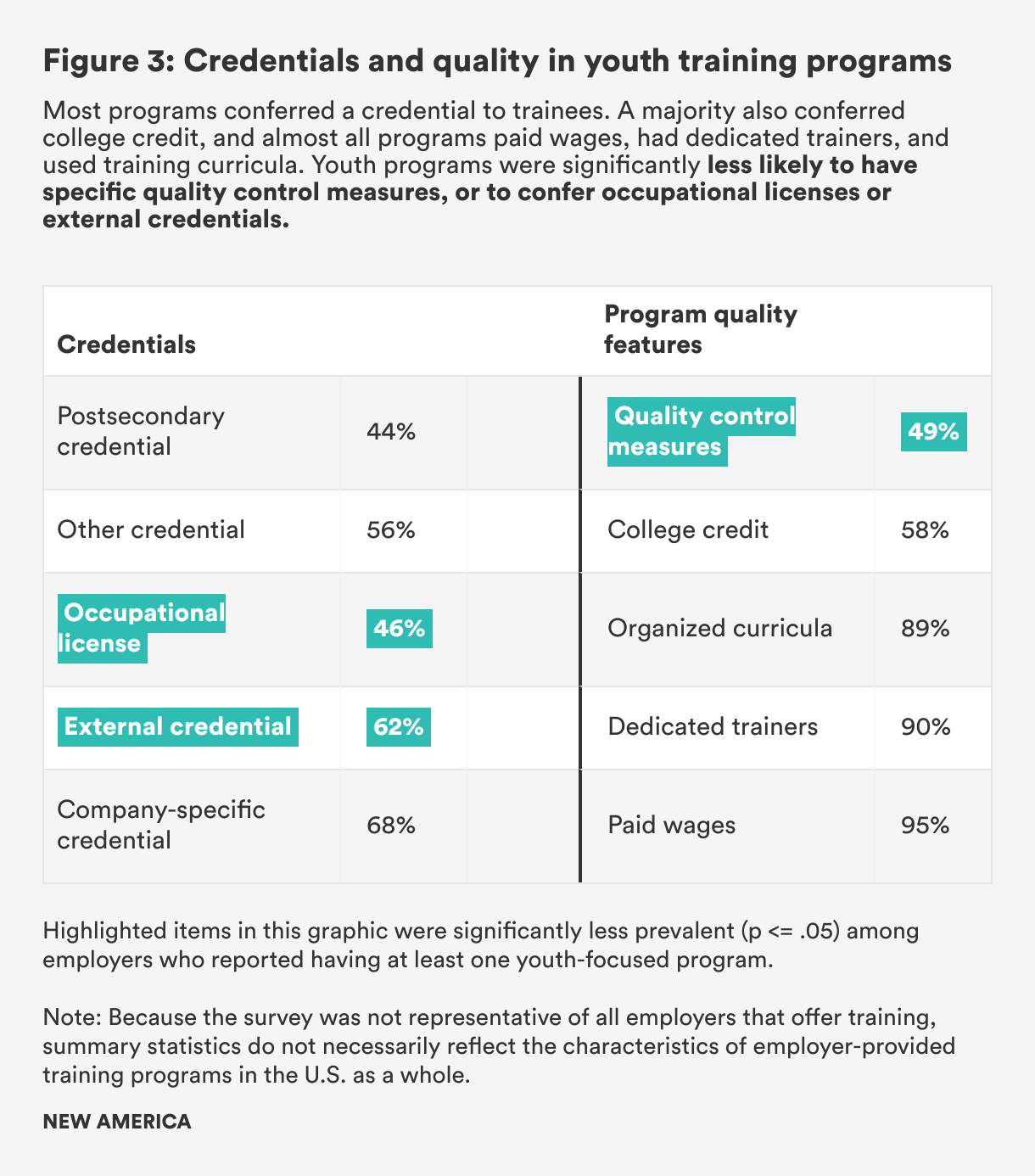
In terms of program quality, most employer-provided training programs seen in the ETS dataset pay wages, have trained mentors, and feature purpose-built curricula, whether internally or externally developed. Youth-focused programs tend to conform to these general characteristics, with the exception of formal quality control systems. Among ETS respondents, quality control measures were found to be significantly less common for youth-focused programs than for all programs. However, this finding may result from respondents’ different interpretations of survey items about quality control. Wisconsin’s youth apprenticeships, in particular, are subject to oversight by state as well as sectoral authorities, but respondents may not have considered these measures to be a form of accreditation, the term used in the survey.
The picture painted of youth-focused employer training by ETS data is heavily influenced by Wisconsin’s youth apprenticeships, which are more widespread than in other states. Even taking this into account, however, the data still reflect positive trends in youth-focused employer-provided training. Most programs are paid, confer portable credentials or credit, and are built on skilled mentorship and dedicated training plans. Although most states do not yet have a youth training infrastructure like Wisconsin’s, the ETS shows that many employers are willing to make investments to provide rigorous, educationally valuable training to youth, and suggests that employers who train youth may be more attentive than others to their organizations’ diversity and the economic success of their communities.

Citations
- Martha Ross, Kristin Anderson Moore, Kelly Murphy, Nicole Bateman, Alex DeMand, and Vanessa Sacks, Pathways to High-Quality Jobs for Young Adults (Washington, DC: Brookings Institution, October 2018), https://www.brookings.edu/research/pathways-to-high-quality-jobs-for-young-adults/
- For the purposes of ETH Zürich’s analysis and this brief, “youth-focused training” refers to any training program that listed youth under age 24 as a target age group, whether it was the only target age group or one of several.
- According to Wisconsin’s Department of Workforce Development, the state’s youth apprenticeship system had 5,407 youth participants and 3,970 employer participants in 2020–21. “YA Student Participation Dashboard,” Wisconsin Department of Workforce Development, https://dwd.wisconsin.gov/apprenticeship/ya/yoda.htm. According to USDOL, the state had 11,735 registered apprentices, which does not include apprentices in its youth program. “Data and Statistics: Fiscal Year 2020 State Totals,” USDOL, https://www.dol.gov/agencies/eta/apprenticeship/about/statistics/2020. For a further discussion of Wisconsin’s apprenticeship system, see Brent Parton, Youth Apprenticeship in America Today, (Washington, DC: New America, December 2017), 18–19, https://www.newamerica.org/education-policy/policy-papers/youth-apprenticeship-america-today/
- Though youth apprenticeship is uncommon in the U.S., it is growing. At an October 2021 PAYA event, Acting Assistant Secretary Angela Hanks of USDOL’s Employment & Training said that the number of registered apprentices ages 16–24 had nearly doubled from 2011 to 2020, to a total of over 68,000. New America, “Preparing our Youth, Preparing our Future: Full program,” YouTube video, 15:56, November 4, 2021, https://www.youtube.com/watch?v=CU4hqEeFGVc