A Chapter of: Employer Training Survey 2021
Introduction
When Americans prepare to enter the workforce, they tend to look to educational institutions, and not their prospective employers, to provide their training.1 But although high schools and colleges provide students with general skills and job readiness, employer-provided training is often necessary for workers to successfully carry out the requirements of a particular job, obtain promotions, and earn higher wages. According to Paul Osterman, who conducted a 2020 study that found that about half of surveyed workers received some formal or informal employer-provided training in the past 12 months, employer-provided training is “the largest source of skill development” in the United States and is positively associated both with earnings growth and promotion for workers and with strong productivity for firms.2
Despite its importance in the success of individual workers and workplaces, the content, prevalence, and value of employer-provided training in the U.S. context are still not well understood. Last year, the Center on Education & Labor at New America partnered with the Swiss university ETH Zürich to administer the 2021 Employer Training Survey (ETS), investigating the training American businesses provide; their reasons for providing training; differences in training provision related to firm size, training type, and employee demographics; and the effects of the COVID-19 pandemic on training.3
The survey was disseminated by email to U.S.-based business networks developed through the Partnership to Advance Youth Apprenticeship (PAYA) and the Apprenticeship Forward Collaborative, national initiatives led by New America focused on the expansion of youth apprenticeship and apprenticeship opportunities, respectively.4 In total, 682 respondents provided usable responses to the ETS, mostly businesses in the Midwest region.5 The resulting dataset includes information about the types of program offered by each employer—apprenticeship, on-the-job training, professional development, internship, or other training programs—as well as the size, industry, and sector (public, private, or nonprofit) of the respondent organizations.
Respondents indicated whether multiple training programs were available within their organization: the average number of programs per organization was 2.2, across all sectors. Respondents also indicated the target age group or groups of each program: trainees up to age 24 (i.e., youth only), adults between ages 25 and 39, or adults above age 40. Roughly one-third of programs targeted youth trainees up to age 24 only; 12 percent targeted trainees up to age 39; and 20 percent targeted trainees of all ages. Roughly 38 percent of training programs were not available to youth.
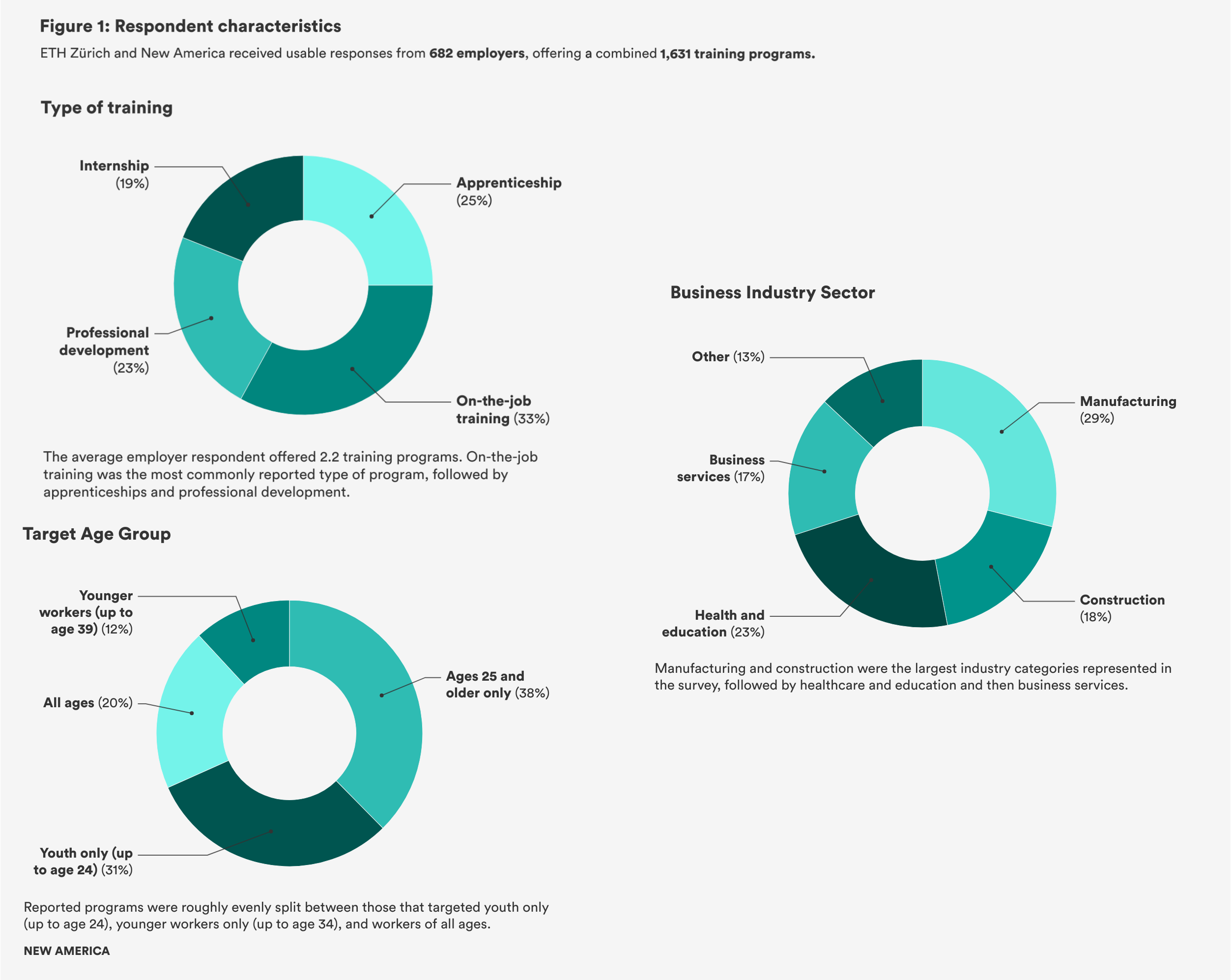
The following brief uses descriptive statistics as well as statistical models developed from the ETS to add to workforce development stakeholders’ understanding of employer-provided training in the U.S. The three sections of the brief focus on apprenticeship programs, youth-focused programs, and the impact of the COVID-19 pandemic on employer-provided training. Because the survey was not representative of employer-provided training nationally, summary statistics from the survey do not necessarily reflect the characteristics of employer-provided training programs in the U.S. as a whole. However, findings from ETH Zürich's statistical analyses provide insight into characteristics of businesses that provide training, employers’ decision-making with regards to training, the effects of the COVID-19 pandemic, and the value of different types of employer-provided training for workers.

Citations
- Among respondents to the 2016 Adult Training and Education Survey who indicated that they held a non-degree work credential such as a license or certification, the majority (67 percent) indicated that they prepared for the credential with classes from a college, technical school, or trade school. Only 38 percent indicated that they prepared using classes from their company, union, industry association, or a private instructor; 51 percent indicated they studied on their own (respondents could choose multiple options). Stephanie Cronen, Meghan McQuiggan, Emily Isenberg, and Sarah Grady, Adult Training and Education: Results from the National Household Education Surveys Program of 2016: First Look (Washington, DC: U.S. Department of Education, 2018), 13, “Table 4: Percentage of adults with a work credential who have a credential with each characteristic, by type of most important work credential: 2016,” https://nces.ed.gov/pubs2017/2017103rev.pdf
- Paul Osterman, “How American Adults Obtain Work Skills: Results of a New National Survey,” ILR Review (June 2021): 1–30.
- Katherine Caves and Patrick McDonald, "Skills, Employer-Provided Training, and the COVID-19 Pandemic," CES Studies, no. 19, (ETH Zürich, Chair of Education Systems, August 2021), https://www.research-collection.ethz.ch/handle/20.500.11850/503549. For the purposes of this brief, employer-provided training can be run exclusively by a company itself, delivered by a third party selected by the company, or offered in partnership with other employers, educational institutions, community-based organizations, or other workforce training providers. See also “FAQ: 2021 Employer Training Survey,” New America, 1, https://s3.amazonaws.com/newamericadotorg/documents/2021_Employer_Training_Survey_FAQ.pdf
- See “Partnership to Advance Youth Apprenticeship: About PAYA,” New America, https://www.newamerica.org/education-policy/partnership-advance-youth-apprenticeship/about/ and “Apprenticeship Forward,” https://www.apprenticeshipforward.org/
- The Midwest region (IL, IN, IA, KS, MI, MN, MO, NE, ND, OH, SD, and WI) accounted for 407 ETS responses—approximately 60 percent of total responses. As a result, ETH Zürich conducted tests for standard error clustering at the state level to determine whether sample variation occurred primarily within or across states. These tests only found significant state-level clustering in the category of “reasons for training”; clustering was insignificant in other categories of survey items. As a result, most findings discussed below can be generalized to any state.