Informal Evictions: Measuring Displacement Outside the Courtroom
Introduction
As businesses across the country shuttered and millions of U.S. residents lost their jobs in the first few months of the COVID-19 pandemic, many feared that an unprecedented surge of evictions was just around the corner. In response, the federal government disbursed billions of dollars in rental assistance to state and local governments to stabilize at-risk households and implemented a federal eviction moratorium.1
So when the Supreme Court struck down the federal eviction moratorium in August 2021, and eviction filings did not immediately surge above pre-pandemic levels, it led many to speculate about the true risk of eviction in the United States. While preliminary analysis attributes the slow rise in eviction filings post-federal moratorium to state and local eviction protections still in place, and to rental assistance finally reaching tenants despite a slow rollout, the magnitude of housing displacement in the United States remains murkier than ever.
The abundance of eviction research in the last two decades has helped frame eviction as more than a one-time financial shock, but a destructive and traumatic process with lasting, negative consequences on housing stability and other indicators of well-being. However, the absence of quality, accessible data on evictions has led to a lack of understanding about the true scope of the growing crisis — both before and during the pandemic. This paucity of data applies to formal, court-ordered evictions, but even more so to evictions happening outside the court system, or so-called “informal evictions.”
Informal eviction commonly occurs when tenants move out of their homes after receiving warnings or threats from their landlord,2 without a claim ever being filed in court. Because informal evictions by definition happen in the shadows, they are incredibly challenging to measure and track. Without knowing the scale of informal eviction, our understanding of displacement and housing insecurity in the United States is incomplete.
The vast and disparate impact of informal evictions is something most housing advocates, tenant organizers, and legal aid providers have long understood. But without the ability to measure the impact, it is difficult to organize, research, and address through programs and policies. In this brief, we shed light on what constitutes an informal eviction, why they are difficult to measure, review findings from existing analyses, and provide some data sources for localities to use to move forward with building a local eviction data infrastructure.
Types of Residential Moves
Evicted author and sociologist Matthew Desmond has classified residential moves into three categories: forced moves, responsive moves and voluntary moves. Evictions are a type of forced move, or involuntary displacement.
- Forced moves are involuntary moves that include eviction (formal and informal), building foreclosures, sales, and condemnations.
- Responsive moves include rent increases, neighborhood violence and maintenance issues, or any moves that are in response to neighborhood or housing conditions.
- Voluntary moves are often initiated by quality of life improvements, such as moving to a neighborhood with better access or to a larger home to accommodate a growing family, and considered to be within a household’s control (i.e., not forced).
Part 1: Informal Eviction Defined
Understanding why landlords would want to circumvent the legal system is helpful in understanding informal evictions. While court processes differ across the country, the formal eviction process typically begins with a landlord providing written notice to a tenant of their lease violation. If the tenant does not remedy the violation (typically non-payment of rent) or leave their home within a specified number of days, the landlord can file an eviction claim with the court system (resulting in an eviction filing). A court case is then scheduled and held, and a judgment is issued, either in favor of the landlord (typically resulting in an eviction) or in favor of the tenant (allowing them to remain in their home).3
The legal proceedings and other costs associated with pursuing a formal eviction are expensive and time-consuming for landlords. As such, they may prefer tactics that enforce rent collection or coerce tenants to leave without the legal backing of the court system. Tactics vary based on existing laws and regulations, but commonly include threatening or intimidating a tenant into paying rent or moving “on their own.”
Informal eviction tactics are built on fear, unequal access to information, and the reality that the law favors landlords' property rights over a tenant's right to remain stably housed.
Given that an eviction filing on a tenant’s record jeopardizes future housing access, landlords can weaponize informal tactics built on fear, unequal access to information on the legal process, and the reality that in many states the law favors landlords’ property rights over a tenant’s right to remain stably housed. Lack of access to information on tenants’ rights, recognition of the lack of parity in landlord-tenant laws, fear of engaging with the court system, and fear of having an eviction record can all motivate tenants to move before a writ of eviction is issued or even before a filing has occurred.
Though most analysis of eviction focuses on a single point in the eviction process — like eviction filings or eviction judgements — tenants face uncertainty at many points along the way, often before any process has officially begun. This fear and uncertainty and perception that a formal eviction is imminent is often what makes tenants vulnerable to different forms of informal eviction, and it is why researchers Garboden and Rosen described even the threat of eviction as “an omnipresent signifier for poor renters that a house is not a home.”
Defining Informal Eviction as a Forced Move
Desmond’s typology classifies eviction as a type of forced residential move or involuntary displacement. Extending this further, Maya Brennan advocates for using the “displacement definition” proposed in a seminal 2003 report, in which eviction is understood as a forced move brought about by a landlord-initiated “change or threat of change in the conditions of occupancy of a housing unit.”
Unlike other definitions of eviction that focus on a specific event or “the culmination of a legal proceeding with a marshal or sheriff coming to the tenant’s door,” the displacement definition reflects the reality that even when a tenant initiates a move “on their own,” it can still be involuntary or forced. In other words, this definition acknowledges that choice is often an illusion given the knowledge, communication, and power imbalance between landlords and tenants, especially low-income and Black and Hispanic tenants, who face systemic barriers to housing access rooted in our nation’s racist housing policies.
Building on Desmond’s definition of eviction, an eviction prevention framework proposed by Brennan further classifies eviction into formal evictions, informal evictions and illegal evictions.
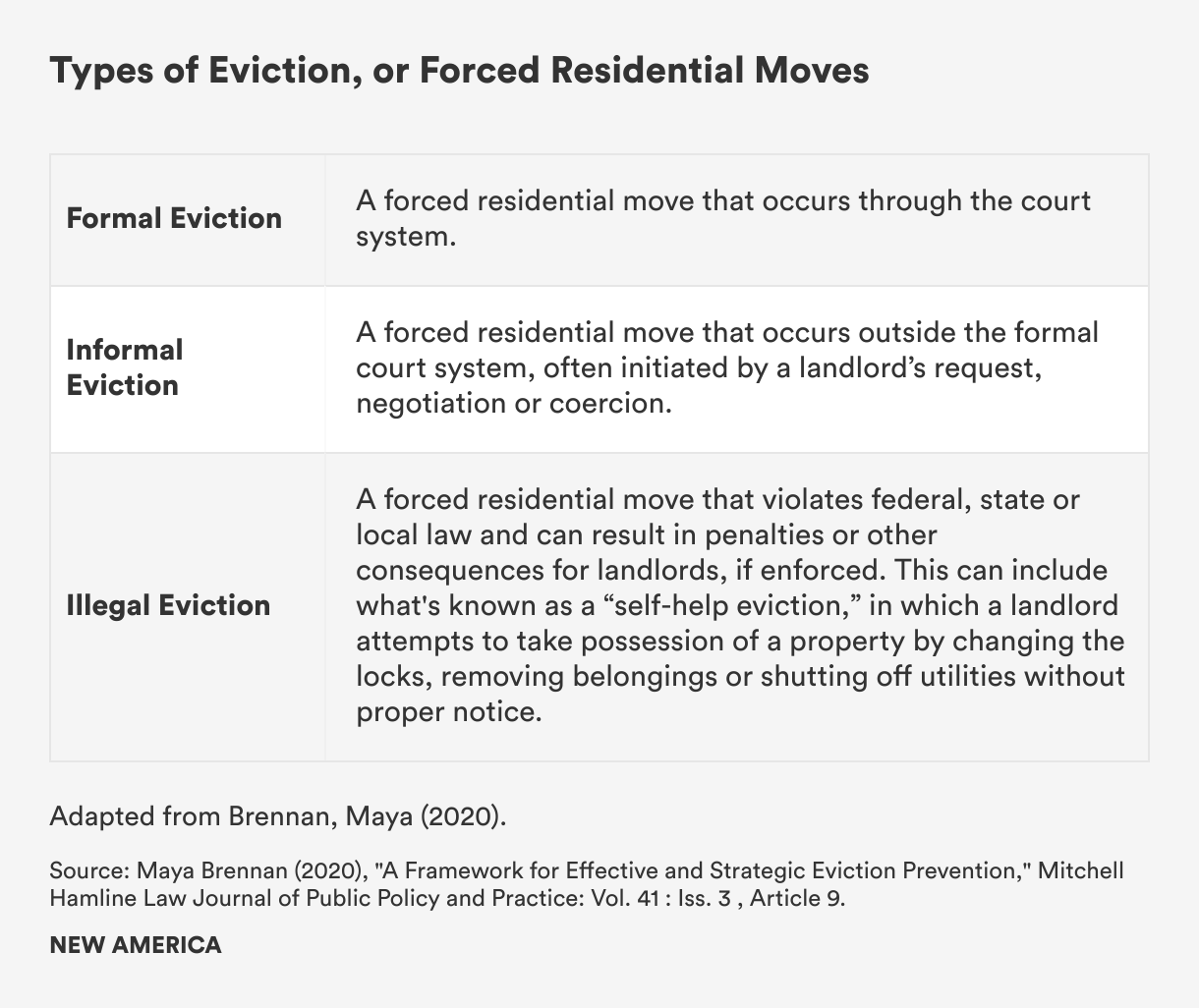
Because tenant protections and housing laws vary from jurisdiction to jurisdiction, the lines between the three kinds of evictions, notably informal and illegal evictions, are often blurred. This is especially true during the pandemic, as federal and state protections are continuously changing.
While informal evictions are broadly defined as those that take place outside the legal system, they can take many forms, including repeated requests from a landlord to vacate without proper legal documentation (often through hostile, harassing or threatening behavior), paying tenants to move out (e.g., “cash for keys”), or refusing to make necessary repairs or engaging in other activities that make a tenant’s living situation untenable. While not technically considered an informal eviction, a common tactic is refusing to renew a tenant’s lease when a tenant has not otherwise violated its terms (this is only illegal in a small number of jurisdictions that have “just cause” eviction policies).
Landlord-initiated Change or Threat of Change to a Tenant's Housing Situation
A pandemic-era survey conducted by the University of Washington and the Tenant’s Union of Washington State asked low-income tenants in the state whether they experienced the following landlord behaviors during COVID-19, showcasing the range of tactics, or “landlord-initiated changes” that a tenant can experience. Whether these specific tactics are considered informal or illegal would vary based on local housing laws and tenant protections in place.
- Text, email, phone call or in-person telling you to vacate
- Changing the locks to prevent access to your place
- Removing your possessions without permission or prior notice
- Shutting off or cutting utilities (e.g., water, electricity, gas, internet)
- Failing to make repairs or perform maintenance
- Retaliation for reporting landlord
- Discrimination or harrassment
- Verbal or physical threat
- Falsely claimed you broke the terms of the lease
- Entering your place without at least two days’ notice
- Invading your privacy
- Refused to renew your lease
- Rent increase without at least 30-days notice
- Withholding amenities
- Additional charges not stated in lease or agreed upon in advance
Why is it Important to Define Informal Evictions?
Defining informal evictions is the first step toward understanding and measuring this type of displacement. Understanding informal evictions is critical for a host of reasons. For one, focusing only on formal evictions underestimates the impact of displacement and housing insecurity in the United States. While estimates of informal evictions depend on the definition, geographic scope and methodology employed (as we will discuss below), estimates suggest that informal evictions are twice as common to 5.5 times as common as formal, court-ordered evictions.
Further, households most likely to experience informal eviction are more likely to be marginalized in other ways. Non-English speaking households, for example, may disproportionately experience informal eviction due to barriers communicating with their landlord or if eviction notices are not provided in their native language. Undocumented and mixed-status households, in particular, are vulnerable to informal eviction due to a justifiable fear of engaging with the court system. Further, these same households face increased barriers to accessing federal rental assistance, a resource that could otherwise help keep them stably housed.
Lastly, the negative social, economic, and health impacts of formal eviction are well-documented, including the detrimental impact of an eviction record on future housing access. While households that experience informal eviction avoid an eviction record, many of the consequences of being caught in the eviction system are present whether an eviction is formal or informal, including reliance on substandard housing, doubling up with another household, and other informal, unstable living arrangements such as couch surfing, sleeping in cars, or renting a room without a lease. Without data on informal evictions, we lack an in-depth understanding of how informal eviction processes impact housing insecurity and its spillover effects.
Part 2: Measuring Informal Eviction: Current Approaches
Unlike formal evictions, informal evictions leave no paper trail or singular data source. Compounding this lack of a data source is the fact that there are a range of activities that constitute informal evictions, that vary depending on local housing laws and tenant protections, making it difficult to standardize a definition, and thus a measurement strategy. Further, the hard-to-reach and transient nature of communities that face informal evictions make this kind of forced move uniquely difficult to study. Given these complexities, the prevailing method for measuring informal evictions are household surveys and qualitative data collection, both of which are resource intensive and complex to administer. Efforts to measure informal evictions are complicated further because tenants who have experienced informal eviction may not understand it as such and may not report it in a survey.
Despite these challenges, there has been major progress in the last decade or so. Administered between 2009 and 2011, the Milwaukee Area Renters Study (MARS), designed by Matthew Desmond, was a first-of-its-kind investigation into the nuances of involuntary displacement experienced by tenants. Through an in-depth questionnaire containing over 250 respondent-friendly questions, MARS was designed to disentangle the complexity of where a tenant lives and whether they’ve been evicted.
In doing so, MARS provided the first glimpse and best known estimate into the prevalence of informal evictions relative to formal, court-ordered evictions, albeit at a city-level. In Milwaukee, MARS found that formal evictions accounted for 24 percent of forced moves and informal evictions accounted for 48 percent, acting as the source of the commonly-cited statistic that informal evictions are twice as common as formal evictions in the United States.
The MARS questionnaire was only fielded once, but its comprehensive approach to understanding housing instability has led to its adoption in much larger studies. In 2017, the American Housing Survey (AHS), a large household survey fielded every other year by the U.S. Census Bureau, adapted a set of MARS questions,4 making it the first nationwide survey on the prevalence of formal and informal eviction. Prior to the adoption of these questions in 2017, the AHS only included one yes or no question focused on formal eviction.
Despite the 2017 AHS providing the first nationwide estimate on the prevalence of informal eviction, researchers Matthew Desmond and Ashley Gromis detail nine reasons why the AHS may be underestimating formal evictions, and caution against using these findings without alternate sources of comparison. With these caveats in mind, the 2017 AHS found that informal evictions accounted for 72.3 percent of forced moves, while formal evictions accounted for 13.1 percent of forced moves, suggesting a ratio of 5.5 informal evictions for every formal eviction in the United States.5
Moving after missing a rent payment for fear of eviction is consistent with other drivers of informal eviction that so often leave tenants without any real choice.
Interestingly, MARS and AHS do not classify tenants who move after missing a rent payment for fear of eviction as an informal eviction, though they do consider it within the broader category of forced moves. As discussed before, tenants often do not know they have the right to remain in their home pending a legal process, or may be motivated by fear of engaging with the court system or having an eviction filing on their record. These motivations for moving are consistent with other drivers of informal eviction that leave tenants without any real choice.
Two other potential sources of data on informal eviction nationally are the Annual Social and Economic Supplement (ASEC) of the Current Population Survey (CPS), conducted by the U.S. Census Bureau and the Bureau of Labor Statistics, and the Panel Study of Income Dynamics (PSID), which has followed a nationally representative sample of U.S. households since 1968.
Both surveys collect data on geographic mobility, asking households who moved within the last few years why they moved, allowing them to select eviction and/or foreclosure; a write-in response allows them to elaborate further. While these large, national surveys are potential vehicles for data collection on informal evictions, as currently designed, they do not explicitly define or further classify evictions beyond a singular response option.
Local, non-governmental organizations also leveraged MARS to collect data on forced moves, including informal eviction. The Poverty Tracker is a longitudinal study of poverty and well-being among low-income New York City (NYC) residents launched in 2012. Conducted by the Columbia Population Research Center and the non-profit organization Robin Hood, the Poverty Tracker began collecting data on relocation and eviction in 2017. These data are classified into three categories: formal evictions, informal evictions, and other forced moves.
Unlike MARS and the AHS, the Poverty Tracker classifies tenants who moved because their “landlord told them to leave” or because they “missed a rent payment and feared eviction” as having experienced an informal eviction. However, tenants who moved because they experienced landlord harassment are considered a forced move, but not an informal eviction.
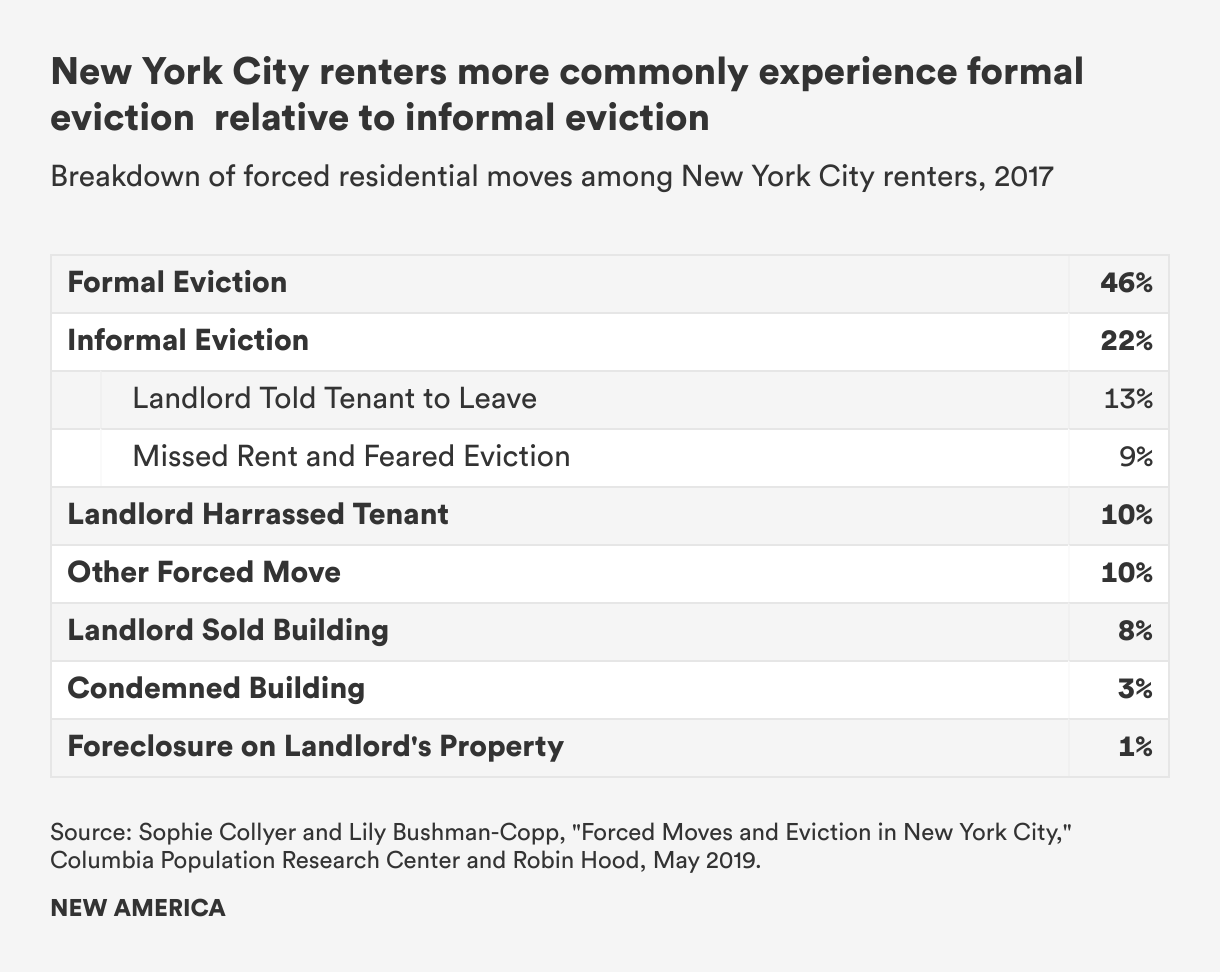
With those definitional caveats in mind, the Poverty Tracker found that among NYC residents, formal evictions, which accounted for 46 percent of forced moves, were almost twice as common as informal evictions, which accounted for 22 percent of forced moves. This is the inverse of what MARS found in Milwaukee. However, if the Poverty Tracker were to include survey respondents who moved due to landlord harassment as informal eviction, forced moves due to informal evictions would increase from 22 percent to 32 percent, narrowing the gap between formal and informal evictions in NYC. Either way, the surprising finding that formal evictions are more common than informal ones in NYC may point to the impact of relatively robust tenant protections in the state.
The presence of informal eviction estimates from two different surveys in the NYC region — the Poverty Tracker and the AHS — allow us to better understand how different measurement methods can impact findings. While the AHS found an informal-to-formal eviction ratio of 2.5:1 in the New York City/Newark MSA, the Poverty Tracker found the inverse. The varied, and in this case opposite, findings from studies designed to investigate informal eviction in the same geographic region raises important questions of how sampling methods and survey design impact the scope of moves captured by different studies.
COVID-era Eviction Studies
The potential for a pandemic-driven surge in evictions has led to new federal and local data collection efforts. While preliminary data analysis does not show a rapid or across-the-board rise in formal, court-ordered eviction filings that many expected when the CDC moratorium lapsed, it is possible that efforts focused on informal eviction could tell a different story.
Starting in April 2020, the Census Bureau launched the Household Pulse Survey, a national survey assessing the impact of COVID-19 on U.S. households, including the number of households at-risk of displacement. Each week, the Census Bureau asked a representative sample of households whether they were behind on rent, how confident they were in their ability to pay rent the following month, and how likely it was that they would be evicted in the next two months.
Given that the Pulse survey does not track moves over time, it can be viewed as a measurement of overall housing insecurity and fear of eviction, and not a measurement of displacement. As discussed earlier, however, fear of eviction is a common driver of informal eviction, and measuring this sentiment over time can serve as an important indicator of precarity that may lead to informal eviction. As of December 2021, the latest data available, 39 percent of U.S households currently behind on rent feared eviction in the next two months.
What if the mechanisms through which tenants were displaced merely shifted to adapt to COVID-era protections, like the eviction moratorium?
At the state-level, the University of Washington and the Tenants Union of Washington State explored how local and federal tenant protections, including a statewide eviction moratorium that offered more protection than the CDC moratorium, impacted the housing security of low-income tenants during COVID-19. According to the survey conducted as part of the study, formal evictions did not rise during the pandemic, suggesting that Washington State’s relatively strong tenant protections kept written eviction notices and eviction orders at bay.
But what if the mechanisms through which tenants were displaced merely shifted to adapt to COVID-era protections, like the moratorium? The study also assesses whether a range of harmful landlord behaviors have become more or less frequent during the pandemic, offering (to our knowledge) a first-of-its-kind analysis on informal eviction tactics during, and potentially in response to, COVID-era protections.
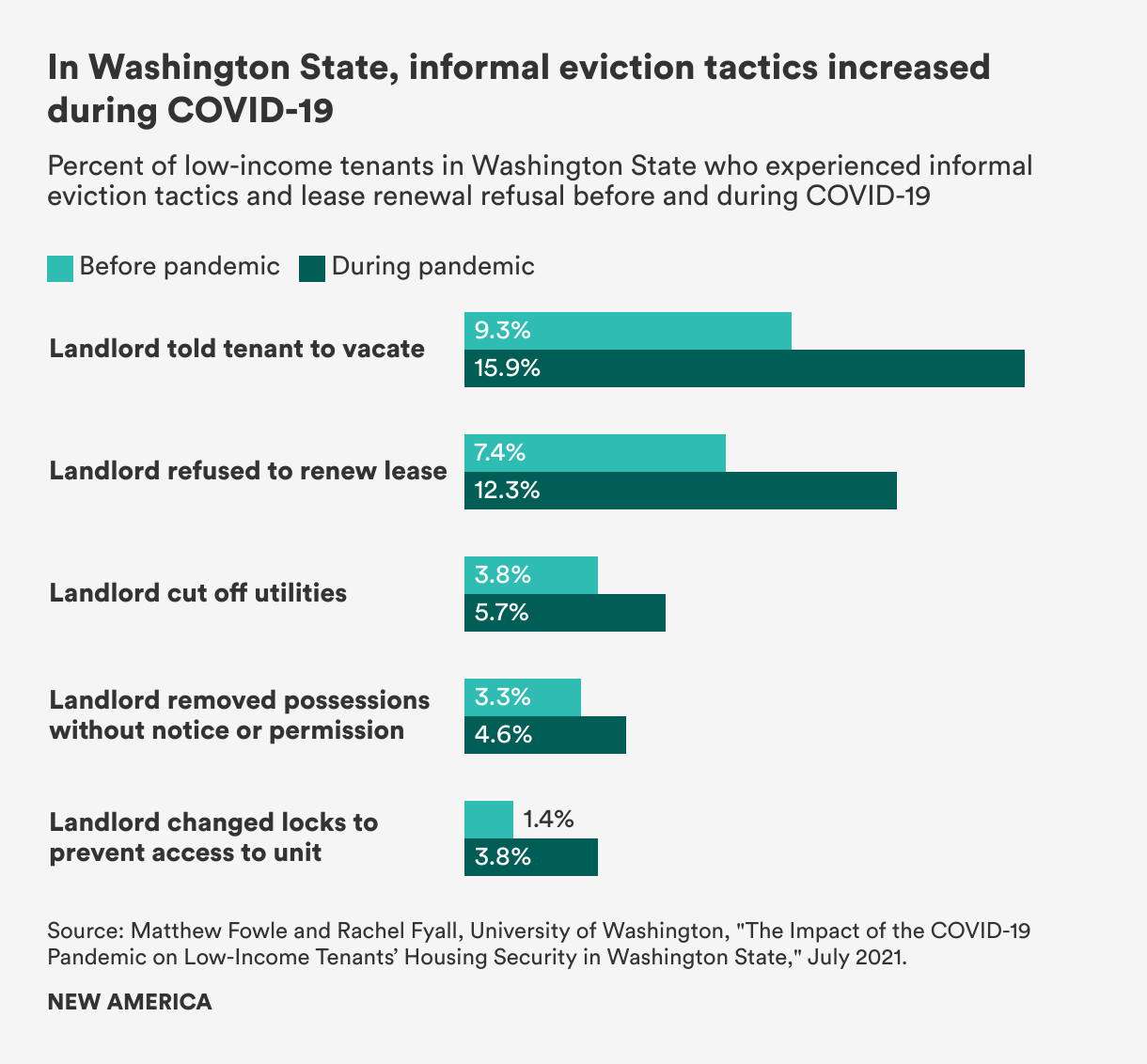
The figure above breaks down informal eviction methods pursued by landlords in Washington State. Overall, the study found that 1 in 8 (13.7 percent) low-income tenants experienced an informal eviction method prior to the pandemic, compared to nearly 1 in 5 (19.4 percent) during the pandemic. The following methods of informal eviction increased during the pandemic: being told to vacate (through a text, email, phone call, or in-person message), changing the locks to prevent access to a unit, removing possessions without permission, and shutting off utilities.6 Refusal to renew a tenant's lease was also more common during the pandemic (12.3 percent) than before the pandemic (7.4 percent), though lease non-renewal is not considered an informal method of eviction by this study, MARS or the AHS.
Unlike AHS, MARS, and the Poverty Tracker, this study does not provide estimates of informal eviction, but instead attempts to better understand landlord behavior and various tactics — both formal and informal — that often precipitate tenants moving “on their own.”
Part 3: Measuring Informal Eviction: Potential Sources for Local Data Collection
Recently, the Biden Administration proposed fielding a national survey on informal evictions — either through an existing survey instrument or through a new, standalone effort. A national survey, however, would require large sample sizes or significant oversampling of hard-to-reach populations to produce county-level estimates.
In the meantime, cities and counties across the United States, can use unprecedented federal resources from COVID-19 relief efforts for increased coordination around the use of administrative data, data linkages and other novel approaches to tracking eviction locally. In this section, we present a preliminary and non-exhaustive list of potential data sources that local jurisdictions may want to consider for starting to track informal evictions.
As noted earlier in the brief, household surveys and qualitative data collection are the best available methods for measuring informal eviction given the lack of a singular data source for this outcome, and the need to contextualize data in order to measure and address demographic and socioeconomic disparities in informal eviction. The data sources discussed in this section primarily offer jurisdictions a jumping off point to identify an appropriate sampling frame for subsequent data collection efforts.
In addition, all the data sources discussed in this section will need to be linked with other sources to create even a partial picture of the households affected by informal eviction. This is true for formal eviction data as well, as court records do not include demographic or socioeconomic characteristics of defendants. While data linkage is a complex, but critical component of understanding housing insecurity, identifying potential data sources, and what they can and cannot address as it relates to housing displacement, is an important first step.
Homeless Management Information System (HMIS) data. A major limitation of the AHS and ASEC CPS as tools for measuring evictions is that data are collected by sampling housing units, excluding individuals who are unhoused, individuals who move to congregate shelter, and individuals with other informal living arrangements. Some of these individuals — those who enter congregate shelter or access other resources in the homeless service system — will be represented in HMIS data, “a local information technology system used to collect client-level data and data on the provision of housing and services to homeless individuals and families and persons at risk of homelessness.”
Linking HMIS data with administrative data on evictions and foreclosures could shed light on whether the individuals represented in this data experienced homelessness as a result of formal or informal displacement. Of course, HMIS data will need to be combined with other data sources to capture the full scope of informal evictions. In particular, individuals who experience informal eviction in part due to fear of engaging with the court system may be similarly reluctant to engage with the homeless service system.
School district data. Households with children face an increased risk of formal eviction, and are often targeted for eviction prevention interventions given the negative and lasting impacts of housing instability on children. School data on children who report a change in address one or more times during the academic year could be linked to court data to determine whether a formal eviction occurred. Alternate data sources or follow-up data collection will be necessary to understand the reason for a move for households without a formal eviction record.
Utilities arrearages. Because many jurisdictions prohibit shutting off utilities such as water and heat (particularly during the pandemic), households often forgo utility payments to afford rent. Data on missed utility payments during the pandemic could be used to identify households at-risk of eviction and connect them with emergency financial assistance. Previous years’ data on utility arrearages could also be linked with court data and change in address data (from the postal service or school districts) to determine whether or not a missed utility payment coincided with either a formal eviction filing or change in address. Follow-up data collection will be necessary to determine whether households who missed a utility payment and subsequently reported a change in address but do not have an eviction record experienced an informal eviction.
Postal service data. Change of address data from the postal service is collected by HUD. Similar to school data, this could be used to identify individuals who move multiple times within a 12-month period — a possible indicator of eviction. Linking this data with court records on eviction filings and judgments could help identify whether someone moved due to a formal, court-ordered eviction (especially in cases where formal court records are incomplete). For informal evictions that do not reach the court system, and do not result in an eviction record, the data is murkier and additional data sources or follow-up data collection to determine if an informal eviction occurred will be necessary.
In addition to the fee associated with accessing postal service data, a significant limitation of postal service data is the small number of data fields, making it difficult to classify household types. Postal service data is also unlikely to include individuals who double up, sleep on couches or make other, informal rental arrangements (such as renting a room in someone’s home with no lease), or individuals who are unhoused or living in congregate shelter.
Local data collection efforts. Non-profit, community-based organizations and tenant organizations are a potential resource for qualitative data from individuals with lived experience of informal eviction. While a small-scale qualitative study will not speak to the prevalence of informal eviction in the United States, the expertise of individuals who have experienced displacement outside of the legal system is critical to discussions focused on defining informal eviction and identifying new sources of measurement. Further, studies designed for a specific population can better account for hard-to-reach populations.
Certain non-profits, including legal aid organizations, social service providers, and non-governmental organizations that provide emergency financial assistance and other services, may also possess quantitative data on the number and characteristics of clients who experience informal eviction, as well as the frequency with which clients experience various informal eviction tactics.
Part 4: Measuring Informal Eviction: Best Practices for Using Available Data
Cities and counties hoping to better understand informal evictions in their communities can start by taking these steps.
- Assess the most common methods of informal eviction in your community, and who is most impacted. As discussed above, there are a range of activities that constitute informal eviction, from landlord harassment to shutting off the utilities. Understanding the experiences of tenants, tenant organizers and legal aid organizations in your community will shed light on the varied, and most common, informal eviction tactics that prompt households to move. This in turn will help localities better understand how to define the scope of informal evictions, leading to more informed data collection methods.
- Account for existing tenant protections, housing laws and the legal regimes of tenant-landlord courts in designing data collection efforts. The varied nature of local laws and protections is a major challenge in developing a common definition for informal eviction. Actions that are perfectly legal and commonly deployed in one city or county are illegal in another, blurring the lines about what constitutes an informal versus illegal eviction. To this end, the Legal Services Corporation and Temple University’s Center for Public Health Law Research developed an Eviction Laws Database that provides a comprehensive overview of the entire legal process and other housing laws across the country.
- Develop cross-sector collaborations and assess the range of data sources at your community’s disposal. Understanding the full scope of informal evictions will require a combination of different data sources, and uncovering what data sources exist will require cross-stakeholder representation from various government agencies, county court systems, housing advocates, legal aid organizations, social service organizations, tenant organizers and tenants. During the pandemic, many localities, including Northern Virginia, established eviction prevention task forces, which can help build out datasets over time.
- Understand who is accounted for and who is missing in potential data sources. Unlike the AHS, the CPS ASEC is administered to all household members, increasing the likelihood of capturing data from individuals who are doubling-up, couch surfing or renting a room from another household. Many administrative data sources do not include certain hard-to-reach populations, including individuals who are unhoused or live in congregate shelters. It is critical to understand who is missing in data sources to better understand how to account for these gaps. It could be the case that newly-developed surveys or qualitative studies are needed to address these gaps.
- Pursue data collection efforts that engage individuals who have experienced informal eviction. Informal evictions rest to a large extent on power imbalances between landlords and tenants and a lack of easily accessible information on tenants’ rights and protections. Individuals who have lived through the process possess invaluable insight and can help elucidate the strengths and limitations of various data sources and inform the design of data collection efforts. A recent report on Oregon’s eviction diversion program during the pandemic emphasizes the micro-practices, or “the everyday communications, decisions, and activities through which policy is carried out” in a way that centers tenants' experience. In addition, Dr. Brittany Lewis lays out an actionable research model that centers tenants in an investigation into eviction in North Minneapolis.
Questions on forced displacement in the AHS and the Poverty Tracker represent important steps forward in understanding housing security in the United States. While the prevalence of eviction in the United States and the systemic inequities in our housing system predate the COVID-19 pandemic, the pandemic did contribute to a more widespread urgency around keeping people stably housed. Efforts to build upon this to impact housing stability should not be wasted.
Acknowledgments
We would like to extend their gratitude to the reviewers of this brief: Peter Hepburn, Margaret Hagan, Katie Dilks, and Amy O'Hara.
We also would like to thank our colleagues at New America that assisted with this report: Alison Yost, Joanne Zalatoris, Naomi Morduch Toubman, and Joe Wilkes.
Downloads
Citations
- There were two eviction moratoriums put in place by the Federal government, one implemented under the CARES Act from March 2020 to July 2020 and another implemented by the Centers for Disease Control and Prevention (CDC) in September 2020. The CARES Act moratorium was much less broad than the CDC moratorium, only applying to properties with federal financing, see https://crsreports.congress.gov/product/pdf/IN/IN11516.
- We use the term ‘landlord’ in this brief for simplicity, but refer to the range of property owners and managers, from large, for-profit owners to small mom-and-pop owners.
- As mentioned, court processes, notably the time periods that tenants have to pay/remedy a violation and how eviction writs are carried out, vary across the country. Useful graphics of eviction processes can be found in these documents: https://georgetown.app.box.com/s/8cq4p8ap4nq5xm75b5mct0nz5002z3ap (Washington, DC) and https://nvaha.org/wp-content/uploads/Eviction-Timeline-10.6.21.pdf (Virginia).
- The remaining 14.6 percent of forced moves were the result of foreclosures (5 percent), condemned buildings (3.2 percent), and fear of eviction following a missed rent payment (6.4 percent).
- See Exhibit A-4 in Appendix A of this HUD report for a full list of eviction-related questions added to the AHS, https://www.huduser.gov/portal/sites/default/files/pdf/Eviction-Database-Feasibility-Report-to-Congress-2021.pdf.
- The study authors did not distinguish between informal and illegal evictions, categories that differ from state-to-state depending on local housing laws and tenant protections.
More About the Authors

Sabiha Zainulbhai
Deputy Director, Future of Land and Housing Program

Nora Daly
Associate Director, Technical Assistance, Center for Community Progress