Support for Ranked-Choice Voting across Race and Partisanship
This brief is part of a series by the Electoral Reform Research Group, a collaboration between New America, Stanford University’s Center on Democracy, Development, and the Rule of Law, the American Enterprise Institute, and the Unite America Institute. To find the full report of the study summarized below, click here.
Overview
This paper presents the results from a national survey experiment that tests how voters evaluate ranked-choice voting (RCV) as an alternative to the traditional single vote plurality method and in response to common arguments for and against RCV. We examine data collected from the 2020 Collaborative Multiracial Post-Election Survey (CMPS). The survey includes large samples of Latino, Black, Asian American and Pacific Islander (AAPI), and white respondents, allowing for comparisons across ethnic and racial groups.
Research Questions
- How do voters rate RCV compared with single-vote methods?
- If voters hear more about RCV, do they become more favorable?
- Do voter evaluations of RCV vary by race?
- Do evaluations of voting rules vary by party identification?
Key Findings
- Even though both RCV and the single vote tend to receive positive satisfaction ratings, the single vote is rated more positively than RCV among all racial groups.
- Latino, Black, and AAPI respondents rate RCV more favorably than white respondents.
- A longer description of RCV that explains the vote transfer feature does not influence preferences for RCV.
- Communicating that RCV elects more women and people of color boosts support for RCV among Latino, Black, AAPI, and white Democratic respondents.
- Republicans are more opposed to RCV than Democrats, particularly among white respondents.
Background and Research Design
A growing number of state and local jurisdictions in the United States have recently adopted preferential voting rules, known in the United States as ranked-choice voting (RCV). While these reforms are gaining in number, there is only a small evidence base indicating how American voters evaluate RCV rules. For example, the ability to have one’s vote transferred to a second or third choice candidate is a major selling point of RCV, but there is little direct evidence indicating whether American voters really like this feature. When given an explanation of the vote transfer properties of RCV, do American voters actually evaluate RCV more positively? How do Americans respond to other common arguments for and against ranked-choice voting? Do these evaluations vary across racial groups?
We test these open questions in a large survey experiment, using data from an early release of the 2020 Collaborative Multi-racial Post-election Survey (CMPS) conducted April through August of 2021. The CMPS is a very large national sample and includes large subsamples of Latinos, African Americans, and Asian Americans and Pacific Islanders (with roughly 4,000 for each group), which allows us to examine whether evaluations of voting rules vary across racial and ethnic groups. We use a within-subjects design that asks each subject to vote under each voting rule for the same set of hypothetical 2024 presidential candidates, randomizing which respondents receive either short or long descriptions of RCV. The long description emphasized that the winner must reach a majority threshold under RCV rules and that second- and third-choice votes are redistributed to candidates until that threshold is met.
Additionally, respondents received random message treatments of ranked-choice voting, one that stated that RCV promotes diversity in political representation and the other stating that RCV has been shown to increase voter confusion. We then ask respondents to rate their satisfaction with each voting rule and to indicate which rule they prefer.
Findings and Implications
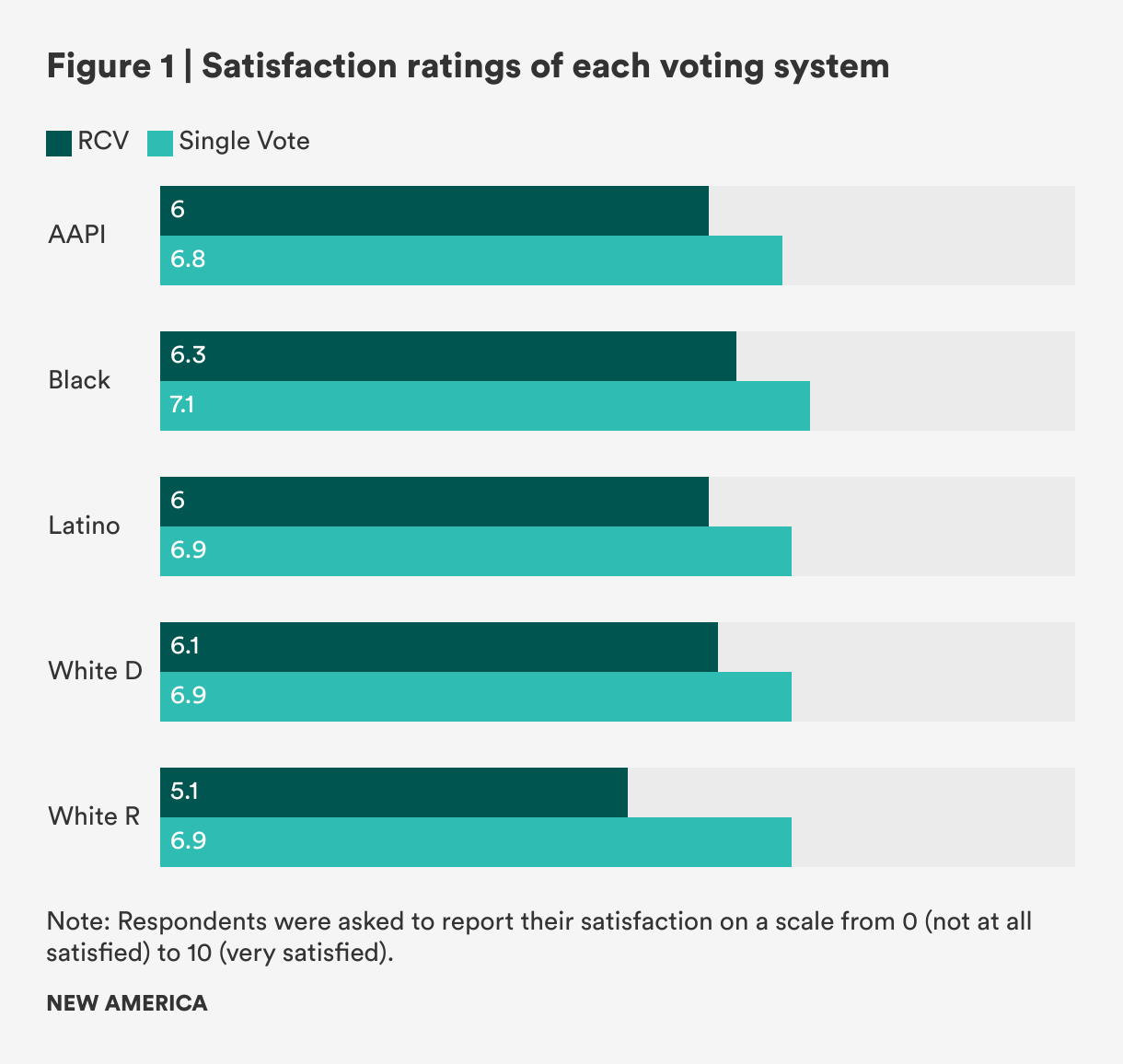
Even though both voting rules (RCV and the traditional single vote) tend to receive positive satisfaction ratings, the single vote is rated more positively than the ranked vote by each racial subgroup (see Figure 1 below). Democrats rate RCV more favorably than Republicans, especially among white respondents. White Republicans rate RCV notably less favorably than white Democrats and other racial groups.
When given a choice between the single vote and RCV, a large majority prefers the status quo option of the single vote. The results of our survey experiment demonstrate that a short explanation of the vote transfer properties of RCV does not increase public support for the voting rule. In fact, providing a more thorough explanation that emphasizes the vote transfer properties of RCV tends to reduce satisfaction ratings by a small but statistically significant amount.
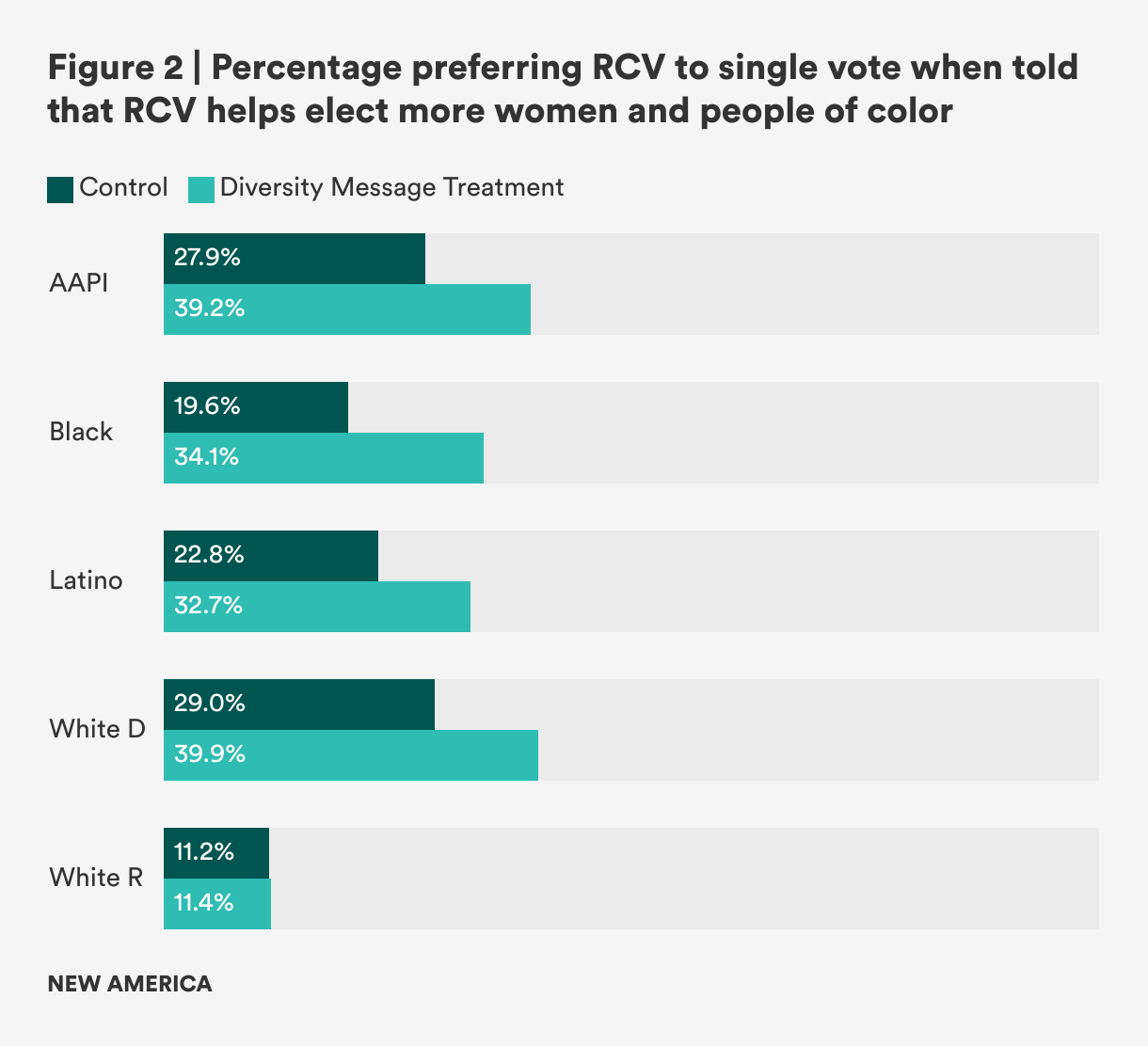
Our study finds that majority preferences for the single vote prevail among representative samples of white, Latino, Black, and AAPI respondents; each subgroup rated the single vote method more favorably than the ranked method. However, Latino, Black, AAPI, and white Democratic respondents evaluate RCV more positively and express a stronger preference for RCV than white Republicans. Furthermore, communicating that RCV helps elect more women and people of color increases preferences for RCV among Latino, Black, AAPI, and white Democratic voters, but not among white Republican voters. The message about voter confusion slightly reduces support for RCV in each subgroup, but the estimated effect is only statistically significant among Black respondents.
As Figure 2 shows, the message that RCV helps increase the number of elected women and people of color boosts preferences for ranked-choice voting by 10 to 15 percentage points among Latino, Black, AAPI, and white Democratic respondents. These are relatively large and statistically significant effects. The message about promoting diversity does not significantly influence preferences for RCV among white Republican respondents.
Conclusion
As more American states and cities consider ranked-choice voting rules, it is important to evaluate them against single-vote plurality rules. Multiple surveys show that Americans rate the single vote method more favorably than ranked-choice voting. These results mean that jurisdictions adopting ranked-choice voting need to prepare for initial resistance from voters who have grown comfortable with the simplicity of plurality rules. A public backlash against new voting rules is more likely to come from white Republican voters than other racial subgroups. Meanwhile, a message noting that ranked-choice voting is confusing, one of the main arguments made by opponents, does not reduce public preferences for RCV by any more than a small amount.
We also find that a brief explanation of the vote transfer features of ranked-choice voting, and the non-majoritarian characteristic of plurality rules, does nothing to increase support for ranked-choice voting. It is a challenge to explain to voters, in a sentence or two, the problems associated with plurality voting rules, like the “spoiler” effect of third-party candidates, or the advantages associated with alternative rules. Repeated communications are likely needed for this information to sink in. Thus, building understanding and support for ranked-choice voting rules likely requires a more sustained campaign.
View and download the full report here.
Acknowledgments
We appreciate feedback on this research from Laura Arnold, Todd Donovan, Lee Drutman, Alex Keena, Cynthia McClintock, and Maresa Strano. We also received valuable guidance from participants at a meeting of the Electoral Reform Research Group in February 2020. Data collection for this project was funded by New America through their ERRG initiative, with support from Arnold Ventures.
Downloads
More About the Authors

Joseph Anthony
David C. Kimball
Jack Santucci