
PAYA Youth Apprenticeship Quality Assessment Tool
Abstract
As youth apprenticeship has gained traction across the United States, many programs have adopted the Partnership to Advance Youth Apprenticeship (PAYA) Definition & Principles for Youth Apprenticeship to guide program design and implementation. Building from those principles, PAYA has developed this Youth Apprenticeship Quality Assessment Tool as a piece of a four-step protocol aimed at assisting education providers, employer and industry partners, intermediary organizations, and other youth apprenticeship leaders in collaboratively identifying ways to improve policies, procedures, and practices in support of learner success.
Acknowledgments
We would like to thank the PAYA National Partners, Grantees, and Network members for their expertise that informed this resource. A special thank you to our colleagues at Advance CTE (Austin Estes and Kate Kreamer), ApprenticeshipNC (Charlie Milling, Joyce Milling, and Elizabeth Standafer), Ascend Indiana (Stephanie Bothun and Natalie Applegate), CareerWise (Ryan Gensler, Melissa Rey, Joslyn Robich, and Jake Williams), Kinetic West (Marc Casale, Andy Ferrera, and Avery Kirsten), JFF (Andrea Messing-Mathie), Trident Technical College (Mitchell Harp and Melissa Stowasser) as well as Pam Howze for their feedback.
This resource benefited from the support and insight of many New America colleagues, including Taylor White, Elena Silva, Kelly Vedi, Michael Prebil, and Shelton Daal. We would also like to thank Sabrina Detlef for her editorial support; and Julie Brosnan, Riker Pasterkiewicz, and Fabio Murgia for their help in the design, publication, and dissemination of this resource.
Finally, we are thankful for our funders, the Annie E. Casey Foundation, Ballmer Group, Bloomberg Philanthropies, Carnegie Corporation of New York, J.P. Morgan Chase & Co., Ralph C. Wilson, Jr. Foundation, Siemens Foundation, Smidt Foundation, and the Walton Family Foundation for their generous support of the Partnership to Advance Youth Apprenticeship.
Downloads
Principles for High-Quality Youth Apprenticeship
High-quality youth apprenticeships offer young people affordable, reliable, and equitable pathways from high school to good jobs and postsecondary credentials. Youth apprenticeship can also deliver a positive return on employer investment by building a pipeline of young, diverse talent and fostering a culture of learning and innovation that attracts and retains employees.
In 2018, the Partnership to Advance Youth Apprenticeship (PAYA) developed a set of guiding principles to define the program characteristics required to adequately serve the many stakeholders in youth apprenticeship—above all, learners. Below is an explanation of how these principles—career-oriented, equitable, adaptable, portable, and accountable—are critical to a well-designed youth apprenticeship that advances a community’s strategy for ensuring quality pathways to college and careers.
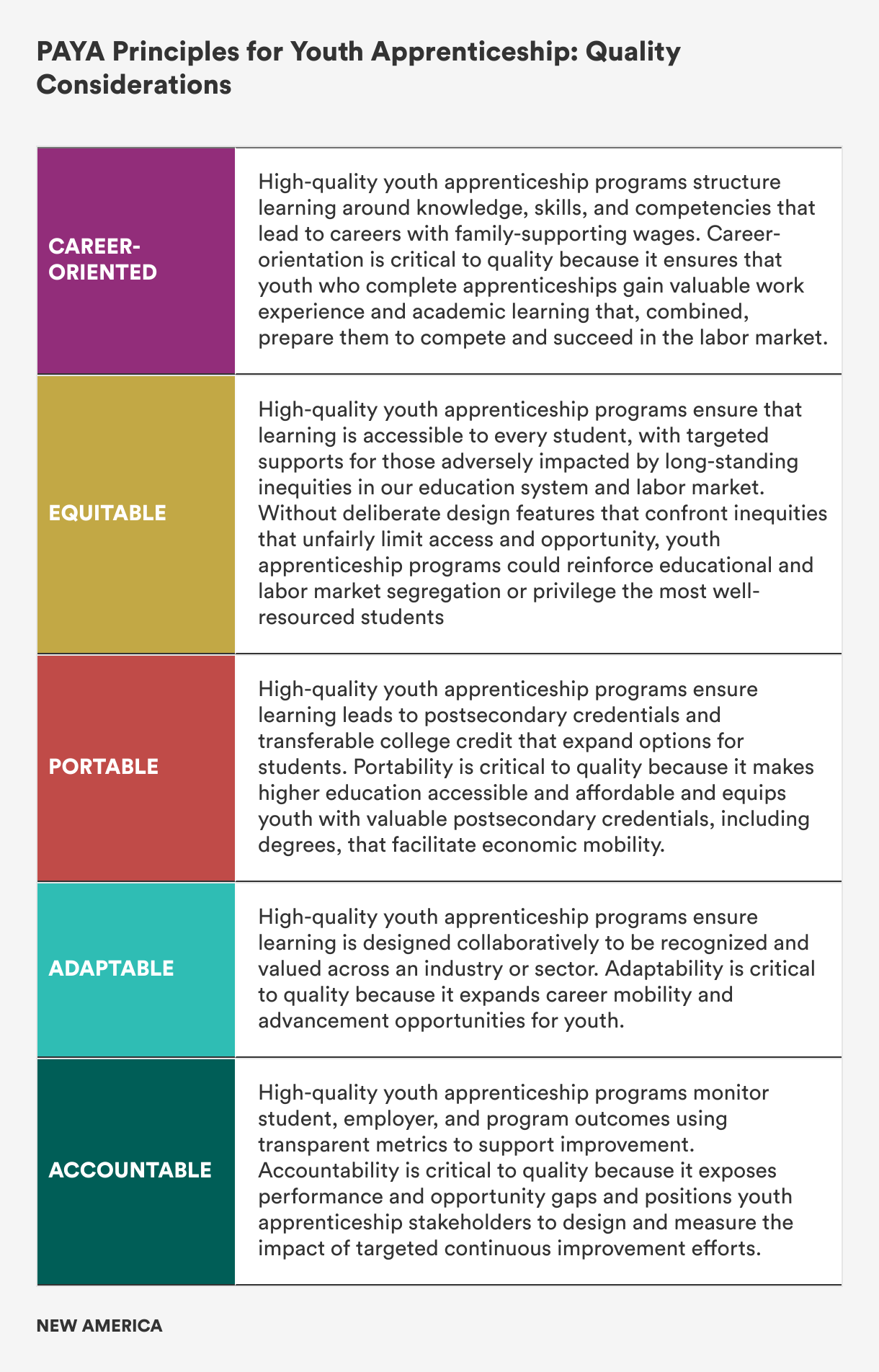
Note: On September 28, 2026, New America updated the link to the set of guiding principles to reflect all current changes.




Youth Apprenticeship Quality Assessment Tool and Protocol
Building from the PAYA principles, PAYA has developed the Youth Apprenticeship Quality Assessment Tool and Protocol to assist education providers, employer and industry partners, intermediary organizations, and other youth apprenticeship leaders in collaboratively identifying ways to improve policies, procedures, and practices in support of learner success.
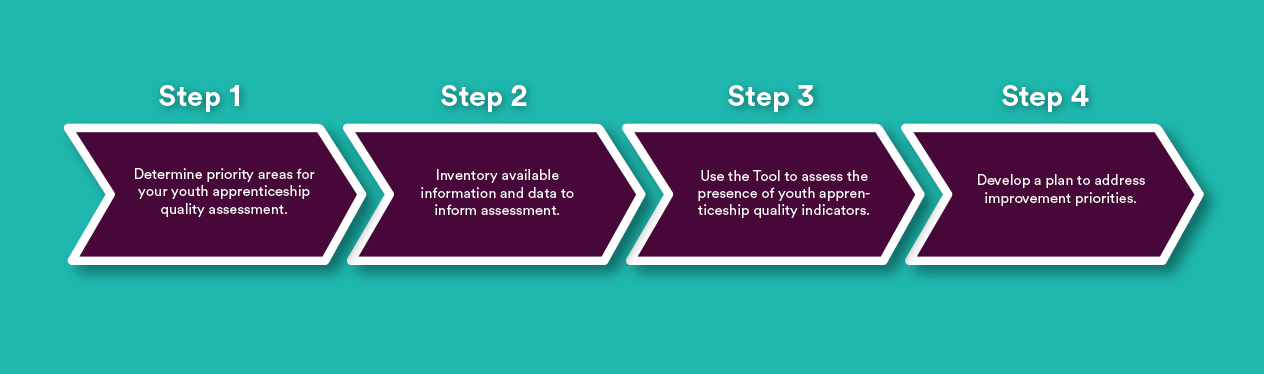
Step 1. Determine Priority Areas for Assessment
The Youth Apprenticeship Quality Assessment Tool is organized around PAYA’s Definition & Principles for Youth Apprenticeship. While each of the five principles are equally important to the development and delivery of high-quality youth apprenticeships, leaders may choose to initially prioritize the principle(s) that will have the most significant impact on learners.
Step 2. Inventory Available Information and Data to Inform Assessment
To determine whether a youth apprenticeship is designed with quality in mind and implemented in a way that leads to positive and equitable outcomes for all learners, program leaders can examine multiple qualitative and quantitative data points. Before engaging the Youth Apprenticeship Quality Assessment Tool (step 3), leaders should identify and compile information and data that can be used to monitor and drive improvement.
Early-stage youth apprenticeship initiatives might rely primarily on information about program operations (recruitment processes, delivery of support services, etc.), curriculum design, and the relevance of target competencies and credentials to help with assessments about a program’s potential to yield positive youth education, training, and employment outcomes. Mature youth apprenticeship initiatives may be better positioned to examine data on the demographic characteristics of learners, their rates of program participation and completion, post-apprenticeship outcomes, and surveys of learner or employer satisfaction. PAYA’s Youth Apprenticeship Data Framework is a helpful starting point for examples of data and information that partnerships can compile. It offers a comprehensive (though non-exhaustive) list of relevant, actionable information and data youth apprenticeship partners can collect to document their processes; monitor apprentice progress; and track outcomes for apprentices, employers, and other key stakeholders.
Step 3. Use the Tool to Assess the Presence of Youth Apprenticeship Quality Indicators
With data and information readily accessible, leaders are well positioned to meaningfully engage with the Youth Apprenticeship Quality Assessment Tool. For each of the PAYA principles, the tool outlines factors that influence the extent to which youth apprenticeships are of high quality and lead to equitable opportunities and outcomes for students. The tool prompts youth apprenticeship leaders to document strengths and areas of improvement related to their partnership structures, the design of their programs, and the specific requirements and components of each occupational pathway offered. Leaders are encouraged to consider the role that each stakeholder plays in advancing quality programming and eliminating barriers to advancement and mobility, particularly for apprentices from historically underserved and marginalized groups.
Step 4. Develop a Plan to Address Improvement Priorities
Once leaders have worked through the Youth Apprenticeship Quality Assessment Tool, the next step is to develop a plan to address improvement opportunities. A plan should, at minimum, address the following:
- Which quality indicators are of highest priority and why?
- What actions need to be taken to address program and/or pathway design or outcome improvement goals?
- Who is responsible for the action items identified?
- When will priority action items occur?
- What measures will the partnership rely on to determine the success of program and/or pathway improvement efforts?
- What additional information or data could/should be collected to monitor and drive improvement?
Appendix: Resource Links
An editable PDF of the Youth Apprenticeship Quality Assessment Tool can be found via this link. A Google Doc version of the Tool is accessible here. To copy the file for use as a Google Doc, simply select "Make a Copy" in the "File" menu. PAYA encourages youth apprenticeship leaders to modify and share this Tool to support program development and improvement efforts.
Questions?
Please submit any suggested modifications, additions, or technical issues to [email protected].
More About the Author

Lul Tesfai
Senior Policy Advisor, Center on Education & Labor