A Chapter of: Evaluating the Effects of Ranked-Choice Voting
RCV is Neither Panacea nor Catastrophe for Minority Representation (Melody Crowder-Meyer, Shana Kushner Gadarian, and Jessica Trounstine)
RCV is Neither Panacea nor Catastrophe for Minority Representation
By Melody Crowder-Meyer, Shana Kushner Gadarian, and Jessica Trounstine
Citations
Working paper: Melody Crowder-Meyer, Shana Kushner Gadarian, and Jessica Trounstine, “Ranking Candidates in Local Elections: Neither Panacea nor Catastrophe,” January 21, 2021, available at SSRN: https://ssrn.com/abstract=3787548.
Brief: Melody Crowder-Meyer, Shana Kushner Gadarian, and Jessica Trounstine, RCV is Neither Panacea nor Catastrophe for Minority Representation (Washington, DC: New America, 2021), https://www.newamerica.org/political-reform/reports/ranking-candidates-in-local-elections/.
Overview
This brief reports results of a set of conjoint survey experiments to test how ranked-choice voting affects the choices voters make about candidates of color and how experience with electoral rules influences satisfaction with the process. The experiments varied the race and gender of hypothetical candidates, the type of election rule, the type of office, and whether the election is partisan. Each respondent was randomly assigned to vote in a ranked-choice or a plurality election, and asked to vote for three different local offices.
Research Questions
- How does election type (ranked-choice voting vs. plurality) influence voter support for candidates from different racial and ethnic groups?
- How does election type (ranked-choice voting vs. plurality) shape voter satisfaction and trust in democracy?
- Does participation in ranked-choice elections improve voter understanding of how ranked-choice voting works?
Key Findings
- Despite the greater cognitive complexity of ranked-choice elections relative to plurality elections, voters penalize candidates of color relative to white candidates at similar rates in nonpartisan ranked-choice and plurality elections. Partisan labels mitigate these penalties.
- Voters’ initial experience with ranked-choice voting (in our experiment) produces dissatisfaction—lower levels of trust in how votes are being counted and in the officials overseeing elections. However, after voting in a second series of ranked-choice contests (in a later experiment), these negative perceptions dissipate.
- The experience of voting in more than one series of ranked-choice contests (in two successive experiments), including reading brief explanations of the ranked-choice voting process, increases voters’ understanding of how ranked-choice voting works.
Background and Research Design
A diverse array of electoral rules govern American cities. How candidates are chosen for office can affect who wins, who loses, and how voters feel about the process. Most cities select officeholders through plurality rule—whoever gets the most votes wins. But an alternative, ranked-choice voting (RCV), has become increasingly popular. RCV requires voters to rank all candidates running for the seat, instead of simply selecting their most preferred candidate. Although the diffusion of this institution is nascent, the system was developed more than 150 years ago. In recent years, policymakers, nonprofit organizations, and even presidential candidates have touted RCV’s potential to reduce partisan rancor, bridge polarized communities, generate less negative campaigns, bring more diverse candidates into the political process, expand participation, and increase representational ties between voters and elected officials. But some observers have noted that RCV may be confusing or tiresome for voters and may not produce the positive outcomes others have proposed. Worse, RCV may suffer from the kind of cognitive complexity that scholars have identified as leading to lower support for candidates of color.
Research reveals that voters are generally unable—due to time and other resource constraints, difficulties obtaining credible information, prioritizing other activities, or other reasons—to research and process extensive amounts of information about every contest and every candidate they are evaluating. Rather, in voting decisions, as in other decisions in life, voters regularly use shortcuts like candidate partisanship and demographic traits such as race and gender when making their decisions. All else equal, voters using candidate race and ethnicity as voting cues are more likely to support white candidates and less likely to support candidates of color.
However, the circumstances under which elections take place can influence how voters respond to candidate race and ethnicity. The negative effects of this shortcut can be reduced. In particular, when voters have more information to draw on when casting their ballots—when they are provided with additional cues beyond candidate race and ethnicity such as partisanship or occupation—the penalty assessed on candidates of color decreases. On the other hand, some election circumstances may increase voters’ reliance on racial and ethnic stereotypes, producing negative effects for candidates of color. Specifically, research indicates that voters whose cognitive resources are being taxed are more likely to penalize candidates of color relative to white candidates. In this study, we investigate whether RCV similarly affects voter support for candidates of color relative to simpler plurality elections.
Studies of these benefits and potential drawbacks to the system are difficult to conduct in the real world for several reasons. The cities that have adopted RCV are not representative of American cities more generally and each election may have several confounding factors (candidates are strategic about entry, campaigns are idiosyncratic, and other institutional features may vary). To test how ranked-choice voting affects the choices that voters make about candidates of color, we use a set of conjoint election experiments that vary the race and gender of hypothetical candidates, the type of election rule, the type of office, and whether the election is partisan. Using an experiment allows us to overcome inferential issues that come from using electoral data or survey data.
In our experiments, respondents were asked to vote in three different types of elections: mayor, city council member election by district, and two city council members elected at-large. Each respondent was randomly assigned to either vote in a “ranked-choice election” where respondents had to rank all four candidates, or a plurality election where respondents chose one candidate (or two candidates for the at-large seats) where the candidate (or two candidates) with the most votes “won” the election.
Findings and Implications
We find that candidates of color are generally penalized in nonpartisan elections. Figure 1 shows that voters have a lower probability of choosing Latino, Asian, and Black candidates than white candidates in both plurality and RCV contests. But as the overlapping confidence intervals reveal, we find no difference in the penalty between plurality rule and RCV elections.
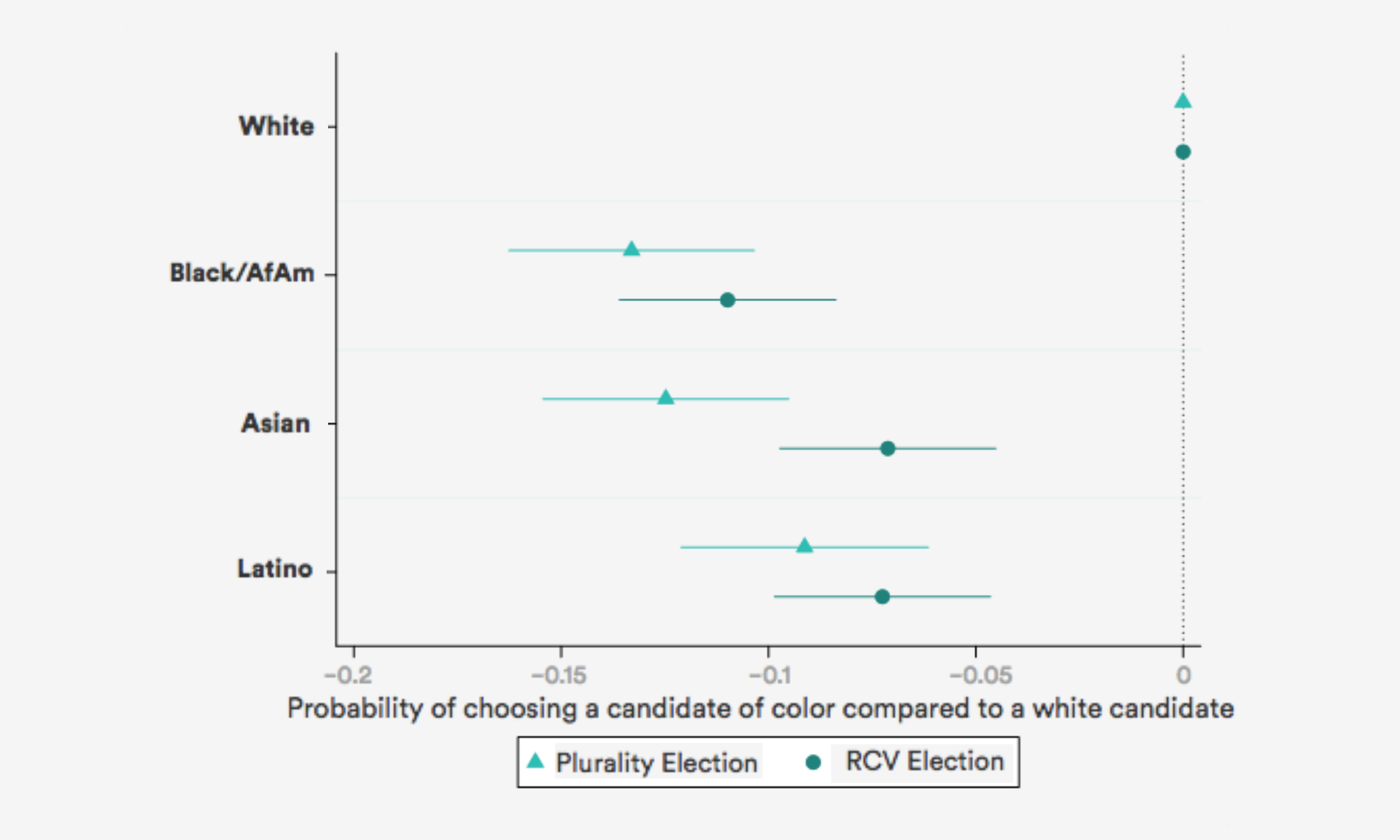
We find that this dispreference for candidates of color is driven nearly completely by ideological moderates and conservatives as well as by white respondents. We also find that adding partisan labels significantly reduces the penalty candidates of color face among voters in both RCV and plurality elections.
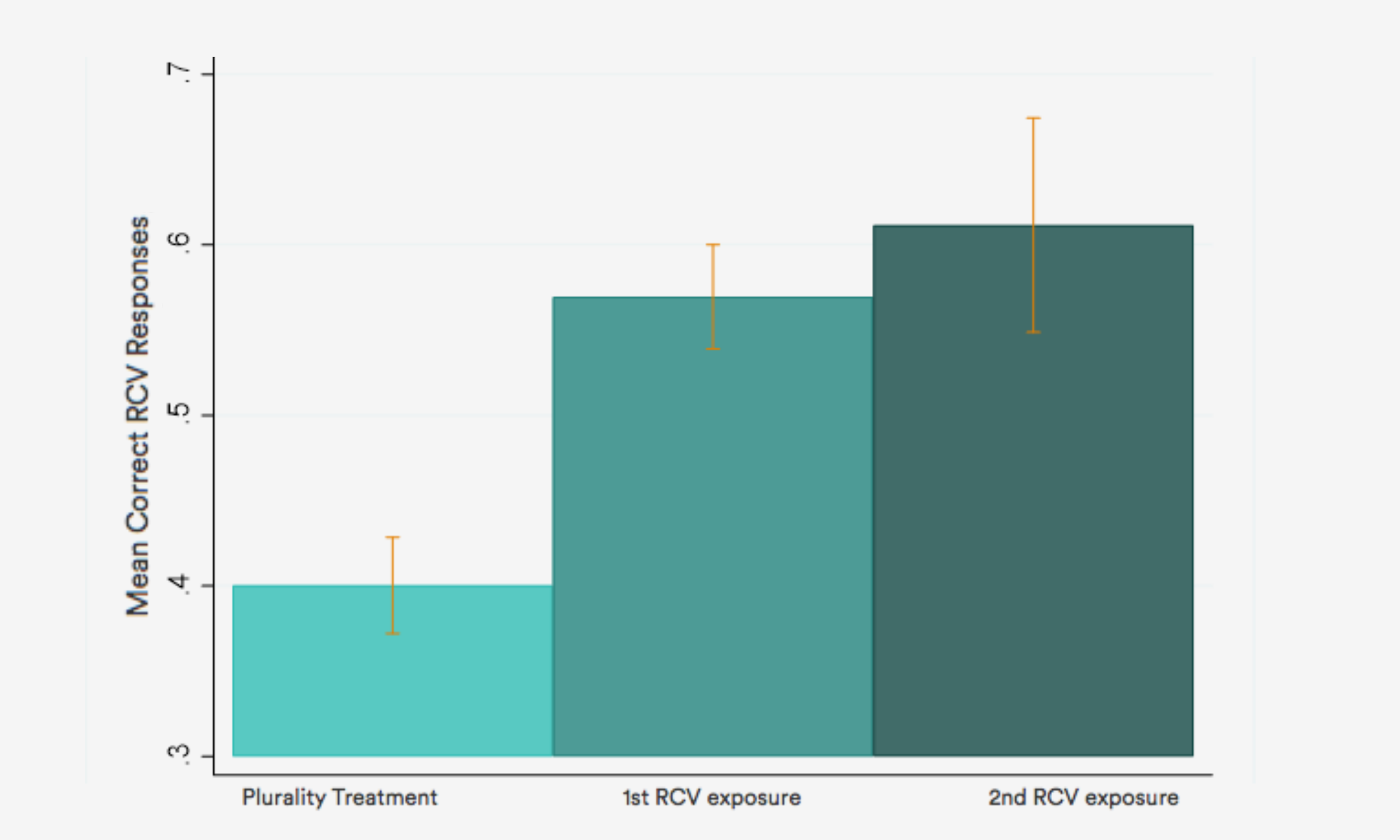
About 15 percent of our sample voted in a second set of RCV elections six weeks after the first wave of the experiment. Even with more RCV experience, we continue to see a penalty for candidates of color. However, among respondents who displayed a high level of understanding of ranked-choice voting, penalties for candidates of color were significantly lower. At the highest level of knowledge, respondents selected candidates of color at the same rate as they selected white candidates. And voting in an RCV election in our survey—during which respondents were provided with an explanation of how RCV elections work—significantly increased respondents’ understanding of how RCV works. We asked respondents how voters express their candidate preferences and how winners are determined. Figure 2 shows the average number of correct responses for each treatment group.
Conclusion
As ranked-choice voting expands to additional localities across the United States, it is important to evaluate how this type of election structure affects the candidates on the ballot and the voters choosing between these candidates. We investigated whether RCV elections affect the disproportionate representation by race and ethnicity present in American elections. While more complex electoral environments have been shown to negatively affect voter support for candidates of color, this outcome seems not to be triggered by the rules governing RCV elections. Rather, voters in RCV elections and those in plurality elections support candidates of color at similar (low) rates, perhaps because the process of ranking candidates requires voters to slow down their thinking and thus move beyond reflexive stereotypes and prejudices when casting their ballots. Furthermore, the provision of additional information, like partisan affiliation, that leads voters in plurality elections to support candidates of color and white candidates at closer rates appears to work similarly in RCV contexts. Thus, while ranked-choice elections may have a variety of effects on election outcomes, political parties, or voter attitudes (such as satisfaction with and trust in the election process), they seem not to affect the likelihood of voters supporting candidates of color.
At the same time, the fears of some observers that RCV elections will be too difficult for voters to understand also appear unfounded. In our experiments, voters were initially less trusting of the electoral process when they voted in RCV elections, but these negative attitudes disappeared with more experience. Further, the relatively brief practice with RCV provided in our experiments led respondents to be significantly more likely to understand how RCV elections work.
We conclude that ranked-choice voting is not likely to dramatically reshape local election outcomes for candidates of color. However, if jurisdictions want to implement RCV for other reasons, such as increasing satisfaction with the electoral process or changing candidates’ strategic calculations, voters should be able to learn and adapt to the new system.
Acknowledgments: We would like to thank New America for its generous support of this work through the ERRG initiative, with support from Arnold Ventures. The views expressed in this report are those of its authors and do not necessarily represent the views of the funders, their officers, or their employees.
Evaluating the Effects of Ranked-Choice Voting
- Introduction (Lee Drutman and Maresa Strano)
- Support for Ranked-Choice Voting across Race and Partisanship (Joseph Anthony, David C. Kimball, Jack Santucci, and Jamil Scott)
- Ranked-Choice Voting is an Acquired Taste (Joseph Anthony and David C. Kimball)
- Does Ranked-Choice Voting Reduce Racial Polarization? (Yuki Atsusaka and Theodore Landsman)
- Ranked-Choice Voting is No Refuge for Extreme Candidates (Melissa Baker)
- The Future is Proportional: Improving Minority Representation through New Electoral Systems (Gerdus Benadè, Ruth Buck, Moon Duchin, Dara Gold, and Thomas Weighill)
- Choosing to "Vote As Usual" (André Blais, Carolina Plescia, and Semra Sevi)
- Ranked-Choice Voting and Political Expression: Voter Guides Narrow the Gap between Informed and Uninformed Citizens (Cheryl Boudreau, Jonathan Colner, and Scott MacKenzie)
- Ranked-Choice Voting, Runoff, and Democracy: Insights from Maine and Other U.S. States (Joseph Cerrone and Cynthia McClintock)
- RCV is Neither Panacea nor Catastrophe for Minority Representation (Melody Crowder-Meyer, Shana Kushner Gadarian, and Jessica Trounstine)
- Electoral Systems Affect Legitimacy Gaps and Affective Polarization (Sean Fischer, Amber Hye-Yon Lee, and Yphtach Lelkes)
- Multi-seat Districts and Larger Assemblies Produce More Diverse Racial Representation (Michael Latner, Jack Santucci, and Matthew S. Shugart)
- Ranked-Choice Voting Delivers Representation and Consensus in Presidential Primaries (Baodong Liu, Nadia Mahallati, and Charles M. Turner)
- More Expression, Less Error: Alternative Ballots Outperform Status Quo (Jason Maloy)
- Does Ranked-Choice Voting Affect Attitudes Toward Running for Office? (Jamil Scott and Jack Santucci)
- The Missing Link: RCV and Substantive Representation in Local Politics (Arjun Vishwanath)