A Chapter of: Evaluating the Effects of Ranked-Choice Voting
Ranked-Choice Voting, Runoff, and Democracy: Insights from Maine and Other U.S. States (Joseph Cerrone and Cynthia McClintock)
Ranked-Choice Voting, Runoff, and Democracy: Insights from Maine and Other U.S. States
By Joseph Cerrone and Cynthia McClintock
Citations
Working paper: Joseph Cerrone and Cynthia McClintock, “Ranked-Choice Voting, Runoff, and Democracy: Insights from Maine and Other U.S. States,” January 19, 2021, available at SSRN: https://ssrn.com/abstract=3769409.
Brief: Joseph Cerrone and Cynthia McClintock, Ranked-Choice Voting, Runoff, and Democracy: Insights from Maine and Other U.S. States (Washington, DC: New America, 2021), https://www.newamerica.org/political-reform/reports/ranked-choice-voting-runoff-and-democracy/.
Overview
This research takes advantage of the recent implementation of ranked-choice voting (RCV) in Maine to compare three alternative electoral rules—RCV, runoff, and plurality—at the federal level. Across a set of 12 competitive 2020 federal elections, the electoral arena in Maine under RCV was more open to new parties and candidates than elsewhere under runoff or plurality, and one candidate broke the national pattern of ideological polarization. Yet, in the context of Maine’s political history, these gains were modest. Further, RCV has been fiercely opposed by Maine’s Republican Party, especially after the 2018 congressional election, in which a Democratic candidate unseated a Republican incumbent in a “come-from-behind” victory. (In a come-from-behind victory under RCV, the winner of the first-preference votes loses after the allocation of additional-preference votes.) In a survey experiment assessing American voters’ satisfaction with the three electoral rules, many voters did not understand the problem of an election won by a candidate without majority support; and, they were much less satisfied with a come-from-behind victory under RCV than under runoff. The results suggest advantages for runoff versus RCV and challenges in the implementation of RCV—but challenges that can be addressed through greater familiarity and understanding of the new rule.
Research Questions
- At the federal level, do runoff and RCV open the electoral arena to new parties and candidates, encourage ideological moderation, and increase voters’ satisfaction with the election results?
- If so, does runoff or RCV perform better?
Key Findings
- Across a dataset of 12 competitive 2020 federal elections, third-party and independent candidates fared better (but still poorly) under RCV than under runoff or plurality.
- Of the 33 candidates included in the dataset, the most ideologically moderate was a Republican candidate from Maine, who ran under RCV.
- In a survey experiment, U.S. voters were less satisfied with election results under RCV than under runoff or plurality. Voters were not dissatisfied with the election of a candidate without majority support under plurality, but they were very dissatisfied with a come-from-behind victory under RCV, much more so than under runoff. (A come-from-behind victory under runoff is when the first-round runner-up wins the second round.)
- The overall modest advances under RCV and runoff in 2020 may be explained by (1) the highly polarized nature of national politics, and (2) the time it takes for candidates and voters to acclimate to new electoral rules.
Background and Research Design
As partisan polarization and public dissatisfaction with government continue to rise in the United States, many political analysts have called for an end to the standard of plurality voting, in which the candidate with the most votes, but not necessarily the majority, is elected. Two leading alternatives are ranked-choice voting (RCV) and runoff. With RCV, voters rank candidates in order of preference; if no candidate wins a majority in the first round, the second choices from the candidate with the fewest first choices are counted, and so on until one candidate wins a majority. Under runoff, a second round among the top two candidates is held if no candidate reaches a certain threshold in the first round, usually 50 percent. In the United States, RCV is increasingly recommended and implemented. Around the world, runoff is the most common rule for presidential elections.
To analyze the effects of the three rules on openness of the electoral arena to new parties and candidates, ideological moderation, and voter satisfaction, we used a variety of research methods. We secured 10 virtual interviews among knowledgeable persons in the state of Maine, which became the first state to adopt RCV in 2016, and the first to use it for state and federal elections in 2018. Interviewees spanned current and former political candidates (including Independent candidate Lisa Savage, who ran for the U.S. Senate in 2020), journalists, and lawyers.
To assess the openness of the electoral arena and ideological moderation, we identified and compared a set of 12 competitive federal election cases (based on Cook Political Report ratings as of summer 2020). We included only competitive elections, because they are the only conditions that truly test the rule. There were only two competitive elections under RCV (Maine’s Senate and 2nd Congressional District) and only five competitive elections under runoff (Georgia’s regular Senate election, Georgia’s special Senate election, Georgia’s 6th Congressional District, and California’s 21st and 25th Congressional Districts). For the plurality cases, we included the two competitive elections in Iowa (its Senate and 1st Congressional District) and in North Carolina (its Senate and 8th Congressional District) because Iowa and North Carolina are deemed similar to Maine and Georgia respectively by FiveThirtyEight. For an additional plurality case, we included the Senate race in Colorado on the basis of the competitiveness criterion.
Then, to assess voters' satisfaction with the three rules, we conducted a survey experiment of U.S. voters nationwide. Any survey in Maine alone would have reflected the strong partisan divisions in the state over RCV. The Maine Republican Party’s opposition to RCV reflects in part its hostility to a come-from-behind victory under RCV, a hostility that intensified after a Democrat won Maine’s 2nd Congressional District seat in a come-from-behind victory in 2018. To explore this controversy, our survey experiment asked voters about their satisfaction with electoral results that simulated the results of this controversial election. The survey was fielded on a sample of 3,471 registered voters via Amazon Mechanical Turk (MTurk) from October 19 to November 8, 2020.
Findings and Implications
Openness of the Electoral Arena to New Parties and Candidates
The electoral arena was more open to non-Democratic/non-Republican candidates under RCV than under runoff or plurality. In elections we studied, the percentage of the vote for third-party and independent candidates was the largest (6.7 percent) in Maine. Further, Independent Lisa Savage was the only non-Democratic/non-Republican candidate to achieve 5 percent in the election result. Under runoff, Libertarian Shane T. Hazel in Georgia achieved 5 percent in pre-election polls, but did not reach that percentage in the election result. In every case under plurality, the vote for non-Democrat/non-Republican candidates was below 5 percent and no candidate achieved 5 percent in in pre-election polls. Among the Maine interviewees, there was consensus that the openness of Maine’s electoral arena was due in good part to RCV. Still, 6.7 percent of the vote for third-party and independent candidates is not a large number, and RCV did not lead to more openness in Maine’s 2nd Congressional District race. Besides RCV, Maine’s strong tradition of independent candidates could also explain its relative openness.
Even under RCV, the headwinds against third-party and independent candidates were strong. First, amid the intense nationwide partisan polarization and the high stakes of the 2020 election, the political space for such candidates was narrow. Second, the effects of RCV were still not fully understood in Maine and potential candidates still did not want to be “spoilers.” Several of our interviewees expected that a come-from-behind victory under RCV would be challenged by Maine’s Republican Party. They also suggested that a mainstream Democratic candidate, such as Sara Gideon, likely worried that she would be tarred as co-opted by the “radical left” if she reached out to a former Green candidate, such as Savage.
Ideological Moderation
We calculated an ideology score for each candidate in our dataset based on their positions on nine policy issues, and considered their scores against the three electoral rules.
On the surface, Maine’s candidates’ scores are consistent with RCV’s promise of greater ideological moderation. Among the 33 candidates evaluated, Sen. Susan Collins (R-Maine) was by far the most moderate; among the four Democrat and Republican candidates in Maine, only one was more than .25 points more extreme than the candidate’s party’s average. We also found that while the set of Democratic and Republican candidates under RCV and plurality approximated similar distances from their parties’ average scores, the set of Democratic and Republican candidates under runoff was more extreme. Still, historically, Maine has been a stronghold not only for independent candidates but also for moderate Republicanism. Indeed, on a measure of ideology based on roll call votes in the Senate, Collins was more moderate prior to the adoption of RCV in Maine in 2016 than after its adoption.
Overall, these results suggest that it is difficult for a single electoral rule in specific states to counter a strong national trend towards ideological extremes. Although Collins won the Maine Senate election, she was predicted to lose, and most analysts attributed her grim prospects to the difficulties of ideological moderation in 2020. In contrast to Collins, Georgia’s Kelly Loeffler, previously considered a Republican moderate, submitted to the right’s increasing domination of the Republican Party. Whereas Collins was not challenged in the Maine Republican primary, Loeffler was competing in the special election’s first round not only against Democrats but also against a staunchly pro-Trump Republican, Doug Collins. Loeffler believed she had to move right to capture the pro-Trump vote. Among the Democratic candidates in this runoff election, Rev. Raphael Warnock was endorsed by former President Barack Obama and soared in the polls; the most moderate candidate, Ed Tarver, did not gain traction.
As mentioned above, under runoff in Georgia, Libertarian candidate Shane Hazel achieved 5 percent in pre-election polls. Hazel had a moderate ideology score, however this score was an amalgam of some far-right positions (on gun control, for example) and some far-left positions (on drugs, for example). While the Libertarian Party is the strongest emerging party in the United States, its specific policy positions are not “at the center.”
Voter Satisfaction
In our survey experiment, we assessed voters’ satisfaction with election results under the three rules. The key treatments were the three rules (plurality, runoff, and RCV) and the likelihood or actuality of a come-from-behind victory. We then combined seven indicators of satisfaction—usability, comprehensibility, fairness, transparency, representativeness, legitimacy, and support—into a single “satisfaction score.” Given the nonrepresentative nature of the sample, we controlled for such factors as age, education, and political affiliation.
As Figure 1 shows, voters were relatively satisfied with both plurality and runoff, but less satisfied with RCV. With RCV, there was a significant decrease in satisfaction relative to plurality. Also, voters were much less satisfied with a come-from-behind victory under RCV than under runoff. To our surprise, voters were not troubled by the election of a winner without majority support under plurality (the likely come-from-behind victory treatment).

Party affiliation was a major indicator of satisfaction with RCV. Republican voters were more likely to oppose RCV; 51 percent of Republicans were dissatisfied with the electoral results under RCV versus 42 percent of Independents and 37 percent of Democrats. Similarly, the satisfaction score with the results under RCV was twice as negative for Republicans than Independents, and eight times more negative for Republicans than Democrats. Republicans’ dissatisfaction appeared tied to a preference for the status quo and opposition to change. Responding to a question in the survey experiment, 65 percent of Republicans reported opposition to changing U.S. electoral rules versus 36 percent of Independents and 12 percent of Democrats.
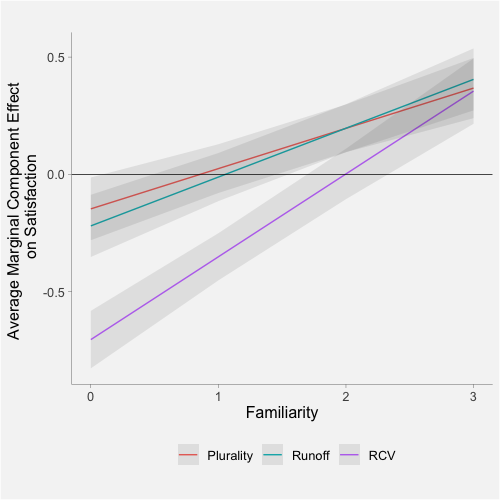
Familiarity with the electoral rule to which respondents were exposed was also an important variable. Most voters were not familiar with RCV, but familiarity mattered much more for satisfaction with RCV than with plurality or runoff (see Figure 2). While a lack of familiarity has a negative impact on satisfaction for all three rules, this effect is significantly larger for RCV than for plurality or runoff. Yet, there is no difference in effect among those “very familiar” with the rule. This suggests that voters do indeed “learn to like” RCV and become more satisfied with it over time.
Conclusion
The promises of a more open electoral arena and of ideological moderation under RCV were upheld in Maine’s 2020 federal elections. Still, the gains were modest, especially in the context of Maine’s political traditions. The effects of both RCV and runoff were limited by the intense political polarization in the United States today, among other factors.
In Maine, RCV has been very divisive, especially due to controversy about come-from-behind victories. Meanwhile, voters nationwide are less satisfied with RCV than with runoff or plurality. Many voters are not troubled by the election of a candidate without majority support under plurality and are skeptical of the remedy for this problem—a come-from-behind victory—slightly so under runoff and significantly so under RCV.
Often, change is hard; it takes time for voters and political actors to adapt to new electoral dynamics. Fortunately, this study provides some hope that with greater explanation of the problems of plurality and the rationale for come-from-behind victories, runoff or RCV will be increasingly adopted across the United States.
Acknowledgments: We would like to thank the Electoral Reform Research Group at New America and Arnold Ventures for their generous support of this work. The views expressed in his report are those of its authors and do not necessarily represent the views of New America and Arnold Ventures, their officers, or their employees. We would also like to thank Alison Thomas and Jordan Ramsay, undergraduate students at George Washington University, for research assistance. Additionally, we appreciate the ten knowledgeable persons who shared their time and views on Maine politics and RCV with us in virtual interviews.
Evaluating the Effects of Ranked-Choice Voting
- Introduction (Lee Drutman and Maresa Strano)
- Support for Ranked-Choice Voting across Race and Partisanship (Joseph Anthony, David C. Kimball, Jack Santucci, and Jamil Scott)
- Ranked-Choice Voting is an Acquired Taste (Joseph Anthony and David C. Kimball)
- Does Ranked-Choice Voting Reduce Racial Polarization? (Yuki Atsusaka and Theodore Landsman)
- Ranked-Choice Voting is No Refuge for Extreme Candidates (Melissa Baker)
- The Future is Proportional: Improving Minority Representation through New Electoral Systems (Gerdus Benadè, Ruth Buck, Moon Duchin, Dara Gold, and Thomas Weighill)
- Choosing to "Vote As Usual" (André Blais, Carolina Plescia, and Semra Sevi)
- Ranked-Choice Voting and Political Expression: Voter Guides Narrow the Gap between Informed and Uninformed Citizens (Cheryl Boudreau, Jonathan Colner, and Scott MacKenzie)
- Ranked-Choice Voting, Runoff, and Democracy: Insights from Maine and Other U.S. States (Joseph Cerrone and Cynthia McClintock)
- RCV is Neither Panacea nor Catastrophe for Minority Representation (Melody Crowder-Meyer, Shana Kushner Gadarian, and Jessica Trounstine)
- Electoral Systems Affect Legitimacy Gaps and Affective Polarization (Sean Fischer, Amber Hye-Yon Lee, and Yphtach Lelkes)
- Multi-seat Districts and Larger Assemblies Produce More Diverse Racial Representation (Michael Latner, Jack Santucci, and Matthew S. Shugart)
- Ranked-Choice Voting Delivers Representation and Consensus in Presidential Primaries (Baodong Liu, Nadia Mahallati, and Charles M. Turner)
- More Expression, Less Error: Alternative Ballots Outperform Status Quo (Jason Maloy)
- Does Ranked-Choice Voting Affect Attitudes Toward Running for Office? (Jamil Scott and Jack Santucci)
- The Missing Link: RCV and Substantive Representation in Local Politics (Arjun Vishwanath)