Evaluating the Effects of Ranked-Choice Voting
Abstract
As ranked-choice voting (RCV) continues to spread across America, activists, voters, election officials, and state lawmakers want to know more about the effects of adopting RCV and other voting systems on participation, processes, partisanship, policy, and power. Recognizing the need for more—and more publicly accessible—research on electoral reform, New America’s Political Reform program formed the Electoral Reform Research Group (ERRG) with partners at the American Enterprise Institute, the Unite America Institute, and Stanford University’s Center on Democracy, Development, and the Rule of Law.
This collection of ERRG research includes 15 original studies, presented here as a series of briefs. The full papers are available to download for free on the Social Science Research Network website.
Acknowledgments
We would like to thank Arnold Ventures for its trust and support throughout this process.
A sincere thanks to Didi Kuo, Avi Green, Kevin Kosar, Tyler Fisher, Nick Troiano, Mark Schmitt, and the Electoral Reform Research Group advisory board for their immense contributions to the research in this series, beginning with the time and effort they put into selecting and workshopping the original project proposals.
We are also grateful to our Political Reform colleagues and our colleagues from the communications, events, and finance teams, for making this work possible. They include but are not limited to Joe Wilkes, Maria Elkin, Naomi Morduch Toubman, Samantha Webster, Elena Souris, Lizbeth Lucero, Shaena Korby, Jewel Stafford, Narmada Variyam, and Angela Spidalette.
Downloads
Introduction (Lee Drutman and Maresa Strano)
Introduction
By Lee Drutman and Maresa Strano
Since San Francisco adopted ranked-choice voting (RCV) for municipal elections in 2002, the alternative voting system has captured the imagination of political reformers across the United States. As of November 2021, 43 jurisdictions used some form of RCV in their most recent election.1 This includes over 20 cities in Utah, which are using various forms of RCV as part of a temporary pilot program created by the state legislature. Even more places, including the state of Alaska, plan to use RCV in their next election. In addition, in the 2020 elections, RCV was used in five states’ presidential primaries and caucuses, and the Republican Party of Virginia embraced RCV for their 2021 nominating convention.
As ranked-choice voting continues to spread across America, activists, voters, election officials, and state legislators want to know more about the effects of switching from plurality voting to RCV and adopting other election reforms. How would it change how people are represented, who runs for office, how they run for office, who turns out to vote, and who wins? How might governance and policymaking change as a result? They also want to know what the public thinks about ranked-choice voting, or might think about it once they learn more.
New America’s Political Reform has long recognized the need for more—and more publicly accessible—research into the ways that RCV and other electoral reforms impact political participation, power, processes, partisanship, and policy outcomes. In 2019, we formed the Electoral Reform Research Group (ERRG) with partners at Stanford University’s Center on Democracy, Development, and the Rule of Law; the Scholars Strategy Network; and the R Street Institute, and set out to organize a new body of work from political scientists around the country and overseas. Since 2020, the ERRG organizing committee has included Stanford’s CDDRL, the American Enterprise Institute, and the Unite America Institute.2
When we began this project, the research available on RCV was limited, particularly scholarly research. While much of it suggested positive effects, including more civility, more voter satisfaction, and more diverse candidates, other research suggested that it may complicate voting for lower-income and minority voters. And some research found it does not change much either way. Meanwhile, dramatic claims about RCV were spreading and growing louder. On the one hand, advocates were touting the method’s ability to deliver transformative benefits that could save our democracy; on the other, opponents were insisting that the added cognitive burden of a ranked system would suppress voting and lead to sky-high rates of ballot rejection, especially among those who are already underrepresented or prone to voting error.
To better inform the public and lawmakers about ranked-choice voting, we sought to expand on and fill gaps in this emerging literature. Our call for proposals asked for projects examining RCV’s benefits, as well as the costs and challenges. All electoral systems have trade-offs, after all, and we should know what they are.
With the help of our advisory board, we selected 14 proposals from a blend of veteran and emerging political scientists to develop into full-fledged research. Topics covered include minority representation, voter satisfaction, information and complexity, moderation and ideological representation, and polarization. We refined the proposals at a research development workshop that brought together all 14 research teams, as well as members of the organizing and advisory committees—many of them RCV and political reform practitioners—for a full day of presentations, discussion, and community-building. We then reconvened in June 2021 to share and discuss the findings of what turned out to be a 15-paper collection. Together, we identified remaining gaps and tensions, and set a course for future research that takes advantage of new data and developments in the electoral reform movement at large.
Consistent with previous RCV research, most of the studies in this series found RCV to be either a comparable or modestly better alternative to our standard "first-past-the-post" or plurality method (in which the candidate who gets most votes, but not necessarily the majority, wins). For example, results indicate that switching from first-past-the-post (FPTP) to single-member RCV produces small improvements in terms of political expression,3 voter error,4 and attitudes about system legitimacy;5 and mostly null effects in terms of minority representation,6 racial polarization,7 candidate emergence,8 and policy responsiveness.9 In the case of extremism, two studies that considered whether RCV supports moderate (or extreme) candidates were split between positive10 and neutral effects11 compared to traditional methods.
Some of the studies highlighted circumstances under which RCV might perform worse than FPTP and even majoritarian runoffs. However, most of them tell a similar story about a (reasonably) solvable problem: status quo bias.
American voters tend to prefer more familiar rules like plurality and even two-stage runoffs, absent a convincing reason for change. In particular, older voters and Republicans show less satisfaction with RCV.12
Dissatisfaction is also sometimes associated with less understanding of the way RCV operates, compared to more familiar voting systems.13 The status quo bias and accompanying reported difficulties in understanding tend to be impervious to explanations of how RCV works, and even common arguments for and against RCV. These include claims that RCV elects majority winners and helps elect women and people of color, and, on the negative side, that RCV is too confusing.14
Yet most of the studies that identified these problems also suggested that experience with RCV increases voters' satisfaction with and understanding of the system. Andre Blais, Carolina Plescia, and Semra Sevi,15 and Joseph Cerrone and Cynthia McClintock16 found that people who start off uneasy about RCV can “learn to like” the system through repeated exposure. Melody Crowder-Meyer, Shana Kushner Gadarian, and Jessica Trounstine found that voters’ initial negative feelings about and difficulty understanding RCV largely went away after participating in a second series of ranked-choice contests.17 Cheryl Boudreau, Jonathan Colner, and Scott MacKenzie observed that providing voter guides significantly narrowed gaps in ranking utilization between voters of different levels of political knowledge, and helped voters to better align their candidate rankings with their policy views.18
Despite some variation in results among the studies that focused on how voters evaluate and use RCV, they all validate the conventional wisdom that sustained voter education—before, during, and even after initial implementation—is the sine qua non of any effective and equitable reform process. They also suggest that voter education should prioritize outreach to older voters, as well as others who may feel stronger loyalty to the status quo, like Republicans outside of major metro areas or communities of color residing in minority-majority districts.
The takeaways on messaging are also important. In national surveys, explanations of the mechanics of RCV do not appear to influence how voters evaluate the system.19 Joseph Anthony and David Kimball recommend messengers emphasize “the shortcomings of current voting rules as well as the mechanics and rationale for new rules.”20 While more research is needed to understand the efficacy of such messaging on voter ratings of RCV, on the question of how RCV messaging affects attitudes toward candidate entry, Jack Santucci and Jamil Scott found that communicating how RCV contrasts with FPTP led to greater interest in running for office among Black respondents (though not other racial groups).21 In addition, survey data suggests the argument that RCV is too confusing might not be as compelling as RCV critics think. Nonetheless, messengers should be mindful of how that argument could be weaponized against voters, and especially Black voters.22
On a methodological note, the studies in this series that examine how Americans evaluate RCV underscore a clear divergence in the small but growing body of research on this topic. When Americans who don’t know RCV are exposed to it in an experimental setting and asked to rate the system, the majority tend to prefer the status quo plurality method—at least at first. Conversely, research conducted outside this series indicates that, in places where RCV has already been implemented, voters tend to prefer RCV to traditional voting systems.23 It is important to understand that for most voters, RCV is still something different and strange, and a single survey experiment can only capture this initial reaction. For now, then, we should maintain a healthy skepticism of experiments that measure respondents’ preferences for RCV versus other voting systems. Still, these surveys offer important insights into how different types of voters might initially respond to ranking and how advocates can both better respond to initial hesitation and design educational resources. Anyone embarking on a new campaign to implement RCV or any new voting method needs to understand that at this point, most voters—not only the most change-resistant groups highlighted—are likely unaware and skeptical, and will need convincing that there is a better way to vote. Such research can also serve as benchmarks for future studies. If national efforts to improve the popularity of RCV are successful, we should observe changes in receptivity to ranked-choice voting in these kinds of surveys and experiments.
The chief takeaways from the 15 papers in this collection are: 1) RCV is learnable; 2) its effects on participation and representation are mainly small but tend to be positive compared to FPTP; and 3) replacing FPTP with RCV without addressing the other structural drivers of America’s hyperpolarized and inequitable two-party system, including single-member districts, is unlikely to bring about the large-scale change we need to repair our national political dysfunction. Put another way, adopting RCV will not hurt as much as you might fear, but it may not help as much as you might hope.
RCV proponents may be disappointed by this pattern of mostly “null to small” effects. And certainly, results like these are unlikely to spur an indifferent citizen to start volunteering for an RCV-enactment campaign, or even reinvigorate current activists. Nevertheless, when you consider how fear of change—and the unintended consequences that often accompany change—can strangle political reform movements, the fact that these projects did not surface any significant new problems with RCV is encouraging.
The “lack of bad news” headline applies especially to the representation of people of color. Of all the projects that explored RCV’s impacts on people of color, none found that replacing FPTP with RCV disadvantages minority voters or candidates.
For instance, Crowder-Meyer et al. found that respondents voting in simulated nonpartisan local elections penalized candidates of color at similar rates under plurality and RCV rules, and these rates were similarly diminished when partisan labels were introduced. The authors concluded, “While more complex electoral environments have been shown to negatively affect voter support for candidates of color, this outcome seems not to be triggered by the rules governing RCV elections.”24
Meanwhile, communicating how RCV promotes diversity in political representation does not hurt support for RCV or lower interest in running for office generally, although it may not help much either. One survey found that pro-diversity messaging around RCV increased support for RCV among most survey respondents, the exception being, unsurprisingly, white Republicans.25 A separate survey that tested (among other things) whether diversity messaging affects attitudes about running for office reported mostly null results; however, the idea that women and people of color are more electable under RCV did lower Latino respondents’ interest in running, suggesting there is a need for more nuanced messaging within communities of color about whom RCV benefits.26
Again, a leading claim by RCV opponents is that the added complexity of ranked and other alternative ballots exacerbates existing racial disparities in voting error. Through large-scale online experiments conducted at the height of the 2020 U.S. presidential primary season, Jason Maloy examined how different ballot types affect the likelihood that some voters will cast more void votes (votes that don’t count toward the final result) than others.27 He concluded that alternative ballot types actually reduced inequalities in void votes between BIPOC and white voters.28
Our findings suggest that although RCV alone likely cannot deliver the representational diversity that many advocates promise, better and more proportional representation may be achievable by combining RCV for single offices with proportional RCV for multi-member bodies, also known as the single transferable vote. Indeed, the most significant conclusions from the research suggest that proportional systems and other structural features—district size and assembly size—that support meaningful multiparty representation are best for minority representation.29 (Of course, to get to a place where proportional, multiparty democracy is feasible, we first need to replace single-member districts, which are currently used for the U.S. House of Representatives and most state legislative chambers, with multi-member districts.)
To review, there are two main forms of RCV: single-winner and multi-winner. With single-winner RCV—the type used most often in the United States—voters rank candidates in order of preference. If one candidate receives a majority of first-preference votes, that candidate is the winner. Otherwise, the race goes to an “instant runoff”: the candidate with the fewest first-preference votes in the first round is eliminated and voters who ranked that candidate first have their ballots transferred to their second-choice candidate. The process repeats until one candidate wins a majority.
Multi-winner RCV, also known as single transferable vote (STV), is a form of proportional representation used for electing bodies like city councils, legislatures, and school boards. Under STV, candidates are again ranked in order of preference, and those who receive a predetermined share of votes (also known as the “quota” or “threshold”) win seats. Any candidates that meet the quota in the first round of voting are elected and surplus votes (votes beyond the quota they needed to win) are reallocated to voters’ next choice. If more candidates than seats remain after the first round, the lowest-ranked candidate is eliminated and voters who ranked that candidate first have their votes transferred to their next choice. This process continues until all seats are filled.30
Single- and multi-winner RCV (referred to from this point on as RCV and STV, respectively) are virtually identical in terms of basic ballot design. Where they differ technically is in their win thresholds, or minimum number of votes required to win a seat. While the threshold in a standard RCV election is always a simple majority (50 percent plus one), the threshold in an STV election changes based on the number of seats that need to be filled. The standard formula for calculating the threshold is simple: divide 100 percent by the number of seats, plus one. For instance, if there are three seats up for election on a city council and 100 votes cast, the threshold a candidate must meet to win a council seat is 25 percent plus one, or 26 votes; for a four-seat election, the threshold becomes 20 percent plus one, or 21 votes, and so on.
Technical similarities notwithstanding, STV and RCV produce measurably different effects. The literature on STV, including some of the studies reported here, credits STV with benefits not necessarily offered by single-winner RCV. Specifically, STV appears to confer most of the advantages of proportional representation systems, including more women and BIPOC candidates and winners; higher public trust in elections; broader ideological and partisan representation; and, finally, the near-absence of partisan gerrymandering.
Multi-winner RCV, or STV, appears to be the gold standard for minority representation, consistently outperforming district plurality systems, as discussed in the report by Gerdus Benadè, Ruth Buck, Moon Duchin, Dara Gold, and Thomas Weighill from the MGGG Redistricting Lab at Tufts University.31 The authors underline STV’s capacity to secure stable proportional representation for people of color in comparison to single-member district plurality systems. From their research brief: “SMD systems sometimes shut out a substantial minority group entirely, no matter how the lines are drawn; in other instances, they can produce representation at rates significantly greater than what is proportional for groups that are large enough and whose residential geography is concentrated just right. But advocates face tricky decisions in district-drawing with respect to turnout and residential shifts if they want to produce plans that will hold up over time. These concerns are simply not present in STV, because proportionality is a structural property.”32
But the voting method is not the only structural property that affects political equality. Michael Latner, Matthew Shugart, and Jack Santucci depart, for the moment, from a focus on voting rules to consider the impact of assembly size and district magnitude on BIPOC representation.33 They collected data from cities across the globe to find out how well those features explain representation in terms of population proportionality as well as the number of parties. The paper’s findings suggest that America’s reliance on single-seat districts and plurality election rules limits the number of parties that compete effectively for minority voters. “As a point of comparison, some of the most diverse Australian cities that use multi-seat ranked-choice voting systems (single transferable vote) may not achieve perfect proportional representation, but they nevertheless elect candidates of color from multiple parties.”34
This series also presents some support for the theory that STV (and to a lesser but relevant extent RCV) can help “break the two-party doom loop” that is driving our democracy to the brink—and driving us all crazy.35 America’s political duopoly has thrived under the single-member district plurality regime, infecting us with a dangerous us-vs-them mentality where any win for the other side is felt not just as a loss for your side but as an existential threat to the country’s future. One of the most pernicious effects of the doom loop has been the breakdown of “mutual toleration”—the norm of accepting election results as legitimate even when you lose.36 In exploring how electoral systems affect this norm, Yphtach Lelkes, Sean Fischer, and Amber Hye-Yon Lee found that RCV and (non-STV) proportional systems were associated with a smaller winner-loser gap in satisfaction and perceived fairness of elections compared to plurality.37 They also found that the gap decreased as the number of parties increased (except when moving from three to four parties), and was lowest at five parties.
Lelkes and his colleagues furthermore tested levels of interparty animosity, or affective polarization—the tendency to dislike and distrust members of the other party—under different election systems and number of parties. Affective polarization is potentially destabilizing for any democracy and, as the authors note, one that Americans feel very acutely in the wake of the 2020 presidential election and the January 6 storming of the Capitol. Surprisingly, this study found that plurality systems on their own had less in-group bias than RCV and non-STV proportional systems. However, as more parties were added, interparty animosity declined for RCV and proportional systems, but not plurality. This, according to the authors, implies that “electoral reform that does not lead to a change in the number of parties in a system may make interparty animosity worse.”38 In light of this finding and the key takeaway of the Latner paper, reformers might consider whether creating space for more partisan diversity via increases to assembly size and district magnitude should be seen as prerequisites to implementing STV, or any form of proportional representation for that matter.
For current electoral reform practitioners, the implications of these 15 studies are substantial. Voting rights advocates can take advantage of new methods advanced under these projects for estimating seat-shares for minority groups and levels of racially polarized voting under different electoral systems. Voting educators and election officials can take heart that their work will likely increase satisfaction with, and understanding of, alternative voting systems, and they can reshape their strategies where needed in order to address vulnerabilities and prepare for likely challenges identified in the research. For those involved in communications, national surveys indicate that voters’ opinions are not susceptible to explanations of how RCV works, and it may be necessary to accentuate the flaws of the current system. Administrators and advocates alike who concern themselves with issues related to voting error and voided ballots can cite the findings from two reports that single-vote rules can yield more wasted ballots than RCV.
Moreover, practitioners can use results on the status quo bias and mistrust of “coming-from-behind victories” to fortify plans for targeted education and messaging campaigns, and perhaps consider forums such as citizen assemblies to give residents more opportunities to learn about the benefits and tradeoffs of the reform prior to enactment or implementation. For advocates of proportional systems like STV, these results may alleviate concerns among skeptics of RCV, or even win them over entirely. This is especially true for those who doubt STV’s ability to defend hard-earned representation in single-member districts. At the same time, findings about STV’s promise for minority representation can serve as an entry point into this space for voter equity activists who have long been skeptical of single-winner RCV.
From a research perspective, this collection of studies covered significant ground. Yet the ground itself has shifted since we launched ERRG in late 2019: increased mainstream attention on RCV—mainly owing to well-publicized campaigns in New York City, Alaska, and Massachusetts—has invited more public and pointed critiques of the system. These critiques tend to draw on the same small handful of papers. As the issue’s salience continues to build, we hope that those who report and comment on RCV will use this collection of research to expand their reference repertoires and use the researchers themsleves as resources.
At the same time, the shifting terrain is a reminder of the work left to be done to understand what it would actually look like if America implemented RCV and STV nationwide. Beyond extending and/or validating results already shared, we must also look to Alaska and its unique hybrid of a top-four primary and RCV general election; to new findings from New York City’s introduction of RCV to its primary and special elections in 2021; and to the impacts of RCV on campaign finance. And with more cities implementing RCV and existing RCV cities gaining more experience running RCV elections and then governing within an RCV context (and generating new data points all the while), not to mention the latest round of redistricting, there are more opportunities than ever to explore the interactions between electoral reform and representation, voter satisfaction, polarization, and policy outcomes.
On behalf of the Electoral Reform Research Group organizers, we are proud to present this collection of original research. Below you will find research briefs for the 15 papers we produced for this series, each one broken down into four parts: 1) overview of key questions and findings; 2) background and research design; 3) findings and implications; and 4) conclusion. Suggested citations for the individual working papers and briefs are listed below.
Citations
- Joseph Anthony, David Kimball, Jack Santucci, and Jamil Scott, “Support for Ranked Choice Voting and Partisanship of Voters: Results from a National Survey Experiment,” January 28, 2022, available at SSRN: https://ssrn.com/abstract=4015904; Joseph Anthony, David Kimball, Jack Santucci, and Jamil Scott, Support for Ranked-Choice Voting across Race and Partisanship: Results from a National Survey Experiment (Washington, DC: New America, 2022), https://www.newamerica.org/political-reform/reports/support-for-ranked-choice-voting-across-race-and-partisanship/.
- Joseph P. Anthony and David Kimball, “Public Perceptions of Alternative Voting Systems: Results from a National Survey Experiment,” April 16, 2021, available at SSRN: https://ssrn.com/abstract=3854047; Joseph Anthony and David C. Kimball, Ranked-Choice Voting is an Acquired Taste (Washington, DC: New America, 2021), https://www.newamerica.org/political-reform/reports/ranked-choice-voting-is-an-acquired-taste/.
- Yuki Atsusaka and Theodore Landsman, “Does Ranked-Choice Voting Reduce Racial Polarization? A Clustering Approach to Ranked Ballot Data,” March 9, 2021, available at SSRN: https://ssrn.com/abstract=3800237; Yuki Atsusaka and Theodore Landsman, Does Ranked-Choice Voting Reduce Racial Polarization? (Washington, DC: New America, 2021), https://www.newamerica.org/political-reform/reports/does-ranked-choice-voting-reduce-racial-polarization/.
- Melissa Baker, “Voters Evaluate Ideologically Extreme Candidates as Similarly Electable under Ranked Choice Voting and Plurality Voting,” April 30, 2021, available at SSRN: https://ssrn.com/abstract=3837021; Melissa Baker, Ranked-Choice Voting is No Refuge for Extreme Candidates (Washington, DC: New America, 2021), https://www.newamerica.org/political-reform/reports/ranked-choice-voting-is-no-refuge-for-extreme-candidates/.
- Gerdus Benadè, Ruth Buck, Moon Duchin, Dara Gold, and Thomas Weighill, “Ranked Choice Voting and Minority Representation,” February 18, 2021, available at SSRN: https://ssrn.com/abstract=3778021; Gerdus Benadè, Ruth Buck, Moon Duchin, Dara Gold, and Thomas Weighill, The Future is Proportional: Improving Minority Representation through New Electoral Systems (Washington, DC: New America, 2021), https://www.newamerica.org/political-reform/reports/the-future-is-proportional/.
- Andre Blais, Carolina Plescia, and Semra Sevi, “Choosing to vote as usual,” February 12, 2021, available at SSRN: https://ssrn.com/abstract=3784822; Andre Blais, Carolina Plescia, and Semra Sevi, Choosing to “Vote As Usual" (Washington, DC: New America, 2021), https://www.newamerica.org/political-reform/reports/choosing-to-vote-as-usual/.
- Cheryl Boudreau, Jonathan Colner, and Scott A. MacKenzie, “Ranked-Choice Voting and Political Expression: How Voting Aids Narrow the Gap between Informed and Uninformed Citizens,” March 24, 2021, available at SSRN: https://ssrn.com/abstract=3786972; Cheryl Boudreau, Jonathan Colner, and Scott MacKenzie, Ranked-Choice Voting and Political Expression: Voter Guides Narrow the Gap between Informed and Uninformed Citizens (Washington, DC: New America, 2021), https://www.newamerica.org/political-reform/reports/ranked-choice-voting-and-political-expression/.
- Joseph Cerrone and Cynthia McClintock, “Ranked-Choice Voting, Runoff, and Democracy: Insights from Maine and Other U.S. States,” January 19, 2021, available at SSRN:https://ssrn.com/abstract=3769409; Joseph Cerrone and Cynthia McClintock, Ranked-Choice Voting, Runoff, and Democracy: Insights from Maine and Other U.S. States (Washington, DC: New America, 2021), https://www.newamerica.org/political-reform/reports/ranked-choice-voting-runoff-and-democracy/.
- Melody Crowder-Meyer, Shana Kushner Gadarian, and Jessica Trounstine, “Ranking Candidates in Local Elections: Neither Panacea nor Catastrophe,” January 21, 2021, available at SSRN: https://ssrn.com/abstract=3787548; Melody Crowder-Meyer, Shana Kushner Gadarian, and Jessica Trounstine, RCV is Neither Panacea nor Catastrophe for Minority Representation (Washington, DC: New America, 2021), https://www.newamerica.org/political-reform/reports/ranking-candidates-in-local-elections/.
- Sean Fischer, Amber Hye-Yon Lee, and Yphtach Lelkes, “Electoral Systems and Political Attitudes: Experimental Evidence,” May 12, 2021, available at SSRN: https://ssrn.com/abstract=3803603; Sean Fischer, Amber Hye-Yon Lee, and Yphtach Lelkes, Electoral Systems Affect Legitimacy Gaps and Affective Polarization, (Washington, DC: New America, 2021), https://www.newamerica.org/political-reform/reports/electoral-systems-affect-legitimacy-gaps-and-affective-polarization/.
- Michael Latner, Jack Santucci, and Matthew Shugart, “Multi-seat Districts and Larger Assemblies Produce More Diverse Racial Representation,” August 25, 2021, available at SSRN: https://ssrn.com/abstract=3911532; Michael Latner, Jack Santucci, and Matthew S. Shugart, Multi-seat Districts and Larger Assemblies Produce More Diverse Racial Representation (Washington, DC: New America, 2021), https://www.newamerica.org/political-reform/reports/multi-seat-districts-and-larger-assemblies-produce-more-diverse-racial-representation/.
- Baodong Liu, Nadia Mahallati, and Charles Turner, “Ranked-Choice Voting Delivers Representation and Consensus in Presidential Primaries,” April 9, 2021, available at SSRN: https://ssrn.com/abstract=3822879; Baodong Liu, Nadia Mahallati, and Charles Turner, Ranked-Choice Voting Delivers Representation and Consensus in Presidential Primaries (Washington, DC: New America, 2021), https://www.newamerica.org/political-reform/reports/ranked-choice-voting-delivers-representation-and-consensus-in-presidential-primaries/.
- Jason Maloy, “Voting Error across Multiple Ballot Types: Results from Super Tuesday (2020) Experiments in Four American States,” September 24, 2020, available at SSRN: https://ssrn.com/abstract=3697637; Jason Maloy, More Expression, Less Error: Alternative Ballots Outperform Status Quo (Washington, DC: New America, 2020), https://www.newamerica.org/political-reform/reports/more-expression-less-error/.
- Jack Santucci and Jamil Scott, “Do Ranked Ballots Stimulate Candidate Entry?,” November 8, 2021, available at SSRN: https://ssrn.com/abstract=3956554; Jack Santucci and Jamil Scott, Does Ranked-Choice Voting Affect Attitudes Toward Running for Office? (Washington, DC: New America, 2021), https://www.newamerica.org/political-reform/reports/does-ranked-choice-voting-affect-attitudes-toward-running-for-office/.
- Arjun Vishwanath, “Electoral Institutions and Substantive Representation in Local Politics: The Effects of Ranked Choice Voting,” July 1, 2021, available at SSRN: https://ssrn.com/abstract=3802566; Arjun Vishwanath, The Missing Link: RCV and Substantive Representation in Local Politics (Washington, DC: New America, 2021), https://www.newamerica.org/political-reform/reports/the-missing-link/.
Citations
- FairVote, “Where Ranked Choice Voting is Used,” accessed January 31, 2022, https://www.fairvote.org/where_is_ranked_choice_voting_used.
- New America, “Electoral Reform Research Group,” accessed March 8, 2022, https://www.newamerica.org/political-reform/errg/.
- Cheryl Boudreau, Jonathan Colner, and Scott A. MacKenzie, “Ranked-Choice Voting and Political Expression: How Voting Aids Narrow the Gap between Informed and Uninformed Citizens,” March 24, 2021, available at SSRN: https://ssrn.com/abstract=3786972.
- Jason Maloy, “Voting Error across Multiple Ballot Types: Results from Super Tuesday (2020) Experiments in Four American States,” September 24, 2020, available at SSRN: https://ssrn.com/abstract=3697637.
- Sean Fischer, Amber Hye-Yon Lee, and Yphtach Lelkes, “Electoral Systems and Political Attitudes:Experimental Evidence,” May 12, 2021, available at SSRN: https://ssrn.com/abstract=3803603.
- Melody Crowder-Meyer, Shana Kushner Gadarian, and Jessica Trounstine, “Ranking Candidates in Local Elections: Neither Panacea nor Catastrophe,” January 21, 2021, available at SSRN:https://ssrn.com/abstract=3787548. See also Crowder-Meyer, Melody, and Shana Kushner Gadarian, and Jessica Trounstine, “Voting Can Be Hard, Information Helps,” Urban Affairs Review 56 (January 2020): 124–53, https://doi.org/10.1177/1078087419831074.
- Yuki Atsusaka and Theodore Landsman, “Does Ranked-Choice Voting Reduce Racial Polarization? A Clustering Approach to Ranked Ballot Data,” March 9, 2021, available at SSRN: https://ssrn.com/abstract=3800237.
- Jack Santucci and Jamil Scott, “Do Ranked Ballots Stimulate Candidate Entry?,” November 4, 2021, available at SSRN: https://ssrn.com/abstract=3956554.
- Arjun Vishwanath, “Electoral Institutions and Substantive Representation in Local Politics: The Effects of Ranked Choice Voting,” July 1, 2021, available at SSRN:https://ssrn.com/abstract=3802566.
- Joseph Cerrone and Cynthia McClintock, “Ranked-Choice Voting, Runoff, and Democracy: Insights from Maine and Other U.S. States,” January 19, 2021, available at SSRN: https://ssrn.com/abstract=3769409.
- Melissa Baker, “Voters Evaluate Ideologically Extreme Candidates as Similarly Electable under Ranked Choice Voting and Plurality Voting,” April 30, 2021, available at SSRN: https://ssrn.com/abstract=3837021.
- From this series: Joseph P. Anthony and David Kimball, “Public Perceptions of Alternative Voting Systems: Results from a National Survey Experiment,” April 16, 2021, available at SSRN: https://ssrn.com/abstract=3854047; Andre Blais, Carolina Plescia, and Semra Sevi, “Choosing to vote as usual,” February 12, 2021, available at SSRN: http://dx.doi.org/10.2139/ssrn.3784822; Cerrone and McClintock, “Ranked-Choice Voting, Runoff, and Democracy: Insights from Maine and Other U.S. States”; These findings are consistent with other research, including: Todd Donovan, “Self-Reported Understanding of Ranked-Choice Voting,” Social Science Quarterly 100 (August 2019): 1768–76, https://onlinelibrary.wiley.com/doi/10.1111/ssqu.12651; Joseph A. Coll, “Demographic Disparities Using Ranked‐Choice Voting? Ranking Difficulty, Under‐Voting, and the 2020 Democratic Primary,” Politics and Governance 9 (June 2021), https://doi.org/10.17645/pag.v9i2.3913; Devin McCarthy and Jack Santucci, “Ranked Choice Voting as a Generational Issue in Modern America Politics,” Politics & Policy 49 (February 2021): 33–60, https://doi.org/10.1111/polp.12390; and Jay Wendland and Erin Carman, Ranking Works? An Examination Of Ranked Choice Voting In New York City (Amherst, New York: Daemen College, 2021), https://documentcloud.adobe.com/link/review?uri=urn%3Aaaid%3Ascds%3AUS%3Af8b02b71-90ef-4ba7-8902-6d91f1a581db#pageNum=1.
- Crowder-Meyer, Kushner Gadarian, and Trounstine, “Ranking Candidates in Local Elections: Neither Panacea nor Catastrophe.”
- Anthony and Kimball, “Public Perceptions of Alternative Voting Systems: Results from a National Survey Experiment”; Joseph Anthony, David Kimball, Jack Santucci, and Jamil Scott, “Support for Ranked Choice Voting and Partisanship of Voters: Results from a National Survey Experiment,” November 4, 2021, available at SSRN: https://ssrn.com/abstract=4015904.
- Blais, Plescia, and Sevi, “Choosing to vote as usual.”
- Cerrone and McClintock, “Ranked-Choice Voting, Runoff, and Democracy: Insights from Maine and Other U.S. States.”
- Crowder-Meyer, Kushner Gadarian, and Trounstine, “Ranking Candidates in Local Elections: Neither Panacea nor Catastrophe.”
- One of this study’s more counterintuitive findings is that a lack of political knowledge and/or information about the election was less of a barrier to marking the ballot under RCV than single-choice plurality. That is, regardless of political knowledge, respondents who weren’t provided with voter guides were more like to cast a vote and have it count under RCV. Boudreau, Colner, and MacKenzie, “Ranked-Choice Voting and Political Expression: How Voting Aids Narrow the Gap between Informed and Uninformed Citizens.”
- Anthony, Kimball, Scott and Santucci, “Support for Ranked Choice Voting and Partisanship of Voters”; Anthony and Kimball, “Public Perceptions of Alternative Voting Systems.”
- Anthony and Kimball.
- Jack Santucci and Jamil Scott, “Do Ranked Ballots Stimulate Candidate Entry?”
- Anthony, Kimball, Santucci, and Scott, “Support for Ranked Choice Voting and Partisanship of Voters.”
- See Sarah John and Andrew Douglas, “Candidate Civility and Voter Engagement in Seven Cities with Ranked Choice Voting," National Civic Review 106 (Spring 2017): 25-29, https://www.jstor.org/stable/10.1002/naticivirevi.106.1.0025; Ranked Choice Voting: 2009 City of Minneapolis Municipal Elections (St. Cloud State University Survey, December 2009); Francis Neely, Lisel Blash, and Corey Cook, An Assessment of Ranked-Choice Voting in the San Francisco 2004 Election (Daly City, CA: Public Research Institute, San Francisco State University, 2005); Santa Fe Voters Support Ranked Choice Voting and Have High Confidence in City Elections (FairVote New Mexico, 2018), https://www.fairvote.org/2018_election; Wendland and Carman, Ranking Works? An Examination Of Ranked Choice Voting In New York City.
- Melody Crowder-Meyer, Shana Kushner Gadarian, and Jessica Trounstine, RCV is Neither Panacea nor Catastrophe for Minority Representation (Washington, DC: New America, 2021), https://www.newamerica.org/political-reform/reports/ranking-candidates-in-local-elections/.
- Anthony, Kimball, Santucci, and Scott, “Support for Ranked Choice Voting and Partisanship of Voters.”
- Jack Santucci and Jamil Scott, “Do Ranked Ballots Stimulate Candidate Entry?”
- Jason Maloy, “Voting Error across Multiple Ballot Types: Results from Super Tuesday (2020) Experiments in Four American States,” September 24, 2020, available at SSRN: https://ssrn.com/abstract=3697637; See also, J. S. Maloy and Matthew Ward, “The Impact of Input Rules and Ballot Options on Voting Error: An Experimental Analysis,” Politics and Governance 9 (June 2021): 306–318, https://www.cogitatiopress.com/politicsandgovernance/article/view/3938/3938.
- Jason Maloy, More Expression, Less Error: Alternative Ballots Outperform Status Quo (Washington, DC: New America, 2020), https://www.newamerica.org/political-reform/reports/more-expression-less-error/.
- Michael Latner, Jack Santucci, and Matthew Shugart, “Multi-seat Districts and Larger Assemblies Produce More Diverse Racial Representation,” August 25, 2021, available at SSRN:https://ssrn.com/abstract=3911532.
- This is the most popular and recommended counting method for STV. However, there are others in use, such as block preferential voting, in which ballots for winning candidates are transferred to voters’ next preferred candidates at full value.
- Gerdus Benade, Ruth Buck, Moon Duchin, Dara Gold, and Thomas Weighill, “Ranked Choice Voting and Minority Representation,” February 18, 2021, available at SSRN: https://ssrn.com/abstract=3778021.
- Gerdus Benadè, Ruth Buck, Moon Duchin, Dara Gold, and Thomas Weighill, The Future is Proportional: Improving Minority Representation through New Electoral Systems (Washington, DC: New America, 2021), https://www.newamerica.org/political-reform/reports/the-future-is-proportional/.
- Latner, Santucci, and Shugart, “Multi-seat Districts and Larger Assemblies Produce More Diverse Racial Representation.”
- Michael Latner, Jack Santucci, and Matthew S. Shugart, Multi-seat Districts and Larger Assemblies Produce More Diverse Racial Representation (Washington, DC: New America, 2021), https://www.newamerica.org/political-reform/reports/multi-seat-districts-and-larger-assemblies-produce-more-diverse-racial-representation/.
- Lee Drutman, Breaking the Two-Party Doom Loop: The Case for Multiparty Democracy in America (New York: Oxford University Press, 2020).
- Daniel Ziblatt and Steven Levitsky, How Democracies Die (New York: Crown Publishing Group, 2019).
- Fischer, Hye-Yon Lee, and Lelkes, “Electoral Systems and Political Attitudes:Experimental Evidence.”
- Sean Fischer, Amber Hye-Yon Lee, and Yphtach Lelkes, Electoral Systems Affect Legitimacy Gaps and Affective Polarization (Washington, DC: New America, 2021), https://www.newamerica.org/political-reform/reports/electoral-systems-affect-legitimacy-gaps-and-affective-polarization/.
Support for Ranked-Choice Voting across Race and Partisanship (Joseph Anthony, David C. Kimball, Jack Santucci, and Jamil Scott)
Support for Ranked-Choice Voting across Race and Partisanship
By Joseph Anthony, David C. Kimball, Jack Santucci, and Jamil Scott
Citations
Working paper: Joseph Anthony, David Kimball, Jack Santucci, and Jamil Scott, “Support for Ranked Choice Voting and Partisanship of Voters: Results from a National Survey Experiment,” November 4, 2021, available at SSRN: https://ssrn.com/abstract=4015904.
Brief: Joseph Anthony, David Kimball, Jack Santucci, and Jamil Scott, Support for Ranked-Choice Voting across Race and Partisanship: Results from a National Survey Experiment (Washington, DC: New America, 2022), https://www.newamerica.org/political-reform/reports/support-for-ranked-choice-voting-across-race-and-partisanship/.
Overview
This paper presents the results from a national survey experiment that tests how voters evaluate ranked-choice voting (RCV) as an alternative to the traditional single vote plurality method and in response to common arguments for and against RCV. We examine data collected from the 2020 Collaborative Multiracial Post-Election Survey (CMPS). The survey includes large samples of Latino, Black, Asian American and Pacific Islander (AAPI), and white respondents, allowing for comparisons across ethnic and racial groups.
Research Questions
- How do voters rate RCV compared with single-vote methods?
- If voters hear more about RCV, do they become more favorable?
- Do voter evaluations of RCV vary by race?
- Do evaluations of voting rules vary by party identification?
Key Findings
- Even though both RCV and the single vote tend to receive positive satisfaction ratings, the single vote is rated more positively than RCV among all racial groups.
- Latino, Black, and AAPI respondents rate RCV more favorably than white respondents.
- A longer description of RCV that explains the vote transfer feature does not influence preferences for RCV.
- Communicating that RCV elects more women and people of color boosts support for RCV among Latino, Black, AAPI, and white Democratic respondents.
- Republicans are more opposed to RCV than Democrats, particularly among white respondents.
Background and Research Design
A growing number of state and local jurisdictions in the United States have recently adopted preferential voting rules, known in the United States as ranked-choice voting (RCV). While these reforms are gaining in number, there is only a small evidence base indicating how American voters evaluate RCV rules. For example, the ability to have one’s vote transferred to a second or third choice candidate is a major selling point of RCV, but there is little direct evidence indicating whether American voters really like this feature. When given an explanation of the vote transfer properties of RCV, do American voters actually evaluate RCV more positively? How do Americans respond to other common arguments for and against ranked-choice voting? Do these evaluations vary across racial groups?
We test these open questions in a large survey experiment, using data from an early release of the 2020 Collaborative Multi-racial Post-election Survey (CMPS) conducted April through August of 2021. The CMPS is a very large national sample and includes large subsamples of Latinos, African Americans, and Asian Americans and Pacific Islanders (with roughly 4,000 for each group), which allows us to examine whether evaluations of voting rules vary across racial and ethnic groups. We use a within-subjects design that asks each subject to vote under each voting rule for the same set of hypothetical 2024 presidential candidates, randomizing which respondents receive either short or long descriptions of RCV. The long description emphasized that the winner must reach a majority threshold under RCV rules and that second- and third-choice votes are redistributed to candidates until that threshold is met.
Additionally, respondents received random message treatments of ranked-choice voting, one that stated that RCV promotes diversity in political representation and the other stating that RCV has been shown to increase voter confusion. We then ask respondents to rate their satisfaction with each voting rule and to indicate which rule they prefer.
Findings and Implications
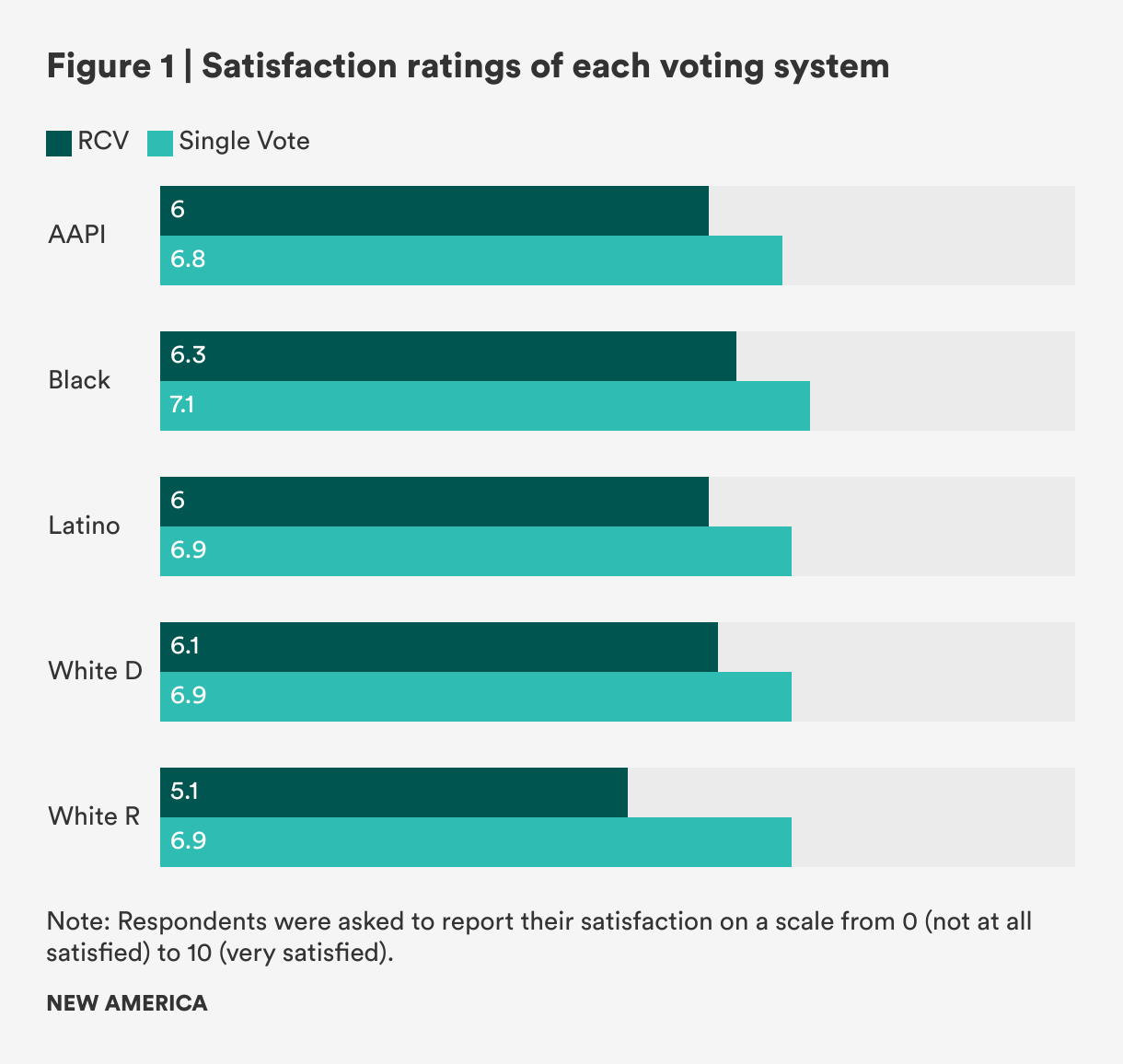
Even though both voting rules (RCV and the traditional single vote) tend to receive positive satisfaction ratings, the single vote is rated more positively than the ranked vote by each racial subgroup (see Figure 1 below). Democrats rate RCV more favorably than Republicans, especially among white respondents. White Republicans rate RCV notably less favorably than white Democrats and other racial groups.
When given a choice between the single vote and RCV, a large majority prefers the status quo option of the single vote. The results of our survey experiment demonstrate that a short explanation of the vote transfer properties of RCV does not increase public support for the voting rule. In fact, providing a more thorough explanation that emphasizes the vote transfer properties of RCV tends to reduce satisfaction ratings by a small but statistically significant amount.
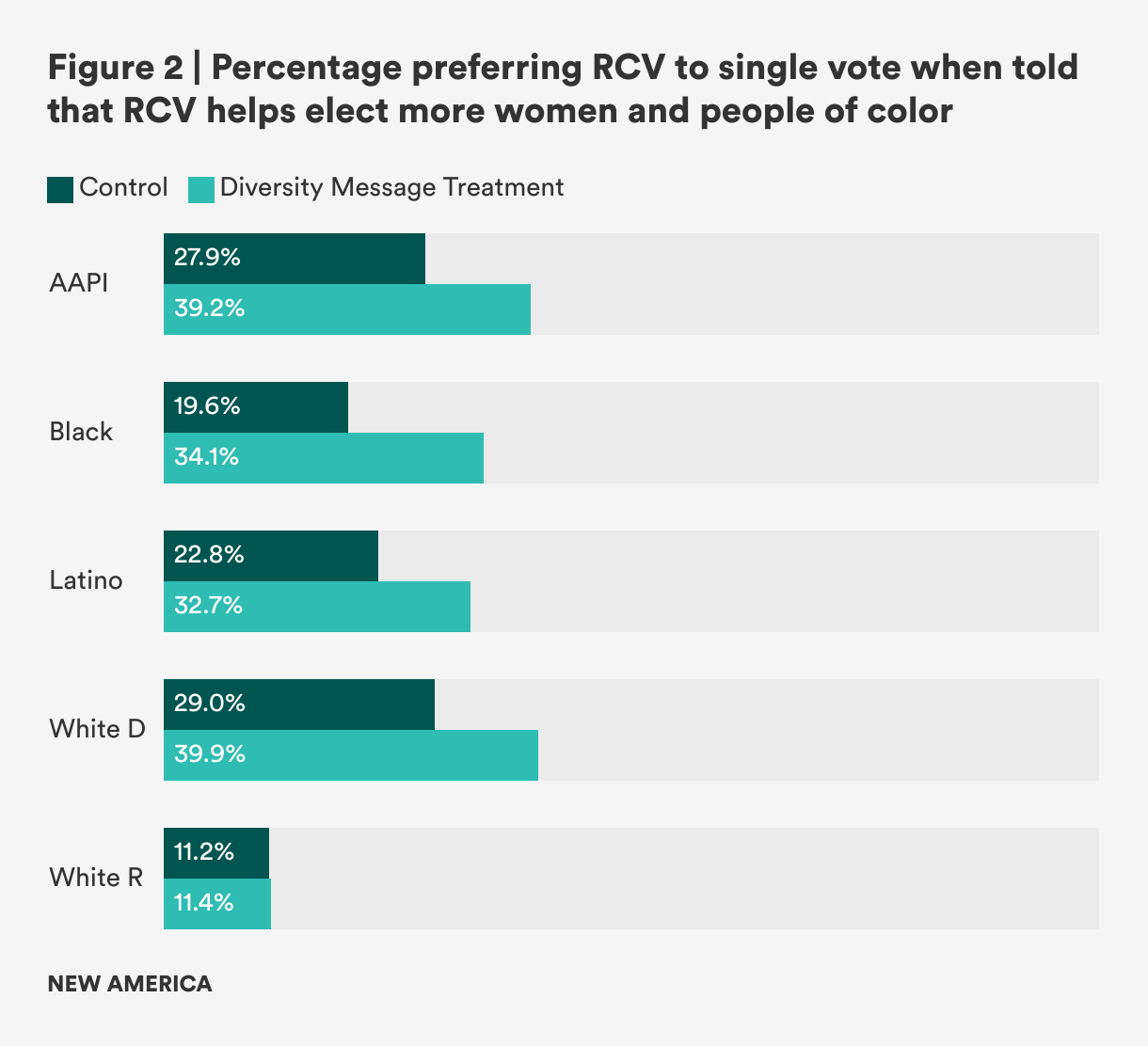
Our study finds that majority preferences for the single vote prevail among representative samples of white, Latino, Black, and AAPI respondents; each subgroup rated the single vote method more favorably than the ranked method. However, Latino, Black, AAPI, and white Democratic respondents evaluate RCV more positively and express a stronger preference for RCV than white Republicans. Furthermore, communicating that RCV helps elect more women and people of color increases preferences for RCV among Latino, Black, AAPI, and white Democratic voters, but not among white Republican voters. The message about voter confusion slightly reduces support for RCV in each subgroup, but the estimated effect is only statistically significant among Black respondents.
As Figure 2 shows, the message that RCV helps increase the number of elected women and people of color boosts preferences for ranked-choice voting by 10 to 15 percentage points among Latino, Black, AAPI, and white Democratic respondents. These are relatively large and statistically significant effects. The message about promoting diversity does not significantly influence preferences for RCV among white Republican respondents.
Conclusion
As more American states and cities consider ranked-choice voting rules, it is important to evaluate them against single-vote plurality rules. Multiple surveys show that Americans rate the single vote method more favorably than ranked-choice voting. These results mean that jurisdictions adopting ranked-choice voting need to prepare for initial resistance from voters who have grown comfortable with the simplicity of plurality rules. A public backlash against new voting rules is more likely to come from white Republican voters than other racial subgroups. Meanwhile, a message noting that ranked-choice voting is confusing, one of the main arguments made by opponents, does not reduce public preferences for RCV by any more than a small amount.
We also find that a brief explanation of the vote transfer features of ranked-choice voting, and the non-majoritarian characteristic of plurality rules, does nothing to increase support for ranked-choice voting. It is a challenge to explain to voters, in a sentence or two, the problems associated with plurality voting rules, like the “spoiler” effect of third-party candidates, or the advantages associated with alternative rules. Repeated communications are likely needed for this information to sink in. Thus, building understanding and support for ranked-choice voting rules likely requires a more sustained campaign.
Acknowledgments: We appreciate feedback on this research from Laura Arnold, Todd Donovan, Lee Drutman, Alex Keena, Cynthia McClintock, and Maresa Strano. We also received valuable guidance from participants at a meeting of the Electoral Reform Research Group in February 2020. Data collection for this project was funded by New America through their ERRG initiative, with support from Arnold Ventures.
Ranked-Choice Voting is an Acquired Taste (Joseph Anthony and David C. Kimball)
Ranked-Choice Voting is an Acquired Taste
By Joseph Anthony and David C. Kimball
Citations
Working paper: Joseph P. Anthony and David Kimball, “Public Perceptions of Alternative Voting Systems: Results from a National Survey Experiment,” April 16, 2021, available at SSRN: https://ssrn.com/abstract=3854047.
Brief: Joseph Anthony and David C. Kimball, Ranked-Choice Voting is an Acquired Taste (Washington, DC: New America, 2021), https://www.newamerica.org/political-reform/reports/ranked-choice-voting-is-an-acquired-taste/.
Overview
We conducted a survey experiment in which respondents participated in a voting task using both the single vote method and ranked-choice method, and then evaluated the two methods. Some respondents were randomly assigned to receive longer descriptions that emphasized the vote transfer and majoritarian features of ranked-choice voting.
Research Questions
- In a national survey sample, how do voters rate the fairness and ease-of-use of ranked-choice voting (RCV) compared with the single vote method?
- If voters are informed about the vote transfer and majoritarian features of RCV, does their support for RCV increase?
Key Findings
- Respondents give the single vote method higher ratings on fairness and ease-of-use measures, and a strong majority prefers the single vote to the ranked vote.
- A short explanation of the vote transfer properties of RCV does not increase public support for that method.
- Younger voters, Democrats, more educated respondents, and third-party supporters tend to evaluate RCV more positively than older voters, Republicans, less educated respondents, and major party supporters.
Background and Research Design
Ranked-choice voting (RCV) is an electoral reform that is gaining support in the United States. RCV has voters rank candidates in order of preference, rather than just selecting one candidate. Several municipalities across the country now use RCV for local contests. Maine adopted RCV through ballot measure for statewide and some federal elections in 2018, and Alaska was the second state to adopt RCV through ballot measure in November 2020. While these reforms are gaining in number, there is still little research indicating how American voters evaluate RCV rules.
American voters have little knowledge of or experience with alternatives to plurality voting rules. This means that they are likely to be influenced by arguments about the positive or negative features of alternative voting rules until they have a chance to vote with those rules. On the positive end, for example, we would expect that emphasizing the RCV's vote transfer and majoritarian properties would increase its public support.
The research measuring support for RCV is limited, but it points to some prevailing factors in public support for and evaluations of RCV, particularly age, education, party affiliation, and prior experience voting with RCV rules. When asking voters to compare RCV with plurality-based voting systems, the evidence is somewhat mixed on which systems voters prefer.39
To date, most experiments testing support for voting rules have used a between-subjects research design, which treats different voting rules as alternative experimental treatments (e.g., one group does a plurality voting task and another group does a ranked voting task) and relies on random assignment to assess whether subject behavior varies by treatment.40 In this study, we use a within-subjects design, which asks each respondent to vote under each voting rule with the same set of candidates, and we randomize the order of voting tasks. A within-subjects design gives voters a more direct comparison of different voting rules with the same set of candidates. This experience may help voters better understand how voting rules differ.
Our sample is from a national survey of American adults conducted as a module on the Cooperative Congressional Election Study (CCES) in 2020 (N=1,000). The CCES survey is administered online and includes pre-election and post-election waves, so it offers two chances to query respondents. In the pre-election wave (conducted from September 29, 2020 to November 2, 2020), we included a voting task featuring five general election candidates for president: the two major party candidates (Donald Trump and Joe Biden) plus three minor party candidates (Howie Hawkins, Jo Jorgensen, and Kanye West). We asked respondents to vote using single vote (plurality) and RCV methods, with the order of voting methods randomized. We then asked respondents how much they like each voting method.
Because we were interested in testing whether informing voters about ballot-counting procedures influences their assessments, we varied the description of plurality and RCV rules before each voting task. One group received short descriptions of plurality and RCV rules (as in many previous studies), while the other group received longer and more complete descriptions of the voting rules.
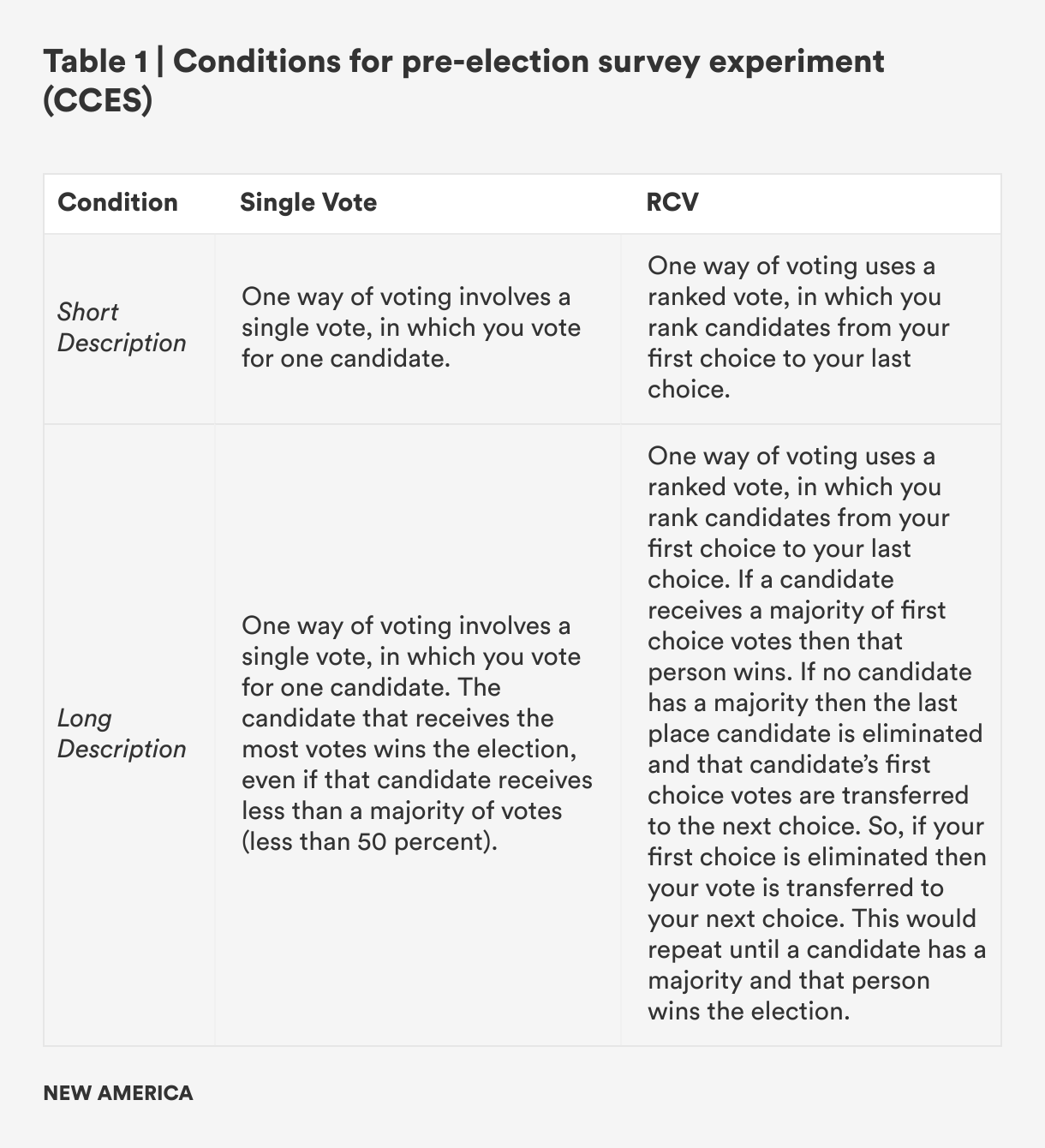
As shown in Table 1, the short description is just one sentence and only describes the task for the voter (e.g., vote for one candidate or rank candidates in order of preference). The longer version adds a couple of sentences describing how votes are counted. For the single vote, the longer description mentions that a candidate can win with less than a majority. For the ranked vote, the longer version includes two important details: (1) that if a voter’s first-choice candidate is eliminated, then the vote transfers to the voter’s next choice; and (2) the retabulation continues until a candidate has a majority of votes. We borrowed language from voter guides in the United States for the longer description of RCV.
After casting their vote with a given method, respondents were asked to use four-point scales to rate the fairness of the voting method and its ease of use. Once they had completed both voting tasks, respondents were asked which voting method they prefer and how important it is for a winning candidate to receive a majority of votes.
Findings and Implications
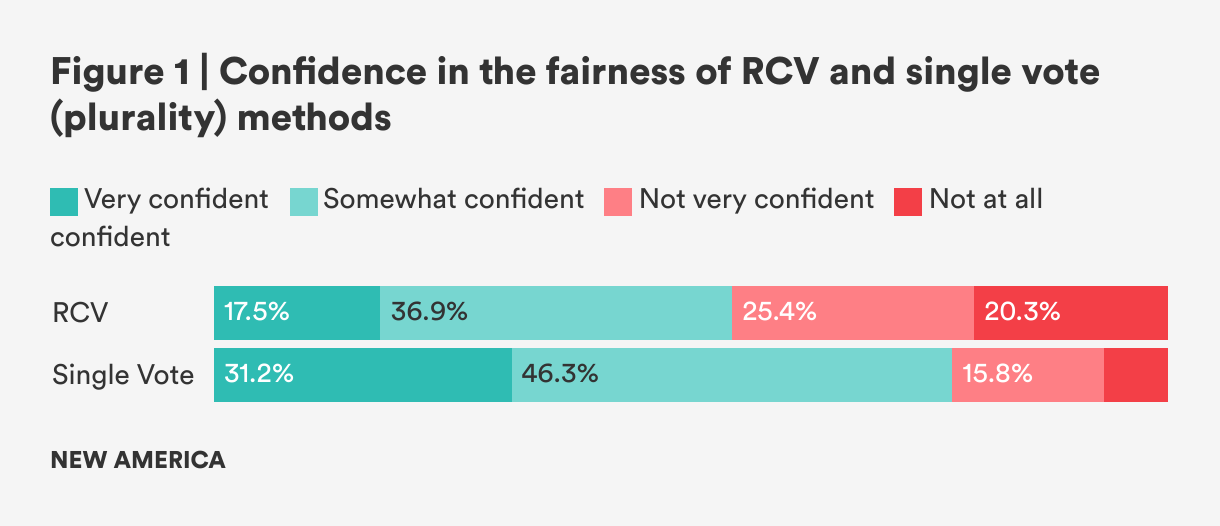
Overall, even though both voting rules tend to receive positive fairness ratings, the single vote is clearly rated more positively than RCV. Contrary to our expectations, providing a more thorough explanation of voting rules that emphasizes the vote transfer properties of RCV does not influence public evaluations of the fairness of either voting rule.
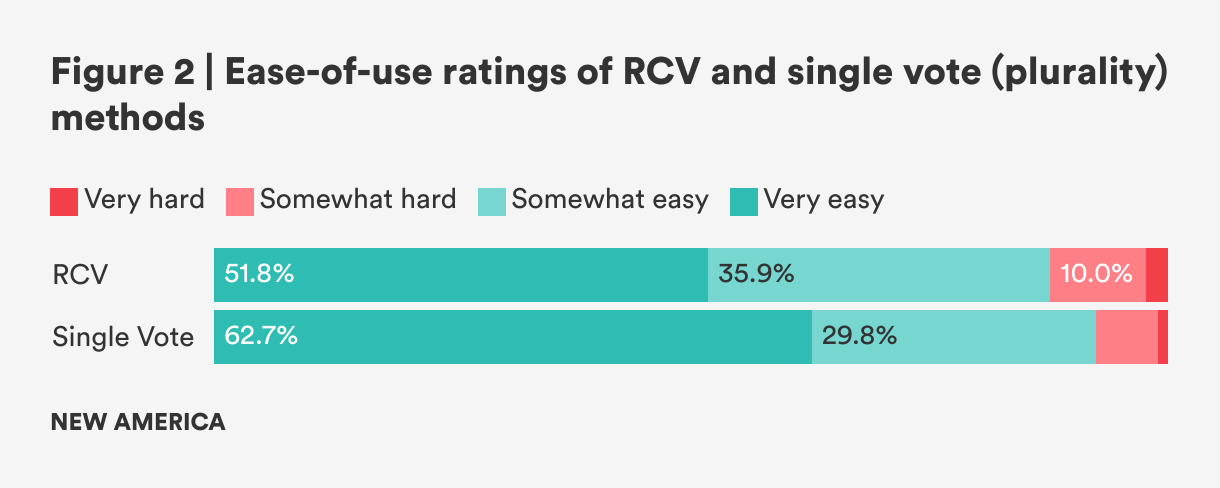
Large majorities find each method very easy or somewhat easy to follow, with the single vote rule earning somewhat higher ratings. Over 70 percent of respondents gave the same rating to both voting rules. Still, the mean rating for the single vote rule (3.54) is significantly higher than the mean rating for the ranked vote (3.37) on a 4-point scale (p<.001).
Asked which voting rule they prefer, 78 percent of respondents chose single vote, and only 22 percent chose ranked-choice voting. But when asked to rate (on a 5-point scale) how important it is for the winning candidate to receive a majority of the vote, 49 percent indicated that a majority winner is very important or extremely important, while just 21 percent reported that it is a little or not at all important.
When we examine the correlates of respondent preferences, age is the strongest predictor of evaluations of both voting rules. Older respondents tend to rate the single vote method as fairer and easier to understand than young voters. Similarly, older respondents express less confidence in the fairness of RCV than younger voters. Among respondents 65 and older, just 6.5 percent prefer RCV to the single vote. Among respondents aged 18-25, slightly more than 40 percent prefer RCV to the single vote. Despite their relative dislike of RCV, we find that older respondents are more likely than younger respondents to see the value in elections that produce a majority winner.
Partisanship is also consistently associated with evaluations of RCV. Democrats tend to rate RCV more favorably than Republicans in terms of fairness and ease-of-use. Party identification is not associated with ratings of the single vote method. Among Republicans, less than 7 percent prefer RCV to the single vote, while 28 percent of Democrats prefer RCV.
We find education to be an important predictor as well. Respondents with higher levels of education tend to give higher ratings of the fairness and ease-of-use of both voting methods. Furthermore, preference for RCV is higher among more educated respondents. Among those with at least a college degree, 31 percent prefer RCV, compared to only 17 percent among respondents with no more than a high school degree. More educated voters are also less likely to see the importance of voting rules that produce a majority winner.
Finally, respondents with a preference for a minor party presidential candidate offer lower ratings of the fairness of the single vote method than other voters, and third-party candidate supporters indicate a stronger affinity for RCV. These results are consistent with other studies that address the wasted vote dilemma confronting minor party supporters in plurality elections.
Conclusion
When given a choice between the single and ranked voting methods, a large majority of survey respondents prefer to stay with the single vote. Respondents also tend to rate the single vote method as fairer and easier to understand than ranked-choice voting. Relatively few respondents seem to understand problems associated with plurality voting rules, like the spoiler effect of third-party candidates.
Likewise, few seem to understand the benefits of RCV. A brief explanation of the vote transfer features of RCV does little to nothing to increase support for that voting rule. Older respondents simultaneously value the principle of majority rule and rate plurality above RCV, which suggests they do not consider the details when evaluating different voting rules, such as whether the rules produce a majority winner.
Jurisdictions that adopt RCV should prepare for initial resistance from voters who are accustomed to the simplicity of plurality rules. A public backlash against new voting rules is likely to come from elderly, Republican, and less educated voters in particular. Meanwhile, younger and more educated voters seem more open to alternatives, as are third-party supporters, who are more likely to see problems with the single vote method and more likely to support RCV.
In sum, these results indicate that building understanding and public support for voting reform may require sustained and targeted efforts to explain the shortcomings of current voting rules as well as the mechanics and rationale for new rules.
Acknowledgements: We appreciate feedback on this research from Laura Arnold, Lee Drutman, and Alex Keena. We also received valuable guidance from participants at a meeting of the Electoral Reform Research Group (ERRG) in February 2020. Data collection for this project was funded by New America through their ERRG initiative, with support from Arnold Ventures.
Citations
- Devin McCarthy and Jack Santucci, “Ranked-choice Voting as a Generational Issue in Modern American Politics,” Politics & Policy 49 (2021): 33-60; Todd Donovan, Caroline Tolbert, and Kellen Gracey, “Self‐Reported Understanding of Ranked‐Choice Voting,” Social Science Quarterly 100 (2019): 1768-1776.
- Melody, Crowder-Meyer, Shana Kushner Gadarian, and Jessica Trounstine. “A Different Kind of Disadvantage: Candidate Race, Cognitive Complexity, and Voter Choice,” Political Behavior 42(2020): 509–53; Lindsay Nielson, “Ranked-choice Voting and Attitudes toward Democracy in the United States: Results from a Survey Experiment,” Politics & Policy 45(2017): 535-70.
Does Ranked-Choice Voting Reduce Racial Polarization? (Yuki Atsusaka and Theodore Landsman)
Does Ranked-Choice Voting Reduce Racial Polarization?
By Yuki Atsusaka and Theodore Landsman
Citations
Working paper: Yuki Atsusaka and Theodore Landsman, “Does Ranked-Choice Voting Reduce Racial Polarization? A Clustering Approach to Ranked Ballot Data,” March 9, 2021, available at SSRN: https://ssrn.com/abstract=3800237.
Brief: Yuki Atsusaka and Theodore Landsman, Does Ranked-Choice Voting Reduce Racial Polarization? (Washington, DC: New America, 2021), https://www.newamerica.org/political-reform/reports/does-ranked-choice-voting-reduce-racial-polarization/.
Overview
To examine whether ranked-choice voting (RCV) improves moderation and reduces racial polarization in the electoral arena, we analyzed a large dataset of ranked ballots and precinct-level data from Bay Area mayoral elections from 1990 to 2020.
Research Question
- Does switching from first-past-the-post (FPTP) to ranked-choice voting (RCV) reduce racially polarized voting?
Key Findings
- RCV implementation does not seem to reduce the level of racially polarized voting for the overall electorate.
- The conclusion holds even after examining each pair of racial groups included in the study (Asian American, African American, Hispanic, and white voters) separately, and using different ways to cluster voters based on their ranked preferences.
- The conclusion remains the same even after taking into account three necessary conditions (co-ethnic voting, no dominant group, and preference for moderate parties) for RCV to reduce inter-group polarization.
Background and Research Design
Ranked-Choice Voting and Moderation Hypothesis
Political scientists have long investigated whether switching from first-past-the-post (FPTP) to ranked-choice voting (RCV) moderates inter-ethnic conflict in the electoral arena in multi-ethnic societies. Under FPTP (also known as winner-take-all or plurality), voters can choose only one candidate and the candidate with the most votes (plurality) wins a single seat assigned to a single district. Under RCV, voters cast ballots by ranking one or more candidates and the candidate with majority support wins either outright or after a series of vote transfers in which the candidates with the fewest first preferences are sequentially eliminated.
Scholars have argued that RCV encourages voting across racial lines because it incentivizes candidates to take more moderate policy positions and rely less on negative campaigning. This is because a competitive RCV candidate in a diverse jurisdiction must appeal not only to voters from her own racial or ethnic group but also those from other groups who may potentially give her their second- or third-preference ballots. In contrast, the same candidate running under FPTP is more likely to be able to win on the support of members of her own group alone. Therefore, there is an expectation that voters’ choices will be less polarized under RCV than under FPTP. Other studies, however, have reported somewhat mixed empirical findings on this "moderation hypothesis." Several researchers, for instance, have argued that RCV can but does not necessarily produce such a moderating effect on ethnically polarized voting patterns.
While previous studies draw different conclusions from various contexts, what they have in common is that they have not directly analyzed all available information contained in individual-level ranked ballots (and whether voters’ preferences are sharply divided along racial and ethnic lines), despite the fact that RCV is the very system that aggregates voters’ ranked preferences. Instead, previous research has either analyzed aggregated election data or voters’ first choices in individual ranked ballots. To fill this gap in the research, we tested the moderation hypothesis by drawing from the literature on rank data analysis in statistics and mathematics to newly collected U.S. election data. Using all available information in individual ranked ballots, tested if RCV implementation mitigated the degree to which voters of different racial groups, including Asian American, African American, Hispanic, and non-Hispanic white voters, systematically support distinct candidates—a phenomenon known as “racially polarized voting” in the literature on minority representation, redistricting, and voting rights.
Bay Area Mayoral Election Data
To test this hypothesis and measure the degree of racially polarized voting, we leveraged data from California’s Bay Area, where four cities—San Francisco, Oakland, San Leandro, and Berkeley—replaced FPTP with RCV for their mayoral elections between 2007 and 2012. We collected data on contested mayoral elections in this region’s 60 most populated cities between 1990 and 2020, including 5.5 million ranked candidate preferences from individual-level ballot data in RCV elections, and candidate vote shares from more than 13,635 precincts in FPTP elections.
Measuring racially polarized voting with ranked ballot data raises unique challenges. The biggest challenge is the vast number of distinct ways voters can “cast a ballot” with RCV. For example, the 2014 Oakland mayoral election featured 16 candidates and voters were allowed to rank up to three candidates. When accounting for voters who ranked their first and second preferences only, voters had 8,178 unique ways of expressing candidate preference in this election. This suggests that, for each pair of racial groups studied, we would need to look at 33,435,753 comparisons of two unique rankings and examine whether voters of different races have different voting patterns (and repeat this for all pairs of racial groups).
To overcome this problem, we applied so-called cluster analysis, or "clustering," to our RCV data. The purpose of using cluster analysis is to categorize and reduce a large number of distinct ranked preferences into a sensible number of “voting blocs” (or clusters) where voters’ preferences are more similar to each other within clusters than across them. Using a statistical model developed for rank data, we estimated three voting blocs in each election and assigned each voter to one of the three clusters based on their ranked ballots. Similarly, we assigned each voter in FPTP elections to one of three voting blocs by whether voters voted for the winner, runner-up, or the other candidates.
Another challenge is that due to secret ballot rules our election data do not include information about voters' self-reported race and ethnicity. To address this issue, we supplemented our election data with demographic data and estimated the number of voters who belong to each cluster for each racial group using ecological inference. We computed the degree of racial polarization based on the results of the ecological inference.
Findings and Implications
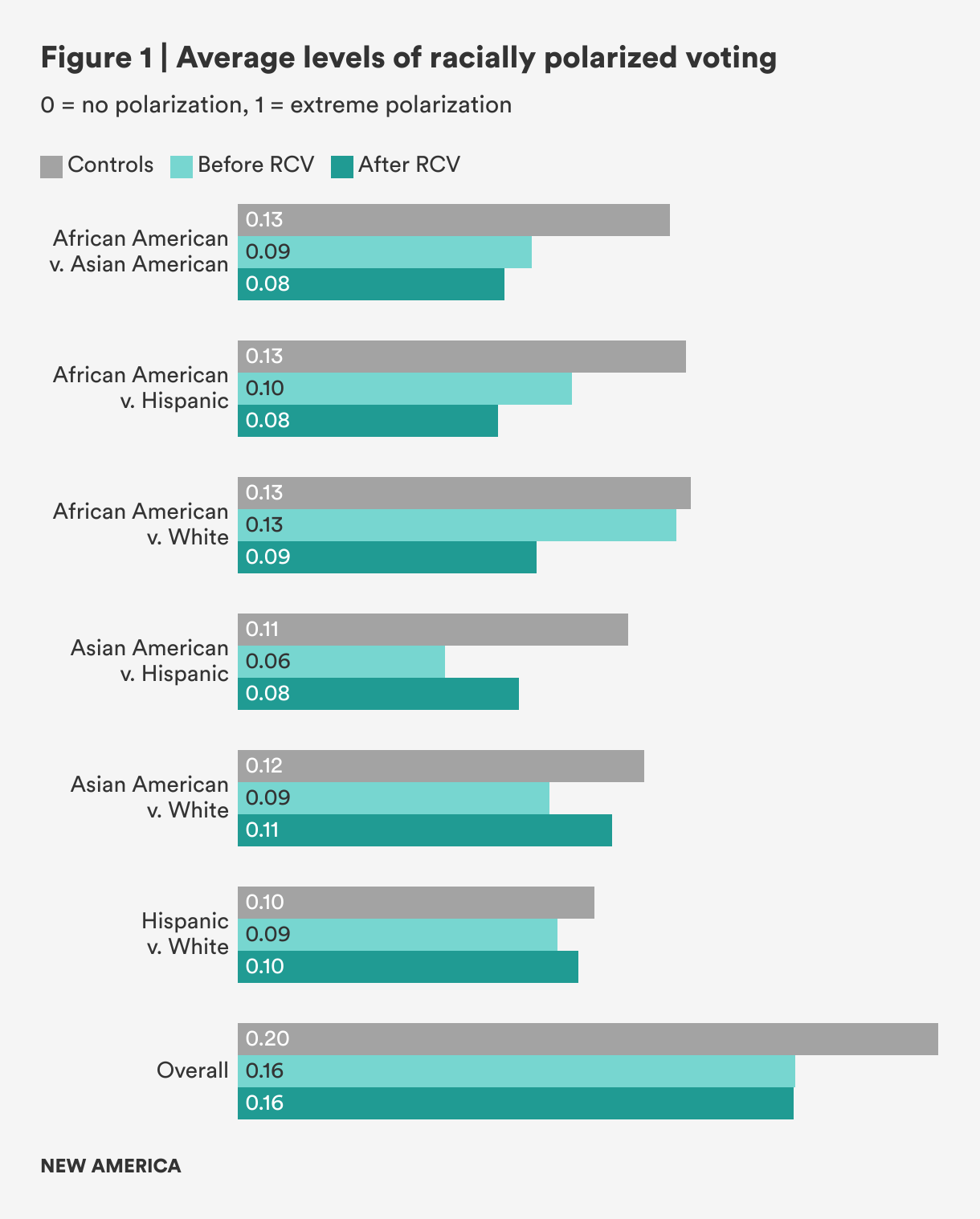
Figure 1 visualizes the average level of racially polarized voting across three types of cities: “Controls” (cities that have never used RCV), “Before RCV” (San Francisco, Oakland, San Leandro, Berkeley before using RCV), and “After RCV” (the four cities after using RCV). On this scale, a score of 0 means that voters of different groups support each candidate at the same proportion (no polarization) and 1 means that they support completely different candidates (extreme polarization).
The top three bars, under “Overall,” show two important findings: (1) the four cities, on average, have a lower level of racially polarized voting than the other cities even before adopting RCV, and (2) it does not appear to decrease after RCV implementation. Similarly, the other bars visualize the average level of racial polarization across the status for each pair of racial groups. While the average scores are lower for RCV elections than for FPTP elections for the overall electorate and some pairs, the difference between the average polarization scores before and after RCV implementation (and between before RCV and control cities) is not statistically large enough to draw a definitive conclusion about such differences.
To ensure that our analysis did not overlook important differences between the four RCV cities and those that have never used RCV, we then accounted for several theoretically relevant factors, such as the proportions of Asian, Black, and Hispanic voters and the level of residential segregation for Asian, Black, and Hispanic residents. Even after accounting for these differences, we found no evidence to support the hypothesis that RCV reduces racially polarized voting. Moreover, we performed multiple robustness checks (the details of which are available in the full paper) by using six different ways to estimate voting blocs in our data. These checks led to the same conclusion.
Investigating further, we looked at three conditions that a group of scholars has articulated as necessary for RCV to reduce inter-group polarization. These conditions are that (1) minority voters prefer co-ethnic candidates, (2) no group numerically dominates the other groups, and (3) voters prefer moderate candidates to more extreme candidates. After accounting for these conditions, RCV implementation still appears not to reduce the degree of racially polarized voting.
Finally, we considered whether the potential presence of strategic ballot concentration—when voters only rank one or two candidates in an attempt to concentrate their voting power to their preferred candidates, a practice also known as "plumping"—may have influenced our empirical analysis. We found circumstantial evidence that some voters may be engaging in plumping by only ranking their top one or two candidates instead of ranking the full slate of three candidates. Specifically, voters on average seem to prefer different ordered sets of candidates depending on how many candidates they rank. Future research should investigate how this behavior impacted our main conclusion.
These results offer several implications for the RCV movement in the United States. Most importantly, our findings suggest that advocates and researchers should not take for granted that local implementation of RCV will automatically diminish the level of racial polarization, at least at the voter level. Additionally, our approach may also help researchers quantify and compare the degree of racially polarized voting under RCV and FPTP for use in redistricting and voting rights cases. Finally, more mathematical and simulation-based research must be done to theorize whether and under what conditions RCV can reduce inter-group polarization in multi-ethnic societies.
Conclusion
The hypothesis that ranked-choice voting induces political moderation remains one of the central arguments for election reform. Analyzing novel data with a unique measurement strategy based on rank data analysis, we attempted to offer direct evidence for the moderation hypothesis focusing on voters’ expressed preferences. Our evidence suggests that switching from first to RCV neither mitigates nor increases the degree of racial polarization among voters. Future research should improve our analysis by bringing a stronger research design for causal identification.
Acknowledgments: I would like to thank New America, the Electoral Reform Research Group, and Arnold Ventures for their generous financial support that enabled the data collection in this research. For helpful comments and valuable feedback, I would like to thank Matthew Hayes, Chris Hughes, Shiro Kuriwaki, Randy Stevenson, and participants of the panels at the MPSA, SPSA, and ERRG workshop.
Ranked-Choice Voting is No Refuge for Extreme Candidates (Melissa Baker)
Ranked-Choice Voting is No Refuge for Extreme Candidates
By Melissa Baker
Citations
Working paper: Melissa Baker, “Voters Evaluate Ideologically Extreme Candidates as Similarly Electable under Ranked Choice Voting and Plurality Voting,” April 30, 2021, available at SSRN: https://ssrn.com/abstract=3837021.
Brief: Melissa Baker, Ranked-Choice Voting is No Refuge for Extreme Candidates (Washington, DC: New America, 2021), https://www.newamerica.org/political-reform/reports/ranked-choice-voting-is-no-refuge-for-extreme-candidates/
Overview
This brief reports the results of a survey experiment assessing voters' responses to ideologically extreme candidates in plurality and ranked-choice elections. Respondents were randomly assigned to two different sets of information about a hypothetical candidate running in an upcoming election: 1) the candidate's ideology and ideological extremity; and 2) whether the candidate would be running under plurality or ranked-choice voting rules. Respondents were asked to report their own ideology and their views on the candidate's electability and representativeness.
Research Questions
- Do ideologically extreme candidates appear as more electable in elections that use ranked-choice voting?
- Do voters change their own identification in response to exposure to extreme candidates?
- Do liberals and conservatives differ in their views on electability?
Key Findings
- Ideologically extreme candidates were not viewed as more electable under ranked-choice voting, compared to plurality voting.
- Moderate and extreme candidates, regardless of ideology, were viewed as similarly electable in elections that use ranked-choice voting and plurality voting.
- Liberals viewed moderate liberal candidates as more electable than extreme liberal candidates, regardless of the election type. Conservatives did not view moderate conservative candidates as more electable than extreme conservative candidates.
Background and Research Design
When evaluating a voting system, it is important to understand the ways in which the system’s rules may help or hurt ideologically extreme candidates. This factor is even more critical in highly polarized political climates like the one we are in currently, which seems to reward candidates who are more extreme than their own voter bases.41
As ranked-choice voting (RCV) continues to spread across the United States, replacing single-vote plurality rules, I sought to understand more about voters’ decision-making processes when faced with extreme candidates under the two systems. Specifically, in RCV and plurality elections, how does an ideologically extreme candidate impact the way voters view their own ideology, the ideological composition of the electorate, and the candidate’s chances at winning an election?
RCV presents voters with an opportunity to consider candidates differently than they would in a plurality election. By asking voters to build a preference list instead of just picking a single preferred candidate, RCV prompts voters to compare candidates in a deeper, more meaningful way, with candidate characteristics becoming more salient in a voter’s consideration. For example, when a candidate is especially ideologically extreme compared to other candidates in an RCV election, their extremity will likely be more noticeable because voters need to pay closer attention to candidate characteristics. This should be especially true for in-party voters, who tend to be more sensitive to coalitional cues from their party. If voters are influenced in some way by this extremity, this may impact how a candidate and/or party runs a campaign, and how we interpret voter behavior in a ranked-choice election.
Social Comparison Theory (SCT) can help us understand how an extreme candidate may influence voters in a ranked-choice election.42 SCT posits that individuals inform their self-concept based on a relational comparison of themselves to others. As people make these comparisons, they may adjust their attitudes and traits in order to be more similar to an optimal social standard (assimilation effect) and/or less similar to a suboptimal social standard (contrast effect). For example, according to SCT, when faced with a suboptimal social standard such as political extremity, individuals should adjust accordingly to distance themselves from that extremity by identifying as more moderate.
In a single-winner plurality setting (in which the candidate with the most votes wins), voters typically have two candidate options and a clear middle ground to gravitate toward in response to extremity. Under RCV, by contrast, voters are more likely to face a handful of candidates representing different places on the ideological spectrum. In this setting, it is likely less clear to a voter in which direction to move ideologically in response to an ideologically extreme candidate. Therefore, it is more difficult for voters to understand what moderating themselves in response to extremity will look like, which direction is moderation when the election includes more than two candidates to evaluate, and what is the optimal ideological trait they should seek to adopt.
Applying SCT to political ideology, political extremity may be considered a suboptimal trait and cause voters to moderate themselves to get some distance from extremity.43 To evaluate this premise, I tested the following hypotheses: H1) when faced with an extreme candidate, voters will report themselves as being more moderate than they would if they were not faced with an extreme candidate; H2) relatedly, because of the cognitive complexity of elections that use RCV, extreme candidates will be viewed as more representative of the electorate in RCV than plurality elections; H3) finally, extreme candidates will be viewed as more electable in ranked-choice elections compared to plurality elections. This is because people can be less strategic (i.e. do not need to choose a single electable candidate) when they can indicate their preference for more than one candidate.
I tested these hypotheses using a survey experiment about a hypothetical political candidate running in a hypothetical upcoming election. Within the experiment, respondents were randomly assigned to two different sets of information: 1) the candidate's ideology (liberal or conservative) and ideological extremity (moderate or extreme), and 2) the type of voting system (plurality or RCV) being used in the upcoming election. Respondents were asked to report their own ideology on a 100 point scale after first reading about the candidate, and were later asked questions on how the candidate would perform in the election (electability) and if the candidate was representative of the electorate (representativeness). Finally, respondents were asked demographic questions including about their political ideology to understand any differences in perceptions between respondents of different ideologies.
Findings and Implications
In partial support of the first hypothesis, I found that liberals, but not conservatives, identified as more ideologically extreme when exposed to an ideologically extreme in-group candidate.
In line with my second hypothesis, extreme candidates were viewed as more representative of the electorate under RCV than plurality. However, this also applied to moderate candidates, and regardless of ideology. In other words, candidates overall were viewed as more representative of the electorate in RCV elections as opposed to plurality elections.
Still, views on representativeness differed by respondent ideology. When considering candidate ideological extremity, liberals saw an extreme liberal as less representative of the electorate than a moderate liberal, regardless of the voting system. Conservatives, meanwhile, showed no difference in perception of representativeness based on extremity in either voting system. These results hold true regardless of the political interest level of the respondents, meaning a person does not necessarily need to have a lot of interest in politics in order to have this perception.
Results also show that moderate liberals and moderate conservatives were viewed as the most electable in both plurality and RCV settings. This is consistent with the conventional wisdom that moderates are perceived as more electable. Meanwhile, perceptions of extreme candidate electability were more complex. Overall, extreme conservatives were viewed as slightly more electable in elections that used plurality voting than they were in elections that used RCV. One way to interpret this finding is that candidates who are extreme conservatives may have a better chance of being elected under plurality rules than under RCV.
Similar to representativeness, views on electability varied by respondent ideology. Among liberals, extreme liberals were seen as less electable regardless of the voting system. Among conservatives, there was no effect of candidate extremity on electability for conservative candidates.
My third hypothesis, that extreme candidates would be viewed as more electable in elections that use RCV, was not supported. These results were consistent regardless of the level of political interest in respondents, indicating that these perceptions are not just isolated to people who are especially interested in politics.


Figure 1 represents results for an election using ranked-choice voting and is broken down by ideology, showing liberal respondents on the left panel and conservative respondents on the right panel. For liberals (left), electability scores are higher for moderate liberal candidates than extreme liberal candidates. For conservatives (right), there is no significant difference in electability between moderate candidates and extreme candidates.
Figure 2 represents results for an election using plurality voting and is broken down by ideology the same way as Figure 1. For liberals, moderate candidates were again seen as more electable than extreme candidates. For conservatives, there was again no significant difference in electability between moderate and extreme candidates.
Conclusion
This research advances our understanding of the psychological mechanisms involved in voting in a ranked-choice voting election, and informs how American voters, accustomed to the national norm of plurality voting, operate in a different information environment. Despite mixed results that RCV alters the way in which voters process and evaluate ideologically extreme candidates, the reform does not appear to create a unique opportunity for more extreme candidates to be elected.
I found that candidates, regardless of ideology or ideological extremity, were seen as more representative of the electorate in elections that used RCV as opposed to plurality voting. However, extreme conservative candidates were seen as slightly more electable in elections that used plurality voting compared to RCV. Liberal respondents viewed extreme liberal candidates as less electable regardless in both plurality and RCV elections, but this effect was especially pronounced in plurality elections. This result suggests that extreme liberal candidates may be slightly less likely to be punished for ideological extremity by liberals in ranked-choice elections. Given that most of the places adopting RCV in the United States skew liberal, one potential implication of these findings is that as RCV continues to spread, ideologically extreme liberal candidates and elected officials may become more common.
Liberals appear to be more sensitive to ideological extremity in that liberals reported as more extreme in their own ideological self-placement in response to extreme liberal candidates. Relatedly, and somewhat counterintuitively, my findings suggest that liberals also see an extreme liberal candidate as being less electable. It is possible that liberals view these extreme in-group candidates as less electable because they view moderation more favorably than conservatives.
Future research should address the ideological asymmetries found in this study. One potential direction is examining why it is that liberals change their perceptions about in-group candidates based on the candidate’s extremity but conservatives do not. Future work should also investigate why voters perceive candidates as more representative in elections that use RCV as compared to plurality voting. Social Comparison Theory does not explain this result, and researchers should dig deeper into the cognitive complexity and other considerations voters face in evaluating candidates within different electoral contexts.
Acknowledgments: I thank New America for its financial support of this work through the Electoral Reform Research Group, with support from Arnold Ventures. I also thank the Electoral Reform Research Group for their workshop comments to assist in project development.
Citations
- John Sides, “Presidential Candidates are Ideologically Extreme. And They Pretty Much Get Away With It,” Washington Post, September 6, 2016; Joseph Bafumi and Michael C. Herron, “Leapfrog Representation and Extremism: A Study of American Voters and Their Members in Congress,” American Political Science Review 104, no. 3 (2010): 519–42.
- Larry Festinger, “A Theory of Social Comparison Processes,” Human Relations 7, no. 2 (May 1954): 117–40.
- Jack Edelson and Frank J. Gonzalez, “I’m (Not) With Stupid: Do Extreme Candidates Help (or Hurt) Their Parties?” 2016, Presented at the 2016 American Political Science Association.
The Future is Proportional: Improving Minority Representation through New Electoral Systems (Gerdus Benadè, Ruth Buck, Moon Duchin, Dara Gold, and Thomas Weighill)
The Future is Proportional: Improving Minority Representation through New Electoral Systems
By Gerdus Benadè, Ruth Buck, Moon Duchin, Dara Gold, and Thomas Weighill
Citations
Working Paper: Gerdus Benadè, Ruth Buck, Moon Duchin, Dara Gold, and Thomas Weighill, “Ranked Choice Voting and Minority Representation,” February 18, 2021, available at SSRN: https://ssrn.com/abstract=3778021.
Brief: Gerdus Benadè, Ruth Buck, Moon Duchin, Dara Gold, and Thomas Weighill, The Future is Proportional: Improving Minority Representation through New Electoral Systems (Washington, DC: New America, 2021), https://www.newamerica.org/political-reform/reports/the-future-is-proportional/.
Overview
The single transferable vote (STV) is a kind of ranked-choice system that is used to elect multiple representatives from a single zone or district. We have developed a realistic data-driven methodology that voting rights advocates can use to project and compare likely minority representation in local government under both STV and the standard system of plurality voting in single-member districts. We demonstrate this method on four case studies: judicial elections in Terrebonne Parish, Louisiana; the county commission of Jones County, North Carolina; and the city councils of Cincinnati, Ohio and Pasadena, Texas.
Research Questions
- How can we estimate the level of representation a minority group will secure for its preferred candidates under a STV system?
- How do we incorporate local information, such as historical election results, into this estimate? In particular, how can we use single-winner electoral history to generate simulated voter rankings?
- How do STV projections compare with a favorably drawn single-member district (SMD) plurality system?
Key Findings
- STV systems tend to elect candidates of choice for people of color (POC) in proportion tothe POC population.
- Compared to STV, the range of representational outcomes in a SMD plurality system is highly sensitive to the size and residential distribution of the minority group.
- SMD plurality’s ability to generate representation for POC is especially questionable in the case of low voter turnout.
Background and Research Design
When it comes to voting, your preferences matter, but how you express those preferences matters deeply as well. For example, in many city council elections in the United States, voters vote for a number of candidates (up to the number of open seats) and the candidates with the most overall votes are elected. Under these at-large plurality elections, if 51 percent of the population votes for the same full slate of candidates, the other 49 percent of voters are left with nothing. Some localities try to break down this effect by using designated seats, where a candidate must choose to run for Seat 4 or Seat 7, say, but is still voted on by all voters. Even with designated seats, however, as long as the majority slate is distributed over the seats, the effect is the same. For this reason, at-large plurality voting has long been acknowledged as a fundamental reason that racial and ethnic minorities in the United States struggle to gain representation on local governing bodies such as city councils or county commissions.
Across the country, jurisdictions have experimented with several alternative electoral systems. The leading alternative in the United States is single-member district (SMD) plurality elections, where the jurisdiction is carved up into territorial divisions electing one representative each by a first-past-the-post or plurality mechanism. This system has been more successful at generating minority representation than at-large plurality systems by creating districts where a much greater proportion of the population belongs to a specific racial or ethnic group than the level in the state or locality overall. Many courts have even called for the creation of majority-minority districts to remedy a pattern of disenfranchisement for a minority group. However, SMD plurality systems also have well-documented flaws. For example, sometimes the residential pattern of the minority group is too dispersed, so that it is not possible to draw a district that is advantageous to that group. SMDs are also subject to gerrymandering.
Instead, multi-winner ranked-choice voting, also called single transferable vote (STV), is a promising alternative voting system that does not rely on districts. Under STV, each voter ranks the candidates rather than just selecting some of them. If a voter’s first choice is elected or eliminated from contention, voting strength is transferred to their second choice, and so on. An algorithm then tallies the ballots in multiple rounds as votes are transferred, until the elected body is complete. Despite its promising features, only one U.S. city, Cambridge, Massachusetts, uses STV for its city council elections today.44
For this project we wanted to compare these two different remedies—SMD and STV—that could result after voting rights litigation aimed at an at-large plurality system.
This task is extremely challenging because there are many unknowns and very little appropriate historical data. With this in mind, we built on existing election analysis tools used in voting rights law and well-studied statistical models of ranking behavior and supplemented these with alternative models. We combined these elements into a three-step method.
Step 1. Learn from historical elections. Look at multiple past elections to measure the level of racial polarization. Voting is racially polarized when a minority group tends to vote cohesively for a candidate of choice, and the majority group votes as a bloc for other candidates. Because of the secret ballot, obtaining the necessary racial and ethnic voter information requires the use of statistical inference. (Here, we used standard ecological inference techniques from voting rights litigation.)
Step 2. Simulate rankings and project STV outcomes. Feed the polarization parameters from Step 1 into four different models to simulate voter behavior in hypothetical STV elections. Each of our models has additional parameters to account for candidate strength—is there a clear favorite among the minority-preferred candidates, for instance, or do voter preferences distribute evenly? Run each model with a range of parameters to produce outputs over a wide variety of plausible scenarios. This provides a more complete picture of the possible outcomes under STV.
Step 3. Compare favorable districting plans. Search the universe of all districting plans (i.e., ways of breaking up the locality into districts) to find configurations with large numbers of majority-minority districts. This gives an indication of how well SMDs might perform under favorable conditions, such as roughly equal turnout between majority and minority voters.45
Findings and Implications
We ran our methodology on four case studies: (1) the judicial court serving Terrebonne Parish, Louisiana, (2) the city council of Cincinnati, Ohio, (3) the county commission for Jones County, North Carolina, and (4) the city council of Pasadena, Texas.
Terrebonne Parish, Jones County, and Pasadena were each recently challenged under the Voting Rights Act for their system of election. In Jones County and Pasadena, these challenges resulted in a change from an at-large system (or in the case of Pasadena, a hybrid at-large and district system) to an SMD system. The plaintiffs in Terrebonne Parish lost on appeal, and so no change was implemented. Additionally, Cincinnati provides an interesting case because it historically employed STV before switching to at-large plurality voting in the 1950s. We specifically chose our four case studies to be diverse in terms of geographic location, size of the governing body, size of the minority group, and voter turnout. Our case studies are far from an exhaustive picture of possible settings for STV, but together with previous work in Santa Clara, California; Chicago, Illinois; Lowell, Massachusetts; and Yakima County, Washington, we are starting to put together a strong portfolio that is varied in scale, demographics, and region.
The table below summarizes the results of the four case studies. We used the proportion of the citizen voting age population (CVAP) belonging to the community of interest (Latino voters in Pasadena and Black voters in the others) as a benchmark for proportional representation.46 The two rightmost columns show the projected levels of POC representation under STV and SMD plurality. Seat share under STV captures the typical range of seat share won by minority-preferred candidates across simulated STV elections. For representation under a SMD plan, we estimated the number of districts which could reliably offer an opportunity to elect POC candidates of choice.47
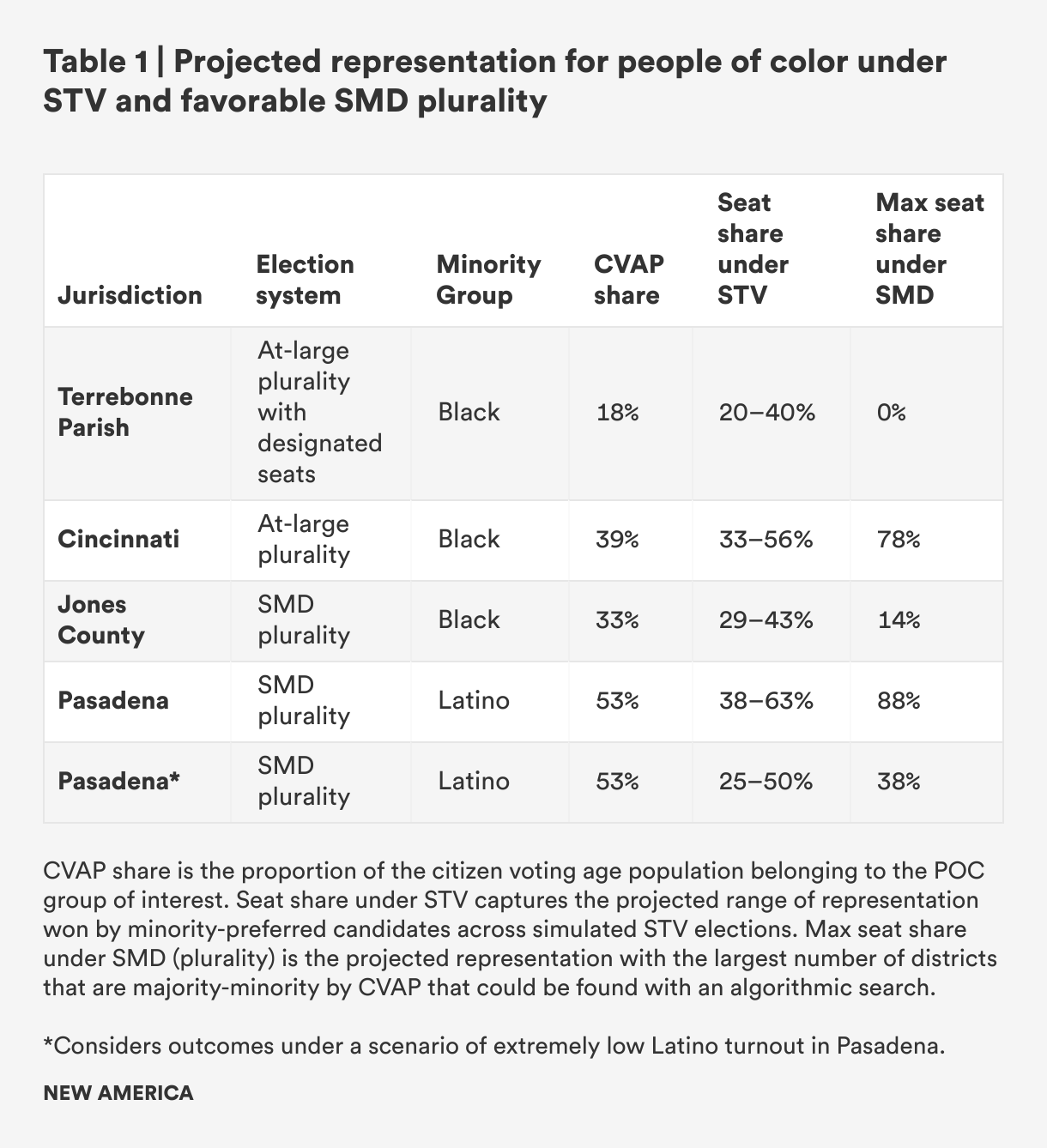
The table illustrates our main finding: across four case studies, multiple statistical models, and a wide range of assumptions, STV indeed projects roughly proportional representation for people of color.
The comparison with the SMD outcomes is stark: our algorithmic search could not find a single plan containing majority-Black districts in Terrebonne Parish, nor any plans that track closely to proportionality in Jones County. This is because the Black population is too small and dispersed in those places for districts to be an effective remedy. On the other hand, the Black population in Cincinnati and the Latino population in Pasadena are large and concentrated, making it possible with careful line-drawing to break through the proportionality ceiling. Such carefully orchestrated districting has major drawbacks, however, because it relies on narrow majorities in each district. The beneficial outcomes are unstable if population shifts over time and are highly vulnerable to the possibility of low minority turnout, as we demonstrate with Pasadena (where low turnout was specifically cited as a major obstacle to Latino representation by the court). In contrast, we find that proportionality under STV holds up under variations like a very low level of Hispanic turnout in Pasadena.
Combining the results of these case studies, a clear picture comes into view. STV will stably and reliably secure representation for people of color in line with their population share, whereas districts can have a wide range of performance. SMD systems sometimes shut out a substantial minority group entirely, no matter how the lines are drawn; in other instances, they can produce representation at rates significantly greater than what is proportional for groups that are large enough and whose residential geography is concentrated just right. But advocates face tricky decisions in district-drawing with respect to turnout and residential shifts if they want to produce plans that will hold up over time. These concerns are simply not present in STV, because proportionality is a structural property.
Conclusion
In this project, we consider the potential for the single transferable vote, a form of multi-winner ranked-choice voting, to better protect voting rights for historically disenfranchised communities, compared to the more standard plurality district approach. Though there is no one-size-fits-all projection for STV outcomes, we have developed a flexible and powerful methodology for exploring the range of outcomes under different models of voter behavior and local electoral conditions which builds on the foundation of established legal practice under the Voting Rights Act of 1965. The early lessons from applying these models in four case studies indicate that while representation under districted plurality systems can vary widely, STV consistently provides proportional (or slightly better) representation for minority groups. The full report presents our method in greater detail and the accompanying web tools (such as this app) allow you to try it for yourself.
Acknowledgments: We are grateful for the suggestions and input from participants of the Electoral Reform Research Group (ERRG) workshop in February 2020. This project was funded by New America through their ERRG initiative, with support from Arnold Ventures. We thank our colleagues in the MGGG Redistricting Lab and at Tisch College for their instrumental support of the project.
Citations
- This is in contrast to single-winner ranked-choice voting, which is used for local elections in about 20 U.S. cities as well as statewide in Maine.
- For this purpose, we use a powerful computational algorithm called ReCom, developed by the MGGG Redistricting Lab. See Daryl DeFord, Moon Duchin and Justin Solomon, “Recombination: A family of Markov chains for redistricting”, arXiv preprint, https://arxiv.org/abs/1911.05725.
- In each of these four jurisdictions, the identified minority group was the only one of significant size.
- In legal settings, majority-minority CVAP districts are a standard stipulation in decisions and consent decrees, even though such districts are an admittedly imperfect proxy for electoral opportunity. Counting POC electeds is not an adequate substitute, both because it ignores the important fact that minority candidates of choice can belong to any demographic group and because of the quirks of candidate availability.
Choosing to "Vote As Usual" (André Blais, Carolina Plescia, and Semra Sevi)
Choosing to "Vote As Usual"
By André Blais, Carolina Plescia, and Semra Sevi
Citations
Working paper: Blais, Carolina Plescia, and Semra Sevi, “Choosing to vote as usual,” February 12, 2021, available at SSRN: https://ssrn.com/abstract=3784822.
Brief: Andre Blais, Carolina Plescia, and Semra Sevi, Choosing to “Vote As Usual” (Washington, DC: New America, 2021), https://www.newamerica.org/political-reform/reports/choosing-to-vote-as-usual/.
Overview
This research brief reports results from two independent yet complementary surveys to examine which voting system citizens prefer. The first survey targeted states that held 2020 Super Tuesday Democratic primaries and used the real candidates, and the second was nationally representative with fictitious candidates. In both surveys, respondents were invited to vote using four different voting rules—single, approval, rank, and point (score)—and then asked how satisfied they were using each system.
Research Questions
- What is the degree of support for single, approval, rank, and point (score) voting systems?
- Which subgroups of the population are most (and least) favorable to each system?
Key Findings
- The single vote remains the most preferred voting method.
- Citizens’ views are strongly correlated with age, with the eldest being much more favorable to the single vote. Surprisingly, these views do not vary across education levels.
- Those who have had personal experience with ranked ballots are more positive toward ranked-choice voting, which suggests the presence of a status quo bias.
Background and Research Design
Electoral reform has resurfaced on the political agenda in the United States. An increasing number of jurisdictions have already switched to ranked-choice voting. Some cities are starting to consider approval voting as well. But, how do citizens assess different ways of voting?
We provide a systematic analysis of citizens’ attitudes towards four different voting systems—single, approval, rank, and point (or score)—based on two separate but complementary surveys conducted in the context of the 2020 Super Tuesday primary elections, one with real Democratic primary candidates and one with hypothetical candidates. The reference point is the single vote, where citizens are asked to vote for one single candidate. The other three options ask voters to cast multiple votes. Under approval voting, voters are invited to vote for as many candidates as they wish, that is, all those that they “approve.” Then there is ranked-choice voting (RCV), where voters are invited to rank the candidates on an ordinal scale, first preference, second, third, and so on. The last option is point voting, also known as score voting. Under such a rule, voters give each candidate points (or scores) and the candidate with the highest number of points (or average score) is elected. The specific system that we used in our study allows voters to give between zero and five points to each candidate.
Among these four voting systems, the one that affords the greatest freedom of expression is the point system (i.e., not only can voters rank the candidates, but they can indicate the intensity of their preferences by giving very low or high scores, and they can also reveal their indifference by giving the same number of points to different candidates), followed by RCV, approval voting, and the single vote. If people value expressiveness in their voting options, they should give the highest rating to point voting and the lowest to single vote. However, people’s ratings may be influenced by “status quo bias”: They may believe that the system that they know the best is the best, regardless of how expressive it is. Among American voters, status quo bias should work in favor of the single vote method, and against the other three options.
To better understand how status quo bias and ballot expressiveness influence Americans’ views on different voting methods, we conducted two studies. Study 1 refers to real candidates from the 2020 Super Tuesday Democratic primary; only citizens eligible to vote in the Democratic primaries were able to participate. The candidates we put on the ballot were the six most prominent candidates at the time: Joseph Biden, Michael Bloomberg, Pete Buttigieg, Amy Klobuchar, Bernie Sanders, and Elizabeth Warren. In Study 2, we used hypothetical candidates, enabling us to measure the views of the entire U.S. population. The names of the candidates are fictional and were chosen to vary in both gender and ethnicity. Respondents were given information on each candidate’s age and top policy priority. Doing the survey with both real candidates in select states and hypothetical candidates nationwide has also allowed us to ascertain the robustness of our findings.
The questionnaire and design were exactly the same for both studies: Participants were asked to vote four times successively, with the same candidates, using each of the four voting systems. The order in which the voting systems appeared was randomized. Evaluations of the four voting systems were tapped in two different ways. First, immediately after casting their vote within a given system, respondents were invited to indicate how satisfied they were with that system on a scale of zero to 10. Second, after they had cast their vote with all four systems, they were asked which one they liked the best.
Findings and Implications
Figure 1 presents the distribution of responses to the questions asked immediately after voters cast their vote for each system. The ratings presented are normalized to take into account the fact that some respondents systematically used higher (or lower) scores. Each score is divided by the total scores given to the four systems and multiplied by 10. For instance, for a person who gives ratings of 8, 8, 4, 0, her normalized scores are 4, 4, 2, 0. In this way, the sum of ratings for the four systems equals 10 for each respondent, and the average rating is 2.5.
The normalized mean rating is 3.36 and 3.08 for the single vote in Study 1 and 2 respectively, compared to 2.22 and 2.31 for the three other options, with little difference between these three within and across the two studies. The results are similar in both studies: The single vote is clearly the most popular way of voting.
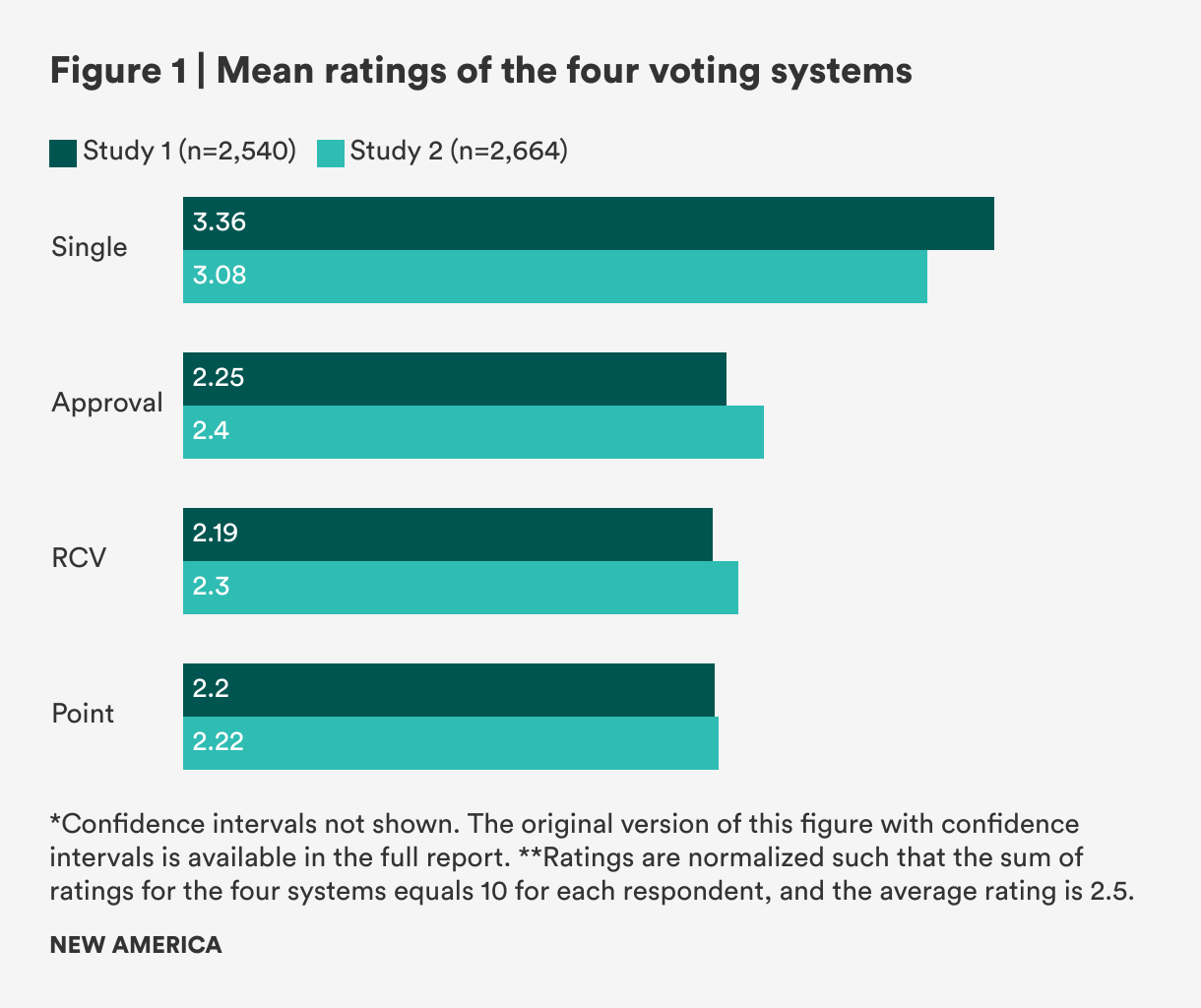
Figure 2 shows the percentage of voters indicating a preference for each voting system at the end of the survey. In both cases, more than 60 percent of the respondents select the single vote and less than 20 percent select each of the three other options. The pattern of preferences is the same as shown in Figure 1 but the contrast between the single vote and the new voting methods is starker. This reflects the fact that many respondents give similar ratings to the various options. Indeed, 46 percent of respondents in Study 1 and 47 percent in Study 2 give their highest ratings to at least two options. Furthermore, these ties usually include the single vote. As expected, most of the time people choose the most familiar option, the single vote.
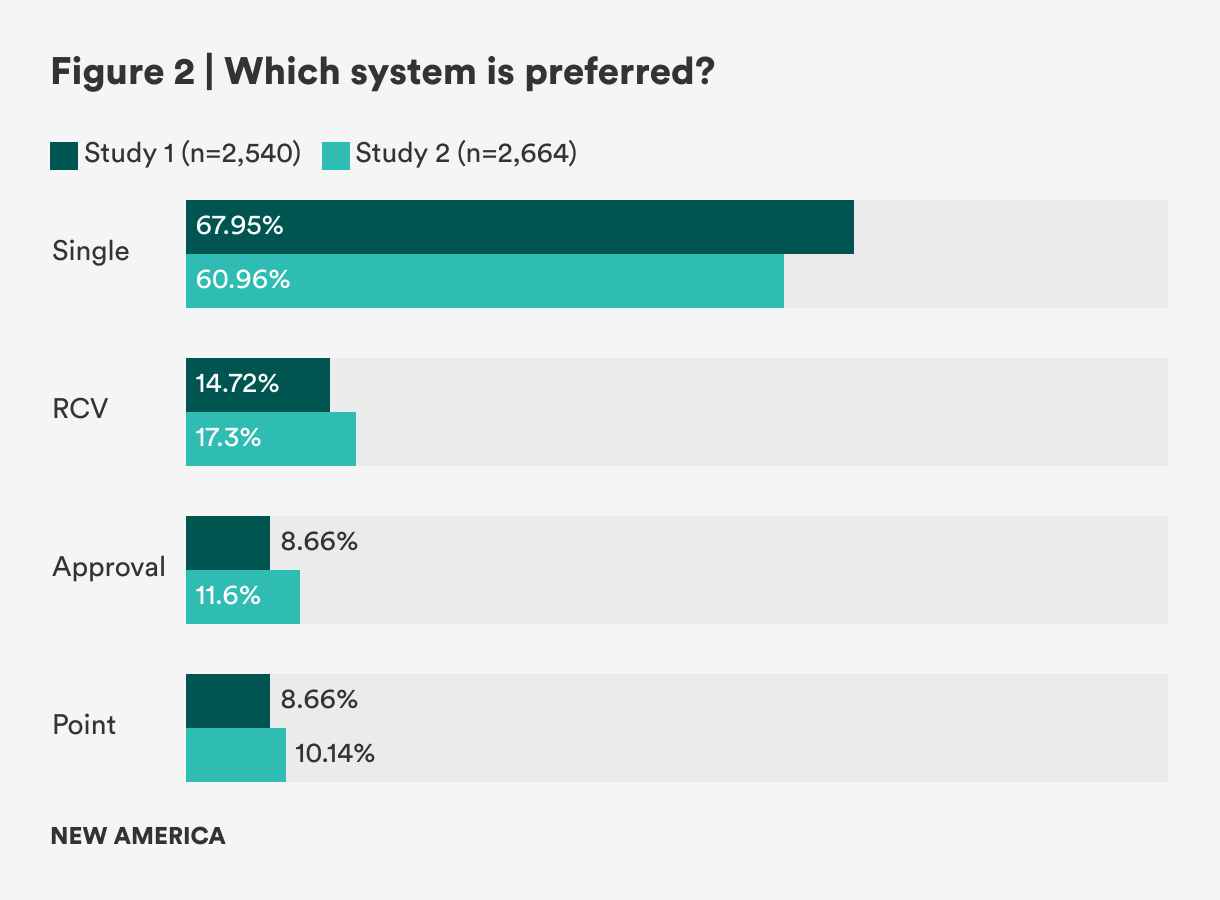
As shown in our full report, evaluations of the different systems are unrelated to education in both studies. Insofar as education can be regarded as a proxy for cognitive ability, we expected less educated respondents to prefer the single vote method because it is the simplest. In fact, our results indicate they do prefer the single vote—but so do the better educated. This suggests that complexity is not a principal factor in people’s evaluations of various voting methods. Likewise we observe little to no correlation between respondents’ gender, race, and ideology, and their preference for different voting methods.
Age is by far the most powerful cleavage. The older the respondent, the greater the support we see for the single vote versus each of the three other options. Among the elderly, the single vote is clearly the preferred option. Our results also show that those who identify as Republican overwhelmingly prefer the single vote and dislike the other systems, especially RCV. Finally, those who have personal experience with the RCV ballot tend to give higher ratings to that system, and lower ratings to the single vote. In short, it appears that when it comes to different voting systems, familiarity and satisfaction are positively associated.
These findings suggest that the single vote is the most popular system because of status quo bias. The fact that age is a powerful factor while education is not is consistent with that interpretation. So is the fact that the dominant contrast is between the single vote and the three less familiar options. The status quo is preferred by all but the youngest respondents, who are more open to other ways of voting, as well as those who have already used another voting system (RCV).
Conclusion
Our main finding is clear and consistent across the two studies: There is no strong demand among Americans for abandoning the single vote. Yet, resistance to alternative voting systems is not very strong either. More importantly, resistance does not appear to stem from a taste for simplicity, as ratings of the various voting methods are not related to education. Support for the single vote is rather the reflection of a status quo bias, as it is strongly correlated with age.
This research suggests that support for voting reform in the United States is unlikely to be based on frustration with the single vote’s limitations on expression per se. This does not mean that the reform movement has no future. On the one hand, more Americans are likely to become familiar with RCV in the years to come, which is bound to weaken the status quo bias. On the other hand, some of the arguments in favor of reform pertain to its effects on the supply of candidates and their campaign strategies. It remains to be seen how people react to these arguments. Further research is needed to take into account these other considerations.
Acknowledgments: The authors would like to thank Jason Maloy and Lee Drutman. We also received valuable guidance from participants at the Electoral Reform Research Group (ERRG) conference in February 2020 in Washington, DC. Data collection for this project was funded by New America through their ERRG initiative, with support from Arnold Ventures. The data themselves are available on request from the authors.
Ranked-Choice Voting and Political Expression: Voter Guides Narrow the Gap between Informed and Uninformed Citizens (Cheryl Boudreau, Jonathan Colner, and Scott MacKenzie)
Ranked-Choice Voting and Political Expression: Voter Guides Narrow the Gap between Informed and Uninformed Citizens
By Cheryl Boudreau, Jonathan Colner, and Scott MacKenzie
Citations
Working paper: Cheryl Boudreau, Jonathan Colner, and Scott A. MacKenzie, “Ranked-Choice Voting and Political Expression: How Voting Aids Narrow the Gap between Informed and Uninformed Citizens,” March 24, 2021, available at SSRN: https://ssrn.com/abstract=3786972.
Brief: Cheryl Boudreau, Jonathan Colner, and Scott MacKenzie, Ranked-Choice Voting and Political Expression: Voter Guides Narrow the Gap between Informed and Uninformed Citizens (Washington, DC: New America, 2021), https://www.newamerica.org/political-reform/reports/ranked-choice-voting-and-political-expression/.
Overview
This brief reports results from a survey experiment to investigate potential disparities in political expression and alignment among informed and uninformed voters in local ranked-choice elections. The survey was conducted during the 2020 general election in San Francisco. Respondents answered questions measuring their local policy views and knowledge about politics, and then ranked actual supervisorial candidates. Before ranking candidates, respondents were randomly assigned to receive either an issue-oriented voter guide or no additional information.
Research Questions
- What types of citizens (informed versus uninformed) will take advantage of the greater opportunity for political expression afforded by ranked-choice voting systems?
- To what extent do informed and uninformed citizens’ rankings of candidates faithfully reflect their own policy views?
- Can political information (e.g., voter guides) enable different types of citizens to take advantage of the greater opportunity for political expression in ranked-choice voting elections?
Key Findings
- Uninformed respondents are significantly less likely than informed respondents to use their allotted rankings. Nonetheless, 70 percent of uninformed respondents ranked at least one candidate and 67 percent ranked more than one.
- The rankings of uninformed respondents are weakly related to their policy views. The rankings of informed respondents more faithfully reflect their policy views, with higher levels of agreement with candidates ranked first than candidates ranked second or lower.
- Providing an accessible summary of candidates’ policy views (i.e., a voter guide) increases uninformed respondents’ propensity to use their allotted rankings. Approximately 76 percent of uninformed respondents who received a voter guide ranked at least one candidate and 75 percent ranked more than one. Overall, the voter guide reduced differences between informed and uninformed respondents.
- Providing an accessible summary of candidates’ policy views strengthens the relationship between informed and uninformed respondents’ candidate rankings and their own policy views.
Background and Research Design
In recent years, political momentum behind ranked-choice voting (RCV) reforms has been building across the United States. In 2004, San Francisco became the first large American city to implement RCV for its local elections. Other cities in California, Colorado, Maine, Maryland, Massachusetts, Michigan, Minnesota, New Mexico, and Utah soon followed. In 2019, voters in New York City voted to adopt RCV for local elections and the California legislature passed legislation enabling any city in the state to do likewise—the bill was vetoed by Gov. Gavin Newsom (D-Calif.).
The adoption of RCV in these settings anticipates several benefits. For local governments, RCV systems are less expensive as they do not require separate primary or runoff elections. For citizens, the ability to rank multiple candidates yields increased opportunities for political expression. For civic organizations, RCV has the potential to increase turnout and engagement, expand candidate entry, and to improve the tenor of campaigns.
Nonetheless, moving to RCV elections might have drawbacks. Among the more important are the additional burdens RCV places on citizens, who must navigate a more complex choice setting (ranking multiple candidates, often without party cues). Moreover, by increasing the number of candidates and giving them incentives to compete for others’ supporters, RCV elections might make it more difficult for citizens to make fine-grained distinctions between candidates. Candidates might decline to endorse policies that could alienate others’ supporters or be more ambiguous about their own positions. The combination of more demanding choices and incentives to obfuscate could impair voter decision-making, especially in low-information local elections and among uninformed citizens.
Existing research sheds light on the benefits and costs of RCV.48 On the plus side, candidates competing in these elections do take concrete positions on a large array of policy issues, offering citizens distinct local platforms. In mayoral elections, citizens are able to perceive these differences and use their rankings to select candidates who best reflect their own policy views.49 In city council elections, however, citizens appear to have greater difficulty in this regard.50
Still, the RCV literature leaves several questions unanswered. First, what types of citizens will take advantage of the greater opportunity for political expression afforded by RCV systems? In particular, do uninformed citizens take advantage of the opportunity to rank candidates beyond their first choice? In San Francisco, where prior to 2019 voters could rank up to three candidates, approximately 75 percent of voters ranked multiple candidates and 60 percent ranked three.51 But we know little about how the propensity to use all rankings varies across different types of citizens. Second, to what extent do citizens’ rankings faithfully reflect their own policy views in low-information local elections, such as for city council? Finally, what types of political information can enable the uninformed and others to take advantage of the greater opportunity for political expression? Can such information also increase the alignment between citizens’ rankings and their policy views?
Citizen Decision-Making in RCV Systems: A Study of San Francisco Elections
We address these questions by conducting an original survey during the 2020 general election in San Francisco. We used Qualtrics to recruit 1,286 San Francisco residents to participate in a survey administered online in the weeks before Election Day. While existing research suggests that respondents from online panels are not always representative of the general population, our sample resembles San Francisco’s population in many respects (see Table 2 of the full report).
In our survey, respondents ranked candidates running for the Board of Supervisors (San Francisco’s legislative body) and answered other questions designed to measure their views about local policy issues and knowledge about local politics. We also embedded an experiment that randomly assigned respondents to receive either: (1) a nonpartisan voter guide summarizing the candidates’ policy views (voter-guide group), or (2) no additional information about the candidates (no-information group). The voter guide displayed the candidates’ actual positions on six local policy issues in a table with the answers respondents gave to questions about these same issues (see Figure 1 of the full report).
The 2020 general election in San Francisco is a fertile context for investigating our research questions for several reasons. First, the election included contests for six of the 11 seats on the Board of Supervisors. It was also the first regularly scheduled election for the board to use San Francisco’s new RCV system, which allows citizens to rank up to 10 candidates. Under the old system (2004–18), citizens could rank up to three candidates.
Second, San Francisco resembles many large American cities demographically and in its overwhelmingly Democratic electorate. One consequence of the latter is that its elections frequently feature candidates who are all Democrats. Despite this partisan homogeneity, the city’s political elite and its citizens are divided between so-called “progressives” (the local left) and “moderates” (the local right). Progressives advocate higher taxes on local businesses, limits on development, and providing cash assistance to the homeless. Moderates typically favor tax breaks for businesses, support for new development, and limits on panhandling. These meaningful policy differences, in the absence of partisan divides, enable us to disentangle the effects of citizens’ policy views from other factors. Our ability to measure candidates’ policy views is enhanced by the activities of local political clubs, which distribute questionnaires to candidates for local offices as a prelude to making endorsements. The policy views of candidates’ included in the voter guide were gathered by local groups prior to Election Day.
We analyze the candidate rankings of respondents assigned to the no-information group to assess (1) whether the propensity to use their allotted rankings varies among different types of citizens, and (2) the extent to which respondents’ rankings reflect their policy views. In doing so, we distinguish between informed and uninformed respondents using four fact-based questions about politics in San Francisco. Respondents who correctly answer two (the median) or more questions are considered informed, and those who correctly answered one or zero questions are considered uninformed. We then compare the candidate rankings of respondents in the no-information and voter-guide groups to examine whether political information increases the propensity to use allotted rankings and/or improves the alignment between citizens’ rankings and their policy views.
Findings and Implications
Our analyses indicate high levels of political expression in the 2020 supervisorial elections in San Francisco. Figure 1A reports the percentages of respondents in the voter guide and no-information groups who ranked a candidate, ranked multiple candidates, and gave a complete ranking of all candidates running in a particular election. Nearly eight in 10 no-information respondents (79.2 percent) ranked at least one candidate and 76.0 percent ranked multiple candidates. Approximately 73.6 percent used all allotted rankings in these elections. These figures are comparable to those reported in observational studies.
We find modest levels of alignment between respondents’ rankings and their own policy views in the no-information group. Figure 1B displays agreement scores (the percentage of congruent policy positions) for candidates ranked first, second, and third by these respondents. Overall, respondents are more likely than not to agree with the candidates they ranked on six issues included in our voter guide. But there are no clear differences in agreement between candidates ranked first and candidates ranked second and third.
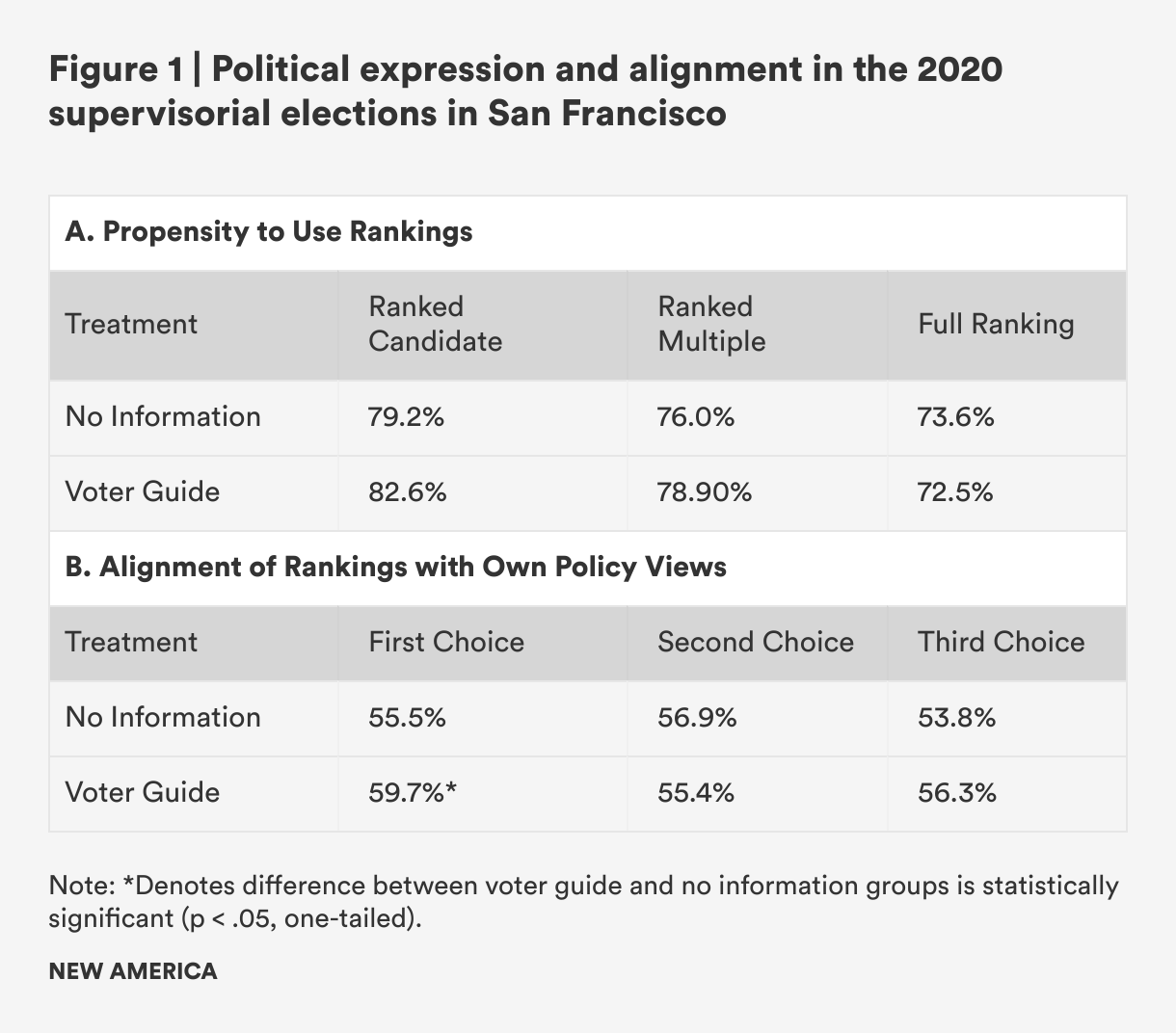
The high levels of political expression portrayed in Figure 1A mask disparities between uninformed and informed respondents. Figures 2A and 2B report the percentages of uninformed and informed respondents in the voter guide and no-information groups who ranked a candidate, ranked multiple candidates, and gave a complete ranking of all candidates. Whereas 85.8 percent of informed respondents in the no-information group ranked one of the candidates, only 70.1 percent of uninformed respondents did likewise. Similarly, 82.4 percent of informed respondents in the no-information group ranked multiple candidates and 78.7 percent used all of their allotted choices, compared to 67.2 and 66.7 of uninformed respondents from the no-information group. These differences in the propensity to use allotted rankings between uninformed and informed respondents are all statistically significant. Relative to informed respondents, the uninformed are less likely to take advantage of the greater opportunity for political expression that RCV elections provide.
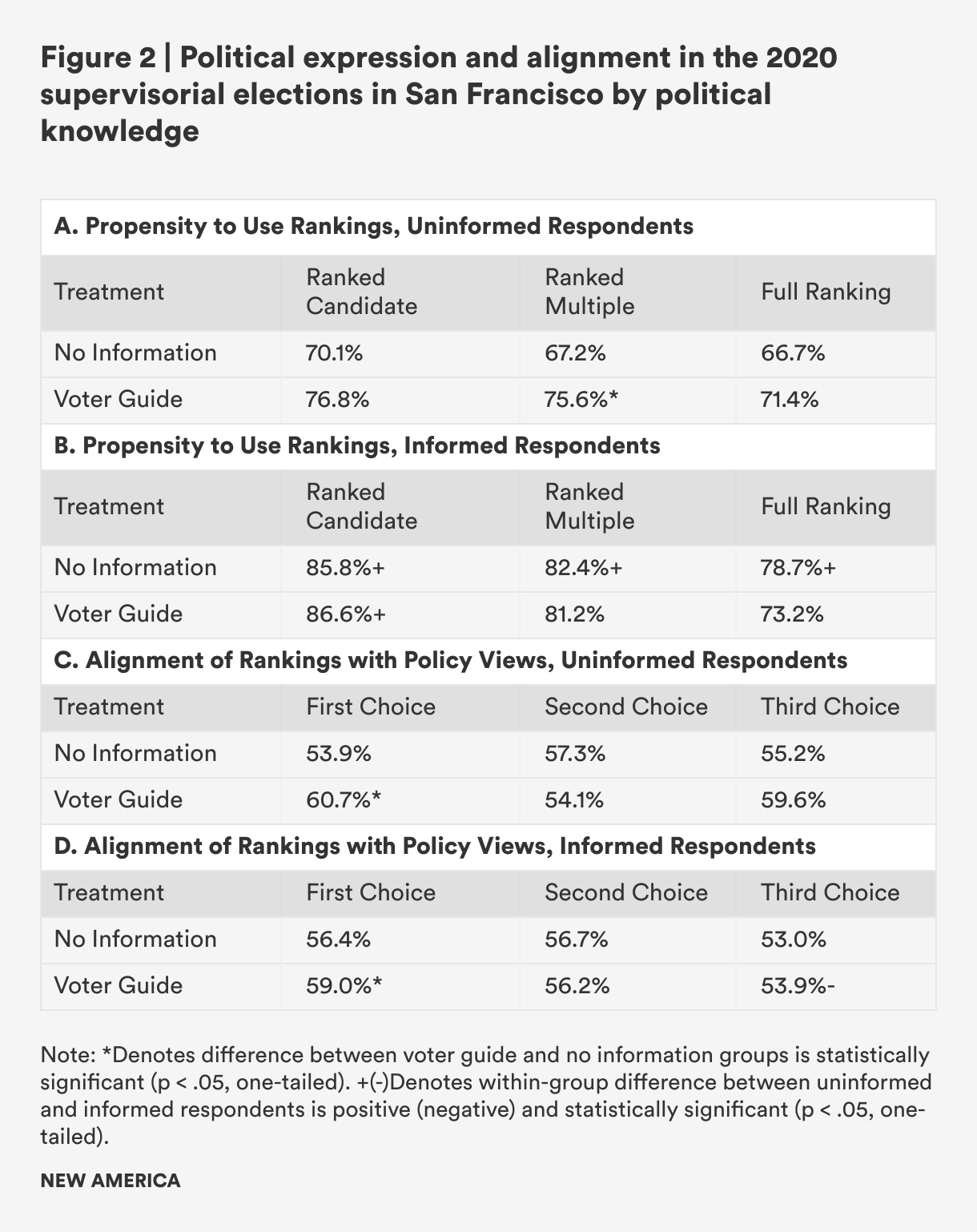
In comparing respondents assigned to the voter-guide and no-information groups, we can determine whether providing citizens with an accessible issue-oriented voter guide improves political expression and alignment. Figure 1A reports the percentages of respondents in the voter-guide group who ranked a candidate, ranked multiple candidates, and gave a complete ranking of all candidates. Approximately 82.6 percent ranked at least one candidate, 78.9 percent ranked multiple candidates, and 72.5 percent used all allotted rankings. These are modest increases in political expression compared to the no-information group.
We observe similar improvements in alignment in the voter-guide group. Figure 1B displays agreement scores (the percentage of congruent policy positions) for candidates ranked first, second, and third by respondents in this group. Respondents and the candidates they ranked first agree on 59.7 percent of issues. This is a significantly greater agreement score than the 55.5 percent in the no-information group. It is also greater than the 56.9 percent agreement score respondents in the voter-guide group have with their second-choice candidate.
Importantly, uninformed respondents benefited the most from receiving the voter guide. As Figure 2A demonstrates, the voter guide increased the percentage of uninformed respondents who ranked a candidate, ranked multiple candidates, and used all of their allotted rankings, relative to the no-information group. These increases of between 5 and 8 percent are substantively large and marginally significant. In contrast, the voter guide has little impact on political expression among informed respondents. As Figure 2B shows, none of the differences between the voter-guide and no-information groups are significant for informed respondents. The combination of large effects on uninformed respondents and null effects on informed respondents means that the voter guide narrows the gap in political expression between these two types of respondents.
Finally, the voter guide modestly improves alignment among both uninformed and informed respondents. As Figure 2C reports, uninformed respondents in the voter-guide group have congruent positions with their first-choice candidate on 60.7 percent issues. This is significantly greater than the 53.9 percent among uninformed respondents in the no-information group. Figure 2D shows a similar increase among informed respondents, from 56.4 percent to 59.0 percent. We observe few differences in respondents’ second- and third-choice candidates.
Conclusion
The results reported here offer a mix of good and bad news for ranked-choice voting proponents. On the plus side, large majorities of citizens take advantage of the greater opportunity for political expression that RCV rules provide. We also find that, more often than not, citizens’ top choices in city council elections are candidates they agree with on many issues. However, this study documents significant disparities in political expression among different types of citizens. The propensity to rank a candidate, rank multiple candidates, and use all of their allotted rankings is significantly lower among uninformed citizens. Our analyses suggest this disparity is explained by uninformed citizens’ inability to distinguish between the candidates’ policy views in RCV elections.
The positive effects of the voter guide on both political expression and alignment demonstrate that these disparities are neither inevitable nor insurmountable. The voter guide, which summarized the candidates’ local policy positions, provided a basis for comparing little-known candidates. As such, it helped close the gap in political expression among informed and uninformed citizens. It also helped both types of citizens to better align their candidate rankings with their policy views. Future research, using similar methods and conducted in real-world election settings, can shed light on what types of information—whether provided on the ballot, in official ballot pamphlets, or by private voter education initiatives—can enable all types of citizens to take advantage of the greater opportunity for political expression under RCV systems.
Acknowledgments: This project was funded by New America and the Electoral Reform Research Group (ERRG), supported by Arnold Ventures. The authors would like to thank participants at the ERRG Research Development Conference, February 7, 2020, in Washington, D.C., for helpful comments and criticism.
Citations
- Craig M. Burnett and Vladimir Kogan, “Ballot (and Voter) “Exhaustion” under Instant Runoff Voting,” Electoral Studies 37 (2015): 41-49.
- Cheryl Boudreau, Christopher S. Elmendorf, and Scott A. MacKenzie, “Racial or Spatial Voting?” American Journal of Political Science 63 (2019): 5-20.
- Cheryl Boudreau, Christopher S. Elmendorf, and Scott A. MacKenzie, “Roadmaps to Representation,” Political Behavior 41 (2019): 1001-1024.
- Pedro Hernandez, Jennifer Pae, Madeline Brown and Theodore Landsman, Voter Experience with Ranked Choice Voting in San Francisco (Takoma Park, MD: FairVote, 2018).
Ranked-Choice Voting, Runoff, and Democracy: Insights from Maine and Other U.S. States (Joseph Cerrone and Cynthia McClintock)
Ranked-Choice Voting, Runoff, and Democracy: Insights from Maine and Other U.S. States
By Joseph Cerrone and Cynthia McClintock
Citations
Working paper: Joseph Cerrone and Cynthia McClintock, “Ranked-Choice Voting, Runoff, and Democracy: Insights from Maine and Other U.S. States,” January 19, 2021, available at SSRN: https://ssrn.com/abstract=3769409.
Brief: Joseph Cerrone and Cynthia McClintock, Ranked-Choice Voting, Runoff, and Democracy: Insights from Maine and Other U.S. States (Washington, DC: New America, 2021), https://www.newamerica.org/political-reform/reports/ranked-choice-voting-runoff-and-democracy/.
Overview
This research takes advantage of the recent implementation of ranked-choice voting (RCV) in Maine to compare three alternative electoral rules—RCV, runoff, and plurality—at the federal level. Across a set of 12 competitive 2020 federal elections, the electoral arena in Maine under RCV was more open to new parties and candidates than elsewhere under runoff or plurality, and one candidate broke the national pattern of ideological polarization. Yet, in the context of Maine’s political history, these gains were modest. Further, RCV has been fiercely opposed by Maine’s Republican Party, especially after the 2018 congressional election, in which a Democratic candidate unseated a Republican incumbent in a “come-from-behind” victory. (In a come-from-behind victory under RCV, the winner of the first-preference votes loses after the allocation of additional-preference votes.) In a survey experiment assessing American voters’ satisfaction with the three electoral rules, many voters did not understand the problem of an election won by a candidate without majority support; and, they were much less satisfied with a come-from-behind victory under RCV than under runoff. The results suggest advantages for runoff versus RCV and challenges in the implementation of RCV—but challenges that can be addressed through greater familiarity and understanding of the new rule.
Research Questions
- At the federal level, do runoff and RCV open the electoral arena to new parties and candidates, encourage ideological moderation, and increase voters’ satisfaction with the election results?
- If so, does runoff or RCV perform better?
Key Findings
- Across a dataset of 12 competitive 2020 federal elections, third-party and independent candidates fared better (but still poorly) under RCV than under runoff or plurality.
- Of the 33 candidates included in the dataset, the most ideologically moderate was a Republican candidate from Maine, who ran under RCV.
- In a survey experiment, U.S. voters were less satisfied with election results under RCV than under runoff or plurality. Voters were not dissatisfied with the election of a candidate without majority support under plurality, but they were very dissatisfied with a come-from-behind victory under RCV, much more so than under runoff. (A come-from-behind victory under runoff is when the first-round runner-up wins the second round.)
- The overall modest advances under RCV and runoff in 2020 may be explained by (1) the highly polarized nature of national politics, and (2) the time it takes for candidates and voters to acclimate to new electoral rules.
Background and Research Design
As partisan polarization and public dissatisfaction with government continue to rise in the United States, many political analysts have called for an end to the standard of plurality voting, in which the candidate with the most votes, but not necessarily the majority, is elected. Two leading alternatives are ranked-choice voting (RCV) and runoff. With RCV, voters rank candidates in order of preference; if no candidate wins a majority in the first round, the second choices from the candidate with the fewest first choices are counted, and so on until one candidate wins a majority. Under runoff, a second round among the top two candidates is held if no candidate reaches a certain threshold in the first round, usually 50 percent. In the United States, RCV is increasingly recommended and implemented. Around the world, runoff is the most common rule for presidential elections.
To analyze the effects of the three rules on openness of the electoral arena to new parties and candidates, ideological moderation, and voter satisfaction, we used a variety of research methods. We secured 10 virtual interviews among knowledgeable persons in the state of Maine, which became the first state to adopt RCV in 2016, and the first to use it for state and federal elections in 2018. Interviewees spanned current and former political candidates (including Independent candidate Lisa Savage, who ran for the U.S. Senate in 2020), journalists, and lawyers.
To assess the openness of the electoral arena and ideological moderation, we identified and compared a set of 12 competitive federal election cases (based on Cook Political Report ratings as of summer 2020). We included only competitive elections, because they are the only conditions that truly test the rule. There were only two competitive elections under RCV (Maine’s Senate and 2nd Congressional District) and only five competitive elections under runoff (Georgia’s regular Senate election, Georgia’s special Senate election, Georgia’s 6th Congressional District, and California’s 21st and 25th Congressional Districts). For the plurality cases, we included the two competitive elections in Iowa (its Senate and 1st Congressional District) and in North Carolina (its Senate and 8th Congressional District) because Iowa and North Carolina are deemed similar to Maine and Georgia respectively by FiveThirtyEight. For an additional plurality case, we included the Senate race in Colorado on the basis of the competitiveness criterion.
Then, to assess voters' satisfaction with the three rules, we conducted a survey experiment of U.S. voters nationwide. Any survey in Maine alone would have reflected the strong partisan divisions in the state over RCV. The Maine Republican Party’s opposition to RCV reflects in part its hostility to a come-from-behind victory under RCV, a hostility that intensified after a Democrat won Maine’s 2nd Congressional District seat in a come-from-behind victory in 2018. To explore this controversy, our survey experiment asked voters about their satisfaction with electoral results that simulated the results of this controversial election. The survey was fielded on a sample of 3,471 registered voters via Amazon Mechanical Turk (MTurk) from October 19 to November 8, 2020.
Findings and Implications
Openness of the Electoral Arena to New Parties and Candidates
The electoral arena was more open to non-Democratic/non-Republican candidates under RCV than under runoff or plurality. In elections we studied, the percentage of the vote for third-party and independent candidates was the largest (6.7 percent) in Maine. Further, Independent Lisa Savage was the only non-Democratic/non-Republican candidate to achieve 5 percent in the election result. Under runoff, Libertarian Shane T. Hazel in Georgia achieved 5 percent in pre-election polls, but did not reach that percentage in the election result. In every case under plurality, the vote for non-Democrat/non-Republican candidates was below 5 percent and no candidate achieved 5 percent in in pre-election polls. Among the Maine interviewees, there was consensus that the openness of Maine’s electoral arena was due in good part to RCV. Still, 6.7 percent of the vote for third-party and independent candidates is not a large number, and RCV did not lead to more openness in Maine’s 2nd Congressional District race. Besides RCV, Maine’s strong tradition of independent candidates could also explain its relative openness.
Even under RCV, the headwinds against third-party and independent candidates were strong. First, amid the intense nationwide partisan polarization and the high stakes of the 2020 election, the political space for such candidates was narrow. Second, the effects of RCV were still not fully understood in Maine and potential candidates still did not want to be “spoilers.” Several of our interviewees expected that a come-from-behind victory under RCV would be challenged by Maine’s Republican Party. They also suggested that a mainstream Democratic candidate, such as Sara Gideon, likely worried that she would be tarred as co-opted by the “radical left” if she reached out to a former Green candidate, such as Savage.
Ideological Moderation
We calculated an ideology score for each candidate in our dataset based on their positions on nine policy issues, and considered their scores against the three electoral rules.
On the surface, Maine’s candidates’ scores are consistent with RCV’s promise of greater ideological moderation. Among the 33 candidates evaluated, Sen. Susan Collins (R-Maine) was by far the most moderate; among the four Democrat and Republican candidates in Maine, only one was more than .25 points more extreme than the candidate’s party’s average. We also found that while the set of Democratic and Republican candidates under RCV and plurality approximated similar distances from their parties’ average scores, the set of Democratic and Republican candidates under runoff was more extreme. Still, historically, Maine has been a stronghold not only for independent candidates but also for moderate Republicanism. Indeed, on a measure of ideology based on roll call votes in the Senate, Collins was more moderate prior to the adoption of RCV in Maine in 2016 than after its adoption.
Overall, these results suggest that it is difficult for a single electoral rule in specific states to counter a strong national trend towards ideological extremes. Although Collins won the Maine Senate election, she was predicted to lose, and most analysts attributed her grim prospects to the difficulties of ideological moderation in 2020. In contrast to Collins, Georgia’s Kelly Loeffler, previously considered a Republican moderate, submitted to the right’s increasing domination of the Republican Party. Whereas Collins was not challenged in the Maine Republican primary, Loeffler was competing in the special election’s first round not only against Democrats but also against a staunchly pro-Trump Republican, Doug Collins. Loeffler believed she had to move right to capture the pro-Trump vote. Among the Democratic candidates in this runoff election, Rev. Raphael Warnock was endorsed by former President Barack Obama and soared in the polls; the most moderate candidate, Ed Tarver, did not gain traction.
As mentioned above, under runoff in Georgia, Libertarian candidate Shane Hazel achieved 5 percent in pre-election polls. Hazel had a moderate ideology score, however this score was an amalgam of some far-right positions (on gun control, for example) and some far-left positions (on drugs, for example). While the Libertarian Party is the strongest emerging party in the United States, its specific policy positions are not “at the center.”
Voter Satisfaction
In our survey experiment, we assessed voters’ satisfaction with election results under the three rules. The key treatments were the three rules (plurality, runoff, and RCV) and the likelihood or actuality of a come-from-behind victory. We then combined seven indicators of satisfaction—usability, comprehensibility, fairness, transparency, representativeness, legitimacy, and support—into a single “satisfaction score.” Given the nonrepresentative nature of the sample, we controlled for such factors as age, education, and political affiliation.
As Figure 1 shows, voters were relatively satisfied with both plurality and runoff, but less satisfied with RCV. With RCV, there was a significant decrease in satisfaction relative to plurality. Also, voters were much less satisfied with a come-from-behind victory under RCV than under runoff. To our surprise, voters were not troubled by the election of a winner without majority support under plurality (the likely come-from-behind victory treatment).

Party affiliation was a major indicator of satisfaction with RCV. Republican voters were more likely to oppose RCV; 51 percent of Republicans were dissatisfied with the electoral results under RCV versus 42 percent of Independents and 37 percent of Democrats. Similarly, the satisfaction score with the results under RCV was twice as negative for Republicans than Independents, and eight times more negative for Republicans than Democrats. Republicans’ dissatisfaction appeared tied to a preference for the status quo and opposition to change. Responding to a question in the survey experiment, 65 percent of Republicans reported opposition to changing U.S. electoral rules versus 36 percent of Independents and 12 percent of Democrats.
Familiarity with the electoral rule to which respondents were exposed was also an important variable. Most voters were not familiar with RCV, but familiarity mattered much more for satisfaction with RCV than with plurality or runoff (see Figure 2). While a lack of familiarity has a negative impact on satisfaction for all three rules, this effect is significantly larger for RCV than for plurality or runoff. Yet, there is no difference in effect among those “very familiar” with the rule. This suggests that voters do indeed “learn to like” RCV and become more satisfied with it over time.
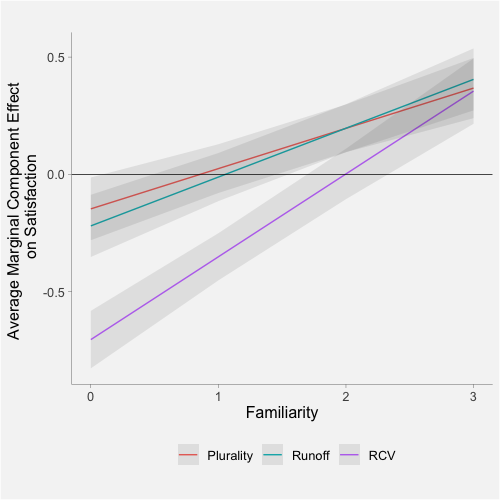
Conclusion
The promises of a more open electoral arena and of ideological moderation under RCV were upheld in Maine’s 2020 federal elections. Still, the gains were modest, especially in the context of Maine’s political traditions. The effects of both RCV and runoff were limited by the intense political polarization in the United States today, among other factors.
In Maine, RCV has been very divisive, especially due to controversy about come-from-behind victories. Meanwhile, voters nationwide are less satisfied with RCV than with runoff or plurality. Many voters are not troubled by the election of a candidate without majority support under plurality and are skeptical of the remedy for this problem—a come-from-behind victory—slightly so under runoff and significantly so under RCV.
Often, change is hard; it takes time for voters and political actors to adapt to new electoral dynamics. Fortunately, this study provides some hope that with greater explanation of the problems of plurality and the rationale for come-from-behind victories, runoff or RCV will be increasingly adopted across the United States.
Acknowledgments: We would like to thank the Electoral Reform Research Group at New America and Arnold Ventures for their generous support of this work. The views expressed in his report are those of its authors and do not necessarily represent the views of New America and Arnold Ventures, their officers, or their employees. We would also like to thank Alison Thomas and Jordan Ramsay, undergraduate students at George Washington University, for research assistance. Additionally, we appreciate the ten knowledgeable persons who shared their time and views on Maine politics and RCV with us in virtual interviews.
RCV is Neither Panacea nor Catastrophe for Minority Representation (Melody Crowder-Meyer, Shana Kushner Gadarian, and Jessica Trounstine)
RCV is Neither Panacea nor Catastrophe for Minority Representation
By Melody Crowder-Meyer, Shana Kushner Gadarian, and Jessica Trounstine
Citations
Working paper: Melody Crowder-Meyer, Shana Kushner Gadarian, and Jessica Trounstine, “Ranking Candidates in Local Elections: Neither Panacea nor Catastrophe,” January 21, 2021, available at SSRN: https://ssrn.com/abstract=3787548.
Brief: Melody Crowder-Meyer, Shana Kushner Gadarian, and Jessica Trounstine, RCV is Neither Panacea nor Catastrophe for Minority Representation (Washington, DC: New America, 2021), https://www.newamerica.org/political-reform/reports/ranking-candidates-in-local-elections/.
Overview
This brief reports results of a set of conjoint survey experiments to test how ranked-choice voting affects the choices voters make about candidates of color and how experience with electoral rules influences satisfaction with the process. The experiments varied the race and gender of hypothetical candidates, the type of election rule, the type of office, and whether the election is partisan. Each respondent was randomly assigned to vote in a ranked-choice or a plurality election, and asked to vote for three different local offices.
Research Questions
- How does election type (ranked-choice voting vs. plurality) influence voter support for candidates from different racial and ethnic groups?
- How does election type (ranked-choice voting vs. plurality) shape voter satisfaction and trust in democracy?
- Does participation in ranked-choice elections improve voter understanding of how ranked-choice voting works?
Key Findings
- Despite the greater cognitive complexity of ranked-choice elections relative to plurality elections, voters penalize candidates of color relative to white candidates at similar rates in nonpartisan ranked-choice and plurality elections. Partisan labels mitigate these penalties.
- Voters’ initial experience with ranked-choice voting (in our experiment) produces dissatisfaction—lower levels of trust in how votes are being counted and in the officials overseeing elections. However, after voting in a second series of ranked-choice contests (in a later experiment), these negative perceptions dissipate.
- The experience of voting in more than one series of ranked-choice contests (in two successive experiments), including reading brief explanations of the ranked-choice voting process, increases voters’ understanding of how ranked-choice voting works.
Background and Research Design
A diverse array of electoral rules govern American cities. How candidates are chosen for office can affect who wins, who loses, and how voters feel about the process. Most cities select officeholders through plurality rule—whoever gets the most votes wins. But an alternative, ranked-choice voting (RCV), has become increasingly popular. RCV requires voters to rank all candidates running for the seat, instead of simply selecting their most preferred candidate. Although the diffusion of this institution is nascent, the system was developed more than 150 years ago. In recent years, policymakers, nonprofit organizations, and even presidential candidates have touted RCV’s potential to reduce partisan rancor, bridge polarized communities, generate less negative campaigns, bring more diverse candidates into the political process, expand participation, and increase representational ties between voters and elected officials. But some observers have noted that RCV may be confusing or tiresome for voters and may not produce the positive outcomes others have proposed. Worse, RCV may suffer from the kind of cognitive complexity that scholars have identified as leading to lower support for candidates of color.
Research reveals that voters are generally unable—due to time and other resource constraints, difficulties obtaining credible information, prioritizing other activities, or other reasons—to research and process extensive amounts of information about every contest and every candidate they are evaluating. Rather, in voting decisions, as in other decisions in life, voters regularly use shortcuts like candidate partisanship and demographic traits such as race and gender when making their decisions. All else equal, voters using candidate race and ethnicity as voting cues are more likely to support white candidates and less likely to support candidates of color.
However, the circumstances under which elections take place can influence how voters respond to candidate race and ethnicity. The negative effects of this shortcut can be reduced. In particular, when voters have more information to draw on when casting their ballots—when they are provided with additional cues beyond candidate race and ethnicity such as partisanship or occupation—the penalty assessed on candidates of color decreases. On the other hand, some election circumstances may increase voters’ reliance on racial and ethnic stereotypes, producing negative effects for candidates of color. Specifically, research indicates that voters whose cognitive resources are being taxed are more likely to penalize candidates of color relative to white candidates. In this study, we investigate whether RCV similarly affects voter support for candidates of color relative to simpler plurality elections.
Studies of these benefits and potential drawbacks to the system are difficult to conduct in the real world for several reasons. The cities that have adopted RCV are not representative of American cities more generally and each election may have several confounding factors (candidates are strategic about entry, campaigns are idiosyncratic, and other institutional features may vary). To test how ranked-choice voting affects the choices that voters make about candidates of color, we use a set of conjoint election experiments that vary the race and gender of hypothetical candidates, the type of election rule, the type of office, and whether the election is partisan. Using an experiment allows us to overcome inferential issues that come from using electoral data or survey data.
In our experiments, respondents were asked to vote in three different types of elections: mayor, city council member election by district, and two city council members elected at-large. Each respondent was randomly assigned to either vote in a “ranked-choice election” where respondents had to rank all four candidates, or a plurality election where respondents chose one candidate (or two candidates for the at-large seats) where the candidate (or two candidates) with the most votes “won” the election.
Findings and Implications
We find that candidates of color are generally penalized in nonpartisan elections. Figure 1 shows that voters have a lower probability of choosing Latino, Asian, and Black candidates than white candidates in both plurality and RCV contests. But as the overlapping confidence intervals reveal, we find no difference in the penalty between plurality rule and RCV elections.
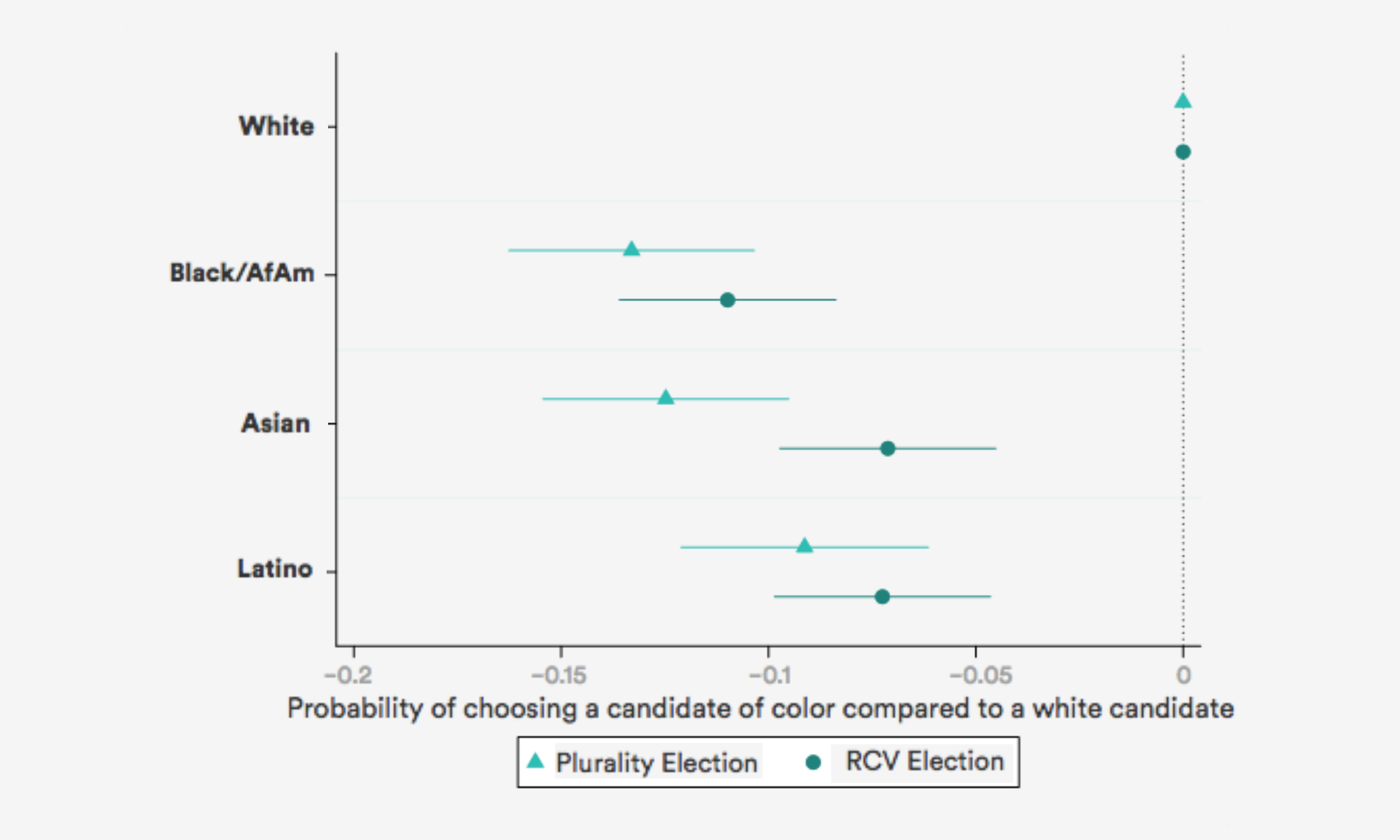
We find that this dispreference for candidates of color is driven nearly completely by ideological moderates and conservatives as well as by white respondents. We also find that adding partisan labels significantly reduces the penalty candidates of color face among voters in both RCV and plurality elections.
About 15 percent of our sample voted in a second set of RCV elections six weeks after the first wave of the experiment. Even with more RCV experience, we continue to see a penalty for candidates of color. However, among respondents who displayed a high level of understanding of ranked-choice voting, penalties for candidates of color were significantly lower. At the highest level of knowledge, respondents selected candidates of color at the same rate as they selected white candidates. And voting in an RCV election in our survey—during which respondents were provided with an explanation of how RCV elections work—significantly increased respondents’ understanding of how RCV works. We asked respondents how voters express their candidate preferences and how winners are determined. Figure 2 shows the average number of correct responses for each treatment group.
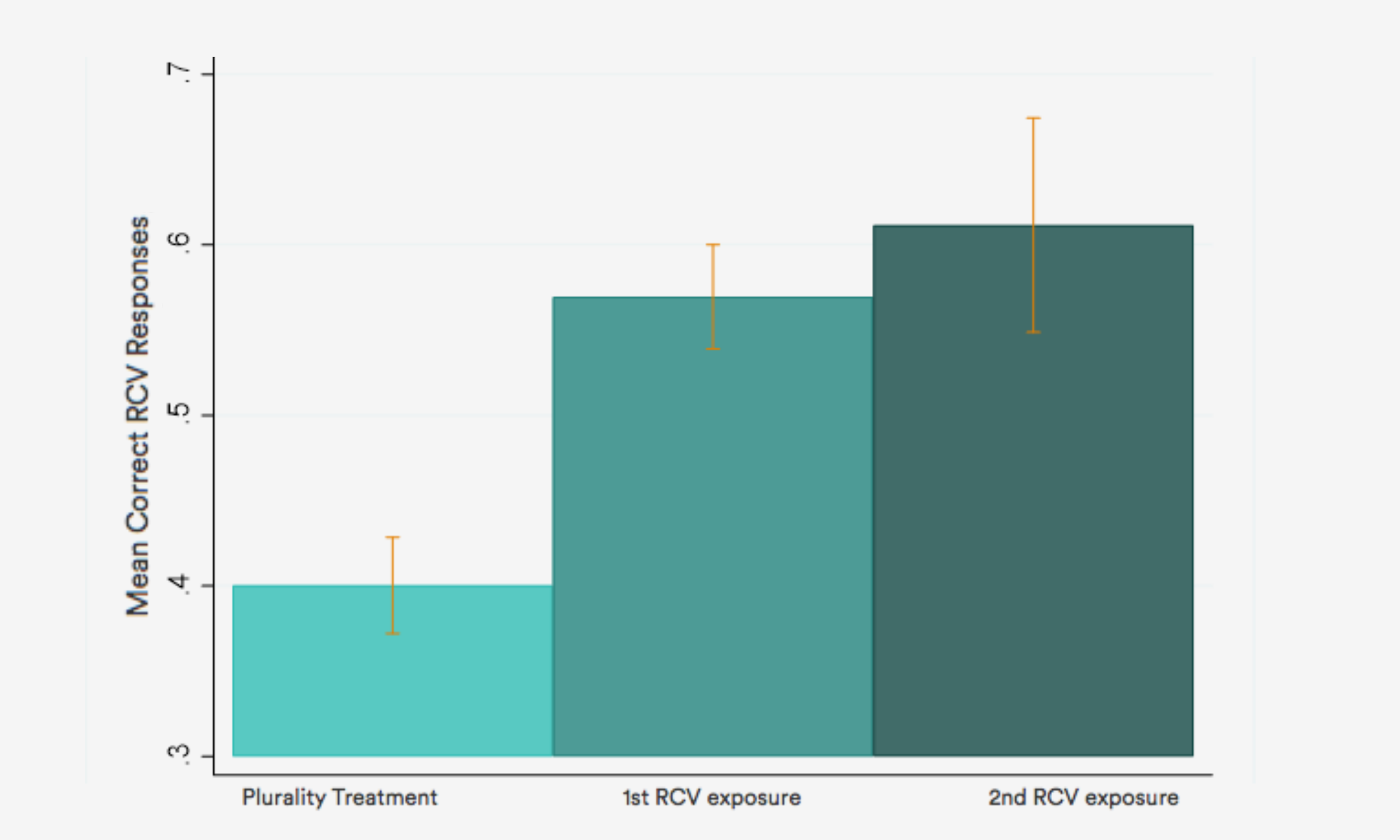
Conclusion
As ranked-choice voting expands to additional localities across the United States, it is important to evaluate how this type of election structure affects the candidates on the ballot and the voters choosing between these candidates. We investigated whether RCV elections affect the disproportionate representation by race and ethnicity present in American elections. While more complex electoral environments have been shown to negatively affect voter support for candidates of color, this outcome seems not to be triggered by the rules governing RCV elections. Rather, voters in RCV elections and those in plurality elections support candidates of color at similar (low) rates, perhaps because the process of ranking candidates requires voters to slow down their thinking and thus move beyond reflexive stereotypes and prejudices when casting their ballots. Furthermore, the provision of additional information, like partisan affiliation, that leads voters in plurality elections to support candidates of color and white candidates at closer rates appears to work similarly in RCV contexts. Thus, while ranked-choice elections may have a variety of effects on election outcomes, political parties, or voter attitudes (such as satisfaction with and trust in the election process), they seem not to affect the likelihood of voters supporting candidates of color.
At the same time, the fears of some observers that RCV elections will be too difficult for voters to understand also appear unfounded. In our experiments, voters were initially less trusting of the electoral process when they voted in RCV elections, but these negative attitudes disappeared with more experience. Further, the relatively brief practice with RCV provided in our experiments led respondents to be significantly more likely to understand how RCV elections work.
We conclude that ranked-choice voting is not likely to dramatically reshape local election outcomes for candidates of color. However, if jurisdictions want to implement RCV for other reasons, such as increasing satisfaction with the electoral process or changing candidates’ strategic calculations, voters should be able to learn and adapt to the new system.
Acknowledgments: We would like to thank New America for its generous support of this work through the ERRG initiative, with support from Arnold Ventures. The views expressed in this report are those of its authors and do not necessarily represent the views of the funders, their officers, or their employees.
Electoral Systems Affect Legitimacy Gaps and Affective Polarization (Sean Fischer, Amber Hye-Yon Lee, and Yphtach Lelkes)
Electoral Systems Affect Legitimacy Gaps and Affective Polarization
By Sean Fischer, Amber Hye-Yon Lee, and Yphtach Lelkes
Citations
Working paper: Sean Fischer, Amber Hye-Yon Lee, and Yphtach Lelkes, “Electoral Systems and Political Attitudes:Experimental Evidence,” May 12, 2021, available at SSRN: https://ssrn.com/abstract=3803603.
Brief: Sean Fischer, Amber Hye-Yon Lee, and Yphtach Lelkes, Electoral Systems Affect Legitimacy Gaps and Affective Polarization (Washington, DC: New America, 2021), https://www.newamerica.org/political-reform/reports/electoral-systems-affect-legitimacy-gaps-and-affective-polarization/.
Overview
This brief reports results from a large-scale behavioral game designed to investigate the effects of different electoral systems on attitudes generally believed to underpin democratic stability. Participants were randomly matched with up to 22 different players in real time and asked to vote for parties under plurality voting, proportional representation, or ranked-choice voting rules. The number of parties in each system also varied randomly. Based on the votes cast by all players, the election result determined a participant’s payout based on the distance between their vote choice and the winning party. Afterward, participants played a modified dictator game, which provided behavioral measures of interparty animosity. We also measured their satisfaction with the election outcomes and examined gaps between those who won and lost the elections.
Research Questions
- How do election type and the number of parties in the system affect perceptions of system legitimacy?
- How do election type and the number of parties in the system affect the “winner-loser gap” in perceived system legitimacy?
- How do election type and the number of parties in the system affect interparty animosity?
Key Findings
- System characteristics had no main effects on perceptions of system legitimacy.
- The winner-loser gap in perceived system legitimacy was smallest in ranked-choice systems and proportional systems and largest in plurality systems.
- The winner-loser gap in perceived system legitimacy was larger in the three-party than the four-party system.
- Interparty animosity was, on average, lower in plurality systems than the other systems.
- Having fewer parties yielded more interparty animosity than having many parties.
Background and Research Design
A stable democracy depends on two things above all else. First, citizens must believe that elections are fair, as expressed by election losers’ willingness to accept the outcomes even if they may be unhappy about them on a personal level. Second, there can be only a minimal amount of interparty animosity, also known as affective polarization. Both criteria are shaped by a democracy’s choice of electoral systems and voting rules. For instance, proportional representation—where legislative seats are allocated to political parties in proportion to the votes cast for each party—is generally considered a fairer system than disproportional systems, such as majoritarian and plurality systems. In proportional systems, minority voices are relatively well represented in government, and losers still have a say in the decision-making process. As a result, losing hurts less. Conversely, winning means more to those in plurality systems due to their winner-take-all, zero-sum nature.
In assessing the effects of different electoral systems, the proportionality or disproportionality of the system has been the main focus since it is most directly related to how votes translate into power. However, ballot structure is another critical dimension of electoral systems worthy of attention. More specifically, how much freedom is allowed in vote choice.
For instance, preferential voting systems such as ranked-choice voting (RCV) allow voters to rank multiple preferences instead of selecting just one. In the United States, some states and cities have adopted RCV to replace single vote plurality systems. Because preferential voting systems allow voters more choices, one can expect this freedom might encourage more public confidence in the system. Nevertheless, there is relatively little empirical work on the relationship between preferential systems and attitudes toward the democratic process.
Besides overall evaluations of the political system, we hypothesized that the electoral system and outcomes could influence another set of “mass attitudes,” or attitudes toward other members of society. Specifically, we explore the possibility that different electoral systems produce different levels of interparty animosity or affective polarization, which refers to the tendency to dislike and disparage those who support the opposing party. Given the winner-take-all nature of plurality systems, where a party’s status (winner or loser) is more clearly determined by an election, party supporters may be more motivated to see those of the opposing party as a threat to their party’s power, which could enhance animus toward them.
We employed a large-scale behavioral game to study the effects of electoral system features and election outcomes on voters' perceptions of the electoral system and behavior towards others. We modeled the experiment after a standard experimental design used to test the impact of institutional design on decisions to vote or not.
Our experiment built on the standard design in a few ways: (1) it involved far more people than the typical game, which allowed us sufficient power to test for the hypothesized interaction effects without needing players to play dozens of rounds of games; (2) we randomized the number of teams, as well as system characteristics; and (3) we included various survey and behavioral measures after the experiment, including an additional pairwise donation game, a modified dictator game, to test whether these features have downstream consequences. In this part of the experiment, respondents were randomly paired with another player and given a pot of money to distribute. The respondents could choose to keep all, some, or none of the money. The players were told about each other’s decisions in the election, and we operationalized interparty animosity as the difference in money allocated to out-party versus in-party players.
Findings and Implications
Our results in some ways experimentally validate past observational studies, although they identify important nuances and significantly extend the literature. We examined whether the system and number of parties, respectively, were related to the difference in satisfaction and perceived fairness between those who won versus those who lost in the election (winner-loser gap). For each condition, we estimate the winner-loser gap by calculating the difference in perceived legitimacy between someone whose payout was one standard deviation below the mean (electoral losers) versus someone whose payout was one standard deviation above the mean.
We found that proportional systems yielded a significantly smaller winner-loser gap in satisfaction with the outcomes than single-winner ranked-choice and plurality systems (Figure 1, Panel A). Plurality and ranked choice systems led to similarly sized gaps. Contrary to expectations, the winner-loser gap in satisfaction was significantly larger in three versus four parties but, in line with expectations, significantly smaller in four versus five parties (Figure 1, Panel B). In other words, the proportional systems and systems with five parties yielded the smallest winner-loser gap in satisfaction.
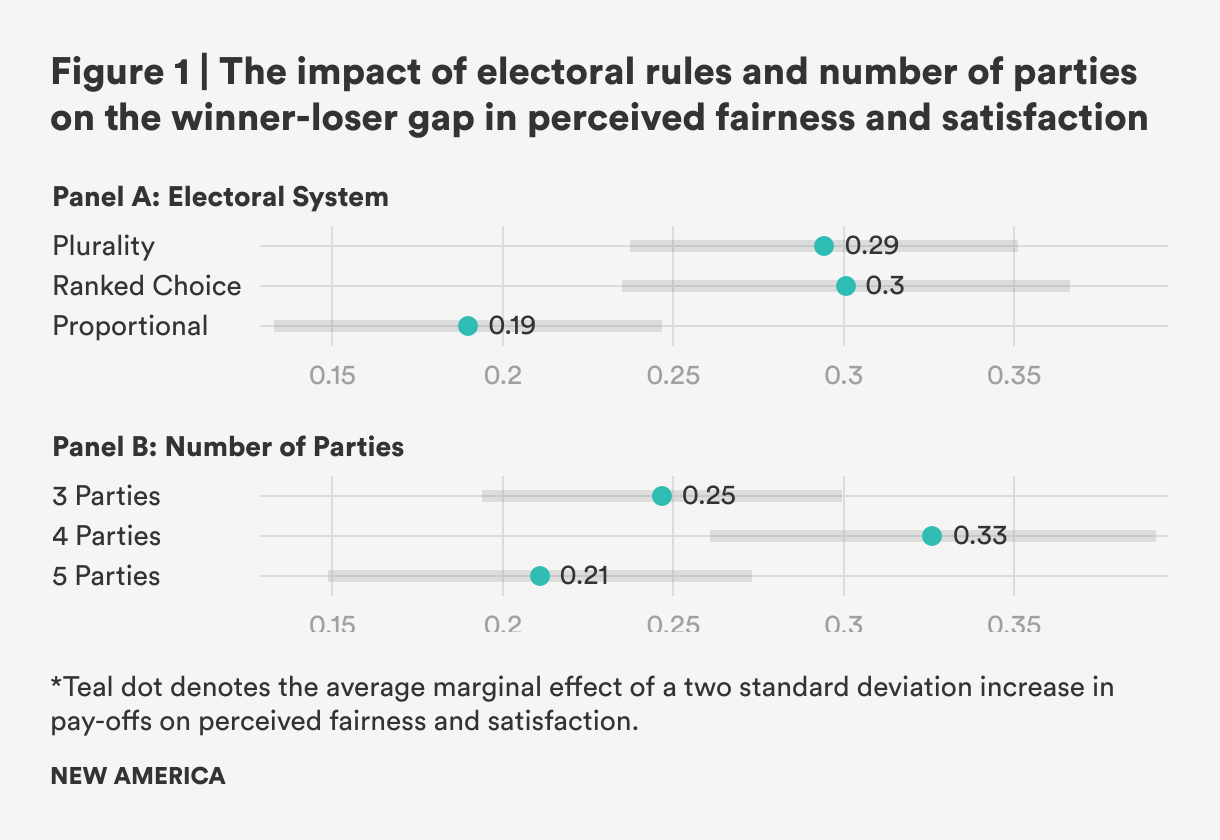
Next we examined the results of the modified dictator game, which was designed to measure the level of interparty animosity. In this game we defined an in-group as a match between the actions of two randomly assigned players. For instance, if both players voted for party A, they were considered in-group members, out-group members, otherwise. (Recall that players were told their partner's behavior in the election game prior to the modified dictator game.) Consistent with our expectations, we found significant in-group bias—when people were matched with a player who engaged in the same action as they did in the election round, they gave them significantly more tokens on average.
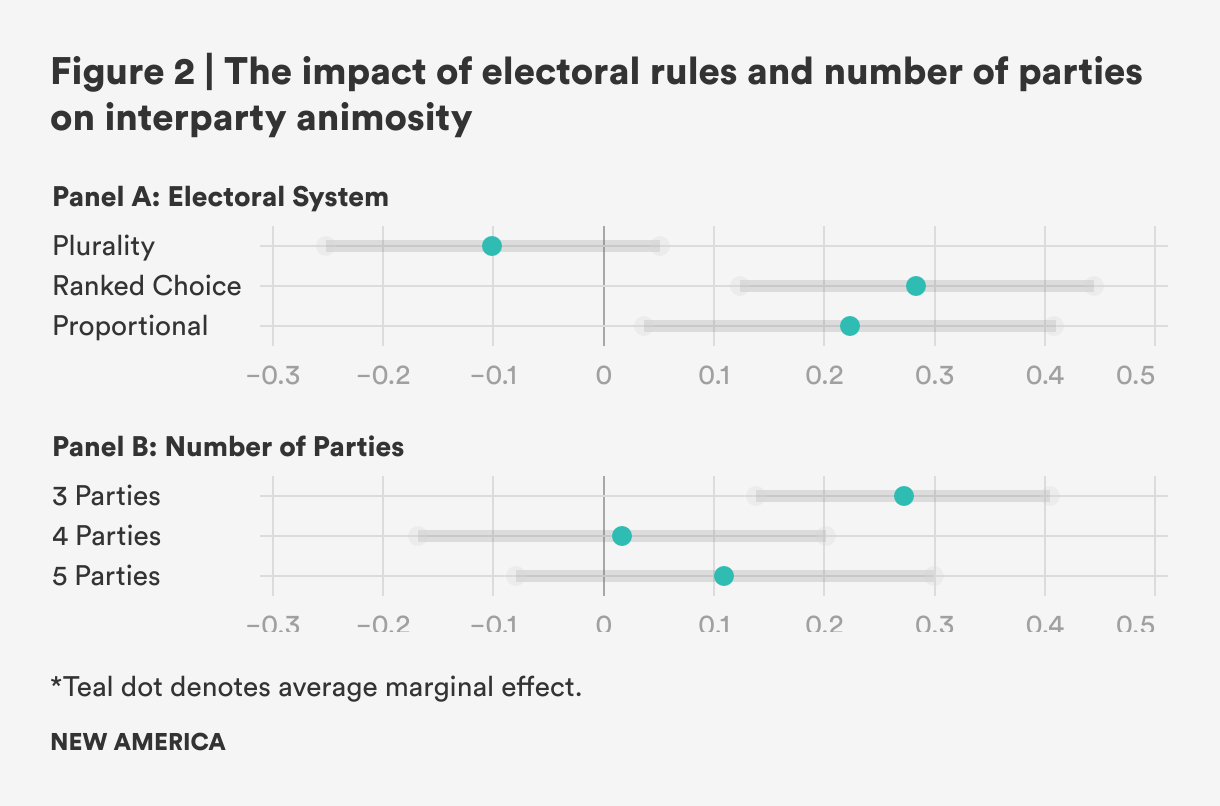
As shown in Figure 2, Panel A, there was more in-group bias in proportional systems and ranked-choice than plurality systems. The two-way interactions testing the difference between playing an in-group versus out-group member in a proportional versus plurality system was significant, as was the two-way interaction in a ranked-choice versus plurality system. Hence, counter to our expectations, plurality systems yielded the lowest level of interparty animosity.
In line with our expectations, increasing the number of teams in a system decreased in-group bias (Figure 2, Panel B). In-group bias was largest in three-party systems, smallest in four-party systems, and middling in five-party systems. The two-way interactions indicated that playing an in-group versus out-group member in a three- versus four-party system was significant, and playing an in-group versus out-group member in a three- versus five-party party system was marginally significant.
In sum, our results suggest that electoral reforms that replace plurality systems with proportional and preferential systems and encourage multipartyism can ameliorate the winner-loser gap in perceived system legitimacy. By shrinking that gap we can reduce the likelihood that electoral losers will turn away from democratic processes and towards alternative and sometimes violent methods to make their voices heard. At the same time, reformers should be wary of how moving away from plurality might impact interparty animosity. Our findings suggest that electoral reform that does not lead to a change in the number of parties in a system may make interparty animosity worse.
Conclusion
Throughout the Western world, increased affective polarization and decreased trust in institutions has raised fears about the future of democracy. The present work indicates that certain institutions, namely those based on proportional representation and RCV, as well as multiparty arrangements, decrease the winner-loser gap in perceived system legitimacy. When electoral losers feel that the democratic process is fair, they are more likely to continue participating. Recent events in the United States, wherein electoral losers refused to accept the election results and engaged in a violent insurrection, underscore the importance of these results.
However, our results indicate that plurality systems led to less interparty animosity than proportional and ranked-choice systems. While concerning, when proportional and ranked-choice systems had more parties, interparty animosity was as low as in plurality systems. Together, these results indicate multiparty proportional or ranked-choice systems can offer the benefits of a small winner-loser gap and an absence of interparty animosity.
While institutional changes at the national level are rare, subnational governments frequently experiment with reform. The present work reinforces the significant role these institutions play in shaping our attitudes toward democracy and serves as a note of encouragement to reformers who seek to decrease the prevalence of electoral systems based on plurality voting.
Acknowledgements: We are grateful for the funding and organization of research efforts from New America, the Electoral Reform Research Group, and Arnold Ventures. We are also grateful for the comments and feedback from Lee Drutman, Noam Gidron, Will Horne, and participants of the Electoral Reform Research Group.
Multi-seat Districts and Larger Assemblies Produce More Diverse Racial Representation (Michael Latner, Jack Santucci, and Matthew S. Shugart)
Multi-seat Districts and Larger Assemblies Produce More Diverse Racial Representation
By Michael Latner, Jack Santucci, and Matthew S. Shugart
Citations
Working paper: Michael Latner, Jack Santucci, and Matthew Shugart, “Multi-seat Districts and Larger Assemblies Produce More Diverse Racial Representation,” August 25, 2021, available at SSRN:https://ssrn.com/abstract=3911532.
Brief: Michael Latner, Jack Santucci, and Matthew S. Shugart, Multi-seat Districts and Larger Assemblies Produce More Diverse Racial Representation (Washington, DC: New America, 2021), https://www.newamerica.org/political-reform/reports/multi-seat-districts-and-larger-assemblies-produce-more-diverse-racial-representation/.
Overview
This study considers the relationship between electoral systems and racial representation in legislative office. Recent scholarship in comparative politics has shown that three components of electoral systems—the number of seats being contested per district (district magnitude), the size of assembly or council, and the rules that allocate seats from votes (electoral formula)—together are highly predictive of the number of political parties that run for and win seats in a country’s legislature. To test how well these components can account for racial representation as well, we examine election results from 159 ethno-racially diverse cities in 13 U.S. states, as well as in Australia, Ireland, and the Netherlands, between 2010–2019. We find that larger assembly size and more contested seats per district are associated with more parties representing communities of color. Our results suggest that these basic electoral system features should figure more prominently into U.S. debates about electoral reform.
Research Questions
- Can electoral system models explain variation in municipal racial representation?
- How does the product of assembly size (S) and district magnitude (M), known as the Seat Product, shape racial diversity in municipal government?
- To what extent can the Seat Product and racial composition account for the number of parties electing candidates of color?
Key Findings
- Larger assembly size (S) and district magnitude (M) are both associated with more parties electing candidates of color.
- Larger Seat Product (MS) is associated with more parties electing candidates of color.
- A logical model of Seat Product and racial composition accounts for about three-quarters of variation in the number of parties electing candidates of color.
Background and Research Design
Our goal is to use recent advances in electoral systems theory to model the constraints of institutions on party competition and, by extension, the election of ethnic and racial minorities. We start from the premise that collective actors such as political parties and coalitions associate in elections for the purpose of winning seats,52 then give strategic attention to the number of seats they can win under given electoral conditions.53 Those electoral conditions include society’s underlying diversity in tandem with the "electoral system," which can be broken down into three key components: 1) the size of the elected council or assembly (S); 2) the number of seats being contested per district, or district magnitude (M); and 3) the rules that allocate seats from votes, also known as the electoral formula (f).54
We have collected data on the partisan affiliation (including candidates in nonpartisan elections who affiliate with a party), race, ethnicity, and gender of candidates in elections for nearly 200 cities, and have complete data for 159. While some official election data include party and gender (the Netherlands), most candidate traits were coded using a combination of candidate social media, party lists, and third-party voter information websites. Where possible, race was coded for six categories, White/European (Non-Hispanic for U.S. cases), Hispanic/Latinx (U.S. cases), Black/African/Afro-Caribbean, Asian, Arab/Middle Eastern, and South Asian/Indian, using a combination of surname, name origin, images, and additional candidate information. For comparative purposes, we identify candidates of color as other than White/European.
We measure votes for parties by aggregating votes for their candidates, and assign candidates to parties using the following rules. First, we try to assign a party to every candidate. In municipal elections, many of which are nonpartisan (in most U.S. cities in the sample candidates are prohibited from running under party labels), there are “independent” candidates and local political parties, which may run under the label of an independent group. For officially nonpartisan elections, every effort was made to identify candidates with a political party or partisan organization that endorsed, financially supported, or could be linked to a candidate in online campaign material. If no information could be found about a candidate, party affiliation is coded "missing data." Meanwhile, if available information consistently suggests no party affiliation, the candidate is coded “independent.” Finally, every independent is treated as their own party.55
Building off Shugart and Taagepera’s Seat Product Model,56 we expect that, on average, the number of parties electing candidates of color will be the total number of seat-winning parties, weighted by the percentage of residents of color living in a city.
Findings and Implications
As shown in Figure 1, there appear to be slightly more parties electing candidates of color on average than what the logical model predicts, but an adjusted model that reduces the weighting by residents of color is a strong fit.57 These results confirm expectations that electoral system features are closely tied to racial representation.
One major takeaway is that U.S. reliance on small assembly sizes, single-seat districts, and winner-take-all electoral rules may limit the number of parties that effectively compete for voters of color. As a point of comparison, some of the most diverse Australian cities that use multi-seat ranked-choice voting systems (single transferable vote) may not achieve perfect proportional representation, but they nevertheless elect candidates of color from multiple parties. Cities in the Netherlands elect candidates of color from multiple parties, and across the ideological spectrum. Overall, many systems (including majoritarian) can approximate proportionality in representation, but larger assembly size and district magnitude are associated with more diverse representation among candidates of color across different political contexts.
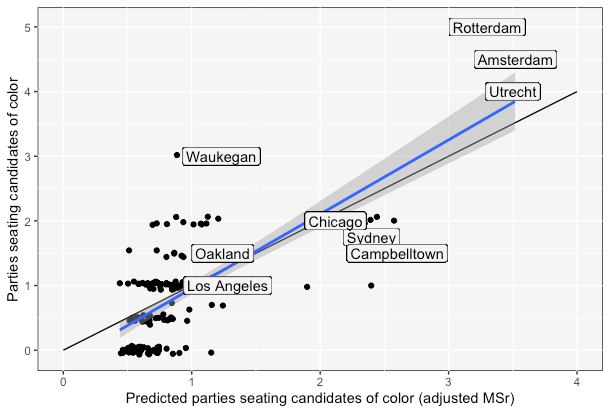
Regardless of electoral system type, as the percentage of residents of color increases, parties generally win a larger percentage of seats with candidates of color. But we find that cities with larger assemblies also have more capacity for parties to elect candidates in terms of absolute numbers. For example, Chicago’s city council seats more than twice as many candidates of color compared to Los Angeles, even though Los Angeles has over a million more residents.
In addition, we find the number of parties represented by candidates of color varies greatly across the racial composition of cities. In U.S. cities, the Democratic Party dominates racial representation relative to other parties. Indeed, the Democratic Party is the only party representing voters of color in most U.S. cities, even in cities where voters of color are in the majority. We do see a handful of Republican, Democratic Socialist (DSA), and independent candidates of color winning seats. Again, a (relatively) larger assembly like Chicago has room to seat more Democratic Socialists than a smaller assembly like that of Los Angeles. The DSA now seats 10 percent of the Chicago council, which is no small feat. Nevertheless, in line with our expectations, we find the partisan diversity of racial representation in U.S. cities to be relatively truncated compared to other racially diverse cities around the globe.
Conclusion
Voting rights advocates and reformers have given significant time and energy to securing representation for historically marginalized groups. The primary means of doing so has been to create single-seat districts—sometimes with a larger assembly, but often not. The results of our research suggest more attention should be paid not just to assembly size but to district magnitude. Additionally, there should be more emphasis on overall population proportionality as well as the number of parties. Our report shows that basic electoral system features are jointly associated with the number of parties that run and elect candidates of color across a variety of national contexts.
So far, we have not been able to say much about specific allocation rules (e.g., single- and multi-winner ranked-choice voting, list proportional representation, and so on). But we show that the Seat Product (MS) matters, and this gets us part of the way. Future research should develop more precise estimates of how variations in electoral rules shape the expression of racial diversity. With more cases of low-magnitude (3–10 seat) elections, we will be better able to test the extent to which allocation formulas reduce or enhance the proportionality of racial and partisan representation.58 Further analysis of these dynamics may eventually lead to new insights about the logical connections between electoral system design and proportionality in the voting strength of racial and multi-racial coalitions, which has direct bearing on the political equality of all voters.
Acknowledgments: We are grateful for the suggestions and input from participants of the Electoral Reform Research Group (ERRG) workshop in February 2020. This project was funded by New America through their ERRG initiative, with support from Arnold Ventures. We thank our research assistants Neila Patino, Jamie Ormiston, and Medina Talebi, the research team at the Center for Science and Democracy at the Union of Concerned Scientists.
Citations
- John Aldrich, Why Parties? The Origin and Transformation of Political Parties in America (Chicago: University of Chicago Press, 1995).
- Gary W. Cox, Making Votes Count: Strategic Coordination in the World’s Electoral Systems. (Cambridge: Cambridge University Press, 1996).
- Octavio Amorim Neto and Gary W. Cox, “Electoral Institutions, Cleavage Structures, and the Number of Parties.” American Journal of Political Science 41 (1): 149-174.
- This differs from standard practice in comparative study of national-level samples, which is to discard independents. In the United States, and especially in American local government, independents are too important to be omitted in the usual way.
- The Seat Product Model is developed in Taagepera, Predicting Party Sizes; further elaborated in Matthew S. Shugart and Rein Taagepera, Votes from Seats: Logical Models of Electoral Systems (Cambridge, United Kingdom ; New York, NY, USA: Cambridge University Press, 2017), and summarized in Rein Taagepera and Matthew Shugart, “Predicting Party Systems from Electoral Systems,” Oxford Research Encyclopedia of Politics, August 27, 2020, https://doi.org/10.1093/acrefore/9780190228637.013.1763.
- The practical relevance of this sort of model fitting is that it reduces the influence of city racial composition on the prediction, that is, the institutions matter more. This is somewhat complementary to the findings in chapter 15 of Shugart and Taagepera, 2017.
- Andrew C. Eggers and Alexander B. Fouirnaies, “Representation and District Magnitude in Plurality Systems,” Electoral Studies 33 (March 2014): 267–77, https://doi.org/10.1016/j.electstud.2013.08.006.
Ranked-Choice Voting Delivers Representation and Consensus in Presidential Primaries (Baodong Liu, Nadia Mahallati, and Charles M. Turner)
Ranked-Choice Voting Delivers Representation and Consensus in Presidential Primaries
By Baodong Liu, Nadia Mahallati, and Charles M. Turner
Citations
Working paper: Baodong Liu, Nadia Mahallati, and Charles Turner, “Ranked-Choice Voting Delivers Representation and Consensus in Presidential Primaries,” April 9, 2021, available at SSRN:: https://ssrn.com/abstract=3822879.
Brief: Baodong Liu, Nadia Mahallati, and Charles Turner, Ranked-Choice Voting Delivers Representation and Consensus in Presidential Primaries (Washington, DC: New America, 2021), https://www.newamerica.org/political-reform/reports/ranked-choice-voting-delivers-representation-and-consensus-in-presidential-primaries/.
Overview
This project examined the results of the 2020 Democratic presidential nomination contests in the five states that adopted ranked-choice voting (RCV) rules. Our findings indicate that voters used their rankings not only to nominate the strongest candidate to represent the party in the general election but also to ensure representation of the party's diverse electorate at the national convention.
Research Questions
- How is RCV in a presidential primary election different from standard instant runoff RCV?
- What patterns emerged from the states that used RCV for party presidential nominations? How were these patterns similar to or different from non-RCV election results? And which candidates benefited from RCV rules?
- Based on our analysis, what can we expect in the future if RCV is used in more (if not all) presidential nomination contests? Should there be rule changes with respect to how RCV is applied in these contests?
Key Findings
- RCV used in presidential primary elections differs from instant runoff RCV in two important ways: 1) There is an unknown number of winners, unlike standard RCV in which the number of winners is predetermined; and 2) the purpose of these elections is both to decide the nominee and to ensure that more—and more diverse—candidates have representation at the convention to reflect the party's broad electorate.
- Current President Joe Biden was the clear first-preference majority winner in all RCV elections and Sen. Bernie Sanders (I-Vt.) was the second most popular candidate. RCV did not distort the ultimate purpose of forming a consensus on the nominee. Additionally, our analysis demonstrated that Sen. Elizabeth Warren (D-Mass.) would have earned more delegates if more states had used RCV, and thus she would have had more representation at the convention.
- RCV shows great potential to produce results more representative of the diverse Democratic electorate and to engage more voters to participate in presidential primary elections. Reducing the 15 percent threshold might produce even stronger diversity and turnout.
Background and Research Design
The Democratic Party has long realized that mobilizing its base and enlarging its electorate in nomination contests can be just as important as finding the strongest candidate. Indeed, since 1972, the Democratic Party “has enforced a total ban on statewide winner-take-all primaries,” and the party has “usually encouraged their state parties to adopt proportional representation formulas.”59 The system is meant to encourage more voices and greater diversity, in contrast to the winner-take-all rule adopted by the Republican Party.
In 2020, the Democratic Party attempted to make the process even more representative with the use of ranked-choice ballots for its presidential primaries in five states: Alaska, Hawaii, Kansas, Nevada, and Wyoming. This real-world experiment was an opportunity to study how RCV operates and how voters express themselves under conditions and goals that differ from standard single-winner instant runoff.
In standard instant runoff RCV, as in first-past-the-post (FPTP) election rules, there is always one winner, either the majority winner using instant runoff or the plurality winner used under FPTP. By contrast, in the 2020 Democratic primary elections, because the goal was not just to elect the party's presidential nominee but also to allocate delegates for the national convention, the RCV process continued until all candidates in the final round reached 15 percent or more of the votes.
This method of awarding delegates differs from instant runoff rules in two important ways. First, it adds a layer of uncertainty. The form of RCV used in the 2020 nomination contests distributed delegates in proportion to the vote shares of all candidates who reached the 15 percent threshold—the final number of qualifying candidates being unknown until the votes are tabulated. In other words, when voters cast their primary ballots, they did not know how many candidates could win delegates. Empirical studies in the last decade have shown conflicting results regarding whether voters are sophisticated enough to use ranking systems to express their preferences, or whether RCV fulfills its promise to produce more consensus winners. Moreover, up to now most research on the use of RCV has been based on ballots designed to elect a predetermined number of winners. In these cases, the election produces either one majority winner tabulated in the final round of vote transfers in instant runoff voting, or a known number of winners in single transferable vote (STV) for representative legislatures. Therefore, little is known about RCV when there is not a predetermined number of winners.
Second, this method has a dual purpose: Democratic presidential primary elections must determine the nominee as well as ensure that candidates—particularly those representing racial, gender, religious, ideological, and other minority groups traditionally left out of the party elite—are represented at the convention to reflect the party’s diverse electorate.
To improve our understanding of this method, we first looked at how RCV was applied across the five states in 2020. We then compared it to the standard instant runoff method being adopted in a growing number of U.S. cities and states. Detailed election returns were examined, and where available the vote-transfers in each round of vote tabulations were investigated to see whether or not the system worked as intended. That is, did RCV rules support (or distort) the goal of nominating the strongest candidate among a large pool of candidates? Did RCV play a role in enhancing proportional representation in the 2020 Democratic presidential nomination contests? If so, how?
Findings and Implications
We observed how ranked-choice was applied in the five states. While there were slight variations between the states, the basic rules were the same. Democratic primary voters were allowed to rank a maximum of five candidates. If any candidate out of the total pool of candidates did not reach the 15 percent threshold in the first round, then the candidate with the fewest first-preference votes was eliminated and the second-preference votes from those ballots were redistributed to the first-place votes of the remaining candidates in the next round. This process continued until every remaining candidate had at least 15 percent of the vote, and thus gained at least a single delegate.
Among the five states studied, the outlier was Nevada, which used RCV only to tabulate the early voting results, which were then added to the caucus votes. Nevada thus did not publish the detailed breakdown of each round of RCV tabulation nor the share of RCV votes in the final vote shares of all candidates. The RCV results from Kansas were more accessible, however we do not have detailed breakdowns for Sen. Warren and Rep. Tulsi Gabbard (D-Hawaii) for the second through fourth rounds of vote tabulations. Alaska, Hawaii, and Wyoming provided complete breakdowns for each round, allowing for more in-depth analysis.
Figure 1 displays the multiple-round vote transfer process for all candidates in Alaska's RCV primary, which occurred before those in Wyoming, Kansas, and Hawaii. Note that Biden and Sen. Sanders were both in the vote transfer process until the last round of vote tabulation (round eight), and Sen. Warren was competitive enough to stay in the vote transfer process until round seven, though she was already the third-place winner in the very first round, based on the first-preference choices of all voters.
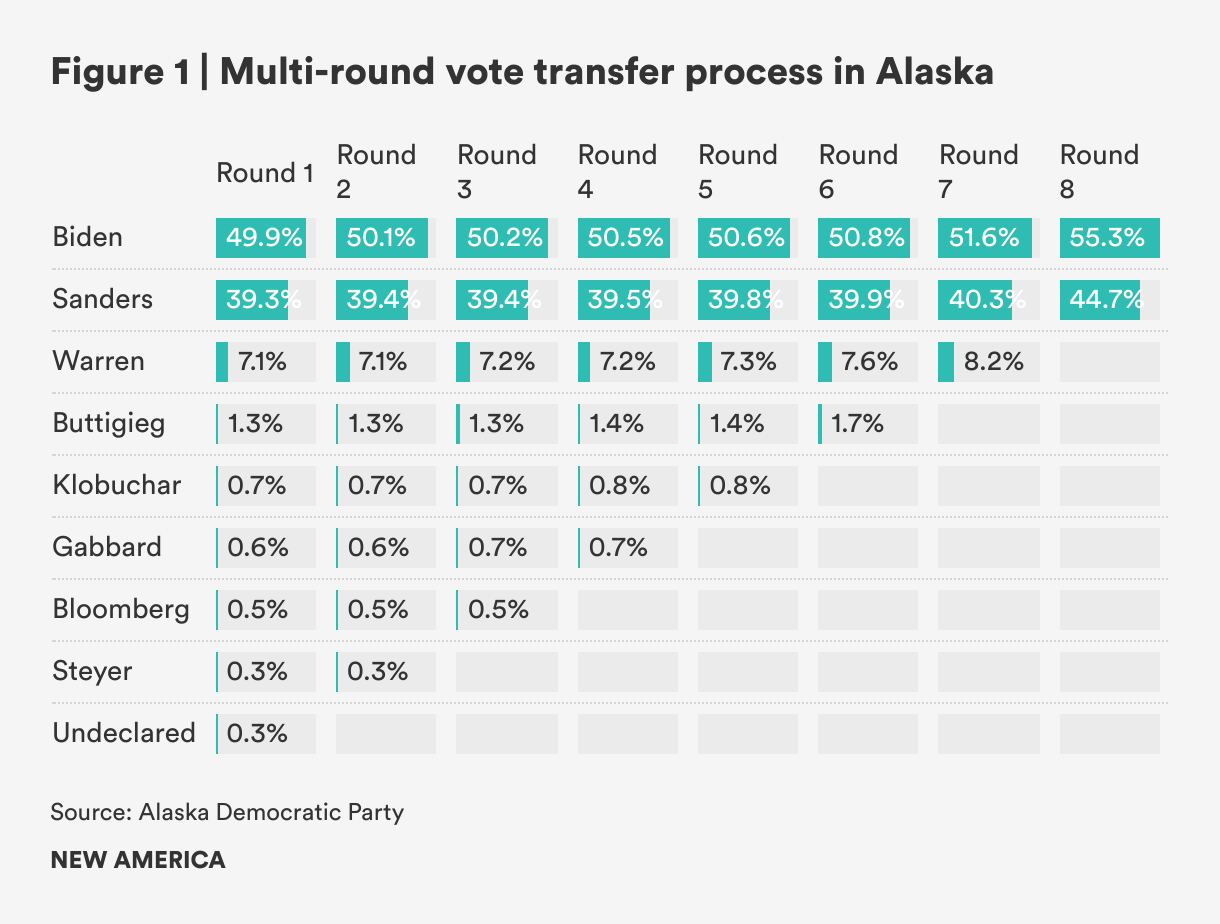
The 2020 Alaska presidential primary had two “winners,” in that both Sanders and Biden earned delegates. Had instant runoff been used instead, when Biden accumulated more than 50 percent of the votes by the second round of vote tabulation, the RCV process would have ended because there was already a simple majority winner and Biden would have been awarded all of Alaska’s pledged delegates.
We also examined the RCV results for each round in Wyoming and Hawaii’s two congressional districts. As detailed in the full paper, Biden was the first-preference majority winner in both contests, with Sanders coming in second. In these states, RCV both helped consolidate the nomination of Biden as the official candidate for the Democratic Party in the general election, and documented Sanders’ popularity.
In addition, the results shed light on RCV’s role in enhancing the representativeness of the Democrats’ delegate selection process—an especially important feature for the party in 2020, as they needed a broad electoral coalition to defeat President Trump in the general election. Our empirical analysis of all RCV states showed that RCV not only allowed a sufficiently large number of voters to send a strong message of choosing Biden to compete against Trump in the general election, but also let the progressive wing of the party select Sanders as the alternative to Biden.
RCV furthermore allowed the clear third-favorite candidate, Warren, to display her unique strength among a powerful segment of the electorate. Indeed, by combining the vote transfer data with the exhausted ballots in each round (i.e., ballots without any further ranking of candidates beyond those that have already been eliminated), we can observe that Warren received the greatest representational boost from the RCV rules.
As shown in the full report, Warren was the third-place winner in all RCV states except Nevada, which held the earliest RCV election on the 2020 Democratic nomination election calendar, and which used RCV only for the early-voting portion of the final votes cast. Among the four states that used RCV for all votes cast, in the first four or five rounds, Warren’s votes were fairly “flat,” indicating she earned minimal vote transfers in these early rounds. In other words, as the weakest candidates such as Tom Steyer and Michael Bloomberg were eliminated in early rounds of tabulation, Warren was not the second choice for voters whose first-preference candidates were already eliminated. As the rounds went beyond the fourth or fifth round, however, Warren received greater shares of vote transfers. Especially in Alaska and Wyoming, there was a steep upward trend in the late rounds of RCV vote tabulations for Warren. More concretely, more voters who voted for either Sen. Amy Klobuchar or Pete Buttigieg as their first choice preferred Warren over Biden and Sanders.
Notably, many Warren voters did not vote for Biden or Sanders at all on their ballots. This is shown in Figure 2 based on the analysis of the exhausted ballots in Hawaii, which reported vote tabulations disaggregated by their two congressional districts.
The J-shaped curves in Figure 2 demonstrate that a significant number of voters used their rankings to show preference for Warren, instead of Biden or Sanders. Note that the first four rounds did not generate any exhausted ballots; they involved the elimination of only the weakest candidates (such as Steyer), and all of the voters who voted these weakest candidates as their first choice ranked other candidates as well, ensuring that their ballots continued to be countable in the tally until at least the fifth round.
Between the fifth and the eighth rounds, however, the exhausted votes started to pick up, suggesting some voters indeed stopped ranking altogether after ranking their preferred second-tier candidates. But it was the last two rounds where the curves were extended almost straight up, indicating that the number of exhausted ballots increased exponentially as Gabbard and Warren dropped from the vote tabulations. The last round in particular shows the ballots that became exhausted because voters did not rank Biden or Sanders at all.
This preference for Warren (but not Biden or Sanders), clearly visible here, would not have been revealed with a traditional single-mark ballot.
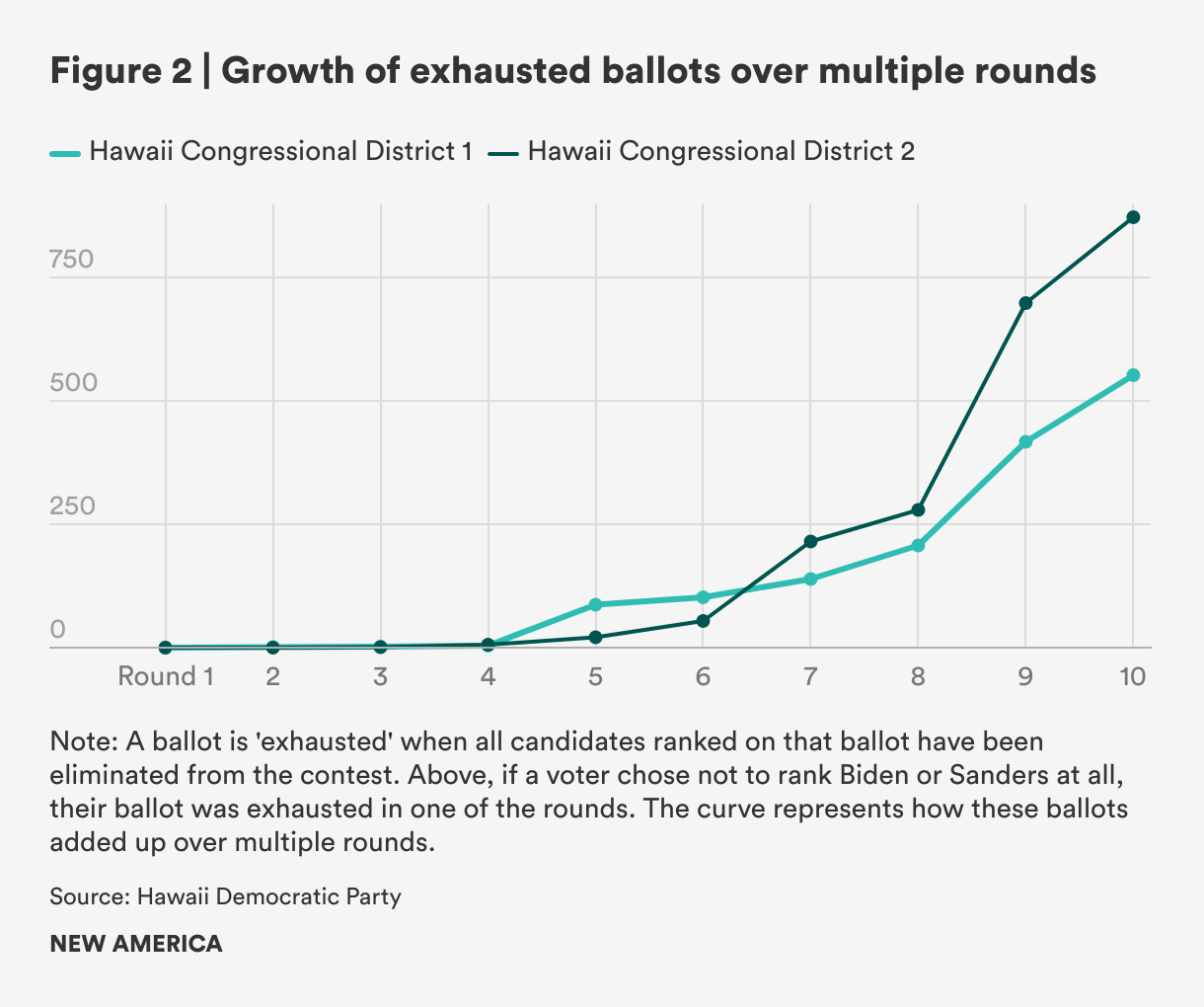
RCV not only allowed a sufficiently large number of voters to send a strong message of choosing Biden to represent the party to compete against President Trump in the general election, but also let the progressive wing of the party select Sanders as the alternative to Biden. More importantly, it illuminated a clear third-favorite candidate, Warren. RCV amplified Warren’s candidacy, a woman and progressive, as well as the voices of her supporters through additional representation at the national convention, including when voting for the party platform.
Conclusion
This study first examined the key differences between standard instant runoff RCV and the proportional form of RCV implemented in five states' 2020 Democratic presidential nomination contests. Beginning with Alaska, had the state's Democratic Party followed the standard instant runoff model, Biden would have won in the second round when the votes from the first-place undeclared ballots were redistributed, increasing Biden’s vote share from 49.9 percent to 50.1 percent, or a simple majority. In turn, had they followed that model, Biden would have received all 15 pledged delegates when passing the majority threshold in the second round.
Our second empirical finding brings promising news to the Democratic Party and potential future growth of RCV applications in party presidential nomination contests. RCV results from Alaska, Kansas, Wyoming, and Hawaii's two congressional districts demonstrate that voters understood how to use ranked ballots. The results also indicate that voters understood the necessity of using their preferences, first and foremost, to nominate the strongest candidate to enter in the general election. Biden drew the most first-preference votes in all RCV elections for which we have detailed data. Voters also made it clear that Sanders was the second most popular candidate. Therefore, RCV did not distort the ultimate purpose of the 2020 Democratic primaries to form a consensus on their nominee.
Unlike in the traditional FPTP system, RCV provided voters with the opportunity to express their preferences beyond picking the candidate they thought would perform best in the general election. Voters used this opportunity to send a strong message of support for Warren, elevating her vote shares much closer to the 15 percent threshold. Though she ultimately did not reach that threshold in the RCV states, our analysis demonstrated that using RCV would have raised her share above 15 percent in the delegate-rich Super Tuesday state of California, in addition to Oklahoma, the District of Columbia, and Democrats Abroad. In short, Warren would have earned more delegates if more states had used RCV in their 2020 Democratic nomination contests, and thus she would have had more representation at convention.
Overall, our findings strongly suggest that RCV indeed can be used effectively in presidential nomination contests, and voters are capable of effectively ranking their preferences. Finally, RCV shows potential to make presidential nomination contests more representative of the electorate and stimulate more participation in traditionally low Democratic turnout states, such as Wyoming and Alaska.
Acknowledgments: We would like to thank Lee Drutman and Maresa Strano for providing guidance on the grant application and execution, and for organizing the February 2020 meeting of the Electoral Reform Research Group (ERRG) in Washington D.C. The data collection and analysis for this paper was funded by New America, through their ERRG initiative with support from Arnold Ventures. We are also grateful to Richard Engstrom for advice on this research, and to the Political Science Department and the College of Social and Behavioral Science at the University of Utah for their support for the grant application.
Citations
- William G. Mayer, The Divided Democrats: Ideological Unity, Party Reform, and Presidential Elections (Boulder, Colorado: West View Press), 15.
More Expression, Less Error: Alternative Ballots Outperform Status Quo (Jason Maloy)
More Expression, Less Error: Alternative Ballots Outperform Status Quo
By Jason Maloy
Citations
Working paper: Jason Maloy, “Voting Error across Multiple Ballot Types: Results from Super Tuesday (2020) Experiments in Four American States,” September 24, 2020, available at SSRN: https://ssrn.com/abstract=3697637.
Brief: Jason Maloy, More Expression, Less Error: Alternative Ballots Outperform Status Quo (Washington, DC: New America, 2020), https://www.newamerica.org/political-reform/reports/more-expression-less-error/.
Overview
This research brief reports results from online experiments conducted at the height of the 2020 U.S. presidential primary season. Over 6,000 experimental subjects in four American states which held their primary elections on Super Tuesday—Colorado, Tennessee, Texas, and Virginia—voted in simulated elections involving real presidential candidates and three different ballot types: a traditional single-mark ballot, a ranking ballot, and a grading ballot.
Research Questions
- Which ballot types are more likely in general to produce void votes (ones that cannot be counted toward the final result)?
- Which types of voters are more likely in general to cast void votes?
- How do different ballot types affect the likelihood that some types of voters will cast more void votes than others?
Key Findings
- Alternative ballot types (ranking and grading) produced fewer void votes (more valid votes) than the status-quo ballot type (single-mark).
- BIPOC voters and male voters were more likely to cast void votes, but these discrepancies were moderated by past voting experience and experience in higher education.
- Alternative ballot types (ranking and grading) were associated with smaller discrepancies in error-proneness according to race and gender, while the status-quo ballot (single-mark) was associated with larger discrepancies.
Background and Research Design
Voting access is a crucial factor in the quality of electoral democracy in any city, state, province, or nation. Accordingly, people are rightly concerned about their ability to register as eligible voters and to exercise their right to vote for governmental officers in the jurisdictions to whose laws they are subject. At the same time, there is an important second-order issue for voting access: Once you’re allowed into the voting booth, how easy or hard is it for you to cast a valid vote that will count toward the outcome?
This second issue, the accessibility of the ballot itself, has been amply explored in terms of voting technology, ballot design, and administrative procedure since the notorious presidential recount of 2000 in the state of Florida. Much money has been spent, and some improvements have been made, in most American states since that time.
But what about the voting method itself—the input rules that voters are given in the instructions on the ballot—and its implications for ballot accessibility? An alternative voting method known as ranked-choice voting (RCV), where voters rank the candidates in order of preference, has been implemented in citywide elections in 18 cities around the country since 2006 and in statewide elections in Maine since 2018. Other reform options such as “range” or “evaluative” voting—essentially a grade point average (GPA) type of system but applied to political candidates instead of students in school—have been proposed but not implemented.
The common intuition is that no input rules could be simpler than the traditional, single-mark ballots that are already used in most American elections. Pick a single favorite candidate for each office and make a single mark to indicate your vote for that favorite. By contrast, asking voters to make rankings or to give grades to more than one candidate per contest seems complicated, inviting an explosion of voting error. In other words, it’s easy to assume that there’s a trade-off between the accessibility of the voting method and how expressive it is: All-or-nothing is crude but accessible, whereas giving different degrees of support to different candidates is more expressive but also more error-prone.
Is the conventional wisdom actually true? To find out, we have to investigate how different voters use different voting methods. Voting experiments are a vital tool for addressing this question, for two reasons. First, for proposals that have never been implemented, such as GPA voting, we have no data from real elections to go by. But experimental studies can generate such data, which are useful as long as we note the features of the experimental setting that differ from those of a real election. (For example, in real public elections with either optical-scan or touch-screen voting machines, the voter may be alerted if some error is detected; in the “error-friendly” design for these experiments, no error alert was used.) Second, even for a voting method like RCV that has an actual track-record (albeit a relatively brief one), we can’t see who exactly is having trouble and who isn’t without violating the secrecy of the ballot. In a voting experiment, however, we can anonymously collect information on individual voters’ characteristics while correlating it with what they do inside the experimental voting booth.
With this goal of analyzing voting error at the individual level in mind, we conducted online voting experiments involving real presidential candidates’ names in four American states in February and March of 2020. Over 6,000 respondents voted in a simulated Democratic Party presidential primary and in a simulated blanket (all-party) presidential primary contest.
The ballot type for each voting task was randomly assigned from three options, called “check,” “rank,” and “grade.” The check ballot mimicked the traditional, single-mark ballot, on which the voter is instructed to check a box next to one and only one candidate’s name. The rank ballot offered a range of rankings (first, second, third, etc.) next to each candidate’s name, instructing the voter to give a unique ranking to as many candidates as desired. The grade ballot offered a range of grades with point-scores (A for four points, B for three, C for two, etc.), instructing the voter to select any one grade for any candidate (with F for zero points as the default).
Findings and Implications
The main expectation behind the experiments was that the simplest and most familiar ballot type, the check ballot, should produce the lowest proportion of “void” votes, or votes that cannot be counted toward the final result. Yet results show that the traditional ballot produced more void votes than the reform alternatives (Figure 1). At the same time, the rates of mismarked votes, with at least one error on a completed ballot, were higher for the reform alternatives than for the traditional ballot. Other results suggest that group-based inequalities in voting error—measured by the discrepancies in void rates across age, gender, and race cohorts—are smaller with reform ballots than with the status quo (Figure 2).
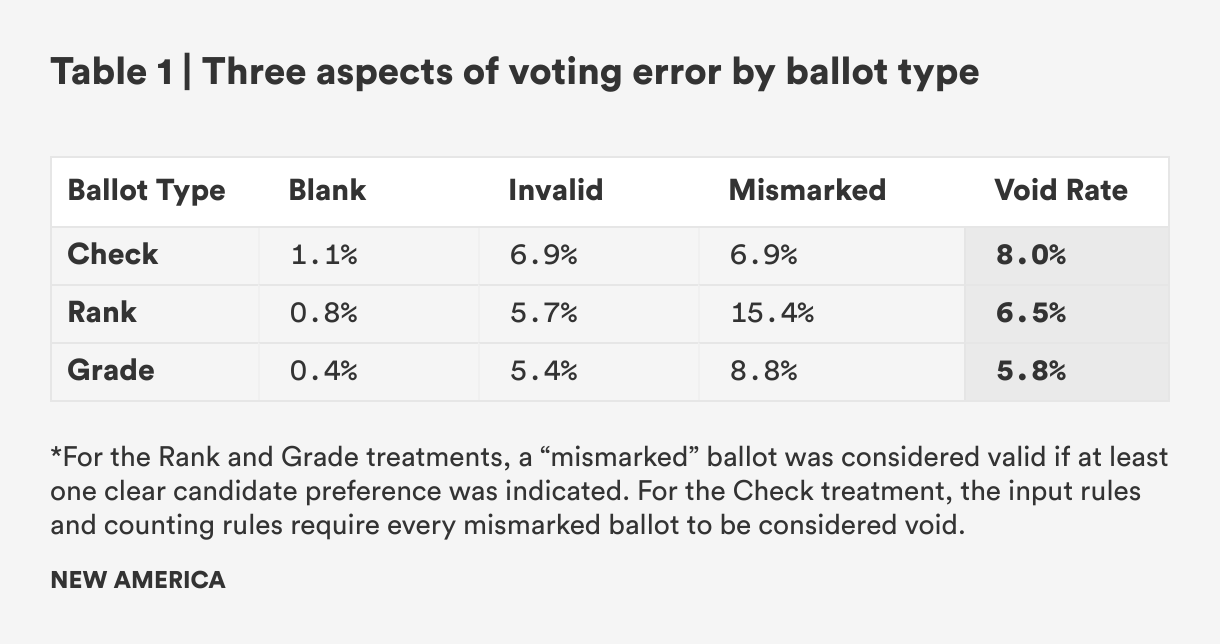
Figure 1 (above) allows comparison of different kinds of voting error across the three ballot treatments. The “blank” rate measures those ballots that contained no markings for any candidate. The “invalid” rate includes those ballots that were marked in such a way that they could not be added to the count. The “mismarked” rate measures those ballots that contained at least one violation of the instructions. Whether a mismarked ballot could still be counted depended on the ballot type. For the rank and grade treatments, a mismarked ballot was still considered valid if at least one clear candidate preference was indicated. For the check treatment, as for single-mark ballots in the real world, the input rules and counting rules require every mismarked ballot to be considered void.60
These results suggest that the opportunity to mark each and every candidate on ranking and grading ballots generates more violations while nonetheless allowing more voters to express a clear preference for at least one candidate. Figure 2 (below) shows the effect of different ballot treatments on different racial cohorts. For BIPOC voters in general, the opportunity to use ranking or grading ballots to express their electoral judgments, instead of traditional single-mark voting, tended to put them at less of a disadvantage with respect to their white peers.
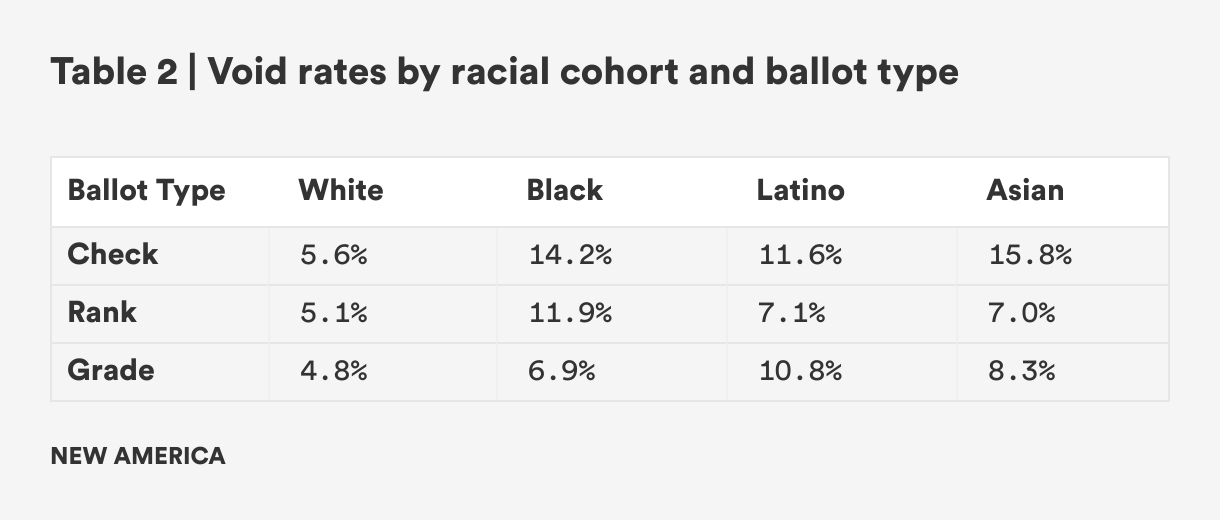
The results reported here puncture the myth of simplicity surrounding single-mark ballots, the status quo in most American elections. In the 2020 Super Tuesday experiments in four states, the status quo was not effectively exploited as a more natural or obvious way of voting, compared to the alternatives. Whether any given ballot type is easy or hard to use correctly cannot be inferred from its formal input rules alone, and it may be in part a function of patterns of political socialization.
Acknowledgments: For feedback about online surveys in general or the particular analysis presented in this brief, my thanks are due to Joseph Anthony, Stephen Barnes, Andre Blais, Barry Burden, Lee Drutman, Kirby Goidel, Michael Henderson, David Kimball, Christie Maloyed, Michael McDermott, Robert Michael, Jack Santucci, Mark Schmitt, and Matthew Ward. I also received valuable guidance from participants at a meeting of the Electoral Reform Research Group (ERRG) in February 2020. Data collection for this project was funded by New America through their ERRG initiative, with support from Arnold Ventures. The data themselves are available on request from the author.
Citations
- Among components of the void rate, the blank rate was a lesser factor than ballots that were marked in such a way as to make it impossible to quantify the voter’s support for at least one candidate. In real public elections, where error rates are calculated for each contest (e.g. each seat or office to be filled, or each ballot proposition to be decided), blank rates account for a significant proportion of void votes because of “roll-off.” In the experimental setting reported here, invalid votes contributed a much larger share of void votes. Contrary to the conventional wisdom, more voters in these experiments could use the reform ballots to indicate a valid, quantifiable preference for at least one candidate than could use the traditional ballot to do so, despite the added complexity of the voting rules and the corresponding tendency to make at least one mistake with respect to those rules.
Does Ranked-Choice Voting Affect Attitudes Toward Running for Office? (Jamil Scott and Jack Santucci)
Does Ranked-Choice Voting Affect Attitudes Toward Running for Office?
By Jamil Scott and Jack Santucci
Citations
Working paper: Jack Santucci and Jamil Scott, “Do Ranked Ballots Stimulate Candidate Entry?,” November 4, 2021, available at SSRN: https://ssrn.com/abstract=3956554.
Brief: Jack Santucci and Jamil Scott, Does Ranked-Choice Voting Affect Attitudes Toward Running for Office? (Washington, DC: New America, 2021), https://www.newamerica.org/political-reform/reports/does-ranked-choice-voting-affect-attitudes-toward-running-for-office/.
Overview
This research brief discusses three survey experiments—two nationwide and one in Philadelphia—that examine how ranked-choice voting affects attitudes toward running for office. The national experiments oversampled minority respondents to capture diverse perspectives. Across the three experiments, we tested three types of messages about ranked-choice voting (RCV). Some respondents were given a simple explanation of RCV; some were given an explanation of RCV and how it is different from the current 'choose one' system; and some were given an explanation of RCV, how it is different from the current system, and that RCV systems have been shown to benefit women and people of color. Our results suggest that electoral system structure does not necessarily shift interest in running for office.
Research Questions
- How does a ranked-choice-voting (RCV) electoral system affect attitudes about running for office?
- Do effects vary across groups of interest, especially for women and people of color?
Key Findings
- Broadly, we see a null effect in the relationship between electoral system messaging and interest in running for political office. However, there are some exceptions.
- Messaging about whom RCV benefits is positively associated with white voters’ interest in running for office, while messaging about how RCV is distinct from the current system is positively associated with interest in running among Black respondents.
- There is reason to be cautious of messaging about who benefits from RCV. The idea that women and people of color win more in RCV systems either had no effect or, in the case of Latinos, negatively affected respondents’ attitudes about running.
Background and Research Design
Despite the electoral gains for women and people of color across all levels of political office in 2018, these groups remain underrepresented. Many scholars who study candidate emergence (i.e., who runs for office) would agree that the largest barrier is candidate supply.61 However, we know that interest in running for office varies by race and gender.62 Women tend to be less likely to consider themselves as officeholders than their male counterparts, but there is variation in interest when we consider racial identity.
Some observational research suggests that replacing “conventional” systems (like plurality and majority runoff) with alternative rules might mitigate candidate-supply problems. Previous evidence suggests structural changes like multi-seat districts and cumulative or limited voting63 can increase the share of officeholders from underrepresented groups.64 Ranked-ballot systems have similarly been associated with more diverse supplies of candidates—especially in the San Francisco Bay Area.65
At least three questions arise: Is the Bay Area different from other American cities? Did increased candidate supply result from long-term RCV messaging? More broadly, does RCV nudge potential candidates (particularly those underrepresented in politics) into thinking that they could win?
To better understand the impact of RCV on candidate supply, we tested RCV messaging among respondents who were largely unfamiliar with ranked-ballot systems. We used a national convenience sample (Lucid), a city-based sample (by way of Emerson College Polling), and a nationally representative sample (Collaborative Multiracial Post Election Survey, or CMPS). In our national studies, we oversampled people of color in order to capture how race and gender impact the consideration to run under an alternative electoral system. Our Philadelphia study had two roles: again to study a diverse population, but also one that had not seen much RCV advocacy.
Across our three studies, we tested three types of messages: (1) knowledge of RCV; (2) knowledge that, under it, one can win on vote transfers; and (3) knowledge that it has benefited women and people of color.66 We tested all three messages with the Lucid and Emerson sample and only tested the third message (in relation to a no-message control) with the CMPS sample. In CMPS, all respondents were primed with information about RCV and an activity in which they were able to practice the RCV process.
The first message (denoted RCV in the figures below) used a simple explanation of RCV: "Using RCV, voters have the opportunity to rank candidates in order of choice. A voter could rank a candidate second or third, and those rankings might help a candidate get elected."
The second message (denoted RCV+ in the figures below) included an explanation of RCV and how it is different from the current 'choose one' ballot system: "Rather than need the most votes to win like in our current system, voters could rank a candidate second or third, and those rankings might help a candidate get elected."
The third message (denoted RCV++ in the figures below) included an RCV explanation, how it is different from the current system, and information consistent with diversity effects: "Rather than need the most votes to win like in our current system, voters could rank a candidate second or third, and those rankings might help a candidate get elected. Studies have shown that this method leads to more women and people of color in office."
In all three studies, the outcome variable is respondent interest in running for office. The outcome takes the form of a thermometer rating (0 to 100) in the Lucid and Emerson study. In the CMPS, the outcome is “run for political office,” or not.
Findings and Implications
Figures 1–3 presents our results across all three samples. Bar height represents the mean rating of interest in running for office for a given group: white, Black, or Latino, in each of the experimental conditions. The black line at the top of each bar is a 95-percent confidence interval. (Confidence intervals that do not overlap reflect a statistically significant difference.)
Figure 1 shows results for the Lucid sample. Because all confidence intervals overlap, we do not find any effect of message type in that sample.
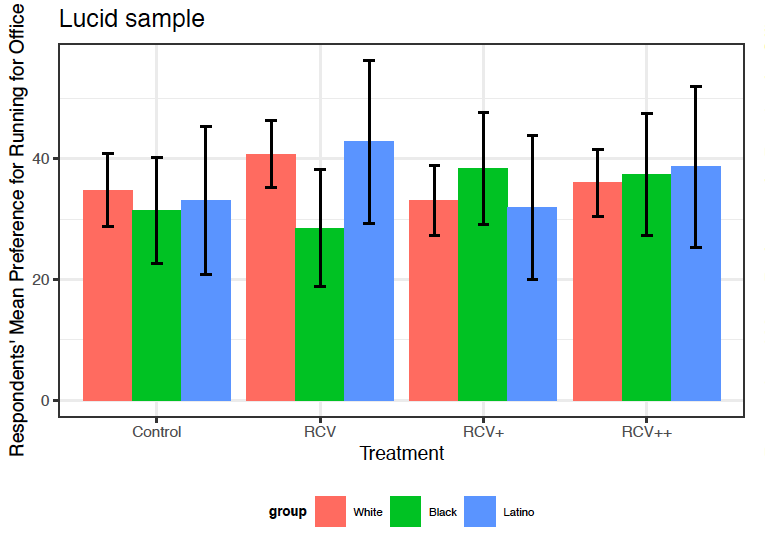
Results from the Philadelphia experiment (Figure 2) were similar with one exception: Black respondents receiving the RCV+ message (which contrasts RCV with the plurality rule of “most votes to win”) rated running for office more highly than Black respondents in the control condition. No other within-group effect, including by gender, was significant.67
Our Philadelphia sample shows us how messaging about RCV matters, to some degree, across racial groups. As in the Lucid sample, we see null effects for many of the groups included in our sample. However, Black and white respondents present exceptions. Black respondents who receive the second message (explanation of RCV and how it is different from plurality) are more positively oriented toward running for office than their Black counterparts who receive the first (simple explanation of RCV). It is only among white respondents that the third message (that RCV helps women and people of color) significantly increases interest in running for office. Why we got such results is beyond the scope of the study, but others have found that subjects from different racial groups respond in different ways to the same experimental treatments.68
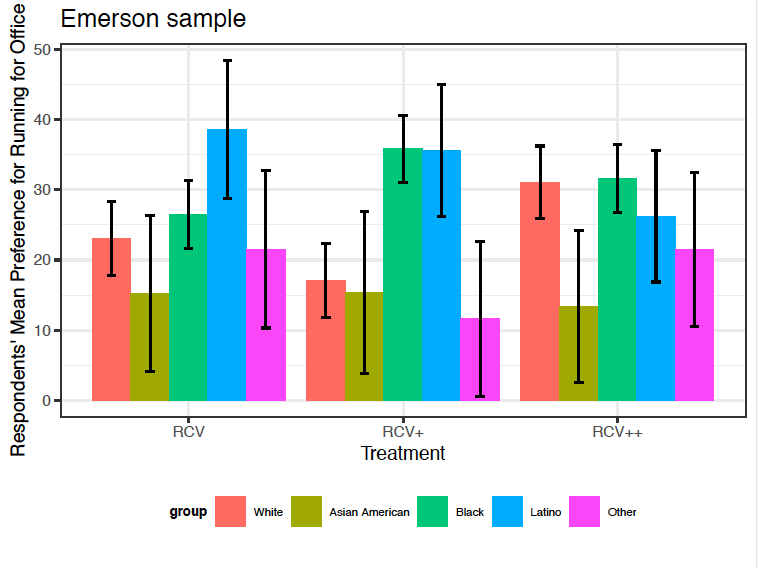
Finally, we look at data from the CMPS (Figure 3). The oversample of people of color lets us tell a broader story about RCV messaging. Again, when taking racial identity into account, we see mostly null effects, except for some that involve Black and Latino respondents. We focus on respondents who show a preference for RCV after the simulated experience using it (right panel).69 Among Latinos, the third message (RCV elects more women and people of color) leads to decreased interest in running for office. While there is no difference among Black respondents in their interest in running for office, Black respondents in the control condition are more likely to consider running for office than their white and Asian counterparts.
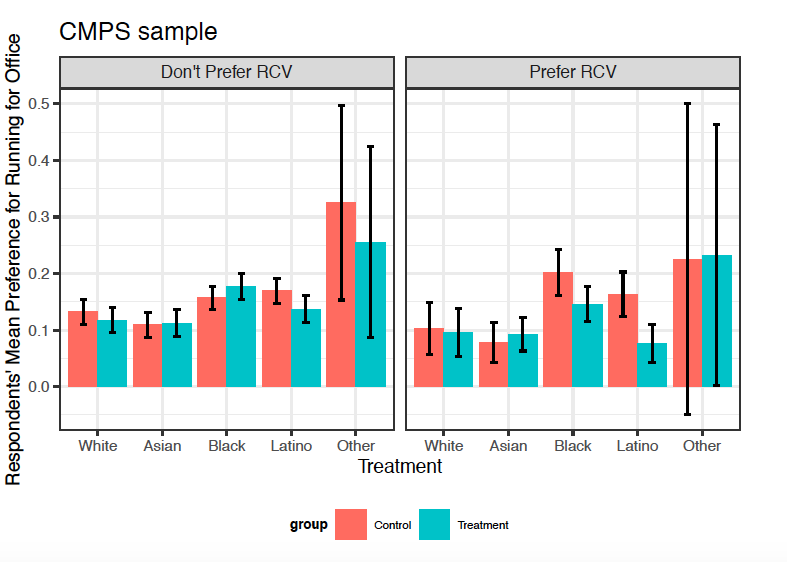
Conclusion
Overall, most of our results are null. This is meaningful in that the desire to run (or at least consider it), particularly among people of color, likely depends on a balance of personal considerations, not so much on system structure. Some of the significant effects we do see suggest that some messages may be less appealing when talking about RCV with respondents of color.
To the extent that these results may be useful, however, several points are worth noting. First, we are not able to test for differences among ranked-ballot systems (e.g., single-winner versus multi-seat proportional).
Nor did we ask about eliminating primaries, where party leadership and other figures have been shown to deter candidate entry and/or steer votes toward preferred nominees. Some contend that this is where RCV has most promise. While the debate about primaries is beyond the scope of our study, our results suggest that RCV on its own may not improve diversity.
More generally, as reformers seek to engage in the conversation about how local electoral systems might incorporate ranked ballots, women and people of color should be included. Political gains for women and people of color start at the local level.70 As local office is a pipeline to higher office, local-level changes certainly might shape the next generation of representatives at the state and national levels.
Acknowledgments: We thank New America's Political Reform Program; the American Enterprise Institute; the Unite America Institute; Stanford University's Center on Democracy, Development, and the Rule of Law; Drexel University; Georgetown University; and Arnold Ventures for the support needed to execute this study. We especially thank Spencer Kimball and Emerson College Polling for heroic work in deploying the Philadelphia study.
Citations
- Eric Gonzalez Juenke, and Paru Shah, "Demand and supply: Racial and ethnic minority candidates in White districts," Journal of Race, Ethnicity, and Politics 1, no. 1 (2016): 60-90.
- Mirya R. Holman, and Monica C. Schneider, "Gender, race, and political ambition: how intersectionality and frames influence interest in political office," Politics, Groups, and Identities 6, no. 2 (2018): 264-280.
- Katie EO Swain, and Pei-te Lien, "Structural and contextual factors regarding the accessibility of elective office for women of color at the local level," Journal of Women, Politics & Policy 38, no. 2 (2017): 128-150.
- Shaun Bowler, Todd Donovan, and David Brockington Electoral reform and minority representation: Local experiments with alternative elections (Ohio State University Press, 2003).
- Sarah John, Haley Smith, and Elizabeth Zack, "The alternative vote: Do changes in single-member voting systems affect descriptive representation of women and minorities?," Electoral Studies 54 (2018): 90-102.
- The Lucid sample received a control message that was unrelated to RCV. We varied our design between the Lucid and Emerson study to ensure that our results were not an effect of overall dislike of running for office or of an overall preference for ‘choose one’ voting.
- See the working paper for results broken out by gender: Jack Santucci and Jamil Scott, “Do Ranked Ballots Stimulate Candidate Entry?,” November 4, 2021, http://dx.doi.org/10.2139/ssrn.3956554.
- Migel M. Unzueta, Angélica S. Gutíerrez, and Negin Ghavami, "How believing in affirmative action quotas affects White women's self-image," Journal of Experimental Psychology 46, no. 1 (2010): 120-126.
- In this study, for which we partnered with other researchers, the key survey item read: “if the voting system fit your preference…”
- Paru Shah, "It takes a black candidate: A supply-side theory of minority representation," Political Research Quarterly 67, no. 2 (2014): 266-279.
The Missing Link: RCV and Substantive Representation in Local Politics (Arjun Vishwanath)
The Missing Link: RCV and Substantive Representation in Local Politics
By Arjun Vishwanath
Citations
Working paper: Arjun Vishwanath, “Electoral Institutions and Substantive Representation in Local Politics: The Effects of Ranked Choice Voting,” July 1, 2021, available at SSRN: https://ssrn.com/abstract=3802566.
Brief: Arjun Vishwanath, The Missing Link: RCV and Substantive Representation in Local Politics (Washington, DC: New America, 2021), https://www.newamerica.org/political-reform/reports/the-missing-link/.
Overview
This project explores the effect of ranked-choice voting (RCV) on substantive representation in nine RCV cities based on a host of fiscal and ideological variables. To evaluate changes in these variables following the switch to RCV, generalized synthetic controls are used to construct hypothetical versions of each of the cities had they not adopted the reform. Then, the hypothetical policy and representational outcomes are compared to the actual outcomes to determine RCV's impact.
Research Questions
- How does ranked-choice voting affect policy outcomes and policy representation?
- How does ranked-choice voting affect the ideological composition of governments and ideological representation?
- How does ranked-choice voting affect the voting behavior of legislators within cities?
Key Findings
- Ranked-choice voting has mixed effects on policy outcomes and policy representation that point to minimal changes stemming from the reform itself.
- Ranked-choice voting has no apparent effect on the ideological composition of governments or ideological representation in the cities that have adopted it.
- Ranked-choice voting has no apparent effect on the voting behavior of legislators within cities.
Background and Research Design
In the past decade, the study of substantive representation and electoral accountability in local politics has flourished. However, we still have relatively little evidence on which mechanisms improve the relationship between local public opinion and public policy, especially in local politics.
This study examines the effects of electoral rules on substantive policy representation—that is, the correspondence between public opinion and the government’s ideology and policies—in local politics using the case of ranked-choice voting (RCV). While some academics have studied the effects of RCV on descriptive representation—the correspondence between the electorate and government on demographic characteristics like race and gender—no studies to date have examined RCV’s impact on substantive representation.71
Research to date has been skeptical of the claim that electoral institutions play a significant role in substantive representation. For example, Chris Tausanovitch and Chris Warshaw find that different electoral rules like partisan elections, term limits, and at-large elections have no effect on the extent of responsiveness to public opinion in local government.72 Similarly, Justin de Benedictis-Kessner and Warshaw find no differences in fiscal outcomes between cities with partisan versus nonpartisan elections or between cities with a council-manager form of government versus those with strong mayors.73
While many of the electoral reforms examined to date have produced either inconsistent or null effects, RCV advocates hope that the system can produce larger and more significant effects. Mainstream voices tend to employ these arguments in favor of the reform, as the New York Times Editorial Board did in its endorsement of the proposal for presidential primaries and New York City elections.74
In particular, advocates point to two barriers to effective representation produced by the U.S. standard election system of first-past-the-post (FPTP) which might be reduced or overcome by adopting RCV. First, FPTP encourages candidate polarization and negative campaigning in order to appear as the “least bad” candidate. On the other hand, RCV proponents claim that the new system will reduce negative campaigning and lead to candidate moderation.75 Existing research finds that voters living in the cities with RCV express higher levels of satisfaction with the way candidates have conducted themselves, noting that candidates criticize each other less, and engage in less negative campaigning in survey responses.76 Second, FPTP enables candidates to win without a majority of support and it requires voters to cast ballots strategically in making this plurality choice. By comparison, under RCV, voters cast a preference ballot as opposed to selecting a single candidate.
Regarding representation, there are three reasons why RCV may generate improvements:
- RCV could force candidates towards the median voter by rewarding cooperative campaign behavior. If the distribution of voters is systematically more moderate than the distribution of legislators, then shifting candidates towards the median would improve representation.
- It could leave candidates’ positioning unchanged but encourage more representative candidates to run who otherwise would not have run under FPTP elections. This story would be consistent with the finding that most of the polarization in Congress can be attributed to changes in the set of candidates who run.
- RCV could translate voter preferences into winners in a more representative fashion. Under FPTP, voters cast a single ballot but may have to vote strategically to avoid wasting their vote. Relatedly, a plurality winner may be elected who does not represent the majority's preferences. As such, RCV may produce superior representation by enabling voters to cast a sincere ballot and avoid a plurality winner.
To answer these questions and evaluate the impact of RCV on policy and representation, I begin with objective measures of local government. In keeping with the literature examining the impact of partisan control,77 I first examine changes across a host of municipal policy outcomes in the following cities that adopted RCV: San Francisco, Calif.; Oakland, Calif.; Berkeley, Calif.; San Leandro, Calif.; Portland, Maine; Minneapolis, Minn.; St. Paul, Minn.; Cary, N.C.; and Burlington, Vt.78 The variables I test (all on a per capita basis) are total revenues, general revenues, total taxes, property taxes, general sales tax, direct expenditures, charges and miscellaneous revenue, intergovernmental revenue, and spending on parks and recreation, highways, education, sewerage, fire protection, police protection, public welfare, libraries, natural resources, and utilities.79
Of course, due to the unique political circumstances of any given city, we should not expect RCV to produce the same change in every city. That said, a key argument of RCV proponents is that the system will produce moderation; thus, since the majority of the cities I study are strongly left-leaning, we might expect to see a decline in spending and taxation relative to the counterfactual world in which they maintained FPTP.
Ultimately, examining variables such as tax revenue and spending on education reveals a city’s priorities. This line of reasoning suggests that, in order to study representation, changes in spending must be interpreted in the context of public demand for goods. An increase in spending could be bad for representation if the public wants less spending. Conversely, it could also be good for representation if the public wants more spending. Furthermore, null effects for spending changes may mask changes in representation if, for example, the RCV-adopting municipalities that want more spending increase spending while those that want less spending decrease spending. To account for this, I construct a measure of “policy representation” for each fiscal variable. This tracks the deviation between the city’s actual spending and the level we would expect based on their ideology. In each case, the city’s ideology is based on the public opinion-based measure of city liberalism calculated by Tausanovitch and Warshaw.80
Next, I turn to the questions of legislative polarization and of representation. While there are now commonly accepted metrics of ideology for state legislators, there is no universal metric of ideology for local government officials. To estimate ideology, then, I use the database of local election returns and officials created by Warshaw that links to the Catalist voter file and CFscores and supplement it by manually searching for all elected officials in RCV-adopting jurisdictions since 1990.81 I construct a similar metric of ideological representation by comparing the city council’s observed ideology to what we would expect for a city of that type based on the ideology scores from Tausanovitch and Warshaw mentioned above.
To evaluate changes in the many dependent variables described, I use generalized synthetic controls to construct hypothetical versions of each of the adopting cities had they not adopted RCV.82 This allows us to compare the difference between the actual outcomes and the hypothetical trajectory to determine the effects of RCV. For each city, I employ population size, median income, sex, race, education, and age as controls.
Findings and Implications
I start by examining changes in fiscal outcomes following adoption of RCV. Table 1 examines the average treatment effects for the full set of municipal revenue and expenditure variables. For each plot, the first coefficient corresponds to changes in fiscal policy and the second coefficient corresponds to changes in representation.
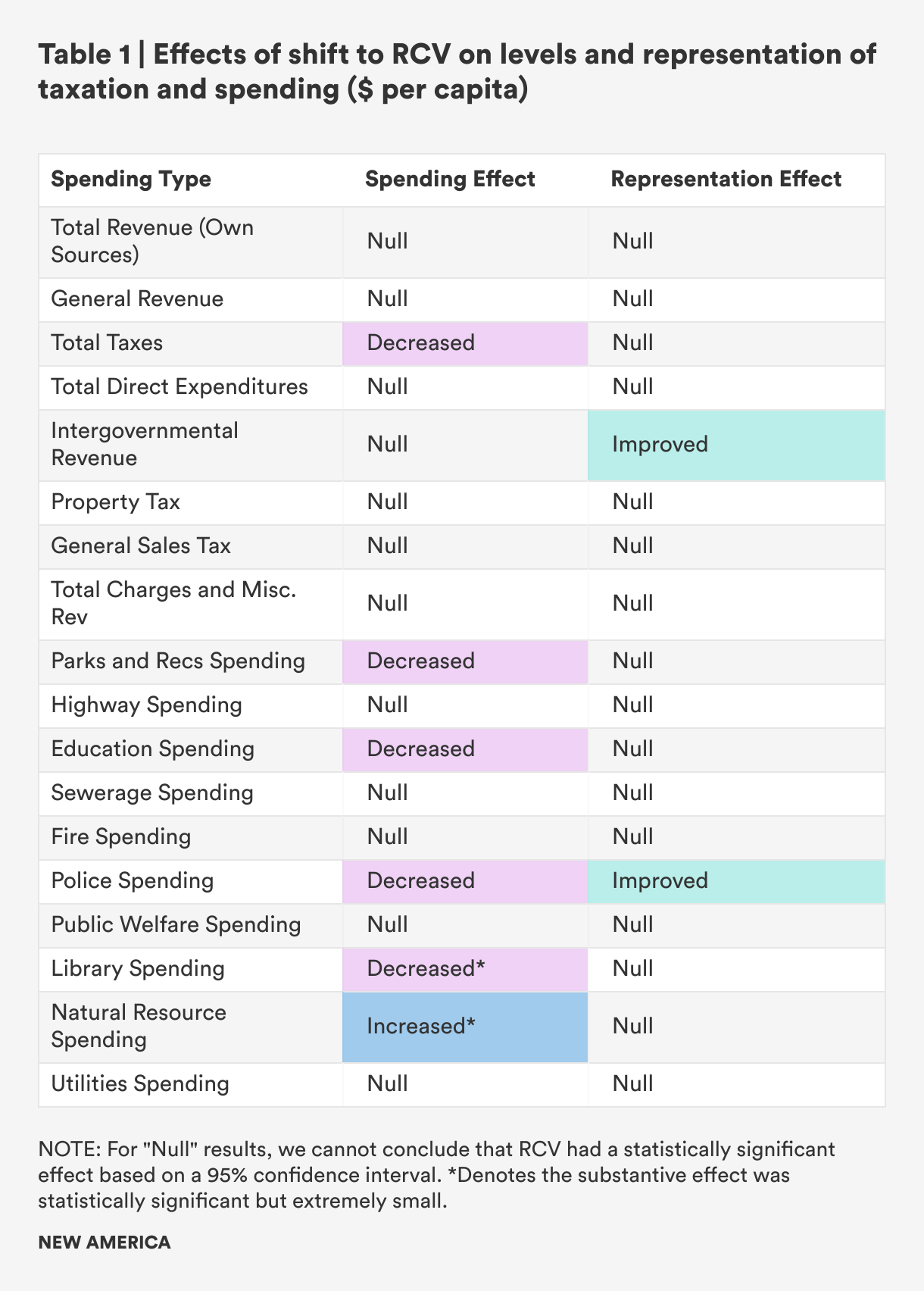
Beginning with changes in fiscal policy, it does not appear that total revenue, general revenue, total expenditure, or intergovernmental revenue levels change following adoption of RCV. Total taxes appear to have gone down following implementation of RCV; however, for the two most visible and important categories of local taxes—property and sales taxes—levels either stayed the same or increased. In the cities that adopted RCV in the sample studied, property and sales taxes account for 75 percent of total tax revenue from 2000 to 2017. Insofar as lower tax revenues come from changes in various less visible domains (e.g., motor fuel taxes, hunting and fishing licenses), it seems less plausible to attribute these changes to RCV. Regarding expenditure categories, the model suggests that spending decreased in parks and recreation, education, and police. Or, in other words, there was a smaller increase in spending than we project would have happened without RCV. (There were also statistically significant but substantively small effects on library and natural resource spending.)
Then, I look at changes in representation. This metric is calculated as the absolute difference between observed spending levels and predicted levels conditional on the city's mass liberalism. These predicted values represent the preferred level of spending for a city given its ideology. Thus, it looks at the spending in cities with similar ideological leanings to predict what the citizens of the city being studied want. As a result, higher values on this metric signify declines in the quality of representation (since the distance between policy and citizens' views has increased). It appears that effects are null for total revenue, general revenue, and total direct expenditures, and, unlike at the policy level, it does not appear that there was an improvement on policy representation for total taxes. This suggests that the relative decline in taxes in some RCV cities corresponded to an increase in representation in some cities but a decline in representation in others. Although it appears that representation on intergovernmental revenue improved, it is unlikely that voters have strong preferences over that category.
Turning to tax and expenditure categories, we see that the increase in general sales tax revenues also lines up with a decline in representation. Compared to the fiscal policy analysis, an even greater share of the representation coefficients are not statistically significant; the only one that achieves significance is police spending (an improvement in representation). In sum, while some categories saw increases or decreases in spending, the picture painted as a whole does not lend itself to any clear interpretation wherein RCV changed municipal policy or altered substantive representation.
Next, I look at the effects of RCV implementation on the ideology of city councils using the Catalist Ideology field and the CFscore. The Catalist Ideology field takes on values from 0 to 100, where higher values are more conservative. The CFscores are not bounded but mostly take on values from -2 to 2, where, again, higher values are more conservative.83 I run two separate models; the first tracks changes in the ideological composition following RCV, and the second explores changes in the distance between the mayor or council and mass opinion (where higher values indicate worse levels of representation). Once again, I use generalized synthetic controls to estimate the average treatment effect of RCV. RCV induces a slight shift rightward on both metrics, but neither of the changes achieves statistical significance. Similarly, we see a slight increase in the caliber of representation on these city councils, but, once again, the change does not reach statistically significant levels.
Finally, I employ roll call data from San Francisco and Oakland city councils collected by Peter Bucchianeri.84 In addition to verifying my findings from other sources, I estimate dynamic ideal points for the two cities. I find here that the same legislators did not have an ideological shift following the adoption of RCV. I also employ estimates of city district-level ideology in San Francisco from Bucchianeri to evaluate whether the caliber of responsiveness within the city changed, and I again find no effects. Further detail of this analysis is available in the full paper.
Conclusion
Most debates about ranked-choice voting come down to questions of representation. Thus, the key question is whether switching from FPTP to RCV improves the correspondence between the ideologies of elected officials or the policies they adopt and the views of the citizenry.
This project provides the first direct analysis of whether RCV affects substantive representation. Formal theories of candidate and voter behavior do not necessarily predict a decline or improvement in representation, and my empirical findings suggest that there is no significant effect of the reform. While it appears RCV produces limited change in the municipalities that have adopted it, my findings do not resolve several of the outstanding debates between supporters and detractors. For example, enabling voters to cast a sincere ballot may be a normative good in and of itself. Similarly, it may be a normative ill if certain groups are less likely to cast a completed RCV ballot. Finally, my findings are limited to the set of fairly progressive cities that have adopted the reform. As additional jurisdictions adopt the reform—especially at the state level—more research should be done to explore whether this relationship persists. However, my empirical findings suggest that at the end of the day, the net effect of this reform on municipal policy and representation is at best limited.
Acknowledgments: Sophia Lee, Mirnes Kukic, and Shelly Tsirulik provided excellent research assistance. I am grateful to New America and Arnold Ventures for funding the research. Chris Warshaw and Peter Bucchianeri graciously shared much of the data in the analyses with me. Tyler Simko, Jim Snyder, and participants in the Electoral Reform Research Group gave helpful comments and advice on the paper. I am especially indebted to Jon Rogowski for detailed comments and advice on the paper.
Citations
- Sarah John, Haley Smith, and Elizabeth Zack, “The Alternative Vote: Do Changes in Single-Member Voting Systems Affect Descriptive Representation of Women and Minorities?,” Electoral Studies 54 (2018): 90–102, https://doi.org/10.1016/j.electstud.2018.05.009.
- Chris Tausanovitch and Christopher Warshaw, “Representation in Municipal Government,” The American Political Science Review 108, no. 3 (2014): 605–41, https://doi.org/10.1017/S0003055414000318.
- Justin de Benedictis-Kessner and Christopher Warshaw, “Mayoral Partisanship and Municipal Fiscal Policy,” The Journal of Politics 78, no. 4 (2016): 1124–38, https://doi.org/10.1086/686308.
- The Editorial Board, “The Primaries Are Just Dumb,” The New York Times, February 26, 2020; The Editorial Board, “New Yorkers Have a Chance to Remake How They Vote,” The New York Times, October 15, 2020.
- Robert Richie, “Instant Runoff Voting: What Mexico (and Others) Could Learn,” Election Law Journal 3, no. 3 (2004): 501–12, https://doi.org/10.1089/1533129041492150.
- Todd Donovan, Caroline Tolbert, and Kellen Gracey, “Campaign Civility under Preferential and Plurality Voting,” Electoral Studies 42 (2016): 157–63, https://doi.org/10.1016/j.electstud.2016.02.009.
- E.g., de Benedictis-Kessner and Warshaw, “Mayoral Partisanship and Municipal Fiscal Policy”
- I cannot use data from San Francisco, Burlington, Cary, and Portland for the analysis of city council ideology. See the paper for more details.
- Kawika Pierson, Michael L. Hand, and Fred Thompson, “The Government Finance Database: A Common Resource for Quantitative Research in Public Financial Analysis” (PLoS ONE, 2015), https://doi.org/10.1371/journal.pone.0130119.
- Chris Tausanovitch and Christopher Warshaw, “Representation in Municipal Government,” The American Political Science Review 108, no. 3 (2014): 605–41, https://doi.org/10.1017/S0003055414000318.
- Adam Bonica, “Mapping the Ideological Marketplace,” American Journal of Political Science 58, no. 2 (2014): 367–86; I do not have sufficient ideology data for the city councils of San Francisco (prior to treatment) or Burlington, Cary, and Portland (after treatment).
- Yiqing Xu, “Generalized Synthetic Control Method: Causal Inference with Interactive Fixed Effects Models,” Political Analysis 25, no. 1 (2017): 57–76, https://doi.org/10.1017/pan.2016.2.
- For example, Bernie Sanders scores at -1.72 and Rand Paul scores at 1.26.
- Peter Bucchianeri, “There’s More than One Way to Party: Progressive Politics and Representation in Nonpartisan San Francisco,” 2018.
- Introduction (Lee Drutman and Maresa Strano)
- Support for Ranked-Choice Voting across Race and Partisanship (Joseph Anthony, David C. Kimball, Jack Santucci, and Jamil Scott)
- Ranked-Choice Voting is an Acquired Taste (Joseph Anthony and David C. Kimball)
- Does Ranked-Choice Voting Reduce Racial Polarization? (Yuki Atsusaka and Theodore Landsman)
- Ranked-Choice Voting is No Refuge for Extreme Candidates (Melissa Baker)
- The Future is Proportional: Improving Minority Representation through New Electoral Systems (Gerdus Benadè, Ruth Buck, Moon Duchin, Dara Gold, and Thomas Weighill)
- Choosing to "Vote As Usual" (André Blais, Carolina Plescia, and Semra Sevi)
- Ranked-Choice Voting and Political Expression: Voter Guides Narrow the Gap between Informed and Uninformed Citizens (Cheryl Boudreau, Jonathan Colner, and Scott MacKenzie)
- Ranked-Choice Voting, Runoff, and Democracy: Insights from Maine and Other U.S. States (Joseph Cerrone and Cynthia McClintock)
- RCV is Neither Panacea nor Catastrophe for Minority Representation (Melody Crowder-Meyer, Shana Kushner Gadarian, and Jessica Trounstine)
- Electoral Systems Affect Legitimacy Gaps and Affective Polarization (Sean Fischer, Amber Hye-Yon Lee, and Yphtach Lelkes)
- Multi-seat Districts and Larger Assemblies Produce More Diverse Racial Representation (Michael Latner, Jack Santucci, and Matthew S. Shugart)
- Ranked-Choice Voting Delivers Representation and Consensus in Presidential Primaries (Baodong Liu, Nadia Mahallati, and Charles M. Turner)
- More Expression, Less Error: Alternative Ballots Outperform Status Quo (Jason Maloy)
- Does Ranked-Choice Voting Affect Attitudes Toward Running for Office? (Jamil Scott and Jack Santucci)
- The Missing Link: RCV and Substantive Representation in Local Politics (Arjun Vishwanath)
More About the Authors

Lee Drutman
Senior Fellow, Political Reform Program

Maresa Strano
Deputy Director, Political Reform Program