
Lessons for Congress from Implementation of the Emergency Rental Assistance Program
Abstract
Created as part of a broader pandemic relief effort, the Emergency Rental Assistance Program (ERAP) provides financial support to households to pay rent and utilities. Now, the program offers a unique case study to evaluate innovative policy design and learn from implementation approaches tested during the pandemic.
Despite an initially slow rollout, ERAP program adjustments were designed to provide a rapid solution while empowering implementers at multiple levels of government to make quick allocation decisions. This resulted in innovative processes that improved program efficiency and reduced the burden on residents receiving support. Comparing approaches and outcomes in states across the United States provides a rich perspective and several clear lessons for future policy design and implementation. These lessons include:
- Tailor program metrics and enforcement to program goals
- Give funds and threaten their loss rather than require grantees to apply and adopt
- Fight fraud without creating barriers to access
- Reduce local burdens with federal shared services
- Give grantmaking role to local governments
- Use modern methods to analyze program efficacy
Acknowledgments
We would like to thank our interviewees, especially the public servants at all levels of government who shared their extensive knowledge and expertise so that future policy makers can learn from their experiences.
- Center on Budget and Policy Priorities (CBPP)
- City of Glendale, Arizona
- City of Houston, Housing and Community Development Dept.
- D.C. Department of Human Services
- Emerson Collective
- General Services Administration (GSA)
- Municipality of Anchorage, Alaska
- National Low Income Housing Coalition (NLIHC)
- North Carolina Department of Public Safety (NCDPS)
- Philadelphia Housing Development Corporation (PHDC)
- Texas Housers
- The Urban Institute
- U.S. Digital Response
- U.S. House Financial Services Committee
- U.S. House Information Resources Office
- United States Digital Service (USDS)
- Virginia Department of Housing and Community Development (DHCD)
- What Works Cities / Results for America
- White House Office of Management and Budget
This report came into existence thanks to the wisdom, guidance and expertise of many people, including Robert Gordon, Marci Harris, Cassandra Madison, Tara McGuinness, and Travis Moore.
Finally, we are grateful to the Ford Foundation for making this research and work possible.
Downloads
Overview
The Emergency Rental Assistance Program (ERAP) aims to prevent evictions during the pandemic. ERAP was established in January of 2021 under the Consolidated Appropriations Act with an initial $25 billion investment to assist households that were unable to pay rent and utilities due to the COVID-19 pandemic. Funds were directed to “eligible grantees” (states, territories, and local governments with more than 200,000 residents, and Indian tribes) to provide assistance through existing or newly created rental assistance programs. An additional $21 billion was authorized in the March 2021 American Rescue Plan.
While federal programs have long provided vouchers for low-income residents and targeted support for nonprofit organizations working with people experiencing homelessness, ERAP was the first program to offer emergency rental aid exclusively for those already in rental housing at risk of eviction. Because the goal of the program was rapid disbursement of funds in response to the emergency, Congress situated the program at the Department of Treasury, to benefit from its experience in moving quickly, rather than at the Department of Housing and Urban Development.
Implementation was slowed by grantees’ lack of technical resources. ERAP implementation was delayed in many states due to the lack of existing systems for verification and distribution of funds. Four months after the program’s creation, many states had not made an application available.1 By late August 2021, only 11 percent of program dollars had been spent2 and only 500,000 of 2.8 million applicants (less than .02 percent) had received aid.
Most grantees that were able to launch programs quickly built their own systems, often modifying an existing system (like a scholarship application) and sometimes using generic application forms. Several vendors offered common solutions across states. The most widely used provider, Neighborly, deployed assistance with over 300 grantees.3 Many smaller localities with fewer resources attempted to build their own solutions, often leading to further delays and complications. In Texas, a poorly designed website went down and stopped all aid during an ice storm, triggering a public outcry,4 until the state eventually opted to go with a Neighborly solution.
The program was successful in reaching many in need and preventing evictions. By the end of March 2022, Treasury reported that grantees had made over $4.7 million payments and had spent or made concrete commitments to spend nearly two-thirds of total funds.5 More than 80 percent of funds were reaching those most in need, and more than 60 percent of program beneficiaries were Black or Latinx.
In conjunction with a federal eviction moratorium,6 state moratoria, and other forms of aid, the ERAP program appears to have achieved many of its intended results. Evictions in 2021 were less than half of pre-pandemic averages.7 Even after the federal eviction moratorium ended on August 26 2021, evictions remained well below pre-pandemic averages through December 2021.
Program effectiveness and success varied by state and locality. Some states and localities were able to get up and running soon after the federal law passed; others took longer. Some states exhausted available funding, while others continued to have more resources than needed. In some localities, getting aid was a smooth process, with easy to use websites and minimal paperwork. In others, the online system was clunky, and applicants were required to produce multiple documents to prove eligibility. These varied implementation approaches and results provide lessons for future policy design.
Citations
- Jason DeParle, “Federal Aid to Renters Moves Slowly, Leaving Many at Risk,” New York Times, April 25, 2021, https://www.nytimes.com/2021/04/25/us/politics/rental-assistance-pandemic.html.
- Glenn Thrush, et al., “About 89% of Rental Assistance Funds Have Not Been Distributed, Figures Show,” New York Times, August 25, 2021, https://www.nytimes.com/2021/08/25/us/politics/eviction-rental-assistance.html
- ”REIMAGINING THE ADMINISTRATION OF HOUSING, ECONOMIC & COMMUNITY DEVELOPMENT PROGRAMS,” Neighborly, https://www.neighborlysoftware.com/about-us/
- Christopher Connelly,”Texas’ rent relief program has been plagued by problems that slow payments and could prompt evictions,” The Texas Tribune, April 7, 2021,ttps://www.texastribune.org/2021/04/07/texas-rent-relief-program-legislature/
- “Treasury Announces $30 Billion in Emergency Rental Assistance Spent or Obligated with Over 4.7 Million Payments Made to Households Through February 2022,” U.S. Department of Treasury, March 30, 2022, https://home.treasury.gov/news/press-releases/jy0688
- On March 27, 2020, the president signed the Coronavirus Aid, Relief, and Economic SecurityAct (P.L. 116-136) (CARES Act) into law. Section 4024 of the CARES Act imposes atemporary moratorium on evictions. This moratorium went into effect immediately upon theenactment of the CARES Act on March 27, 2020 and lasted for 120 days (through July 24, 2020).
- Peter Hepburn, et al., “Preliminary Analysis: Eviction Filing Patterns in 2021,” The Eviction Lab , March 8, 2022, https://evictionlab.org/us-eviction-filing-patterns-2021/
Lessons
1. Tailor Program Metrics and Enforcement to Program Goals
ERAP allocation was initially through a population-based formula, but the Treasury later introduced reallocation based on how effectively grantees spent down the money. Jurisdictions that failed to commit a specific share of funds by a certain date were required to change or accelerate their approach in order to retain funding. Under this “use it or lose it” approach, if corrective measures did not effectively accelerate implementation, funds were reallocated to jurisdictions with more success in distributing funds. The Treasury has undertaken two rounds of reallocation in ERAP, with one additional round expected.
The ERAP program provides one of the most aggressive examples of reallocation in federal government programs due to its size and speed. While a typical government program might have from $5 million to $10 million left over at the end of a fiscal year, about $800 million of ERAP funds were recaptured by the federal government and reallocated. ERAP directed the Treasury to begin the reallocation process only nine months after its enactment, and a year before dollars must be spent. More typical reallocation provisions leave redistribution until 45 or 60 days before funds would lapse. Early engagement made reallocation an integral part of program administration.
The Treasury adopted the reallocation mechanism to address flaws with the initial formulaic allocation approach, allowing the program to right itself by allocating money more closely based on need and changing behavior. Grantees reacted to the threat of losing money by either redirecting it to better uses or spending it faster. While the federal government reclaimed and redistributed $800 million to higher-spending or needier jurisdictions, about $1.3 billion was “voluntarily” reallocated, with slow-going state governments moving funds to their own faster-moving counties or cities. As one senior leader explained, “We used reallocation to let grantees work things out among themselves, before taking the money. Governors had a choice: They could stand firm against spending, and then risk losing it before the next election. Or they could redirect the money within their states.”
Initial Program Design was Inequitable and Did Not Prioritize Rapid Allocation
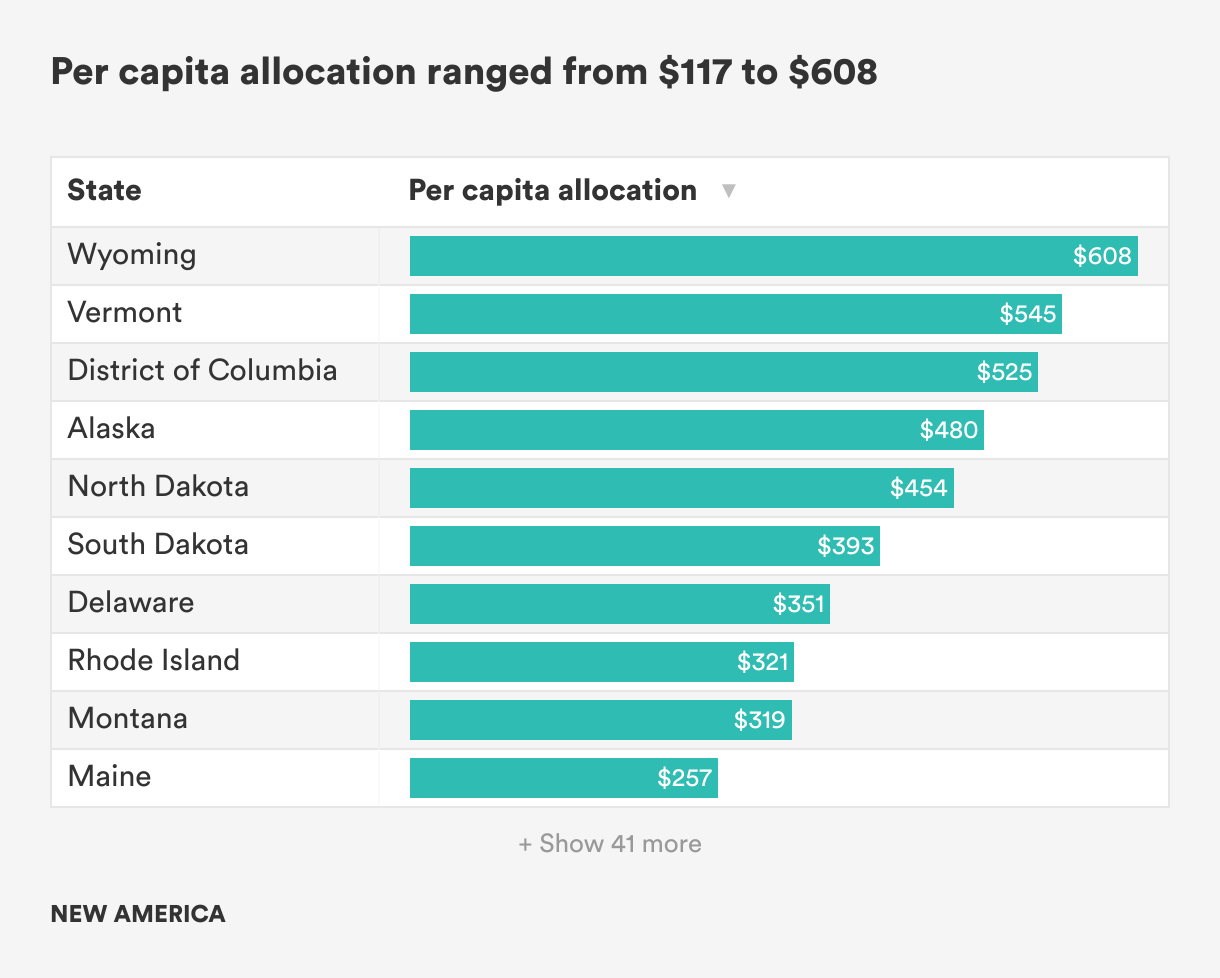
Unlike the reallocation approach based on need and speed, ERAP initially began with a base allocation to all states plus a population adjustment. A “small state minimum” of $352 million per state was the result of legislative negotiation and the need to secure votes in the Senate,8 rather than an assessment of the need or capacity to implement in those states. While a modest fixed allocation would be reasonable to address fixed administrative costs (e.g., staffing an office, cutting checks), the initial formula was notably inequitable, with California receiving $131 per capita while Wyoming received more than four times that, at $610 per capita. Beyond the small-state guarantee, ERAP initially allocated virtually all funding based on a population formula without regard to state-specific conditions, such as the ratio of renters to homeowners or individuals’ ratio of income to rent or relative cost of food, transportation, and health care.
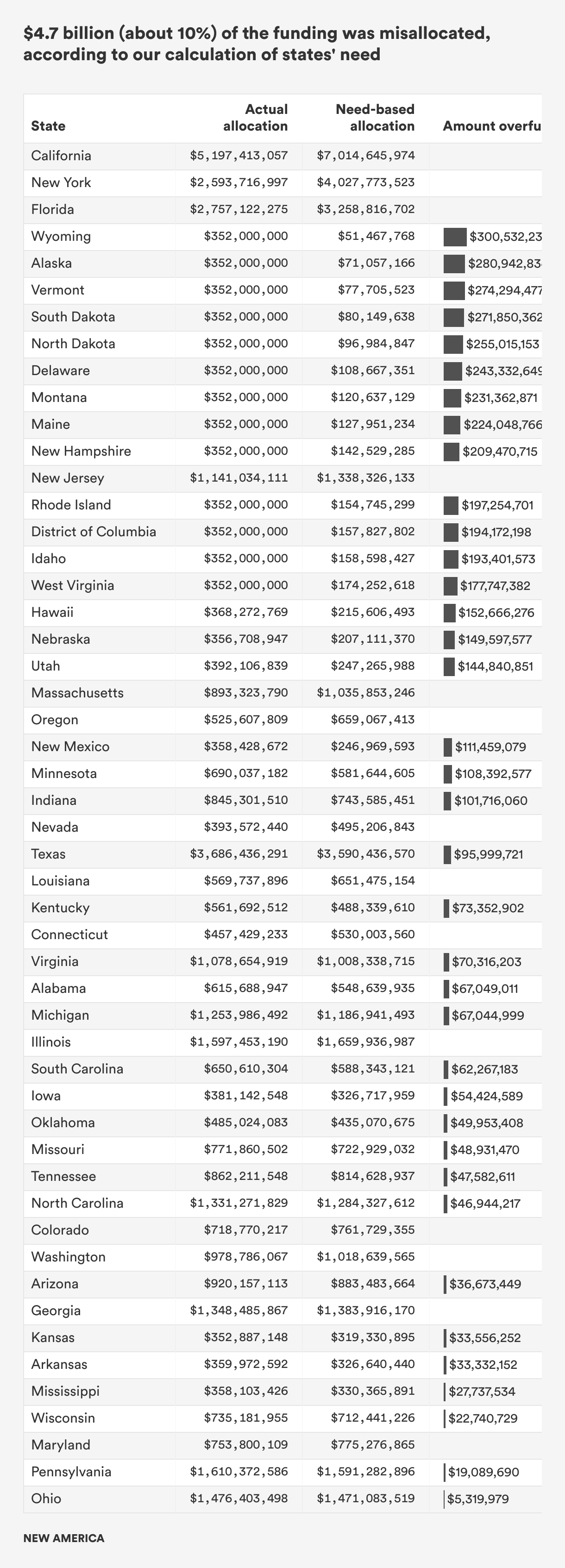
Instead of the initial per state + population allocation formula, Congress could have considered a simple need-based formulation for funding allocation, such as the share of households in a state that pays more than 50 percent of their income on rent. Instead, ERAP’s initial structure created a gap between funding allocation and actual need (see figure below). A need-based approach would have shifted $4.7 billion (of $45 billion total) to states with the greatest need. Importantly, it was those states with greatest need that ultimately showed greater capacity for implementation. Underfunded states had spent 75 percent of their funds by December 31, compared to 52 percent in the overfunded states.
Reallocation has begun to correct for these imbalances, but only in part. Out of the $4.7 billion in over-allocation, Treasury has pulled back under $600 million9 to date, and the window is quickly closing. Three jurisdictions (Alaska, the District of Columbia, and Hawaii) have already spent more ERAP money than they would have received based on a pure need-based allocation. While this is a testament to efficient administrative capabilities, it also means that over-allocated funds cannot be reallocated.
Even if reallocation could perfectly redirect funds based on need, the delay prior to reallocation caused harm. Fast-spending states and cities like Philadelphia, New York, and California had to suspend programs to await more federal dollars, while others slowed disbursements. Ultimately, many residents were left without the funds that they were promised by the federal government.
“Use it or Lose it” Reallocation Led to More Effective Implementation
ERAP’s aggressive and effective reallocation process offers a new model for policymakers to consider for future programs. The approach provided a transparent, standardized, and streamlined mechanism for rewarding success in one important metric. In the case of ERAP, the goal was speed.
Future policies could be designed to optimize for other metrics tied to program goals. For example: How many meals were served to poor children? Or, how many people received training and were then hired? With access to real-time information, it is increasingly possible to access detailed implementation data. Notably, the ERAP reallocation process did not depend on data alone but gave grantees a chance to plead their cases—via performance improvement plans—without a whole new round of competitive grantmaking. That is a success. Policymakers should consider introducing outcomes-based metrics for new and existing programs in lieu of or in addition to more conventional approaches, such as competitive processes or formulaic block grants.
2. Give Funds and Threaten Their Loss Rather Than Require Grantees to Apply and Adopt
Granting funding that can be taken away if not used is a powerful policy lever—a phenomenon familiar to behavioral scientists who study loss aversion.10 If Congress had set aside half of ERAP funds for allocation through a competitive process, it is likely that many states would not have applied at all, a pattern increasingly common in safety net programs, from Medicaid expansion to extended unemployment insurance during the pandemic. The voluntary nature of these programs feeds a growing disparity between states in terms of access to services by low-income residents.
ERAP partly addressed this problem by getting money to everyone on day one. Once states received ERAP money, they wanted to keep it. And when keeping it meant that they had to spend more quickly, they moved to spend more quickly. This is an important policy design lesson for new programs in an era of increasing polarization: Get broad take-up early, and distribution will be more equitable in the end.
3. Fight Fraud Without Creating Barriers to Access
Government programs usually require extensive documentation for access to benefits. Because of the urgency of the COVID crisis, ERAP did not. Typically, loose documentation requirements are viewed as a gateway to fraud, but that did not happen with ERAP for two reasons:
- Checks were built into program design: While the tenant applied for the benefit, the program required proof of a contractual relationship with a landlord and a residency within the jurisdiction. In every state, this included a signed lease, a utility bill, or, if necessary, an attestation from a landlord or management company. Without driving fraud risk to zero, these requirements substantially reduced fraud risk without excessively complicating the application process.
- Grantees were innovative: Jurisdictions used innovative systems—with a necessary default to paperless due to the pandemic—to target fraud without increasing burdens.
Examples of these principles in practice include data-sharing agreements across agencies in the District of Columbia, which allowed identities, employment, and utility information to be verified without the need for additional documentation. So, someone who qualified for the Supplemental Nutrition Assistance Program (SNAP) would be presumed eligible for ERAP. Officials adopted additional back-end processes for verifying identities and addresses, using credit reports or even calling the phone number on file. Outlier applications received an additional layer of review. While these steps slowed down internal processes, the additional burden on beneficiaries was minimal and the District of Columbia still managed to be one of the fastest jurisdictions in the country at getting money out the door. The District now hopes to leverage these new linkages across agencies to speed up regular-order benefits programs.
Another fast-moving state was North Carolina, where officials worked to identify the patterns behind fraudulent applications. They saw that individuals from out of state were making arrangements with unsuspecting elderly North Carolinians to accept payments and send them money. The state also saw complex efforts to fraudulently secure checks based on false places of residence. To address both these challenges, North Carolina moved to making payments using paper checks, rather than electronically. This accomplished two goals, tying payments to actual North Carolina residents, and putting another informal layer of verification into place. An official in North Carolina shared, “Banks called us and said, ‘Why is 76-year-old Mr. Jones standing in front of us with a $10,000 check he plans to send to his Russian girlfriend?’”
ERAP shows how federal policymakers and local implementers can make use of anti-fraud efforts that reduce error without burdening applications. Back-end data matching, machine learning to identify patterns of fraud, and even mailing paper checks are not only more targeted at misconduct than front-end documentation requirements, but they can also be more effective. Data-sharing agreements within state agencies—and between federal agencies like the Internal Revenue Service (IRS) and states—can play a key role in identifying fraud without increasing burden.
4. Reduce Local Burdens with Federal Shared Services
The ERAP experience points to the potential value and cost-savings of optional federal shared services that would reduce the level of administrative effort needed in every jurisdiction.
There will always be some things that governments closest to the people do best. Because ERAP programs needed to vary based on property and eviction laws, and because those laws are state and local in nature, it made sense that state and local governments established policies for ERAP programs. Likewise, where it was a challenge to notify low-income and immigrant residents about this new program, it also made sense for different jurisdictions to stand up outreach operations, since they know their communities and speak the relevant languages, literally and figuratively.
Some areas of program implementation and administration, however, were identical across all grantees, such as the need to build websites, establish call centers, and make payments. Federal departments, such as the IRS, Department of Labor, and Department of Health & Human Services, have the data to support verification of identity, residency, and income more accurately and efficiently than patchwork state systems, and with less demand for documentation from residents.
The federal government could productively establish shared services to support faster program stand-up and more efficient delivery. Whether through federal employees at the United States Digital Service (USDS) and 18F at the General Service Administration programs, or through quickly procured private contracts, the federal government could have quickly established shared websites and correspondence engines, call centers, and check payment operations. The same system could have enabled accuracy checks against federal databases. States and localities could have been asked early on to decide whether to opt into these services.
As in the private sector, there are economies of scale: A single larger purchaser, on behalf of multiple jurisdictions, could have gotten better prices than 400 communities operating separately. The share of effort on administration would decline, allowing for greater investment in outreach and frontline services. And while a shared service might not perform as well as the most superb local players, the high average quality of federal staff and systems likely would have lifted the effectiveness of average programs, particularly in smaller jurisdictions.
In the context of future new programs, the federal government should consider this mixed administration approach. And even in existing programs like the SNAP and the Special Supplemental Nutrition Program for Women, Infants, and Children, federal technology agencies can build on their existing work to offer more robust shared services. USDS and 18F are moving in this direction. Those efforts should accelerate.
5. Give Grantmaking Role to Local Governments
ERAP was one of the first federal programs to give grantmaking authority to multiple overlapping jurisdictions. While state and tribal governments were the primary recipients, cities and counties with populations over 200,000 were allowed to access ERAP grants without state approval. The local option proved essential in states where implementation was slow. States overall spent faster on average if they allocated more funds locally.
This program configuration played out in different ways across the country. In Arizona and Georgia, state-led ERAP programs have distributed less than 20 percent of funds to date, while the locally led programs have distributed more than 80 percent. New York and Virginia stood up effective statewide programs with only a smattering of locally administered programs. In Pennsylvania and Texas, both states and localities ran effective programs. While this led to some duplication of efforts—in Texas, residents could apply locally or at the state level, and the state ran a back-end deduplication process—two good programs proved better than none at all. In California, Los Angeles and San Francisco initially stood up their own programs, but eventually decided their residents would be better served by relying on the state.
The local option also had drawbacks. In Ohio, the state effectively deferred its entire program to counties, did not stand up a statewide website, and as a result became one of the slowest states in the nation to allocate funds. But on balance, providing funds through localities was a key mechanism for ensuring relief in communities where state governments had little interest in providing support. In New York, the state exhausted funds with an effective operation, but two large suburbs, Yonkers and Hempstead, had impenetrable websites and unspent funds. Even so, those negative outcomes are more than balanced out by positive ones like Phoenix and Atlanta. More allocation to locals predicted more rapid spending overall.
Other federal programs should consider ERAP’s approach of hybrid state-local delivery. This approach enables states and localities to agree to provide services as efficiently as possible with direct support from the state level.
6. Use Modern Methods to Analyze Programs and Efficacy
It is increasingly possible for Congress and federal agencies to access data to conduct a rigorous analysis of legislation in action. This report models what kind of analysis is possible with program evaluation even as the program is still being implemented. These lessons are critical for understanding how to design future policies. As George Satayana famously wrote, “Those who cannot remember the past are destined to repeat it.” Today, the tools exist to truly understand which policies worked and for whom, as well as who was left out. Congress should seize this moment to leverage data and on-the-ground insights to create more effective policy for the American public.
Citations
- According to interviews with participants in the legislative process.
- We calculated this figure ($530,089,611.59) by totaling all of the negative changes in states’ total allocations. States that had net money added to their allocation, or those that did not see any change in allocation, were not included, only changes that saw a net loss of allocated ERAP funds.
- “Global Study Confirms Influential Theory Behind Loss Aversion,” Columbia University Mailman School of Public Health, May 18 2020, https://www.publichealth.columbia.edu/public-health-now/news/global-study-confirms-influential-theory-behind-loss-aversion
Conclusion
Implementing jurisdictions—whether states, tribal governments, or cities and counties—operate from a wide range of capability, capacity, political will, and experience when it comes to implementing federal policies. Congress must meet these implementing bodies where they are when it comes to standing up a new program or modifying an existing one. This is especially true for programs that include a technical component, which these days is nearly every program. The ERAP experience provides clear lessons for future policy design and evaluation and points to new approaches for more equitable implementation, more efficient program administration, and better results for the American public.
More About the Authors

Hana Schank
Fellow, Public Interest Technology

Alberto Rodríguez

Aaron Lemon-Strauss

Alexandra Hohenlohe
Program Associate, Public Interest Technology & Justice, Health, and Democracy Rapid Respond Impact Initiative