A Chapter of: Toolkit for Using Policy to Enable Effective and Supportive Transitions for Children, Families, & Educators
9. Federal COVID Relief Dollars and How They Can Help Fund This Work
In March of 2021, Congress allocated additional funds to address the challenges facing public education in light of the pandemic. With the signing of the American Rescue Plan (ARP) came an unprecedented $122 billion for the Elementary and Secondary School Emergency Relief (ESSER) Fund (known as ESSER III). Like previous ESSER investments, these funds were provided to state educational agencies and school districts to address safe school reopening and mitigate the impact of the pandemic on students. In order to access the ESSER funds, states had to submit an application describing their plans for evidence-based interventions to address learning loss, as well as the academic, social, and emotional needs of students, with a particular emphasis on addressing the disproportionate impact of the pandemic on students of color.
All 50 states, plus DC and Puerto Rico, had their state plans approved by the US Department of Education by the end of December 2021. States have until late 2024 to properly obligate and use their ESSER III funds. However, given the myriad of issues affecting fund expenditure in 2022, ED will now consider requests from school districts for an 18-month extension on spending these funds (right now) for infrastructure projects beyond the earlier September 30, 2024 deadline.
ESSER III funds can be used for early childhood education. For example, the funds can be used to prevent staff layoffs or service cuts in Head Start, state-funded pre-K programs, and child care programs that are operated by LEAs. In October of 2021, we laid out possible ways to leverage this funding specifically in support of effective early childhood transitions.
While its analysis was not focused on early childhood education, a recent report from FutureEd offers perhaps the best information yet on how school districts are planning to spend their portion of ARP funds. FutureEd analyzed spending plans submitted by more than 4,100 LEAs serving about 68 percent of the country’s public school students and receiving $77 billion in ESSER III funding. The analysis reveals that the current highest priority for districts using the funds is hiring or rewarding teachers, academic specialists, or guidance counselors. About 60 percent of the districts are planning to spend funds in this manner, though it’s unclear whether that money will go towards hiring new staff or rewarding existing staff. Approximately two-fifths of districts will spend funds on staff professional development.
Another popular use of the funds is improving school ventilation, with over half of districts planning to improve ventilation and upgrade their heating and air conditioning systems in an effort to reduce the chances of COVID exposure.
Schools are also working to effectively respond to a youth mental health crisis: over 1,400 districts plan to use ESSER funds on social-emotional materials, training, and programs.
States and districts have the opportunity to make historic investments in early childhood education, too. According to the analysis by FutureEd, nearly 60 percent of school districts and charter schools plan to use a portion of their funding on summer learning or after-school activities. Some larger districts (including Chicago, San Diego, and Hawaii) expressly state that their summer learning programs support transitions—notably, in kindergarten and other early elementary years.
In Massachusetts, summer learning opportunities aim to tackle the loss of both academic and social-emotional learning for students of all ages. For the youngest students entering kindergarten, first grade, and second grade (two cohorts also drastically impacted by out of school time during the pandemic) millions of dollars are being dedicated to targeted literacy academies that provide young learners with opportunities to both learn and socialize with peers. Another Massachusetts summer program, Summer Step Up, directs the use of ESSER funds toward solving dipping enrollment rates by identifying families with young children in the early grades that were eligible to enroll in Massachusetts public schools in the 2020–21 school year but who may have opted out of school district services.
South Carolina’s state ESSER plan provides an express focus on early learning by dedicating funds for training and instructional materials in schools where one-third or more of third graders struggled on 2019 statewide reading and math assessments. The state plan also lays out a partnership with SC First Steps, a program that supports students transitioning into pre-K and kindergarten by engaging parents, focusing on teacher recruitment and retention, and identifying children with special needs early.
Hawaii is also using these funds to address special needs in early learners, by focusing on teaching the behaviors that may be a challenge for young children with little to no school experience as they enter kindergarten.
In North Dakota, ESSER funds are being used to fund high-quality pre-K classrooms for four-year-olds through grants that are available to public, private, and religious child care providers, indicating an emphasis on providing early learning opportunities through a mixed-delivery system. The state is also dedicating funds so an additional 800 preschool-aged children can participate in the Waterford Upstart program, which will provide online early literacy lessons to the most rurally located children and give them opportunities to begin learning prior to the start of kindergarten.
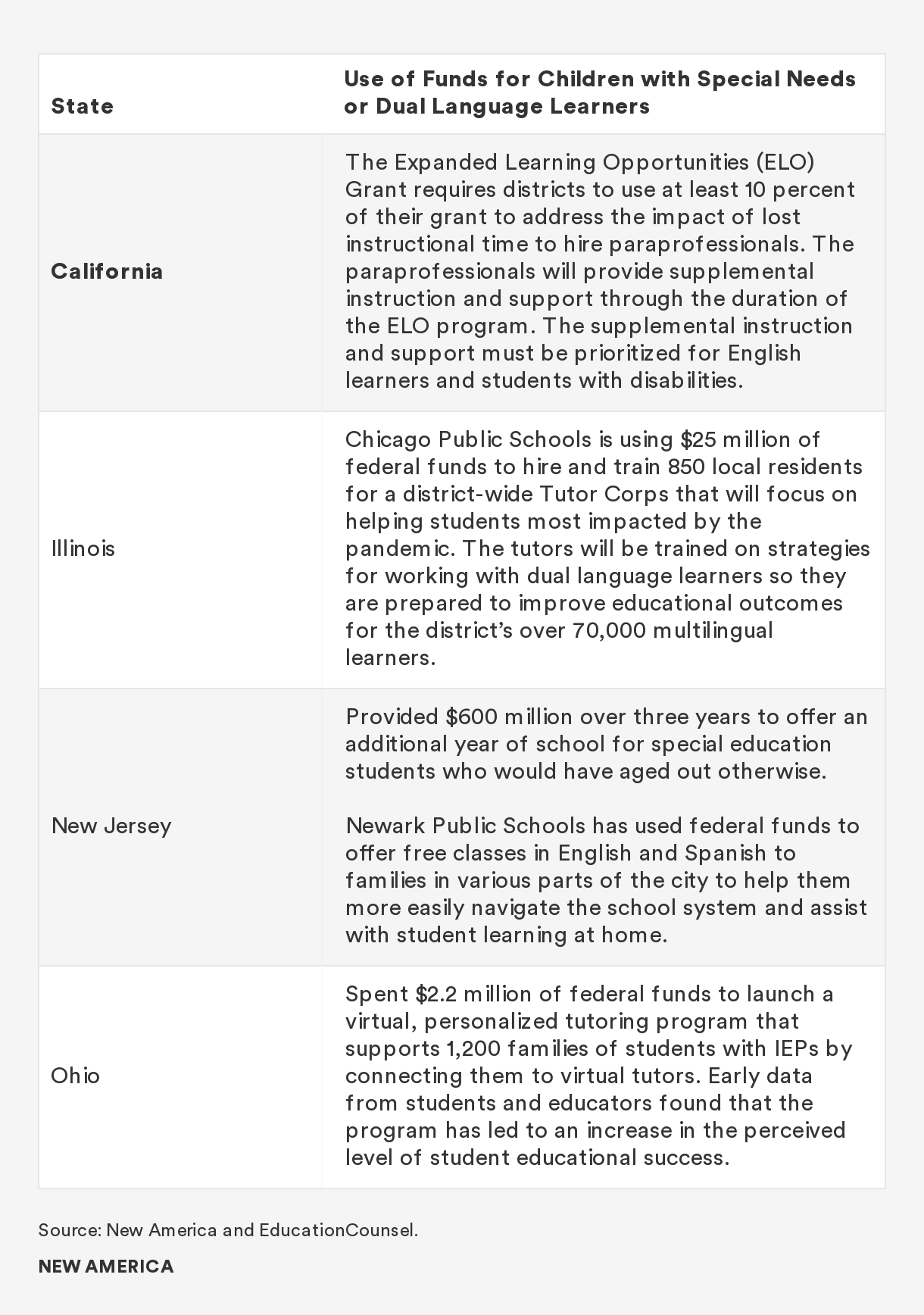
Some states are using additional funds on programs to provide targeted support and early intervention for children with special needs and dual language learners to set them up for success as they transition into the K–12 system. Below are two examples:
The jump from pre-K settings into kindergarten can be tough under the best of circumstances. Two years into COVID-19, the need for effective and supportive transitions is even greater. As LEAs grapple with the many competing crises exacerbated by the pandemic, it is good that this relief funding can be spread out over time as they meaningfully engage in this work.

Toolkit for Using Policy to Enable Effective and Supportive Transitions for Children, Families, & Educators
- 1. Introduction
- 2. How to Use this Toolkit
- 3. Definitions & Abbreviations
- 4. The State of Children, Families, & Educators in the Second Year of COVID: Challenges & Solutions
- 5. Guiding Framework: How Policy Can Help Meet the Needs of Young Learners
- 6. Six Steps for Educators and Systems Leaders to Strengthen Transitions
- 7. Nine Takeaways from Our Work with States, School Districts, & Communities
- 8. State & Local Policy Ideas with Examples
- 9. Federal COVID Relief Dollars and How They Can Help Fund This Work
- 10. Other Funding Streams that can be Used for Early Learning and Transitions
- Appendix A: Resources by Topic
- Appendix B: Focus Group Questions
- Appendix C: Self-Assessment Tool
- Appendix D: Work Plan