A Chapter of: Toolkit for Using Policy to Enable Effective and Supportive Transitions for Children, Families, & Educators
8. State & Local Policy Ideas with Examples
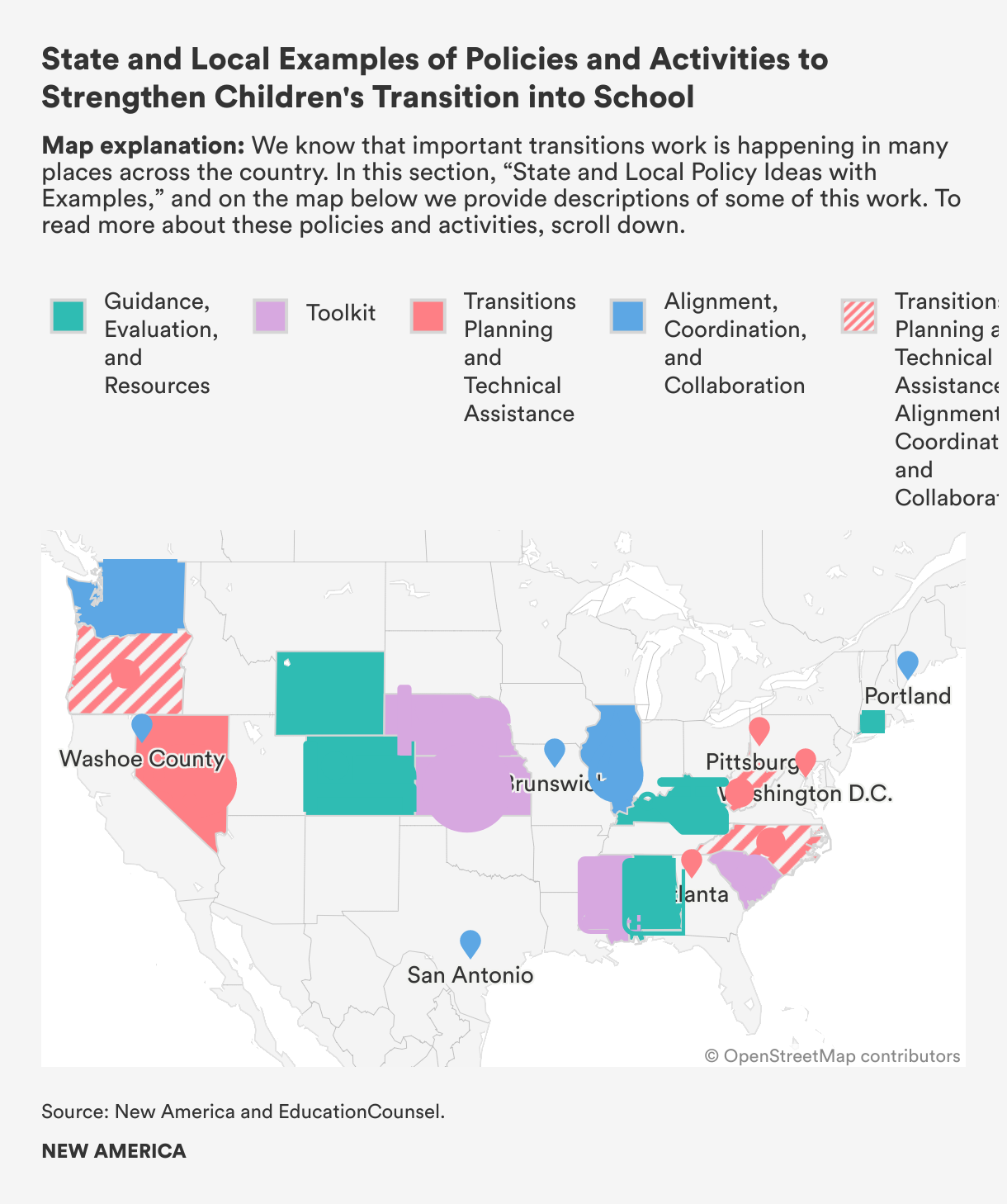
These policy ideas are organized by state and localities and grouped into themes:
- Alignment, coordination, and collaboration
- Transitions planning and technical assistance
- Guidance, evaluation, and resources
We use these themes to organize the policies most important for transforming how children enter pre-K and kindergarten and move through the early grades. As we begin to move beyond the global COVID-19 pandemic, these considerations should take precedence in the next three to five years to meet children’s immediate needs:
- Prioritize investment, planning, and guidance to address pressing needs for the state or local community (see section 5 for more) and in response to the guiding questions (see section 6 for more).
- Center equity, distribute funding equitably to communities most affected by COVID-19, and engage local community leaders and diverse parties (see section 7 for more) in determining unmet needs and planning for how funds should be spent.
- Work across offices and agencies to support children and their parents or guardians and to strengthen family economic recovery and security.
- Provide meaningful family engagement opportunities where parents and other caregivers are invited to partner in their child’s learning.
- Make a case for how this work aligns with and even bolsters other priorities and find state and local champions who will commit to moving it forward and allocate funds.
- Plan funding that would sustain strategies after federal relief funds run out.
Both state and local leaders can lead on transitions and alignment efforts. ESSA requires LEAs to form coordination agreements with Head Start programs. It also applies this requirement to coordination with other early childhood programs, if feasible. The federal law specifies the areas which these agreements must cover at a minimum: data and record sharing; joint professional development; staff communication; parent-teacher connections; and educational services. Although it is LEAs that must establish these agreements, states can facilitate, educate, and encourage LEAs to do so. States can also provide oversight by holding LEAs accountable if they don’t develop the agreements.
States can support local education agencies and communities in ensuring effective and supportive transitions in three main areas: facilitating alignment, coordination, and collaboration; supporting transitions planning; providing guidance and resources.
Alignment, Coordination, and Collaboration
- Identify an office at the state level that has responsibility for transitions. (Possible funding: PDG B–5, ESSA, Head Start, K–12 funding formulas, state pre-K dollars)
- Establish an interagency working group to guide state-level transitions efforts. (Possible funding: ESSA, Head Start, state pre-K dollars)
- Work with county/community agencies to streamline the registration process between federal Head Start and state and local pre-K programs. (Possible funding: ESSA, Head Start)
- Remove barriers and provide incentives for establishing data-sharing agreements across early care and education, elementary schools, child welfare, and health systems. (Possible funding: PDG B–5, ESSA, CCDBG, Head Start, IDEA, state pre-K dollars, other state agency funding)
- Fund cross-grade, cross-sector ongoing professional development opportunities that are focused on post-COVID needs: social and emotional learning, trauma-informed practices, accelerated learning, and developmentally appropriate practice. (Possible funding: ESSER, ESSA Title I and II, Head Start, state pre-K dollars)
- Provide resources to bring together school leaders and licensed child care centers and family child care homes. Encourage virtual or in-person joint professional learning opportunities, meet-and-greet activities, participation on planning councils, and coordination of activities as part of funding applications. (Possible funding: ESSA Title I and II, CCDBG, PDG B–5, state pre-K dollars, K–12 funding formulas)
- Share data across early childhood and elementary school settings. (Possible funding: PDG B–5, Head Start, CCDBG, ESSA Title I, state pre-K dollars, K–12 funding formulas)
- Pass legislation to require kindergarten for all children, require districts to provide kindergarten for the same length of time as first grade, and fund it at least at the same level as first grade. (Possible funding: state dollars with a boost from ARP, ESSA)
State Examples
- Illinois established a Kindergarten Transition Advisory Committee to review kindergarten transitions in the state and make recommendations for improvement. The committee was made up of lawmakers, state agency personnel, educators, administrators, and advocates.
- Oregon's Early Learning Kindergarten Readiness Partnership and Innovation grant program (KRPI) was designed to establish models for P–3 alignment at the local level, with a focus on shared professional development for early learning providers and kindergarten teachers. The grants have enabled hundreds of educators to participate in cross-grade, cross-sector PD, with a focus on understanding the experiences and expectations of children in pre-K and kindergarten.
- Washington is promoting early learning collaboration between elementary schools and child care providers, through a partnership with Child Care Aware of Washington. Principals can fill out a data request form to receive a list of local child care providers and connect with Child Care Aware regional offices. The regional offices provide follow-up services and resources to build collaboration between local child care providers and elementary schools.
- West Virginia requires all districts to offer a full-day kindergarten program that is equivalent in length of day to first grade. Kindergarten programs are funded through the same funding formula used for first grade through 12th grade.
- North Carolina requires child data sharing between preschool teachers, and either kindergarten teachers or the schools that receive the incoming kindergarten students. Further, child data must be shared between preschool teachers and the parents or guardians of the child who is transitioning to kindergarten. See Section 12B.5.(d) of Session Law 2016-94 for details.
Transitions Planning and Technical Assistance
- Include transitions activities—such as detailed community-wide plans, connections with community providers, and review and use of data—in monitoring protocols used by the state department of education. (Possible funding: Head Start, ESSA, Title I, CCDBG, state pre-K dollars)
- Establish a grant program to encourage districts to develop local plans to prioritize transitions and alignment activities. This is one way to encourage LEAs and local communities to work together on a key state priority, to learn what works and what does not and for whom, and to develop a plan for sharing and expanding successful strategies across the state. A grant program like this could also be used to focus on prioritizing equity in transitions and alignment planning and activities. (Possible funding: ESSA Title I, Title II if focused on educators, CCDBG quality funds, state pre-K dollars)
- Require LEAs to develop district transitions strategies with the participation of parties that include representatives from Head Start and other early childhood programs, teachers, parents, representatives from relevant district offices, and principals. These strategies should pay attention to populations such as children with disabilities, children from low-income families, children in tribal communities, homeless children, and dual language learners. (Possible funding: Head Start, ESSA Title I, McKinney-Vento, state pre-K dollars)
State Examples
- The Nevada Department of Education has brought together groups of early childhood professionals to create developmentally appropriate (DAP) kindergarten cohorts. Funded through federal programs, the DAP cohorts work together to vertically align developmentally appropriate curriculum, instruction, and assessment that’s being implemented in high-quality pre-K programs.
- In North Carolina’s MOU guidance, LEAs must confirm that a set of activities has been addressed in the agreement. These include data sharing, coordination, and transitions—all of which are important for effective and supportive transitions.
- The Oregon state legislature established and funded the Early Learning Kindergarten Readiness Partnership and Innovation grant program (KRPI). This program included four priorities, one of which is focused on transitions and another on increasing alignment, connection, and collaboration.
- In West Virginia, counties are required to establish transitions teams that develop local plans. These teams must include a set of diverse parties. There is a similar structure at the state level.
- The District of Columbia’s Office of the State Superintendent has created an MOA that is designed to be used with school districts, Head Start programs, and other early childhood programs. It lays out plans for coordination and collaboration in data sharing, communication, family engagement, joint professional development, and standards, curriculum, and instruction.
Guidance, Evaluation, and Resources
- Develop guidance for LEAs and schools to strengthen transitions efforts and deepen alignment, coordination, and collaboration across the PreK–3 and even B–3 continuum. States can foster opportunities for these diverse early learning leaders to come together for joint professional development and discussions of how to better connect pre-K, kindergarten, and the early elementary grades. (Possible funding: CCDBG, ESSA, state pre-K dollars, IDEA)
- Gather information on models of effective transitions practices (with special attention to immigrant families, dual language learners, children from low-income families, children with disabilities, and children in tribal communities) at the local level that can be shared with school and community leaders across the state. (Possible funding: ESSA, PDG B–5, Head Start, CCDBG, IDEA, ESSER, state pre-K dollars)
- Include transitions policies and activities in state-level planning committees, such as a state early learning council. (Possible funding: PDG B–5, CCDBG, ESSA, state pre-K dollars)
- Develop state professional learning modules for teachers, child care providers, and school leaders that include specific activities that support transitions with a focus on equity concerns, implicit bias, and effective and authentic family engagement practices. (Possible funding: ESSA Title I and II, CCDBG, Head Start, state pre-K dollars)
State Examples
- In Connecticut, the State Department of Education and the Office of Early Childhood convened a PreK to Kindergarten Transition Workgroup, which created a guidance document detailing how districts and school leaders can implement successful transitions. It includes information on coordinating professional development across settings, meaningfully partnering with families, leveraging existing resources, and improving communication across settings and with families.
- Kentucky’s Early Childhood Advisory Council included developing an early childhood transitions framework as a key goal in the state’s Early Childhood Strategic Plan. The transitions framework is meant to improve children’s and families’ experiences transitioning from one early childhood setting to another, across the B–3 continuum.
- Alabama has recently released a Transition to Kindergarten Toolkit designed for both parents and educators. The toolkit includes a planning guide to help schools think strategically about easing the transitions into kindergarten, sample child information forms to assist educators in gathering data on incoming kindergartners, and a variety of other resources that explain the rationale for focusing on a smooth school transition.
- Wyoming created a framework/continuum to direct its current work, which includes supporting five community grantees and pilots. It is building out supports for families, educators, programs, and communities who are not grantees in order to engage in their conversations about transitions. Leaders of this work have found that strengthening coordination and partnerships is the first step. This is because transitions work requires:
- relationships that are equal and valued;
- recognition that transitions are about change (children are navigating their worlds and there is constant change as they build out resilience and healthy brain infrastructure); and
- aligned vision, expectations, and practice.
- Colorado’s Office of Early Childhood and the CDE Preschool through Third Grade Office worked with the National P–3 Center to create “The Transitions to Kindergarten in Colorado: A Roadmap” and other resources.
Several other states have developed transitions toolkits and resources as well:
- Supporting the Transition to Kindergarten in Nevada
- Nebraska Transition to Kindergarten Toolkit and Resource Guide
- Maine Transitioning into Kindergarten—Professional Development Modules
- Mississippi Transition Toolkit for Families and Early Learning Providers
- South Carolina Pre-K to Kindergarten Transitions Plan: Family Engagement
- Kansas Kindergarten Transitions Toolkit
Local education agencies and communities play a critical role in the implementation of state transitions policies, but also in organizing community partners, school-level leaders, and parents to ensure that transitions activities are responsive to locally identified needs and priorities.
Alignment, Coordination, and Collaboration
- Go beyond the ESSA requirement to establish agreements with Head Start programs and extend agreements to other early childhood programs serving children likely to attend district schools. The ESSA requirement (Section 1119), in fact, requires such agreements with other early childhood programs, if feasible. These agreements should include elements such as data sharing and joint professional development and plans to align curricula, teaching strategies, discipline practices, family engagement strategies, and ways to meet community needs. The Head Start Act also requires coordination with school districts on these and other transitions points, including addressing facilities and transportation issues. (Possible funding streams: ESSA, ESSER, IDEA, Head Start Act, state and local pre-K dollars, local philanthropy, local property taxes)
- Create opportunities to build elementary school principal knowledge of early childhood education and how to support PreK–3 teachers. (Possible funding: ESSA Title II, ESSER, CCDBG, Head Start, state and local pre-K dollars, local philanthropy, local municipalities)
- Get to know organizations supporting Head Start and other early childhood programs, and come up with strategies for connecting principals, program administrators, and teachers to build relationships across pre-K and the early grades of elementary school. This should become a two-way learning opportunity. School districts could also work with regional child care referral offices to establish processes for connecting schools and early education programs. (Possible funding: ESSER, ESSA, Head Start, state and local pre-K dollars, local property taxes, local philanthropy, local municipalities)
- Take steps to ensure children are able to transitions into kindergarten at the elementary school parents have chosen for pre-K. Work to establish feeder relationships and agreements with other community-based pre-K programs within a school’s attendance zone. (Possible funding: ESSA, ESSER, Head Start, state and local pre-K dollars)
Transitions Planning and Technical Assistance
- Develop strategies to encourage collaboration across pre-K, kindergarten, and the early elementary grades to share information and data, and to align discipline approaches, instruction, environments, curricula, and other areas as needed. (Possible funding: ESSA, ESSER, CCDBG, Head Start, IDEA, state and local pre-K dollars, state K–12 funding formulas, local property taxes)
- Establish community transitions teams with working groups to identify areas of need. Ensure that members of underserved populations are included and compensated for their time. (Possible funding: ESSA, ESSER, Head Start, state and local pre-K dollars, state K–12 funding formulas, local property taxes, local municipalities, local philanthropy)
- Provide joint professional development on aligning routines and expectations for pre-K, kindergarten, and early elementary teachers. (Possible funding: ESSA, ESSER, CCDBG, Head Start, IDEA, state and local pre-K dollars, state K–12 funding formulas, local property taxes)
Guidance, Evaluation, and Resources
- Direct funds to ensure there is an ECE-trained paraprofessional/assistant teacher in each kindergarten and first-grade classroom. (Possible funding: ESSA, ESSER, state K–12 funding formulas, local property taxes)
- Provide bonuses/stipends for kindergarten teachers who engage in home visits. (Possible funding: ESSA, ESSER, state K–12 funding formulas, local property taxes, local municipalities, local philanthropy)
- Provide grants to child care providers to implement innovative curriculum around kindergarten expectations. (Possible funding: ESSA, ESSER, CCDBG, Head Start, local municipalities, local philanthropy)
- Gather information from families about children’s previous ECE experiences on enrollment and registration forms. (Possible funding: ESSA, ESSER, CCDBG, IDEA, McKinney-Vento)
- Provide incentives for information sharing and collaboration between child care centers and schools. (Possible funding: ESSA, ESSER, CCDBG, Head Start, local property taxes, local municipalities, local philanthropy)
- Develop guidance for schools to strengthen transitions efforts and deepen alignment, coordination, and collaboration across the PreK–3 and even B–3 continuum. Localities can foster opportunities for these diverse early learning leaders to come together for joint professional development and discussions of how to better connect pre-K, kindergarten, and the early elementary grades. (Possible funding: ESSA, ESSER, IDEA, Head Start, state and local pre-K dollars)
Local Examples
- In San Antonio, TX the Pre-K 4 SA program provides professional learning grants for elementary school principals to participate in the New Teacher Center’s (NTC) Early Learning Leadership Program, a year-long training and coaching initiative to help elementary school leaders better understand early childhood systems and pedagogy.
- The Brunswick, MO R-II School District will create opportunities to improve coordination between and across early childhood and early elementary grades by establishing data teams that include a preschool teacher, kindergarten teacher, Title I reading teacher, federal programs representative, school counselor, an administrator, and parents. The plan requires teams to meet throughout the year to analyze data and help design transitions plans.
- Portland Public Schools in Maine offers pre-K classrooms in both public school buildings and in partnership sites, with a goal of identifying a slot for every child that enters the pre-K lottery.
- The Ready Freddy program, an initiative between Pittsburgh Public Schools and the University of Pittsburgh, provides technical assistance and resources to local transitions teams to help prepare children, parents, and schools for the start of kindergarten. Teams supported by Ready Freddy assist with enrollment and transitions activities and are made up of kindergarten teachers, early childhood educators, principals, community agencies, and parents.
- Atlanta, Georgia has created a citywide alliance (PAACT: Promise All Atlanta Children Thrive) that brings together leaders from both public and private sectors to support high-quality early learning. Members of this group include Atlanta Public Schools, which has established grant funds for schools and providers to support students transitioning into kindergarten; the Georgia Early Education Alliance for Ready Students, which funds Atlanta Early Education Ambassadors to lead pre-K recruitment and early learning advocacy in targeted communities across the city; and more.
- Washoe County, Nevada has used Early Childhood Advisory Council funding to bring together leaders and educators from district kindergarten classrooms and community-based pre-K programs to work toward aligning teaching practices and student routines.

Toolkit for Using Policy to Enable Effective and Supportive Transitions for Children, Families, & Educators
- 1. Introduction
- 2. How to Use this Toolkit
- 3. Definitions & Abbreviations
- 4. The State of Children, Families, & Educators in the Second Year of COVID: Challenges & Solutions
- 5. Guiding Framework: How Policy Can Help Meet the Needs of Young Learners
- 6. Six Steps for Educators and Systems Leaders to Strengthen Transitions
- 7. Nine Takeaways from Our Work with States, School Districts, & Communities
- 8. State & Local Policy Ideas with Examples
- 9. Federal COVID Relief Dollars and How They Can Help Fund This Work
- 10. Other Funding Streams that can be Used for Early Learning and Transitions
- Appendix A: Resources by Topic
- Appendix B: Focus Group Questions
- Appendix C: Self-Assessment Tool
- Appendix D: Work Plan