A Chapter of: Toolkit for Using Policy to Enable Effective and Supportive Transitions for Children, Families, & Educators
4. The State of Children, Families, & Educators in the Second Year of COVID: Challenges & Solutions
More than two years out from the onset of COVID-19, public schools are left to navigate declining public school enrollment, particularly in the early grades; uncertainty around long-term funding to support school programs; and a politically charged environment, where public trust in educational systems and institutions is challenged. Education, as always, must be aimed at meeting the needs of children and families. These challenges come at a time when a demonstrated learning lag exists for incoming children, who display increased social and emotional fragility compared to children pre-pandemic.
How are these needs best met for young children transitioning into school? Simply continuing to operate schools as we did in 2019 would be a missed opportunity. The supports and structures designed for student success in the past were plagued with inequity, failed to meet the needs of individual children, and resulted in an ever-growing gap in achievement. If there were ever a time to rethink and enhance the public school experience for young children, it is now.
Enrollment
The pandemic has had a profound impact on enrollment. In 2020–21, public school enrollment fell by 3 percent compared to the previous year, marking the first enrollment decline since the start of this century. The declines were mostly concentrated in pre-K, which saw a 22 percent decrease on average, and kindergarten, which experienced a 9 percent dip. Pre-K and kindergarten (in many places) are not typically a required part of children’s schooling.
Pre-K enrollment varied across state programs, with declines ranging from 15 to 41 percent according to the National Institute for Early Education Research (NIEER), which cites three main reasons for this drop: (1) lack of in-person options, (2) families concerned about the safety of in-person schooling, and (3) cuts in pre-K funding.
The enrollment loss in pre-K was quantified in NIEER’s most recent State of Preschool report, which said the pandemic erased “a decade of growth with a decline of more than 298,000 children in one year,” (p. 5) with the greatest negative impacts on preschoolers from families with low incomes and preschoolers of color. NIEER predicts a decade of catch-up: “even if states recuperate from losses due to the pandemic and return to prior enrollment growth rates, states are likely to enroll just 40 percent of 4-year-olds and 8 percent of 3-year-olds ten years from now,” (p. 5) conclude the authors of the report.
Enrollment is expected to rebound, but 2021–22 numbers reflect uncertainty about stable growth. In its examination of states that have released 2021–22 enrollment data, Bellwether Education Partners revealed that public schools have yet to see enrollment bounce back to their pre-pandemic levels. As an example, California experienced growth in its 2021–22 kindergarten enrollment class, but first-grade enrollment declined and overall K–12 enrollment fell by 1.8 percent from the prior year, when COVID-19 was at its peak.
Families have faced unprecedented challenges these last few years. In some cases, persisting drops in enrollment are due to family hesitancy to return, stemming from fear of COVID-19 spread, skepticism about public schools’ crisis management abilities, or a preference for virtual learning or homeschooling. For some Black families, in particular, after seeing the racial inequities and bias their children experienced in virtual classrooms, they chose to homeschool.
Because K–12 enrollment is tied to funding, school districts experiencing drops in enrollment also face funding instability. Some states waived enrollment-based cuts the last two school years, but that may not continue. Federal COVID relief dollars have helped, but some districts have hesitated to use funds for staffing and other ongoing needs and others have needed to use the federal funds to plug holes created by state cuts. In addition, inflation has made everything more expensive, so schools are having to stretch their already limited dollars even further. While the federal government has made significant funding available to schools, it hasn’t been so easy for schools to spend these dollars. And, many are trying to be strategic about how to use the funding through 2024, which is when dollars must be spent.
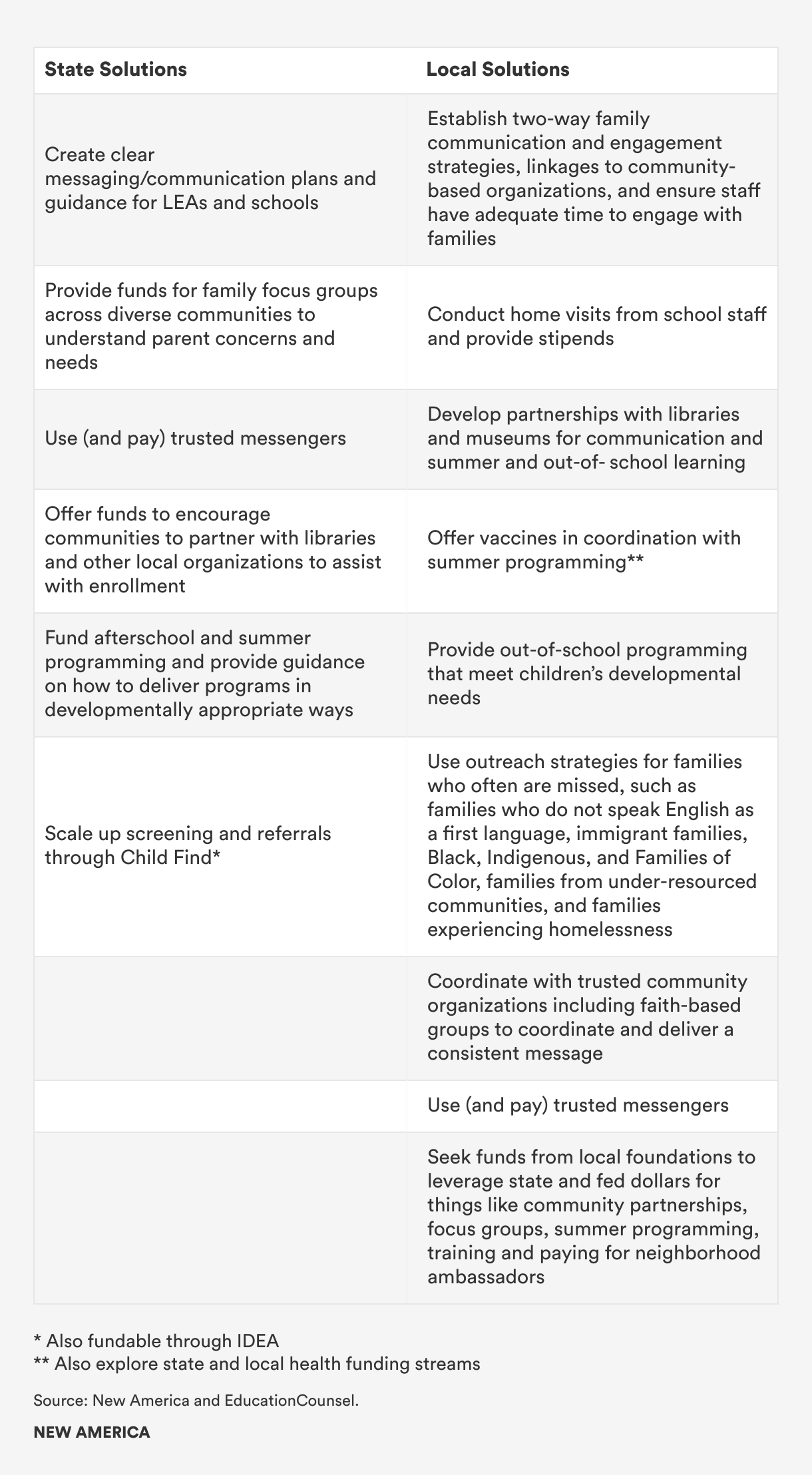
Finding Solutions for Declines in Enrollment
ALL of the following solutions are fundable through these funding streams, and/or a combination of them: ESSER, ESSA (Title I), state funding formulas, state pre-K dollars (if applicable), local philanthropic dollars.
Learning Recovery
The pandemic has taken a toll on our youngest learners in many ways. It has shone a bright light on historical inequities. In an April 2022 study, McKinsey and Company reported that online learning left children, on average, four months behind in mathematics and reading before the 2021–22 school year. These findings were more pronounced in schools serving primarily Black children. Parents of Black and Latinx students also reported higher rates of concern about their students’ mental health and engagement in school. A research brief from Amplify, an assessment developer, showed reading losses were concentrated predominantly in kindergarten through second grades. And while schools worked to provide virtual instruction to dual language learners, data suggest that the reliance on remote learning inhibited the language development of many of these students. Special education students also suffered negative consequences as a result of online learning, with many forced to go months without the vital services to which they are entitled.
Children’s missed learning and lost learning weren’t just limited to academics. After periods of remote learning and limited interactions with peers, children are missing important fine motor skills such as cutting paper and tying shoes, as well as social and emotional skills such as taking turns, listening to peers, and exhibiting self-control. Children are also experiencing difficulty focusing during classwork and paying attention. A national survey of educators by Education Week found that 39 percent of respondents said that the social skills and emotional maturity levels of their current students are “much less advanced” than their pre-pandemic students.
Another effect of the pandemic is related to mental health. In spring 2021, according to a McKinsey report, one in three parents said they were very or extremely worried about their early elementary-aged child’s mental health, with rising reported levels of student anxiety, depression, social withdrawal, irrational fear, and lack of energy. Despite increased levels of concern among parents, there was a steep decline in the number of mental health assessments conducted for children compared to those conducted in 2019. Allowing student mental health issues to linger can negatively impact their quality of life, school attendance, and classwork.
Finally, chronic absenteeism is on the rise in the COVID era, a problem that leads to lower academic results, reduced emotional engagement, and a higher likelihood of dropping out of high school. Chronic absenteeism is typically defined as a child missing 10 percent or more of scheduled days in a school year. While national data are lacking, Education Week points to an analysis that documents a dramatic increase in chronic absenteeism, particularly in the elementary grades. More alarming, the number of students who missed half the school year, defined as extreme chronic absenteeism, is also increasing.
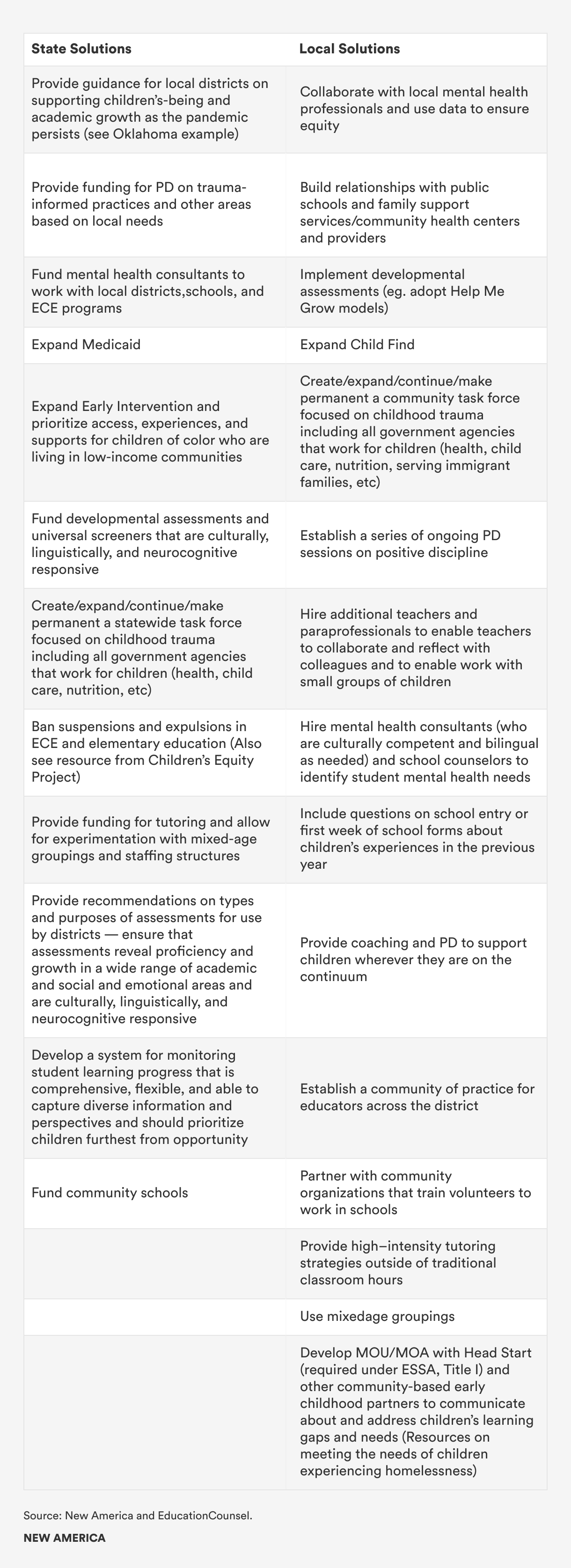
Finding Solutions for Disruptions in Learning and Development
ALL of the following solutions are fundable through these funding streams, and/or a combination of them: ESSER, ESSA (Title I), state funding formulas, state pre-K dollars (if applicable), local philanthropic dollars.
Staffing and Educator Needs
Staffing shortages are nothing new and tend to be where ECE educators are comparatively underpaid, but the pandemic has exacerbated the shortages. A federal survey conducted in December and January of 2021–22 found that nearly half of the public schools have teaching vacancies. A July 2021 survey of child care centers and homes conducted by the National Association for the Education of the Young Child found shortages in almost every state. Even before COVID, the United States faced a shortage of substitutes, but COVID certainly made things worse. When omicron hit, policymakers and education leaders took desperate measures to ensure that there was a pool of eligible substitutes. School district administrators dusted off their teaching certificates. Some states tried to entice state employees and police officers into schools. One governor called in National Guard members to volunteer.
There is an ongoing staffing issue in schools. Surveys over the last year have warned that many teachers plan to leave the classroom; as the next school year begins, teacher resignations are higher than in previous years. Educator well-being has taken a dive and work-related stress is on the rise. RAND researchers found teachers and principals alike reporting poor well-being during COVID.
Public education must confront new challenges in the court of public opinion as well. Educators are under immense pressure in today’s classrooms with openly hostile school board meetings, increasing questions about what is being taught and not taught in school and the appropriateness of books available to children, and policymaker concerns regarding instruction that supports children’s social, emotional, and cultural assets and needs.
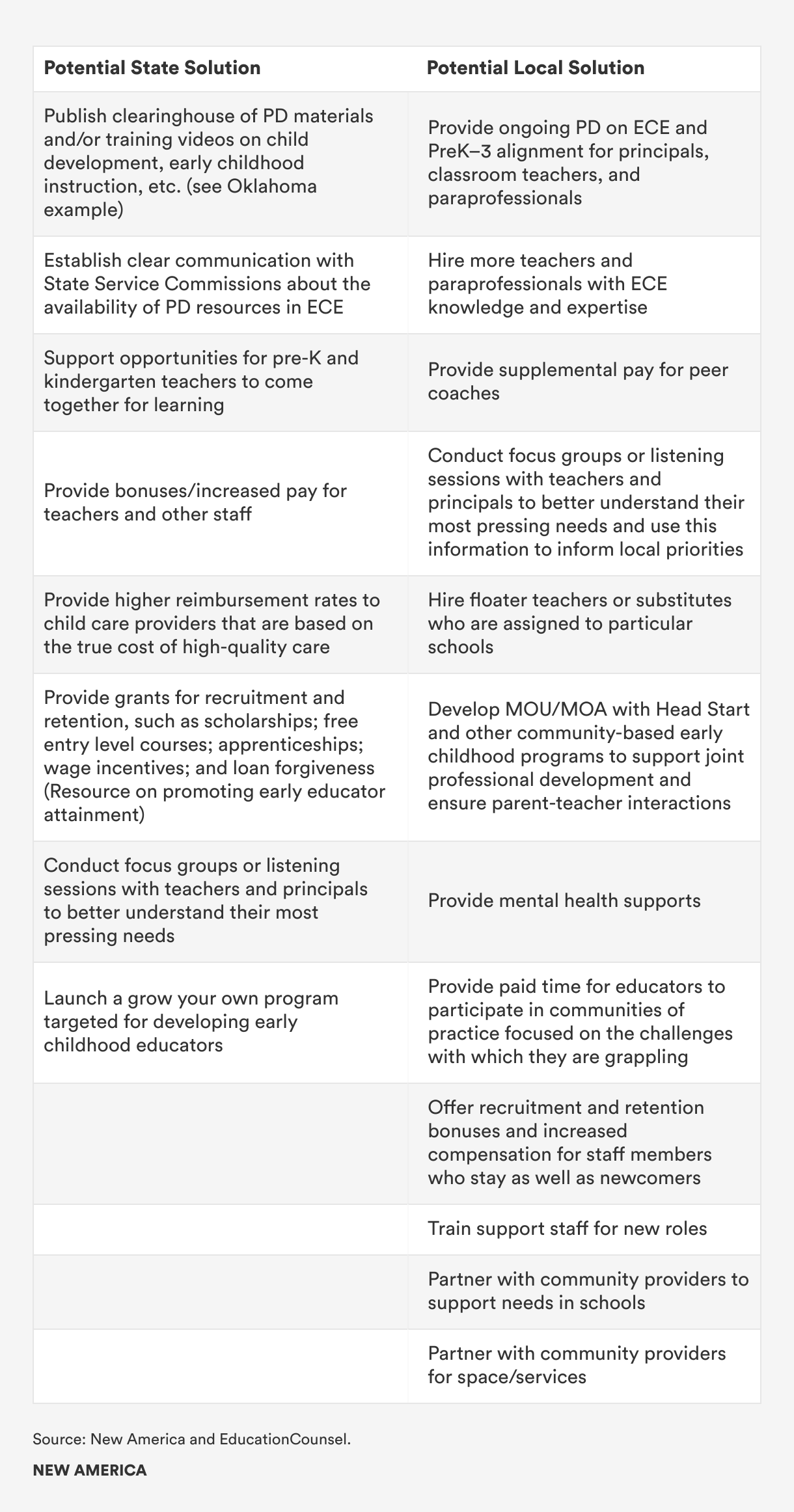
Finding Solutions for Staffing Challenges and Supporting Educator and Staff Needs
ALL of the following solutions are fundable through these funding streams, and/or a combination of them: ESSER, ESSA (Title I), state funding formulas, state pre-K dollars (if applicable), local philanthropic dollars.
Toolkit for Using Policy to Enable Effective and Supportive Transitions for Children, Families, & Educators
- 1. Introduction
- 2. How to Use this Toolkit
- 3. Definitions & Abbreviations
- 4. The State of Children, Families, & Educators in the Second Year of COVID: Challenges & Solutions
- 5. Guiding Framework: How Policy Can Help Meet the Needs of Young Learners
- 6. Six Steps for Educators and Systems Leaders to Strengthen Transitions
- 7. Nine Takeaways from Our Work with States, School Districts, & Communities
- 8. State & Local Policy Ideas with Examples
- 9. Federal COVID Relief Dollars and How They Can Help Fund This Work
- 10. Other Funding Streams that can be Used for Early Learning and Transitions
- Appendix A: Resources by Topic
- Appendix B: Focus Group Questions
- Appendix C: Self-Assessment Tool
- Appendix D: Work Plan