What Everyone Should Know about Designing Equity-Minded Paid Work-Based Learning Opportunities for College Students
Abstract
Despite the growing popularity of WBL, the community college and workforce development fields need greater transparency and clarity on the design of these programs to broaden workforce pathways, ensure the transferability of exemplary program models, and support the advancement of equitable outcomes for all students, especially learners from historically underserved and underprivileged backgrounds. In this report, we highlight case studies of emerging program models across the United States to understand the motivation, goals, and design of paid WBL opportunities available at two-year colleges. This report outlines four recommendations for community college leaders and state policymakers. Findings from this study have important implications for state policymakers and college stakeholders in career services, academic advising, and workforce development.
Acknowledgments
We would like to thank Annie E. Casey Foundation for its generous support of this work. The views expressed in this report are those of Dr. Mauriell Amechi and do not necessarily represent the views of the Casey Foundation, its officers, or its employees. We also like to acknowledge the community college staff members who contributed valuable insights during the interviews.
Downloads
Introduction and Context
Picture this scenario: Brandy is among a small group of community college students invited by Learn and Earn program staff and senior administrators to participate in a focus group a few weeks before commencement. All from low-income, first-generation, and primarily racially minoritized backgrounds, this group was part of the first cohort of a newly launched internship program at a biopharmaceutical company. Before entering year two of the college's biotechnology technician program, Brandy, a dynamic, yet shy, 30-year-old returning student had not envisioned that a yearlong, paid internship would yield a full-time job offer. Nevertheless, she commended the Learn and Earn program staff for their encouragement and guidance throughout the application process. In addition to mock interview preparation, Brandy benefited from step-by-step assistance with resume and cover letter development, among other essential career readiness skills.
During a focus group, when asked to reflect on what she valued most about the immersive internship experience, Brandy praised her sponsor, who had been at the company for nearly a decade and had risen to the leadership ranks. As a proud woman of color and alumna of the same degree program as Brandy, Michelle felt deeply responsible for cultivating a fair, inclusive work environment and modeling appropriate workplace behavior. Michelle took time to get to know Brandy during biweekly lunches and helped her access on-site child care, one of the company's coveted perks. Michelle also advocated for a one-time, cost-of-living salary adjustment, an adjustment awarded to all full-time employees due to inflation.
Having a sponsor who was invested in her career but also understood the daily challenges she faced motivated Brandy to strive for excellence during her internship. Indeed, Brandy exceeded her direct supervisors’ expectations. In the end, Michelle invited Brandy to join the staff part time as a lab operations coordinator during her final year in the biotech program, with the opportunity to join the team full time upon graduation.
This fictitious story demonstrates what is possible when employers and college stakeholders reimagine the future possibilities of engaging community college students in equitable, high-impact, work-based learning opportunities. Work-based learning (WBL) refers to any activity in a work setting—whether paid or unpaid—that equips youth and young adults with in-depth, firsthand experience and authentic engagement with the tasks required in a given field.1 WBL has accelerated across various industries like public affairs and journalism, alleviating the “relevant work experience” dilemma many job seekers face when entering a new profession, which is a valid concern for community college students who are often first-generation, returning students, or individuals who may have delayed college enrollment and are now interested in pursuing a new career.2
Unfortunately, although WBL opportunities can provide myriad benefits to individuals, they widely vary in design and have increasingly become inequitable for certain student demographics. WBL reproduces social inequalities in at least two distinct ways discussed below. First, the perpetuation of unpaid internships limits opportunity, particularly for community college students.3 Second, unpaid internships pose a significant barrier for those who occupy multiple marginalized identities.4
National evidence indicates that approximately two-thirds of undergraduates enrolled at a two-year college maintain either full- or part-time employment.5 These students tend to be older and are more likely to be responsible for supporting their families than their peers at four-year colleges. For example, an estimated 42 percent of students who have children enroll at two-year institutions.6 Because of their unique circumstances, adult and first-generation community college students may encounter logistical and psychological barriers that deter their participation in WBL opportunities, whether paid or unpaid.7
Unpaid WBL Disadvantages Community College Students
The Center for Research on College Workforce Transition at the University of Wisconsin–Madison estimates that around one million students receive offers for uncompensated internships each year.8 WBL opportunities rooted in the exploitation of free labor often have unintended yet severe consequences for community college students. Given their history of creating educational access for diverse student populations, two-year colleges serve a larger demographic of low-income and students of color than their four-year peers.9 While students from historically underrepresented and disadvantaged backgrounds can gain significant benefits from WBL opportunities, such as valuable connections in one’s field of interest and transferable skills, many community college students—who are often the sole providers for their families—cannot forgo a job that provides steady income and benefits while they accept temporary unpaid employment.
Minoritized Students Face Unique Barriers to WBL Opportunities
Evidence from the National Association of Colleges and Employers (NACE) suggests that minoritized students encounter significant challenges in finding a paid internship. The NACE survey, conducted annually with nearly 4,000 seniors at more than 400 colleges and universities, found differences based on race, gender, and parents’ educational attainment.10 For example, Black respondents were underrepresented in paid internships. Hispanic and Latino students were more likely to report not having any internship experience before graduation than any other racial group. Overall, findings suggest that students who participate in unpaid internships fare worse during job fairs than peers with paid internships.
WBL Opportunities Privilege Elite, Four-year Colleges
Even in sought-after fields like STEM (Science, Technology, Engineering, and Mathematics), which offer broader opportunities for paid internships, researchers have found that students at universities are awarded internship opportunities at a ratio close to nine to one compared to their two-year peers.11 To help promote equitable labor market outcomes among graduates, a growing number of community college leaders are partnering with employers and philanthropic organizations to address the critical shortage of paid WBL opportunities for their students.
Despite the growing popularity of WBL, the community college and workforce development fields need greater transparency and clarity on the design of these programs to broaden workforce pathways, ensure the transferability of exemplary program models, and support the advancement of equitable outcomes for all students, especially learners from historically underserved and underprivileged backgrounds. In this report, we highlight case studies of emerging program models across the United States to understand the motivation, goals, and design of paid WBL opportunities available at two-year colleges. This report outlines four recommendations for community college leaders and state policymakers:
- Reconsidering student populations historically excluded from paid WBL opportunities.
- Conducting comprehensive program evaluations annually to examine student outcomes.
- Implementing a starting $15 hourly base salary and redressing students’ basic needs insecurity.
- Increasing institutional funding to promote growth and sustainability.
Findings from this study have important implications for state policymakers and college stakeholders in career services, academic advising, and workforce development.
Citations
- Carl D. Perkins Act, 20 U.S.C. § 2301 (2019). https://tinyurl.com/CAREER-AND-TECHNICAL-EDUCATION.
- M.H. Amechi and I. Palmer, “Unpaid Internships Should Be Illegal: Why Colleges Should Reconsider Unpaid Internships,” New America (blog), April 13, 2022, https://www.newamerica.org/education-policy/edcentral/unpaid-internships-should-be-illegal-why-colleges-should-reconsider- unpaid-internships/.
- P. Eddinger and R. Kazis, “Reimagining Experiential Learning and Internships for Community College Students,” in Teaching Students about the World of Work, edited by N. Hoffman and M. L. Collins (Cambridge, MA: Harvard Education Press, 2020), 35–51; R. Kazis and N. Synder, Uncovering Hidden Talent: Community College Internships that Pay (Boston Foundation, 2019), https://files.eric.ed.gov/fulltext/ED602752.pdf.
- Kazis and Synder, Uncovering Hidden Talent; Amechi and Palmer, “Unpaid Internships Should Be Illegal”; M. Hora, M. Wolfram, A. Huerta, C. Lee, and A. Gopal, “A Multilevel, Agent-centered Analysis of Intersectionality in a Hispanic-serving Institution,” AERA Open 8, no. 1 (2022), 1–17.
- National Center for Education Statistics, “Table 5.1. Work while enrolled: Percentage distribution of undergraduates, by work intensity while enrolled, and among those who worked, the average and median hours worked per week, control and level of institution, and selected student characteristics,” 2015–16. https://nces.ed.gov/datalab/table/library/detail/13212.
- Institute for Women’s Policy Institute, Parents in College: By the Numbers (Washington, DC: Institute for Women’s Policy Research and ASCEND, 2019), https://ascend-resources.aspeninstitute.org/resources/parents-in-college-by-the-numbers/.
- G. McGillen, L. Flores, and G. Seaton, “Work-Related Barriers Experienced by Low-Income People of Color and Indigenous Individuals,” in Teaching Students about the World of Work, edited by N. Hoffman and M. L. Collins (Cambridge, MA: Harvard Education Press, 2020), 113–130.
- Hora et al., “A Multilevel, Agent-centered Analysis of Intersectionality.”
- C. Nevarez and J.L. Wood, Community College Leadership and Administration: Theory, Practice, and Change (New York, NY: Peter Lang, 2010).
- R.A. Ravishankar, “It’s Time to Officially End Unpaid Internships,” Harvard Business Review, May 26, 2021, https://hbr.org/2021/05/its-time-to-officially-end-unpaid-internships.
- Eddinger and Kazis, “Reimagining Experiential Learning.”
WBL Opportunities at Community Colleges
With around 3.5 million college students completing an internship in college and a growing number of academic programs requiring them, the significance of WBL experiences in the higher education landscape—whether in the form of an internship, practicum, or apprenticeship—should not be underestimated. Internships and similar forms of WBL have become the “gold standard for college students wishing to explore the world of work,” according to Bunker Hill Community College President Pam Eddinger and colleague.12 Still, evidence suggests community college students are less likely to find avenues for paid WBL.
In their report titled Uncovering Hidden Talent, Kazis and Snyder found that internship opportunities targeting community college students remain scant compared to those for students at four-year institutions.13 For example, from their investigation of Massachusetts state policy efforts to increase access to WBL among undergraduates, they found that community college or state community college systems fail short in developing equitable, student- and employer-centered programs. Moreover, they found that even when Massachusetts state policy allocated funding to promote broader access to paid internships, the $1 million budget was restricted to state universities, which excluded students enrolled at two-year colleges. This specific case study begins to shed light on the inequities faced by community college leaders seeking to launch new paid WBL programs on their campuses and also illustrates some of the hurdles faced by programs already in operation.
What We Know about Paid WBL Programs
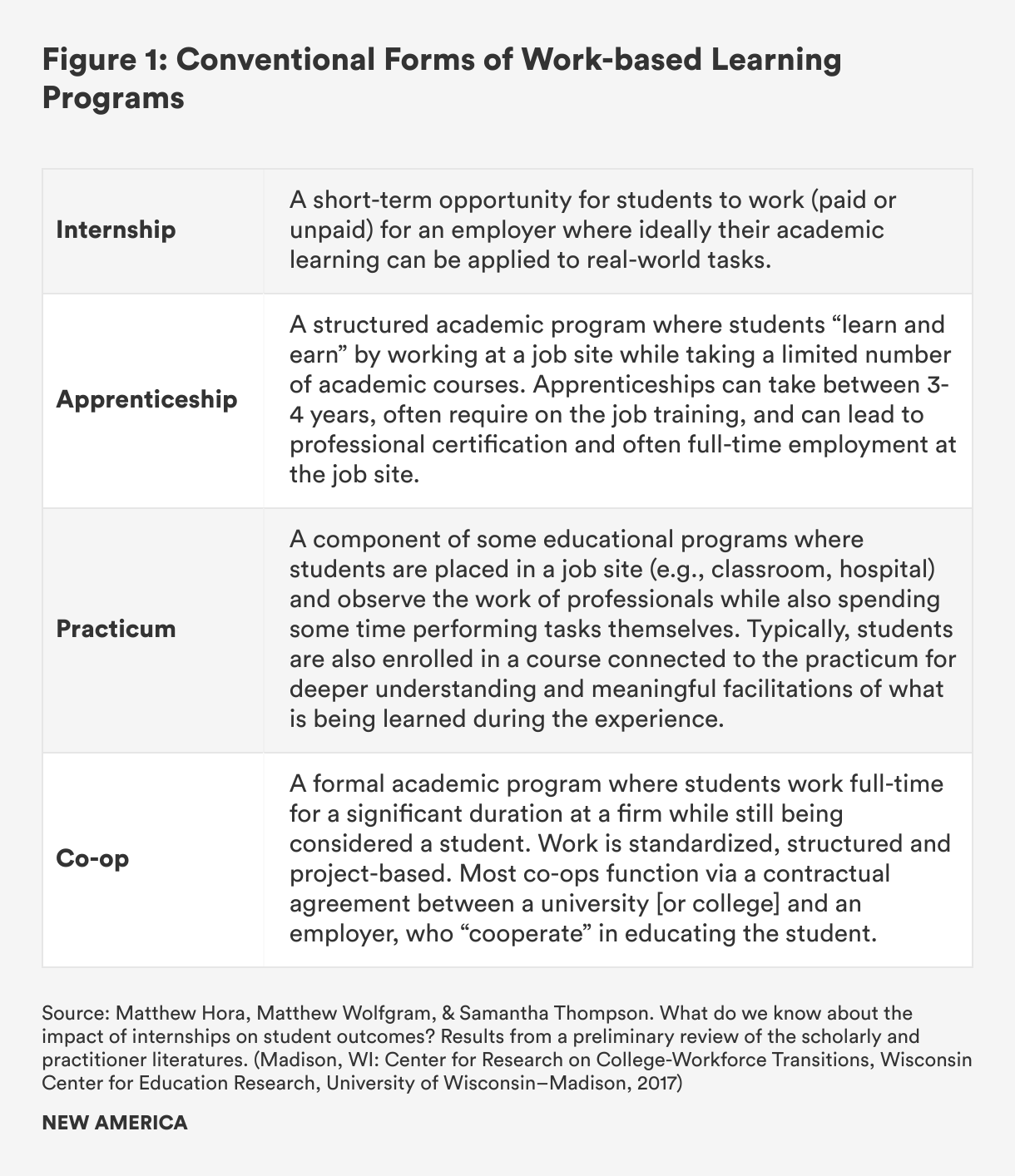
Although WBL programs come in various forms (e.g., internships, apprenticeships, practicums, and cooperative (co-op) education models), there is no definitive definition of what an internship entails compared to an apprenticeship or co-op placement. In a research brief investigating the impact of internships on students, researchers noted how the inconsistency and variation in how WBL is defined (or not defined) has consequences for various stakeholders including employers, educators, students, researchers, and policymakers.14 Figure 1 provides a brief overview of the most common forms of experiential learning.
Key WBL Program Design and Characteristics
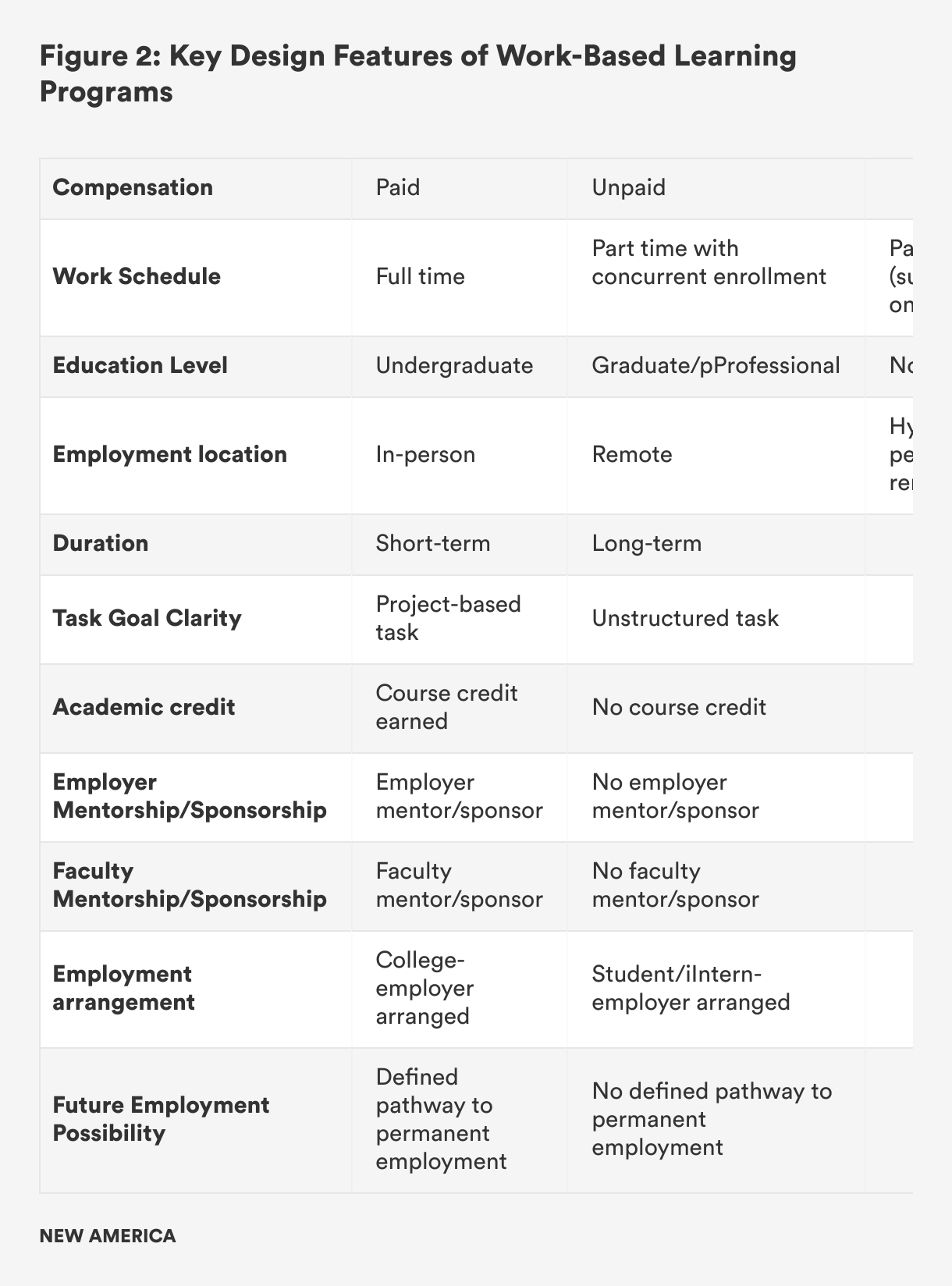
WBL programs for community college students may vary in design and format. One critical factor in the creation of WBL opportunities relates to whether to include compensation or not. Empirical evidence suggests that students who complete an internship accrue benefits compared to their peers who do not complete one, such as higher starting wages and greater job offers.15 Nevertheless, internships have received significant media attention in recent years, stemming from economic justice concerns surrounding the expansion of unpaid work in specific fields such as the public sector and requirements in academic programs like teacher education.16 For example, after years of advocacy, college students participating in the prestigious White House internship program will now receive compensation for the first time starting in fall 2022.
Other key characteristics of building appealing and successful WBL experiences relate to scheduling, employment location, and work duration.17 Co-ops and apprenticeship programs typically provide full-time roles for one year or longer. In contrast, internships and practicums usually are part-time roles that last for a shorter duration (e.g., three to four months). Because of disruptions caused by the COVID-19 pandemic, many WBL programs shifted online. While some programs have returned to in-person, a growing number of employers are offering the flexibility of remote placement. WBL programs may also focus on a specific educational level, such as undergraduate studies or graduate and professional studies. In other cases, the programs may be situated within a nonacademic context, such as apprenticeships.18
Some paid WBL programs may be integrated into programs of study, requiring the completion of academic assignments as part of a credit-bearing course. Another feature of WBL relates to the nature of work assignments completed. For example, some practicums may be arranged around completing a defined project or task, while other internships may be unstructured and lack clarity in the day-to-day work. Evidence suggests that integrating academic coursework with WBL can enhance students’ overall perception of the experience.19 Drawing on a survey of 118 business students at a large, southwestern university in the United States, researchers found students perceived internships as most valuable when they had a clear structure, were strategically integrated into their program of study, and aligned with their career interests.20 Furthermore, students perceived the most value from internships that facilitated their ability to find employment. Researchers also found a correlation between age and the perceived value of experiential learning, suggesting that older students may be more mature and better able to handle ambiguity on the job.
Identifying paid WBL opportunities may be challenging for community college students who lack access to professional networks in their fields of interest. Thus, to help bridge the gap between students’ professional networks and employers, many community colleges appoint dedicated staff to serve as advocates or formal career coaches. Some internship programs at community colleges have an integrated career readiness component that supports students. Career readiness refers to skills required to enter one’s field, including but not limited to mock interview preparation, resume and cover letter reviews, and setting career goals.21 While some community colleges place the responsibility on the student for identifying an appropriate internship program, college staff increasingly play a leading role in facilitating entry into WBL opportunities where they can find them, like at local small businesses, corporations, and nonprofit organizations.
Another significant way college leaders and employers can help prepare community college students for entry into the workforce is through mentorship and sponsorship. Some internships provide students with a designated professional mentor or sponsor to help guide and support the transition into the new work environment. WBL experiences that are well connected to programs of study may assign a faculty mentor. Having an internship with an assigned faculty or professional mentor enhances students' social capital, which can help them land a job upon completion of their postsecondary degree or credential.
The possibility of future employment is an additional critical dimension of WBL programs. Some apprenticeships, internships, and co-ops have clearly articulated and defined pathways to permanent employment. Because many community college students are entering new fields with limited professional networks, WBL programs with clearly defined expectations for reappointment or promotion can help demystify the process for motivated, career-driven students.
Crafting a high-impact WBL program requires staff to weigh various design factors and characteristics, as illustrated in Figure 2. It is crucial to recognize that there is no one-size-fits-all approach to developing an effective WBL program, so leaders interested in creating a new one can acquire significant insights from exploring the case studies highlighted in this report.
Citations
- Hora et al., “A Multilevel, Agent-centered Analysis of Intersectionality”; Eddinger and Kazis, “Reimagining Experiential Learning.”
- Kazis and Synder, Uncovering Hidden Talent.
- M. Hora, M. Wolfram, M., and S. Thompson, What do we know about the impact of internships on student outcomes? Results from a preliminary review of the scholarly and practitioner literatures (Madison, WI: Center for Research on College-Workforce Transitions, University of Wisconsin–Madison, 2017).
- P. McHugh, “The impact of compensation, supervision and work design on internship efficacy: Implications for educators, employers and prospective interns,” Journal of Education and Work 30, no. 4 (2017), 367–382.
- Amechi and Palmer, “Unpaid Internships”; R. Lieber, “Why we still haven’t solved the unpaid internship problem,” New York Times, June 11, 2022, https://www.nytimes.com/2022/06/11/your-money/unpaid-internships.html; C. Vera, “Unpaid Internships Often Exclude Students of Color,” USA Today, November 16, 2020, https://www.usatoday.com/story/opinion/2020/11/16/why-unpaid-internships-hurt-young-people-color-column/6276781002/.
- C. Maertz, P. Stoeberl, and J. Marks, “Building successful internships: Lessons from the research for interns, schools, and employers,” Career Development International 19, no. 1 (2013), 123–142.
- Ibid.
- Hora, Wolfram, and Thompson, “What do we know about the impact of internships on student outcomes?”
- Michael Hergert, “Student Perceptions of the Value of Internships in Business Education,” American Journal of Business Education 2, no. 1 (2009), 9–14, https://files.eric.ed.gov/fulltext/EJ1052655.pdf.
- National Association of Colleges and Employers, Career readiness: Development validation of the NACE career readiness competencies, 2022, https://www.naceweb.org/uploadedfiles/files/2022/resources/2022-nace-career-readiness-development-and-validation.pdf.
Study Method
Using a case study methodological approach,22 we studied five programs across the United States to understand the motivation, goals, and design of paid WBL opportunities available at two-year colleges. Four research questions guided our investigation:
- What are the program’s intended objectives and outcomes?
- How is the program funded?
- What are the program’s particular features and characteristics?
- Which student demographic(s) participates in the program?
We used a convenience sampling approach to identify and select the most accessible, information-rich, and geographically diverse cases. Our investigation included the following research sites:
- Middlesex Community College in Massachusetts (Learn and Earn Experience)
- Salt Lake Community College in Utah (Campus Internship Program)
- San Antonio College in Texas (Earn and Learn Program)
- Cuyahoga Community College in Ohio (Summer Internship Program)
- Bunker Hill Community College in Massachusetts (Learn and Earn Program).
We conducted in-depth, semi-structured, one-on-one interviews with program directors and senior campus administrators who were influential in developing and leading the WBL program. On average, all discussions lasted 60 minutes, and were conducted by one to two New America staff members via Zoom. Except for Bunker Hill, interviews were digitally recorded and transcribed. A qualitative approach was well suited for this topic because it helped unpack often overlooked or potentially hidden programmatic elements and decisions. The interview protocol examined each WBL program’s origins, intended goals and outcomes, funding sources, types of institutional resources provided, and career development support available to students.
Research Sites
Middlesex Community College
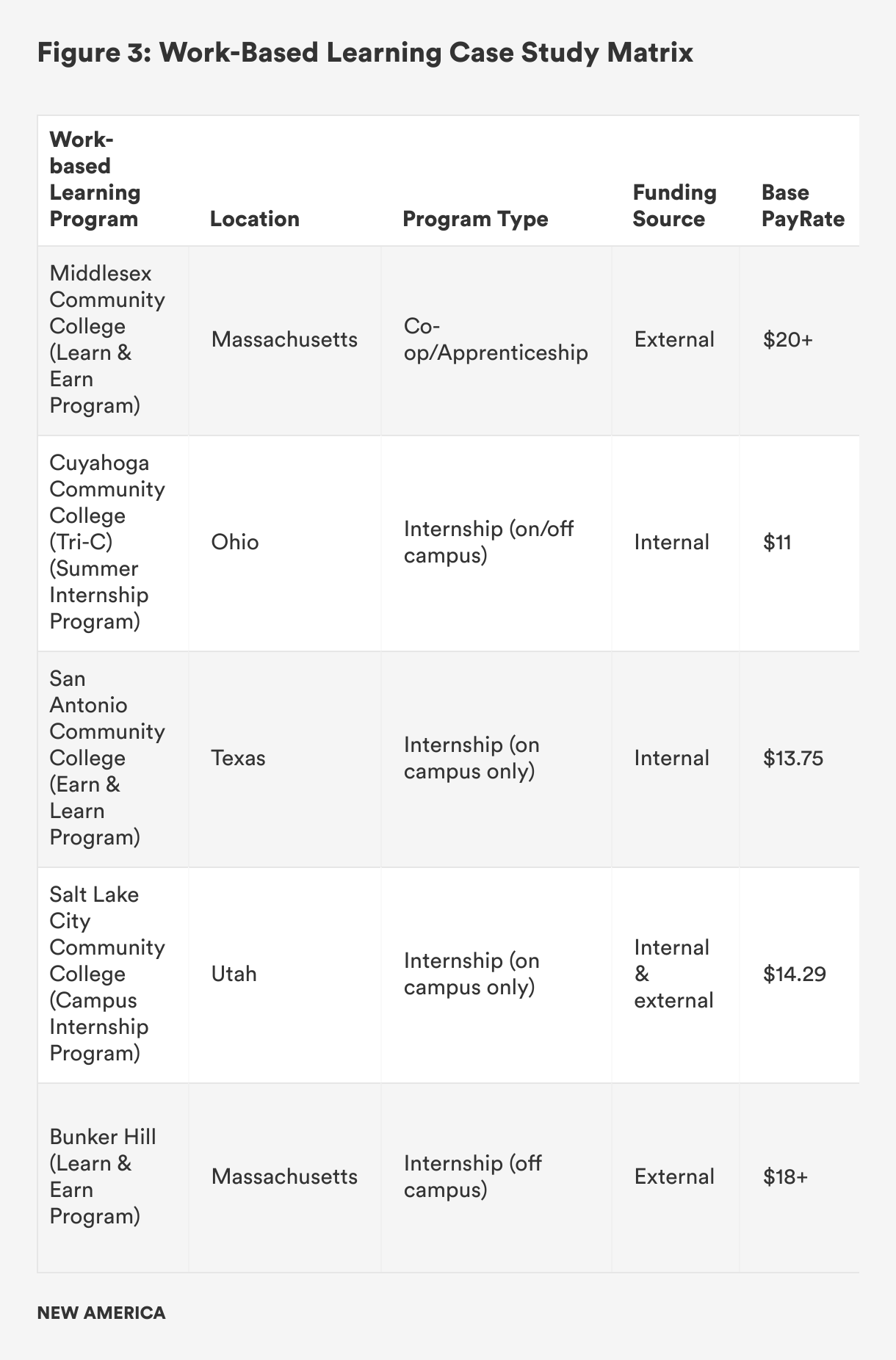
Spanning two branch campuses (Bedford and Lowell campuses), Middlesex Community College is a midsize, public, two-year institution in Massachusetts with an estimated student population of 6,885 (fall 2020).23 Middlesex’s mission is to equip students from racially and ethnically diverse backgrounds with a high-quality and affordable education. Students are prepared for success through workforce development opportunities, such as the Learn and Earn Experience program. Following the apprenticeship/co-op model, the program affords students majoring in the Biotechnology Technician Program an opportunity to work at a biotech company while completing their associate degree. Closing the diversity gap in STEM was a driving factor in creating the program, in partnership with regional biotech companies. While employed full time for one year, earning a minimum of $20 per hour, students progress towards degree completion by completing seven credits per semester. Classes are flexibly structured to avoid conflicts with work hours. When they complete the apprenticeship/co-op, program alums have already been vetted for potential permanent positions at partner biotech companies and often directly hired into them. Participating employers include Pfizer, Bristol Myers, Takeda, and Ultragenyx, to name a few.
Since launching in 2020, the program has admitted two cohorts, serving a total of 30 students. Stefana Soitos, director of the Learn and Earn Experience, told us about the integrated wraparound services—or the “invisible work,” as she called it—that help with student retention. “One [strategy], in particular, is checking in with them every semester,” Soitos said. Another wraparound support with impact relates to academic enrollment. Instead of students enrolling themselves into courses for the next semester, Soitos “bulk enrolls them in a cohort.” This makes the decision to continue in the program into a nondecision. This advising strategy is critical when working with community college students because of the greater likelihood of dropout and temporary stop-out. This case study shows that integrating proactive advising strategies is one way Learn and Earn program staff can address common barriers to student retention and completion.
Salt Lake City Community College
Salt Lake Community College (SLCC) is a large, public two-year institution committed to removing economic barriers for underprivileged students by covering the cost of tuition and fees. The campus is Utah’s largest and most diverse college, with student enrollment exceeding 27,000 (fall 2020).24
Driven by concerns about narrowly tailored secretarial student employment on campus, the Campus Internship Program (CIP) aims to broaden students’ professional skills and enhance career readiness. In addition to a semester-long internship with an on-campus office or department, students receive mentorship from supervisors and support from coaches in Career Services. In addition, students are encouraged to attend various career exploration and readiness workshops and other events hosted by Career Services, such as Gallup’s StrengthsFinder, major exploration, and career readiness. Students must enroll in a minimum of nine academic credit hours during the fall and spring semesters.
Since the program was revamped in 2018, nearly 200 students have participated. When CIP launched in 2010, interns earned a starting hourly wage of $12.75. However, because market conditions have driven up the average hourly salary by 8 percent,25 Earn and Learn program staff and employers had to rethink their compensation strategy. Career Services Director Ella Aho said the expansion of lucrative employment opportunities off campus has resulted in significant declines in student participation in the program during the summer months. Current economic conditions led Aho to advocate raising CIP starting wages to $15 per hour, although the intern hourly rate was only $14.29 at the time of our interview. “Some unique context about Utah is that it has consistently ranked among the top five U.S. state economies. So we have a low unemployment rate and a high minimum wage rate, so offering students $15 an hour would make the program more competitive with students choosing not to work on campus right now. For example, students could work at retail or fast food and make $20 an hour,” she explained. Because most community college students are already employed—whether part time or full time—employers must design attractive internship opportunities that encourage students to apply. Following our interview, SLCC President Deneece Huftalin announced plans in March to raise the increase the student minimum wage to $15 per hour. This case study highlights the importance of providing livable wages to attract and retain talented students from culturally diverse and economically underprivileged backgrounds.
San Antonio College
Among one of the largest community colleges in the nation, San Antonio College serves approximately 20,000 students each year (fall 2020).26 Founded as a junior college in 1925, this public, two-year college is one of five colleges in the Alamo Community College District.
The Learn and Earn program launched during the COVID-19 pandemic using institutional and federal funding sources (i.e., Pell Grants). The Assistant Director, Sabrina Macal-Polasek, said, "we saw a lot of students who have never had any sort of work experience before." The program seeks to help equip students with career-ready skills through high-impact internship opportunities, particularly on campus.” Providing internship opportunities on campus is critical for multiple reasons. “Many [students] don’t have transportation,” said Macal-Polasek, “and they’re taking two buses to get to campus, and so the program helps to relieve a huge burden of them having to travel back and forth to different areas.” In turn, the program’s focus on campus opportunities helps eliminate potential transportation obstacles and encourages students to become more engaged in campus life.
Piloted in fall 2021, the program has already served over 300 students. Participants must maintain enrollment in a minimum of six-course credit hours, which helps them stay on track for program completion. They receive an hourly base salary of $13.75 for their internship, with the opportunity to participate over successive academic terms.
In addition to employment opportunities on campus, participants can access other institutional support networks. For example, Career Navigators, two full-time staff members, assist with various career readiness competencies, such as resume review and mock interviews. This case study suggests hiring multiple dedicated coordinators to administer program activities can help ease staff capacity issues while facilitating access to caring, individualized career advising for community college students, fostering an optimal environment for experiential learning.
Cuyahoga Community College
With approximately 19,000 students, Cuyahoga Community College, in northeastern Ohio, is the state’s oldest and largest two-year college.27 Founded in 1963, this large, public school—also known as Tri-C—has expanded to serve diverse students across four branch campuses and at various off-campus locations. Tri-C's mission is removing barriers to a high-quality, affordable, and accessible education for local community members. As articulated in its 2018–22 strategic plan, Tri-C strives to build on current workforce development efforts by increasing opportunities for students to earn degrees and industry credentials that align with employer need.
Campus leaders are working toward this goal through Tri-C's Summer Internship Program (SIP). Sandy McKnight, associate vice president for Access, Learning, and Success, said that improving student retention was the most significant factor behind the development of SIP. "The program was designed to give students a rich experience, but what we have learned at Tri-C is that if we can keep people engaged [on campus] through the summer, they are more likely to return for the fall semester," McKnight said.
With a base hourly salary of $11, SIP participants must take at least one academic course during the summer, which the college fully subsidizes, for up to five credit hours. Another feature of this program is that students receive a book voucher for $125. Since the program launched in 2016 with over 100 participants, student interest has steadily grown, peaking at 212 participants in 2019, before the pandemic. Because of the program’s growth and success in increasing retention rates by as much as 20 percent, McKnight said it has evolved from focusing primarily on campus-based internships to expanding internship opportunities off campus through emerging partnerships with local businesses.
Although Tri-C has captured the short-term effects of the program on year-to-year student retention, McKnight, unfortunately, could not report on the program’s long-term effects on student completion. One critical implication from this case study is the significance of collecting robust, comprehensive data on student outcomes, which allows college leaders to demonstrate program impacts.
Bunker Hill Community College
The largest and most racially and ethnically diverse two-year institution in Massachusetts, Bunker Hill Community College is a public, midsize, urban institution serving the metropolitan Boston area and adjacent cities. Many Bunker Hill students are already employed, over half are parents, and over three-fourths fall within the two lowest income quartiles. Founded in 1973, the college has expanded to educate students across its two main campuses in Charlestown and Chelsea. Most students live less than eight miles from the college and commute via local transit.28
Because most students remain in the area upon degree or credential completion, helping them gain exposure in their desired fields through partnerships with local businesses is imperative. Building on the college’s mission to become an “educational and economic asset for the Commonwealth of Massachusetts,” the Learn and Earn program launched in spring 2012 with just 20 students, driven by a partnership with five firms seeking to broaden the diversity of their talent pool.29 With the creation of new alliances with small businesses, civic organizations, corporations, and nonprofits, Bunker Hill now places approximately 150 interns each semester. Although internship placements typically last for 10 weeks, some corporate employers support a limited number of yearlong positions. Over 500 students have benefited from internships thus far, and more than 40 percent have had their placement extended or converted into permanent positions.30
Learn and Earn participants receive a starting hourly rate of $18 and must complete a three-credit internship class. In addition, participants in the program benefit from travel stipends, ranging from $180 to $500, which helps alleviate a common barrier to internship participation for community college students.
Bunker Hill President Pamela Eddinger asserts that when designing WBL opportunities, college leaders must consider the demographics of the student population: “that so many BHCC students already work, and the majority are older, are facts that must be taken into account by higher education institutional leaders and policymakers who want to expand the availability of internships for this population,” she said.31 Eddinger mentioned that while students are often eager to build new connections in their fields of interest and demonstrate their skills and preparation, they still may require encouragement, resources, and material support to overcome perceived obstacles to participation. Although many two-year institutions are accustomed to operating with limited financial resources, one key takeaway from this case study is that access to adequate funding is a prerequisite to expanding and sustaining high-impact WBL opportunities, particularly for community college students.
Citations
- R.K. Yin, Case study research: Design and methods, 5th ed. (New York, NY: Sage Publications, 2014).
- The Carnegie Classification of Institutions of Higher Education, “About Carnegie Classification,” (n.d.) https://carnegieclassifications.acenet.edu.
- Ibid.
- Celcilia Rouse & Martha Gimbel. The pandemic’s effect on measured wage growth. (Washington, D.C.: The White House, 2021). Source: https://www.whitehouse.gov/cea/written-materials/2021/04/19/the-pandemics-effect-on-measured-wage-growth/
- Ibid.
- Ibid.
- Eddinger and Kazis, “Reimagining experiential learning.”
- Bunker Hill Community College, “Mission and Vision,” (n.d), https://www.bhcc.edu/about/missionvision/#MassCCMission.
- Eddinger and Kazis, “Reimagining experiential learning.”
- Ibid.
Key Findings from Case Studies of Paid WBL Programs
In this multicase study of paid WBL programs, New America sought to uncover the compelling factors that inspired each program’s development. Three major themes emerged: (a) paid WBL programs enhance a college’s student retention strategy; (b) students value paid WBL opportunities on campus or in the local community; (c) integrated, flexible, wraparound services address student needs; (d) paid WBL learning programs are funded in multiple ways; and (e) comprehensive program evaluations are elusive or non-existent. We provide an overview of the particular features found across each program, as illustrated in Figure 3.
Paid WBL Programs Enhance a College’s Student Retention Strategy
Most WBL staff mentioned student retention as the primary or secondary motivating factor. In describing the institutional context that led to the development of Cuyahoga Community College’s Summer Internship Program, McKnight asserted that career placement was not a primary goal. “When we launched” the Summer Internship Program,” she said, “it was focused on retention strategy. It wasn't a graduation strategy. It wasn't a career placement strategy. It really was a retention strategy.” As part of an institutional plan to combat student dropout or temporary stop-out during the summer months, McKnight explained that the program has worked; campus data indicate a 20 percent increase in retention from year to year (e.g., fall to fall) for students who participate.
Salt Lake City Community College’s Campus Internship Program was also part of an institutional effort to promote student retention while providing schedule flexibility, according to Career Services Director Ella Aho. The premise that engaging college students in paid experiential learning opportunities can result in higher retention rates is rooted in the scholarly evidence on student engagement. Higher education experts contend that when college students engage in educationally purposeful activities, inside or outside the classroom, they are more likely to persist to degree completion.32
Students Value Paid WBL Opportunities on Campus or in the Local Community
Equipping community college students with valuable real-world experience in their chosen professions was a second motivating factor behind each WBL program’s creation. Recognizing the obstacles community college students face managing the demands of school, work, and family, staff members cited how campus internship programs sought to alleviate some of the stressors by providing employment opportunities on campus or in the local community. For example, San Antonio College’s Student Enrichment Center provides internships on campus because many students do not have personal transportation, according to assistant director Sabrina Macal-Polasek. “Many don’t have transportation, and they’re taking two or three buses to get to campus. So the program relieves the burden of them traveling back and forth to different areas” she said.
Integrated, Flexible, Wraparound Services Address Student Needs
WBL staff across multiple community colleges cited various wraparound services to facilitate the career readiness and inclusion of all students. For example, to help Tri-C students fulfill the Summer Internship Program’s guideline of enrollment in at least one academic course, they receive assistance with book expenses and course costs. Because of the high cost of living in the Boston metropolitan area and the recognition that many students come from economically disadvantaged backgrounds, Bunker Hill’s Learn and Earn program covers internship travel expenses up to $500. Off-campus child care center vouchers are distributed to those seeking to participate in WBL opportunities at Salt Lake City Community College (SLCC), since students with children make up a sizable participant demographic there, around 30 percent. In two other cases—San Antonio and SLCC—students received guidance from knowledgeable career advisors and formally assigned mentors. Across all campuses, students received some degree of support with career readiness, including mock interviews, resume and cover letter reviews, and job searches.
Paid WBL Programs are Funded in Multiple Ways
How are paid WBL programs funded? We found that the sources varied. For example, San Antonio College staff leveraged federal funding from Higher Education Emergency Relief Fund (HEERF) and Pell grants to supplement student employment. Other program personnel, particularly at Cuyahoga and Salt Lake City, cited internal funding sources through the colleges' general operating budget.
Other paid WBL programs leverage support from private donors and philanthropic foundations. Staff reported receiving contributions from external sources at Salt Lake City, Bunker Hill, and Middlesex. Bunker Hill's Learn and Earn Program uses a cost-sharing method with four foundations local to the Boston metropolitan area. Salt Lake City receives support from local state appropriations and private donors in addition to institutional dollars. Career Services Director Aho emphasized the fact that international students are generally excluded from Earn and Learn programs sourced by federal aid, such as work-study. However, they can participate in the program through support from private donors, which makes this particular case different from others.
Corporate sponsorship of interns appeared to be on the horizon at Cuyahoga Community College. McKnight said, “this year alone, we have about six different grants” for the Summer Internship Program. “Because everybody’s in a different space now and their employers are being smart,” she said, “given the [workforce] shortages, companies are beginning to imagine how to build stronger pipelines of talent. So they’re like, ‘Okay, I’m going to write a check.’" However, she added, "our [SIP] program is funded using general funds.”
Earn and Learn staff members at Middlesex work with companies in the biotechnology industry to help identify and place diverse, talented community college students into paid, yearlong internships. The program aims to give students in the biotechnology degree program immersive, hands-on training in the industry by matching them with local employers. Middlesex generates funding for the program by charging partnered companies a placement fee for every intern and permanent hire.
Comprehensive Program Evaluations are Elusive or Non-Existent
One troubling trend across these cases was the lack of longitudinal data on student outcomes. Apart from Middlesex and San Antonio Community College, each WBL program has been operating for five years or longer, which is adequate time to evaluate the program’s long-term impacts. Nevertheless, staff could only generally share baseline demographic data on student participation trends, particularly for racial identity, gender, and age group. Insufficient capacity seems to be the problem. Some staff members noted the possibility of retrieving specific student outcomes data through campus institutional research departments but were unclear about the type and quality of data collected.
Citations
- S.R. Harper and S. Quaye, “Making engagement equitable for students in U.S. higher education,” in Student engagement in higher education: Theoretical perspectives and practice approaches for diverse populations, edited by S. Quaye & S. R. Harper (New York, NY: Routledge, 2019), 1–14.
Takeaways and Recommendations
Our look at five community colleges suggests that while paid WBL programs are viewed mainly as an effective strategy for facilitating student career readiness and retention, leaders must do more to make these experiences more equitable for all learners. Below we outline four recommendations for state policymakers and college stakeholders in career services, academic advising, and workforce development to enhance the effectiveness of WBL program design and implementation.
Consider Student Populations Historically Excluded From WBL Opportunities
Our research reveals that some community colleges struggle to provide equitable WBL opportunities for all learners, especially historically underserved populations, including but not limited to low-income, first-generation, and racially minoritized students. For example, after auditing and revamping its participant outreach and recruitment methods—such as eliminating arduous, multi-round interviews and removing grade point average cutoffs—Bunker Hill staff achieved parity in participation among college men from racially minoritized backgrounds, who now make up the second largest student subgroup. Community colleges that espouse a commitment to diversity, equity, and inclusion in campus mission statements cannot overlook systemic inequities within the implementation of WBL programs that reinforces white racial privilege.
Community college leaders must begin to see equitable participation in paid WBL programs as both an economic justice and a racial equity issue.
Community college leaders must begin to see equitable participation in paid WBL programs as both an economic justice and a racial equity issue. Staff members from career services and academic advising should start this process by conducting an internal audit of their outreach activities to better understand which student groups are most likely to apply for and participate in WBL. Disaggregation—breaking data down by race/ethnicity, gender, age, college generation status, family income level, and/or other demographic factors like foster care and student parent status—can help explore hidden gaps in participation.33 College staff must accept institutional responsibility for disengagement trends found among specific student subgroups.34 Finally, institutions should leverage qualitative research methods, such as focus groups or interviews, to better understand why particular subgroups do not participate or accrue the same short- or long-term benefits as their peers.
Conduct Annual Comprehensive Program Evaluations to Examine Student Outcomes
One significant shortcoming of this investigation is that WBL staff generally do not collect and could not elaborate on long-term impact of programs, especially those operating for five or more years. The scarcity of high-quality student outcome data weakens accountability for achieving program goals and diminishes meaningful opportunities for program improvement. This issue partly stems from the fact that most WBL programs do not have the staff capacity to conduct extensive program evaluations.
WBL staff should consider forming partnerships with institutional assessment offices to perform annual evaluations and closely track student outcomes such as employment status, wages, and career satisfaction. Community colleges should consider joining the recently launched National Survey of Paid Internships led by researchers at the University of Wisconsin–Madison’s Center for Research on College-Workforce Transitions. Longitudinal data on student outcomes will provide college leaders with the evidence needed to advocate for future state funding. With the collection of robust, comprehensive program data, WBL staff will be able to demonstrate impact, establish an iterative design process, and ensure accountability for goals.
Implement a Starting $15 Hourly Salary and Redress Student Basic Needs Insecurity
Concerns about inflation and the rising cost of living in the United States affect many Americans, especially community college students who are often financially independent. Even before the COVID-19 pandemic, studies indicated that community college students faced severe challenges related to housing and food insecurity.35 It should come as little surprise that such challenges have worsened for community college students throughout the pandemic resulting in unprecedented enrollment declines and stop-outs.36
Our interviews suggest that access to dependable transportation is another significant barrier to student participation in paid WBL programs. In crafting a high-impact WBL program, staff must attend to the crucial yet often overlooked basic needs factors, such as child care costs and transportation to off-campus work sites.
To lessen barriers to participation and attract talented students, college leaders and employers should aim to offer at least a starting $15 hourly base salary. To determine starting compensation through an equity lens, employers should give special consideration to student parents, especially family size and the total number of financially contributing adults in a household. In addition, employers should redress basic needs concerns by providing vouchers for travel and child care expenses. Furthermore, it is vital that paid WBL opportunities, especially part-time positions, guarantee a minimum number of work hours each week.
Increase Institutional Funding to Promote Program Growth and Sustainability
Our interviews revealed that one of the biggest concerns of WBL staff is securing adequate funding for program operation, expansion, and sustainability. For example, WBL staff members at San Antonio College were interested in helping underserved subgroups, such as undocumented students and Deferred Action for Childhood Arrivals (DACA). Unfortunately, Title IV federal financial aid guidelines prohibit staff from serving this vital group.
Increasing funding for paid WBL learning programs is one of the most impactful ways that state policymakers and community college presidents can promote program growth and sustainability while broadening participation. With additional funding, programs may be able to recruit staff members trained in program evaluation and provide more comprehensive, caring wraparound services to participants.
With equity-minded policies and strategies in place, employers and community colleges can broaden the impacts and benefits of paid WBL to countless students like Brandy.
Citations
- Institute for Higher Education Policy, “Opening the promise: The five principles of equitable policymaking,” Institute for Higher Ed Policy, January 2022, https://www.ihep.org/wp-content/uploads/2022/01/IHEP_equitable_policy_principles_brief_final_web2.pdf.
- Harper and Quaye, “Making engagement equitable.”
- S. Goldrick-Rab et al., Hungry and homeless in college: Results from a national study of basic needs insecurity in higher education, The Wisconsin Hope Center, 2016, https://hope4college.com/wp-content/uploads/2018/09/Hungry-and-Homeless-in-College-Report.pdf; M. Vasquez, M. Vang, F. Garcia, and F. Harris, “What do I eat? Where do I sleep?: A concern for men of color in community college,” Community College Journal of Research and Practice 43, no. 4 (2009), 295–306.
- T. Strayhorn, “Lessons Learned from Institutional Responses to COVID-19: Evidence-Based Insights from a Qualitative Study of Historically Black Community Colleges,” Community College Journal of Research and Practice 46, no. 1 (2022), 30–40; L. Zottarelli et al., “Basic needs initiatives at Texas community college Hispanic-serving institutions: Changes in service offerings during the COVID-19 pandemic,” Community College Journal of Research and Practice 46, no. 1-2 (2019), 138–144, https://doi.org/10.1080/10668926.2021.1973611; National Student Clearinghouse Research Center, “COVID-19: Stay informed,” 2021, https://nscresearchcenter.org/stay-informed.
Appendix
Interview topic areas and questions
Topic areas:
- Program strategic goals
- Funding
- Program features and characteristics
- Participant demographics
- Intern outcomes
- Program evaluation
- Academic connections
- Employer partners
- Program challenges
Primary questions:
- When did this internship program begin and what were the motivating factors?
- How is the paid WBL program funded?
- How much do interns earn?
- Do students receive academic credit?
- Who participates in the program?
- What (non-monetary) resources and benefits do students accrue from the program?
- How do you identify and attract employers to participate in the program?
- How do you assess student outcomes?
More About the Author

Mauriell H. Amechi
Senior Policy Analyst, Center on Education & Labor
Issues
Related