2021–2022 Reapportionment and Commissions
In general, states with truly independent commissions produced reasonably fair maps through reasonably fair procedures. California, Colorado, and Michigan should all be considered success stories.
However, Arizona, which also used an independent citizens redistricting commission, was more complicated. The commission has two Democrats, two Republicans, and one “Independent.” However, since this one “Independent” effectively has all the power, state Republicans worked very hard to ensure that the “Independent” was really a Republican. Their behind-the-scenes machinations paid off with a map that was more favorable to Republicans.111 This difference highlights the importance of how citizens are appointed to independent commissions. In California, Colorado, and Michigan, citizens may apply to be on redistricting commissions and a panel of retired judges make final decisions. In Arizona's case, partisan elected officials select the first four citizen commissioners, and these four select one Independent as the fifth and final member.
Other states that passed redistricting commissions ahead of the 2021-2022 redistricting cycle that were not truly independent struggled.112 In New York, Ohio, Utah, and Missouri, voters had approved statewide initiatives during the previous decade that established commissions to draw maps. However, since none of these commissions had final authority to enact the maps, partisan state legislatures all wound up tossing out the work of the commissions and drawing their own maps. In all four states, the process was extremely ugly, with partisan state legislatures drawing extreme gerrymanders. In New York, the state supreme court ultimately drew the maps. In Missouri, the process adopted by voters was never used. The legislature repealed it before it could go into effect.
In Virginia, the state replaced an advisory commission named by the governor with a bipartisan commission equally balanced between Democrats and Republicans. Democrats and Republicans failed to agree to a compromise, leaving the state supreme court to draw the maps.
Overall, maps in eight states had to be drawn by the courts.
The below tables and graphs compare results by redistricting protocol across several measures.
Partisan Balance
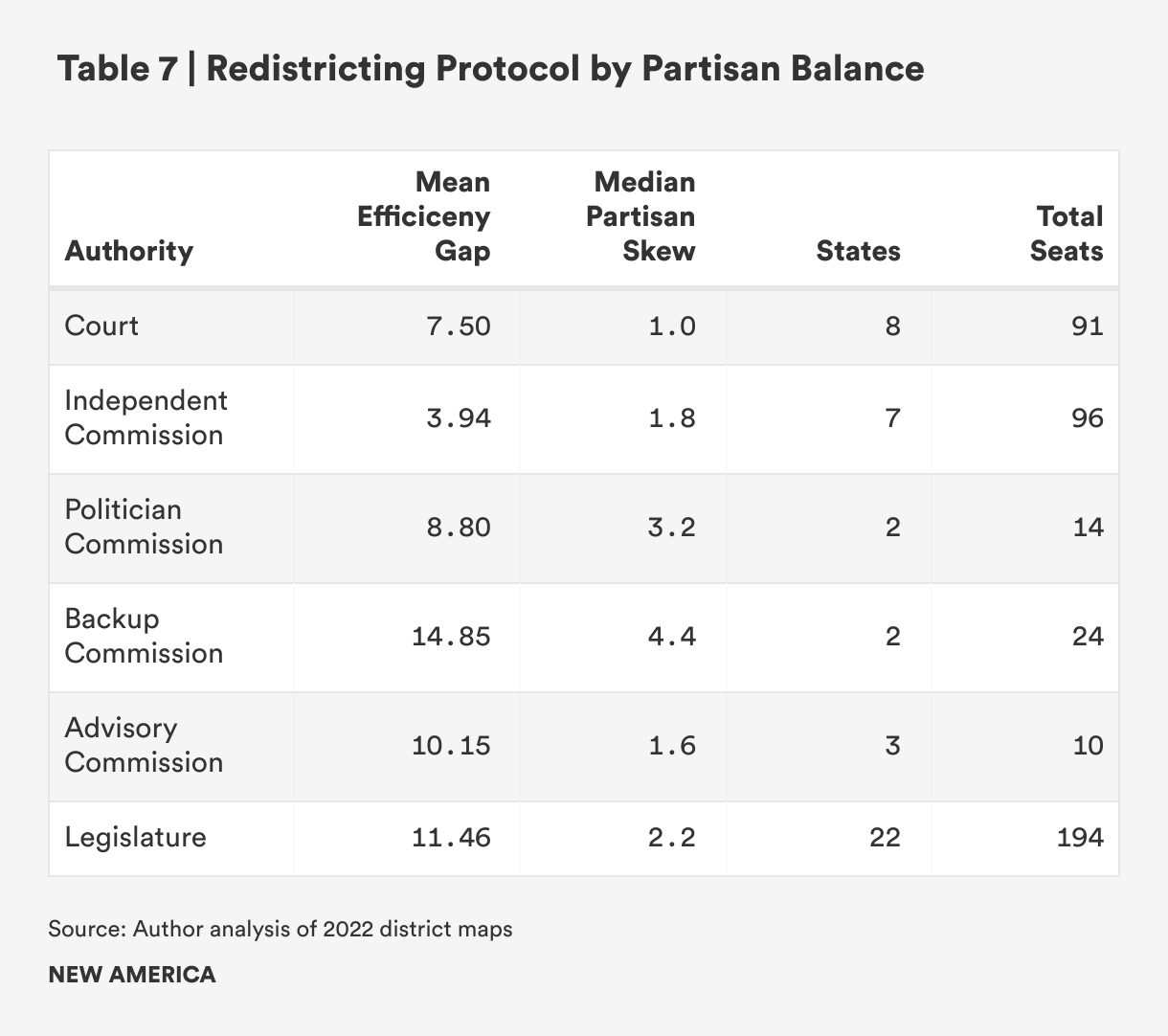
On balance, independent commissions and courts drew 2022 maps that are most neutral. Independent commissions have the lowest average efficiency gap, and courts have the lowest average partisan skew.
Competitiveness
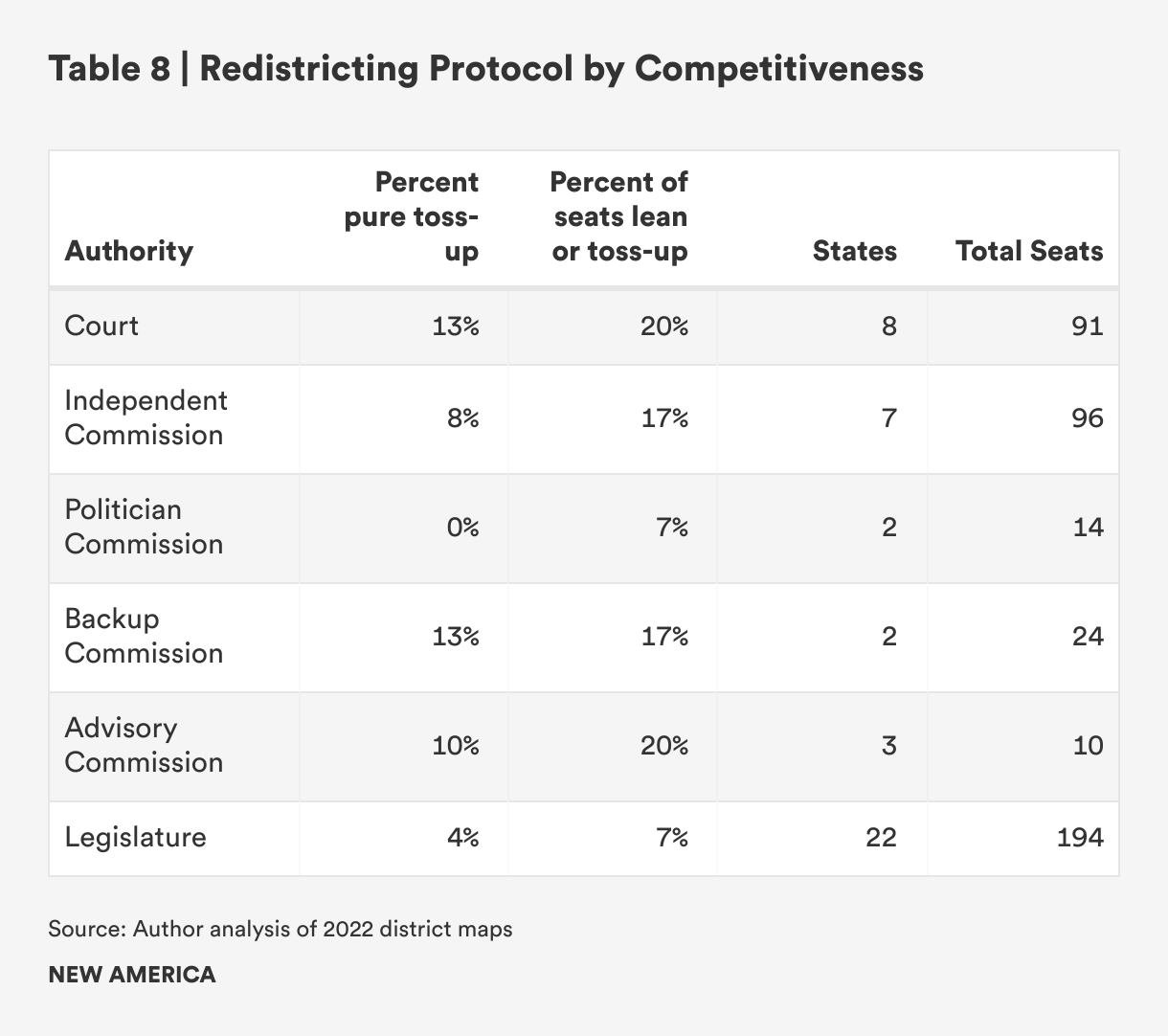
Turning to competitiveness, again, courts perform the best. Legislatures clearly perform the worst.
But even in states where the boundaries are drawn by courts, only one-in-seven districts are swing districts, and only one-in-five are either swing or lean districts. No redistricting authority has been able to do any better than this, meaning that regardless of districting authority, lopsided districts predominate.
Compactness and Community Integrity
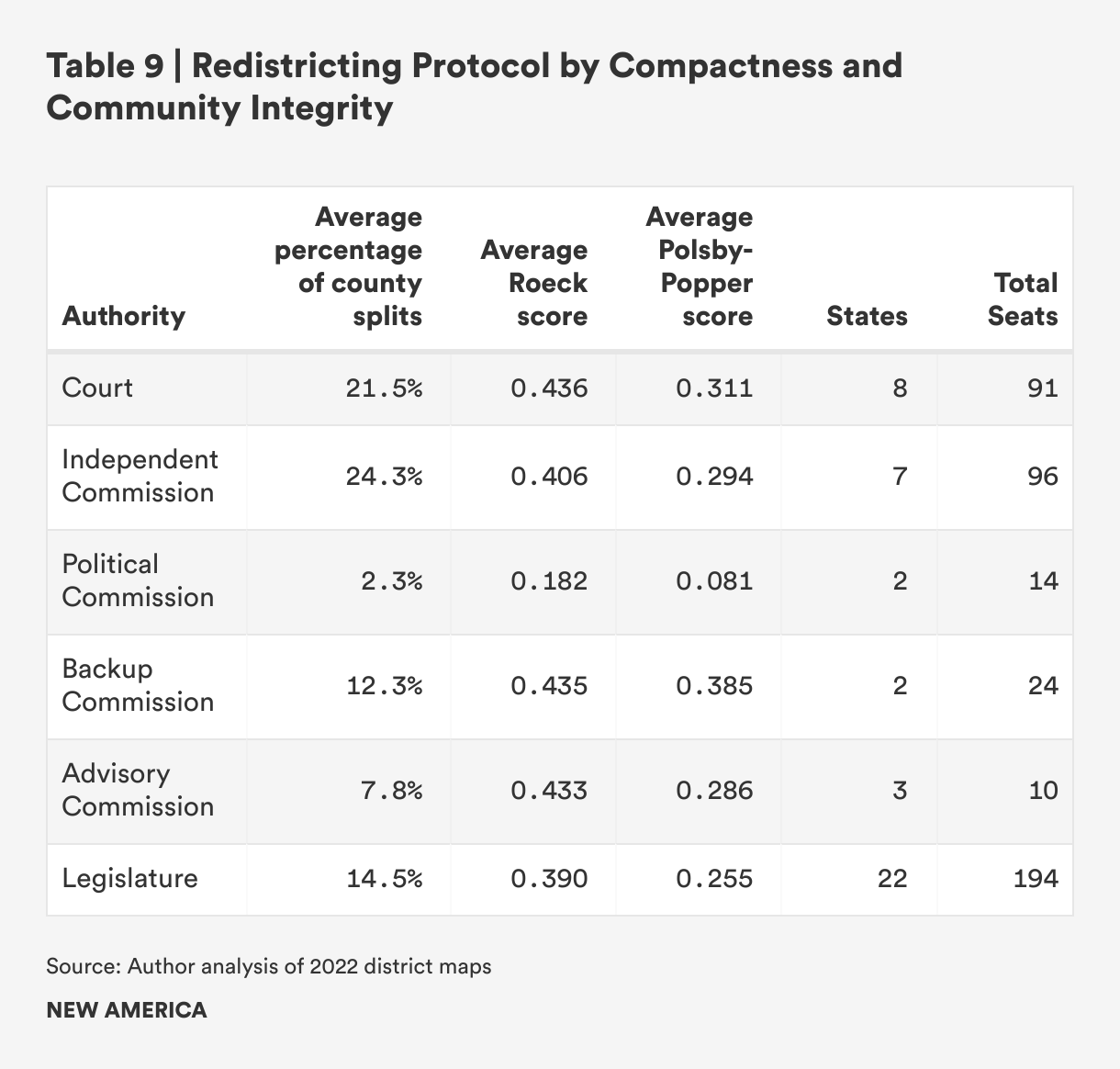
On compactness and keeping communities together (measured by county splits), the story is less clear for 2021-2022. Interestingly, independent commissions split the highest percentage of counties. The differences on Roeck and Polsby-Popper scores (measures of compactness) do not appear to vary significantly based on redistricting authority.

What We Know About Redistricting and Redistricting Reform
- Introduction
- Where We Have Been: The History of Gerrymandering in America
- How Gerrymandering Got So Nasty: Means, Motive, and Opportunity
- Redistricting Reform
- Can Commissions Make Districting Fairer?
- 2021–2022 Reapportionment and Commissions
- Alternatives to American-Style Districting
- Areas for Future Research
- Conclusion
- Appendix
Citations
- David Daley, “Will Arizona's relentless Republican gerrymander decide the 2024 presidential election?,” Salon, December 4, 2021, https://www.salon.com/2021/12/04/will-arizonas-relentless-gerrymander-decide-the-2024-presidential-election/.
- For useful overviews, see Tierney Sneed, “A Fair Maps Success Story or ‘Multi-layered Stages of Dante’s Hell’?,” CNN, June 18, 2022, https://www.cnn.com/2022/06/18/politics/redistricting-commission-takeaways-success/index.html; David Daley, “The Sood, the Bad and the Ugly of Redistricting Reform,” DemocacySOS, July 6, 2022, https://democracysos.substack.com/p/the-good-the-bad-and-the-ugly-of.