Appendix 1: Country Briefs
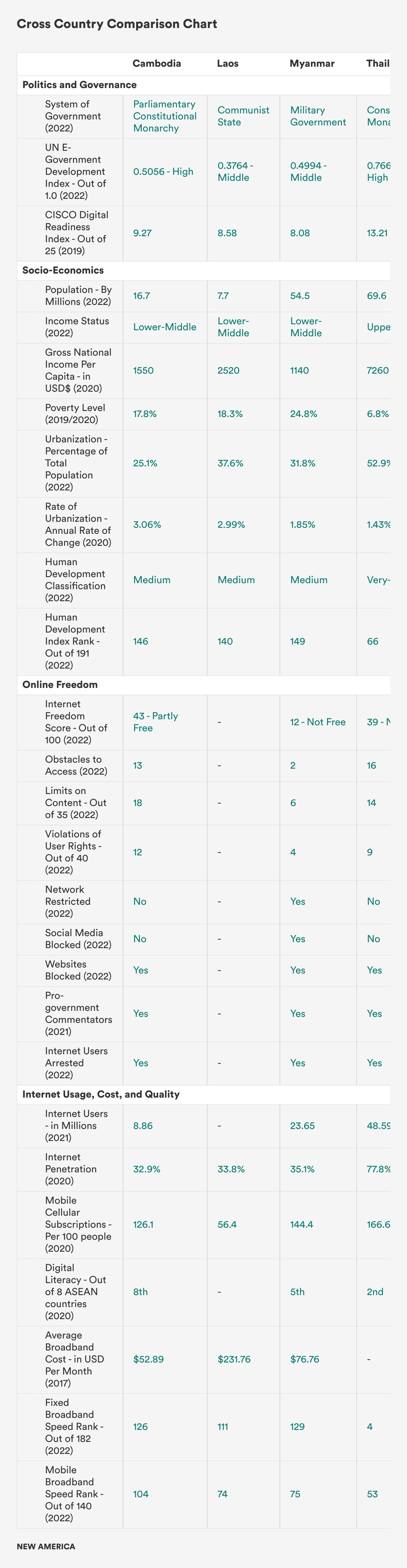
To highlight the unique opportunities and challenges of each Lower Mekong country, the following Country Briefs provide a digital overview, identify challenges to digital transformation, and outline key areas to watch in each country. In addition, this section includes a cross-country comparison chart (below) outlining the foundational elements to regional digital transformation including political and governance models; socio-economic statistics; online freedoms; and internet usage, cost, and quality.
Cambodia | Kingdom of Cambodia
After years of strategic economic and social development, Cambodia is poised to leapfrog to modern digital solutions, particularly in the field of financial technologies. Given the current state of digital development and deployment and the geopolitical interest in the region, priority areas to watch include (1) digital governance measures; (2) sustaining a healthy environment for digital commerce and economy; (3) digital solutions for environmental management and monitoring; and (4) engagement from multistakeholder organizations. However, Cambodia continues to face several barriers to sustainable digital transformation, such as human rights and civil liberties violations that reinforce systemic challenges around trust and security, as well as lagging hard infrastructure development and low digital literacy.
The Cambodian government began tightening its control over the country’s digital transformation with the 2015 Law on Telecommunications that allowed the government plenary authority over information and communications technologies and put the licensure of any entities seeking to conduct telecommunications activities in the country at the discretion of the government. Recent developments have further strengthened government control over the internet. Implementation of the National Internet Gateway (NIG) was postponed due to technical issues and the COVID-19 pandemic the day before it was scheduled to go live in February 2022. The NIG would route all internet traffic—including from abroad—through a government-run portal, as is done in China, with the stated goal of cracking down on internet service providers (ISPs) that facilitate illegal online gambling and underpay government fees. Instituting the NIG would give state regulators the means to “prevent and disconnect all network connections that affect national income, security, social order, morality, culture, traditions, and customs.” However, the system has been met with widespread concerns by human right organizations and internet freedom advocates who state that it would lead to increased censorship, restriction of online freedoms, and crackdowns on activists. There is some cautious optimism about the delay, as civil society believes that the Cambodian government is not ready for the potential ramifications of going that far toward a digital authoritarian approach to systems.
Digital transformation government priorities are landscaped in Cambodia’s Digital Economy and Society Policy Framework 2021–2035. The framework outlines 10 strategies to support whole-of-society digital transformation, including improving digital connectivity and digital payments infrastructure, strengthening digital security infrastructure, developing digital human capital, and promoting collaborations with digital technology companies and startups.
Challenges for Digital Transformation:
- Digital governance in Cambodia remains fragmented and presents serious concerns for human rights, civil liberties, and online freedoms. Two out of three Cambodian users report feeling that the internet is not a safe method of interacting with the government, and three out of four users report that they do not trust e-government services.
- Lagging hard infrastructure development, such as fixed and mobile broadband coverage, limits Cambodia’s ability to develop and deploy digital solutions.
- Low rates of digital literacy in the country limit the impact of digital solutions. According to the Ministry of Post and Telecommunications, only 30 percent of Cambodians have both access to the internet and the basic digital literacy needed to use it, spurring the need for such programs as UNESCO’s National Media, Information, and Digital Literacy Competency Framework.
Four Key Areas to Watch:
- Digital Governance: Cambodia is rapidly adopting technology and looking to further boost innovation, but the current fragmented approach to digital governance has two major impacts: (1) human rights violations, restricted civil liberties and free speech, and other limited online freedoms; and (2) ineffective regulatory frameworks and policies that have left gaps in user security and privacy. Cambodia has a history of strict monitoring of users’ internet activity, leaving users wary of digital and e-government services. Cambodia also lacks comprehensive and effective cybersecurity policies, disincentivizing telecom investments. With greater reliance on e-payment methods, the lack of cybersecurity threatens consumer confidence and greater adoption of digital platform services. However, while digital governance is lacking, Cambodian officials are promoting implementation of electronic Know Your Customer services, particularly in digital finance and other important sectors.
- Digital Commerce and Economy: While rapid growth in the fintech sector has been led by government efforts, large-scale digital transformation is required to foster greater collaboration among the private sector, investors, governments, development actors, civil society, and educational institutions. Cambodia is also seeing great promise in its technology innovation ecosystem. An extensive report by the Asian Development Bank on technology startups in the country demonstrates how the ecosystem has grown from fewer than 50 tech startups in 2013 to around 300 by 2018 and six local venture capital firms, with most in fintech. While not representative of all startups in the country, as of August 2022, StartUp Cambodia, a national entrepreneurship program led by the Ministry of Economy and Finance is working with 105 active startups, and a number of investors, academic institutions, development partners, incubators and accelerators, corporate partners, co-working spaces, and government institutions supporting tech startups. As the digital environment in Cambodia matures, the private sector is expected to continue to grow. Cambodia’s leading commercial banks, ACLEDA and ABA, have reportedly connected more than 1.5 million users to mobile banking options. The growth of financial digital solutions is supported by state-led efforts, such as the National Bank of Cambodia’s Bakong digital currency, a blockchain-enabled, QR-code based, peer-to-peer and peer-to-business digital payment system that enables anyone in the nation to access their account through a smartphone.
- Environmental Management and Monitoring: Given persistent environmental issues and vulnerability to natural disasters, Cambodia has significant opportunity to leverage data-powered digital solutions for environmental management and monitoring. Somleng partnered with the government and an NGO called People in Need to create an interactive voice response-based early warning system that provides lifesaving information to more than 50,000 people in disaster-prone areas during inclement weather, overcoming existing literacy and internet access barriers. In 2020, the U.S. Embassy in Cambodia announced the Mekong Dam Monitor, created in collaboration with the Stimson Center and Eyes on Earth. This system uses open source remote sensing, satellite imagery, and geographic information systems to provide real-time reporting of climate conditions, estimated river flows, and reservoir conditions in an effort to promote better water management.
- Multistakeholder Engagement: Multistakeholder organization engagement can help drive the direction of development toward more open and people-centered solutions. In January 2022, the Cambodia Academy of Digital Technology, in collaboration with UNESCO, launched an Assessment of Internet Development in Cambodia using UNESCO’s Internet Universality Indicators to provide a holistic diagnosis of Cambodia’s internet policies and digital environment. The aim is to promote universal access to information and freedom of expression. The effort includes a Multistakeholder Advisory Board composed of local Cambodian cross-sector experts and representatives from the Ministry of Post and Telecommunications, the Ministry of Information, civil society organizations, media, private sector, regulators, and U.N. agencies. Multistakeholder engagement is essential for people-centric digital transformation.
Laos | Lao People's Democratic Republic
Laos faces several barriers to economic and social development, including significant poverty and high debt, growing inequalities between social groups in the multiethnic region, and limited development and infrastructure. These challenges complicate and stifle digital development and deployment initiatives. Given the current development challenges and limited information available, priority areas to watch include (1) nascent digital innovation ecosystems, (2) “leapfrog” digital development; (3) e-learning and capacity building; and (4) foreign investment and special economic zones.
In recent years, Lao public officials have prioritized a more structured approach to development and infrastructure buildout, with a 2015 revised constitution and a 2017 national strategy. In 2022, along with Cambodia, Thailand, and Vietnam, Laos joined the Regional Comprehensive Economic Partnership, which aims to build the region’s capacity in order to establish and grow its digital ecosystem in line with the Master Plan on ASEAN Connectivity 2025. In 2020, Laos revealed its $6 billion (USD) Vientiane-Boten Expressway project linking Laos and China, and two years later, Lao Telecom, the leading telecom service in Laos, launched its first 5G service as part of the smart motorway network. As Laos seeks to strengthen its physical and digital infrastructure development, simultaneous updates are being made to domestic regulations on the country’s burgeoning digital sectors, such as the 2021 Regulation on e-Commerce. In addition, there is growing focus on data security and privacy concerns as more people gain access to online spaces. Currently, Laos is the only country in the region that does not have policies that enable the government to block and moderate content. How Lao officials decide to approach these concerns will have larger impacts on human rights, civil liberties, and online freedoms.
Challenges for Digital Transformation:
- Laos is considered by the UN to be a least-developed country. While development advancements in Laos have reduced poverty rates in the past 25 years, the country’s reliance on agriculture, the informality of the Lao labor market, lack of access to education, and the impact of the COVID-19 pandemic complicate social and economic development.
- Development efforts are reliant on foreign investment and aid, which bring geopolitical pressures and complicate the country’s ability to power sustainable development and governance initiatives. Improved management of natural resources and enhanced agricultural productivity have been identified as top development priorities, both areas could benefit from innovative approaches.
- Modest economic growth has been accompanied by rising inequality in the country, as poverty remains high among ethnic minority groups and households with less education.
- Limited infrastructure coverage and quality have long been a barrier for development. These challenges also affect internet access and digital solutions deployment.
- Lagging access to online spaces and low digital literacy affect the country’s capacity for digital transformation. Accessibility, quality, and affordability remain large barriers to internet access in the country.
Four Key Areas to Watch:
- Nascent Digital Innovation Ecosystems: UNDP labeled Laos as digitally nascent,36 but it is moving towards digitally emerging. Compared with its neighbors, the country's digital innovation ecosystem is very nascent and is missing key players and components, such as investment, developed markets, and supportive regulation, initiatives, and administration. This limits the ability of startups to innovate, grow, and contribute to improved national outcomes. In addition, Laos lacks the homegrown investment needed to grow its sector, yet at the same time, seeking foreign investment presents challenges. The small population and market potential, as well as low rates of digital and English literacy, are barriers to receiving foreign investment and growing the technology sector. As Laos seeks to expand its digital innovation ecosystem, overcoming these barriers will advance progress on the country’s path to a people-centered digital transformation. Movement toward improved government regulations, requirements, and services should be monitored and assessed for accessibility, inclusion, security, privacy, and human rights impact.
- “Leapfrog” Digital Development: In 2022, Lao Telecom launched its first 5G service as part of the Vientiane-Boten (Laos-China) Expressway, a smart motorway network that strengthens connectivity with China. The steady increase in projects such as the railway marks a turning point for the country’s hard infrastructure development as Lao technology corporations prioritize information and communications technology development in rural areas, including 3G internet connectivity. In addition, international (particularly Chinese and Thai) technology, such as inexpensive computing devices and solar tech, is being brought into the country. Close attention should be paid to the potential of tech leapfrogging in Laos and the flows of foreign funding, such as the World Bank’s Poverty Reduction Fund, that might steer more innovative approaches to reducing inequality in the region. Now that 5G infrastructure has been launched by the state telecommunications service, consideration should be given not just to service costs, but also to how the government uses it to track data and users.
- E-Learning and Capacity Building: The COVID-19 pandemic accelerated the reliance on digital connectivity, amplifying the need for digital education and literacy in Laos. As schools closed in-person instruction, Laos began to lean on its limited digital infrastructure, which was needed but not readily available in rural and remote areas where poor, rural students lacked the digital technology to learn from home. In the 2020 UN Lao PDR Socio-Economic Response Framework to COVID-19, the Laos Ministry of Education put forth commitments to the education ecosystem, such as “the continuity of learning through the implementation of diverse/key learning activities/opportunities aimed at quality learning and the wellbeing of learners, teachers, caregivers/parents, and school committees.” Out of this public commitment, several technologies were launched, such as Khang Panya Lao, a teaching and learning platform for adults and children modeled after UNICEF’s Learning Passport education tool. By May 2022 the platform had approximately 90,000 users. Other e-learning platforms such as the SMART UP e-learning platform were launched to help small and medium-sized enterprises enhance their digital skills. Through these initiatives and others like them, Laos can strengthen access to education for rural and poor communities, basic and digital literacy levels for all ethnic groups, and e-learning opportunities for all age groups.
- Foreign Investment and Special Economic Zones: As Laos continues to develop, it is struggling to overcome its heavy reliance on foreign investment and aid, which drives national priorities and leads to tension in this geopolitically sensitive region. The Boten Special Economic Zone and the Mohan-Boten Economic Cooperation Zone are particular areas of interest for the region. Costing over $11 billion (USD), the Boten Special Economic Zone is the most expensive infrastructure development project in Laos. It has been funded and developed by China since 2003. In coordination with this project, the Boten region is being transformed into an urban and tourism hub, called the “Boten Beautiful Land” Specific Economic Zone. As the relationship between Laos and China deepens, key areas to watch are the types of next-generation technologies Chinese developers will import or develop in its neighboring country, how the developments will influence the future of work for multiethnic populations, and what key governance challenges may arise from such approaches to foreign partnerships and investments.
Myanmar
Myanmar faces the most challenging and uncertain path to progress in the region. With widespread human rights abuses, recent genocide of the Rohingya people, extreme isolation, an increase in misinformation and disinformation online, Myanmar has experienced accelerating political, economic, and social turmoil in recent years. Since the 2021 military coup, there have been internet blackouts and a massive withdrawal of foreign governments, companies, and development projects. Prior to the coup, Myanmar’s digital landscape was very briefly led by the private sector, but is now inextricably tied to military rule. A foundational site for understanding this entanglement is through Myanmar’s 2004 Electronic Transactions Law (amended in 2021). The first iteration of the law was used to “regulate and control phone and internet users with harsh criminal punishments.” Shortly after the military seized control, an amendment was made to the law suspending Section 5 (protection against search, seizure, and arrest without civilian observation), Section 7 (protection against indefinite detention), and Section 8 (provision of a wide-ranging individual privacy rights). Under such circumstances, technological development and regulation have regressed and any development in the sector under military rule poses a threat to human rights, privacy, and security. Keeping this in mind, the four areas to watch are (1) Meta/Facebook’s disproportionate impact on the country; (2) internet shutdowns, government censorship, and the response; (3) regressing digital development; and (4) withdrawal of development agencies and outside support in protest of the coup.
Challenges for Digital Transformation:
- Current regime actions are categorized by human rights violations and abuses, including widespread genocide of the Rohingya people, torture and sexual violence of military detainees, blocked humanitarian aid, censorship and crackdown on dissent, and attacks on civilians.
- Lagging infrastructure and poor quality of electricity, roads, railways, and other basic infrastructure limits Myanmar’s development and economic growth.
- Widespread internet shutdowns, particularly on mobile internet access, as well as restricted internet access, censorship, and online surveillance, have led UN human rights experts to call Myanmar a “digital dictatorship.”
- Foreign governments, development actors, and the private sector halted operations and imposed sanctions on the country after the February 2021 coup. The resulting hostile environment not only isolates Myanmar from the international community but also makes the outlook for social and economic development incredibly bleak.
Four Key Areas to Watch:
- Meta/Facebook’s Disproportionate Impact on the Country: Meta’s Facebook has played an outsized role in the country and is often referred to as “the internet,” due to its popularity (roughly 76 percent of internet users in Myanmar are on Facebook in 2022). A large part of this user base grew out of Facebook’s Free Basics initiative, a program that offered free-of-charge access to other select websites and services, turning Facebook into a landing page in a larger internet hub. However, Meta’s popularity had an outsized impact on the country. In 2017, Facebook was used to promote discrimination and genocide of the Myanmar Rohingya community. Coordinated campaigns by the military on Facebook flamed ethnic violence toward the Rohingya community and led to nearly 7,000 deaths and 700,000 Rohingya fleeing the country. After an independent internal review, Facebook publicly admitted in 2018 that it did not do enough to prevent the platform from being used to incite violence in Myanmar. As a result, a $150 billion (USD) class-action complaint was filed in California by parties in the United States and the United Kingdom on behalf of the Rohingya in December 2021.37 This case remains pending but is being closely watched by human rights and open internet advocates. Facebook’s internal Human Rights Impact Assessment suggested publishing data in order to evaluate the scale of human rights violations in Myanmar. However, when pressed to share data with a trial at the International Court of Justice, Facebook refused. The military blocked Meta’s Facebook and Whatsapp when activists began using it to organize. Post-coup, Facebook banned individual military leaders from the platform, while the military blocked access to Facebook in Myanmar. Access to Facebook is still blocked by some internet service providers in Myanmar, however users can access the platform through virtual private networks (VPNs).38 The role of social media platforms in society has a large impact on many societies, not just Myanmar. There are serious global considerations about the governance of social media platforms, the preservation of digital evidence, and the responsibility of the private sector to take action to prevent atrocities. These considerations do not just apply to Facebook, but to all platforms, especially as alternative platforms gain traction in the country.
- Internet Shutdowns, Government Censorship, and the Response: The military conducts widespread internet shutdowns, restricts internet access, and relies on censorship and online surveillance. While fiber-optic and fixed wireless connectivity has been intermittently restored, much of the restrictions targeting mobile internet remain, so the vast majority of the population still lacks reliable access to the internet. Users have attempted to bypass these restrictions with virtual private networks (VPNs), which have become increasingly popular in the country. However, a newly proposed cyber law would make all VPN usage illegal with the punishment of a steep fine and jail sentence of up to three years. Blocking VPNs removes essential cybersecurity protections and prevents international companies from accessing necessary business information on servers outside of Myanmar. Furthermore, with Facebook effectively blocked, individuals, businesses, and civil rights groups that rely on VPN use to access online platforms have deeply criticized the potential regulation. In March 2022, Norwegian company Telenor completed the sale of 80 percent of Telenor Myanmar to a local, military-linked group. Telenor is one of the world’s largest telecom companies, and the deal received significant pushback from civil society, with expectations that it will further threaten human rights and the relationship between private sector and state-sponsored control and censorship. The military control of the country is also being met with online protests in the form of doxing family members of officers in the military.39
- Regressing Digital Development: Starting in 2014, a slew of investments spurred incredible growth in telecommunications infrastructure deployment and adoption in Myanmar. However, the lack of a strong telecommunications policy framework and increased digital authoritarianism are causing growth in the sector to reverse. Promising accelerator and incubator initiatives such as the Phandeeyar Tech Seed Accelerator, Ooredoo’s Ideabox Myanmar, and One to Watch have been slowed. Wave Money was expected to be Myanmar’s first tech unicorn, with Ant Financial buying a stake in the company for $70 million (USD). After the 2021 military coup, however, the company lost over half of its monthly active users. Not surprisingly, Myanmar ranks lowest among all ASEAN countries in the development of information and communications technology, e-government development, network readiness, and cybersecurity. Prior to the coup, Myanmar’s Ministry of Transport and Communications put forth a new Universal Service Strategy for 2018 to 2022 to extend telecom services and internet access in the country, as well as an e-Governance Master Plan (2021 to 2025) that included plans for census data management, e-payments, cyber crime, income tax management, and the movement of public services online. However, the status of these initiatives is unknown—and there is a high chance they have been shelved.
- Withdrawal of Development Agencies and Outside Support in Protest of the Coup: The government has arrested over 14,000 people and killed over 2,000 since the coup began in 2021. This sparked a wave of development actors pulling investments and canceling projects in the country. Myanmar has an abundance of natural energy resources, particularly natural gas; the country is among the region’s top five exports, generating nearly 7 percent of the country’s GDP in 2019. Natural resource extraction historically attracted foreign investment and created revenue for the military. However, in an effort to influence military action, international companies, including ones that work in natural resources, have faced pressure to halt projects in the country. Voltalia, a renewable power producer, exited the country in March 2021. TotalEnergies ceased production at Yadana gas field in May 2021, and Chevron withdrew from its gas venture in January 2022. Several other companies ended military-owned leases, sold stocks in Myanmar-based companies, and rejected production opportunities. In addition, sanctions and potential sanctions from other countries prevent or inhibit the flow of investment and resources into the country.
Thailand | Kingdom of Thailand
Thailand consistently leads the region in infrastructure accessibility, digital literacy, and digital transformation efforts. As the only upper middle-income-country in the Lower Mekong Region, much of Thailand’s success comes from its private sector and high rates of tech innovation. A nationwide movement toward Industry 4.0 is on the verge of turning the country into an economic force, or a self-described “Asian digital behemoth.” The digital industry is growing quickly, with an estimated value of $1.08 billion (USD), driven by gaming, big data, and animation industries. With the size of this market, Thailand is ready for 5G, e-payments systems, and the rest that Industry 4.0 has to offer. As part of the Thailand 4.0 plan, the government intends to revitalize the easternmost region of Thailand and turn it into the Eastern Economic Corridor, dedicated to increased and improved infrastructure; business, industrial clusters, and innovation hubs; tourism; and the creation of new cities through smart urban planning.
However, Thailand’s tech promise is hindered by legislation and regulation that consistently censors free speech, increases government control and surveillance over the internet, and lacks commitment to strengthening human rights. For example, the 2007 Computer Crime Act (amended in 2017) provides the government with “unlimited powers to restrict online speech, undertake surveillance and warrantless searches of personal information and data, undermine the right to use encryption and anonymity, and force service providers to facilitate government surveillance and censorship.” As Thailand continues to develop its tech sector and usher in a period of digital transformation, areas to watch include (1) digital governance; (2) whole-of-society digital transformation; (3) development of agritech and smart farming; and (4) the country’s innovative environment.
Challenges for Digital Transformation:
- Tensions between efforts in driving economic progress and retaining tight regulator control and censorship can make it difficult for outside countries and businesses to decide if and how to interact with the country.
- Human trafficking is a significant concern in Thailand and other countries in the region. Thailand recently moved from a tier 3 to a tier 2 in the U.S. State Department’s Trafficking in Persons ranking, indicating a slight improvement in the country’s efforts to curb trafficking and forced labor. Tier 3 status prompts the State Department to assess whether economic sanctions are warranted. Sanctions, or even the risk of sanctions, limit Thailand’s ability to attract the foreign direct investment needed to advance its digital sector.
- Thailand’s widespread government surveillance represents major concerns for human rights and freedom of speech. Civil society reports have identified Pegasus surveillance software on Thai civil dissidents’ phones, and in June 2022, the Thai Minister of Digital Economy and Society admitted to the Parliament that the government used spyware to track individuals related to national security cases. He later walked the statement back, but the initial admission raised concerns for civil society and international partners.
- Navigating geopolitical tensions as a rising regional leader is a complicated endeavor with economic consequences. Thailand is simultaneously working to improve their relationship with the United States post-pandemic with the United States-Thailand Communiqué on Strategic Alliance and Partnership, signed in July 2022, which details cooperation on everything from cybersecurity to innovation and education. Thailand is also working on economic, technological, and defense infrastructure deals with China—ranging from buying Huawei 5G technology to negotiating a complex deal for submarines. Thailand is hedging these complications and seeking more partnerships with other middle powers to find a more stable balance in security and economic interests.
Four Key Areas to Watch:
- Digital Governance: In 2022, Thailand received a low Freedom on the Net score by international watchdog Freedom House because of the continued rise in digital authoritarianism in the country. After the military coup in 2014, several reforms sparked increased regulation of online activity. As a result, Thailand’s military cyberwarfare unit, technology crime suppression division, and Ministry of Digital Economy and Society’s “anti-fake news center” monitors and reports activity deemed harmful to the government. Thailand has also worked with Facebook, YouTube, and other social media platforms to remove content critical of government activity. In 2020, over 8,000 closed-circuit TV cameras supposedly equipped with artificial intelligence technology were activated across the country, leading the UN to criticize the government for using biometric data captured by the cameras at checkpoints. This criticism has not slowed efforts. In fact, the government has since installed over 60,000 new closed-circuit TV cameras in Bangkok alone.
On a brighter note, the Thai Personal Data Protection Act, a policy to protect user data, went into effect in June 2022. The PDPA is similar to the European Union’s General Data Protection Regulation, which governs how personal data of individuals in the EU may be processed and transferred. Thailand’s measure was enacted in 2019 but implementation was stalled due to COVID-19 and lack of business readiness. The PDPA outlines several rights for users, including “the right to be informed, access, rectify and update data; restrict and object to processing; and the right to data erasure and portability.” In addition, users must give consent to data-tracking and businesses must ensure adequate cybersecurity to prevent data breaches, otherwise businesses are at risk of fines and jail time for violations. It is still too early to tell if the act will have a net positive or negative impact on the Thai digital ecosystem.
- Whole-of-Society Digital Transformation: In 2018, Thailand released the Thailand 4.0 national strategy, an innovative economic development plan to uplift the country’s economy to avoid falling into the so-called middle-income trap through prioritization of digital transformation, characterized by a move into the Fourth Industrial Revolution—one centered around smart technology, connectivity, and automation. This suite of government-led economic development initiatives is dedicated to enhancing the country’s overall tech competitiveness by funding research and development, directing the private sector toward high-technology, high-value-added industries, and training to support the labor force that will be needed.
The Thailand 4.0 digital transformation is supported in part by the new 5G Ecosystem Innovation Center, an incubator and innovation hub backed by the Thai government’s Digital Economy Promotion Agency and the Chinese tech giant Huawei. Huawei is also a leading member of the Thailand 5G Ecosystem Partnership Alliance, composed of public agencies, private companies, and industry associations that strive to support 5G integration and tech-driven economic growth across the country. In a promising development in smart governance, Thailand is working to harness X-Road, open source software that promises unified and secure data exchange between organizations. X-Road is an open source public good verified by the Digital Public Goods Alliance being used by a handful of early-mover countries to help attain the UN SDGs.40
- Development of Agritech and Smart Farming: There is a great regional need for higher-production agricultural services. As a major agricultural force in Asia, Thailand is strategically positioned to lead in this movement. Even though 30 percent of Thailand’s land is arable and 30 percent of its workforce is in the industry, agriculture provides only 8.63 percent value added to Thailand’s GDP, and COVID-19 posed a significant challenge for most of Thailand’s small farms. The Thai government has recognized these opportunities and is aiming to create the FoodTech Silicon Valley. Transformative goals capitalizing on agritech and smart farming have been incorporated into the Thailand 4.0 model and the Bio-Circular-Green economic model. Thailand’s Board of Investment, a government agency dedicated to promoting foreign investment, has created an incentive system to support innovation throughout the food supply chain. It is offering corporate income tax exemptions for companies taking action in a variety of future-forward ways, through cloud technology; farm management services; smart farming techniques using sensors, drones, and greenhouses; and biotechnology.
- Innovative Environment: Thailand intends to create “a digitized integrated business and social system” by increasing internet access, providing educational opportunities, and assisting digital entrepreneurs. To recruit digital talent, Thailand began offering the SMART Visa in 2018 to investors and entrepreneurs working in such industries as next-generation automotives, digital technologies, smart electronics, automation and robotics, and human resource development in science and technology. By 2021, Thailand has issued over 700 SMART Visas. In addition, Thailand has reformed several other government processes to ease business activity including simplifying paying corporate income taxes by strengthening its online platform and reducing the time-cost of border compliance by developing an online matching system. Thailand’s efforts have increased its ease of doing business score, which measures business-friendly policies and strengthening the potential of its innovative ecosystem. Social entrepreneurship, a rapidly expanding field in Thailand, is on the rise with the help of government backing. In February 2019, Thailand adopted the Social Enterprise Promotion Act, which offers tax breaks and other incentives to ventures seeking to reconcile profit with purpose.
Vietnam | Socialist Republic of Vietnam
Similar to Thailand, Vietnam is technologically advanced for the region, with investments in both soft and hard infrastructure and a government that prioritizes tech development and long-term digital strategy. Vietnam is trying to foster a more welcoming climate for foreign investment by simplifying and streamlining its legal and bureaucratic processes through opening, deregulating, and privatizing its economy to drive growth. A clear indicator on this front is the March 2022 launch of the Vietnam Ministry of Finance’s e-portal for foreign suppliers to comply with the rules for taxation of e-commerce. The e-portal is available in both English and Vietnamese, and allows for the handling of tax registration, declaration, and payment under the e-commerce rules. Vietnam continues to prioritize supply-chain diversification and manufacturing opportunities, positioning the country as a safer alternative to China. Apple, Canon, Samsung, LG, Microsoft, Sony, Nokia, Panasonic, Intel, and other major global corporations have a substantial manufacturing presence in the country. In addition, Vietnam is working to address a number of tech-related development challenges, including workforce capacity issues, insufficient digital literacy, low access to capital, and cybersecurity concerns. Key areas to watch are developments in (1) the governance and security landscape; (2) 5G rollout; (3) advancing digital skills and capacity; and (4) digital financial services.
Vietnam’s government demonstrated their commitment to digital transformation with the 2021 passage of the National Digital Transformation Programme by 2025, the country’s first e-government strategy. The program outlines five target areas to support whole-of-society digital transformation by providing high-quality services, broadening public engagement, improving state agency operations, addressing socio-economic growth, and improving the country’s UN E-Government ranking. These five areas touch a broad array of sectors, with particular focus on government and finance. Changes to government processes include benchmarks such as all national databases being online and connected, with shared data available on a government reporting information system and 80 percent of online public services being accessible through mobile devices. Goals in the finance sector include ensuring that half of consumer banking operations are fully online and that 70 percent of customer transactions can be done through digital channels. The Asian Development Bank commends the strategy for moving in the right direction but notes that it needs an implementing force to ensure that movement will take place. In addition, the World Bank funded Vietnam’s work with e-Governance Academy to develop a plan to advance the e-cabinet and e-consultation processes and eventually move toward the e-service system. This plan entailed how e-cabinet, e-consultation and e-services will fit into a future data exchange platform in Vietnam, similar to X-Road. Furthermore, Vietnam is planning to launch its own version of Silicon Valley in Ho Chi Minh City, setting aside three eastern city districts to create a technology development zone that can attract tech entrepreneurs from across the country and the world. This initiative supports national plans to develop more digital institutions, digital human resources, and digital resources to support whole-of-society digital transformation.
Challenges for Digital Transformation:
- Repression and censorship, particularly on social media, pose threats to free speech and civic spaces as the government continues to hinder online activity. Vietnam is the only Southeast Asian state to publicly acknowledge having a military cyber unit: Force 47, a 10,000-person military unit, that is working to repress online dissent in the country.
- User distrust must be addressed at the foundational levels. Internet users in Vietnam are concerned about scams, government surveillance, and a general lack of protections to ensure a healthy digital ecosystem.
- Vietnam lacks sufficient plans to address critical workforce capacity and digital literacy issues. The high-tech developed in the factories necessitates a highly trained workforce to manage it. A digital transformation in Vietnam should include plans to address potential marginalization or digital divide issues, especially for women and rural communities. Although companies like CoderSchool, a Vietnam-based code training and mentoring platform, help fill the gap, the payment model remains out of reach for many workers who could benefit from upskilling.
- After a years-long delay, Vietnam’s data localization law came into effect in October 2022, mandating that telecommunications, internet or value-added service providers that collect personally identifiable information will need to host the data locally, opening companies up to potential data auditing by the government. The U.S. Chamber of Commerce, the American Chamber of Commerce Hanoi, and the Asia Internet Coalition published a letter to the Vietnamese Prime Minister, stating that the law creates uncertainty and could have a “considerable impact” on investment.
Four Key Areas to Watch:
- Governance and Security Landscape: Vietnam’s Law on Cybersecurity, enacted in 2018, was designed to protect national security and improve safety in cyberspace. Despite these goals, the law came under heavy criticism from Western businesses, which said new data localization requirements and restraints on free speech would hinder Fourth Industrial Revolution ambitions to achieve GDP and job growth in Vietnam, discourage foreign investment, and hurt opportunities for local businesses and small and medium-sized enterprises to flourish. These claims proved true. Meta’s Facebook in particular felt the realities of the cybersecurity law and has come under heightened scrutiny for complying with government censorship requests in Vietnam. The country is one of Facebook’s top 10 markets globally with an estimated 60 million to 70 million active users on the platform. After the cybersecurity law was adopted, the Vietnamese government required Facebook to remove anti-government content within 24 hours of receiving notice from a government official. As a result, the company drastically increased the number of posts it removed in Vietnam, from 834 in early 2020 to more than 2,200 in late 2020. Facebook has chosen to comply with the legislation and regulation stating that “not complying with the government’s demands would be even worse for free speech in Vietnam.” With Facebook’s market in Vietnam being worth about $1 billion (USD), civil society has countered that the company’s compliance is more than just a dedication to free speech.
- 5G Rollout: Upgraded digital systems are key to social digital transformation and unlocking the leapfrog capabilities of technology. Vietnam has shown particular promise in its organizing of a nationwide 5G rollout. The Ministry of Information and Communications has issued permits for telecom businesses to pilot 5G technology in 40 provinces and cities nationwide. In a strategic financing move, Vietnam’s major telecom operators (all state owned)—Viettel, Vinaphone, and Mobifone—have agreed to share 5G infrastructure in an effort to streamline capital investment. The approach will be phased, with 5G coexisting with other networks and connectivity solutions until it becomes the predominant system. Additionally, 5G has the potential to provide quality and reliable internet access to geographical areas that are underserved by the more traditional telecommunications network. This could bring significant social impact through advancements in healthtech and edtech in addition to the economic potential of increasing the country’s capacity for high-tech manufacturing.
- Advancing Digital Skills and Capacity: As Vietnam outlines plans for whole-of-society digital transformation and focuses on growing its entrepreneurial environment to include hosting at least five tech unicorns by 2025 and 10 by 2030, investing in human capacity is key. Projects aimed at both the general population and specific talent development are gaining traction across the country. Training in digital skills must be inclusive and sustainable. Vietnam lags behind global standards when it comes to national policies that address female digital inclusion, specifically internet access; female-focused digital skills training; and education in the STEM fields of science, technology, engineering, and mathematics. Outside organizations are trying to address this gap. Global Digital Library (GDL), for example, is a remote e-learning platform created through a collaboration between UNESCO, Creative Commons, the Norwegian Agency for Development Cooperation (Norad), and Global Book Alliance. GDL has special focus on increasing literacy for girls, especially those who do not have easily accessible schooling, and provides reading resources in multiple languages, especially underserved languages, to improve its reach. In 2021, Google launched “Be Internet Awesome” in Vietnam, an educational project promoting safe and confident use of digital technology for children by teaching the fundamentals of online engagement. The program also trains primary school teachers to be able to teach safety skills to students directly. Another example of a program used to transform the skills of entire communities in Vietnam is the Ignite project (which also runs in Pakistan and Peru) supported by the humanitarian organization CARE and the Mastercard Center for Inclusive Growth. Ignite provides access to financial services and technology, with training on how to build networks and entrepreneurship capacity and skills. The program aims to accelerate the growth of 50,000 businesses and reach nearly 1 million Vietnamese entrepreneurs, of whom at least 70 percent will be women, after three years.
- Digital Financial Services: Vietnam has a promising fintech market, and connecting users with online and mobile banking services is an area of opportunity for the country. The hope is that the competition around services will help with financial inclusion measures. Fintech app MoMo, with a valuation of $2 billion (USD) in December 2021, became Vietnam’s 4th tech unicorn and most widely used e-wallet. MoMo developed a super app that includes payment and financial transaction processing in one self-contained online commerce platform and has attracted over 30 million users in Vietnam. The demand for digital payment solutions, such as mobile payment and QR code payment has pushed e-wallet players like MoMo, VNPay, Moca (on Grab), ViettelPay, and ZaloPay to widen their presence with merchants, both online and offline, to increase user convenience. The government has recognized the potential for fintech services and included the goal of ensuring that 80 percent of its population has access to an e-payment account by 2025 in its National Strategy for Digital Economy and Society Development. A state-owned solution, for example, allows users to pay for their Viettel phone bills and other telecom packages using Viettel Money. Advancement of fintech services may help integrate those who are unbanked or underbanked into the economy.

Digital Transformation Opportunities and Challenges in the Lower Mekong Region
- Overview
- Introduction
- A Closer Look at the Lower Mekong Region
- Factors Affecting the Development, Deployment, and Acceptance of Digital Solutions
- A Brief Landscape of the Regional Digital Ecosystem
- Broad Recommendations for People-Centered Digital Transformation
- Conclusion
- Appendix 1: Country Briefs
- Appendix 2: Catalog of Digital Solutions in the Lower Mekong Region
- Additional Readings
Citations
- The Laos UNDP Digital Maturity Assessment was published in August 2022, and therefore its findings are not fully incorporated into this report. However, readers are encouraged to explore the UNDP report for a more in-depth view of Laos’s digital development.
- Dan Milmo, “Rohingya sue Facebook for £150bn over Myanmar genocide,” Guardian, December 6, 2021, https://www.theguardian.com/technology/2021/dec/06/rohingya-sue-facebook-myanmar-genocide-us-uk-legal-action-social-media-violence.
- Billy Perrigo, “Facebook’s Ban of Myanmar’s Military Will Be a Test of the True Power of Social Media Platforms,” Time Magazine, March 1, 2021, https://time.com/5943151/facebook-myanmar-military-ban/.
- Clara McMichael, “Myanmar’s Social Punishment,” Slate, April 23, 2021, https://slate.com/technology/2021/04/myanmar-coup-social-punishment.html.
- Like many open solutions, the available documentation is often not the easiest to discover or written in the language of the government or organization looking for proven or innovative ideas. In a promising sign, “E-Estonia. E-Governance in Practice” was translated into Thai language in 2021 (It’s fourth after English, Russian, and Japanese). The handbook was published with support from Khon Kaen University.