

This brief is part of a series by the Electoral Reform Research Group, a collaboration between New America, Stanford University’s Center on Democracy, Development, and the Rule of Law, the American Enterprise Institute, and the Unite America Institute. To find the full report of the study summarized below, click here.
Overview
This brief reports the results of a quasi-experimental analysis of how ranked-choice voting (RCV) affects the number and types of candidates who choose to run for office. With RCV, voters rank candidates in order of preference; if no candidate wins a majority of first-choice rankings in the first round, the candidate with the fewest first-choice rankings is eliminated and their votes reallocated to the voters' second choice, and so on, until a candidate wins a majority. For this study, election data was collected for cities implementing RCV as well as for similar cities that have not. Finally, a difference-in-differences analysis was used to measure whether the number of candidates, the number of viable candidates, the proportion of candidates of color, or the proportion of female candidates was affected by RCV.
Research Questions
- Does ranked-choice voting expand the candidate pool, either in the short or long term?
- Does ranked-choice voting attract more viable candidates to the race?
- Does ranked-choice voting result in a more diverse candidate pool?
Key Findings
- Ranked-choice voting leads to a meaningful increase in the size of the candidate pool in both mayoral and city council elections, however the increase dissipates after the first election cycle following implementation.
- The increase in the size of the candidate pool stems from more candidates with low to medium levels of support, rather than from candidates with a serious chance of winning office.
- Ranked-choice voting decreases the probability of having multiple female candidates in mayoral elections but has no effect in city council elections.
- Ranked-choice voting increases the probability that a city council election has multiple candidates of color but decreases the probability that a mayoral election has multiple candidates of color.
Background
Proponents of ranked-choice voting (RCV) cite several benefits of this electoral system, including increased civility, more representative outcomes, and less strategic voting.1 Perhaps most important, however, is RCV’s purported ability to attract a larger and higher-quality candidate pool.2
There are several reasons why RCV might be expected to increase the number of candidates running for office. The elimination of strategic voting reduces the need for political gatekeepers to limit candidate entry from within coalitional groups. Additionally, the more collaborative nature of RCV elections encourages candidates to enter the race even when they have little chance of winning outright. Fringe candidates can leverage their supporters’ second- and third-choice rankings into quasi-coalitions with more established candidates, boosting their personal profile and the issues they care about. Finally, RCV elections are less expensive because they do not require a second runoff campaign and more civil because candidates might refrain from negativity in hopes of attracting supporters of rival candidates, making it easier and more attractive for potential candidates to enter.3
While increasing the size of the candidate pool may be valuable on its own as a way to provide more choices to voters, increasing the quality of the candidates is a more important potential benefit of RCV. Increases in the quality of the candidate pool could happen in two main ways: increasing the diversity of the pool or increasing the number of competitive candidates who are able to garner electoral support that would be otherwise latent in a single-choice system. First, there is research indicating that political gatekeepers are more likely to tell women and minority candidates to “wait their turn,” so removing crowding concerns could lead to a more diverse candidate pool.4 Second, RCV offers more candidates a path to victory, for example by outflanking a co-partisan and then securing their supporters in a later round. An increase in the number of paths to victory may increase the number of candidates who can become competitive by creating new coalitions of voters.
Surprisingly, the size and composition of candidate pools in RCV systems have never been systematically studied in the American context. Most existing studies on the number and type of candidates who run in RCV elections focus on ranked voting in proportional representation (PR) systems outside the United States. This research largely confirms that ranked voting can increase descriptive representation of women and racial minorities in PR settings.5 The effects of RCV in single-member district systems on descriptive representation, however, are less obvious. Existing studies focus on only a few cities, typically located in California. Nonetheless, these studies also find increased candidate entry and more diverse candidate pools.6
Research Design
There are several open questions about the effect of RCV on the candidate pool. First, does implementing RCV increase the size of the candidate pool, and is this effect temporary or long-lived? Second, how does RCV influence the demographic makeup of the candidate pool? Do we observe more female or minority candidates running? Finally, to the extent the candidate pool increases in size, are there more high quality or viable candidates?
While previous studies of RCV in the United States have focused on one or two cities, this study leverages nearly the full range of cities that have used RCV for at least one election since 2004. This includes 43 cities and hundreds of elections involving different offices. While some cities (e.g., San Francisco and Berkeley) have used RCV for many election cycles, others only ran one trial election using RCV or repealed it after several elections (e.g., Aspen, Colo.). This variation in usage across time helps to identify both the short-term and long-term effects of a switch to RCV.
To answer the questions above, the research strategy uses data collected on candidates and vote shares in every city that has adopted RCV since 2004, including all elections occurring 10 years before and after implementation. The dataset includes 43 cities across 12 states that use RCV to elect either members of city councils, mayors, or both. Then, to facilitate comparisons with non-RCV settings, a matching procedure was used to identify cities that are similar to those that have implemented RCV on various observable characteristics, including population size, age, race, gender composition, employment ratio, and home ownership.7 Similar data was collected on candidates and vote shares for city council and mayoral elections for these matched cities.
To identify the gender of the candidates, their first names were compared to the Social Security Administration’s database of names; to identify the candidates’ race, first and last names were compared to the Florida Voter Registration files.8 Names that had more than a 50 percent probability of being male were coded as male. Names that were more likely to be white rather than Hispanic, Black, or Asian were coded as white. All other candidates were coded as female and non-white, respectively.
Two different measures were used to quantify how many competitive candidates contested each election. The less restrictive measure indicates whether a candidate received more than 5 percent of the vote, a low bar for a candidate maintaining a meaningful base of support. The more restrictive measure deems any candidate as viable if they receive at least 70 percent of the votes received by the winner with the fewest number of votes.9
Finally, a difference-in-differences design that compares cities that have implemented RCV and otherwise comparable cities, before and after the implementation of RCV, was used to estimate the effects of RCV on the size and composition of the candidate pool. The difference-in-differences design is a quasi-experimental strategy that can identify the causal effect of RCV on the outcomes of interest by taking advantage of variation across time periods and cities.
A variety of control variables were included in the model, including whether there was an incumbent in the race and, for city council elections, how many incumbents. More details on the study’s methodology can be found in the full working paper.10
Findings and Implications
The Size of the Candidate Pool
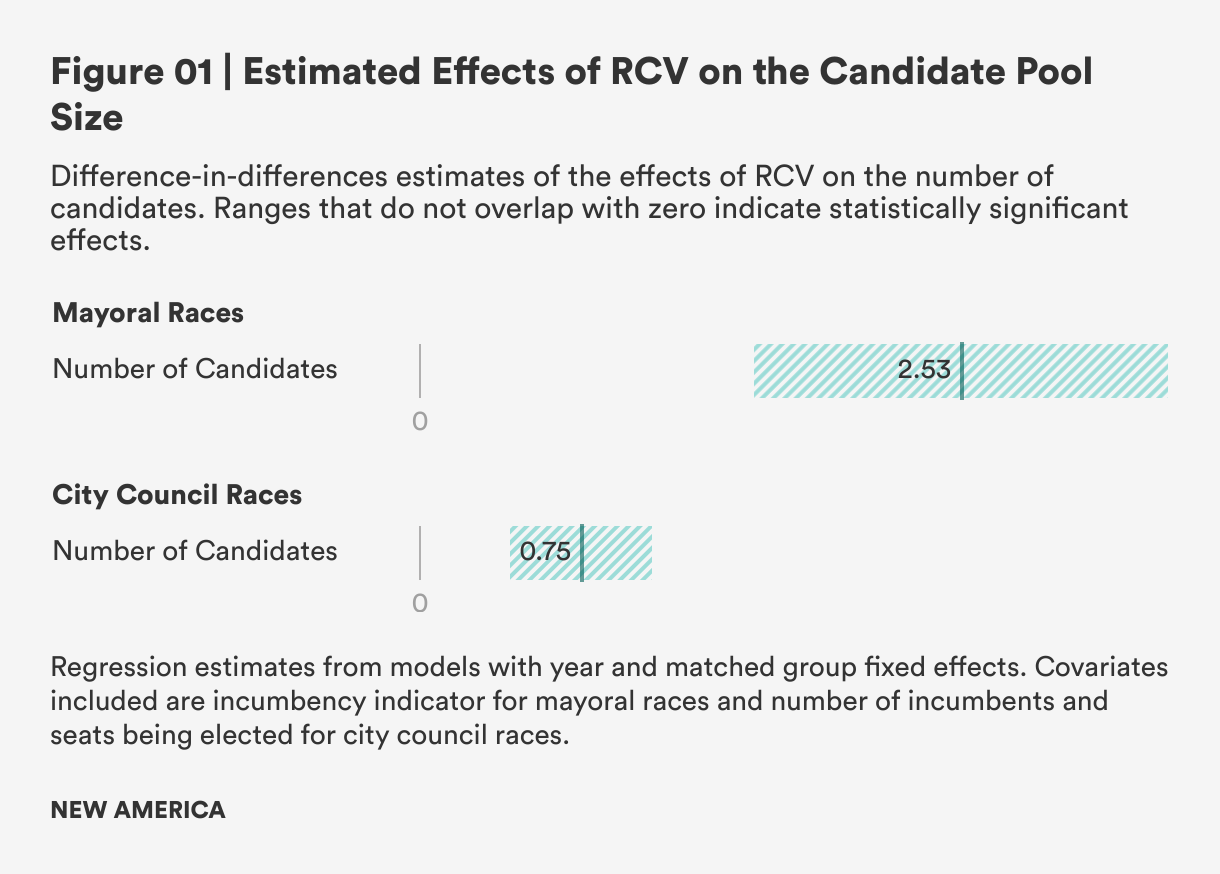
Figure 1 shows that RCV increases the size of the candidate pool in both mayoral and city council elections. For mayoral elections, RCV seems to add on average 2.5 more candidates to the race, while city council elections add 0.75 more. Both results are substantively and statistically significant.
The Quality of the Candidate Pool (Diversity and Viability)
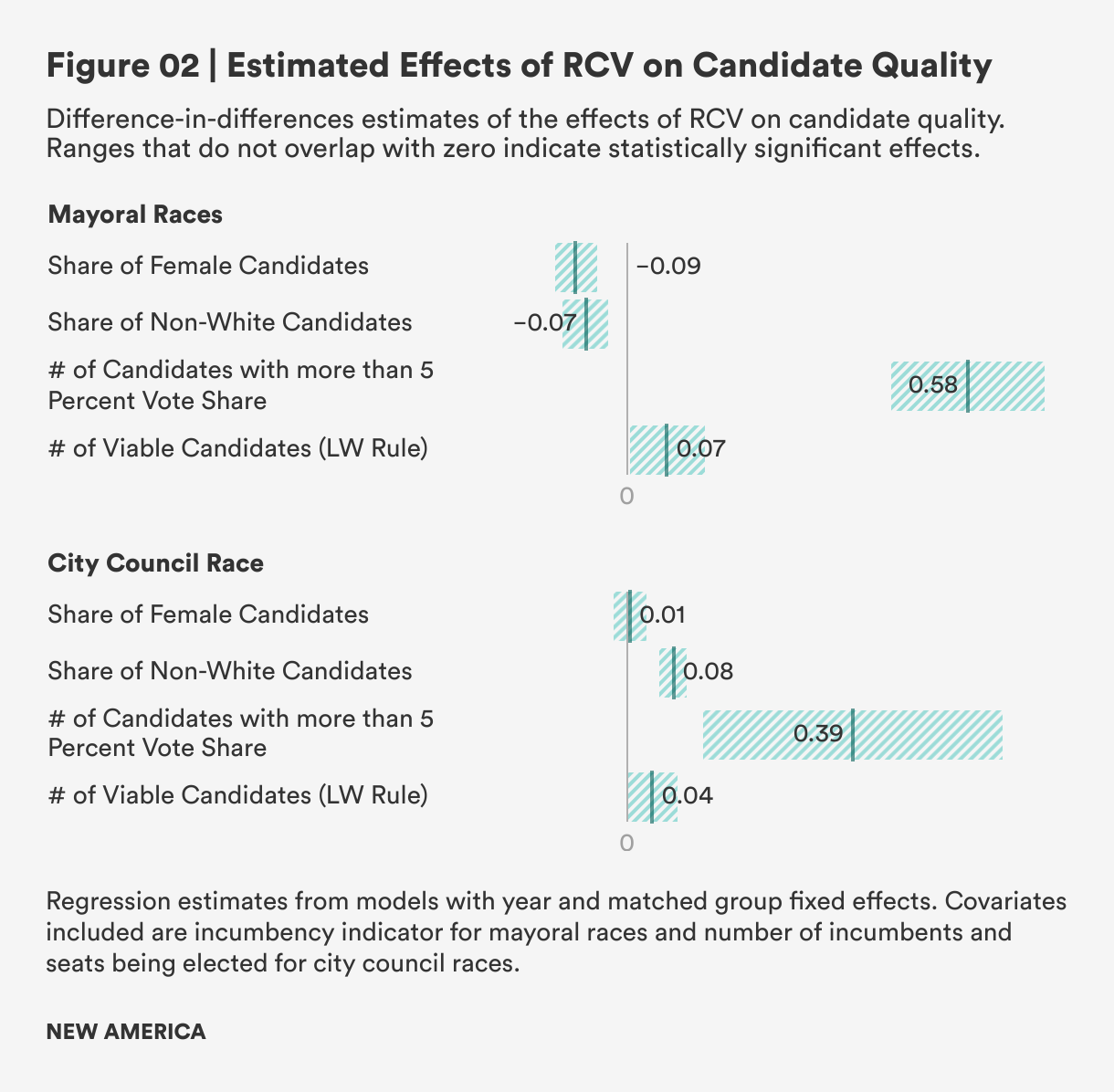
Figure 2 shows there is no consistent effect of RCV on the quality of the candidate pool. Looking first at mayoral elections, the proportion of female candidates slightly decreases in RCV cities following implementation. The same is true for candidates of color in mayoral elections, who see a slightly smaller decrease in proportion post RCV. For city council elections, both the proportion of female candidates and non-white candidates is higher following RCV implementation, though the increase in female candidates is statistically insignificant. Both models indicate that cities choosing to implement RCV already have a more diverse candidate pool. The higher levels of diversity in these cities’ elections before RCV is implemented and the decrease in diversity in mayoral elections post implementation may indicate that a ceiling effect is occurring, and that the diversity of the candidate pool could increase in other, comparable cities.
Finally, Figure 2 shows the results of the models that estimate RCV’s effect on the number of competitive or viable candidates in the election. For the less restrictive measure of viability (the 5 percent rule), RCV increases the number of competitive candidates. However, for the more restrictive measure (LW rule), there does not appear to be a similar increase. This suggests that the candidates choosing to run for office following RCV’s implementation are not completely devoid of support but are also not the main contenders for election.
Long-Term Effect of RCV
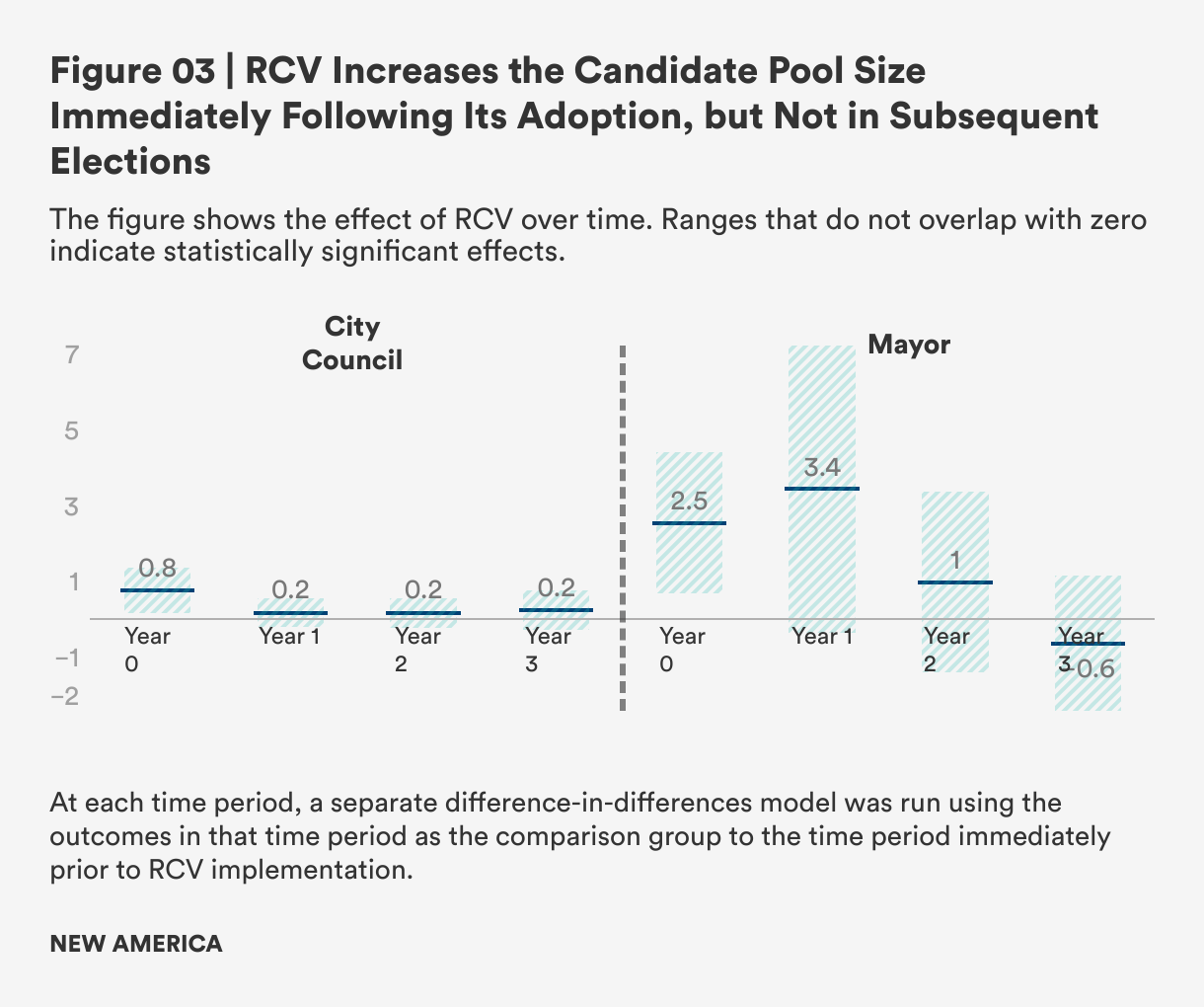
While RCV appears to have a significant effect on the number of candidates running for office in both mayoral and city council elections, it is unclear whether the effect is stable over time. By leveraging election data from the 10 years following RCV implementation, the analysis in Figure 3 shows that the positive effect of RCV implementation on candidate pool size is only significant in the first period post implementation, as each of the following models have an insignificant estimated effect. The temporary nature of the impact of RCV on candidate entry indicates that the effect is not due to RCV itself but instead a combination of novelty and the instability introduced by RCV in the political environment. Candidates may be unclear how RCV will change the political dynamics or be overly optimistic that it will dramatically increase their chances of winning. If RCV implementation acts primarily as a destabilizing factor, then the jump in the candidate pool size would be temporary. The confusion caused by RCV would lead to an initial shake-up in the political environment, before eventually fading into a predictable aspect of each city’s politics.
Conclusion
Contrary to the benefits claimed by RCV advocates, this study finds little evidence that RCV significantly improves the candidate pool in local elections.
The results suggest that implementing RCV leads to a meaningful increase in candidates running for both city council and mayoral elections. This effect, however, is limited to less viable candidates, and it dissipates after the first election cycle. The temporary nature of the effect indicates it is due to the political instability caused by changing voting systems rather than any characteristics specific to RCV.
Furthermore, the results were mixed on RCV’s effect on the diversity of the candidate pool. In mayoral elections, RCV seems to decrease gender and racial/ethnic diversity. In city council elections, RCV has a small but positive effect on racial/ethnic diversity. This may indicate that there is a ceiling effect occurring in mayoral elections, or that there are different dynamics at play for city council and mayoral elections.
Though RCV is increasingly popular across the United States, this study indicates that our understanding of its costs and benefits—particularly in the long-term—is still lacking. Claims related to RCV’s positive effect on the size and composition of the candidate pool are not supported by the results here and indicate that further analysis is needed as more and more cities adopt RCV. As cities that have adopted RCV continue to use it, there will also be more and more data on RCV’s impact over time. Building on the results in this analysis, more work can be done to identify whether RCV encourages more extreme or centrist candidates, as well as whether RCV works in similar ways at different levels of government.
View and download the full report here.
Acknowledgments
This project was funded by New America and the Electoral Reform Research Group (ERRG), supported by Arnold Ventures. I would like to thank Makenna Drye for her help collecting the data for this project as well as Scott MacKenzie, Rachel Bernhard, Ryan Hübert, and Lauren Peritz for their advice and support.
More About the Author
Issues
Programs/Projects/Initiatives

Citations
- Courtney L. Juelich and Joseph A. Coll, “Ranked Choice Voting and Youth Voter Turnout: The Roles of Campaign Civility and Candidate Contact,” Politics and Governance 9 (June 2021): 319–331, https://doi.org/10.17645/pag.v9i2.3914; Todd Donovan, Caroline Tolbert, and Kellen Gracey, “Campaign Civility Under Preferential and Plurality Voting,” Electoral Studies 42 (June 2016): 157‐163, https://doi.org/10.1016/j.electstud.2016.02.009; Martha Kropf, “Using Campaign Communications to Analyze Civility in Ranked Choice Voting Elections,” Politics and Governance 9 (June 2021): 280–292, https://doi.org/10.17645/pag.v9i2.4293.
- Alexandra Copper and Ruth Greenwood, The Civic Benefits of Ranked Choice Voting (Washington, DC: Campaign Legal Center, 2018), https://campaignlegal.org/sites/default/files/2018-08/CLC%20Issue%20Brief%20RCV%20PDF.pdf; Jack Santucci and Jamil Scott, “Do Ranked Ballots Stimulate Candidate Entry?,” November 4, 2021, available at SSRN: https://ssrn.com/abstract=3956554.
- Todd Donovan, Caroline Tolbert, and Kellen Gracey, “Campaign Civility Under Preferential and Plurality Voting,” Electoral Studies 42 (June 2016): 157‐163, https://doi.org/10.1016/j.electstud.2016.02.009; Martha Kropf, “Using Campaign Communications to Analyze Civility in Ranked Choice Voting Elections,” Politics and Governance 9 (June 2021): 280–292, https://doi.org/10.17645/pag.v9i2.4293.
- Richard Fox, and Jennifer Lawless “Entering the Arena? Gender and the Decision to Run for Office” American Journal of Political Science 48, no. 2 (2004): 264-280, https://doi.org/10.2307/1519882; Mona Lena Krook, “Beyond Supply and Demand: A feminist-Institutionalist Theory of Candidate Selection” Political Research Quarterly 63, no. 4 (2010): 707-720, https://doi.org/10.1177/1065912909336275
- Claire McGing, “The single transferable vote and women's representation in Ireland,” Irish Political Studies 28, no. 3 (2013): 322–340, https://doi.org/10.1080/07907184.2013.818536; Alistair Clark, “Second Time Lucky? The Continuing Adaptation of Voters and Parties to the Single Transferable Vote in Scotland,” Representation 49, no. 1 (2013): 55–68, https://doi.org/10.1080/00344893.2012.742456; Harold J. Jansen, “The Political Consequences of the Alternative Vote: Lessons from Western Canada,” Canadian Journal of Political Science/Revue Canadienne de Science Politique 37, no. 3 (2004): 647–69, https://doi.org/10.1017/S0008423904030227..
- Terrell, Cynthia Richie Terrell, Courtney Lamendola, and Maura Reilly, “Election Reform and Women’s Representation: Ranked Choice Voting in the U.S,” Politics and Governance 9 (June 2021): 332–43, https://doi.org/10.17645/pag.v9i2.3924; Sarah John, Haley Smith, and Elizabeth Zack, “The Alternative Vote: Do Changes in Single-Member Voting Systems Affect Descriptive Representation of Women and Minorities?,” Electoral Studies 54 (August 2019): 90–102, https://doi.org/10.1016/j.electstud.2018.05.009.
- US Census and the ICMA Municipal Form of Government Survey
- The Gender R package was used identify gender and the Rethnicity R package was used to identify race. Cameron Blevins and Lincoln Mullen, “Jane, John … Leslie? A Historical Method for Algorithmic Gender Prediction,” Digital Humanities Quarterly 009 (3); Xie, Fangzhou Xie, “Rethnicity: An R Package for Predicting Ethnicity from Names,” SoftwareX 17 (January 2022): 100965, https://doi.org/10.1016/j.softx.2021.100965.
- Richard G. Niemi and John Fuh-sheng Hsieh, “Counting Candidates: An Alternative to the Effective N: With an Application to the M + 1 Rule in Japan,” Party Politics 8 (1): 75–99, https://doi.org/10.1177/1354068802008001004.
- Jonathan Colner, “Running Towards Rankings: Ranked Choice Voting’s Impact on Candidate Entry and Descriptive Representation,” January 3, 2023, available at SSRN: https://papers.ssrn.com/sol3/papers.cfm?abstract_id=4317298.