
Candace Rondeaux
Senior Fellow, Future Security
Drawing on five years of intensive research, this report is part of a series investigating the Wagner Group, Russia's shadowy paramilitary cartel, to shed light on its deception operations and map its expansive reach.
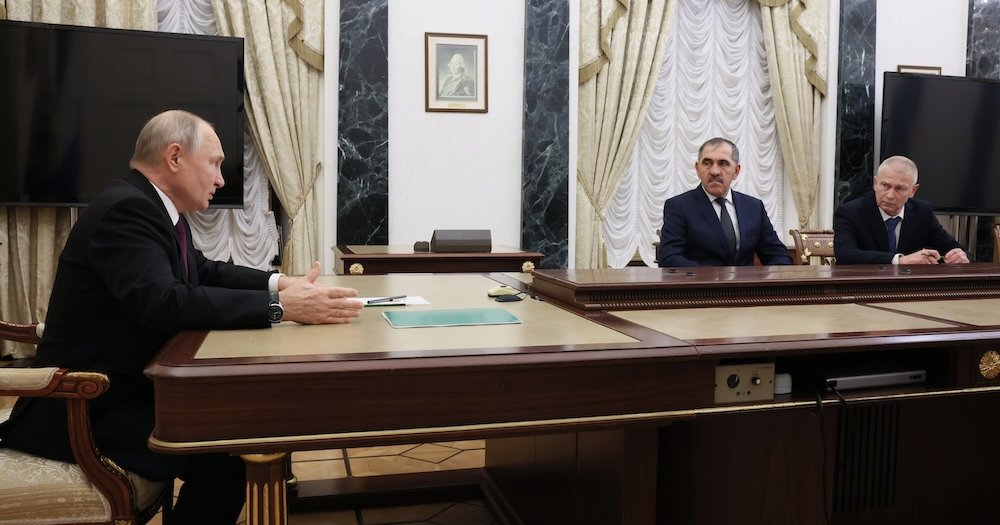
In January 2023, Yevgeny Prigozhin, the self-avowed billionaire founder of the Russian paramilitary Wagner Group, claimed that his fighters had seized the eastern Ukrainian town of Soledar after weeks of brutal fighting. Along with his announcement, Prigozhin released photos of himself in full battle dress and surrounded by Wagner fighters, casting himself as a frontline commander. It was a stunning moment. One of Russia’s most visible and vocal critics of Russian military operations in Ukraine was shouting from the virtual rooftop that he had done what no Russian general yet had: seized the strategic initiative from Ukrainian forces. Even more remarkable, Prigozhin, a close associate of Russia’s President Vladimir Putin, claimed to have achieved that dubious victory by forward deploying a ragtag group of prison convicts as cannon fodder.
Online on VKontakte, Russia’s Facebook-like social media platform, pro-Wagner groups crackled with excitement. “The hero of this victory is the Wagner PMC and Yevgeny Prigozhin personally,” an administrator posted on PMC Wagner-Military Review, one of the oldest and largest VKontakte groups dedicated to the Wagner Group. “[O]nly Wagnerovtsy can achieve such success,” wrote another, among hundreds of similar comments. The online hero worship marked yet another public relations coup for Prigozhin, a convicted criminal who has managed to transform himself into one of Russia’s most recognizable war profiteers. It was a moment that has become emblematic of the way Prigozhin and the Wagner Group have successfully rebranded the Russian way of war.
In a few short years, Wagner Group-themed social media channels have grown from small, tight-knit user communities with minimal engagement into one of the most important sources of news and updates about Russia’s irregular contract forces—and a juggernaut for Russian military recruitment and force mobilization. The administrators who run them, many of them anonymous, command audiences in the hundreds of thousands. The echoes of their posts reach millions. New groups have proliferated on VKontakte and Telegram, some of them opportunistic fan pages, but others part of a centralized recruiting and propaganda structure. Putin’s invasion has elevated Wagner Group social media into essential components of Russia’s military mobilization and information war against Ukraine and the West.
In February 2019, our team at New America and Arizona State University began tracking the PMC Wagner-Military Review (ЧВК Вагнера – военное обозрение) group on VKontakte after conducting a deep dive into the evolution of Russia’s use of irregular contract forces. Drawing on a team of researchers, data scientists, and open source investigators, we have analyzed over 841 gigabytes of social media data containing 5.3 million network nodes, representing nearly one percent of VKontakte’s 656 million registered users.
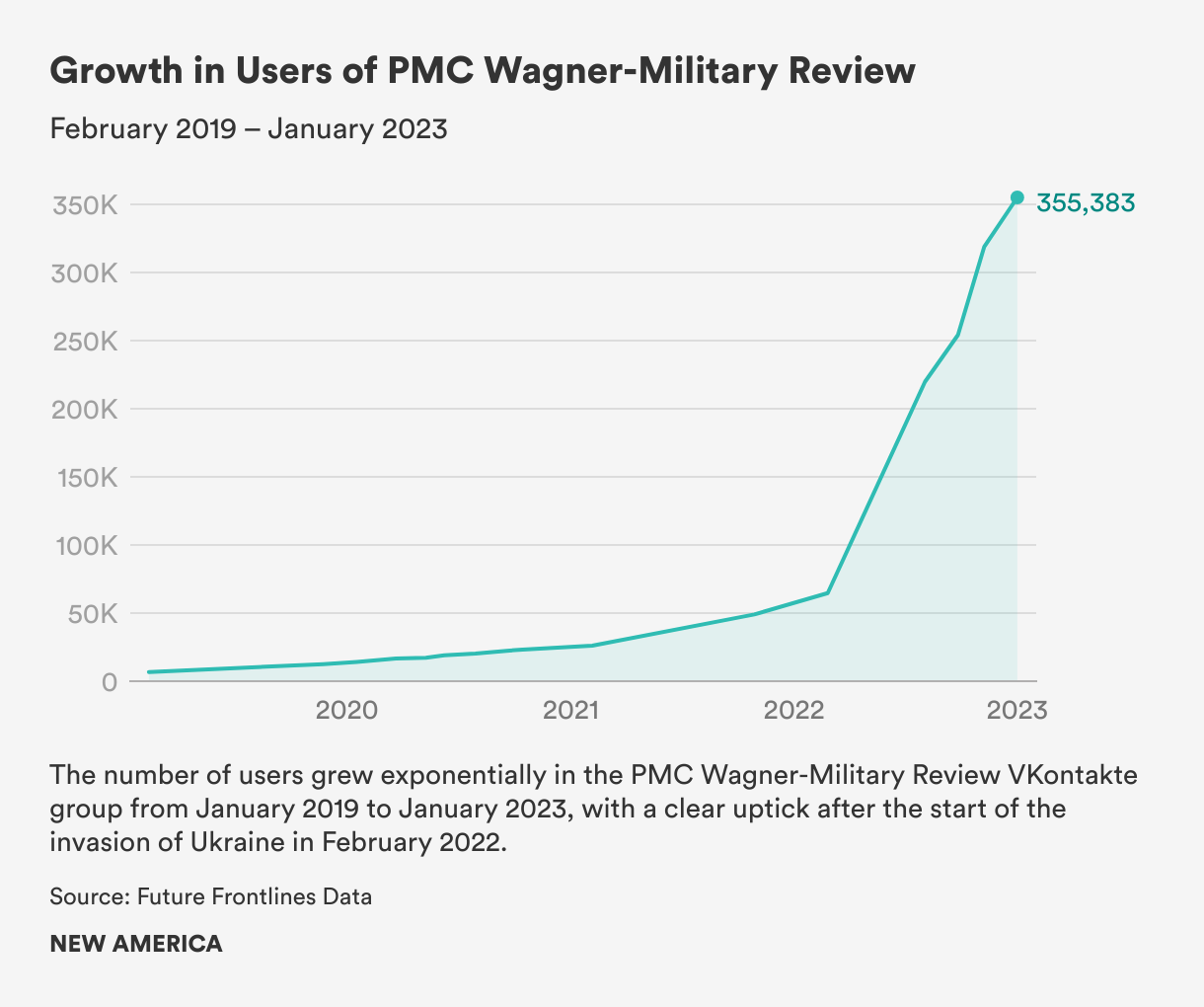
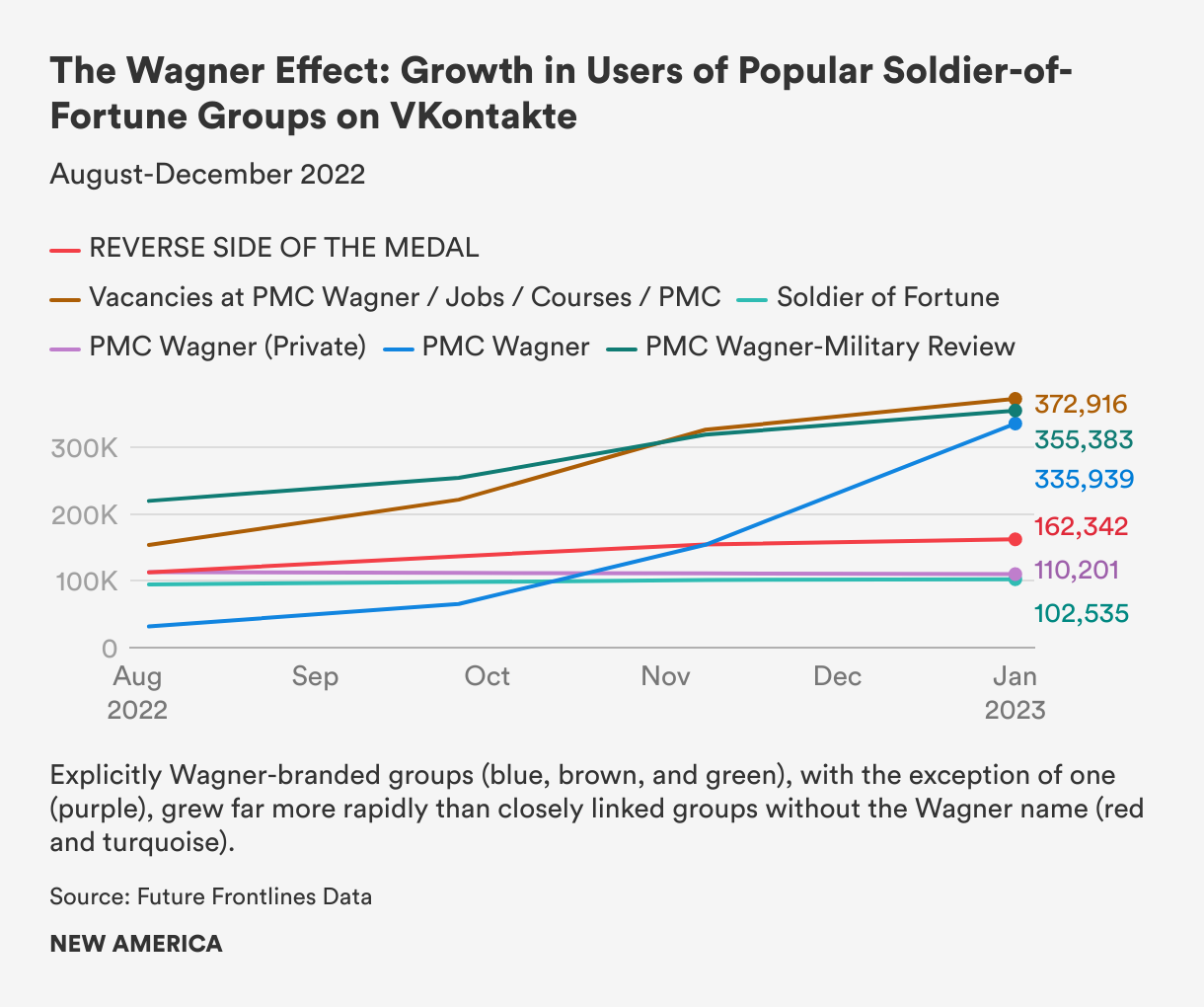
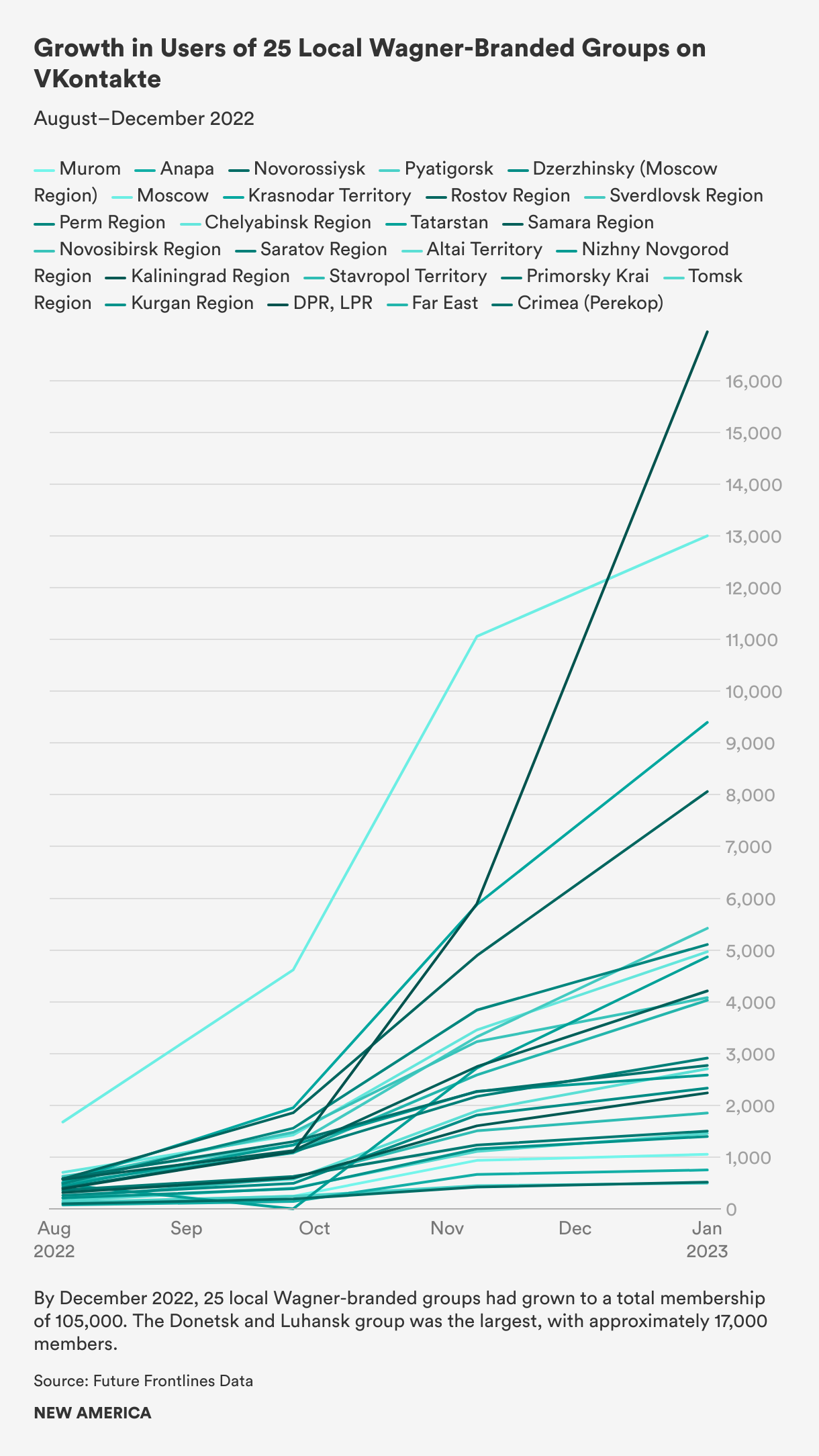
Since we began monitoring the group, its online membership has grown from a modest starting membership of 6,745 to almost 65,000 members at the beginning of Russia’s full-scale invasion in February 2022, and then to more than 355,000 by the end of 2022, an increase of over 5,100 percent altogether. That single channel spawned 25 localized groups in places like Moscow and Crimea, together attracting about 105,000 members as of December 2022. Combined, the 29 Wagner-branded VKontakte groups that we monitor counted a membership base of almost 1.3 million by the end of 2022.
Not all of these users are active Wagner fighters, but the sheer scale and reach of these groups illustrates the success of Prigozhin’s effort to consolidate and promote the Wagner Group as a brand. What started out as an opportunistic experiment has spawned a fanbase that is millions strong: it has its own recognizable memes, symbols, and lingo, and today it constitutes one of the most virulent ultranationalist social movements in Russia. Since Russia annexed Crimea in 2014, the Kremlin and its allies in Russia’s oligarchy have flooded state-controlled media with jingoist messaging, priming the pump of the Wagner Group’s own media juggernaut, while Kremlin-linked ultranationalist influencers have helped create Wagner’s online mythos in mutually self-referential blog posts and videos. Wagner Group-branded social media returned the favor by becoming one of Russia’s most potent sources of force mobilization: one estimate by the United Kingdom Ministry of Defense placed the total number of Wagner mercenaries now fighting in Ukraine at 50,000.
What started out as an opportunistic experiment has spawned a fanbase that is millions strong: it has its own recognizable memes, symbols, and lingo, and today it constitutes one of the most virulent ultranationalist social movements in Russia.
The PMC Wagner-Military Review group is a key part of how the Wagner brand grew from a rumor, one that Kremlin officials and Prigozhin himself frequently denied existed, to the media colossus it is today. Since its creation at the beginning of 2018, the group has established itself as a premier hub for contract fighters and those connected to them to gossip, trade information, and celebrate the soldier-of-fortune lifestyle. It has inspired dozens of copycats on VKontakte and Telegram, including Reverse Side of the Medal, a collection of popular social media pages that regularly publish original Wagner-related content. Over the course of five years, the group’s evolution has mirrored not just the history of the Wagner Group, but the formulation—and mythologization—of the brand itself.
The first post on the PMC Wagner-Military Review VKontakte group appeared on January 15, 2018, a tribute video titled “to our heroes—PMC Wagner—who protect the world from terrorists in Syria.” Since deleted, but available elsewhere online, the video was typical of Wagner Group propaganda at the time, featuring a montage of soldiers-of-fortune fighting in Syria and set to Russian rock. The war in Syria dominated the group’s early content, which coincided with the deployment of several thousand Wagner fighters to Syria to protect Russian oil, gas, and mineral extraction infrastructure. In the years to come, the group’s content would reflect Wagner deployments around the world, such as in Libya in 2020 or Mali in 2021.
Member engagement during the group’s early days was minimal, with most posts receiving fewer than 10 likes, but growth came quickly. For example, a post from February 11, 2018, less than one month into the group’s existence, attracted 183 comments. It appeared a few days after the Battle of Khasham, during which U.S. forces engaged Wagner fighters in Syria, and commenters debated whether rumors of large-scale Russian casualties were accurate. Many commenters claimed to have direct ties to combatants. “I have an acquaintance with the PMC [private military company] in Syria,” wrote one user. “Second tour. 5th assault detachment. There is no news about deaths.” A user named Ivan Mezentsev posted two audio recordings of unidentified male speakers describing the rout of Wagner forces. “The 5th were all wiped out,” said one. “The guys didn’t stand a chance.”
By November 2019, the page was demonstrating its apparent inside track on the mercenary outfit. That month, a video went viral on Russian social media platforms depicting several Russian-speaking men torturing, killing, and dismembering a Syrian national later identified as Muhammad Taha al-Abdullah, known to friends as Hamdi Bouta. On November 21, 2019, PMC Wagner-Military Review posted a note from an anonymous subscriber responding to media reports and purporting to give a participant’s account of the incident:
We picked up this f*ck in late February or early March with his bare ass hanging out in the desert when we were sweeping the territory that had just been retaken from the enemy. During the interrogation, he said that his unit had retreated from his position when the enemy began to attack and he fought back.
The post claimed that Bouta escaped captivity, only to be recaptured by Russian and pro-regime Syrian forces toward the end of April 2017. According to the author, Bouta’s gruesome death was retribution for supplying the enemy with battlefield intelligence. The post received 1,833 comments, 2,687 likes, and 340,000 views, and it was shared widely within VKontakte using the platform’s forward feature. Among the users to forward the post was Dmitry “Crow” Bobrov, whose close ties to Wagner networks we detailed in our June 2020 report Inquiry into the Murder of Hamdi Bouta.
Contrary to the Wagner Group’s reputation for strategic ambiguity and disinformation, users of PMC Wagner-Military Review were remarkably free with their personal information during the group’s early years. The group itself kept its membership public, allowing anyone who accessed VKontakte to view user profiles. Many users with apparent ties to soldier-of-fortune units not only made their profiles public but posted photos and videos, often with digital data such as geocoordinates, that enabled reporters and researchers to pinpoint mercenary operations in Ukraine and Syria.
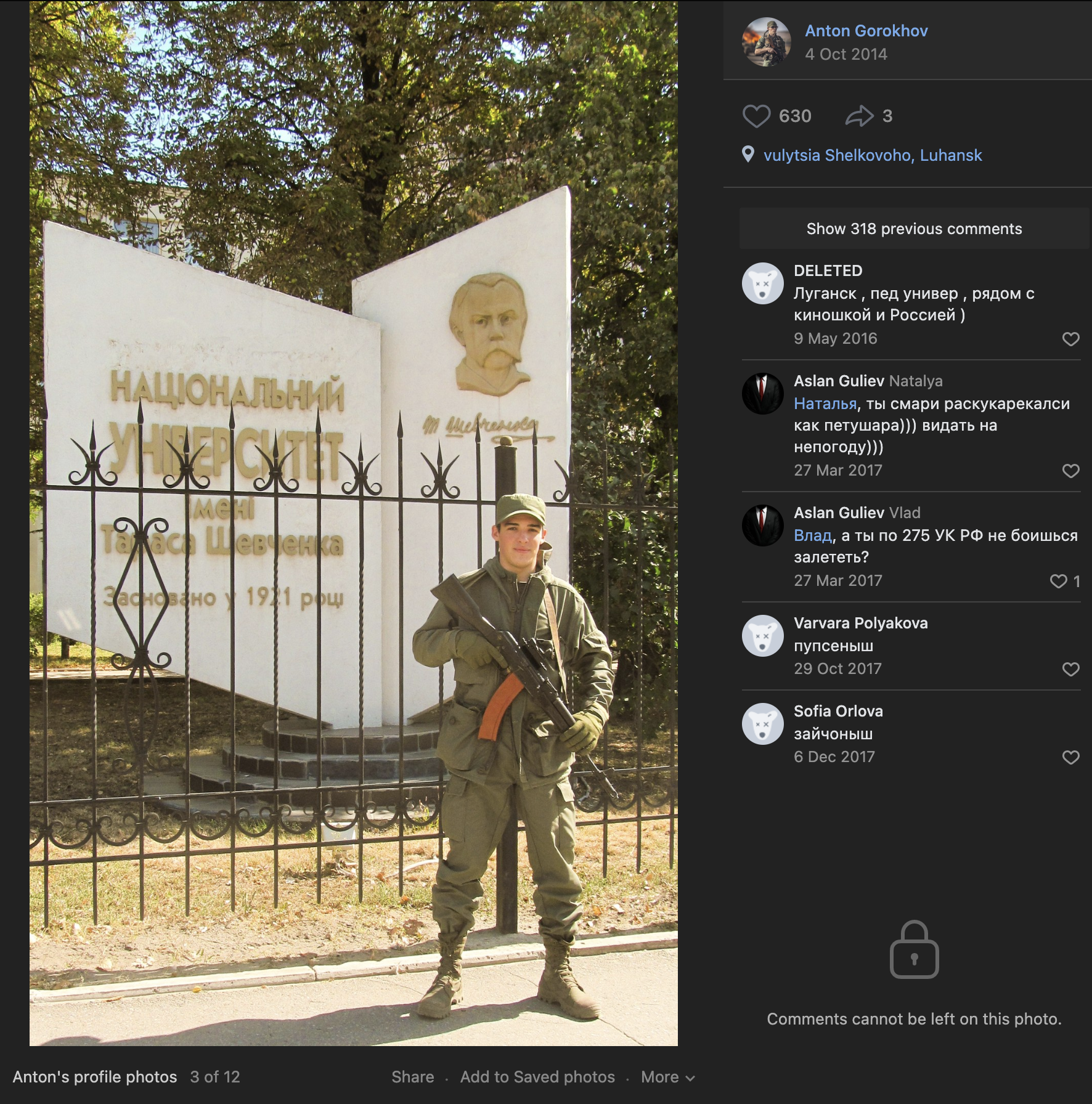
For example, a group member named Anton Gorokhov, a native of Saratov, Russia, according to his VKontakte profile, posted geotagged photos of himself holding a gun and dressed in military fatigues in Ukraine’s Luhansk region during the fall of 2014, at a time when the Kremlin categorically denied the presence of Russian personnel in Ukraine. Gorokhov’s uniform lacks any insignia, a telltale sign of his likely membership in a contract-based paramilitary unit. Open source investigators at Bellingcat and the Conflict Intelligence Team were quick to exploit this selfie soldier phenomenon to gather evidence of Russian soldiers in Ukraine, leading Russia to pass an anti-selfie law in 2019.
Even before Russia’s 2022 invasion of Ukraine sparked explosive growth of Wagner Group-branded social media, VKontakte groups like PMC Wagner-Military Review posed a verification problem. Group members represented a data gold mine, which researchers could tap for insights into the structure, operations, and social ties of Wagner fighters. By analyzing individual profiles, researchers could cut through the aura of mystery and menace that Wagner commanders seek to project. By tracking geocoded tags on posts, they could get a sense of deployments before they were visible in the field. By looking at overlaps with affiliated networks such as far-right activists and Airsoft leagues (Airsoft is a team-based shooting sport), they could learn how communities sustained themselves off the battlefield and understand the ideology driving recruits. However, Wagner-branded social media quickly morphed into a mass phenomenon, attracting thousands of followers with a casual or dilettante interest in Russia’s soldier-of-fortune communities but no battlefield experience or institutional connection to units. As the groups grew, it became increasingly time-consuming to separate Wagner fans from combatants and commanders.
Network analysis techniques help drill down into the core of a social media group, greatly speeding the process of identifying key figures in the Wagner network, for example by triangulating membership among related social media groups. To that end, in 2019, our team at New America and Arizona State University began the large-scale collection of data from the most prominent VKontakte groups dedicated to three organizations with known overlapping membership structures: the Wagner Group, the Russian Imperial Movement (RIM), and DShRG Rusich (DShRG, a transliteration of ДШРГ, stands for Sabotage Assault Reconnaissance Group).
Rusich is one of the most notorious militias that formed in 2014 to fight on behalf of Ukraine’s breakaway regions, subsequently deploying to Syria in 2017 and returning to Ukraine in 2022. The Russian Imperial Movement is an ultranationalist, Orthodox movement dedicated to the restoration of the Russian empire and tsar. RIM’s armed wing, the Russian Imperial Legion, has fought in Ukraine since 2014, and the group maintains training facilities near St. Petersburg. In 2020, the United States designated RIM a foreign terrorist organization.
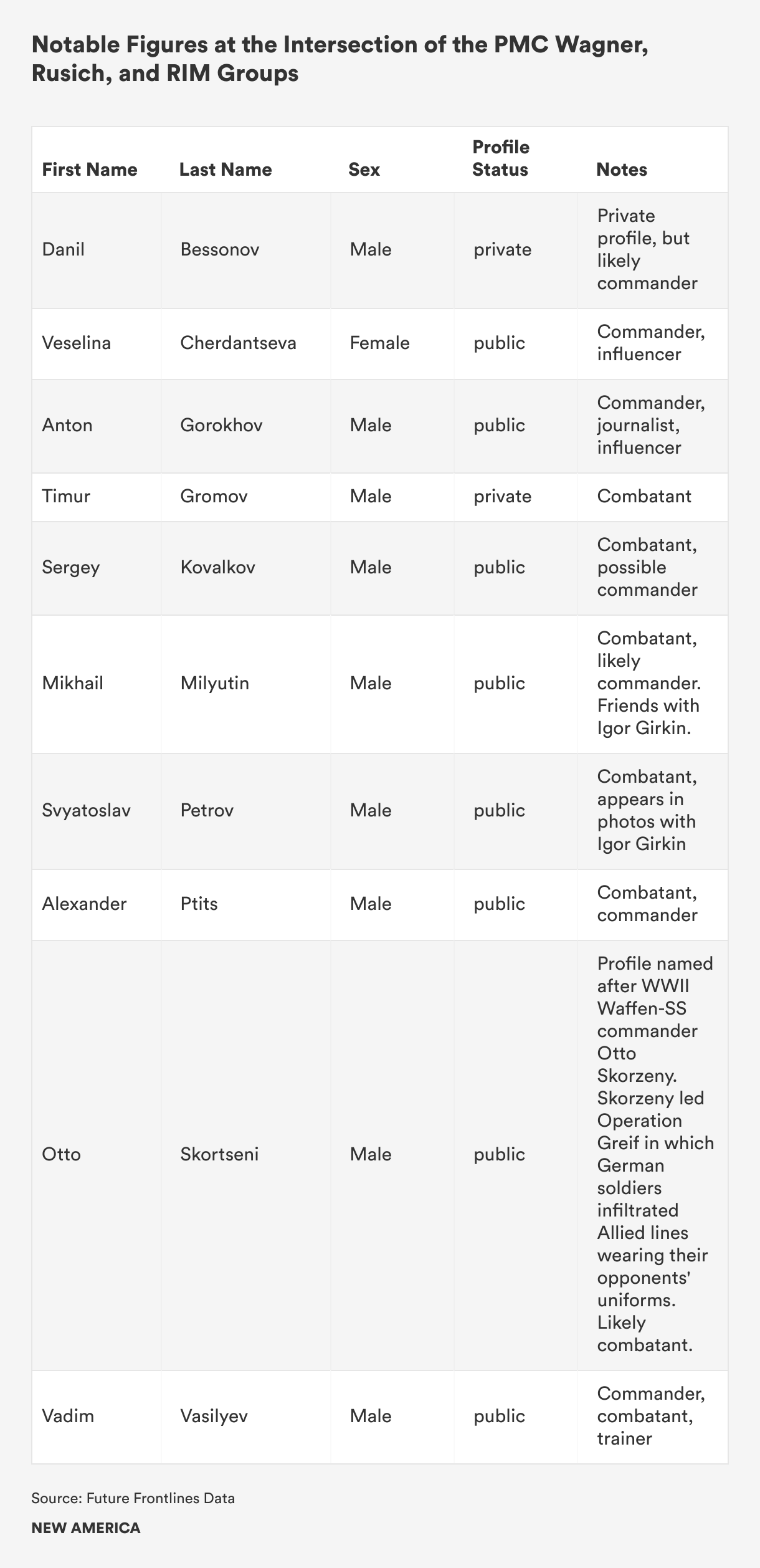
Collecting data from VKontakte groups dedicated to Wagner, Rusich, and RIM yielded a much smaller subset of 31 users who were members of all three, many of whom appear to be current or former Russian commanders with experience fighting in Ukraine. Identifying these users on VKontakte is a starting point and presents an opportunity to dig deeper into individuals and their backgrounds—their military service, education, small businesses, friends, deployments—as well as into the culture and ideology of the larger social movement in which they participate. A closer look at some of these individuals offers a taste of the prevailing culture in the PMC Wagner-Military Review group during 2018–2021 and demonstrates the effectiveness of network analysis in identifying figures of interest.
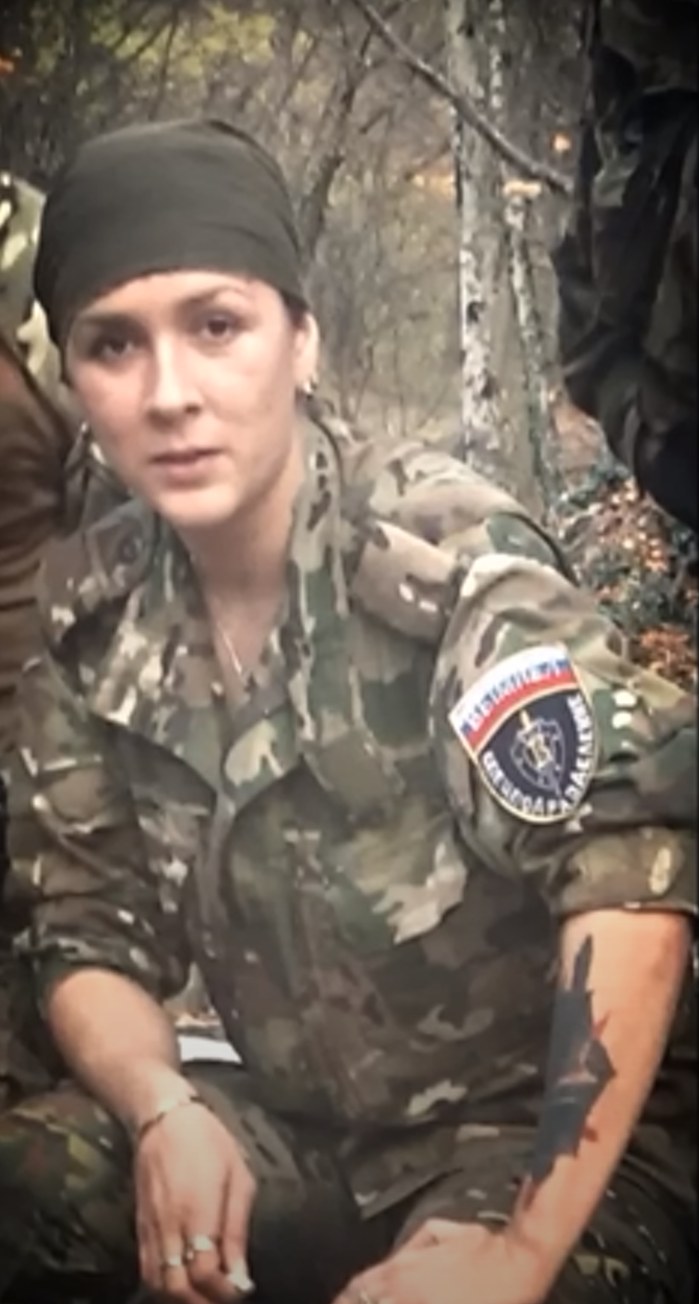
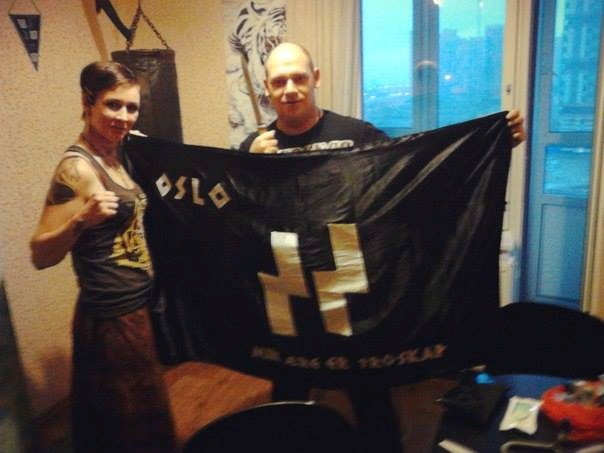
According to interviews, Veselina Cherdantseva, whose real name is Ksenia Shikalova, took command in 2014 of one of the many volunteer contingents fighting on behalf of the breakaway Donetsk and Luhansk regions, naming her group Vympel after the elite special forces counterterrorism unit controlled by Russia’s Federal Security Service (FSB). She became a minor celebrity of the Donbas war, profiled in multiple news segments and a web documentary on Russia’s RT network. Her notoriety led reporters and bloggers to dig into her personal life, unearthing photos of her posing with ultranationalist and neo-pagan iconography, including a neo-Nazi flag with the motto of Norway’s WWII-era Schutzstaffel or SS, the Nazi paramilitary organization.
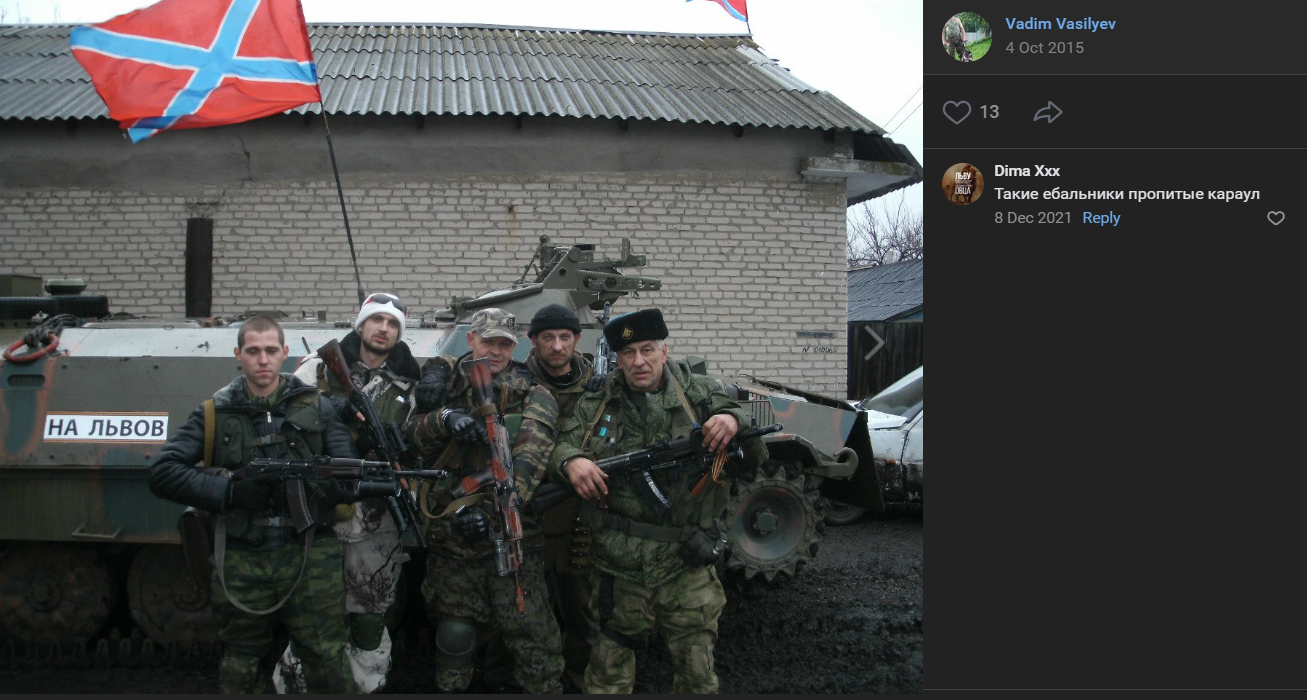
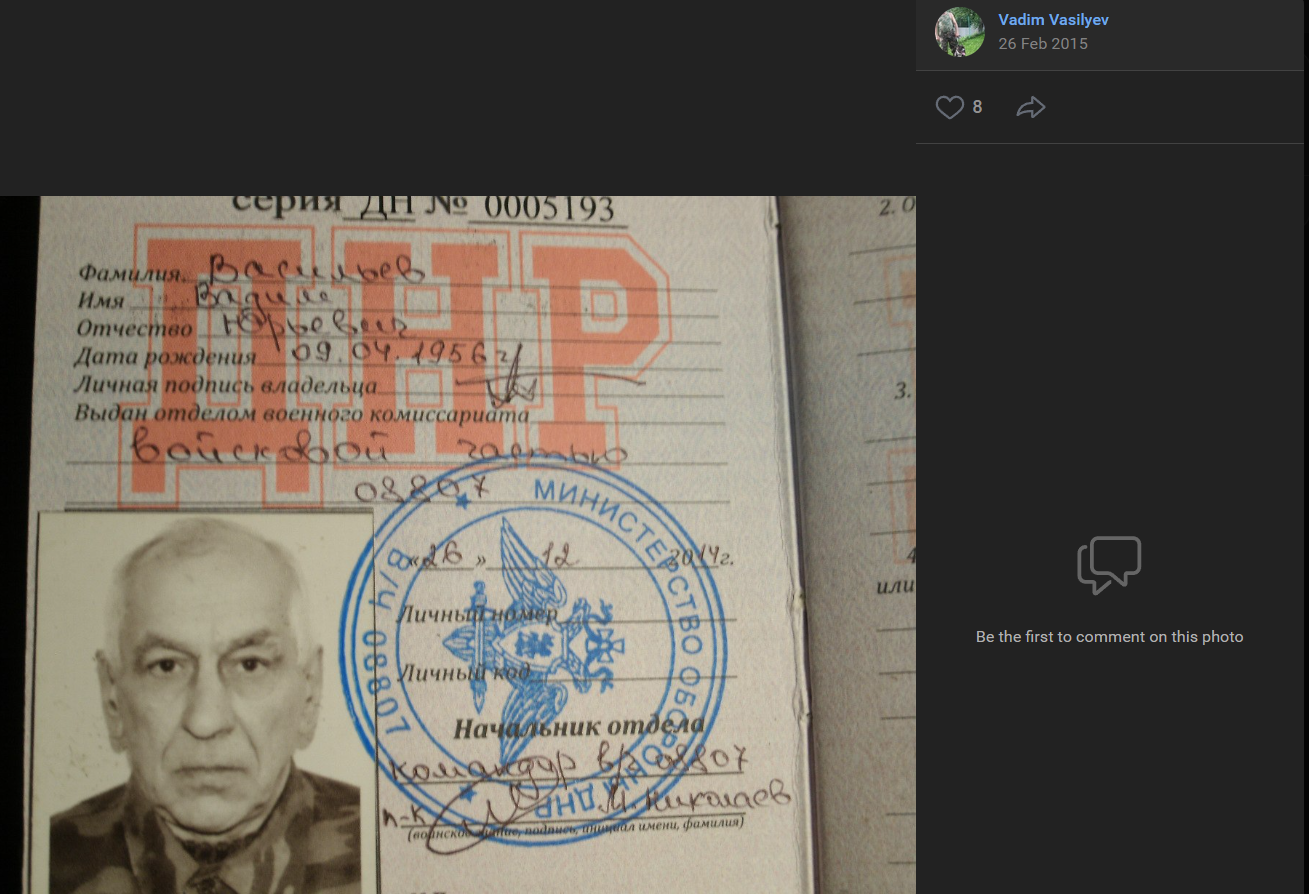
Vadim Vasilyev is a commander in the Russian Imperial Movement’s armed wing, the Imperial Legion. His extensive photo archive on VKontakte suggests that he fought in Ukraine beginning in August 2014, when the first photos appeared of him posing with armed and camouflaged fighters and wearing an Imperial Legion patch. In his VKontakte uploads, Vasilyev appears with a wide array of weaponry and material, including a WWII-era anti-tank rifle and a tank spray-painted with the label Legion. In two photos, he poses with the wreckage of Malaysia Flight 17, which a Dutch court ruled in November 2022 was shot down by Russia-controlled separatist forces. Vasilyev appears to take a command or training role in many photos. His call sign staryy means old; he was born in 1956 and lives in St. Petersburg, according to his VKontakte profile. An April 2016 post on the Imperial Legion’s VKontakte page called him one of their “most respected and proven… commanders.”
According to his VKontakte profile, Alexander Ptits is a veteran of the 36th Separate Airborne Brigade. The military unit, disbanded since 1997, was garrisoned in the town of Garbolovo, close to St. Petersburg. The Russian military has undergone several waves of restructuring and decommissioning of units, with a significant percentage of disbanded units concentrated among the country’s airborne assault forces, or VDV, which may account for the high representation of VDV veterans in Russian contract units and private military companies.
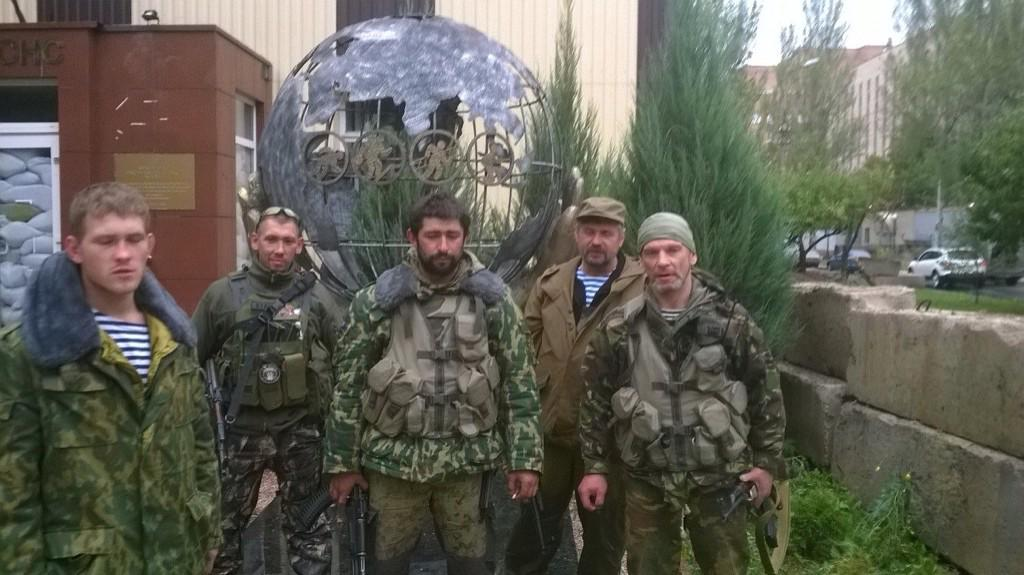
Photos from Ptits’s VKontakte page indicate that he fought in Ukraine in 2014 and again in 2022. Along with posts about special forces, mercenary culture, and the sport Airsoft, Ptits has posted photos of himself with an array of weaponry over the years, including tanks in September 2014 and, in 2022, rifles and rocket launchers. In February 2015, Twitter user Surovyi Chelovek posted a photo of Ptits armed and standing in front of a Donetsk memorial, claiming that the photo dated to spring 2014. The photo does not appear elsewhere on the Internet, per Google and Yandex searches, but may originate from Lost Ivan, a now-defunct website that tracked Russian fighters in Ukraine. By September 2014, Ptits had a profile on Lost Ivan that described him as a mercenary, which was partially preserved in the Internet Archive. If the spring 2014 description is accurate, Ptits would have been among the earliest Russian fighters to deploy to Ukraine’s Donbas region. Notably, two other men in the photo are wearing the striped blue-and-white telnyashka shirts associated with Russian Airborne Units and the Russian Navy.
These three fighters and commanders illustrate several characteristics of the Wagner Group’s social base. Members tend to be politically ultraconservative and preoccupied with neo-pagan Slavic symbology. Many claim adherence to Rodnovery, a neo-pagan movement that draws inspiration from the religious practices of pre-Christian Slavs and often overlaps with Slavic ethnonationalism. Members also often share veteran status, particularly in airborne or spetsnaz (special forces) units, preoccupation with special forces and soldier-of-fortune culture, and involvement with martial sports and sports associations like Airsoft and judo. These are the pre-existing networks atop which the Wagner Group’s social media presence—and thus its recruitment base and potent capacity for force mobilization—was built.
Wagner refers not only to the Wagner Group as a unitary organization, albeit one that is supported by a cartel-like structure. Wagner might most accurately refer to these networks, in which fighters share affiliations and interests and circulate on and off contracts with a constellation of services, companies, and units. These networks constitute the Wagner Group’s core, which remains in place even as Russia’s full-scale invasion of Ukraine in February 2022 transformed both Wagner’s operations and the pro-Wagner social media landscape. Understanding them and how they intersect with Wagner Group leadership is key to grasping the organization’s capacity to mobilize forces and fight effectively on the battlefield.
Russia’s full-scale invasion of Ukraine in February 2022 transformed Wagner Group social media, sparking explosive growth and a centralized effort to create local groups with the explicit goal of recruiting fresh fighters. The first of these trends, rapid user growth, was most evident in the original PMC Wagner-Military Review VKontakte group. From 2019 through 2021, the group grew steadily by about 1,600 users per month. After February 2022, when Putin announced his “special military operation,” the invasion of Ukraine and associated explosion of interest in the Wagner Group boosted the rate of new users to about 29,000 per month, taking it from 64,000 members in February in 2022 to over 355,000 by the end of the year.
The Wagner Group brand appears to be one key to rapid user growth. A comparison of several popular soldier-of-fortune community groups on VKontakte between August and December 2022 shows that those with Wagner in their name (the blue, brown, and green lines in the figure below) grew faster than similar groups such as Reverse Side of the Medal and Soldiers of Fortune (red and turquoise lines), both of which are established pages with comparable content and user bases to PMC Wagner-Military Review. The one exception was a group called simply PMC Wagner (purple line), which lost a small number of users, likely because the group operates privately, so group administrators must approve requests to join it.
The invasion of Ukraine not only acted as a growth accelerant for established Wagner-related groups, it also set off a proliferation of new groups, many of them part of a centralized effort to standardize and localize Wagner recruiting online. In June 2022, dozens of localized Wagner groups began cropping up on VKontakte. In August, we identified 25 new groups with listings for 5 cities, 3 regions, and 17 federal subjects of the Russian Federation. (A federal subject is a top-level political division within the Russian Federation such as an oblast, krai, or republic.) Dedicated groups sprang up in Moscow, Ukraine’s Donetsk and Luhansk breakaway regions, various federal entities within Russia, the Kaliningrad exclave, and the “far east,” or the vast territory east of Siberia that abuts the Pacific Ocean. Each group featured the same header image of five camo-clad fighters carrying orchestral instruments, a reference to a meme in Wagner circles in which the mercenary outfit is described as an orchestra—itself a reference to the composer Richard Wagner, one of the Wagner Group’s namesakes. The inaugural posts on each site were identical: “The Wagner philharmonic is recruiting… for tours in the near abroad! Our Russian music is very popular, but we want to add tunes from different cities.”
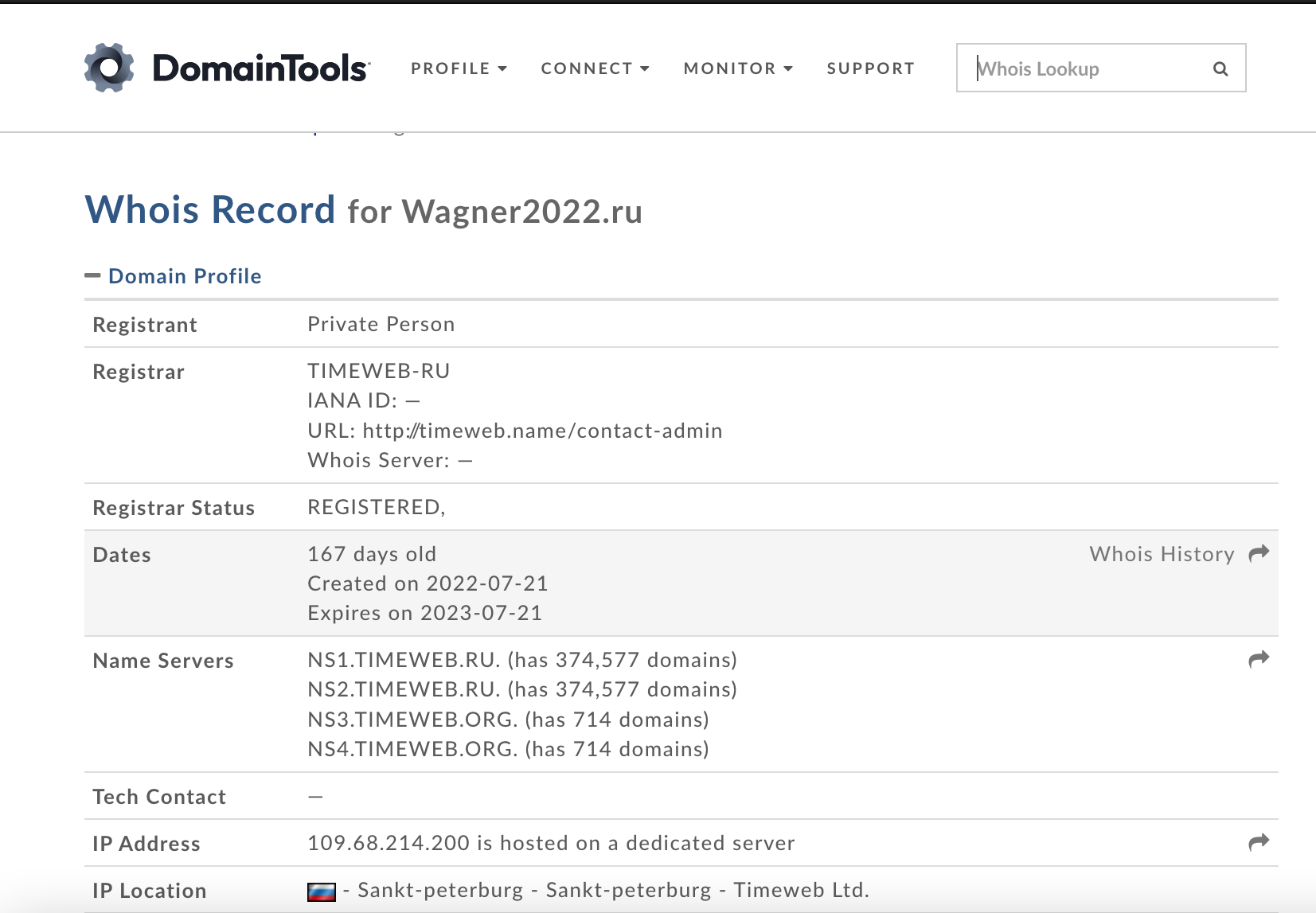
Groups advertised phone numbers for potential recruits as well as a website, wagner2022.ru, created on July 21, 2022 and hosted on a dedicated server in St. Petersburg, Russia. The timing of the website’s creation coincides with an apparent push by the Wagner Group’s self-avowed founder Yevgeny Prigozhin to recall contract soldiers in his employ from assignments in Libya and Syria and deploy them to the Ukrainian front. It also came two months before Putin announced a partial mobilization of conscripted soldiers, suggesting a degree of coordination between Prigozhin and the Kremlin not previously seen.
We noticed another marked shift in the move to promote the Wagner Group brand just as Russia was reportedly experiencing some of its worst battlefield losses in the northeastern town of Kharkiv and the southeastern province of Kherson in September 2022. In September, PMC Wagner-Military Review posted a long list of local groups with their respective VKontakte links and phone numbers. As of January 2023, the post remains pinned at the top of the group’s page, giving pride of place to regional recruiting efforts. The endorsement from the mother ship helped fuel steady growth among all local groups between August and December 2022. As of January 2023, the three largest local groups were Ukraine’s Donetsk and Luhansk regions with about 17,000 members, Moscow with 13,000, and Krasnodar Krai, a Russian territory adjacent to Crimea, with 9,400.
From the outset of the February 2022 invasion, Russia faced an acute manpower shortage in Ukraine, a problem Putin tried to address six months into the invasion with the announcement of partial mobilization of conscripts and reservists in September. Signs that Prigozhin was upping his public relations game arrived in July as the internet pulsed with rumors of prison recruitment efforts. Soon it became clear that Prigozhin himself was traveling to Russian penal colonies to deliver inmates a brutal offer: six months on the frontlines in Ukraine with a high likelihood of death in exchange for freedom. With this effort, Wagner fighters began to close Russia’s manpower gap, drastically increasing the outfit’s profile but also suffering heavy casualties, with 90 percent of them convicts, according to U.S. government estimates. This in turn has made Wagner units hungry for fresh recruits. A sprawling network of ever-growing VKontakte groups is one part of this recruiting infrastructure. Wagner’s use of convicts as cannon fodder has drawn criticism from human rights groups, but Wagner’s online audience remains enthusiastic and virulently pro-war, and recruits from this fan base seem to relish their status as soldiers of fortune and “heroes of Russia.”
In the five years since PMC Wagner-Military Review’s first post appeared on VKontakte, the Wagner Group has become one of the most visible tools of Russian statecraft. On frontlines in Ukraine, Mali, Libya, Syria, the Central African Republic, and beyond, Wagner fighters constitute the vanguard of the Kremlin’s global ambitions and have proven themselves to be an adaptable and cost-effective force. The paramilitary outfit’s newfound prominence has fueled a concomitant explosion in Wagner-branded online communities, which serve as propaganda tools, fan clubs, and gathering spaces for the broader social networks in which Wagner members are embedded and from which they recruit.
Yet, as Wagner has metamorphosed into a household name, the group’s mythology has eclipsed its origins, structure, and operations; this diversion has always been a core purpose of the Wagner brand. After all, any accountability mechanism that targets a unitary Wagner organization and not the sprawling networks undergirding it will miss the lion’s share of commanders and fighters, financiers and recruiters. One way to cut through this mythology is through open-source social media monitoring, collection, verification, and analysis. In our next report in this series, we will examine the demographic composition of Wagner-branded social media to learn who, after all, is in these groups and what that can tell us about the Wagner Group’s social base.
Senior Fellow, Future Security

Fellow, Future Security