A Chapter of: Bringing Adults Back to Community College Playbook
Themes and Recommendations
Five clear themes emerged through our work with this cohort. To better recruit, enroll, and reenroll adult students, community colleges need to improve:
- Communications with students and student-facing resources, including websites;
- Satisfactory Academic Progress (SAP) policies;
- Course scheduling and modality;
- Advising and student services; and
- Efforts to help students access and afford basic needs.
Theme 1: Improve Communications
To better recruit and reenroll adult learners, community colleges need to craft communications that help adults see the value of a community college education—and importantly—navigate the logistical steps to enroll in classes. In conversations with institutional leaders and community college students, we learned that community colleges need to communicate more effectively with stopped-out students to help ensure they can navigate the reenrollment process.
In interviews, prospective and former adult students said that they did not receive clear enough information from their institution to navigate the enrollment process without significant barriers. One student described confusion, for example:
With enrollment… advisors need to communicate better… I sat around in 2020, I was waiting on an advisor to let me know what classes I was supposed to register in. It was weeks I was waiting until they finally got back to me… I didn’t know that I was supposed to [enroll] at the City Park campus… and I started at [another campus]. [Because of this], I took classes that first year that I didn’t need to take…That’s something I feel like they’ve got to look more into because students are signing up for school to come and do what they’re supposed to be doing, [with] nobody trying to take extra classes…That’s like money that…could’ve gone to something that you actually needed.
Even though community colleges have institutional resources to help students enroll in their preferred course of study, if an institution does not clearly communicate this information—like by prominently displaying it on their website and creating a targeted messaging campaign—students can enroll in the wrong courses, or even decide to delay their college enrollment altogether.
Consider undertake the following four actions to improve communications:
- Create a messaging campaign focused on the financial impact of Career and Technical Education (CTE) programs.
- Create a central place on your college’s website for returning adults with step-by-step reenrollment instructions.
- Hire enrollment navigators and communicate their availability to students.
- Create incentives to entice students to reenroll at your college.
Recommendation 1: Create a messaging campaign focused on the financial impact of Career and Technical Education (CTE) programs.
To reenroll adult learners who stopped out of community college, and to increase adult enrollment more broadly, community colleges should launch messaging campaigns tailored to recruit adult students.
While individual colleges will need to tailor messages to the specific interests and needs of adults in their communities, all community colleges would benefit from campaigns that highlight the economic benefits of their CTE programs. Because adults tend to pursue community college to increase their economic opportunities, and that the past few years have created economic uncertainty for millions of Americans, community colleges should highlight how their programs can directly increase their students’ future incomes. By highlighting the economic returns18 of their CTE programs, colleges can design effective messaging campaigns that highlight the benefits of the programs they offer that are most attractive to adult students’ needs.
Pitt Community College (PCC) in Winterville, North Carolina demonstrates how messaging campaigns about the financial benefits of CTE programs can increase engagement with potential adult learners. In 2021, Pitt hosted the “Better Skills, Better Jobs” fair,19 an event that more than 40020 prospective adult learners attended. This event focused on the types of jobs that students could access after completing CTE programs at PCC. Given the event’s success, PCC hosted a similar event in 2022, which reached an additional 447 adults.21
Social media can play an important role in these messaging campaigns. A recent publication22 from the Belk Center for Community College Leadership and Research at North Carolina State University highlights the importance of using social media to recruit adult students, and it found that using photos of students from a given college can encourage adult learners to enroll. This same report found that successful community college messaging campaigns centered on specific programs that prepare students to earn a family-sustaining wage.23 Further, successful messaging campaigns often use short phrases that grab the attention of adult students, including phrases like24 “free college” or “earn a degree in 6 months.” Examples of successful Facebook campaigns from the Belk Center’s report can be found below:
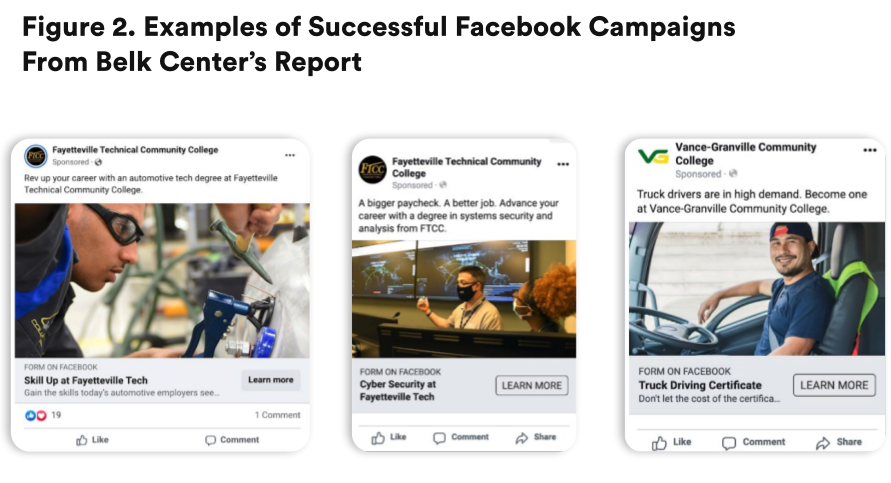
To design an effective outreach campaign, community colleges should assess the programs they offer that are most likely to suit the needs and interests of potential adult students and then craft communication materials about these programs on a section of their website that is designed for adult students.
Recommendation 2: Create a central web page with information for returning adult students.
Community college websites often confuse students and prevent them from seamlessly enrolling in college at all, let alone in the correct program. Despite the importance of college websites25 on prospective students’ higher education decisions, many institutions lack the content and usability associated with high-performing websites. In particular, college websites do not always26 have clear information about the application and enrollment process, nor do they have the necessary academic information that can help students choose potential courses of study.
Many college websites do not speak to former students who stopped out since the onset of the pandemic, nor to adults interested in attending college for the first time. Even when community colleges have resources to help students reenroll in classes—like enrollment navigators or advisors—they do not always feature this information in a clear, organized manner on their websites. This lack of information might prevent some students from coming back to college.
Institutions should prominently feature a web page designed for former students who want to reenroll in college, with a clear checklist of steps they must take before they can begin classes. Community colleges need to highlight this information in a clear, central place on their website, so that all students who left college during the pandemic can know exactly what they need to do to reenroll for another term. Such a web page should include a brief questionnaire on the home page of the college’s website to determine if students are new applicants, returning students, or transfer students, with customized, step-by-step instructions for enrollment for each type of student.
Recommendation 3: Hire enrollment navigators and communicate their availability to students.
To increase enrollment, community colleges should hire—and publicize the availability of— enrollment navigators. Colleges should connect all students who fill out a returning-student questionnaire with an enrollment navigator before they even apply. This will give prospective students an institutional resource to speak with when questions arise. Preemptively connecting prospective students with enrollment navigators will help colleges reestablish trust with former students and facilitate a smooth reenrollment process, where students feel supported in their decision to return to campus. Information on enrollment navigators and academic counselors should be centrally featured in all web pages designed to facilitate reenrollment.
Recommendation 4: Create incentives to entice students to reenroll.
To entice stopped-out students to reenroll, colleges should supplement messaging campaigns with powerful incentives designed to facilitate adult enrollment.
To assess which incentives would help increase adult enrollment, we asked more than 900 former adult students at colleges in our cohort what incentives would be powerful recruitment motivators. Table 2 shows their answers.
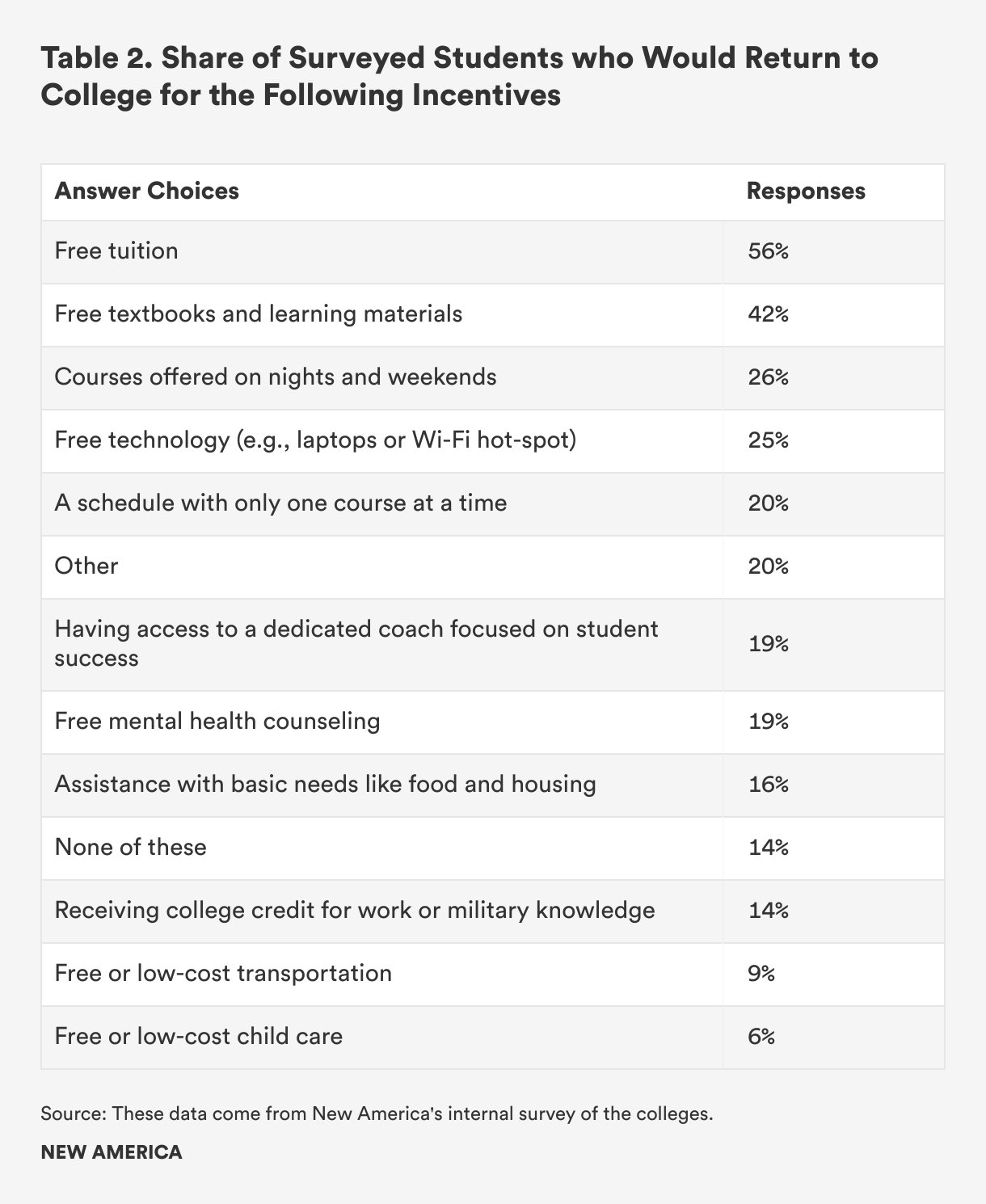
While community colleges may not be able to afford these incentives without additional state and federal funding, college leaders should assess how they might, given their fiscal reality, create impactful incentives to recruit adults to their campuses. For example, it’s possible colleges could allow returning adult students to have free or discounted tuition for their first term back, free textbooks and learning materials, or free technology. Colleges should structure the incentives they can afford based on the insights of our survey.
Mt. Hood Community College’s efforts to incentivize students to reenroll demonstrates that these incentives can help bring students back to campus. Mt. Hood reduced outstanding balances that students owed to the college so that it could remove registration holds for these students. Mt. Hood invested $107,000 in this effort, for 685 students. Of this number, 285 reenrolled for the following term. This increase in enrollment resulted in a nearly $400,000 return on investment, and it helped increase Mt. Hood’s 2022 fall enrollment for the first time in five years.
If community colleges craft adult-specific communications, and prominently display this information on their websites, they will better position themselves to reenroll adult students. While it’s critical that community colleges also offer the necessary institutional resources to help adults enroll in college, clear websites and communications are central to overcoming enrollment barriers.
Theme 2: Revise Satisfactory Academic Progress (SAP) Policies
College policies relating to satisfactory academic progress (SAP) can create reenrollment barriers that particularly impact adult learners. Colleges which seek to reenroll adult learners should evaluate and revise their SAP policies.
To be eligible for federal financial aid authorized under Title IV of the Higher Education Act (HEA), college students need to make satisfactory academic progress,27 and colleges must have a policy to define and monitor that progress. College SAP policies must establish both quantitative and qualitative standards to define what constitutes student academic progress, as well as a maximum time frame for completing a program of study. Colleges need to establish a grade point average students must maintain in order to meet SAP, and they must also determine the pace at which students need to progress through their program in order to qualify for Title IV funding.
The pace and GPA required to meet SAP must be at least as stringent as the academic requirements for students not receiving Title IV aid28 and for most institutions this means a GPA of at least 2.0 and a completion pace—the share of classes that students pass—of 67 percent of classes enrolled in. Maximum time frame is usually 150 percent of program length. Students who do not meet SAP requirements are ineligible for federal financial aid, which can discourage them from continuing to pursue higher education. Students can appeal to regain their financial aid29 after it’s been terminated, but the appeal process is often challenging to navigate. While federal requirements for SAP are complex and limit what community colleges can do to reform SAP, community colleges can define what constitutes SAP for their students, given that SAP definitions match their general academic standards, and therefore they have opportunities to craft SAP policies from a student-centric perspective.
SAP policies create enrollment barriers for many community college students across the country. One 2021 analysis found that nearly 25 percent30 of community college Pell Grant recipients in California fail to make SAP for their first two consecutive terms. Of these, 34 percent of Black students who received a Pell Grant fail to make SAP, compared to only 15 percent of white students who received a Pell Grant.31 This is deeply concerning, given that 77 percent32 of students who failed to make SAP lost their Pell Grant award, and 58 percent33 of students who failed to make SAP during their first year did not return for a second year. Only 18 percent34 of students who achieved SAP in their first academic year did not enroll in a second year. Given the importance of financial aid35 to community college students, institutional policies that can prevent more than one in five students from accessing financial aid unnecessarily depress college enrollment.
SAP created substantial issues for the colleges in our cohort. One administrator told us how failing to make SAP was intertwined with student mental health challenges:
SAP is one of those… hot-button issues. Last semester alone, we've seen more SAP requests than ever before. Now students are having other challenges…but it is affecting the SAP process. So it's like, what's the cause? Is it SAP and the academic process causing the mental stress? Is it environmental issues and external issues causing the mental stress (that then) causes SAP (problems)? I think it's linear….We saw in (a student) survey, when you get into trouble with SAP and you start getting these emails that are using words like probation and threatening dismissal and stuff like that, [it] can compound issues.
Recommendation 1: Community Colleges Should Reform Their SAP Policies
To increase adult reenrollment, community colleges should reform their academic and financial hold policies. A complete reset of SAP36 for students who have not been enrolled for a period of time—such as a two or three-year hiatus in enrollment—would allow a substantial number of people to reenroll. However, an SAP reset would require legislative action37 under the Higher Education Act (HEA). Absent changes to the HEA, community colleges should use the flexibility in current regulations to reform their policies the best they can to meet students' needs.
To do this, community colleges should improve their communications with students who fail to make SAP, simplify the SAP appeals process, and analyze the patterns of those affected by SAP by race, gender, Pell status, and other demographic factors. This will help to uncover whether their SAP policies worsen longstanding inequities in higher education, as suggested in the earlier cited research from California. Taken together, these actions will ensure a substantial number of community college students can reenroll in classes, with financial aid eligibility.
Community colleges need to improve their communications with students throughout the entire SAP process. First, they should proactively communicate with all students so that the entire student body understands how SAP can affect the ability to keep and maintain federal financial aid. In conversations with college leaders, students, and stakeholders, we learned that students do not always see the connection between SAP and their financial aid. Colleges must ensure all students—even those who consistently make SAP—understand this connection at the beginning of their college experience. One administrator at a college in our cohort articulated her recent efforts to ensure all students understand this fact:
It’s important for me explain to students in the very beginning…that SAP is a big deal. I'm revamping new student orientation to do this…I'm really looking to make sure that we do that communication piece (early) so that students understand, at the very beginning, that SAP truly can affect your ability to keep and maintain your federal financial aid.
Community colleges should also proactively communicate with students about their SAP status and steps they would need to take to reenroll in college, using asset-based and non-threatening language. Colleges in our cohort often communicated with students about failing to meet SAP in ways that could unintentionally discourage students from navigating the SAP appeal process. For example, one college used alarming language in its initial emails to students who risked failing to make SAP. Given the importance of crafting equitable communication strategies38 with students regarding academic progress, colleges need to revise their language regarding SAP to make the experience less discouraging for students. This should also involve providing more clarity around the SAP appeals process, so that students understand there is a process and know what content the appeals committee expects in any written appeal. Communicating with students more effectively can prevent them from failing to make SAP, which can help increase student retention and enrollment.
Community colleges should communicate with students ahead of their census dates, or their drop deadline, to help students understand the impact that withdrawing from a class after census has been taken might have on their GPA and as a result on their financial aid eligibility due to SAP. By being proactive with these communications, colleges can potentially limit the number of Returns to Title IV Aid (R2T4) issues they need to deal with, as well as reduce the number of students who end up with SAP issues because they did not fully understand the impact that dropping a class after census would have.
Current regulations39 allow colleges to be more restrictive with their SAP policies than the minimum federal requirements. Colleges should review their policies to ensure that they have not introduced measures that make their SAP rules more onerous than federal regulations require. Colleges should also review whether they look at SAP on a payment-period basis or an annual basis.
Reviewing SAP on an annual basis gives students more limited and less timely feedback on whether their financial aid is jeopardy. By reviewing SAP every payment period, as allowed by federal regulations, schools can provide students with a financial aid warning in the first payment period they fail to meet SAP. Giving students a financial aid warning for an entire academic term can help them understand they need to improve their GPA with more time for them to take action. Ideally, financial aid warnings will come with an appointment with an academic advisor who can help put a corrective action plan in place.
All community colleges should have an appeals process in place for SAP. These appeals are an optional component of the SAP regulations,40 but they provide a vital lifeline for students whose GPA may have dropped due to circumstances outside of their control.
Community colleges also need to simplify the SAP appeals process. They should do this by reducing the steps students need to win an SAP appeal. As part of this effort, colleges should review the documentation they require for appeals and wherever possible, minimize the amount of documentation that students need to provide. Additionally, community colleges should ensure every student has access to resources—like a well-written SAP appeal guide41 or the SwiftStudent technology tool42—to help students craft appeals. By simplifying the appeals process, eliminating burdensome documentation requirements, and providing students with a staff member who can help students craft effective appeals, community colleges can positively impact a large number of students, who could then reenroll in courses.
Delgado Community College exemplifies how colleges can and why they should redesign their SAP policies to better meet students’ needs. As a result of our project, Delgado reexamined its SAP appeals data and realized something: hundreds of students were unable to complete their SAP appeal because they failed to submit third-party documentation explaining why they were unable to make SAP, which was the college’s requirement at the time. Delgado realized that many of its students were unable to provide documentation explaining why they were unable to make SAP, because the 2021 destruction of Hurricane Ida43 made it logistically challenging to access such documentation. Delgado changed its institutional policy to remove the third-party documentation requirement to complete an SAP appeal. The college no longer has a single student with an incomplete SAP appeal.
Community colleges must also analyze SAP patterns, both in terms of who receives SAP holds and who successfully wins SAP appeals, to ensure that the system is not reinforcing racial, gender, and economic inequities. Analyzing SAP patterns and appeal outcomes by race, gender identity, Pell status, and other relevant demographic factors will help institutions ensure that their policies do not deepen inequities. Colleges should also analyze whether certain courses—like developmental courses—are disproportionately contributing to SAP issues. This information could help colleges see if there are certain kinds of students with or classes likely to lead to SAP issues. These patterns could be used to craft interventions to better meet students’ needs.
Theme 3: Increase Course Flexibility
Community college course scheduling can create challenges for adult students. Because the vast majority44 of adult students work, and many of them have to balance school, employment, and caregiving responsibilities,45 they face obstacles to attending in-person classes that occur during traditional work hours. They need flexible course schedules, both in terms of when courses are offered and through which modality courses are taught. Community colleges would likely increase adult enrollment and facilitate their success if they increased the number of courses offered outside of traditional work hours, as well as the number of virtual learning options for their students.
While the colleges in our cohort understood the importance of flexible course offerings, implementing these reforms can be challenging. Many community colleges continue to face staffing shortages46 stemming from the COVID-19 pandemic, and they have struggled to recruit and retain academic and administrative personnel over the past three years. Given this, it may be challenging to hire the necessary staff to effectively offer additional night, weekend, and virtual classes. A dean at a college in our cohort articulated staffing constraints:
I really think staffing is an issue. People have too many jobs, so nobody’s doing a good job. I mean we can’t, like it’s not the way it works….I think about the advisors and…they’re dropping out because they can’t do their job….There’s just many instances where we had these draconian budget cuts, and we did not strategically rebuild….(We need) investment in human capital.
Given the scope of these staffing constraints,47 many community colleges may feel ill-equipped to offer night, weekend, and virtual courses. However, 26 percent of the stopped-out students we surveyed at the colleges in our cohort said they would seriously consider coming back to college within the next year if the courses they needed to take were offered on nights and weekends. In interviews, current and former adult students expressed support for the flexibility that accompanies virtual and hybrid courses. One former adult community college student explained that taking virtual courses
was awesome… I had a newborn; she was born right before the pandemic… So I went back in the fall of 2020 and it was all online, so I didn’t have to do any shifting or anything, and I loved it. I wouldn’t have gone to the class at all if it hadn’t been online. At the time I only had two kids and one of them was the newborn, so it worked out really well for me personally… My wife would come home from work and I would go to class, and she would do the same thing. So it was nice to have that motivator at home.
Given the importance of offering flexible courses, many colleges hope to expand the number of HyFlex courses48—classes that can be completed either virtually or in-person–to create additional options for students to pursue their courses of study. While HyFlex courses can offer students the opportunity to pursue a course in the modality that best meets their needs, creating high-quality, student-centric HyFlex courses can be a significant challenge for institutions. HyFlex courses can create technological challenges for institutions, and if done poorly, can place increased burdens on faculty. To offer HyFlex courses to meet student and staff needs, community colleges need to establish institutional processes that create successful HyFlex options.
Recommendation 1: Offer more night and weekend classes.
To better meet the needs of adult students, community colleges should offer additional night and weekend classes.
To do this effectively, community colleges should hire staff with the explicit expectation of night and weekend teaching. Additionally, colleges could incentivize faculty to teach nights and weekend classes by providing additional funding for harder to fill positions. If community colleges can incentivize enough faculty to teach classes on nights and weekends, they will be able to increase adult enrollment and enrollment for all students who work full-time jobs.
Recommendation 2: Offer more HyFlex courses.
We recommend that community colleges offer more HyFlex courses—rather than fully virtual courses—to allow students to enroll in courses either virtually or in person, given their needs, interests, and learning styles. HyFlex courses are a promising strategy to engage and enroll adult learners. However, community colleges need to craft systems and policies to offer HyFlex courses in ways that promote learning without overwhelming faculty.
Before offering HyFlex courses, community colleges should collect data from current and former students to assess which of their courses they should consider offering in a HyFlex model. In this planning phase, colleges should create HyFlex courses that are likely to attract adult students. After analyzing data on student interest in potential HyFlex courses, community colleges should design a pilot49 HyFlex course—or series of courses—to learn how these courses impact enrollment, student outcomes, and faculty satisfaction. As part of this pilot program, community colleges should create a campus-wide definition50 of what exactly constitutes a HyFlex course. Colleges will need to decide if HyFlex courses will be offered synchronously, asynchronously, or if each faculty member can decide which method makes the most sense for a given class.
After assessing student demand for HyFlex courses, designing HyFlex pilots, and defining what HyFlex means across campus, community colleges need to ensure they have the technology infrastructure51 necessary to deliver effective HyFlex courses. To create a positive learning experience for both in-person and virtual learners in HyFlex courses, community colleges will need to outfit HyFlex classrooms with interactive video conferencing technology—including tracking cameras, microphones, and audio—as well as multiple screens that allow in-person and virtual learners to feel connected. Outfitting HyFlex classrooms with this technology will help ensure these courses add value for all enrolled students.
Successful HyFlex courses also require faculty support and resources to ensure teachers are adequately equipped to design and teach them. While many faculty members now have experience delivering virtual and HyFlex classes because of the COVID-19 pandemic, community colleges need to ensure HyFlex is not forced upon faculty, and that those teaching HyFlex courses have the skills and resources they need to be successful. Colleges need to provide professional development for faculty so that they learn the technology available to them, how to differentiate lessons for virtual and in-person students, and how to foster a cohesive classroom environment that spans multiple physical locations.
Recommendation 3: Increase flexibility for entire programs.
Based on our conversations with students, faculty, staff, and community college leadership, we recognize the importance of ensuring that students can maintain their desired course modality and timing throughout their entire program, so that they can complete their academic journey in a way that meets their schedule. Increasing course flexibility, in terms of when and how classes are offered, is a powerful tool, but if students can enroll in one course that meets their schedule and are then unable to enroll in subsequent program requirements because those courses lack flexibility, they may be unable to complete their program. To increase both enrollment and student retention, colleges should increase flexibility for entire programs.
Theme 4: Establish Case Management Systems for Enrollment and Advising
Community colleges do not always have dedicated enrollment staff or procedures to recruit students and help them navigate the enrollment process. They often do not have the capacity to undertake proactive recruitment strategies, like contacting all students who started but did not finish an application to the college, or crafting individual outreach to stopped-out students.
There are also capacity constraints in student advising. Since the onset of COVID-19, college students have experienced unprecedented52 levels of isolation, anxiety, stress,53 and increased economic hardship.54 In interviews with adult learners, we heard that community colleges do not always provide advising services that help students navigate the challenges they face. One adult student at a college in our cohort said,
I felt that there were too many emails that got me confused. I just want to talk to a person….I feel like if they were in the same department, it would be better for me. Like one person to ask all the questions….I don’t want to go through different offices. They [say] go to this one for financial aid, this one for health insurance….The pandemic made it hard [and] virtual made it not attractive.
Institutions often keep important student information in different offices and departments. Community college students—particularly those who are older and have been removed from the education system for a number of years—may have trouble accessing information if they need to navigate multiple departments. As community colleges prepare to increase enrollment, they need to establish centralized advising so they can better share relevant information with their students.
Community colleges should establish case management systems for both enrollment and student advising. In doing so, they can create holistic plans to drive student success while increasing the number of students they serve. Enrollment and advising should be seen as part of a continuum of services offered to all prospective and enrolled students. Proactive case management55 advising can improve student persistence rates,56 and can therefore be an enrollment strategy. If colleges design case management systems for their entire spectrum of enrollment and advising services, they will be better positioned to serve students’ needs and increase their enrollments.
Recommendation 1: Hire enrollment navigators to integrate enrollment and advising services.
Community colleges should hire enrollment navigators to help prospective students access the information they need to enroll, or reenroll, in college. Enrollment navigators can also introduce students to their academic advisors (see Figure 3).
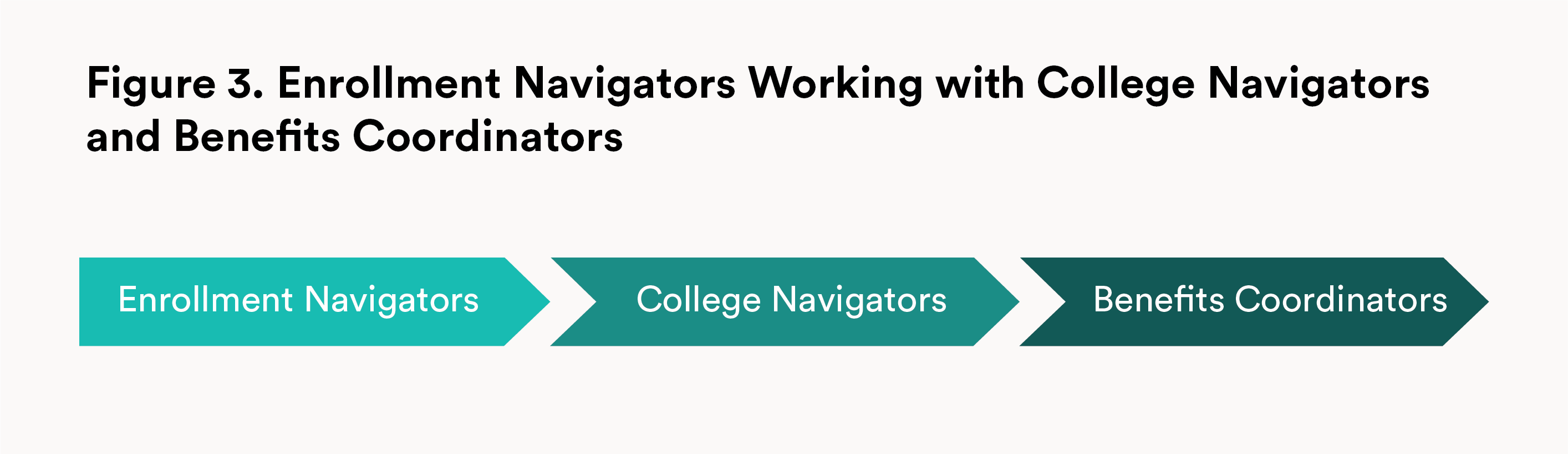
For an example of a case management system for enrollment and advising, colleges can look to the work of Ozarks Technical Community College in Springfield, Missouri. To institutionalize its commitment to meeting students’ needs, Ozarks Tech implemented a student-support model, called Student Success,57 which ensures all students are connected with professionally trained staff members capable of navigating them through academic, economic, and personal challenges. Each Ozarks Tech student now has three staff members assigned to their success team: an admissions counselor to help from the application process to class registration, a college navigator to help from registration to program completion, and a community resource specialist to help with non-academic supports that can help students thrive.
Under this model, students develop relationships with their college navigator, whose sole job is to help manage barriers students face to academic and personal success. College navigators manage a caseload of 300 students. As college navigators work with students, they learn when to connect students with a community resource specialist, who can help them meet their basic needs. Student Success allows the college to meet the academic and personal needs of each student it serves. This team-based, relationship-centric approach to enrollment and advising creates institutional avenues to meeting students’ needs before, during, and after the enrollment process.
Community colleges across the country should establish similar case management systems to increase adult enrollment. They will need to hire enrollment navigators and redesign the academic advisor role. While redesigning the expectations for and job description of academic advisors can lead to staff turnover, colleges can learn from Ozarks Tech how to increase staff and faculty support for case management systems. Using data to recognize which students likely need additional support, college navigators at Ozarks Tech reach out to students to ensure they enroll in the right classes and receive the academic and non-academic support they need. This has resulted in noticeable increases in academic persistence and improvements in student outcomes, which has driven faculty buy-in for the model.
Pitt Community College used a similar set of enrollment strategies in 2021 to better meet the needs of adult students. Partnering with InsideTrack, PCC relied on enrollment coaches—a similar concept to enrollment navigators—to reach out to a set of stopped-out students prioritized by the institution.58 After the coaches made contact with these students, they introduced them to staff members at PCC who could answer questions, and who ensured the students were introduced to a faculty or staff member before their first day of classes. This allowed adult students to feel connected to campus before they even arrived for a new term. PCC contacted 36 percent of its prioritized students, and 44 percent of the students they contacted reenrolled.59 This brought in more than $500,000 of tuition revenue for the college.60
Community colleges can make significant strides in supporting returning adults if they build case management systems to integrate enrollment and advising. Doing so will ensure colleges are equipped to recruit students and, critically, meet those students' needs. To make these efforts successful, colleges need to prioritize collecting, maintaining, and internally sharing data on case management enrollment and advising efforts.
A Model Timeline of Enrollment Navigators
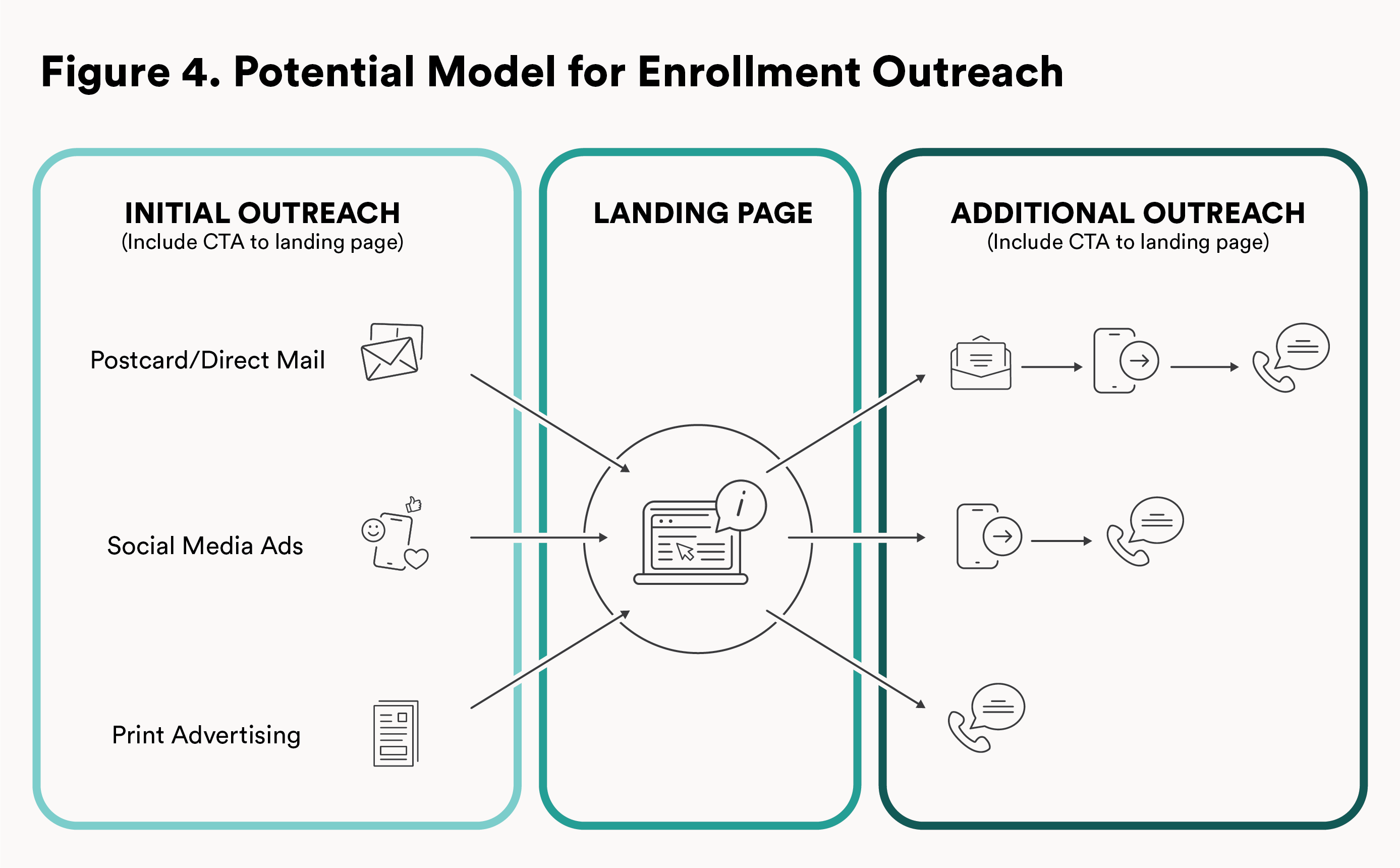
To effectively reach stopped-out adult learners, college enrollment navigators should try to contact students through multiple methods, including direct mail, email, text, and phone call. Enrollment outreach should generally start with the least intrusive methods, like email and direct mail, before continuing to more intrusive methods, like texts and phone calls. All forms of reenrollment outreach should include a clear call to action that directs students to a simplified reenrollment landing page on which students provide their name, email, and phone number as a way to indicate their interest in reenrolling.
If stopped-out students fill out a sign-up form to indicate they are interested in reenrolling, colleges should reach out multiple times, through multiple methods, to ensure they complete their application. While colleges should provide students the opportunity to opt out of emails and texts at any point of their outreach, colleges should do what they can to ensure interested students reenroll in classes.
Colleges should consider following up with interested students up to five times after initial outreach. Colleges should structure reenrollment outreach based on the technology and staffing capacity they have. Colleges may not have the capacity to follow up with a phone call for each interested student, but they may have software that makes it easier to email or text these students. While the specifics will vary from campus to campus, a potential model for enrollment outreach over the course of a 30-day period is listed below:
- Direct mail to all stopped-out students directing them to the reenrollment landing page. Colleges should email students who do not respond to the initial direct mail. If there is no email response after a few days, colleges should try texting, and eventually calling, while ensuring students are not overwhelmed with potential outreach.
- Automated, yet personalized, email from an enrollment navigator to all students who fill out the landing page form. In this email, enrollment navigators should offer to answer any questions, schedule a call, or help start the reenrollment process.
- Automated follow-up email to all students who did not open the prior email can be sent after 48 hours.
- A follow-up text message from enrollment navigators to everyone who opened the email but didn’t reply, click on the link to apply, or click on a link to schedule a call or meeting.
- Follow-up phone calls to anyone who did not respond to previous texts or emails.
This model is outlined in the following figure:
Recommendation 2: Design student orientation processes to better serve adult learners.
Student onboarding offers community colleges the opportunity to connect adults with important information and institutional resources that can help them thrive. Colleges should ensure that adult students meet their advisors during orientation, so that adults can have a campus point of contact before they even begin classes.
Research from the Council for Adult and Experiential Learning (CAEL) shows that adult-focused orientations can play a meaningful role in preparing adults for college success, and allow colleges to teach adult learners how to balance academic, work, personal, and caregiving responsibilities.61 Given the importance of creating a greater sense of belonging62 among adult students, adult-focused orientations can also help these students connect and foster bonds outside of the classroom. By creating adult-specific orientations tailored to the needs of first-time and returning adult students, community colleges can make meaningful strides towards helping adults persist and complete their courses of study.
Community colleges should also design orientation programming that helps adults prepare for hybrid and virtual learning environments. Even if adult students enroll in fully in-person courses, they will need to successfully navigate virtual learning technology at some point in their academic program, and it’s critical that they are prepared to do so before classes start. Colleges can offer “first courses”—orientation programs designed to provide adults with necessary information before the academic term begins—including trial versions of online courses, so that they can understand what to expect in virtual learning environments.63 Successful orientation first courses can also include information on course materials, curriculum, and an exploration of CPL options.64
Theme 5: Help Students Afford Their Basic Needs
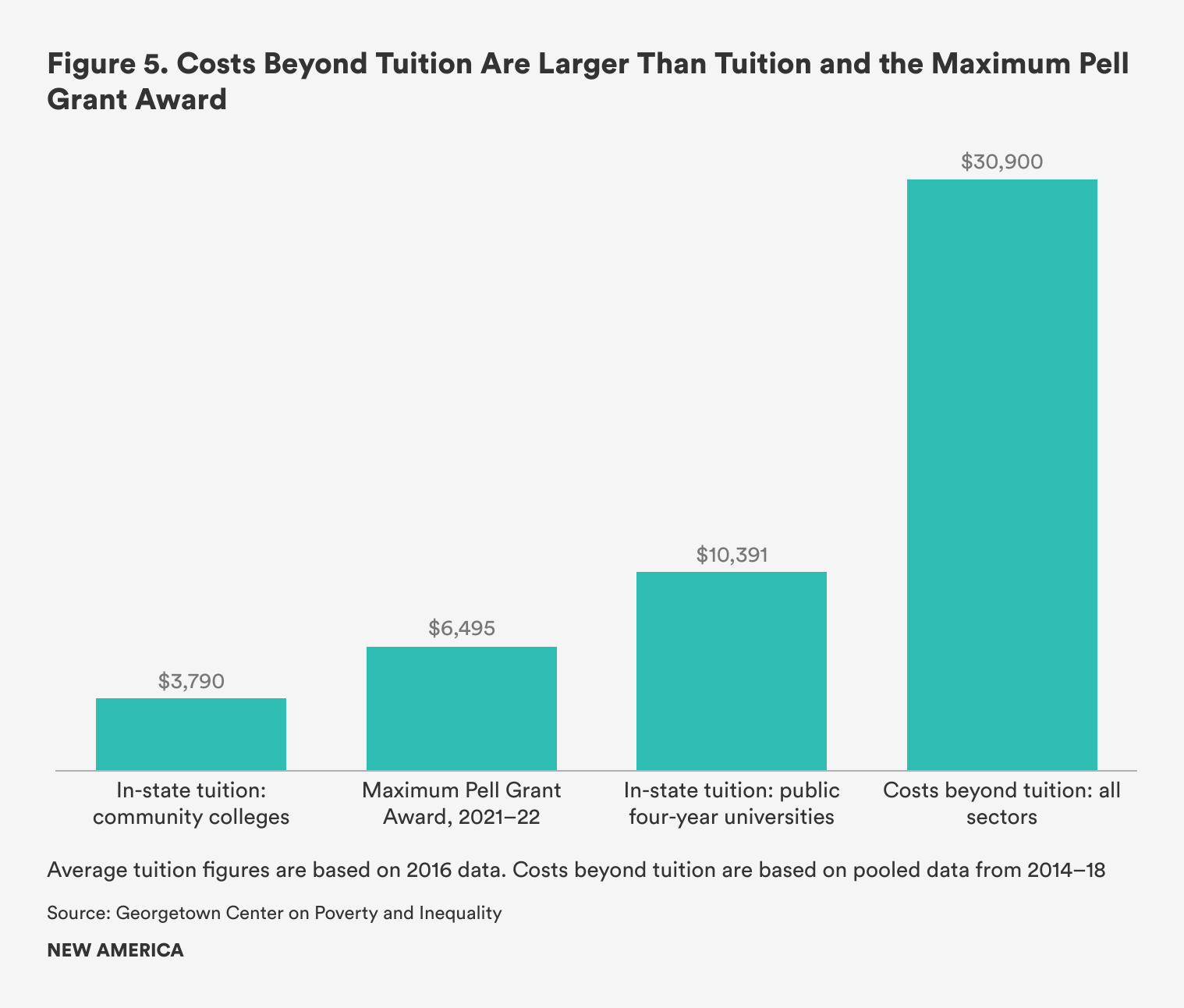
Even before the COVID-19 pandemic upended higher education and the American economy, many community college students struggled to afford their basic needs. Costs for housing, food, transportation, health care, and child care are so substantial that they often exceed the price of tuition itself65 (see Figure 5). Students who cannot afford their basic needs often struggle to complete college,66 making basic needs insecurity a significant threat to student persistence. Students who cannot afford their basic needs face heightened risk of experiencing a mental health crisis.67 It’s therefore imperative that community colleges help students afford their basic needs. Doing so will improve student well-being, academic outcomes, and persistence rates.
Housing Insecurity Harms Community College Students
Nationwide skyrocketing costs68 have made housing unaffordable for millions of Americans, and this housing crisis is acutely felt by community college students. In 2020, 52 percent of all community college students experienced housing insecurity.69 Housing costs are so substantial for community college students that, on average, they are larger than the cost of community college tuition.70 Given that 26 percent of community college students are parents,71 and that 59 percent of community college students72 receive financial aid to help afford tuition, community college students need affordable, high-quality housing.
As most community colleges73 do not offer on-campus housing, they lack the tools four-year universities have to offer subsidized housing. But, while community colleges cannot solve the housing crisis on their own, they can prioritize institutional responses to helping students access affordable housing.
The Growing Mental Health Crisis in Community Colleges
Even before the COVID-19 pandemic, college students had significant, unmet mental health needs.74 In 2019, 87 percent of college students felt overwhelmed by all they had to do, 85 percent felt mentally exhausted, 66 percent felt overwhelming anxiety, and 56 percent felt things were hopeless.75 Since the onset of COVID-19, things have gotten even worse: college students have experienced unprecedented76 levels of isolation, anxiety, and stress,77 all while facing the same academic pressure that existed before the pandemic. An online survey conducted by College Pulse in March 2022 indicate that the mental health crisis for college students continues to spiral: while 56 percent of survey respondents said their mental health was fair or poor, only 13 percent have used on-campus counseling since the onset of the pandemic.78 Even more concerning, 57 percent of survey respondents felt their college did not provide enough support to connect them to off-campus therapists.79
Student Parents Need Better Child Care Options
For the nearly five million student parents80 who make up 26 percent of all undergraduates, child care can be a significant barrier81 to college enrollment and completion. Despite earning higher GPAs than their peers without children, student parents are far less likely to complete their degrees, in large part because of child care concerns.82 In fact, only 28 percent of single mothers83 who started college between 2003 and 2009 completed their program within six years. To make matters worse, the number of community colleges offering on-campus child care significantly declined84 between 2003 and 2015, a troubling trend that accelerated during the COVID-1985 pandemic.
Community colleges play a particularly important role in serving student parents. Nearly 42 percent86 of all student parents attend community colleges, yet community colleges frequently lack the resources necessary to provide students with accessible, high-quality, on-campus child care.
Many College Students Experience Food Insecurity
Food insecurity—which was widespread87 on college campuses prior to the pandemic—has since increased.88 Given how detrimental food insecurity is for academic89 and mental well-being,90 community colleges need to prioritize efforts to help students access affordable, healthy foods. Many community colleges nationwide, and in our cohort, launched initiatives to help students afford food during the pandemic. One stopped-out adult student at a college in our cohort shared her experience at an on-campus food and clothing pantry:
I noticed…on the bathroom stalls there’s QR codes to help you get a food box, and there’s a benefits navigator on your phone….I did the food box one….I prefer going in-person [to the on-campus food pantry] because they’ve got some fun stuff in there, and I have a blast. I’ve been bugging them for four and a half years, asking if they need any help in the clothes closet because I just like it so much. They told me you have to sign up for work-study for that…so I went ahead and signed up for work-study for that too….I’ve actually left there crying on occasion because they’ve touched me so deeply.
Despite meaningful efforts to help students afford their basic needs, students continue to have significant unmet needs, which threaten their ability to persist in college. Another stopped-out adult student at a college in our cohort explained how basic needs insecurity threatened her ability to stay enrolled in college:
Everything costs so much, and I’m at the point where now I can barely afford groceries, and I can get public assistance, and still can't afford groceries. I don't plan on living like that. It's not a goal of mine. My goal is to be financially stable, where I can take care of my children without public assistance.
Recommendations to Address Basic Needs Insecurity
To address the heightened economic pressures community college students face, colleges need to enact bold actions that can help students access and afford their basic needs. Doing so will increase student persistence rates and adult enrollment.
Recommendation 1: Hire benefits navigators to coordinate basic needs support.
Benefits navigators are trained professionals that help students access federal, state, and local public benefits programs, such as SNAP, housing assistance, and other resources91 that help address students’ basic needs. While benefits navigators cannot fully address basic needs insecurity without more resources being offered, they can make a meaningful difference in student well-being, academic outcomes, and retention.
Benefits navigators can also coordinate the allocation of basic needs support across an entire campus. One community college that has successfully coordinated basic needs support is Dallas College.92 Its Student Care Network coordinates student access to resources.93 Students are referred or simply fill out a form and a coordinator assesses what the student needs. After the assessment, the coordinator sends the student to a nurse or mental health counselor or over to a basic needs case manager, who works to connect him or her to resources at the college or in the community. The Student Care Network takes the complexity out of accessing resources. For instance, before the network, a single mother would need to assess if she was eligible for the Working Wonders94 child care stipend, or if she should contact a community-based organization, or perhaps apply to the Adult Resource Center95 child care subsidy program, or maybe apply for subsidized child care96 at the two Head Start centers on the Brookhaven or Eastfield campuses. Now, her Student Care Network coordinator will connect her with a case manager who can help her navigate all the options available and find the one that works best for her family.
In 2021, Oregon passed new legislation97 that required each community college and public university to hire benefits navigators and also funded them. The implementation of this law demonstrates the positive impact benefits navigators can have on student well-being and subsequent academic outcomes.98 Lindsey Bellefeuille, the benefits navigator for Southwestern Oregon Community College, explained the importance of her work:
I was a first-generation college student…(and) there are great programs for students like me who qualify, but everyone could benefit from this information. Helping people sign up for benefits is essential (because) the system in Oregon was just not made for people who need benefits. The (Oregon Department of Human Services) doesn’t communicate in a way that’s accessible for working people….It’s very helpful to have someone just be able to explain things (in a way that makes sense to students).
The success of benefits navigators depends in part on the culture of the college in which they operate, and the commitment a college has to fostering an inclusive environment that serves all students. To foster such an environment, colleges need to develop the systems and training necessary to ensure that faculty and staff understand their role in helping students navigate challenging economic and life circumstances.
Recommendation 2: Require student basic needs training for all faculty and staff.
This training should be designed and facilitated in conjunction with benefits navigators. Increasing faculty and staff awareness about basic needs insecurity will help them better understand their students' experiences, and therefore equip them to better meet students’ academic and personal needs.
Recommendation 3: Review institutional policies relating to student basic needs and financial aid.
Colleges should also consider institutional policy reforms, reviewing all institutional policies that could unintentionally contribute to basic needs insecurity. This should include a close examination of financial aid policies to ensure that they are student-centric and do not exacerbate the economic pressures students face. For example, colleges can help reduce transportation and child care costs if they offer more HyFlex courses. While the goal of HyFlex courses isn’t to reduce basic needs insecurity, a review of institutional policies across a broad swath of areas might yield creative ways to help students afford their basic needs.
Given the importance of financial aid for students facing basic needs insecurity, community colleges should examine their financial aid and emergency grant policies and capabilities to ensure they are in a position to help support students with low incomes. Analyzing financial aid policies with trained experts in student basic needs, such as benefits navigators, could allow colleges to find opportunities to better meet student needs. Doing so can better position community colleges to effectively serve older students.
Recommendation 4: Find ways to offer students free resources.
One of the clearest ways community colleges can help students afford their basic needs and the entire cost of attending college is by lowering costs they can control. More than half, 56 percent, of the stopped-out adult students we surveyed at the colleges in our cohort said they would reenroll if tuition were free. While community colleges may not be able to afford to offer free tuition without substantial federal and state investment, 42 percent of the adult students we surveyed said they would reenroll if their colleges could offer free textbooks and learning materials, and 25 percent said they would reenroll if they were offered free technology such as laptops or Wi-Fi hotspots. Community colleges should assess which of these incentives they might be able to afford, and they should offer them as part of a coordinated campaign to reenroll stopped-out students. Colleges should also ask community-based organizations and local employers if they can contribute resources to help their students.
Community colleges should also fundraise to provide students with resources. This could include creating on-campus food pantries; creating housing subsidies for students with low incomes; offering emergency grant aid; and providing subsidies for child care. If colleges can help students with their basic needs, they will be helping students succeed, which will increase college enrollment, completion, and post-graduation success.

Citations
- Chris Geary, “College Pays Off. But by How Much Depends on Race, Gender, and Type of Degree,” EdCentral (blog), New America, March 1, 2022, https://www.newamerica.org/education-policy/edcentral/college-pays-off/.
- Greenville ENC Alliance, “'Better Skills, Better Jobs' Job Fair to Serve as Largest in Region,” October 15, 2021, https://www.encalliance.com/news-posts/better-skills-better-jobs-job-fair-to-serve-as-largest-in-region.
- InsideTrack, “Reconnect, Re-Enroll & Rise,” 2023, https://info.insidetrack.org/reconnect-re-enroll-rise.
- InsideTrack, “Reconnect, Re-Enroll & Rise,” 2023, https://info.insidetrack.org/reconnect-re-enroll-rise.
- Belk Center for Community College Leadership and Research, Adult Learner Guidebook: A Guide to Recruit and Retain Adult Learners at North Carolina Community Colleges (Raleigh: North Carolina State University College of Education, 2022), https://belk-center.ced.ncsu.edu/wp-content/uploads/sites/128/2022/10/Belk-AdultLearnersGuidebook-2022.pdf.
- Belk Center for Community College Leadership and Research, Adult Learner Guidebook: A Guide to Recruit and Retain Adult Learners at North Carolina Community Colleges (Raleigh: North Carolina State University College of Education, 2022), https://belk-center.ced.ncsu.edu/wp-content/uploads/sites/128/2022/10/Belk-AdultLearnersGuidebook-2022.pdf.
- Belk Center for Community College Leadership and Research, Adult Learner Guidebook: A Guide to Recruit and Retain Adult Learners at North Carolina Community Colleges (Raleigh: North Carolina State University College of Education, 2022), https://belk-center.ced.ncsu.edu/wp-content/uploads/sites/128/2022/10/Belk-AdultLearnersGuidebook-2022.pdf.
- Wendy Ford, “Evaluating the Effectiveness of College Web Sites for Prospective Students,” Journal of College Admission (Summer 2011): 26–31, https://files.eric.ed.gov/fulltext/EJ939063.pdf.
- Wendy Ford, “Evaluating the Effectiveness of College Web Sites for Prospective Students,” Journal of College Admission (Summer 2011): 26–31, https://files.eric.ed.gov/fulltext/EJ939063.pdf.
- Federal Student Aid (website), “2022–2023 Federal Student Aid Handbook,” March 28, 2021, https://fsapartners.ed.gov/knowledge-center/fsa-handbook/2022-2023/vol1/ch1-school-determined-requirements.
- Code of Federal Regulations (website),Title 34, Subtitle B, Chapter VI, Part 668, Subpart C, October 29, 2010, https://www.ecfr.gov/current/title-34/subtitle-B/chapter-VI/part-668/subpart-C/section-668.34.
- The Overlooked Obstacle—How Satisfactory Academic Progress Policies Impede Student Success and Equity (San Francisco, CA: John Burton Advocates for Youth, July 19, 2021), https://jbay.org/resources/sap-webinar-2021/.
- John Burton Advocates for Youth, “The Overlooked Obstacle—How Satisfactory Academic Progress Policies Impede Student Success and Equity,” JBAY, July 19, 2021, https://jbay.org/resources/sap-webinar-2021/.
- John Burton Advocates for Youth, “The Overlooked Obstacle—How Satisfactory Academic Progress Policies Impede Student Success and Equity,” JBAY, July 19, 2021, https://jbay.org/resources/sap-webinar-2021/.
- John Burton Advocates for Youth, “The Overlooked Obstacle—How Satisfactory Academic Progress Policies Impede Student Success and Equity,” JBAY, July 19, 2021, https://jbay.org/resources/sap-webinar-2021/.
- John Burton Advocates for Youth, “The Overlooked Obstacle—How Satisfactory Academic Progress Policies Impede Student Success and Equity,” JBAY, July 19, 2021, https://jbay.org/resources/sap-webinar-2021/.
- John Burton Advocates for Youth, “The Overlooked Obstacle—How Satisfactory Academic Progress Policies Impede Student Success and Equity,” JBAY, July 19, 2021, https://jbay.org/resources/sap-webinar-2021/.
- Bridget Terry Long, “Financial Aid: A Key to Community College Student Success,” The White House Summit on Community Colleges Conference Papers, 2010, https://www2.ed.gov/PDFDocs/college-completion/08-financial-aid.pdf.
- John Burton Advocates for Youth, “The Overlooked Obstacle—How Satisfactory Academic Progress Policies Impede Student Success and Equity,” JBAY, July 19, 2021, https://jbay.org/resources/sap-webinar-2021/.
- Institute for Higher Education Policy (website), “Letter to The Honorable Patty Murray and The Honorable Richard Burr, Chairwoman and Ranking Member of the U.S. Senate Committee on Health, Education, Labor, and Pensions: SAP Reset,” November 8, 2022, https://www.ihep.org/wp-content/uploads/2022/11/SAP-Reset-Sign-On-2022.pdf.
- Monique Ositelu, Ewaoluwa Ogundana, and Iris Palmer, Five Recommendations for Community Colleges to Equitably Implement Early Alert Systems (Washington, DC: New America, October 2022), https://www.newamerica.org/education-policy/reports/five-recommendations-for-community-colleges-to-equitably-implement-early-alert-systems/.
- Federal Student Aid (website), “Satisfactory Academic Progress,” ners.ed.gov/knowledge-center/library/fsa-assessments/2022-11-17/satisfactory-academic-progress.
- Federal Student Aid (website), “Satisfactory Academic Progress,” ners.ed.gov/knowledge-center/library/fsa-assessments/2022-11-17/satisfactory-academic-progress.
- UCLA Financial Aid & Scholarships, “Satisfactory Academic Progress Appeal,” 2023, https://financialaid.ucla.edu/file/62572fef-c126-4cbc-80a2-4e33e6ccfe61.
- “SwiftStudent: Free College Financial Aid Appeal Resources,” FormSwift, https://formswift.com/swift-student#.
- Chris Geary, “Merging ‘Twindemics’: The Storm after the Disaster,” The Thread (New America blog), April 5, 2022, https://www.newamerica.org/the-thread/merging-twindemics-the-storm-after-the-disaster/.
- National Center for Education Statistics, The Condition of Education 2020, “College Student Employment,” https://nces.ed.gov/programs/coe/pdf/coe_ssa.pdf.
- Lindsey Reichlin Cruse, Tessa Holtzman, Barbara Gault, David Croom, Portia Polk, and Tessa Holtzman, “Parents in College by the Numbers,” The Aspen Institute and the Institute for Women's Policy Research, April 11, 2019, https://iwpr.org/iwpr-issues/student-parent-success-initiative/parents-in-college-by-the-numbers/.
- Barbara Shelly, “Colleges Face Staffing Challenges,” Community College Daily, January 18, 2022, https://www.ccdaily.com/2022/01/facing-staffing-challenges/.
- Sara Weissman, “Community Colleges Suffer from Employee Shortages,” Inside Higher Ed, January 4, 2023, https://www.insidehighered.com/news/2023/01/04/community-colleges-suffer-employee-shortages.
- Jennifer Rider and Ayla Moore,“Scaling HyFlex for the Post-Pandemic Campus,” EDUCAUSE Review, August 13, 2021, https://er.educause.edu/articles/2021/8/scaling-hyflex-for-the-post-pandemic-campus.
- Jennifer Rider and Ayla Moore,“Scaling HyFlex for the Post-Pandemic Campus,” EDUCAUSE Review, August 13, 2021, https://er.educause.edu/articles/2021/8/scaling-hyflex-for-the-post-pandemic-campus.
- Jennifer Rider and Ayla Moore,“Scaling HyFlex for the Post-Pandemic Campus,” EDUCAUSE Review, August 13, 2021, https://er.educause.edu/articles/2021/8/scaling-hyflex-for-the-post-pandemic-campus.
- Jennifer Rider and Ayla Moore,“Scaling HyFlex for the Post-Pandemic Campus,” EDUCAUSE Review, August 13, 2021, https://er.educause.edu/articles/2021/8/scaling-hyflex-for-the-post-pandemic-campus.
- Missouri Higher Education Equity Bridges to Success, “Equity in Mental Health During COVID-19,” May 2021, https://dhewd.mo.gov/documents/whitepapermentalhealth.pdf.
- Active Minds, “Student Mental Health Survey (September 2020),” 2020, https://www.activeminds.org/wp-content/uploads/2020/10/Student-Mental-Health-Data-Sheet-Fall-2020-1pdf.
- The Hope Center for College, Community, and Justice, #RealCollege 2021: Basic Needs Insecurity During the Ongoing Pandemic (Philadelphia, PA: Temple University, March, 31, 2021), https://www.luminafoundation.org/wp-content/uploads/2021/04/real-college-2021.pdf.
- Roslyn C. Richardson, “A Case Management Approach to Academic Advising,” Penn State University Journals 10 (December 3, 2008), https://journals.psu.edu/mentor/article/view/61581/61233.
- William Evans, Melissa Kearney, Brendan C. Perry, and James X. Sullivan, “Increasing Community College Completion Rates Among Low-Income Students: Evidence from a Randomized Controlled Trial Evaluation of a Case Management Intervention,” Journal of Policy Analysis and Management, 39, no. 4 (December 2017): 930–965, https://www.nber.org/papers/w24150.
- Ozarks Technical Community College (website), “Student Success,” https://students.otc.edu/success/.
- InsideTrack, “Reconnect, Re-Enroll & Rise, The Outreach Checklist: How to Identify the Most Viable Students to Re-Enroll,” 2023, https://www.insidetrack.org/wp-content/uploads/2022/11/The-Outreach-Checklist.pdf.
- InsideTrack, “Reconnect, Re-Enroll & Rise,” 2023, https://info.insidetrack.org/reconnect-re-enroll-rise.
- InsideTrack, “Reconnect, Re-Enroll & Rise,” 2023, https://info.insidetrack.org/reconnect-re-enroll-rise.
- Barry Darnell, Rebecca Klein-Collins, and Kari Shafenberg, Building Adult Learner Leaders for Institutional Effectiveness (ALLIES): Research Findings and a New Frameworkfor Supporting Institutional Change (Indianapolis, IN: Council for Adult and Experiential Learning, October 2022), https://files.eric.ed.gov/fulltext/ED624373.pdf.
- Barry Darnell, Rebecca Klein-Collins, and Kari Shafenberg, Building Adult Learner Leaders for Institutional Effectiveness (ALLIES): Research Findings and a New Frameworkfor Supporting Institutional Change (Indianapolis, IN: Council for Adult and Experiential Learning, October 2022), https://files.eric.ed.gov/fulltext/ED624373.pdf.
- Barry Darnell, Rebecca Klein-Collins, and Kari Shafenberg, Building Adult Learner Leaders for Institutional Effectiveness (ALLIES): Research Findings and a New Frameworkfor Supporting Institutional Change (Indianapolis, IN: Council for Adult and Experiential Learning, October 2022), https://files.eric.ed.gov/fulltext/ED624373.pdf.
- Barry Darnell, Rebecca Klein-Collins, and Kari Shafenberg, Building Adult Learner Leaders for Institutional Effectiveness (ALLIES): Research Findings and a New Frameworkfor Supporting Institutional Change (Indianapolis, IN: Council for Adult and Experiential Learning, October 2022), https://files.eric.ed.gov/fulltext/ED624373.pdf.
- Chris Geary, “It's Not Enough to Make College Tuition Free,” EdCentral (blog), New America, April 11, 2022, https://www.newamerica.org/education-policy/edcentral/its-not-enough-to-make-college-tuition-free/.
- Julia A. Wolfson, Noura Insolera, Alicia Cohen, and Cindy W. Leung, “The Effect of Food Insecurity during College on Graduation and Type of Degree Attained: Evidence from a Nationally Representative Longitudinal Survey,” Public Health Nutrition 25, no. 2 (2022): 389–97, doi:10.1017/S1368980021003104.
- Kathryn E. Coakley, Sarita Cargas, Marygold Walsh-Dilley, and Heather Mechler, “Basic Needs Insecurities Are Associated with Anxiety, Depression, and Poor Health among University Students in the State of New Mexico,” Journal of Community Health 47, no. 3 (February 6, 2022): 454–63, https://doi.org/10.1007/s10900-022-01073-9.
- Jessica Dickler, “Home Prices Are Now Rising Much Faster than Incomes, Studies Show,” CNBC, November 10, 2021, https://www.cnbc.com/2021/11/10/home-prices-are-now-rising-much-faster-than-incomes-studies-show.html.
- The Hope Center for College, Community, and Justice, #RealCollege 2021: Basic Needs Insecurity During the Ongoing Pandemic (Philadelphia, PA: Temple University, March, 31, 2021), https://www.luminafoundation.org/wp-content/uploads/2021/04/real-college-2021.pdf.
- Vincent Palacios, Chris Geary, Casey Goldvale, and Laura Tatum, Obstacles to Opportunity: Increasing College Success by Understanding & Addressing Older Students’ Costs Beyond Tuition, Georgetown Center on Poverty and Inequality, April 2021, https://www.georgetownpoverty.org/wp-content/uploads/2021/05/CBT-Obstacles-to-Opportunity-Report-May2021.pdf.
- Lindsey Reichlin Cruse, Tessa Holtzman, Barbara Gault, David Croom, Portia Polk, and Tessa Holtzman, “Parents in College by the Numbers,” The Aspen Institute and the Institute for Women's Policy Research, April 11, 2019, https://iwpr.org/iwpr-issues/student-parent-success-initiative/parents-in-college-by-the-numbers/.
- American Association of Community Colleges, “AACC Fast Facts 2020,” March 2021, https://www.aacc.nche.edu/wp-content/uploads/2021/03/AACC_2021_FastFacts.pdf.
- American Association of Community Colleges, “On Campus Housing,” Data Points, November 2016, https://www.aacc.nche.edu/wp-content/uploads/2017/09/DataPoints_No23.pdf.
- American College Health Association National College Health Assessment: Spring 2019 Reference Group Executive Summary, (Silver Spring, MD: American College Health Association, 2019), https://www.acha.org/documents/ncha/NCHA-II_SPRING_2019_US_REFERENCE_GROUP_EXECUTIVE_SUMMARY.pdf.
- American College Health Association National College Health Assessment: Spring 2019 Reference Group Executive Summary, (Silver Spring, MD: American College Health Association, 2019), https://www.acha.org/documents/ncha/NCHA-II_SPRING_2019_US_REFERENCE_GROUP_EXECUTIVE_SUMMARY.pdf.
- Missouri Higher Education Equity Bridges to Success, “Equity in Mental Health During COVID-19,” May 2021, https://dhewd.mo.gov/documents/whitepapermentalhealth.pdf.
- Active Minds, “Student Mental Health Survey (September 2020),” 2020, https://www.activeminds.org/wp-content/uploads/2020/10/Student-Mental-Health-Data-Sheet-Fall-2020-1pdf.
- College Pulse, “Mental Health Survey,” Insights (blog), March 2022, https://insights.collegepulse.com/vault/question/6230832a03392908e11b4b98?token=eyJ0eXAiOiJKV1QiLCJhbGciOiJIUzI1NiJ9.eyJpc3MiOiI2MjU3MWQzNjM5YzYzYzAwMTk0ODA2MmYiLCJleHAiOjI1MTM4NzYyNzg5MzV9.3ceJmuyHN6K-uhzCyjw2--xRhg6wpXDn24kWvDwkgfU.
- College Pulse, “Mental Health Survey,” Insights (blog), March 2022, https://insights.collegepulse.com/vault/question/6230832a03392908e11b4b98?token=eyJ0eXAiOiJKV1QiLCJhbGciOiJIUzI1NiJ9.eyJpc3MiOiI2MjU3MWQzNjM5YzYzYzAwMTk0ODA2MmYiLCJleHAiOjI1MTM4NzYyNzg5MzV9.3ceJmuyHN6K-uhzCyjw2--xRhg6wpXDn24kWvDwkgfU.
- Barbara Gault, Lindsey Reichlin Cruse, Elizabeth Reynolds, Meghan Froehner, “4.8 Million College Students Are Raising Children,” Institute for Women’s Policy Research, fact sheet, November 17, 2014, https://iwpr.org/iwpr-issues/student-parent-success-initiative/4-8-million-college-students-are-raising-children/.
- Meredith Manze, Dana Watnick, and Nicholas Freudenberg, “How Do Childcare and Pregnancy Affect the Academic Success of College Students?” Journal of American College Health 71, no. 2 (March 24, 2021): 460–67, https://doi.org/10.1080/07448481.2021.1895174.
- Melanie Kruvelis, Lindsey Reichlin Cruse, and Barbara Gault, Single Mothers in College: Growing Enrollment, Financial Challenges, and the Benefits of Attainment (Washington, DC: Institute for Women's Policy Research, September 2017), https://iwpr.org/wp-content/uploads/2020/08/C460_Single-Mothers-Briefing-Paper-8.21.17-final.pdf.
- Institute for Women's Policy Research, “Single Mothers in College: Growing Enrollment, Financial Challenges, and the Benefits of Attainment,” September 2017, https://iwpr.org/wp-content/uploads/2020/08/C460_Single-Mothers-Briefing-Paper-8.21.17-final.pdf.
- Barbara Gault, Lindsey Reichlin, Elizabeth Reynolds, and Meghan Froehner, “Campus Child Care Declining Even as Growing Numbers of Parents Attend College,” Institute for Women's Policy Research, November 2014, https://iwpr.org/wp-content/uploads/2020/12/C425_Child-Care-_Final.pdf.
- Kelly Field, “The Pandemic Accelerates a Decline in Campus-Based Child Care,” Chronicle of Higher Education, December 15, 2021, https://www.chronicle.com/article/the-pandemic-accelerates-a-decline-in-campus-based-child-care.
- Lindsey Reichlin Cruse, Tessa Holtzman, Barbara Gault, David Croom, Portia Polk, and Tessa Holtzman, “Parents in College by the Numbers,” The Aspen Institute and the Institute for Women's Policy Research, April 11, 2019, https://iwpr.org/iwpr-issues/student-parent-success-initiative/parents-in-college-by-the-numbers/.
- Maureen McCoy, Sarah Martinelli, Swapna Reddy, Rachel Don, Adam Thompson, Matthew Speer, Randy Bravo, Michael Yudell, and Saigayatri Darira, “Food Insecurity on College Campuses: The Invisible Epidemic,” Health Affairs, January 31, 2022, https://www.healthaffairs.org/do/10.1377/forefront.20220127.264905.
- Diane Schanzenbach and Abigail Pitts, How Much Has Food Insecurity Risen? Evidence from the Census Household Pulse Survey (Evanston, IL: Northwestern University Institute for Policy Research, June 10, 2020), https://www.ipr.northwestern.edu/documents/reports/ipr-rapid-research-reports-pulse-hh-data-10-june-2020.pdf.
- Maya E. Maroto, Anastasia Snelling, and Henry Linck, “Food Insecurity Among Community College Students: Prevalence and Association with Grade Point Average,” Community College Journal of Research and Practice 39, no. 6 (2015): 515–26, https://doi.org/10.1080/10668926.2013.850758.
- Suzanna M. Martinez, Edward A Frongillo, Cindy Leung, and Lorrene Ritchie, “No Food for Thought: Food Insecurity Is Related to Poor Mental Health and Lower Academic Performance among Students in California’s Public University System,” Journal of Health Psychology 25, no. 12 (2018): 1930–39.
- National Skills Coalition, “Bill Creates Funding for Benefit Navigators at All Oregon Public Community Colleges and Universities,” July 16, 2021, https://nationalskillscoalition.org/news/press-releases/bill-creates-funding-for-benefit-navigators-at-all-oregon-public-community-colleges-and-universities/.
- Iris Palmer, Addressing America's Affordability Crisis: Helping Young People Earn College Credentials and Connect to Careers (Washington, DC: New America, August 24, 2022), https://www.newamerica.org/education-policy/briefs/addressing-americas-affordability-crisis-by-helping-young-people-earn-college-credentials-and-connect-to-careers/.
- Dallas College (website), “Student Care Network,” https://www.dallascollege.edu/resources/student-care-network/pages/default.aspx.
- Dallas College (website), “Working Wonders,” https://www.dallascollege.edu/resources/student-care-network/child-care/pages/working-wonders.aspx.
- Dallas College (website), “Our Services,” https://www.dallascollege.edu/resources/centers/adult-resource-center/pages/services.aspx.
- Dallas College (website), “Childcare Resources,” https://www.dallascollege.edu/resources/student-care-network/child-care/pages/default.aspx.
- Oregon Live, “House Bill 2835,” The Oregonian, 2021, https://gov.oregonlive.com/bill/2021/HB2835/.
- Chris Geary, “What Can Community Colleges Do to Help Students Afford Higher Education?” EdCentral (blog), New America, June 1, 2022, https://www.newamerica.org/education-policy/edcentral/community-colleges-help-students-afford-higher-education/.