A Chapter of: Bringing Adults Back to Community College Playbook
Project Overview
Over the course of 18 months, researchers at the Center on Education & Labor at New America and technical assistance providers at Student Ready Strategies (SRS) worked with this cohort of colleges on how institutions can reenroll adult learners who stopped out since the onset of the COVID-19 pandemic. Colleges applied to be part of this cohort and were picked based on a multitude of factors, including the severity of the enrollment declines they experienced since spring 2020 and their plans to reenroll a subgroup of adult learners who faced particularly large enrollment declines. Each college was focused on a different subgroup of adult students—ranging from student parents to working adults with no higher-education credential—based on the types of students they lost and their community’s needs.
After picking a cohort of colleges, the New America and SRS team conducted site visits at each college. This involved a one-day, in-person meeting with a range of stakeholders (college leaders, faculty, staff, and students) and a subsequent two-day visit. Between site visits, New America and SRS conducted qualitative interviews with current and stopped-out adult students, reviewed institutional policies and procedures relating to enrollment and adult student success, and identified potential pain points within each college’s enrollment process. At the second round of visits, the team spent two days conducting focus groups with faculty, staff, and administrators to uncover relevant information about enrollment and adult services.
Based on the results of qualitative interviews with current and stopped-out students, the review of institutional policies and procedures, and the findings from both rounds of site visits, the team identified specific challenges to adult enrollment at each college. Prior to the fall 2022 semester, we provided each college with a set of recommendations to bring stopped-out adult students back to campus.
We then synthesized these recommendations to highlight the challenges to adult enrollment we saw on each campus, which became the basis for the themes and recommendations found in this playbook. After identifying common challenges to adult enrollment throughout this cohort, we supplemented our field research with existing research on adult student success at community colleges and with examples of successful practices from community colleges across the country.
Colleges in the Bringing Adults Back Cohort
To assess how colleges can reenroll adult learners in different contexts, the Center on Education & Labor at New America and SRS partnered with six community colleges in three different states. We wanted to work with colleges in states with large enrollment declines; wanted a racially, geographically, and politically diverse cohort; and wanted to look both within, and across, state contexts. We chose the participating colleges by looking at states with above average enrollment declines in community college enrollments, diverse political perspectives and experiences with COVID-19, few foundation-funded efforts, and geographies. Once we picked the states of Illinois, Oregon, and Louisiana, we circulated an application of interest through the systems or associations. We then chose the colleges with the strongest applications of interest while taking into account if they were MSIs and looking for a mix of urban, suburban, and rural. The applications include the amount enrollment had dropped, their focus on equity, and the plan they wanted to implement with the funding.
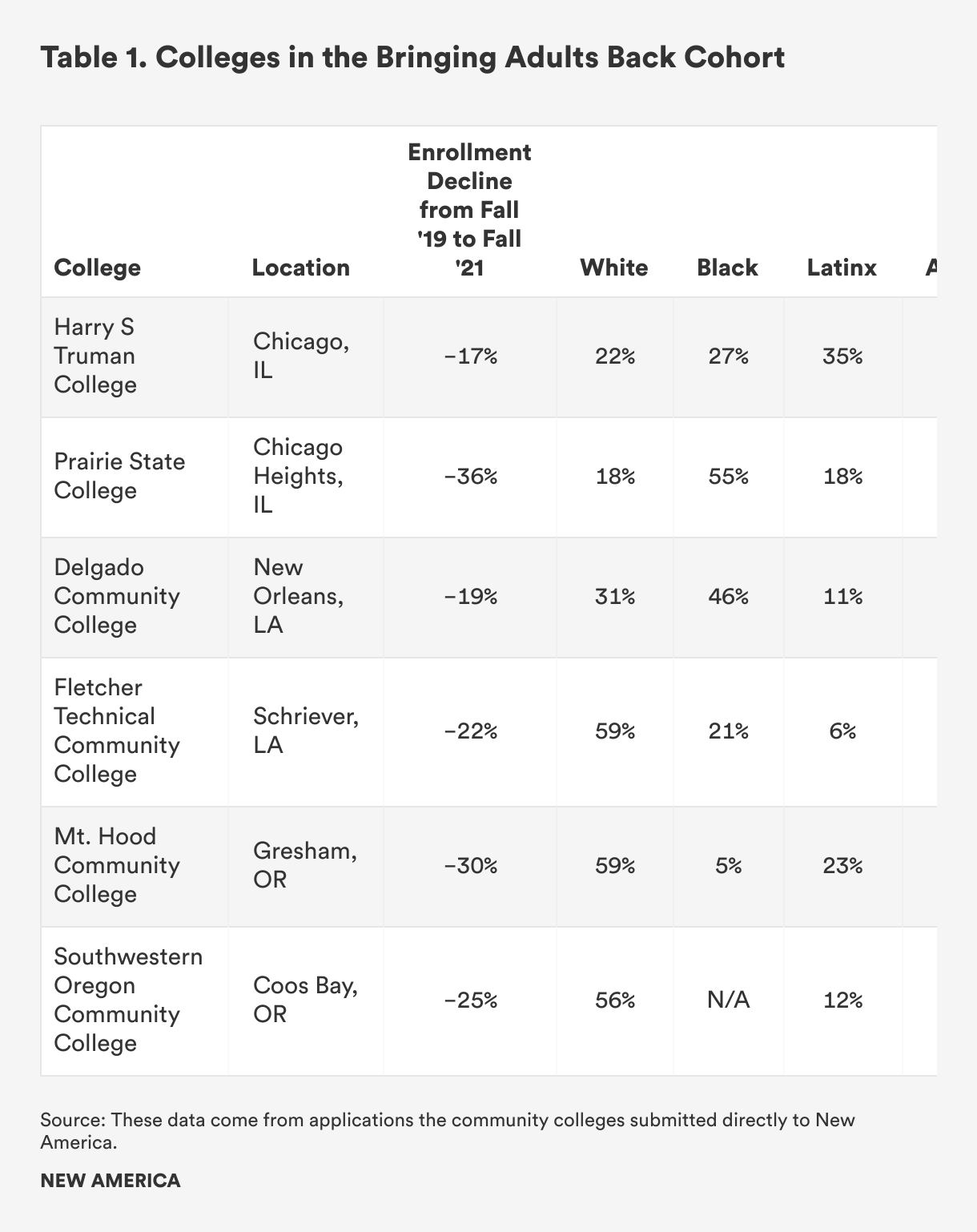
The colleges in this cohort are:
City Colleges of Chicago—Harry S. Truman College
Operating as one of the City Colleges of Chicago, Harry S. Truman College is one of the seven colleges that comprise the City Colleges of Chicago system. Truman is one of the most diverse colleges in the system, with students hailing from over 150 countries. Truman offers several instructional programs, including semester credit, adult education, and continuing education. The college is designated a Hispanic serving institution (HSI), with 35 percent of Truman semester credit students identifying as Latinx, 27 percent identifying as Black, 22 percent identifying as White, and 11 percent identifying as Asian. Truman also serves a diverse student body in terms of age, with nearly half of the semester credit students over the age of 25.
Because Truman is part of a community college system, it lacks the authority to implement changes to its policies and procedures. Many of the major policies and procedures, including changes to the satisfactory academic progress (SAP) process, are set at the district level and implemented at all seven City Colleges. Truman needs to coordinate extensively with the district office before tweaking policies.
Prairie State College
Situated 30 miles south of Chicago in Chicago Heights, Illinois, Prairie State College has experienced significant enrollment declines since the onset of the COVID-19 pandemic. Over 55 percent of Prairie State students are Black or African American—making the college a predominantly black institution (PBI)—and the college’s leadership is committed to advancing the well-being and educational outcomes of these students. Prairie State College entered this project after a challenging experience with COVID-19, enrollment declines, and staff turnover.
Mt. Hood Community College
Located in the Portland, Oregon metro area, Mt. Hood Community College in Gresham, Oregon continues to face challenges from the ongoing COVID-19 pandemic. Like other colleges did in spring 2020, Mt. Hood pivoted to virtual learning, but by the spring 2022 term, it was still operating on a primarily virtual basis.
Nearly 60 percent of Mt. Hood students are White and 23 percent are Latinx, and the college strives to foster an inclusive campus culture. Due to its efforts to systematically address racism, poverty, and language barriers, Mt. Hood received a national equity award from the Association of Community College Trustees in 2021.7
While Mt. Hood has experienced significant enrollment declines each term since the start of the pandemic, the college has prioritized serving adult students’ holistic needs in order to both increase enrollment and foster educational equity.
Southwestern Oregon Community College
SWOCC is a rural college located in Coos Bay, Oregon. Situated more than 220 miles south of Portland, SWOCC experiences many of the challenges facing rural colleges across the country.8 SWOCC is more than 120 miles away from the nearest four-year university, and about 90 miles from the closest two-year college, which makes it the only traditional higher education option for people from the surrounding communities who want to attend college close to home.
Despite its history as Oregon’s oldest community college,9 SWOCC finds itself at a crossroads: enrollment has significantly declined10 since the onset of the COVID-19 pandemic and members of the community often question the value of higher education. SWOCC’s leadership and staff feel a deep commitment not only to educate their students, but to help drive economic mobility and opportunity throughout their community.
Delgado Community College
Delgado Community College in New Orleans, Louisiana, is an urban college with multiple campuses throughout the city. A designated PBI, nearly half of Delgado’s students identify as Black or African American. In 2022, Delgado’s chancellor, Larissa Littleton-Steib, was recognized as a President for Latino Student Success by Excelencia in Education.11
While Delgado experienced greater enrollment declines since the start of COVID-19 than the national average, it has successfully launched multiple initiatives that it believes will increase enrollment. However, the college has also struggled with a large number of fraudulent applicants, which has plagued the Louisiana Community and Technical College system.12
Fletcher Technical Community College
Sitting on a low-lying road in Schriever, Louisiana, Fletcher Technical Community College is a rural college roughly 65 miles southwest of New Orleans. While Fletcher struggled with enrollment due to COVID-19, the college—like the rest of Terrebonne Parish13—was devastated14 by Hurricane Ida, which destroyed businesses, homes, schools, hospitals, and neighborhoods between August 29 and 30, 2021. Across southeast Louisiana, communities—even those not directly hit by the storm—were without power for weeks,15 if not months. While the rest of the country debated mask requirements and how schools could safely operate in the second year of a global pandemic, in southeast Louisiana, life was organized around hurricane recovery. Schools were closed and jobs were lost not because of public health guidance, but because of damage to the electrical grid and the destruction of many buildings.
Fletcher and the rural, predominantly White, communities it serves, face significant challenges recovering from both Hurricane Ida and COVID-19. As the college strives to increase enrollment of adult students, it also recognizes the significant economic, health, and housing needs of its community. Fletcher opened its campus as a hub of hurricane recovery, and it increased its basic needs support for students and is now poised to better enroll and serve adult learners.

Citations
- Mt. Hood Community College (website), “Anti-Racism and Poverty Efforts Gain MHCC National Equity Award,” news release, October 20, 2021, https://mhcc.edu/MHCC-National-Equity-Award/.
- Chris Geary, “Rural Colleges Need to Engage Their Communities to Serve Adults,” EdCentral (blog), New America, July 5, 2022, https://www.newamerica.org/education-policy/edcentral/rural-colleges-need-to-engage-their-communities-to-serve-adults/.
- Mitzi Loftus, “Southwestern Oregon Community College,” The Oregon Encyclopedia, April 25, 2022, https://www.oregonencyclopedia.org/articles/southwestern_oregon_community_college/.
- Chris Geary, “These Community Colleges Are Working to Bring Adults Back to Campus,” EdCentral (blog), New America, February 15, 2022, https://www.newamerica.org/education-policy/edcentral/bring-adults-back-to-campus/.
- Excelencia in Education (website), “Presidents for Latino Student Success,” https://www.edexcelencia.org/leadership/presidents-latino-student-success.
- United States Department of Justice (website), U.S. Attorney's Office, Eastern District of Louisiana, “St. Bernard Parish Man Admits to Student Aid Fraud of over $74,000,” press release, October 6, 2022, https://www.justice.gov/usao-edla/pr/st-bernard-parish-man-admits-student-aid-fraud-over-74000.
- Dan Copp, “'Everything We Thought It Was Going to Be and More': Terrebonne, Lafourche Assess Ida's Damage,” Houma Courier, August 30, 2021, https://www.houmatoday.com/story/news/2021/08/30/hurricane-ida-path-destruction-terrebonne-lafourche-louisiana/5650773001/.
- Chris Geary, “Merging ‘Twindemics’: The Storm after the Disaster,” The Thread (New America blog), April 5, 2022, https://www.newamerica.org/the-thread/merging-twindemics-the-storm-after-the-disaster/.
- Sophie Kasakove, “Three Weeks after Hurricane Ida, Parts of Southeast Louisiana Are Still Dark.” New York Times, September 18, 2021, https://www.nytimes.com/2021/09/18/us/ida-louisiana-power-outages.html.