A Chapter of: Bringing Adults Back to Community College Playbook
Introduction
Community college enrollment has significantly declined in the United States since the start of the COVID-19 pandemic. Between the spring 2020 term and the spring 2022 term, nationwide community college enrollment declined by nearly 17 percent.1 This troubling trend has poses a threat to the well-being of community colleges and the students they serve, which includes more than half of all undergraduate students from low-income families.2 Because of this, community college enrollment declines threaten to worsen educational inequities.3
Community colleges play an important role serving adult learners. In 2019, more than 1.7 million students over the age of 25 were enrolled at public two-year colleges.4 A group of students disproportionately composed5 of people of color and people with low incomes, adult students have experienced enrollment declines that have been larger at community colleges than in any other sector of higher education.6
To help address this problem, the Center on Education & Labor at New America partnered with six community colleges in three states to help reenroll adult students who have stopped out of college since the beginning of the COVID-19 pandemic. These colleges are:
- Harry S. Truman College—one of the City Colleges of Chicago
- Prairie State College
- Southwestern Oregon Community College
- Mt. Hood Community College
- Delgado Community College
- Fletcher Technical Community College
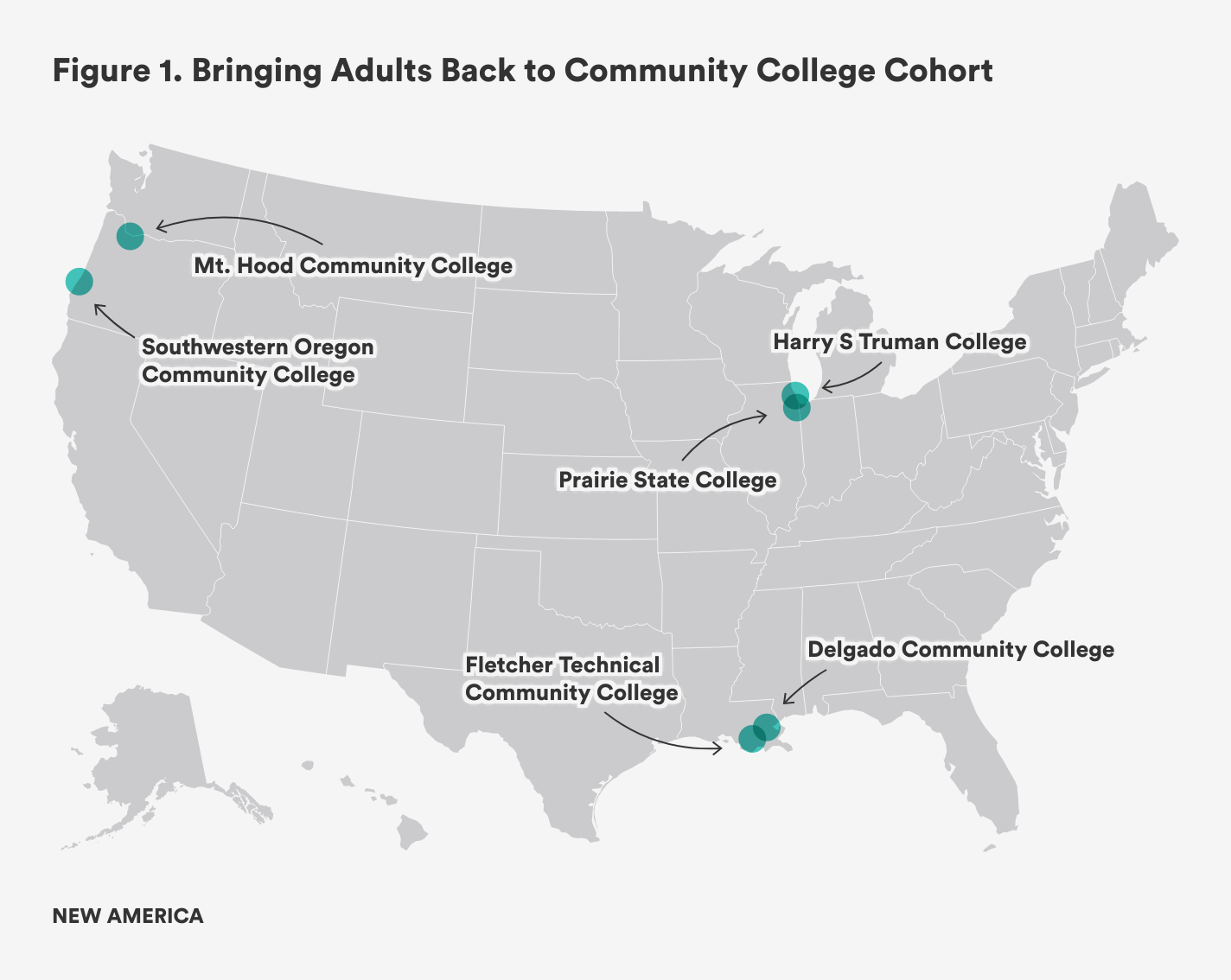
These schools serve those in rural, urban, and suburban settings, differ dramatically in size, and face different state and local contexts that impact their ability to enroll, and adequately serve, adult students. But all six faced enrollment challenges, which allowed us the opportunity to unpack trends that may affect the community college field more broadly.
This playbook contains the findings of New America’s work with the Bringing Adults Back to Community College cohort. Designed to help community colleges across the country navigate enrollment challenges for adult learners, this playbook contains suggestions to help institutions address the most pressing issues facing adult students.

Citations
- National Student Clearinghouse Research Center, “Overview: Spring 2021 Enrollment Estimates,” 2021, https://nscresearchcenter.org/wp-content/uploads/CTEE_Report_Spring_2021.pdf.
- National Center for Education Statistics, Young Adult Educational and Employment Outcomes by Family Socioeconomic Status (Washington, DC: U.S. Department of Education, Institute of Education Sciences, 2022), https://nces.ed.gov/programs/coe/indicator/tbe.
- Chris Geary, “Community College Enrollment Declines Threaten to Worsen Educational Inequity.” EdCentral (blog), New America, January 25, 2022, https://www.newamerica.org/education-policy/edcentral/community-college-enrollment/.
- National Center for Education Statistics, “Student Enrollment: How Many Students Ages 25 and over Enroll in Postsecondary Institutions in the Fall?”, U.S. Department of Education, National Center for Education Statistics, Integrated Postsecondary Education Data System (IPEDS) 2022, https://nces.ed.gov/ipeds/TrendGenerator/app/build-table/2/8.
- Vincent Palacios, Chris Geary, Casey Goldvale, and Laura Tatum, Obstacles to Opportunity: Increasing College Success by Understanding & Addressing Older Students’ Costs Beyond Tuition, Georgetown Center on Poverty and Inequality, April 2021, https://www.georgetownpoverty.org/wp-content/uploads/2021/05/CBT-Obstacles-to-Opportunity-Report-May2021.pdf.
- National Student Clearinghouse Research Center (website), Current Term Enrollment Estimates: Fall 2022 Expanded Edition, February 2, 2023, https://nscresearchcenter.org/current-term-enrollment-estimates/.