Introduction
"Belonging means more than just being seen. Belonging entails having a meaningful voice and the opportunity to participate in the design of social and cultural structures. Belonging means having the right to contribute to, and make demands on, society and political institutions.”
– john a. powell
Our country is at an inflection point to rethink how we govern. The murder of George Floyd and the devastation of the pandemic served as violent and stark reminders that politics as usual will not lead to a healthy multiracial, multiethnic democracy. Faced with historic social inequalities and distrust in political institutions, there has been growing public demand for sweeping changes at all levels of government.
On his first day in office, President Joe Biden responded to this demand by signing an executive order on advancing racial equity. The historic order called for equity impact assessments for the federal government and national government agencies. Two years later, the Biden administration signed a second executive order reaffirming and updating its promise to advance racial equity in the federal government. The second order emphasized the importance of partnering with communities early in the policymaking process to deliver better outcomes. During this same time period, Congress passed the Inflation Reduction Act (IRA) and the Infrastructure and Investment Jobs Act (IIJA), which introduced new funding sources that specifically incentivize local governments to implement meaningful community engagement aimed at creating more equitable policies. For example, under the IRA—which represents the largest climate spending bill in U.S. history—the Environmental Protection Agency (EPA) is providing states with funding to engage low-income and disadvantaged communities in the development of climate action plans. Similarly, the IIJA offers funding for local transportation planning that supports public participation. Together, these policies call for a sustained commitment to reorient and modernize federal agencies to better serve the needs of communities that have been traditionally underserved by government.
Embedding equity from the beginning of a policymaking process requires that we fundamentally transform our political structures. It is not enough to simply mobilize around electoral cycles, rather we need a methodology for building a more inclusive civic voice into the very fabric and design of policy. An ultimate goal of these public engagement initiatives is to understand policymaking itself as a vehicle for power, building in hooks and levers which hold decision makers to account while also creating channels for more effective, equitable, and responsive policy. Rather than engaging community members as lip service after decisions have already been made, collaborative governance offers a pre-decisional opportunity for local governments to partner with communities to start the conversation, set the agenda, and build deliberative structures.
Collaborative governance or “co-governance” is one piece of a larger policy framework toward achieving the systemic change this country so desperately needs to build a multiracial, multiethnic democracy. Co-governance refers to a range of models, such as citizen assemblies and participatory budgeting, that enable people inside and outside of government to work together in designing and implementing policy. These models invite people most impacted by problems in their community to help design the solution. More than a one-off transaction for public input, successful models of co-governance facilitate generational relationships between communities and government building civic power and transform government functions to work for more than just the elite few.
Co-governance models furthermore have the potential to create more equitable structures for governing by building channels for BIPOC and rural communities to impact policymaking from the earliest stages. The historic executive orders advancing equity through the federal government over the last two years present an opportunity to explore models of policy implementation and inclusive decision-making at all levels of government. Brookings Metro and the Institute on Race, Power and Political Economy at The New School recently released a report gauging the progress that has been made to address social and racial inequality in the United States. The report found that there is a critical need to consider equity not only for assessing policy outcomes but also for assessing how the policy is created in the first place. PolicyLink, a national research and action institute advancing racial and economic equity, published a Racial Equity Governing Agenda that calls for institutions to partner with the people who are often excluded: “To make the government more equitable, federal leaders must engage the very groups that have historically been left out of shaping our government’s institutions. This requires building trust, engaging leaders, and ensuring the public has a voice.” A co-governance methodology can be one component toward building a racial equity governing framework.
With unprecedented federal dollars flowing to communities, we have a once-in-a-generation opportunity to leverage federal dollars to remake the relationship between people and their public institutions. While participation at the national level presents challenges of scale, the practice of participatory governance at the local and state level has evolved dramatically in the last two decades, and the lessons of participatory and deliberative experiments include participatory budgeting, citizen assemblies, and less formalized methods of non-adversarial engagement between organized citizens and agencies of government.
Community organizations, advocates, neighborhood leaders, and local governments from across the United States and abroad have been pushing for and experimenting with models of co-governance ranging from citizen assemblies, participatory budgeting, public banks, and community land trusts, as well as a range of digital tools such as Decidim, Pol.is, Front Porch Forum, and vTaiwan that can be used to support co-governance models. Multiple research initiatives are advancing the conversation on co-governance, including DemocracyNext’s international action institute dedicated to supporting innovative models of civic participation and Race Forward and Partners for Dignity & Rights’ report detailing co-governance models from across the country led by communities of color. These tools and resources are breaking down systemic barriers between government and the people and breathing new life and ideas into civic institutions.
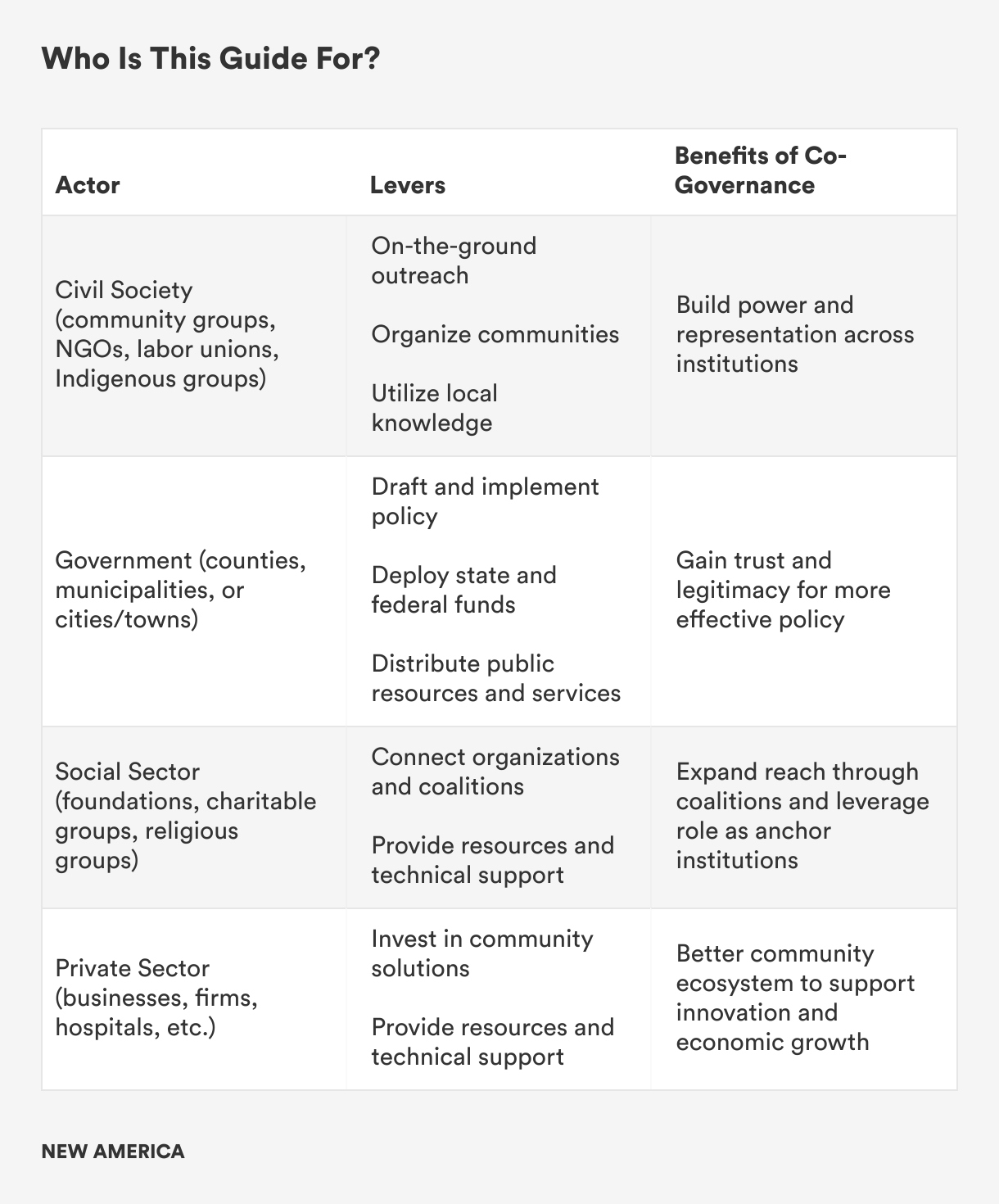
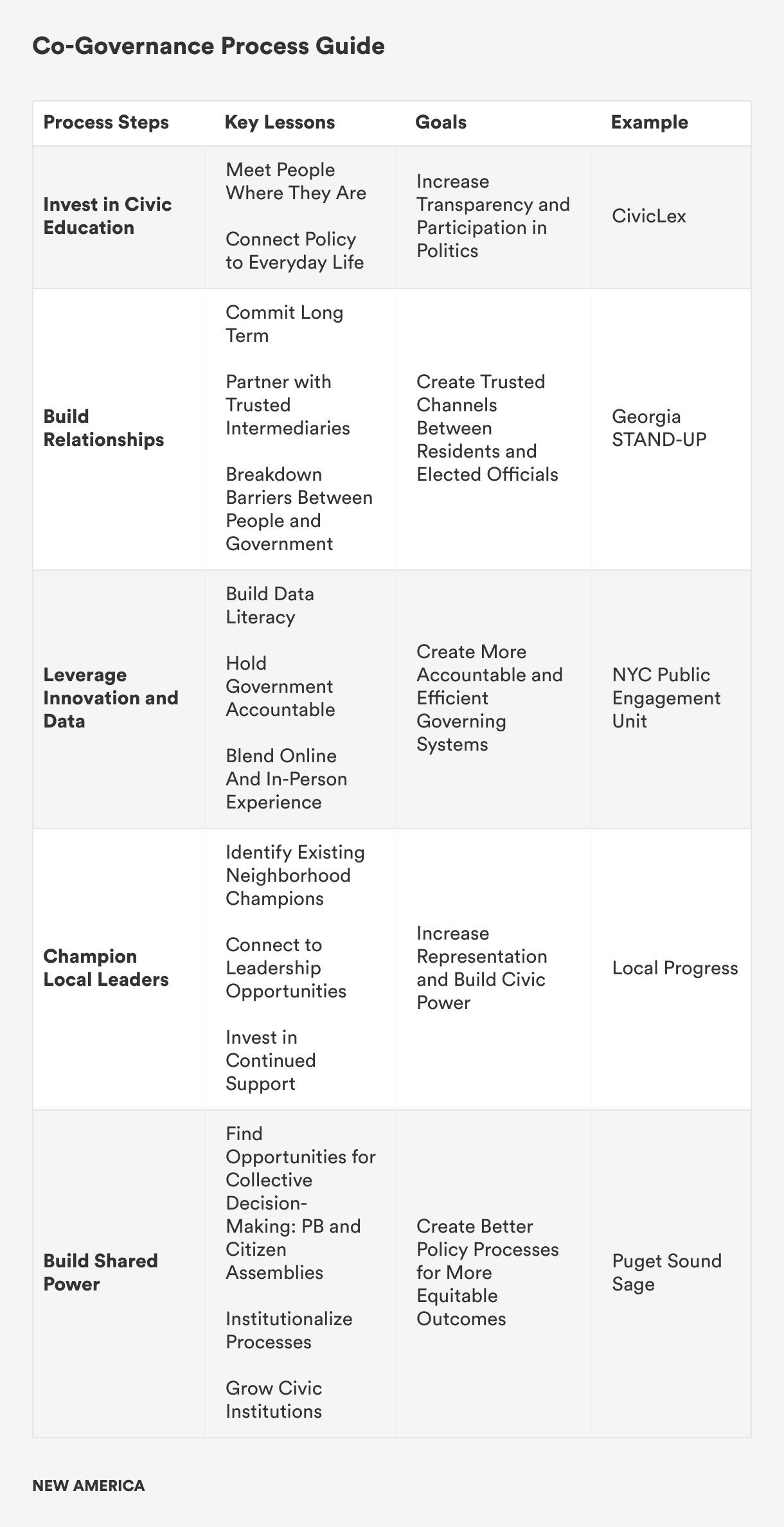
Of course, deploying these models is not easy or automatic. Each case provides lessons for building effective collaboration between communities and politicians and redistributing political power—not only lessons on what works but also what does not. We seek to distill and elevate these lessons and best practices into a toolkit to help local leaders navigate co-governance in their communities.
Drawing from New America’s research on collaborative governance and the future of institutions—which includes a series of case studies with community organizations and local governments across the country—this toolkit lays out a process for implementing co-governance strategies at the local level.