More Parties, Better Parties
Abstract
Political parties are the central institutions of modern representative democracy. They must also be at the center of efforts to reform American democracy. To redirect and realign the downward trajectory of our politics, we must focus on political parties. We need them to do better. And in order to create better parties, we need more parties.
This paper makes the case for pro-parties reform both generally, and then for two specific reforms that would center parties: fusion voting and proportional representation. Fusion voting allows for multiple parties to endorse the same candidate, encouraging new party formation. Proportional representation ends the single-member district, making it possible for multiple parties to win seats in larger, multi-member districts, in proportion to their popular support. The goal of these reforms—fusion in the short and medium term and proportional representation in the long term—is to move us toward a more representative, effective, and resilient democracy for the twenty-first century.
Audiobook: More Parties, Better Parties
Listen to More Parties, Better Parties—narrated by author Lee Drutman.
Acknowledgments
This report has benefited from very helpful comments from Daniel Cantor, Sean Soendker Nicholson, David Palmer, Sasha Post, Oscar Pocasangre, Joel Rogers, Mark Schmitt, Micah Sifry, Daniel Stid, Maresa Strano, Cerin Lindgrensavage, Jennifer Dresden, Beau Tremitiere, Grant Tudor, and Farbod Faraji. Thanks also to Maresa Strano, Lizbeth Lucero, Joe Wilkes, Jodi Narde, and Naomi Morduch Toubman for their editing and communications support.
Finally, I would like to thank Additional Ventures for its generous support of the Political Reform program’s research on multiparty democracy.
Downloads
Executive Summary
The crisis of American democracy has been long in the making, and its causes are many. As it has steadily worsened, the crisis has tipped into a spiral, or doom loop, that cannot correct itself. Structural reform has become necessary.
Starting from this premise, this paper argues that we need a system-level solution to what has become a system-wide problem. And at the center of our political system, we find the two most crucial institutions that organize and structure our democracy—the Republican Party and the Democratic Party.
Political parties are the central institutions of modern representative democracy. They must also be the center of reform efforts. To redirect and realign the downward trajectory of American politics, we must focus on political parties. We need them to do better. And in order for them to do better, we need more than two of them.
It may seem obvious that system-level problems cannot be solved by incremental changes. Yet, for years, existential threats to American democracy have been met with small, candidate-related tweaks that have largely failed to alter the trajectory. Rather than continue to focus on bad actors or extremist individuals, then, we must understand the way in which the entire system empowers and elevates the worst instincts in political leaders, who in turn stoke the most irrational fears among citizens. We must understand how this extremism follows from the toxic combination of an anxious uncertainty and a confrontational us-against-them binary fight for total power.
The good news is that the roiling crisis has driven more attention and support toward political reform. But that attention has also brought expanding ideas and proposals of varying quality. Different reforms tackle the problem at different levels, but none are entirely new. Therefore, history offers important lessons about which types of reforms are most likely to be successful and sustainable, and which approaches are typically feeble and fast-fading.
Many proposals focus primarily on candidates and, in particular, elevating independent and moderate candidates in the immediate term. These “candidate-centric” reforms include open primaries, top-two primaries, ranked-choice voting, and blanket primaries that send the top four or five finishers regardless of party to a ranked-choice general election. This category of “candidate-centric” reforms views political parties as obstacles to good governance and see the task of reform as finding a clever way around the perceived destructiveness of parties and especially partisanship. Though these candidate-centric reforms can sometimes work in targeted circumstances, this paper argues that such productive circumstances are limited. More broadly, this paper argues that in addition to having mixed and uncertain immediate-term effects, these candidate-centric reforms are unlikely to have sustainable long-term positive effects, because they do not address the core questions of the political party system.
Instead, this paper makes the case for pro-parties reforms both generally, and specifically for two powerful pro-parties reforms: fusion voting and proportional representation. Fusion voting allows for multiple parties to endorse the same candidate, encouraging new party formation. Proportional representation ends the single-member district, and makes it possible for multiple parties to win a proportional share of representation in larger, multi-member districts. The goal of these reforms—fusion in the short and medium terms, and proportional representation in the longer term—is to move us toward a thriving multiparty democracy in which healthy political parties perform the crucial functions essential to modern representative democracy, with less of the us-against-them, all-or-nothing, high-stakes uncertainty that sabotages self-governance.
Healthy parties aggregate long-term policy commitments among diverse groups. Healthy parties communicate the consequences of these policies to voters at scale. Healthy parties make elections meaningful and consequential by structuring choices. Healthy parties engage and mobilize voters. Healthy parties vet and support qualified candidates for public office. Healthy parties assemble governing majorities and broker compromises capable of solving public problems. These are all essential functions of modern democracy. No other organization can do all these things simultaneously or at scale.
Healthy parties perform all these roles with honesty and integrity. Healthy parties do not lie to voters. Healthy parties do not engage in corruption. Most importantly, healthy parties adhere to the basic foundations of democracy—mutual toleration (accepting the legitimacy of political opponents) and forbearance (holding back from abusing legal powers). Healthy parties police extremism and authoritarianism in their ranks. Healthy parties do not dehumanize their political opponents or tolerate violence, let alone endorse it. Healthy parties accept electoral defeat with grace, and electoral victory with humility.
Understandably, both U.S. parties are not living up to these standards. This is because a polarized two-party system creates many perverse incentives both between and within the two major parties. A two-party system also shuts out new entrants and thus limits innovative new models of party organization. Instead, reformers are left with the difficult and unsustainable tasks of retrofitting old, aging parties, or finding ways around parties altogether.
The case for pro-parties reform may seem counterintuitive, since it cuts against the American reform tradition, which is decidedly anti-party. It may indeed feel paradoxical to call for more parties as the solution to hyper-partisan division. But as this paper will make clear, the anti-party reform tradition has repeatedly failed in its goals of achieving a more representative and responsive government. Political parties have survived efforts to marginalize them, but only by becoming less transparent and less accountable.
This paper will describe the history of these anti-party reform efforts and why they have failed. It will cover the crucial democracy reform episodes of the 1830s, 1900s, and 1960s. Each of these reform periods involved devolving authority ever closer to “the people.” But each of these reform periods failed to understand that collective organization is the key to citizen power. Each of these reform periods assumed an idealized “democratic wish” of independent citizen participation, spontaneous candidate emergence, and large-scale deliberative governance at odds with the scale and scope of modern democracy.
The repeated lesson, however, is that only powerful interests have the organizational resources to navigate the proliferating participatory entry points. Yet, once again, many democracy reformers see political parties as failing. And once again, many reformers are attempting to find ways around political parties by focusing on candidate-centric reforms. History shows that these reforms are unlikely to succeed beyond temporary gains, and even these gains may not exist.
In calling for pro-parties reform, this paper argues that we must see our crisis at a system level. A system-level crisis cannot be fixed by incremental changes. We must address the root causes. Rather than taking buckets to a flood, we must fix the entire stormwater management system.
Pro-parties reform will not solve everything. More parties and better parties are not an end in themselves. They are the mechanism through which we can have a healthy, representative democracy with a fighting chance of solving more difficult and pressing problems, such as climate, the dominance of big money in our politics, AI’s impact on the economy, and whatever else the world throws at us in the decades to come.
Given that we are in an emergency, with too many seemingly willing to abandon the rule of law for short-term power, it is reasonable to try many things at once. But we cannot try everything. We must act prudently. For reforms to achieve long-term success, they need to be thoughtfully planned. Experience and a wealth of political science research show that reforms solely targeting candidates while sidestepping parties are neither sustainable nor effective. These types of reforms draw backlash and may not even work in the short term.
Pro-parties reform is both practical and tactical. Fusion is an immediate solution to extremism. It creates an opportunity for moderates to form a constructive party that won’t spoil elections or waste votes. Such a party, which cross-endorses major party candidates, can act as an off-ramp for those who are disgusted with the extremism in their own party but are not fully ready to vote for the other major party. Voting for a moderate party offers a way to signal this view and to form a new identity. The major parties would need to moderate to compete for those votes.
Longer term, more parties can mean a more fluid and responsive political system, capable of realigning, with space for new innovative parties. The proposal here is for modest multipartyism through proportional representation, aiming toward five or six parties—enough to provide diverse representation, but not so much as to make governing fractious and voting confusing. A sweet spot does exist.
Though the status quo feels locked in, historically, it is precisely the moments when the status quo feels locked in that major change is most likely. This is because rigidity and brittleness are the same.
Change always happens two ways: slowly, then all at once. This is especially true in the U.S. party system, because a two-party system offers few release valves. Instead, pressure builds and builds.
The signs are powerful that U.S. democracy is now entering a fourth significant period of reform. Though still early, increasing interest in structural change is real. During the initial phases of a reform period, it’s critical to be rigorous about the institutional legacy we wish to pass on. Yet, given the clear democracy emergency alongside this opportunity, it is sometimes hard to think straight. It is easy to rely on the near past. It is harder to learn from the more distant past. Perhaps the greatest challenge in moments of deep pessimism is imagining a different, better future.
Yet we must retain some optimism. We must see that the urgency of combating extremism is equally a chance to build a more representative, effective, and full democracy for the twenty-first century. There are no shortcuts. If we succeed, it will be only because we did the hard work to make more and better parties possible.
Introduction: The Case for More and Better Parties
American democracy is in crisis. The basic foundational agreements of legitimate opposition and neutral elections are in shambles. Partisans view each other as the nation’s top threat, surpassing even foreign adversaries. Each election, we are told, the soul of the nation is at stake: Will America remain a democracy?1 Will America remain “America”?2
Such high-stakes uncertainty atop repeated us-versus-them conflict is a proven driver of political extremism.3 In moments of uncertainty, humans are drawn to demagogic extremism to restore order. Close binary conflict lights up our ancient in-group versus out-group threat circuits, and leads us away from cooperation and compromise and toward violence.
Yet amid rising extremism—or perhaps more accurately, because of it—the possibility for electoral reform expands. More people recognize the problem is bigger than any individual actor. The problem is the party system itself. And it is not self-correcting. Instead, it is self-reinforcing; a “doom loop.”
As the enthusiasm surrounding electoral reform intensifies, we're witnessing, for the first time in generations, a tangible opportunity for a revitalized, more inclusive, and responsive system of self-governance to emerge.
Paradox pervades this possibility. Reform feels feasible precisely because the status quo feels so unstable. Big political change travels with rising radicalism and extremism. Indeed, there are many good reasons to believe the United States is entering its fourth great era of democracy reform. As with the previous reform eras (the 1830s, the 1900s, the 1960s), a high-stakes moral passion animates politics. Engagement hits new highs. Antisystem sentiments and institutional distrust prevail among the general public.4
We must act. The threats and uncertainties are real, self-reinforcing, and worsening. Uncertainty breeds extremism. Extremism breeds uncertainty. Many actors in American politics now openly espouse views antithetical to pluralist, liberal democracy. They remain on the cusp of winning unified control in Washington, DC. The stakes are high. Democracy may not survive.
The pressing task at hand is to thwart extremists from seizing governmental power. In the near term, this entails sidelining those with authoritarian inclinations who seek to penalize their adversaries, curtail civil liberties, and manipulate electoral regulations into a permanent advantage.
The long-term challenge is to minimize the allure and influence of these illiberal forces, limiting their power and access for generations to come. This is more difficult. It demands understanding the reasons illiberal, extremist forces have gained such traction in contemporary American politics.
This paper advances an argument that such extremist forces are a product of the party system—in particular, our hyperpolarized, nationalized two-party system. Therefore, only a system change can address the threat of extremism and democratic breakdown. Because political parties are the central organizing institutions of modern democracy, no change is possible without changing the political parties.
The core problem is that a system so deeply divided by geography, identity, and culture has catalyzed a zero-sum, us-against-them mode of political conflict that feeds on itself. This dominate-or-be-dominated partisan conflict breeds distrust, hatred, and extremism, and a predictable slide into authoritarianism.
Thus, to marginalize the dangers of extremism destroying our political system, we must address the core of the problem: the two-party doom loop.
The “rotten at the core of the party system” is a familiar trope in American political reform. In every era of reform, leading activists have railed against the evils of the party system. The traditional American reform move has been to treat political parties, particularly party leadership, as an obstacle to democracy in America. The classic reform move in every era has thus been a variation on the same theme: more direct democracy. In each era, reformers have sought a way around parties.
But there is no way around political parties in modern mass democracy. Improving democracy hinges on robust political parties. Rather than treating political parties as obstacles to healthy democracy, this paper treats political parties as facilitators of healthy democracy. Political parties make modern representative self-governance possible.
We need better parties. By better, I mean parties that can honestly and effectively carry out the essential activities that parties perform in modern democracy. Thus, effective and representative governance in modern democracy requires better parties.
Here, it is crucial to clarify: Political parties are a means to better governance. Political parties are the infrastructure of modern mass democracy just as roads and bridges and railways and airports and electricity grids are the infrastructure of a modern economy. If we want better roads and bridges, it is not merely because we enjoy driving. Rather, we say we want better infrastructure because of what else it makes possible—a thriving economy not bogged down by potholes and closures and traffic snarls. In the same way, we want better political parties not for their own sake, but for the sake of a healthy representative democracy that improves the collective welfare of everyone. Like roads and bridges that connect citizens across the country to the larger economy, parties are the institutions that connect citizens to the government. When they function poorly, many citizens feel disconnected and isolated.
“We want better political parties not for their own sake, but for the sake of a healthy representative democracy that improves the collective welfare of everyone.”
Healthy parties perform numerous essential functions. They aggregate long-term policy commitments among diverse groups and communicate the consequences of these policies to voters at scale. They make elections meaningful and consequential by structuring choices. They engage and mobilize voters. They vet and support qualified candidates for public office. Healthy parties assemble governing majorities and broker compromises capable of solving public problems.
Healthy parties perform all these roles with honesty and integrity. Healthy parties do not lie to voters. Healthy parties do not engage in corruption. Most importantly, healthy parties adhere to the basic foundations of democracy—mutual toleration and forbearance.5 Healthy parties police extremism and authoritarianism in their ranks. Healthy parties do not dehumanize their political opponents or tolerate violence, let alone endorse it. Healthy parties accept electoral defeat with grace, and electoral victory with humility.
Healthy parties take a longer view than individual candidates and know that they will be held accountable by voters, whether they are in the majority or the minority in a particular governing institution. They don’t expect total, permanent power, but they hope to achieve at least some of their policy goals in any circumstance.
Healthy parties do not mean perfect parties. As with other institutions in society—corporations, universities, hospitals, nonprofits, etc.—institutional quality exists on a continuum. Institutions change. Leadership matters. Culture matters. Personnel matters.
Yet the system itself matters. Our polarized, nationalized two-party framework results in parties entrenched in relentless conflict, producing limited options and repercussions from intense competition. Politics is an ecosystem. If the temperature is too high, the ecosystem collapses.
A multiparty system creates multiple parties that exist in more dynamic competition and cooperation. This environmental variable is the crucial shaping factor for the quality of parties. In a multiparty system, party quality will certainly vary. It should. But more competition means that new parties can emerge when mainstream parties falter.
Understandably, advocacy for better parties can feel hollow when hyperpartisanship is such a core democratic crisis. Our existing party system is undoubtedly spiraling into disaster. But we cannot do modern democracy without parties. So we must build better parties, not abandon parties altogether. We need vibrant competition for representation and effectiveness. A genuine multiparty democracy—the proper environment for better parties to emerge—is unlikely to take hold immediately. Our two-party system is the product of existing single-winner election formulas that discourage third parties by rendering them as spoilers and wasted votes. The two-party system is also buttressed by other rules that punish smaller parties, such as anti-fusion and ballot-access laws, which major parties have put in place to protect their dominance.
Altering these rules takes time. But momentum for structural reform is increasing. In the meantime, we must do what we can, where we can. We can take buckets to the flood to hold off the worst damage right now while recognizing that we must also repair the stormwater management system.
Elevating more moderate representatives over extremists in the short-term can keep the extremists out of power. Several reform approaches can accomplish this goal, to varying degrees. Some may work better under certain circumstances than others. All may buy us a little time. We must carefully consider which reforms can yield immediate results while also contributing to long-term stability. A short-term fix that comes at the cost of long-term stability is counterproductive.
The core argument of this paper is that long-term democratic stability will require more political parties and better political parties. The contemporary rise of political extremism and the threats to our democracy are consequences of a failed party system.
We cannot have a functioning, representative, participatory democracy without organized political parties. Political parties provide the coherence and framework of electoral choice and governing accountability. No modern democracy has ever succeeded without organized parties, and for a good reason.
Absent parties to structure and organize politics, democracy crumbles. A failing party system is a hallmark of democratic backsliding and instability. Dictators hate nothing more than organized political opposition capable of mounting any electoral challenge. One recent study of authoritarian dictatorships found that in 43 percent of such countries, only one party—the ruling party—was legal (no organized opposition). In 18 percent of such countries, parties were banned outright. Only 39 percent allowed multiple parties to exist, and even there, opposing parties were often restricted and hobbled by ruling authoritarians.6 In the Soviet Union, only one political party was allowed. In China, only one political party is allowed. A single political party—or better, no parties at all!—is a promise of unity and harmony. It is a historically false and brutal hope. Among the countries where politics is entirely nonpartisan today (because political parties are banned): Kuwait, Qatar, and Saudi Arabia.
Yet the American party system right now is plainly failing. Parties can have a dark side. To unite citizens, parties must also divide. As psychologists have long known, in-group loyalty and out-group hostility emerge from the same psychological processes of categorization. And under certain circumstances, particularly ones of high stress and high threat, and usually with active goading from above, out-group hostility can easily grow into a destructive force when partisan competition flattens into two (and only two) sides.
Because of the extremism that our current hyperpartisan party system has unleashed, and how this extremism has lodged itself deeply into the Republican Party, we face an immediate threat of illiberal extremism gaining enough power in our political system to undermine American pluralism and prosperity. We must fight this threat with all we can. When each election poses an existential threat, illiberal extremists will perpetually remain a few thousand votes from complete control. In one election, they might win. Such extended existential conflict is itself a politically radicalizing force.
Short-term reform thus focuses on managing the symptoms of a flawed system. Long-term reform readjusts the system to nurture both pluralism and prosperity, undermining the causes of extremism. Short-term reform can buy us time. But it is not a substitute for fixing a broken system.
Short-term reform focuses on the constituent parts of the larger political system, in particular politicians and voters. It focuses on elevating certain groups of voters (moderates) over other groups of voters (extremists). It focuses on elevating certain types of candidates (moderates) over other types of candidates (extremists).
Long-term reform focuses instead on the party system. It sees parties as the central organizing institutions of democracy. To change the trajectory of our democracy, we must change our party system. Both voters and politicians exist within a party system. The party system shapes their expectations and possibilities and connects them to each other. The parties are the central gravitational bodies around which everything else in democracy revolves. If dysfunctional political parties are the drivers of hyperpartisan extremism at the current moment, then more and better political parties still must be the builders and facilitators of democratic renewal.
A strong idealism pervades a vision that we can do without political parties, or at least that our political parties can be so bottom up and open that they almost fade away. This well-intentioned hope has driven a long-standing “democratic wish” in the history of American political reform that power can come directly from The People, with no form of intermediation, and especially not partisan intermediation.
This “open it all up” vision has guided previous reform attempts, which have consistently failed to resolve the inevitable problem at the heart of politics, which is that somebody must ultimately wield power. Previous reform efforts responded to real abuses of power. But power and organization are necessary parts of any political system.
This paper will document some of this history, because it is crucial that we learn from it.
First, in the 1830s, reformers smashed the centralization of party leadership in Washington, and brought presidential nominations to the states. The first modern mass parties organized in response to this decentralization. But to hold the parties together, leaders simply replaced the clubby caucus rooms of Congress with the patronage “spoils system” politics that stymied the development of American state-building capacity.
In the 1900s, progressive reformers again set their sights on party leadership, replacing party bosses with direct primaries for most elected offices, setting up “nonpartisan” government and new administrative agencies that only the “public interest” would guide. This did not solve the problem of organized interests. It only moved organized interests into the shadows, where they could, ironically, operate with less scrutiny and more power.
In the 1960s, a new generation of reformers, angered by this hidden power elite, borrowed the familiar moralizing populism. They broke open the presidential nominating process and gave it over to direct primaries, weakening political parties even further. They also took a new approach to administrative agencies, setting up new agencies as more open to the public, which would presumably act as a bulwark against the cozy corruption of government and business that the progressive reformers had failed to anticipate.
But as we enter the 2020s, we are dealing with the new problems created by excessive opening up. As parties weakened, organized interest groups became stronger and more powerful. Government agencies became hobbled by process. Organized lobbying interests have repeatedly abused the transparency and openness to delay and to undermine government regulations. Unorganized citizens have not taken the same advantage of the expanded participatory opportunities.
Yet, once again, a “more democracy” hope for expanded open and direct participation suffuses many current visions of reform. Once again, there is a theory that partisanship and parties are keeping Americans from government by the people. And if extremism has taken hold, it is only because the “wrong people” are in charge. Give “ordinary” citizens more power, the theory goes, and we’ll get better leaders because we’ll get better participation.
If we study our history, however, we recognize that this idealism does not fit the simple political reality that political power always follows political organization and political parties are the central organizers of all modern politics. There is simply no getting around this.
This paper argues for learning these lessons, and then for trying something different this time. Rather than less intermediation and more direct democracy, we need better intermediary institutions, and perhaps a little less direct democracy. We need better parties.
An argument for more and better parties is, of course, also an argument for electoral reforms that make more parties viable. In particular, it is an argument for fusion voting in the immediate term and proportional representation in the longer term.
Fusion voting allows multiple parties to endorse the same candidates on the ballot. Within a system of single-winner elections, fusion creates an opportunity for new parties to form, because a ballot line gives them some meaningful power. Proportional representation is the standard electoral mechanism in advanced democracies around the world. While winner-take-all systems punish third parties, proportional-representation systems allow for more than two parties to win seats in a legislature, because seats are proportional to vote shares. Both fusion and proportional representation build political parties. They make it possible for more parties to form and organize, thus creating an environment in which better parties can grow and thrive.
While other currently popular reforms, particularly open primaries and ranked-choice voting, may help certain more moderate candidates to defeat extremists in certain elections, they do not build toward more parties. In the short term, we should do what we can to deal with the democracy emergency. But as we think about getting out of the emergency, we must think hard about how extremism is the product of the party system, far beyond individual candidates. To change the system, we cannot get around parties. A better democracy can only come through better political parties, which at this stage in American political development will require more political parties.
The paper will proceed as follows:
- Section 1 defines the current problem. It explains how extremism is a product of the party system, and why reform that attempts to manage rising political extremism without addressing its root causes is likely to fail. It explains how to join strategies that resolve short-term emergencies with strategies that build long-term democratic resiliency.
- Section 2 details why political parties are the essential and inevitable institutions of modern mass democracy. I will explain in more detail what roles parties play and explain how we can evaluate better parties. I will also explain why parties in the hyperpolarized U.S. system are unable to perform these functions.
- Section 3 offers a guided tour of American democracy-reform history. The tour will cover the three major periods of democracy reform. In each major era, a candidate-centric, antipower ethos of democracy reform reigned supreme. Despite the best intentions of idealistic reformers, the reforms fell short because they treated political parties, and organized power more generally, as obstacles to circumvent rather than as facilitating institutions to work through.
- Section 4 assesses the current reform menu, explaining the extent to which different reform options are likely to lead to better political parties. This section divides reforms into candidate-centric reforms likely to preserve the two-party system (open primaries, ranked-choice voting) and party-centric reforms likely to make space for more parties (fusion and proportional representation). Following the logic of this paper, we should consider fusion and proportional representation as the most powerful electoral reform paths.
Citations
- President Barack Obama, Address at 2020 Democratic National Convention, (Philadelphia, August 19, 2020); President Joe Biden, “Remarks by President Biden on Standing up for Democracy,” (Washington, DC, November 2, 2022). Barack Obama’s 2020 Democratic National Convention speech put the stakes plainly: “Because that’s what’s at stake right now. Our democracy.” He said that the Trump administration “has shown it will tear our democracy down if that’s what it takes to win.” In 2022, before the midterms, Joe Biden similarly clarified the stakes with a speech in which he said, “Make no mistake: Democracy is on the ballot.”
- Vice President Mike Pence, Address at 2020 Republican National Convention, (Fort McHenry, Baltimore, August 26, 2020). Mike Pence’s Republican National Convention speech argued that: “In this election, it is not so much whether America will be more conservative or more liberal, more Republican or more Democrat. The choice in this election is whether America remains America.”
- J. M. Berger, Extremism (Cambridge, MA: MIT Press, 2018).
- Samuel P. Huntington, American Politics: The Promise of Disharmony (Cambridge, MA: Belknap Press, 1983).
- Steven Levitsky and Daniel Ziblatt, How Democracies Die (New York: Crown Publishing, 2018).
- Milan W. Svolik, The Politics of Authoritarian Rule (Cambridge, MA: Cambridge University Press, 2012), 35.
1. Defining the Problem(s)
Democracy requires shared legitimacy in electoral and governing institutions, regardless of who wins and who governs. For a metastasizing share of the American electorate and a growing share of the political class, this shared legitimacy is collapsing. The other party is not the opposition anymore. It is now the enemy and a threat to the well-being of the nation. They must be kept out of power at all costs. Such thinking is a hallmark sign of political extremism.7
Some party polarization is healthy and normal in modern democracy. Societies are diverse. Voters benefit from meaningful alternatives. But contemporary American polarization is decidedly unhealthy. This is “pernicious polarization,” where all politics flattens into an all-encompassing us-against-them fight.8 Democracies that have experienced similar binary partisan flattenings degrade quickly, often sliding into civil war and authoritarianism.9 Addressing other concerns, such as effective governing or, say, dealing with a pandemic or a climate crisis, becomes like arranging a bookshelf amid an earthquake.
But why has our politics grown so toxic and destructive? How we diagnose and define the problem shapes how we respond. The main argument of this paper is that we have a system-level problem. A system-level problem requires a system-level solution.
Because parties are the central institutions of modern representative democracy, and the dangers follow from this partisan-identity conflict, we must alter the dynamics of this conflict. We must “break the two-party doom loop.”10 This requires re-organizing and re-orienting our party system.
This first requires adjusting how we analyze and diagnose the problem. If “extremism” threatens the democratic system (it does), we must ask ourselves: Where is this extremism originating? What is its source?
Is it coming from the politicians? It is tempting to blame “extreme” politicians because we see such politicians constantly in the news (they are the darlings of social media and click-bait journalism). But why have elected officials become too extreme?
Other explanations blame the voters, particularly the primary voters. But then why have voters, especially primary voters, grown more extreme? And what’s the connection between extreme voters and extreme politicians?
Politicians shape what voters think. Voters constrain what politicians can do and what they should prioritize. It is a recursive feedback loop. But voters and politicians are connected by a core intermediary institution: the political party. Many definitions of political parties exist in political science, but conceived here broadly to include the emergent coalition of aligned interest groups, activists, and media, as well as the politicians and the formal party apparatus.11
Political parties do not exist in isolation. Parties compete against each other. Competition shapes them, as the parties seek new strategies in response to each other.12 But voters and politicians and interest groups and activists and donors also shape parties, frequently constraining them.13
Politics is a complex system, full of dynamic patterns and interactions. The complete system is not simply the mathematical aggregate of its parts. It operates as something more, perhaps almost alive, and certainly emergent.14 The individual parts (the voters, the politicians, the parties, and other groups) are meaningless in isolation from each other. Instead, they move in an evolutionary dance with each other.
This requires a higher unit of analysis: the system. The more typical (read: publishable) academic approach is to treat voters and politicians as independent actors for robust statistical analysis.
In journalism, the more common approach is also to treat politicians as independent actors, as subjects of individual stories or characters in a drama. Similarly, to the extent voters show up, they show up as individual actors too, in diners, focus groups, or as persons-on-the street. We don’t inquire into their sources of knowledge as much.
Reformers, relying on these studies and narratives, slice the electorate into different segments of politicians and voters. Then, by an electoral tweak or two (an open primary here, a redistricting committee there), maybe they can give “moderates” a boost over “extremists.”
But who counts as a moderate? And who counts as an extremist? It feels like we should all be able to agree. But definitions quickly become subjective. People often assume that they are reasonable and grounded in reality, while their opponents are extreme and based in falsehoods.15 Perhaps the only agreement we all share is a “my-side bias.”16 So what, again, is moderation?
Absent universal truths, pluralist democracy is the best alternative for those who are not sure they are right. It is the very process of democratic contestation and public debate that helps us define the boundaries of reasonableness and extremism. If we can’t have that debate, then we can’t have democracy.
Here’s where extremism comes in: “Extremism refers to the belief that an in-group’s success or survival can never be separated from the need for hostile action against an out-group. The hostile action must be part of the in-group’s definition of success.”17 Extremists impose purity tests on their in-groups, and closely police their direct interactions with out-groups. Extremists highlight only the most negative aspects of out-groups, distorting reality into a dusky and murky funhouse mirror.
Over the last decade, we’ve seen a sharp rise in extremist behavior in American politics, particularly on the political right, with issues of race and national identity at the forefront. But again, why? Has something pushed the people into extremist anti-system thinking? What was extreme 10 years ago no longer seems so extreme today. How did so many people change what they consider acceptable? Surely, things will be different 10 years from now.
Perhaps the core problem is that extremism is not an individual-level property, but a system-level property. High levels of group polarization and high uncertainty are core drivers of political extremism.18 Closely divided, razor’s-edge elections contribute to high levels of uncertainty.
One factor unites almost all the causal processes driving polarization: “Once categorical boundaries between ‘us and them’ are drawn, a whole host of destructive social processes may kick in.”19
But try to break the causal chain apart, and everything affects everything. An exhaustive review of recent literature on political polarization found a complex web of reinforcing causal mechanisms and cognitive biases driving partisan polarization.20 A similar finding comes from the Proceedings of the National Academy of Sciences (PNAS), which recently published a “Dynamics of Political Polarization Special Feature.” The special issue brought together a mix of political scientists and complex-systems scientists to explore how many aspects of polarization have self-reinforcing dynamics. In summarizing and integrating the findings, Scott Page observed how “each type of polarization strengthens the other through feedbacks.”21
When everything reinforces everything else, Page goes on, “no sequence of small interventions will likely reverse our course.” The core problem is a flattening of dimensionality, a fancy way of saying that everything has become reduced to a single us-versus-them fight, distributed bimodally. “As a rule, a bimodal distribution for anything suggests that something strange is afoot.” Several papers in the series note bimodal distributions are almost always signs of impending collapse in many types of systems.
“So what is to be done?” Page asks. “How do we escape our current situation? First, we must be aware of why we cannot chip away at this problem. We must take substantial actions.”22
Once politics tips into this “bimodal state” (two separate distributions), small interventions become pointless. Worse, they may even be counterproductive: “Once in a polarized state, well-intentioned attempts to improve interaction between groups may increase rather than decrease polarization, by encouraging the behaviors that pull people apart…Even if we could turn tolerance up to 11, so to speak, the polarized equilibrium cannot be escaped.”23
This is a hard insight to absorb, because it suggests that much of the current playbook of just defeating “extremists” in elections is simply taking buckets to a worsening flood.
“When individuals have a say in governance and individual agency, they become less prone to the all-or-nothing mentality that drives extremism.”
Scholars of extremism come to a similar conclusion. To reduce extremism, punishing extremists is not nearly as effective as changing the environment that produces extremism. As Susan T. Fiske argues: “We can change contexts more effectively than merely by restraining bad actors, simply incarcerating or executing a few evil-doers. As long as the wrong contexts prevail, other bad actors will rise up to take their places.”24 One way to reduce extremism is to reduce uncertainty, particularly around democratic representation and personal liberty. When individuals have a say in governance and individual agency, they become less prone to the all-or-nothing mentality that drives extremism.25
McCoy and Somer make a similar point in explaining how majoritarian winner-take-all elections drive pernicious polarization.26 Indeed, a theme across multiple studies is that when crosscutting cleavages that sustain multidimensional political conflict and social relations disappear, and society bifurcates into two opposing groups, bad things happen.
These patterns are bigger than elevating certain actors over others. They are system-level properties. However, to view politics as a system means transcending the simpler solution: If only our side could secure additional victories, the opposition would inevitably concede and adopt a more moderate stance. This view has its advocates. A large industry of campaign consultants already exists to help win elections. This industry is embedded within the parties. A large industry of pollsters already exists to test campaign messages, also embedded within the parties. The righteousness of a good fight has a powerful appeal. But such thinking is precisely what drives the doom loop.
In a two-sided conflict, “myside” bias leads to excuses for extremism and antidemocratic behavior. By fixating on the dangers posed by the opposing side, we nurture the necessity of allegiance to our own camp.27 It is precisely under these conditions that partisans will tolerate antidemocratic behavior by their side, and thus perhaps unintentionally usher in illiberal authoritarianism.28
Combatting belief polarization is arduous, and political parties play a significant role here. Political parties organize identities, helping individuals see themselves as part of a larger whole, and providing a shared identity to make sense of the world.29 Being a ‘moderate Democrat’ or ‘moderate Republican’ is one thing, but identifying oneself as part of a ‘Moderate Party’ with a distinct set of values and priorities is something entirely different. Moderate Democrats are just like Democrats but less so. Moderate Republicans are just like Republicans, but less so. Moderates without a party are just disorganized and powerless dots on a scatterplot of the electorate.
Unfortunately, for those who don’t want to be pulled to extremes, no easy off-ramps exist. For strong partisans at all levels, the only option is to jump completely over to the other side. For example, Republicans who have left their party talk about how they are politically homeless, and how many of their old friends and family members have disowned them. This kind of break is rocky, and not for most people.
Without a stable middle ground, loyalty to one’s faction prevails. Offering more off-ramps allows for gradual belief adjustments, which are more likely than sudden reversals. It would also make politics crosscutting and multidimensional again, which is essential for healthy democratic functioning. Creating space for more parties would scramble the current dynamic by creating more possible political identities. More political parties would allow for flexible and incremental belief shifts that don’t involve repudiation. More parties would allow for new and shifting coalitions that can break out of the binary mindset.
System change must come through political parties—not individual politicians and voters. Political parties organize politics, not individual politicians or voters. Political parties structure the interactions of politicians and voters, and political parties interact with each other. Extremism is a product of a party system out of control. The system will not correct itself, and unorganized moderates are powerless to pull it back. Only political parties have the gravity and force to alter the dynamics. Therefore, we need more parties.
Upsetting a bimodal distribution that resists change will require considerable concentrated force. It can feel intimidating. Yet systems change is possible. All systems have a point of leverage. The two-party system in America is not an immutable law of nature. It follows from a particular set of electoral rules. Electoral rules are amenable to change.
The systems approach to politics treats politicians as actors within a larger system, adapting to the ebbs and flows of the system’s patterns and dynamics. This systems view differs from the moralistic American reform tradition that analyzes politics through individual actors, distrusts organized power, and demands full openness on the assumption that politics can operate as a true free market, just as neoliberal economists argued against regulations. The moralistic reform vision is inherently a narrative of personal responsibility and morality and individualism. It struggles with collective activity necessary to organize power and authority.
We must confront this reform tradition head on, and we will. But first we must understand what healthy and effective political parties actually do in modern mass democracy. As we will see, political parties in the United States have struggled to perform their crucial duties because of the constraints of a two-party system and past reforms that have hindered their capacities. Duopolies are not ideal in any organizational landscape.
Citations
- President Barack Obama, Address at 2020 Democratic National Convention, (Philadelphia, August 19, 2020); President Joe Biden, “Remarks by President Biden on Standing up for Democracy,” (Washington, DC, November 2, 2022). Barack Obama’s 2020 Democratic National Convention speech put the stakes plainly: “Because that’s what’s at stake right now. Our democracy.” He said that the Trump administration “has shown it will tear our democracy down if that’s what it takes to win.” In 2022, before the midterms, Joe Biden similarly clarified the stakes with a speech in which he said, “Make no mistake: Democracy is on the ballot.”
- Vice President Mike Pence, Address at 2020 Republican National Convention, (Fort McHenry, Baltimore, August 26, 2020). Mike Pence’s Republican National Convention speech argued that: “In this election, it is not so much whether America will be more conservative or more liberal, more Republican or more Democrat. The choice in this election is whether America remains America.”
- J. M. Berger, Extremism (Cambridge, MA: MIT Press, 2018).
- Samuel P. Huntington, American Politics: The Promise of Disharmony (Cambridge, MA: Belknap Press, 1983).
- Steven Levitsky and Daniel Ziblatt, How Democracies Die (New York: Crown Publishing, 2018).
- Milan W. Svolik, The Politics of Authoritarian Rule (Cambridge, MA: Cambridge University Press, 2012), 35.
- Berger, Extremism.
- Murat Somer and Jennifer McCoy, “Transformations through Polarizations and Global Threats to Democracy,” The ANNALS of the American Academy of Political and Social Science 681 (January 2019): 8–22, https://doi.org/10.1177/0002716218818058; Murat Somer and Jennifer McCoy, “Toward a Theory of Pernicious Polarization and How It Harms Democracies: Comparative Evidence and Possible Remedies,” The ANNALS of the American Academy of Political and Social Science 681 (January 2019): 234–71, https://doi.org/10.1177/0002716218818782. Somer and McCoy identify 10 key aspects of “pernicious” polarization that distinguish it from “healthy pluralism.” They are: 1) Division of the electorate into two hostile camps, where multiple cleavages have collapsed into one dominant cleavage or boundary line between the two camps; 2) The political identity of the two camps becomes a social identity in which members feel they belong to a “team” and demonstrate strong loyalty to it; 3) Political demands and interests form around those identities; 4) The two camps are characterized in moral terms of “good” and “evil”; 5) The identities and interests of the two camps are viewed as mutually exclusive and antagonistic, thus negating the possibility of common interests between different groups; 6) A greater cohesion grows within groups, and greater conflict and hostility between groups; 7) Stereotyping and prejudice build toward the out-group due to lack of direct communication and/or social interaction; 8) The center drops out and the polarized camps attempt to label all individuals and groups in society as one or the other; 9) Institutions, including media, become dominated by one bloc or the other through discursive changes as well as changes of ownership, management, and staff, weakening the middle ground in public and political discourses; 10) The antagonistic relationship manifests in spatial and psychological separation of the polarized groups.
- Jennifer McCoy, Tahmina Rahman, and Murat Somer, “Polarization and the Global Crisis of Democracy: Common Patterns, Dynamics, and Pernicious Consequences for Democratic Polities,” American Behavioral Scientist 62 (January 2018): 16–42, https://doi.org/10.1177/0002764218759576. McCoy, Rahman, and Somer find that: “Situations of deep polarization create problems of governance as communication and trust break down and the two camps prove unwilling and unable to negotiate and compromise. Political gridlock paralyzes government, and in some cases, results in instability and careening between policy choices if neither side can prevail in the long run and seeks to overturn the predecessor’s policies at every chance. Alternatively, one camp may become hegemonic and curtail liberties, tend toward authoritarianism, or even establish an autocratic regime. At the societal level, citizens become divided spatially and socially. They come to believe they can no longer coexist in the same nation. Finally, the backlash and conflict arising from extreme polarization can also lead to democratic collapse if former elites and dominant societal groups, often allied with military forces, retake control with undemocratic means.” See also: Daniel Ziblatt and Steven Levitsky, How Democracies Die; Barbara F. Walter, How Civil Wars Start: And How to Stop Them (New York: Crown, 2022); Jennifer McCoy and Benjamin Press, What Happens When Democracies Become Perniciously Polarized? (Washington, DC: Carnegie Endowment for International Peace, 2022), https://carnegieendowment.org/2022/01/18/what-happens-when-democracies-become-perniciously-polarized-pub-86190.
- Lee Drutman, Breaking the Two-Party Doom Loop: The Case for Multiparty Democracy in America (New York: Oxford University Press, 2020).
- Modern political parties, particularly in America, are somewhat amorphous networks, almost like “blobs” that defy easy explanation.
- See, e.g., Michael Laver and Ernest Sergenti, Party Competition: An Agent-Based Model (Princeton, NJ: Princeton University Press, 2011).
- Kathleen Bawn, Martin Cohen, David Karol, Seth Masket, Hans Noel, and John Zaller, “A Theory of Political Parties: Groups, Policy Demands and Nominations in American Politics,” Perspectives on Politics 10 (September 2012): 571–97.
- For more perspective on this question of living, emergent systems, see Fritjof Capra, The Web of Life: A New Scientific Understanding of Living Systems (New York: Macmillan Audio, 1996).
- Craig W. Blatz and Brett Mercier, “False Polarization and False Moderation: Political Opponents Overestimate the Extremity of Each Other’s Ideologies but Underestimate Each Other’s Certainty,” Social Psychological and Personality Science 9 (July 2018): 521–29, https://doi.org/10.1177/1948550617712034; Philip M. Fernbach and Leaf Van Boven, “False Polarization: Cognitive Mechanisms and Potential Solutions,” Current Opinion in Psychology 43 (February 2022): 1–6, https://doi.org/10.1016/j.copsyc.2021.06.005; Michael C. Schwalbe, Geoffrey L. Cohen, and Lee D. Ross, “The Objectivity Illusion and Voter Polarization in the 2016 Presidential Election,” Proceedings of the National Academy of Sciences 117 (September 2020): 21218–29, https://doi.org/10.1073/pnas.1912301117.
- Keith E. Stanovich, The Bias That Divides Us: The Science and Politics of Myside Thinking (Cambridge, MA: MIT Press, 2021); Keith E. Stanovich, Richard F. West, and Maggie E. Toplak, “Myside Bias, Rational Thinking, and Intelligence,” Current Directions in Psychological Science 22 (August 2013): 259–64, https://doi.org/10.1177/0963721413480174.
- Berger, Extremism, 43.
- Berger, Extremism.
- Keith E. Stanovich, Richard F. West, and Maggie E. Toplak. “Myside Bias, Rational Thinking, and Intelligence,” Current Directions in Psychological Science 22, no. 4 (August 2013): 259–64, https://doi.org/10.1177/0963721413480174. The authors go on to list a few examples, “including stereotyping, prejudice, ingroup favouritism, out-group derogation and even dehumanization.”
- Such is the takeaway from an exhaustive review on “Cognitive-motivational mechanisms of political polarization.” The review cites 345 articles documenting causal pathways in every direction, and a long list of cognitive biases that exacerbate binary partisan polarization once it gets underway. For example, as the authors note, “longitudinal research demonstrated that ideological consistency at time 1 predicted affective polarization at time 2, and affective polarization at time 1 predicted ideological consistency at time 2, all other things being equal.”
- Delia Balassarri and Scott E. Page, “The Emergence and Perils of Polarization,” Proceedings of the National Academy of Sciences 118 (December 2021), https://doi.org/10.1073/pnas.2116863118.
- Balassarri and Page, “The Emergence and Perils of Polarization.”
- Balassarri and Page, “The Emergence and Perils of Polarization.”
- Susan T. Fiske, “A Millennial Challenge: Extremism in Uncertain Times,” Journal of Social Issues 69, no. 3 (2013): 605–13, https://doi.org/10.1111/josi.12031.
- Fiske, “A Millennial Challenge.” Fiske explains: “To reduce extremism, give certainty about social justice in terms of democratic representation, and individual personal agency.”
- McCoy and Somer, “Toward a Theory of Pernicious Polarization and How It Harms Democracies.” “We find that the most extreme cases of polarization among our countries emerge in contexts of majoritarian electoral systems that produce a disproportionate representation for the majority or plurality party, and that, once in power, the polarizing parties and incumbents attempt, and often succeed, in engineering additional constitutional and legal changes to enhance their electoral advantage.”
- Benjamin Highton and Walter J. Stone, “Reconciling Candidate Extremism and Spatial Voting,” Legislative Studies Quarterly 46, no. 2 (2021): 585–613, https://doi.org/10.1111/lsq.12289.
- Indeed, a growing literature reinforces a basic finding: that strong partisans are quite willing to tolerate antidemocratic behavior on their side, while being hypervigilant about such activities on the other side. See, e.g., Matthew H. Graham and Milan W. Svolik, “Democracy in America? Partisanship, Polarization, and the Robustness of Support for Democracy in the United States,” American Political Science Review 114 (May 2020): 392–409, https://doi.org/10.1017/S0003055420000052; Gabor Simonovits, Jennifer McCoy, and Levente Littvay, “Democratic Hypocrisy and Out-Group Threat: Explaining Citizen Support for Democratic Erosion,” Journal of Politics 84, no. 3 (2022): 1806–11; Elisabeth Gidengil, Dietlind Stolle, and Olivier Bergeron-Boutin, “The Partisan Nature of Support for Democratic Backsliding: A Comparative Perspective,” European Journal of Political Research 61, no. 4 (2022): 901–29, https://doi.org/10.1111/1475-6765.12502; Alia Braley, Gabriel S. Lenz, Dhaval Adjodah, Hossein Rahnama, and Alex Pentland, “The Subversion Dilemma: Why Voters Who Cherish Democracy Participate in Democratic Backsliding,” (Working Paper, 2022), 45; John Carey, Katherine Clayton, Gretchen Helmke, Brendan Nyhan, Mitchell Sanders, and Susan Stokes, “Who Will Defend Democracy? Evaluating Tradeoffs in Candidate Support among Partisan Donors and Voters,” Journal of Elections, Public Opinion and Parties (July 2020): 1–16, https://doi.org/10.1080/17457289.2020.1790577.
- Lilliana Mason, Uncivil Agreement: How Politics Became Our Identity (Chicago: University of Chicago Press, 2018); Donald Green, Bradley Palmquist, and Eric Schickler, Partisan Hearts and Minds (New Haven, CT: Yale University Press, 2004).
2. The Case for Political Parties: Why Modern Mass Democracy Needs Political Parties and Can’t Operate without Them
This section will cover the essential roles that political parties play in a democratic system.30 Some political parties perform these roles more responsibly and effectively than others do. However, given the scale and scope of modern representative democracy, it is impossible to conceive of the system working without political parties. As one classic political science text on political parties argues, “to talk, today, about democracy, is to talk about a system of competitive political parties. Unless one chooses to reject the representative model that has been the staple of the theory and practice of democracy since the French Revolution, one must come to terms with political parties.”31
By understanding the roles that political parties should play, we can set out an ideal to work toward. As we will see, a highly polarized, highly nationalized two-party system creates significant obstacles for political parties to perform these roles effectively. But these failures should not mean giving up on parties. They must push us into thinking about how political parties can work better.
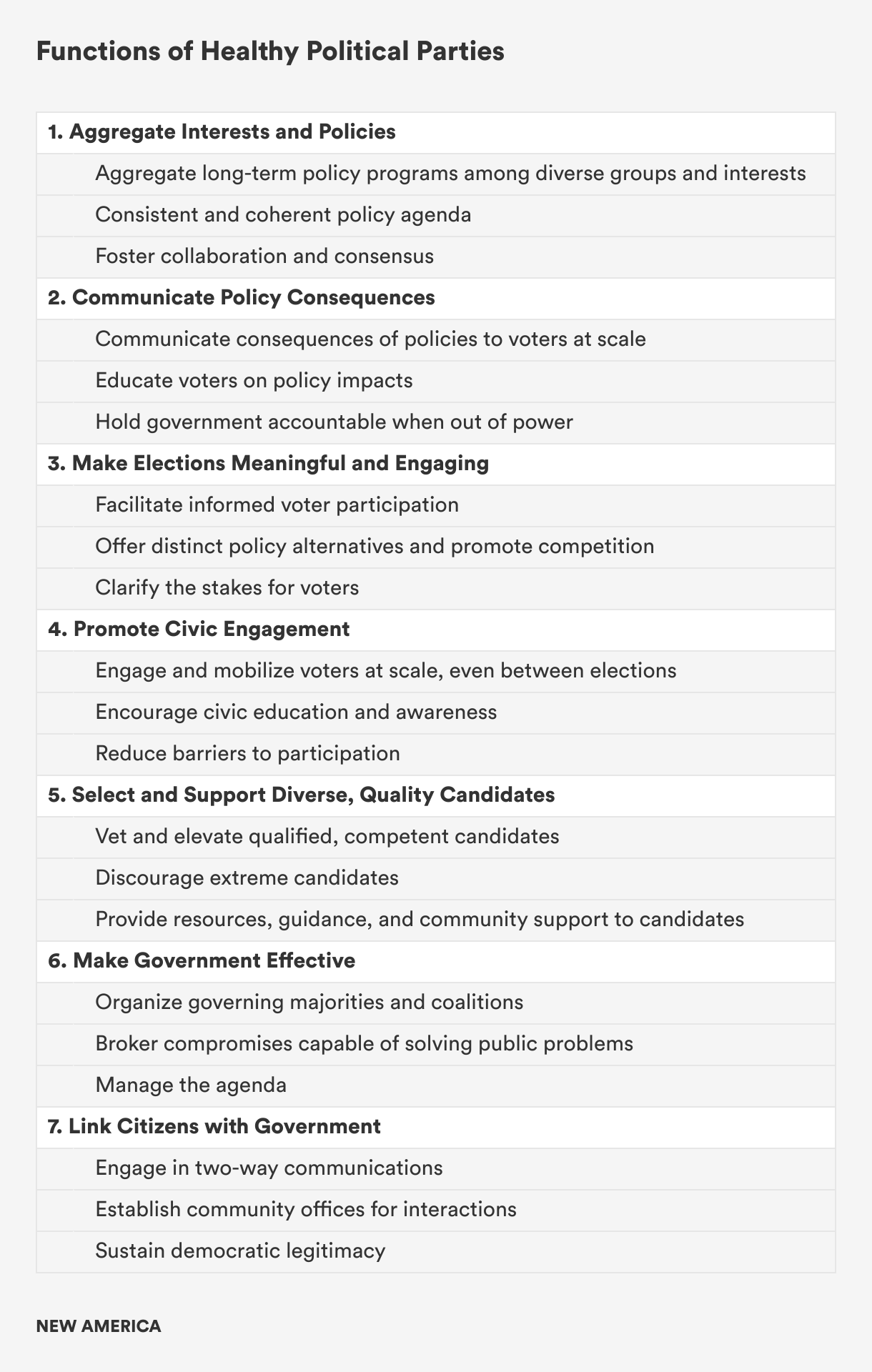
Healthy Parties Aggregate Long-Term Policy Programs That Broker among Groups and Interests
Political parties are coalitions of ambitious politicians, political operatives, organized interest groups, donors, activists, and more diffuse supporters.32 These actors would have a difficult time agreeing if they operated independently. But because they have to agree at least somewhat in order to have a chance at winning shared representation, they must find common ground.
Thus, political parties aggregate citizen and group preferences, and fuse those interests into a consistent long-term program. Without this partisan brokering function, independent actors would float around the political space chaotically. Voters would have little understanding of how their vote choices might translate into public policy. Voters would not know whom to hold accountable for public policy failures or to reward for public policy successes, all of which depend on collective coordination across many actors.
Healthy Parties Make Elections Meaningful and Engaging for Voters
Parties give voters clear electoral choices by developing policy programs and group alignments that are somewhat consistent over time. Because parties campaign on policy programs (or, at the very least, values and priorities), elections emphasize policy and value conflicts. To win elections, parties differentiate themselves from each other and strategically elevate competing issues. Conflict and competition, over policies, values, and priorities, are what make elections meaningful. Conflict engages voters and clarifies the stakes. Competitive elections are the most powerful force for citizen engagement and voter turnout.33
Without the adversarial nature of electoral democracy, one party could rule indefinitely, without challenge. New ideas enter politics and innovative policy solutions emerge through partisan competition and conflict, not in spite of it.34 Without partisan challengers, incumbents and one-party systems drift into corruption.35
Healthy Parties Engage and Mobilize Voters at Large Scale and Over Time
Much as we might idealize citizen participation as an individual choice and responsibility, real politics is fundamentally a social and group activity. Most people engage in politics because others engage them. Marginalized citizens particularly depend on others to engage them in politics by investing in their participation.36
Because political parties are trying to win elections, they organize to mobilize and engage voters. While individual candidates also have the same motivations and can also build organizations to mobilize and engage voters, candidates compete in only single races. They come and go. Only political parties can engage and mobilize voters consistently at scale and across time. Ideally, this gives political parties a longer-term view that must go beyond the personality or charisma of any single leader (though, obviously, party leaders are important).
When parties are institutionally weak, individual candidates take on outsized roles. Candidates cannot rely on parties. They must develop their own organizations, especially if they compete in primaries.37 For example, presidents and presidential candidates now increasingly build their own campaign operations distinct from the parties. Barack Obama built his own operation, Organizing for America, rather than building up the Democratic Party. Donald Trump has his distinct organization. Indeed, because parties do not control presidential or candidate nominations, individual candidates have a strong reason to build up their own independent organizations—further undermining the ability of parties to do the important work of long-term mobilization. Candidates come and go. Parties last.
Moreover, because parties are somewhat consistent across elections in their policies, values, and priorities, even voters who are not overly engaged in politics can still make informed choices without having to do extensive personal research. Knowing what the parties stand for enables voters to choose the party that best aligns with their values. This reduces participation barriers for citizens who lack the time or resources to evaluate policies or candidates independently.
Certainly, many other civic and political organizations play crucial roles in mobilizing collective citizen power. A robust pluralism of associations of varying scale is essential for a healthy democracy. However, political parties are unique in both their electoral role and their level of aggregation. A democracy of only civic associations would be too fragmented to function. Many civic associations come and go. Scale and structure matter for consistency and equality of representation.
Healthy Parties Vet Candidates for Office
Who is qualified to hold public office? Who knows? Who decides? Healthy political parties vet and elevate candidates who have the qualifications and temperament for public office. When this is done responsibly, political parties perform a crucial quality-control function in electoral democracy.38
Voters cannot conduct full background checks on candidates. They cannot elevate the candidates directly. They don’t know whose public extroversion is also private psychotic narcissism, and whose public awkwardness is quiet competence. Voters rely on a kind of “peer review” within party leadership that can push aside those who are most likely to abuse their power.
“Weak and unhealthy political parties can easily become fiefdoms of autocratic rulers. Indeed, the failure of political parties to play this key gatekeeping role is a common warning sign of oncoming democratic decline.”
When parties do not perform these roles responsibly, demagogues can come to power. Weak and unhealthy political parties can easily become fiefdoms of autocratic rulers. Indeed, the failure of political parties to play this key gatekeeping role is a common warning sign of oncoming democratic decline.39
Parties are also solving a collective action problem of would-be candidates by helping them coordinate their campaigns and providing shared branding, technology, and funding. This can lower the barriers to entry for candidates. A hollow party leads to mostly candidates with high personal wealth or dedicated partisan zeal running for office. These qualities best prepare candidates to conquer the costly nomination climb.40
Healthy Parties Make Governance Possible and (Somewhat) Accountable by Organizing Governing Majorities
Parties and candidates can make many promises when they campaign. But whether they can turn those promises into public policy depends on their ability to secure legislative majorities for these proposals. Without political parties, every legislative vote would require its own distinct process of coalition-building and renegotiation. Anybody who has ever tried to negotiate an agreement among a large and diverse group will appreciate the limits of open-ended individualistic deliberation.
The first U.S. political parties emerged in the First Congress to solve the chaos problem. The Federalist Party assembled to pass Alexander Hamilton’s banking proposal. Thomas Jefferson and James Madison formed the Democratic-Republican Party to organize the opposition. Though the Framers had fretted about political parties in writing the Constitution, they quickly changed their minds when they set to governing, having realized that without the ability to organize a long-term coalition, governing would be impossible.41
Without a team approach to politics, the task of passing legislation devolves into a chaotic free-for-all that is far less likely to yield any resolution, much less a negotiated consensus resolution. More precisely, when each lawmaker is a free agent, many demand side payments for support. This is why weak parties and highly fragmented politics almost always correspond to rampant corruption.
Governing is a team sport. Political parties make governance possible by organizing teams around specific policy promises and the value of a shared “brand” that all candidates can benefit from across multiple elections.
Individual candidates, by contrast, cannot make meaningful policy promises because a single lawmaker is largely powerless without a party. They cannot promise to “deliver results” beyond narrow parochial concerns, since only organized political parties have any chance of delivering anything policy-related. As a result, only parties can be held accountable for how hard they worked toward that policy outcome.
Political parties cohere policy alternatives and manufacture majority coalitions in support of them.42 Without political parties, it would be impossible to form governing majorities of any scale in legislatures.43 Without parties, governance would devolve into endless bargaining. Every individual lawmaker would attempt to extract something in exchange for their support. This is why extensive corruption is commonly found alongside personalized weak parties and highly fragmented party systems.44
Healthy Parties Contribute to Democratic Legitimacy by Linking Citizens with Government and Making Voters Feel Represented
By connecting citizens to government, political parties play a crucial “linkage” role in sustaining democratic legitimacy. Across democracies, citizens report being most satisfied with democracy when they support political parties who they feel represent them well, especially when those parties hold power (including within a governing coalition). Because political parties have clear incentives to mobilize and engage voters, well-resourced political parties contribute to democratic legitimacy. When voters see parties and candidates within those parties who are trying to earn their vote, they are more satisfied with democracy. When citizens don’t see candidates showing up in their communities, listening to them, and reflecting their concerns, they are understandably less satisfied with democracy.45
Individual elected officials, to be sure, can also help connect citizens to government, separate from parties, through their constituency service. However, because individual elected officials can accomplish little independently, the linkage is limited to simple constituency service. This is one reason many individual representatives run against Congress: it allows them to blame their failures on the system. This, in turn, contributes to further distrust and dissatisfaction with Congress, which further undermines democratic legitimacy.
Healthy parties, however, can engage in a thicker, more long-term way than individual candidates. Parties can set up community offices to enable essential two-way communications, so that party representatives not only campaign but also listen. Parties with a permanent organizational presence can direct party volunteers and employees to hear citizens’ diverse concerns and share them with party leaders and candidates. Parties can invite local civic associations to contribute to a party’s agenda. Ultimately, parties should engage in this kind of “associational party building”46 because building thick ties with community organizations ultimately gets out more votes.
Of course, this is only if the parties need wider community support to win seats. Not all parties need such support. Parties that operate in places where they are guaranteed either victory or defeat have no reason to build anything.
Parties can also contribute to democratic legitimacy by accepting elections as legitimate. Indeed, one minimal definition of democracy is a system in which parties lose elections.47 Parties perform crucial leadership roles in helping citizens accept electoral losses and understand that they will have opportunities to win in the future. Without this leadership, democratic legitimacy is difficult to maintain. Obviously, political parties can also undermine democratic legitimacy. Irresponsible and unhealthy parties are marked by activities that undermine democratic legitimacy, in particular by attacking their political opponents as illegitimate and by advocating for and passing policies that alter the rules of electoral competition to their advantage. Organized power can be abused. Hence, many reformers remain skeptical of organized power. But, again, the solution to antidemocratic or illiberal parties is not to undermine parties altogether—it is to create better and alternative parties that can build up democratic legitimacy.
What Is the Alternative?
Those who dislike political parties might imagine a better alternative. But there is a good reason why every stable modern democracy has strong, functioning, long-lasting political parties. The alternative to political parties is chaos. Countries with weak or nonexistent political parties fall into authoritarianism and corruption.
Just as a stable government is necessary to provide some basic law and order (the alternative to government is not freedom, it is complete disorder), so political parties are necessary to provide stable representative government. It is easy to romanticize a truly equal society in which everybody decides independently and rationally. Indeed, we seem to be hard-wired for this kind of romanticism, since it seems to pop up repeatedly in various utopian visions. But we seem equally hard-wired never to achieve this vision.
“Without parties,” writes the political scientist Nancy Rosenblum, “deliberation is disorganized and impossible within legislatures, much less on a public national scale… Parties not only organize debate within government; they can organize debate among activist citizens and can force those into argument who would rather evade it.”48
A politics without parties lacks any coherent or even semi-stable structure. It is a politics of chaos and anarchy, not reasoned deliberation and compromise.
Indeed, a core warning sign of a degrading democracy is weakening political parties. As democracy expert Kim Lane Scheppele has observed, “Collapsing democracies follow on collapsing political parties.”49 As Scheppele explains: “If one traces the failing and failed democracies, one will generally find that traditional parties in that country had first fallen victim to insidious infighting, ideological drift, or credibility collapse in a way that disrupted the ability of those mainstream parties to screen out toxic choices put to voters. And the voters, not realizing that the safety checks had disappeared when they were offered up seriously bad options, picked one of the options they were given—which in turn sent their countries down ‘the rabbit hole of autocracy.’”
Scheppele offers case studies of Venezuela and Hungary to illustrate. Both countries were once widely described as stable and thriving multiparty democracies. But then, “multiple parties collapsed into a two-party system and a punishing-vote practice emerged in which the electorate threw out the government at every opportunity save one… The paths that led to Chávez and Orbán involved progressively narrowing party choices, ending eventually in an election in which the budding autocrat was the only reasonable-looking option among the available limited choices. In short, party collapse preceded democratic collapse.”50
Similarly, developing democracies with weak, incoherent, and transient political parties are most likely to slide back into autocracy. Authoritarian leaders thrive amid the chaos of such gossamer parties. When parties cannot organize politics, charismatic dictators have an opening.
Certainly, core functions like candidate recruitment and agenda-setting can occur without parties. However, broad interest aggregation and reconciliation uniquely depend on parties. Without parties, narrowly organized groups will instead shape candidate recruitment and issue agenda-setting. Without parties at the center, the alternatives are all less transparent, less accountable, and less representative than political parties.
Governing without parties is more difficult. Governing institutions require some mechanism to decide what comes up for a vote, which usually means selecting some leaders. Ambitious politicians will lead and assemble coalitions to pass their preferred policies. These coalitions will behave like parties.
Whatever their flaws, political parties are much better at organizing democratic contestation and representation than any of the alternatives at present.
Building healthy political parties does not mean that we have to go back to a bygone era of “smoke-filled rooms” where political “bosses” trade favors with donors and make decisions insulated from public input. We can instead envision a twenty-first-century version of political parties that combines leadership and representativeness and builds upon new organizational forms. A new generation of scholars and organizers is thinking through new innovative approaches to party organizing in the United States.51 Abroad, new parties are exploring new organizing models on the ground.52 But abroad, new parties can emerge because more permissive electoral rules allow space for new parties to enter.53 Long-standing parties typically have little interest in innovating until their dominance is threatened. Under U.S. voting rules, existing parties face no threat. Both parties have a monopoly on opposition.
To reiterate: Stronger, healthier political parties enhance the quality of representative government. Better political parties are not the goal for their own sake. They are the institutions that make stable, healthy governance possible in the twenty-first century.
The Problem of Just Two Parties
Parties are important. But both the sheer size of U.S. political parties (two parties for a diverse nation of 330 million people) and the binary nature of partisan competition (which creates a monopoly on opposition for both parties) makes it difficult for the Democratic and Republican parties to carry out the responsibilities of healthy political parties.
Having discussed the essential democratic roles of political parties above, I will now turn to the ways in which two polarized nationalized parties face significant obstacles to performing those roles.
Let’s start with aggregation. Again, parties perform a crucial policy aggregation role. However, there is a trade-off between size and effectiveness. Parties that are too big must suppress too many potential internal conflicts, thus keeping many issues off the agenda.
A big tent may be necessary to win elections, but a big tent can be stretched so big that it becomes difficult for voters to know exactly what they are voting for because the party they support aims to represent so many perspectives. Indeed, this was the long-standing critique many threw at the U.S. party system for much of the twentieth century—that the parties were too indistinguishable and, as a result, voters lacked meaningful choices, particularly on the crucial issue of civil rights.
However, because twentieth-century American politics centered more on state and local politics than national politics, the national parties operated more like loose labels—more like dispositional than programmatic parties. In practice, this yielded a kind of hidden multi-party system within the two-party system. Organized factions played a significant role. Both parties came in many regional varieties.
Moreover, because many voters had some sympathies with both parties, a vibrant competition of policy innovation could emerge, as party leaders sought new policy aggregations capable of winning over the many groups of voters willing to consider either side. This is how party competition should work. A substantial group of voters should be open to multiple parties. Parties should innovate new policies to attract new voters.
However, as American politics nationalized and sorted, parties simplified and flattened into two distinct coalitions, with much less overlap. Winning over “swing voters” has diminishing returns. Few remain, and those who do are unpredictable, heterogenous, and mostly disengaged and disgusted by politics. Though factions continue to exist within the two parties, they are no longer overlapping. In the twenty-first century, American partisan conflict has collapsed into an all-or-nothing binary. This means party leaders can suppress internal conflict by emphasizing their common enemy.
Only in a binary conflict is the enemy of my enemy my friend. This kind of zero-sum conflict makes partisan competition so totalizing that the potentially innovative benefits of party aggregation disappear into the black hole of us-versus-them group psychology. Politics has now become calcified.54 With few voters up for grabs, the potential for flexible policy innovation and aggregation declines to zero. As COVID-19 demonstrated, even a public health crisis could become a very partisan issue in only a few short months.
Indeed, while parties do make elections meaningful and engaging for voters, binary adversarial competition can make elections too meaningful. In 2020, for example, the United States had its highest-turnout election in more than 100 years. Nothing drives turnout like a crisis.
Limiting choices to only two simplifies elections, which is one supposed benefit of the two-party system. However, limiting choices to just two can also oversimplify elections, which is one of the drawbacks of the two-party system. Elections can become a recursive and reductive us-versus-them conflict, with the same us and same them over and over, particularly when parties turn to negative, lesser-of-two-evils campaigning—a strategy that a two-party system encourages.
A two-party system also leaves dissatisfied voters only one “change” option. This can lead to a constant cycle of “throw the bums out” based on small shifts. If every election becomes a change election, constant policy whiplash undermines effective governing. And if one of two major parties turns illiberal (which is common in a polarized two-party system because having only one opposition alternative breeds oppositional extremism), a vote to “throw the bums out” can become an unwitting vote to install authoritarian leadership. Because the costs of losing seem so high, parties in power often change the rules to avoid losing.55
Turning to parties’ role in engaging voters in elections, it is notable that turnout is consistently lower in countries with first-past-the-post elections, like the United States. This is not surprising. In a system with single-member districts, many districts are not two-party competitive. When districts are not competitive, parties have little incentive to mobilize voters. The dominant party has good reasons not to mobilize voters (since it is already in power). The opposing party sees no chance of winning; why waste precious resources?
By contrast, in multiparty systems with proportional representation, every voter counts the same, regardless of geography. And with more parties competing everywhere, more parties are out mobilizing and engaging voters. More parties also mean more options for voters, and thus more likelihood voters will feel excited about supporting a party.
Turning to parties’ role in vetting candidates, the United States is unique in so fully turning candidate selection over to the public. As a result of the direct primary—a Progressive Era reform—voters (not party leaders) choose party nominees. In all other advanced democracies, political parties have their own internal processes for selecting candidates, though some parties have moved toward more open elections among party members.
However, though U.S. parties do leave nominations open to the public, party networks and factions do work behind the scenes, supporting particular candidates with their money and public endorsements.56 Parties also rely on outside groups with narrow agendas to recruit and support candidates.57 These fuzzy lines of responsibility blur the meaning of political parties in the United States and make money even more important, contributing to unrepresentative candidate recruitment patterns.
They also contribute to a vague and ever-present distrust. When it’s not clear who is actually making decisions, conspiracy thinking thrives. This fuels more antisystem sentiment. For example, in 2016, many Bernie Sanders supporters believed that the Democratic presidential nomination process was somehow rigged.58 Was it? The rules were not always clear to voters, and party leaders almost certainly intervened to clear the field for Hillary Clinton. No process is entirely neutral.
As for governance, political parties make governing possible because political parties broker coalitions and compromises to pass legislation. A long-standing argument for a two-party system is that having two cohesive, responsible parties allows voters to choose one, assess its performance, and evaluate the results in subsequent elections. This is the so-called Responsible Party Government theory.59
Nonetheless, this theory seems ill-suited for the American government. Separated powers and bicameralism frequently generate divided government and blur responsibility. Biennial congressional elections leave little time to evaluate policy results. The American system of government was designed intentionally to frustrate narrow majoritarian governing with overlapping and ever-changing authority. In modern American politics, divided government has been the dominant situation in Washington.60 Unified government is rare, and it is even rarer for one party to hold a filibuster-proof majority in the Senate.61 And even here, the Supreme Court offers a potential veto, since the United States is unique in having widespread judicial review.
In two-party polarized politics, divided government means legislative gridlock. And legislative gridlock means that the executive branch is left to improvise within existing legal authority. This creates more instability. The Obama presidency marked a major reversal from the Bush presidency on a range of administrative policies. The Trump presidency marked an even bigger reversal on even more policies. The Biden presidency has intensified the executive branch whiplash. The next Republican administration will accelerate the instability even further. This policy whiplash leads to high executive branch turnover, which contributes to poorer and more inefficient governing. It also undermines American global leadership and industry, given the extent to which the rest of the world cannot count on American promises from one administration to the next.
Meanwhile, a polarized Congress becomes helpless to take back any of its power. Under unified government, one-party rule fuses congressional powers with the presidency. Under divided government, the congressional opposition is left to either pass bills that will be vetoed, or just to engage in oppositional oversight. Compromise is not rational for either party. Blurring the differences by cooperating undermines a clear electoral message: The other side is dangerous.
In the current era of pendulum politics, both parties get two years of unified government every 12 years or so, and a chance to pass some big, important policies. (Democrats managed to do that during their recent hold on unified government. Republicans did much less during theirs.) But a government that is only able to assemble governing majorities to pass big policies less than a third of the time can hardly be considered effective or efficient.
It is true that in multiparty systems, coalitions sometimes take a few months to come together after an election, and sometimes coalitions fall apart and change (in parliamentary systems, this sometimes involves a new election). But compared to the U.S. two-party system, which spends most of its time mired in gridlock in which little can happen, multiparty systems are much more effective in solving public problems on an ongoing basis, in large part because coalitions have more flexibility to change over time.
When it comes to democratic legitimacy and the importance of partisan “linkage” in maintaining that legitimacy, a polarized two-party system presents a problem.
First, on the problem of “linkage:” Because two major parties are inevitably big, broad coalitions (even if they are polarized), it is difficult for a big party to connect meaningfully with a wide range of voters, especially in a large and diverse country. Smaller parties can speak more directly to different communities and represent their concerns more effectively. Of course, parties must also act as aggregators, so parties that are too small would not perform this crucial democracy-enhancing function. A middle ground exists between too small and too large.
Additionally, because the single-member districts that maintain two-party competition inevitably result in large numbers of districts that are uncompetitive (even in the most competitive times), two geographically polarized parties have mostly safe districts and safe states, where they do not need to worry about any competition. This lack of competition means that both Democrats and Republicans need not invest in meaningful “linkage” activities in large parts of the country.
Yet both parties still need some way to motivate and unify voters. A geographically polarized two-party system provides the obvious answer: the threat of the other party winning. Nothing unites like a common enemy. Not only does a fearsome common enemy absolve parties of having to listen to concerns of many of their voters, it also allows—and perhaps even encourages—party leaders to refuse to concede elections.
“Losers’ consent” (the political science term for partisan losers accepting outcomes) is a crucial foundation for modern democracy, since without legitimate elections, the whole system of representative self-government degrades into authoritarianism.
However, as multiple studies have shown, in two-party systems, especially polarized two-party systems, political losers experience a sharper sting from losing. This makes losers less likely to trust the government, and more skeptical of democracy generally when they are out of power. In proportional multiparty systems, the sting of losing is less severe, since power is much more broadly shared and fluid, and the differences between the opposition coalition and the governing coalition are usually smaller.62 Thus, in proportional, multiparty systems, losers’ consent is much higher, and voters are more satisfied with democracy and more trusting in the government even when the party they supported isn’t in power.
“Newer parties can find new ways of organizing, can highlight new solutions and new concerns, and can find new ways of linking citizens with governing.”
To be sure, political parties in multiparty systems are not always healthy and effective either. Established political parties in European multiparty systems tend to rise and fall in a somewhat cyclical and even dialectical manner. As parties centralize internally and govern predictably, they often make hard compromises that leave many supporters cold. In response to a crisis of legitimacy, voters—particularly younger voters—can migrate to newer parties. Newer parties are not bogged down by old structures and old leadership. Newer parties can find new ways of organizing, can highlight new solutions and new concerns, and can find new ways of linking citizens with governing.63
This process of “creative destruction” makes political systems resilient. In many ways, the recent party volatility in European multiparty democracies is a clear and ultimately healthy sign of this. Political parties throughout history have innovated in how they organize and connect citizens to the government. The European story of party development, by contrast, is a story of change through the rise and fall of particular parties, with innovation coming from new parties rather than from attempting to retrofit old parties.64
But in a two-party system, innovation must come from within major parties, where it is slowest, messiest, and least likely. This means factions challenging each other internally, undermining the ability of parties to perform their essential roles with consistency and coherence. Indeed, American party development is essentially a series of internal party reform episodes—outsiders busting open existing power structures, and then struggling to build something new out of a busted-open institution.65
The American story of party reform is anti-party. This is partially because the American political tradition holds major skepticism toward any organized power. It is also because Americans have repeatedly tried to refashion the existing parties, trying to make them into something they cannot be—truly open and porously participatory—and yet still be effective in carrying out the basic roles of political parties in modern democracy. The end result has been a worst-of-both-worlds compromise: not effective enough to be legitimate and capable, and not participatory enough to satisfy small-d democratic demands. Stuck with just two options, many Americans get little out of party democracy. But they can’t govern themselves collectively without party democracy.
Citations
- President Barack Obama, Address at 2020 Democratic National Convention, (Philadelphia, August 19, 2020); President Joe Biden, “Remarks by President Biden on Standing up for Democracy,” (Washington, DC, November 2, 2022). Barack Obama’s 2020 Democratic National Convention speech put the stakes plainly: “Because that’s what’s at stake right now. Our democracy.” He said that the Trump administration “has shown it will tear our democracy down if that’s what it takes to win.” In 2022, before the midterms, Joe Biden similarly clarified the stakes with a speech in which he said, “Make no mistake: Democracy is on the ballot.”
- Vice President Mike Pence, Address at 2020 Republican National Convention, (Fort McHenry, Baltimore, August 26, 2020). Mike Pence’s Republican National Convention speech argued that: “In this election, it is not so much whether America will be more conservative or more liberal, more Republican or more Democrat. The choice in this election is whether America remains America.”
- J. M. Berger, Extremism (Cambridge, MA: MIT Press, 2018).
- Samuel P. Huntington, American Politics: The Promise of Disharmony (Cambridge, MA: Belknap Press, 1983).
- Steven Levitsky and Daniel Ziblatt, How Democracies Die (New York: Crown Publishing, 2018).
- Milan W. Svolik, The Politics of Authoritarian Rule (Cambridge, MA: Cambridge University Press, 2012), 35.
- Berger, Extremism.
- Murat Somer and Jennifer McCoy, “Transformations through Polarizations and Global Threats to Democracy,” The ANNALS of the American Academy of Political and Social Science 681 (January 2019): 8–22, https://doi.org/10.1177/0002716218818058; Murat Somer and Jennifer McCoy, “Toward a Theory of Pernicious Polarization and How It Harms Democracies: Comparative Evidence and Possible Remedies,” The ANNALS of the American Academy of Political and Social Science 681 (January 2019): 234–71, https://doi.org/10.1177/0002716218818782. Somer and McCoy identify 10 key aspects of “pernicious” polarization that distinguish it from “healthy pluralism.” They are: 1) Division of the electorate into two hostile camps, where multiple cleavages have collapsed into one dominant cleavage or boundary line between the two camps; 2) The political identity of the two camps becomes a social identity in which members feel they belong to a “team” and demonstrate strong loyalty to it; 3) Political demands and interests form around those identities; 4) The two camps are characterized in moral terms of “good” and “evil”; 5) The identities and interests of the two camps are viewed as mutually exclusive and antagonistic, thus negating the possibility of common interests between different groups; 6) A greater cohesion grows within groups, and greater conflict and hostility between groups; 7) Stereotyping and prejudice build toward the out-group due to lack of direct communication and/or social interaction; 8) The center drops out and the polarized camps attempt to label all individuals and groups in society as one or the other; 9) Institutions, including media, become dominated by one bloc or the other through discursive changes as well as changes of ownership, management, and staff, weakening the middle ground in public and political discourses; 10) The antagonistic relationship manifests in spatial and psychological separation of the polarized groups.
- Jennifer McCoy, Tahmina Rahman, and Murat Somer, “Polarization and the Global Crisis of Democracy: Common Patterns, Dynamics, and Pernicious Consequences for Democratic Polities,” American Behavioral Scientist 62 (January 2018): 16–42, https://doi.org/10.1177/0002764218759576. McCoy, Rahman, and Somer find that: “Situations of deep polarization create problems of governance as communication and trust break down and the two camps prove unwilling and unable to negotiate and compromise. Political gridlock paralyzes government, and in some cases, results in instability and careening between policy choices if neither side can prevail in the long run and seeks to overturn the predecessor’s policies at every chance. Alternatively, one camp may become hegemonic and curtail liberties, tend toward authoritarianism, or even establish an autocratic regime. At the societal level, citizens become divided spatially and socially. They come to believe they can no longer coexist in the same nation. Finally, the backlash and conflict arising from extreme polarization can also lead to democratic collapse if former elites and dominant societal groups, often allied with military forces, retake control with undemocratic means.” See also: Daniel Ziblatt and Steven Levitsky, How Democracies Die; Barbara F. Walter, How Civil Wars Start: And How to Stop Them (New York: Crown, 2022); Jennifer McCoy and Benjamin Press, What Happens When Democracies Become Perniciously Polarized? (Washington, DC: Carnegie Endowment for International Peace, 2022), https://carnegieendowment.org/2022/01/18/what-happens-when-democracies-become-perniciously-polarized-pub-86190.
- Lee Drutman, Breaking the Two-Party Doom Loop: The Case for Multiparty Democracy in America (New York: Oxford University Press, 2020).
- Modern political parties, particularly in America, are somewhat amorphous networks, almost like “blobs” that defy easy explanation.
- See, e.g., Michael Laver and Ernest Sergenti, Party Competition: An Agent-Based Model (Princeton, NJ: Princeton University Press, 2011).
- Kathleen Bawn, Martin Cohen, David Karol, Seth Masket, Hans Noel, and John Zaller, “A Theory of Political Parties: Groups, Policy Demands and Nominations in American Politics,” Perspectives on Politics 10 (September 2012): 571–97.
- For more perspective on this question of living, emergent systems, see Fritjof Capra, The Web of Life: A New Scientific Understanding of Living Systems (New York: Macmillan Audio, 1996).
- Craig W. Blatz and Brett Mercier, “False Polarization and False Moderation: Political Opponents Overestimate the Extremity of Each Other’s Ideologies but Underestimate Each Other’s Certainty,” Social Psychological and Personality Science 9 (July 2018): 521–29, https://doi.org/10.1177/1948550617712034; Philip M. Fernbach and Leaf Van Boven, “False Polarization: Cognitive Mechanisms and Potential Solutions,” Current Opinion in Psychology 43 (February 2022): 1–6, https://doi.org/10.1016/j.copsyc.2021.06.005; Michael C. Schwalbe, Geoffrey L. Cohen, and Lee D. Ross, “The Objectivity Illusion and Voter Polarization in the 2016 Presidential Election,” Proceedings of the National Academy of Sciences 117 (September 2020): 21218–29, https://doi.org/10.1073/pnas.1912301117.
- Keith E. Stanovich, The Bias That Divides Us: The Science and Politics of Myside Thinking (Cambridge, MA: MIT Press, 2021); Keith E. Stanovich, Richard F. West, and Maggie E. Toplak, “Myside Bias, Rational Thinking, and Intelligence,” Current Directions in Psychological Science 22 (August 2013): 259–64, https://doi.org/10.1177/0963721413480174.
- Berger, Extremism, 43.
- Berger, Extremism.
- Keith E. Stanovich, Richard F. West, and Maggie E. Toplak. “Myside Bias, Rational Thinking, and Intelligence,” Current Directions in Psychological Science 22, no. 4 (August 2013): 259–64, https://doi.org/10.1177/0963721413480174. The authors go on to list a few examples, “including stereotyping, prejudice, ingroup favouritism, out-group derogation and even dehumanization.”
- Such is the takeaway from an exhaustive review on “Cognitive-motivational mechanisms of political polarization.” The review cites 345 articles documenting causal pathways in every direction, and a long list of cognitive biases that exacerbate binary partisan polarization once it gets underway. For example, as the authors note, “longitudinal research demonstrated that ideological consistency at time 1 predicted affective polarization at time 2, and affective polarization at time 1 predicted ideological consistency at time 2, all other things being equal.”
- Delia Balassarri and Scott E. Page, “The Emergence and Perils of Polarization,” Proceedings of the National Academy of Sciences 118 (December 2021), https://doi.org/10.1073/pnas.2116863118.
- Balassarri and Page, “The Emergence and Perils of Polarization.”
- Balassarri and Page, “The Emergence and Perils of Polarization.”
- Susan T. Fiske, “A Millennial Challenge: Extremism in Uncertain Times,” Journal of Social Issues 69, no. 3 (2013): 605–13, https://doi.org/10.1111/josi.12031.
- Fiske, “A Millennial Challenge.” Fiske explains: “To reduce extremism, give certainty about social justice in terms of democratic representation, and individual personal agency.”
- McCoy and Somer, “Toward a Theory of Pernicious Polarization and How It Harms Democracies.” “We find that the most extreme cases of polarization among our countries emerge in contexts of majoritarian electoral systems that produce a disproportionate representation for the majority or plurality party, and that, once in power, the polarizing parties and incumbents attempt, and often succeed, in engineering additional constitutional and legal changes to enhance their electoral advantage.”
- Benjamin Highton and Walter J. Stone, “Reconciling Candidate Extremism and Spatial Voting,” Legislative Studies Quarterly 46, no. 2 (2021): 585–613, https://doi.org/10.1111/lsq.12289.
- Indeed, a growing literature reinforces a basic finding: that strong partisans are quite willing to tolerate antidemocratic behavior on their side, while being hypervigilant about such activities on the other side. See, e.g., Matthew H. Graham and Milan W. Svolik, “Democracy in America? Partisanship, Polarization, and the Robustness of Support for Democracy in the United States,” American Political Science Review 114 (May 2020): 392–409, https://doi.org/10.1017/S0003055420000052; Gabor Simonovits, Jennifer McCoy, and Levente Littvay, “Democratic Hypocrisy and Out-Group Threat: Explaining Citizen Support for Democratic Erosion,” Journal of Politics 84, no. 3 (2022): 1806–11; Elisabeth Gidengil, Dietlind Stolle, and Olivier Bergeron-Boutin, “The Partisan Nature of Support for Democratic Backsliding: A Comparative Perspective,” European Journal of Political Research 61, no. 4 (2022): 901–29, https://doi.org/10.1111/1475-6765.12502; Alia Braley, Gabriel S. Lenz, Dhaval Adjodah, Hossein Rahnama, and Alex Pentland, “The Subversion Dilemma: Why Voters Who Cherish Democracy Participate in Democratic Backsliding,” (Working Paper, 2022), 45; John Carey, Katherine Clayton, Gretchen Helmke, Brendan Nyhan, Mitchell Sanders, and Susan Stokes, “Who Will Defend Democracy? Evaluating Tradeoffs in Candidate Support among Partisan Donors and Voters,” Journal of Elections, Public Opinion and Parties (July 2020): 1–16, https://doi.org/10.1080/17457289.2020.1790577.
- Lilliana Mason, Uncivil Agreement: How Politics Became Our Identity (Chicago: University of Chicago Press, 2018); Donald Green, Bradley Palmquist, and Eric Schickler, Partisan Hearts and Minds (New Haven, CT: Yale University Press, 2004).
- For an even more extended discussion of the essential role of political parties in modern democracy, see Nancy L. Rosenblum, On the Side of the Angels: An Appreciation of Parties and Partisanship (Princeton, NJ: Princeton University Press, 2008); Russell Muirhead, The Promise of Party in a Polarized Age (Cambridge, MA: Harvard University Press, 2014); Russell Muirhead and Nancy L. Rosenblum, “The Political Theory of Parties and Partisanship: Catching Up,” Annual Review of Political Science 23 (May 11, 2020): 95–110; Russell Muirhead, “A Defense of Party Spirit,” Perspectives on Politics 4, no. 4 (2006): 713–27; Frances Rosenbluth and Ian Shapiro, Responsible Parties: Saving Democracy from Itself (New Haven, CT: Yale University Press, 2018). The following discussion draws on insights from these works, especially the writings of Nancy Rosenbaum.
- David Bruce Robertson, A Theory of Party Competition (Hoboken, NJ: John Wiley & Sons, 1976), 1.
- Some theories of parties suggest that politicians form parties for their own advancement in winning office and passing policies. See, e.g., John H. Aldrich, Why Parties? The Origin and Transformation of Political Parties in America (Chicago: University of Chicago Press, 1995); Joseph A. Schlesinger, Political Parties and the Winning of Office (Ann Arbor: University of Michigan Press, 1991). Other theories of parties see them as coalitions of interest groups and donors. From a comparative perspective, there are many types of parties, which differ in how they organize internally and the types of constituencies they represent. See, e.g., Susan E. Scarrow, Paul D. Webb, and Thomas Poguntke, eds., “Conclusion: The Study of Party Organization,” in Organizing Political Parties: Representation, Participation, and Power (Oxford: Oxford University Press, 2017), 307-320; Richard Gunther and Larry Diamond, “Species of Political Parties: A New Typology,” Party Politics 9 (March 2003): 167–99, https://doi.org/10.1177/13540688030092003. Over time, political parties have changed considerably, and they come in many different varieties. Richard S. Katz, and Peter Mair, “The Evolution of Party Organizations in Europe: The Three Faces of Party Organization,” American Review of Politics 14 (January 1994): 593–617, https://doi.org/10.15763/issn.2374-7781.1993.14.0.593-617. Yet what all political parties have in common is that they put forward candidates for public office on an official ballot line. See, generally: Giovanni Sartori, Parties and Party Systems: A Framework for Analysis (Colchester, UK: ECPR Press, 1976).
- Consistent across all studies is that competitive elections drive higher turnout: André Blais, “What Affects Voter Turnout?” Annual Review of Political Science 9 (June 2006): 111–25, https://doi.org/10.1146/annurev.polisci.9.070204.105121; João Cancela and Benny Geys, “Explaining Voter Turnout: A Meta-Analysis of National and Subnational Elections,” Electoral Studies 42 (June 2016): 264–75, https://www.sciencedirect.com/science/article/abs/pii/S0261379416300956; Gary W. Cox, “Electoral Rules, Mobilization, and Turnout,” Annual Review of Political Science 18 (May 2015): 49–68, https://doi.org/10.1146/annurev-polisci-060414-035915; Benny Geys, “Explaining Voter Turnout: A Review of Aggregate-Level Research,” Electoral Studies 25 (December 2006): 637–63, https://www.sciencedirect.com/science/article/abs/pii/S0261379405000910?via%3Dihub.
- Nelson W. Polsby, Political Innovation in America: The Politics of Policy Initiation (New Haven, CT: Yale University Press, 1985).
- Research consistently finds a relationship between low levels of partisan competition and high levels of political corruption, both across U.S. states and across countries worldwide. See, e.g., Kim Quaile Hill, “Democratization and Corruption: Systematic Evidence from the American States,” American Politics Research 31 (November 2003): 613–31, https://doi.org/10.1177/1532673X03255178; Thomas Schlesinger and Kenneth J. Meier, “Variations in Corruption among the American States,” in Political Corruption, ed. Michael Johnston (New York: Routledge, 2002), chap. 33; Daniel Treisman, “The Causes of Corruption: A Cross-National Study,” Journal of Public Economics 76 (June 2000): 399–457, https://doi.org/10.1016/S0047-2727(99)00092-4; Petra Schleiter and Alisa M Voznaya,“Party System Competitiveness and Corruption,” Party Politics 20 (September 2014): 675–86, https://doi.org/10.1177/1354068812448690.
- Few “normal” people participate in politics because of a spontaneous passion or interest; they participate because somebody asks them. Political parties are the institutions that have historically done most of the asking. When political parties do not subsidize mobilization, it is the poor and least engaged who tend to drop out of politics. See, e.g., Sidney Verba, Kay Lehman Schlozman, and Henry E. Brady, Voice and Equality: Civic Voluntarism in American Politics (Cambridge, MA.: Harvard University Press, 1995); Steven J. Rosenstone and John Mark Hansen, Mobilization, Participation, and Democracy in America, (New York, Munich: Pearson, 2002); Kim Quaile Hill and Jan E. Leighley, “Political Parties and Class Mobilization in Contemporary United States Elections,” American Journal of Political Science 40 (August 1996): 787, https://doi.org/10.2307/2111795; Robert Huckfeldt and John Sprague, “Political Parties and Electoral Mobilization: Political Structure, Social Structure, and the Party Canvass,” American Political Science Review 86 (March 1992): 70–86, https://doi.org/10.2307/1964016; Joe Soss and Lawrence R. Jacobs, “The Place of Inequality: Non-Participation in the American Polity,” Political Science Quarterly 124, no. 1 (2009): 95–125, https://doi.org/10.1002/j.1538-165X.2009.tb00643.x.
- John M. Carey and Matthew Shugart, “Incentives to Cultivate a Personal Vote: A Rank Ordering of Electoral Formulas,” Electoral Studies 14 (December 1, 1995): 417–39, https://doi.org/10.1016/0261-3794(94)00035-2; Audrey André, Sam Depauw, and Matthew S. Shugart, “The Effect of Electoral Institutions on Legislative Behaviour,” in The Oxford Handbook of Legislative Studies, ed. Shane Martin, Thomas Saalfeld, and Kaare W. Strøm (Oxford: Oxford University Press, 2014), 231–249.
- Reuven Y. Hazan and Gideon Rahat, Democracy within Parties: Candidate Selection Methods and Their Political Consequences (Oxford: Oxford University Press, 2010).
- Levitsky and Ziblatt, How Democracies Die; Kim Lane Scheppele, “The Party’s Over,” in Constitutional Democracy in Crisis? ed. Mark A. Graber, Sanford Levinson, Mark Tushnet (Oxford: Oxford University Press, 2018), https://doi.org/10.1093/law/9780190888985.003.0028.
- Andrew B. Hall, Who Wants to Run? How the Devaluing of Political Office Drives Polarization (Chicago: University of Chicago Press, 2019).
- See John H. Aldrich, Why Parties? The Origin and Transformation of Political Parties in America (Chicago: University of Chicago Press, 1995); John H. Aldrich and Ruth W. Grant, “The Antifederalists, the First Congress, and the First Parties,” The Journal of Politics 55, no. 2 (1993): 295–326.
- Rosenblum, On the Side of the Angels: An Appreciation of Parties and Partisanship, 58: “No majority exists spontaneously, ready to be contested for. It is identified in the course of drawing lines of division. That is what political activity generally and party activity is specifically about.”
- Seymour Martin Lipset, “The Indispensability of Political Parties,” Journal of Democracy 11, no. 1 (2000): 48–55, https://doi.org/10.1353/jod.2000.0016; Elmer Eric Schattschneider, Party Government (New York: Farrar & Rinehart, Inc., 1942).
- See, e.g., Michael Johnston, Corruption, Contention and Reform: The Power of Deep Democratization (Cambridge: Cambridge University Press, 2014); Susan Rose-Ackerman and Bonnie J. Palifka, Corruption and Government: Causes, Consequences, and Reform (New York: Cambridge University Press, 2016).
- Hannah M. Ridge, “Just Like the Others: Party Differences, Perception, and Satisfaction with Democracy,” Party Politics 28, no. 3 (May 2022): 419–30, https://doi.org/10.1177/1354068820985193: “Citizens who view their system as including a broad array of parties are more likely to be satisfied with their democracy’s performance.” See also: Paul Webb, Susan Scarrow, and Thomas Poguntke, “Party Organization and Satisfaction with Democracy: Inside the Blackbox of Linkage,” Journal of Elections, Public Opinion and Parties 32, no. 1 (January 2, 2022): 151–72, https://doi.org/10.1080/17457289.2019.1698047.
- Tabatha Abu El-Haj, “Networking the Party: First Amendment Rights and the Pursuit of Responsive Party Government,” Columbia Law Review 118, no. 4 (2018): 1225–1302; Tabatha Abu El-Haj, and Didi Kuo, “Associational Party-Building: A Path to Rebuilding Democracy,” Columbia Law Review 122 (2022): 50.
- Adam Przeworski, Democracy and the Market (Cambridge, : Cambridge University Press, 1991).
- Rosenblum, On the Side of the Angels, 160.
- Scheppele, “The Party’s Over.”
- Scheppele, “The Party’s Over,” 8.
- Lara Putnam, Daniel Schlozman, Tabatha Abu El-Haj, Joseph Anthony, Jacob M. Grumbach, Alexander Hertel-Fernandez, Adam Seth Levine, and Caroline Tervo, “Local Political Parties as Networks: A Guide to Self-Assessment,” Scholars Strategy Network (May 19, 2020), https://scholars.org/contribution/local-political-parties-guide; El-Haj and Kuo, “Associational Party-Building: A Path to Rebuilding Democracy.”
- Piero Ignazi, “The Failure of Mainstream Parties and the Impact of New Challenger Parties in France, Italy and Spain,” Italian Political Science Review/Rivista Italiana Di Scienza Politica 51, no. 1 (March 2021): 100–116, https://doi.org/10.1017/ipo.2020.26.
- Margit Tavits, “Party System Change: Testing a Model of New Party Entry,” Party Politics 12 (January 2006): 99–119, https://doi.org/10.1177/1354068806059346.
- John Sides, Chris Tausanovitch, and Lynn Vavreck, The Bitter End: The 2020 Presidential Campaign and the Challenge to American Democracy (Princeton, NJ: Princeton University Press, 2022).
- Scheppele, “The Party’s Over.”
- Marty Cohen, David Karol, Hans Noel, and John Zaller, The Party Decides: Presidential Nominations Before and After Reform (Chicago: University of Chicago Press, 2008); Marty Cohen, David Karol, Hans Noel, and John Zaller, “Party Versus Faction in the Reformed Presidential Nominating System,” PS: Political Science & Politics 49, no. 04 (October 2016): 701–8, https://doi.org/10.1017/S1049096516001682; Hans J. G. Hassell, The Party’s Primary: Control of Congressional Nominations (Cambridge: Cambridge University Press, 2017); Hans J. G. Hassell, “Party Elite Engagement and Coordination in House Primary Elections: A Test of Theories of Parties,” American Journal of Political Science 67, no. 2 (2023): 307–23, https://doi.org/10.1111/ajps.12680.
- See Theda Skocpol and Alexander Hertel-Fernandez, “The Koch Network and Republican Party Extremism,” Perspectives on Politics 14, no. 3 (September 2016): 681–99, https://doi.org/10.1017/S1537592716001122.
- See Ezra Klein, “Was the Democratic Primary Rigged?” Vox, November 14, 2017, https://www.vox.com/policy-and-politics/2017/11/14/16640082/donna-brazile-warren-bernie-sanders-democratic-primary-rigged.
- For a useful history of the idea of responsible party government and its development in U.S. politics, see Sam Rosenfeld, The Polarizers: Postwar Architects of Our Partisan Era (Chicago: University of Chicago Press, 2017).
- Since 1994, Republicans have enjoyed six years of unified government (four under Bush, two under Trump), and Democrats have enjoyed four years of unified government (two under Obama, two under Biden). That means two-thirds of the time, control of the presidency, Senate, and the House was split between the two parties.
- This happened in 2009. Before that, it last happened in 1977-1978.
- Shaun Bowler, Todd Donovan, Ola Listhaug, Christopher J. Anderson, and André Blais, Losers’ Consent: Elections and Democratic Legitimacy (Oxford: Oxford University Press, 2007); Matthew Germer, Restoring Losers’ Consent: A Necessary Step to Stabilizing Our Democracy (Washington, DC: R Street Institute, September 2021), https://www.rstreet.org/research/restoring-losers-consent-a-necessary-step-to-stabilizing-our-democracy/; Richard Nadeau and Andre Blais, “Accepting the Election Outcome: The Effect of Participation on Losers’ Consent,” British Journal of Political Science 23, no. 4 (1993): 553–63.
- Piero Ignazi, “The Failure of Mainstream Parties and the Impact of New Challenger Parties in France, Italy and Spain,” Italian Political Science Review/Rivista Italiana Di Scienza Politica 51 (March 2021): 100–116, https://doi.org/10.1017/ipo.2020.26. Ignazi notes how challenger parties are innovating in response to the failures of the old mainstream parties.
- Luciano Bardi, Stefano Bartolini, and Alexander Trechsel, “Party Adaptation and Change and the Crisis of Democracy,” Party Politics 20, no. 2 (March 1, 2014): 151–59, https://doi.org/10.1177/1354068813519966.
- Austin Ranney, Curing the Mischiefs of Faction: Party Reform in America (Berkeley: University of California Press, 1975); Byron E. Shafer and Regina L. Wagner, The Long War over Party Structure: Democratic Representation and Policy Responsiveness in American Politics (Cambridge: Cambridge University Press, 2019), https://doi.org/10.1017/9781108753517.
3. Learning from History: The Flawed American Tradition of “Tearing Open” without “Building Up”
An antipartisan reform tradition lies deep in the American subconscious. This long-running narrative is readily available and poised for dusting off and repurposing: Something has gone wrong with our democracy. Too few have too much power. Party bosses, moneyed interests, and other selfish and corrupt actors have conspired to undermine true democracy. To restore “true” democracy, we must expand political participation. Informed and nonpartisan voters, drawing on their innate wisdom, will consistently make the “right” decisions.
Conceptually, this antipartisan vision is an antiorganization vision, and it shares much with the neoliberal fantasy of efficiently self-regulating markets guided by an invisible hand, or the opposing communist fantasy of a government that melts away because all are equal. In such a fantasy, individual leaders miraculously merge the diversity of society into a coherent whole, or, even better, are unnecessary because society becomes conflict-free.
Every history of even modestly sized civilizations suggests otherwise. And every modern representative democracy has contained organized divisions. Indeed, some organized division is necessary for democracy to function. Democracy requires elections. Elections require meaning. Elections must be about something. Parties must present clear alternatives. For representation to work, competing representatives must organize competing visions for governing. Conflict engages. Democracy is not about avoiding conflict, but rather about managing and channeling conflicts to ensure peace.
Though coalitions must form to compete in elections in order to give voters meaningful opportunities to choose among alternatives, coalitions must not become so permanent and binary that citizens feel locked in a permanent struggle with their fellow citizens. Citizens must also feel that they indeed have meaningful options, and that elections do indeed matter. Conflict can be healthy and manageable. Or conflict can be destructive and uncontrollable.
Periods of democracy reform followed eras when partisan polarization was too low (and citizens lacked meaningful choices, and a political establishment formed an exclusive consensus), or when partisan polarization was too high (and corruption flourished because many voters were unwilling to switch parties in response). Low polarization describes both the 1950s (when a bipartisan centrist consensus dominated) and the 1820s (the “Era of Good Feelings,” when the United States had a one-party system). High polarization describes the 1890s, when few voters switched parties. We’ve now returned to excessive polarization. In both scenarios, many voters feel devoid of a meaningful choice, either because the parties are too similar, or because partisan loyalty is too high.
In such periods, the political parties become problematic. The parties either exclude the concerns of many voters (too much partisan consensus leaves many voters unrepresented), or the parties fight so intensely that little gets accomplished and corruption can flourish (when voters will support their parties no matter what, leaders can get away with many things).
“Democracy is not about avoiding conflict, but rather about managing and channeling conflicts to ensure peace.”
Under such realities, it is easy for reformers to see political parties as obstacles to representative government. It’s tempting to think that replacing leaders and granting citizens greater influence in elections could unveil a newfound “public interest.” Well-intentioned reformers, unable to step outside the immediacy of elections and appreciate the broader patterns of the complex political system, turn to morality instead.
The perpetual challenge is that deciding what is “right” is far more subjective than we’d prefer to acknowledge. In moments when politics feels corrupt or unrepresentative, it is natural to want to remove the corruption. But corruption suggests distortion from some baseline. But what is that baseline of unbiased politics, in the “public interest”? Who can define it to universal agreement? Perhaps the “public interest” is like a rainbow. It appears in the distance, but the closer we approach it, the more it dissolves into many little droplets.
The natural response is to wrest power away from those who abuse it. But power is also a confusing concept. In a democracy, we equate power with choice. Voters have power, we tell ourselves, because voters ultimately make the choices. But who chooses the choices?
Opening up the process is one thing. Power to shape the alternatives is always more consequential. Individual voters can decide among alternatives, but only organized groups can shape alternatives. Political parties perform this crucial function, but they require leadership. Somebody has to have power. This is something antipartisan reforms have missed.
In each of the three major reform periods, reforms that appeared to put voters “first” only made it harder for individual voters to coordinate collectively to solve public problems through public policy. Ultimately, small but well-organized interests triumphed because politics always rewards coordination and collective action. Decentralizing power does not equalize power. It just moves it elsewhere, where only the most engaged and well-connected can access it.
American reform has constantly tried to disrupt power. Anti-party reform has forced power into the shadows, where it is hardest to observe, easiest to escape scrutiny and accountability, and most likely to fuel conspiracy theories. If Americans hold uniquely conspiratorial, distrustful views of government, perhaps it is because previous reformers have promised to make organized power vanish, but only made it less visible. Our storytelling brains see things happening, but without clear causation or explanation. We fill in the blanks with our own invented stories.
A pro-parties vision means that much interest aggregation will take place in private. And understandably, many Americans, educated within an antipower tradition, will recoil. But ultimately, anti-partyism becomes a self-fulfilling prophecy. It is easy enough for outsiders to blast existing parties and authorities. Everyone wants “change” when they are on the outside. But aspiring political leaders have a responsibility to offer an affirmative vision of responsible leadership. Our sense of what is possible depends on our collective courage to learn from our past mistakes and do better. Hopefully, by appreciating the distinct limits of anti-party reform in the past, we can do better in the future.
We thus now turn to the history. Those who follow current reform conversations will see obvious reverberations from the past. The familiar ideals of more “open” participation are re-emerging as the path to achieving the “public interest” and “unity.”
The Age of Jackson: The Search for Populist Equality and Limited Government Discovers Patronage and Spoils Instead
The first era of reform begins with the 1824 presidential election—a four-candidate election that fell to Congress (the House must decide when no candidate wins the Electoral College outright). Andrew Jackson won a plurality of the popular vote and Electoral College vote, though not a majority. But John Quincy Adams became president after making a deal with fellow candidate Henry Clay to make Clay secretary of state.
Jackson and his supporters declared it a “corrupt bargain” and organized disparateanti-Adams groups into the new Democratic Party, with Jackson (a popular general, but a political cipher at the time) as the standard-bearer. Jackson, a populist, won in 1828 in a revolt against the elites. But the revolt had begun in 1824, not just with Jackson’s outsider candidacy, but also with the breakdown of one-party rule.
Let’s back up. After the collapse of the Federalist Party in the early 1800s, the Jeffersonian Democratic-Republican Party (by then called “the Republicans”) achieved dominance, and American democracy experienced its only period of one-party rule, the so-called “Era of Good Feelings.” The American government also operated as a quasi-parliamentary system, with the congressional caucus nominating presidential candidates.
But one-party rule is never really one-party rule. It is the rule of submerged factions. In 1824, after James Monroe—the last of the Virginia dynasty—announced he would not seek a third term, he left no obvious successor. Factions swiftly re-emerged.
William Crawford, Secretary of the Treasury and longtime Virginia dynasty loyalist, was preferred by the insiders in Congress. But outside of Washington, resentment at “King Caucus” (the congressional nominating caucus) was growing, and state activists pressured their representatives not to participate. They found common cause with anti-Crawford factions in Congress. In 1824, only 66 out of 216 Republican Congress members voted for a Republican presidential nominee. This abstinence responded to constituents who disapproved of centralized decision-making in Washington, seeking increased local influence.
Andrew Jackson played the avatar of the new populist movement against big government (or what passed for big government at the time) and big banks. “Old Hickory” won the presidency in the 1828 election on a wave of frontier resentment against the corrupt ruling elites. He condemned “the moral depravity” of the aristocracy and their “false, rotten, insubstantial world.” He spoke for the “common men,” the “farmers and planters” and “mechanics and [laborers]” who were full of “independent spirit” and “intelligence.” “Never for a moment believe,” he argued, “that the great body of citizens … can deliberately intend to do wrong.”66
This populism reflected a growing divide and unresponsiveness from Washington. The era of one-party rule and “consensus” left many Americans feeling like the system no longer represented them. This was especially true for those who had moved inland to the expanding frontier. “Good feelings” were not everywhere. Jackson was the most visible figure in a larger populist movement that demanded more local autonomy and more participatory power—and he got it, by expanding the franchise and arresting the growth of government in Washington.
The devolution of political participatory activity out of Washington led to a new type of party: the first real mass party, the Democratic Party, which strung together a diverse and heterogeneous network of local chapters. However, in the American anti-party tradition, the Democrats of the 1830s were an odd kind of party, organized primarily around what it was against (government authority, especially from the federal government) and tied together by a particular vision of procedural equality, in which all who participated within the party participated on equal grounds, and anybody should be able to hold public office.67 It was a kind of radical libertarian equality. Everyone was free to pursue their self-interest until it ran into somebody else’s self-interest.
In practice, though, winning elections required organizing and mobilizing. But how do you mobilize people on the principle of having no principles? Under the leadership of some clever operatives (with Martin Van Buren being the most renowned as the first genuine pro-parties leader), Democrats figured out a winning strategy: the seemingly high-minded populist principle of “rotation in office.” In rhetoric, it meant everybody should be able to serve in government, regardless of background. In practice, it meant patronage—the so-called “spoils system.”
Administratively, this necessitated standardizing government roles. Government clerks thus became interchangeable parts. But what were they doing? Somebody had to set the rules and routines for them to follow. That gave a few people—or perhaps one person—tremendous power. The promise of equality was that all party members were equal in their submission to authority. Under the pretense of freedom and equality, a new oligarchy emerged.
The opposition to the Democrats, initially forming as the “National Republicans” (1832) and later the “Whigs” (beginning in 1836), observed Andrew Jackson’s White House leadership and saw tyranny. The Whig Party thus organized around opposition to “executive usurpation” and ran against “King Andrew.”
The big divide was over the so-called Bank War. The Charter of the Second Bank of the United States was set to expire in 1836. In 1832, Congress passed a bill to recharter it. Jackson vetoed the bill, which was a popular position among the public. His opponents were dismayed by both Jackson’s direct appeal to voters and to his antielitist populism. (The bank was, naturally, directed by the “best men.”)68
The Whigs had their core in Yankee New England, where an evangelical anti-partyism had deep roots in the ideal of communal solidarity, without division, under the guidance of sagacious leaders. With their high ideals and strong principles, they struggled in the finer arts of compromise necessary for effective party-building and lost many elections as a result.69 Being an anti-party party was not a particularly winning strategy. In a conflict between two parties centered on primarily negative principles—Democrats opposing government in general, and Whigs resisting executive power—election outcomes oscillated predictably. Throughout the 1840s and early 1850s, nearly every election was a “change election.” Though both Democrats and Whigs built modern mass political parties during the 1840s, these new parties were loose networks with no real national organization. The national party was “only the transparent filaments of the ghost of a party.”70
Eventually, of course, the slavery question, which both parties had suppressed in the service of building national coalitions, became unavoidable. Building a national party meant neither party could take a strong position on the one issue that would divide the country in half. But by the 1850s, the “slavery question” needed to be answered. In the tumultuous decade, it realigned the political system from two broad, overlapping national coalitions organized around patronage into two decidedly nonoverlapping coalitions that viewed each other with increasingly conspiratorial contempt.71
Could the Civil War have been avoided under a different party system? Possibly. We do know, however, that once politics devolved into a binary struggle by the late 1850s, peace became unlikely.72 As the Civil War historian David Blight wrote in a recent New York Times essay, “in a two-party system, the capture of one party by extremists is enough to cause great political havoc and violence, a lesson we should have learned from the destruction of our Union in 1861.”73
The lessons of this early period of democracy reform are complicated. The Democrats stood for popular participation and limited government and constant rotation of people, and so they loved elections for everything. Judicial elections, for example, are a Jacksonian-era electoral innovation. Jacksonian democracy, in its fullest aspiration, meant that nobody should be above anybody else, a noble spirit indeed, but a challenging way to run government efficiently and effectively. In practice, it set back American state-building capacity tremendously and built up a corrupt system of office-seeking patronage politics that grew even worse following the Civil War, until it was eventually tamed (somewhat).
While the Whigs promoted a more positive governing agenda focused on internal infrastructure investments—unlike the predominantly antigovernment Democrats—they lacked confidence in positive party organization. Consequently, the Whigs disintegrated faster in the 1850s when the escalating tensions over slavery tested party loyalty.
In practice, the two parties accomplished something quite remarkable, something only political parties can accomplish: They organized a diverse and sprawling nation into coalitions capable of holding together for the sake of winning office. In so doing, they made democracy accessible and interpretable and engaging for a growing share of Americans, expanding the franchise (though it was still quite limited by contemporary standards).
But the legacy is mixed. The decentralized nature of the parties made nominating presidential candidates especially difficult, hence a string of mediocre presidents who were fine compromise candidates but hapless leaders as the nation careened into civil war. The anti-party and antipower ethos prevented either the Whigs or the Democrats from assembling a genuine governing program, which slowed American state-building. Both parties were largely organized in opposition to each other and held together by patronage that bred corruption, inefficiency, and mistrust in governing. These failures of state capacity and rampant corruption, of course, would create the reformist foil for the next age of reform, the Progressive Era.
The irony, of course, is that the decentralizing, antipower ethos that guided both parties made politics more corrupt and less stable. Lacking meaningful authority over policy, or meaningful organization around shared values, party leaders had only patronage and favors to trade. Without any real ideology guiding either party, politics relied on complicated patronage to maintain the coalitions—until, of course, patronage was not enough. And then, with only two competing and antithetical ideologies, it was civil war.
In short, the Age of Jackson marked the beginning of political reform in the United States. Following the collapse of the Federalist Party, the one-party rule of the Jeffersonian Democratic-Republicans emerged, leading to the “Era of Good Feelings.” However, factions eventually resurfaced, culminating in the 1824 presidential election and the formation of the Democratic Party. Andrew Jackson’s populist movement promoted increased local autonomy, participatory power, and the expansion of the franchise. The opposition, initially the National Republicans and later the Whigs, focused on resisting executive power. Both parties struggled with organization and shared values, relying on patronage and favors to maintain their coalitions. This period of reform expanded democracy and political engagement, but also bred corruption, inefficiency, and mistrust in governing. Ultimately, the decentralizing, antipower ethos of the time made politics more corrupt and less stable. The two-party system contributed to the inability to resolve slavery through normal politics.
The Progressive Era: An Attempt to Build a Pure Democracy, Organized Power Fights Back
The Progressive Era stands as the giant among American reform eras, with many relevant contemporary echoes: deep distrust in political institutions, high levels of inequality, changing demographics, rising questions of American identity, and highly “polarized” politics.74
After the Civil War, American politics entered its most openly corrupt era. As Civil War tensions cooled, particularly following the compromise of 1876 that ended Reconstruction, politics once again became a patronage, pay-for-play machine, but with high levels of party loyalty and military-like mobilization, given the patronage at stake. Substantively, the parties mainly disagreed on tariff schemes, reflecting different industrial backers. As one observer remarked, the two parties were as “two bottles, each having a label, denoting the kind of liquor it contains, but each being empty… The American parties now continue to exist, because they have existed. The mill has been constructed, and its machinery goes on turning, even when there is no grist to grind.”75
But society was transforming. New giant railroad and banking conglomerates were dominating the economy, and corporate consolidation everywhere was driving inequality. Immigrants were flooding into cities, where political machines dominated. In rural areas, farmers were at the mercy of railroads, banks, and weather patterns. Everything felt unsettled.
By the 1890s, a loose movement of populists, rising-class professionals, and old-money moralists had congealed around a critique. As historian Samuel Hays distills the theory guiding reformers: “Selfish and evil men arose to take advantage of a political arrangement whereby unsystematic government offered many opportunities for personal gain at public expense. The system thrived until the 'better elements' 'men of intelligence and civic responsibility' or 'right-thinking people' ousted the culprits and fashioned a political force which produced decisions in the 'public interest.’”76
The Progressive Era, like reform eras before and after, was marked by antipower, anti-party reform theories aiming to “restore” direct, unmediated power to the people, despite them never having possessed such power. Reforms that were on their surface equalizing and democratizing were merely power-shifting. By opening up and tearing down existing structures of power, reformers hoped something organic and equal would emerge. But by tearing open all authority, they left nothing on which to build.
As one reticent reformer later reflected on the era, “The real trouble with us reformers is that we made a crusade against standards. Well, we smashed them all, and now neither we nor the people have anything left.”77
The Progressive narrative posed politics as a clash between the “people” and the “interests.”78 The problem was “the system.” Amid a “deep and widespread sense of exploitation and disorder,” many sought to wipe away the encrustations of partisanship and corruption. In a commonly held view, “selfishness had corrupted the original purposes of a higher nation.”79 If only Americans could reconnect with those original purposes, paradise could be restored. If only the people knew the truth (independent of parties), they would no longer be “misinformed and manipulated.”
Jacksonian Era reformers shifted power from Washington to the states; now, people sought to take it directly, bypassing any and all intermediaries between them and their government. “Democratization” served as a cudgel, an attack on the existing system.80
The movement was infused with an abstract ideal of the “public interest.” However, they only defined the ideal negatively, as the antithesis of current politics. The public interest was envisioned as a pristine canvas. It could only be revealed once reformers chiseled away the grimy layers of corruption and selfishness concealing it.
In their loftiest rhetoric, reformers contemplated the possibility of more direct citizen rule—a well-informed and wise electorate, capable of making rationally collective decisions through independent judgment, without corrupting intermediaries like parties or (ordinary) politicians. It was, as the political scientist James Morone called it, a vision of “participatory organization around neoclassical ideals.” Through informed and rational individuals acting independently, an invisible hand would magically unite an atomized public into an efficient polity.
During this period, reformers implemented “democratizing” reforms that seemingly transferred power from “corrupt” politicians and interests to “independent” people and experts. The key reforms were:
- civil service reform (moving from a patronage-based system of government employment to a merit-based system);
- the secret, government-printed ballot (replacing the party “ticket”);
- the direct primary (replacing the party convention);
- the direct election of U.S. senators (replacing appointment by state legislatures);
- the initiative and referendum; and
- recall elections.
The 1890s marked the introduction of the “Australian” ballot, in which states printed universal ballots that listed all candidates rather than parties and candidates handing out individual ballots or “tickets.” Reformers championed this new approach to voting because it gave voters the opportunity to cast their ballots in secret, free from intimidation, and in a space where individual citizens could quietly contemplate their options. Party leaders, meanwhile, championed reforms because it meant that state governments would be in charge of printing and regulating ballots, and since parties controlled state governments, party leaders could shape rules of ballot access in ways that helped their party.81
For dominant parties, a significant advantage of the new secret ballot was that they could now limit fusion voting. In the era of ticket-voting, this cross-endorsement sustained an active third-party movement, which could put pressure on the major parties by elevating issues the parties were ignoring. But by limiting cross-endorsement through ballot control, major parties effectively killed fusion voting around the turn of the century. The banning of fusion and the wide gating-off of ballot access undermined third-party activity.
Direct primary elections also undermined third-party activity, by making the major parties more permeable to outsiders. The direct primary emerged as a response to a corrupted system of nominations, in which party insiders and their moneyed backers conspired to select corrupt candidates. Reformers wanted the people to decide instead.
Already in the 1890s, political parties in some places had turned over their role in administering candidate selection to the states when internal divides prevented them from doing so, marking the first versions of the direct primary. Meanwhile, ambitious politicians grew increasingly frustrated with the power that the convention system gave “political bosses” and “wire pullers.”
Many ambitious candidates preferred to run on their own, confident that a direct connection with the voters would give them the autonomy and power that they rightfully deserved, rather than having to suck up to some political machine. In short, the old convention system had fewer and fewer defenders, as its problems became harder and harder to manage. The only consistent defenders of the existing primary system were rural delegates and representatives, who feared that a more popular-vote driven system would undermine their power relative to urban voters, who were underrepresented. By around 1900, the long-standing convention approach to nominating candidates became increasingly fraught.82
Wisconsin, then a hotbed of progressive reform, enacted the first official direct-primary statute in 1903. Within a decade, most states followed Wisconsin’s lead. The widespread introduction of the direct primary assumed that a hidden fifth column of responsible citizens would emerge, if only given the opportunity.
Nebraska Senator George Norris, a leading progressive, explained his high hopes for the direct primary in a 1923 essay entitled “Why I Believe in the Direct Primary”: The direct primary, Norris noted, places “a great deal of responsibility … upon the individual voter. The intelligent American citizen assumes this responsibility with a firm determination of performing his full duty by informing himself upon all the questions pertaining to government. It therefore results in a more intelligent electorate, and as this intelligence increases, it results in better government.”
Norris predicted that once everyone could participate equally, “the enlightened judgment of reason … will pervade the firesides and homes of a thinking patriotic people.”83 As was typical of Mugwump progressive reformers, Norris shared an abiding faith in the untutored wisdom of ordinary citizens to exercise reasoned and independent judgment and a deep-seated conviction that partisan bosses and organized interests were corrupting forces.
As one chronicler of the reformer history explained the hope: “Civic-minded citizens knew that the system was rigged, reformers averred, hence their decision not to take part was entirely understandable. The same citizens would flock to the polls if they knew their votes would be honestly counted by election officials who were not beholden to a corrupt political boss.”84 The story left one question unanswered: Who would mobilize these citizens?
The direct primary did not transform voter engagement or reason. Voter participation did not increase. Competition increased briefly before declining; the main beneficiaries of the reform were political incumbents.85 By the 1920s, the old forces of organized power regained power. Inequality rose until the stock market crash of 1929. Wealthy individuals and powerful companies continued to influence candidate selection behind the scenes. In some cases, direct primaries even strengthened party machines and “bosses.” The illusion of voter choice took the spotlight off candidate recruitment.
Certainly, progressive reformers talked about the wisdom of the citizens acting on their own. However, glowingly praising “the people” and their wisdom in the abstract is one thing. It is another thing to give them actual power. Professional-class progressive reformers, after rallying working-class populists, belied their rhetoric by empowering independent nonpartisan commissions to stand outside of politics, guided only by disinterested science and “caught up in dreams of social efficiency, systematization, and scientifically adjusted harmony.”86
During the Progressive Era, turnout declined, likely because of reforms that made political participation more demanding, less rewarding, and more confusing for many voters. In 1900, 80 percent of the voter-eligible population had cast ballots, a turnout rate that had been consistent since the 1840s, when the mass patronage party became dominant. Between 1900 and 1920, turnout steadily declined to 50 percent. In particular, the shift to the “Australian ballot” appears to have been a key cause of the decline in turnout.87
In the 1880s and 1890s, partisan machines had mobilized voters with almost military-level get-out-the-vote efforts. Ticket voting was easy. But the new politics weakened the tools of party leadership. Politics now placed political engagement atop the shoulders of individuals, who now shrugged it off as too much effort for too little payoff. The decline of patronage politics almost certainly contributed as well.
Thus, Progressive Era reformers also expanded and centralized government authority by establishing a wide range of administrative commissions, with new powers to regulate industry and land in “the public interest.”
The theory, of course, was that only new, nonpartisan government power could confront the corrupt parties and the special interests. Nonpartisan and independent “experts” would use the most advanced methods of scientific administration. The proper methods would generate the “right” answers, in “the public interest.” And “the people” would, of course, see the progress and boot out any partisan politician who opposed the public interest.
But in practice, the new agencies and commissions disagreed over what, exactly, “the public interest” entailed. Instead, they defaulted to refereeing between competing “special interests” who showed up. New lobbying groups formed to influence new agencies on behalf of narrow interests that could more easily organize collectively in ways diffuse citizens could not match. New lobbying organizations and political professionals could navigate the new institutions because they had the time and resources. Disorganized citizens could not. As Grant McConnell observed, “In sheer self-defense, if nothing else, the commissioners were forced into a search for accommodation, and accommodation slipped imperceptibly into corruption.”88 Without a clear definition of the public interest on which to stand, many “independent” commissioners followed the path of least resistance: capitulating to industry pressure.89 This capitulation would lead the next generation of reformers to try—and fail—to even further decentralize power.
Still, Progressive Era reformers did important work in professionalizing government. The civil service expanded considerably, with an increasing percentage of government positions now selected by merit, not political connections. Under the leadership of energetic reforms, many of the new agencies initially reigned in excesses of corporate power, making the economy fairer. The direct election of U.S. senators, another Progressive Era reform, was also a success.
But reformers of the early twentieth century made one key mistake. They tried to do democracy without organized power. Drawn to the ideal of true democratic equality via complete participatory openness without structure or authority, they believed they could find a way around political parties. So they tore open existing institutions, especially political parties, and hoped for the triumph of process over power-building.
Yet democratic equality meant participatory individualism, and organized power always triumphs over participatory individualism. Reformers hoped that when politics was direct and disintermediated, a “public interest” would miraculously emerge. But the “public interest” they envisioned was only a negative vision—an unstated alternative to the status quo and a common carrier for vague hopes and dreams. It lacked a positive vision or a structure around which to organize. It lacked a positive vision of power and a role for political parties to organize that power. It lacked a realistic understanding of modern representative democracy, which requires intermediary organizations, political parties above all, to mobilize and engage masses of voters and forge governing compromises on their behalf.
In summary, the Progressive Era marked a time of significant reform in American politics, driven by a loose movement of populists, rising-class professionals, and old-money moralists. They believed in restoring power to the people and making the government more democratic. But their reforms were mainly power-shifting and left no authority on which to build. Despite their lofty ideals of direct citizen rule, the reforms enacted during this era, such as civil service reform, the secret ballot, the direct primary, the direct election of senators, the initiative and referendum, and recall elections, did not bring the hoped-for transformation. Voter turnout declined, and new lobbying groups formed to influence the new agencies on behalf of narrow interests. The reformers’ failure to recognize the importance of organized power and political parties in representative democracy would be repeated in future reform eras. Nonetheless, their work in professionalizing the government, expanding the civil service, and reining in excesses of corporate power made the economy fairer.
The 1960s Participatory Party Reform: The Path to Polarization and Populist Backlash
In the 1960s, democracy reform fervor resurfaced with a familiar critique—leadership of the major parties was corrupt and self-serving. A new generation of reformers, with righteous moral fervor, thus turned to a familiar prescription—more openness and more participation.
Following the Second World War, a business-government-labor detente emerged in the 1950s, representing an unusual politics of bipartisan consensus. Both parties converged on a political middle: a vigorous role for America in the world, and peace with the welfare state at home. In the glow of postwar affluence, growth and bigness seemed in harmony. Anticommunism was a cudgel against dissent.
But dissent was growing. C. Wright Mills in 1956 wrote about the “power elite,” a cabal of business, government, and military leaders who run the society for their own personal power and enrichment. Students for a Democratic Society (SDS) launched with a 1962 manifesto against established power: “We would replace power rooted in possession, privilege, or circumstance by power and uniqueness rooted in love, reflectiveness, reason, and creativity. As a social system we seek the establishment of a democracy of individual participation.”90
“The crisis of the 1960s,” wrote Theodore Lowi, “is at bottom a political crisis, a crisis of public authority…. Today government itself has become the problem … protests and militancy, black and white, are the outward signs of decaying respect for public symbols and destroyed trust in public objects.”91
The conventional political institutions, particularly political parties, appeared remote to many citizens. In the “bipartisan lovefest” of the 1950s, many outside of Washington saw what the Texas born Mills saw—a power elite, running government for and by itself.
Though Progressive Era reformers had re-made the American political system, tearing it open to expanded participation, the criticisms of the early 1960s echoed the criticisms of the Progressives: too much power, in too few hands, for too much private gain.
The familiar solutions followed. More decentralization. More grassroots involvement. Revived anti-party sentiment weaved its way into party reform once more, working to sideline existing leadership.
During the 1960s, a new generation of volunteer “amateurs” set their sights on displacing the party “regulars” and demanded seats at the table to support their principles.92 On the left, activists rallied around civil rights and then against the Vietnam War. Meanwhile, on the right, new conservative activists saw the progress of big-government “liberalism” as threatening individual liberty. Though at opposite ends of the political spectrum, both groups saw the political establishment as their enemy and rejected the “go along, get along” culture of political bargaining that dominated the 1950s consensus-style politics, seemingly without clear principle.93
Within the parties, these were factional fights. Because the newer issue-oriented factions began as political outsiders with grassroots energy, they naturally gravitated towards participatory reforms. As with Progressive Era reformers, the reformers of the 1960s saw the political parties as corrupt institutions, held together by backroom parochialism, and thus incapable of decisive principled action. They were anti-party in that they had no taste for the pragmatic machine-style politics that still dominated in the 1950s. Instead, they hoped to seize control of the parties through more open participation. Then, powered by more engagement from new voters, they could re-fashion the parties into principled organizations, capable of advancing righteous moral causes.
Once again, the theory of change posited a simple plan. One, break down existing power sources. Two, give more authority to “the people.” And, voila!: Honesty and integrity in politics would return. And why was this time different? Was it that the Progressives hadn’t done enough to fully democratize politics? That they hadn’t stuck with it long enough? Or was it just that few thought critically about the history?
The most memorable and visible clash came at the 1968 Democratic National Convention, when antiwar protestors fought Chicago police in the streets, while Democrats nominated Hubert Humphrey, Johnson’s vice president. Most of the antiwar protestors had supported Eugene McCarthy, Humphrey’s longtime fellow Minnesota senator. In 1968, the current system of binding primaries was not in place. Instead, each state had its own delegates, who used their own judgment. States voted as units, which gave party “bosses” more control. The protestors howled when Humphrey won the nomination.
Following the chaos of the 1968 Democratic convention, Democrats established the Commission on Party Structure and Delegate Selection, better known as the McGovern-Fraser Commission. Adopting the committee’s recommendations meant that starting in 1972, Democrats handed over the choice of presidential selection to the voters through binding, direct primaries. George McGovern, the very liberal history professor turned U.S. senator from South Dakota, won under the new rules, but lost handily to Nixon in the general election.
Under the new rules, state delegates were now bound by what primary voters in their state had decided. Because these reforms required state legislation, Republicans followed along. This ended the long-standing practice of delegates selecting the nominees at the convention, as parties had done since the 1830s. The shift to direct primaries for president further weakened already-struggling local party organizations. Without their crucial role in appointing delegates, local parties atrophied further.94
The mainstream political science view is that turning presidential selection over so completely to voters weakened the parties as spaces for negotiation and compromise. Instead, parties became increasingly “hollow” organizations where advocates and interest groups mobilized donors and activists to support their chosen candidates, then went directly to the voters for support. Many contemporary scholars see this primary reform as a significant wrong turn, and a key reason why American politics has deteriorated.95
These analyses perhaps overstate the significance of a single change. After all, Goldwater
acolytes had taken over the Republican Party in 1964, before the McGovern-Fraser reforms. Conservatives were already taking over the Republican Party, and liberals were already taking over the Democratic Party—the main reason why the reforms succeeded in the first place.96 Partisan sorting and nationalized polarization would almost certainly have proceeded apace. Nonetheless, the change was consequential for organizational developments in the major parties.
The immediate impact in the 1970s was that candidates developed their own organizations, independent of parties, and used television to speak to their constituents. But unlike the old model of parties as on-the-ground and in-the-community organizations, television advertising was one-way. It was all talking and no listening. Candidates promised a more direct, unmediated relationship with constituents (as compared to parties). What constituents got instead was a one-directional stream of unmediated advertising and promotional mail.
As spending on television and direct mail replaced local organizing and community presence as the currency of politics in the 1970s, both parties coordinated and centralized into national networks of campaign consultants, organized around national committee offices headquartered in Washington, DC, starting in the 1980s. Politics went from the local union and American Legion halls to the airwaves and, eventually, social media. As conflict over race and religion displaced conflict over business regulation and labor regulation, politics became more moral, emotional, and irresolvable. With weakened local parties, politics became more nationalized. As politics became more nationalized, it became more polarized, with parties standardizing their brands everywhere. Local variation in parties, which had contributed to multidimensional fluid coalition, gave way to two nationalized parties, fully sorted, distinct, and at war with each other for total dominance.
As in previous eras, reformers diagnosed genuine institutional failures. The political “establishment” had been an obstacle to progress on civil rights. The political “establishment” had blundered into a disastrous war in Vietnam. Reformers sought to change the rules both within the parties and within Congress. They wanted to throw out the old establishment and give their people power. Reformers believed the public stood firmly with their principles. If so, a democratic, open, and transparent process would naturally yield the “right” policies in the “public interest.”
Party reformers of the 1960s did not ultimately build responsible parties. Instead, they went to war with the existing party establishment. And in the fight over control, power splintered into competing factions within the party, which formed more informal, networked groups.97 Well-funded issue groups came to dominate over professionals in both parties, elevating national culture-war conflict. In this round, nationalized media became the most powerful tool of power.
Reformers also set their sights on the workings of Congress and the federal government writ large, demanding more openness and transparency across decision-making procedures.98 New campaign finance regulations demanded publicity for political donations. Like Progressive Era reformers, the 1960s and 1970s reformers held that a well-informed citizenry, with greater visibility into government operations, would demand and receive more from their leaders.
The concept of the “public interest” returned in full force, alongside deep skepticism of any organized power, outside or inside the government.99 But now the problems were even bigger—nuclear war and environmental degradation loomed as existential problems, alongside new, ambitious expectations of poverty elimination and, for some, self-actualization.100
More broadly, reformers valorized a politics of individual liberation and self-expression, individualized citizen participation, and consumer sovereignty. Ralph Nader, a self-styled “consumer advocate,” became a hero of the left. Atomistic, market-based “neoliberal” principles came to define politics on both left and right.101 If neither big government nor big business deserved trust, then governance must rely on engaged and independent public citizens. If small was beautiful, then any bigness inherent in organized, collective activity was, by definition, ugly.102
The irony was that reformers of the 1960s ultimately made power even harder to wield through their fixations with “participation” and “openness.” And once again, the cycle repeated itself. As the idealist reform energy of the moralizing 1960s and early 1970s dissipated into the narcissistic, materialistic culture of the 1980s and 1990s, the institutions that reformers had established in hopes of a more participatory democracy wound up eventually controlled by the organized few with narrow preferences and the resources to demand them.
A new professional class of lobbyists, working mostly for corporations and business associations, benefited from the expanding range of open-government access points, and with the resources to crowd out smaller groups representing more diffuse constituencies. A new professional class of campaign consultants and fundraisers fused seamlessly with the new class of lobbyists. Campaign-finance reforms put in place after Watergate initially privileged individual candidates over parties, but then, as campaign costs skyrocketed, party committees regained power over individual members by providing access to money.
Meanwhile, many of the new government agencies that emerged in the late 1960s and early 1970s overlearned from the failures of the progressive commission structure. Instead of insulating commissions, new agencies were to be more open to public comment and public pressure, on the theory that mass citizen participation would drive action—hence the model of the “public citizen.” By the late 1970s, businesses began investing significant resources in Washington in response.103 The small-is-beautiful Brandeisian turn toward decentralized power was repurposed into the 1980s neoliberal turn towards full-on market competition.104
Concurrently, the increased transparency and openness only heightened voters’ awareness of their limited control. The political parties, now transformed into networks of donors and organized activists, figured out once again how to control the parties behind the scenes through an “invisible primary,” leaving voters once again feeling powerless and frustrated.
As political parties weakened as institutions in the 1970s and 1980s, political scientists and analysts wrote about the death of collective responsibility and the constant blame-shifting. If nobody was in charge, nobody deserved blame. Everyone could just run against the system, then blame the system when voters complained.105 Single-issue particularistic politics led to legislative chaos. In the mid-1970s, the twin crises of energy and inflation proved too much for the American system of government, which struggled to respond.
Political parties inevitably regained power, primarily through national fundraising committees. These committees became increasingly crucial in campaign management and shaping party messaging. Party leaders asserted more power in Congress because individual members handed over that power. The decentralized Congress of the 1970s and early 1980s left individual members frustrated. They wanted leaders who could organize their caucuses and pass legislation.
And so, as politics nationalized, and the parties centralized, the party system polarized and flattened. Money became more important, and citizens became more distrustful and angrier. The financial crisis of 2008-2009 and its aftermath (bailouts for the banks) broadcasted a confirmation that the government was only for the rich and powerful. The election of Barack Obama, the first Black president, accelerated a racial backlash.
Meanwhile, the unchecked influx of big money, especially “dark money” post-Citizens United, fueled perceptions of political corruption and elite disconnect. In such an environment, “drain the swamp” had an obvious appeal. But when Donald Trump latched onto it in 2016, it was not new. Nancy Pelosi had used it when Democrats were climbing back to a House majority in the 2006 midterms. Before that, Ronald Reagan had used it. “Drain the swamp” is as fitting an ur-slogan of American political reform as any: Something is rotten in Washington. We must smash the corrupt power and give it back to the people. Same old, same old.
Significantly, Trump’s nomination resulted from the presidential primary reforms implemented by earlier generations of reformers. But Trump was no champion of open participation. He was an aspiring autocrat “populist” who scammed and abused everyone around him, especially his supporters. He stripped “rigged” of its meaning by throwing “rigged” at any outcome he didn’t like. And the Republican Party, helpless to stop his rise, handed him the power of the presidency.
Once again, a generation of reforms had failed because they didn’t take political parties seriously enough. Instead, the 1960s reformers simply assumed that a more open, participatory approach to politics would lead to “better” outcomes because an enlightened public would emerge organically, without structure, without organization. Once again, those with resources and concentrated power reasserted that power, taking over the institutions of governing and elections. And once again, the mass public responded with anger.
An important historical irony is that a key democratizing reform of earlier generations—the direct primary—played an important role in creating the current hyperpartisan polarization. Clearly, bypassing parties to give citizens more control does not yield more responsive politics. Yet, it’s unclear if we’ve learned this, given some current proposals.
In short: In the 1960s, reformers sought to address perceived corruption and self-serving behavior among party leaders by promoting openness and participation. Amid a growing atmosphere of dissent, activists on both the left and the right challenged the political establishment. The resulting reforms, particularly the direct primary for presidential nominations, aimed to democratize politics and give more power to the people. However, these measures ultimately weakened political parties and opened the door for big money and special-interest groups to gain influence. The disillusionment that followed has worsened the hyperpartisan polarization. It now seems that the push for more direct control by citizens did not lead to more responsive politics. Political parties and organized interests continue to structure politics, but are now even less connected to nonelite citizens.
A Note on Minor Parties in American History
The history of American democracy reform can often leave out third parties. Yet, despite a system of winner-take-all elections that are unfavorable for vibrant third-party activity, third parties have played key roles in U.S. politics. Throughout the nineteenth and early twentieth centuries, third parties were innovators in many policy areas, including notably women’s suffrage, the progressive income tax, and the direct election of senators. Third parties were frequently the “forerunners” of political change, “representing new groups, and offering new ideas for public policy.”106
The most consequential example was the emergence of the Republican Party in the 1850s—then a third party, but also the offshoot of previous third-party efforts to elevate the abolitionist cause, such as the Free Soil party. The Free Soil party itself was a merging of the Liberty Party and the Barnburners of the 1840s, which first elevated the antislavery cause when the two major parties, the Democrats and the Whigs, tried to suppress the slavery issue, which would split their national coalitions. Major parties are reluctant to respond in ways that might upset their long-standing coalitions. New parties pick up the slack and bring in new voters.
Third parties could thrive in the nineteenth century primarily because of the widespread use of fusion voting. Also called “multiple-party nomination” or “cross-endorsement,” fusion describes a system in which a single candidate can run on multiple party lines—typically a major party and a minor party. The votes are then tallied, first separately by party (to assess where the votes came from), then aggregated, or “fused,” together to determine a candidate’s total votes.
This practice gave minor parties an opportunity to wield modest power within the winner-take-all system of single-member districts. Minor parties could show exactly how much of a candidate’s support came from the minor party. This gave minor parties some bargaining leverage. By demonstrating how many votes a minor party contributed to a winning candidate’s vote share, that minor party could reveal how much a candidate might lose should the minor party abandon its support.
Practically, this encouraged dissenting voices to organize themselves into political parties, where they could have meaningful power. Fusion significantly advanced the abolition cause in the 1840s and 1850s and later propelled populist and progressive reform parties from the 1890s to 1910s.107
However, around the turn of the twentieth century, major parties outlawed fusion voting. They could, because around this time, states took control of ballot access. Early Progressive reformers advanced the “Australian” ballot—a secret ballot—as a response to the grift and intimidation that surrounded “ticket” voting. Today, voters go into a private ballot booth, where they can consider all the options in a secluded setting. In the nineteenth century, voters picked up printed “tickets” of party candidates (hence the phrase “split ticket” voting, because a voter who wanted to vote for two different parties would need to physically split their tickets).
The shift to state-printed ballots meant that somebody had to be in charge of standardizing ballot access. Naturally, partisans in control of state governments wanted to eliminate minor parties that might threaten them. Thus, they eliminated the possibility of fusion. They also enacted many other barriers to third parties.108 Meanwhile, the rise of the direct primary meant dissenters could now simply compete as Democrats or Republicans. Dissenters could now freely contest a major party primary.
While the United States aimed for more nonpartisan and disinterested politics, reformers in other global democracies—mired in more open class conflicts—harbored no such illusions. Around the turn of the twentieth century, politics was disputatious everywhere. Across Europe, new socialist parties were gaining, particularly in the cities. The franchise was expanding beyond the traditional landed classes as governments everywhere tried to gain legitimacy through electoral democracy. Between 1899 and 1919, most European democracies adopted proportional representation, essentially guaranteeing representative multiparty democracy.109 Americans instead doubled down on aspirations of nonpartisanship.
Lessons of History: Doing Democracy Without Organized Parties Is Like Building a House Without Bricks
The American political tradition is an anti-parties tradition. Yet political parties have structured American democracy from the very beginning. This is a peculiar contradiction. Reformers have attempted to fight against the hard reality that political parties are inevitable given the scale and scope of modern mass democracy. Reality, however, remains undefeated.
The basic story of reform is that in each of the major reform eras, popular reform movements attempted to disrupt existing concentrations of power by bringing authority closer, ever closer to “the people.” Reformers hoped that “the people” would be wiser than their leaders could ever be. Or, more specifically, that “the people” completely agreed with the reformers.
But the problem was that “the people” are not a unified bloc but a diverse group in need of structure. Democracy is a system to resolve and manage disagreements. To manage and resolve disagreements, however, requires some order and structure. This is the central role that political parties play in modern mass democracy. Parties organize and mobilize alternatives. But doing so requires both power and limits on participation. If everything is open to debate, then nothing can ever be resolved. Effective government becomes impossible.
In the Age of Jackson, early populists sought to smash centralized power and centralized banking on an ideal of decentralization and equality, against authority. But to hold together for the sake of winning elections, party leaders turned to patronage. Both the early Democrats and the Whigs were parties organized around opposition: Democrats around opposition to federal authority, Whigs around executive overreach they saw in Jackson’s dictatorial opposition to federal authority. Both parties had a negative conception of liberty. Without an affirmative vision of power, graft was the glue that held two competing party coalitions together in opposition to each other.
In the Progressive Era, reformers saw the two parties as irredeemably corrupt. They were certainly corrupt. But a more direct, unmediated connection between the people and their government proved unworkable. Bringing politics closer to the people didn’t solve the question of organization and agenda-setting. And insulating government agencies from partisan pressures by making them independent did not insulate them from private interests. The Progressives envisioned a “public interest” in the abstract, but not in the specifics. They agreed only on the empty vessel of “change.” The “public interest” would somehow emerge when the “private interests” were stripped of their power via direct primaries. Today, direct primaries enable narrowly organized groups to hold excessive power under the guise of democratic participation.
In the 1960s, reformers targeted a corrupt political establishment and sought to revolutionize the existing authority with the aspiration that a more participatory politics would yield a superior outcome. However, the envisioned improvement lacked crucial specificity beyond encouraging openness and fostering a “democratic wish” that the people would exhibit greater wisdom than their leaders. In an era of distrust, reformers improved transparency and expanded participatory opportunities. But disorganized citizens could not mobilize effectively to use these new participatory spaces. Narrowly organized groups could.
In each era, reformers worked to undermine party leadership. But rather than establishing new parties or new collective organizations, they simply attempted to make existing sources of power harder to manage and control. Often reformers try to counter problems of legitimacy by expanding participation, hoping more open participation would restore the legitimacy of institutions. But more open participation without clear structure just makes organizations and institutions more difficult to lead and less effective—and thus less legitimate, creating a recurring set of crises. Bruce Cain calls this the “delegation paradox.” Reformers are constantly trying to close the “representation gap” by giving citizens more nominal control, but this just shifts authority to those who shape the alternatives over which citizens are deciding. Target those who shape the new alternatives by giving citizens more control over them, and authority moves one step beyond. There is no solving the problem that somebody has to set the agenda.110
Yet despite reform efforts to push them to the margins, political parties are resilient, inevitable institutions.111 Well-organized political groups and actors, especially those with big bank accounts, are most adaptive to new obstacles. In each era, the reforms designed to enable more public participation failed to accomplish their goals. Instead, they made public participation harder, by making it more time-demanding.
In each era, empowering citizens with fewer yet more significant opportunities for participation would have yielded greater impact. Fewer elections with more parties would make those choices clearer and more meaningful. Instead, reformers gave voters more choices and opportunities for participation, but less structure, clarity, and meaningful choice.
In every era, reformers made it harder to lead and govern by increasing the participatory opportunities, thus making politics more about campaigning and advertising, and less about doing the hard work of forging governing compromise.
Americans have countless opportunities to vote in endless elections at all levels of government. But most elections, especially at the state and local level, have only one viable candidate. There are thousands of opportunities to participate in all levels of government decision-making, but few organizations exist to represent those who are not already powerful.112 For those, participation falls on the individual actor. Yet, organization is power. Political parties are the central institutions of organized power in modern mass democracy.
The question for our current era is whether we can recognize this truth, or whether we will make the same mistake again.
Citations
- President Barack Obama, Address at 2020 Democratic National Convention, (Philadelphia, August 19, 2020); President Joe Biden, “Remarks by President Biden on Standing up for Democracy,” (Washington, DC, November 2, 2022). Barack Obama’s 2020 Democratic National Convention speech put the stakes plainly: “Because that’s what’s at stake right now. Our democracy.” He said that the Trump administration “has shown it will tear our democracy down if that’s what it takes to win.” In 2022, before the midterms, Joe Biden similarly clarified the stakes with a speech in which he said, “Make no mistake: Democracy is on the ballot.”
- Vice President Mike Pence, Address at 2020 Republican National Convention, (Fort McHenry, Baltimore, August 26, 2020). Mike Pence’s Republican National Convention speech argued that: “In this election, it is not so much whether America will be more conservative or more liberal, more Republican or more Democrat. The choice in this election is whether America remains America.”
- J. M. Berger, Extremism (Cambridge, MA: MIT Press, 2018).
- Samuel P. Huntington, American Politics: The Promise of Disharmony (Cambridge, MA: Belknap Press, 1983).
- Steven Levitsky and Daniel Ziblatt, How Democracies Die (New York: Crown Publishing, 2018).
- Milan W. Svolik, The Politics of Authoritarian Rule (Cambridge, MA: Cambridge University Press, 2012), 35.
- Berger, Extremism.
- Murat Somer and Jennifer McCoy, “Transformations through Polarizations and Global Threats to Democracy,” The ANNALS of the American Academy of Political and Social Science 681 (January 2019): 8–22, https://doi.org/10.1177/0002716218818058; Murat Somer and Jennifer McCoy, “Toward a Theory of Pernicious Polarization and How It Harms Democracies: Comparative Evidence and Possible Remedies,” The ANNALS of the American Academy of Political and Social Science 681 (January 2019): 234–71, https://doi.org/10.1177/0002716218818782. Somer and McCoy identify 10 key aspects of “pernicious” polarization that distinguish it from “healthy pluralism.” They are: 1) Division of the electorate into two hostile camps, where multiple cleavages have collapsed into one dominant cleavage or boundary line between the two camps; 2) The political identity of the two camps becomes a social identity in which members feel they belong to a “team” and demonstrate strong loyalty to it; 3) Political demands and interests form around those identities; 4) The two camps are characterized in moral terms of “good” and “evil”; 5) The identities and interests of the two camps are viewed as mutually exclusive and antagonistic, thus negating the possibility of common interests between different groups; 6) A greater cohesion grows within groups, and greater conflict and hostility between groups; 7) Stereotyping and prejudice build toward the out-group due to lack of direct communication and/or social interaction; 8) The center drops out and the polarized camps attempt to label all individuals and groups in society as one or the other; 9) Institutions, including media, become dominated by one bloc or the other through discursive changes as well as changes of ownership, management, and staff, weakening the middle ground in public and political discourses; 10) The antagonistic relationship manifests in spatial and psychological separation of the polarized groups.
- Jennifer McCoy, Tahmina Rahman, and Murat Somer, “Polarization and the Global Crisis of Democracy: Common Patterns, Dynamics, and Pernicious Consequences for Democratic Polities,” American Behavioral Scientist 62 (January 2018): 16–42, https://doi.org/10.1177/0002764218759576. McCoy, Rahman, and Somer find that: “Situations of deep polarization create problems of governance as communication and trust break down and the two camps prove unwilling and unable to negotiate and compromise. Political gridlock paralyzes government, and in some cases, results in instability and careening between policy choices if neither side can prevail in the long run and seeks to overturn the predecessor’s policies at every chance. Alternatively, one camp may become hegemonic and curtail liberties, tend toward authoritarianism, or even establish an autocratic regime. At the societal level, citizens become divided spatially and socially. They come to believe they can no longer coexist in the same nation. Finally, the backlash and conflict arising from extreme polarization can also lead to democratic collapse if former elites and dominant societal groups, often allied with military forces, retake control with undemocratic means.” See also: Daniel Ziblatt and Steven Levitsky, How Democracies Die; Barbara F. Walter, How Civil Wars Start: And How to Stop Them (New York: Crown, 2022); Jennifer McCoy and Benjamin Press, What Happens When Democracies Become Perniciously Polarized? (Washington, DC: Carnegie Endowment for International Peace, 2022), https://carnegieendowment.org/2022/01/18/what-happens-when-democracies-become-perniciously-polarized-pub-86190.
- Lee Drutman, Breaking the Two-Party Doom Loop: The Case for Multiparty Democracy in America (New York: Oxford University Press, 2020).
- Modern political parties, particularly in America, are somewhat amorphous networks, almost like “blobs” that defy easy explanation.
- See, e.g., Michael Laver and Ernest Sergenti, Party Competition: An Agent-Based Model (Princeton, NJ: Princeton University Press, 2011).
- Kathleen Bawn, Martin Cohen, David Karol, Seth Masket, Hans Noel, and John Zaller, “A Theory of Political Parties: Groups, Policy Demands and Nominations in American Politics,” Perspectives on Politics 10 (September 2012): 571–97.
- For more perspective on this question of living, emergent systems, see Fritjof Capra, The Web of Life: A New Scientific Understanding of Living Systems (New York: Macmillan Audio, 1996).
- Craig W. Blatz and Brett Mercier, “False Polarization and False Moderation: Political Opponents Overestimate the Extremity of Each Other’s Ideologies but Underestimate Each Other’s Certainty,” Social Psychological and Personality Science 9 (July 2018): 521–29, https://doi.org/10.1177/1948550617712034; Philip M. Fernbach and Leaf Van Boven, “False Polarization: Cognitive Mechanisms and Potential Solutions,” Current Opinion in Psychology 43 (February 2022): 1–6, https://doi.org/10.1016/j.copsyc.2021.06.005; Michael C. Schwalbe, Geoffrey L. Cohen, and Lee D. Ross, “The Objectivity Illusion and Voter Polarization in the 2016 Presidential Election,” Proceedings of the National Academy of Sciences 117 (September 2020): 21218–29, https://doi.org/10.1073/pnas.1912301117.
- Keith E. Stanovich, The Bias That Divides Us: The Science and Politics of Myside Thinking (Cambridge, MA: MIT Press, 2021); Keith E. Stanovich, Richard F. West, and Maggie E. Toplak, “Myside Bias, Rational Thinking, and Intelligence,” Current Directions in Psychological Science 22 (August 2013): 259–64, https://doi.org/10.1177/0963721413480174.
- Berger, Extremism, 43.
- Berger, Extremism.
- Keith E. Stanovich, Richard F. West, and Maggie E. Toplak. “Myside Bias, Rational Thinking, and Intelligence,” Current Directions in Psychological Science 22, no. 4 (August 2013): 259–64, https://doi.org/10.1177/0963721413480174. The authors go on to list a few examples, “including stereotyping, prejudice, ingroup favouritism, out-group derogation and even dehumanization.”
- Such is the takeaway from an exhaustive review on “Cognitive-motivational mechanisms of political polarization.” The review cites 345 articles documenting causal pathways in every direction, and a long list of cognitive biases that exacerbate binary partisan polarization once it gets underway. For example, as the authors note, “longitudinal research demonstrated that ideological consistency at time 1 predicted affective polarization at time 2, and affective polarization at time 1 predicted ideological consistency at time 2, all other things being equal.”
- Delia Balassarri and Scott E. Page, “The Emergence and Perils of Polarization,” Proceedings of the National Academy of Sciences 118 (December 2021), https://doi.org/10.1073/pnas.2116863118.
- Balassarri and Page, “The Emergence and Perils of Polarization.”
- Balassarri and Page, “The Emergence and Perils of Polarization.”
- Susan T. Fiske, “A Millennial Challenge: Extremism in Uncertain Times,” Journal of Social Issues 69, no. 3 (2013): 605–13, https://doi.org/10.1111/josi.12031.
- Fiske, “A Millennial Challenge.” Fiske explains: “To reduce extremism, give certainty about social justice in terms of democratic representation, and individual personal agency.”
- McCoy and Somer, “Toward a Theory of Pernicious Polarization and How It Harms Democracies.” “We find that the most extreme cases of polarization among our countries emerge in contexts of majoritarian electoral systems that produce a disproportionate representation for the majority or plurality party, and that, once in power, the polarizing parties and incumbents attempt, and often succeed, in engineering additional constitutional and legal changes to enhance their electoral advantage.”
- Benjamin Highton and Walter J. Stone, “Reconciling Candidate Extremism and Spatial Voting,” Legislative Studies Quarterly 46, no. 2 (2021): 585–613, https://doi.org/10.1111/lsq.12289.
- Indeed, a growing literature reinforces a basic finding: that strong partisans are quite willing to tolerate antidemocratic behavior on their side, while being hypervigilant about such activities on the other side. See, e.g., Matthew H. Graham and Milan W. Svolik, “Democracy in America? Partisanship, Polarization, and the Robustness of Support for Democracy in the United States,” American Political Science Review 114 (May 2020): 392–409, https://doi.org/10.1017/S0003055420000052; Gabor Simonovits, Jennifer McCoy, and Levente Littvay, “Democratic Hypocrisy and Out-Group Threat: Explaining Citizen Support for Democratic Erosion,” Journal of Politics 84, no. 3 (2022): 1806–11; Elisabeth Gidengil, Dietlind Stolle, and Olivier Bergeron-Boutin, “The Partisan Nature of Support for Democratic Backsliding: A Comparative Perspective,” European Journal of Political Research 61, no. 4 (2022): 901–29, https://doi.org/10.1111/1475-6765.12502; Alia Braley, Gabriel S. Lenz, Dhaval Adjodah, Hossein Rahnama, and Alex Pentland, “The Subversion Dilemma: Why Voters Who Cherish Democracy Participate in Democratic Backsliding,” (Working Paper, 2022), 45; John Carey, Katherine Clayton, Gretchen Helmke, Brendan Nyhan, Mitchell Sanders, and Susan Stokes, “Who Will Defend Democracy? Evaluating Tradeoffs in Candidate Support among Partisan Donors and Voters,” Journal of Elections, Public Opinion and Parties (July 2020): 1–16, https://doi.org/10.1080/17457289.2020.1790577.
- Lilliana Mason, Uncivil Agreement: How Politics Became Our Identity (Chicago: University of Chicago Press, 2018); Donald Green, Bradley Palmquist, and Eric Schickler, Partisan Hearts and Minds (New Haven, CT: Yale University Press, 2004).
- For an even more extended discussion of the essential role of political parties in modern democracy, see Nancy L. Rosenblum, On the Side of the Angels: An Appreciation of Parties and Partisanship (Princeton, NJ: Princeton University Press, 2008); Russell Muirhead, The Promise of Party in a Polarized Age (Cambridge, MA: Harvard University Press, 2014); Russell Muirhead and Nancy L. Rosenblum, “The Political Theory of Parties and Partisanship: Catching Up,” Annual Review of Political Science 23 (May 11, 2020): 95–110; Russell Muirhead, “A Defense of Party Spirit,” Perspectives on Politics 4, no. 4 (2006): 713–27; Frances Rosenbluth and Ian Shapiro, Responsible Parties: Saving Democracy from Itself (New Haven, CT: Yale University Press, 2018). The following discussion draws on insights from these works, especially the writings of Nancy Rosenbaum.
- David Bruce Robertson, A Theory of Party Competition (Hoboken, NJ: John Wiley & Sons, 1976), 1.
- Some theories of parties suggest that politicians form parties for their own advancement in winning office and passing policies. See, e.g., John H. Aldrich, Why Parties? The Origin and Transformation of Political Parties in America (Chicago: University of Chicago Press, 1995); Joseph A. Schlesinger, Political Parties and the Winning of Office (Ann Arbor: University of Michigan Press, 1991). Other theories of parties see them as coalitions of interest groups and donors. From a comparative perspective, there are many types of parties, which differ in how they organize internally and the types of constituencies they represent. See, e.g., Susan E. Scarrow, Paul D. Webb, and Thomas Poguntke, eds., “Conclusion: The Study of Party Organization,” in Organizing Political Parties: Representation, Participation, and Power (Oxford: Oxford University Press, 2017), 307-320; Richard Gunther and Larry Diamond, “Species of Political Parties: A New Typology,” Party Politics 9 (March 2003): 167–99, https://doi.org/10.1177/13540688030092003. Over time, political parties have changed considerably, and they come in many different varieties. Richard S. Katz, and Peter Mair, “The Evolution of Party Organizations in Europe: The Three Faces of Party Organization,” American Review of Politics 14 (January 1994): 593–617, https://doi.org/10.15763/issn.2374-7781.1993.14.0.593-617. Yet what all political parties have in common is that they put forward candidates for public office on an official ballot line. See, generally: Giovanni Sartori, Parties and Party Systems: A Framework for Analysis (Colchester, UK: ECPR Press, 1976).
- Consistent across all studies is that competitive elections drive higher turnout: André Blais, “What Affects Voter Turnout?” Annual Review of Political Science 9 (June 2006): 111–25, https://doi.org/10.1146/annurev.polisci.9.070204.105121; João Cancela and Benny Geys, “Explaining Voter Turnout: A Meta-Analysis of National and Subnational Elections,” Electoral Studies 42 (June 2016): 264–75, https://www.sciencedirect.com/science/article/abs/pii/S0261379416300956; Gary W. Cox, “Electoral Rules, Mobilization, and Turnout,” Annual Review of Political Science 18 (May 2015): 49–68, https://doi.org/10.1146/annurev-polisci-060414-035915; Benny Geys, “Explaining Voter Turnout: A Review of Aggregate-Level Research,” Electoral Studies 25 (December 2006): 637–63, https://www.sciencedirect.com/science/article/abs/pii/S0261379405000910?via%3Dihub.
- Nelson W. Polsby, Political Innovation in America: The Politics of Policy Initiation (New Haven, CT: Yale University Press, 1985).
- Research consistently finds a relationship between low levels of partisan competition and high levels of political corruption, both across U.S. states and across countries worldwide. See, e.g., Kim Quaile Hill, “Democratization and Corruption: Systematic Evidence from the American States,” American Politics Research 31 (November 2003): 613–31, https://doi.org/10.1177/1532673X03255178; Thomas Schlesinger and Kenneth J. Meier, “Variations in Corruption among the American States,” in Political Corruption, ed. Michael Johnston (New York: Routledge, 2002), chap. 33; Daniel Treisman, “The Causes of Corruption: A Cross-National Study,” Journal of Public Economics 76 (June 2000): 399–457, https://doi.org/10.1016/S0047-2727(99)00092-4; Petra Schleiter and Alisa M Voznaya,“Party System Competitiveness and Corruption,” Party Politics 20 (September 2014): 675–86, https://doi.org/10.1177/1354068812448690.
- Few “normal” people participate in politics because of a spontaneous passion or interest; they participate because somebody asks them. Political parties are the institutions that have historically done most of the asking. When political parties do not subsidize mobilization, it is the poor and least engaged who tend to drop out of politics. See, e.g., Sidney Verba, Kay Lehman Schlozman, and Henry E. Brady, Voice and Equality: Civic Voluntarism in American Politics (Cambridge, MA.: Harvard University Press, 1995); Steven J. Rosenstone and John Mark Hansen, Mobilization, Participation, and Democracy in America, (New York, Munich: Pearson, 2002); Kim Quaile Hill and Jan E. Leighley, “Political Parties and Class Mobilization in Contemporary United States Elections,” American Journal of Political Science 40 (August 1996): 787, https://doi.org/10.2307/2111795; Robert Huckfeldt and John Sprague, “Political Parties and Electoral Mobilization: Political Structure, Social Structure, and the Party Canvass,” American Political Science Review 86 (March 1992): 70–86, https://doi.org/10.2307/1964016; Joe Soss and Lawrence R. Jacobs, “The Place of Inequality: Non-Participation in the American Polity,” Political Science Quarterly 124, no. 1 (2009): 95–125, https://doi.org/10.1002/j.1538-165X.2009.tb00643.x.
- John M. Carey and Matthew Shugart, “Incentives to Cultivate a Personal Vote: A Rank Ordering of Electoral Formulas,” Electoral Studies 14 (December 1, 1995): 417–39, https://doi.org/10.1016/0261-3794(94)00035-2; Audrey André, Sam Depauw, and Matthew S. Shugart, “The Effect of Electoral Institutions on Legislative Behaviour,” in The Oxford Handbook of Legislative Studies, ed. Shane Martin, Thomas Saalfeld, and Kaare W. Strøm (Oxford: Oxford University Press, 2014), 231–249.
- Reuven Y. Hazan and Gideon Rahat, Democracy within Parties: Candidate Selection Methods and Their Political Consequences (Oxford: Oxford University Press, 2010).
- Levitsky and Ziblatt, How Democracies Die; Kim Lane Scheppele, “The Party’s Over,” in Constitutional Democracy in Crisis? ed. Mark A. Graber, Sanford Levinson, Mark Tushnet (Oxford: Oxford University Press, 2018), https://doi.org/10.1093/law/9780190888985.003.0028.
- Andrew B. Hall, Who Wants to Run? How the Devaluing of Political Office Drives Polarization (Chicago: University of Chicago Press, 2019).
- See John H. Aldrich, Why Parties? The Origin and Transformation of Political Parties in America (Chicago: University of Chicago Press, 1995); John H. Aldrich and Ruth W. Grant, “The Antifederalists, the First Congress, and the First Parties,” The Journal of Politics 55, no. 2 (1993): 295–326.
- Rosenblum, On the Side of the Angels: An Appreciation of Parties and Partisanship, 58: “No majority exists spontaneously, ready to be contested for. It is identified in the course of drawing lines of division. That is what political activity generally and party activity is specifically about.”
- Seymour Martin Lipset, “The Indispensability of Political Parties,” Journal of Democracy 11, no. 1 (2000): 48–55, https://doi.org/10.1353/jod.2000.0016; Elmer Eric Schattschneider, Party Government (New York: Farrar & Rinehart, Inc., 1942).
- See, e.g., Michael Johnston, Corruption, Contention and Reform: The Power of Deep Democratization (Cambridge: Cambridge University Press, 2014); Susan Rose-Ackerman and Bonnie J. Palifka, Corruption and Government: Causes, Consequences, and Reform (New York: Cambridge University Press, 2016).
- Hannah M. Ridge, “Just Like the Others: Party Differences, Perception, and Satisfaction with Democracy,” Party Politics 28, no. 3 (May 2022): 419–30, https://doi.org/10.1177/1354068820985193: “Citizens who view their system as including a broad array of parties are more likely to be satisfied with their democracy’s performance.” See also: Paul Webb, Susan Scarrow, and Thomas Poguntke, “Party Organization and Satisfaction with Democracy: Inside the Blackbox of Linkage,” Journal of Elections, Public Opinion and Parties 32, no. 1 (January 2, 2022): 151–72, https://doi.org/10.1080/17457289.2019.1698047.
- Tabatha Abu El-Haj, “Networking the Party: First Amendment Rights and the Pursuit of Responsive Party Government,” Columbia Law Review 118, no. 4 (2018): 1225–1302; Tabatha Abu El-Haj, and Didi Kuo, “Associational Party-Building: A Path to Rebuilding Democracy,” Columbia Law Review 122 (2022): 50.
- Adam Przeworski, Democracy and the Market (Cambridge, : Cambridge University Press, 1991).
- Rosenblum, On the Side of the Angels, 160.
- Scheppele, “The Party’s Over.”
- Scheppele, “The Party’s Over,” 8.
- Lara Putnam, Daniel Schlozman, Tabatha Abu El-Haj, Joseph Anthony, Jacob M. Grumbach, Alexander Hertel-Fernandez, Adam Seth Levine, and Caroline Tervo, “Local Political Parties as Networks: A Guide to Self-Assessment,” Scholars Strategy Network (May 19, 2020), https://scholars.org/contribution/local-political-parties-guide; El-Haj and Kuo, “Associational Party-Building: A Path to Rebuilding Democracy.”
- Piero Ignazi, “The Failure of Mainstream Parties and the Impact of New Challenger Parties in France, Italy and Spain,” Italian Political Science Review/Rivista Italiana Di Scienza Politica 51, no. 1 (March 2021): 100–116, https://doi.org/10.1017/ipo.2020.26.
- Margit Tavits, “Party System Change: Testing a Model of New Party Entry,” Party Politics 12 (January 2006): 99–119, https://doi.org/10.1177/1354068806059346.
- John Sides, Chris Tausanovitch, and Lynn Vavreck, The Bitter End: The 2020 Presidential Campaign and the Challenge to American Democracy (Princeton, NJ: Princeton University Press, 2022).
- Scheppele, “The Party’s Over.”
- Marty Cohen, David Karol, Hans Noel, and John Zaller, The Party Decides: Presidential Nominations Before and After Reform (Chicago: University of Chicago Press, 2008); Marty Cohen, David Karol, Hans Noel, and John Zaller, “Party Versus Faction in the Reformed Presidential Nominating System,” PS: Political Science & Politics 49, no. 04 (October 2016): 701–8, https://doi.org/10.1017/S1049096516001682; Hans J. G. Hassell, The Party’s Primary: Control of Congressional Nominations (Cambridge: Cambridge University Press, 2017); Hans J. G. Hassell, “Party Elite Engagement and Coordination in House Primary Elections: A Test of Theories of Parties,” American Journal of Political Science 67, no. 2 (2023): 307–23, https://doi.org/10.1111/ajps.12680.
- See Theda Skocpol and Alexander Hertel-Fernandez, “The Koch Network and Republican Party Extremism,” Perspectives on Politics 14, no. 3 (September 2016): 681–99, https://doi.org/10.1017/S1537592716001122.
- See Ezra Klein, “Was the Democratic Primary Rigged?” Vox, November 14, 2017, https://www.vox.com/policy-and-politics/2017/11/14/16640082/donna-brazile-warren-bernie-sanders-democratic-primary-rigged.
- For a useful history of the idea of responsible party government and its development in U.S. politics, see Sam Rosenfeld, The Polarizers: Postwar Architects of Our Partisan Era (Chicago: University of Chicago Press, 2017).
- Since 1994, Republicans have enjoyed six years of unified government (four under Bush, two under Trump), and Democrats have enjoyed four years of unified government (two under Obama, two under Biden). That means two-thirds of the time, control of the presidency, Senate, and the House was split between the two parties.
- This happened in 2009. Before that, it last happened in 1977-1978.
- Shaun Bowler, Todd Donovan, Ola Listhaug, Christopher J. Anderson, and André Blais, Losers’ Consent: Elections and Democratic Legitimacy (Oxford: Oxford University Press, 2007); Matthew Germer, Restoring Losers’ Consent: A Necessary Step to Stabilizing Our Democracy (Washington, DC: R Street Institute, September 2021), https://www.rstreet.org/research/restoring-losers-consent-a-necessary-step-to-stabilizing-our-democracy/; Richard Nadeau and Andre Blais, “Accepting the Election Outcome: The Effect of Participation on Losers’ Consent,” British Journal of Political Science 23, no. 4 (1993): 553–63.
- Piero Ignazi, “The Failure of Mainstream Parties and the Impact of New Challenger Parties in France, Italy and Spain,” Italian Political Science Review/Rivista Italiana Di Scienza Politica 51 (March 2021): 100–116, https://doi.org/10.1017/ipo.2020.26. Ignazi notes how challenger parties are innovating in response to the failures of the old mainstream parties.
- Luciano Bardi, Stefano Bartolini, and Alexander Trechsel, “Party Adaptation and Change and the Crisis of Democracy,” Party Politics 20, no. 2 (March 1, 2014): 151–59, https://doi.org/10.1177/1354068813519966.
- Austin Ranney, Curing the Mischiefs of Faction: Party Reform in America (Berkeley: University of California Press, 1975); Byron E. Shafer and Regina L. Wagner, The Long War over Party Structure: Democratic Representation and Policy Responsiveness in American Politics (Cambridge: Cambridge University Press, 2019), https://doi.org/10.1017/9781108753517.
- James A. Morone, The Democratic Wish: Popular Participation and the Limits of American Government (New Haven, CT: Yale University Press, 1998); 79-82.
- Douglas W. Jaenicke, “The Jacksonian Integration of Parties into the Constitutional System,” Political Science Quarterly 101, no. 1 (1986): 91-92, https://doi.org/10.2307/2151445: “The Jacksonians’ ideal was a party and society without any recognized values except the procedural equality and negative liberty of strict constitutional construction”; “the Democratic principles of equal opportunity, limited government, and strict construction necessarily engendered a politics of competitive self-interest.”
- Lynn L. Marshall, “The Strange Stillbirth of the Whig Party,” The American Historical Review 72, no. 2 (January 1967): 464. “The Bank of the United States embodied just this leadership ideal championed by Tocqueville and the proto-Whigs. Without denying the obvious economic utility of central control on banking, consider the socially impacted structure of this particular institution. Originally constructed in accordance with a segment of Hamilton’s brilliant theory, it represented a grand scheme with which men of honor might reach out imaginatively to secure possibly great benefits for the whole of society. It represented, pre-eminently, government buttressing of private socioeconomic position.”
- Ronald P. Formisano, “Political Character, Antipartyism and the Second Party System,” American Quarterly 21, no. 4 (1969): 683, https://doi.org/10.2307/2711603.
- Elmer Eric Schattschneider, Party Government (New York: Farrar & Rinehart, Inc., 1942), 129. Also cited in Rainey 1975, 174), who cites wide agreement.
- Eric Foner, Politics and Ideology in the Age of the Civil War (New York: Oxford University Press, 1981), 66. As historian Foner has explained, “These competing conspiratorial outlooks were reflections, not merely of sectional “paranoia,” but of the fact that the nation was every day growing apart and into two societies whose ultimate interests were diametrically opposed. The South’s fear of black Republicans, despite its exaggerated rhetoric, was based on the realistic assessment that at the heart of Republican aspirations for the nation’s future was the restriction and eventual eradication of slavery. And the Slave Power expressed northerners’ conviction, not only that slavery was incompatible with basic democratic values, but that to protect slavery, southerners were determined to control the federal government and use it to foster the expansion of slavery. In summary, the Slave Power idea was the ideological glue of the Republican party—it enabled them to elect in 1860 a man conservative enough to sweep to victory in every northern state, yet radical enough to trigger the secession crisis.”
- Foner, Politics and Ideology in the Age of the Civil War.
- David Blight, “Was the Civil War Inevitable?” New York Times Magazine, December 21, 2022, https://www.nytimes.com/2022/12/21/magazine/civil-war-jan-6.html.
- Frances E. Lee, “Patronage, Logrolls, and ‘Polarization’: Congressional Parties of the Gilded Age, 1876–1896,” Studies in American Political Development 30 (October 2016): 116–27. Americans were polarized in their voting during the Progressive Era, but on substance there was little difference.
- James Bryce, The American Commonwealth (New York: Macmillan Publishers, 1889).
- Samuel P. Hays, “The Politics of Reform in Municipal Government in the Progressive Era,” The Pacific Northwest Quarterly 55, no. 4 (1964): 157–69.
- J. Allen Smith, as quoted in Grant McConnell, Private Power & American Democracy (New York: Knopf, 1966), 48.
- David M. Kennedy, “Overview: The Progressive Era,” The Historian 37 (May 1975): 453–68, https://doi.org/10.1111/j.1540-6563.1975.tb00037.x. “It embodies moral passion, has its own built-in dramatic elements in the clash between the ‘people'’and the ‘interests,’” but the problem with this theory is that the reformers were often the elites, and the reforms were not necessarily successful.
- McConnell, Private Power & American Democracy, 31-32, 34. McConnell describes a “deep and widespread sense of exploitation and disorder” and a public preoccupied with corruption; “Any power was usurpation” and conspiracy”; there was “an ingrained distrust of power in the abstract”; the perception was that corruption was rampant—“selfishness had corrupted the original purposes of a higher nation”; the problem was “the system.”
- Hays, “The Politics of Reform in Municipal Government in the Progressive Era”: “The ideology of democratization of decision-making was negative rather than positive; it served as an instrument of attack against the existing political system rather than as a guide to alternative action."
- Lee Demetrius Walker, “The Ballot as a Party-System Switch: The Role of the Australian Ballot in Party-System Change and Development in the USA,” Party Politics 11 (March 2005): 217–41; Alan Ware, “Anti-Partism and Party Control of Political Reform in the United States: The Case of the Australian Ballot,” British Journal of Political Science 30 (January 2000): 1–29.
- For overviews of how the primary system changed during this period, see John F. Reynolds, The Demise of the American Convention System, 1880-1911 (Cambridge: Cambridge University Press, 2006); Alan Ware, The American Direct Primary: Party Institutionalization and Transformation in the North (Cambridge: Cambridge University Press, 2002); Shigeo Hirano, Primary Elections in the United States (Cambridge: Cambridge University Press, 2019).
- George W. Norris, “Why I Believe in the Direct Primary,” The ANNALS of the American Academy of Political and Social Science 106 (March 1923): 22–30.
- John F. Reynolds, “The Origins of the Direct Primary,” In Routledge Handbook of Primary Elections, ed. Robert G. Boatright, (New York Routledge, 2018), 39–56.
- Stephen Ansolabehere, John Mark Hansen, Shigeo Hirano, and James M. Snyder, “More Democracy: The Direct Primary and Competition in U.S. Elections,” Studies in American Political Development 24 (October 2010): 190–205.
- Daniel T. Rodgers, “In Search of Progressivism,” Reviews in American History 10 (1982): 118, https://doi.org/10.2307/2701822.
- Erik J. Engstrom, “The Rise and Decline of Turnout in Congressional Elections: Electoral Institutions, Competition, and Strategic Mobilization,” American Journal of Political Science 56, no. 2 (2012): 373–86; Erik J. Engstrom and Samuel Kernell, Party Ballots, Reform, and the Transformation of America’s Electoral System (Cambridge: Cambridge University Press, 2014).
- McConnell, Private Power & American Democracy, 50.
- Marver H. Bernstein, Regulating Business by Independent Commission (Princeton, N.J.: Princeton University Press, 1955). Marver Bernstein’s 1955 classic, Regulating Industry by Independent Commission, described the evolution of industry capture, whereby industries over time capture the independent commissions that were intended to regulate them. McConnell made a similar argument in 1966.
- Students for a Democratic Society (U.S.), “The Port Huron Statement,” (1962).
- Theodore J. Lowi, The End of Liberalism: The Second Republic of the United States (New York: W.W. Norton & Company, 1969).
- James Q. Wilson, The Amateur Democrat: Club Politics in Three Cities (Chicago: University of Chicago Press, 1962).
- For a good history of this era, see Eugene J. Dionne, Why Americans Hate Politics (New York: Simon and Schuster, 2004).
- El-Haj and Kuo, “Associational Party-Building,” 17, citing Jaime Sánchez, Jr., “Revisiting McGovern-Fraser: Party Nationalization and the Rhetoric of Reform,” Journal of Policy History 32, no. 1 (2020): 1–24; and Commission on Party Structure and Delegate Selection, 92nd Cong., Mandate for Reform (1971), reprinted in 117 Cong. Rec. 32,908 (1971): “In the 1970s, political parties lost ground at the local level as they began a process of nationalization. With advances in communication technologies, national parties became more prominent in the mid- twentieth century. The McGovern–Fraser reforms accelerated this trend by stripping state parties of their candidate-nomination roles and mandating a primary election system whereby voters themselves would determine the party’s presidential candidate.”
- See Jonathan Rauch, Political Realism: How Hacks, Machines, Big Money, and Back-Room Deals Can Strengthen American Democracy (Washington, DC: Brookings Institution Press, 2015); Frances Rosenbluth and Ian Shapiro, Responsible Parties: Saving Democracy from Itself (New Haven, CT: Yale University Press, 2018); Lawrence R. Jacobs, Democracy under Fire: The Rise of Extremists and the Hostile Takeover of the Republican Party (Oxford: Oxford University Press, 2022).
- Sam Rosenfeld, The Polarizers.
- Byron E. Shafer and Regina L. Wagner, The Long War over Party Structure: Democratic Representation and Policy Responsiveness in American Politics (Cambridge: Cambridge University Press, 2019), https://doi.org/10.1017/9781108753517; Seth Masket, No Middle Ground: How Informal Party Organizations Control Nominations and Polarize Legislatures (Ann Arbor: University of Michigan Press, 2011).
- Julian Zelizer, On Capitol Hill: The Struggle to Reform Congress and Its Consequences, 1948-2000 (Cambridge: Cambridge University Press, 2006).
- Paul Sabin, Public Citizens: The Attack on Big Government and the Remaking of American Liberalism (New York: WW Norton & Company, 2021).
- Michel Crozier, Samuel P. Huntington, and Joji Watanuki, The Crisis of Democracy: Report on the Governability of Democracies to the Trilateral Commission (New York: New York University Press, 1975).
- Gary Gerstle, The Rise and Fall of the Neoliberal Order: America and the World in the Free Market Era (Oxford: Oxford University Press, 2022).
- Ernst Friedrich Schumacher, Small Is Beautiful: A Study of Economics as if People Mattered (New York: Random House, 2011). The influential book Small is Beautiful urged everyone to live off the land, a kind of neo-Jeffersonianism vision amid capitalist progress.
- Lee Drutman, The Business of America Is Lobbying: How Corporations Became Politicized and Politics Became More Corporate (New York: Oxford University Press, 2015).
- Thomas Frank, The Conquest of Cool: Business Culture, Counterculture, and the Rise of Hip Consumerism (Chicago: University of Chicago Press, 1997).
- Morris P. Fiorina, “The Decline of Collective Responsibility in American Politics,” Daedalus 109, no. 3, (1980), 25–45. For example, Fiorina writes, “As the electoral interdependence of the party in government declines, its ability to act also declines. If responsibility can be shifted to another level or to another officeholder, there is less incentive to stick one’s own neck out in an attempt to solve a given problem. Leadership becomes more difficult, the ever-present bias toward the short-term solution becomes more pronounced, and the possibility of solving any given problem lessens.”
- Steven J. Rosenstone, Roy L. Behr, and Edward H. Lazarus, Third Parties in America (Princeton, NJ: Princeton University Press, 1996).
- Peter H. Argersinger, “A Place on the Ballot’: Fusion Politics and Antifusion Laws,” American Historical Review 85, no. 2 (1980): 287–306; Howard A. Scarrow, “Duverger’s Law, Fusion, and the Decline of American ‘Third’ Parties,” Western Political Quarterly 39, no. 4 (December 1, 1986): 634–47, https://doi.org/10.1177/106591298603900405.
- Lisa Disch, The Tyranny of the Two-Party System (New York: Columbia University Press, 2002).
- Andrew McLaren Carstairs, A Short History of Electoral Systems in Western Europe (Crows Nest, Australia: Allen & Unwin, 1980).
- Bruce E. Cain, Democracy More or Less: America’s Political Reform Quandary (Cambridge: Cambridge University Press, 2014), 8-9. Cain explains: “The delegation paradox is this: The effort to gain more citizen control can never close the representation gap. It merely shifts the delegation. Elect more representatives to check the ones that have disappointed or failed, and you have created more delegations. Resort to direct democracy to check or bypass representative government, and a new class of election entrepreneurs gets the delegated task of formulating policy, organizing the effort to get something on the ballot, and providing voters with the information and cues they need to make a decision. Create new citizen forums, and they become the new agents. Average citizens will sporadically give input to government when something really matters to them. Organized interests are a constant presence.”
- Seth Masket, The Inevitable Party: Why Attempts to Kill the Party System Fail and How They Weaken Democracy (New York: Oxford University Press, 2016).
- Kay Lehman Schlozman, Sidney Verba, and Henry E. Brady, The Unheavenly Chorus: Unequal Political Voice and the Broken Promise of American Democracy (Princeton: NJ, Princeton University Press, 2012).
4. The Contemporary Choice: Will We Repeat the Mistakes of the Past or Build Something Better for the Future?
We turn now to the present-day challenge.
It is familiar in the boiling discontent, the distrust of elites, and general antisystem feelings. It is distinct that hyperpartisan polarization and political extremism pose a second, and perhaps more urgent threat to the continued existence of liberal democracy in America.
As in previous moments of democratic discontent, aspiring reformers are promoting a wide range of proposals. Each reform has its own theory of the case. Each makes its own assumptions about politics and how voters and politicians might respond. Nonetheless, some theories of reform are fantastical, while others are better grounded in history, political science, data, and common sense.
Some reforms envision a kind of politics that has never existed before on a mass scale—a politics free of political parties, with everyone acting independently and with individual voters devoting unprecedented time and energy to political engagement.
Others, and I put myself in this category, start instead from the basic reality that most people don’t want to think about politics most of the time; that political parties are inevitable and necessary; and too much independent action makes collective governing impossible.
Certainly, reform experimentation is valuable. We must always approach reform with humility. Reforms also take time to work. But incremental reforms are unlikely to change system dynamics. If the problem is a system problem, small tweaks here and there are unlikely to have much impact if they do not get at the core dynamics driving the breakdown.
Very few reforms work exactly as intended, hence the skeptic’s lazy retort to any reform: “What about the unintended consequences?” To which the plucky reformer can always respond: “But maintaining the status quo also has unintended consequences.”
The year 2023 is not the year 1787. The collective knowledge of human civilization is exponentially larger, and this includes knowledge of how to manage the hard problems of large-scale self-governance. Just as the Framers attempted to learn the lessons of history and early political science in writing the U.S. Constitution, so we should also learn the lessons of history and political science in updating our democratic vision. We know plenty, based on what has (and hasn’t worked) elsewhere.
This paper has tried to distill some of the most relevant lessons from history and political science into a framework for evaluating contemporary reform paths. This framework starts with the centrality and inevitability of political parties in modern representative democracy. Political parties organize modern democracy. This is a necessary reality. Therefore, we should make political parties as good as we can—as representative, responsive, and effective in performing the essential roles that only parties can fulfill.
Political parties organize and cohere citizens. Political parties set the agenda and shape conflict. Political parties allocate and organize power. Power, organization, and agenda-setting are the central features of modern democracy.
We ignore these patterns at our peril. The idealistic American reform tradition may disdain organized power and dislike political parties as corrupt manifestations of power. It may wish for a more direct, unmediated democracy. But this wish is just that.
The realities are more complicated. Politics is a complex system with many interacting forces. Effective organization always translates to greater power than haphazard coordination. As the proverb goes, a single stick easily breaks. A bundle of sticks tied together resists considerable force.113
Political parties are the most important source of organized power in modern democracy. Though many other sources of organized power obviously exist, politically they must interact with the political parties—usually as one group within a larger party coalition.
Pro-parties reform starts with this reality. Conceptually, pro-parties reform views the political system as a system, with parties as the central organizing institutions of this system. It says we need both better parties and a better party system.
This gives us a framework for evaluating any reform: Does it improve the party system? More specifically, does it encourage and facilitate healthy and effective parties that can perform their central role in modern representative democracy with honesty and integrity?
The goal of better parties, of course, is not better parties for their own sake. The goal is better parties for the sake of better self-governance through better representation, through … better parties. Better parties and more parties are merely the means. Better self-governance through better representation is the end.
More parties can stabilize the doom loop and produce system-level moderation by adding dimensionality to the political system and creating an opportunity for moderate parties to form on both the left and right, to pull politics back to the middle. Political parties offer identities that shape how citizens engage in politics, especially how they vote.
To calm down extremism and restore balance in politics, new moderate parties are necessary. Political parties are the institutions best equipped to forge compromises, build new identities, and break the doom loop. The problem of hyperpartisanship cannot resolve without partisanship, but different partisanship.
The Alternative to Pro-Parties Reform: “More Moderate Candidates” Reform
The alternative to pro-parties reform is pro-moderate candidates reform. The goal in these reforms is to solve a particular problem at a particular moment by finding a way around the political parties. In this view, the political parties are the problem. The solution is better candidates. Here, “better” means more moderate and more compromise-oriented. In particular, on the political right, it means “pro-democracy” and “non-MAGA” as defined by accepting the results of the 2020 election and not engaging in election denialism.
In this category, I put open primaries and ranked-choice voting, and the combination of open primaries and ranked-choice voting, Final Five Voting.
The thinking here is consistent with the long anti-parties reform tradition in the United States. This thinking looks at the dominant power within the two parties and tries to dislodge it by creating an alternative pathway specifically for more moderate candidates. In this manner, it is consistent with approaches previous generations of reformers took in trying to elevate political outsiders by taking away power from political insiders.
The great irony, of course, is that in the 1960s, the political outsiders sought to upset the balance of power within the parties because they thought both parties were too compromise-oriented. But the same theory holds, which is that parties are unnecessary intermediaries.
It would be better, this thinking goes, for voters to elect representatives who represent all their constituents, not just the hard-core partisans. The important thing is to elect representatives who can work on behalf of everyone and find reasonable compromises on all the important issues. Parties interfere with this.
Reforms in this space accept the two parties (and their failed states) as givens. Instead of trying to make parties better, they look for ways around the parties. These reforms focus on candidate recruitment and support, on changing primary elections, and on encouraging independent candidates. They focus on disintermediation, on “tearing open” the existing power structures, hoping to give voters (as a whole, not segregated by party) more direct authority over the system.
What they envision, either implicitly or explicitly, is something akin to the weak and incoherent parties of the 1970s, in which overlapping factions existed and moderates thrived in both parties. The theory is that by opening up the electoral process further, moderates that loosely affiliate with Democrats and Republicans can return to Washington. Some advocates of factionalized politics see this as possible even without electoral reform, merely by force of investment in faction-building.114
An obvious challenge here is that the parties of the 1970s were factionalized and overlapping because American politics was not yet fully nationalized, and because the parties were realigning. Liberal Republicans were common in New England and on the West Coast. Conservative Democrats were common in the South and in the West. Liberal Republicans and Conservative Democrats were the “moderates” because they were cross-pressured on many issues. Given the nationalization and sorting of politics since the 1970s, the Democratic Party brand is completely toxic in about 45 percent of the country, and the Republican Party brand is completely toxic in a different 45 percent of the country. Out-party hatred has transformed American politics.
This changes the meaning of “moderate” as well. In the past, a moderate was somebody who agreed with Democrats on some issues and Republicans on other issues because views on social issues, economic issues, and foreign policy were separate, and politics was multidimensional. The nature of moderation has changed in an era of one-dimensional, us-versus-them politics. To be a moderate is now to disagree with both parties, which is a lonely place to be. In the past, moderates just had a mix of views, and that was okay, because politics was multidimensional, and there were many ways to be a Democrat or to be a Republican.
Today, things are obviously different. There are still a few states and a few places where conservative Democrats or liberal Republicans survive: Alaska, Maine, Montana. But they are rare and endangered because the voting calculations that supported them have changed.
“Better” candidates who are at odds with their party label are not likely to lead to better parties. They are likely to lead to less-coherent parties, which will then have a harder time doing the things parties are necessary to do in a modern representative democracy, in organizing and structuring elections and governing. Parties that are incoherent are not likely to be effective. These failures lead to more frustrations with the existing parties, which fuel the antipartisan, antipolitician, antigovernment energies that make governing even more difficult.
Candidate-Centric Reforms: Electing More Moderates
Let us now turn to the candidate-centric reforms: open primaries, single-winner ranked-choice voting, and Final Five Voting.
I label these as candidate-centric reforms because they focus on changing the candidates who run and win elections. They are very unlikely to change the structure of the party system. These reforms are designed to work within the existing party system, in the hope that they can elevate more moderate candidates and rebuild the political center by “changing the incentives” and encouraging candidates to appeal to “all voters” more “broadly.”
Underlying these reforms are flawed assumptions about the electorate. Indeed, one could be forgiven for looking only at polling and observing that about a third of Americans identify as “moderate”115 and that over 40 percent identify as “independent”116 and think there’s a latent political center that is not being represented in our party system. However, few dig beneath these survey responses. Fewer than half of self-identified “independents” also describe themselves as “moderates.” Many self-identified moderates are quite happy to vote for their preferred party because their perception of “moderate” is partisan.
Often voters are asked to declare whether they are liberal, moderate, or conservative. Moderate is the default category for respondents who do not think of themselves as either liberal or conservative. As one recent book on political ideology explained, “the moderate category seems less an ideological destination than a refuge for the innocent and the confused.”117
Moderate does not mean centrist. It often means someone who doesn’t pay close attention to politics. Self-identified “moderate” voters are the least attentive to policy.118 This is likely because “moderates” in the voting population don’t have strong preferences. Typically, they don’t pay enough attention to politics to have well-defined ideological views.119
Independents, meanwhile, are on the whole more antisystem than they are moderate. Self-identified “independent” voters on balance are less compromise-oriented than registered partisans—their disdain for the political process turns out to be disdain over both partisanship and bargaining.120
Of course, some percentage of the American population is centrist, independent, follows politics, and has thought through the issues. This highly engaged profile is especially common in the world of democracy reformers and especially democracy-reform funders and their friends. However, it is not so common beyond these elite circles.
The more broadly shared view among the American public is generalized disaffection and frustration. Support for the two-party system is very low. Desire for more parties and more options is very high. But thoroughly considered ideology outside of the existing parties’ programs is hard to find.
Why do so few people hold thought-through political ideologies independent of the two parties? The answer is simple: To the extent that most people engage in politics, it is around elections, and thus they engage as partisans. People learn about political ideologies from elections and from listening to what candidates are talking about. If there were more parties, the public would have more policy ideologies to choose from. But with just two nationalized, sorted parties, only two dominant ideologies are likely to proliferate in the mass public.
Most people do not have the time or inclination to develop a coherent political view independent of the political parties. Instead, most people who don’t pay attention hold idiosyncratic views, which are often quite extreme on particular issues but held together by a distrust of politics. A new political party could help them form a more coherent and practical identity and link them with politics. Neither the Democratic nor Republican Party can accomplish this.
The challenge in interpreting the popular labels of “moderate” and “independent” is that they are both default choices for people who don’t identify in the other two categories offered in the standard poll question. If you don’t think of yourself as “liberal” or “conservative,” you are then “moderate.” If you choose not to identify as a Democrat or a Republican, you are then “independent.” Independent and moderate, therefore, contain multitudes. This is partly why no party has yet united around either of these labels, despite their popularity. There is not enough shared ground among those who identify thusly to overcome the formidable fortress that the single-member district and the pro-two-parties jurisprudence have enacted to discourage challengers.
However, there might be enough for three or four new political parties to form to represent the diversity of perspectives and identities that the “independent” and “moderate” labels are picking up. But without political parties to organize these perspectives into coherent identities, voters will not organize on their own, and individual candidates are unlikely to emerge without parties. And without changes in the electoral system, none of these alternative perspectives will have an opportunity to organize.
As we think about evaluating candidate-centric modes of reform designed to elevate moderate candidates, we must confront the reality that the labels of “moderate” and “independent” do not mean the same things to everyone. The share of true centrist, moderate independents with strong values may be high in the world of democracy reform elites. But it is low in the mass public.
Political reformers and funders are uniquely engaged, and many of them were drawn to democracy reform because of their genuine concern for the hyperpartisan polarization of American politics and the decline of our democratic system. Many “independents” in the mass public are disengaged because they see the same broken system but conclude it can’t be fixed, so why bother? To engage them in politics will take more than allowing them to vote in primaries—especially younger voters who are most likely to identify as independent and most likely to feel the current system has nothing to offer them.
We should not, of course, expect candidate-centric reforms to build more and better parties; this is not their goal, so it would be unfair to hold them to such a standard. However, we can evaluate candidate-centric reforms on their ability to elect more moderates. Lots of academic studies have evaluated their effects. Few have detected any systematic impact.
A core problem is that without partisan labels, voters resort to other mental shortcuts, such as name recognition, gender, race, occupation, home county, or other personal or biographic details.121 In short, take away partisan labels, and the advantage goes to well-known white men with lots of money, prestigious careers, and good looks.
Nonetheless, these candidate-centric reforms—particularly primary reform—have gained some traction because they seem feasible. If we can find some ways to make candidate-centric reforms more effective, or better understand where they can have the most impact, they could remain a valuable tool in our current democracy emergency. Thus, it is valuable to understand why these reforms have performed more like wrenches on a rusty bolt, but how some adjustments might loosen at least some stuck bolts.
“Open” Primaries
In much conventional wisdom, primaries are a main cause of polarization. The explanation is this: Since incumbents fear being primaried by more extreme candidates in their parties, many incumbents either adjust to ward off primary challengers, drop out in anticipation of such challenges, or lose.
Certainly, eliminating primaries altogether would make a tremendous difference. This would be a pro-parties reform. The inability of party leaders to select their nominees has made U.S. parties candidate-centric since direct primaries emerged in the Progressive Era.
However, no serious energy has gone into eliminating primaries altogether. Instead, reformers have focused their efforts on modifying the criteria for primary-voting eligibility and candidate advancement, yet these modifications seem to have minimal influence on who votes, who runs, and who wins.
Roughly half of U.S. states have some version of open primaries. Because states have experimented with different approaches to congressional primaries, political scientists have been able to use this variety to explore whether primary type affects the candidates who emerge under different primary voting systems.
In “open” primaries, voters can vote in the primary of their choice. Democrats can vote in the Republican primary, Republicans can vote in the Democratic primary, and Independents can vote in either. In “closed” primaries, one must be a registered partisan to vote in that party’s primary. There are also “semi-closed” and “semi-open” primaries. When combined with registration timelines, primary rules run the gamut from very permissive to very restrictive.
Still, the consensus across multiple studies is that primary type does not affect candidate ideology, on balance. The share of moderate candidates elected is consistent across different primary types. In a recent exhaustive report on primary reform, I reviewed dozens of studies; closed primaries do not elect more extreme candidates than open primaries.122
The moderation theory behind open primaries has a two-step logic: that if primaries are open, 1) more independents will vote; and 2) more independents voting will have a moderating impact on outcomes.
Turnout in open primaries is slightly higher than turnout in closed primaries. Regardless of who can vote, turnout is around 15-20 percent.123 Since primaries happen many months before November elections, most voters are not following politics closely enough to know a primary is occurring. Most primaries lack substantial competition, resulting in little candidate effort to mobilize voters.
One piece of evidence in the independents-are-not-necessarily-moderates column is that independents voting in the 2016 Democratic primary preferred Bernie Sanders to Hillary Clinton, leading Sanders to call for an end to closed primaries. In the 2016 primary, Donald Trump did better in open-primary states than closed-primary states. Trump did best among voters tired of all the messy fighting in Washington.124
Others have argued that crossover voting at least gives voters from a party destined to lose in the general election a chance to vote in the primary of the other party. Wyoming, for example, had open primaries in 2022. Liz Cheney thus encouraged Democrats to cross party lines and vote for her in the 2022 Republican primary, which she lost despite some cross-over support. However, this can cut both ways. Partisans can also interfere in the other party’s primary to elect the more extreme candidate, hoping the more extreme candidate would be a general election loser. There is not much evidence of voters doing either. Mostly, the same reliable group of party-faithful voters turn up in primary after primary, regardless of the rules on who can vote.
The bottom line is that there is no clear evidence that converting a closed primary to an open one consistently results in more moderate winners. There may be normative reasons to prefer open primaries to closed primaries, such as that primaries should be open to everyone. But that is a separate debate.
Two-Round Nonpartisan “Primaries”
One type of “open primary,” however, deserves closer scrutiny. Except it’s not a primary. It is a nonpartisan two-round election.
California and Washington State use a “top two” primary, in which the top two candidates, regardless of party, advance to a general election. Alaska now uses a “top four” primary, in which the top four candidates advance to a ranked-choice voting general election. We’ll say more about the Alaska system a little later, since it is more complicated. For now, we’ll focus on the top-two system.
The basic logic of this approach is straightforward. Imagine an 80 percent Democratic district. Most likely, two Democrats would advance to the general election. Imagine one Democrat getting 45 percent, a second Democrat getting 35 percent, and a Republican getting 20 percent. If the 35 percent Democrat is more moderate, they would lose a straight Democratic primary. But the top-two system allows her to advance. And by courting the 20 percent of Republicans in the general election, she could win as the moderate.
Of course, whether this works as intended depends on two intermediate steps.
First, candidate percentage must break down in a manner to generate intraparty competition in the second round.
Second, opposite-party voters must vote for the more moderate candidate. This requires them to a) understand the difference between the two opposite party candidates; and b) be willing to vote for somebody of the opposite party, which they despise.
An incumbent Democrat in a lopsided Democratic district could try to clear the field of Democratic competition so that she will be guaranteed to face a Republican competitor. But if too many Democrats enter a lopsided Democratic district (seeing a likely November win), they could split the vote too much, so that only one Democrat makes it to the general election—that is, if only one Republican wins. But multiple Republicans could enter. Or none could, leaving the field to Democrats. It’s a lot of complicated calculation, based on what others are doing.
Same-party general election contests occur roughly one-sixth of the time, and when they occur, the moderate candidate is more likely (but far from guaranteed) to win. But political elites in the dominant party are often effective at clearing the field for their side, leading to lower levels of same-party competition than a simple partisan-voter index would expect.125
Why don’t moderates win all the same-party contests? A same-party contest may not advance a moderate candidate. A Democratic district might advance two very liberal Democrats; a Republican district might advance two very conservative Republicans. Differences may be minimal, noticeable only to engaged citizens.
Without clear labels helping voters to distinguish moderate partisans from more extreme partisans, many voters (who don’t pay close attention) struggle to tell the difference.126 Indeed, there is considerable evidence suggesting that voters can’t tell the difference without significant additional information—far more than they would typically receive.
But here is where hyperpartisan polarization kicks in. Democrats and Republicans stereotype and smear each other with a broad brush. To many Republicans, there are no good Democrats. To many Democrats, there are simply no good Republicans. Even with additional information available, many voters might be unwilling to hear it or unreceptive to the mere idea of crossing party lines.
Thus, studies estimate that between 40 and 50 percent of “orphaned” voters in top-two elections will abstain from voting in a race when their only option is a candidate of the opposite party.127 That is, almost half of Democrats see choosing between two Republicans as a lose-lose choice (so why bother?). Almost half of Republicans feel the same way when it’s two Democrats.
Absent the traditional party cues, money plays a more important role because advertising and name recognition become even more crucial. Notably, California’s shift to nonpartisan top-two primaries raised campaign expenditures considerably.128
Thus, the overwhelming research consensus is that the “top two” system has not produced more moderate representatives, on balance. However, this should not be taken to mean that a two-round system cannot moderate politics. As one of the more recent analyses of the California system concluded, “Taken together, these findings suggest that political scientists’ claims that the top-two primary has had ‘no effect’ are premature and that the key to the system’s effectiveness lies in reformers’ ability to find ways to encourage more same-party competition.”129
Making a two-round system work better for single-winner offices will involve working with political parties, not against them. This could, for example, involve letting multiple parties nominate one candidate for a first-round election, and then letting parties whose candidates do not advance to the second round an opportunity to offer their ballot line to one of the two finalists through fusion voting. Thus, a “Moderate Party” could compete in the primary, and if its candidate doesn’t advance to the general election, the two remaining candidates could compete for the ballot line. Allowing more parties to compete would help voters better understand the differences among candidates, since parties provide valuable cues.
But based on the evidence from California and Washington, the approach of elevating moderates within the two-party system by encouraging same party competition through a free-for-all two-round system has some significant limits, even if it sometimes succeeds in electing the more moderate candidate.
Later, we will turn to Alaska, which uses a Top Four system with ranked-choice voting. But first we must evaluate ranked-choice voting on its own terms.
Ranked-Choice Voting (Single-Winner)
A second reform that has generated considerable interest is ranked-choice voting in single-winner elections. Ranked-choice voting (RCV) is seen as a way to encourage more compromise and moderation in politics; to reduce negative campaigning; to introduce more competition within the two major parties; to end the spoiler effect of third-party candidates; and to ensure majority winners.
Single-winner RCV operates by having voters rank candidates by preference (first, second, third, etc.). If no candidate secures a majority of first-choice votes, the least popular candidate’s second-choice votes are distributed. This continues until a candidate achieves a majority of the remaining votes.
As more cities and states have adopted RCV, scholars have analyzed its impacts. The effects appear somewhat limited, particularly in partisan elections where the electorate is already polarized.
As a recent comprehensive report I coauthored on ranked-choice voting noted, “while single-winner ranked-choice voting does have many positive effects both in theory and in overseas usage, in practice these benefits have been somewhat limited and/or difficult to quantify based on limited usage thus far in the United States. On balance, the benefits of RCV outweigh the downsides, and RCV has many appealing qualities that make it a strong improvement over more traditional single-mark plurality voting. However, the benefits appear to be more marginal than many had initially hoped.”
RCV first gained traction in the early 2000s in several U.S. cities following the 2000 presidential election in which many blamed Ralph Nader for taking votes from Al Gore in Florida and handing the state—and the presidency—to George W. Bush. Had Nader supporters in Florida been able to vote for Nader first and Gore second, Al Gore might well have been the forty-third president of the United States. In 2000, both Gore and Bush presented as moderates. Bush promised to be a uniter (not a divider). He campaigned on his success working with Democratic state legislators in Texas. The third-party challenges were on the progressive and conservative sides—not in the center.
With extreme minor parties and center-oriented major parties, ranked-choice voting effectively allows noncentrist candidates to express dissenting views without affecting election outcomes. However, when major parties polarize, ranked-choice voting is less likely to benefit centrist minor-party candidates. The importance of elimination order and the requirement for significant first-preference votes work against small center-oriented candidates. In a divided political landscape, centrist candidates will struggle to secure enough first preferences to win.
Indeed, increasing evidence suggests that when RCV is attempting to bridge an enormous gap with a bimodal electoral distribution, centrist candidates do not do well. Once the electorate grows polarized, RCV ceases to be a potentially moderating force.130 Some even suggest it may actually increase the likelihood of candidates running to the extremes in many places, because in lopsided districts, RCV effectively insures them against vote-splitting by moderates.131 This assumes a centrist candidate even runs. As a candidate-centric reform, ranked-choice voting requires candidates to volunteer themselves to run a minor-party campaign almost certain to end in defeat.
Approval voting is sometimes pitched as a solution to this collapse of the center. But approval voting confuses the issue further because it relies on voters feeling equivocal about multiple candidates, something that no campaign wants to see. The game theory equilibrium of strategic campaign behavior under approval voting is that every voter should vote for just one candidate, which is what it frequently devolves to in practice. It changes nothing, but adds confusion.132
Still, ranked-choice voting can work well in certain settings where politics is inherently candidate-centric and many candidates typically enter so that no candidate often gets a majority. In particular, ranked-choice voting would work well in: 1) nonpartisan local elections, where party labels do not exist by definition; and 2) party primaries, in which every candidate shares the same party label, making the label effectively meaningless. A mayoral primary in a technically nonpartisan city, for example, would be a perfect place for ranked-choice voting.
Local nonpartisan elections and primary elections also share a common feature: The differences among candidates are limited. Most cities, particularly the cities where ranked-choice voting has been implemented, are essentially one-party cities, with Democrats as the overwhelmingly dominant party. Although various Democratic factions exist in city politics, these differences pale compared to the vast divide between Democrats and Republicans.
Similarly, in a party primary, partisan factions are more similar than different. Such elections often attract many candidates, and without ranked-choice voting, an extreme candidate with narrow but committed support could win. Because the differences among candidates in such elections are relatively small, ranking is both a helpful way to find a consensus winner and can encourage coalitions among competing candidates. These limited differences mean that, to the extent RCV can build coalitions and consensus across candidates, the gap that it sets out to bridge is comparatively small.
Could a new centrist party emerge and thrive under RCV? Anything is possible. But it is not likely. In order to build a successful party under RCV, a party needs to attract compelling candidates who can expand the party’s following and reach. In order to attract compelling candidates, the party must offer a genuine path to victory for such candidates. No minor party can provide such a victory path now, even with RCV (and/or open primaries). Thus, no new moderate party is likely to emerge.
Over time, a hypothetical Moderate Party could build a stronger identity and draw in more voters. But a Moderate Party must first exist. Then it must gain sufficient influence to attract resources. If it comes and goes based on its ability to recruit strong candidates to stand for office (who will come and go), it is unlikely to build power and loyalty. Fusion voting solves this problem by establishing a ballot line that is not dependent on recruiting effectively doomed candidacies.
To be sure, ranked-choice voting lowers the barriers to candidate entry. Challenger candidates from outside the political mainstream can campaign without fear of being spoilers. This is a potential positive benefit of ranked-choice voting, though the extent to which RCV has truly stimulated more diverse candidates (across demographic and ideological categories) is still unclear, based on the very limited studies conducted. RCV stimulates new candidate entry initially upon passage. But over time, as outsider candidates realize it is more difficult to assemble a winning majority, the number of candidates declines.133
Notably, in Maine, where ranked-choice voting has been in place for three election cycles, new parties have not emerged, nor have existing third parties expanded their support. A few independent candidates have run. To be sure, minor party candidates have done slightly better in Maine than elsewhere. But the two-party system remains strong in Maine. No new parties have emerged yet.134
Were national politics broadly centrist, ranked-choice voting could likely work to drain off extremist sentiment while preserving a dominant and moderate two-party system, as it has in the Australian House for a century. However, given the current hyperpartisan polarization, ranked-choice voting is unlikely to stimulate new parties.
Still, ranked-choice voting has some positive properties toward cooperation and compromise in candidate-centric settings where politics is already less polarized or devoid of distinct party labels. Ranked-choice voting is a candidate-centric reform and so works well within crowded candidate-centric environments, such as nonpartisan local elections and party primaries. This is where it should be used.
Open Primaries plus RCV—aka Final Four/Five Voting
In 2022, Alaskans voted for the first time under a new system that combined nonpartisan open “top four” primaries with ranked-choice voting in the general election. The system works as follows: The first round, the primary, is open to all candidates and all voters, similar to the “top two primary.” However, instead of just the top two candidates advancing, the top four advance to the general. Then the general election is decided by ranked-choice voting to ensure a majority winner. Parties have no formal role, but candidates can choose which party to affiliate with.135
Alaska has now run one election under the “final four” system. We should, of course, be cautious in overinterpreting from a single election. And Alaska is unique in its politics in two important respects. First, it has a strong “independent” tradition, with by far the highest share of voters of any state considering themselves Independent (at 55 percent).136 Second, it is unique in that the urban-rural divide is not a partisan divide. Republicans and Democrats do equally well in rural and urban areas.137 This makes politics more multidimensional (since urban versus rural cuts across both parties), and thus supports the overlap that has made bipartisan coalition governing possible in the Alaska state legislature possible for many years now..
The three statewide elections in 2022 each yielded a different result. Alaskans elected a moderate Democrat to the House in its one statewide race, a moderate Republican to the Senate, and a conservative Republican to the governorship. This likely represents Alaska’s somewhat idiosyncratic politics.
In the high-profile Senate race, Lisa Murkowski, one of the few remaining moderate Republicans, was re-elected, 53.7 percent to 46.3 percent over Kelly Tshibaka, the Trump-endorsed Republican, after transfers. In the first round, Murkowski got 43.4 percent, Tshibaka got 42.6 percent, and a third candidate, Democrat Pat Chesbro (a retired academic) got 10.4 percent. A fourth candidate who had advanced to the general election, far-right Republican Buzz Kelley, dropped out in September and endorsed Tshibaka.138
Under a traditional Republican primary, Murkowski likely would have lost to Tshibaka. The Final Four system enabled her to advance to the general election without leaving the Republican Party or running independently. Had she run independently, she would have likely defeated Tshibaka, since Democrats did not mount a significant campaign. This mirrors her victories in 2010 (as a write-in candidate) and 2016, when Democrats also mounted no serious campaign. Notably, Murkowski is the only senator elected three times without a majority of first-preference votes in any of those elections.
It is possible that the new rules helped to save Lisa Murkowski’s career. But Murkowski survived to be re-elected only because Democrats effectively stood down and supported her. Murkowski raised $11.2 million in campaign contributions and spent $10.4 million. Chesbro raised $188,164 and spent $178,681—which, in current campaign spending, is the equivalent of sneezing into the wind.139
Murkowski’s reelection strategy relied on Democratic cooperation as much as the voting system. As a relatively moderate Republican incumbent, Murkowski is unique, and the Alaska system suits her re-election. However, few senators or representatives resemble her profile, and few states have Alaska’s unusual partisan political geography, in which the urban-rural divide is not a partisan divide.
In the House race, Mary Peltola, a moderate Democrat, won in both the special election (to replace Don Young) and the general election rematch. In both elections, Republicans split their vote between Sarah Palin and Nick Begich, with Palin slightly edging out Begich. Had Alaska used the old system of separate partisan primaries, Palin and Peltola likely would have won their respective primaries, and Peltola would have won the general election, since Palin was widely disliked statewide. Begich (considered the slightly more moderate Republican) might have defeated Peltola head-to-head. But order of elimination matters. As with the Senate race, the fourth-place finisher in the primary, Tara Sweeney (a moderate Republican) dropped out, seeing no path to victory.
In the governor’s race, Mike Dunleavy, a conservative Republican, was re-elected with a majority of first-round preferences. He almost certainly would have won re-election under the old system.
That Alaskans elected a moderate Democrat, a moderate Republican, and a conservative Republican to different offices in the same election speaks to Alaska’s unusual politics, which seems to be unusually personalistic and idiosyncratic. Alaska’s state legislature has also explored various approaches to bipartisan governing over the years.
It seems unlikely that new parties will emerge in Alaska, since aspiring candidates can grab the labels of the existing parties for free without having to build their own, thus further confusing voters as to the meanings of “Democrat” and “Republican.” Murkowski is not building the Moderate Party of Alaska.
In the state legislature, meanwhile, a bipartisan coalition leads the Senate as of 2023: nine democrats and eight of the 11 Republicans. However, Alaska has a long experience with bipartisan governing coalitions. Between 2006 and 2012, a bipartisan coalition ran the Senate.140 Prior to the current session, a bipartisan coalition governed the House going back to 2013. Alaska’s state legislature has consistently been one of the least polarized, and with the highest share of elected Independents.141 Notably, Alaska’s Senate, with just 20 members, is the smallest State Senate in the country, and its House, with just 40 members, is the smallest state House. In tiny chambers, members may be more likely to form personal connections, fostering bipartisan relationships.
Among states, Alaska’s strong independent streak and long history of bipartisan governance would make it a state most likely to adopt a reform like the top-four system. Alaska has the highest share of genuinely independent voters.142 Obviously, evaluating a reform’s impact after one cycle is challenging. Short time frames likely yield limited changes, and one case is one data point. Politicians and parties adapt over time as they learn. It is also difficult to assess a reform based on a single state, especially when that state is unique in so many respects.
A top-five (Final Five Voting) version of this system also was approved narrowly by Nevada voters in 2022, though it will have to win again statewide in 2024 in order to become law, a daunting prospect since the initiative did not face any organized opposition in 2022, but almost certainly will in 2024.
The Problem of Candidate Entry in Candidate-Centric Reform
These candidate-based approaches to reform rely on candidates. But where do candidates come from?
In a candidate-centric political system, candidates must volunteer themselves and decide that they want to run for office. Who runs? Men are more likely to volunteer themselves than women.143 Rich people with connections, especially lawyers, are far more likely than working-class people to volunteer themselves.144 Political extremists and those who fit well with their party are more likely to volunteer themselves than moderates and those who fit poorly with their party.145 White candidates are more likely to run for higher office than candidates of color.146 Older individuals are likelier to run for office than younger ones.147
Party leaders play some role in candidate recruitment. In a candidate-based system, party leaders seek self-sufficient candidates who can fundraise independently, connect directly with voters, and align with the party’s prevailing ideology. Party leaders and voters also must make calculations about candidate “electability”—a self-fulfilling proposition that cuts against candidates who don’t fit the traditional mold of white and male.148 As a general pattern, the more open and inclusive the candidate selection process (across countries), the less likely female candidates and candidates of color are to be selected.
Many interest groups also play active roles in recruitment. These groups typically have more extreme policy demands. Indeed, political parties in the United States often outsource crucial candidate recruitment and support functions to outside groups, because such groups are eager to do so and parties themselves have limited resources to accomplish this.149
In a more party-centric political system, political parties could do much more vetting and candidate development and more actively ensure that their candidate lists represented the diversity of the electorate.150
A major shortcoming of candidate-centric reform is that it does not wrestle with the core question of the candidate pipeline and desire of candidates to run for office. Instead, the view assumes that candidates will just emerge if the opportunity presents itself. Yet, running for public office in the United States is a tremendous commitment and a tremendous personal sacrifice. In other, more party-centric democratic systems, political parties do far more to recruit and support their candidates. Most U.S. candidates launch their campaigns independently.
Candidate-Centric Reforms That Don’t Reshape Party Dynamics are Unlikely to Succeed
Candidate-centric reforms fit easily into the traditional American reform narrative of individualistic reform. In theory, all we need are better politicians, acting on their own judgment, connecting directly to their constituents.
In a short-term democracy emergency, with too many dangerously illiberal candidates, candidates obviously matter. Better candidates are indeed better. And short-term fixes that help better, pro-democracy candidates win, are valuable. But short-term fixes are just that: short term.
And just as hyperpartisan polarization and extremism in America have developed over many years, they won’t vanish instantly. They are certainly unlikely to disappear without addressing some of the system-level dynamics that continue to drive polarization and extremism—specifically the binary us-versus-them, all-or-nothing political conflict, which is a significant accelerator of extremist behavior.
It is certainly possible that in some particular, targeted circumstances, changing primary rules, adopting ranked-choice voting, or combining the two could help a particular (better) candidate advance, or work to defeat another (more extreme) candidate. In certain circumstances, rules changes can have meaningful consequences in a particular moment.
But if reforms are narrowly targeted to help (or defeat) particular candidates in a particular election, they may not hold up well under changed conditions. The history of party reform in America has been the history of factional fights, with reformers trying to open up the process to help their preferred candidates advance and without thinking much into the future.
Reforms built around advancing particular candidates or particular factions in particular moments are vulnerable to backlash. We see this in the history of ranked-choice voting in the United States. Between 1915 and 1948, many U.S. cities implemented ranked-choice voting, often using the proportional form of it. In every city save one (Cambridge, Massachusetts), RCV was eventually repealed by partisans who wanted to strengthen their party. Pro-RCV reformers didn’t think about how to organize the government. They did not build parties into their approach. But parties organize the government. Without parties committed to defending reforms (because their existence depends on such reforms), candidate-centric reforms can change based on the rise and fall of changing candidates. As Jack Santucci explains in his important history of ranked-choice voting in the United States, More Parties or No Parties: “Reformers will need some way to organize government. In the long run, reform may not outlast the reform coalition.”151
We see this today in the Republican backlash to ranked-choice voting, which Republicans believe has helped Democrats.152 In 2022, Tennessee and Florida banned ranked-choice voting. In 2023, at least four Republican state legislatures advanced legislation to ban RCV after the Republican National Committee came out strongly against it (following the success of Alaska Democrat Mary Peltola in defeating Sarah Palin).153 Similarly, Wyoming banned “open primaries” in 2023. In 2022, Liz Cheney had encouraged Democratic voters to cross over and vote for her in the Republican primary.154
To be sure, the backlash against RCV, particularly after Alaska, reflects the deeper challenges of the party system. In a binary, hyperpolarized system, any change that even as much as appears to give one side an advantage gets sucked into the maw of hyperpartisanship. A reform that does not change the existing party system meaningfully may not survive the party system’s attempt to kill it. A reform that keeps the two-party binary is unlikely to help both parties equally. And when the reform reinforces existing partisan divisions, it is difficult to expand and to sustain.
Some reforms institutionalize an organized constituency whose success depends on the reform. These reforms are durable. Reforms that do not organize a constituency to defend the reform are not durable. This is a key finding in broader studies about reform sustainability. As Eric Patashnik has written in his landmark study of reform sustainability, reform is a dynamic process—“the losers cannot be counted on to vanish without another fight, and new actors may arrive on the scene who will seek to undo a reform to further their own agenda.”155
Sustainable reforms disrupt long-standing patterns of governance, recast institutions, upset existing power monopolies, and create feedback effects that “render it difficult or unattractive for the government to reverse course.” Sustainable reforms bring about a “conscious, nonincremental shift.” Sustainable reforms break up existing orders, recast identities and political affiliations. Thus sustainability of reform depends on the “reconfiguration of political dynamics.”156 Policy backlash is a real problem across multiple policy areas, especially in an era of high partisan polarization.157
Unless reforms meaningfully reallocate power and reshape political affiliations, they are unlikely to be sustained. Incrementalism is as likely to lead to reversion as it is to build up. To endure, change in any policy area must realign power dynamics on the side of sustainability. The political losers in any policy change are unlikely to go quietly if they retain their organizational coherence and alignment. This explains why U.S. cities almost universally repealed ranked-choice voting within a few decades of enacting it, Santucci found. It did not alter the two-party system. And the major parties eventually killed RCV, because it undermined their power enough to be annoying, but not enough to build new and competing sources of power to protect it.158 Indeed, as the preceding discussion of candidate emergence suggests, candidate-centric reform does little to change the candidate pipeline to create a permanent constituency to support any reform.
Changing the dynamics of the system involves thinking bigger than just changing candidates, or elevating some voters over other voters. It involves changing the party system. We now turn to that challenge.
Citations
- President Barack Obama, Address at 2020 Democratic National Convention, (Philadelphia, August 19, 2020); President Joe Biden, “Remarks by President Biden on Standing up for Democracy,” (Washington, DC, November 2, 2022). Barack Obama’s 2020 Democratic National Convention speech put the stakes plainly: “Because that’s what’s at stake right now. Our democracy.” He said that the Trump administration “has shown it will tear our democracy down if that’s what it takes to win.” In 2022, before the midterms, Joe Biden similarly clarified the stakes with a speech in which he said, “Make no mistake: Democracy is on the ballot.”
- Vice President Mike Pence, Address at 2020 Republican National Convention, (Fort McHenry, Baltimore, August 26, 2020). Mike Pence’s Republican National Convention speech argued that: “In this election, it is not so much whether America will be more conservative or more liberal, more Republican or more Democrat. The choice in this election is whether America remains America.”
- J. M. Berger, Extremism (Cambridge, MA: MIT Press, 2018).
- Samuel P. Huntington, American Politics: The Promise of Disharmony (Cambridge, MA: Belknap Press, 1983).
- Steven Levitsky and Daniel Ziblatt, How Democracies Die (New York: Crown Publishing, 2018).
- Milan W. Svolik, The Politics of Authoritarian Rule (Cambridge, MA: Cambridge University Press, 2012), 35.
- Berger, Extremism.
- Murat Somer and Jennifer McCoy, “Transformations through Polarizations and Global Threats to Democracy,” The ANNALS of the American Academy of Political and Social Science 681 (January 2019): 8–22, https://doi.org/10.1177/0002716218818058; Murat Somer and Jennifer McCoy, “Toward a Theory of Pernicious Polarization and How It Harms Democracies: Comparative Evidence and Possible Remedies,” The ANNALS of the American Academy of Political and Social Science 681 (January 2019): 234–71, https://doi.org/10.1177/0002716218818782. Somer and McCoy identify 10 key aspects of “pernicious” polarization that distinguish it from “healthy pluralism.” They are: 1) Division of the electorate into two hostile camps, where multiple cleavages have collapsed into one dominant cleavage or boundary line between the two camps; 2) The political identity of the two camps becomes a social identity in which members feel they belong to a “team” and demonstrate strong loyalty to it; 3) Political demands and interests form around those identities; 4) The two camps are characterized in moral terms of “good” and “evil”; 5) The identities and interests of the two camps are viewed as mutually exclusive and antagonistic, thus negating the possibility of common interests between different groups; 6) A greater cohesion grows within groups, and greater conflict and hostility between groups; 7) Stereotyping and prejudice build toward the out-group due to lack of direct communication and/or social interaction; 8) The center drops out and the polarized camps attempt to label all individuals and groups in society as one or the other; 9) Institutions, including media, become dominated by one bloc or the other through discursive changes as well as changes of ownership, management, and staff, weakening the middle ground in public and political discourses; 10) The antagonistic relationship manifests in spatial and psychological separation of the polarized groups.
- Jennifer McCoy, Tahmina Rahman, and Murat Somer, “Polarization and the Global Crisis of Democracy: Common Patterns, Dynamics, and Pernicious Consequences for Democratic Polities,” American Behavioral Scientist 62 (January 2018): 16–42, https://doi.org/10.1177/0002764218759576. McCoy, Rahman, and Somer find that: “Situations of deep polarization create problems of governance as communication and trust break down and the two camps prove unwilling and unable to negotiate and compromise. Political gridlock paralyzes government, and in some cases, results in instability and careening between policy choices if neither side can prevail in the long run and seeks to overturn the predecessor’s policies at every chance. Alternatively, one camp may become hegemonic and curtail liberties, tend toward authoritarianism, or even establish an autocratic regime. At the societal level, citizens become divided spatially and socially. They come to believe they can no longer coexist in the same nation. Finally, the backlash and conflict arising from extreme polarization can also lead to democratic collapse if former elites and dominant societal groups, often allied with military forces, retake control with undemocratic means.” See also: Daniel Ziblatt and Steven Levitsky, How Democracies Die; Barbara F. Walter, How Civil Wars Start: And How to Stop Them (New York: Crown, 2022); Jennifer McCoy and Benjamin Press, What Happens When Democracies Become Perniciously Polarized? (Washington, DC: Carnegie Endowment for International Peace, 2022), https://carnegieendowment.org/2022/01/18/what-happens-when-democracies-become-perniciously-polarized-pub-86190.
- Lee Drutman, Breaking the Two-Party Doom Loop: The Case for Multiparty Democracy in America (New York: Oxford University Press, 2020).
- Modern political parties, particularly in America, are somewhat amorphous networks, almost like “blobs” that defy easy explanation.
- See, e.g., Michael Laver and Ernest Sergenti, Party Competition: An Agent-Based Model (Princeton, NJ: Princeton University Press, 2011).
- Kathleen Bawn, Martin Cohen, David Karol, Seth Masket, Hans Noel, and John Zaller, “A Theory of Political Parties: Groups, Policy Demands and Nominations in American Politics,” Perspectives on Politics 10 (September 2012): 571–97.
- For more perspective on this question of living, emergent systems, see Fritjof Capra, The Web of Life: A New Scientific Understanding of Living Systems (New York: Macmillan Audio, 1996).
- Craig W. Blatz and Brett Mercier, “False Polarization and False Moderation: Political Opponents Overestimate the Extremity of Each Other’s Ideologies but Underestimate Each Other’s Certainty,” Social Psychological and Personality Science 9 (July 2018): 521–29, https://doi.org/10.1177/1948550617712034; Philip M. Fernbach and Leaf Van Boven, “False Polarization: Cognitive Mechanisms and Potential Solutions,” Current Opinion in Psychology 43 (February 2022): 1–6, https://doi.org/10.1016/j.copsyc.2021.06.005; Michael C. Schwalbe, Geoffrey L. Cohen, and Lee D. Ross, “The Objectivity Illusion and Voter Polarization in the 2016 Presidential Election,” Proceedings of the National Academy of Sciences 117 (September 2020): 21218–29, https://doi.org/10.1073/pnas.1912301117.
- Keith E. Stanovich, The Bias That Divides Us: The Science and Politics of Myside Thinking (Cambridge, MA: MIT Press, 2021); Keith E. Stanovich, Richard F. West, and Maggie E. Toplak, “Myside Bias, Rational Thinking, and Intelligence,” Current Directions in Psychological Science 22 (August 2013): 259–64, https://doi.org/10.1177/0963721413480174.
- Berger, Extremism, 43.
- Berger, Extremism.
- Keith E. Stanovich, Richard F. West, and Maggie E. Toplak. “Myside Bias, Rational Thinking, and Intelligence,” Current Directions in Psychological Science 22, no. 4 (August 2013): 259–64, https://doi.org/10.1177/0963721413480174. The authors go on to list a few examples, “including stereotyping, prejudice, ingroup favouritism, out-group derogation and even dehumanization.”
- Such is the takeaway from an exhaustive review on “Cognitive-motivational mechanisms of political polarization.” The review cites 345 articles documenting causal pathways in every direction, and a long list of cognitive biases that exacerbate binary partisan polarization once it gets underway. For example, as the authors note, “longitudinal research demonstrated that ideological consistency at time 1 predicted affective polarization at time 2, and affective polarization at time 1 predicted ideological consistency at time 2, all other things being equal.”
- Delia Balassarri and Scott E. Page, “The Emergence and Perils of Polarization,” Proceedings of the National Academy of Sciences 118 (December 2021), https://doi.org/10.1073/pnas.2116863118.
- Balassarri and Page, “The Emergence and Perils of Polarization.”
- Balassarri and Page, “The Emergence and Perils of Polarization.”
- Susan T. Fiske, “A Millennial Challenge: Extremism in Uncertain Times,” Journal of Social Issues 69, no. 3 (2013): 605–13, https://doi.org/10.1111/josi.12031.
- Fiske, “A Millennial Challenge.” Fiske explains: “To reduce extremism, give certainty about social justice in terms of democratic representation, and individual personal agency.”
- McCoy and Somer, “Toward a Theory of Pernicious Polarization and How It Harms Democracies.” “We find that the most extreme cases of polarization among our countries emerge in contexts of majoritarian electoral systems that produce a disproportionate representation for the majority or plurality party, and that, once in power, the polarizing parties and incumbents attempt, and often succeed, in engineering additional constitutional and legal changes to enhance their electoral advantage.”
- Benjamin Highton and Walter J. Stone, “Reconciling Candidate Extremism and Spatial Voting,” Legislative Studies Quarterly 46, no. 2 (2021): 585–613, https://doi.org/10.1111/lsq.12289.
- Indeed, a growing literature reinforces a basic finding: that strong partisans are quite willing to tolerate antidemocratic behavior on their side, while being hypervigilant about such activities on the other side. See, e.g., Matthew H. Graham and Milan W. Svolik, “Democracy in America? Partisanship, Polarization, and the Robustness of Support for Democracy in the United States,” American Political Science Review 114 (May 2020): 392–409, https://doi.org/10.1017/S0003055420000052; Gabor Simonovits, Jennifer McCoy, and Levente Littvay, “Democratic Hypocrisy and Out-Group Threat: Explaining Citizen Support for Democratic Erosion,” Journal of Politics 84, no. 3 (2022): 1806–11; Elisabeth Gidengil, Dietlind Stolle, and Olivier Bergeron-Boutin, “The Partisan Nature of Support for Democratic Backsliding: A Comparative Perspective,” European Journal of Political Research 61, no. 4 (2022): 901–29, https://doi.org/10.1111/1475-6765.12502; Alia Braley, Gabriel S. Lenz, Dhaval Adjodah, Hossein Rahnama, and Alex Pentland, “The Subversion Dilemma: Why Voters Who Cherish Democracy Participate in Democratic Backsliding,” (Working Paper, 2022), 45; John Carey, Katherine Clayton, Gretchen Helmke, Brendan Nyhan, Mitchell Sanders, and Susan Stokes, “Who Will Defend Democracy? Evaluating Tradeoffs in Candidate Support among Partisan Donors and Voters,” Journal of Elections, Public Opinion and Parties (July 2020): 1–16, https://doi.org/10.1080/17457289.2020.1790577.
- Lilliana Mason, Uncivil Agreement: How Politics Became Our Identity (Chicago: University of Chicago Press, 2018); Donald Green, Bradley Palmquist, and Eric Schickler, Partisan Hearts and Minds (New Haven, CT: Yale University Press, 2004).
- For an even more extended discussion of the essential role of political parties in modern democracy, see Nancy L. Rosenblum, On the Side of the Angels: An Appreciation of Parties and Partisanship (Princeton, NJ: Princeton University Press, 2008); Russell Muirhead, The Promise of Party in a Polarized Age (Cambridge, MA: Harvard University Press, 2014); Russell Muirhead and Nancy L. Rosenblum, “The Political Theory of Parties and Partisanship: Catching Up,” Annual Review of Political Science 23 (May 11, 2020): 95–110; Russell Muirhead, “A Defense of Party Spirit,” Perspectives on Politics 4, no. 4 (2006): 713–27; Frances Rosenbluth and Ian Shapiro, Responsible Parties: Saving Democracy from Itself (New Haven, CT: Yale University Press, 2018). The following discussion draws on insights from these works, especially the writings of Nancy Rosenbaum.
- David Bruce Robertson, A Theory of Party Competition (Hoboken, NJ: John Wiley & Sons, 1976), 1.
- Some theories of parties suggest that politicians form parties for their own advancement in winning office and passing policies. See, e.g., John H. Aldrich, Why Parties? The Origin and Transformation of Political Parties in America (Chicago: University of Chicago Press, 1995); Joseph A. Schlesinger, Political Parties and the Winning of Office (Ann Arbor: University of Michigan Press, 1991). Other theories of parties see them as coalitions of interest groups and donors. From a comparative perspective, there are many types of parties, which differ in how they organize internally and the types of constituencies they represent. See, e.g., Susan E. Scarrow, Paul D. Webb, and Thomas Poguntke, eds., “Conclusion: The Study of Party Organization,” in Organizing Political Parties: Representation, Participation, and Power (Oxford: Oxford University Press, 2017), 307-320; Richard Gunther and Larry Diamond, “Species of Political Parties: A New Typology,” Party Politics 9 (March 2003): 167–99, https://doi.org/10.1177/13540688030092003. Over time, political parties have changed considerably, and they come in many different varieties. Richard S. Katz, and Peter Mair, “The Evolution of Party Organizations in Europe: The Three Faces of Party Organization,” American Review of Politics 14 (January 1994): 593–617, https://doi.org/10.15763/issn.2374-7781.1993.14.0.593-617. Yet what all political parties have in common is that they put forward candidates for public office on an official ballot line. See, generally: Giovanni Sartori, Parties and Party Systems: A Framework for Analysis (Colchester, UK: ECPR Press, 1976).
- Consistent across all studies is that competitive elections drive higher turnout: André Blais, “What Affects Voter Turnout?” Annual Review of Political Science 9 (June 2006): 111–25, https://doi.org/10.1146/annurev.polisci.9.070204.105121; João Cancela and Benny Geys, “Explaining Voter Turnout: A Meta-Analysis of National and Subnational Elections,” Electoral Studies 42 (June 2016): 264–75, https://www.sciencedirect.com/science/article/abs/pii/S0261379416300956; Gary W. Cox, “Electoral Rules, Mobilization, and Turnout,” Annual Review of Political Science 18 (May 2015): 49–68, https://doi.org/10.1146/annurev-polisci-060414-035915; Benny Geys, “Explaining Voter Turnout: A Review of Aggregate-Level Research,” Electoral Studies 25 (December 2006): 637–63, https://www.sciencedirect.com/science/article/abs/pii/S0261379405000910?via%3Dihub.
- Nelson W. Polsby, Political Innovation in America: The Politics of Policy Initiation (New Haven, CT: Yale University Press, 1985).
- Research consistently finds a relationship between low levels of partisan competition and high levels of political corruption, both across U.S. states and across countries worldwide. See, e.g., Kim Quaile Hill, “Democratization and Corruption: Systematic Evidence from the American States,” American Politics Research 31 (November 2003): 613–31, https://doi.org/10.1177/1532673X03255178; Thomas Schlesinger and Kenneth J. Meier, “Variations in Corruption among the American States,” in Political Corruption, ed. Michael Johnston (New York: Routledge, 2002), chap. 33; Daniel Treisman, “The Causes of Corruption: A Cross-National Study,” Journal of Public Economics 76 (June 2000): 399–457, https://doi.org/10.1016/S0047-2727(99)00092-4; Petra Schleiter and Alisa M Voznaya,“Party System Competitiveness and Corruption,” Party Politics 20 (September 2014): 675–86, https://doi.org/10.1177/1354068812448690.
- Few “normal” people participate in politics because of a spontaneous passion or interest; they participate because somebody asks them. Political parties are the institutions that have historically done most of the asking. When political parties do not subsidize mobilization, it is the poor and least engaged who tend to drop out of politics. See, e.g., Sidney Verba, Kay Lehman Schlozman, and Henry E. Brady, Voice and Equality: Civic Voluntarism in American Politics (Cambridge, MA.: Harvard University Press, 1995); Steven J. Rosenstone and John Mark Hansen, Mobilization, Participation, and Democracy in America, (New York, Munich: Pearson, 2002); Kim Quaile Hill and Jan E. Leighley, “Political Parties and Class Mobilization in Contemporary United States Elections,” American Journal of Political Science 40 (August 1996): 787, https://doi.org/10.2307/2111795; Robert Huckfeldt and John Sprague, “Political Parties and Electoral Mobilization: Political Structure, Social Structure, and the Party Canvass,” American Political Science Review 86 (March 1992): 70–86, https://doi.org/10.2307/1964016; Joe Soss and Lawrence R. Jacobs, “The Place of Inequality: Non-Participation in the American Polity,” Political Science Quarterly 124, no. 1 (2009): 95–125, https://doi.org/10.1002/j.1538-165X.2009.tb00643.x.
- John M. Carey and Matthew Shugart, “Incentives to Cultivate a Personal Vote: A Rank Ordering of Electoral Formulas,” Electoral Studies 14 (December 1, 1995): 417–39, https://doi.org/10.1016/0261-3794(94)00035-2; Audrey André, Sam Depauw, and Matthew S. Shugart, “The Effect of Electoral Institutions on Legislative Behaviour,” in The Oxford Handbook of Legislative Studies, ed. Shane Martin, Thomas Saalfeld, and Kaare W. Strøm (Oxford: Oxford University Press, 2014), 231–249.
- Reuven Y. Hazan and Gideon Rahat, Democracy within Parties: Candidate Selection Methods and Their Political Consequences (Oxford: Oxford University Press, 2010).
- Levitsky and Ziblatt, How Democracies Die; Kim Lane Scheppele, “The Party’s Over,” in Constitutional Democracy in Crisis? ed. Mark A. Graber, Sanford Levinson, Mark Tushnet (Oxford: Oxford University Press, 2018), https://doi.org/10.1093/law/9780190888985.003.0028.
- Andrew B. Hall, Who Wants to Run? How the Devaluing of Political Office Drives Polarization (Chicago: University of Chicago Press, 2019).
- See John H. Aldrich, Why Parties? The Origin and Transformation of Political Parties in America (Chicago: University of Chicago Press, 1995); John H. Aldrich and Ruth W. Grant, “The Antifederalists, the First Congress, and the First Parties,” The Journal of Politics 55, no. 2 (1993): 295–326.
- Rosenblum, On the Side of the Angels: An Appreciation of Parties and Partisanship, 58: “No majority exists spontaneously, ready to be contested for. It is identified in the course of drawing lines of division. That is what political activity generally and party activity is specifically about.”
- Seymour Martin Lipset, “The Indispensability of Political Parties,” Journal of Democracy 11, no. 1 (2000): 48–55, https://doi.org/10.1353/jod.2000.0016; Elmer Eric Schattschneider, Party Government (New York: Farrar & Rinehart, Inc., 1942).
- See, e.g., Michael Johnston, Corruption, Contention and Reform: The Power of Deep Democratization (Cambridge: Cambridge University Press, 2014); Susan Rose-Ackerman and Bonnie J. Palifka, Corruption and Government: Causes, Consequences, and Reform (New York: Cambridge University Press, 2016).
- Hannah M. Ridge, “Just Like the Others: Party Differences, Perception, and Satisfaction with Democracy,” Party Politics 28, no. 3 (May 2022): 419–30, https://doi.org/10.1177/1354068820985193: “Citizens who view their system as including a broad array of parties are more likely to be satisfied with their democracy’s performance.” See also: Paul Webb, Susan Scarrow, and Thomas Poguntke, “Party Organization and Satisfaction with Democracy: Inside the Blackbox of Linkage,” Journal of Elections, Public Opinion and Parties 32, no. 1 (January 2, 2022): 151–72, https://doi.org/10.1080/17457289.2019.1698047.
- Tabatha Abu El-Haj, “Networking the Party: First Amendment Rights and the Pursuit of Responsive Party Government,” Columbia Law Review 118, no. 4 (2018): 1225–1302; Tabatha Abu El-Haj, and Didi Kuo, “Associational Party-Building: A Path to Rebuilding Democracy,” Columbia Law Review 122 (2022): 50.
- Adam Przeworski, Democracy and the Market (Cambridge, : Cambridge University Press, 1991).
- Rosenblum, On the Side of the Angels, 160.
- Scheppele, “The Party’s Over.”
- Scheppele, “The Party’s Over,” 8.
- Lara Putnam, Daniel Schlozman, Tabatha Abu El-Haj, Joseph Anthony, Jacob M. Grumbach, Alexander Hertel-Fernandez, Adam Seth Levine, and Caroline Tervo, “Local Political Parties as Networks: A Guide to Self-Assessment,” Scholars Strategy Network (May 19, 2020), https://scholars.org/contribution/local-political-parties-guide; El-Haj and Kuo, “Associational Party-Building: A Path to Rebuilding Democracy.”
- Piero Ignazi, “The Failure of Mainstream Parties and the Impact of New Challenger Parties in France, Italy and Spain,” Italian Political Science Review/Rivista Italiana Di Scienza Politica 51, no. 1 (March 2021): 100–116, https://doi.org/10.1017/ipo.2020.26.
- Margit Tavits, “Party System Change: Testing a Model of New Party Entry,” Party Politics 12 (January 2006): 99–119, https://doi.org/10.1177/1354068806059346.
- John Sides, Chris Tausanovitch, and Lynn Vavreck, The Bitter End: The 2020 Presidential Campaign and the Challenge to American Democracy (Princeton, NJ: Princeton University Press, 2022).
- Scheppele, “The Party’s Over.”
- Marty Cohen, David Karol, Hans Noel, and John Zaller, The Party Decides: Presidential Nominations Before and After Reform (Chicago: University of Chicago Press, 2008); Marty Cohen, David Karol, Hans Noel, and John Zaller, “Party Versus Faction in the Reformed Presidential Nominating System,” PS: Political Science & Politics 49, no. 04 (October 2016): 701–8, https://doi.org/10.1017/S1049096516001682; Hans J. G. Hassell, The Party’s Primary: Control of Congressional Nominations (Cambridge: Cambridge University Press, 2017); Hans J. G. Hassell, “Party Elite Engagement and Coordination in House Primary Elections: A Test of Theories of Parties,” American Journal of Political Science 67, no. 2 (2023): 307–23, https://doi.org/10.1111/ajps.12680.
- See Theda Skocpol and Alexander Hertel-Fernandez, “The Koch Network and Republican Party Extremism,” Perspectives on Politics 14, no. 3 (September 2016): 681–99, https://doi.org/10.1017/S1537592716001122.
- See Ezra Klein, “Was the Democratic Primary Rigged?” Vox, November 14, 2017, https://www.vox.com/policy-and-politics/2017/11/14/16640082/donna-brazile-warren-bernie-sanders-democratic-primary-rigged.
- For a useful history of the idea of responsible party government and its development in U.S. politics, see Sam Rosenfeld, The Polarizers: Postwar Architects of Our Partisan Era (Chicago: University of Chicago Press, 2017).
- Since 1994, Republicans have enjoyed six years of unified government (four under Bush, two under Trump), and Democrats have enjoyed four years of unified government (two under Obama, two under Biden). That means two-thirds of the time, control of the presidency, Senate, and the House was split between the two parties.
- This happened in 2009. Before that, it last happened in 1977-1978.
- Shaun Bowler, Todd Donovan, Ola Listhaug, Christopher J. Anderson, and André Blais, Losers’ Consent: Elections and Democratic Legitimacy (Oxford: Oxford University Press, 2007); Matthew Germer, Restoring Losers’ Consent: A Necessary Step to Stabilizing Our Democracy (Washington, DC: R Street Institute, September 2021), https://www.rstreet.org/research/restoring-losers-consent-a-necessary-step-to-stabilizing-our-democracy/; Richard Nadeau and Andre Blais, “Accepting the Election Outcome: The Effect of Participation on Losers’ Consent,” British Journal of Political Science 23, no. 4 (1993): 553–63.
- Piero Ignazi, “The Failure of Mainstream Parties and the Impact of New Challenger Parties in France, Italy and Spain,” Italian Political Science Review/Rivista Italiana Di Scienza Politica 51 (March 2021): 100–116, https://doi.org/10.1017/ipo.2020.26. Ignazi notes how challenger parties are innovating in response to the failures of the old mainstream parties.
- Luciano Bardi, Stefano Bartolini, and Alexander Trechsel, “Party Adaptation and Change and the Crisis of Democracy,” Party Politics 20, no. 2 (March 1, 2014): 151–59, https://doi.org/10.1177/1354068813519966.
- Austin Ranney, Curing the Mischiefs of Faction: Party Reform in America (Berkeley: University of California Press, 1975); Byron E. Shafer and Regina L. Wagner, The Long War over Party Structure: Democratic Representation and Policy Responsiveness in American Politics (Cambridge: Cambridge University Press, 2019), https://doi.org/10.1017/9781108753517.
- James A. Morone, The Democratic Wish: Popular Participation and the Limits of American Government (New Haven, CT: Yale University Press, 1998); 79-82.
- Douglas W. Jaenicke, “The Jacksonian Integration of Parties into the Constitutional System,” Political Science Quarterly 101, no. 1 (1986): 91-92, https://doi.org/10.2307/2151445: “The Jacksonians’ ideal was a party and society without any recognized values except the procedural equality and negative liberty of strict constitutional construction”; “the Democratic principles of equal opportunity, limited government, and strict construction necessarily engendered a politics of competitive self-interest.”
- Lynn L. Marshall, “The Strange Stillbirth of the Whig Party,” The American Historical Review 72, no. 2 (January 1967): 464. “The Bank of the United States embodied just this leadership ideal championed by Tocqueville and the proto-Whigs. Without denying the obvious economic utility of central control on banking, consider the socially impacted structure of this particular institution. Originally constructed in accordance with a segment of Hamilton’s brilliant theory, it represented a grand scheme with which men of honor might reach out imaginatively to secure possibly great benefits for the whole of society. It represented, pre-eminently, government buttressing of private socioeconomic position.”
- Ronald P. Formisano, “Political Character, Antipartyism and the Second Party System,” American Quarterly 21, no. 4 (1969): 683, https://doi.org/10.2307/2711603.
- Elmer Eric Schattschneider, Party Government (New York: Farrar & Rinehart, Inc., 1942), 129. Also cited in Rainey 1975, 174), who cites wide agreement.
- Eric Foner, Politics and Ideology in the Age of the Civil War (New York: Oxford University Press, 1981), 66. As historian Foner has explained, “These competing conspiratorial outlooks were reflections, not merely of sectional “paranoia,” but of the fact that the nation was every day growing apart and into two societies whose ultimate interests were diametrically opposed. The South’s fear of black Republicans, despite its exaggerated rhetoric, was based on the realistic assessment that at the heart of Republican aspirations for the nation’s future was the restriction and eventual eradication of slavery. And the Slave Power expressed northerners’ conviction, not only that slavery was incompatible with basic democratic values, but that to protect slavery, southerners were determined to control the federal government and use it to foster the expansion of slavery. In summary, the Slave Power idea was the ideological glue of the Republican party—it enabled them to elect in 1860 a man conservative enough to sweep to victory in every northern state, yet radical enough to trigger the secession crisis.”
- Foner, Politics and Ideology in the Age of the Civil War.
- David Blight, “Was the Civil War Inevitable?” New York Times Magazine, December 21, 2022, https://www.nytimes.com/2022/12/21/magazine/civil-war-jan-6.html.
- Frances E. Lee, “Patronage, Logrolls, and ‘Polarization’: Congressional Parties of the Gilded Age, 1876–1896,” Studies in American Political Development 30 (October 2016): 116–27. Americans were polarized in their voting during the Progressive Era, but on substance there was little difference.
- James Bryce, The American Commonwealth (New York: Macmillan Publishers, 1889).
- Samuel P. Hays, “The Politics of Reform in Municipal Government in the Progressive Era,” The Pacific Northwest Quarterly 55, no. 4 (1964): 157–69.
- J. Allen Smith, as quoted in Grant McConnell, Private Power & American Democracy (New York: Knopf, 1966), 48.
- David M. Kennedy, “Overview: The Progressive Era,” The Historian 37 (May 1975): 453–68, https://doi.org/10.1111/j.1540-6563.1975.tb00037.x. “It embodies moral passion, has its own built-in dramatic elements in the clash between the ‘people'’and the ‘interests,’” but the problem with this theory is that the reformers were often the elites, and the reforms were not necessarily successful.
- McConnell, Private Power & American Democracy, 31-32, 34. McConnell describes a “deep and widespread sense of exploitation and disorder” and a public preoccupied with corruption; “Any power was usurpation” and conspiracy”; there was “an ingrained distrust of power in the abstract”; the perception was that corruption was rampant—“selfishness had corrupted the original purposes of a higher nation”; the problem was “the system.”
- Hays, “The Politics of Reform in Municipal Government in the Progressive Era”: “The ideology of democratization of decision-making was negative rather than positive; it served as an instrument of attack against the existing political system rather than as a guide to alternative action."
- Lee Demetrius Walker, “The Ballot as a Party-System Switch: The Role of the Australian Ballot in Party-System Change and Development in the USA,” Party Politics 11 (March 2005): 217–41; Alan Ware, “Anti-Partism and Party Control of Political Reform in the United States: The Case of the Australian Ballot,” British Journal of Political Science 30 (January 2000): 1–29.
- For overviews of how the primary system changed during this period, see John F. Reynolds, The Demise of the American Convention System, 1880-1911 (Cambridge: Cambridge University Press, 2006); Alan Ware, The American Direct Primary: Party Institutionalization and Transformation in the North (Cambridge: Cambridge University Press, 2002); Shigeo Hirano, Primary Elections in the United States (Cambridge: Cambridge University Press, 2019).
- George W. Norris, “Why I Believe in the Direct Primary,” The ANNALS of the American Academy of Political and Social Science 106 (March 1923): 22–30.
- John F. Reynolds, “The Origins of the Direct Primary,” In Routledge Handbook of Primary Elections, ed. Robert G. Boatright, (New York Routledge, 2018), 39–56.
- Stephen Ansolabehere, John Mark Hansen, Shigeo Hirano, and James M. Snyder, “More Democracy: The Direct Primary and Competition in U.S. Elections,” Studies in American Political Development 24 (October 2010): 190–205.
- Daniel T. Rodgers, “In Search of Progressivism,” Reviews in American History 10 (1982): 118, https://doi.org/10.2307/2701822.
- Erik J. Engstrom, “The Rise and Decline of Turnout in Congressional Elections: Electoral Institutions, Competition, and Strategic Mobilization,” American Journal of Political Science 56, no. 2 (2012): 373–86; Erik J. Engstrom and Samuel Kernell, Party Ballots, Reform, and the Transformation of America’s Electoral System (Cambridge: Cambridge University Press, 2014).
- McConnell, Private Power & American Democracy, 50.
- Marver H. Bernstein, Regulating Business by Independent Commission (Princeton, N.J.: Princeton University Press, 1955). Marver Bernstein’s 1955 classic, Regulating Industry by Independent Commission, described the evolution of industry capture, whereby industries over time capture the independent commissions that were intended to regulate them. McConnell made a similar argument in 1966.
- Students for a Democratic Society (U.S.), “The Port Huron Statement,” (1962).
- Theodore J. Lowi, The End of Liberalism: The Second Republic of the United States (New York: W.W. Norton & Company, 1969).
- James Q. Wilson, The Amateur Democrat: Club Politics in Three Cities (Chicago: University of Chicago Press, 1962).
- For a good history of this era, see Eugene J. Dionne, Why Americans Hate Politics (New York: Simon and Schuster, 2004).
- El-Haj and Kuo, “Associational Party-Building,” 17, citing Jaime Sánchez, Jr., “Revisiting McGovern-Fraser: Party Nationalization and the Rhetoric of Reform,” Journal of Policy History 32, no. 1 (2020): 1–24; and Commission on Party Structure and Delegate Selection, 92nd Cong., Mandate for Reform (1971), reprinted in 117 Cong. Rec. 32,908 (1971): “In the 1970s, political parties lost ground at the local level as they began a process of nationalization. With advances in communication technologies, national parties became more prominent in the mid- twentieth century. The McGovern–Fraser reforms accelerated this trend by stripping state parties of their candidate-nomination roles and mandating a primary election system whereby voters themselves would determine the party’s presidential candidate.”
- See Jonathan Rauch, Political Realism: How Hacks, Machines, Big Money, and Back-Room Deals Can Strengthen American Democracy (Washington, DC: Brookings Institution Press, 2015); Frances Rosenbluth and Ian Shapiro, Responsible Parties: Saving Democracy from Itself (New Haven, CT: Yale University Press, 2018); Lawrence R. Jacobs, Democracy under Fire: The Rise of Extremists and the Hostile Takeover of the Republican Party (Oxford: Oxford University Press, 2022).
- Sam Rosenfeld, The Polarizers.
- Byron E. Shafer and Regina L. Wagner, The Long War over Party Structure: Democratic Representation and Policy Responsiveness in American Politics (Cambridge: Cambridge University Press, 2019), https://doi.org/10.1017/9781108753517; Seth Masket, No Middle Ground: How Informal Party Organizations Control Nominations and Polarize Legislatures (Ann Arbor: University of Michigan Press, 2011).
- Julian Zelizer, On Capitol Hill: The Struggle to Reform Congress and Its Consequences, 1948-2000 (Cambridge: Cambridge University Press, 2006).
- Paul Sabin, Public Citizens: The Attack on Big Government and the Remaking of American Liberalism (New York: WW Norton & Company, 2021).
- Michel Crozier, Samuel P. Huntington, and Joji Watanuki, The Crisis of Democracy: Report on the Governability of Democracies to the Trilateral Commission (New York: New York University Press, 1975).
- Gary Gerstle, The Rise and Fall of the Neoliberal Order: America and the World in the Free Market Era (Oxford: Oxford University Press, 2022).
- Ernst Friedrich Schumacher, Small Is Beautiful: A Study of Economics as if People Mattered (New York: Random House, 2011). The influential book Small is Beautiful urged everyone to live off the land, a kind of neo-Jeffersonianism vision amid capitalist progress.
- Lee Drutman, The Business of America Is Lobbying: How Corporations Became Politicized and Politics Became More Corporate (New York: Oxford University Press, 2015).
- Thomas Frank, The Conquest of Cool: Business Culture, Counterculture, and the Rise of Hip Consumerism (Chicago: University of Chicago Press, 1997).
- Morris P. Fiorina, “The Decline of Collective Responsibility in American Politics,” Daedalus 109, no. 3, (1980), 25–45. For example, Fiorina writes, “As the electoral interdependence of the party in government declines, its ability to act also declines. If responsibility can be shifted to another level or to another officeholder, there is less incentive to stick one’s own neck out in an attempt to solve a given problem. Leadership becomes more difficult, the ever-present bias toward the short-term solution becomes more pronounced, and the possibility of solving any given problem lessens.”
- Steven J. Rosenstone, Roy L. Behr, and Edward H. Lazarus, Third Parties in America (Princeton, NJ: Princeton University Press, 1996).
- Peter H. Argersinger, “A Place on the Ballot’: Fusion Politics and Antifusion Laws,” American Historical Review 85, no. 2 (1980): 287–306; Howard A. Scarrow, “Duverger’s Law, Fusion, and the Decline of American ‘Third’ Parties,” Western Political Quarterly 39, no. 4 (December 1, 1986): 634–47, https://doi.org/10.1177/106591298603900405.
- Lisa Disch, The Tyranny of the Two-Party System (New York: Columbia University Press, 2002).
- Andrew McLaren Carstairs, A Short History of Electoral Systems in Western Europe (Crows Nest, Australia: Allen & Unwin, 1980).
- Bruce E. Cain, Democracy More or Less: America’s Political Reform Quandary (Cambridge: Cambridge University Press, 2014), 8-9. Cain explains: “The delegation paradox is this: The effort to gain more citizen control can never close the representation gap. It merely shifts the delegation. Elect more representatives to check the ones that have disappointed or failed, and you have created more delegations. Resort to direct democracy to check or bypass representative government, and a new class of election entrepreneurs gets the delegated task of formulating policy, organizing the effort to get something on the ballot, and providing voters with the information and cues they need to make a decision. Create new citizen forums, and they become the new agents. Average citizens will sporadically give input to government when something really matters to them. Organized interests are a constant presence.”
- Seth Masket, The Inevitable Party: Why Attempts to Kill the Party System Fail and How They Weaken Democracy (New York: Oxford University Press, 2016).
- Kay Lehman Schlozman, Sidney Verba, and Henry E. Brady, The Unheavenly Chorus: Unequal Political Voice and the Broken Promise of American Democracy (Princeton: NJ, Princeton University Press, 2012).
- N.S. Gill, “Aesop’s Fable of the Bundle of Sticks: One Man’s Contribution to Thousands of Years of Political Theory,” ThoughtCo., October 23, 2019, https://www.thoughtco.com/aesops-fable-the-bundle-of-sticks-118589: “An old man had a set of quarrelsome sons, always fighting with one another. On the point of death, he summoned his sons around him to give them some parting advice. He ordered his servants to bring in a bundle of sticks wrapped together. To his eldest son, he commanded, "Break it." The son strained and strained, but with all his efforts was unable to break the bundle. Each son in turn tried, but none of them was successful. “Untie the bundle,” said the father, “and each of you take a stick.” When they had done so, he called out to them: “Now, break,” and each stick was easily broken. “You see my meaning,” said their father. “Individually, you can easily be conquered, but together, you are invincible. Union gives strength.”
- Steven M. Teles and Robert P. Saldin,“The Future Is Faction,” National Affairs, Fall 2020, https://www.nationalaffairs.com/publications/detail/the-future-is-faction.
- Lydia Saad, “U.S. Political Ideology Steady; Conservatives, Moderates Tie,” Gallup, January 17, 2022, https://news.gallup.com/poll/388988/political-ideology-steady-conservatives-moderates-tie.aspx. Gallup puts moderates at 35%, Morning Consult at 27%, but with a “don’t know” category as an option https://morningconsult.com/2022/08/18/america-ideology-less-liberal-but-not-necessarily-more-conservative/.
- Geoffrey Skelley, “Few Americans Who Identify as Independent Are Actually Independent. That’s Really Bad For Politics,” FiveThirtyEight, April 15, 2021, https://fivethirtyeight.com/features/few-americans-who-identify-as-independent-are-actually-independent-thats-really-bad-for-politics/.
- Donald R. Kinder and Nathan P. Kalmoe, Neither Liberal nor Conservative: Ideological Innocence in the American Public (Chicago: University of Chicago Press, 2017).
- James Adams, Erik Engstrom, Danielle Joeston, Walt Stone, Jon Rogowski, and Boris Shor, “Do Moderate Voters Weigh Candidates’ Ideologies? Voters’ Decision Rules in the 2010 Congressional Elections,” Political Behavior 39, no. 1 (March 2017): 205–27: “Moderate voters are less responsive to candidate positioning than non-moderate voters.”
- Kinder and Kalmoe, Neither Liberal nor Conservative
- Samara Klar and Yanna Krupnikov, Independent Politics: How American Disdain for Parties Leads to Political Inaction (Cambridge: Cambridge University Press, 2016), 149. Klar and Krupnikov find that most self-identified independents are actually “undercover partisans”—that is, they vote consistently for one of the two major parties, but present themselves as independent. However, they are full of contractions: “On the one hand, they refuse to identify with partisan label or do anything to support a party they may secretly endorse. On the other hand, they are frustrated when their favored party compromises, wishing instead for a stronger fight. In some ways, these people lack the normatively positive aspects of partisans (for example, being politically participatory) while embracing the negative aspects of partisans (a stubborn dislike of compromise) … The people who avoid partisanship are a political candidate’s worst nightmare. They do little to offer support, they refuse to admit their support publicly, and they are unlikely to convince their social networks to support a particular party position or policy. Meanwhile, they make grand overtures about partisan compromise yet grow increasingly frustrated when their party—the very same party they are ashamed to admit they prefer—bends in any way to the will of the opposition, even when this is the only way the political process can move forward. These voters want their party to engage in the very same behavior that (they claim) drove them away from partisanship in the first place.”
- See, e.g., Marsha Matson and Terri Susan Fine, “Gender, Ethnicity, and Ballot Information: Ballot Cues in Low-Information Elections,” State Politics & Policy Quarterly 6, no. 1 (2006): 49–72, https://doi.org/10.1177/153244000600600103; Monika L McDermott, “Candidate Occupations and Voter Information Shortcuts,” The Journal of Politics 67, no. 1 (2005): 201–19, https://doi.org/10.1111/j.1468-2508.2005.00314.x; Monika L. McDermott, “Race and Gender Cues in Low-Information Elections,” Political Research Quarterly 51, no. 4 (1998): 895–918, https://doi.org/10.2307/449110; Melody Crowder-Meyer, Shana Kushner Gadarian, Jessica Trounstine, and Kau Vue, “A Different Kind of Disadvantage: Candidate Race, Cognitive Complexity, and Voter Choice,” Political Behavior, October 9, 2018, https://doi.org/10.1007/s11109-018-9505-1; Jamie Carson, Michael H. Crespin, Carrie P. Eaves, and Emily O. Wanless, “Constituency Congruency and Candidate Competition in Primary Elections for the U.S. House,” State Politics & Policy Quarterly 12, no. 2 (June 2012): 127–45, https://doi.org/10.1177/1532440012438892.
- Lee Drutman, What We Know About Congressional Primaries (Washington, DC: New America, 2021), https://www.newamerica.org/political-reform/reports/what-we-know-about-redistricting-and-redistricting-reform/.
- Matthew J. Geras and Michael H. Crespin, “The Effect of Open and Closed Primaries on Voter Turnout,” in Routledge Handbook of Primary Elections, ed. Robert G. Boatright (New York: Routledge, 2018), 133-146, https://doi.org/10.4324/9781315544182-10.
- A significant share of voters “believe that governing is (or should be) simple, and best undertaken by a few smart, capable people who are not overtly self-interested and can solve challenging issues without boring discussions and unsatisfying compromises…. Because that’s just what Trump promises, his candidacy is attracting those who think someone should just walk in and get it done.” John R. Hibbing and Elizabeth Theiss-Morse, “A Surprising Number of Americans Dislike How Messy Democracy Is. They Lke Trump,” Washington Post, May 2, 2016, https://www.washingtonpost.com/news/monkey-cage/wp/2016/05/02/a-surprising-number-of-americans-dislike-how-messy-democracy-is-they-like-trump/.
- Jesse Crosson, “Extreme Districts, Moderate Winners: Same-Party Challenges, and Deterrence in Top-Two Primaries,” Political Science Research and Methods 9 (March 2020): 1–17, https://doi.org/10.1017/psrm.2020.7.
- Douglas J. Ahler, Jack Citrin, and Gabriel S. Lenz, “Do Open Primaries Improve Representation? An Experimental Test of California’s 2012 Top-Two Primary,” Legislative Studies Quarterly 41, no. 2 (2016): 237–68, https://doi.org/10.1111/lsq.12113. One study conducted just before California’s 2012 primaries found that “voters failed to distinguish moderate and extreme candidates. As a consequence, voters actually chose more ideologically distant candidates on the new ballot.” This led the authors to suggest that "lack of voter knowledge about candidate ideology and the problem of more than two candidates may be formidable obstacles” to electing more moderate candidates.
- Jonathan Nagler, “Voter Behavior in California’s Top Two Primary,” California Journal of Politics and Policy 7, no. 1 (2015), https://doi.org/10.5070/P2cjpp7125524. “47.9% of orphaned voters chose to abstain in the State Assembly race in the general Election. Of those voters who had a co-partisan choice available, only 3.9% chose to abstain.” See also Colin A. Fisk, “No Republican, No Vote: Undervoting and Consequences of the Top-Two Primary System,” State Politics & Policy Quarterly 20 (December 2019): 292-312, https://doi.org/10.1177/1532440019893688. For similar findings, see also: Benjamin Highton, Robert Huckfeldt, and Isaac Hale, “Some General Consequences of California’s Top-Two Primary System,” The California Journal of Politics & Policy 8, no. 2 (2016), http://dx.doi.org/10.5070/P2cjpp8230564; Daniel D. Bonneau and John Zaleski, “The Effect of California’s Top-Two Primary System on Voter Turnout in US House Elections,” Economics of Governance 22 (March 2021): 1–21, https://doi.org/10.1007/s10101-021-00249-8.
- Steven Sparks, “Campaign Spending and the Top-Two Primary: How Challengers Earn More Votes per Dollar in One-Party Contests,” Electoral Studies 54 (August 2018): 56–65, https://doi.org/10.1016/j.electstud.2018.04.018. However, this did help challengers: “In the absence of differentiating party cues to guide vote choice, the information provided by campaign expenditures has a much larger effect for increasing challenger vote share and overcoming the advantages inherent to incumbency.”
- Jesse Crosson, “Extreme Districts, Moderate Winners: Same-Party Challenges, and Deterrence in Top-Two Primaries,” Political Science Research and Methods 9 (March 2020): 532-548, https://doi.org/10.1017/psrm.2020.7.
- See Nathan Atkinson, Edward B. Foley, and Scott Ganz, “Beyond the Spoiler Effect: Can Ranked Choice Voting Solve the Problem of Political Polarization?” SSRN Scholarly Paper (April 5, 2023): 1-43, https://doi.org/10.2139/ssrn.4411173: “This analysis shows that IRV tends to produce winning candidates who are more divergent ideologically from the state’s median voter, and thus are more extreme winners, than other forms of RCV. Furthermore, this effect is most pronounced in the most polarized states—precisely the set of states for which IRV is being promoted as an antidote to existing divisiveness.” See also Robbie Robinette, “Implications of Strategic Position Choices by Candidates,” Constitutional Political Economy (February 2, 2023), https://doi.org/10.1007/s10602-022-09378-6: “IRV places candidates with the highest social utility at a disadvantage. Not only do candidates with high social utility fail to win many elections, but the disadvantage is so extreme that candidates with high social utility move to inferior positions.”
- Peter Buisseret and Carlo Prato, “Politics Transformed? Electoral Competition under Ranked Choice Voting,” Yale Institution for Social and Policy Studies (March 31, 2023), https://isps.yale.edu/sites/default/files/files/di-pb-2-3-23-v3.pdf. The study shows, “In fact, second preferences are irrelevant when the majority unites behind a single candidate. RCV therefore benefits a majority of voters only if they disagree over their preferred candidate. This is the channel through which RCV is expected to reduce the risk that a Condorcet loser wins. For the same reason, however, RCV benefits a candidate’s election prospects only if the majority divides. These divisions are more likely when the candidates adopt differentiated policies. Relative to plurality, RCV therefore tends to [ensure] candidates’ electoral prospects against the vote-splitting problem to a greater extent when they pursue policies that are less likely to unite the majority. This can benefit a candidate’s individual election prospects, but it may incentivize electoral strategies that divide the majority to such a degree that the Condorcet loser’s victory prospects increase, relative to plurality.”
- A general finding is that the Nash equilibrium under approval voting is for all candidates to urge their supporters to vote for only one candidate—themselves. See, e.g., Jack H. Nagel, “The Burr Dilemma in Approval Voting,” The Journal of Politics 69, no. 1 (February 1, 2007): 43–58; Richard G. Niemi, “The Problem of Strategic Behavior under Approval Voting,” American Political Science Review 78, no. 4 (December 1984): 952–58, https://doi.org/10.2307/1955800.
- Jonathan Colner, “Running Towards Rankings: Ranked Choice Voting’s Impact on Candidate Entry and Descriptive Representation,” SSRN (January 3, 2023): 1-41, https://doi.org/10.2139/ssrn.4317298; Jack Santucci, More Parties or No Parties: The Politics of Electoral Reform in America (New York: Oxford University Press, 2022). Colner finds that “any increase in the candidate pool size dissipates after several election cycles. Similarly, related benefits such as a higher quality and more diverse candidate pool are also temporary.” Santucci finds the same thing: Initial candidate interest, followed by a decline.
- Joseph Cerrone and Cynthia McClintock, “Ranked-Choice Voting, Runoff, and Democracy: Insights from Maine and Other U.S. States,” SSRN (January 19, 2021): 1-51, https://doi.org/10.2139/ssrn.3769409. Cerrone and McClintock find that: “Across a dataset for twelve competitive 2020 federal elections, the electoral arena was more open to new parties and candidates under RCV in Maine than under runoff or plurality elsewhere. Also under RCV in Maine, one candidate broke the national pattern of ideological polarization. Yet, in the context of Maine’s political history, these gains were modest.”
- The Institute for Political Innovation, founded by Katherine Gehl, which has pioneered and trademarked Final Five Voting (FFV for short), describes its solution this way on its website: “We propose replacing party primaries and plurality voting with a system that realigns the industry incentives, injects healthy competition, and ensures politicians are held accountable for delivering results.” (By “industry,” IPI refers to the politics industry, as theorized in IPI founder Katherine Gehl’s book, The Politics Industry, coauthored with Harvard Business School professor Michael Porter.) The election would work as follows: “In a Final Five Voting primary, all candidates running for Congress will appear on a single ballot, and all voters can participate in the primary regardless of whether they are registered with a party. In a Final Five Voting general election, voters use a ranked-choice voting ballot to rank candidates in their order of preference, first choice through fifth (ranking as many or as few as they want).” Alaska’s Final Four Voting is a variant of Final Five Voting with four instead of five.
- Alexa Mikalaski, “9 States Where Registered Independents Outnumber Both Major Political Parties,” IVN Network, August 8, 2018, https://ivn.us/2018/08/08/9-states-registered-independents-outnumber-major-political-parties.
- This is largely due to the fact that the oil and gas industry is significant in cities, and Native Alaskans in rural parts of the country tend to vote Democratic.
- Lisa Phu and Alaska Beacon, “Fourth-Place Finisher Buzz Kelley Suspends Campaign for U.S. Senate, Backs Tshibaka,” Alaska Public Media, September 14, 2022, https://alaskapublic.org/2022/09/14/fourth-place-finisher-buzz-kelley-suspends-campaign-for-u-s-senate-backs-tshibaka/.
- Open Secrets, “Alaska Senate 2022 Race,” May 12, 2023, https://www.opensecrets.org/races/candidates?cycle=2022&id=AKS2&spec=N.
- Jeff Landfield, “Alaska Senate Forms Bipartisan Majority Coalition for First Time in a Decade,” The Alaska Landmine, November 25, 2023, https://alaskalandmine.com/landmines/alaska-senate-forms-bipartisan-majority-coalition-for-first-time-in-a-decade/.
- As of April 11, 2023, there were a total of 21 state representatives in seven states identifying as independents or with parties other than Democratic and Republican. Six of these representatives were from Alaska, five of whom were independent and one of whom identified as nonpartisan. Ballotpedia, “Partisan Composition of State Legislatures,” https://ballotpedia.org/Partisan_composition_of_state_legislatures:
- By Pew’s count, 29 percent of Alaska voters are not partisan leaners. That is, they are genuinely independent. This is the highest percentage of any state. Pew Research Center, “Party Affiliation by State,” (2014), https://www.pewresearch.org/religion/religious-landscape-study/compare/party-affiliation/by/state/.
- Richard L. Fox and Jennifer L. Lawless, “Uncovering the Origins of the Gender Gap in Political Ambition,” American Political Science Review 108 (August 2014): 499–519, https://doi.org/10.1017/S0003055414000227.
- Nicholas Carnes, The Cash Ceiling: Why Only the Rich Run for Office—and What We Can Do About It (Princeton, NJ: Princeton University Press, 2020).
- Andrew B. Hall, Who Wants to Run?: How the Devaluing of Political Office Drives Polarization, first edition (Chicago: University of Chicago Press, 2019); Danielle M. Thomsen, “Ideological Moderates Won’t Run: How Party Fit Matters for Partisan Polarization in Congress,” Journal of Politics 76, no. 3 (July 2014): 786–97, https://doi.org/10.1017/S0022381614000243; Danielle M. Thomsen, Opting Out of Congress: Partisan Polarization and the Decline of Moderate Candidates (Cambridge: Cambridge University Press, 2017).
- Bernard L. Fraga, Eric Gonzalez Juenke, and Paru Shah, “One Run Leads to Another: Minority Incumbents and the Emergence of Lower Ticket Minority Candidates,” The Journal of Politics 82 (April 2020): 771–75, https://doi.org/10.1086/706599.
- Jennifer L. Lawless and Richard L. Fox, Running from Office: Why Young Americans Are Turned Off to Politics (New York: Oxford University Press, 2015).
- Regina Bateson, “Strategic Discrimination.” Perspectives on Politics 18, no. 4 (December 2020): 1068–87, https://doi.org/10.1017/S153759272000242X; Kjersten Nelson, “You Seem like a Great Candidate, But …: Race and Gender Attitudes and the 2020 Democratic Primary,” Journal of Race, Ethnicity, and Politics 6 (November 2021): 642–66, https://doi.org/10.1017/rep.2020.53.
- Theda Skocpol and Alexander Hertel-Fernandez, “The Koch Network and Republican Party Extremism,” Perspectives on Politics 14 (September 2016): 681–99, https://doi.org/10.1017/S1537592716001122; Daniel Schlozman and Sam Rosenfeld, “The Hollow Parties,” in Can America Govern Itself?, ed. Frances E. Lee and Nolan McCarty. (Cambridge: Cambridge University Press, 2019), 120–52, https://doi.org/10.1017/9781108667357.006.
- Reuven Y. Hazan, “Candidate Selection: Implications and Challenges for Legislative Behaviour,” in The Oxford Handbook of Legislative Studies, eds. Shane Martin, Thomas Saalfeld, and Kaare W. Strøm (Oxford: Oxford University Press, 2014), https://doi.org/10.1093/oxfordhb/9780199653010.013.0005.
- Jack Santucci, More Parties or No Parties: The Politics of Electoral Reform in America (New York: Oxford University Press, 2022), 6.
- See David Weigel, “Republicans Go to War Against Ranked-Choice Voting,” Semafor, February 10, 2023, https://www.semafor.com/article/02/10/2023/republicans-ranked-choice-alaska-plain.
- Shawn Fleetwood, “State Lawmakers Should Follow The RNC’s Lead And Reject Ranked-Choice Voting,” The Federalist, February 01, 2023, https://thefederalist.com/2023/03/02/south-dakota-and-montana-join-states-seeking-to-ban-ranked-choice-voting/.
- “‘Crossover Voting’ in Primaries in Wyoming is About to Become More Difficult,” CBS News, March 3, 2023, https://www.cbsnews.com/news/gop-sought-primary-voter-restrictions-become-law-in-wyoming/.
- Eric M. Patashnik, Reforms at Risk: What Happens After Major Policy Changes Are Enacted (Princeton, NJ: Princeton University Press, 2008).
- Patashnik, Reforms at Risk, 3.
- Eric M. Patashnik, “Limiting Policy Backlash: Strategies for Taming Countercoalitions in an Era of Polarization,” ANNALS of the American Academy of Political and Social Science 685 (September 2019): 47–63, https://doi.org/10.1177/0002716219862511.
- Santucci, More Parties or No Parties.
5. Pro-Parties Reform: Building More and Better Parties
This paper’s core argument is that political parties are vital to modern mass democracy, and more than two are necessary for effective self-governance. Under current conditions (specifically: a diverse, nationalized polity with urban-rural geographic polarization) two parties alone cannot perform the crucial roles that only parties can play in a modern, representative democracy.
Because political parties are the central organizations of modern mass democracy, and we are facing a system problem, reform must begin with the core organizing institutions of the system: the political parties.
Pro-parties reform addresses the problems of polarization, extremism, and democratic representation on the theory that the key point of leverage is realigning partisan competition through more parties, which will require electoral changes.
Specifically, this paper recommends fusion voting and proportional representation. Fusion voting is more likely to be an immediate-term solution. Proportional representation is a longer-term solution. Fusion voting is an immediate-term solution because it can be achieved in a short time, and it can address political extremism right now by creating an opportunity for new center-oriented parties to be at once impactful. Proportional representation is a longer-term and more sustainable solution because it reshapes competition sustainably to maximize vibrant and fluid partisan competition necessary for effective parties and healthy, resilient modern democracy.
Fusion Voting
As described above, fusion voting refers to a system in which a candidate wins the support of more than one party – usually one major party and one “minor” party. Each party nominates the same candidate, and the candidate appears twice on the ballot under two distinct party labels. The votes for each candidate are tallied separately by party, and then added together to produce the ultimate outcome.
Fusion encourages parties to organize because it gives qualified parties a place on the ballot. This place on the ballot gives parties potential leverage, which they can use to bargain with major-party candidates. It is this feature that makes fusion powerfully pro-party. A ballot line is power, and organizations and money are drawn to power like graduate students to a free lunch.
A ballot line signifies a party’s presence across multiple elections, enabling it to hold candidates accountable. This is crucial in building a potential Moderate Party. Consistent parties across elections let voters support major candidates on minor lines, conveying their values effectively.
For moderates, a new party helps in several ways. First, its existence gives them a fresh way to signal their values. The current system allows only crude signaling: “D” or “R.” The new party gives currently homeless voters a new political identity. This matters, because identity is enormously important in modern politics. Much of the vitriol in American political discourse stems from the hardening of voters’ self-conception into bifurcated partisan identities. By strengthening the “moderate” identity, a new and much-needed centripetal force could emerge in American politics.
A party with 10 percent of the vote could significantly increase electoral competitiveness across the country. This would give it a strong claim on encouraging crosspartisan compromise governing. Importantly, a moderate party (or other party) will give voters a reason to show up in an election that otherwise might be less competitive, since the share of votes their preferred ballot party contributes to the winning total contributes to their party’s relative bargaining power.
This potential makes fusion a powerful weapon against extremism in contemporary U.S. politics.
In competitive districts, moderate parties could have a kingmaker status that would pull candidates closer to the political center. Although competitive districts do have a slight moderating pull on political candidates, this moderating pull is somewhat weak. Many political science studies have shown that the centripetal pull of competitive districts is much smaller than the centrifugal pull of partisanship.
Most districts, however, are not two-party competitive. In such districts, fusion would create a different opportunity for a moderate party. Rather than playing kingmaker, a moderate party could effectively run its own candidate and then ask for the endorsement of the minority party. For example, in a district that is 60-40 Republican, a Democratic candidate will never win. But a Moderate Party candidate could. If Democrats could signal on the ballot that they endorsed Moderate Party candidates who could win, this would allow more moderate candidates to compete and sometimes win, thus making more districts competitive and increasing the number of moderates in Congress.
From the perspective of elected officials, the moderate party label becomes meaningful to communicate moderation. In an era of nationalized politics, Republican and Democrat candidates are tied to their national parties, and typically to the most extreme elements of their parties. Candidates can say that they are a different type of Republican or a different kind of Democrat, but it is almost impossible to communicate this to voters, given that they have very few opportunities to break from their national parties, and most voters pay very limited attention to politics and largely rely on party labels.
This is the reality of our highly nationalized political environment. Parties matter to voters more than candidates, because parties determine the direction of government. Voters may like individual candidates of an opposite party, but in competitive districts they are told repeatedly that they are not voting for a candidate; they are voting for which party gets control of the majority in Congress. Crucially, most voters today cast ballots for or against the president, an influence beyond individual congressional members’ control. A new party, capable of organizing a meaningful constituency into a collective identity, can help elected officials break free of these polarizing national forces.
This is not merely theoretical. Fusion has a long and rich history in the United States.159 The Free Soil Party and the Liberty Party, which advanced the abolitionist cause, were fusion parties. Fusion was most widely used in the final third of the nineteenth h century. In the 1880s, fusion allowed minor parties to hold the balance of power in a majority of states. Between 1874 and 1892, fusion allowed minor parties to gain at least 20 percent of the vote at least once in half of the non-Southern states.160
However, starting in 1888, states shifted from the old system of ticket-voting (in which parties printed their own voting tickets, at their own expense, with freedom to cross-nominate) to a new system in which states printed ballots. The reform spread throughout the country during the 1890s and 1900s. With states printing the ballots, state administrators needed a process for listing candidates and parties. Since major parties controlled states, and major parties disliked minor parties, antifusion laws and ballot-access laws spread until they all but eliminated fusion.161
New York, where fusion voting has remained legal since 1911, consistently features minor parties, often positioned at the ideological flanks. Examples include the Conservative and Working Families parties, which lean right and left, respectively, of Republicans and Democrats. Both play a credible, durable role in the political and policy landscape of the Empire State. Fusion voting yields a modest turnout increase in New York, with Democrats and Republicans gaining approximately 3 and 5 percentage points, respectively, when appearing on a second party line.162
What about a New York Moderate Party? In 2022, Matt Castelli, a moderate Democrat challenging Elise Stefanik in the twenty-first district in New York, helped to establish a new Moderate Party of New York and ran as its candidate. Castelli lost, but the Moderate Party helped to make it a closer race. As Castelli explained in a 2023 post, “Our Moderate Democrat brand resonated. Despite zero political experience and name recognition, I outperformed most statewide Democrats on the ballot in NY-21—including Governor Kathy Hochul. In a cycle that saw an 11+ point average shift to the right from 2020 Presidential results in Congressional districts across New York, the shift in NY-21 was the smallest. It’s easy to imagine a closer race if not for the terrible environment for Democrats in NY that mobilized Republican voters at Presidential election levels.”163
Though skeptics might worry that fusion would cause ballots to grow thick with tiny front parties, cluttering ballots with what are basically advertisements, the positive experience of New York suggests otherwise. Minor parties only thrive if candidates want their nomination. Thus, a QAnon Party is unlikely to catch on beyond a few fringe candidates, because most sensible candidates would reject such an endorsement. If a candidate accepts such an endorsement, it effectively signals to voters their extremist stance.
As a practical matter, fusion voting is appealing because litigation can revitalize it. Litigation is both cheaper and more widely possible than ballot initiatives. Many state constitutions provide fulsome protections for the freedom of association. This should apply to political parties and their right to associate with candidates of their choice. This legal theory is currently being tested in the state of New Jersey.
In 2022, the Moderate Party in New Jersey formed because center-right political activists were fed up with the Trumpification of the GOP. Upon founding their party, they chose, as their inaugural candidate for national office, Rep. Tom Malinowski, a moderate incumbent Democrat in the Seventh Congressional District. Malinowski had also been nominated by the Democrats. The cross-nomination, however, was disallowed by the New Jersey secretary of state, since New Jersey law bans fusion. Malinowski was defeated in the November 2022 election.
New Jersey’s Moderate Party sued in state court to repeal the ban and relegalize fusion voting in New Jersey. Lawyers for the party believe they have a strong case under the New Jersey State Constitution’s freedom of association clause, which has remarkably robust language on the “freedom of association” and the right to vote, as do many state constitutions. A decision is expected in early 2024. If this litigation succeeds, similar litigation strategies are likely to succeed elsewhere.
As a pro-parties reform approach, fusion makes sense because it encourages groups and factions who currently feel unrepresented to channel their energies into party-building. New parties gain significance by actively influencing major-party candidates. New parties build new identities for currently politically homeless voters that last beyond an election.
Fusion voting that enables a Moderate Party is thus a powerful and achievable reform that accomplishes two crucial things with one blow. By establishing a new political center, it immediately counteracts extremism. It accomplishes this by offering a feasible alternative for partisans discontented with their party but unwilling to endorse the opposition. And in creating space for new parties, expanding fusion voting marks a powerful first step towards a multiparty democracy that can break the destructive two-party doom loop that is at the core of spiraling extremism and dysfunction.
Ultimately, proportional representation will be necessary to fully support a vibrant multiparty democracy. We turn to that now. However, because some elected offices (senator, governor, president) are single-winner elections, proportional representation is not an option for such offices. An ideal system would use fusion for inherently single-winner offices and proportional representation for offices that can be chosen through multiwinner elections. Or for the U.S. Congress: fusion for Senate elections, proportional representation for House elections.
We now turn to proportional representation.
Proportional Representation
Proportional representation describes a family of voting systems that aims to ensure a party’s share of seats in the legislature is closely proportional to its share of votes in the electorate. Because representation is proportional to party vote share, proportional representation systems are more party-focused. However, there are several types of proportional representation. Systems vary in the number of representatives per district, the threshold for legislative representation, and the extent to which voters are voting for candidates, parties, or both. No two countries use the same system.
Mechanically, proportional representation facilitates a multiparty system, just as winner-take-all elections facilitate a two-party system. When the threshold for winning is a simple plurality, political energy concentrates into two camps. When the threshold for winning is lower, more parties can form. For example, in a five-seat district elected proportionally, it is possible for five different parties to gain representation. This encourages more parties to compete. In a one-seat district, only one seat is available. With only one seat available, third parties become spoilers or wasted votes.
Thus, proportional representation and multiparty democracy go together. A legislature elected through a system of proportional representation is likely to have multiple parties. The number of parties is largely a function of district size, though the size of the legislature and diversity of a country also affect the number of parties. Larger districts correlate with a reduced viability threshold, resulting in a greater number of parties. The larger the legislature, and the more societal diversity, the more viable parties. Allocation formulas also matter. (For example: Does the voting system give a bonus to larger parties or smaller parties?)
Israel, for example, is at the extreme end of the permissive proportional spectrum. The entire Knesset is selected through one nationwide electoral district of 120 seats. Over time, Israel has upped the threshold for representation to 3.25 percent nationwide. A permissive proportional representation system in a diverse and contentious society often features many parties on the ballot, regularly including over a dozen parties in the Knesset simultaneously.
Most proportional multiparty systems have fewer parties. Research on optimal district magnitude suggests that district magnitude of four to eight maximizes benefits (e.g., representation) before venturing too far into risks (e.g., fractionalization).164 Such a system would likely generate four to six national parties—enough to give voters real and meaningful choices and allow different opportunities for governing coalitions, but not too much fragmentation to make governing difficult or voting confusing.
Crucially, a “sweet spot” of four to six parties enables new coalitions to emerge and ascend while allowing older parties to fade away. This dynamic competition is essential to resilient democracy. Consider the current dynamism of party systems in proportional democracies in Western Europe. New Green parties (center-left) and Liberal parties (center-right) are engaging a new generation of citizens who feel disconnected from the more traditional parties, leading to new models of organization and new coalitions. Rather than trying to retrofit the traditional parties, a new generation of political leaders is remaking new parties for contemporary times.
To be sure, dynamism can lead to volatility, and not all new parties are “better.” However, this is not the first instance of European party systems encountering volatility. The standard pattern has been a kind of dialectical process. New parties emerge to fit their times. For example, in the 1950s, European parties consistently represented particular collective identities and bargained on their behalf toward universal solutions. These new “catch-all” parties acted as brokers between citizens and the government. They replaced the earlier model of “mass parties,” which were highly participatory and treated politics as a conflict of interests, incapable of mutual compromise, reflecting the overt class conflicts of a newly mobilized working class in the early twentieth century.165
The point is simply this: Like many organizations, new political parties form in particular moments, with particular structures, oriented around particular types of politics. Like many organizations, they can struggle to adapt to changing times and circumstances. Sometimes, new organizations must replace old ones. Or, in order to adapt, older organizations must reorganize, often merging or splitting in the process. The same is true for political parties.
A more fluid multiparty system allows for old parties to fade away, new parties to rise, and various recombinations and adjustments in between. “Creative destruction” may not generate healthy parties. However, the fluidity and constant recalibration required is more manageable than in a two-party system, where both major parties are ensured continuation because of their monopoly on opposition.
In proportional multiparty systems, as more established parties lose touch with voters or become internally sclerotic, new parties can arise. Indeed, this appears to be the semi-cyclical pattern as political parties attempt to balance the responsibilities of governance with responsiveness to public constituencies, two important roles that can sometimes come into tension. Over time, parties and party systems adapt.166
Since extremism is a central concern in our current moment, let us return to extremism briefly here in the context of proportional, multiparty democracy. In our discussion of fusion, we explored how it could create a moderate party that would offer a meaningful off-ramp for center-right voters who do not want to fully endorse the Democratic Party, but are dissatisfied with the Republican Party’s extremism.
Proportional representation takes this a step further by making it possible for a new center-right party, distinct from the MAGA-right, to run candidates and gain seats in the Congress (or state legislature), thus increasing its power and strengthening the identity of such a party. A center-left party could also form, separate from the progressive left. In many multiparty democracies, center-left and center-right parties have governed together in centrist coalitions in order to form a “cordon sanitaire” to keep extremist parties out of a governing coalition.167 In other multiparty democracies, mainstream parties have tamed populist parties by inviting them into coalitions as junior partners, and effectively sapping them of their antisystem support base through compromise and association with “the system.”168 Mainstream parties have been able to do this because the flexibility of a multiparty system gives them leverage. If the extreme junior party demands too much, the mainstream party can find another coalition partner.
For years, many mainstream American political scientists contended that two-party systems were more effective in confining and minimizing extremism. The argument was as follows: In a two-party system, both parties have to be a broad coalition if they hope to win a national majority. Thus, party leaders have a powerful motivation to marginalize and police extremism. By contrast, in a proportional multiparty system, a 10 percent antisystem party can gain 10 percent of seats in a legislature, with the validation and visibility that come with this representation. They can then harness this to build more support and eventually become a dominant party.
However, as the experience of multiparty systems shows, antisystem parties rise and fall.169 Either the major parties form pacts to keep antisystem parties out of government, or the major parties take them on as junior partners, which often saps them of the support by associating them with the corrupt “system” and forcing them to make compromises.170
By contrast, in a two-party system, once an extreme faction takes over one of the two major parties, the contagion spreads quickly, and politics rapidly polarizes. Moderates have no ability to form a new party and must pick sides. Significantly, an extremist faction only requires a plurality within a major party to seize control. The far-right MAGA movement probably represents at most 20 percent of Americans. But because it is well-placed within the Republican Party, it can achieve total power. In a two-party system with single-winner elections, the Republican Party’s opposition monopoly to Democrats ensures its enduring presence.
A two-party system is moderating until it isn’t. A multiparty system is flexible. It can allow some antisystem representation, but it can also more effectively manage that antisystem representation because parties have more flexibility to change their strategies and coalitions from election to election.
At this moment, America requires a viable center-right party that isn’t antisystem and illiberal. Fusion voting enables the formation of such a party and its electoral impact. Proportional representation fosters an environment where this party can flourish and significantly influence governance through its own representatives.
Proportional representation also softens the distinction between winning and losing, which can increase support for the system and reduce extremism. A winner-take-all system, as the name suggests, gives the winner everything and the loser nothing. But in a proportional system, the distinction between winning and losing is less clear. Coalitions are more fluid, and election-losing parties are not completely shut out of power. The softened binary between winning and losing changes the nature of opposition. In proportional systems, political losers have more trust in the political system and report higher levels of satisfaction with democracy and trust in government. In majoritarian, winner-take-all systems, especially polarized majoritarian systems, the losing side has much lower trust after an election loss. Over time, repeated losing can foster extremism and strong antisystem attitudes.
Another important benefit of proportional representation is that it counts every vote equally, regardless of geography. It also eliminates the potential for disruptive gerrymandering. In the current U.S. system of single-winner districts, roughly 10 percent of districts are competitive, which means only 10 percent of voters live in places where their votes are potentially consequential. In a system of proportional representation, every vote is consequential, since party-seat shares are allocated proportionally to vote shares. Gerrymandering is only consequential when the geographical distribution of voters predictably determines which seats a party can win, as in single-member districts. The larger the district size, the less consequential the partisan geography.
Doing away with gerrymandering, and making every vote consequential, can blunt anti-system feelings as well because it contributes to the perceived fairness of the system. In a proportional system, almost all voters will see their votes go toward a candidate who they feel represents them, and get to support a winner. In a single-winner district, the share of the electorate voting for a losing party has no representative who shares their values.
Because every vote matters equally in proportional representation, parties have a powerful incentive to reach out to all voters everywhere. This makes parties more representative, but it also encourages parties to invest more in on-the-ground organizing and mobilization in all communities.
By contrast, in the current U.S. system of single-winner elections, where most districts are lopsided, parties only have an incentive to invest in the limited number of competitive districts and states. Where elections are a foregone conclusion, money spent on a community presence is electorally wasted money. As a result, party-building has predictably atrophied in one-party states and districts across the country, further contributing to American distrust in and disconnection from political parties.
If we want better parties that can more effectively aggregate citizen concerns and engage and mobilize citizens, we need a system of elections that gives parties a reason to invest in communities everywhere.
Diversity of representation is also much greater under proportional representation. In particular, systems of proportional representation are considered superior for ethnically and racially diverse polities. There are two main reasons for this. First, and most significantly, is that specific identity groups are better able to choose their candidate of choice, regardless of where they live. Second is that majoritarian, winner-take-all systems can exacerbate the us-versus-them thinking that leads to sharpened racial divides as ethnic and racial groups sort into competing parties.
Multiparty proportional systems soften these binaries and allow for more crosscutting coalitions, which are essential for political peace in diverse democracies. They allow for flexible choice. In the U.S. system of single-member districts, by contrast, minority communities who are not sufficiently geographically concentrated are unlikely to elect a candidate who represents them descriptively. Though majority-minority districts have improved descriptive racial representation in the United States, they have come at a cost of isolating racial groups into safe districts where their representatives do not have to compete for their voters. In such districts, competing political parties have little reason to organize a permanent presence where they might better play the crucial linkage and integration role that comes from being a presence in a diverse community. Majority-minority districts are rarely consequential swing districts.
Another advantage of a proportional system is that by ensuring voters have an adequate choice in the general election, it could make the taxpayer-funded direct primary obsolete. Instead, parties could do what they do in all other advanced democracies—choose their candidates privately.
Parties around the world use a variety of methods to select their candidates. Some open the vote to all party members. Others use a delegate system. Others use a more top-down committee system. In doing so, parties must balance coherence and legitimacy. Party-based proportional systems excel at promoting a diverse candidate pool across race and gender when party leaders exert greater control over nominations. This is attributed to leaders’ ability to balance diverse constituencies without relying solely on popular votes and the propensity of men and dominant racial or ethnic groups to self-nominate in popularity-driven contests.171
Implementing proportional representation at a national or state level will involve various design choices, since proportional representation describes a family of voting systems. What all the systems share, however, is that “proportional” refers to the translation of party votes into party seats. Proportional representation makes more parties possible in the longer-term.
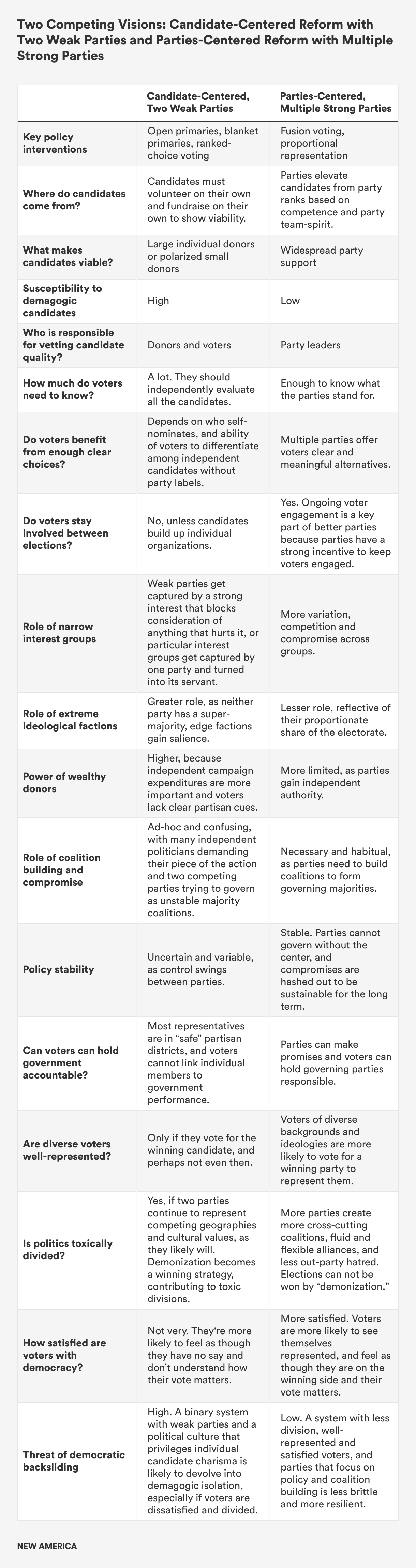
A Proposal for Single-Winner Offices: A Two-Round System, with Fusion in the Second Round
Proportionality is not an option for single-winner offices. However, there are ways to achieve some proportionality even within a single-winner office.
Such a system could work as follows:
Any party aiming to compete in such an election will nominate a candidate through its preferred method. Independents who wish to run without a party can also enter if they can meet a signature requirement.
The initial round of voting occurs during a week in September, two months prior to the November election. This is a top-two election, to elevate the top two candidates to a general election. It is held open for a week to increase participation.
Between the two rounds, parties that participated in the first round but whose candidate did not advance have the option to cross-endorse one of the two remaining candidates, effectively fusing with one of the top two candidates. If they choose to do so, their ballot line will appear in the general election. They would have a month to decide. As with any fusion system, candidates must consent to such an endorsement.
This system would work easily with Senate and gubernatorial elections.
However, the Electoral College makes this slightly difficult to implement for presidential elections. Without reforming the Electoral College, however, the bargaining that would take place among parties between the first round of voting for Senate and gubernatorial offices and the November round would certainly spill over into the presidential race, with parties forming pre-electoral coalitions. Presidential candidates could promise Cabinet positions to representatives from different parties, which is how presidents often govern in democracies that use proportional representation for their legislatures, a combination that is common in Latin America, and widely considered to function well—as long as presidents are not too powerful and legislatures not excessively fragmented (which is only likely to happen under overly permissive system of proportional representation.)172
If such a system were adopted, America would have a dynamic two-month election season, full of negotiations and shifting coalitions and innovative compromises, to build winning majorities. Rather than the staid us-versus-them grind of current politics, parties could fuse and coalesce in response to changing problems.
Additional Factors: Campaign Finance and Internal Party Organization
We might also envision changes to campaign finance law, particularly public funding for qualified political parties (not candidates). If campaign finance law could channel organizing and fundraising activities to operate within the political party, these would be a powerful pro-party change. However, rules that channel organizing and fundraising activities to outside organizations or individual candidates undermine party operations.
Not all party activities are equal. A party that mainly focuses on advertising and messaging is typically linked weakly to nonelites and controlled by a small group of donors, consultants, and politicians. Such parties are warning signs of crumbling democracy.173 Instead, as Didi Kuo and Tabatha Abu-El Haj argue, political parties “should foster deep ties to local communities. They should prioritize social interactions with communities and voters, and they should do so in ways that ‘listen’ to the community. This requires investing in state and local parties as organizations with year-round offices, staff, and events.”174
Campaign finance laws and other party regulations can prioritize these more personal and direct modes of political engagement. Currently, campaign finance law and the broader legal conception of political parties favor a very limited view of speech as the most important thing to be protected. The speech under protection, however, is the ability of party leaders to broadcast their message, and the speech of wealthy political donors to broadcast their message, too. Such a cramped view sees politics as a kind of marketplace, in which those who already have power should get to control the conversation. The rest are simply passive listeners.
The Supreme Court’s view has long been that top-down, two-party competition serves democratic accountability well, and so party leadership in the two major parties deserves special protection. Despite the mounting evidence to the contrary (indeed, the two-party system has been a clear driver of democratic dysfunction for at least two decades), the Court has not yet budged from this theory.175
The Supreme Court has maintained that hierarchical two-party competition effectively promotes democratic accountability, warranting protection. Despite increasing evidence to the contrary—with the two-party system driving democratic dysfunction for at least two decades—the Court has yet to update its views. As Tabatha Abu-El Haj explains, “the Court consistently rules in favor of the party leadership’s control of the brand in conflicts between leaders and members.”
The Court also rules in favor of national party leadership over state party leadership, and state party leadership over state party members, and the two parties against the smaller parties.
On money, the court has sided repeatedly with a view that unlimited money is just fine—especially if it flows into “outside” groups that are technically independent from the parties, even if they are not.
A better way to handle campaign finance is to put money into parties, especially for on-the-ground party-building activities that involve face-to-face interactions rather than just one-way advertising. To the extent campaign finance and party regulation can privilege more “associational-party building” approaches, our parties will be better and healthier, and better able to perform their crucial intermediary roles in representative democracy.
However, even with favorable campaign finance regulations and other rules that encourage party leaders to spend more time with diverse constituents and less time with narrow and limited donors, parties are only likely to make such investments where winning more votes actually pays off.
Here’s the problem: Democrats and Republicans have little motivation to invest in on-the-ground party-building in most places, either because they are certain of winning seats or because the possibility of victory is negligible. This issue is most acute in locations where one party dominates, with party leaders displaying a minimal interest in anything that could disrupt the status quo. This lack of competition follows from the difficult combination of geographically sorted parties and single-member districts.
Under a multiparty system, particularly a proportional multiparty system, multiple parties can connect with different communities and develop a more honest representation of these communities. If votes become valuable equally in all locations (as opposed to just in swing districts), investing in party-building organizations everywhere will make sense for party leaders.
In multiparty systems, new parties can more easily innovate with new models of organization. With lower barriers to entry, new challenger parties in proportional democracies are exploring new approaches to internal organization,176 particularly through new technology. There is certainly no perfect model—the balance between inclusivity and leadership is always changing, and parties are constantly attempting to balance short-term responsiveness with long-term responsibility. But as a general rule, a more fluid party system creates more opportunities for rebalancing, because parties that cannot manage the balance also typically cannot gain adherents while other parties replace them.177
The bottom line is this: The key to making parties better is allowing new parties to enter politics. New parties bring new ideas, new approaches to organization, and new forms of representation. Competition spurs innovation.
Citations
- President Barack Obama, Address at 2020 Democratic National Convention, (Philadelphia, August 19, 2020); President Joe Biden, “Remarks by President Biden on Standing up for Democracy,” (Washington, DC, November 2, 2022). Barack Obama’s 2020 Democratic National Convention speech put the stakes plainly: “Because that’s what’s at stake right now. Our democracy.” He said that the Trump administration “has shown it will tear our democracy down if that’s what it takes to win.” In 2022, before the midterms, Joe Biden similarly clarified the stakes with a speech in which he said, “Make no mistake: Democracy is on the ballot.”
- Vice President Mike Pence, Address at 2020 Republican National Convention, (Fort McHenry, Baltimore, August 26, 2020). Mike Pence’s Republican National Convention speech argued that: “In this election, it is not so much whether America will be more conservative or more liberal, more Republican or more Democrat. The choice in this election is whether America remains America.”
- J. M. Berger, Extremism (Cambridge, MA: MIT Press, 2018).
- Samuel P. Huntington, American Politics: The Promise of Disharmony (Cambridge, MA: Belknap Press, 1983).
- Steven Levitsky and Daniel Ziblatt, How Democracies Die (New York: Crown Publishing, 2018).
- Milan W. Svolik, The Politics of Authoritarian Rule (Cambridge, MA: Cambridge University Press, 2012), 35.
- Berger, Extremism.
- Murat Somer and Jennifer McCoy, “Transformations through Polarizations and Global Threats to Democracy,” The ANNALS of the American Academy of Political and Social Science 681 (January 2019): 8–22, https://doi.org/10.1177/0002716218818058; Murat Somer and Jennifer McCoy, “Toward a Theory of Pernicious Polarization and How It Harms Democracies: Comparative Evidence and Possible Remedies,” The ANNALS of the American Academy of Political and Social Science 681 (January 2019): 234–71, https://doi.org/10.1177/0002716218818782. Somer and McCoy identify 10 key aspects of “pernicious” polarization that distinguish it from “healthy pluralism.” They are: 1) Division of the electorate into two hostile camps, where multiple cleavages have collapsed into one dominant cleavage or boundary line between the two camps; 2) The political identity of the two camps becomes a social identity in which members feel they belong to a “team” and demonstrate strong loyalty to it; 3) Political demands and interests form around those identities; 4) The two camps are characterized in moral terms of “good” and “evil”; 5) The identities and interests of the two camps are viewed as mutually exclusive and antagonistic, thus negating the possibility of common interests between different groups; 6) A greater cohesion grows within groups, and greater conflict and hostility between groups; 7) Stereotyping and prejudice build toward the out-group due to lack of direct communication and/or social interaction; 8) The center drops out and the polarized camps attempt to label all individuals and groups in society as one or the other; 9) Institutions, including media, become dominated by one bloc or the other through discursive changes as well as changes of ownership, management, and staff, weakening the middle ground in public and political discourses; 10) The antagonistic relationship manifests in spatial and psychological separation of the polarized groups.
- Jennifer McCoy, Tahmina Rahman, and Murat Somer, “Polarization and the Global Crisis of Democracy: Common Patterns, Dynamics, and Pernicious Consequences for Democratic Polities,” American Behavioral Scientist 62 (January 2018): 16–42, https://doi.org/10.1177/0002764218759576. McCoy, Rahman, and Somer find that: “Situations of deep polarization create problems of governance as communication and trust break down and the two camps prove unwilling and unable to negotiate and compromise. Political gridlock paralyzes government, and in some cases, results in instability and careening between policy choices if neither side can prevail in the long run and seeks to overturn the predecessor’s policies at every chance. Alternatively, one camp may become hegemonic and curtail liberties, tend toward authoritarianism, or even establish an autocratic regime. At the societal level, citizens become divided spatially and socially. They come to believe they can no longer coexist in the same nation. Finally, the backlash and conflict arising from extreme polarization can also lead to democratic collapse if former elites and dominant societal groups, often allied with military forces, retake control with undemocratic means.” See also: Daniel Ziblatt and Steven Levitsky, How Democracies Die; Barbara F. Walter, How Civil Wars Start: And How to Stop Them (New York: Crown, 2022); Jennifer McCoy and Benjamin Press, What Happens When Democracies Become Perniciously Polarized? (Washington, DC: Carnegie Endowment for International Peace, 2022), https://carnegieendowment.org/2022/01/18/what-happens-when-democracies-become-perniciously-polarized-pub-86190.
- Lee Drutman, Breaking the Two-Party Doom Loop: The Case for Multiparty Democracy in America (New York: Oxford University Press, 2020).
- Modern political parties, particularly in America, are somewhat amorphous networks, almost like “blobs” that defy easy explanation.
- See, e.g., Michael Laver and Ernest Sergenti, Party Competition: An Agent-Based Model (Princeton, NJ: Princeton University Press, 2011).
- Kathleen Bawn, Martin Cohen, David Karol, Seth Masket, Hans Noel, and John Zaller, “A Theory of Political Parties: Groups, Policy Demands and Nominations in American Politics,” Perspectives on Politics 10 (September 2012): 571–97.
- For more perspective on this question of living, emergent systems, see Fritjof Capra, The Web of Life: A New Scientific Understanding of Living Systems (New York: Macmillan Audio, 1996).
- Craig W. Blatz and Brett Mercier, “False Polarization and False Moderation: Political Opponents Overestimate the Extremity of Each Other’s Ideologies but Underestimate Each Other’s Certainty,” Social Psychological and Personality Science 9 (July 2018): 521–29, https://doi.org/10.1177/1948550617712034; Philip M. Fernbach and Leaf Van Boven, “False Polarization: Cognitive Mechanisms and Potential Solutions,” Current Opinion in Psychology 43 (February 2022): 1–6, https://doi.org/10.1016/j.copsyc.2021.06.005; Michael C. Schwalbe, Geoffrey L. Cohen, and Lee D. Ross, “The Objectivity Illusion and Voter Polarization in the 2016 Presidential Election,” Proceedings of the National Academy of Sciences 117 (September 2020): 21218–29, https://doi.org/10.1073/pnas.1912301117.
- Keith E. Stanovich, The Bias That Divides Us: The Science and Politics of Myside Thinking (Cambridge, MA: MIT Press, 2021); Keith E. Stanovich, Richard F. West, and Maggie E. Toplak, “Myside Bias, Rational Thinking, and Intelligence,” Current Directions in Psychological Science 22 (August 2013): 259–64, https://doi.org/10.1177/0963721413480174.
- Berger, Extremism, 43.
- Berger, Extremism.
- Keith E. Stanovich, Richard F. West, and Maggie E. Toplak. “Myside Bias, Rational Thinking, and Intelligence,” Current Directions in Psychological Science 22, no. 4 (August 2013): 259–64, https://doi.org/10.1177/0963721413480174. The authors go on to list a few examples, “including stereotyping, prejudice, ingroup favouritism, out-group derogation and even dehumanization.”
- Such is the takeaway from an exhaustive review on “Cognitive-motivational mechanisms of political polarization.” The review cites 345 articles documenting causal pathways in every direction, and a long list of cognitive biases that exacerbate binary partisan polarization once it gets underway. For example, as the authors note, “longitudinal research demonstrated that ideological consistency at time 1 predicted affective polarization at time 2, and affective polarization at time 1 predicted ideological consistency at time 2, all other things being equal.”
- Delia Balassarri and Scott E. Page, “The Emergence and Perils of Polarization,” Proceedings of the National Academy of Sciences 118 (December 2021), https://doi.org/10.1073/pnas.2116863118.
- Balassarri and Page, “The Emergence and Perils of Polarization.”
- Balassarri and Page, “The Emergence and Perils of Polarization.”
- Susan T. Fiske, “A Millennial Challenge: Extremism in Uncertain Times,” Journal of Social Issues 69, no. 3 (2013): 605–13, https://doi.org/10.1111/josi.12031.
- Fiske, “A Millennial Challenge.” Fiske explains: “To reduce extremism, give certainty about social justice in terms of democratic representation, and individual personal agency.”
- McCoy and Somer, “Toward a Theory of Pernicious Polarization and How It Harms Democracies.” “We find that the most extreme cases of polarization among our countries emerge in contexts of majoritarian electoral systems that produce a disproportionate representation for the majority or plurality party, and that, once in power, the polarizing parties and incumbents attempt, and often succeed, in engineering additional constitutional and legal changes to enhance their electoral advantage.”
- Benjamin Highton and Walter J. Stone, “Reconciling Candidate Extremism and Spatial Voting,” Legislative Studies Quarterly 46, no. 2 (2021): 585–613, https://doi.org/10.1111/lsq.12289.
- Indeed, a growing literature reinforces a basic finding: that strong partisans are quite willing to tolerate antidemocratic behavior on their side, while being hypervigilant about such activities on the other side. See, e.g., Matthew H. Graham and Milan W. Svolik, “Democracy in America? Partisanship, Polarization, and the Robustness of Support for Democracy in the United States,” American Political Science Review 114 (May 2020): 392–409, https://doi.org/10.1017/S0003055420000052; Gabor Simonovits, Jennifer McCoy, and Levente Littvay, “Democratic Hypocrisy and Out-Group Threat: Explaining Citizen Support for Democratic Erosion,” Journal of Politics 84, no. 3 (2022): 1806–11; Elisabeth Gidengil, Dietlind Stolle, and Olivier Bergeron-Boutin, “The Partisan Nature of Support for Democratic Backsliding: A Comparative Perspective,” European Journal of Political Research 61, no. 4 (2022): 901–29, https://doi.org/10.1111/1475-6765.12502; Alia Braley, Gabriel S. Lenz, Dhaval Adjodah, Hossein Rahnama, and Alex Pentland, “The Subversion Dilemma: Why Voters Who Cherish Democracy Participate in Democratic Backsliding,” (Working Paper, 2022), 45; John Carey, Katherine Clayton, Gretchen Helmke, Brendan Nyhan, Mitchell Sanders, and Susan Stokes, “Who Will Defend Democracy? Evaluating Tradeoffs in Candidate Support among Partisan Donors and Voters,” Journal of Elections, Public Opinion and Parties (July 2020): 1–16, https://doi.org/10.1080/17457289.2020.1790577.
- Lilliana Mason, Uncivil Agreement: How Politics Became Our Identity (Chicago: University of Chicago Press, 2018); Donald Green, Bradley Palmquist, and Eric Schickler, Partisan Hearts and Minds (New Haven, CT: Yale University Press, 2004).
- For an even more extended discussion of the essential role of political parties in modern democracy, see Nancy L. Rosenblum, On the Side of the Angels: An Appreciation of Parties and Partisanship (Princeton, NJ: Princeton University Press, 2008); Russell Muirhead, The Promise of Party in a Polarized Age (Cambridge, MA: Harvard University Press, 2014); Russell Muirhead and Nancy L. Rosenblum, “The Political Theory of Parties and Partisanship: Catching Up,” Annual Review of Political Science 23 (May 11, 2020): 95–110; Russell Muirhead, “A Defense of Party Spirit,” Perspectives on Politics 4, no. 4 (2006): 713–27; Frances Rosenbluth and Ian Shapiro, Responsible Parties: Saving Democracy from Itself (New Haven, CT: Yale University Press, 2018). The following discussion draws on insights from these works, especially the writings of Nancy Rosenbaum.
- David Bruce Robertson, A Theory of Party Competition (Hoboken, NJ: John Wiley & Sons, 1976), 1.
- Some theories of parties suggest that politicians form parties for their own advancement in winning office and passing policies. See, e.g., John H. Aldrich, Why Parties? The Origin and Transformation of Political Parties in America (Chicago: University of Chicago Press, 1995); Joseph A. Schlesinger, Political Parties and the Winning of Office (Ann Arbor: University of Michigan Press, 1991). Other theories of parties see them as coalitions of interest groups and donors. From a comparative perspective, there are many types of parties, which differ in how they organize internally and the types of constituencies they represent. See, e.g., Susan E. Scarrow, Paul D. Webb, and Thomas Poguntke, eds., “Conclusion: The Study of Party Organization,” in Organizing Political Parties: Representation, Participation, and Power (Oxford: Oxford University Press, 2017), 307-320; Richard Gunther and Larry Diamond, “Species of Political Parties: A New Typology,” Party Politics 9 (March 2003): 167–99, https://doi.org/10.1177/13540688030092003. Over time, political parties have changed considerably, and they come in many different varieties. Richard S. Katz, and Peter Mair, “The Evolution of Party Organizations in Europe: The Three Faces of Party Organization,” American Review of Politics 14 (January 1994): 593–617, https://doi.org/10.15763/issn.2374-7781.1993.14.0.593-617. Yet what all political parties have in common is that they put forward candidates for public office on an official ballot line. See, generally: Giovanni Sartori, Parties and Party Systems: A Framework for Analysis (Colchester, UK: ECPR Press, 1976).
- Consistent across all studies is that competitive elections drive higher turnout: André Blais, “What Affects Voter Turnout?” Annual Review of Political Science 9 (June 2006): 111–25, https://doi.org/10.1146/annurev.polisci.9.070204.105121; João Cancela and Benny Geys, “Explaining Voter Turnout: A Meta-Analysis of National and Subnational Elections,” Electoral Studies 42 (June 2016): 264–75, https://www.sciencedirect.com/science/article/abs/pii/S0261379416300956; Gary W. Cox, “Electoral Rules, Mobilization, and Turnout,” Annual Review of Political Science 18 (May 2015): 49–68, https://doi.org/10.1146/annurev-polisci-060414-035915; Benny Geys, “Explaining Voter Turnout: A Review of Aggregate-Level Research,” Electoral Studies 25 (December 2006): 637–63, https://www.sciencedirect.com/science/article/abs/pii/S0261379405000910?via%3Dihub.
- Nelson W. Polsby, Political Innovation in America: The Politics of Policy Initiation (New Haven, CT: Yale University Press, 1985).
- Research consistently finds a relationship between low levels of partisan competition and high levels of political corruption, both across U.S. states and across countries worldwide. See, e.g., Kim Quaile Hill, “Democratization and Corruption: Systematic Evidence from the American States,” American Politics Research 31 (November 2003): 613–31, https://doi.org/10.1177/1532673X03255178; Thomas Schlesinger and Kenneth J. Meier, “Variations in Corruption among the American States,” in Political Corruption, ed. Michael Johnston (New York: Routledge, 2002), chap. 33; Daniel Treisman, “The Causes of Corruption: A Cross-National Study,” Journal of Public Economics 76 (June 2000): 399–457, https://doi.org/10.1016/S0047-2727(99)00092-4; Petra Schleiter and Alisa M Voznaya,“Party System Competitiveness and Corruption,” Party Politics 20 (September 2014): 675–86, https://doi.org/10.1177/1354068812448690.
- Few “normal” people participate in politics because of a spontaneous passion or interest; they participate because somebody asks them. Political parties are the institutions that have historically done most of the asking. When political parties do not subsidize mobilization, it is the poor and least engaged who tend to drop out of politics. See, e.g., Sidney Verba, Kay Lehman Schlozman, and Henry E. Brady, Voice and Equality: Civic Voluntarism in American Politics (Cambridge, MA.: Harvard University Press, 1995); Steven J. Rosenstone and John Mark Hansen, Mobilization, Participation, and Democracy in America, (New York, Munich: Pearson, 2002); Kim Quaile Hill and Jan E. Leighley, “Political Parties and Class Mobilization in Contemporary United States Elections,” American Journal of Political Science 40 (August 1996): 787, https://doi.org/10.2307/2111795; Robert Huckfeldt and John Sprague, “Political Parties and Electoral Mobilization: Political Structure, Social Structure, and the Party Canvass,” American Political Science Review 86 (March 1992): 70–86, https://doi.org/10.2307/1964016; Joe Soss and Lawrence R. Jacobs, “The Place of Inequality: Non-Participation in the American Polity,” Political Science Quarterly 124, no. 1 (2009): 95–125, https://doi.org/10.1002/j.1538-165X.2009.tb00643.x.
- John M. Carey and Matthew Shugart, “Incentives to Cultivate a Personal Vote: A Rank Ordering of Electoral Formulas,” Electoral Studies 14 (December 1, 1995): 417–39, https://doi.org/10.1016/0261-3794(94)00035-2; Audrey André, Sam Depauw, and Matthew S. Shugart, “The Effect of Electoral Institutions on Legislative Behaviour,” in The Oxford Handbook of Legislative Studies, ed. Shane Martin, Thomas Saalfeld, and Kaare W. Strøm (Oxford: Oxford University Press, 2014), 231–249.
- Reuven Y. Hazan and Gideon Rahat, Democracy within Parties: Candidate Selection Methods and Their Political Consequences (Oxford: Oxford University Press, 2010).
- Levitsky and Ziblatt, How Democracies Die; Kim Lane Scheppele, “The Party’s Over,” in Constitutional Democracy in Crisis? ed. Mark A. Graber, Sanford Levinson, Mark Tushnet (Oxford: Oxford University Press, 2018), https://doi.org/10.1093/law/9780190888985.003.0028.
- Andrew B. Hall, Who Wants to Run? How the Devaluing of Political Office Drives Polarization (Chicago: University of Chicago Press, 2019).
- See John H. Aldrich, Why Parties? The Origin and Transformation of Political Parties in America (Chicago: University of Chicago Press, 1995); John H. Aldrich and Ruth W. Grant, “The Antifederalists, the First Congress, and the First Parties,” The Journal of Politics 55, no. 2 (1993): 295–326.
- Rosenblum, On the Side of the Angels: An Appreciation of Parties and Partisanship, 58: “No majority exists spontaneously, ready to be contested for. It is identified in the course of drawing lines of division. That is what political activity generally and party activity is specifically about.”
- Seymour Martin Lipset, “The Indispensability of Political Parties,” Journal of Democracy 11, no. 1 (2000): 48–55, https://doi.org/10.1353/jod.2000.0016; Elmer Eric Schattschneider, Party Government (New York: Farrar & Rinehart, Inc., 1942).
- See, e.g., Michael Johnston, Corruption, Contention and Reform: The Power of Deep Democratization (Cambridge: Cambridge University Press, 2014); Susan Rose-Ackerman and Bonnie J. Palifka, Corruption and Government: Causes, Consequences, and Reform (New York: Cambridge University Press, 2016).
- Hannah M. Ridge, “Just Like the Others: Party Differences, Perception, and Satisfaction with Democracy,” Party Politics 28, no. 3 (May 2022): 419–30, https://doi.org/10.1177/1354068820985193: “Citizens who view their system as including a broad array of parties are more likely to be satisfied with their democracy’s performance.” See also: Paul Webb, Susan Scarrow, and Thomas Poguntke, “Party Organization and Satisfaction with Democracy: Inside the Blackbox of Linkage,” Journal of Elections, Public Opinion and Parties 32, no. 1 (January 2, 2022): 151–72, https://doi.org/10.1080/17457289.2019.1698047.
- Tabatha Abu El-Haj, “Networking the Party: First Amendment Rights and the Pursuit of Responsive Party Government,” Columbia Law Review 118, no. 4 (2018): 1225–1302; Tabatha Abu El-Haj, and Didi Kuo, “Associational Party-Building: A Path to Rebuilding Democracy,” Columbia Law Review 122 (2022): 50.
- Adam Przeworski, Democracy and the Market (Cambridge, : Cambridge University Press, 1991).
- Rosenblum, On the Side of the Angels, 160.
- Scheppele, “The Party’s Over.”
- Scheppele, “The Party’s Over,” 8.
- Lara Putnam, Daniel Schlozman, Tabatha Abu El-Haj, Joseph Anthony, Jacob M. Grumbach, Alexander Hertel-Fernandez, Adam Seth Levine, and Caroline Tervo, “Local Political Parties as Networks: A Guide to Self-Assessment,” Scholars Strategy Network (May 19, 2020), https://scholars.org/contribution/local-political-parties-guide; El-Haj and Kuo, “Associational Party-Building: A Path to Rebuilding Democracy.”
- Piero Ignazi, “The Failure of Mainstream Parties and the Impact of New Challenger Parties in France, Italy and Spain,” Italian Political Science Review/Rivista Italiana Di Scienza Politica 51, no. 1 (March 2021): 100–116, https://doi.org/10.1017/ipo.2020.26.
- Margit Tavits, “Party System Change: Testing a Model of New Party Entry,” Party Politics 12 (January 2006): 99–119, https://doi.org/10.1177/1354068806059346.
- John Sides, Chris Tausanovitch, and Lynn Vavreck, The Bitter End: The 2020 Presidential Campaign and the Challenge to American Democracy (Princeton, NJ: Princeton University Press, 2022).
- Scheppele, “The Party’s Over.”
- Marty Cohen, David Karol, Hans Noel, and John Zaller, The Party Decides: Presidential Nominations Before and After Reform (Chicago: University of Chicago Press, 2008); Marty Cohen, David Karol, Hans Noel, and John Zaller, “Party Versus Faction in the Reformed Presidential Nominating System,” PS: Political Science & Politics 49, no. 04 (October 2016): 701–8, https://doi.org/10.1017/S1049096516001682; Hans J. G. Hassell, The Party’s Primary: Control of Congressional Nominations (Cambridge: Cambridge University Press, 2017); Hans J. G. Hassell, “Party Elite Engagement and Coordination in House Primary Elections: A Test of Theories of Parties,” American Journal of Political Science 67, no. 2 (2023): 307–23, https://doi.org/10.1111/ajps.12680.
- See Theda Skocpol and Alexander Hertel-Fernandez, “The Koch Network and Republican Party Extremism,” Perspectives on Politics 14, no. 3 (September 2016): 681–99, https://doi.org/10.1017/S1537592716001122.
- See Ezra Klein, “Was the Democratic Primary Rigged?” Vox, November 14, 2017, https://www.vox.com/policy-and-politics/2017/11/14/16640082/donna-brazile-warren-bernie-sanders-democratic-primary-rigged.
- For a useful history of the idea of responsible party government and its development in U.S. politics, see Sam Rosenfeld, The Polarizers: Postwar Architects of Our Partisan Era (Chicago: University of Chicago Press, 2017).
- Since 1994, Republicans have enjoyed six years of unified government (four under Bush, two under Trump), and Democrats have enjoyed four years of unified government (two under Obama, two under Biden). That means two-thirds of the time, control of the presidency, Senate, and the House was split between the two parties.
- This happened in 2009. Before that, it last happened in 1977-1978.
- Shaun Bowler, Todd Donovan, Ola Listhaug, Christopher J. Anderson, and André Blais, Losers’ Consent: Elections and Democratic Legitimacy (Oxford: Oxford University Press, 2007); Matthew Germer, Restoring Losers’ Consent: A Necessary Step to Stabilizing Our Democracy (Washington, DC: R Street Institute, September 2021), https://www.rstreet.org/research/restoring-losers-consent-a-necessary-step-to-stabilizing-our-democracy/; Richard Nadeau and Andre Blais, “Accepting the Election Outcome: The Effect of Participation on Losers’ Consent,” British Journal of Political Science 23, no. 4 (1993): 553–63.
- Piero Ignazi, “The Failure of Mainstream Parties and the Impact of New Challenger Parties in France, Italy and Spain,” Italian Political Science Review/Rivista Italiana Di Scienza Politica 51 (March 2021): 100–116, https://doi.org/10.1017/ipo.2020.26. Ignazi notes how challenger parties are innovating in response to the failures of the old mainstream parties.
- Luciano Bardi, Stefano Bartolini, and Alexander Trechsel, “Party Adaptation and Change and the Crisis of Democracy,” Party Politics 20, no. 2 (March 1, 2014): 151–59, https://doi.org/10.1177/1354068813519966.
- Austin Ranney, Curing the Mischiefs of Faction: Party Reform in America (Berkeley: University of California Press, 1975); Byron E. Shafer and Regina L. Wagner, The Long War over Party Structure: Democratic Representation and Policy Responsiveness in American Politics (Cambridge: Cambridge University Press, 2019), https://doi.org/10.1017/9781108753517.
- James A. Morone, The Democratic Wish: Popular Participation and the Limits of American Government (New Haven, CT: Yale University Press, 1998); 79-82.
- Douglas W. Jaenicke, “The Jacksonian Integration of Parties into the Constitutional System,” Political Science Quarterly 101, no. 1 (1986): 91-92, https://doi.org/10.2307/2151445: “The Jacksonians’ ideal was a party and society without any recognized values except the procedural equality and negative liberty of strict constitutional construction”; “the Democratic principles of equal opportunity, limited government, and strict construction necessarily engendered a politics of competitive self-interest.”
- Lynn L. Marshall, “The Strange Stillbirth of the Whig Party,” The American Historical Review 72, no. 2 (January 1967): 464. “The Bank of the United States embodied just this leadership ideal championed by Tocqueville and the proto-Whigs. Without denying the obvious economic utility of central control on banking, consider the socially impacted structure of this particular institution. Originally constructed in accordance with a segment of Hamilton’s brilliant theory, it represented a grand scheme with which men of honor might reach out imaginatively to secure possibly great benefits for the whole of society. It represented, pre-eminently, government buttressing of private socioeconomic position.”
- Ronald P. Formisano, “Political Character, Antipartyism and the Second Party System,” American Quarterly 21, no. 4 (1969): 683, https://doi.org/10.2307/2711603.
- Elmer Eric Schattschneider, Party Government (New York: Farrar & Rinehart, Inc., 1942), 129. Also cited in Rainey 1975, 174), who cites wide agreement.
- Eric Foner, Politics and Ideology in the Age of the Civil War (New York: Oxford University Press, 1981), 66. As historian Foner has explained, “These competing conspiratorial outlooks were reflections, not merely of sectional “paranoia,” but of the fact that the nation was every day growing apart and into two societies whose ultimate interests were diametrically opposed. The South’s fear of black Republicans, despite its exaggerated rhetoric, was based on the realistic assessment that at the heart of Republican aspirations for the nation’s future was the restriction and eventual eradication of slavery. And the Slave Power expressed northerners’ conviction, not only that slavery was incompatible with basic democratic values, but that to protect slavery, southerners were determined to control the federal government and use it to foster the expansion of slavery. In summary, the Slave Power idea was the ideological glue of the Republican party—it enabled them to elect in 1860 a man conservative enough to sweep to victory in every northern state, yet radical enough to trigger the secession crisis.”
- Foner, Politics and Ideology in the Age of the Civil War.
- David Blight, “Was the Civil War Inevitable?” New York Times Magazine, December 21, 2022, https://www.nytimes.com/2022/12/21/magazine/civil-war-jan-6.html.
- Frances E. Lee, “Patronage, Logrolls, and ‘Polarization’: Congressional Parties of the Gilded Age, 1876–1896,” Studies in American Political Development 30 (October 2016): 116–27. Americans were polarized in their voting during the Progressive Era, but on substance there was little difference.
- James Bryce, The American Commonwealth (New York: Macmillan Publishers, 1889).
- Samuel P. Hays, “The Politics of Reform in Municipal Government in the Progressive Era,” The Pacific Northwest Quarterly 55, no. 4 (1964): 157–69.
- J. Allen Smith, as quoted in Grant McConnell, Private Power & American Democracy (New York: Knopf, 1966), 48.
- David M. Kennedy, “Overview: The Progressive Era,” The Historian 37 (May 1975): 453–68, https://doi.org/10.1111/j.1540-6563.1975.tb00037.x. “It embodies moral passion, has its own built-in dramatic elements in the clash between the ‘people'’and the ‘interests,’” but the problem with this theory is that the reformers were often the elites, and the reforms were not necessarily successful.
- McConnell, Private Power & American Democracy, 31-32, 34. McConnell describes a “deep and widespread sense of exploitation and disorder” and a public preoccupied with corruption; “Any power was usurpation” and conspiracy”; there was “an ingrained distrust of power in the abstract”; the perception was that corruption was rampant—“selfishness had corrupted the original purposes of a higher nation”; the problem was “the system.”
- Hays, “The Politics of Reform in Municipal Government in the Progressive Era”: “The ideology of democratization of decision-making was negative rather than positive; it served as an instrument of attack against the existing political system rather than as a guide to alternative action."
- Lee Demetrius Walker, “The Ballot as a Party-System Switch: The Role of the Australian Ballot in Party-System Change and Development in the USA,” Party Politics 11 (March 2005): 217–41; Alan Ware, “Anti-Partism and Party Control of Political Reform in the United States: The Case of the Australian Ballot,” British Journal of Political Science 30 (January 2000): 1–29.
- For overviews of how the primary system changed during this period, see John F. Reynolds, The Demise of the American Convention System, 1880-1911 (Cambridge: Cambridge University Press, 2006); Alan Ware, The American Direct Primary: Party Institutionalization and Transformation in the North (Cambridge: Cambridge University Press, 2002); Shigeo Hirano, Primary Elections in the United States (Cambridge: Cambridge University Press, 2019).
- George W. Norris, “Why I Believe in the Direct Primary,” The ANNALS of the American Academy of Political and Social Science 106 (March 1923): 22–30.
- John F. Reynolds, “The Origins of the Direct Primary,” In Routledge Handbook of Primary Elections, ed. Robert G. Boatright, (New York Routledge, 2018), 39–56.
- Stephen Ansolabehere, John Mark Hansen, Shigeo Hirano, and James M. Snyder, “More Democracy: The Direct Primary and Competition in U.S. Elections,” Studies in American Political Development 24 (October 2010): 190–205.
- Daniel T. Rodgers, “In Search of Progressivism,” Reviews in American History 10 (1982): 118, https://doi.org/10.2307/2701822.
- Erik J. Engstrom, “The Rise and Decline of Turnout in Congressional Elections: Electoral Institutions, Competition, and Strategic Mobilization,” American Journal of Political Science 56, no. 2 (2012): 373–86; Erik J. Engstrom and Samuel Kernell, Party Ballots, Reform, and the Transformation of America’s Electoral System (Cambridge: Cambridge University Press, 2014).
- McConnell, Private Power & American Democracy, 50.
- Marver H. Bernstein, Regulating Business by Independent Commission (Princeton, N.J.: Princeton University Press, 1955). Marver Bernstein’s 1955 classic, Regulating Industry by Independent Commission, described the evolution of industry capture, whereby industries over time capture the independent commissions that were intended to regulate them. McConnell made a similar argument in 1966.
- Students for a Democratic Society (U.S.), “The Port Huron Statement,” (1962).
- Theodore J. Lowi, The End of Liberalism: The Second Republic of the United States (New York: W.W. Norton & Company, 1969).
- James Q. Wilson, The Amateur Democrat: Club Politics in Three Cities (Chicago: University of Chicago Press, 1962).
- For a good history of this era, see Eugene J. Dionne, Why Americans Hate Politics (New York: Simon and Schuster, 2004).
- El-Haj and Kuo, “Associational Party-Building,” 17, citing Jaime Sánchez, Jr., “Revisiting McGovern-Fraser: Party Nationalization and the Rhetoric of Reform,” Journal of Policy History 32, no. 1 (2020): 1–24; and Commission on Party Structure and Delegate Selection, 92nd Cong., Mandate for Reform (1971), reprinted in 117 Cong. Rec. 32,908 (1971): “In the 1970s, political parties lost ground at the local level as they began a process of nationalization. With advances in communication technologies, national parties became more prominent in the mid- twentieth century. The McGovern–Fraser reforms accelerated this trend by stripping state parties of their candidate-nomination roles and mandating a primary election system whereby voters themselves would determine the party’s presidential candidate.”
- See Jonathan Rauch, Political Realism: How Hacks, Machines, Big Money, and Back-Room Deals Can Strengthen American Democracy (Washington, DC: Brookings Institution Press, 2015); Frances Rosenbluth and Ian Shapiro, Responsible Parties: Saving Democracy from Itself (New Haven, CT: Yale University Press, 2018); Lawrence R. Jacobs, Democracy under Fire: The Rise of Extremists and the Hostile Takeover of the Republican Party (Oxford: Oxford University Press, 2022).
- Sam Rosenfeld, The Polarizers.
- Byron E. Shafer and Regina L. Wagner, The Long War over Party Structure: Democratic Representation and Policy Responsiveness in American Politics (Cambridge: Cambridge University Press, 2019), https://doi.org/10.1017/9781108753517; Seth Masket, No Middle Ground: How Informal Party Organizations Control Nominations and Polarize Legislatures (Ann Arbor: University of Michigan Press, 2011).
- Julian Zelizer, On Capitol Hill: The Struggle to Reform Congress and Its Consequences, 1948-2000 (Cambridge: Cambridge University Press, 2006).
- Paul Sabin, Public Citizens: The Attack on Big Government and the Remaking of American Liberalism (New York: WW Norton & Company, 2021).
- Michel Crozier, Samuel P. Huntington, and Joji Watanuki, The Crisis of Democracy: Report on the Governability of Democracies to the Trilateral Commission (New York: New York University Press, 1975).
- Gary Gerstle, The Rise and Fall of the Neoliberal Order: America and the World in the Free Market Era (Oxford: Oxford University Press, 2022).
- Ernst Friedrich Schumacher, Small Is Beautiful: A Study of Economics as if People Mattered (New York: Random House, 2011). The influential book Small is Beautiful urged everyone to live off the land, a kind of neo-Jeffersonianism vision amid capitalist progress.
- Lee Drutman, The Business of America Is Lobbying: How Corporations Became Politicized and Politics Became More Corporate (New York: Oxford University Press, 2015).
- Thomas Frank, The Conquest of Cool: Business Culture, Counterculture, and the Rise of Hip Consumerism (Chicago: University of Chicago Press, 1997).
- Morris P. Fiorina, “The Decline of Collective Responsibility in American Politics,” Daedalus 109, no. 3, (1980), 25–45. For example, Fiorina writes, “As the electoral interdependence of the party in government declines, its ability to act also declines. If responsibility can be shifted to another level or to another officeholder, there is less incentive to stick one’s own neck out in an attempt to solve a given problem. Leadership becomes more difficult, the ever-present bias toward the short-term solution becomes more pronounced, and the possibility of solving any given problem lessens.”
- Steven J. Rosenstone, Roy L. Behr, and Edward H. Lazarus, Third Parties in America (Princeton, NJ: Princeton University Press, 1996).
- Peter H. Argersinger, “A Place on the Ballot’: Fusion Politics and Antifusion Laws,” American Historical Review 85, no. 2 (1980): 287–306; Howard A. Scarrow, “Duverger’s Law, Fusion, and the Decline of American ‘Third’ Parties,” Western Political Quarterly 39, no. 4 (December 1, 1986): 634–47, https://doi.org/10.1177/106591298603900405.
- Lisa Disch, The Tyranny of the Two-Party System (New York: Columbia University Press, 2002).
- Andrew McLaren Carstairs, A Short History of Electoral Systems in Western Europe (Crows Nest, Australia: Allen & Unwin, 1980).
- Bruce E. Cain, Democracy More or Less: America’s Political Reform Quandary (Cambridge: Cambridge University Press, 2014), 8-9. Cain explains: “The delegation paradox is this: The effort to gain more citizen control can never close the representation gap. It merely shifts the delegation. Elect more representatives to check the ones that have disappointed or failed, and you have created more delegations. Resort to direct democracy to check or bypass representative government, and a new class of election entrepreneurs gets the delegated task of formulating policy, organizing the effort to get something on the ballot, and providing voters with the information and cues they need to make a decision. Create new citizen forums, and they become the new agents. Average citizens will sporadically give input to government when something really matters to them. Organized interests are a constant presence.”
- Seth Masket, The Inevitable Party: Why Attempts to Kill the Party System Fail and How They Weaken Democracy (New York: Oxford University Press, 2016).
- Kay Lehman Schlozman, Sidney Verba, and Henry E. Brady, The Unheavenly Chorus: Unequal Political Voice and the Broken Promise of American Democracy (Princeton: NJ, Princeton University Press, 2012).
- N.S. Gill, “Aesop’s Fable of the Bundle of Sticks: One Man’s Contribution to Thousands of Years of Political Theory,” ThoughtCo., October 23, 2019, https://www.thoughtco.com/aesops-fable-the-bundle-of-sticks-118589: “An old man had a set of quarrelsome sons, always fighting with one another. On the point of death, he summoned his sons around him to give them some parting advice. He ordered his servants to bring in a bundle of sticks wrapped together. To his eldest son, he commanded, "Break it." The son strained and strained, but with all his efforts was unable to break the bundle. Each son in turn tried, but none of them was successful. “Untie the bundle,” said the father, “and each of you take a stick.” When they had done so, he called out to them: “Now, break,” and each stick was easily broken. “You see my meaning,” said their father. “Individually, you can easily be conquered, but together, you are invincible. Union gives strength.”
- Steven M. Teles and Robert P. Saldin,“The Future Is Faction,” National Affairs, Fall 2020, https://www.nationalaffairs.com/publications/detail/the-future-is-faction.
- Lydia Saad, “U.S. Political Ideology Steady; Conservatives, Moderates Tie,” Gallup, January 17, 2022, https://news.gallup.com/poll/388988/political-ideology-steady-conservatives-moderates-tie.aspx. Gallup puts moderates at 35%, Morning Consult at 27%, but with a “don’t know” category as an option https://morningconsult.com/2022/08/18/america-ideology-less-liberal-but-not-necessarily-more-conservative/.
- Geoffrey Skelley, “Few Americans Who Identify as Independent Are Actually Independent. That’s Really Bad For Politics,” FiveThirtyEight, April 15, 2021, https://fivethirtyeight.com/features/few-americans-who-identify-as-independent-are-actually-independent-thats-really-bad-for-politics/.
- Donald R. Kinder and Nathan P. Kalmoe, Neither Liberal nor Conservative: Ideological Innocence in the American Public (Chicago: University of Chicago Press, 2017).
- James Adams, Erik Engstrom, Danielle Joeston, Walt Stone, Jon Rogowski, and Boris Shor, “Do Moderate Voters Weigh Candidates’ Ideologies? Voters’ Decision Rules in the 2010 Congressional Elections,” Political Behavior 39, no. 1 (March 2017): 205–27: “Moderate voters are less responsive to candidate positioning than non-moderate voters.”
- Kinder and Kalmoe, Neither Liberal nor Conservative
- Samara Klar and Yanna Krupnikov, Independent Politics: How American Disdain for Parties Leads to Political Inaction (Cambridge: Cambridge University Press, 2016), 149. Klar and Krupnikov find that most self-identified independents are actually “undercover partisans”—that is, they vote consistently for one of the two major parties, but present themselves as independent. However, they are full of contractions: “On the one hand, they refuse to identify with partisan label or do anything to support a party they may secretly endorse. On the other hand, they are frustrated when their favored party compromises, wishing instead for a stronger fight. In some ways, these people lack the normatively positive aspects of partisans (for example, being politically participatory) while embracing the negative aspects of partisans (a stubborn dislike of compromise) … The people who avoid partisanship are a political candidate’s worst nightmare. They do little to offer support, they refuse to admit their support publicly, and they are unlikely to convince their social networks to support a particular party position or policy. Meanwhile, they make grand overtures about partisan compromise yet grow increasingly frustrated when their party—the very same party they are ashamed to admit they prefer—bends in any way to the will of the opposition, even when this is the only way the political process can move forward. These voters want their party to engage in the very same behavior that (they claim) drove them away from partisanship in the first place.”
- See, e.g., Marsha Matson and Terri Susan Fine, “Gender, Ethnicity, and Ballot Information: Ballot Cues in Low-Information Elections,” State Politics & Policy Quarterly 6, no. 1 (2006): 49–72, https://doi.org/10.1177/153244000600600103; Monika L McDermott, “Candidate Occupations and Voter Information Shortcuts,” The Journal of Politics 67, no. 1 (2005): 201–19, https://doi.org/10.1111/j.1468-2508.2005.00314.x; Monika L. McDermott, “Race and Gender Cues in Low-Information Elections,” Political Research Quarterly 51, no. 4 (1998): 895–918, https://doi.org/10.2307/449110; Melody Crowder-Meyer, Shana Kushner Gadarian, Jessica Trounstine, and Kau Vue, “A Different Kind of Disadvantage: Candidate Race, Cognitive Complexity, and Voter Choice,” Political Behavior, October 9, 2018, https://doi.org/10.1007/s11109-018-9505-1; Jamie Carson, Michael H. Crespin, Carrie P. Eaves, and Emily O. Wanless, “Constituency Congruency and Candidate Competition in Primary Elections for the U.S. House,” State Politics & Policy Quarterly 12, no. 2 (June 2012): 127–45, https://doi.org/10.1177/1532440012438892.
- Lee Drutman, What We Know About Congressional Primaries (Washington, DC: New America, 2021), https://www.newamerica.org/political-reform/reports/what-we-know-about-redistricting-and-redistricting-reform/.
- Matthew J. Geras and Michael H. Crespin, “The Effect of Open and Closed Primaries on Voter Turnout,” in Routledge Handbook of Primary Elections, ed. Robert G. Boatright (New York: Routledge, 2018), 133-146, https://doi.org/10.4324/9781315544182-10.
- A significant share of voters “believe that governing is (or should be) simple, and best undertaken by a few smart, capable people who are not overtly self-interested and can solve challenging issues without boring discussions and unsatisfying compromises…. Because that’s just what Trump promises, his candidacy is attracting those who think someone should just walk in and get it done.” John R. Hibbing and Elizabeth Theiss-Morse, “A Surprising Number of Americans Dislike How Messy Democracy Is. They Lke Trump,” Washington Post, May 2, 2016, https://www.washingtonpost.com/news/monkey-cage/wp/2016/05/02/a-surprising-number-of-americans-dislike-how-messy-democracy-is-they-like-trump/.
- Jesse Crosson, “Extreme Districts, Moderate Winners: Same-Party Challenges, and Deterrence in Top-Two Primaries,” Political Science Research and Methods 9 (March 2020): 1–17, https://doi.org/10.1017/psrm.2020.7.
- Douglas J. Ahler, Jack Citrin, and Gabriel S. Lenz, “Do Open Primaries Improve Representation? An Experimental Test of California’s 2012 Top-Two Primary,” Legislative Studies Quarterly 41, no. 2 (2016): 237–68, https://doi.org/10.1111/lsq.12113. One study conducted just before California’s 2012 primaries found that “voters failed to distinguish moderate and extreme candidates. As a consequence, voters actually chose more ideologically distant candidates on the new ballot.” This led the authors to suggest that "lack of voter knowledge about candidate ideology and the problem of more than two candidates may be formidable obstacles” to electing more moderate candidates.
- Jonathan Nagler, “Voter Behavior in California’s Top Two Primary,” California Journal of Politics and Policy 7, no. 1 (2015), https://doi.org/10.5070/P2cjpp7125524. “47.9% of orphaned voters chose to abstain in the State Assembly race in the general Election. Of those voters who had a co-partisan choice available, only 3.9% chose to abstain.” See also Colin A. Fisk, “No Republican, No Vote: Undervoting and Consequences of the Top-Two Primary System,” State Politics & Policy Quarterly 20 (December 2019): 292-312, https://doi.org/10.1177/1532440019893688. For similar findings, see also: Benjamin Highton, Robert Huckfeldt, and Isaac Hale, “Some General Consequences of California’s Top-Two Primary System,” The California Journal of Politics & Policy 8, no. 2 (2016), http://dx.doi.org/10.5070/P2cjpp8230564; Daniel D. Bonneau and John Zaleski, “The Effect of California’s Top-Two Primary System on Voter Turnout in US House Elections,” Economics of Governance 22 (March 2021): 1–21, https://doi.org/10.1007/s10101-021-00249-8.
- Steven Sparks, “Campaign Spending and the Top-Two Primary: How Challengers Earn More Votes per Dollar in One-Party Contests,” Electoral Studies 54 (August 2018): 56–65, https://doi.org/10.1016/j.electstud.2018.04.018. However, this did help challengers: “In the absence of differentiating party cues to guide vote choice, the information provided by campaign expenditures has a much larger effect for increasing challenger vote share and overcoming the advantages inherent to incumbency.”
- Jesse Crosson, “Extreme Districts, Moderate Winners: Same-Party Challenges, and Deterrence in Top-Two Primaries,” Political Science Research and Methods 9 (March 2020): 532-548, https://doi.org/10.1017/psrm.2020.7.
- See Nathan Atkinson, Edward B. Foley, and Scott Ganz, “Beyond the Spoiler Effect: Can Ranked Choice Voting Solve the Problem of Political Polarization?” SSRN Scholarly Paper (April 5, 2023): 1-43, https://doi.org/10.2139/ssrn.4411173: “This analysis shows that IRV tends to produce winning candidates who are more divergent ideologically from the state’s median voter, and thus are more extreme winners, than other forms of RCV. Furthermore, this effect is most pronounced in the most polarized states—precisely the set of states for which IRV is being promoted as an antidote to existing divisiveness.” See also Robbie Robinette, “Implications of Strategic Position Choices by Candidates,” Constitutional Political Economy (February 2, 2023), https://doi.org/10.1007/s10602-022-09378-6: “IRV places candidates with the highest social utility at a disadvantage. Not only do candidates with high social utility fail to win many elections, but the disadvantage is so extreme that candidates with high social utility move to inferior positions.”
- Peter Buisseret and Carlo Prato, “Politics Transformed? Electoral Competition under Ranked Choice Voting,” Yale Institution for Social and Policy Studies (March 31, 2023), https://isps.yale.edu/sites/default/files/files/di-pb-2-3-23-v3.pdf. The study shows, “In fact, second preferences are irrelevant when the majority unites behind a single candidate. RCV therefore benefits a majority of voters only if they disagree over their preferred candidate. This is the channel through which RCV is expected to reduce the risk that a Condorcet loser wins. For the same reason, however, RCV benefits a candidate’s election prospects only if the majority divides. These divisions are more likely when the candidates adopt differentiated policies. Relative to plurality, RCV therefore tends to [ensure] candidates’ electoral prospects against the vote-splitting problem to a greater extent when they pursue policies that are less likely to unite the majority. This can benefit a candidate’s individual election prospects, but it may incentivize electoral strategies that divide the majority to such a degree that the Condorcet loser’s victory prospects increase, relative to plurality.”
- A general finding is that the Nash equilibrium under approval voting is for all candidates to urge their supporters to vote for only one candidate—themselves. See, e.g., Jack H. Nagel, “The Burr Dilemma in Approval Voting,” The Journal of Politics 69, no. 1 (February 1, 2007): 43–58; Richard G. Niemi, “The Problem of Strategic Behavior under Approval Voting,” American Political Science Review 78, no. 4 (December 1984): 952–58, https://doi.org/10.2307/1955800.
- Jonathan Colner, “Running Towards Rankings: Ranked Choice Voting’s Impact on Candidate Entry and Descriptive Representation,” SSRN (January 3, 2023): 1-41, https://doi.org/10.2139/ssrn.4317298; Jack Santucci, More Parties or No Parties: The Politics of Electoral Reform in America (New York: Oxford University Press, 2022). Colner finds that “any increase in the candidate pool size dissipates after several election cycles. Similarly, related benefits such as a higher quality and more diverse candidate pool are also temporary.” Santucci finds the same thing: Initial candidate interest, followed by a decline.
- Joseph Cerrone and Cynthia McClintock, “Ranked-Choice Voting, Runoff, and Democracy: Insights from Maine and Other U.S. States,” SSRN (January 19, 2021): 1-51, https://doi.org/10.2139/ssrn.3769409. Cerrone and McClintock find that: “Across a dataset for twelve competitive 2020 federal elections, the electoral arena was more open to new parties and candidates under RCV in Maine than under runoff or plurality elsewhere. Also under RCV in Maine, one candidate broke the national pattern of ideological polarization. Yet, in the context of Maine’s political history, these gains were modest.”
- The Institute for Political Innovation, founded by Katherine Gehl, which has pioneered and trademarked Final Five Voting (FFV for short), describes its solution this way on its website: “We propose replacing party primaries and plurality voting with a system that realigns the industry incentives, injects healthy competition, and ensures politicians are held accountable for delivering results.” (By “industry,” IPI refers to the politics industry, as theorized in IPI founder Katherine Gehl’s book, The Politics Industry, coauthored with Harvard Business School professor Michael Porter.) The election would work as follows: “In a Final Five Voting primary, all candidates running for Congress will appear on a single ballot, and all voters can participate in the primary regardless of whether they are registered with a party. In a Final Five Voting general election, voters use a ranked-choice voting ballot to rank candidates in their order of preference, first choice through fifth (ranking as many or as few as they want).” Alaska’s Final Four Voting is a variant of Final Five Voting with four instead of five.
- Alexa Mikalaski, “9 States Where Registered Independents Outnumber Both Major Political Parties,” IVN Network, August 8, 2018, https://ivn.us/2018/08/08/9-states-registered-independents-outnumber-major-political-parties.
- This is largely due to the fact that the oil and gas industry is significant in cities, and Native Alaskans in rural parts of the country tend to vote Democratic.
- Lisa Phu and Alaska Beacon, “Fourth-Place Finisher Buzz Kelley Suspends Campaign for U.S. Senate, Backs Tshibaka,” Alaska Public Media, September 14, 2022, https://alaskapublic.org/2022/09/14/fourth-place-finisher-buzz-kelley-suspends-campaign-for-u-s-senate-backs-tshibaka/.
- Open Secrets, “Alaska Senate 2022 Race,” May 12, 2023, https://www.opensecrets.org/races/candidates?cycle=2022&id=AKS2&spec=N.
- Jeff Landfield, “Alaska Senate Forms Bipartisan Majority Coalition for First Time in a Decade,” The Alaska Landmine, November 25, 2023, https://alaskalandmine.com/landmines/alaska-senate-forms-bipartisan-majority-coalition-for-first-time-in-a-decade/.
- As of April 11, 2023, there were a total of 21 state representatives in seven states identifying as independents or with parties other than Democratic and Republican. Six of these representatives were from Alaska, five of whom were independent and one of whom identified as nonpartisan. Ballotpedia, “Partisan Composition of State Legislatures,” https://ballotpedia.org/Partisan_composition_of_state_legislatures:
- By Pew’s count, 29 percent of Alaska voters are not partisan leaners. That is, they are genuinely independent. This is the highest percentage of any state. Pew Research Center, “Party Affiliation by State,” (2014), https://www.pewresearch.org/religion/religious-landscape-study/compare/party-affiliation/by/state/.
- Richard L. Fox and Jennifer L. Lawless, “Uncovering the Origins of the Gender Gap in Political Ambition,” American Political Science Review 108 (August 2014): 499–519, https://doi.org/10.1017/S0003055414000227.
- Nicholas Carnes, The Cash Ceiling: Why Only the Rich Run for Office—and What We Can Do About It (Princeton, NJ: Princeton University Press, 2020).
- Andrew B. Hall, Who Wants to Run?: How the Devaluing of Political Office Drives Polarization, first edition (Chicago: University of Chicago Press, 2019); Danielle M. Thomsen, “Ideological Moderates Won’t Run: How Party Fit Matters for Partisan Polarization in Congress,” Journal of Politics 76, no. 3 (July 2014): 786–97, https://doi.org/10.1017/S0022381614000243; Danielle M. Thomsen, Opting Out of Congress: Partisan Polarization and the Decline of Moderate Candidates (Cambridge: Cambridge University Press, 2017).
- Bernard L. Fraga, Eric Gonzalez Juenke, and Paru Shah, “One Run Leads to Another: Minority Incumbents and the Emergence of Lower Ticket Minority Candidates,” The Journal of Politics 82 (April 2020): 771–75, https://doi.org/10.1086/706599.
- Jennifer L. Lawless and Richard L. Fox, Running from Office: Why Young Americans Are Turned Off to Politics (New York: Oxford University Press, 2015).
- Regina Bateson, “Strategic Discrimination.” Perspectives on Politics 18, no. 4 (December 2020): 1068–87, https://doi.org/10.1017/S153759272000242X; Kjersten Nelson, “You Seem like a Great Candidate, But …: Race and Gender Attitudes and the 2020 Democratic Primary,” Journal of Race, Ethnicity, and Politics 6 (November 2021): 642–66, https://doi.org/10.1017/rep.2020.53.
- Theda Skocpol and Alexander Hertel-Fernandez, “The Koch Network and Republican Party Extremism,” Perspectives on Politics 14 (September 2016): 681–99, https://doi.org/10.1017/S1537592716001122; Daniel Schlozman and Sam Rosenfeld, “The Hollow Parties,” in Can America Govern Itself?, ed. Frances E. Lee and Nolan McCarty. (Cambridge: Cambridge University Press, 2019), 120–52, https://doi.org/10.1017/9781108667357.006.
- Reuven Y. Hazan, “Candidate Selection: Implications and Challenges for Legislative Behaviour,” in The Oxford Handbook of Legislative Studies, eds. Shane Martin, Thomas Saalfeld, and Kaare W. Strøm (Oxford: Oxford University Press, 2014), https://doi.org/10.1093/oxfordhb/9780199653010.013.0005.
- Jack Santucci, More Parties or No Parties: The Politics of Electoral Reform in America (New York: Oxford University Press, 2022), 6.
- See David Weigel, “Republicans Go to War Against Ranked-Choice Voting,” Semafor, February 10, 2023, https://www.semafor.com/article/02/10/2023/republicans-ranked-choice-alaska-plain.
- Shawn Fleetwood, “State Lawmakers Should Follow The RNC’s Lead And Reject Ranked-Choice Voting,” The Federalist, February 01, 2023, https://thefederalist.com/2023/03/02/south-dakota-and-montana-join-states-seeking-to-ban-ranked-choice-voting/.
- “‘Crossover Voting’ in Primaries in Wyoming is About to Become More Difficult,” CBS News, March 3, 2023, https://www.cbsnews.com/news/gop-sought-primary-voter-restrictions-become-law-in-wyoming/.
- Eric M. Patashnik, Reforms at Risk: What Happens After Major Policy Changes Are Enacted (Princeton, NJ: Princeton University Press, 2008).
- Patashnik, Reforms at Risk, 3.
- Eric M. Patashnik, “Limiting Policy Backlash: Strategies for Taming Countercoalitions in an Era of Polarization,” ANNALS of the American Academy of Political and Social Science 685 (September 2019): 47–63, https://doi.org/10.1177/0002716219862511.
- Santucci, More Parties or No Parties.
- Argersinger, “A Place on the Ballot”; Disch, The Tyranny of the Two-Party System; Scarrow, “Duverger’s Law, Fusion, and the Decline of American ‘Third’ Parties.”
- Argersinger, “A Place on the Ballot,” 289.
- On the rise of the state-printed “Australian ballot,” see Jerrold G. Rusk, “The Effect of the Australian Ballot Reform on Split Ticket Voting: 1876–1908,” American Political Science Review 64 (December 1970): 1220–38, https://doi.org/10.2307/1958367; Lee Demetrius Walker, “The Ballot as a Party-System Switch: The Role of the Australian Ballot in Party-System Change and Development in the USA,” Party Politics 11 (March 1, 2005): 217–41; Ware, “Anti-Partism and Party Control of Political Reform in the United States: The Case of the Australian Ballot.”
- Oscar Pocasangre, “Fusion Voting in New York and Connecticut: An Analysis of Congressional Races From 1976-2022,” (memo presented at the More Parties Better Parties conference, Palo Alto, CA, April 13-14, 2023).
- Matt Castelli, “Beyond the Ballot: Reflections on My Race Against Elise Stefanik,” Substack, April 4, 2023, https://mattcastelli.substack.com/p/beyond-the-ballot-reflections-on.
- See John M. Carey and Simon Hix, “The Electoral Sweet Spot: Low-Magnitude Proportional Electoral Systems,” American Journal of Political Science 55, no. 2 (April 2011): 383–397.
- Richard S. Katz and Peter Mair, “Changing Models of Party Organization and Party Democracy: The Emergence of the Cartel Party,” Party Politics 1 (January 1995): 5–28, https://doi.org/10.1177/1354068895001001001; Richard S. Katz and Peter Mair, “The Evolution of Party Organizations in Europe: The Three Faces of Party Organization,” American Review of Politics 14 (January 1994): 593–617, https://doi.org/10.15763/issn.2374-7781.1993.14.0.593-617.
- Johannes Karremans and Zoe Lefkofridi, “Responsive versus Responsible? Party Democracy in Times of Crisis,” Party Politics 26 (May 2020): 271–79, https://doi.org/10.1177/1354068818761199; Zsolt Enyedi, “The Discreet Charm of Political Parties.” Party Politics 20 (March 2014): 194–204, https://doi.org/10.1177/1354068813519959: “Party systems also have several ways of adapting to the changing demands of society. On one extreme, completely new parties embracing the new demands of the environment appear. On the other, continuity in actors persists, even if they incorporate the new demands into their platforms and partially or completely abandon their previous agenda. A third alternative is the creation of abstract principles, cognitive frames and styles that are capable of accommodating the new demands while preserving ideological continuity.”
- Benny Geys, Bruno Heyndels, and Jan Vermeir,“Explaining the Formation of Minimal Coalitions: Anti-System Parties and Anti-Pact Rules,” European Journal of Political Research 45, no. 6 (2006): 957–84, https://doi.org/10.1111/j.1475-6765.2006.00640.x.
- Pedro Riera and Marco Pastor, “Cordons Sanitaires or Tainted Coalitions? The Electoral Consequences of Populist Participation in Government.” Party Politics 28 (September 2022): 889–902, https://doi.org/10.1177/13540688211026526.
- Cas Mudde, “Three Decades of Populist Radical Right Parties in Western Europe: So What?” European Journal of Political Research 52, no. 1 (2013): 1–19, https://doi.org/10.1111/j.1475-6765.2012.02065.x.
- Reinhard Heinisch, “Success in Opposition—Failure in Government: Explaining the Performance of Right-Wing Populist Parties in Public Office,” West European Politics 26 (July 2003): 91–130, https://doi.org/10.1080/01402380312331280608.
- Hazan, “Candidate Selection: Implications and Challenges for Legislative Behaviour”: “If we focus on the question of representation, smaller electorates are able to balance the composition of the candidate list, or candidacies in single-member districts, better than larger selectorates. In the latter, candidates from a dominant group can win most of the safe positions on the list, or candidacies for the party’s safe seats. The more inclusive the selectorate the less representative the selected candidates—and vice-versa. For example, women, minorities, and candidates from territorial and other social peripheries will find it more difficult to be selected when the selectorate is more inclusive.”
- For overviews of how presidentialism works well with PR, see Cheibub, Jose Antonio, Presidentialism, Parliamentarism, and Democracy (New York: Cambridge University Press, 2006); Carlos Pereira and Marcus André Melo, “The Surprising Success of Multiparty Presidentialism,” Journal of Democracy 23 (July 2012): 156–70, https://doi.org/10.1353/jod.2012.0041; Christian Arnold, David Doyle, and Nina Wiesehomeier, “Presidents, Policy Compromise, and Legislative Success,” The Journal of Politics 79 (April 2017): 380–95, https://doi.org/10.1086/688080. Though earlier studies had suggested that presidentialism and multipartyism went together poorly, more recent studies have demonstrated that proportional representation and presidentialism can work well together, because the presidency tends to be moderating, and presidents have many tools to build coalitions in the legislature. Brazil, however, is the example of what can go wrong if presidents are too powerful and proportional representation is too permissive, leading to an overly fragmented party system with weak parties.
- Scheppele, “The Party’s Over,” 2. Scheppele calls for more attention to the internal functioning of political parties, suggesting regulations that ensure parties are internally democratic. She notes that antidemocratic parties are also antidemocratic in their internal operations. “Unless constitutional regulation can reach into parties to check their constitutional and democratic health before those parties enter the general public sphere, intra-party civil wars and intra-party dictatorships can grow and spread beyond their boundaries, to the detriment of those who then get to vote on what the parties put forward as choices.”
- El-Haj and Kuo, “Associational Party-Building: A Path to Rebuilding Democracy.”
- El-Haj, “Networking the Party: First Amendment Rights and the Pursuit of Responsive Party Government”: “Strikingly, the Supreme Court’s resolutions in cases involving the First Amendment rights of political parties virtually map onto the 1950 call for responsible party government through a two-party system. The Court’s commitment to responsible party government’s account of the path to democratic accountability explains both why the Court has consistently sided with the leaders of the two major parties when internal party conflicts arise and why it has taken positions in favor of entrenching the two-party system.”
- Piero Ignazi, “The Failure of Mainstream Parties.” New parties “contest mainstream parties for their outmoded and sclerotic organization and their consequent inability to interact appropriately with citizens and respond to their demands.”
- Luciano Bardi, Stefano Bartolini, and Alexander H. Trechsel, “Responsive and Responsible? The Role of Parties in Twenty-First Century Politics,” West European Politics 37 (March 2014): 235–52, https://doi.org/10.1080/01402382.2014.887871.
6. Conclusion: Imagining a Better Future, with More and Better Parties
The party-centric view aims to change parties by altering the party system. The argument is as follows:
- Parties are the essential and inevitable institutions of modern mass democracy. Parties organize elections and government.
- Because parties operate within a party system, the most effective way to encourage better parties is to change the party system.
- Illiberal extremism follows from a binary, highly polarized party system, because extremism emerges from radicalized in-group/out-group conflict.
- Thus, the party system requires change. Breaking the core problem of escalating binary, us-versus-them competition requires adding new parties to realign and reorient partisan competition.
- More parties can make for better parties by forcing more competition on existing parties. New parties can build new models of organizing and mobilizing underrepresented constituencies and aggregating policies in innovative ways—crucial roles that parties are essential for playing.
- By changing the rules by which parties compete, we can have better parties.
Understandably, at a time in which hyper-partisan polarization is a destructive force in American politics, a pro-parties argument can feel counterintuitive—especially since it contradicts the deeply ingrained “democratic wish” and the candidate-centric, individualist narratives of American politics. Yet, this approach has repeatedly fallen short.
This paper argues we should stop trying to find our way around political parties and, instead of weakening them, we should make our political parties as robust and healthy as possible. Political parties make democracy possible by structuring policy alternatives, supporting and vetting candidates, mobilizing voters, forming majority governing coalitions, and providing essential links between diverse citizens and their government. Not all parties do this well. But without political parties, it is very difficult to accomplish these crucial democracy-sustaining roles.
The two major parties in the United States are not performing these roles productively today. Given both the diversity of American society, and the dangers of binary zero-sum politics, parties in a two-party system cannot do what parties need to do to make modern representative democracy function. They cannot be reformed from the inside because their failures are a function of the party system. Thus, the moment demands reforms that not only make multiple parties possible, but give them the support they need to make modern democracy coherent, legitimate, and resilient.
The two-party system and earlier reformers have hindered political parties from fulfilling their crucial role in a thriving democracy. Therefore, the challenge of our time is to create something new by establishing new and improved parties. Building more and better parties is the keystone in rebuilding our democracy.
Changing the electoral system to allow for more parties to compete and innovate, of course, cannot guarantee better parties. It can merely create an environment in which better parties are possible because new opportunities are open and competitive pressures reward innovation. This is the best we can do.
However, as with any reform, we must also compare it to both the alternatives and the status quo.
The status quo is to hope that the two-party system self-corrects. Yet, for reasons I’ve explained both above and in more detail elsewhere, the current “doom loop” is not self-correcting, but instead self-escalating. The more both sides perceive themselves as fighters for complete control in a zero-sum, winner-takes-all game, the more winning takes priority. Distrust breeds distrust. Extremism breeds extremism. Fair play becomes impossible without a shared sense of fairness. Striking first becomes rational if you believe the other side is about to eliminate your rights. This escalation feeds on itself, hence the phrase “doom loop.” The binary zero-sum power struggle has erased the political center and restricted the potential majority ruling coalitions to two opposing alternatives, each treating the other as an enemy.
History is clear that this binary condition is highly unstable. It leads to a kind of “pernicious polarization” that is a five-alarm warning of impending democratic collapse. Extremist groups are most powerful under polarized binary conditions because such conflict breeds uncertainty and hatred – the seeds of extremism. Eventually, without the ability to build a center-oriented governing coalition, political leaders can only build majorities that include the most extreme elements on their side. Extremism fosters more extremism.
The logic of escalating conflict encourages both sides to see only one path forward: total domination. But if democracy depends on political losers, such domination is democratic destruction. If 45 percent of the country feels permanently shut out of the national governing authority, the results will not be a peaceful acceptance of defeat—especially if that 45 percent has been radicalized as part of the fight for total dominance. These conditions fuel extremism by reinforcing the belief that an out-group’s mere existence threatens the in-group. The more Democrats and Republicans announce publicly that their plan is to gain total victory, the more they radicalize against each other.
The status quo is to continue down the doom loop. This is a likely path toward democratic breakdown.
A second (inadequate) alternative is more modest than changing the party system: It is to slightly readjust the candidate selection process, hoping to elect more moderates and fewer extremists. This is the approach of open parties, ranked-choice voting, and Final Five Voting (the combination).
This “Elevate-the-Moderates,” candidate-centric reform may succeed in particular places because of distinct place-based or candidate-based dynamics. But reform sustainability is a significant concern. History should make us cautious. This incremental approach is unlikely to last beyond particular candidates, and does not change the underlying dynamics of the political system. It does not reallocate and reorganize power in meaningful ways. It may buy us time and help move towards more long-term reforms. But it cannot be a substitute for strengthening democracy with parties.
Pro-parties reform gives us the best shot at breaking the doom loop by creating a space for new parties that can reorient the dynamics of binary, zero-sum polarization. It gives us the most likelihood of creating better parties. It is both an immediate-term solution in fusion voting (moderate parties can emerge and hold the balance of power) and a long-term solution (multiple parties can compete in a fluid, multidimensional electoral space better able to represent the diversity of the country).
Given that we are in a democracy emergency, it is reasonable to try many things at once. But we cannot try everything. We must act prudently. For reforms to achieve long-term success, they need to be thoughtfully planned. Experience and a wealth of political science research show that reforms solely targeting candidates while sidestepping parties are neither sustainable nor effective. These types of reforms draw backlash and may not even work in the short-term.
Though the status quo feels locked in, historically it is precisely the moments in which the status quo feels locked in when major change is most likely. This is because rigidity and brittleness are the same.
Change always happens two ways: slowly, then all at once. This is especially true in the U.S. party system because a two-party system offers few release valves. Instead, pressure builds and builds.
The signs are powerful that U.S. democracy is now entering a fourth significant period of reform. Though still early, increasing interest in structural change is real. During the initial phases of a reform period, it’s critical to be rigorous about the institutional legacy we wish to pass on. Yet given the clear democracy emergency alongside this opportunity, it is sometimes hard to think straight. It is easy to rely on the near past. It is harder to learn from the more distant past. Perhaps the most challenging in moments of deep pessimism is imagining a different, better future.
Yet we must retain some optimism. We must see that the urgency of combating extremism is equally a chance to build a more representative, effective, and full democracy for the twenty-first century. There are no shortcuts. If we succeed, it will be only because we did the hard work to make more and better parties possible. So let’s get started.
Citations
- President Barack Obama, Address at 2020 Democratic National Convention, (Philadelphia, August 19, 2020); President Joe Biden, “Remarks by President Biden on Standing up for Democracy,” (Washington, DC, November 2, 2022). Barack Obama’s 2020 Democratic National Convention speech put the stakes plainly: “Because that’s what’s at stake right now. Our democracy.” He said that the Trump administration “has shown it will tear our democracy down if that’s what it takes to win.” In 2022, before the midterms, Joe Biden similarly clarified the stakes with a speech in which he said, “Make no mistake: Democracy is on the ballot.”
- Vice President Mike Pence, Address at 2020 Republican National Convention, (Fort McHenry, Baltimore, August 26, 2020). Mike Pence’s Republican National Convention speech argued that: “In this election, it is not so much whether America will be more conservative or more liberal, more Republican or more Democrat. The choice in this election is whether America remains America.”
- J. M. Berger, Extremism (Cambridge, MA: MIT Press, 2018).
- Samuel P. Huntington, American Politics: The Promise of Disharmony (Cambridge, MA: Belknap Press, 1983).
- Steven Levitsky and Daniel Ziblatt, How Democracies Die (New York: Crown Publishing, 2018).
- Milan W. Svolik, The Politics of Authoritarian Rule (Cambridge, MA: Cambridge University Press, 2012), 35.
- Berger, Extremism.
- Murat Somer and Jennifer McCoy, “Transformations through Polarizations and Global Threats to Democracy,” The ANNALS of the American Academy of Political and Social Science 681 (January 2019): 8–22, https://doi.org/10.1177/0002716218818058; Murat Somer and Jennifer McCoy, “Toward a Theory of Pernicious Polarization and How It Harms Democracies: Comparative Evidence and Possible Remedies,” The ANNALS of the American Academy of Political and Social Science 681 (January 2019): 234–71, https://doi.org/10.1177/0002716218818782. Somer and McCoy identify 10 key aspects of “pernicious” polarization that distinguish it from “healthy pluralism.” They are: 1) Division of the electorate into two hostile camps, where multiple cleavages have collapsed into one dominant cleavage or boundary line between the two camps; 2) The political identity of the two camps becomes a social identity in which members feel they belong to a “team” and demonstrate strong loyalty to it; 3) Political demands and interests form around those identities; 4) The two camps are characterized in moral terms of “good” and “evil”; 5) The identities and interests of the two camps are viewed as mutually exclusive and antagonistic, thus negating the possibility of common interests between different groups; 6) A greater cohesion grows within groups, and greater conflict and hostility between groups; 7) Stereotyping and prejudice build toward the out-group due to lack of direct communication and/or social interaction; 8) The center drops out and the polarized camps attempt to label all individuals and groups in society as one or the other; 9) Institutions, including media, become dominated by one bloc or the other through discursive changes as well as changes of ownership, management, and staff, weakening the middle ground in public and political discourses; 10) The antagonistic relationship manifests in spatial and psychological separation of the polarized groups.
- Jennifer McCoy, Tahmina Rahman, and Murat Somer, “Polarization and the Global Crisis of Democracy: Common Patterns, Dynamics, and Pernicious Consequences for Democratic Polities,” American Behavioral Scientist 62 (January 2018): 16–42, https://doi.org/10.1177/0002764218759576. McCoy, Rahman, and Somer find that: “Situations of deep polarization create problems of governance as communication and trust break down and the two camps prove unwilling and unable to negotiate and compromise. Political gridlock paralyzes government, and in some cases, results in instability and careening between policy choices if neither side can prevail in the long run and seeks to overturn the predecessor’s policies at every chance. Alternatively, one camp may become hegemonic and curtail liberties, tend toward authoritarianism, or even establish an autocratic regime. At the societal level, citizens become divided spatially and socially. They come to believe they can no longer coexist in the same nation. Finally, the backlash and conflict arising from extreme polarization can also lead to democratic collapse if former elites and dominant societal groups, often allied with military forces, retake control with undemocratic means.” See also: Daniel Ziblatt and Steven Levitsky, How Democracies Die; Barbara F. Walter, How Civil Wars Start: And How to Stop Them (New York: Crown, 2022); Jennifer McCoy and Benjamin Press, What Happens When Democracies Become Perniciously Polarized? (Washington, DC: Carnegie Endowment for International Peace, 2022), https://carnegieendowment.org/2022/01/18/what-happens-when-democracies-become-perniciously-polarized-pub-86190.
- Lee Drutman, Breaking the Two-Party Doom Loop: The Case for Multiparty Democracy in America (New York: Oxford University Press, 2020).
- Modern political parties, particularly in America, are somewhat amorphous networks, almost like “blobs” that defy easy explanation.
- See, e.g., Michael Laver and Ernest Sergenti, Party Competition: An Agent-Based Model (Princeton, NJ: Princeton University Press, 2011).
- Kathleen Bawn, Martin Cohen, David Karol, Seth Masket, Hans Noel, and John Zaller, “A Theory of Political Parties: Groups, Policy Demands and Nominations in American Politics,” Perspectives on Politics 10 (September 2012): 571–97.
- For more perspective on this question of living, emergent systems, see Fritjof Capra, The Web of Life: A New Scientific Understanding of Living Systems (New York: Macmillan Audio, 1996).
- Craig W. Blatz and Brett Mercier, “False Polarization and False Moderation: Political Opponents Overestimate the Extremity of Each Other’s Ideologies but Underestimate Each Other’s Certainty,” Social Psychological and Personality Science 9 (July 2018): 521–29, https://doi.org/10.1177/1948550617712034; Philip M. Fernbach and Leaf Van Boven, “False Polarization: Cognitive Mechanisms and Potential Solutions,” Current Opinion in Psychology 43 (February 2022): 1–6, https://doi.org/10.1016/j.copsyc.2021.06.005; Michael C. Schwalbe, Geoffrey L. Cohen, and Lee D. Ross, “The Objectivity Illusion and Voter Polarization in the 2016 Presidential Election,” Proceedings of the National Academy of Sciences 117 (September 2020): 21218–29, https://doi.org/10.1073/pnas.1912301117.
- Keith E. Stanovich, The Bias That Divides Us: The Science and Politics of Myside Thinking (Cambridge, MA: MIT Press, 2021); Keith E. Stanovich, Richard F. West, and Maggie E. Toplak, “Myside Bias, Rational Thinking, and Intelligence,” Current Directions in Psychological Science 22 (August 2013): 259–64, https://doi.org/10.1177/0963721413480174.
- Berger, Extremism, 43.
- Berger, Extremism.
- Keith E. Stanovich, Richard F. West, and Maggie E. Toplak. “Myside Bias, Rational Thinking, and Intelligence,” Current Directions in Psychological Science 22, no. 4 (August 2013): 259–64, https://doi.org/10.1177/0963721413480174. The authors go on to list a few examples, “including stereotyping, prejudice, ingroup favouritism, out-group derogation and even dehumanization.”
- Such is the takeaway from an exhaustive review on “Cognitive-motivational mechanisms of political polarization.” The review cites 345 articles documenting causal pathways in every direction, and a long list of cognitive biases that exacerbate binary partisan polarization once it gets underway. For example, as the authors note, “longitudinal research demonstrated that ideological consistency at time 1 predicted affective polarization at time 2, and affective polarization at time 1 predicted ideological consistency at time 2, all other things being equal.”
- Delia Balassarri and Scott E. Page, “The Emergence and Perils of Polarization,” Proceedings of the National Academy of Sciences 118 (December 2021), https://doi.org/10.1073/pnas.2116863118.
- Balassarri and Page, “The Emergence and Perils of Polarization.”
- Balassarri and Page, “The Emergence and Perils of Polarization.”
- Susan T. Fiske, “A Millennial Challenge: Extremism in Uncertain Times,” Journal of Social Issues 69, no. 3 (2013): 605–13, https://doi.org/10.1111/josi.12031.
- Fiske, “A Millennial Challenge.” Fiske explains: “To reduce extremism, give certainty about social justice in terms of democratic representation, and individual personal agency.”
- McCoy and Somer, “Toward a Theory of Pernicious Polarization and How It Harms Democracies.” “We find that the most extreme cases of polarization among our countries emerge in contexts of majoritarian electoral systems that produce a disproportionate representation for the majority or plurality party, and that, once in power, the polarizing parties and incumbents attempt, and often succeed, in engineering additional constitutional and legal changes to enhance their electoral advantage.”
- Benjamin Highton and Walter J. Stone, “Reconciling Candidate Extremism and Spatial Voting,” Legislative Studies Quarterly 46, no. 2 (2021): 585–613, https://doi.org/10.1111/lsq.12289.
- Indeed, a growing literature reinforces a basic finding: that strong partisans are quite willing to tolerate antidemocratic behavior on their side, while being hypervigilant about such activities on the other side. See, e.g., Matthew H. Graham and Milan W. Svolik, “Democracy in America? Partisanship, Polarization, and the Robustness of Support for Democracy in the United States,” American Political Science Review 114 (May 2020): 392–409, https://doi.org/10.1017/S0003055420000052; Gabor Simonovits, Jennifer McCoy, and Levente Littvay, “Democratic Hypocrisy and Out-Group Threat: Explaining Citizen Support for Democratic Erosion,” Journal of Politics 84, no. 3 (2022): 1806–11; Elisabeth Gidengil, Dietlind Stolle, and Olivier Bergeron-Boutin, “The Partisan Nature of Support for Democratic Backsliding: A Comparative Perspective,” European Journal of Political Research 61, no. 4 (2022): 901–29, https://doi.org/10.1111/1475-6765.12502; Alia Braley, Gabriel S. Lenz, Dhaval Adjodah, Hossein Rahnama, and Alex Pentland, “The Subversion Dilemma: Why Voters Who Cherish Democracy Participate in Democratic Backsliding,” (Working Paper, 2022), 45; John Carey, Katherine Clayton, Gretchen Helmke, Brendan Nyhan, Mitchell Sanders, and Susan Stokes, “Who Will Defend Democracy? Evaluating Tradeoffs in Candidate Support among Partisan Donors and Voters,” Journal of Elections, Public Opinion and Parties (July 2020): 1–16, https://doi.org/10.1080/17457289.2020.1790577.
- Lilliana Mason, Uncivil Agreement: How Politics Became Our Identity (Chicago: University of Chicago Press, 2018); Donald Green, Bradley Palmquist, and Eric Schickler, Partisan Hearts and Minds (New Haven, CT: Yale University Press, 2004).
- For an even more extended discussion of the essential role of political parties in modern democracy, see Nancy L. Rosenblum, On the Side of the Angels: An Appreciation of Parties and Partisanship (Princeton, NJ: Princeton University Press, 2008); Russell Muirhead, The Promise of Party in a Polarized Age (Cambridge, MA: Harvard University Press, 2014); Russell Muirhead and Nancy L. Rosenblum, “The Political Theory of Parties and Partisanship: Catching Up,” Annual Review of Political Science 23 (May 11, 2020): 95–110; Russell Muirhead, “A Defense of Party Spirit,” Perspectives on Politics 4, no. 4 (2006): 713–27; Frances Rosenbluth and Ian Shapiro, Responsible Parties: Saving Democracy from Itself (New Haven, CT: Yale University Press, 2018). The following discussion draws on insights from these works, especially the writings of Nancy Rosenbaum.
- David Bruce Robertson, A Theory of Party Competition (Hoboken, NJ: John Wiley & Sons, 1976), 1.
- Some theories of parties suggest that politicians form parties for their own advancement in winning office and passing policies. See, e.g., John H. Aldrich, Why Parties? The Origin and Transformation of Political Parties in America (Chicago: University of Chicago Press, 1995); Joseph A. Schlesinger, Political Parties and the Winning of Office (Ann Arbor: University of Michigan Press, 1991). Other theories of parties see them as coalitions of interest groups and donors. From a comparative perspective, there are many types of parties, which differ in how they organize internally and the types of constituencies they represent. See, e.g., Susan E. Scarrow, Paul D. Webb, and Thomas Poguntke, eds., “Conclusion: The Study of Party Organization,” in Organizing Political Parties: Representation, Participation, and Power (Oxford: Oxford University Press, 2017), 307-320; Richard Gunther and Larry Diamond, “Species of Political Parties: A New Typology,” Party Politics 9 (March 2003): 167–99, https://doi.org/10.1177/13540688030092003. Over time, political parties have changed considerably, and they come in many different varieties. Richard S. Katz, and Peter Mair, “The Evolution of Party Organizations in Europe: The Three Faces of Party Organization,” American Review of Politics 14 (January 1994): 593–617, https://doi.org/10.15763/issn.2374-7781.1993.14.0.593-617. Yet what all political parties have in common is that they put forward candidates for public office on an official ballot line. See, generally: Giovanni Sartori, Parties and Party Systems: A Framework for Analysis (Colchester, UK: ECPR Press, 1976).
- Consistent across all studies is that competitive elections drive higher turnout: André Blais, “What Affects Voter Turnout?” Annual Review of Political Science 9 (June 2006): 111–25, https://doi.org/10.1146/annurev.polisci.9.070204.105121; João Cancela and Benny Geys, “Explaining Voter Turnout: A Meta-Analysis of National and Subnational Elections,” Electoral Studies 42 (June 2016): 264–75, https://www.sciencedirect.com/science/article/abs/pii/S0261379416300956; Gary W. Cox, “Electoral Rules, Mobilization, and Turnout,” Annual Review of Political Science 18 (May 2015): 49–68, https://doi.org/10.1146/annurev-polisci-060414-035915; Benny Geys, “Explaining Voter Turnout: A Review of Aggregate-Level Research,” Electoral Studies 25 (December 2006): 637–63, https://www.sciencedirect.com/science/article/abs/pii/S0261379405000910?via%3Dihub.
- Nelson W. Polsby, Political Innovation in America: The Politics of Policy Initiation (New Haven, CT: Yale University Press, 1985).
- Research consistently finds a relationship between low levels of partisan competition and high levels of political corruption, both across U.S. states and across countries worldwide. See, e.g., Kim Quaile Hill, “Democratization and Corruption: Systematic Evidence from the American States,” American Politics Research 31 (November 2003): 613–31, https://doi.org/10.1177/1532673X03255178; Thomas Schlesinger and Kenneth J. Meier, “Variations in Corruption among the American States,” in Political Corruption, ed. Michael Johnston (New York: Routledge, 2002), chap. 33; Daniel Treisman, “The Causes of Corruption: A Cross-National Study,” Journal of Public Economics 76 (June 2000): 399–457, https://doi.org/10.1016/S0047-2727(99)00092-4; Petra Schleiter and Alisa M Voznaya,“Party System Competitiveness and Corruption,” Party Politics 20 (September 2014): 675–86, https://doi.org/10.1177/1354068812448690.
- Few “normal” people participate in politics because of a spontaneous passion or interest; they participate because somebody asks them. Political parties are the institutions that have historically done most of the asking. When political parties do not subsidize mobilization, it is the poor and least engaged who tend to drop out of politics. See, e.g., Sidney Verba, Kay Lehman Schlozman, and Henry E. Brady, Voice and Equality: Civic Voluntarism in American Politics (Cambridge, MA.: Harvard University Press, 1995); Steven J. Rosenstone and John Mark Hansen, Mobilization, Participation, and Democracy in America, (New York, Munich: Pearson, 2002); Kim Quaile Hill and Jan E. Leighley, “Political Parties and Class Mobilization in Contemporary United States Elections,” American Journal of Political Science 40 (August 1996): 787, https://doi.org/10.2307/2111795; Robert Huckfeldt and John Sprague, “Political Parties and Electoral Mobilization: Political Structure, Social Structure, and the Party Canvass,” American Political Science Review 86 (March 1992): 70–86, https://doi.org/10.2307/1964016; Joe Soss and Lawrence R. Jacobs, “The Place of Inequality: Non-Participation in the American Polity,” Political Science Quarterly 124, no. 1 (2009): 95–125, https://doi.org/10.1002/j.1538-165X.2009.tb00643.x.
- John M. Carey and Matthew Shugart, “Incentives to Cultivate a Personal Vote: A Rank Ordering of Electoral Formulas,” Electoral Studies 14 (December 1, 1995): 417–39, https://doi.org/10.1016/0261-3794(94)00035-2; Audrey André, Sam Depauw, and Matthew S. Shugart, “The Effect of Electoral Institutions on Legislative Behaviour,” in The Oxford Handbook of Legislative Studies, ed. Shane Martin, Thomas Saalfeld, and Kaare W. Strøm (Oxford: Oxford University Press, 2014), 231–249.
- Reuven Y. Hazan and Gideon Rahat, Democracy within Parties: Candidate Selection Methods and Their Political Consequences (Oxford: Oxford University Press, 2010).
- Levitsky and Ziblatt, How Democracies Die; Kim Lane Scheppele, “The Party’s Over,” in Constitutional Democracy in Crisis? ed. Mark A. Graber, Sanford Levinson, Mark Tushnet (Oxford: Oxford University Press, 2018), https://doi.org/10.1093/law/9780190888985.003.0028.
- Andrew B. Hall, Who Wants to Run? How the Devaluing of Political Office Drives Polarization (Chicago: University of Chicago Press, 2019).
- See John H. Aldrich, Why Parties? The Origin and Transformation of Political Parties in America (Chicago: University of Chicago Press, 1995); John H. Aldrich and Ruth W. Grant, “The Antifederalists, the First Congress, and the First Parties,” The Journal of Politics 55, no. 2 (1993): 295–326.
- Rosenblum, On the Side of the Angels: An Appreciation of Parties and Partisanship, 58: “No majority exists spontaneously, ready to be contested for. It is identified in the course of drawing lines of division. That is what political activity generally and party activity is specifically about.”
- Seymour Martin Lipset, “The Indispensability of Political Parties,” Journal of Democracy 11, no. 1 (2000): 48–55, https://doi.org/10.1353/jod.2000.0016; Elmer Eric Schattschneider, Party Government (New York: Farrar & Rinehart, Inc., 1942).
- See, e.g., Michael Johnston, Corruption, Contention and Reform: The Power of Deep Democratization (Cambridge: Cambridge University Press, 2014); Susan Rose-Ackerman and Bonnie J. Palifka, Corruption and Government: Causes, Consequences, and Reform (New York: Cambridge University Press, 2016).
- Hannah M. Ridge, “Just Like the Others: Party Differences, Perception, and Satisfaction with Democracy,” Party Politics 28, no. 3 (May 2022): 419–30, https://doi.org/10.1177/1354068820985193: “Citizens who view their system as including a broad array of parties are more likely to be satisfied with their democracy’s performance.” See also: Paul Webb, Susan Scarrow, and Thomas Poguntke, “Party Organization and Satisfaction with Democracy: Inside the Blackbox of Linkage,” Journal of Elections, Public Opinion and Parties 32, no. 1 (January 2, 2022): 151–72, https://doi.org/10.1080/17457289.2019.1698047.
- Tabatha Abu El-Haj, “Networking the Party: First Amendment Rights and the Pursuit of Responsive Party Government,” Columbia Law Review 118, no. 4 (2018): 1225–1302; Tabatha Abu El-Haj, and Didi Kuo, “Associational Party-Building: A Path to Rebuilding Democracy,” Columbia Law Review 122 (2022): 50.
- Adam Przeworski, Democracy and the Market (Cambridge, : Cambridge University Press, 1991).
- Rosenblum, On the Side of the Angels, 160.
- Scheppele, “The Party’s Over.”
- Scheppele, “The Party’s Over,” 8.
- Lara Putnam, Daniel Schlozman, Tabatha Abu El-Haj, Joseph Anthony, Jacob M. Grumbach, Alexander Hertel-Fernandez, Adam Seth Levine, and Caroline Tervo, “Local Political Parties as Networks: A Guide to Self-Assessment,” Scholars Strategy Network (May 19, 2020), https://scholars.org/contribution/local-political-parties-guide; El-Haj and Kuo, “Associational Party-Building: A Path to Rebuilding Democracy.”
- Piero Ignazi, “The Failure of Mainstream Parties and the Impact of New Challenger Parties in France, Italy and Spain,” Italian Political Science Review/Rivista Italiana Di Scienza Politica 51, no. 1 (March 2021): 100–116, https://doi.org/10.1017/ipo.2020.26.
- Margit Tavits, “Party System Change: Testing a Model of New Party Entry,” Party Politics 12 (January 2006): 99–119, https://doi.org/10.1177/1354068806059346.
- John Sides, Chris Tausanovitch, and Lynn Vavreck, The Bitter End: The 2020 Presidential Campaign and the Challenge to American Democracy (Princeton, NJ: Princeton University Press, 2022).
- Scheppele, “The Party’s Over.”
- Marty Cohen, David Karol, Hans Noel, and John Zaller, The Party Decides: Presidential Nominations Before and After Reform (Chicago: University of Chicago Press, 2008); Marty Cohen, David Karol, Hans Noel, and John Zaller, “Party Versus Faction in the Reformed Presidential Nominating System,” PS: Political Science & Politics 49, no. 04 (October 2016): 701–8, https://doi.org/10.1017/S1049096516001682; Hans J. G. Hassell, The Party’s Primary: Control of Congressional Nominations (Cambridge: Cambridge University Press, 2017); Hans J. G. Hassell, “Party Elite Engagement and Coordination in House Primary Elections: A Test of Theories of Parties,” American Journal of Political Science 67, no. 2 (2023): 307–23, https://doi.org/10.1111/ajps.12680.
- See Theda Skocpol and Alexander Hertel-Fernandez, “The Koch Network and Republican Party Extremism,” Perspectives on Politics 14, no. 3 (September 2016): 681–99, https://doi.org/10.1017/S1537592716001122.
- See Ezra Klein, “Was the Democratic Primary Rigged?” Vox, November 14, 2017, https://www.vox.com/policy-and-politics/2017/11/14/16640082/donna-brazile-warren-bernie-sanders-democratic-primary-rigged.
- For a useful history of the idea of responsible party government and its development in U.S. politics, see Sam Rosenfeld, The Polarizers: Postwar Architects of Our Partisan Era (Chicago: University of Chicago Press, 2017).
- Since 1994, Republicans have enjoyed six years of unified government (four under Bush, two under Trump), and Democrats have enjoyed four years of unified government (two under Obama, two under Biden). That means two-thirds of the time, control of the presidency, Senate, and the House was split between the two parties.
- This happened in 2009. Before that, it last happened in 1977-1978.
- Shaun Bowler, Todd Donovan, Ola Listhaug, Christopher J. Anderson, and André Blais, Losers’ Consent: Elections and Democratic Legitimacy (Oxford: Oxford University Press, 2007); Matthew Germer, Restoring Losers’ Consent: A Necessary Step to Stabilizing Our Democracy (Washington, DC: R Street Institute, September 2021), https://www.rstreet.org/research/restoring-losers-consent-a-necessary-step-to-stabilizing-our-democracy/; Richard Nadeau and Andre Blais, “Accepting the Election Outcome: The Effect of Participation on Losers’ Consent,” British Journal of Political Science 23, no. 4 (1993): 553–63.
- Piero Ignazi, “The Failure of Mainstream Parties and the Impact of New Challenger Parties in France, Italy and Spain,” Italian Political Science Review/Rivista Italiana Di Scienza Politica 51 (March 2021): 100–116, https://doi.org/10.1017/ipo.2020.26. Ignazi notes how challenger parties are innovating in response to the failures of the old mainstream parties.
- Luciano Bardi, Stefano Bartolini, and Alexander Trechsel, “Party Adaptation and Change and the Crisis of Democracy,” Party Politics 20, no. 2 (March 1, 2014): 151–59, https://doi.org/10.1177/1354068813519966.
- Austin Ranney, Curing the Mischiefs of Faction: Party Reform in America (Berkeley: University of California Press, 1975); Byron E. Shafer and Regina L. Wagner, The Long War over Party Structure: Democratic Representation and Policy Responsiveness in American Politics (Cambridge: Cambridge University Press, 2019), https://doi.org/10.1017/9781108753517.
- James A. Morone, The Democratic Wish: Popular Participation and the Limits of American Government (New Haven, CT: Yale University Press, 1998); 79-82.
- Douglas W. Jaenicke, “The Jacksonian Integration of Parties into the Constitutional System,” Political Science Quarterly 101, no. 1 (1986): 91-92, https://doi.org/10.2307/2151445: “The Jacksonians’ ideal was a party and society without any recognized values except the procedural equality and negative liberty of strict constitutional construction”; “the Democratic principles of equal opportunity, limited government, and strict construction necessarily engendered a politics of competitive self-interest.”
- Lynn L. Marshall, “The Strange Stillbirth of the Whig Party,” The American Historical Review 72, no. 2 (January 1967): 464. “The Bank of the United States embodied just this leadership ideal championed by Tocqueville and the proto-Whigs. Without denying the obvious economic utility of central control on banking, consider the socially impacted structure of this particular institution. Originally constructed in accordance with a segment of Hamilton’s brilliant theory, it represented a grand scheme with which men of honor might reach out imaginatively to secure possibly great benefits for the whole of society. It represented, pre-eminently, government buttressing of private socioeconomic position.”
- Ronald P. Formisano, “Political Character, Antipartyism and the Second Party System,” American Quarterly 21, no. 4 (1969): 683, https://doi.org/10.2307/2711603.
- Elmer Eric Schattschneider, Party Government (New York: Farrar & Rinehart, Inc., 1942), 129. Also cited in Rainey 1975, 174), who cites wide agreement.
- Eric Foner, Politics and Ideology in the Age of the Civil War (New York: Oxford University Press, 1981), 66. As historian Foner has explained, “These competing conspiratorial outlooks were reflections, not merely of sectional “paranoia,” but of the fact that the nation was every day growing apart and into two societies whose ultimate interests were diametrically opposed. The South’s fear of black Republicans, despite its exaggerated rhetoric, was based on the realistic assessment that at the heart of Republican aspirations for the nation’s future was the restriction and eventual eradication of slavery. And the Slave Power expressed northerners’ conviction, not only that slavery was incompatible with basic democratic values, but that to protect slavery, southerners were determined to control the federal government and use it to foster the expansion of slavery. In summary, the Slave Power idea was the ideological glue of the Republican party—it enabled them to elect in 1860 a man conservative enough to sweep to victory in every northern state, yet radical enough to trigger the secession crisis.”
- Foner, Politics and Ideology in the Age of the Civil War.
- David Blight, “Was the Civil War Inevitable?” New York Times Magazine, December 21, 2022, https://www.nytimes.com/2022/12/21/magazine/civil-war-jan-6.html.
- Frances E. Lee, “Patronage, Logrolls, and ‘Polarization’: Congressional Parties of the Gilded Age, 1876–1896,” Studies in American Political Development 30 (October 2016): 116–27. Americans were polarized in their voting during the Progressive Era, but on substance there was little difference.
- James Bryce, The American Commonwealth (New York: Macmillan Publishers, 1889).
- Samuel P. Hays, “The Politics of Reform in Municipal Government in the Progressive Era,” The Pacific Northwest Quarterly 55, no. 4 (1964): 157–69.
- J. Allen Smith, as quoted in Grant McConnell, Private Power & American Democracy (New York: Knopf, 1966), 48.
- David M. Kennedy, “Overview: The Progressive Era,” The Historian 37 (May 1975): 453–68, https://doi.org/10.1111/j.1540-6563.1975.tb00037.x. “It embodies moral passion, has its own built-in dramatic elements in the clash between the ‘people'’and the ‘interests,’” but the problem with this theory is that the reformers were often the elites, and the reforms were not necessarily successful.
- McConnell, Private Power & American Democracy, 31-32, 34. McConnell describes a “deep and widespread sense of exploitation and disorder” and a public preoccupied with corruption; “Any power was usurpation” and conspiracy”; there was “an ingrained distrust of power in the abstract”; the perception was that corruption was rampant—“selfishness had corrupted the original purposes of a higher nation”; the problem was “the system.”
- Hays, “The Politics of Reform in Municipal Government in the Progressive Era”: “The ideology of democratization of decision-making was negative rather than positive; it served as an instrument of attack against the existing political system rather than as a guide to alternative action."
- Lee Demetrius Walker, “The Ballot as a Party-System Switch: The Role of the Australian Ballot in Party-System Change and Development in the USA,” Party Politics 11 (March 2005): 217–41; Alan Ware, “Anti-Partism and Party Control of Political Reform in the United States: The Case of the Australian Ballot,” British Journal of Political Science 30 (January 2000): 1–29.
- For overviews of how the primary system changed during this period, see John F. Reynolds, The Demise of the American Convention System, 1880-1911 (Cambridge: Cambridge University Press, 2006); Alan Ware, The American Direct Primary: Party Institutionalization and Transformation in the North (Cambridge: Cambridge University Press, 2002); Shigeo Hirano, Primary Elections in the United States (Cambridge: Cambridge University Press, 2019).
- George W. Norris, “Why I Believe in the Direct Primary,” The ANNALS of the American Academy of Political and Social Science 106 (March 1923): 22–30.
- John F. Reynolds, “The Origins of the Direct Primary,” In Routledge Handbook of Primary Elections, ed. Robert G. Boatright, (New York Routledge, 2018), 39–56.
- Stephen Ansolabehere, John Mark Hansen, Shigeo Hirano, and James M. Snyder, “More Democracy: The Direct Primary and Competition in U.S. Elections,” Studies in American Political Development 24 (October 2010): 190–205.
- Daniel T. Rodgers, “In Search of Progressivism,” Reviews in American History 10 (1982): 118, https://doi.org/10.2307/2701822.
- Erik J. Engstrom, “The Rise and Decline of Turnout in Congressional Elections: Electoral Institutions, Competition, and Strategic Mobilization,” American Journal of Political Science 56, no. 2 (2012): 373–86; Erik J. Engstrom and Samuel Kernell, Party Ballots, Reform, and the Transformation of America’s Electoral System (Cambridge: Cambridge University Press, 2014).
- McConnell, Private Power & American Democracy, 50.
- Marver H. Bernstein, Regulating Business by Independent Commission (Princeton, N.J.: Princeton University Press, 1955). Marver Bernstein’s 1955 classic, Regulating Industry by Independent Commission, described the evolution of industry capture, whereby industries over time capture the independent commissions that were intended to regulate them. McConnell made a similar argument in 1966.
- Students for a Democratic Society (U.S.), “The Port Huron Statement,” (1962).
- Theodore J. Lowi, The End of Liberalism: The Second Republic of the United States (New York: W.W. Norton & Company, 1969).
- James Q. Wilson, The Amateur Democrat: Club Politics in Three Cities (Chicago: University of Chicago Press, 1962).
- For a good history of this era, see Eugene J. Dionne, Why Americans Hate Politics (New York: Simon and Schuster, 2004).
- El-Haj and Kuo, “Associational Party-Building,” 17, citing Jaime Sánchez, Jr., “Revisiting McGovern-Fraser: Party Nationalization and the Rhetoric of Reform,” Journal of Policy History 32, no. 1 (2020): 1–24; and Commission on Party Structure and Delegate Selection, 92nd Cong., Mandate for Reform (1971), reprinted in 117 Cong. Rec. 32,908 (1971): “In the 1970s, political parties lost ground at the local level as they began a process of nationalization. With advances in communication technologies, national parties became more prominent in the mid- twentieth century. The McGovern–Fraser reforms accelerated this trend by stripping state parties of their candidate-nomination roles and mandating a primary election system whereby voters themselves would determine the party’s presidential candidate.”
- See Jonathan Rauch, Political Realism: How Hacks, Machines, Big Money, and Back-Room Deals Can Strengthen American Democracy (Washington, DC: Brookings Institution Press, 2015); Frances Rosenbluth and Ian Shapiro, Responsible Parties: Saving Democracy from Itself (New Haven, CT: Yale University Press, 2018); Lawrence R. Jacobs, Democracy under Fire: The Rise of Extremists and the Hostile Takeover of the Republican Party (Oxford: Oxford University Press, 2022).
- Sam Rosenfeld, The Polarizers.
- Byron E. Shafer and Regina L. Wagner, The Long War over Party Structure: Democratic Representation and Policy Responsiveness in American Politics (Cambridge: Cambridge University Press, 2019), https://doi.org/10.1017/9781108753517; Seth Masket, No Middle Ground: How Informal Party Organizations Control Nominations and Polarize Legislatures (Ann Arbor: University of Michigan Press, 2011).
- Julian Zelizer, On Capitol Hill: The Struggle to Reform Congress and Its Consequences, 1948-2000 (Cambridge: Cambridge University Press, 2006).
- Paul Sabin, Public Citizens: The Attack on Big Government and the Remaking of American Liberalism (New York: WW Norton & Company, 2021).
- Michel Crozier, Samuel P. Huntington, and Joji Watanuki, The Crisis of Democracy: Report on the Governability of Democracies to the Trilateral Commission (New York: New York University Press, 1975).
- Gary Gerstle, The Rise and Fall of the Neoliberal Order: America and the World in the Free Market Era (Oxford: Oxford University Press, 2022).
- Ernst Friedrich Schumacher, Small Is Beautiful: A Study of Economics as if People Mattered (New York: Random House, 2011). The influential book Small is Beautiful urged everyone to live off the land, a kind of neo-Jeffersonianism vision amid capitalist progress.
- Lee Drutman, The Business of America Is Lobbying: How Corporations Became Politicized and Politics Became More Corporate (New York: Oxford University Press, 2015).
- Thomas Frank, The Conquest of Cool: Business Culture, Counterculture, and the Rise of Hip Consumerism (Chicago: University of Chicago Press, 1997).
- Morris P. Fiorina, “The Decline of Collective Responsibility in American Politics,” Daedalus 109, no. 3, (1980), 25–45. For example, Fiorina writes, “As the electoral interdependence of the party in government declines, its ability to act also declines. If responsibility can be shifted to another level or to another officeholder, there is less incentive to stick one’s own neck out in an attempt to solve a given problem. Leadership becomes more difficult, the ever-present bias toward the short-term solution becomes more pronounced, and the possibility of solving any given problem lessens.”
- Steven J. Rosenstone, Roy L. Behr, and Edward H. Lazarus, Third Parties in America (Princeton, NJ: Princeton University Press, 1996).
- Peter H. Argersinger, “A Place on the Ballot’: Fusion Politics and Antifusion Laws,” American Historical Review 85, no. 2 (1980): 287–306; Howard A. Scarrow, “Duverger’s Law, Fusion, and the Decline of American ‘Third’ Parties,” Western Political Quarterly 39, no. 4 (December 1, 1986): 634–47, https://doi.org/10.1177/106591298603900405.
- Lisa Disch, The Tyranny of the Two-Party System (New York: Columbia University Press, 2002).
- Andrew McLaren Carstairs, A Short History of Electoral Systems in Western Europe (Crows Nest, Australia: Allen & Unwin, 1980).
- Bruce E. Cain, Democracy More or Less: America’s Political Reform Quandary (Cambridge: Cambridge University Press, 2014), 8-9. Cain explains: “The delegation paradox is this: The effort to gain more citizen control can never close the representation gap. It merely shifts the delegation. Elect more representatives to check the ones that have disappointed or failed, and you have created more delegations. Resort to direct democracy to check or bypass representative government, and a new class of election entrepreneurs gets the delegated task of formulating policy, organizing the effort to get something on the ballot, and providing voters with the information and cues they need to make a decision. Create new citizen forums, and they become the new agents. Average citizens will sporadically give input to government when something really matters to them. Organized interests are a constant presence.”
- Seth Masket, The Inevitable Party: Why Attempts to Kill the Party System Fail and How They Weaken Democracy (New York: Oxford University Press, 2016).
- Kay Lehman Schlozman, Sidney Verba, and Henry E. Brady, The Unheavenly Chorus: Unequal Political Voice and the Broken Promise of American Democracy (Princeton: NJ, Princeton University Press, 2012).
- N.S. Gill, “Aesop’s Fable of the Bundle of Sticks: One Man’s Contribution to Thousands of Years of Political Theory,” ThoughtCo., October 23, 2019, https://www.thoughtco.com/aesops-fable-the-bundle-of-sticks-118589: “An old man had a set of quarrelsome sons, always fighting with one another. On the point of death, he summoned his sons around him to give them some parting advice. He ordered his servants to bring in a bundle of sticks wrapped together. To his eldest son, he commanded, "Break it." The son strained and strained, but with all his efforts was unable to break the bundle. Each son in turn tried, but none of them was successful. “Untie the bundle,” said the father, “and each of you take a stick.” When they had done so, he called out to them: “Now, break,” and each stick was easily broken. “You see my meaning,” said their father. “Individually, you can easily be conquered, but together, you are invincible. Union gives strength.”
- Steven M. Teles and Robert P. Saldin,“The Future Is Faction,” National Affairs, Fall 2020, https://www.nationalaffairs.com/publications/detail/the-future-is-faction.
- Lydia Saad, “U.S. Political Ideology Steady; Conservatives, Moderates Tie,” Gallup, January 17, 2022, https://news.gallup.com/poll/388988/political-ideology-steady-conservatives-moderates-tie.aspx. Gallup puts moderates at 35%, Morning Consult at 27%, but with a “don’t know” category as an option https://morningconsult.com/2022/08/18/america-ideology-less-liberal-but-not-necessarily-more-conservative/.
- Geoffrey Skelley, “Few Americans Who Identify as Independent Are Actually Independent. That’s Really Bad For Politics,” FiveThirtyEight, April 15, 2021, https://fivethirtyeight.com/features/few-americans-who-identify-as-independent-are-actually-independent-thats-really-bad-for-politics/.
- Donald R. Kinder and Nathan P. Kalmoe, Neither Liberal nor Conservative: Ideological Innocence in the American Public (Chicago: University of Chicago Press, 2017).
- James Adams, Erik Engstrom, Danielle Joeston, Walt Stone, Jon Rogowski, and Boris Shor, “Do Moderate Voters Weigh Candidates’ Ideologies? Voters’ Decision Rules in the 2010 Congressional Elections,” Political Behavior 39, no. 1 (March 2017): 205–27: “Moderate voters are less responsive to candidate positioning than non-moderate voters.”
- Kinder and Kalmoe, Neither Liberal nor Conservative
- Samara Klar and Yanna Krupnikov, Independent Politics: How American Disdain for Parties Leads to Political Inaction (Cambridge: Cambridge University Press, 2016), 149. Klar and Krupnikov find that most self-identified independents are actually “undercover partisans”—that is, they vote consistently for one of the two major parties, but present themselves as independent. However, they are full of contractions: “On the one hand, they refuse to identify with partisan label or do anything to support a party they may secretly endorse. On the other hand, they are frustrated when their favored party compromises, wishing instead for a stronger fight. In some ways, these people lack the normatively positive aspects of partisans (for example, being politically participatory) while embracing the negative aspects of partisans (a stubborn dislike of compromise) … The people who avoid partisanship are a political candidate’s worst nightmare. They do little to offer support, they refuse to admit their support publicly, and they are unlikely to convince their social networks to support a particular party position or policy. Meanwhile, they make grand overtures about partisan compromise yet grow increasingly frustrated when their party—the very same party they are ashamed to admit they prefer—bends in any way to the will of the opposition, even when this is the only way the political process can move forward. These voters want their party to engage in the very same behavior that (they claim) drove them away from partisanship in the first place.”
- See, e.g., Marsha Matson and Terri Susan Fine, “Gender, Ethnicity, and Ballot Information: Ballot Cues in Low-Information Elections,” State Politics & Policy Quarterly 6, no. 1 (2006): 49–72, https://doi.org/10.1177/153244000600600103; Monika L McDermott, “Candidate Occupations and Voter Information Shortcuts,” The Journal of Politics 67, no. 1 (2005): 201–19, https://doi.org/10.1111/j.1468-2508.2005.00314.x; Monika L. McDermott, “Race and Gender Cues in Low-Information Elections,” Political Research Quarterly 51, no. 4 (1998): 895–918, https://doi.org/10.2307/449110; Melody Crowder-Meyer, Shana Kushner Gadarian, Jessica Trounstine, and Kau Vue, “A Different Kind of Disadvantage: Candidate Race, Cognitive Complexity, and Voter Choice,” Political Behavior, October 9, 2018, https://doi.org/10.1007/s11109-018-9505-1; Jamie Carson, Michael H. Crespin, Carrie P. Eaves, and Emily O. Wanless, “Constituency Congruency and Candidate Competition in Primary Elections for the U.S. House,” State Politics & Policy Quarterly 12, no. 2 (June 2012): 127–45, https://doi.org/10.1177/1532440012438892.
- Lee Drutman, What We Know About Congressional Primaries (Washington, DC: New America, 2021), https://www.newamerica.org/political-reform/reports/what-we-know-about-redistricting-and-redistricting-reform/.
- Matthew J. Geras and Michael H. Crespin, “The Effect of Open and Closed Primaries on Voter Turnout,” in Routledge Handbook of Primary Elections, ed. Robert G. Boatright (New York: Routledge, 2018), 133-146, https://doi.org/10.4324/9781315544182-10.
- A significant share of voters “believe that governing is (or should be) simple, and best undertaken by a few smart, capable people who are not overtly self-interested and can solve challenging issues without boring discussions and unsatisfying compromises…. Because that’s just what Trump promises, his candidacy is attracting those who think someone should just walk in and get it done.” John R. Hibbing and Elizabeth Theiss-Morse, “A Surprising Number of Americans Dislike How Messy Democracy Is. They Lke Trump,” Washington Post, May 2, 2016, https://www.washingtonpost.com/news/monkey-cage/wp/2016/05/02/a-surprising-number-of-americans-dislike-how-messy-democracy-is-they-like-trump/.
- Jesse Crosson, “Extreme Districts, Moderate Winners: Same-Party Challenges, and Deterrence in Top-Two Primaries,” Political Science Research and Methods 9 (March 2020): 1–17, https://doi.org/10.1017/psrm.2020.7.
- Douglas J. Ahler, Jack Citrin, and Gabriel S. Lenz, “Do Open Primaries Improve Representation? An Experimental Test of California’s 2012 Top-Two Primary,” Legislative Studies Quarterly 41, no. 2 (2016): 237–68, https://doi.org/10.1111/lsq.12113. One study conducted just before California’s 2012 primaries found that “voters failed to distinguish moderate and extreme candidates. As a consequence, voters actually chose more ideologically distant candidates on the new ballot.” This led the authors to suggest that "lack of voter knowledge about candidate ideology and the problem of more than two candidates may be formidable obstacles” to electing more moderate candidates.
- Jonathan Nagler, “Voter Behavior in California’s Top Two Primary,” California Journal of Politics and Policy 7, no. 1 (2015), https://doi.org/10.5070/P2cjpp7125524. “47.9% of orphaned voters chose to abstain in the State Assembly race in the general Election. Of those voters who had a co-partisan choice available, only 3.9% chose to abstain.” See also Colin A. Fisk, “No Republican, No Vote: Undervoting and Consequences of the Top-Two Primary System,” State Politics & Policy Quarterly 20 (December 2019): 292-312, https://doi.org/10.1177/1532440019893688. For similar findings, see also: Benjamin Highton, Robert Huckfeldt, and Isaac Hale, “Some General Consequences of California’s Top-Two Primary System,” The California Journal of Politics & Policy 8, no. 2 (2016), http://dx.doi.org/10.5070/P2cjpp8230564; Daniel D. Bonneau and John Zaleski, “The Effect of California’s Top-Two Primary System on Voter Turnout in US House Elections,” Economics of Governance 22 (March 2021): 1–21, https://doi.org/10.1007/s10101-021-00249-8.
- Steven Sparks, “Campaign Spending and the Top-Two Primary: How Challengers Earn More Votes per Dollar in One-Party Contests,” Electoral Studies 54 (August 2018): 56–65, https://doi.org/10.1016/j.electstud.2018.04.018. However, this did help challengers: “In the absence of differentiating party cues to guide vote choice, the information provided by campaign expenditures has a much larger effect for increasing challenger vote share and overcoming the advantages inherent to incumbency.”
- Jesse Crosson, “Extreme Districts, Moderate Winners: Same-Party Challenges, and Deterrence in Top-Two Primaries,” Political Science Research and Methods 9 (March 2020): 532-548, https://doi.org/10.1017/psrm.2020.7.
- See Nathan Atkinson, Edward B. Foley, and Scott Ganz, “Beyond the Spoiler Effect: Can Ranked Choice Voting Solve the Problem of Political Polarization?” SSRN Scholarly Paper (April 5, 2023): 1-43, https://doi.org/10.2139/ssrn.4411173: “This analysis shows that IRV tends to produce winning candidates who are more divergent ideologically from the state’s median voter, and thus are more extreme winners, than other forms of RCV. Furthermore, this effect is most pronounced in the most polarized states—precisely the set of states for which IRV is being promoted as an antidote to existing divisiveness.” See also Robbie Robinette, “Implications of Strategic Position Choices by Candidates,” Constitutional Political Economy (February 2, 2023), https://doi.org/10.1007/s10602-022-09378-6: “IRV places candidates with the highest social utility at a disadvantage. Not only do candidates with high social utility fail to win many elections, but the disadvantage is so extreme that candidates with high social utility move to inferior positions.”
- Peter Buisseret and Carlo Prato, “Politics Transformed? Electoral Competition under Ranked Choice Voting,” Yale Institution for Social and Policy Studies (March 31, 2023), https://isps.yale.edu/sites/default/files/files/di-pb-2-3-23-v3.pdf. The study shows, “In fact, second preferences are irrelevant when the majority unites behind a single candidate. RCV therefore benefits a majority of voters only if they disagree over their preferred candidate. This is the channel through which RCV is expected to reduce the risk that a Condorcet loser wins. For the same reason, however, RCV benefits a candidate’s election prospects only if the majority divides. These divisions are more likely when the candidates adopt differentiated policies. Relative to plurality, RCV therefore tends to [ensure] candidates’ electoral prospects against the vote-splitting problem to a greater extent when they pursue policies that are less likely to unite the majority. This can benefit a candidate’s individual election prospects, but it may incentivize electoral strategies that divide the majority to such a degree that the Condorcet loser’s victory prospects increase, relative to plurality.”
- A general finding is that the Nash equilibrium under approval voting is for all candidates to urge their supporters to vote for only one candidate—themselves. See, e.g., Jack H. Nagel, “The Burr Dilemma in Approval Voting,” The Journal of Politics 69, no. 1 (February 1, 2007): 43–58; Richard G. Niemi, “The Problem of Strategic Behavior under Approval Voting,” American Political Science Review 78, no. 4 (December 1984): 952–58, https://doi.org/10.2307/1955800.
- Jonathan Colner, “Running Towards Rankings: Ranked Choice Voting’s Impact on Candidate Entry and Descriptive Representation,” SSRN (January 3, 2023): 1-41, https://doi.org/10.2139/ssrn.4317298; Jack Santucci, More Parties or No Parties: The Politics of Electoral Reform in America (New York: Oxford University Press, 2022). Colner finds that “any increase in the candidate pool size dissipates after several election cycles. Similarly, related benefits such as a higher quality and more diverse candidate pool are also temporary.” Santucci finds the same thing: Initial candidate interest, followed by a decline.
- Joseph Cerrone and Cynthia McClintock, “Ranked-Choice Voting, Runoff, and Democracy: Insights from Maine and Other U.S. States,” SSRN (January 19, 2021): 1-51, https://doi.org/10.2139/ssrn.3769409. Cerrone and McClintock find that: “Across a dataset for twelve competitive 2020 federal elections, the electoral arena was more open to new parties and candidates under RCV in Maine than under runoff or plurality elsewhere. Also under RCV in Maine, one candidate broke the national pattern of ideological polarization. Yet, in the context of Maine’s political history, these gains were modest.”
- The Institute for Political Innovation, founded by Katherine Gehl, which has pioneered and trademarked Final Five Voting (FFV for short), describes its solution this way on its website: “We propose replacing party primaries and plurality voting with a system that realigns the industry incentives, injects healthy competition, and ensures politicians are held accountable for delivering results.” (By “industry,” IPI refers to the politics industry, as theorized in IPI founder Katherine Gehl’s book, The Politics Industry, coauthored with Harvard Business School professor Michael Porter.) The election would work as follows: “In a Final Five Voting primary, all candidates running for Congress will appear on a single ballot, and all voters can participate in the primary regardless of whether they are registered with a party. In a Final Five Voting general election, voters use a ranked-choice voting ballot to rank candidates in their order of preference, first choice through fifth (ranking as many or as few as they want).” Alaska’s Final Four Voting is a variant of Final Five Voting with four instead of five.
- Alexa Mikalaski, “9 States Where Registered Independents Outnumber Both Major Political Parties,” IVN Network, August 8, 2018, https://ivn.us/2018/08/08/9-states-registered-independents-outnumber-major-political-parties.
- This is largely due to the fact that the oil and gas industry is significant in cities, and Native Alaskans in rural parts of the country tend to vote Democratic.
- Lisa Phu and Alaska Beacon, “Fourth-Place Finisher Buzz Kelley Suspends Campaign for U.S. Senate, Backs Tshibaka,” Alaska Public Media, September 14, 2022, https://alaskapublic.org/2022/09/14/fourth-place-finisher-buzz-kelley-suspends-campaign-for-u-s-senate-backs-tshibaka/.
- Open Secrets, “Alaska Senate 2022 Race,” May 12, 2023, https://www.opensecrets.org/races/candidates?cycle=2022&id=AKS2&spec=N.
- Jeff Landfield, “Alaska Senate Forms Bipartisan Majority Coalition for First Time in a Decade,” The Alaska Landmine, November 25, 2023, https://alaskalandmine.com/landmines/alaska-senate-forms-bipartisan-majority-coalition-for-first-time-in-a-decade/.
- As of April 11, 2023, there were a total of 21 state representatives in seven states identifying as independents or with parties other than Democratic and Republican. Six of these representatives were from Alaska, five of whom were independent and one of whom identified as nonpartisan. Ballotpedia, “Partisan Composition of State Legislatures,” https://ballotpedia.org/Partisan_composition_of_state_legislatures:
- By Pew’s count, 29 percent of Alaska voters are not partisan leaners. That is, they are genuinely independent. This is the highest percentage of any state. Pew Research Center, “Party Affiliation by State,” (2014), https://www.pewresearch.org/religion/religious-landscape-study/compare/party-affiliation/by/state/.
- Richard L. Fox and Jennifer L. Lawless, “Uncovering the Origins of the Gender Gap in Political Ambition,” American Political Science Review 108 (August 2014): 499–519, https://doi.org/10.1017/S0003055414000227.
- Nicholas Carnes, The Cash Ceiling: Why Only the Rich Run for Office—and What We Can Do About It (Princeton, NJ: Princeton University Press, 2020).
- Andrew B. Hall, Who Wants to Run?: How the Devaluing of Political Office Drives Polarization, first edition (Chicago: University of Chicago Press, 2019); Danielle M. Thomsen, “Ideological Moderates Won’t Run: How Party Fit Matters for Partisan Polarization in Congress,” Journal of Politics 76, no. 3 (July 2014): 786–97, https://doi.org/10.1017/S0022381614000243; Danielle M. Thomsen, Opting Out of Congress: Partisan Polarization and the Decline of Moderate Candidates (Cambridge: Cambridge University Press, 2017).
- Bernard L. Fraga, Eric Gonzalez Juenke, and Paru Shah, “One Run Leads to Another: Minority Incumbents and the Emergence of Lower Ticket Minority Candidates,” The Journal of Politics 82 (April 2020): 771–75, https://doi.org/10.1086/706599.
- Jennifer L. Lawless and Richard L. Fox, Running from Office: Why Young Americans Are Turned Off to Politics (New York: Oxford University Press, 2015).
- Regina Bateson, “Strategic Discrimination.” Perspectives on Politics 18, no. 4 (December 2020): 1068–87, https://doi.org/10.1017/S153759272000242X; Kjersten Nelson, “You Seem like a Great Candidate, But …: Race and Gender Attitudes and the 2020 Democratic Primary,” Journal of Race, Ethnicity, and Politics 6 (November 2021): 642–66, https://doi.org/10.1017/rep.2020.53.
- Theda Skocpol and Alexander Hertel-Fernandez, “The Koch Network and Republican Party Extremism,” Perspectives on Politics 14 (September 2016): 681–99, https://doi.org/10.1017/S1537592716001122; Daniel Schlozman and Sam Rosenfeld, “The Hollow Parties,” in Can America Govern Itself?, ed. Frances E. Lee and Nolan McCarty. (Cambridge: Cambridge University Press, 2019), 120–52, https://doi.org/10.1017/9781108667357.006.
- Reuven Y. Hazan, “Candidate Selection: Implications and Challenges for Legislative Behaviour,” in The Oxford Handbook of Legislative Studies, eds. Shane Martin, Thomas Saalfeld, and Kaare W. Strøm (Oxford: Oxford University Press, 2014), https://doi.org/10.1093/oxfordhb/9780199653010.013.0005.
- Jack Santucci, More Parties or No Parties: The Politics of Electoral Reform in America (New York: Oxford University Press, 2022), 6.
- See David Weigel, “Republicans Go to War Against Ranked-Choice Voting,” Semafor, February 10, 2023, https://www.semafor.com/article/02/10/2023/republicans-ranked-choice-alaska-plain.
- Shawn Fleetwood, “State Lawmakers Should Follow The RNC’s Lead And Reject Ranked-Choice Voting,” The Federalist, February 01, 2023, https://thefederalist.com/2023/03/02/south-dakota-and-montana-join-states-seeking-to-ban-ranked-choice-voting/.
- “‘Crossover Voting’ in Primaries in Wyoming is About to Become More Difficult,” CBS News, March 3, 2023, https://www.cbsnews.com/news/gop-sought-primary-voter-restrictions-become-law-in-wyoming/.
- Eric M. Patashnik, Reforms at Risk: What Happens After Major Policy Changes Are Enacted (Princeton, NJ: Princeton University Press, 2008).
- Patashnik, Reforms at Risk, 3.
- Eric M. Patashnik, “Limiting Policy Backlash: Strategies for Taming Countercoalitions in an Era of Polarization,” ANNALS of the American Academy of Political and Social Science 685 (September 2019): 47–63, https://doi.org/10.1177/0002716219862511.
- Santucci, More Parties or No Parties.
- Argersinger, “A Place on the Ballot”; Disch, The Tyranny of the Two-Party System; Scarrow, “Duverger’s Law, Fusion, and the Decline of American ‘Third’ Parties.”
- Argersinger, “A Place on the Ballot,” 289.
- On the rise of the state-printed “Australian ballot,” see Jerrold G. Rusk, “The Effect of the Australian Ballot Reform on Split Ticket Voting: 1876–1908,” American Political Science Review 64 (December 1970): 1220–38, https://doi.org/10.2307/1958367; Lee Demetrius Walker, “The Ballot as a Party-System Switch: The Role of the Australian Ballot in Party-System Change and Development in the USA,” Party Politics 11 (March 1, 2005): 217–41; Ware, “Anti-Partism and Party Control of Political Reform in the United States: The Case of the Australian Ballot.”
- Oscar Pocasangre, “Fusion Voting in New York and Connecticut: An Analysis of Congressional Races From 1976-2022,” (memo presented at the More Parties Better Parties conference, Palo Alto, CA, April 13-14, 2023).
- Matt Castelli, “Beyond the Ballot: Reflections on My Race Against Elise Stefanik,” Substack, April 4, 2023, https://mattcastelli.substack.com/p/beyond-the-ballot-reflections-on.
- See John M. Carey and Simon Hix, “The Electoral Sweet Spot: Low-Magnitude Proportional Electoral Systems,” American Journal of Political Science 55, no. 2 (April 2011): 383–397.
- Richard S. Katz and Peter Mair, “Changing Models of Party Organization and Party Democracy: The Emergence of the Cartel Party,” Party Politics 1 (January 1995): 5–28, https://doi.org/10.1177/1354068895001001001; Richard S. Katz and Peter Mair, “The Evolution of Party Organizations in Europe: The Three Faces of Party Organization,” American Review of Politics 14 (January 1994): 593–617, https://doi.org/10.15763/issn.2374-7781.1993.14.0.593-617.
- Johannes Karremans and Zoe Lefkofridi, “Responsive versus Responsible? Party Democracy in Times of Crisis,” Party Politics 26 (May 2020): 271–79, https://doi.org/10.1177/1354068818761199; Zsolt Enyedi, “The Discreet Charm of Political Parties.” Party Politics 20 (March 2014): 194–204, https://doi.org/10.1177/1354068813519959: “Party systems also have several ways of adapting to the changing demands of society. On one extreme, completely new parties embracing the new demands of the environment appear. On the other, continuity in actors persists, even if they incorporate the new demands into their platforms and partially or completely abandon their previous agenda. A third alternative is the creation of abstract principles, cognitive frames and styles that are capable of accommodating the new demands while preserving ideological continuity.”
- Benny Geys, Bruno Heyndels, and Jan Vermeir,“Explaining the Formation of Minimal Coalitions: Anti-System Parties and Anti-Pact Rules,” European Journal of Political Research 45, no. 6 (2006): 957–84, https://doi.org/10.1111/j.1475-6765.2006.00640.x.
- Pedro Riera and Marco Pastor, “Cordons Sanitaires or Tainted Coalitions? The Electoral Consequences of Populist Participation in Government.” Party Politics 28 (September 2022): 889–902, https://doi.org/10.1177/13540688211026526.
- Cas Mudde, “Three Decades of Populist Radical Right Parties in Western Europe: So What?” European Journal of Political Research 52, no. 1 (2013): 1–19, https://doi.org/10.1111/j.1475-6765.2012.02065.x.
- Reinhard Heinisch, “Success in Opposition—Failure in Government: Explaining the Performance of Right-Wing Populist Parties in Public Office,” West European Politics 26 (July 2003): 91–130, https://doi.org/10.1080/01402380312331280608.
- Hazan, “Candidate Selection: Implications and Challenges for Legislative Behaviour”: “If we focus on the question of representation, smaller electorates are able to balance the composition of the candidate list, or candidacies in single-member districts, better than larger selectorates. In the latter, candidates from a dominant group can win most of the safe positions on the list, or candidacies for the party’s safe seats. The more inclusive the selectorate the less representative the selected candidates—and vice-versa. For example, women, minorities, and candidates from territorial and other social peripheries will find it more difficult to be selected when the selectorate is more inclusive.”
- For overviews of how presidentialism works well with PR, see Cheibub, Jose Antonio, Presidentialism, Parliamentarism, and Democracy (New York: Cambridge University Press, 2006); Carlos Pereira and Marcus André Melo, “The Surprising Success of Multiparty Presidentialism,” Journal of Democracy 23 (July 2012): 156–70, https://doi.org/10.1353/jod.2012.0041; Christian Arnold, David Doyle, and Nina Wiesehomeier, “Presidents, Policy Compromise, and Legislative Success,” The Journal of Politics 79 (April 2017): 380–95, https://doi.org/10.1086/688080. Though earlier studies had suggested that presidentialism and multipartyism went together poorly, more recent studies have demonstrated that proportional representation and presidentialism can work well together, because the presidency tends to be moderating, and presidents have many tools to build coalitions in the legislature. Brazil, however, is the example of what can go wrong if presidents are too powerful and proportional representation is too permissive, leading to an overly fragmented party system with weak parties.
- Scheppele, “The Party’s Over,” 2. Scheppele calls for more attention to the internal functioning of political parties, suggesting regulations that ensure parties are internally democratic. She notes that antidemocratic parties are also antidemocratic in their internal operations. “Unless constitutional regulation can reach into parties to check their constitutional and democratic health before those parties enter the general public sphere, intra-party civil wars and intra-party dictatorships can grow and spread beyond their boundaries, to the detriment of those who then get to vote on what the parties put forward as choices.”
- El-Haj and Kuo, “Associational Party-Building: A Path to Rebuilding Democracy.”
- El-Haj, “Networking the Party: First Amendment Rights and the Pursuit of Responsive Party Government”: “Strikingly, the Supreme Court’s resolutions in cases involving the First Amendment rights of political parties virtually map onto the 1950 call for responsible party government through a two-party system. The Court’s commitment to responsible party government’s account of the path to democratic accountability explains both why the Court has consistently sided with the leaders of the two major parties when internal party conflicts arise and why it has taken positions in favor of entrenching the two-party system.”
- Piero Ignazi, “The Failure of Mainstream Parties.” New parties “contest mainstream parties for their outmoded and sclerotic organization and their consequent inability to interact appropriately with citizens and respond to their demands.”
- Luciano Bardi, Stefano Bartolini, and Alexander H. Trechsel, “Responsive and Responsible? The Role of Parties in Twenty-First Century Politics,” West European Politics 37 (March 2014): 235–52, https://doi.org/10.1080/01402382.2014.887871.
- Executive Summary
- Introduction: The Case for More and Better Parties
- 1. Defining the Problem(s)
- 2. The Case for Political Parties: Why Modern Mass Democracy Needs Political Parties and Can’t Operate without Them
- 3. Learning from History: The Flawed American Tradition of “Tearing Open” without “Building Up”
- 4. The Contemporary Choice: Will We Repeat the Mistakes of the Past or Build Something Better for the Future?
- 5. Pro-Parties Reform: Building More and Better Parties
- 6. Conclusion: Imagining a Better Future, with More and Better Parties
More About the Author

Lee Drutman
Senior Fellow, Political Reform Program