
The Multiplicity of Factions
This brief is part of a series by the Electoral Reform Research Group, a collaboration between New America, Stanford University’s Center on Democracy, Development, and the Rule of Law, the American Enterprise Institute, and the Unite America Institute. To find the full report of the study summarized below, click here.
Overview
America's two-party system collapses politics along a single left-right dimension. In this paper, we use new methods and new data to analyze what a multiparty system might look like in American politics. Our chosen method estimates the optimal number and identity of preference dimensions found in a unique, joint dataset of interest group position-taking and legislators’ roll call voting on bills before Congress. Our analysis demonstrates that in addition to the classic left vs. right dimension, American national political conflict is optimally characterized by dimensions concerning agribusiness vs. consumer interests, conservation vs. economic development, and industry vs. individualism. Characterizing these dimensions and the actors that exemplify them informs speculation about potential latent factions in American politics that might be “released” if American political institutions were reformed to encourage a multiparty system.
Key Takeaways
- Parties are diverse coalitions of groups and interests, but they face incentives to hide when these interests disagree. We use new data and methods to uncover latent disagreements in these coalitions.
- Although the traditional left-right dimension is a useful tool for understanding many policy disagreements, our analysis reveals there are at least five additional dimensions that structure the preferences of U.S. legislators and interest groups.
- Using these five total preference dimensions, we explore how clusters of interest groups and legislators could form into parties, were the United States to adopt electoral rules that would allow a multiparty system to emerge.
Introduction
For most of American history, voters have typically faced a basic choice between the two major parties. Although the distinct identities of those parties—Federalists, Whigs, Democrats, Republicans, and so on—have shifted over time, the binary nature of the choice that American voters confront at the ballot box has barely budged. How is it possible that a country with such a multifaceted economic, linguistic, and cultural landscape can produce such a simple sort of politics?
Political scientists attribute this phenomenon to key features of the U.S. electoral system, such as single-member districts and winner-take-all elections, which channel the diverse interests of the American polity into two internally fractious parties that each represent a coalition of social groups with different, often competing, goals.1 In order to win elections, these coalitions agree to set aside their internal differences and pool their strengths toward common objectives. Consequently, American voters are not necessarily choosing between two clear agendas or ideologies, but rather from two “baskets” of interests. Ironically, both of these coalitions will, as a function of the nation’s tremendous diversity, almost assuredly include interests and causes that each voter will find disagreeable.
This is not inherently a “bad” feature of American politics: the Framers set out to establish a politics of compromise, and our broad two-party system necessitates a series of long-term compromises between distinct groups inside each party coalition. This feature does mean, however, that most voters will be left to choose between two options, neither of which fully represents their interests. In other words, in the current system, the parties decide which compromise they represent, and the voters choose between compromises.2
Describing the parties in this fashion may strike the average American as inconsistent with the polarized politics they experience on a daily basis. Both popular discourse about and media coverage surrounding American politics tend to reduce many political questions to a single ideological dimension: “left” vs. “right” or “liberal” vs. “conservative.” Accordingly, politicians of each party are depicted as being unified around distinct ideologies and messages, revealing comparatively little of their parties’ underlying conflict or diversity.
Yet what the discourse and party messaging hides is often vital for understanding major events in American politics. Parties’ oft-hidden factions give legislative leaders the flexibility necessary to negotiate bipartisan compromises on significant policy issues. Moreover, party factions render each party quite distinct in organizational structure,3 and competition among party factions creates opportunities for political entrepreneurs to exploit mismatches between the preferences of currently dominant factions and those in a party's electoral base (see, for example, the rapid rise of the Tea Party, its domination of the Republican Party, and its culmination in the nomination of Donald Trump).4
“If party factions and organized interests are the building blocks of governing coalitions, then understanding such entities’ preferences in multiple policy dimensions is key to imagining how an American multiparty system might look and behave.”
Understanding these intra-party coalitions can also help us imagine the types of parties that could emerge were the United States to adopt electoral rules and institutions that would encourage the development of additional parties. That is, if party factions and organized interests are the building blocks of governing coalitions, then understanding such entities’ preferences in multiple policy dimensions is key to imagining how an American multiparty system might look and behave.
Methodology
Political scientists have long observed that not all conflict is unidimensional, but it’s unclear what dimensions matter now and what kinds of interests define each dimension. To uncover these buried coalitions and conflicts in Congress, we estimated multidimensional interest group and legislator “ideal points.” A common tool of political science scholarship, ideal points summarize different legislators’ preferences as points on a number line, such that legislators with more progressive preferences have lower numbers (to the left on the number line) while more conservative legislators have higher numbers (to the right on the number line).
To identify the salient dimensions of political conflict in the contemporary United States, we leverage a new methodology known as Bayesian nonparametric estimation procedure (BPIRT).5 A key innovation of the BPIRT procedure is that it both identifies the optimal set of dimensions and estimates each legislator’s and interest group’s ideal point within each dimension. This innovation allows the multidimensionality of position-taking data to “speak for itself,” rather than being either imposed ex-ante and/or limited via difficult-to-interpret rules of thumb.
We apply this procedure to a large dataset of congressional roll call votes and publicly observable interest group positions taken on bills from the 109th to 114th Congresses.6 In doing so, we not only uncover several key dimensions of conflict among the interest group population beyond the dominant left-right dimension of modern politics, but the inclusion of interest group data in estimation uncovers difficult-to-identify dimensions of conflict among legislators—dimensions that are masked by roll call data alone.
Analysis
The Multiple Dimensions of American Politics
The key premise in our analysis is that collapsing legislative disagreement into a single dimension—which two-party competition often does—may hide a lot of particulars about who is really disagreeing with whom on any given issue. To show this, we combine legislators’ roll call votes with the positions of organized interest groups on congressional bills. Compared to assessing public opinion more broadly, examining interest group positions is useful for two reasons. Substantively, because parties are coalitions of group interests in society that are often also reflected in organized interest groups, interest groups offer a window into the internal coalitional “building blocks” of the two major parties. Methodologically, because interest groups take positions on bills that don’t receive a roll call vote, we can show how two legislators who appear to vote similarly might be aligned with very different types of interests. This can help reveal the diversity of preferences and priorities not only between each of the two parties but within them.
To demonstrate how allowing for multiple dimensions of conflict reveals this intra-party and interest-group diversity, we score the ideology of each legislator and each interest group in our data in two distinct ways. In the first, we assume (or rather, force) legislators’ and interest groups’ preferences to all fall on a single dimension of conflict and show how groups would be placed on this single dimension based on the positions they take publicly.7 Here, we refer to this as the groups’ and legislators’ positions in “Left-Right (Unidimensional)” space. In the second, we use the new BPIRT procedure on the same data, which both reveals the dimensions of conflict underlying legislators’ votes and interest groups’ bill positions and scores each legislator and each interest group on each dimension.
If all conflict were truly one-dimensional in the way that popular discourse and past analyses often assume, then the two methods would produce very similar results—a single dimension. It is telling, then, that the second method reveals not one dimension, but five.
More than “Left vs. Right”
What does our new, multidimensional analysis of interest group and legislator preferences reveal about underlying cleavages in American politics?
Our analysis confirms that a traditional Left-Right dimension does explain considerable variation in our data. Of course, even in multiparty systems abroad, there are frequently “major” parties that, in comparative perspective, roughly occupy the “center-left” and “center-right” of a country’s political system. Our findings are consistent with the idea that the United States is similar in this regard. However, even within the standard Left-Right (or L-R) dimension that we uncover, we find there are actually two distinct versions of “Left vs. Right,” one for the House and one for the Senate. That our method pulls these out as separate dimensions underscores the fact that policy conflicts in the House and Senate are distinct. The question is, are they really all that different?
Including interest groups in these estimates reveals that they emphasize different “lefts” and “rights.” In the House L-R dimension, the extremes are dominated by groups involved in conflicts over economic and labor policy—e.g., the labor groups American Federation of Labor and Congress of Industrial Organizations (AFL-CIO) and American Federation of State, County & Municipal Employees (AFSCME) on the far left of the dimension and groups representing peak business, such as the U.S. Chamber of Commerce and the National Association of Manufacturers, on the far right. This leads us to roughly summarize the House L-R dimension as “Labor Left vs. Big Business”—a quite traditional cleavage in American politics.
The Senate L-R dimension, on the other hand, emphasizes ideological movements more than economic interests. While some of the same groups, like the AFL-CIO and the National Association of Manufacturers, show up near the extremes again, more extreme on this dimension are progressive and conservative movement organizations, such as the League of Women Voters on the left or the Heritage Foundation and FreedomWorks on the right. Thus, we summarize this dimension as the “Movement Left vs. Movement Right” dimension.
“The two-party system is making conflict more unidimensional, more collapsed, and more partisan than it actually is.”
The political discourse has often collapsed conflicts between “Labor vs. Business” and “Progressives vs. Conservatives” into the single dimension of “Democrats vs. Republicans.” This is not surprising, given the centrality of economic, fiscal, and redistributive issues to partisan conflict. However, our findings show that even though collapsing these conflicts together still predicts congressional voting within each chamber fairly well, they represent distinct conflicts among organized interests. This suggests that even on these two closely related dimensions, the two-party system is making conflict more unidimensional, more collapsed, and more partisan than it actually is. When we consider the other conflict dimensions that our research reveals, the diversity and distinctiveness of organized interests become that much more apparent.
Agribusiness vs. Consumer Interest
Throughout much of American history, agriculture has made for unexpected political alliances. At present, these manifest as a generally bipartisan coalition built around Congress's pairing of food stamp and school nutrition programs with farm subsidies in the farm bill. However, that a bargain exists between lawmakers does not mean that there is no conflict between the interests that care about such issues.
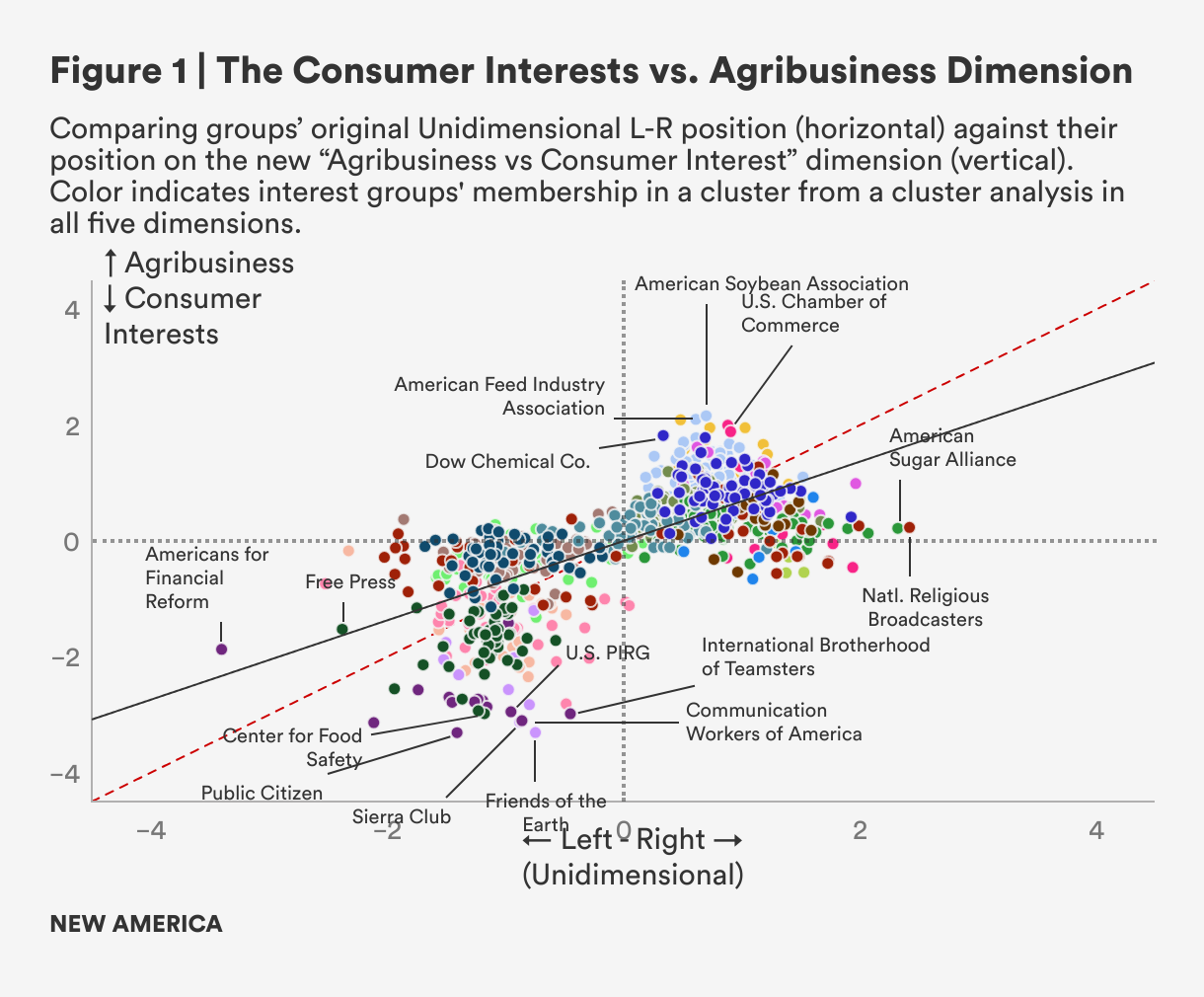
Our findings suggest that agriculture remains a cross-cutting issue below the surface. In Figure 1, below, we compare groups’ original Unidimensional L-R scores to their scores on our newly revealed “Agribusiness vs. Consumer Interest” dimension. For each organization (represented by a dot in the plot), its horizontal location is its “Left-Right Unidimensional” ideology score, while its vertical location is its score on our new Agribusiness vs. Consumer Interest dimension. This latter dimension identifies a conflict between large agricultural interests—like the American Farm Bureau Federation and the American Soybean Association—on the one hand, and a variety of environmental, consumer safety, and anti-GMO groups—like the Consumer Federation, Sierra Club, Public Citizen, and the Center for Food Safety—on the other.
What’s particularly interesting about this conflict, however, is that it is clearly distinct from our original L-R dimension. If a group’s original L-R Unidimensional score and its Agribusiness vs. Consumer Interest dimension scores were equivalent, that group would fall on the dashed red diagonal line going from the bottom left to the top right of the figure. Indeed, many groups do not, and the (solid) line of best fit clearly diverges from the dashed red “equivalent scores” line.
This suggests that groups that find this dimension particularly important may not be well-captured in typical L-R depictions of American politics. On both sides, such groups adopt much more extreme positions on this dimension than they do in other areas (depicted in the figure as the dot representing their group falling well below the dashed red “equivalency” line on the left side of the figure and above that line on the right). For example, the American Feed Industry Association and Friends of the Earth each register as quite moderate on the original single dimension but quite extreme on this new Agribusiness vs. Consumer Interest dimension. These cross-dimension differences can illustrate both how unexpected alliances are possible—when groups that are opponents on one dimension might be closer to one another on a different dimension—and how bitter conflicts can emerge among groups that appear to be on the same “side.”
Conservation vs. Development
Similar to agriculture politics, environmental politics are notorious for introducing cleavages into party systems. Indeed, with the rise of the conservationist movement, both Republicans and Democrats have championed increasing the government's role in environmental protection. Although not precisely a true “environmental dimension,” our new method reveals a significant cleavage that we have termed the “Conservation vs. Development” dimension. As depicted in Figure 2, below, this dimension once again creates strange alliances and unexpected conflicts among organized interests.
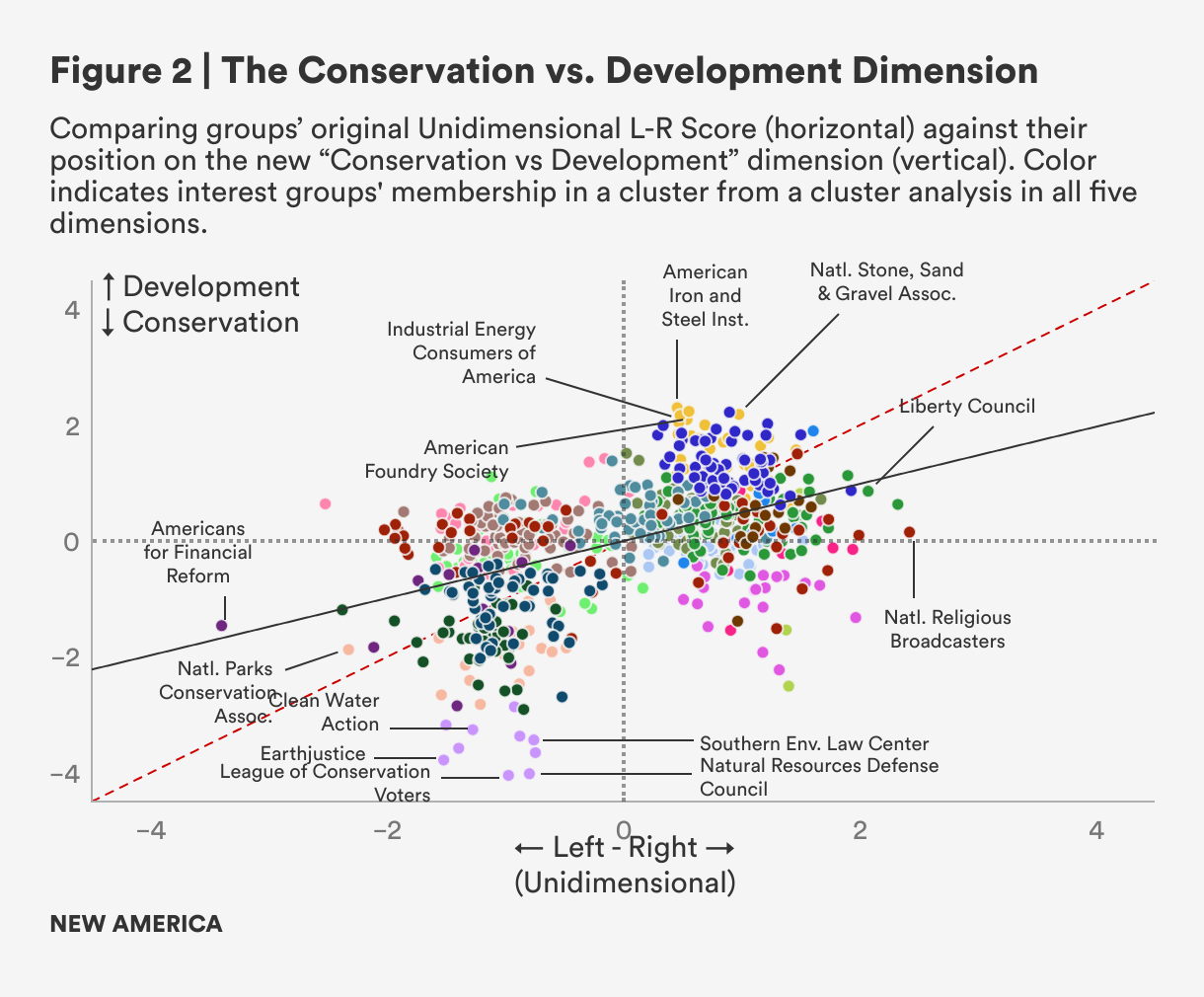
Bills that typify this dimension, such as the highway bill, the Deep Ocean Energy Resources Act of 2006, and the American-Made Energy and Good Jobs Act, often focus on trade-offs between development and economic growth versus environmental protection and conservation. Industrial organizations dominate “higher” scores on this dimension, while environmental organizations dominate the lower end, even though many of these organizations have relatively moderate unidimensional scores. These findings indicate that environmental-adjacent issues do introduce some cross-cutting cleavages into American politics, and may structure congressional policymaking in potentially underappreciated ways. For example, bills that load onto this dimension also include the approval of the Iran nuclear deal, the Safe and Accurate Food Labeling Act, the Stop Targeting of Political Beliefs by the IRS Act of 2014, and Food & Drug Administration (FDA) reauthorization. And so, this dimension may reflect a willingness to trust the outputs of complex bureaucratic activities that depend on technocratic expertise.
Individualism vs. Industry
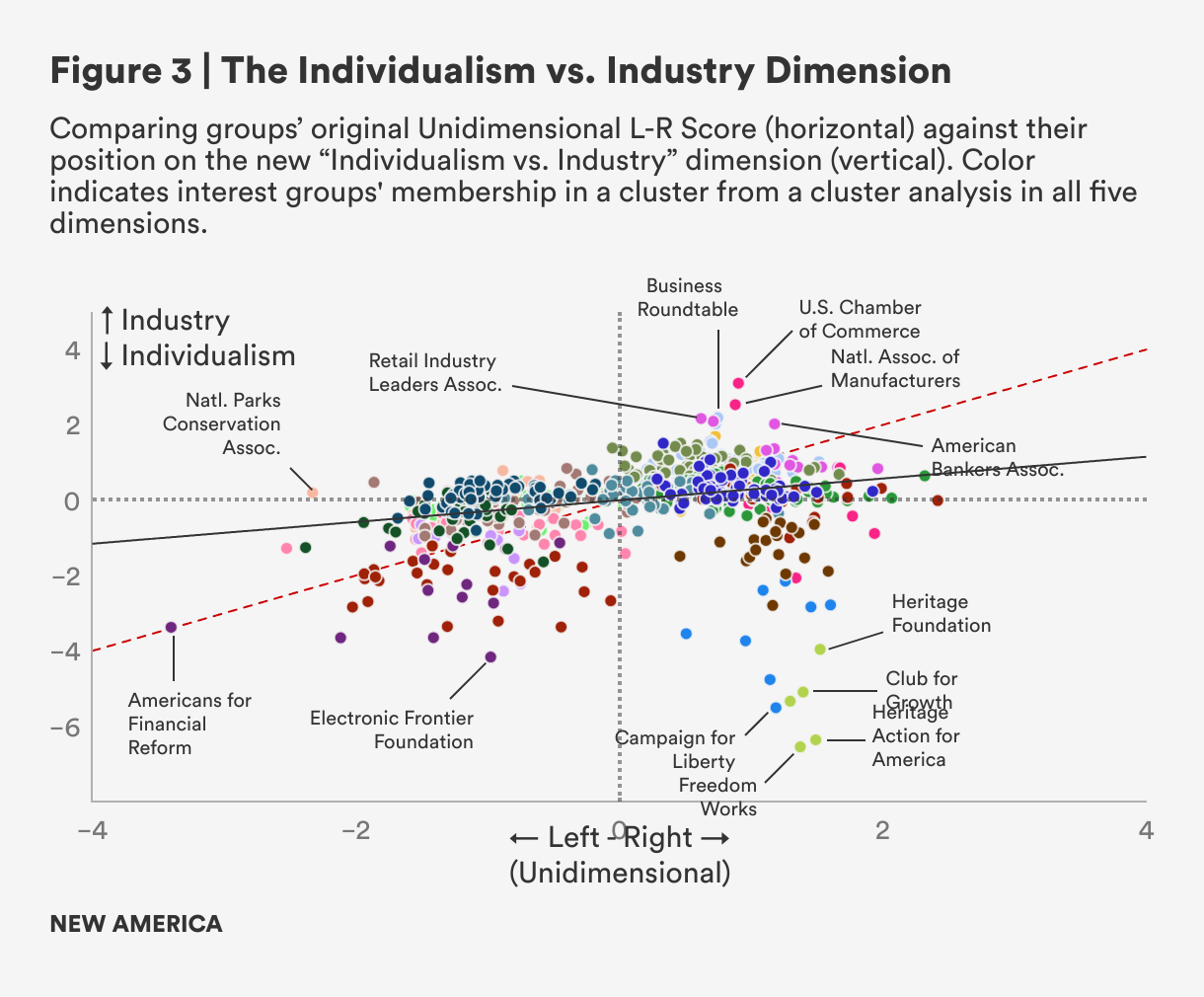
The final dimension we uncover in our paper is perhaps the most difficult to define substantively. This dimension appears to correspond most strongly with business, industry, and globalization and the challenges to individual rights that it presents. One end of this dimension is dominated by peak business associations, while the other includes organizations like Americans for Financial Reform and the American Civil Liberties Union. Here again, though, both ends of this dimension include potentially surprising organizations, underscoring key differences between this dimension and typical left-right characterizations of American politics. In particular, this dimension appears to capture competition among traditionally conservative factions: big business and small government. One common way this distinction manifests in contemporary policymaking is in cybersecurity, information sharing, intellectual property, and privacy legislation. For example, the Stop Online Piracy Act, the Cybersecurity Information Sharing Act of 2015, and the Protecting Cyber Networks Act all divided interest group coalitions along this fifth dimension.
Conclusion
Our work uncovered multiple dimensions of political conflict and that interest groups have preferences across these dimensions that are far more diverse and surprising than what the usual left-right depiction would suggest. This is notable because these differences are detectable despite the pressures created by our two-party system. Contemporary partisan conflict often reduces issues to left vs. right, in part to render complex policy choices more tractable for voters. At the same time, by forcing complex conflicts onto a single dimension, the parties ensure that interest groups must be influential within one of the two parties to influence policy8 and so are incentivized to choose a camp.9 This partitions a complex web of political conflicts into two internally fractious sides.
Nonetheless, our analysis shows that even under strong pressures toward partisan conflict, multiple dimensions are readily detectable. On some dimensions, an interest group might be among the most conservative and in others more centrist or even progressive. These differences in relative position imply a potential for different coalitions of interests to emerge depending on which dimensions are salient on a given policy issue.
More broadly, these differences can help us predict what might happen if the United States were to switch to a set of electoral institutions that allowed more parties to realistically contest power. In such a system, any group interest (or coalition thereof) that reflected the interests of enough voters to win seats in Congress could conceivably form its own party. The diversity of interests that currently manifests in intra-party factional battles could then be expressed through a multitude of parties. In such a system, voters could choose the party that most closely reflects their interests rather than the least objectionable coalition. These parties would, in turn, have strength in Congress proportional to their support in society and could form governing coalitions on that basis.
Acknowledgments
This project was funded by New America through their Electoral Reform Research Group initiative, with support from Arnold Ventures.
Downloads
More About the Authors

Geoffrey M. Lorenz
Jesse M. Crosson
Alexander C. Furnas
Kevin McAlister
Issues
Programs/Projects/Initiatives




Citations
- Kathleen Bawn, Martin Cohen, David Karol, Seth Masket, Hans Noel, and John Zaller, "A theory of political parties: Groups, policy demands and nominations in American politics," Perspectives on Politics 10, no. 3 (2012): 571-597.
- Kathleen Bawn and Frances Rosenbluth, "Short versus long coalitions: Electoral accountability and the size of the public sector," American Journal of Political Science 50, no. 2 (2006): 251-265.
- Matt Grossmann and David A. Hopkins, Asymmetric Politics: Ideological Republicans and group interest Democrats (New York, NY: Oxford University Press, 2016).
- Rachel M. Blum, "How the tea party captured the GOP," In How the Tea Party Captured the GOP: Insurgent Factions in American Politics (Chicago, IL: University of Chicago Press, 2020); Michael T. Heaney and Fabio Rojas, Party in the street: The antiwar movement and the democratic party after 9/11 (New York, NY: Cambridge University Press, 2015).
- Kevin McAlister, "Disagreement and Dimensionality: A Varying Dimensions Approach to Roll Call Scaling in the U.S. Congress" (Submission to American Political Science Review, 2021).
- Interest group positions were collected by the transparency organization MapLight.org and were downloaded via its Application Programming Interface (API).
- Jesse M. Crosson, Alexander C. Furnas, and Geoffrey M. Lorenz, "Polarized pluralism: Organizational preferences and biases in the American pressure system," American Political Science Review 114, no. 4 (2020): 1117-1137.
- Bawn et al., "A theory of political parties: Groups, policy demands and nominations in American politics."
- Our ongoing book project examines this phenomenon. See https://www.alexanderfurnas.com/polarizing-pluralism for more information.