A Chapter of: Beyond Rebuilding
Introduction
Scientists project that sea-level rise could force over 13 million Americans to permanently leave their homes by 2100. Add wildfires, extreme heat and drought, flooding, and hurricanes, and perhaps more than 20 million Americans will need to relocate over the coming decades due to climate impacts.1
The planned relocation of climate-vulnerable residents is known as “managed retreat,” and the U.S. government most commonly pursues this strategy through post-disaster buyouts. After a natural disaster damages or destroys a home, local governments may choose to offer homeowners the pre-disaster, fair-market value of their house to move away, rather than rebuild. The federal government usually provides three-quarters of the funding, while state and local authorities administer programs and fund the balance. Over the last 40 years, municipalities have relocated nearly 50,000 American households in this manner at a cost of $3.5 billion, typically a few homes at a time.
Key Terms Defined
- Managed Retreat: The strategic and planned relocation of houses, commercial property, and infrastructure, as well as people, to a new location to reduce natural hazard risk. Managed retreat seeks to be a more proactive alternative to the forced displacement that is expected to occur as a result of sea-level rise, increasingly severe flooding and erosion, and other climate impacts.
- Buyout(s): Real estate acquisitions in which owners voluntarily sell their properties in high-risk areas and (ideally) relocate to lower-risk areas. Buyouts are mostly implemented in post-disaster contexts in the U.S., with the “buyer” being local governments, who usually receive funding from federal agencies to compensate the homeowner. The tactic is often part of a larger managed retreat strategy.
At this rate of buyouts, it would take over 4,000 years to help an estimated 5 million at-risk households move to safety.2 Of course, the U.S. does not have the luxury to incrementally relocate residents over the course of thousands of years. The ocean is already encroaching upon entire towns, from North Carolina to Louisiana and Alaska. Either the federal government must step up to more efficiently relocate such communities en masse, or property owners will eventually be forced to abandon their homes, likely at a near-total financial loss.
While small-scale relocation of climate-vulnerable households over the course of millennia is nonsensical, especially as climate impacts to housing become worse, moving millions of households all at once is similarly impossible. But steadily supporting a few hundred thousand people to relocate per year until 2100 is less daunting, particularly considering that 40 million Americans already move each year.
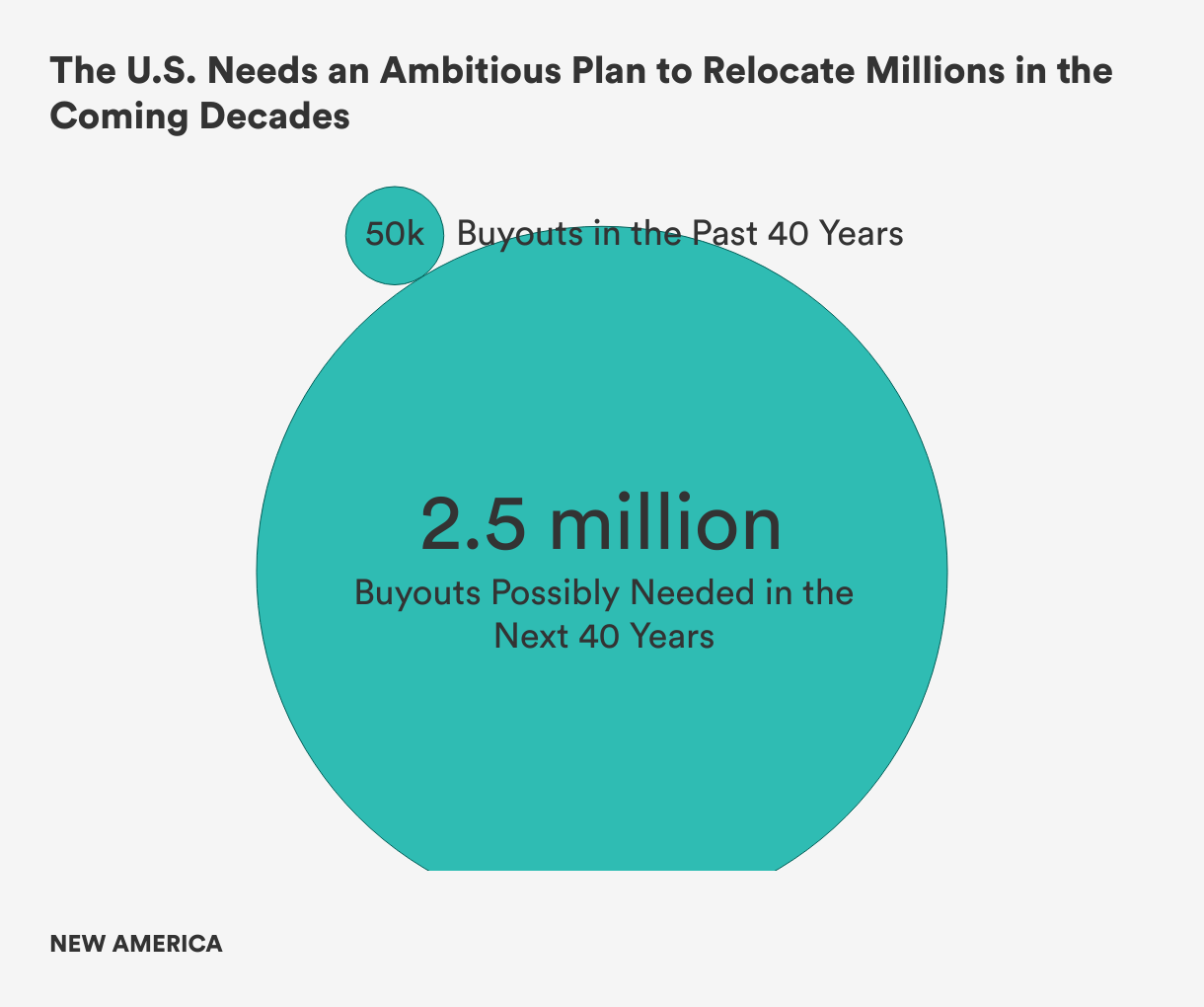
We need an ambitious plan to support millions of Americans to steadily relocate in a way that is financially feasible, community-led, and socioeconomically equitable. The federal government, local partners, and the private sector must collaborate over the coming decades to (1) limit further population inflows to climate-vulnerable areas; (2) incentivize at-risk residents to move to safer ground on their own accord; and (3) proactively plan and implement buyouts at scale.
Citations
- In fact, Tulane University professor Jesse Keenan estimates that 50 million Americans could move by 2050 due to climate change.
- As noted above, more than 20 million Americans may need to relocate over the coming decades due to climate change. Accounting for 2.6 persons per U.S. household and a U.S. homeownership rate of 66 percent, we estimate that approximately 5 million American households may require a future buyout. At a historical rate of roughly 1,250 buyouts per year, all future buyouts would take over 4,000 years to complete.