A Chapter of: Lessons from the Past to Govern for the Future
The Subak System in Bali, Indonesia
By Dewa Atmaja, Jero Dodo, and Gordon LaForge
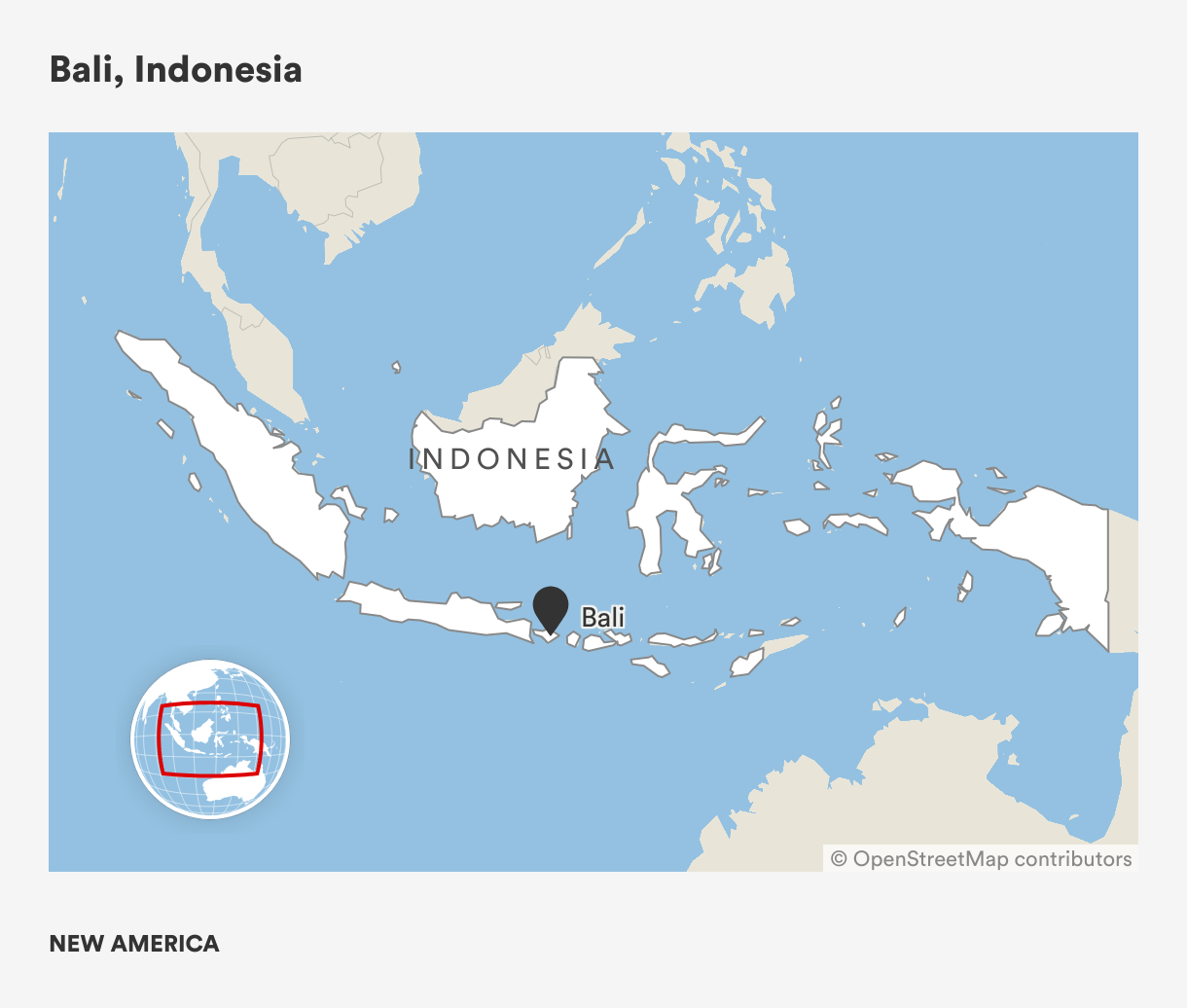
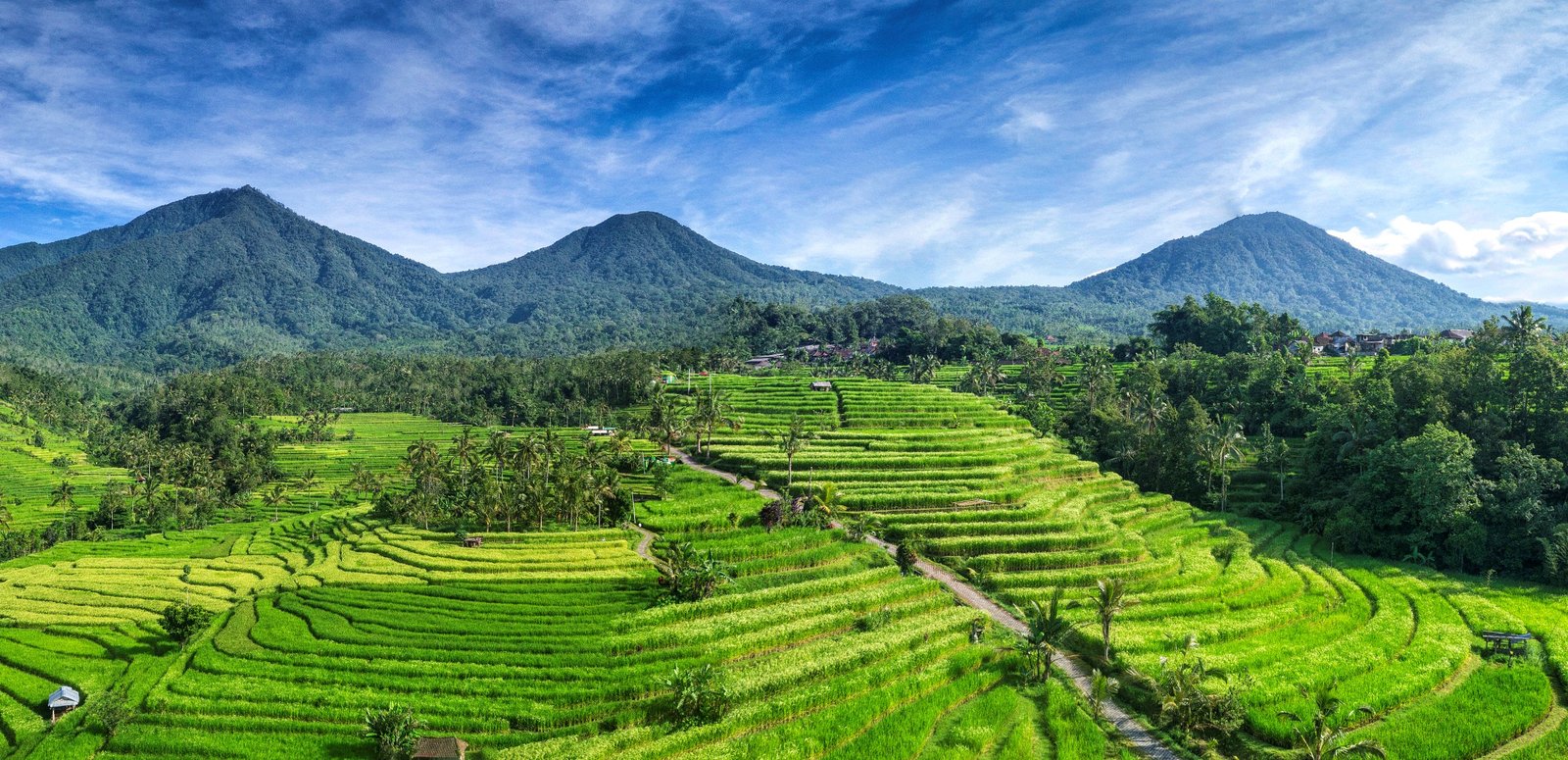
On the island of Bali in Indonesia, water flows down a group of central volcanoes to irrigate terraced rice paddies below. Since the eleventh century, the Indigenous Balinese have maintained the subak system to manage that water and preserve a way of life for future generations. Each subak is an independent, self-governing collective of farmers who share limited water and suppress pests by synchronizing their planting cycles. Communal, consensus-based governance aligned with hindu religious traditions enables the farmers in a subak to maintain their own crop yields and those of the subak. Today, some 800 subaks manage around 75,000 hectares of rice paddies in Bali.36
The subak system governs a common resource without centralized, top-down control. Its success challenges the theory of the “tragedy of the commons,” which holds that individual actors deplete a common resource unless a central authority manages the resource. Especially in extractive industries—fishing and hunting areas, natural resources like water, and energy resources like coal and oil—individual actors plunder as much as possible without consideration for future needs. Subak governance offers a bottom-up, community-scale, and democratic form of resource governance. All the farmers with land in a given area meet regularly to determine irrigation schedules, allocate maintenance responsibilities, and manage problems that arise.37 Members of the subak elect leaders from their own group.
To better understand how the subak functions and preserve the interests of future generations, New America’s Gordon LaForge talked with two subak leaders in Bali, Dewa Atmaja who is the head (pekaseh) and Jero Dodo who is the manager (kelian) of Subak Bena. This interview has been translated from Bahasa Indonesia and edited for clarity.
Gordon LaForge: Could you please explain the characteristics of the subak system?
Dewa Atmaja: Before answering, allow me to first request blessings for our conversation. In Bali, we do that by saying Om Swatiastu. Right; thank you very much for taking the time to conduct this interview.
The subak system is a foundation in Bali. It regulates how we share water and farm rice. Before cultivating our fields, we meet to discuss irrigation and sharing water. The members of the subak are all farmers. They farm rice, but also vegetables and ornamental plants every third planting cycle to balance and nourish the soil. Our subak, called Subak Bena, where I am the pekaseh, has 240 members divided into three tempek [sub-divisions].
Jero Dodo: To add to that, a subak is a community of the people who work together on the shared goal of farming rice. The subak system is a way of organizing and governing communal life that is closely tied to what we call desa ADAT.38 “A” stands for agama [religion], which is central to our lives and the subak system. “D” stands for dresta, which refers to the process followed by the farmers irrigating the paddy, planting the seeds, and harvesting the rice. “A” stands for awig-awig [by-laws based on customary rules]. All members of a subak must follow the awig-awig. If they violate them, they are sanctioned according to the consensus reached in a subak meeting. If someone repeatedly violates the rules, they can be expelled from the subak. Finally, “T” stands for tata krama [etiquette], a main feature of which is transparency. All the members of the subak have to be transparent to avoid conflicts and misunderstanding. We all work with the same view.
The subak depends on the tri mandala [three spaces].39 For the subak, the tri mandala consists of prahyangan [the temples and holy places where humans connect to the Supreme Being], pelemahan [the rice fields], and pawongan [the members of the subak]. We maintain harmony to the Supreme Being with rituals, to the environment with the fields we farm sustainably, and to the members of the subak with strong fellowship, respect, and adherence to the rules and etiquette.
In Bali, we never try to divide one another, and everyone knows everyone. The ultimate goal of the subak is to work together to produce agricultural crops to sustain our lives and support our families and children. We in Bali cannot become disconnected from any part of the tri mandala [the Supreme Being, the environment, and the community], just as a human beings’ vital body parts are interconnected, and we cannot live without any one of them.
J. Stephen Lansing
LaForge: How do subak meetings work? Who participates, and how are they run so that everyone can provide input and have their voices heard?
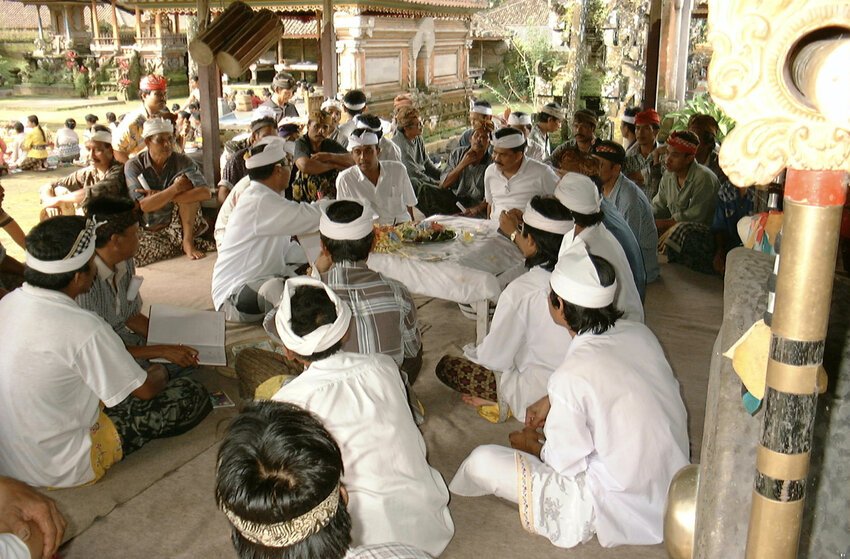
Dodo: Very good question. The meetings follow the tata krama [etiquette], according to which the members of the subak have to gather for a meeting at the Bale Subak [Subak meeting place] when they hear the sound of the kentongan [a drum made of bamboo]. Subak members are required to attend when they hear the kentongan. In practice, some of the members live out of earshot of the drum, so we let everyone know the date and time of each meeting beforehand.
In each meeting, we identify problems and issues that need attention. The Subak members are obligated to perform activities like fixing waterways and repairing irrigation structures.40
LaForge: In a subak meeting, how are disputes or disagreements resolved?
Atmaja: When a disagreement occurs in our subak, we ask our members to sit together and discuss the matter until they can find a consensus. If we cannot reach a consensus, then we ask for an outside party to sit with us and help mediate and find a consensus. Until now, in our subak we have always been able to resolve disputes through consensus.
LaForge: What is the role of religion and tradition in the subak?
Dodo: Sang Hyang Widi [God Almighty] is the soul of the subak. We Hindus in Bali follow Sang Hyang Widi. All we have is from God. We uphold the principles of divinity and can’t live without those principles. When we are sick, we won’t be able to cultivate our land. God blesses us with health and gives us guidance so that we can take care of our land and perform other activities.
Our work in the fields is closely related to religion, and we hold rituals [at each stage of the farming cycle]. When we first irrigate our field, we have a ritual. Before we plant our seeds, we hold a ritual. We have a ritual when we plough the field and another when we prepare to harvest. We hope that when we are working on our fields, God gives blessings to us.
In our subak, we have no courage to cultivate our land unless we have conducted the appropriate ritual or ceremony. If a subak member fails to perform or participate in a ritual, they will be sanctioned by the subak meeting. The penalty is described in the awig-awig. Religion is like the blood running through the subak. We cultivate our land in accordance with the principles of our religion, and we cannot imagine it any other way.
LaForge: Since all the subaks in Bali rely on the same source of water for irrigation, subaks might need to coordinate with each other or resolve disputes that might arise. How do you cooperate with other subaks?
Atjama: If there are problems coordinating with another subak, we will first call the leaders of that subak and invite them to sit together with us to discuss the matter. Together, we figure out a way to solve the problem, and we arrive at a consensus. We make sure that we are clear and that we have the same understanding of the problem and solution. We settle it as if we were all part of the same family. That’s it. Our subak has never been unable to solve a problem with another subak.
Dodo: To add a little bit to that, in our day-to-day lives, one subak coexists with another subak. The rules and etiquette govern how they relate to each [other]. For example, in the irrigation process, one pekaseh and another pekaseh must be transparent with one another.
You can't be egotistical. For example, the amount of water for irrigation is allocated according to the size of the subak. This is set according to the awig-awig. One subak cannot impose its will or demand more. It is important that the leaders of different subaks have a transparent relationship.
If there are problems, we sit together to talk, because we are in a community, an organization with a shared purpose to bind together all the members who work in the agricultural process. That means one pekaseh is closely related to another pekaseh. We all share the subak system.
LaForge: How does the subak system protect the interests of future generations? How does the subak system connect the past with the future?
Dodo: In our daily lives today, we still use the benchmarks of the past. We cannot determine what will happen tomorrow, but we still measure everything based on the past. In the past, our ancestors, the former leaders of our community, formed an organization called the subak. We accept the logic of that era today and pass it forward to the next generation. As we mentioned earlier, that past wisdom we manifest today as the adat [customary] system: religion, farming method, rules, and etiquette. Future generations in Bali will never let this system go, so long as they still need rice. For those cultivating rice somewhere besides Bali, I'm sorry, I have no idea how it works.
In Bali we also believe the relationship between the older generations and the present generations cannot be severed, as was ordained by our ancestors. In Bali, our children believe in not disappointing their parents, let alone their ancestors or those who have passed away. This customary standard [of filial piety] exists in the household.
LaForge: The subak is connected with the past, but is it also able to adapt? For instance, if there are new technologies, is the subak able to adopt them?
Dodo: When it comes to new technology, we in the subak are very adaptive. If we hear about a new technique or technology that can benefit us and improve our work, we have no hesitation adopting it.
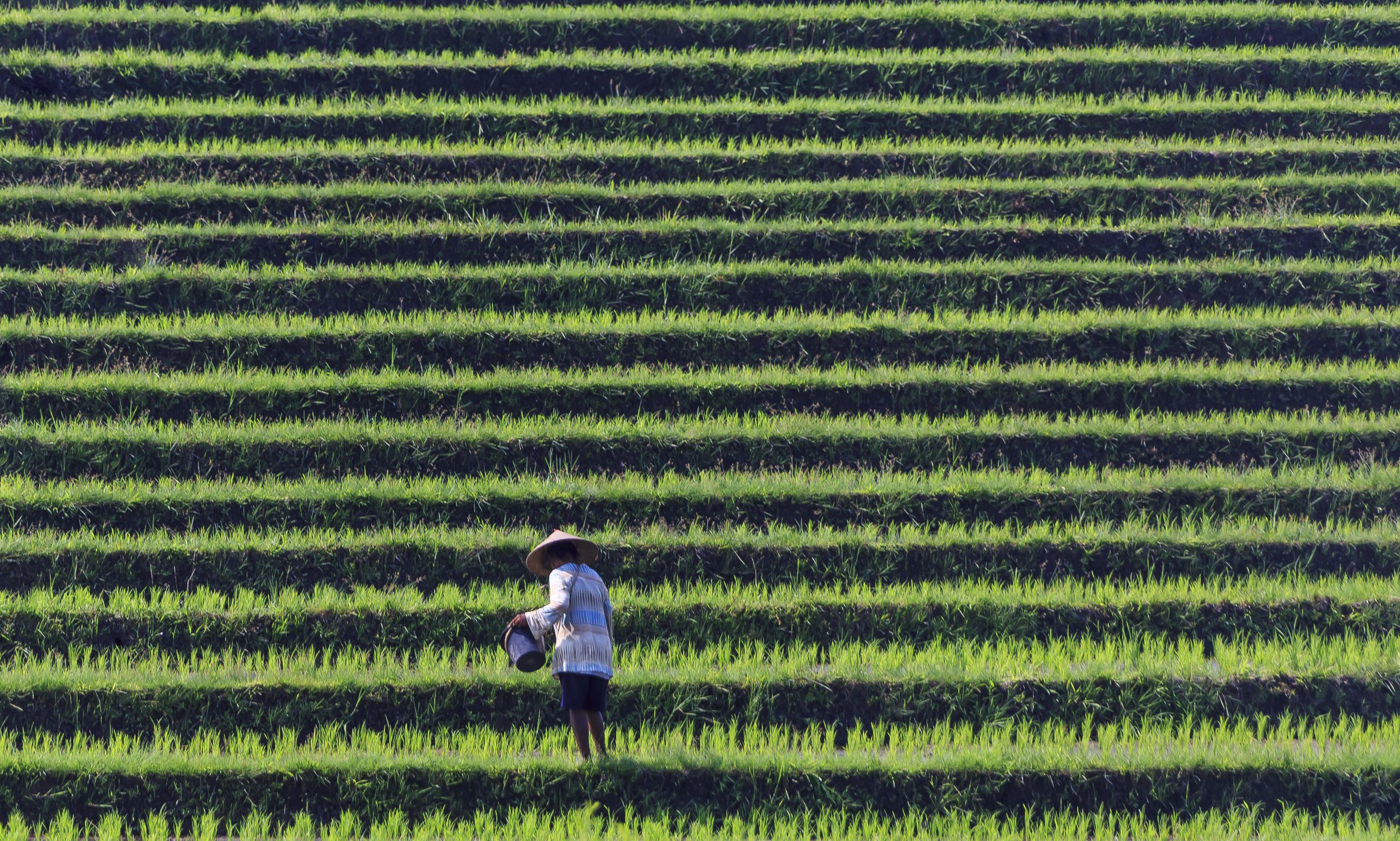
For instance, we have adopted new farming techniques to harvest more rice. In the past, our parents used to harvest only once a year. Now we harvest up to three times per year. That means, if our parents produced one ton of rice per year, now we produce three. If we still relied on their farming technique, we would have missed the boat. Times change. Our parents ate cassava; nowadays, our children eat Kentucky Fried Chicken and hamburgers.
However, in the process of adopting new technology, we never deviate from etiquette, awig-awig, and the rest of the adat system. There are also bad effects of new technology along with benefits. It’s always a balance. Techniques that make farming more efficient also make our farmers a little lazy. In the old days, our parents had to collect topsoil and use it as fertilizer. Now, we can just go to a shop to buy fertilizer. What would take a whole day we can now do in two hours, so with the extra time we might just go home and sleep. So there’s always good and bad.
Right now, 18 farmers in our subak have been experimenting with a new technique that is beneficial. In terms of irrigation, the method uses less water, and it also results in a more productive harvest.41
We hope more of our subak members will adopt it. It requires the same amount of work and energy. There’s no difference. And whatever the method of work, if you love it sincerely, it will give you a sense of pleasure. So our spiritual mind becomes satisfied.
CEphoto, Uwe Aranas
LaForge: What do you think are the greatest threats facing the subak system? What could prevent it from continuing into the future?
Dodo: One type of threats are those that come from nature, such as pests. But there have always been pests; they were created by God long ago. From ancient times, we have had birds that eat the rice, mice, plant hoppers, even bacteria. We are not really worried about these threats because they are natural, and we can adjust to them. If God wishes them to happen, they will definitely happen.
What makes me fear now for the life of the subak is the concrete line. This is my term, the concrete line, and what I mean is the construction of new buildings, houses, and tourist facilities made of cement. Subak land is being taken and concrete buildings are going up. This is what I’m afraid of. When it comes to pests, we will never be anxious because nature is in control. What we fear the most is the greed of humans.
If modern structures continue to be built on subak fields, the subaks will surely disappear because one of the three spaces required for the subak is pelemahan [the environment, the rice fields]. Our subak is still natural for the time being, with no concrete housing. There is only a small shelter, a place for farmers to rest during the day, take shelter when it rains, and cook a little bit. Our subak is still original, and the water is still good.
Atmaja: I agree that the conversion of the land for new development is a threat. Another big one is the changing weather [climate] these days. I just came from a dam that was destroyed, and [it] disrupted the water supply in our subak. This time of year, we shouldn’t have much rain in Bali, but suddenly there was very heavy rain for two days that caused flooding and damaged several dams. We are fixing them, but this is a growing threat.
Dewa Atmaja is the leader (pekaseh) and Made Gunawan, also known as Jero Dodo, is a manager (kelian) of Subak Bena in Tabanan, a regency in Southern Bali.
Citations
- John Stephen Lansing, Ning Ning Chung, Lock Yue Chew, and Guy S. Jacobs, “Averting Evolutionary Suicide from the Tragedy of the Commons,” International Journal of the Commons 15, no. 1 (November 2021): 414, https://www.researchgate.net/publication/356146235_Averting_Evolutionary_Suicide_from_the_Tragedy_of_the_Commons.
- J. Stephen Lansing, Perfect Order: Recognizing Complexity in Bali (Princeton, NJ: Princeton University Press, 2006), 89.
- Desa adat translates to “customary village,” but in this context, ADAT is used as a mnemonic device.
- Tri mandala is a concept of space and being that comes from the Tri Hita Karana, the traditional philosophy of the Balinese that roughly translates to “three causes of prosperity.” It holds that harmonious relationships within and among three realms—the spiritual, the environment, and humanity—are the source of happiness and flourishing.
- Routine subak meetings are held around every 35 days, and farmers synchronize their planting and water use schedules in them. As each subak is self-governing, some are more democratic than others. See Lansing, Perfect Order, p. 5.
- The new irrigation technique, which moistens rather than floods the soil, also reduces methane emissions from the rice paddies by as much as 70 percent. See Claire Turrell, “Bali Rice Experiment Cuts Greenhouse Gas Emissions and Increases Yields,” Mongabay, August 11, 2023, https://news.mongabay.com/2023/08/bali-rice-experiment-cuts-greenhouse-gas-emissions-and-increases-yields.