A Chapter of: “We Shouldn’t Have to Choose between Maintaining and Bettering Our Lives”: An Analysis of Older and Parenting College Students
Financial Aid: Program Implementation
Despite the differences among the states, a significantly lower percentage of students who are over 24 and student parents receive state grant aid than receive Pell Grants in all four states. These disparities are particularly stark at community colleges. Traditional-aged students who receive Pell Grants are far more likely to also receive state aid than older students.
As Figure 5 shows, even for students and student parents 24 and over with significant financial need, the structure of these programs means that they are not receiving the state aid they should be. This appears to be particularly true for those attending community college—approximately two-thirds of students and student parents 24 and over with $0 EFC receive only federal grants and no state grants. But of course, these students still need the money. One of our focus group participants said, “Even though I have financial aid…I still pay out of pocket.”
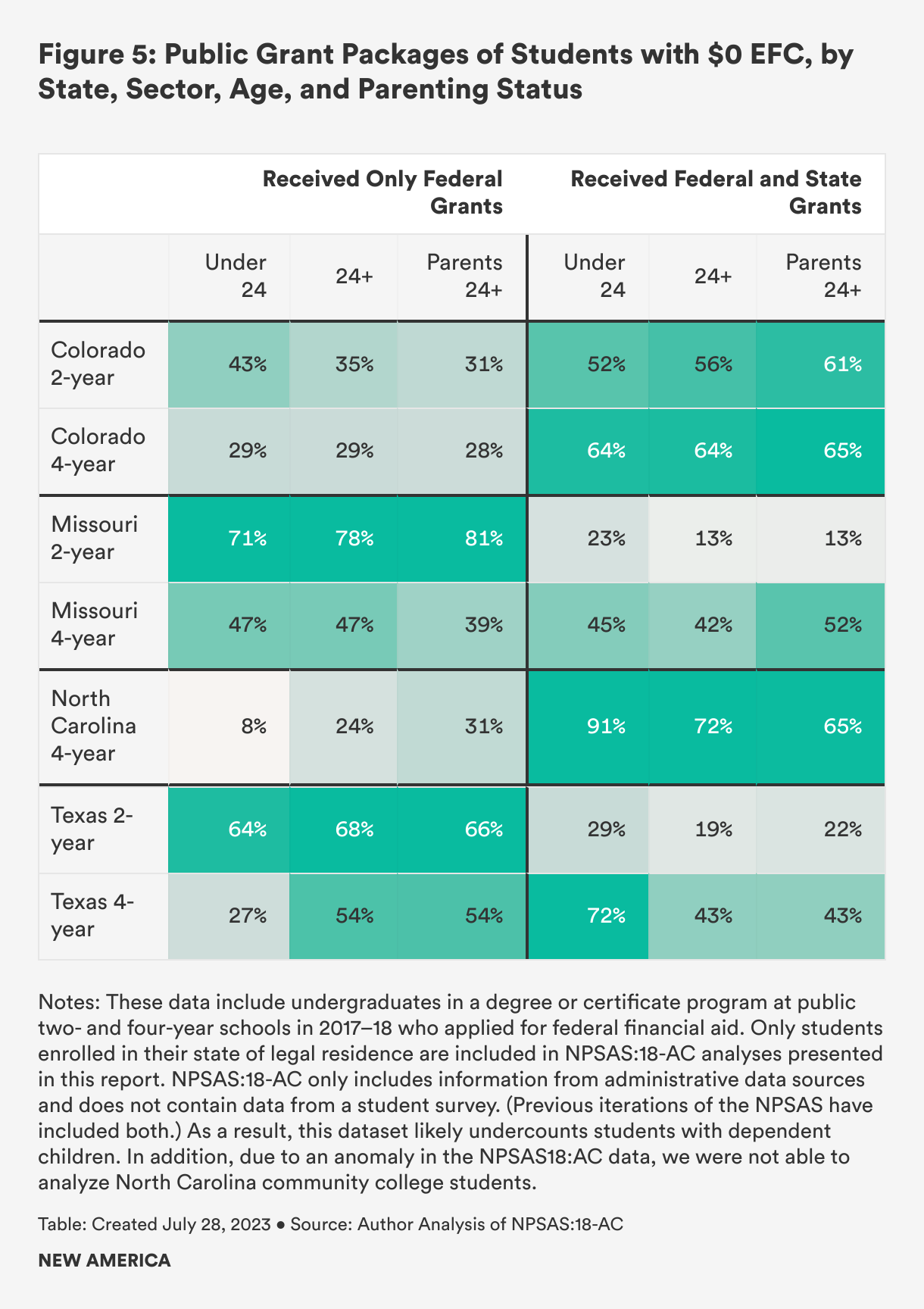
In all four states and in both sectors, a notable share of older students with $0 EFC received no grants at all. There are a few reasons these students may not have been able to access federal and state financial aid.27 They may not have completed a FAFSA. If they did complete one but did not do so early enough in the year, state grant funds might have been depleted by the time they applied for aid, despite their significant financial need. They may have exceeded the length of time they are allowed to access Pell Grants.28 If they have previously earned a bachelor’s degree and are returning to college, they will not be able to access federal grants and are unlikely to be able to access any state grants, regardless of need. And if they are not meeting satisfactory academic progress standards, they will not be able to receive such grants.29
Many students in our focus groups found that they had significant gaps between their college expenses and how much was covered by financial aid. Most participants said that financial aid did not even come close to covering all their expenses, with many noting that they still had unmet financial need even after taking out student loans. A Missouri student said, “Even after loans, which are in the thousands, I still owe every school that I [attended], every time that I went.”

“We Shouldn’t Have to Choose between Maintaining and Bettering Our Lives”: An Analysis of Older and Parenting College Students
- Introduction and Overview
- Methodology and Overview of State Aid and Public Benefits Programs
- Where These Students Enroll, How They Enroll, and How Much Financial Aid They Need
- State Higher Education Funding and Financial Aid Program Design
- Financial Aid: Program Implementation
- Public Benefits: Program Design and Funding
- How Each State Uses Safety Net Programs to Supports Students
- Recommendations
- Appendix A: Methodology
- Appendix B: State Grant Program Budgets and Expenditures
Citations
- Office of Federal Student Aid, “Student Loan Delinquency and Default,” U.S. Department of Education, https://studentaid.gov/manage-loans/default. In addition to the other reasons mentioned in this section, if students are in default on a federal student loan, they are ineligible for federal aid.
- Office of Federal Student Aid, “What is the Lifetime Eligibility Used (LEU) for a Pell Grant?” U.S. Department of Education, https://studentaid.gov/help-center/answers/article/leu-for-pell-grant. Students may receive a total of the equivalent of six years of Pell Grant funding.
- Office of Federal Student Aid, “Staying Eligible,” U.S. Department of Education, https://studentaid.gov/understand-aid/eligibility/staying-eligible. Federal satisfactory academic progress rules require students to meet their institution's academic standards to maintain eligibility for federal financial aid. Variation exists, but most institutions require a minimum 2.0 GPA and completing 67 percent of credits attempted.