We Shouldnt Have to Choose between Maintaining and Bettering Our Lives_
Abstract
The resources that federal financial aid, state financial aid, and federal public benefits programs provide, when they operate effectively, are critical to older students and students with children. This report seeks to shed light on how these programs are functioning by analyzing data and policies across four states—Colorado, Missouri, North Carolina, and Texas. We analyzed the designs of student financial aid programs to see how many state financial aid resources older students and student parents receive. We chose these states as test cases because they had state representative data in the 2018 National Postsecondary Student Aid Study, a survey administered by the U.S. Department of Education, and they were geographically, politically, and demographically diverse.
In addition to examining financial aid programs, we also looked at states’ public benefit program designs and policies and we conducted focus groups with older students and student parents in each state. This additional analysis provides a view of what it is like to rely on the system meant to support students to and through college, where it is falling short, and why. We found that Colorado, while far from perfect, designed its financial aid and safety net programs to provide the most robust support for adult and parenting students to enroll in and attend its institutions of higher education. Missouri and Texas provided the weakest support. North Carolina fell somewhere in the middle.
We end this report by suggesting several recommendations for policymakers and stakeholders looking to design or reform state financial aid and safety net programs. Within budget constraints, they should adjust eligibility criteria for state aid programs so older students and student parents have the same access to grant programs as students leaving high school. Where states have flexibility in administering federal public benefit programs, they should use that flexibility to ease eligibility criteria and expand access. And they should communicate opportunities and fund supports to help older students and student parents to go to college and access public benefits.
Acknowledgments
New America would like to thank Lumina Foundation and The Annie E. Casey Foundation, Inc. for their generous support of this project and the Bill & Melinda Gates Foundation for its generous support of our work. The views expressed in this report are those of the authors and do not necessarily represent the views of the funders, their officers, or their employees.
The authors would like to thank Sandy Baum from the Urban Institute, Sarah Pingel from the National Center for Higher Education Management Systems, and Elizabeth Lower-Basch from the Center for Law and Social Policy for reviewing an earlier draft of this work. We would also like to thank Sophie Nguyen, Da’Shon Carr, Steve Burd, and Rachel Fishman for their thoughtful review and feedback; Sabrina Detlef for her copyediting support; and Katherine Portnoy and Mandy Dean for their communication and data visualization support. The work is better for their comments and contributions. All errors are our own.
Downloads
Introduction and Overview
College students today are often taking classes while working or parenting or both. This is especially true for students aged 24 and older, who make up more than one-third of all undergraduates.1 Going to college as an older adult is extremely challenging: It is hard to afford, hard to juggle with other responsibilities, and hard to finish. It is hard in part because, in the United States, we have made it difficult for people to access and complete their education and provide a better life for themselves and their families.
The patchwork of federal financial aid, state financial aid, and federal public benefits programs, including those administered through states, should support these students. As one parenting student told us in one of a series of focus groups we held, “We shouldn't have to choose between maintaining and bettering our lives.” But too often students have to make tough choices because these programs are difficult to access.
In fact, because the supports are so complex and full of holes, many older students are never able to access resources, instead settling for going without as long as they can. As another older student told us, “I just had to always try to figure a way to make things work.” Other students are treated poorly when they attempt to access the support available. One student mother said, “the attitudes, the phone calls, the long wait times, looking online, trying to figure it out yourself. There's only so much one can do without support and help from [financial aid] people.” She added “you got to jump through all these hoops” to get support. Still others are managing complex lives and financial insecurity, as summed up by one student who told us about juggling classes while experiencing eviction.
The resources that these programs provide, when they operate effectively, are critical to older students and students with children. This report seeks to shed light on how these programs are functioning by analyzing data and policies across four states—Colorado, Missouri, North Carolina, and Texas. We analyzed the designs of student financial aid programs to see how many state financial aid resources older students and student parents receive. We chose these states as test cases because they had state representative data in the 2018 National Postsecondary Student Aid Study, a survey administered by the U.S. Department of Education, and they were geographically, politically, and demographically diverse. We found that:
- Across the board, students who are 24 and over and student parents are less likely to receive state grant aid than they are to receive a Pell Grant, even when they have financial need that will make it difficult for them to afford to go to college.
- In all four states we examined, even the most financially needy older students are not able to access many of the state aid programs available.
- Even more alarming: In both two-year and four-year colleges in all four states, a substantial share of the most financially needy students receive no grants at all.
- Older students and student parents attending four-year colleges were more likely to receive state aid than those attending community colleges.
In addition to examining financial aid programs, we also looked at states’ public benefit program designs and policies and we conducted focus groups with older students and student parents in each state. This additional analysis provides a view of what it is like to rely on the system meant to support students to and through college, where it is falling short, and why. We found that Colorado, while far from perfect, designed its financial aid and safety net programs to provide the most robust support for adult and parenting students to enroll in and attend its institutions of higher education. Missouri and Texas provided the weakest support. North Carolina fell somewhere in the middle.
We end this report by suggesting several recommendations for policymakers and stakeholders looking to design or reform state financial aid and safety net programs. Within budget constraints, they should adjust eligibility criteria for state aid programs so older students and student parents have the same access to grant programs as students leaving high school. Where states have flexibility in administering federal public benefit programs, they should use that flexibility to ease eligibility criteria and expand access. And they should communicate opportunities and fund supports to help older students and student parents to go to college and access public benefits.
Note on Terminology
In other research, students aged 24 and over are referred to as “adult students,” “older students,” “non-traditional students,” or “independent students.” In this report, we use those descriptive terms when needed but otherwise refer to this group simply as “students,” or “students in our sample.” The same applies for those 24 and older with children, whom we otherwise refer to as “student parents.”
Citations
- Authors’ calculations using the 2020 National Postsecondary Student Aid Study, Undergraduate (NPSAS:UG).
Methodology and Overview of State Aid and Public Benefits Programs
This analysis builds on previous work that highlights how state financial aid and public benefit policies can include more adult students.2 We also know from previous research that program design matters for college access, the types of institutions students attend, and for student retention and completion.3 Using a variety of data sources and combining qualitative and quantitative methods, we examine the intersection of these supports for older students and student parents in four states—Colorado, Missouri, North Carolina, and Texas.
We use state-representative data from the 2017–18 National Postsecondary Student Aid Study, Administrative Collection (NPSAS:18-AC), a survey run by the U.S. Department of Education, to establish patterns in enrollment, financial need, and aid access for these students. We also examine public benefit eligibility rules for these populations; and we incorporate older student and student parent voices from a series of focus groups we conducted in 2022 to highlight students’ awareness of these resources and their ability to access them.
The NPSAS:18-AC data have several limitations. The dataset only includes information from college administrative data and does not contain data from a student survey, through which some student parents self-identify. (Previous iterations of NPSAS have included both.) In addition, we define student parents in this analysis as those with dependent children, which could exclude some parents without primary caregiving or financial responsibility for their child or children. As a result, this dataset and our analysis likely undercounts students with dependent children. In addition, an irregularity with some of the North Carolina data in NPSAS:18-AC means we cannot analyze North Carolina community college students’ grant aid or expected family contributions. (See Appendix A for more information about the data and methods used in this report.)
In 2017–18, more than half of financial aid for undergraduates came from federal sources, including federal student loans and Pell Grants.4 Slightly more than one-quarter came from grants and scholarships that colleges award, which have been increasing as a share of aid. While state grant aid makes up less than a quarter of the college financial aid pie, it is an important source of funds, especially for students with unmet need—the amount of college cost that is left to be paid after other financial aid is awarded.
States contribute to student financial aid packages with an array of programs, each with its own set of eligibility criteria—based on need, merit, or other factors—and target population. In 2017–18, states spent nearly $12 billion on grants to undergraduate students, three-fourths of which was need-based.5 The District of Columbia and all but three states offered some need-based financial aid programs, while 23 states offered some grants based only on merit.6
Eligible students may also be able to access public benefits programs for additional financial and in-kind support. Public benefit programs are funded through a mixture of state and federal dollars and many are administered by states, which often have significant discretion over how programs are run and what eligibility criteria are used.
In this analysis, we examine a subset of public benefit programs that have state requirements and are most available to students. These include the Supplemental Nutrition Assistance Program (SNAP), cash assistance under the Temporary Assistance for Needy Families (TANF) program, Medicaid and the Children’s Health Insurance Program (CHIP), and child care subsidies through the Child Care and Development Block Grant (CCDBG).7
The federal government primarily funds TANF and CCDBG through block grants to states that they can use to support beneficiaries according to program rules.8 SNAP and Medicaid are entitlement programs, meaning that anyone who meets specific criteria is eligible.9 And CHIP funding is an entitlement to states, which receive allotments and can also access additional funding from the federal government if they experience shortfalls.10
Citations
- Authors’ calculations using the 2020 National Postsecondary Student Aid Study, Undergraduate (NPSAS:UG).
- For example, Sarah Pingel and Neal Holly, Seeking Support: State Financial Aid Programs and Adult Students, Education Commission of the States, October 2017, https://www.ecs.org/seeking-support-state-financial-aid-programs-and-adult-students/; Wayne Taliaferro and Amy Ellen Duke-Benfield, Redesigning State Financial Aid to Better Serve Nontraditional Adult Students, Center for Law and Social Policy, September 2016, https://www.clasp.org/sites/default/files/public/resources-and-publications/publication-1/Redesigning-State-Financial-Aid-to-Better-Serve-Nontraditional-Adult-Students.pdf; Sarah Pingel, Brian A. Sponsler, and Neal Holly, Redesigning State Financial Aid: Principles to Guide State Aid Policymaking, Education Commission of the States, August 2018, https://www.ecs.org/wp-content/uploads/Redesigning-State-FInancial-Aid.pdf; Sandy Baum, Kristin Blagg, Leonardo Restrepo, and Fanny Terrones, Race, Ethnicity, and the Design of State Grant Aid Programs, Urban Institute, January 26, 2023, https://www.urban.org/research/publication/race-ethnicity-and-design-state-grant-aid-programs; Wesley Jenkins, College Students’ Siloed Safety Net, Urban Institute, May 13, 2020, https://www.urban.org/features/college-students-siloed-safety-net; and Lauren Walizer, State Strategies for Addressing College Students' Basic Needs, Center for Law and Social Policy, January 15, 2020, https://www.clasp.org/publications/report/brief/state-strategies-addressing-college-students-basic-needs/.
- See Tuan D. Nguyen, Jenna W. Kramer, and Brent J. Evans, "The Effects of Grant Aid on Student Persistence and Degree Attainment: A Systematic Review and Meta-Analysis of the Causal Evidence," Review of Educational Research 89, no. 6 (2019), https://doi.org/10.3102/0034654319877156; and Karen Bussey, Kimberly Dancy, Alyse Gray Parker, Eleanor Eckerson Peters, and Mamie Voight, Realizing the Mission of Higher Education Through Equitable Admissions Policies, (Washington, DC: Institute for Higher Education Policy, June 2021), https://www.ihep.org/wp-content/uploads/2021/06/IHEP_JOYCE_full_report_final_web_614.pdf.
- Jennifer Ma and Matea Pender, Trends in College Pricing and Student Aid 2022, College Board, https://research.collegeboard.org/media/pdf/trends-in-college-pricing-student-aid-2022.pdf. Federal financial aid also includes tax benefits, work study, veterans’ benefits, and Federal Supplemental Educational Opportunity Grants (FSEOG). In this paper, we use aid data from 2018, where possible, to match the NPSAS:18-AC data.
- National Association of State Student Grant and Aid Programs, 49th Annual Survey Report on State-Sponsored Student Financial Aid: 2017–2018 Academic Year, https://www.nassgapsurvey.com/survey_reports/2017-2018-49th.pdf.
- National Association of State Student Grant and Aid Programs.
- In addition, although not examined in this paper, families may have access to housing subsidies, mostly designed and distributed at the local level, and tax credits, such as the Earned Income Tax Credit (EITC) and Child Tax Credit (CTC), which are distributed at the federal level. (Some states and localities have established their own versions of the EITC to complement the federal credit, and a host of states have their own child or dependent-related tax credits.) See Amy Ellen Duke-Benfield, Bolstering Non-Traditional Student Success: A Comprehensive Student Aid System Using Financial Aid, Public Benefits, and Refundable Tax Credits, Center for Law and Social Policy, December 2015, https://www.clasp.org/sites/default/files/public/resources-and-publications/publication-1/Bolstering-NonTraditional-Student-Success.pdf.
- Congressional Research Service, The Temporary Assistance for Needy Families (TANF) Block Grant: A Primer on TANF Financing and Federal Requirements, August 14, 2023, https://crsreports.congress.gov/product/pdf/RL/RL32748 and Congressional Research Service, The Child Care and Development Block Grant: In Brief, November 18, 2022, https://crsreports.congress.gov/product/pdf/R/R47312.
- Congressional Research Service, Farm Bill Primer: SNAP and Nutrition Title Programs, November 18, 2022, https://crsreports.congress.gov/product/pdf/IF/IF12255 and Congressional Research Service, Medicaid: An Overview, February 8, 2023, https://crsreports.congress.gov/product/pdf/R/R43357.
- Congressional Research Service, Federal Financing for the State Children’s Health Insurance Program (CHIP), May 23, 2018, https://crsreports.congress.gov/product/pdf/R/R43949.
Where These Students Enroll, How They Enroll, and How Much Financial Aid They Need
Our analysis shows where older students and student parents tend to enroll and their enrollment intensity. We also examine students’ expected family contributions, or EFCs. When students fill out the Free Application for Federal Student Aid (FAFSA), the resulting EFC calculation determines their eligibility for federal student financial aid.11 The EFC formula considers a family’s income, assets, and benefits. The lower the EFC, the fewer resources an individual or family has and the less they are expected to contribute toward the cost of higher education. Our findings confirm previous research on older students and student parents showing that they are more likely to enroll in community colleges, attend part time, and need more financial support.
Older students and student parents usually attend two-year institutions
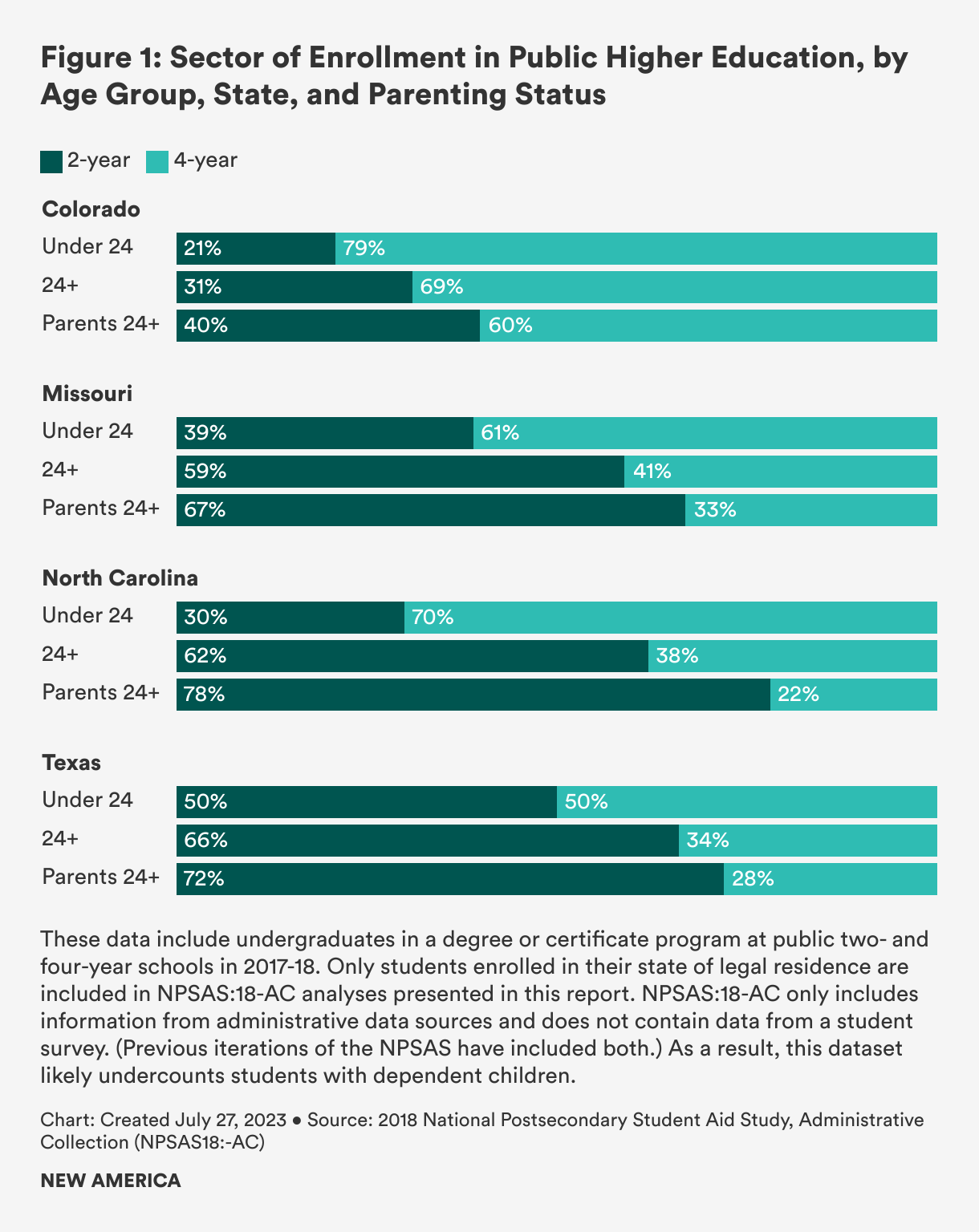
Using the 2018 NPSAS data, we found that the majority of older students and student parents attend two-year colleges in three of the four states—Missouri, North Carolina, and Texas—although the proportions differed at the state level, as shown in Figure 1.12 In all four states, student parents who are 24 and over are more likely to attend community colleges than the general population of students who are 24 and over.
Older Black students and student parents are the most likely to attend community college
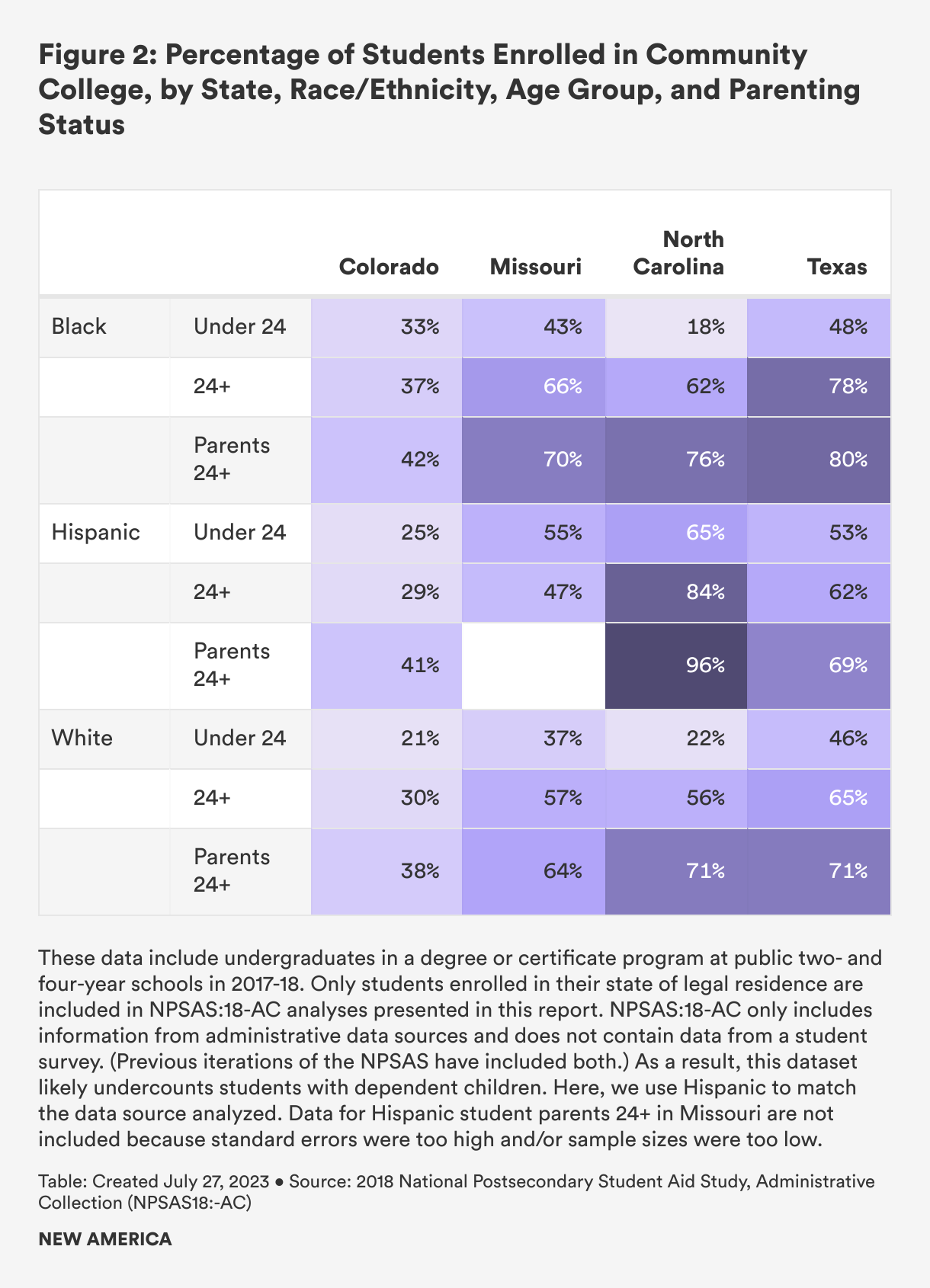
We found, as shown in Figure 2, that in all three racial and ethnic groups large enough for analysis, a higher share of student parents than students overall enroll in two-year institutions.13 Older Black students in all four states chose community colleges at higher rates than their white counterparts. Unlike other states in our research, in North Carolina, older Hispanic students enrolled in community colleges at a considerably higher rate than both white and Black peers, and almost all student parents enrolled in community colleges.
Older students and student parents 24+ tend to enroll in college part time
In all four states, the clear majority of older students and student parents in our sample enroll in college part time for at least part of the academic year. Older students and student parents who enroll full time are far more likely to go to four-year colleges than community colleges in all the states.
Older students and student parents have fewer resources than younger students
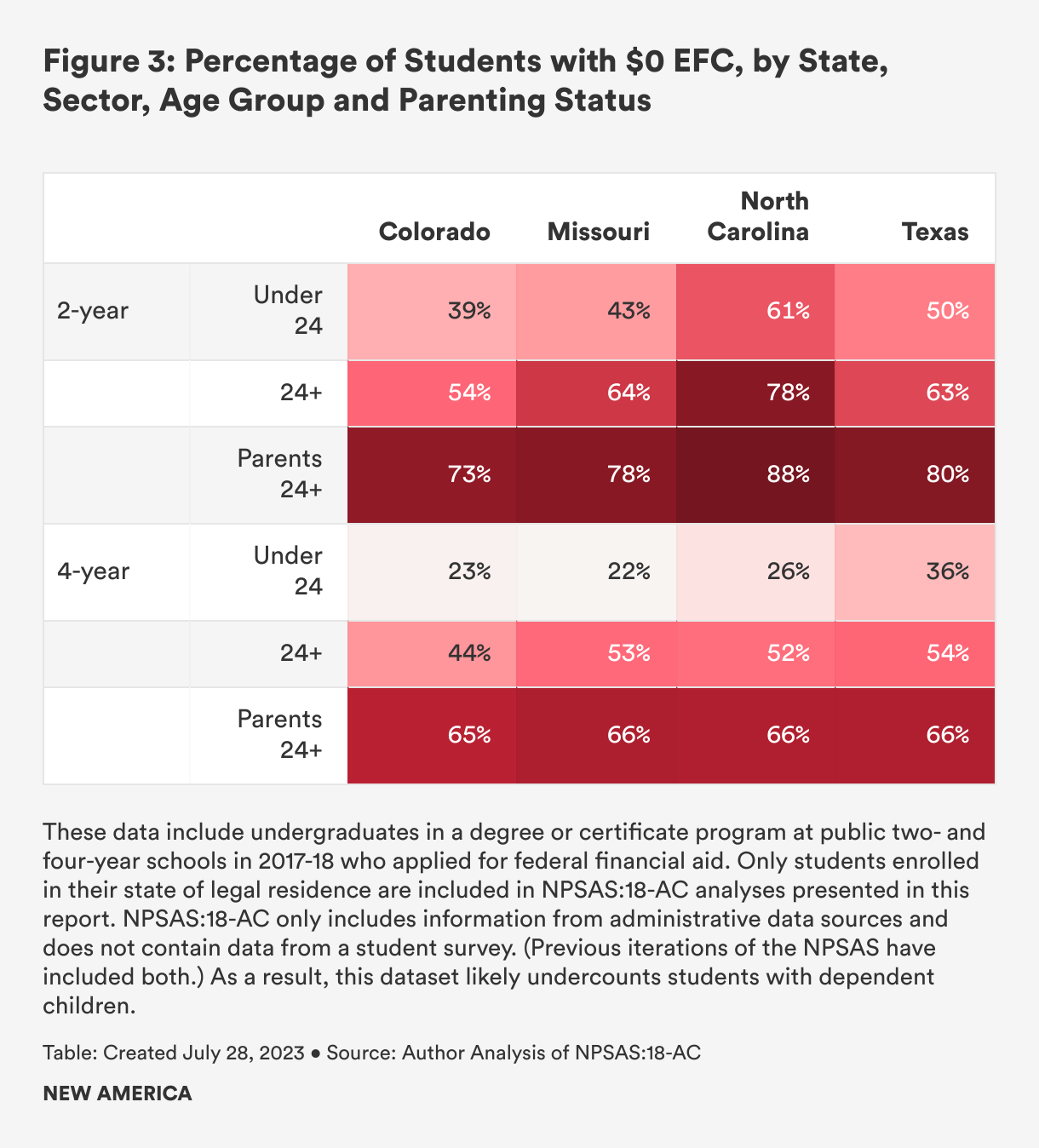
Older students and student parents who completed a FAFSA had a lower EFC compared to younger students across all four states. EFC for younger students is, in most cases, related to their parents’ income, rather than their own. Also, in all four states—in both community colleges and public universities—a considerable share of students has a $0 EFC, meaning they have no resources to pay for their college education, as shown in Figure 3.14
Citations
- Authors’ calculations using the 2020 National Postsecondary Student Aid Study, Undergraduate (NPSAS:UG).
- For example, Sarah Pingel and Neal Holly, Seeking Support: State Financial Aid Programs and Adult Students, Education Commission of the States, October 2017, https://www.ecs.org/seeking-support-state-financial-aid-programs-and-adult-students/; Wayne Taliaferro and Amy Ellen Duke-Benfield, Redesigning State Financial Aid to Better Serve Nontraditional Adult Students, Center for Law and Social Policy, September 2016, https://www.clasp.org/sites/default/files/public/resources-and-publications/publication-1/Redesigning-State-Financial-Aid-to-Better-Serve-Nontraditional-Adult-Students.pdf; Sarah Pingel, Brian A. Sponsler, and Neal Holly, Redesigning State Financial Aid: Principles to Guide State Aid Policymaking, Education Commission of the States, August 2018, https://www.ecs.org/wp-content/uploads/Redesigning-State-FInancial-Aid.pdf; Sandy Baum, Kristin Blagg, Leonardo Restrepo, and Fanny Terrones, Race, Ethnicity, and the Design of State Grant Aid Programs, Urban Institute, January 26, 2023, https://www.urban.org/research/publication/race-ethnicity-and-design-state-grant-aid-programs; Wesley Jenkins, College Students’ Siloed Safety Net, Urban Institute, May 13, 2020, https://www.urban.org/features/college-students-siloed-safety-net; and Lauren Walizer, State Strategies for Addressing College Students' Basic Needs, Center for Law and Social Policy, January 15, 2020, https://www.clasp.org/publications/report/brief/state-strategies-addressing-college-students-basic-needs/.
- See Tuan D. Nguyen, Jenna W. Kramer, and Brent J. Evans, "The Effects of Grant Aid on Student Persistence and Degree Attainment: A Systematic Review and Meta-Analysis of the Causal Evidence," Review of Educational Research 89, no. 6 (2019), https://doi.org/10.3102/0034654319877156; and Karen Bussey, Kimberly Dancy, Alyse Gray Parker, Eleanor Eckerson Peters, and Mamie Voight, Realizing the Mission of Higher Education Through Equitable Admissions Policies, (Washington, DC: Institute for Higher Education Policy, June 2021), https://www.ihep.org/wp-content/uploads/2021/06/IHEP_JOYCE_full_report_final_web_614.pdf.
- Jennifer Ma and Matea Pender, Trends in College Pricing and Student Aid 2022, College Board, https://research.collegeboard.org/media/pdf/trends-in-college-pricing-student-aid-2022.pdf. Federal financial aid also includes tax benefits, work study, veterans’ benefits, and Federal Supplemental Educational Opportunity Grants (FSEOG). In this paper, we use aid data from 2018, where possible, to match the NPSAS:18-AC data.
- National Association of State Student Grant and Aid Programs, 49th Annual Survey Report on State-Sponsored Student Financial Aid: 2017–2018 Academic Year, https://www.nassgapsurvey.com/survey_reports/2017-2018-49th.pdf.
- National Association of State Student Grant and Aid Programs.
- In addition, although not examined in this paper, families may have access to housing subsidies, mostly designed and distributed at the local level, and tax credits, such as the Earned Income Tax Credit (EITC) and Child Tax Credit (CTC), which are distributed at the federal level. (Some states and localities have established their own versions of the EITC to complement the federal credit, and a host of states have their own child or dependent-related tax credits.) See Amy Ellen Duke-Benfield, Bolstering Non-Traditional Student Success: A Comprehensive Student Aid System Using Financial Aid, Public Benefits, and Refundable Tax Credits, Center for Law and Social Policy, December 2015, https://www.clasp.org/sites/default/files/public/resources-and-publications/publication-1/Bolstering-NonTraditional-Student-Success.pdf.
- Congressional Research Service, The Temporary Assistance for Needy Families (TANF) Block Grant: A Primer on TANF Financing and Federal Requirements, August 14, 2023, https://crsreports.congress.gov/product/pdf/RL/RL32748 and Congressional Research Service, The Child Care and Development Block Grant: In Brief, November 18, 2022, https://crsreports.congress.gov/product/pdf/R/R47312.
- Congressional Research Service, Farm Bill Primer: SNAP and Nutrition Title Programs, November 18, 2022, https://crsreports.congress.gov/product/pdf/IF/IF12255 and Congressional Research Service, Medicaid: An Overview, February 8, 2023, https://crsreports.congress.gov/product/pdf/R/R43357.
- Congressional Research Service, Federal Financing for the State Children’s Health Insurance Program (CHIP), May 23, 2018, https://crsreports.congress.gov/product/pdf/R/R43949.
- Office of Federal Student Aid, “What is my Expected Family Contribution (EFC)?,” U.S. Department of Education, https://studentaid.gov/help-center/answers/article/what-is-efc; and Office of Federal Student Aid, “(GENERAL-22-91) Publication of the 2024-25 Draft Student Aid Index (SAI) and Pell Grant Eligibility Guide,” U.S. Department of Education, https://fsapartners.ed.gov/knowledge-center/library/electronic-announcements/2022-11-21/publication-2024-25-draft-student-aid-index-sai-and-pell-grant-eligibility-guide. FAFSA is the federal form that students have to complete to be considered for federal financial aid. The information students provide on FAFSA is used to determine a student’s EFC. States, as well as colleges and universities use the information from the form to determine eligibility for their own financial aid dollars. In the coming years, the student aid index (SAI) will replace the EFC.
- Fewer than 8 percent of students under 24 are parents in each state. And more than 85 percent of student parents are over the age of 24 across all states and sectors. Throughout the analysis, patterns did not change when we added in the younger student parents.
- Here and throughout this report, we use Hispanic instead of Latino/a/x to match the data source analyzed.
- The difference between older and younger students are likely due, at least in part, because all students over 24 are counted as independent, which means their EFCs are based upon their own resources, not those of parents or guardians. In addition, having dependents generally lowers your EFC to reflect the additional resources required to raise children or support others. Many students under age 24, on the other hand, are considered dependent, and as a result, their EFCs reflect a combination of their own and their parents’ resources. Older students without dependents may also have slightly higher median EFCs because they are not eligible to receive an automatic $0 EFC. Automatic $0 EFC is available to specific groups of students who have an income of $27,000 or less. Eligibility also depends on factors like receiving benefits from certain federal programs, specific tax filing conditions, and the student's dependency status. For more detail and a definition of independent and dependent students, see Office of Federal Student Aid, “The EFC Formula, 2022–2023,” U.S. Department of Education, August 2021, https://fsapartners.ed.gov/sites/default/files/2021-08/2223EFCFormulaGuide.pdf.
State Higher Education Funding and Financial Aid Program Design
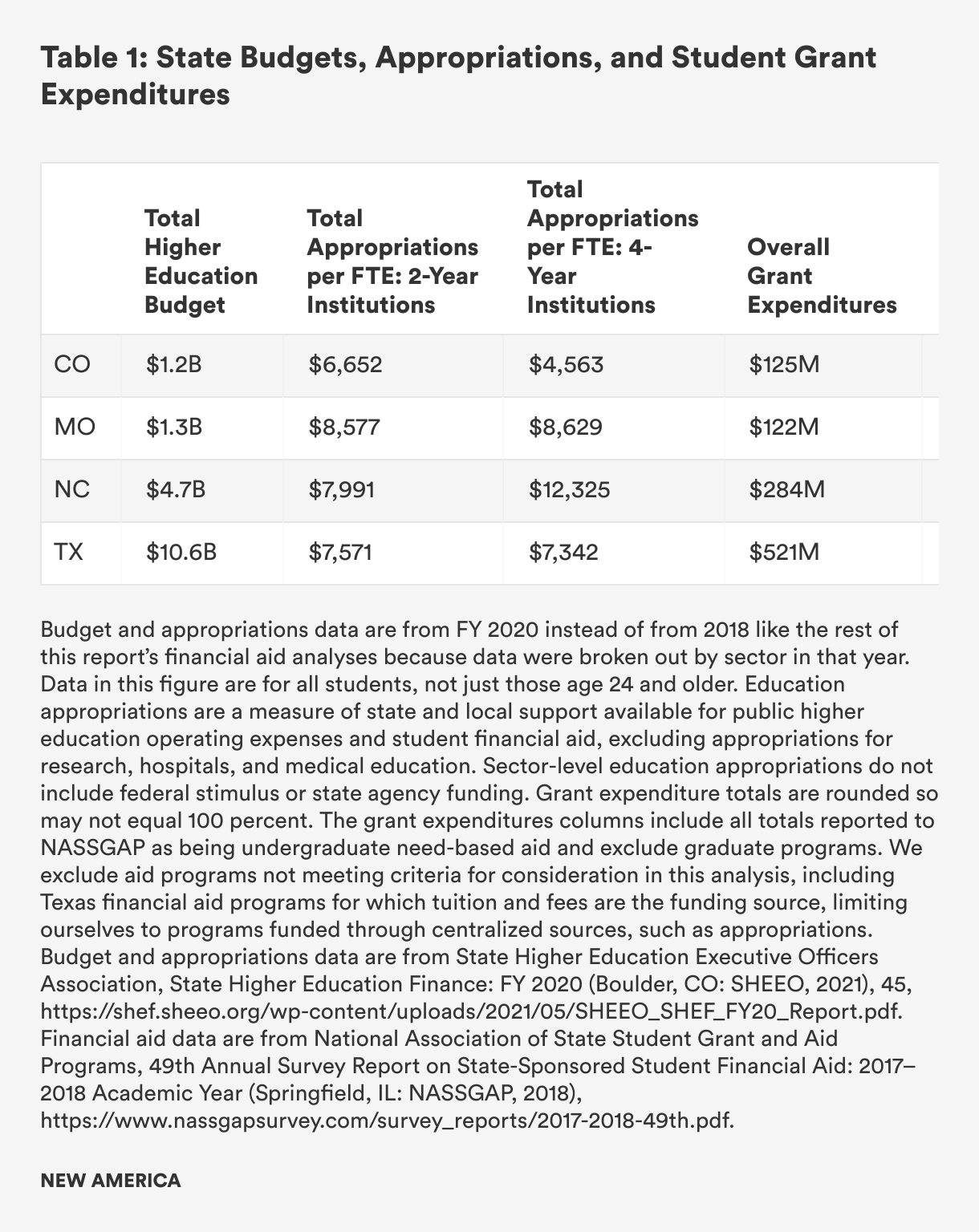
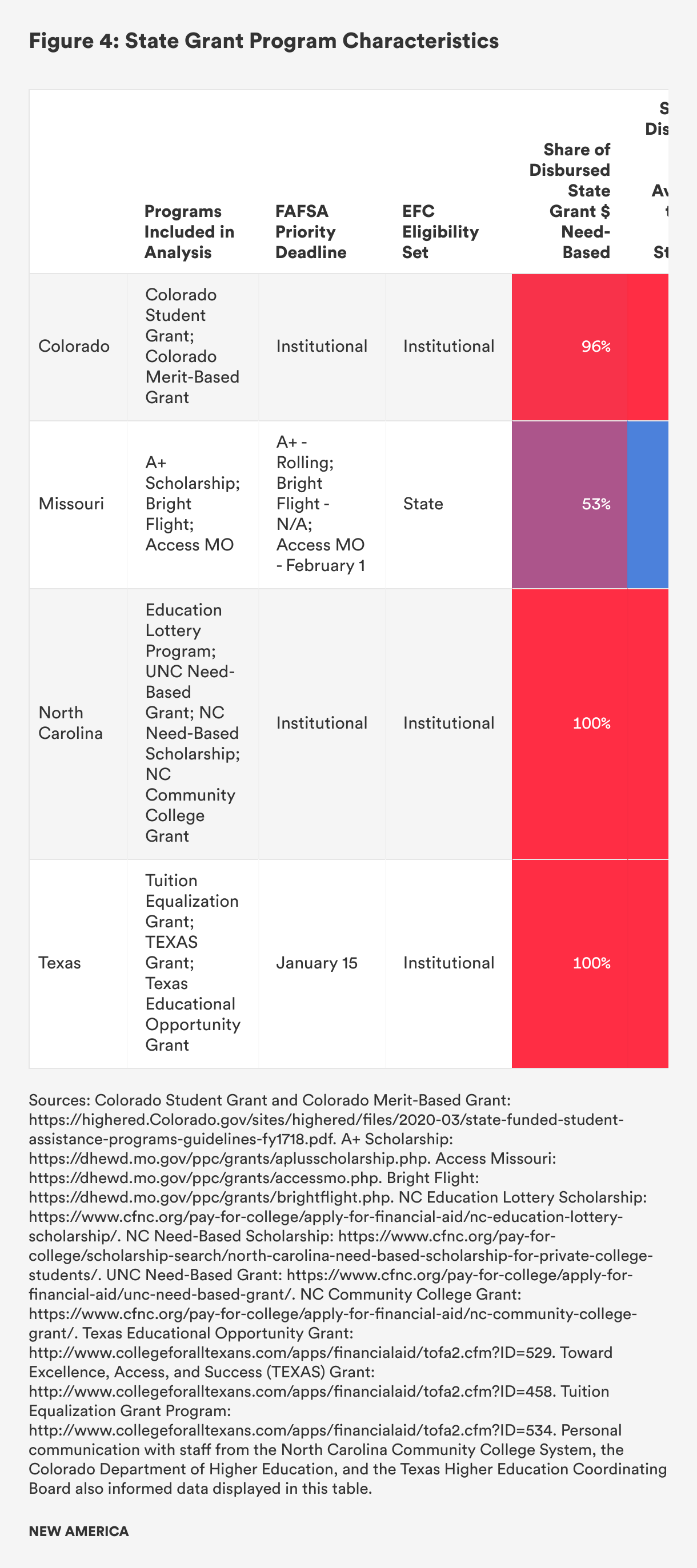
In all four states we examined in Table 1, spending on financial aid programs–both overall and per full time equivalent (FTE) enrollment–represents only a fraction of the direct support they provide for colleges, but the share of spending that each state devotes to financial aid differs. Each of the four states has a different mix of need-based and merit-based aid programs. Students who meet the criteria for merit aid, scholarships to those who have a high grade point average or perform well on standardized college entrance tests, tend to have more financial resources than those who do not qualify.15 Texas and North Carolina awarded all of their state aid based on need. Colorado awarded the majority of its aid based on need but had a small pot of merit aid. Missouri offered almost as much merit aid as it does need-based aid.
Design of major state financial aid programs
For each of our four focus states, we looked at the design, eligibility, and funding for the major state financial aid programs operating in 2017–18.16 (See Appendix B for more information on how these programs are funded.) Those programs are:
- Colorado:
- Colorado Merit-Based Grant17
- Colorado Student Grant
- Missouri: A+ Scholarship
- Access Missouri
- Bright Flight
- North Carolina: Education Lottery Scholarship
- NC Community College Grant
- NC Need-Based Scholarship
- UNC Need-Based Grant
- Texas: Texas Educational Opportunity Grant
- Toward Excellence, Access, and Success (TEXAS) Grant
- Tuition Equalization Grant
Our analysis shows that in these four states, fewer older students received state financial aid than their younger peers. Previous research also highlights the fact that older students are much less likely to receive state financial aid than younger students.18 There are a number of reasons why that may be so.
Our focus group conversations suggest that people considering going to or back to college later in life are less likely to know what support is available to them. “When you're in high school, you learned right there” about what kind of student aid was available, an older Colorado student said. “But as for adult learning, there's not very many resources where you can go and talk to counselors or anything about continuing your education.” Without guidance, older students may not apply for state aid or do so too late, as many state aid programs allocate their limited resources on a first-come, first-served basis.19 Older students also may not realize that they have to fill out the FAFSA, as the federal student aid application often serves as the application for state financial aid as well.
While lack of knowledge about the availability of state aid programs or how to apply for the funding hampers many older students, state aid programs often have confusing design or eligibility requirements that make it more difficult for older students and student parents to obtain funding. These students tend to enroll part time, attend community colleges, and have high financial need, and many state financial aid programs are simply not designed with these students in mind.
For example, state merit aid programs tend to reward top high school graduates who are going to a traditional four-year college.20 And some state need-based aid programs exclude part-time students and community college students. State aid programs also disadvantage older students and student parents when they require applicants to submit their standardized test scores or their high school GPA. For students who have been out of high school for an extended period of time, as is often the case for older students and student parents, such requirements impose a significant burden that may discourage them from applying, such as making in-person inquiries to their former schools.
Our focus groups suggest that older students and student parents are more likely to benefit from state grant and scholarship programs that determine eligibility automatically through the FAFSA, rather than requiring students to file a separate application or provide additional documentation. In addition, grants and scholarships that are first-dollar—meaning that college financial aid administrators are required to use the aid to cover tuition and fees first, leaving other resources like the Pell Grant to cover living expenses—are particularly likely to benefit older students and student parents, because eligible students tend to get more aid overall.
We found that older students and student parents had more success accessing state aid in some of the states we examined than others, and that program design likely played a significant part in those differences. But despite these differences, we found that many older students and student parents who are low-income are not accessing state aid for which they may be eligible in all four states.
To start, we will look at the differences between the states.
Colorado
Of the states we reviewed, the one that is doing the best by its older students is Colorado. The state provides aid to a high percentage of older students, even at community colleges. While 44 percent of older students and 54 percent of student parents are eligible for Pell, 34 percent of older students and 40 percent of student parents receive state grant aid, which is a small difference compared to the other states in this analysis.
Much of Colorado’s success has to do with the design of its large need-based aid program, the Colorado Student Grant, which works well for older, caregiving students. Students can access it if they go part time. They can use it at community colleges, and it is first-dollar. As far as state eligibility guidelines go, students only have to fill out the FAFSA. There are no additional requirements for test scores or other documentation of academic achievement. Colleges have some latitude to determine grant eligibility requirements within state parameters. For example, Colorado State University—for the upcoming academic year—requires students to be enrolled for at least 12 credits to get a grant. Pueblo Community College requires students to be enrolled for at least 6 credit hours, and from there, it pro-rates based on enrollment intensity.
North Carolina
The picture is a little more complex in North Carolina. While the design of its need-based financial aid programs was not optimal, the programs have proven to be mostly accessible to older students attending four-year colleges. This could be due to enrollment intensity of the students attending four-year colleges or the generous funding levels. Due to an anomaly in the NPSAS18:AC data, we were not able to analyze state grant receipt among community college students. In North Carolina public universities, 58 percent of older students and 53 percent of student parents received Pell, and 55 percent and 40 percent, respectively, received state grants. This is the highest share of older students receiving state grants among the states we analyzed. While this is a strong finding for university students, it should be noted that nearly two-thirds of older students and more than three-fourths of student parents in public higher education attended community colleges rather than universities.
Still, North Carolina’s strategy of offering aid through four programs with different eligibility criteria, three of which corresponded to different sectors of higher education, may have confused students. However, it recently revamped its financial aid strategy to correct some of these issues. Starting in the 2023–24 academic year, North Carolina discontinued the three need-based aid programs for students in public higher education which were operating when data for this report were collected. Instead, the state now administers the NC Need-Based Scholarship for Public Colleges and Universities, which combined and replaced the Education Lottery Scholarship, NC Community College Need-Based Grant, and the UNC Need-Based Grant.21 The simplicity of communicating about one grant program versus three may benefit older students,22 given that our focus group participants in North Carolina had little to no familiarity with state grant programs in place at the time. Furthermore, the priority FAFSA date for this new grant programs is June 1 for students attending public universities and August 15 for students attending community colleges,23 much more realistic dates for adult students making college-going decisions in the spring and summer. Priority dates in Missouri and Texas are set in February and January, respectively.
Texas
Texas makes it difficult for older and parenting students to access public benefits and financial aid to complete their education. And although Texas’s state aid programs had many of the same design flaws as North Carolina’s, financially needy older students fare worse in the Lone Star State. The state has a particularly stark difference in its four-year colleges for older and parenting students who receive Pell and the percentage who receive state grant aid. The community college state aid program seems woefully underfunded with only 14 percent of older students receiving aid, when 45 percent receive Pell. In Texas, a significantly higher share of older students and student parents in our sample with a $0 EFC at public universities received both state and federal grants than their peers at community colleges.
Texas has three financial aid programs, only one of which can be used at community colleges. Recent analysis from the Urban Institute found that fewer than one in ten students otherwise eligible for a Texas Educational Opportunity Grant (TEOG) at community colleges received such a grant.24 Program funding is meager, and even so, only 24 percent of TEOG awards went to students classified as independent on the FAFSA.25 Without adequate funding for the state’s community college financial aid program, adult students who enroll in this sector are likely to continue to be excluded from these resources. Students must carry at least a three-quarters course load to be eligible for a TEXAS grant at a public university, but students at community colleges may enroll only half time and be eligible for TEOG. Eligibility for part-time students makes state grant programs more likely to reach older students, yet differing eligibility requirements among programs may prove confusing and make financial planning for college difficult.26 All of these factors serve as impediments to older students and student parents.
Missouri
Financially needy older students also find it difficult to obtain state aid in Missouri. In general, students 24 and older tend to be excluded from merit-based state grant aid. Alone among our sample states, Missouri’s merit aid comprises half of its financial aid expenditures. The two merit aid programs in the state represent a significant investment in higher education that older students and student parents do not often access, leaving particularly large gaps between Pell eligibility and access to state aid in Missouri. While 58 percent of older students and 68 percent of student parents receive Pell, only 18 percent and 19 percent, respectively, receive state grant aid.
In Missouri, a significantly higher share of older students and student parents in our sample with a $0 EFC at public universities received both state and federal grants than their peers at community colleges. On the one hand, this difference makes sense, given the higher tuition at universities (typically resulting in a higher cost of attendance). However, as we have shown, a higher share of students 24 and over—especially students with dependent children and Black students—opt for community colleges over universities. The fact that community college students are less likely to get state grants may have equity implications for these groups.
The primary reason that older students have trouble accessing state financial aid in Missouri is that a significant share of it is devoted to merit-based aid, which primarily goes to top high school students going straight to college. Of the three programs in this analysis, two are merit-based and all require full-time enrollment. The two merit-based programs require some measure of academic performance in high school, and the A+ program requires service hours, high attendance, and more. Students going to community colleges are eligible for funding through all three programs, and two of the programs offer last-dollar aid. Furthermore, setting eligibility criteria at the state level provides a level of clarity to students. For example, the EFC eligibility level for Access Missouri has been held steady in state statute since the program’s inception in 2007. Students across institutions, sectors of higher education, and years may therefore have been able to more reliably predict whether or not they could receive aid from this program, given the stability and state-level eligibility criteria, than students in states where EFC eligibility thresholds fluctuate from institution to institution and year to year.
Citations
- Authors’ calculations using the 2020 National Postsecondary Student Aid Study, Undergraduate (NPSAS:UG).
- For example, Sarah Pingel and Neal Holly, Seeking Support: State Financial Aid Programs and Adult Students, Education Commission of the States, October 2017, https://www.ecs.org/seeking-support-state-financial-aid-programs-and-adult-students/; Wayne Taliaferro and Amy Ellen Duke-Benfield, Redesigning State Financial Aid to Better Serve Nontraditional Adult Students, Center for Law and Social Policy, September 2016, https://www.clasp.org/sites/default/files/public/resources-and-publications/publication-1/Redesigning-State-Financial-Aid-to-Better-Serve-Nontraditional-Adult-Students.pdf; Sarah Pingel, Brian A. Sponsler, and Neal Holly, Redesigning State Financial Aid: Principles to Guide State Aid Policymaking, Education Commission of the States, August 2018, https://www.ecs.org/wp-content/uploads/Redesigning-State-FInancial-Aid.pdf; Sandy Baum, Kristin Blagg, Leonardo Restrepo, and Fanny Terrones, Race, Ethnicity, and the Design of State Grant Aid Programs, Urban Institute, January 26, 2023, https://www.urban.org/research/publication/race-ethnicity-and-design-state-grant-aid-programs; Wesley Jenkins, College Students’ Siloed Safety Net, Urban Institute, May 13, 2020, https://www.urban.org/features/college-students-siloed-safety-net; and Lauren Walizer, State Strategies for Addressing College Students' Basic Needs, Center for Law and Social Policy, January 15, 2020, https://www.clasp.org/publications/report/brief/state-strategies-addressing-college-students-basic-needs/.
- See Tuan D. Nguyen, Jenna W. Kramer, and Brent J. Evans, "The Effects of Grant Aid on Student Persistence and Degree Attainment: A Systematic Review and Meta-Analysis of the Causal Evidence," Review of Educational Research 89, no. 6 (2019), https://doi.org/10.3102/0034654319877156; and Karen Bussey, Kimberly Dancy, Alyse Gray Parker, Eleanor Eckerson Peters, and Mamie Voight, Realizing the Mission of Higher Education Through Equitable Admissions Policies, (Washington, DC: Institute for Higher Education Policy, June 2021), https://www.ihep.org/wp-content/uploads/2021/06/IHEP_JOYCE_full_report_final_web_614.pdf.
- Jennifer Ma and Matea Pender, Trends in College Pricing and Student Aid 2022, College Board, https://research.collegeboard.org/media/pdf/trends-in-college-pricing-student-aid-2022.pdf. Federal financial aid also includes tax benefits, work study, veterans’ benefits, and Federal Supplemental Educational Opportunity Grants (FSEOG). In this paper, we use aid data from 2018, where possible, to match the NPSAS:18-AC data.
- National Association of State Student Grant and Aid Programs, 49th Annual Survey Report on State-Sponsored Student Financial Aid: 2017–2018 Academic Year, https://www.nassgapsurvey.com/survey_reports/2017-2018-49th.pdf.
- National Association of State Student Grant and Aid Programs.
- In addition, although not examined in this paper, families may have access to housing subsidies, mostly designed and distributed at the local level, and tax credits, such as the Earned Income Tax Credit (EITC) and Child Tax Credit (CTC), which are distributed at the federal level. (Some states and localities have established their own versions of the EITC to complement the federal credit, and a host of states have their own child or dependent-related tax credits.) See Amy Ellen Duke-Benfield, Bolstering Non-Traditional Student Success: A Comprehensive Student Aid System Using Financial Aid, Public Benefits, and Refundable Tax Credits, Center for Law and Social Policy, December 2015, https://www.clasp.org/sites/default/files/public/resources-and-publications/publication-1/Bolstering-NonTraditional-Student-Success.pdf.
- Congressional Research Service, The Temporary Assistance for Needy Families (TANF) Block Grant: A Primer on TANF Financing and Federal Requirements, August 14, 2023, https://crsreports.congress.gov/product/pdf/RL/RL32748 and Congressional Research Service, The Child Care and Development Block Grant: In Brief, November 18, 2022, https://crsreports.congress.gov/product/pdf/R/R47312.
- Congressional Research Service, Farm Bill Primer: SNAP and Nutrition Title Programs, November 18, 2022, https://crsreports.congress.gov/product/pdf/IF/IF12255 and Congressional Research Service, Medicaid: An Overview, February 8, 2023, https://crsreports.congress.gov/product/pdf/R/R43357.
- Congressional Research Service, Federal Financing for the State Children’s Health Insurance Program (CHIP), May 23, 2018, https://crsreports.congress.gov/product/pdf/R/R43949.
- Office of Federal Student Aid, “What is my Expected Family Contribution (EFC)?,” U.S. Department of Education, https://studentaid.gov/help-center/answers/article/what-is-efc; and Office of Federal Student Aid, “(GENERAL-22-91) Publication of the 2024-25 Draft Student Aid Index (SAI) and Pell Grant Eligibility Guide,” U.S. Department of Education, https://fsapartners.ed.gov/knowledge-center/library/electronic-announcements/2022-11-21/publication-2024-25-draft-student-aid-index-sai-and-pell-grant-eligibility-guide. FAFSA is the federal form that students have to complete to be considered for federal financial aid. The information students provide on FAFSA is used to determine a student’s EFC. States, as well as colleges and universities use the information from the form to determine eligibility for their own financial aid dollars. In the coming years, the student aid index (SAI) will replace the EFC.
- Fewer than 8 percent of students under 24 are parents in each state. And more than 85 percent of student parents are over the age of 24 across all states and sectors. Throughout the analysis, patterns did not change when we added in the younger student parents.
- Here and throughout this report, we use Hispanic instead of Latino/a/x to match the data source analyzed.
- The difference between older and younger students are likely due, at least in part, because all students over 24 are counted as independent, which means their EFCs are based upon their own resources, not those of parents or guardians. In addition, having dependents generally lowers your EFC to reflect the additional resources required to raise children or support others. Many students under age 24, on the other hand, are considered dependent, and as a result, their EFCs reflect a combination of their own and their parents’ resources. Older students without dependents may also have slightly higher median EFCs because they are not eligible to receive an automatic $0 EFC. Automatic $0 EFC is available to specific groups of students who have an income of $27,000 or less. Eligibility also depends on factors like receiving benefits from certain federal programs, specific tax filing conditions, and the student's dependency status. For more detail and a definition of independent and dependent students, see Office of Federal Student Aid, “The EFC Formula, 2022–2023,” U.S. Department of Education, August 2021, https://fsapartners.ed.gov/sites/default/files/2021-08/2223EFCFormulaGuide.pdf.
- See Naomi Harris, “How Popular Merit College Scholarships have Perpetuated Racial Inequities,” Washington Post, May 7, 2022, https://www.washingtonpost.com/education/2022/05/07/merit-scholarships-college-racial-inequities/ and Stephen Burd, Crisis Point: How Enrollment Management and the Merit-Aid Arms Race Are Derailing Public Higher Education (Washington, DC: New America, February 13, 2020), https://www.newamerica.org/education-policy/reports/crisis-point-how-enrollment-management-and-merit-aid-arms-race-are-destroying-public-higher-education/.
- We defined a major program as one in which the funding was at least $1 million and that was not limited by one area of study, like STEM or teaching, or to a highly specific population, like children of service members or law enforcement officers. Using these criteria we examined the requirements for the following programs, including the source of the funding, how much is spent, and the number of recipients.
- The Colorado Merit-Based Grant has not been funded since 2020.
- For example, see Iris Palmer, “Degrees Denied: Adults Left out of State Financial Aid Programs,” EdCentral (blog), New America, August 4, 2015, https://www.newamerica.org/education-policy/edcentral/adults-state-financial-aid/.
- See Taliaferro and Duke-Benfield, Redesigning State Financial Aid; and CampusLogic, Timing is Everything: FAFSA Filing Trends, 2019.
- Pingel, Sponsler, and Holly, Redesigning State Financial Aid.
- For complete program rules, see North Carolina State Education Assistance Authority, “Rules Governing the North Carolina Need-Based Scholarship for Public Colleges and Universities,” 2023, https://www.ncseaa.edu/wp-content/uploads/sites/1171/2023/04/Rules-Governing-the-North-Carolina-Need-Based-Scholarship-for-Public-Colleges-and-Universities-effective-4-3-2023-Signed-and-Sealed.pdf.
- Sandy Baum, Improving the Targeting, Predictability, and Simplicity of North Carolina’s State Grant Programs, NC Community Colleges and the University of North Carolina System, December 2018, https://www.northcarolina.edu/wp-content/uploads/reports-and-documents/strategy-and-policy/sasg_baum_policybrief_012919.pdf.
- College Foundation of North Carolina, “NC Scholarship,” 2023, https://www.cfnc.org/pay-for-college/apply-for-financial-aid/nc-scholarship/.
- Sandy Baum and Kristin Blagg, Strengthening Student Aid in Texas: Funding Students atDifferent Types of Institutions, Urban Institute, September 2021, https://www.urban.org/sites/default/files/publication/104841/strengthening-student-aid-in-texas-funding-students-at-different-types-of-institutions_0.pdf.
- Independent students are most often classified as such due to being married, having dependent children, or being 24 or older. For analysis of TEOG recipients, see Texas Higher Education Coordinating Board, Report on Student Financial Aid in Texas Higher Education: Fiscal Year 2018, 2019, https://reportcenter.highered.texas.gov/reports/data/report-on-student-financial-aid-in-texas-higher-education-for-fy-2018/.
- For a discussion of program eligibility requirements and implications for the adult learner, see Sandy Baum and Kristin Blagg, A Review of State Grant Aid in Texas, Urban Institute, 2021 https://www.urban.org/sites/default/files/publication/104281/a-review-of-state-grant-aid-in-texas_0.pdf.
Financial Aid: Program Implementation
Despite the differences among the states, a significantly lower percentage of students who are over 24 and student parents receive state grant aid than receive Pell Grants in all four states. These disparities are particularly stark at community colleges. Traditional-aged students who receive Pell Grants are far more likely to also receive state aid than older students.
As Figure 5 shows, even for students and student parents 24 and over with significant financial need, the structure of these programs means that they are not receiving the state aid they should be. This appears to be particularly true for those attending community college—approximately two-thirds of students and student parents 24 and over with $0 EFC receive only federal grants and no state grants. But of course, these students still need the money. One of our focus group participants said, “Even though I have financial aid…I still pay out of pocket.”
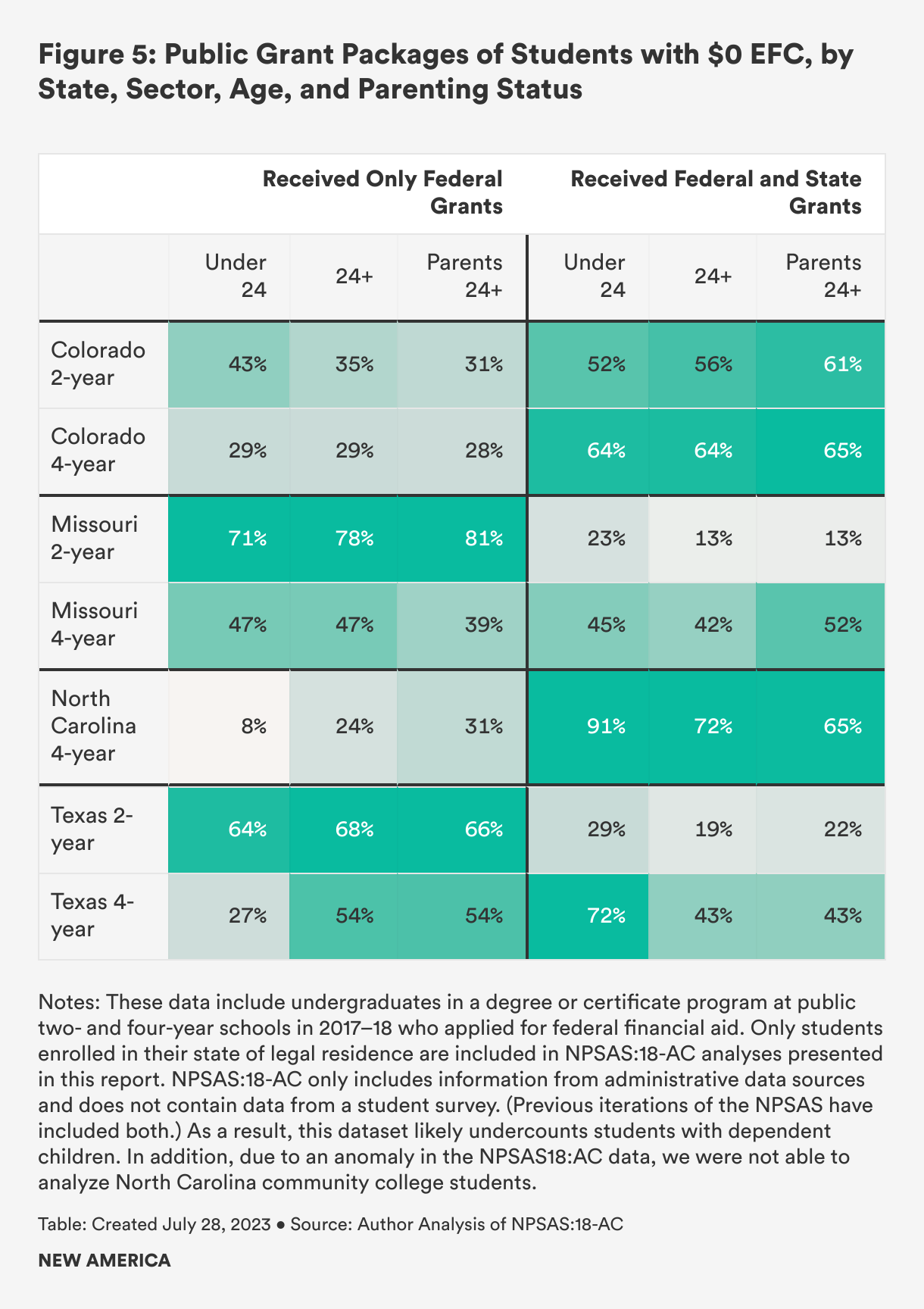
In all four states and in both sectors, a notable share of older students with $0 EFC received no grants at all. There are a few reasons these students may not have been able to access federal and state financial aid.27 They may not have completed a FAFSA. If they did complete one but did not do so early enough in the year, state grant funds might have been depleted by the time they applied for aid, despite their significant financial need. They may have exceeded the length of time they are allowed to access Pell Grants.28 If they have previously earned a bachelor’s degree and are returning to college, they will not be able to access federal grants and are unlikely to be able to access any state grants, regardless of need. And if they are not meeting satisfactory academic progress standards, they will not be able to receive such grants.29
Many students in our focus groups found that they had significant gaps between their college expenses and how much was covered by financial aid. Most participants said that financial aid did not even come close to covering all their expenses, with many noting that they still had unmet financial need even after taking out student loans. A Missouri student said, “Even after loans, which are in the thousands, I still owe every school that I [attended], every time that I went.”
Citations
- Authors’ calculations using the 2020 National Postsecondary Student Aid Study, Undergraduate (NPSAS:UG).
- For example, Sarah Pingel and Neal Holly, Seeking Support: State Financial Aid Programs and Adult Students, Education Commission of the States, October 2017, https://www.ecs.org/seeking-support-state-financial-aid-programs-and-adult-students/; Wayne Taliaferro and Amy Ellen Duke-Benfield, Redesigning State Financial Aid to Better Serve Nontraditional Adult Students, Center for Law and Social Policy, September 2016, https://www.clasp.org/sites/default/files/public/resources-and-publications/publication-1/Redesigning-State-Financial-Aid-to-Better-Serve-Nontraditional-Adult-Students.pdf; Sarah Pingel, Brian A. Sponsler, and Neal Holly, Redesigning State Financial Aid: Principles to Guide State Aid Policymaking, Education Commission of the States, August 2018, https://www.ecs.org/wp-content/uploads/Redesigning-State-FInancial-Aid.pdf; Sandy Baum, Kristin Blagg, Leonardo Restrepo, and Fanny Terrones, Race, Ethnicity, and the Design of State Grant Aid Programs, Urban Institute, January 26, 2023, https://www.urban.org/research/publication/race-ethnicity-and-design-state-grant-aid-programs; Wesley Jenkins, College Students’ Siloed Safety Net, Urban Institute, May 13, 2020, https://www.urban.org/features/college-students-siloed-safety-net; and Lauren Walizer, State Strategies for Addressing College Students' Basic Needs, Center for Law and Social Policy, January 15, 2020, https://www.clasp.org/publications/report/brief/state-strategies-addressing-college-students-basic-needs/.
- See Tuan D. Nguyen, Jenna W. Kramer, and Brent J. Evans, "The Effects of Grant Aid on Student Persistence and Degree Attainment: A Systematic Review and Meta-Analysis of the Causal Evidence," Review of Educational Research 89, no. 6 (2019), https://doi.org/10.3102/0034654319877156; and Karen Bussey, Kimberly Dancy, Alyse Gray Parker, Eleanor Eckerson Peters, and Mamie Voight, Realizing the Mission of Higher Education Through Equitable Admissions Policies, (Washington, DC: Institute for Higher Education Policy, June 2021), https://www.ihep.org/wp-content/uploads/2021/06/IHEP_JOYCE_full_report_final_web_614.pdf.
- Jennifer Ma and Matea Pender, Trends in College Pricing and Student Aid 2022, College Board, https://research.collegeboard.org/media/pdf/trends-in-college-pricing-student-aid-2022.pdf. Federal financial aid also includes tax benefits, work study, veterans’ benefits, and Federal Supplemental Educational Opportunity Grants (FSEOG). In this paper, we use aid data from 2018, where possible, to match the NPSAS:18-AC data.
- National Association of State Student Grant and Aid Programs, 49th Annual Survey Report on State-Sponsored Student Financial Aid: 2017–2018 Academic Year, https://www.nassgapsurvey.com/survey_reports/2017-2018-49th.pdf.
- National Association of State Student Grant and Aid Programs.
- In addition, although not examined in this paper, families may have access to housing subsidies, mostly designed and distributed at the local level, and tax credits, such as the Earned Income Tax Credit (EITC) and Child Tax Credit (CTC), which are distributed at the federal level. (Some states and localities have established their own versions of the EITC to complement the federal credit, and a host of states have their own child or dependent-related tax credits.) See Amy Ellen Duke-Benfield, Bolstering Non-Traditional Student Success: A Comprehensive Student Aid System Using Financial Aid, Public Benefits, and Refundable Tax Credits, Center for Law and Social Policy, December 2015, https://www.clasp.org/sites/default/files/public/resources-and-publications/publication-1/Bolstering-NonTraditional-Student-Success.pdf.
- Congressional Research Service, The Temporary Assistance for Needy Families (TANF) Block Grant: A Primer on TANF Financing and Federal Requirements, August 14, 2023, https://crsreports.congress.gov/product/pdf/RL/RL32748 and Congressional Research Service, The Child Care and Development Block Grant: In Brief, November 18, 2022, https://crsreports.congress.gov/product/pdf/R/R47312.
- Congressional Research Service, Farm Bill Primer: SNAP and Nutrition Title Programs, November 18, 2022, https://crsreports.congress.gov/product/pdf/IF/IF12255 and Congressional Research Service, Medicaid: An Overview, February 8, 2023, https://crsreports.congress.gov/product/pdf/R/R43357.
- Congressional Research Service, Federal Financing for the State Children’s Health Insurance Program (CHIP), May 23, 2018, https://crsreports.congress.gov/product/pdf/R/R43949.
- Office of Federal Student Aid, “What is my Expected Family Contribution (EFC)?,” U.S. Department of Education, https://studentaid.gov/help-center/answers/article/what-is-efc; and Office of Federal Student Aid, “(GENERAL-22-91) Publication of the 2024-25 Draft Student Aid Index (SAI) and Pell Grant Eligibility Guide,” U.S. Department of Education, https://fsapartners.ed.gov/knowledge-center/library/electronic-announcements/2022-11-21/publication-2024-25-draft-student-aid-index-sai-and-pell-grant-eligibility-guide. FAFSA is the federal form that students have to complete to be considered for federal financial aid. The information students provide on FAFSA is used to determine a student’s EFC. States, as well as colleges and universities use the information from the form to determine eligibility for their own financial aid dollars. In the coming years, the student aid index (SAI) will replace the EFC.
- Fewer than 8 percent of students under 24 are parents in each state. And more than 85 percent of student parents are over the age of 24 across all states and sectors. Throughout the analysis, patterns did not change when we added in the younger student parents.
- Here and throughout this report, we use Hispanic instead of Latino/a/x to match the data source analyzed.
- The difference between older and younger students are likely due, at least in part, because all students over 24 are counted as independent, which means their EFCs are based upon their own resources, not those of parents or guardians. In addition, having dependents generally lowers your EFC to reflect the additional resources required to raise children or support others. Many students under age 24, on the other hand, are considered dependent, and as a result, their EFCs reflect a combination of their own and their parents’ resources. Older students without dependents may also have slightly higher median EFCs because they are not eligible to receive an automatic $0 EFC. Automatic $0 EFC is available to specific groups of students who have an income of $27,000 or less. Eligibility also depends on factors like receiving benefits from certain federal programs, specific tax filing conditions, and the student's dependency status. For more detail and a definition of independent and dependent students, see Office of Federal Student Aid, “The EFC Formula, 2022–2023,” U.S. Department of Education, August 2021, https://fsapartners.ed.gov/sites/default/files/2021-08/2223EFCFormulaGuide.pdf.
- See Naomi Harris, “How Popular Merit College Scholarships have Perpetuated Racial Inequities,” Washington Post, May 7, 2022, https://www.washingtonpost.com/education/2022/05/07/merit-scholarships-college-racial-inequities/ and Stephen Burd, Crisis Point: How Enrollment Management and the Merit-Aid Arms Race Are Derailing Public Higher Education (Washington, DC: New America, February 13, 2020), https://www.newamerica.org/education-policy/reports/crisis-point-how-enrollment-management-and-merit-aid-arms-race-are-destroying-public-higher-education/.
- We defined a major program as one in which the funding was at least $1 million and that was not limited by one area of study, like STEM or teaching, or to a highly specific population, like children of service members or law enforcement officers. Using these criteria we examined the requirements for the following programs, including the source of the funding, how much is spent, and the number of recipients.
- The Colorado Merit-Based Grant has not been funded since 2020.
- For example, see Iris Palmer, “Degrees Denied: Adults Left out of State Financial Aid Programs,” EdCentral (blog), New America, August 4, 2015, https://www.newamerica.org/education-policy/edcentral/adults-state-financial-aid/.
- See Taliaferro and Duke-Benfield, Redesigning State Financial Aid; and CampusLogic, Timing is Everything: FAFSA Filing Trends, 2019.
- Pingel, Sponsler, and Holly, Redesigning State Financial Aid.
- For complete program rules, see North Carolina State Education Assistance Authority, “Rules Governing the North Carolina Need-Based Scholarship for Public Colleges and Universities,” 2023, https://www.ncseaa.edu/wp-content/uploads/sites/1171/2023/04/Rules-Governing-the-North-Carolina-Need-Based-Scholarship-for-Public-Colleges-and-Universities-effective-4-3-2023-Signed-and-Sealed.pdf.
- Sandy Baum, Improving the Targeting, Predictability, and Simplicity of North Carolina’s State Grant Programs, NC Community Colleges and the University of North Carolina System, December 2018, https://www.northcarolina.edu/wp-content/uploads/reports-and-documents/strategy-and-policy/sasg_baum_policybrief_012919.pdf.
- College Foundation of North Carolina, “NC Scholarship,” 2023, https://www.cfnc.org/pay-for-college/apply-for-financial-aid/nc-scholarship/.
- Sandy Baum and Kristin Blagg, Strengthening Student Aid in Texas: Funding Students atDifferent Types of Institutions, Urban Institute, September 2021, https://www.urban.org/sites/default/files/publication/104841/strengthening-student-aid-in-texas-funding-students-at-different-types-of-institutions_0.pdf.
- Independent students are most often classified as such due to being married, having dependent children, or being 24 or older. For analysis of TEOG recipients, see Texas Higher Education Coordinating Board, Report on Student Financial Aid in Texas Higher Education: Fiscal Year 2018, 2019, https://reportcenter.highered.texas.gov/reports/data/report-on-student-financial-aid-in-texas-higher-education-for-fy-2018/.
- For a discussion of program eligibility requirements and implications for the adult learner, see Sandy Baum and Kristin Blagg, A Review of State Grant Aid in Texas, Urban Institute, 2021 https://www.urban.org/sites/default/files/publication/104281/a-review-of-state-grant-aid-in-texas_0.pdf.
- Office of Federal Student Aid, “Student Loan Delinquency and Default,” U.S. Department of Education, https://studentaid.gov/manage-loans/default. In addition to the other reasons mentioned in this section, if students are in default on a federal student loan, they are ineligible for federal aid.
- Office of Federal Student Aid, “What is the Lifetime Eligibility Used (LEU) for a Pell Grant?” U.S. Department of Education, https://studentaid.gov/help-center/answers/article/leu-for-pell-grant. Students may receive a total of the equivalent of six years of Pell Grant funding.
- Office of Federal Student Aid, “Staying Eligible,” U.S. Department of Education, https://studentaid.gov/understand-aid/eligibility/staying-eligible. Federal satisfactory academic progress rules require students to meet their institution's academic standards to maintain eligibility for federal financial aid. Variation exists, but most institutions require a minimum 2.0 GPA and completing 67 percent of credits attempted.
Public Benefits: Program Design and Funding
Financial aid alone—whether from state or federal sources—is often not enough for older students and student parents to live on while enrolled in college. Even with existing aid, we know that there are high rates of food and housing insecurity among students.30 When financial aid is insufficient, college students may seek support from the social safety net. And those using public benefits may seek a higher education credential as a route toward economic security.
We considered five public benefit programs and their support of adult students and student parents: SNAP, TANF, Medicaid and CHIP, and child care subsidies provided through CCDBG. We reviewed current eligibility for these programs based on federal standards for students and student parents, as well as any eligibility differences in the four states in our sample.31
However, eligibility requirements are only part of the story of why these public benefit programs can be difficult to access. Prior research, including from the U.S. Government Accountability Office, has shown that students may be unaware of their eligibility for public benefits that could help them make ends meet, just as they are often unaware of state aid programs.32 In our focus groups of older students and student parents, not only were most participants unaware of benefits for which they were eligible, but they also were less willing to discuss benefits-related issues than financial aid. The students’ reticence suggests that there is still stigma around these programs and this makes it even more challenging to understand who is using these programs.
A student parent at the focus group we held in Missouri acknowledged feeling this stigma when using food stamps at the grocery store. He noted that, in order to use these benefits, “you had to have specific things on each check.” He “would try to organize it, so that [my transaction] would go quickly, but there was always going to be somebody behind you that complained."
Some focus group participants said that they did not seek help from public benefit programs even if they might have qualified for them. These participants were clear that they preferred to rely on themselves rather than asking for help. One Texas student said that she would “rather just deal with it on my own than asking for somebody to help me.” She added, “I don't need to be going to somebody to beg for something.”
Only a small number of participants mentioned getting information about public benefits from their college or university. Multiple participants thought it would be useful to have colleges provide information about these programs and how to apply for these benefits. Research indicates that one-stop and wraparound support approaches to student services on college campuses provide significant benefits, including increased persistence and retention.33 These services can include financial aid, academic advising, and basic needs support. These comprehensive programs use counselors who provide a single point of contact for access to benefits.
In addition, both federal and state governments require students who would qualify for public benefits to repeatedly prove that they have very limited resources by submitting new applications for every public benefit they attempt to access. A possible solution, which the Biden administration recently encouraged in guidance, is for colleges to use FAFSA data to give students information about their eligibility for public benefits programs; over time, this information will hopefully increase awareness of benefits for eligible students.34 However, this guidance does not address other administrative burdens that limit the uptake of benefits.
Supplemental Nutrition Assistance Program (SNAP)
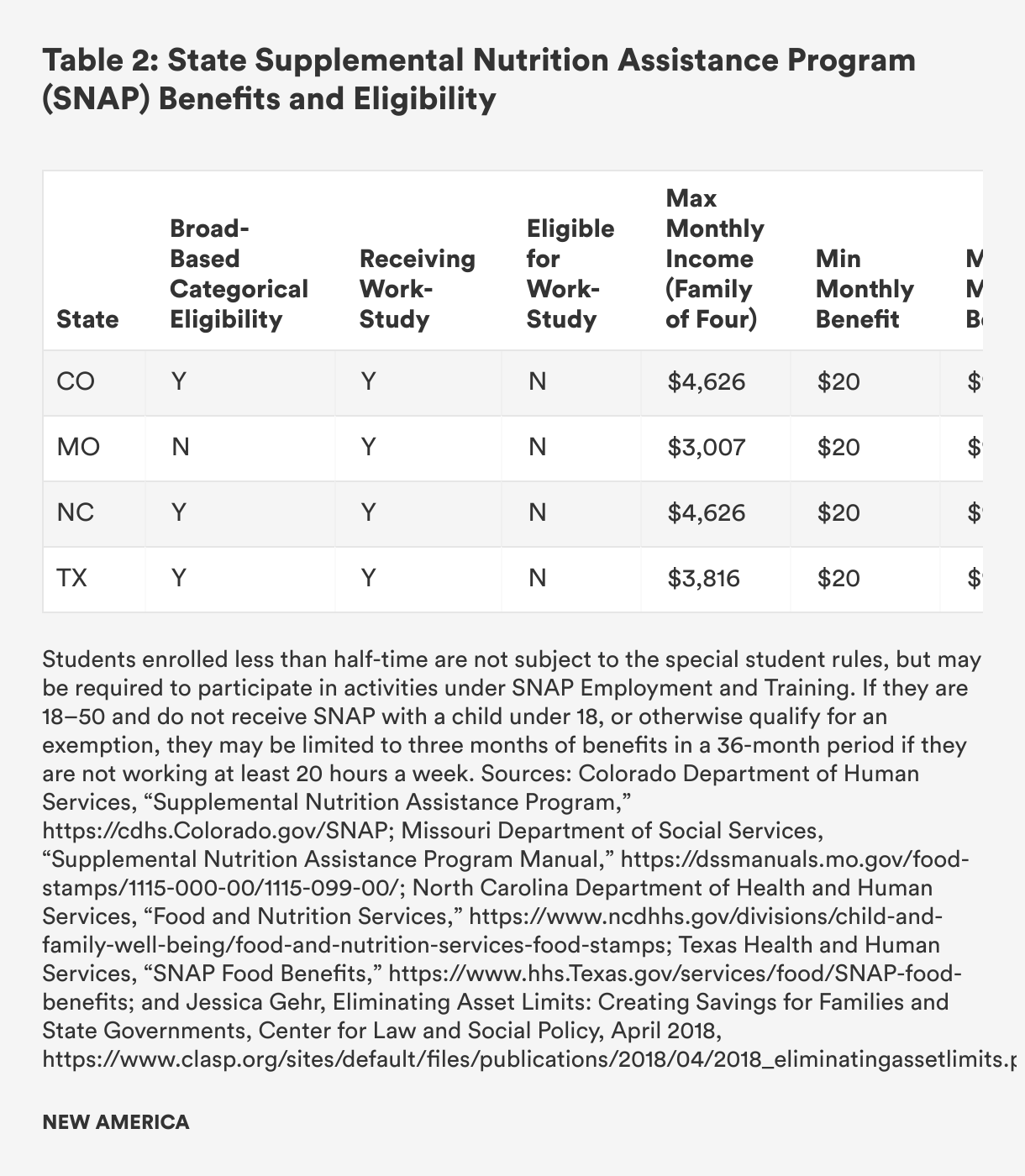
SNAP is designed to supplement households’ food budgets and has been shown to reduce food insecurity.35 The primary requirement for SNAP eligibility is gross income at or below 130 percent of the federal poverty guidelines, which is currently approximately $25,600 for a family of two and $32,300 for a family of three.36 A state can raise this threshold to a maximum of 200 percent of the federal poverty guidelines using a policy known as broad-based categorical eligibility to make the qualification process slightly simpler, as shown in Table 2.37 Two of our four focus states—Colorado and North Carolina—have raised their eligibility criteria to this level.
SNAP is an entitlement program, so costs rise as the number of people enrolled in it grows. In FY 2021, SNAP cost around $111 billion.38 This was a sharp increase from prior years, mostly due to a spike in enrollment numbers and an increase in benefit amounts as a result of the COVID-19 pandemic and related program adjustments. But even with the spike in enrollment, research from the Center on Budget and Policy Priorities suggests that there are many families that need additional assistance.39
The pandemic exacerbated many of the existing challenges that students face when trying to access public benefits. Students in our focus groups who relied on public benefits found an already challenging application and renewal process to be even more burdensome during the pandemic—a time when they most needed the support these programs provided. A Missouri student recounted that “some people, myself included, were up for renewals during [the early pandemic] and because you couldn't get ahold of an actual person to process your case, your case got denied. And then you had to start over from the beginning and you lost out on a couple months’ worth of aid.”
SNAP enrollment criteria for students
SNAP is one of the easiest federal benefit programs for students to access.40
Students enrolled in higher education half time or more can qualify for SNAP if they meet one of several criteria:41
- Are under age 18 or age 50 or older;
- Have a physical or mental disability;
- Work at least 20 hours a week in paid employment;
- Participate in a state- or federally-financed work-study program;
- Participate in an on-the-job training program;
- Care for a child under the age of 6;
- Care for a child aged 6 to 11 and lack the necessary child care to enable attending school and working 20 hours a week or participating in work-study;
- Are a single parent enrolled full time in college and taking care of a child under 12;
- Receive TANF assistance; or
- Are assigned to, placed in, or self-placed in a college or other institution of higher education through:
- A SNAP Employment and Training (SNAP E&T) program.
- Certain other E&T programs for low-income households, which are operated by a state or local government and have an equivalent component to SNAP E&T.
- A program under the Workforce Innovation and Opportunity Act of 2014 (WIOA).
- A Trade Adjustment Assistance Program under Section 236 of the Trade Act of 1974.
Students enrolled less than half time are not subject to the special student rules, but they may be required to participate in activities under SNAP E&T. If they are 18–52 and do not receive SNAP with a child under 18, or otherwise qualify for an exemption, they may be limited to three months of benefits in a 36-month period if they are not working at least 20 hours a week.42
Early in the pandemic, the government temporarily expanded SNAP benefits by making students who were eligible to participate in a state or federal work-study program or had an EFC of $0 qualified for benefits.43 Congress also authorized emergency allotments to boost SNAP benefits by at least $95 per month. These exemptions and additional benefits generally ended by early 2023.44
Some states are more generous with the rules around SNAP benefits than others. A key issue is that most states include asset limits in determining eligibility. However, some have chosen to raise or remove asset tests for eligibility. (See the “TANF” section below for more information about the potential interactions between asset limits and financial aid.) Another crucial issue is how states count work hours. Students can obtain SNAP if they work at least 20 hours in paid employment, but states count work hours differently. States can choose to average work hours over the course of a month, a semester, or a quarter. All of the states we considered use monthly averaging, which leaves them with an opportunity to improve flexibility for students by averaging over the course of a semester or quarter instead.
Caregiving responsibilities, variable work schedules, and changing class schedules mean that having to average work hours on a monthly basis can potentially push students out of eligibility. Semester-based averaging allows students to have more flexible work schedules as needed to accommodate other responsibilities without the risk of losing eligibility for food assistance.
Temporary Assistance for Needy Families (TANF)
TANF cash assistance provides a monthly stipend to very low-income families with minor children, and to pregnant people. The federal government provides the funds as a block grant to states, which determine eligibility criteria and use of the money.45 Federal funding for TANF has remained static since 1996, leading to a drop in the real value of the program by 40 percent, severely limiting how many people can receive support.46 States have flexibility in how they use TANF funds, as long as the money is used for one of the following purposes:
- Assisting families in need so children can be cared for in their own homes or the homes of relatives.
- Reducing dependency on public benefits by promoting job preparation, work, and marriage for parents in need.
- Preventing pregnancies among unmarried persons.
- Encouraging the formation and maintenance of two-parent families.
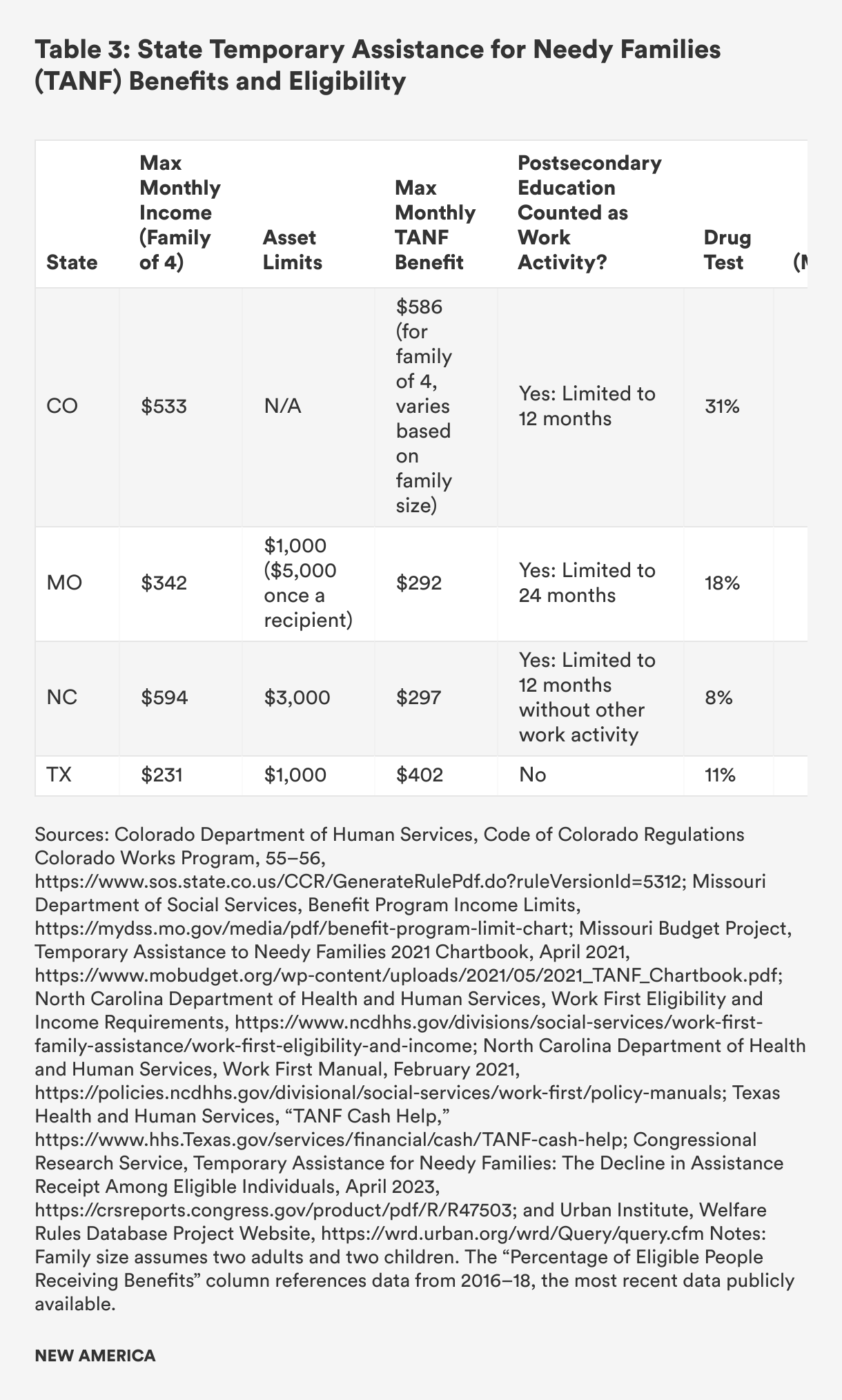
Allowable uses of TANF funds are broadly defined, and as a result, states have used them for a variety of purposes, including funding financial aid programs.47 Federal law requires only that TANF cash assistance funds are provided to “needy” families, but does not define what needy means. As a result, states are free to set their own eligibility rules. States tend to set income thresholds well below the federal poverty guidelines. For example, Texas’s threshold is set so low that working 32 hours a month at the federal minimum wage would disqualify someone with a family of four from support, as shown in Table 3. Texas spends only a tiny fraction of its total TANF dollars on basic assistance—just 4 percent in 2021, for example.48
There are various activities that TANF recipients must engage in to remain eligible for the benefits. The greatest barrier to TANF access for students is that education and training rarely count as a full-time activity, often needing to be combined with another 20 or more hours of a “core activity” such as employment.49 The Center for Law and Social Policy has shown that many states will not permit work requirements to be met with anything other than short-term education and training programs and frequently assign participants to job search classes even if they are enrolled in college.50
Frustrations about work requirements were evident in our focus groups, during which multiple participants noted not being able to get help while trying to complete programs lasting longer than one year. Many participants also felt there was constant tension between going to college and accessing public benefits. It was not that the two were mutually exclusive, but going to college made it harder to access certain benefits. And several noted that they would start working and immediately see their benefits cut. “They make you look for a job while you apply for [benefits] and as soon as you get a job, they cut [them],” a Missouri student parent said.51
Asset limits also present challenges for students accessing support from TANF, as well as other benefits programs like SNAP. Missouri and Texas both have asset limits of $1,000 for TANF cash assistance eligibility, and North Carolina’s asset limit is $3,000. Colorado has no asset limit. Low asset limits make it hard for people to build a financial cushion to help with emergency expenses and could discourage students from applying for public benefits.
Financial aid is generally paid out in lump sums at the start of every semester. If students receive more aid than their tuition and fees, that money is refunded to them to help pay for housing, food, books, and other expenses. Students can therefore have several thousand dollars in their bank accounts at the start of the semester, a time when they may also be seeking support from public benefits. State manuals generally require benefits administrators to disregard funds from financial aid or loans when calculating an applicant's assets, but what is broadly advertised is the top-line asset limit. Knowing what is and is not counted requires a level of technical knowledge that most students do not possess.
Medicaid and CHIP
Whether or not one is a student does not have an impact on Medicaid eligibility, making this the most straightforward program for students to access.52 In FY 2021, the Medicaid program received $728 billion, with 69 percent of those funds coming from the federal government and the rest from states.53
Three of our states (Colorado, Missouri, and North Carolina) expanded Medicaid access as part of the Affordable Care Act (ACA), although Missouri only did so in 2021, and North Carolina Governor Roy Cooper signed legislation in 2023 to begin the expansion process.54 As shown in Table 4, Texas currently has no plans to do so. In states that have expanded Medicaid, citizens and some immigrants are eligible for Medicaid coverage as long as their income is at or below 138 percent of the federal poverty guidelines. People with incomes above 100 percent of the guidelines are eligible to purchase subsidized coverage under the exchanges.55 Children, pregnant people, and parents may be eligible for coverage under Medicaid or CHIP at higher income levels, depending on state policies.
Health insurance coverage for students and their children can help mitigate the risk of high medical bills derailing a student’s education, and Medicaid expansion has increased the share of students enrolled in Medicaid by five percentage points.56 Eligibility in states that have not expanded Medicaid is complicated. For example, pregnant people in Texas are Medicaid-eligible at income levels up to 207 percent of the federal poverty guidelines.57 However, once they have given birth, the eligibility threshold drops to 16 percent. In 2023, this means that a family of three must have an income below $4,000 a year to qualify for Medicaid. Parents also lose coverage at incomes well below the threshold for receiving ACA subsidies, and childless adults are generally not eligible for Medicaid at all. These people fall into the coverage gap and are frequently uninsured. Different limits for pregnant people, parents, and children likely only add to the confusion around an already complex program.
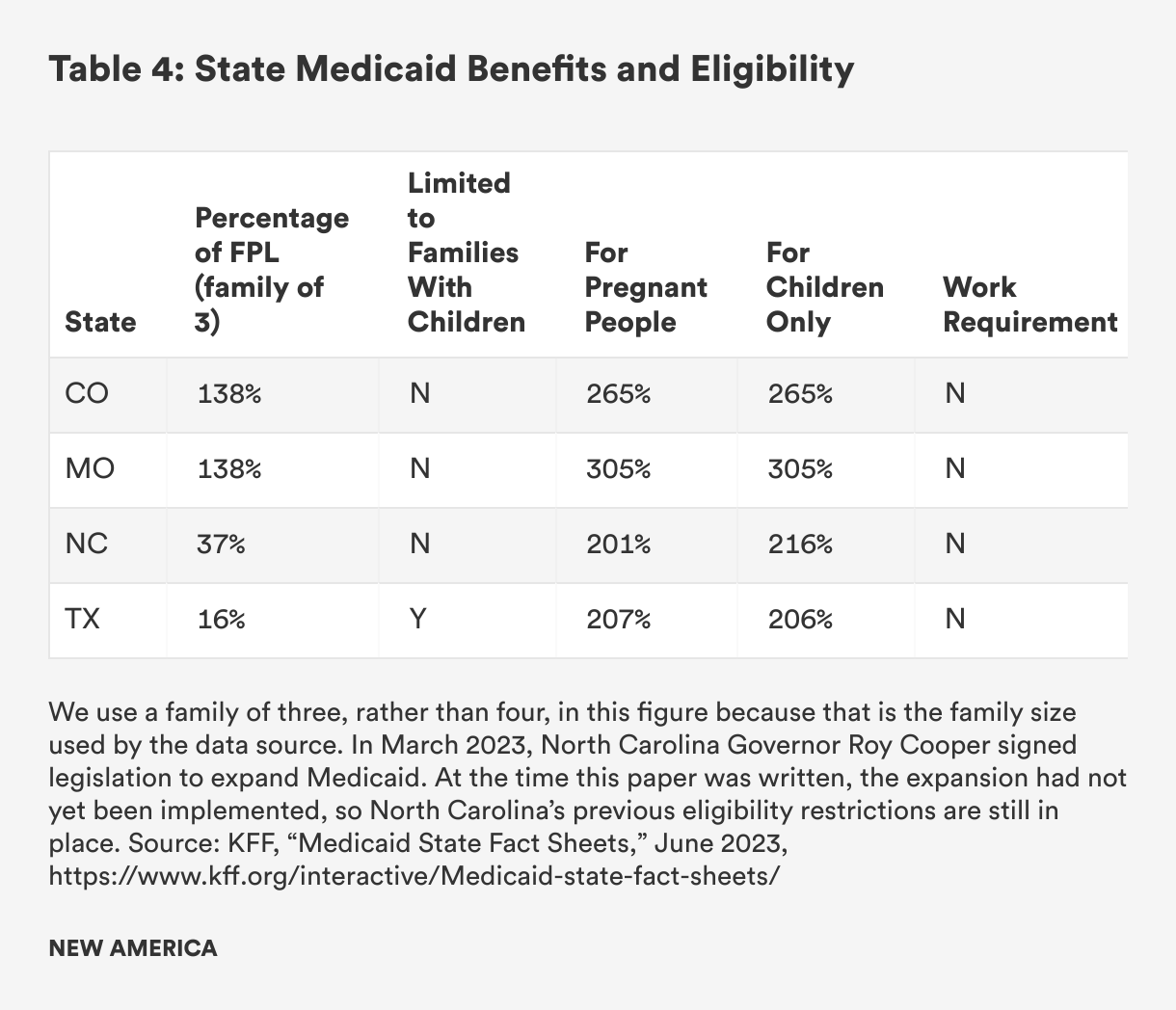
CHIP provides health insurance for families with low and moderate incomes and can act as a vital source of support for student parents who are either not working or do not have affordable health insurance provided by their employer. CHIP uses the federal poverty guidelines to determine eligibility, but some states use different eligibility thresholds, depending on the age of the children. Additionally, states have the option to cover children through their Medicaid program, through a separate CHIP program, or by using a combined approach. All four of the states we analyzed use a combined approach, as shown in Table 5. Premiums are determined using a sliding scale that increases with family income but cannot exceed 5 percent of family income.
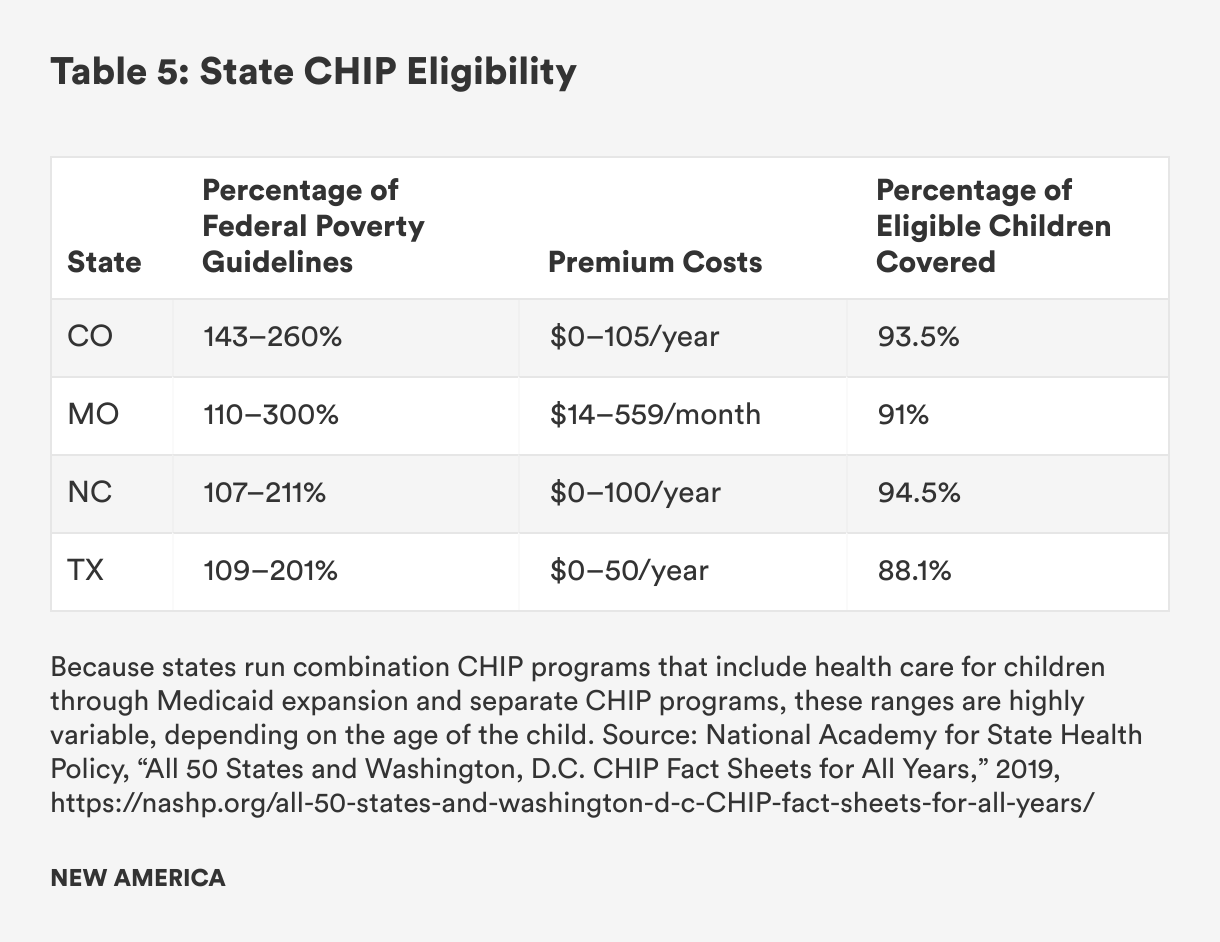
Child care subsidies through the Child Care and Development Block Grant (CCDBG)
The CCDBG provides funding to states that is used to subsidize child care for families with low incomes. States can also use TANF dollars to support CCDBG. States have a great deal of flexibility in how they prioritize who to support with CCDBG funds, with different rules for students depending on the state in which they reside, as shown in Table 6. Most of the assistance tends to be focused on working families.
Because states have so much flexibility, eligibility for child care subsidies varies widely by state. For example, in Texas, families with annual incomes that do not exceed 250 percent of the federal poverty guidelines—or approximately $75,000 for a family of four in 2023—are eligible.58 However, even high-income limits do not translate into broad access to child care subsidies in states and nationwide, primarily because of a lack of funding. In fact, nationally, there are almost nine million children eligible for subsidies under state rules (which tend to be more restrictive than federal rules), but in 2017 only 1.9 million children actually received subsidized child care.59 The percentage of eligible children receiving subsidies varies across our four states. But as of 2016, even in Missouri, which has the highest percentage of eligible children receiving benefits among the states we examined, fewer than 24 percent are receiving subsidies. In Texas, fewer than 8 percent are receiving subsidies.
During the pandemic, it became increasingly clear that our child care system is broken, and access to affordable and high-quality child care is limited for many people.60 This disconnect between demand and funding makes it challenging for student parents to access the reliable, subsidized care that is vital for them to successfully enroll in and complete a higher education credential.
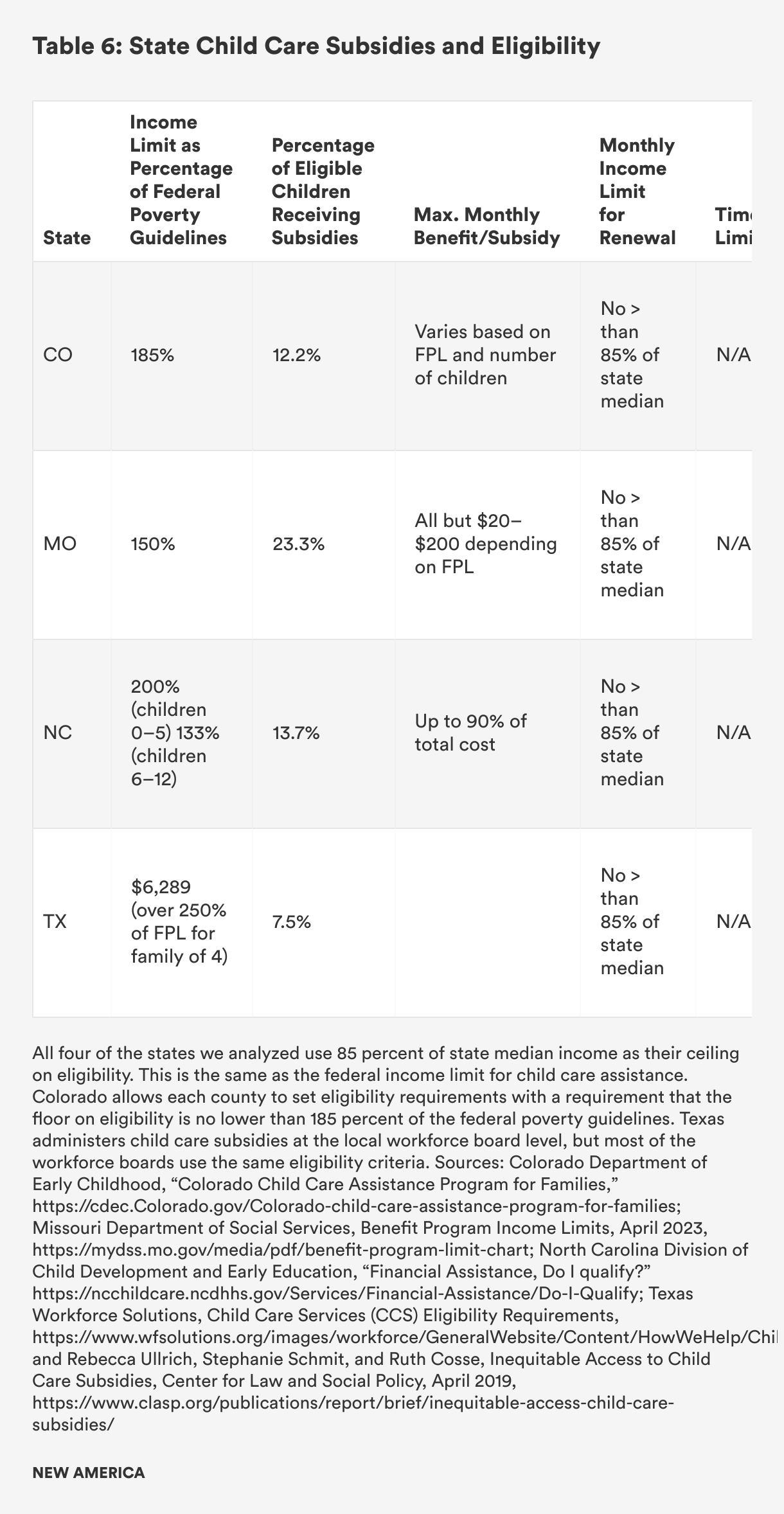
Citations
- Authors’ calculations using the 2020 National Postsecondary Student Aid Study, Undergraduate (NPSAS:UG).
- For example, Sarah Pingel and Neal Holly, Seeking Support: State Financial Aid Programs and Adult Students, Education Commission of the States, October 2017, https://www.ecs.org/seeking-support-state-financial-aid-programs-and-adult-students/; Wayne Taliaferro and Amy Ellen Duke-Benfield, Redesigning State Financial Aid to Better Serve Nontraditional Adult Students, Center for Law and Social Policy, September 2016, https://www.clasp.org/sites/default/files/public/resources-and-publications/publication-1/Redesigning-State-Financial-Aid-to-Better-Serve-Nontraditional-Adult-Students.pdf; Sarah Pingel, Brian A. Sponsler, and Neal Holly, Redesigning State Financial Aid: Principles to Guide State Aid Policymaking, Education Commission of the States, August 2018, https://www.ecs.org/wp-content/uploads/Redesigning-State-FInancial-Aid.pdf; Sandy Baum, Kristin Blagg, Leonardo Restrepo, and Fanny Terrones, Race, Ethnicity, and the Design of State Grant Aid Programs, Urban Institute, January 26, 2023, https://www.urban.org/research/publication/race-ethnicity-and-design-state-grant-aid-programs; Wesley Jenkins, College Students’ Siloed Safety Net, Urban Institute, May 13, 2020, https://www.urban.org/features/college-students-siloed-safety-net; and Lauren Walizer, State Strategies for Addressing College Students' Basic Needs, Center for Law and Social Policy, January 15, 2020, https://www.clasp.org/publications/report/brief/state-strategies-addressing-college-students-basic-needs/.
- See Tuan D. Nguyen, Jenna W. Kramer, and Brent J. Evans, "The Effects of Grant Aid on Student Persistence and Degree Attainment: A Systematic Review and Meta-Analysis of the Causal Evidence," Review of Educational Research 89, no. 6 (2019), https://doi.org/10.3102/0034654319877156; and Karen Bussey, Kimberly Dancy, Alyse Gray Parker, Eleanor Eckerson Peters, and Mamie Voight, Realizing the Mission of Higher Education Through Equitable Admissions Policies, (Washington, DC: Institute for Higher Education Policy, June 2021), https://www.ihep.org/wp-content/uploads/2021/06/IHEP_JOYCE_full_report_final_web_614.pdf.
- Jennifer Ma and Matea Pender, Trends in College Pricing and Student Aid 2022, College Board, https://research.collegeboard.org/media/pdf/trends-in-college-pricing-student-aid-2022.pdf. Federal financial aid also includes tax benefits, work study, veterans’ benefits, and Federal Supplemental Educational Opportunity Grants (FSEOG). In this paper, we use aid data from 2018, where possible, to match the NPSAS:18-AC data.
- National Association of State Student Grant and Aid Programs, 49th Annual Survey Report on State-Sponsored Student Financial Aid: 2017–2018 Academic Year, https://www.nassgapsurvey.com/survey_reports/2017-2018-49th.pdf.
- National Association of State Student Grant and Aid Programs.
- In addition, although not examined in this paper, families may have access to housing subsidies, mostly designed and distributed at the local level, and tax credits, such as the Earned Income Tax Credit (EITC) and Child Tax Credit (CTC), which are distributed at the federal level. (Some states and localities have established their own versions of the EITC to complement the federal credit, and a host of states have their own child or dependent-related tax credits.) See Amy Ellen Duke-Benfield, Bolstering Non-Traditional Student Success: A Comprehensive Student Aid System Using Financial Aid, Public Benefits, and Refundable Tax Credits, Center for Law and Social Policy, December 2015, https://www.clasp.org/sites/default/files/public/resources-and-publications/publication-1/Bolstering-NonTraditional-Student-Success.pdf.
- Congressional Research Service, The Temporary Assistance for Needy Families (TANF) Block Grant: A Primer on TANF Financing and Federal Requirements, August 14, 2023, https://crsreports.congress.gov/product/pdf/RL/RL32748 and Congressional Research Service, The Child Care and Development Block Grant: In Brief, November 18, 2022, https://crsreports.congress.gov/product/pdf/R/R47312.
- Congressional Research Service, Farm Bill Primer: SNAP and Nutrition Title Programs, November 18, 2022, https://crsreports.congress.gov/product/pdf/IF/IF12255 and Congressional Research Service, Medicaid: An Overview, February 8, 2023, https://crsreports.congress.gov/product/pdf/R/R43357.
- Congressional Research Service, Federal Financing for the State Children’s Health Insurance Program (CHIP), May 23, 2018, https://crsreports.congress.gov/product/pdf/R/R43949.
- Office of Federal Student Aid, “What is my Expected Family Contribution (EFC)?,” U.S. Department of Education, https://studentaid.gov/help-center/answers/article/what-is-efc; and Office of Federal Student Aid, “(GENERAL-22-91) Publication of the 2024-25 Draft Student Aid Index (SAI) and Pell Grant Eligibility Guide,” U.S. Department of Education, https://fsapartners.ed.gov/knowledge-center/library/electronic-announcements/2022-11-21/publication-2024-25-draft-student-aid-index-sai-and-pell-grant-eligibility-guide. FAFSA is the federal form that students have to complete to be considered for federal financial aid. The information students provide on FAFSA is used to determine a student’s EFC. States, as well as colleges and universities use the information from the form to determine eligibility for their own financial aid dollars. In the coming years, the student aid index (SAI) will replace the EFC.
- Fewer than 8 percent of students under 24 are parents in each state. And more than 85 percent of student parents are over the age of 24 across all states and sectors. Throughout the analysis, patterns did not change when we added in the younger student parents.
- Here and throughout this report, we use Hispanic instead of Latino/a/x to match the data source analyzed.
- The difference between older and younger students are likely due, at least in part, because all students over 24 are counted as independent, which means their EFCs are based upon their own resources, not those of parents or guardians. In addition, having dependents generally lowers your EFC to reflect the additional resources required to raise children or support others. Many students under age 24, on the other hand, are considered dependent, and as a result, their EFCs reflect a combination of their own and their parents’ resources. Older students without dependents may also have slightly higher median EFCs because they are not eligible to receive an automatic $0 EFC. Automatic $0 EFC is available to specific groups of students who have an income of $27,000 or less. Eligibility also depends on factors like receiving benefits from certain federal programs, specific tax filing conditions, and the student's dependency status. For more detail and a definition of independent and dependent students, see Office of Federal Student Aid, “The EFC Formula, 2022–2023,” U.S. Department of Education, August 2021, https://fsapartners.ed.gov/sites/default/files/2021-08/2223EFCFormulaGuide.pdf.
- See Naomi Harris, “How Popular Merit College Scholarships have Perpetuated Racial Inequities,” Washington Post, May 7, 2022, https://www.washingtonpost.com/education/2022/05/07/merit-scholarships-college-racial-inequities/ and Stephen Burd, Crisis Point: How Enrollment Management and the Merit-Aid Arms Race Are Derailing Public Higher Education (Washington, DC: New America, February 13, 2020), https://www.newamerica.org/education-policy/reports/crisis-point-how-enrollment-management-and-merit-aid-arms-race-are-destroying-public-higher-education/.
- We defined a major program as one in which the funding was at least $1 million and that was not limited by one area of study, like STEM or teaching, or to a highly specific population, like children of service members or law enforcement officers. Using these criteria we examined the requirements for the following programs, including the source of the funding, how much is spent, and the number of recipients.
- The Colorado Merit-Based Grant has not been funded since 2020.
- For example, see Iris Palmer, “Degrees Denied: Adults Left out of State Financial Aid Programs,” EdCentral (blog), New America, August 4, 2015, https://www.newamerica.org/education-policy/edcentral/adults-state-financial-aid/.
- See Taliaferro and Duke-Benfield, Redesigning State Financial Aid; and CampusLogic, Timing is Everything: FAFSA Filing Trends, 2019.
- Pingel, Sponsler, and Holly, Redesigning State Financial Aid.
- For complete program rules, see North Carolina State Education Assistance Authority, “Rules Governing the North Carolina Need-Based Scholarship for Public Colleges and Universities,” 2023, https://www.ncseaa.edu/wp-content/uploads/sites/1171/2023/04/Rules-Governing-the-North-Carolina-Need-Based-Scholarship-for-Public-Colleges-and-Universities-effective-4-3-2023-Signed-and-Sealed.pdf.
- Sandy Baum, Improving the Targeting, Predictability, and Simplicity of North Carolina’s State Grant Programs, NC Community Colleges and the University of North Carolina System, December 2018, https://www.northcarolina.edu/wp-content/uploads/reports-and-documents/strategy-and-policy/sasg_baum_policybrief_012919.pdf.
- College Foundation of North Carolina, “NC Scholarship,” 2023, https://www.cfnc.org/pay-for-college/apply-for-financial-aid/nc-scholarship/.
- Sandy Baum and Kristin Blagg, Strengthening Student Aid in Texas: Funding Students atDifferent Types of Institutions, Urban Institute, September 2021, https://www.urban.org/sites/default/files/publication/104841/strengthening-student-aid-in-texas-funding-students-at-different-types-of-institutions_0.pdf.
- Independent students are most often classified as such due to being married, having dependent children, or being 24 or older. For analysis of TEOG recipients, see Texas Higher Education Coordinating Board, Report on Student Financial Aid in Texas Higher Education: Fiscal Year 2018, 2019, https://reportcenter.highered.texas.gov/reports/data/report-on-student-financial-aid-in-texas-higher-education-for-fy-2018/.
- For a discussion of program eligibility requirements and implications for the adult learner, see Sandy Baum and Kristin Blagg, A Review of State Grant Aid in Texas, Urban Institute, 2021 https://www.urban.org/sites/default/files/publication/104281/a-review-of-state-grant-aid-in-texas_0.pdf.
- Office of Federal Student Aid, “Student Loan Delinquency and Default,” U.S. Department of Education, https://studentaid.gov/manage-loans/default. In addition to the other reasons mentioned in this section, if students are in default on a federal student loan, they are ineligible for federal aid.
- Office of Federal Student Aid, “What is the Lifetime Eligibility Used (LEU) for a Pell Grant?” U.S. Department of Education, https://studentaid.gov/help-center/answers/article/leu-for-pell-grant. Students may receive a total of the equivalent of six years of Pell Grant funding.
- Office of Federal Student Aid, “Staying Eligible,” U.S. Department of Education, https://studentaid.gov/understand-aid/eligibility/staying-eligible. Federal satisfactory academic progress rules require students to meet their institution's academic standards to maintain eligibility for federal financial aid. Variation exists, but most institutions require a minimum 2.0 GPA and completing 67 percent of credits attempted.
- See U.S. Government Accountability Office December, Food Insecurity: Better Information Could Help Eligible College Students Access Federal Food Assistance Benefits, December 2018, https://www.gao.gov/assets/gao-19-95.pdf; and Bryce McKibben, Jiayao Wu, and Sara Abelson, New Federal Data Confirm that College Students Face Significant—and Unacceptable—Basic Needs Insecurity, The Hope Center For College, Community, and Justice, August 2023, https://hope.temple.edu/npsas.
- Program criteria are from 2022–23 unless otherwise noted.
- U.S. Government Accountability Office December, Food Insecurity.
- Lindsay Daugherty, William R. Johnston, and Tiffany Berglund, Connecting College Students to Alternative Sources of Support: The Single Stop Community College Initiative and Postsecondary Outcomes (Santa Monica, CA: RAND Corporation, 2020), https://www.rand.org/pubs/research_reports/RR1740-1.html.
- Office of Federal Student Aid, “Use of FAFSA Data to Administer Federal Programs,” U.S. Department of Education, January 20, 2022, https://fsapartners.ed.gov/knowledge-center/library/dear-colleague-letters/2022-01-20/use-FAFSA-data-administer-federal-programs.
- Center on Budget and Policy Priorities, Policy Basics: The Supplemental Nutrition Assistance Program, June 2022, https://www.cbpp.org/research/food-assistance/the-supplemental-nutrition-assistance-program-snap.
- Office of the Assistant Secretary for Planning and Evaluation, HHS Poverty Guidelines for 2023, U.S. Department of Health and Human Services, https://aspe.hhs.gov/topics/poverty-economic-mobility/poverty-guidelines.
- Food and Nutrition Service, Broad-Based Categorical Eligibility, U.S. Department of Agriculture, July 2023, https://www.fns.usda.gov/snap/broad-based-categorical-eligibility and Center for Law and Social Policy, Broad-Based Categorical Eligibility (BBCE) is Not a SNAP Loophole, 2019, https://www.clasp.org/sites/default/files/publications/2019/08/2019_bbceisnotaloophole.pdf. Broad-based categorical eligibility is a policy where households can be considered eligible for SNAP because they qualify for some form of non-cash-based assistance from the TANF program.
- Center on Budget and Policy Priorities, Policy Basics: The Supplemental Nutrition Assistance Program.
- Center on Budget and Policy Priorities, Tracking the COVID-19 Economy’s Effects on Food, Housing, and Employment Hardships, October 2021, https://www.cbpp.org/research/poverty-and-inequality/tracking-the-covid-19-economys-effects-on-food-housing-and.
- In states that have expanded Medicaid coverage as part of the ACA, Medicaid may be easier to access, but not all of the states we consider here have done so.
- Carrie Welton and Darrel Thompson, SNAP and Students: Food Assistance Can Support College Success, Center for Law and Social Policy, December 2019, https://www.clasp.org/wp-content/uploads/2022/01/2019_snapandstudentsfoodassistance.pdf and Food and Nutrition Service (website), FAQ: “What are the Student Exemptions for SNAP?” U.S. Department of Agriculture, https://www.fns.usda.gov/snap/students.
- As a result of the 2023 Debt Ceiling Agreement the upper age limit is incrementally increasing to 54. Katie Bergh and Dottie Rosenbaum, Debt Ceiling Agreement’s SNAP Changes Would Increase Hunger and Poverty for Many Older Low-Income People; New Exemptions Would Help Some Others, Center on Budget and Policy Priorities, May 2023, https://www.cbpp.org/research/food-assistance/debt-ceiling-agreements-snap-changes-would-increase-hunger-and-poverty-for.
- Center on Budget and Policy Priorities, States Are Using Much-Needed Temporary Flexibility in SNAP to Respond to COVID-19 Challenges, January 25, 2023, https://www.cbpp.org/research/food-assistance/states-are-using-much-needed-temporary-flexibility-in-snap-to-respond-to and Food and Nutrition Service; “SNAP Student Provisions in the CAA 2021-Questions and Answers,” U.S. Department of Agriculture, February 2021, https://fns-prod.azureedge.us/sites/default/files/resource-files/SNAP%20Student%20Provisions%20in%20the%20CAA%202021_Questions%20and%20Answers.pdf.
- Dorothy Rosenbaum, Katie Bergh, and Lauren Hall, Temporary Pandemic SNAP Benefits Will End in Remaining 35 States in March 2023, Center on Budget and Policy Priorities, February 6, 2023, https://www.cbpp.org/sites/default/files/2-6-23fa.pdf.
- Center on Budget and Policy Priorities, Policy Basics: Temporary Assistance for Needy Families, March 2022, https://www.cbpp.org/research/family-income-support/temporary-assistance-for-needy-families.
- Center on Budget and Policy Priorities, Policy Basics: Temporary Assistance for Needy Families.
- Jenni Bergal, “States Raid Fund Meant for Needy Families to Pay for Other Programs,” Stateline, July 24, 2020, https://stateline.org/2020/07/24/states-raid-fund-meant-for-needy-families-to-pay-for-other-programs/.
- Center on Budget and Policy Priorities, Texas TANF Spending, March 2023, https://www.cbpp.org/sites/default/files/atoms/files/tanf_spending_tx.pdf.
- Center on Budget and Policy Priorities, Policy Basics: Temporary Assistance for Needy Families, March 2022.
- Randi Hall, Expanding Education and Training Opportunities Under TANF: A Path to Stable Employment in Today’s Economy, Center for Law and Social Policy, July 2016, https://www.clasp.org/wp-content/uploads/2022/04/07.201620Expanding20Education20and20Training20Opportunities20under20TANF.pdf.
- SNAP benefits can be provided on an electronic benefits transfer (EBT) card.
- Amy Ellen Duke-Benfield, Exploring How Public Benefits Can Help Support Postsecondary Students From Low-income Backgrounds, National Skills Coalition, Postsecondary Value Commission, 2021, https://postsecondaryvalue.org/wp-content/uploads/2021/10/PVC_DukeBenfield.pdf.
- Elizabeth Williams, Robin Rudowitz, and Alice Burns, Medicaid Financing: The Basics, KFF, April 2023, https://www.kff.org/medicaid/issue-brief/medicaid-financing-the-basics/.
- KFF, Status of State Medicaid Expansion Decisions: Interactive Map, July 2023, https://www.kff.org/medicaid/issue-brief/status-of-state-medicaid-expansion-decisions-interactive-map/.
- Congressional Research Service, Overview of Health insurance Exchanges, March 2023, https://sgp.fas.org/crs/misc/R44065.pdf. Under the ACA, subsidized coverage can be purchased through state or federally run health insurance exchanges that operate as a marketplace for individuals and small businesses.
- Jen Mishory, Olivia Chan, and Peter Granville, The ACA’s Impact on College Students, The Century Foundation, July 2020, https://tcf.org/content/report/the-acas-impact-on-college-students/.
- KFF, Medicaid in Texas, June 2023 https://files.kff.org/attachment/fact-sheet-medicaid-state-TX; KFF, Medicaid in Missouri, June 2023, https://files.kff.org/attachment/fact-sheet-medicaid-state-MO; KFF, Medicaid in North Carolina, June 2023, https://files.kff.org/attachment/fact-sheet-medicaid-state-NC; and KFF, Medicaid in Colorado, June 2023, https://files.kff.org/attachment/fact-sheet-medicaid-state-CO.
- Office of the Assistant Secretary for Planning and Evaluation, HHS Poverty Guidelines for 2023.
- Government Accountability Office, Child Care: Subsidy Eligibility and Receipt, and Wait Lists, February 2021, https://www.gao.gov/products/gao-21-245r.
- See Roselyn Miller and Jahdziah St. Julien, A Bold Policy Agenda for Work-Family Justice and Gender Equity During COVID-19 and Beyond (Washington, DC: New America, December 2020), https://www.newamerica.org/better-life-lab/reports/bold-policy-agenda-work-family-justice-and-gender-equity-during-covid-19-and-beyond/.
How Each State Uses Safety Net Programs to Supports Students
The pressure associated with being a student who is older or parenting is profound. And our support structures in this country are flawed. But state policy makes a difference. In this section, we explore how each state treats older, parenting students by looking at the policies they set for their safety net programs, as described throughout this paper.
Colorado
Similar to its approach to financial aid, Colorado does a good job compared to some of the other states in our sample of using public benefits-related policy and the eligibility criteria at its disposal to support students. Colorado runs its SNAP program in a way that allows for student access. It uses broad-based categorical eligibility to set its income limit at 200 percent of the federal poverty guidelines, allows eligibility for students receiving state or Federal Work-Study, and does not impose asset limits.
The state is slightly less generous in how it runs its TANF program. On the positive side, Colorado has one of the higher income limits, does not have an asset limit, and has the most generous monthly benefit of our sample states. It also has a high percentage of eligible people receiving benefits, does not require a drug test, and allows recipients to access benefits for 60 months—the federal maximum. But while it does allow attending college to count as a work activity, students can only attend a program for 12 months, a very short time to be able to achieve a credential that will help them get a job with a family-sustaining income.
Colorado has expanded Medicaid, meaning eligible residents with incomes up to 138 percent of the federal poverty level are covered, with increased eligibility for children and pregnant people; its state CHIP eligibility is also on the generous side; and it has a generous income limit for child care subsidies, although only 12 percent of eligible children receive the benefit.
Missouri
Missouri makes it difficult for older students and student parents to access state financial aid and access public support as they go to college. Missouri is the least generous on SNAP eligibility of any of the four states we examined. It is the only state in our sample that does not use broad-based categorical eligibility. It also has the lowest monthly income allowed and the lowest percent of poverty cut-off, meaning that a family must have an extremely low income to qualify. It also has an asset limit of $2,750, so a family can own very little and still be ineligible.
For TANF, Missouri is also less generous than other states in our sample. The maximum monthly family income to be eligible for benefits is an extremely limited $342 for a family of four, with an asset limit of $1,000. And the monthly benefit is the lowest of our group, at $292. The state also requires drug testing and limits eligibility for TANF to only 45 months. On the positive side, Missouri allows students to be eligible for the longest of any of our states, 24 months. That means that a student could earn an associate degree while receiving support from the program.
Missouri expanded Medicaid and also has the most generous eligibility for children and pregnant people in our sample. The state also has generous CHIP eligibility for children, but the premiums are very high, reaching up to $559 a month. For child care subsidies, Missouri has the lowest income threshold for eligibility but it covers the highest percentage of the eligible population of any of the states we examined.
North Carolina
North Carolina has a mixed picture for older or parenting students trying to access financial aid. Its approach to public benefits is also mixed. In SNAP, the state provides a high maximum monthly income cap, at 200 percent of the federal poverty guidelines, but it also has a lower asset limit, of $2,750.
For TANF, the Tar Heel State has the highest monthly income eligibility of any of the states we looked at, $594. It also has a time limit of 60 months. While it does have an asset limit, it is high, at $3,000. The state allows education as a qualifying work activity, but only for 12 months. However, the monthly benefits are low, at only $297; the state requires a drug test for eligibility; and a mere 8 percent of eligible people receive the benefit, the worst among our sample states.
Although North Carolina is in the process of expanding Medicaid, the expansion has yet to go into effect. Eligibility is set at only 37 percent of the federal poverty level; the threshold will increase to 138 percent once the expansion takes effect. Eligibility for pregnant people and children is also not particularly generous, at 201 and 216 percent of poverty, respectively. For CHIP, eligibility is on the low end of our sample states but a high 95 percent of eligible children are covered, with a low premium of $100 a year. For child care subsidies, North Carolina has a high income threshold for families with younger children, but only 14 percent of eligible children receive grants.
Texas
Texas makes it difficult for older and parenting students, especially those with high financial need and who attend community college, to access financial aid. These populations also struggle to access public benefits in the Lone Star State. Texas is only slightly better than Missouri in terms of eligibility for SNAP benefits. The monthly income cap is about $800 higher than Missouri but below North Carolina and Colorado. The percent of poverty guideline is also lower than in North Carolina or Colorado but higher than in Missouri. The asset limit is also higher than in North Carolina and Missouri.
Texas’s TANF program is hard to access. A family of four can only make $231 a month and have an asset value of $1,000. The monthly benefit is higher than in North Carolina and Missouri, but postsecondary education does not count as a work activity. Only 11 percent of eligible people actually receive the benefit.
Texas is the only state in our group that has not expanded Medicaid. This means that adults in Texas are only eligible for Medicaid if they make at or below 16 percent of the federal poverty level and have children, by far the strictest eligibility of the group. Texas also has less generous eligibility requirements for children and pregnant people. For CHIP, the eligibility requirements are similar to those in North Carolina and the premiums are low. However, Texas also has the lowest percentage of eligible children covered in the states we looked at. Texas has generous eligibility for child care benefits, but only 8 percent of eligible children receive them, the smallest share of any of our states.
Citations
- Authors’ calculations using the 2020 National Postsecondary Student Aid Study, Undergraduate (NPSAS:UG).
- For example, Sarah Pingel and Neal Holly, Seeking Support: State Financial Aid Programs and Adult Students, Education Commission of the States, October 2017, https://www.ecs.org/seeking-support-state-financial-aid-programs-and-adult-students/; Wayne Taliaferro and Amy Ellen Duke-Benfield, Redesigning State Financial Aid to Better Serve Nontraditional Adult Students, Center for Law and Social Policy, September 2016, https://www.clasp.org/sites/default/files/public/resources-and-publications/publication-1/Redesigning-State-Financial-Aid-to-Better-Serve-Nontraditional-Adult-Students.pdf; Sarah Pingel, Brian A. Sponsler, and Neal Holly, Redesigning State Financial Aid: Principles to Guide State Aid Policymaking, Education Commission of the States, August 2018, https://www.ecs.org/wp-content/uploads/Redesigning-State-FInancial-Aid.pdf; Sandy Baum, Kristin Blagg, Leonardo Restrepo, and Fanny Terrones, Race, Ethnicity, and the Design of State Grant Aid Programs, Urban Institute, January 26, 2023, https://www.urban.org/research/publication/race-ethnicity-and-design-state-grant-aid-programs; Wesley Jenkins, College Students’ Siloed Safety Net, Urban Institute, May 13, 2020, https://www.urban.org/features/college-students-siloed-safety-net; and Lauren Walizer, State Strategies for Addressing College Students' Basic Needs, Center for Law and Social Policy, January 15, 2020, https://www.clasp.org/publications/report/brief/state-strategies-addressing-college-students-basic-needs/.
- See Tuan D. Nguyen, Jenna W. Kramer, and Brent J. Evans, "The Effects of Grant Aid on Student Persistence and Degree Attainment: A Systematic Review and Meta-Analysis of the Causal Evidence," Review of Educational Research 89, no. 6 (2019), https://doi.org/10.3102/0034654319877156; and Karen Bussey, Kimberly Dancy, Alyse Gray Parker, Eleanor Eckerson Peters, and Mamie Voight, Realizing the Mission of Higher Education Through Equitable Admissions Policies, (Washington, DC: Institute for Higher Education Policy, June 2021), https://www.ihep.org/wp-content/uploads/2021/06/IHEP_JOYCE_full_report_final_web_614.pdf.
- Jennifer Ma and Matea Pender, Trends in College Pricing and Student Aid 2022, College Board, https://research.collegeboard.org/media/pdf/trends-in-college-pricing-student-aid-2022.pdf. Federal financial aid also includes tax benefits, work study, veterans’ benefits, and Federal Supplemental Educational Opportunity Grants (FSEOG). In this paper, we use aid data from 2018, where possible, to match the NPSAS:18-AC data.
- National Association of State Student Grant and Aid Programs, 49th Annual Survey Report on State-Sponsored Student Financial Aid: 2017–2018 Academic Year, https://www.nassgapsurvey.com/survey_reports/2017-2018-49th.pdf.
- National Association of State Student Grant and Aid Programs.
- In addition, although not examined in this paper, families may have access to housing subsidies, mostly designed and distributed at the local level, and tax credits, such as the Earned Income Tax Credit (EITC) and Child Tax Credit (CTC), which are distributed at the federal level. (Some states and localities have established their own versions of the EITC to complement the federal credit, and a host of states have their own child or dependent-related tax credits.) See Amy Ellen Duke-Benfield, Bolstering Non-Traditional Student Success: A Comprehensive Student Aid System Using Financial Aid, Public Benefits, and Refundable Tax Credits, Center for Law and Social Policy, December 2015, https://www.clasp.org/sites/default/files/public/resources-and-publications/publication-1/Bolstering-NonTraditional-Student-Success.pdf.
- Congressional Research Service, The Temporary Assistance for Needy Families (TANF) Block Grant: A Primer on TANF Financing and Federal Requirements, August 14, 2023, https://crsreports.congress.gov/product/pdf/RL/RL32748 and Congressional Research Service, The Child Care and Development Block Grant: In Brief, November 18, 2022, https://crsreports.congress.gov/product/pdf/R/R47312.
- Congressional Research Service, Farm Bill Primer: SNAP and Nutrition Title Programs, November 18, 2022, https://crsreports.congress.gov/product/pdf/IF/IF12255 and Congressional Research Service, Medicaid: An Overview, February 8, 2023, https://crsreports.congress.gov/product/pdf/R/R43357.
- Congressional Research Service, Federal Financing for the State Children’s Health Insurance Program (CHIP), May 23, 2018, https://crsreports.congress.gov/product/pdf/R/R43949.
- Office of Federal Student Aid, “What is my Expected Family Contribution (EFC)?,” U.S. Department of Education, https://studentaid.gov/help-center/answers/article/what-is-efc; and Office of Federal Student Aid, “(GENERAL-22-91) Publication of the 2024-25 Draft Student Aid Index (SAI) and Pell Grant Eligibility Guide,” U.S. Department of Education, https://fsapartners.ed.gov/knowledge-center/library/electronic-announcements/2022-11-21/publication-2024-25-draft-student-aid-index-sai-and-pell-grant-eligibility-guide. FAFSA is the federal form that students have to complete to be considered for federal financial aid. The information students provide on FAFSA is used to determine a student’s EFC. States, as well as colleges and universities use the information from the form to determine eligibility for their own financial aid dollars. In the coming years, the student aid index (SAI) will replace the EFC.
- Fewer than 8 percent of students under 24 are parents in each state. And more than 85 percent of student parents are over the age of 24 across all states and sectors. Throughout the analysis, patterns did not change when we added in the younger student parents.
- Here and throughout this report, we use Hispanic instead of Latino/a/x to match the data source analyzed.
- The difference between older and younger students are likely due, at least in part, because all students over 24 are counted as independent, which means their EFCs are based upon their own resources, not those of parents or guardians. In addition, having dependents generally lowers your EFC to reflect the additional resources required to raise children or support others. Many students under age 24, on the other hand, are considered dependent, and as a result, their EFCs reflect a combination of their own and their parents’ resources. Older students without dependents may also have slightly higher median EFCs because they are not eligible to receive an automatic $0 EFC. Automatic $0 EFC is available to specific groups of students who have an income of $27,000 or less. Eligibility also depends on factors like receiving benefits from certain federal programs, specific tax filing conditions, and the student's dependency status. For more detail and a definition of independent and dependent students, see Office of Federal Student Aid, “The EFC Formula, 2022–2023,” U.S. Department of Education, August 2021, https://fsapartners.ed.gov/sites/default/files/2021-08/2223EFCFormulaGuide.pdf.
- See Naomi Harris, “How Popular Merit College Scholarships have Perpetuated Racial Inequities,” Washington Post, May 7, 2022, https://www.washingtonpost.com/education/2022/05/07/merit-scholarships-college-racial-inequities/ and Stephen Burd, Crisis Point: How Enrollment Management and the Merit-Aid Arms Race Are Derailing Public Higher Education (Washington, DC: New America, February 13, 2020), https://www.newamerica.org/education-policy/reports/crisis-point-how-enrollment-management-and-merit-aid-arms-race-are-destroying-public-higher-education/.
- We defined a major program as one in which the funding was at least $1 million and that was not limited by one area of study, like STEM or teaching, or to a highly specific population, like children of service members or law enforcement officers. Using these criteria we examined the requirements for the following programs, including the source of the funding, how much is spent, and the number of recipients.
- The Colorado Merit-Based Grant has not been funded since 2020.
- For example, see Iris Palmer, “Degrees Denied: Adults Left out of State Financial Aid Programs,” EdCentral (blog), New America, August 4, 2015, https://www.newamerica.org/education-policy/edcentral/adults-state-financial-aid/.
- See Taliaferro and Duke-Benfield, Redesigning State Financial Aid; and CampusLogic, Timing is Everything: FAFSA Filing Trends, 2019.
- Pingel, Sponsler, and Holly, Redesigning State Financial Aid.
- For complete program rules, see North Carolina State Education Assistance Authority, “Rules Governing the North Carolina Need-Based Scholarship for Public Colleges and Universities,” 2023, https://www.ncseaa.edu/wp-content/uploads/sites/1171/2023/04/Rules-Governing-the-North-Carolina-Need-Based-Scholarship-for-Public-Colleges-and-Universities-effective-4-3-2023-Signed-and-Sealed.pdf.
- Sandy Baum, Improving the Targeting, Predictability, and Simplicity of North Carolina’s State Grant Programs, NC Community Colleges and the University of North Carolina System, December 2018, https://www.northcarolina.edu/wp-content/uploads/reports-and-documents/strategy-and-policy/sasg_baum_policybrief_012919.pdf.
- College Foundation of North Carolina, “NC Scholarship,” 2023, https://www.cfnc.org/pay-for-college/apply-for-financial-aid/nc-scholarship/.
- Sandy Baum and Kristin Blagg, Strengthening Student Aid in Texas: Funding Students atDifferent Types of Institutions, Urban Institute, September 2021, https://www.urban.org/sites/default/files/publication/104841/strengthening-student-aid-in-texas-funding-students-at-different-types-of-institutions_0.pdf.
- Independent students are most often classified as such due to being married, having dependent children, or being 24 or older. For analysis of TEOG recipients, see Texas Higher Education Coordinating Board, Report on Student Financial Aid in Texas Higher Education: Fiscal Year 2018, 2019, https://reportcenter.highered.texas.gov/reports/data/report-on-student-financial-aid-in-texas-higher-education-for-fy-2018/.
- For a discussion of program eligibility requirements and implications for the adult learner, see Sandy Baum and Kristin Blagg, A Review of State Grant Aid in Texas, Urban Institute, 2021 https://www.urban.org/sites/default/files/publication/104281/a-review-of-state-grant-aid-in-texas_0.pdf.
- Office of Federal Student Aid, “Student Loan Delinquency and Default,” U.S. Department of Education, https://studentaid.gov/manage-loans/default. In addition to the other reasons mentioned in this section, if students are in default on a federal student loan, they are ineligible for federal aid.
- Office of Federal Student Aid, “What is the Lifetime Eligibility Used (LEU) for a Pell Grant?” U.S. Department of Education, https://studentaid.gov/help-center/answers/article/leu-for-pell-grant. Students may receive a total of the equivalent of six years of Pell Grant funding.
- Office of Federal Student Aid, “Staying Eligible,” U.S. Department of Education, https://studentaid.gov/understand-aid/eligibility/staying-eligible. Federal satisfactory academic progress rules require students to meet their institution's academic standards to maintain eligibility for federal financial aid. Variation exists, but most institutions require a minimum 2.0 GPA and completing 67 percent of credits attempted.
- See U.S. Government Accountability Office December, Food Insecurity: Better Information Could Help Eligible College Students Access Federal Food Assistance Benefits, December 2018, https://www.gao.gov/assets/gao-19-95.pdf; and Bryce McKibben, Jiayao Wu, and Sara Abelson, New Federal Data Confirm that College Students Face Significant—and Unacceptable—Basic Needs Insecurity, The Hope Center For College, Community, and Justice, August 2023, https://hope.temple.edu/npsas.
- Program criteria are from 2022–23 unless otherwise noted.
- U.S. Government Accountability Office December, Food Insecurity.
- Lindsay Daugherty, William R. Johnston, and Tiffany Berglund, Connecting College Students to Alternative Sources of Support: The Single Stop Community College Initiative and Postsecondary Outcomes (Santa Monica, CA: RAND Corporation, 2020), https://www.rand.org/pubs/research_reports/RR1740-1.html.
- Office of Federal Student Aid, “Use of FAFSA Data to Administer Federal Programs,” U.S. Department of Education, January 20, 2022, https://fsapartners.ed.gov/knowledge-center/library/dear-colleague-letters/2022-01-20/use-FAFSA-data-administer-federal-programs.
- Center on Budget and Policy Priorities, Policy Basics: The Supplemental Nutrition Assistance Program, June 2022, https://www.cbpp.org/research/food-assistance/the-supplemental-nutrition-assistance-program-snap.
- Office of the Assistant Secretary for Planning and Evaluation, HHS Poverty Guidelines for 2023, U.S. Department of Health and Human Services, https://aspe.hhs.gov/topics/poverty-economic-mobility/poverty-guidelines.
- Food and Nutrition Service, Broad-Based Categorical Eligibility, U.S. Department of Agriculture, July 2023, https://www.fns.usda.gov/snap/broad-based-categorical-eligibility and Center for Law and Social Policy, Broad-Based Categorical Eligibility (BBCE) is Not a SNAP Loophole, 2019, https://www.clasp.org/sites/default/files/publications/2019/08/2019_bbceisnotaloophole.pdf. Broad-based categorical eligibility is a policy where households can be considered eligible for SNAP because they qualify for some form of non-cash-based assistance from the TANF program.
- Center on Budget and Policy Priorities, Policy Basics: The Supplemental Nutrition Assistance Program.
- Center on Budget and Policy Priorities, Tracking the COVID-19 Economy’s Effects on Food, Housing, and Employment Hardships, October 2021, https://www.cbpp.org/research/poverty-and-inequality/tracking-the-covid-19-economys-effects-on-food-housing-and.
- In states that have expanded Medicaid coverage as part of the ACA, Medicaid may be easier to access, but not all of the states we consider here have done so.
- Carrie Welton and Darrel Thompson, SNAP and Students: Food Assistance Can Support College Success, Center for Law and Social Policy, December 2019, https://www.clasp.org/wp-content/uploads/2022/01/2019_snapandstudentsfoodassistance.pdf and Food and Nutrition Service (website), FAQ: “What are the Student Exemptions for SNAP?” U.S. Department of Agriculture, https://www.fns.usda.gov/snap/students.
- As a result of the 2023 Debt Ceiling Agreement the upper age limit is incrementally increasing to 54. Katie Bergh and Dottie Rosenbaum, Debt Ceiling Agreement’s SNAP Changes Would Increase Hunger and Poverty for Many Older Low-Income People; New Exemptions Would Help Some Others, Center on Budget and Policy Priorities, May 2023, https://www.cbpp.org/research/food-assistance/debt-ceiling-agreements-snap-changes-would-increase-hunger-and-poverty-for.
- Center on Budget and Policy Priorities, States Are Using Much-Needed Temporary Flexibility in SNAP to Respond to COVID-19 Challenges, January 25, 2023, https://www.cbpp.org/research/food-assistance/states-are-using-much-needed-temporary-flexibility-in-snap-to-respond-to and Food and Nutrition Service; “SNAP Student Provisions in the CAA 2021-Questions and Answers,” U.S. Department of Agriculture, February 2021, https://fns-prod.azureedge.us/sites/default/files/resource-files/SNAP%20Student%20Provisions%20in%20the%20CAA%202021_Questions%20and%20Answers.pdf.
- Dorothy Rosenbaum, Katie Bergh, and Lauren Hall, Temporary Pandemic SNAP Benefits Will End in Remaining 35 States in March 2023, Center on Budget and Policy Priorities, February 6, 2023, https://www.cbpp.org/sites/default/files/2-6-23fa.pdf.
- Center on Budget and Policy Priorities, Policy Basics: Temporary Assistance for Needy Families, March 2022, https://www.cbpp.org/research/family-income-support/temporary-assistance-for-needy-families.
- Center on Budget and Policy Priorities, Policy Basics: Temporary Assistance for Needy Families.
- Jenni Bergal, “States Raid Fund Meant for Needy Families to Pay for Other Programs,” Stateline, July 24, 2020, https://stateline.org/2020/07/24/states-raid-fund-meant-for-needy-families-to-pay-for-other-programs/.
- Center on Budget and Policy Priorities, Texas TANF Spending, March 2023, https://www.cbpp.org/sites/default/files/atoms/files/tanf_spending_tx.pdf.
- Center on Budget and Policy Priorities, Policy Basics: Temporary Assistance for Needy Families, March 2022.
- Randi Hall, Expanding Education and Training Opportunities Under TANF: A Path to Stable Employment in Today’s Economy, Center for Law and Social Policy, July 2016, https://www.clasp.org/wp-content/uploads/2022/04/07.201620Expanding20Education20and20Training20Opportunities20under20TANF.pdf.
- SNAP benefits can be provided on an electronic benefits transfer (EBT) card.
- Amy Ellen Duke-Benfield, Exploring How Public Benefits Can Help Support Postsecondary Students From Low-income Backgrounds, National Skills Coalition, Postsecondary Value Commission, 2021, https://postsecondaryvalue.org/wp-content/uploads/2021/10/PVC_DukeBenfield.pdf.
- Elizabeth Williams, Robin Rudowitz, and Alice Burns, Medicaid Financing: The Basics, KFF, April 2023, https://www.kff.org/medicaid/issue-brief/medicaid-financing-the-basics/.
- KFF, Status of State Medicaid Expansion Decisions: Interactive Map, July 2023, https://www.kff.org/medicaid/issue-brief/status-of-state-medicaid-expansion-decisions-interactive-map/.
- Congressional Research Service, Overview of Health insurance Exchanges, March 2023, https://sgp.fas.org/crs/misc/R44065.pdf. Under the ACA, subsidized coverage can be purchased through state or federally run health insurance exchanges that operate as a marketplace for individuals and small businesses.
- Jen Mishory, Olivia Chan, and Peter Granville, The ACA’s Impact on College Students, The Century Foundation, July 2020, https://tcf.org/content/report/the-acas-impact-on-college-students/.
- KFF, Medicaid in Texas, June 2023 https://files.kff.org/attachment/fact-sheet-medicaid-state-TX; KFF, Medicaid in Missouri, June 2023, https://files.kff.org/attachment/fact-sheet-medicaid-state-MO; KFF, Medicaid in North Carolina, June 2023, https://files.kff.org/attachment/fact-sheet-medicaid-state-NC; and KFF, Medicaid in Colorado, June 2023, https://files.kff.org/attachment/fact-sheet-medicaid-state-CO.
- Office of the Assistant Secretary for Planning and Evaluation, HHS Poverty Guidelines for 2023.
- Government Accountability Office, Child Care: Subsidy Eligibility and Receipt, and Wait Lists, February 2021, https://www.gao.gov/products/gao-21-245r.
- See Roselyn Miller and Jahdziah St. Julien, A Bold Policy Agenda for Work-Family Justice and Gender Equity During COVID-19 and Beyond (Washington, DC: New America, December 2020), https://www.newamerica.org/better-life-lab/reports/bold-policy-agenda-work-family-justice-and-gender-equity-during-covid-19-and-beyond/.
Recommendations
We recommend the following ways for state policymakers to better support older and parenting students:
Adjust eligibility so they have the same access to grants as students leaving high school.
Revise grant aid eligibility to focus on need rather than merit-based criteria.
Few older students are able to access merit-based grants, designed to reward top high school students, because of requirements like reporting recent GPAs and college entrance exam scores. For many adults, these are impossible or difficult to obtain. To support older students and maximize the impact of grant dollars, states should focus grant aid on need-based programs and consider relaxing aid eligibility requirements tied to high school and merit-related criteria.
Allow students to access need-based aid regardless of time elapsed since high school.
Some states limit student eligibility for grant aid to a certain amount of time after high school graduation. States want to encourage reskilling and lifelong learning, and they should align their program requirements with that priority.
Provide grants for students enrolled less than full time and regardless of college sector.
Some state grant programs require or incentivize full-time enrollment. Although full-time enrollment is associated with better completion rates, states should consider providing aid to part-time students, given that most students 24 and over enroll part time at least some of the time. Older students with busy lives may struggle to attend full time; not providing them grant aid will only reduce their likelihood of completion.
Revise aid rules so grants to community college students can cover living expenses.
Some states provide smaller state grants to people attending community colleges than to those attending four-year colleges and universities. While this may make sense, given the higher cost of attendance at four-year schools, states should decrease this gap, because it means that adult students and student parents, who are more likely to attend two-year colleges, receive smaller grants. It also means that there is a financial penalty for attending a two-year college, when most of the financial burden students face at those schools is for living expenses, not tuition and fees.
Fully fund state grant programs.
Most state grant programs do not function as entitlements. Instead, there is a set amount of money allocated from the state, and when that money runs out, no further grants can be given that year. This first-come, first-served model results in the most advantaged students, who tend to apply for financial aid early, being more likely to receive a grant. States should consider what Washington State (among others) did and make their need-based aid programs a fully funded entitlement.61
Make grant aid first-dollar.
First-dollar grant aid is awarded to students before any other financial aid is taken into account. When state grants are the first aid applied to students’ balances, other aid, such as Pell Grants, can then be applied, with any remaining funds returned to students to use for living expenses. When state grants are deployed to close the gap between federal aid and tuition cost, states end up allocating more aid to wealthier students who receive less Pell Grant funding. A first-dollar model for need-based state financial aid means it is better allocated to the students that need it most.
Use flexibility in administering federal public benefit programs to expand access.
Expand eligibility for SNAP within limited federal parameters.
States should average work hours across semesters or quarters to allow more flexibility and expand access for students. Among postsecondary programs run by state and local government, states can expand the number and types of programs at which students are eligible to receive SNAP benefits. (In fact, several states, including Massachusetts and Pennsylvania, have included programs at community colleges that focus on employment and training.62) In addition, states should use broad-based categorical eligibility to raise income thresholds and implement a less stringent asset test. This policy can also expand the ability of children to receive free meals at school.63
Prioritize TANF dollars for low-income families and allow recipients to attend college.
States should allocate more TANF dollars to cash assistance for needy families, which typically comprises a small slice of spending.64 But when states engage in other activities, they should consider those that help low-income parenting students access and complete higher education, including funding work study opportunities and providing access to supports such as child care. When TANF funds are used for financial aid, they should not supplant other state funds and they should only serve parents with low incomes. States should also ensure that attending school can count as a work activity, within federal work participation requirements, and that student parents have access to higher education without other requirements during the year.65 Finally, they should use state dollars to fund access to higher education or allow recipients to participate in higher education as a non-countable activity where they have flexibility to do so.
Expand Medicaid and CHIP eligibility.
Include access for adults without children, to ensure that more low-income students as well as student parents with children of all ages have access to health care.
Broaden access to CCDBG and advocate for more funding.
States should ensure that participating in higher education counts as a stand-alone activity (without additional work requirements), increase the amount of time parents have access to child care funding while enrolled in school, and ensure more student parents are eligible by allowing those enrolled part time in a wide variety of programs to access funds.
Communicate opportunities to go to college and access public benefits.
Encourage students who have attended college before but not completed to return.
Follow the examples of Mississippi, Indiana, and Tennessee by creating campaigns that target potential college competitors to encourage them to return and finish their degrees.66 Campaigns should include direct outreach to students who have stopped out, providing financial aid to support their return to college, offering coaching, and supplying further information on and assistance accessing public benefits to help them succeed. States should also make benefits websites and other information more accessible to help students easily assess eligibility requirements.67 Given declining enrollment, these approaches would be beneficial to colleges as well as prospective students.
Provide resources for public benefits navigators and other coaching services.
States can help build the capacity of colleges to help people complete their programs and connect to the public benefits for which they are eligible. California and Oregon both support basic needs navigators at each community college campus,68 and Iowa funds pathway navigators in high-needs fields at community colleges,69 for example. Students at Des Moines Area Community College found these navigators so useful that the college hired additional navigators for programs that the state did not support.
Citations
- Authors’ calculations using the 2020 National Postsecondary Student Aid Study, Undergraduate (NPSAS:UG).
- For example, Sarah Pingel and Neal Holly, Seeking Support: State Financial Aid Programs and Adult Students, Education Commission of the States, October 2017, https://www.ecs.org/seeking-support-state-financial-aid-programs-and-adult-students/; Wayne Taliaferro and Amy Ellen Duke-Benfield, Redesigning State Financial Aid to Better Serve Nontraditional Adult Students, Center for Law and Social Policy, September 2016, https://www.clasp.org/sites/default/files/public/resources-and-publications/publication-1/Redesigning-State-Financial-Aid-to-Better-Serve-Nontraditional-Adult-Students.pdf; Sarah Pingel, Brian A. Sponsler, and Neal Holly, Redesigning State Financial Aid: Principles to Guide State Aid Policymaking, Education Commission of the States, August 2018, https://www.ecs.org/wp-content/uploads/Redesigning-State-FInancial-Aid.pdf; Sandy Baum, Kristin Blagg, Leonardo Restrepo, and Fanny Terrones, Race, Ethnicity, and the Design of State Grant Aid Programs, Urban Institute, January 26, 2023, https://www.urban.org/research/publication/race-ethnicity-and-design-state-grant-aid-programs; Wesley Jenkins, College Students’ Siloed Safety Net, Urban Institute, May 13, 2020, https://www.urban.org/features/college-students-siloed-safety-net; and Lauren Walizer, State Strategies for Addressing College Students' Basic Needs, Center for Law and Social Policy, January 15, 2020, https://www.clasp.org/publications/report/brief/state-strategies-addressing-college-students-basic-needs/.
- See Tuan D. Nguyen, Jenna W. Kramer, and Brent J. Evans, "The Effects of Grant Aid on Student Persistence and Degree Attainment: A Systematic Review and Meta-Analysis of the Causal Evidence," Review of Educational Research 89, no. 6 (2019), https://doi.org/10.3102/0034654319877156; and Karen Bussey, Kimberly Dancy, Alyse Gray Parker, Eleanor Eckerson Peters, and Mamie Voight, Realizing the Mission of Higher Education Through Equitable Admissions Policies, (Washington, DC: Institute for Higher Education Policy, June 2021), https://www.ihep.org/wp-content/uploads/2021/06/IHEP_JOYCE_full_report_final_web_614.pdf.
- Jennifer Ma and Matea Pender, Trends in College Pricing and Student Aid 2022, College Board, https://research.collegeboard.org/media/pdf/trends-in-college-pricing-student-aid-2022.pdf. Federal financial aid also includes tax benefits, work study, veterans’ benefits, and Federal Supplemental Educational Opportunity Grants (FSEOG). In this paper, we use aid data from 2018, where possible, to match the NPSAS:18-AC data.
- National Association of State Student Grant and Aid Programs, 49th Annual Survey Report on State-Sponsored Student Financial Aid: 2017–2018 Academic Year, https://www.nassgapsurvey.com/survey_reports/2017-2018-49th.pdf.
- National Association of State Student Grant and Aid Programs.
- In addition, although not examined in this paper, families may have access to housing subsidies, mostly designed and distributed at the local level, and tax credits, such as the Earned Income Tax Credit (EITC) and Child Tax Credit (CTC), which are distributed at the federal level. (Some states and localities have established their own versions of the EITC to complement the federal credit, and a host of states have their own child or dependent-related tax credits.) See Amy Ellen Duke-Benfield, Bolstering Non-Traditional Student Success: A Comprehensive Student Aid System Using Financial Aid, Public Benefits, and Refundable Tax Credits, Center for Law and Social Policy, December 2015, https://www.clasp.org/sites/default/files/public/resources-and-publications/publication-1/Bolstering-NonTraditional-Student-Success.pdf.
- Congressional Research Service, The Temporary Assistance for Needy Families (TANF) Block Grant: A Primer on TANF Financing and Federal Requirements, August 14, 2023, https://crsreports.congress.gov/product/pdf/RL/RL32748 and Congressional Research Service, The Child Care and Development Block Grant: In Brief, November 18, 2022, https://crsreports.congress.gov/product/pdf/R/R47312.
- Congressional Research Service, Farm Bill Primer: SNAP and Nutrition Title Programs, November 18, 2022, https://crsreports.congress.gov/product/pdf/IF/IF12255 and Congressional Research Service, Medicaid: An Overview, February 8, 2023, https://crsreports.congress.gov/product/pdf/R/R43357.
- Congressional Research Service, Federal Financing for the State Children’s Health Insurance Program (CHIP), May 23, 2018, https://crsreports.congress.gov/product/pdf/R/R43949.
- Office of Federal Student Aid, “What is my Expected Family Contribution (EFC)?,” U.S. Department of Education, https://studentaid.gov/help-center/answers/article/what-is-efc; and Office of Federal Student Aid, “(GENERAL-22-91) Publication of the 2024-25 Draft Student Aid Index (SAI) and Pell Grant Eligibility Guide,” U.S. Department of Education, https://fsapartners.ed.gov/knowledge-center/library/electronic-announcements/2022-11-21/publication-2024-25-draft-student-aid-index-sai-and-pell-grant-eligibility-guide. FAFSA is the federal form that students have to complete to be considered for federal financial aid. The information students provide on FAFSA is used to determine a student’s EFC. States, as well as colleges and universities use the information from the form to determine eligibility for their own financial aid dollars. In the coming years, the student aid index (SAI) will replace the EFC.
- Fewer than 8 percent of students under 24 are parents in each state. And more than 85 percent of student parents are over the age of 24 across all states and sectors. Throughout the analysis, patterns did not change when we added in the younger student parents.
- Here and throughout this report, we use Hispanic instead of Latino/a/x to match the data source analyzed.
- The difference between older and younger students are likely due, at least in part, because all students over 24 are counted as independent, which means their EFCs are based upon their own resources, not those of parents or guardians. In addition, having dependents generally lowers your EFC to reflect the additional resources required to raise children or support others. Many students under age 24, on the other hand, are considered dependent, and as a result, their EFCs reflect a combination of their own and their parents’ resources. Older students without dependents may also have slightly higher median EFCs because they are not eligible to receive an automatic $0 EFC. Automatic $0 EFC is available to specific groups of students who have an income of $27,000 or less. Eligibility also depends on factors like receiving benefits from certain federal programs, specific tax filing conditions, and the student's dependency status. For more detail and a definition of independent and dependent students, see Office of Federal Student Aid, “The EFC Formula, 2022–2023,” U.S. Department of Education, August 2021, https://fsapartners.ed.gov/sites/default/files/2021-08/2223EFCFormulaGuide.pdf.
- See Naomi Harris, “How Popular Merit College Scholarships have Perpetuated Racial Inequities,” Washington Post, May 7, 2022, https://www.washingtonpost.com/education/2022/05/07/merit-scholarships-college-racial-inequities/ and Stephen Burd, Crisis Point: How Enrollment Management and the Merit-Aid Arms Race Are Derailing Public Higher Education (Washington, DC: New America, February 13, 2020), https://www.newamerica.org/education-policy/reports/crisis-point-how-enrollment-management-and-merit-aid-arms-race-are-destroying-public-higher-education/.
- We defined a major program as one in which the funding was at least $1 million and that was not limited by one area of study, like STEM or teaching, or to a highly specific population, like children of service members or law enforcement officers. Using these criteria we examined the requirements for the following programs, including the source of the funding, how much is spent, and the number of recipients.
- The Colorado Merit-Based Grant has not been funded since 2020.
- For example, see Iris Palmer, “Degrees Denied: Adults Left out of State Financial Aid Programs,” EdCentral (blog), New America, August 4, 2015, https://www.newamerica.org/education-policy/edcentral/adults-state-financial-aid/.
- See Taliaferro and Duke-Benfield, Redesigning State Financial Aid; and CampusLogic, Timing is Everything: FAFSA Filing Trends, 2019.
- Pingel, Sponsler, and Holly, Redesigning State Financial Aid.
- For complete program rules, see North Carolina State Education Assistance Authority, “Rules Governing the North Carolina Need-Based Scholarship for Public Colleges and Universities,” 2023, https://www.ncseaa.edu/wp-content/uploads/sites/1171/2023/04/Rules-Governing-the-North-Carolina-Need-Based-Scholarship-for-Public-Colleges-and-Universities-effective-4-3-2023-Signed-and-Sealed.pdf.
- Sandy Baum, Improving the Targeting, Predictability, and Simplicity of North Carolina’s State Grant Programs, NC Community Colleges and the University of North Carolina System, December 2018, https://www.northcarolina.edu/wp-content/uploads/reports-and-documents/strategy-and-policy/sasg_baum_policybrief_012919.pdf.
- College Foundation of North Carolina, “NC Scholarship,” 2023, https://www.cfnc.org/pay-for-college/apply-for-financial-aid/nc-scholarship/.
- Sandy Baum and Kristin Blagg, Strengthening Student Aid in Texas: Funding Students atDifferent Types of Institutions, Urban Institute, September 2021, https://www.urban.org/sites/default/files/publication/104841/strengthening-student-aid-in-texas-funding-students-at-different-types-of-institutions_0.pdf.
- Independent students are most often classified as such due to being married, having dependent children, or being 24 or older. For analysis of TEOG recipients, see Texas Higher Education Coordinating Board, Report on Student Financial Aid in Texas Higher Education: Fiscal Year 2018, 2019, https://reportcenter.highered.texas.gov/reports/data/report-on-student-financial-aid-in-texas-higher-education-for-fy-2018/.
- For a discussion of program eligibility requirements and implications for the adult learner, see Sandy Baum and Kristin Blagg, A Review of State Grant Aid in Texas, Urban Institute, 2021 https://www.urban.org/sites/default/files/publication/104281/a-review-of-state-grant-aid-in-texas_0.pdf.
- Office of Federal Student Aid, “Student Loan Delinquency and Default,” U.S. Department of Education, https://studentaid.gov/manage-loans/default. In addition to the other reasons mentioned in this section, if students are in default on a federal student loan, they are ineligible for federal aid.
- Office of Federal Student Aid, “What is the Lifetime Eligibility Used (LEU) for a Pell Grant?” U.S. Department of Education, https://studentaid.gov/help-center/answers/article/leu-for-pell-grant. Students may receive a total of the equivalent of six years of Pell Grant funding.
- Office of Federal Student Aid, “Staying Eligible,” U.S. Department of Education, https://studentaid.gov/understand-aid/eligibility/staying-eligible. Federal satisfactory academic progress rules require students to meet their institution's academic standards to maintain eligibility for federal financial aid. Variation exists, but most institutions require a minimum 2.0 GPA and completing 67 percent of credits attempted.
- See U.S. Government Accountability Office December, Food Insecurity: Better Information Could Help Eligible College Students Access Federal Food Assistance Benefits, December 2018, https://www.gao.gov/assets/gao-19-95.pdf; and Bryce McKibben, Jiayao Wu, and Sara Abelson, New Federal Data Confirm that College Students Face Significant—and Unacceptable—Basic Needs Insecurity, The Hope Center For College, Community, and Justice, August 2023, https://hope.temple.edu/npsas.
- Program criteria are from 2022–23 unless otherwise noted.
- U.S. Government Accountability Office December, Food Insecurity.
- Lindsay Daugherty, William R. Johnston, and Tiffany Berglund, Connecting College Students to Alternative Sources of Support: The Single Stop Community College Initiative and Postsecondary Outcomes (Santa Monica, CA: RAND Corporation, 2020), https://www.rand.org/pubs/research_reports/RR1740-1.html.
- Office of Federal Student Aid, “Use of FAFSA Data to Administer Federal Programs,” U.S. Department of Education, January 20, 2022, https://fsapartners.ed.gov/knowledge-center/library/dear-colleague-letters/2022-01-20/use-FAFSA-data-administer-federal-programs.
- Center on Budget and Policy Priorities, Policy Basics: The Supplemental Nutrition Assistance Program, June 2022, https://www.cbpp.org/research/food-assistance/the-supplemental-nutrition-assistance-program-snap.
- Office of the Assistant Secretary for Planning and Evaluation, HHS Poverty Guidelines for 2023, U.S. Department of Health and Human Services, https://aspe.hhs.gov/topics/poverty-economic-mobility/poverty-guidelines.
- Food and Nutrition Service, Broad-Based Categorical Eligibility, U.S. Department of Agriculture, July 2023, https://www.fns.usda.gov/snap/broad-based-categorical-eligibility and Center for Law and Social Policy, Broad-Based Categorical Eligibility (BBCE) is Not a SNAP Loophole, 2019, https://www.clasp.org/sites/default/files/publications/2019/08/2019_bbceisnotaloophole.pdf. Broad-based categorical eligibility is a policy where households can be considered eligible for SNAP because they qualify for some form of non-cash-based assistance from the TANF program.
- Center on Budget and Policy Priorities, Policy Basics: The Supplemental Nutrition Assistance Program.
- Center on Budget and Policy Priorities, Tracking the COVID-19 Economy’s Effects on Food, Housing, and Employment Hardships, October 2021, https://www.cbpp.org/research/poverty-and-inequality/tracking-the-covid-19-economys-effects-on-food-housing-and.
- In states that have expanded Medicaid coverage as part of the ACA, Medicaid may be easier to access, but not all of the states we consider here have done so.
- Carrie Welton and Darrel Thompson, SNAP and Students: Food Assistance Can Support College Success, Center for Law and Social Policy, December 2019, https://www.clasp.org/wp-content/uploads/2022/01/2019_snapandstudentsfoodassistance.pdf and Food and Nutrition Service (website), FAQ: “What are the Student Exemptions for SNAP?” U.S. Department of Agriculture, https://www.fns.usda.gov/snap/students.
- As a result of the 2023 Debt Ceiling Agreement the upper age limit is incrementally increasing to 54. Katie Bergh and Dottie Rosenbaum, Debt Ceiling Agreement’s SNAP Changes Would Increase Hunger and Poverty for Many Older Low-Income People; New Exemptions Would Help Some Others, Center on Budget and Policy Priorities, May 2023, https://www.cbpp.org/research/food-assistance/debt-ceiling-agreements-snap-changes-would-increase-hunger-and-poverty-for.
- Center on Budget and Policy Priorities, States Are Using Much-Needed Temporary Flexibility in SNAP to Respond to COVID-19 Challenges, January 25, 2023, https://www.cbpp.org/research/food-assistance/states-are-using-much-needed-temporary-flexibility-in-snap-to-respond-to and Food and Nutrition Service; “SNAP Student Provisions in the CAA 2021-Questions and Answers,” U.S. Department of Agriculture, February 2021, https://fns-prod.azureedge.us/sites/default/files/resource-files/SNAP%20Student%20Provisions%20in%20the%20CAA%202021_Questions%20and%20Answers.pdf.
- Dorothy Rosenbaum, Katie Bergh, and Lauren Hall, Temporary Pandemic SNAP Benefits Will End in Remaining 35 States in March 2023, Center on Budget and Policy Priorities, February 6, 2023, https://www.cbpp.org/sites/default/files/2-6-23fa.pdf.
- Center on Budget and Policy Priorities, Policy Basics: Temporary Assistance for Needy Families, March 2022, https://www.cbpp.org/research/family-income-support/temporary-assistance-for-needy-families.
- Center on Budget and Policy Priorities, Policy Basics: Temporary Assistance for Needy Families.
- Jenni Bergal, “States Raid Fund Meant for Needy Families to Pay for Other Programs,” Stateline, July 24, 2020, https://stateline.org/2020/07/24/states-raid-fund-meant-for-needy-families-to-pay-for-other-programs/.
- Center on Budget and Policy Priorities, Texas TANF Spending, March 2023, https://www.cbpp.org/sites/default/files/atoms/files/tanf_spending_tx.pdf.
- Center on Budget and Policy Priorities, Policy Basics: Temporary Assistance for Needy Families, March 2022.
- Randi Hall, Expanding Education and Training Opportunities Under TANF: A Path to Stable Employment in Today’s Economy, Center for Law and Social Policy, July 2016, https://www.clasp.org/wp-content/uploads/2022/04/07.201620Expanding20Education20and20Training20Opportunities20under20TANF.pdf.
- SNAP benefits can be provided on an electronic benefits transfer (EBT) card.
- Amy Ellen Duke-Benfield, Exploring How Public Benefits Can Help Support Postsecondary Students From Low-income Backgrounds, National Skills Coalition, Postsecondary Value Commission, 2021, https://postsecondaryvalue.org/wp-content/uploads/2021/10/PVC_DukeBenfield.pdf.
- Elizabeth Williams, Robin Rudowitz, and Alice Burns, Medicaid Financing: The Basics, KFF, April 2023, https://www.kff.org/medicaid/issue-brief/medicaid-financing-the-basics/.
- KFF, Status of State Medicaid Expansion Decisions: Interactive Map, July 2023, https://www.kff.org/medicaid/issue-brief/status-of-state-medicaid-expansion-decisions-interactive-map/.
- Congressional Research Service, Overview of Health insurance Exchanges, March 2023, https://sgp.fas.org/crs/misc/R44065.pdf. Under the ACA, subsidized coverage can be purchased through state or federally run health insurance exchanges that operate as a marketplace for individuals and small businesses.
- Jen Mishory, Olivia Chan, and Peter Granville, The ACA’s Impact on College Students, The Century Foundation, July 2020, https://tcf.org/content/report/the-acas-impact-on-college-students/.
- KFF, Medicaid in Texas, June 2023 https://files.kff.org/attachment/fact-sheet-medicaid-state-TX; KFF, Medicaid in Missouri, June 2023, https://files.kff.org/attachment/fact-sheet-medicaid-state-MO; KFF, Medicaid in North Carolina, June 2023, https://files.kff.org/attachment/fact-sheet-medicaid-state-NC; and KFF, Medicaid in Colorado, June 2023, https://files.kff.org/attachment/fact-sheet-medicaid-state-CO.
- Office of the Assistant Secretary for Planning and Evaluation, HHS Poverty Guidelines for 2023.
- Government Accountability Office, Child Care: Subsidy Eligibility and Receipt, and Wait Lists, February 2021, https://www.gao.gov/products/gao-21-245r.
- See Roselyn Miller and Jahdziah St. Julien, A Bold Policy Agenda for Work-Family Justice and Gender Equity During COVID-19 and Beyond (Washington, DC: New America, December 2020), https://www.newamerica.org/better-life-lab/reports/bold-policy-agenda-work-family-justice-and-gender-equity-during-covid-19-and-beyond/.
- Michael T. Nietzel, “The State of Washington's New Financial Aid Approach Hits the Sweet Spot,” Forbes, May 13, 2019, https://www.forbes.com/sites/michaeltnietzel/2019/05/13/the-state-of-washingtons-new-financial-aid-approach-hits-the-progressive-sweet-spot/?sh=1a98e99f360d.
- Ashley Burnside, Parker Gilkesson, and Patricia Baker, Connecting Community College Students to SNAP, Center for Law and Social Policy and Massachusetts Law Reform Institute, April 20, 2021, https://www.clasp.org/publications/report/brief/connecting-community-college-students-snap/.
- Dottie Rosenbaum, SNAP’s “Broad-Based Categorical Eligibility” Supports Working Families and Those Saving for the Future, Center on Budget and Policy Priorities, July 30, 2019,https://www.cbpp.org/research/food-assistance/snaps-broad-based-categorical-eligibility-supports-working-families-and.
- Center on Budget and Policy Priorities, Policy Basics: Temporary Assistance for Needy Families.
- Elizabeth Lower-Basch, Amy Ellen Duke-Benfield, and Lavanya Mohan, Ensuring Full Credit under TANF’s Work Participation Rate, Center for Law and Social Policy, March 2014, https://www.clasp.org/wp-content/uploads/2022/01/Ensuring-Full-Credit-Under-TANFs-Work-Participation-Rate.pdf.
- Complete 2 Compete, “Finish your degree. C2C can help,” https://msc2c.org/; Next Level Jobs, Indiana, https://nextleveljobs.org/; and Tennessee Reconnect, https://tnreconnect.gov/.
- Examples include work being done by Code for America in partnership with states like Minnesota. See Code for America, Integrated Benefits Applications: Making it Easier for People and Families to Access all Their Benefits in One Place, https://codeforamerica.org/programs/social-safety-net/integrated-benefits/ and Code for America, The Benefits Enrollment Field Guide: What the Online Enrollment Experience for Safety Net Benefits Looks Like Across America, https://codeforamerica.org/programs/social-safety-net/benefits-enrollment-field-guide/.
- Betty Marquez Rosales, “California Colleges Now Have Centers to Help Students with Basic Needs Like Food and Housing’” EdSource, August 11, 2022, https://edsource.org/2022/california-colleges-now-have-centers-to-help-students-with-basic-needs-like-food-and-housing/676568?amp=1 and Chris Geary, “What Can Community Colleges do to Help Students Afford Higher Education?,” New America, June 1, 2022, https://www.newamerica.org/education-policy/edcentral/community-colleges-help-students-afford-higher-education/.
- Iowa Department of Education, “Pathways for Academic Career and Employment (PACE),” https://educateiowa.gov/adult-career-comm-college/community-colleges/pathways-academic-career-and-employment-pace.
Appendix A: Methodology
Quantitative data
The quantitative data presented here, unless otherwise noted, is from the 2017–2018 National Postsecondary Student Aid Study, Administrative Collection (NPSAS:18-AC). NPSAS is a nationally representative cross-sectional study of undergraduate and graduate students enrolled in postsecondary education. It examines the characteristics of students, with special focus on how they finance their education.
The data used in this analysis are limited to undergraduates aged 24 or older in a degree or certificate program at public two- and four-year colleges in 2018, which is the group of institutions and the latest year for which state-representative data are available. All NPSAS:18-AC data used in this analysis are from state residents. In NPSAS:18-AC, undocumented students are not considered in-state residents and so are not included in this analysis. A data anomaly in NPSAS:18-AC prevents us from analyzing North Carolina community college students’ EFC and financial aid packages.
States were chosen from a group that had at least one major financial aid program defined as having a budget of $1 million or greater in the year analyzed and not limited to specific areas of study or specific populations of students. Among all qualifying states, we selected four—Colorado, Missouri, North Carolina, and Texas—to ensure a mixture of population demographics, state political affiliation, and geographic distribution. Other financial aid data used in this report are from 2018, where possible, to match the NPSAS:18-AC data.
“Student parents” are defined in this analysis as those with dependent children, which could exclude some parents without primary caregiving or financial responsibility for their child or children. NPSAS:18-AC only includes information from administrative data sources and does not contain data from a student survey. (Previous iterations of NPSAS have included both.) As a result, this dataset likely undercounts students with dependent children.
Qualitative data
Focus groups were conducted by Lake Research Partners in June and July of 2022, and themes were analyzed by New America staff using Dedoose software. Eight, approximately two hour long, focus groups, made up of 57 participants in total, were conducted. Two focus groups—one including students 24 and over (older students) and one including older students with dependents under the age of 12 (student parents)—were conducted in person in three cities: Houston, Texas; St. Louis, Missouri; and Denver, Colorado. One focus group was conducted in person in Charlotte, NC, with older students. Due to recruitment challenges, one focus group was conducted online for student parents in North Carolina.
All participants were currently enrolled (either full or part time) at a postsecondary institution, seeking an associate or bachelor’s degree, receiving financial aid (or had received financial aid in the past), and had a household income below the income threshold for state public benefit programs. A semi structured set of questions was used to guide the discussions. The groups explored participants’ experience with financial aid and public benefits and were recruited to ensure a mix of participants by gender, age (above 24), race and ethnicity, enrollment intensity, and level and sector of education. Quotations included in this report have been lightly edited for grammar and clarity.
Citations
- Authors’ calculations using the 2020 National Postsecondary Student Aid Study, Undergraduate (NPSAS:UG).
- For example, Sarah Pingel and Neal Holly, Seeking Support: State Financial Aid Programs and Adult Students, Education Commission of the States, October 2017, https://www.ecs.org/seeking-support-state-financial-aid-programs-and-adult-students/; Wayne Taliaferro and Amy Ellen Duke-Benfield, Redesigning State Financial Aid to Better Serve Nontraditional Adult Students, Center for Law and Social Policy, September 2016, https://www.clasp.org/sites/default/files/public/resources-and-publications/publication-1/Redesigning-State-Financial-Aid-to-Better-Serve-Nontraditional-Adult-Students.pdf; Sarah Pingel, Brian A. Sponsler, and Neal Holly, Redesigning State Financial Aid: Principles to Guide State Aid Policymaking, Education Commission of the States, August 2018, https://www.ecs.org/wp-content/uploads/Redesigning-State-FInancial-Aid.pdf; Sandy Baum, Kristin Blagg, Leonardo Restrepo, and Fanny Terrones, Race, Ethnicity, and the Design of State Grant Aid Programs, Urban Institute, January 26, 2023, https://www.urban.org/research/publication/race-ethnicity-and-design-state-grant-aid-programs; Wesley Jenkins, College Students’ Siloed Safety Net, Urban Institute, May 13, 2020, https://www.urban.org/features/college-students-siloed-safety-net; and Lauren Walizer, State Strategies for Addressing College Students' Basic Needs, Center for Law and Social Policy, January 15, 2020, https://www.clasp.org/publications/report/brief/state-strategies-addressing-college-students-basic-needs/.
- See Tuan D. Nguyen, Jenna W. Kramer, and Brent J. Evans, "The Effects of Grant Aid on Student Persistence and Degree Attainment: A Systematic Review and Meta-Analysis of the Causal Evidence," Review of Educational Research 89, no. 6 (2019), https://doi.org/10.3102/0034654319877156; and Karen Bussey, Kimberly Dancy, Alyse Gray Parker, Eleanor Eckerson Peters, and Mamie Voight, Realizing the Mission of Higher Education Through Equitable Admissions Policies, (Washington, DC: Institute for Higher Education Policy, June 2021), https://www.ihep.org/wp-content/uploads/2021/06/IHEP_JOYCE_full_report_final_web_614.pdf.
- Jennifer Ma and Matea Pender, Trends in College Pricing and Student Aid 2022, College Board, https://research.collegeboard.org/media/pdf/trends-in-college-pricing-student-aid-2022.pdf. Federal financial aid also includes tax benefits, work study, veterans’ benefits, and Federal Supplemental Educational Opportunity Grants (FSEOG). In this paper, we use aid data from 2018, where possible, to match the NPSAS:18-AC data.
- National Association of State Student Grant and Aid Programs, 49th Annual Survey Report on State-Sponsored Student Financial Aid: 2017–2018 Academic Year, https://www.nassgapsurvey.com/survey_reports/2017-2018-49th.pdf.
- National Association of State Student Grant and Aid Programs.
- In addition, although not examined in this paper, families may have access to housing subsidies, mostly designed and distributed at the local level, and tax credits, such as the Earned Income Tax Credit (EITC) and Child Tax Credit (CTC), which are distributed at the federal level. (Some states and localities have established their own versions of the EITC to complement the federal credit, and a host of states have their own child or dependent-related tax credits.) See Amy Ellen Duke-Benfield, Bolstering Non-Traditional Student Success: A Comprehensive Student Aid System Using Financial Aid, Public Benefits, and Refundable Tax Credits, Center for Law and Social Policy, December 2015, https://www.clasp.org/sites/default/files/public/resources-and-publications/publication-1/Bolstering-NonTraditional-Student-Success.pdf.
- Congressional Research Service, The Temporary Assistance for Needy Families (TANF) Block Grant: A Primer on TANF Financing and Federal Requirements, August 14, 2023, https://crsreports.congress.gov/product/pdf/RL/RL32748 and Congressional Research Service, The Child Care and Development Block Grant: In Brief, November 18, 2022, https://crsreports.congress.gov/product/pdf/R/R47312.
- Congressional Research Service, Farm Bill Primer: SNAP and Nutrition Title Programs, November 18, 2022, https://crsreports.congress.gov/product/pdf/IF/IF12255 and Congressional Research Service, Medicaid: An Overview, February 8, 2023, https://crsreports.congress.gov/product/pdf/R/R43357.
- Congressional Research Service, Federal Financing for the State Children’s Health Insurance Program (CHIP), May 23, 2018, https://crsreports.congress.gov/product/pdf/R/R43949.
- Office of Federal Student Aid, “What is my Expected Family Contribution (EFC)?,” U.S. Department of Education, https://studentaid.gov/help-center/answers/article/what-is-efc; and Office of Federal Student Aid, “(GENERAL-22-91) Publication of the 2024-25 Draft Student Aid Index (SAI) and Pell Grant Eligibility Guide,” U.S. Department of Education, https://fsapartners.ed.gov/knowledge-center/library/electronic-announcements/2022-11-21/publication-2024-25-draft-student-aid-index-sai-and-pell-grant-eligibility-guide. FAFSA is the federal form that students have to complete to be considered for federal financial aid. The information students provide on FAFSA is used to determine a student’s EFC. States, as well as colleges and universities use the information from the form to determine eligibility for their own financial aid dollars. In the coming years, the student aid index (SAI) will replace the EFC.
- Fewer than 8 percent of students under 24 are parents in each state. And more than 85 percent of student parents are over the age of 24 across all states and sectors. Throughout the analysis, patterns did not change when we added in the younger student parents.
- Here and throughout this report, we use Hispanic instead of Latino/a/x to match the data source analyzed.
- The difference between older and younger students are likely due, at least in part, because all students over 24 are counted as independent, which means their EFCs are based upon their own resources, not those of parents or guardians. In addition, having dependents generally lowers your EFC to reflect the additional resources required to raise children or support others. Many students under age 24, on the other hand, are considered dependent, and as a result, their EFCs reflect a combination of their own and their parents’ resources. Older students without dependents may also have slightly higher median EFCs because they are not eligible to receive an automatic $0 EFC. Automatic $0 EFC is available to specific groups of students who have an income of $27,000 or less. Eligibility also depends on factors like receiving benefits from certain federal programs, specific tax filing conditions, and the student's dependency status. For more detail and a definition of independent and dependent students, see Office of Federal Student Aid, “The EFC Formula, 2022–2023,” U.S. Department of Education, August 2021, https://fsapartners.ed.gov/sites/default/files/2021-08/2223EFCFormulaGuide.pdf.
- See Naomi Harris, “How Popular Merit College Scholarships have Perpetuated Racial Inequities,” Washington Post, May 7, 2022, https://www.washingtonpost.com/education/2022/05/07/merit-scholarships-college-racial-inequities/ and Stephen Burd, Crisis Point: How Enrollment Management and the Merit-Aid Arms Race Are Derailing Public Higher Education (Washington, DC: New America, February 13, 2020), https://www.newamerica.org/education-policy/reports/crisis-point-how-enrollment-management-and-merit-aid-arms-race-are-destroying-public-higher-education/.
- We defined a major program as one in which the funding was at least $1 million and that was not limited by one area of study, like STEM or teaching, or to a highly specific population, like children of service members or law enforcement officers. Using these criteria we examined the requirements for the following programs, including the source of the funding, how much is spent, and the number of recipients.
- The Colorado Merit-Based Grant has not been funded since 2020.
- For example, see Iris Palmer, “Degrees Denied: Adults Left out of State Financial Aid Programs,” EdCentral (blog), New America, August 4, 2015, https://www.newamerica.org/education-policy/edcentral/adults-state-financial-aid/.
- See Taliaferro and Duke-Benfield, Redesigning State Financial Aid; and CampusLogic, Timing is Everything: FAFSA Filing Trends, 2019.
- Pingel, Sponsler, and Holly, Redesigning State Financial Aid.
- For complete program rules, see North Carolina State Education Assistance Authority, “Rules Governing the North Carolina Need-Based Scholarship for Public Colleges and Universities,” 2023, https://www.ncseaa.edu/wp-content/uploads/sites/1171/2023/04/Rules-Governing-the-North-Carolina-Need-Based-Scholarship-for-Public-Colleges-and-Universities-effective-4-3-2023-Signed-and-Sealed.pdf.
- Sandy Baum, Improving the Targeting, Predictability, and Simplicity of North Carolina’s State Grant Programs, NC Community Colleges and the University of North Carolina System, December 2018, https://www.northcarolina.edu/wp-content/uploads/reports-and-documents/strategy-and-policy/sasg_baum_policybrief_012919.pdf.
- College Foundation of North Carolina, “NC Scholarship,” 2023, https://www.cfnc.org/pay-for-college/apply-for-financial-aid/nc-scholarship/.
- Sandy Baum and Kristin Blagg, Strengthening Student Aid in Texas: Funding Students atDifferent Types of Institutions, Urban Institute, September 2021, https://www.urban.org/sites/default/files/publication/104841/strengthening-student-aid-in-texas-funding-students-at-different-types-of-institutions_0.pdf.
- Independent students are most often classified as such due to being married, having dependent children, or being 24 or older. For analysis of TEOG recipients, see Texas Higher Education Coordinating Board, Report on Student Financial Aid in Texas Higher Education: Fiscal Year 2018, 2019, https://reportcenter.highered.texas.gov/reports/data/report-on-student-financial-aid-in-texas-higher-education-for-fy-2018/.
- For a discussion of program eligibility requirements and implications for the adult learner, see Sandy Baum and Kristin Blagg, A Review of State Grant Aid in Texas, Urban Institute, 2021 https://www.urban.org/sites/default/files/publication/104281/a-review-of-state-grant-aid-in-texas_0.pdf.
- Office of Federal Student Aid, “Student Loan Delinquency and Default,” U.S. Department of Education, https://studentaid.gov/manage-loans/default. In addition to the other reasons mentioned in this section, if students are in default on a federal student loan, they are ineligible for federal aid.
- Office of Federal Student Aid, “What is the Lifetime Eligibility Used (LEU) for a Pell Grant?” U.S. Department of Education, https://studentaid.gov/help-center/answers/article/leu-for-pell-grant. Students may receive a total of the equivalent of six years of Pell Grant funding.
- Office of Federal Student Aid, “Staying Eligible,” U.S. Department of Education, https://studentaid.gov/understand-aid/eligibility/staying-eligible. Federal satisfactory academic progress rules require students to meet their institution's academic standards to maintain eligibility for federal financial aid. Variation exists, but most institutions require a minimum 2.0 GPA and completing 67 percent of credits attempted.
- See U.S. Government Accountability Office December, Food Insecurity: Better Information Could Help Eligible College Students Access Federal Food Assistance Benefits, December 2018, https://www.gao.gov/assets/gao-19-95.pdf; and Bryce McKibben, Jiayao Wu, and Sara Abelson, New Federal Data Confirm that College Students Face Significant—and Unacceptable—Basic Needs Insecurity, The Hope Center For College, Community, and Justice, August 2023, https://hope.temple.edu/npsas.
- Program criteria are from 2022–23 unless otherwise noted.
- U.S. Government Accountability Office December, Food Insecurity.
- Lindsay Daugherty, William R. Johnston, and Tiffany Berglund, Connecting College Students to Alternative Sources of Support: The Single Stop Community College Initiative and Postsecondary Outcomes (Santa Monica, CA: RAND Corporation, 2020), https://www.rand.org/pubs/research_reports/RR1740-1.html.
- Office of Federal Student Aid, “Use of FAFSA Data to Administer Federal Programs,” U.S. Department of Education, January 20, 2022, https://fsapartners.ed.gov/knowledge-center/library/dear-colleague-letters/2022-01-20/use-FAFSA-data-administer-federal-programs.
- Center on Budget and Policy Priorities, Policy Basics: The Supplemental Nutrition Assistance Program, June 2022, https://www.cbpp.org/research/food-assistance/the-supplemental-nutrition-assistance-program-snap.
- Office of the Assistant Secretary for Planning and Evaluation, HHS Poverty Guidelines for 2023, U.S. Department of Health and Human Services, https://aspe.hhs.gov/topics/poverty-economic-mobility/poverty-guidelines.
- Food and Nutrition Service, Broad-Based Categorical Eligibility, U.S. Department of Agriculture, July 2023, https://www.fns.usda.gov/snap/broad-based-categorical-eligibility and Center for Law and Social Policy, Broad-Based Categorical Eligibility (BBCE) is Not a SNAP Loophole, 2019, https://www.clasp.org/sites/default/files/publications/2019/08/2019_bbceisnotaloophole.pdf. Broad-based categorical eligibility is a policy where households can be considered eligible for SNAP because they qualify for some form of non-cash-based assistance from the TANF program.
- Center on Budget and Policy Priorities, Policy Basics: The Supplemental Nutrition Assistance Program.
- Center on Budget and Policy Priorities, Tracking the COVID-19 Economy’s Effects on Food, Housing, and Employment Hardships, October 2021, https://www.cbpp.org/research/poverty-and-inequality/tracking-the-covid-19-economys-effects-on-food-housing-and.
- In states that have expanded Medicaid coverage as part of the ACA, Medicaid may be easier to access, but not all of the states we consider here have done so.
- Carrie Welton and Darrel Thompson, SNAP and Students: Food Assistance Can Support College Success, Center for Law and Social Policy, December 2019, https://www.clasp.org/wp-content/uploads/2022/01/2019_snapandstudentsfoodassistance.pdf and Food and Nutrition Service (website), FAQ: “What are the Student Exemptions for SNAP?” U.S. Department of Agriculture, https://www.fns.usda.gov/snap/students.
- As a result of the 2023 Debt Ceiling Agreement the upper age limit is incrementally increasing to 54. Katie Bergh and Dottie Rosenbaum, Debt Ceiling Agreement’s SNAP Changes Would Increase Hunger and Poverty for Many Older Low-Income People; New Exemptions Would Help Some Others, Center on Budget and Policy Priorities, May 2023, https://www.cbpp.org/research/food-assistance/debt-ceiling-agreements-snap-changes-would-increase-hunger-and-poverty-for.
- Center on Budget and Policy Priorities, States Are Using Much-Needed Temporary Flexibility in SNAP to Respond to COVID-19 Challenges, January 25, 2023, https://www.cbpp.org/research/food-assistance/states-are-using-much-needed-temporary-flexibility-in-snap-to-respond-to and Food and Nutrition Service; “SNAP Student Provisions in the CAA 2021-Questions and Answers,” U.S. Department of Agriculture, February 2021, https://fns-prod.azureedge.us/sites/default/files/resource-files/SNAP%20Student%20Provisions%20in%20the%20CAA%202021_Questions%20and%20Answers.pdf.
- Dorothy Rosenbaum, Katie Bergh, and Lauren Hall, Temporary Pandemic SNAP Benefits Will End in Remaining 35 States in March 2023, Center on Budget and Policy Priorities, February 6, 2023, https://www.cbpp.org/sites/default/files/2-6-23fa.pdf.
- Center on Budget and Policy Priorities, Policy Basics: Temporary Assistance for Needy Families, March 2022, https://www.cbpp.org/research/family-income-support/temporary-assistance-for-needy-families.
- Center on Budget and Policy Priorities, Policy Basics: Temporary Assistance for Needy Families.
- Jenni Bergal, “States Raid Fund Meant for Needy Families to Pay for Other Programs,” Stateline, July 24, 2020, https://stateline.org/2020/07/24/states-raid-fund-meant-for-needy-families-to-pay-for-other-programs/.
- Center on Budget and Policy Priorities, Texas TANF Spending, March 2023, https://www.cbpp.org/sites/default/files/atoms/files/tanf_spending_tx.pdf.
- Center on Budget and Policy Priorities, Policy Basics: Temporary Assistance for Needy Families, March 2022.
- Randi Hall, Expanding Education and Training Opportunities Under TANF: A Path to Stable Employment in Today’s Economy, Center for Law and Social Policy, July 2016, https://www.clasp.org/wp-content/uploads/2022/04/07.201620Expanding20Education20and20Training20Opportunities20under20TANF.pdf.
- SNAP benefits can be provided on an electronic benefits transfer (EBT) card.
- Amy Ellen Duke-Benfield, Exploring How Public Benefits Can Help Support Postsecondary Students From Low-income Backgrounds, National Skills Coalition, Postsecondary Value Commission, 2021, https://postsecondaryvalue.org/wp-content/uploads/2021/10/PVC_DukeBenfield.pdf.
- Elizabeth Williams, Robin Rudowitz, and Alice Burns, Medicaid Financing: The Basics, KFF, April 2023, https://www.kff.org/medicaid/issue-brief/medicaid-financing-the-basics/.
- KFF, Status of State Medicaid Expansion Decisions: Interactive Map, July 2023, https://www.kff.org/medicaid/issue-brief/status-of-state-medicaid-expansion-decisions-interactive-map/.
- Congressional Research Service, Overview of Health insurance Exchanges, March 2023, https://sgp.fas.org/crs/misc/R44065.pdf. Under the ACA, subsidized coverage can be purchased through state or federally run health insurance exchanges that operate as a marketplace for individuals and small businesses.
- Jen Mishory, Olivia Chan, and Peter Granville, The ACA’s Impact on College Students, The Century Foundation, July 2020, https://tcf.org/content/report/the-acas-impact-on-college-students/.
- KFF, Medicaid in Texas, June 2023 https://files.kff.org/attachment/fact-sheet-medicaid-state-TX; KFF, Medicaid in Missouri, June 2023, https://files.kff.org/attachment/fact-sheet-medicaid-state-MO; KFF, Medicaid in North Carolina, June 2023, https://files.kff.org/attachment/fact-sheet-medicaid-state-NC; and KFF, Medicaid in Colorado, June 2023, https://files.kff.org/attachment/fact-sheet-medicaid-state-CO.
- Office of the Assistant Secretary for Planning and Evaluation, HHS Poverty Guidelines for 2023.
- Government Accountability Office, Child Care: Subsidy Eligibility and Receipt, and Wait Lists, February 2021, https://www.gao.gov/products/gao-21-245r.
- See Roselyn Miller and Jahdziah St. Julien, A Bold Policy Agenda for Work-Family Justice and Gender Equity During COVID-19 and Beyond (Washington, DC: New America, December 2020), https://www.newamerica.org/better-life-lab/reports/bold-policy-agenda-work-family-justice-and-gender-equity-during-covid-19-and-beyond/.
- Michael T. Nietzel, “The State of Washington's New Financial Aid Approach Hits the Sweet Spot,” Forbes, May 13, 2019, https://www.forbes.com/sites/michaeltnietzel/2019/05/13/the-state-of-washingtons-new-financial-aid-approach-hits-the-progressive-sweet-spot/?sh=1a98e99f360d.
- Ashley Burnside, Parker Gilkesson, and Patricia Baker, Connecting Community College Students to SNAP, Center for Law and Social Policy and Massachusetts Law Reform Institute, April 20, 2021, https://www.clasp.org/publications/report/brief/connecting-community-college-students-snap/.
- Dottie Rosenbaum, SNAP’s “Broad-Based Categorical Eligibility” Supports Working Families and Those Saving for the Future, Center on Budget and Policy Priorities, July 30, 2019,https://www.cbpp.org/research/food-assistance/snaps-broad-based-categorical-eligibility-supports-working-families-and.
- Center on Budget and Policy Priorities, Policy Basics: Temporary Assistance for Needy Families.
- Elizabeth Lower-Basch, Amy Ellen Duke-Benfield, and Lavanya Mohan, Ensuring Full Credit under TANF’s Work Participation Rate, Center for Law and Social Policy, March 2014, https://www.clasp.org/wp-content/uploads/2022/01/Ensuring-Full-Credit-Under-TANFs-Work-Participation-Rate.pdf.
- Complete 2 Compete, “Finish your degree. C2C can help,” https://msc2c.org/; Next Level Jobs, Indiana, https://nextleveljobs.org/; and Tennessee Reconnect, https://tnreconnect.gov/.
- Examples include work being done by Code for America in partnership with states like Minnesota. See Code for America, Integrated Benefits Applications: Making it Easier for People and Families to Access all Their Benefits in One Place, https://codeforamerica.org/programs/social-safety-net/integrated-benefits/ and Code for America, The Benefits Enrollment Field Guide: What the Online Enrollment Experience for Safety Net Benefits Looks Like Across America, https://codeforamerica.org/programs/social-safety-net/benefits-enrollment-field-guide/.
- Betty Marquez Rosales, “California Colleges Now Have Centers to Help Students with Basic Needs Like Food and Housing’” EdSource, August 11, 2022, https://edsource.org/2022/california-colleges-now-have-centers-to-help-students-with-basic-needs-like-food-and-housing/676568?amp=1 and Chris Geary, “What Can Community Colleges do to Help Students Afford Higher Education?,” New America, June 1, 2022, https://www.newamerica.org/education-policy/edcentral/community-colleges-help-students-afford-higher-education/.
- Iowa Department of Education, “Pathways for Academic Career and Employment (PACE),” https://educateiowa.gov/adult-career-comm-college/community-colleges/pathways-academic-career-and-employment-pace.
Appendix B: State Grant Program Budgets and Expenditures
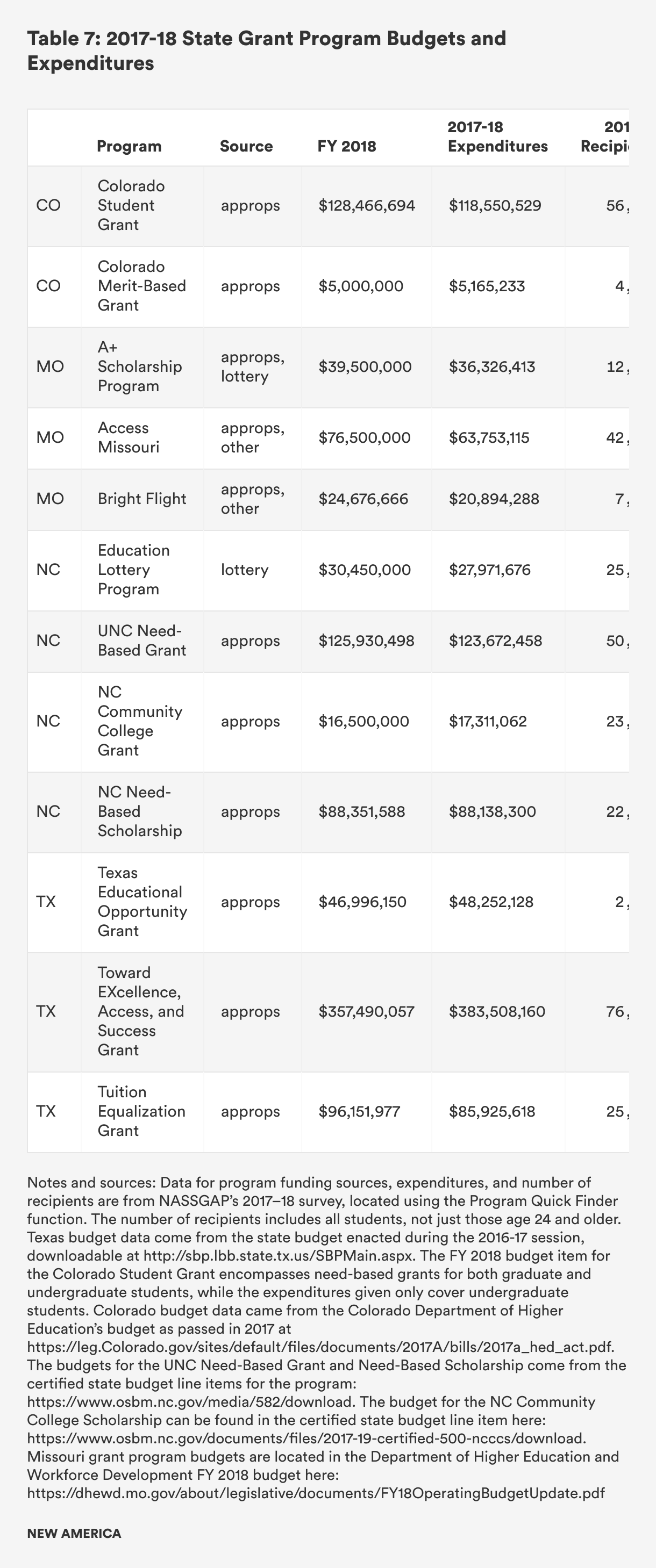
Citations
- Authors’ calculations using the 2020 National Postsecondary Student Aid Study, Undergraduate (NPSAS:UG).
- For example, Sarah Pingel and Neal Holly, Seeking Support: State Financial Aid Programs and Adult Students, Education Commission of the States, October 2017, https://www.ecs.org/seeking-support-state-financial-aid-programs-and-adult-students/; Wayne Taliaferro and Amy Ellen Duke-Benfield, Redesigning State Financial Aid to Better Serve Nontraditional Adult Students, Center for Law and Social Policy, September 2016, https://www.clasp.org/sites/default/files/public/resources-and-publications/publication-1/Redesigning-State-Financial-Aid-to-Better-Serve-Nontraditional-Adult-Students.pdf; Sarah Pingel, Brian A. Sponsler, and Neal Holly, Redesigning State Financial Aid: Principles to Guide State Aid Policymaking, Education Commission of the States, August 2018, https://www.ecs.org/wp-content/uploads/Redesigning-State-FInancial-Aid.pdf; Sandy Baum, Kristin Blagg, Leonardo Restrepo, and Fanny Terrones, Race, Ethnicity, and the Design of State Grant Aid Programs, Urban Institute, January 26, 2023, https://www.urban.org/research/publication/race-ethnicity-and-design-state-grant-aid-programs; Wesley Jenkins, College Students’ Siloed Safety Net, Urban Institute, May 13, 2020, https://www.urban.org/features/college-students-siloed-safety-net; and Lauren Walizer, State Strategies for Addressing College Students' Basic Needs, Center for Law and Social Policy, January 15, 2020, https://www.clasp.org/publications/report/brief/state-strategies-addressing-college-students-basic-needs/.
- See Tuan D. Nguyen, Jenna W. Kramer, and Brent J. Evans, "The Effects of Grant Aid on Student Persistence and Degree Attainment: A Systematic Review and Meta-Analysis of the Causal Evidence," Review of Educational Research 89, no. 6 (2019), https://doi.org/10.3102/0034654319877156; and Karen Bussey, Kimberly Dancy, Alyse Gray Parker, Eleanor Eckerson Peters, and Mamie Voight, Realizing the Mission of Higher Education Through Equitable Admissions Policies, (Washington, DC: Institute for Higher Education Policy, June 2021), https://www.ihep.org/wp-content/uploads/2021/06/IHEP_JOYCE_full_report_final_web_614.pdf.
- Jennifer Ma and Matea Pender, Trends in College Pricing and Student Aid 2022, College Board, https://research.collegeboard.org/media/pdf/trends-in-college-pricing-student-aid-2022.pdf. Federal financial aid also includes tax benefits, work study, veterans’ benefits, and Federal Supplemental Educational Opportunity Grants (FSEOG). In this paper, we use aid data from 2018, where possible, to match the NPSAS:18-AC data.
- National Association of State Student Grant and Aid Programs, 49th Annual Survey Report on State-Sponsored Student Financial Aid: 2017–2018 Academic Year, https://www.nassgapsurvey.com/survey_reports/2017-2018-49th.pdf.
- National Association of State Student Grant and Aid Programs.
- In addition, although not examined in this paper, families may have access to housing subsidies, mostly designed and distributed at the local level, and tax credits, such as the Earned Income Tax Credit (EITC) and Child Tax Credit (CTC), which are distributed at the federal level. (Some states and localities have established their own versions of the EITC to complement the federal credit, and a host of states have their own child or dependent-related tax credits.) See Amy Ellen Duke-Benfield, Bolstering Non-Traditional Student Success: A Comprehensive Student Aid System Using Financial Aid, Public Benefits, and Refundable Tax Credits, Center for Law and Social Policy, December 2015, https://www.clasp.org/sites/default/files/public/resources-and-publications/publication-1/Bolstering-NonTraditional-Student-Success.pdf.
- Congressional Research Service, The Temporary Assistance for Needy Families (TANF) Block Grant: A Primer on TANF Financing and Federal Requirements, August 14, 2023, https://crsreports.congress.gov/product/pdf/RL/RL32748 and Congressional Research Service, The Child Care and Development Block Grant: In Brief, November 18, 2022, https://crsreports.congress.gov/product/pdf/R/R47312.
- Congressional Research Service, Farm Bill Primer: SNAP and Nutrition Title Programs, November 18, 2022, https://crsreports.congress.gov/product/pdf/IF/IF12255 and Congressional Research Service, Medicaid: An Overview, February 8, 2023, https://crsreports.congress.gov/product/pdf/R/R43357.
- Congressional Research Service, Federal Financing for the State Children’s Health Insurance Program (CHIP), May 23, 2018, https://crsreports.congress.gov/product/pdf/R/R43949.
- Office of Federal Student Aid, “What is my Expected Family Contribution (EFC)?,” U.S. Department of Education, https://studentaid.gov/help-center/answers/article/what-is-efc; and Office of Federal Student Aid, “(GENERAL-22-91) Publication of the 2024-25 Draft Student Aid Index (SAI) and Pell Grant Eligibility Guide,” U.S. Department of Education, https://fsapartners.ed.gov/knowledge-center/library/electronic-announcements/2022-11-21/publication-2024-25-draft-student-aid-index-sai-and-pell-grant-eligibility-guide. FAFSA is the federal form that students have to complete to be considered for federal financial aid. The information students provide on FAFSA is used to determine a student’s EFC. States, as well as colleges and universities use the information from the form to determine eligibility for their own financial aid dollars. In the coming years, the student aid index (SAI) will replace the EFC.
- Fewer than 8 percent of students under 24 are parents in each state. And more than 85 percent of student parents are over the age of 24 across all states and sectors. Throughout the analysis, patterns did not change when we added in the younger student parents.
- Here and throughout this report, we use Hispanic instead of Latino/a/x to match the data source analyzed.
- The difference between older and younger students are likely due, at least in part, because all students over 24 are counted as independent, which means their EFCs are based upon their own resources, not those of parents or guardians. In addition, having dependents generally lowers your EFC to reflect the additional resources required to raise children or support others. Many students under age 24, on the other hand, are considered dependent, and as a result, their EFCs reflect a combination of their own and their parents’ resources. Older students without dependents may also have slightly higher median EFCs because they are not eligible to receive an automatic $0 EFC. Automatic $0 EFC is available to specific groups of students who have an income of $27,000 or less. Eligibility also depends on factors like receiving benefits from certain federal programs, specific tax filing conditions, and the student's dependency status. For more detail and a definition of independent and dependent students, see Office of Federal Student Aid, “The EFC Formula, 2022–2023,” U.S. Department of Education, August 2021, https://fsapartners.ed.gov/sites/default/files/2021-08/2223EFCFormulaGuide.pdf.
- See Naomi Harris, “How Popular Merit College Scholarships have Perpetuated Racial Inequities,” Washington Post, May 7, 2022, https://www.washingtonpost.com/education/2022/05/07/merit-scholarships-college-racial-inequities/ and Stephen Burd, Crisis Point: How Enrollment Management and the Merit-Aid Arms Race Are Derailing Public Higher Education (Washington, DC: New America, February 13, 2020), https://www.newamerica.org/education-policy/reports/crisis-point-how-enrollment-management-and-merit-aid-arms-race-are-destroying-public-higher-education/.
- We defined a major program as one in which the funding was at least $1 million and that was not limited by one area of study, like STEM or teaching, or to a highly specific population, like children of service members or law enforcement officers. Using these criteria we examined the requirements for the following programs, including the source of the funding, how much is spent, and the number of recipients.
- The Colorado Merit-Based Grant has not been funded since 2020.
- For example, see Iris Palmer, “Degrees Denied: Adults Left out of State Financial Aid Programs,” EdCentral (blog), New America, August 4, 2015, https://www.newamerica.org/education-policy/edcentral/adults-state-financial-aid/.
- See Taliaferro and Duke-Benfield, Redesigning State Financial Aid; and CampusLogic, Timing is Everything: FAFSA Filing Trends, 2019.
- Pingel, Sponsler, and Holly, Redesigning State Financial Aid.
- For complete program rules, see North Carolina State Education Assistance Authority, “Rules Governing the North Carolina Need-Based Scholarship for Public Colleges and Universities,” 2023, https://www.ncseaa.edu/wp-content/uploads/sites/1171/2023/04/Rules-Governing-the-North-Carolina-Need-Based-Scholarship-for-Public-Colleges-and-Universities-effective-4-3-2023-Signed-and-Sealed.pdf.
- Sandy Baum, Improving the Targeting, Predictability, and Simplicity of North Carolina’s State Grant Programs, NC Community Colleges and the University of North Carolina System, December 2018, https://www.northcarolina.edu/wp-content/uploads/reports-and-documents/strategy-and-policy/sasg_baum_policybrief_012919.pdf.
- College Foundation of North Carolina, “NC Scholarship,” 2023, https://www.cfnc.org/pay-for-college/apply-for-financial-aid/nc-scholarship/.
- Sandy Baum and Kristin Blagg, Strengthening Student Aid in Texas: Funding Students atDifferent Types of Institutions, Urban Institute, September 2021, https://www.urban.org/sites/default/files/publication/104841/strengthening-student-aid-in-texas-funding-students-at-different-types-of-institutions_0.pdf.
- Independent students are most often classified as such due to being married, having dependent children, or being 24 or older. For analysis of TEOG recipients, see Texas Higher Education Coordinating Board, Report on Student Financial Aid in Texas Higher Education: Fiscal Year 2018, 2019, https://reportcenter.highered.texas.gov/reports/data/report-on-student-financial-aid-in-texas-higher-education-for-fy-2018/.
- For a discussion of program eligibility requirements and implications for the adult learner, see Sandy Baum and Kristin Blagg, A Review of State Grant Aid in Texas, Urban Institute, 2021 https://www.urban.org/sites/default/files/publication/104281/a-review-of-state-grant-aid-in-texas_0.pdf.
- Office of Federal Student Aid, “Student Loan Delinquency and Default,” U.S. Department of Education, https://studentaid.gov/manage-loans/default. In addition to the other reasons mentioned in this section, if students are in default on a federal student loan, they are ineligible for federal aid.
- Office of Federal Student Aid, “What is the Lifetime Eligibility Used (LEU) for a Pell Grant?” U.S. Department of Education, https://studentaid.gov/help-center/answers/article/leu-for-pell-grant. Students may receive a total of the equivalent of six years of Pell Grant funding.
- Office of Federal Student Aid, “Staying Eligible,” U.S. Department of Education, https://studentaid.gov/understand-aid/eligibility/staying-eligible. Federal satisfactory academic progress rules require students to meet their institution's academic standards to maintain eligibility for federal financial aid. Variation exists, but most institutions require a minimum 2.0 GPA and completing 67 percent of credits attempted.
- See U.S. Government Accountability Office December, Food Insecurity: Better Information Could Help Eligible College Students Access Federal Food Assistance Benefits, December 2018, https://www.gao.gov/assets/gao-19-95.pdf; and Bryce McKibben, Jiayao Wu, and Sara Abelson, New Federal Data Confirm that College Students Face Significant—and Unacceptable—Basic Needs Insecurity, The Hope Center For College, Community, and Justice, August 2023, https://hope.temple.edu/npsas.
- Program criteria are from 2022–23 unless otherwise noted.
- U.S. Government Accountability Office December, Food Insecurity.
- Lindsay Daugherty, William R. Johnston, and Tiffany Berglund, Connecting College Students to Alternative Sources of Support: The Single Stop Community College Initiative and Postsecondary Outcomes (Santa Monica, CA: RAND Corporation, 2020), https://www.rand.org/pubs/research_reports/RR1740-1.html.
- Office of Federal Student Aid, “Use of FAFSA Data to Administer Federal Programs,” U.S. Department of Education, January 20, 2022, https://fsapartners.ed.gov/knowledge-center/library/dear-colleague-letters/2022-01-20/use-FAFSA-data-administer-federal-programs.
- Center on Budget and Policy Priorities, Policy Basics: The Supplemental Nutrition Assistance Program, June 2022, https://www.cbpp.org/research/food-assistance/the-supplemental-nutrition-assistance-program-snap.
- Office of the Assistant Secretary for Planning and Evaluation, HHS Poverty Guidelines for 2023, U.S. Department of Health and Human Services, https://aspe.hhs.gov/topics/poverty-economic-mobility/poverty-guidelines.
- Food and Nutrition Service, Broad-Based Categorical Eligibility, U.S. Department of Agriculture, July 2023, https://www.fns.usda.gov/snap/broad-based-categorical-eligibility and Center for Law and Social Policy, Broad-Based Categorical Eligibility (BBCE) is Not a SNAP Loophole, 2019, https://www.clasp.org/sites/default/files/publications/2019/08/2019_bbceisnotaloophole.pdf. Broad-based categorical eligibility is a policy where households can be considered eligible for SNAP because they qualify for some form of non-cash-based assistance from the TANF program.
- Center on Budget and Policy Priorities, Policy Basics: The Supplemental Nutrition Assistance Program.
- Center on Budget and Policy Priorities, Tracking the COVID-19 Economy’s Effects on Food, Housing, and Employment Hardships, October 2021, https://www.cbpp.org/research/poverty-and-inequality/tracking-the-covid-19-economys-effects-on-food-housing-and.
- In states that have expanded Medicaid coverage as part of the ACA, Medicaid may be easier to access, but not all of the states we consider here have done so.
- Carrie Welton and Darrel Thompson, SNAP and Students: Food Assistance Can Support College Success, Center for Law and Social Policy, December 2019, https://www.clasp.org/wp-content/uploads/2022/01/2019_snapandstudentsfoodassistance.pdf and Food and Nutrition Service (website), FAQ: “What are the Student Exemptions for SNAP?” U.S. Department of Agriculture, https://www.fns.usda.gov/snap/students.
- As a result of the 2023 Debt Ceiling Agreement the upper age limit is incrementally increasing to 54. Katie Bergh and Dottie Rosenbaum, Debt Ceiling Agreement’s SNAP Changes Would Increase Hunger and Poverty for Many Older Low-Income People; New Exemptions Would Help Some Others, Center on Budget and Policy Priorities, May 2023, https://www.cbpp.org/research/food-assistance/debt-ceiling-agreements-snap-changes-would-increase-hunger-and-poverty-for.
- Center on Budget and Policy Priorities, States Are Using Much-Needed Temporary Flexibility in SNAP to Respond to COVID-19 Challenges, January 25, 2023, https://www.cbpp.org/research/food-assistance/states-are-using-much-needed-temporary-flexibility-in-snap-to-respond-to and Food and Nutrition Service; “SNAP Student Provisions in the CAA 2021-Questions and Answers,” U.S. Department of Agriculture, February 2021, https://fns-prod.azureedge.us/sites/default/files/resource-files/SNAP%20Student%20Provisions%20in%20the%20CAA%202021_Questions%20and%20Answers.pdf.
- Dorothy Rosenbaum, Katie Bergh, and Lauren Hall, Temporary Pandemic SNAP Benefits Will End in Remaining 35 States in March 2023, Center on Budget and Policy Priorities, February 6, 2023, https://www.cbpp.org/sites/default/files/2-6-23fa.pdf.
- Center on Budget and Policy Priorities, Policy Basics: Temporary Assistance for Needy Families, March 2022, https://www.cbpp.org/research/family-income-support/temporary-assistance-for-needy-families.
- Center on Budget and Policy Priorities, Policy Basics: Temporary Assistance for Needy Families.
- Jenni Bergal, “States Raid Fund Meant for Needy Families to Pay for Other Programs,” Stateline, July 24, 2020, https://stateline.org/2020/07/24/states-raid-fund-meant-for-needy-families-to-pay-for-other-programs/.
- Center on Budget and Policy Priorities, Texas TANF Spending, March 2023, https://www.cbpp.org/sites/default/files/atoms/files/tanf_spending_tx.pdf.
- Center on Budget and Policy Priorities, Policy Basics: Temporary Assistance for Needy Families, March 2022.
- Randi Hall, Expanding Education and Training Opportunities Under TANF: A Path to Stable Employment in Today’s Economy, Center for Law and Social Policy, July 2016, https://www.clasp.org/wp-content/uploads/2022/04/07.201620Expanding20Education20and20Training20Opportunities20under20TANF.pdf.
- SNAP benefits can be provided on an electronic benefits transfer (EBT) card.
- Amy Ellen Duke-Benfield, Exploring How Public Benefits Can Help Support Postsecondary Students From Low-income Backgrounds, National Skills Coalition, Postsecondary Value Commission, 2021, https://postsecondaryvalue.org/wp-content/uploads/2021/10/PVC_DukeBenfield.pdf.
- Elizabeth Williams, Robin Rudowitz, and Alice Burns, Medicaid Financing: The Basics, KFF, April 2023, https://www.kff.org/medicaid/issue-brief/medicaid-financing-the-basics/.
- KFF, Status of State Medicaid Expansion Decisions: Interactive Map, July 2023, https://www.kff.org/medicaid/issue-brief/status-of-state-medicaid-expansion-decisions-interactive-map/.
- Congressional Research Service, Overview of Health insurance Exchanges, March 2023, https://sgp.fas.org/crs/misc/R44065.pdf. Under the ACA, subsidized coverage can be purchased through state or federally run health insurance exchanges that operate as a marketplace for individuals and small businesses.
- Jen Mishory, Olivia Chan, and Peter Granville, The ACA’s Impact on College Students, The Century Foundation, July 2020, https://tcf.org/content/report/the-acas-impact-on-college-students/.
- KFF, Medicaid in Texas, June 2023 https://files.kff.org/attachment/fact-sheet-medicaid-state-TX; KFF, Medicaid in Missouri, June 2023, https://files.kff.org/attachment/fact-sheet-medicaid-state-MO; KFF, Medicaid in North Carolina, June 2023, https://files.kff.org/attachment/fact-sheet-medicaid-state-NC; and KFF, Medicaid in Colorado, June 2023, https://files.kff.org/attachment/fact-sheet-medicaid-state-CO.
- Office of the Assistant Secretary for Planning and Evaluation, HHS Poverty Guidelines for 2023.
- Government Accountability Office, Child Care: Subsidy Eligibility and Receipt, and Wait Lists, February 2021, https://www.gao.gov/products/gao-21-245r.
- See Roselyn Miller and Jahdziah St. Julien, A Bold Policy Agenda for Work-Family Justice and Gender Equity During COVID-19 and Beyond (Washington, DC: New America, December 2020), https://www.newamerica.org/better-life-lab/reports/bold-policy-agenda-work-family-justice-and-gender-equity-during-covid-19-and-beyond/.
- Michael T. Nietzel, “The State of Washington's New Financial Aid Approach Hits the Sweet Spot,” Forbes, May 13, 2019, https://www.forbes.com/sites/michaeltnietzel/2019/05/13/the-state-of-washingtons-new-financial-aid-approach-hits-the-progressive-sweet-spot/?sh=1a98e99f360d.
- Ashley Burnside, Parker Gilkesson, and Patricia Baker, Connecting Community College Students to SNAP, Center for Law and Social Policy and Massachusetts Law Reform Institute, April 20, 2021, https://www.clasp.org/publications/report/brief/connecting-community-college-students-snap/.
- Dottie Rosenbaum, SNAP’s “Broad-Based Categorical Eligibility” Supports Working Families and Those Saving for the Future, Center on Budget and Policy Priorities, July 30, 2019,https://www.cbpp.org/research/food-assistance/snaps-broad-based-categorical-eligibility-supports-working-families-and.
- Center on Budget and Policy Priorities, Policy Basics: Temporary Assistance for Needy Families.
- Elizabeth Lower-Basch, Amy Ellen Duke-Benfield, and Lavanya Mohan, Ensuring Full Credit under TANF’s Work Participation Rate, Center for Law and Social Policy, March 2014, https://www.clasp.org/wp-content/uploads/2022/01/Ensuring-Full-Credit-Under-TANFs-Work-Participation-Rate.pdf.
- Complete 2 Compete, “Finish your degree. C2C can help,” https://msc2c.org/; Next Level Jobs, Indiana, https://nextleveljobs.org/; and Tennessee Reconnect, https://tnreconnect.gov/.
- Examples include work being done by Code for America in partnership with states like Minnesota. See Code for America, Integrated Benefits Applications: Making it Easier for People and Families to Access all Their Benefits in One Place, https://codeforamerica.org/programs/social-safety-net/integrated-benefits/ and Code for America, The Benefits Enrollment Field Guide: What the Online Enrollment Experience for Safety Net Benefits Looks Like Across America, https://codeforamerica.org/programs/social-safety-net/benefits-enrollment-field-guide/.
- Betty Marquez Rosales, “California Colleges Now Have Centers to Help Students with Basic Needs Like Food and Housing’” EdSource, August 11, 2022, https://edsource.org/2022/california-colleges-now-have-centers-to-help-students-with-basic-needs-like-food-and-housing/676568?amp=1 and Chris Geary, “What Can Community Colleges do to Help Students Afford Higher Education?,” New America, June 1, 2022, https://www.newamerica.org/education-policy/edcentral/community-colleges-help-students-afford-higher-education/.
- Iowa Department of Education, “Pathways for Academic Career and Employment (PACE),” https://educateiowa.gov/adult-career-comm-college/community-colleges/pathways-academic-career-and-employment-pace.
- Introduction and Overview
- Methodology and Overview of State Aid and Public Benefits Programs
- Where These Students Enroll, How They Enroll, and How Much Financial Aid They Need
- State Higher Education Funding and Financial Aid Program Design
- Financial Aid: Program Implementation
- Public Benefits: Program Design and Funding
- How Each State Uses Safety Net Programs to Supports Students
- Recommendations
- Appendix A: Methodology
- Appendix B: State Grant Program Budgets and Expenditures
More About the Authors

Ivy Love
Senior Policy Analyst, Center on Education & Labor

Edward Conroy
Senior Policy Manager, Education Policy Program

Iris Palmer
Director, Community Colleges

Sarah Sattelmeyer
Director of Education, Opportunity, and Mobility
Issues
Programs/Projects/Initiatives
Related



Supports for Student Parents Must Extend Beyond On-Campus Child Care